
Rome City Zoning Code
ARTICLE XIII
- DEVELOPMENT STANDARDS
Sec. 80-13.1. - General development requirements.
(a)
All activities within an enclosed structure. Within all districts, all activities must be conducted entirely within an enclosed structure, with the exception of the following uses and activities:
i.
Agriculture.
ii.
Parking lots, principal and ancillary, and park and ride lots.
iii.
Parks, conservation areas, and similar open space uses.
iv.
Outdoor dining.
v.
Permitted outdoor storage, and outdoor sales and display areas.
vi.
Permitted outdoor temporary uses (section 80-12.4).
vii.
Establishments with an integral outdoor component, including, but not limited to, outdoor amusement facilities, outdoor storage yards, heavy retail, rental, and service, outdoor storage yards, salvage yards, outdoor dining, car washes, animal care facilities including kennels, light and heavy industrial, and similar non-residential uses. Where there is a need to determine whether a use has an integral outdoor component, the codes enforcement officer will make such interpretation.
(b)
Applicability of dimensional requirements. All structures must meet the dimensional requirements of the zoning district in which the structure is located. No existing structure may be enlarged, altered, reconstructed, or relocated in such a manner that conflicts with the requirements of the district in which the structure it is located unless a variance is approved. When more than one principal building is permitted on a lot, all structures must comply with the dimensional standards of the district.
(Ord. No. 9301A, 9-26-18)
Sec. 80-13.2. - Accessory structures and uses.
All accessory structures and uses are subject to the requirements of this section and the permitted encroachment requirements of section 80-13.3. Additional accessory structures not regulated in this section may be regulated in section 80-13.3.
(a)
General regulations for accessory structures All accessory structures are subject to the following regulations, in addition to any other specific regulations within this code.
i.
No accessory structure may be constructed prior to construction of the principal building to which it is accessory.
ii.
A zoning permit and a building permit is required for the construction of an accessory structure, unless specifically exempted by this code or other local or state codes.
iii.
Only those accessory structures permitted by this section and section 80-13.3 are permitted in required setbacks. Certain accessory structures may also be prohibited in certain yards. Required setbacks are stated in the district standards. The use of the term "yard" refers to the area between the applicable building line and applicable lot line. The distinction is made because certain principal buildings may not be built at required district setback lines, thereby creating a yard larger than the minimum setback dimension. If a structure is permitted within a yard, it is permitted within the required setback subject to any additional limitations. Where there is no structure to determine yard location, yards are the same as the minimum district setbacks.
iv.
The maximum height of any detached accessory structure is 15 feet and one and one-half stories, unless otherwise permitted or restricted by this code. In no case may an accessory structure exceed the height of the principal structure. These height limitations do not apply to agricultural accessory structures for a lot in agricultural use such as barns and silos.
v.
Accessory structures are included and must comply with all maximum lot coverage requirements and maximum impervious surface coverage.
vi.
The footprint of a detached accessory structure cannot exceed the footprint of the principal building, which is measured as the square footage of the building footprint that is roofed. This limitation does not apply to agricultural accessory structures for a lot in agricultural use such as barns and silos.
vii.
Accessory structures, including those listed in this section and section 80-13.3, must be at least three feet from any lot line, unless otherwise permitted or restricted by this code. This does not apply to fences. Such measurement is taken from any eave overhang. No accessory structures are permitted in the front setback or front yard unless specifically permitted by this code.
(b)
Amateur (HAM) radio equipment.
i.
Towers that solely support amateur (HAM) radio equipment and conform to all applicable performance criteria as set forth in section 80-13.4 are permitted only in the rear yard, and must be located ten feet from any lot line and any principal building. Towers are limited to the maximum building height of the applicable district plus an additional ten feet, unless a taller tower is technically necessary to engage successfully in amateur radio communications and a special use approval is obtained.
ii.
Antennas may also be building-mounted and are limited to a maximum height of ten feet above the structure, unless a taller antenna is technically necessary to engage successfully in amateur radio communications and special use approval is obtained.
iii.
Every effort must be made to install towers or antennas in locations that are not readily visible from adjacent lots or from the public right-of-way, excluding alleys.
iv.
An antenna or tower that is proposed to exceed the height limitations is a special use. The operator must provide evidence that a taller tower and/or antenna is technically necessary to engage successfully in amateur radio communications. In addition, the applicant must provide evidence that the tower and/or antenna will not prove a hazard and that it conforms to all applicable performance criteria of section 80-13.4. As part of the application, the applicant must submit a site plan showing the proposed location of the tower or antenna, as well as its relation to the principal building and accessory structures.
v.
Any such antennas and/or towers owned and operated by the city are exempt from these requirements.
(c)
Apiary. Apiaries facilities are not considered an accessory use on lots that are in use for agriculture as a principal use, but rather part of the agricultural use.
i.
Apiaries are permitted only in the rear yard and must be located ten feet from any lot line and the principal building.
ii.
All bee colonies must be kept in a removable frame hive, which must be kept in sound and usable condition.
iii.
Where any colony is located within 25 feet of a lot line, as measured from the nearest point of the hive to the lot line, the beekeeper must establish and maintain a flyway barrier at least six feet in height consisting of a hedge, fence, solid wall, or combination that is parallel to the lot line and extends ten feet beyond the colony in each direction so that bees are forced to fly at an elevation of at least six feet above ground level over adjacent lots in the vicinity of the apiary.
iv.
Each beekeeper must provide a convenient source of water available to the bees at all times.
v.
In any instance in which a colony exhibits unusual aggressive characteristics by stinging or attempting to sting without due provocation or exhibits an unusual disposition toward swarming, the beekeeper must promptly re-queen the colony.
vi.
Apiaries do not require a building permit.
(d)
Aquaculture/aquaponics. Aquaculture/aquaponics facilities are not considered an accessory use on lots that are in use for agriculture as a principal use, but rather part of the agricultural use.
i.
Aquaculture/aquaponics facilities are permitted only in the rear yard and must be located ten feet from any lot line.
ii.
All aquaculture/aquaponics operations must be located within partially or fully enclosed structures designed for holding and rearing fish, and contain adequate space and shade.
iii.
Aquaculture/aquaponics facilities do not require a building permit.
(e)
Book exchange box.
i.
Book exchange boxes are allowed in the residential districts.
ii.
Boxes are limited to a maximum height of six feet measured to the highest point on the structure, and a maximum width and depth of three feet.
iii.
Boxes are permitted only in the front or side corner setback and must be located a minimum of three feet from any lot line.
iv.
Boxes are prohibited in the public right-of-way. Boxes cannot be constructed or installed in a manner that obstructs a sight triangle.
v.
Permanent foundations for the boxes are prohibited. Temporary foundations comprised of concrete, masonry pavers, or other similar movable materials are allowed.
vi.
Each box must be designed and constructed in such a manner that books are protected from the elements. All books must be fully contained within a weatherproof enclosure that is integral with the structure that comprises the book exchange box.
vii.
Book exchange boxes do not require a building permit.
(f)
Chicken coops. Chicken coops are not considered an accessory use on lots that are in use for agriculture as a principal use, but rather part of the agricultural use.
i.
Chicken coops are permitted in the rear yard only.
ii.
No hens may be kept or raised within a dwelling.
iii.
Up to a maximum of eight hens may be kept on any lot. The owner of the hens must be a resident of the dwelling on the lot.
iv.
Roosters are prohibited. However, if the sex of a chick cannot be determined at hatching, a chick of either sex may be kept on the property for up to six months.
v.
With the exception of the R-R district, all hens must be provided with both a chicken coop and a fenced outdoor enclosure, subject to the following provisions. In the R-R district, hens are allowed to free roam on the property.
a.
The chicken coop must provide a minimum of four square feet per hen.
b.
The chicken coop and fenced enclosure must be kept in good repair, maintained in a clean and sanitary condition, and free of vermin, obnoxious smells, and substances. The facility must be adequately lit and ventilated.
c.
The chicken coop must be designed to ensure the health and well-being of the hens, including protection from predators, the elements, and inclement weather.
d.
The chicken coop must be located upon an impermeable surface that prevents waste run-off.
vi.
Any manure that is composted must be kept in enclosed bins.
vii.
Slaughtering of chickens on-site is prohibited.
(g)
Collective alternative energy system.
i.
A collective alternative energy system, such as solar, wind, or geothermal, is permitted to be shared by property owners or a neighborhood organization, homeowners association, or institutional use.
ii.
Properties may share an alternative energy system, including permission to install equipment along all properties. All owners must agree to such arrangement, and an agreement must be recorded as a "collective alternative energy easement" on each plat of survey and access is granted to all participants to maintain equipment. A management plan must be submitted and servitude recorded.
iii.
Collective alternative energy systems must be built in accordance with accessory use standards for the particular type of energy system used, as described in this section or in other ordinances of the city, and any other applicable regulations.
(h)
Donation box.
i.
Donation boxes are permitted in the C-1, C-2, C-3, I-G, and I districts.
ii.
Only one donation box is permitted per lot.
iii.
No donation box may be located in the front yard. Donation boxes may be located in the corner side, interior side or rear yard but must be three feet from any property line. No donation box may be located within a required parking space.
iv.
The area surrounding the donation box must be kept free of any junk, debris or other material.
v.
Donation boxes must be maintained in good condition and appearance with no structural damage, holes, or visible rust, and free of graffiti.
vi.
Donation boxes must be locked or otherwise secured.
vii.
Donation boxes must contain the following contact information on the front of each donation box: the name, address, email, and phone number of the operator.
viii.
Donation boxes must be serviced and emptied as needed, but at a minimum of every 15 days.
ix.
Donation boxes cannot exceed six feet in height and 60 cubic feet.
(i)
Electric vehicle charging station.
i.
Commercial electric vehicle charging stations are permitted as an accessory use within any parking lot, parking structure, or gas station in all districts.
ii.
Private charging stations are permitted as an accessory use to all multi-family dwellings to serve the residents of that property.
iii.
Electric charging station equipment may not block the public right-of-way.
iv.
Each public charging station space must be posted with a sign indicating the space is only for electric vehicle charging purposes. Days and hour of operations must be included if time limits of tow away provisions are enforced by the owner. Information identifying voltage and amperage levels or safety information must be posted.
v.
Charging station equipment must be maintained in good condition and all equipment must be functional. Charging stations no longer in use must be immediately removed.
(j)
Exterior lighting.
i.
Maximum lighting regulations.
a.
The maximum allowable footcandle at any lot line is one footcandle.
b.
When additional security lighting is required for security reasons in excess of the footcandle limit imposed by item a., above, additional lighting may be allowed based on evidence for the need for additional security through site plan review.
c.
No glare onto adjacent properties is permitted.
iii.
Luminaire with cut off standards.
a.
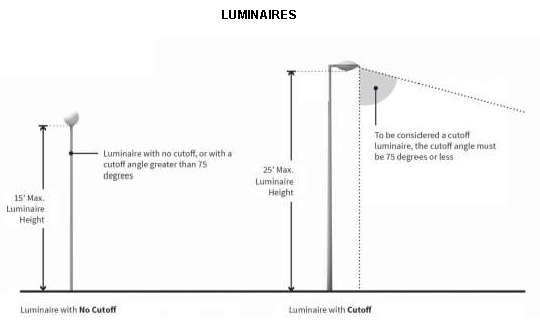
To be considered a cut off luminaire, the cut off angle must be 75 degrees or less.
b.
The maximum total height of a cut off luminaire, either freestanding or attached to a structure, is 25 feet. Any luminaire greater than 25 feet in total height requires special use approval.
c.
A cut off luminaire must be designed to completely shield the light source from an observer three and one-half feet above the ground at any point along an abutting lot line.
iv.
Luminaire with no cut off standards.
a.
A luminaire is considered to have no cut off if it is unshielded or has a cut off angle greater than 75 degrees.
b.
The maximum permitted total height of a luminaire with no cut off is 15 feet. Any luminaire greater than 15 feet in total height requires special use approval.
v.
Exceptions to lighting standards.
a.
Luminaires used for public roadway illumination are exempt from the requirements of this section.
b.
All temporary emergency lighting required by public safety agencies, other emergency services, or construction are exempt from the requirements of this section.
c.
Because of their unique requirements for nighttime visibility and limited hours of operation, outdoor recreational facilities (public or private) such as, but not limited to, football fields, soccer fields, baseball fields, softball fields, tennis courts, golf driving ranges, show areas, and other similar uses are exempt from the requirements of this section. Recreational facilities are permitted a total luminaire height of 60 feet in any district. Luminaires greater than 60 feet in total height require special use approval.
d.
Certain temporary uses may be unable to meet the requirements of this section. When such temporary uses are allowed, approval of all lighting is required as part of the temporary use permit.
vi.
Prohibited lighting.
a.
Flickering or flashing lights are prohibited.
b.
Searchlights, floodlights, laser source lights, or any similar high intensity lights are prohibited.
(k)
Fences.
i.
General requirements.
a.
Barbed wire, electrical current, or charge of electricity fences are prohibited except for the following:
(1)
Uses that include the containment of animals, or for the protection of property from animals, barbed wire or electrical current may be used.
(2)
Prisons, jails, and other detention facilities may use barbed wire or electrical current.
(3)
Outdoor salvage yards and junkyards.
(4)
In all commercial and industrial districts, barbed wire is permitted. The barbed wire must be located no less than six feet above grade.
(5)
Fences containing barbed wire may be constructed surrounding city utility facilities, wireless communication facilities, utility substations, and natural gas facilities. The barbed wire must be located no less than six feet above grade.
b.
Broken glass, scrap metal, or similar hazardous materials cannot be used for fencing.
c.
Every fence and wall must be maintained in a good repair and safe condition at all times. Every damaged or missing element must be repaired, removed, or replaced immediately.
d.
Height is measured from the adjacent ground to the highest point, except that decorative posts of a fence or wall may exceed the maximum height by six inches.
e.
When fence requirements are a condition of a use or site element in this code or other ordinances, such requirements control. When additional fence requirements are found in the use standards of article IX or the landscape standards of article XII, such requirements control.
f.
A fence or wall, including all posts, bases, and other structural parts must be located completely within the boundaries of the lot on which it is located.
ii.
Fence height.
a.
Residential districts. Fences are permitted in all yards and are subject to the following maximum heights, unless any state or local code, or a specific regulation of this zoning code, requires a taller height.
(1)
Interior lot—Front yard: 42 inches.
(2)
Interior lot—Interior side yard: 72 inches.
(3)
Corner lot—Front and corner side yard: 42 inches in height within the required front setback then 72 inches in height for the remainder of the front and corner side yards.
(4)
All lots—Rear yard: 72 inches.
(5)
Through lots: A 72-inch fence may be allowed in one of the front yards by the codes enforcement officer, provided the following conditions are met:
(A)
The fence will be located in the yard on the rear facade of the structure.
(B)
There is no street access from the end of the lot where the fence will be located.
(C)
The addition of the fence will not be detrimental to the neighborhood in terms of view, light, and air, nor impair traffic safety.
(D)
The fence will not appear obtrusive when compared to the rest of the blockface where it will be placed.
b.
Commercial and industrial districts. Fences are permitted in all yards and are subject to the following maximum heights:
(1)
Interior lot—Front yard:
(A)
I-G district: Ten feet.
(B)
All other districts: 42 inches.
(2)
Interior lot—Interior side yard: No limit.
(3)
Corner lot—Front and corner side yard: 42 inches in height within the required front setback then 72 inches in height for the remainder of the front and corner side yards.
(4)
All lots—Rear yard: No limit.
c.
Fence height for public recreation areas. Public recreation areas may be enclosed along their boundaries (i.e., all yards) with an open fence to a height not to exceed eight feet. Tennis courts and other similar uses may be fenced in accordance with national standards for such uses.
d.
Energy facilities. Fencing for energy facilities such as substations, switching stations, and natural gas gate stations, and for city utility facilities must satisfy fence height restrictions for industrial districts or, in lieu thereof, the utility may submit an alternative plan for review and approval by the codes enforcement officer.
(l)
Flat roof features. Accessory rooftop features of a flat roof, such as green roofs, rooftop decks, rooftop gardens, and stormwater detention systems are permitted below the parapet of any flat roof building, and are excluded from the calculation of maximum building height. Flat roof features must meet the following standards:
i.
For green roofs, rooftop gardens, and similar features, documentation must be submitted demonstrating that the roof can support the additional load of plants, soil, and retained water. For green roofs, this must also indicate an adequate soil depth will be provided for plants to survive.
ii.
Rooftop decks or patios must have a guardrail that is a minimum of three feet and a maximum of four feet in height as measured from the surface of the roof deck or patio. Chainlink fencing is prohibited as a guardrail material.
iii.
The roof must contain sufficient space for future installations, such as mechanical equipment.
(m)
Garage (detached).
i.
One detached garage is permitted per lot, except in the AG district where more than one detached garage is permitted.
ii.
Detached garage are permitted a maximum height of 25 feet.
iii.
Unless allowed as an accessory dwelling unit per the standards of article XII, the area above the vehicle parking spaces in a detached garage may not contain a kitchen or sleeping area but may contain an office or recreation room.
iv.
Detached garages are permitted only in the rear, interior side, and corner side yards. A three-foot setback is required unless the lot line abuts a public right-of-way, in which case no setback is required.
(n)
Home occupations.
i.
Purpose. Accessory home occupations are activities accessory to uses in the household living category. Home occupations have special regulations to ensure that they will not be a detriment to the character and livability of the surrounding neighborhood. The regulations ensure that the accessory home occupation remains subordinate to the residential use, and that the residential viability of the dwelling is maintained. The regulations recognize that many types of jobs can be done in a home with little or no effect on the surrounding neighborhood.
ii.
Type A and type B home occupations. There are two types of home occupations, type A and type B, defined as follows:
a.
Type A. A type A home occupation is one where the residents use their home as a place of work, where no employees or customers come to the site. Examples include, but are not limited to, artists, crafts people, and writers. Type A home occupations also provide an opportunity for a home to be used as a business address but not as a place of work.
b.
Type B. A type B home occupation is one where the residents use their home as a place of work, and either one employee or customers come to the site consistent with the regulations of this section. Examples include, but are not limited to, counseling, tutoring, legal, medical, accounting, and hair cutting and styling.
iii.
Permitted districts. Type A and type B home occupations are allowed as follows:
a.
Only type A home occupations are allowed in the R-1 district. Type B home occupations are prohibited in the R-1 district.
b.
Type A or type B home occupations are allowed in dwellings in all other districts.
iv.
Types of home occupations.
a.
The intent of these regulations is to establish performance standards for all home occupations rather than to limit the allowed uses to a specific list. Uses that comply with the standards of this section are allowed by-right unless specifically prohibited in item b below.
b.
The following uses are prohibited:
(1)
Any type of repair or assembly of vehicles or equipment with internal combustion engines, such as autos, motorcycles, scooters, snowmobiles, outboard marine engines, lawn mowers, chain saws, and other small engines, or of large appliances, such as washing machines, dryers, and refrigerators, or any other work related to automobiles and their parts is prohibited.
(2)
Accessory home occupations may not serve as headquarters or dispatch centers where employees come to the site and are dispatched to other locations.
v.
Home occupation regulations. The following apply to all home occupations:
a.
Outdoor Activities.
(1)
All activities must be in completely enclosed structures.
(2)
Exterior storage or display of goods or equipment is prohibited.
b.
Appearance of structure and site. The dwelling and site must remain residential in appearance and characteristics. Internal or external changes that make the dwelling appear less residential in nature or function are prohibited. Examples of such prohibited alterations include construction of parking lots, paving of required setbacks, or adding commercial-like exterior lighting.
c.
Signs. One sign of a maximum of six square feet is allowed on the property and may be attached to the exterior or placed in the window of the residence or accessory structure, or placed within the front setback, mounted on an architectural post not to exceed four feet in height, or a monument sign not to exceed four feet above grade in the front setback. No sign may interfere with vision clearance on adjoining public rights-of-way.
d.
Hazardous substances. Hazardous substances are prohibited, except at the consumer commodity level.
e.
Noise. The maximum noise level for a home occupation is 50 dba. Noise level measurements are taken at the property line. Home occupations that propose to use power tools must document in advance that the home occupation will meet the 50 dba standard.
f.
Vehicles. No more than one vehicle may be used in association with the home occupation. The maximum size of vehicle used in association with the home occupation is a light truck.
g.
Deliveries. Truck deliveries or pick-ups of supplies or products associated with the home occupation are allowed at the home only between 8:00 a.m. and 5:00 p.m. Vehicles used for delivery and pickup may not include heavy trucks.
vi.
Additional regulations for type B home occupation. The following additional regulations apply to type B home occupations:
a.
Hours. Customers may visit the site only during the hours of 7:00 a.m. to 9:00 p.m.
b.
Nonresident employees. One nonresident employee is allowed in a type B home occupation provided no customers come to the site at any time. Home occupations that have customers coming to the site at any time may not have nonresident employees. For the purpose of this section, the term "one nonresident employee" includes an employee, business partner, co-owner, or other person affiliated with the home occupation. The term "one nonresident employee" does not allow employee shifts, with each shift staffed by a different employee, even when only one nonresident employee is at the site at any one time. Variances to this section are prohibited.
c.
Customers. Only five customers or clients may visit the site in a day.
d.
Retail sales. Retail sales of goods must be entirely accessory to any services provided on the site, such as hair care products sold as an accessory to hair cutting.
e.
Number of type B home occupations. More than one type B home occupation per dwelling unit is prohibited.
(o)
Livestock enclosure. Keeping of livestock are not considered an accessory use on lots that are in use for agriculture as a principal use, but rather part of the agricultural use. Chicken coops, apiaries, and aquaponic/aquaculture facilities are regulated separately. These standards do not apply to livestock kept as part of a public safety facility, such as horses for mounted police.
i.
Keeping of livestock within the required livestock enclosures is permitted as an accessory use only in the AG and R-R districts.
ii.
A minimum lot size of one acre is required to keep livestock.
iii.
Livestock enclosures are prohibited in the front or corner side yard.
iv.
Livestock enclosures must be located 50 feet from any lot line.
v.
The maximum number of livestock permitted on a lot is calculated according to the following standards. These standards will be used as the basis by the codes enforcement officer for establishing a standard for any animal not included in the table. Lots of 20 or more acres are not subject to a minimum lot area per animal. The standards are cumulative requirements; for example, in order to keep one horse and one cow, a minimum of two acres of lot area is required are needed. However, in any case, a minimum lot area of one acre is required to keep any livestock.
a.
Equines, llamas, and alpacas: One acre for first animal + 10,000 square feet for each additional animal.
b.
Cattle: One acre for first bull/cow + 10,000 square feet for each additional animal.
c.
Goat or sheep: 10,000 square feet per animal.
d.
Pigs: 5,000 square feet per animal.
e.
Rabbit: 100 square feet per animal.
f.
Duck or other fowl (excluding chickens): 100 square feet per duck/fowl.
vi.
In addition, in order to maintain livestock, a certain square footage of the lot must be maintained as open space and dedicated to the livestock, in accordance with the following standards. These standards will be used as the basis by the codes enforcement officer for establishing a standard for any animal not included in the table. Lots of 20 or more acres are not subject to this standard. The standards are cumulative; for example, in order to keep one horse and one cow, 50,000 square feet of open space dedicated to the livestock is needed. These standards are not used to determine lot area but rather to determine how much area on a lot must be maintained as open space for the livestock's use.
a.
Equines, llamas, and alpacas: 25,000 square feet for first horse + 12,250 square feet for each additional animal.
b.
Cattle: 25,000 square feet for first horse + 12,250 square feet for each additional animal.
c.
Goat or sheep: 5,000 square feet per animal.
d.
Pigs: 2,500 square feet per animal.
e.
Rabbit: Not applicable.
f.
Duck or other fowl (excluding chickens): Not applicable.
vii.
All enclosures must be designed to ensure the health and well-being of the animals, including protection from predators, the elements, and inclement weather.
viii.
All livestock must be kept to prevent any adverse impact, including but not limited to odor, noise, drainage, or pest infestation, on any other property.
ix.
The following activities are permitted as part of the operation of a horse stable:
a.
Riding lessons.
b.
Boarding horses.
c.
Renting horses for recreational riding.
d.
Therapeutic riding.
(p)
Mechanical equipment. Mechanical equipment includes heating, ventilation, and air conditioning (HVAC) equipment, electrical generators, and similar equipment.
i.
Ground-mounted equipment.
a.
Mechanical equipment is prohibited in the front yard. If mechanical equipment is located in the front yard as of the effective date of this code, the equipment may remain and may be repaired and maintained unless it is replaced in its entirety or the principal structure is demolished.
b.
Mechanical equipment is permitted only in the interior side, corner side, or rear yard.
c.
Mechanical equipment is prohibited in the front yard. If mechanical equipment is located in the front yard as of the effective date of this ordinance, the equipment may remain and may be repaired and maintained unless it is replaced in its entirety or the principal structure is demolished.
d.
For multi-family and non-residential uses, ground-mounted mechanical equipment must be screened from view by a decorative wall or solid fence that is compatible with the architecture and landscaping of a development site. The wall or fence must be of a height equal to or greater than the height of the mechanical equipment being screened.
e.
For single-family, two-family and attached single-family dwellings, ground-based mechanical equipment must completely screened if visible from the public right-of-way, excluding alleys. Screening materials may be masonry, wood, landscape, or other opaque material, and must effectively screen mechanical equipment so no portion is visible from a street.
ii.
Roof-mounted equipment.
a.
For structures four or more stories in height, all roof equipment must be set back from the edge of the roof a minimum distance of one foot for every two feet by which the equipment extends above the roof.
b.
For structures less than four stories in height and for any building where roof equipment cannot meet the setback requirement of item a above, there must be either a parapet wall to screen the equipment from view, as viewed from the sidewalk from across the street, or the equipment must be housed in solid building material that is architecturally integrated with the structure.
iii.
Wall-mounted equipment.
a.
Wall-mounted mechanical equipment is not permitted on the front façade of the building or any façade of the building visible from a public street. This does not apply to window air conditioning units.
b.
For multi-family and non-residential uses, wall-mounted mechanical equipment that protrudes more than 12 inches from the outer building wall must be screened from view by structural features that are compatible with the architecture of the subject building. This does not apply to window air conditioning units.
c.
Wall-mounted mechanical equipment that protrudes less than 12 inches must be designed to blend with the primary color and architectural design of the subject building. This does not apply to window air conditioning units.
(q)
Outdoor sales and display.
i.
Retail goods establishments and vehicle dealerships are permitted to have accessory outdoor sales and display of merchandise. Where there is a need to determine whether a different use requires accessory outdoor sales and display, the codes enforcement officer will make such interpretation.
ii.
Outdoor sales and display of goods not offered for sale by the establishment is prohibited.
iii.
Any outdoor display must be located on the same lot as the principal use. No outdoor display is permitted in the public right-of-way.
iv.
No required parking area may be used as outdoor display.
(r)
Outdoor storage.
i.
The following uses are permitted outdoor storage: greenhouse/nursery-retail, including the growing of plants in the open, heavy retail, rental, and service, vehicle dealerships, vehicle rentals, vehicle operations facility, vehicle repair/service, minor or major, and light and general industrial. Where there is a need to determine whether a different use requires accessory outdoor storage, the codes enforcement officer will make such interpretation.
ii.
No outdoor storage is permitted in any public right-of-way or located so that it obstructs pedestrian or vehicular traffic. Outdoor storage is prohibited in a required setback.
iii.
All manufacturing, assembly, repair, or work activity must take place inside an enclosed building. This does not apply to heavy industrial uses that are typically conducted outdoors or have an outdoor component.
iv.
No required parking area may be used as an outdoor storage.
v.
A building permit is required only for storage structures with a permanent foundation.
(s)
Refuse and recycling containers.
i.
Refuse and recycling container regulations apply only to multi-family dwellings and non-residential uses.
ii.
Refuse and recycling containers are prohibited in the front yard. No dumpsters may be located on any public right-of-way, including alleys.
iii.
All refuse and recycling containers must be fully enclosed on three sides by a solid fence, wall, or wall extension of the principal building a minimum of six feet and a maximum of eight feet in height. The enclosure must be gated. Such gate must be solid. Such construction requires a building permit. This requirement does not apply to refuse containers located in an alley.
iv.
Dumpsters must not be located so that the disposal area drains toward a storm drain or off-site. Dumpsters must be covered and are not allowed to drain freely.
(t)
Satellite dish antennas.
i.
General requirements.
a.
Small satellite dish antennas do not require a building permit. Large satellite dish antennas require a building permit.
b.
Satellite dish antennas must be permanently installed on a building, in the ground, or on a foundation, and cannot be mounted on a portable or movable structure.
c.
Subject to operational requirements, the dish color must be of a neutral color, such as white or grey. No additional signs or advertising is permitted on the satellite dish itself, aside from the logos of the satellite dish service provider and/or dish manufacturer.
d.
Compliance with all federal, state, and local regulations is required in the construction, installation, and operation of satellite dish antennas.
e.
All exposed surfaces of the antenna must be kept clean and all supports must be painted to maintain a well-kept appearance.
f.
Antennas no longer in use must be immediately removed.
ii.
Small satellite dish antennas. Small satellite dish antennas, which are one meter (3.28 feet) or less in diameter, are subject to the general requirements above.
iii.
Large satellite dish antennas. Large satellite dish antennas, which are greater than one meter (3.28 feet) in diameter, are subject to the general requirements above as well as the following requirements:
a.
Residential districts.
(1)
Large satellite dish antennas, which are greater than one meter (3.28 feet) in diameter, are permitted only in the rear yard, and must be set back a distance from all lot lines that is at least equal to the height of the dish, but in no case less than five feet from any lot line.
(2)
The overall height of a large satellite dish antenna cannot exceed 12 feet.
(3)
A large satellite dish antenna must be located and screened so that it cannot be readily seen from public rights-of-way or adjacent properties. Screening includes solid fences, plant materials, and/or earth berms located to conceal the antenna and its support structure. Plants must be, a minimum of five feet tall at the time of installation.
b.
Non-residential districts.
(1)
Large satellite dish antenna are permitted only in the rear or interior side yard, and must be set back a distance from all lot lines that is at least equal to the height of the dish, but in no case less than five feet from any lot line.
(2)
Roof-mounting is permitted only if the satellite dish antenna is screened by an architectural feature.
(3)
A large satellite dish antenna must be located and screened so that it cannot be readily seen from public rights-of-way or adjacent properties. Screening includes solid fences, plant materials, and/or earth berms located to conceal the antenna and its support structure. Plants must be a minimum of five feet tall at the time of installation.
(u)
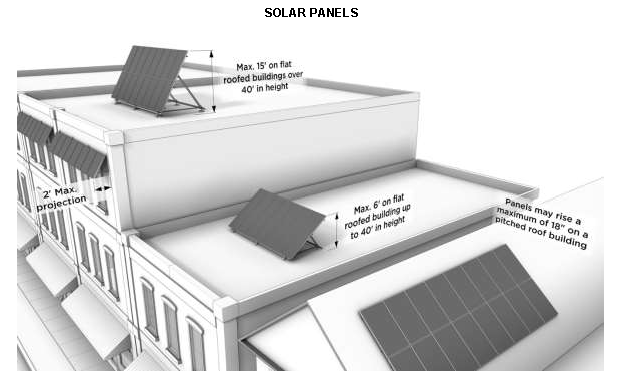
Solar energy systems. See section 80-19.11.
(v)
Wind energy systems—Private.
i.
Wind turbines may be designed as either vertical or horizontal axis turbines with or without exposed blades, including designs that combine elements of the different types of turbines.
ii.
Wind turbines are subject to the following height restrictions:
a.
The maximum height of any ground-mounted wind turbine is the maximum height allowed in the district. A taller height may be allowed by special use.
b.
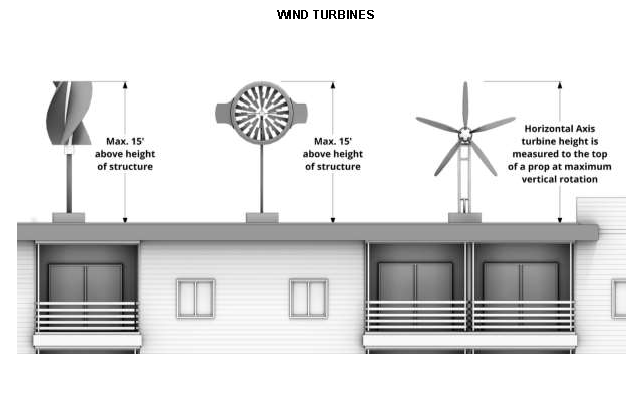
The maximum height of any wind turbine mounted upon a structure is 15 feet above the height of such structure.
c.
Maximum height is the total height of the turbine system, including the tower and the maximum vertical height of the turbine blades. Maximum height therefore is calculated measuring the length of a prop at maximum vertical rotation to the base of the tower. The maximum height of any ground-mounted wind turbine is measured from grade to the length of a prop at maximum vertical rotation.
d.
No portion of exposed turbine blades (vertical access wind turbine) may be within 20 feet of the ground. Unexposed turbine blades (horizontal access wind turbine) may be within ten feet of the ground.
iii.
Ground-mounted wind turbines are permitted only in the rear yard. No part of the wind system structure, including guy wire anchors, may be located closer than ten feet to any lot line. The tower must be set back from all lot lines equal to the height of the system. No principal buildings may be located within this area.
iv.
All wind turbines must be equipped with manual (electronic or mechanical) and automatic over speed controls to limit the blade rotation speed to within the design limits of the wind energy system.
Sec. 80-13.3. - Permitted encroachments.
An encroachment is the extension or placement of any attached or detached accessory structure or architectural feature into a required setback. Permitted encroachments are indicated in table 80-13-1: permitted encroachments into required setbacks.
(a)
Additional restrictions on permitted encroachments, including additional placement restrictions and dimensional standards, can be found in section 80-13.2.
(b)
Unless constructed concurrently with the principal building, attached or detached accessory structures or architectural features require a building permit, unless exempted by this section or section 80-13.2.
(c)
Unless otherwise indicated, all accessory structures and architectural features must be at least three feet from any lot line, as measured from any eave overhang, unless otherwise permitted or restricted by this section or section 80-13.2. Where table 80-13-1 indicates a maximum encroachment into a required setback, such standard controls over this regulation.
(d)
When an attached or detached accessory structure or architectural feature regulated by table 80-13-1 is permitted to locate in a required setback, it also indicates permission to locate in the corresponding yard.
(e)
When an attached or detached accessory structure or architectural feature regulated by table 80-13-1 is prohibited to encroach in a required setback, the structure or architectural feature may encroach in the corresponding yard up to the required setback line unless specifically prohibited by the table or section 80-13.2.
(Ord. No. 9301A, 9-26-18)
Sec. 80-13.4. - Environmental performance standards.
All uses must comply with the performance standards established in this section unless any federal, state, or local law, ordinance, or regulation establishes a more restrictive standard, in which case, the more restrictive standard applies.
(a)
Fire and explosion hazards. All activities involving, and all storage of, inflammable and explosive materials must be provided with adequate safety devices against the hazards of fire and explosion and adequate firefighting and fire suppression equipment and devices standard in the fire safety industry. Burning of waste materials in open fires is prohibited. The relevant provisions of state and local laws and regulations also apply.
(b)
Radioactivity or electrical disturbance. No activities are permitted which emit dangerous radioactivity or electrical disturbance adversely affecting the operation of any equipment other than that of the creator of such disturbance. All applicable federal regulations must be complied with.
(c)
Noise.
i.
As measured at the lot line, noise levels will be measured in decibels and cannot exceed the following:
ii.
The noise levels above may be exceeded by 10 dBA for up to 15 minutes per day.
iii.
Noise must be measured by a meter set on the A-weighted slow response scale. The meter must meet the American National Standards Institute (ANSI S1. 4-1983) "American Standard Specification for General Purpose Sound Level Meters."
iv.
The following are exceptions to the noise standards specified in this section:
a.
Operation of small garden equipment including but not limited to lawnmowers and leaf blowers between the hours of 8:00 a.m. and 9:00 p.m.
b.
Operation of snow blowers between the hours of 6:00 a.m. and 10:00 p.m.
c.
Operation of agricultural equipment or devices between the hours of 6:00 a.m. and 10:00 p.m. except that impulsive sounds emanating from corn guns and other devices designed to discourage predators must not be discharged more frequently than at 15 minute intervals in residential districts and/or within 500 feet of a residential district boundary.
d.
Construction activity.
e.
Emergency operations.
f.
Sounds of nature, such as crickets and other insects, frogs, birds and other animals.
g.
Bells, chimes or carillons of places of worship.
h.
Noise of aircraft or flight operations.
i.
Backup alarms as required for safety, OSHA, or other federal or state regulations.
j.
Publicly sponsored celebrations.
(d)
Vibration. It is unlawful for any person to create, maintain, or cause any ground vibration that is perceptible without instruments at any point on any property. For the purpose of this section, the perception threshold is presumed to be more than 0.05 inches per second RMS velocity, as measured with a seismograph or complement of instruments capable of recording vibration displacement and frequency, particle velocity, or acceleration simultaneously in three mutually perpendicular directions (i.e., accelerometer). The vibration caused by construction activity, permitted blasting, moving vehicles, trains, and aircraft are exempt from this section.
(e)
Glare. There must be no direct or sky-reflected glare, whether from floodlights or from high-temperature processes such as combustion or welding or otherwise, so as to be visible at the lot lines. This restriction does not apply to signs otherwise permitted by the provisions of this code.
(f)
Smoke. Smoke is measured at the point of emission and cannot exceed 20 percent visual opacity.
(g)
Odors. No emission is permitted of odorous gases or other odorous matter in such quantities as to be readily detectable at the property line of the zone lot from which they are emitted without instruments.
(h)
Other forms of air pollution. No emission of fly ash, dust, fumes, vapors, gases and other forms of air pollution are permitted which can cause any damage to health, to animal, vegetation, or other forms of property, or which can cause any excessive soiling. Dust and other types of air pollution, borne by the wind from sources, such as storage areas, yards, roads, conveying equipment and the like, within lot boundaries, must be kept to a minimum by appropriate landscape, screening, sheltering, paving, fencing, wetting, collecting, or other acceptable means.
(Ord. No. 9301A, 9-26-18)

