
Rome City Zoning Code
ARTICLE VIII
- GB GRIFFISS BUSINESS REDEVELOPMENT DISTRICT
Sec. 80-8.1. - Applicability.
Where the GB district contains regulations that conflict with the regulations of the zoning ordinance, the regulations of the GB district control. Where the GB district does not provide specific regulations, the applicable regulations of the zoning ordinance apply.
(Ord. No. 9301A, 9-26-18)
Sec. 80-8.2. - Purpose.
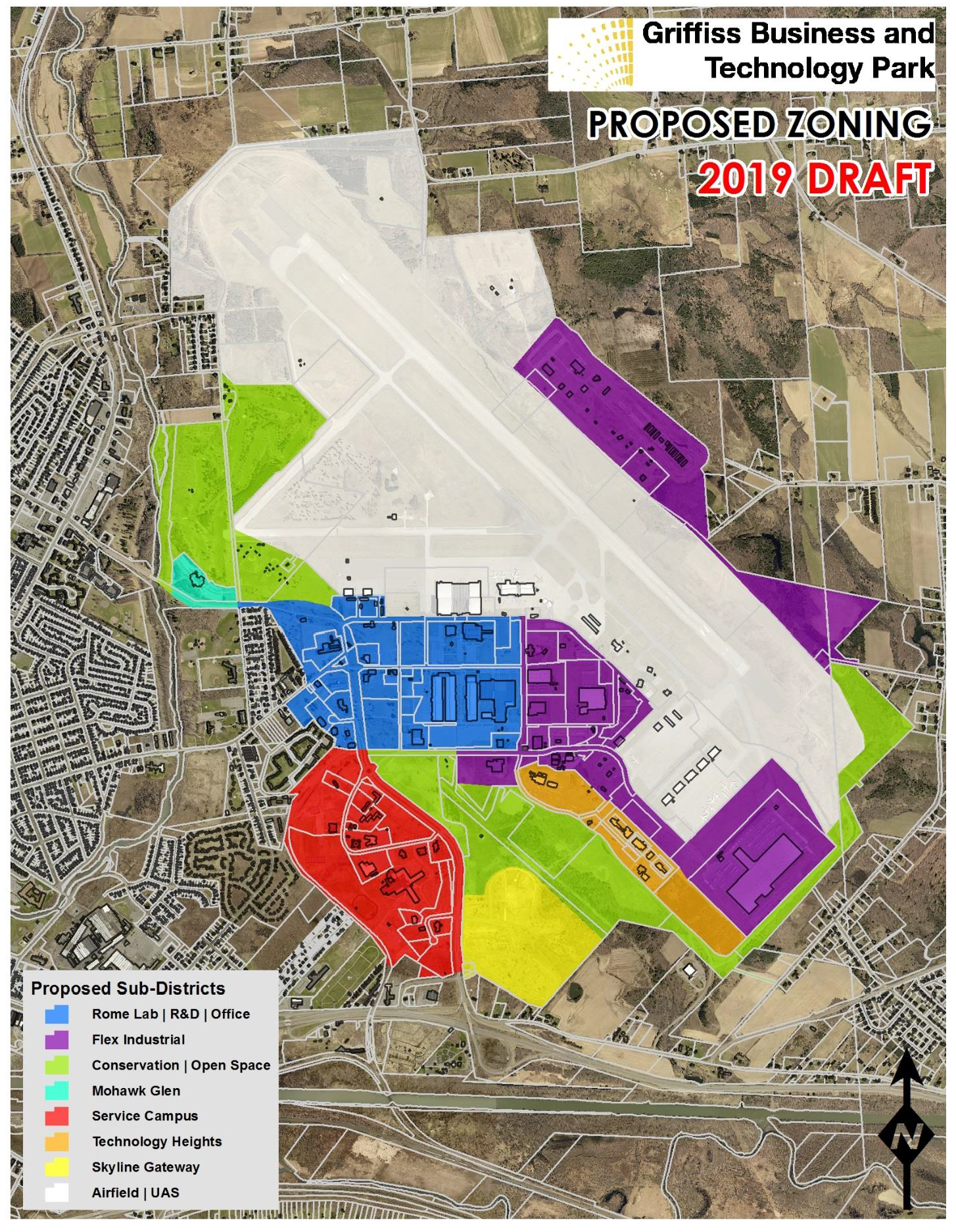
The GB Griffiss Park redevelopment district is intended to address the Griffiss Business and Technology Park within the city. The purpose of the district is to support the high quality, state-of-the-art business and technology center, within a work environment that blends operational efficiency with a pleasing atmosphere. In order to address the different functional and aesthetic character areas within the Griffiss Business and Technology Park, the GB district is divided into a series of sub-districts with tailored dimensional standards, permitted uses, and design and development standards. These sub-districts are:
(a)
GB-RL Rome Lab/R&D/office campus sub-district. The GB-RL sub-district is designed to promote the expansion of Rome Lab and augment the cyber ecosystem. This area should support continued use and viability of remaining Department of Defense functions, mixed-use housing development along the Floyd Avenue corridor to attract and retain talent to the community. It will be the visual focus of the Griffiss Business and Technology Park and function as the epicenter of commerce. Architecturally attractive buildings will front on main thoroughfares. Brooks Road and Floyd Avenue will be developed as an urban pedestrian scale corridor with a strong visual emphasis placed on building facades, street planting, decorative paving, ornamental lighting and other streetscape amenities.
Ample parking lots for office use are provided in back-lot locations, screened from pedestrian areas by the Brooks Road and Floyd Avenue buildings. This zone strongly prefers green infrastructure practices to reduce runoff, improve groundwater quality, shade paved surfaces, and enhance the workplace setting. Tree-lined streets, trails, and sidewalks are envisioned to create a pedestrian friendly live-work environment.
(b)
GB-FI flex industrial development sub-district. The GB-FI sub-district is reserved for high tech and light industrial uses. Design consideration should be given to the overall aesthetic character of the Griffiss Business and Technology Park, the transition areas surrounding the Rome Lab/R&D/office campus, and general areas of public view. Large parcels are encouraged. Subdivisions should maximize parcel size and flexibility.
(c)
GB-SG Skyline Gateway development sub-district. GB-SG sub-district is the gateway site of the Griffiss Business and Technology Park. The design intent for this sub-district is to create a high profile, high quality, business complex that capitalizes on the site's excellent visibility, superior access, and world-class infrastructure. Emphasis should be placed on flexibility of development as a corporate campus/complex where office, hi-tech manufacturing, research and development, warehousing, logistics, and/or industrial suppliers can be co-located. The site should not be subdivided unnecessarily, especially where other sites throughout the park could accommodate a less integrated project. The area should be used for advanced manufacturing corporate campus development, but may also be utilized for class A office, and large-scale development.
(d)
GB-MG Mohawk Glen development sub-district. The GB-MG sub-district is intended to support the reuse and expansion of existing support facilities and to provide new opportunities for training, recreation, health/wellness, and child care development.
(e)
GB-SC service campus sub-district. One of the important assets of the Griffiss Business and Technology Park is the existing service and support facilities centrally located along Brookley/Geiger Road. Existing facilities include a childcare center, outdoor recreation fields, VA hospital, dormitories, special needs housing, a public high school, and a dental office. The intent of the GB-SC sub-district is to aid in the reuse and expansion of these facilities to support other park activities and provide new opportunities for education, training, recreation, and limited commercial development. Supporting facilities that enhance marketability of the entire redevelopment program should be encouraged to locate within this area.
(f)
GB-CV conservation recreation sub-district. The GB-CV sub-district delineates certain open areas of value to the public within the park, represented in their natural, undeveloped, or unbuilt condition. It is recognized by the city that the principal use of these open areas is and ought to be the development, management, and utilization of the natural resources that exist in these areas. In order that this value be maintained and this use encouraged, a zoning sub-district is established to protect and enhance the natural resources, natural amenities, natural habitats of wildlife, watershed areas, public recreation areas, and the public health, safety and welfare by reducing the hardship and financial burdens imposed upon the city by the wanton destruction of resources, and the improper and wasteful use of open land and wooded areas. It is further the intent of this district to permit compatible uses and structures only at a low density and low impact as an added guarantee of compatibility with surrounding conservation.
(g)
GB-TH technology heights sub-district. The GB-TH sub-district is intended to accommodate cyber security and information assurance firms (and similar uses) including large corporate firms, as well as smaller contractors and entrepreneurial startups. Continued focus should be placed on attracting IT and cyber security firms by leveraging the existing cyber security workforce, as well as the tremendous assets of the AFRL—Rome and the Griffiss Institute. Limited retail and commercial businesses are allowed in this zone as an accessory use to support a dynamic professional environment, for example, cafes, employer-sponsored daycare, or commissary.
(Ord. No. 9301A, 9-26-18; Ord. No. 9346A, 5-8-19)
Sec. 80-8.3. - Uses.
(a)
Permitted uses and performance standards—General.
i.
All uses must comply with all laws, statutes, regulations, and ordinances promulgated by the City of Rome, Oneida County, New York State, U.S. Government, or any other controlling jurisdictions.
ii.
Uses which are considered "high hazard" as defined in part 700 of the state building code are permitted only in the manufacturing complex, light industrial, or heavy industrial sub-districts, and such use must be specifically approved by the planning board.
iii.
Uses that exceed any of the standards contained in the zoning ordinance are permitted only within the GB-FI sub-district, and such uses must be specifically approved by the planning board.
iv.
Uses that may interfere with airfield operations must be specifically approved by the Federal Aviation Administration.
(b)
Use table. Table 80-8-1: GB district use matrix identifies the principal and temporary uses allowed within each subdistrict of the GB Griffiss Park Redevelopment District. P indicates that the use is permitted in the district. S indicates that the use is a special use in the district and requires special use approval. If a cell is blank, the use is not allowed in the district. In the case of temporary uses, a T indicates the temporary use is allowed in the district and may require approval of a temporary use permit.
(Ord. No. 9301A, 9-26-18; Ord. No. 9346A, 5-8-19; Ord. No. 9399A, 2-12-20; Ord. No. 9563A, 1-25-23; Ord. No. 9591A, 5-24-23)
Sec. 80-8.4. - Dimensional standards.
Table 80-8-2: GB district dimensional standards establishes the dimensional standards for the GB sub-districts. These regulations apply to all uses within each sub-district unless a different standard is listed for a specific use or in this section.
(Ord. No. 9301A, 9-26-18; Ord. No. 9399A, 2-12-20; Ord. No. 9591A, 5-24-23)
Sec. 80-8.5. - Design and development standards.
(a)
Design standards. These design standards are intended to result in unified, harmonious and high quality architecture throughout the Griffiss Business and Technology Park without inhibiting the imaginative work of architectural designers and the individuality and propriety of tenant businesses.
Design methods are encouraged which tend to minimize the large-scale visual impact of buildings and create a complex of buildings compatible with the pedestrian scale of the streetscape. Developers and designers are encouraged to explore the creative possibilities on individual sites while seeking to maintain an architectural consistency with the basic patterns and elements throughout the Griffiss Business and Technology Park.
All buildings should be modern and progressive in design and concept while maintaining a quiet conservatism to avoid overshadowing surrounding architecture. Buildings should reflect and utilize the technology of today.
i.
Sidewalks.
a.
Sidewalk systems within a development parcel must be provided to meet the circulation requirements of on-site users. Sidewalks must provide safe, aesthetically pleasing, and all-weather efficient means of on-site movement and must be integrated into the overall architectural and site design concept.
b.
Pedestrian facilities must comply with ADA standards.
c.
Differentiation in paving materials and installation of architectural bollards is encouraged to delineate pedestrian uses from vehicular uses and to enrich the aesthetic character of the site.
d.
Sidewalks must be installed on site regardless of its interconnectivity or lack thereof with the park wide sidewalk system.
ii.
Site design criteria.
a.
Entrance drives must be clearly visible and intuitively located to the first time visitor.
b.
Passive solar design is encouraged.
c.
Conflict between service vehicles, automobiles, and pedestrians should be minimized.
d.
Main building entries must be emphasized by accent features including:
(1)
Ceremonial entry porte-cochere.
(2)
Plazas.
(3)
Decorative planters and landscape plantings.
(4)
Architectural walls.
e.
Architecture and site development must be coordinated and unified.
f.
Each phase of a development project should be able to attain a standalone visual unity.
iii.
Building massing and form.
a.
All buildings must have a horizontal appearance. Horizontal bands and facia must be used to minimize the vertical appearance of structures.
b.
Building walls must be designed to create pedestrian scale exterior spaces by utilizing smaller wall segments, landscaping, wall texture and shadow lines.
c.
Architectural design or signage which draws excessive attention from surrounding roadways is not acceptable.
d.
Any structure that may interfere with airfield operations must be approved by the Federal Aviation Administration.
iv.
Materials.
a.
Building exterior wall materials.
(1)
One primary material should be used. Materials which express permanence, substance, timelessness, and restraint are required.
(2)
Materials should be sufficiently durable to guarantee low maintenance, stability and a reasonable life span.
(3)
Materials must be consistent, or blend with existing materials in adjacent areas of the park.
(4)
Pre-engineered buildings featuring predominantly metal painted exteriors are strongly discouraged except in the industrial development districts.
(5)
Exposed drainage pipes on building fronts are not permitted, except if specifically approved by the planning board.
(6)
Highly reflective surfaces that create hazardous glares for motorist and aircraft operators are discouraged.
b.
Building roofs.
(1)
When flat roof areas can be viewed from above, roof-mounted equipment should be installed in a neat and compact fashion and be of a color which blends with the visual background.
(2)
Sloped roofs should be constructed of a traditional roof material. Corrugated metal, fiberglass, and asphalt are not allowed unless specifically approved by the planning board.
(3)
Building parapets should be of such a height to screen roof-mounted mechanical equipment. If parapets cannot provide adequate screening, an unobtrusive screening device designed to appear integral with the building architecture may be used. Such screening devices must be constructed of durable materials and finished in a texture and color scheme consistent with the architectural character of the building.
v.
Colors and textures.
a.
Simple and consistent texture patterns are encouraged.
b.
Color variations should be minimized.
c.
Accent colors may be used to express corporate identity.
(b)
Development standards.
i.
GB-RL sub-district.
a.
Architectural and site development/redevelopment should maintain an attractive visual quality compatible with the overall design character of the Griffiss Business and Technology Park.
b.
Design consideration should be given to the visual attractiveness of development sites. Parking, storage, service and loading areas, mechanical and electrical equipment, utilities, and fuel storage facilities should be screened from public view by architecture, landform, and vegetation. Landscaping should be used to create a distinctive working environment and to enrich portions of the site visible to the public.
c.
Pedestrian ways should be paved, lighted and tree lined to provide for and encourage pedestrian movement from place to place.
d.
All exterior on-site utilities, including but not limited to drainage systems, sewers, gas lines, water lines, and electrical, telephone, and communications wires and equipment, must be installed and maintained underground. The intersection of the parkway and Brooks Road is the entry and primary civic space for the Rome Lab/R&D/office campus.
e.
Sites facing Brooks Road and the parkway are reserved for office, R&D, and complementary high-profile commercial uses that will benefit from a high quality front door and contribute to the overall quality of the park.
f.
A "build-to-line" requirement is established along Brooks Road. "Build-to-line" refers to the point within the parcel to which a building should be aligned, with the intent of establishing a consistent edge to the street and avoiding extensive setbacks where buildings are isolated and disconnected from the pedestrian street. Where existing buildings do not comply with the desired build-to-lines, landscape material can help maintain the pedestrian environment and landscaped pedestrian corridors will connect streets and building entrances. Any renovation or new construction should comply with the build-to-line. Building materials and the design of facades abutting the build-to-line should reflect a pedestrian scale environment.
g.
Primary buildings, whenever possible, should front on Brooks Road. New buildings along Brooks Road should be a minimum of two stories in height, but may be a maximum of five stories in height.
h.
Parking should be constructed on the interior of the parcels wherever possible, screened from Brooks Road by intervening buildings, landform, and landscaping. Access to parking should be from the perimeter roads of the Rome Lab/R&D/office campus.
i.
Small open spaces adjacent to buildings that serve as informal gathering places are encouraged.
j.
Design consideration should be given to the visual attractiveness of development sites. To the greatest extent possible parking, storage, service and loading areas, mechanical and electrical equipment, utilities, and fuel storage facilities should be screened from public view. Landscaping should create a distinctive working environment and enrich portions of the site visible to the public.
k.
Lighting and street furnishings along the roadways should establish a safe and functional environment while making the streetscape visually memorable.
l.
Parking lots should be subdivided into no more than four double bays or eight rows and should provide for ingress/egress at two locations. Trees should be located in and around the parking areas to provide shaded and visually attractive parking lots.
m.
Pedestrian ways should be paved, lighted and tree lined to provide for and encourage pedestrian movement from place to place. Pedestrian ways should create a unique and coherent character with consistent treatment of pavement and ground plane throughout the park.
n.
The reduction of curb cuts on Brooks Road is strongly encouraged and design accommodations should be made, when practicable, for the provision of common driveways.
o.
Curbing is required for all public roads, access drives and parking lots.
p.
All exterior on-site utilities, including but not limited to drainage systems, sewers, gas lines, water lines, and electrical, telephone, and communications wires and equipment, must be installed and maintained underground.
q.
The use of art features such as sculptures, fountains, distinctive landscaping, and murals add a unique identification and style to a development and are encouraged in this district. Art features should be appropriate to the historic, architectural, and visual character of the site, and must be submitted to the Griffiss Park Landowners Association for their consent and approval at a regular meeting of the board of directors.
ii.
GB-FI sub-district.
a.
Otis Street serves as a visual terminus to Brooks Road. Lots fronting Otis Street should be configured such that high quality building facades and landscaping create a strong urban street edge similar to the character of Brooks Road. A 20-foot setback build-to-line is established along each side of Otis Street to create a consistent edge to the street to avoid buildings that are isolated and disconnected from the pedestrian street.
b.
Primary building entrances should be off Otis Street where possible. A landmark building is recommended for the visual terminus to Brooks Road.
c.
A strong street tree planting program will be established to separate the industrial/manufacturing areas from the Rome Lab/R&D/office campus.
d.
Design consideration should be given to the visual attractiveness of lots. To the extent possible parking, storage, service and loading areas, mechanical and electrical equipment, utilities, and fuel storage facilities should be screened from public view. Landscaping should be used to create a distinctive working environment and to enrich portions of the site visible to the public.
e.
All exterior on-site utilities, including but not limited to drainage systems, sewers, gas lines, water lines, and electrical, telephone, and communications wires and equipment, must be installed and maintained underground.
iii.
GB-SG sub-district.
a.
The intersection of the parkway and the corporate development area access road should be designed as a high quality and memorable gateway to the Griffiss Business and Technology Park as well as the corporate development area.
b.
Buildings located in high profile locations such as the access road near the parkway intersection should establish a high quality front door image for the Griffiss Business and Technology Park.
c.
Primary buildings, whenever possible, should front on the public right-of-way. New buildings should be a minimum of two stories in height, but may be a maximum of five stories in height.
d.
Small open spaces adjacent to buildings that serve as informal gathering places are encouraged.
e.
A comprehensive street planting and sidewalk program should be implemented within the public right-of-way and should be coordinated with site landscaping to form a continuity of greenspace and pedestrian circulation.
f.
Curbs are required for all public roads, access drives and parking lots.
g.
Design consideration should be given to the visual attractiveness of development sites. To the greatest extent possible parking, storage, service and loading areas, mechanical and electrical equipment, utilities, and fuel storage facilities should be screened from public view by architecture, landform, and vegetation. Any industrial storage, water storage, or industrial process containment towers that exceed the height of any of the principal structures must be treated as an exterior wall, and must therefore be clad and finished in the same material as the primary structure. Landscaping should be used to create a distinctive working environment and to enrich portions of the site visible to the public.
h.
Lighting and street furnishings along the roadways should establish a safe and functional environment while making the streetscape visually memorable.
i.
The visual scale of the parking areas will be reduced by segregating lots for specific buildings where possible and breaking the mass of larger parking fields with regularly spaced planting islands and tree-lined internal access drives.
j.
Pedestrian ways should be paved, lighted and tree lined to provide for and encourage pedestrian movement from place to place. Pedestrian ways should combine to create a unique and coherent character with consistent treatment of pavement and ground plane throughout the district.
k.
All exterior on-site utilities, including but not limited to drainage systems, sewers, gas lines, water lines, and electrical, telephone, and communications wires and equipment, must be installed and maintained underground.
iv.
GB-MG sub-district.
a.
Architectural and site development/redevelopment should maintain an attractive visual quality compatible with the overall design character of the Griffiss Business and Technology Park.
b.
Design consideration should be given to the visual attractiveness of development sites. Parking, storage, service and loading areas, mechanical and electrical equipment, utilities, and fuel storage facilities should be screened from public view by architecture, landform, and vegetation. Landscaping should be used to create a distinctive working environment and to enrich portions of the site visible to the public.
c.
Pedestrian ways should be paved, lighted and tree lined to provide for and encourage pedestrian movement from place to place.
d.
All exterior on-site utilities, including but not limited to drainage systems, sewers, gas lines, water lines, and electrical, telephone, and communications wires and equipment, must be installed and maintained underground.
v.
GB-SC sub-district.
a.
The core of the service campus should be limited to secondary uses that support the function of other areas of the Griffiss Business and Technology Park.
b.
Architectural and site development/redevelopment should maintain an attractive visual quality compatible with the overall design character of the Griffiss Business and Technology Park.
c.
Design consideration should be given to the visual attractiveness of development sites. Parking, storage, service and loading areas, mechanical and electrical equipment, utilities, and fuel storage facilities should be screened from public view by architecture, landform, and vegetation. Landscaping should be used to create a distinctive working environment and to enrich portions of the site visible to the public.
d.
Pedestrian ways should be paved, lighted and tree lined to provide for and encourage pedestrian movement from place to place.
e.
All exterior on-site utilities, including but not limited to drainage systems, sewers, gas lines, water lines, and electrical, telephone, and communications wires and equipment, must be installed and maintained underground.
vi.
GB-CV sub-district.
a.
Conservation and recreation design should be used for parkways, stormwater management, pedestrian circulation, low intensity recreational development, utility corridors, wildlife habitat, and aesthetic amenities.
b.
Areas should be reforested as necessary to support the above functions.
c.
Wetlands, watercourses, and sensitive environments should remain "forever wild."
vii.
GB-TH sub-district.
a.
Phoenix Drive is designed with traditionally suburban setbacks and considerable landscaping. Future construction on new lots should be configured such that high quality building facades and landscaping create a soft suburban street edge similar to the existing character of Phoenix Drive.
b.
Primary building entrances should be off Phoenix Drive (and its future extension) where possible.
c.
Design consideration should be given to the visual attractiveness of lots. To the extent possible parking, storage, service and loading areas, mechanical and electrical equipment, utilities, and fuel storage facilities should be screened from public view. Landscaping should be used to create a distinctive working environment and to enrich portions of the site visible to the public.
d.
All exterior on-site utilities, including but not limited to drainage systems, sewers, gas lines, water lines, and electrical, telephone, and communications wires and equipment, must be installed and maintained underground.
(Ord. No. 9301A, 9-26-18; Ord. No. 9399A, 2-12-20)
Sec. 80-8.6. - Parking requirements.
(a)
Off-street parking must be provided to accommodate all parking needs for the site. Required off-street parking must be provided on the site of the use served, unless otherwise approved by the planning board.
(b)
Parking should be designed to avoid conflicts between the motorist and the pedestrian while creating a visual attractiveness within and around the site.
(c)
Joint access drives for car parking areas with adjoining properties are encouraged. Shared access minimizes disruption of traffic flow on collector streets, reduces potential points of conflict between through and turning traffic, and facilitates the control and separation of vehicles and pedestrian movement.
(d)
Car parking area designs must eliminate or minimize through traffic by delivery trucks. Curb cuts should be located at a safe distance from street intersections.
(e)
Fire lanes must be developed in consultation with city officials and must conform to state fire code requirements.
(f)
Truck parking areas must be located in side and/or rear yard areas outside required yard setback areas. Truck loading/unloading areas must be screened from adjacent properties.
(g)
Parking space and drive lane dimensions must conform to city standards.
(h)
Handicapped parking requirements must conform to NYS and ADA regulations.
(i)
It is the responsibility of each owner to provide and maintain parking lot striping for areas serving the tenant's facilities.
(j)
It is strongly recommended that new development projects consider sustainable approaches to parking. This may include the use of pervious paving materials to allow infiltration, and the reduction of existing impervious surfaces, where practicable.
(k)
Furthermore, parking should be located to the rear of such structures to ensure substantial visual screening from the Brooks Road and Otis Street corridors. In no case will parking be permitted within 100 feet of the Brooks Road right-of-way or within 50 feet of the Otis Street right-of-way.
(Ord. No. 9301A, 9-26-18)
Sec. 80-8.7. - Storage, service, loading and refuse collection areas.
Storage, service, maintenance, and loading areas must be designed, used, and maintained as follows:
(a)
No supplies, materials, or equipment, including motor vehicles other than daily parking, may be stored on a site unless enclosed within a building or behind a durable material wall. Walls must be no less than six feet, nor greater than eight feet in height must, from eye level, completely screen such storage, service, or loading areas from adjacent sites and streets. Outdoor storage areas must be architecturally compatible with primary buildings, and must be located to the rear of the site, unless approved by the planning board.
(b)
No outdoor storage may be located within the front yard.
(c)
Outdoor storage must be restricted to non-hazardous materials only, as defined in part 700 of the state building code.
(d)
No on-street vehicle loading is permitted.
(e)
No loading areas can be visible from main thoroughfares or designated pedestrian gathering places.
(f)
No outdoor storage is permitted in the GB-RL sub-district unless specifically approved by the planning board.
(g)
Outdoor dumpsters must be located within a six- to eight-foot high enclosure constructed of durable materials architecturally compatible with the primary structure, so as not to be visible from adjacent lots or streets. No refuse collection areas are permitted within a front yard.
(h)
Refuse collection areas should be appropriately sized to contain all refuse generated and deposited on-site between collections. Refuse should not be visible from outside the enclosure at any time.
(i)
The location of refuse collection areas should be convenient for the deposition of refuse generated on the site and provide clear and convenient access to collection vehicles.
(j)
Trash must be collected on a weekly basis, at a minimum, so as to prevent long-term accumulation of trash, recyclables, etc. It is the responsibility of the tenant to contract for such services.
(Ord. No. 9301A, 9-26-18)
Sec. 80-8.8. - Screening, fences, and walls.
(a)
Exterior roof-mounted mechanical systems and equipment, including but not limited to piping, tanks, stacks, collectors, heating, cooling, and ventilating-equipment fans, blowers, ductwork, vents, louvers, meters, compressors, motors, incinerators, ovens, etc., must be screened from public view by the use of architecturally compatible materials.
(b)
Views to roof-mounted mechanical systems and equipment from upper floors of adjacent buildings should be minimized where possible. In all cases, roof-mounted equipment must be installed in a neat and compact fashion, and be of a color which blends with the visual background.
(c)
Wall mounted exterior mechanical systems or equipment must be integrated with the building architecture, and must be specifically approved by the planning board.
(d)
Ground-level mechanical equipment must be screened from public view by the use of landscaping, walls, fencing, and other design treatments compatible with the finishes of the primary structure. All screening materials must be approved by the planning board.
(e)
Any transformers that might be visible from streets or adjacent lots must be screened from public view by the use of landscaping, walls, fencing, and other design treatments of a design acceptable to the local electric service provider.
(f)
Enclosures should be designed of durable materials with finishes and colors compatible with the primary structure.
(g)
Where practical, electrical equipment should be contained within a building. When interior mounting is not possible, exterior equipment should be substantially screened from public view. In no case shall exterior electrical equipment be mounted on the front yard side of any building.
(h)
Exterior-mounted electrical equipment and conduits must be kept to a minimum. Where visible, such equipment must be installed in a neat and orderly fashion, and be of a color which blends with the surrounding architecture.
(i)
No fence or wall greater than three feet in height shall be constructed closer than 30 feet from the curbline of any public street.
(j)
Walls and fences located within any front yard are discouraged. When necessary, such fences or walls require approval by the planning board.
(k)
No fence or wall shall exceed a height of eight feet unless approved by the planning board.
(l)
All materials must be durable and of a texture and color compatible with the architecture of the primary structure.
(m)
Chain link fencing may be used if required for security purposes, provided that the fence fabric, posts, gates, and appurtenances are black in color. No screening slats are permitted.
(n)
Where appropriate, fences must be constructed to restrict unauthorized entry to hazardous areas such as storage yards and loading docks.
(Ord. No. 9301A, 9-26-18)
Sec. 80-8.9. - Utilities, telecommunications, and fuel/storage tanks.
(a)
Utilities and telecommunications—Generally.
i.
All new and rebuilt exterior on-site utilities, including but not limited to drainage systems, sewers, gas lines, water lines, and electrical, telephone, and communications wires and equipment, must be installed and maintained underground.
ii.
No antenna or transmission/reception device, shall be placed so that it is visible by a ground level observer within 500 feet unless specifically approved by the planning board.
iii.
Temporary overhead power and telephone facilities are permitted during construction. Any structure that may interfere with airfield operations must be approved by the Federal Aviation Administration.
(b)
Fuel and storage tanks—Generally.
i.
Storage of fuel and other volatile materials must conform to applicable local, state, and federal regulations.
ii.
Above ground tank storage is not permitted in front yard areas or other areas without approval of the planning board.
(Ord. No. 9301A, 9-26-18)
Sec. 80-8.10. - Landscape standards.
(a)
Objectives. Landscaping is a design element that plays an important role in creating the park-like setting of the Griffiss Business and Technology Park. The intent of these landscape guidelines is to establish design criteria that create a distinctive working environment and unifies the site landscape with site architecture as well as the overall aesthetic character of the park. The park encourages the use of ornamental and shade trees as the primary landscape features, and discourages the use of groundcovers and formal planting beds. The intent is to maximize the ecosystem benefits provided by tree canopy and reduce the maintenance burden on building owners and park maintenance staff.
(b)
Landscape maintenance.
i.
Maintenance of unimproved sites. Undeveloped sites must be maintained in a clean and neat appearance.
ii.
Maintenance of improved sites.
a.
Planted areas should be watered, fertilized, and pruned on a regular basis to maintain a neat and orderly appearance. Formal lawns must be maintained at a minimum height of two inches and a maximum height of five inches. All sites must be kept clean and should remain free of trash, debris, and brush.
b.
All dead or dying plant materials must be replaced on a timely basis to maintain the designed intent of the approved planting plan.
(b)
Landscaping requirements.
i.
Landscaping within the public right-of-way.
a.
The public road corridors form the primary access into the park, and as such, landscape treatment is critical to establish the desired image of the Griffiss Business and Technology Park. Consequently, improvements within these corridors are subject to the highest level of regulation.
b.
Landscape development within the public right-of-way will include sidewalks, street trees, lighting, signage, grading, and site entries. The streetscapes at intersections are to be treated with elements of enriched paving, lighting and accent planting.
(1)
Parkway—Main entries to the Rome Lab/R&D/office campus areas at Brooks Road, the industrial area at Ellsworth Road, and the manufacturing complex area at Hangar Road will be emphasized by the use of distinctive paving, tree planting, signage and lighting.
(2)
Local streets—Standard lighting, street trees, signage and sidewalks will be installed.
c.
All landscape maintenance will be provided by the property owners.
d.
Landscape within the right-of-way will be installed as a continuous linear system. Demolition of portions of this system will be necessary at vehicular access points during construction of the site access drives. It is the responsibility of individual property owners to reconstruct any grading, tree planting, paving, and streetscape amenities disturbed during construction.
ii.
Landscaping within setback areas.
a.
Development within the required setback areas is dependent on the needs of individual property owners and tenants and thus is provided a greater degree of flexibility than within the public right-of-way. Landscape guidelines within these areas primarily concern parking areas, building fronts and entries, and rear and side property line buffering.
b.
Landscape treatment within the front yard should focus around building facades visible from surrounding streets as well as entry areas. The use of ornamental planting, lighting, signage and other site amenities is encouraged to enrich front yard areas and building entries.
c.
It is intended that landscape development within the side and rear yard setback area result in a distinct sense of enclosure and informality while remaining subordinate to the right-of-way and front yard landscaping. Berming is encouraged to reduce the visibility of parking lot, service, loading, storage and maintenance areas from off-site locations.
iii.
Parking lots. See article XV for parking lot landscape requirements.
(c)
Approved plant materials. See urban plantings list on file at the city.
i.
Other site plantings. The intent of landscaping within individual sites is to create visually pleasing and imaginative settings that are unified and harmonious with the overall character of the Griffiss Business and Technology Park. Landscape designers are encouraged to be creative in the selection of plant materials. The following should be considered in selection of plant materials:
a.
Maintenance requirements should be an important consideration.
b.
Materials must be consistent, or blend with existing materials in adjacent areas of the park with the exception of plants intended to serve as a visual accent.
c.
Plant size, color, texture, and form should be used to enhance wildlife corridors and plant pollination strategies.
d.
Plant selection should consider complementary materials with differing periods of spring flower and fall color to maximize seasonal variation.
(Ord. No. 9301A, 9-26-18)
Sec. 80-8.11. - Exterior sign guidelines.
(a)
Objectives. The objective of the following signage guidelines is to ensure that exterior signs contribute to, rather than degrade the desired aesthetic character of the Griffiss Business and Technology Park.
(b)
General requirements.
i.
Off-premise advertising signs are prohibited.
ii.
No freestanding signs are permitted along New York State Route 825.
iii.
Secondary signs required for effective site operation should be designed in a unified manner consistent with the intent of these guidelines and must be specifically approved by the planning board.
iv.
Signs must be fabricated as individual letters mounted on either building facades or freestanding masonry sign-walls, or as masonry based signs with metal fabricated sign cabinets attached to a masonry base (minimum base height 24 inches).
v.
Internally-illuminated sign cabinets are prohibited.
vi.
Rooftop signs are prohibited.
vii.
Signs may not rotate, blink, or move in any fashion.
viii.
Signs attached to exterior glass must be specifically approved by the planning board.
ix.
The standard typeface for the Griffiss Business and Technology Park is Helvetica (light and bold). This type face must be used by all facilities unless replaced by a corporate logo and/or logotype for site identification. All other signs necessary for the effective operation of each facility must be the standard typeface for the Griffiss Business and Technology Park.
x.
Sign colors must be subdued in tone. Contrasting primary colors are prohibited unless part of an established corporate logo or logotype.
xi.
Repair and maintenance of all wall-mounted and/or freestanding signs are the direct responsibility of the tenant.
(c)
Building mounted tenant identification signs.
i.
Building mounted tenant identification signage for single-tenant buildings.
a.
Identification signs are limited to one location along the highest building fascia per public street frontage.
b.
The following criteria applies to single story buildings:
(1)
The typeface may not exceed two feet in height (measured uppercase height).
(2)
Use of corporate logos is allowed for tenant identification. If a corporate logo is used alone, the height of the logo may be increased to three feet. If a logo is used in conjunction with corporate logotype, neither may exceed two feet in height.
(3)
The maximum area of a wall-mounted sign must not exceed 60 square feet. Area is measured as the rectangular area surrounding the sign lettering and logo.
c.
The following criteria applies to multi-story buildings:
(1)
The typeface may not exceed two feet in height (measured uppercase height).
(2)
Use of corporate logos is allowed for tenant identification. If a corporate logo is used alone, the height of the logo may be increased to five feet. If a logo is used in conjunction with corporate logotype, the logo may not exceed three feet in height and the logotype may not exceed two feet in height.
(3)
The maximum area of a wall-mounted sign must not exceed 150 square feet. Area is measured as the rectangular area surrounding the sign lettering and logo.
(d)
Building mounted tenant identification signage for multi-tenant buildings.
i.
Primary tenant identification.
a.
Identification signage for the primary tenant of a multi-tenant building is limited to one location along the highest building fascia per public street frontage.
b.
Should two primary tenants be located within a single building, one identification sign for each primary tenant may be permitted along the highest building fascia per public street frontage, space permitting. Such dual primary tenant signage must be appropriately spaced as to not create visual confusion and must be specifically approved by the planning board. Should insufficient space be deemed to be available for dual primary tenant signage, or if more than two primary tenants exist, the guidelines for secondary tenant identification will prevail.
c.
The following criteria applies to wall-mounted primary tenant signage on single story buildings:
(1)
The typeface may not exceed two feet in height (measured uppercase height).
(2)
Use of corporate logos is allowed for tenant identification. If a corporate logo is used alone, the height of the logo may be increased to three feet. If a logo is used in conjunction with corporate logotype, neither may exceed two feet in height.
(3)
The maximum area of a wall-mounted sign for the primary tenant must not exceed 60 square feet. Area is measured as the rectangular area surrounding the sign lettering and logo.
d.
The following criteria applies to wall-mounted primary tenant identification on multi-story buildings:
(1)
The typeface may not exceed two feet in height (measured uppercase height).
(2)
Use of corporate logos is allowed for tenant identification. If a corporate logo is used alone, the height of the logo may be increased to five feet. If a logo is used in conjunction with corporate logotype, the logo may not exceed three feet in height and the logotype may not exceed two feet in height.
(3)
The maximum area of a wall-mounted sign for the primary tenant must not exceed 150 square feet. Area is measured as the rectangular area surrounding the sign lettering and logo.
ii.
Secondary tenant identification.
a.
Wall-mounted identification signage for all secondary tenants occupying ground floor space will be located adjacent to the primary entrance serving the named tenants.
b.
The typeface may not exceed six inches in height (measured uppercase height).
c.
Use of corporate logos is allowed for tenant identification. If a corporate logo is used alone, the height of the logo may be increased to eight inches. If a logo is used in conjunction with corporate logotype, neither may exceed six inches in height.
d.
The maximum area of a wall-mounted identification sign for a secondary tenant must not exceed five square feet. Area is measured as the rectangular area surrounding the sign lettering and logo.
e.
Remaining tenant identification must be restricted to an interior tenant directory.
f.
Where an entrance serves more than one secondary tenant, wall-mounted signage must be coordinated in a unified manner.
(Ord. No. 9301A, 9-26-18)
Sec. 80-8.12. - Lighting guidelines.
(a)
Objectives. The objective of these lighting guidelines is to:
i.
Create a safe and efficient working environment.
ii.
Complement and reinforce the site design and architectural character.
iii.
Maintain consistent parking lot lighting fixtures and illumination levels throughout the Griffiss Business and Technology Park.
iv.
Prevent light spillage and glare on adjacent lots and streets in a manner which creates a nuisance or safety concern.
(b)
Guidelines.
i.
All lighting which might be visible from an adjacent street must be indirect or utilize a full cut-off shield-type fixture. Pedestrian scale bollard lighting is encouraged and may be directly visible from adjacent streets.
ii.
Parking areas, access drives, and internal vehicular circulation areas must be illuminated by zero cutoff fixtures. The parking-lot illumination level must achieve a uniformity ratio of 3:1 (average to minimum) with a maintained average of one footcandle and a minimum of 0.3 footcandle.
iii.
Service-area lighting must be substantially contained within the service yard's boundaries and enclosure walls.
iv.
Indirect (invisible source) wall lighting or "wall-washing" overhead down lighting of site architecture, or interior building illumination which spills outside is encouraged. Architectural lighting should articulate and accent building design, as well as landscape areas, and create functional illumination for safety and clarity of pedestrian movement.
v.
Pedestrian area lighting:
a.
Lighting of outdoor pedestrian use areas (including courtyards, entryways, etc.) should achieve a uniformity ratio of 3.5:1 (average to minimum), with an average illumination of 0.60 footcandle and a minimum of 0.18 footcandle.
b.
Lighting of pedestrian walkways should clearly identify the walkway and imply the direction of travel.
vi.
Inoperable bulbs must be replaced, and fixtures maintained/repaired within five business days to maintain required lighting levels.
(Ord. No. 9301A, 9-26-18)
Sec. 80-8.13. - Sustainable design.
(a)
Objectives. The objective of these sustainability guidelines is to ensure that new projects are built to modern specifications for energy efficiency and long-term environmental sustainability.
(b)
Guidelines.
i.
On an architectural level, this primarily will mean reducing energy consumption by constructing buildings that respond to the local climate through building orientation, shading devices and access to natural ventilation. Additionally, designing buildings with a flexible lay-out will allow for the long term adaptability of the structures, reducing the need for new construction. Finally, the use of sustainable and locally-produced materials is encouraged, as they typically contain less embodied energy and are less harmful to the environment and the building's occupants.
ii.
On a site level, it is recommended that new development projects consider sustainable approaches to storm water management. This may include the use of green infrastructure best practices.
iii.
Existing mature site vegetation represents a significant part of the character and charm of Griffiss Business and Technology Park and should be maintained to the maximum extent possible.
(Ord. No. 9301A, 9-26-18; Ord. No. 9346A, Exh. B, 3-27-19)

