
Sanford City Zoning Code
Schedule E
ADDITIONAL REQUIREMENTS AND PROVISIONS FOR SPECIFIC USES
Section 1.0.- Vehicular uses and welding establishments.
All vehicular service, vehicular accessory sales, vehicular rental, major equipment rental, major equipment repair, vehicular dealer sales and welding establishments shall comply with the following regulations:
A.
Inoperative vehicles, equipment and repairs. All vehicles and equipment shall be maintained in an operative condition at all times, provided, however, that all vehicles and equipment which are inoperative or that are being serviced, maintained, and/or repaired shall be located within buildings designated for such purposes or within areas located in the rear of the premises, provided such areas are visually screened from surrounding areas. Such visual screening shall have no openings except for entrances and exits which shall be provided with unpierced gates. In addition, no such enclosed area for inoperative vehicles, equipment or repairs shall be permitted within any required yard or building setback.
B.
Storage space. Storage space for all vehicles and equipment shall be provided on the premises in an amount and manner that ensures that no street, sidewalk, or other public way is impeded or utilized for any vehicular or equipment storage associated with the activities and use located on the premises. Such storage space shall be in addition to the off-street parking, loading, and unloading space required by this Ordinance.
C.
Outdoor display of equipment and vehicular accessory sales. All equipment and vehicular accessory products intended for lease, rental or sale and stored, parked, or otherwise displayed shall be provided with a setback of at least 25 feet in depth along all street right-of-way lines and at least ten feet in depth along all other parcel lines. A precast concrete curb or other barrier of a similar and permanent nature approved by the Planning and Zoning Commission shall be placed between the outdoor display area and the required setback adjacent to all street right-of-way lines upon which the outdoor display area is located. In addition, no such outdoor display area shall be permitted within any required buffer. No equipment that exceeds the height of the principal building on the parcel shall be displayed in the front yard. No berm or other device shall be used to artificially elevate the display area.
D.
Vehicular circulation pattern. All vehicle and equipment storage space, outdoor display area and off-street parking, loading and unloading space shall be arranged and located so as not to interfere with vehicular access points serving the premises. In addition, the overall vehicular circulation pattern shall be designed to enhance and facilitate traffic movement both on and off the premises. The vehicular circulation pattern as well as storage space, outdoor display area and off-street parking, loading and unloading space, shall be indicated on a site plan accompanying all site development permit and/or certificate of completion applications involving automotive uses.
E.
Gasoline service stations (including convenience store with gas pumps). In addition to conforming with all other applicable provisions of this ordinance for automotive uses set forth above, gasoline service stations shall also conform to the following regulations:
1.
Service island. All service islands utilized for dispensing fuel, oil and/or related appurtenances, structures, and services shall be located at least 35 feet from all parcel lines.
2.
Parking of small nonmotorized hauling trailers and trucks without drivers. The renting of small nonmotorized hauling trailers and trucks without drivers by gasoline service stations shall be subject to the following regulations:
a.
Not more than ten hauling trailers shall be stored on the premises at any one time. In addition, no such hauling trailer shall exceed 14 feet in overall body length.
b.
Not more than three rental trucks shall be stored on the premises at any one time. In addition, the hauling space portion of such rental trucks shall not exceed 24 feet in length.
c.
All hauling trailers, rental trucks and related nonmotorized hauling accessories and moving aids shall be arranged and maintained in a neat and orderly fashion within designated storage space and outdoor display areas.
F.
Required screening of outdoor display areas. All outdoor display areas utilized for the purpose of storing small nonmotorized hauling trailers, trucks without drives and/or tires shall be visually screened from surrounding areas. Such visual screening shall be located along all side and/or rear parcel lines which parallel the outdoor display areas.
G.
Vehicular sales and rental standards. All vehicular sales and rental businesses except for those governed by subsection E.4 [sic] of this schedule, shall comply with the following regulations:
1.
Applicability. This section shall apply to all businesses that sell, lease or rent new or used vehicles including, but not limited to, automobiles, trucks, boats, recreational vehicles and travel trailers that store some or all of the vehicles outdoors.
2.
Minimum lot size and parcel width.
a.
Businesses with repair facilities. All businesses with new and used vehicles intended for lease, rental or sale and which service, detail, clean, paint or repair the vehicles shall have a minimum parcel area of one acre and a minimum parcel width at the front property line of 125 feet.
b.
Businesses without repair facilities. All businesses with new and used vehicles intended for lease, rental or sale which do not have service, detail, clean, paint or repair facilities shall have a minimum parcel area of one-half (1/2) acre and a minimum parcel width at the front property line of 125 feet.
3.
Buffer. All vehicular sales and rentals shall comply with the buffer requirements of Schedule J and/or Schedule U of these regulations. No vehicular display shall be located within a required buffer area.
4.
Outdoor display of vehicles. The outdoor display area is limited to one vehicle for every 250 square feet of net usable area, calculated as the square footage of the parcel minus all easements, required landscaping, setback and buffer areas, required drainage areas, wetlands, required open space and building areas and required access, parking and loading areas.
To prevent the intrusion of the outdoor display area into required buffers and setbacks, a precast concrete curb or barrier of a similar and permanent nature approved by the Planning and Zoning Commission shall be placed between the outdoor display area and the required setback and/or buffer that is adjacent to a street right-of-way.
All vehicles that are displayed outdoors shall be displayed at grade and no vehicle shall be elevated on a berm, pedestal, flat bed, crane or other device that has the effect of elevating the vehicle above the ground.
5.
Indoor service area required. All businesses that sell, lease or rent new or used vehicles and service, detail, clean, paint or repair the vehicles which they sell, lease or rent shall:
(a)
Have an indoor area to service at least two vehicles at the same time.
(b)
New vehicular sales shall also have additional interior space for the storage of at least five vehicles.
(c)
Have proper sewage connections for drainage and sanitary purposes.
6.
Sunset provision. If a vehicular sales or rental use is discontinued or closed for six months or more, the use shall not be reestablished without first obtaining conditional use approval of the planning and zoning commission.
(Ord. No. 3821, § 10, 12-8-2003; Ord. No. 3948, § 1.0, 8-8-2005)
Section 2.0. - Retail sales and services.
All outdoor display, storage and gasoline sales accessory to retail sales and services shall comply with the following regulations:
A.
Outdoor display. All outdoor display and/or storage related to retail sales and services shall comply with the following regulations:
1.
When a use is permitted under the land use category in Schedule B of these regulations as "retail sales and services," the outdoor display and/or storage of goods, commodities or merchandise is prohibited.
2.
When a use is permitted under the land use category in Schedule B of these regulations as "outdoor display" or "outdoor storage," retail sales and services which are normally permitted outdoors may store or display their goods outdoors provided that no such outdoor display and/or storage of goods, commodities or merchandise shall be permitted within any required buffer yard or building setback.
3.
When a use is permitted under the land use categories in Schedule B of these regulations as "outdoor display—new merchandise" or "outdoor display—used merchandise," the outdoor display of new and used goods and merchandise which are normally used or stored indoors including, but not limited to, the following types of merchandise is prohibited:
•
Furniture;
•
Appliances;
•
Farm hardware;
•
Farm production supplies;
•
Miscellaneous farm and garden supplies;
•
Lumber;
•
Building materials;
•
Hardware;
•
Paint;
•
Glass;
•
Electrical supplies;
•
Roofing materials;
•
Plumbing supplies.
4.
The land use category, "outdoor storage," when related to retail sales and service shall specifically include the outdoor storage of furniture, appliances, farm hardware, farm production supplies, miscellaneous farm and garden supplies, lumber, building materials, hardware, paint, glass, electrical supplies, roofing materials and plumbing supplies. All such outdoor storage shall be located in an area that is screened from adjacent parcels and street rights-of-way through the provision of a Type One or Type Two Visual Screen as set forth in Schedule J, Landscape, Buffer and Tree Requirements.
5.
Solicitation by means of a box or other receptacle is unlawful and prohibited, in, upon or adjacent to any street, alley, sidewalk, park, or other public place; or in, or upon any place of business or other place open and accessible to the public.
B.
Accessory retail gasoline sales. Retail gasoline sales that are accessory to convenience stores or other retail sales or service establishments are permitted as conditional uses subject to the following regulations:
1.
All service islands shall be limited to and utilized only for the dispensing of fuel, air, water and/or oil. All service islands and related appurtenances and structures above ground shall be located at least 35 feet from all parcel lines. No service islands or the activities related thereto shall be permitted within any required buffer strip.
2.
All service islands and related vehicular access shall be arranged so as not to interfere with vehicular access points servicing the premises and shall be located to ensure that no street, sidewalk or other public way is impeded. Space utilized for service islands and the vehicular access thereto shall be in addition to the off-street parking, loading and unloading space required for the particular use to which the retail gasoline sales are accessory. The vehicular circulation pattern, as well as the location and arrangement of service islands and off-street parking, loading and unloading space shall be indicated on a site plan accompanying all site development permit and/or certificate of completion applications involving accessory retail gasoline sales.
(Ord. No. 3821, § 10, 12-8-2003; Ord. No. 3948, § 2.0, 8-8-2005)
Section 3.0. - Home occupations.
All home occupation activities shall be subject to the following regulations:
A.
There shall be no display of goods, commodities, merchandise visible from the street.
B.
There shall be no change in the outside appearance of the building or premises, or other visible evidence of the conduct of the home occupation.
C.
No home occupation shall increase the average daily automobile trips generated by the residence in which the home occupation is located.
D.
No home occupation shall occupy a space within the dwelling unit of more than 25 percent of the first-floor area of the residence or more than 500 square feet, whichever is less, exclusive of the area of any open porch or attached garage or similar space not suited or intended for occupancy as living quarters. No rooms which have been constructed as an addition to the residence, nor any attached garage or porch which has been converted into living quarters, shall be considered as floor area until two years after the date of the completion thereof, as shown by the records in the office of the administrative official.
E.
Home occupations may also be conducted within one accessory building located on the premises or a permitted one-family dwelling provided such accessory building complies with all setback requirements and does not exceed 25 feet in height. In addition, no home occupation conducted within an accessory building shall be permitted to occupy an area which would be in excess of 25 percent of the first floor area of the residence located on the premises. The permissible area to be occupied by a home occupation located within an accessory building shall be computed in the same manner as for a home occupation located in a residence. No more than one home occupation shall be conducted on the premises.
F.
Only members of the immediate family living in the residence shall be permitted to work at the home occupation.
G.
No equipment or process shall be used in such home occupation which creates noise, vibration, glare, fumes, odors or electrical interference detectable to the normal senses off the premises. In the case of electrical interference, no equipment or process shall be used which creates visual or audible interference in any radio or television receivers off the premises.
H.
All applications for home occupations shall be on the form provided by the administrative official. The information required includes, but is not limited to, the following:
1.
Name of applicant.
2.
Location of residence where home occupation, if approved, will be conducted.
3.
Total floor area of the first floor of the residence.
4.
Area of the room or rooms to be utilized in the conduct of the home occupation.
5.
A sketch showing the floor plan and the area to be utilized for the conduct of the home occupation.
6.
The nature of the home occupation sought to be approved.
7.
If the applicant is not the owner of the premises, the property owner and/or agent must provide notarized written approval for the home occupation.
The administrative official shall then issue a permit for such home occupation, based on compliance with the provisions of this subsection.
I.
Any resident of the City of Sanford shall have the right to object to the issuance of a home occupation permit and shall have the right to request a hearing before the city commission. The city commission shall have the power to revoke any home occupation permit if, after public hearing with due public notice, the city commission finds the home occupation being conducted to be a nuisance or in nonconformity with this section.
(Ord. No. 3821, § 10, 12-8-2003; Ord. No. 3948, § 3.0, 8-8-2005)
Section 4.0. - Temporary construction activities.
All temporary construction activities shall be subject to the following regulations:
A.
Temporary use permits shall not be required for those temporary activities normally associated with the construction of a permitted use such as storage, processing and fabrication when a valid land use permit has been issued. A temporary use permit shall, however, be required for all temporary real estate sales offices, model housing units, construction offices and housing associated with the construction of such permitted use and related activities.
B.
All structures which contain temporary real estate sales offices, model housing units, construction offices or housing units shall comply with all of the applicable area and dimension regulations of this Schedule for the particular zoning district in which such structure is located.
C.
All temporary construction activities shall be discontinued when all permitted construction on the premises is completed and/or when all parcels or new housing units located within the subdivision or planned development project in question are sold, as applicable.
D.
All temporary construction activities which are not in compliance with the requirements of this ordinance are prohibited and shall be required to comply with the provisions of this ordinance by the administrative official upon notification of such noncompliance or violation.
(Ord. No. 3821, § 10, 12-8-2003; Ord. No. 3948, § 4.0, 8-8-2005)
Section 5.0. - Mobile homes.
The following regulations shall apply to all mobile homes:
A.
Accessory building. No mobile home shall be permitted as an accessory building.
B.
Location. No mobile home shall be permitted in any zoning district except as follows.
1.
In a zoning district which permits mobile homes.
2.
As a temporary office used for permitted temporary construction activities located on the same premises or as a temporary shelter used incidental to permitted construction on the same premises. No such temporary mobile home shall be permitted to remain on the premises for more than six months, subject to additional renewal periods not to exceed six months each. In no case, however, shall a temporary mobile home be permitted to remain on the premises beyond the effective period of any land use permit or building permit issued for the permitted use under construction on the premises. In addition, no temporary mobile home may be permitted to remain on the premises beyond the date of completion of construction activities nor shall any temporary mobile home be permitted on the premises until after all required land use permits and building permits have been issued for the permitted use proposed to be constructed on the premises.
C.
Construction. No mobile home shall be used as a dwelling unit without complying with the following requirements in addition to all other appropriate local, state and federal regulations pertaining to inspections, tie downs, blocking electrical, plumbing and construction standards.
1.
The mobile home shall be completely underskirted with metal or plastic skirting, the subflooring shall be structurally sound and the heating and air conditioning facilities of the mobile home shall comply with appropriate City of Sanford codes.
2.
Underskirting, patio awnings, carports and utility rooms shall be compatible with the design and type of mobile home to which they are attached and/or accessory to and shall comply with the City of Sanford land development regulations.
D.
Area and dimensional regulations. The following area and dimensional regulations shall apply to mobile homes:
1.
The maximum density of a mobile home development shall be six mobile homes per acre.
2.
Each mobile home shall have a site area or space of at least 5,000 square feet.
3.
No mobile home or permanent attachment thereto shall be located closer than ten feet to any mobile home site line.
4.
An accessway at least 35 feet in width shall provide direct access to each mobile home site which does not abut a street. The area occupied by the accessway shall not fulfill any part of the area requirements for any mobile home site.
(Ord. No. 3821, § 10, 12-8-2003; Ord. No. 3948, § 5.0, 8-8-2005)
Section 6.0. - Travel trailers.
The following regulations shall apply to all travel trailers:
A.
Accessory building. No travel trailer shall be permitted as an accessory building.
B.
Location. No travel trailer shall be permitted in any zoning district except as follows:
1.
In a zoning district which permits travel trailers.
2.
As a temporary office used for permitted temporary construction activities located on the same premises or as a temporary shelter used incidental to permitted construction on the same premises. No such temporary travel trailer shall be permitted to remain on the premises for more than six months, subject to additional renewal periods not to exceed six months each. In no case, however, shall a temporary travel trailer be permitted to remain on the premises beyond the effective period of any site development permit or building permit issued for the permitted use under construction on the premises. In addition, no temporary travel trailer may be permitted to remain on the premises beyond the date of completion of construction activities nor shall any temporary travel trailer be permitted on the premises until after all required site development permits and building permits have been issued for the permitted use proposed to be constructed on the premises.
C.
Area and dimensional regulations. The following area and dimensional regulations shall apply to travel trailers:
1.
Each travel trailer shall have a site area or space of at least 1,500 square feet.
2.
No travel trailer or attachment thereto shall be located closer than ten feet to any travel trailer site line.
3.
An accessway at least 35 feet in width shall provide direct access to each travel trailer site. The area occupied by the accessway shall not fulfill any part of the area requirements for any travel trailer site.
(Ord. No. 3821, § 10, 12-8-2003; Ord. No. 3948, § 6.0, 8-8-2005)
Section 7.0. - Community residential homes.
Community residential homes with six or fewer residents shall comply with applicable state law and requirements. Community residential homes with six or fewer residents licensed by the department of children and families (DCF) shall be deemed single-family units and shall be allowed in single-family or multifamily zoning districts provided that such homes shall not be located within a radius of 1,000 feet of existing duly licensed group home of six or fewer residents.
Community residential homes with seven to 14 residents shall comply with applicable state laws and requirements, the city's development plan review and permitting process as set forth in these regulations and the city's local business tax requirements.
A.
On-site supervision. A responsible person over the age of 18 years shall be on duty on the premises at all times while residents are on the premises.
B.
Recreational area. Outdoor recreation area shall be provided at the minimum ratio of 50 square feet per resident.
C.
Proposed site plan. A proposed site plan shall be submitted for all community residential homes and residential care facilities.
1.
Site selection. When a site for a home has been selected by a sponsoring agency ("sponsoring agency" shall mean an agency or unit of government, a profit or nonprofit agency, or any other person or organization which intends to establish or operate a community residential home) in an area zoned for multifamily, the agency shall notify the city manager in writing and include in such notice the specific address of the site, the residential licensing category, the number of residents, and the community support requirements of the program. Such notice shall also contain a statement from the state agency with controlling jurisdiction indicating the need for and the licensing status of the proposed community residential home and specifying how the home meets applicable licensing criteria for the safe care and supervision of the clients in the home. The district administrator shall also provide to the city manager the most recently published data compiled that identifies all community residential homes in the district in which the proposed site is to be located. The city shall review the notification of the sponsoring agency in accordance with the zoning ordinances of the city.
2.
Site review process. Pursuant to such review, the city may:
a.
Determine that the siting of the community residential home is in accordance with zoning and approve the siting. If the siting is approved, the sponsoring agency may establish the home at the site selected.
b.
Fail to respond within 60 days. If the city fails to respond within such time, the sponsoring agency may establish the home at the site selected.
c.
Deny the siting of the home.
d.
The city shall not deny the siting of a community residential home unless the city establishes that the siting of the home at the site selected:
(1)
Does not otherwise conform to existing zoning regulations applicable to other multifamily uses in the area.
(2)
Does not meet applicable licensing criteria established and determined by the department of children and family services (DCFS), including, but not limited to, requirements that the home be located to assure the safe care and supervision of all clients in the home.
(3)
Would result in such a concentration of community residential homes in the area in proximity to the site selected, or would result in a combination of such homes with other residences in the community, such that the nature and character of the area would be substantially altered. A home that is located within a radius of 1,200 feet of another existing community residential home in a multifamily zone shall be an overconcentration of such homes that substantially alters the nature and character of the area. A home that is located within a radius of 500 feet of an area of single-family zoning substantially alters the nature and character of the area. All distance requirements in this section shall be measured from the nearest point of the existing home or area of single-family zoning to the nearest point of the proposed home.
(4)
All group homes shall contain requisite infrastructure including, but not limited to, potable water; adequate surface water management and approved system of wastewater disposal. The sites shall also be free of safety hazards and all structures shall comply with city ordinances and applicable state laws including applicable licensing and program requirements of the state.
e.
If agreed to by both the city commission and the sponsoring agency, a conflict may be resolved through informal mediation. The city shall arrange for the services of an independent mediator or may utilize the mediation process established by a regional planning council pursuant to F.S. § 186.509. Mediation shall be concluded within 45 days of a request therefor. The resolution of any issue through the mediation process shall not alter any person's, or the city's, right to a judicial determination of any issue if that person is entitled to such a determination under statutory or common law.
E.
Zoning requirements. A dwelling unit housing a community residential home or community residential facility established pursuant to this section shall be subject to the same local laws and ordinances applicable to other noncommercial, residential family units in the area in which it is established.
F.
Nonconforming uses. Nothing in this section shall be deemed to affect the authority of any community residential home or residential care facility lawfully established prior to the effective date of this schedule to continue to operate.
G.
Resident qualifications. Nothing in this section shall permit persons to occupy a community residential home or residential care facility who would constitute a direct threat to the health and safety of other persons or whose residency would result in substantial physical damage to the property of others.
(Ord. No. 3821, § 10, 12-8-2003; Ord. No. 3948, § 7.0, 8-8-2005; Ord. No. 4195, § 2, 12-14-2009)
Section 8.0. - Hazardous and nonhazardous uses.
Uses identified in the text of these land development regulations, including any schedule, as being hazardous or nonhazardous shall be subject to the following regulations:
A.
Application. All hazardous and nonhazardous uses shall be subject to the appropriate performance standards set forth below and all such uses which are changed, altered or enlarged shall comply with all of the required performance standards for the portion of the use and/or structure which is involved in such change, alteration or enlargement.
B.
Smoke. No smoke shall be emitted greater than Number One of the Power's Micronringelmann Chart (copyrighted 1954 by McGraw-Hill Publishing Company, Inc.) or of the Department of the Interior 1955 (Bureau of Mines Information Circular No. 7718); provided, however, that smoke not greater than Number Three on said charts may be emitted for a period not to exceed six minutes in any 24-hour period.
C.
Dust, dirt and other particulate matter. Particulate matter shall be defined as any material discharged into or suspended in the atmosphere in finely divided form. Calculation of the total net rate of emission of particulate matter within the boundaries of any lot shall be made in the following manner.
1.
Determine maximum emission in pounds per hour for each source of emission and divide this figure by the acres in the lot area, thereby obtaining the gross hourly rate of emission, in pounds per acre.
2.
For each gross hourly rate of emission, deduct the height of emission collection factor from the following table, interpolating as necessary for heights not given.
TABLE E-1. ALLOWANCES FOR HEIGHT OF EMISSION
The result is the next hourly rate of emission in pounds per acre for each source of emission.
3.
Adding together individual net rates of emission gives the total new rate of emission from all sources of emission within the boundaries of the lot.
The total net rate of emission from all sources within the boundaries of a lot or tract in question shall not exceed one pound per acre of lot area during any one hour.
The emission, from all sources within any lot area, or particulate matter containing more than ten percent by weight of particles having a diameter larger than 44 microns is prohibited.
The emission of particles in the form of fly ash from any flue or smokestack shall not exceed 0.2 grains per cubic foot of flue gas at a stack temperature of 500 degrees Fahrenheit. Dust and other types of airborne pollution from such sources as storage yards, piled materials, yards, roads or other untreated open areas which are developed, shall be kept to a minimum by appropriate screening, design, landscaping, paving, sprinkling, or other acceptable means approved by the administrative official.
D.
Toxic or noxious matter. The emission of toxic or noxious matter beyond any lot line is prohibited.
E.
Odorous matter. No offensive odors shall be emitted that are detectable without instruments at or beyond any property line.
F.
Vibration. Every use shall be so operated that ground vibration inherently and recurrently generated is not perceptible, without instruments, at any point on the property line of the property on which the use is located.
G.
Noise. Maximum permissible sound pressure levels emitted between 7:00 a.m. and 8:00 p.m. shall not exceed standards set forth in the following table. Measurements are to be taken at the property line.
TABLE E-2. NOISE STANDARDS
Sound pressure levels permitted between the hours of 8:00 p.m. and 7:00 a.m. shall not be greater than 80 percent of the above noise standards.
H.
Fire and explosion hazard. All activities and all storage of flammable and explosive materials shall be in accordance with the National Board of Fire Underwriter's publications, applicable city ordinances and state statutes and procedures and standards approved by the City of Sanford Fire Chief.
I.
Electromagnetic interference performance standards. No hazardous or nonhazardous use shall be conducted which produces electromagnetic interference with normal radio or television reception within the areas adjacent to the premises in question.
J.
Humidity, steam, heat or glare performance standards. No hazardous or nonhazardous use shall be permitted to produce any humidity, steam, heat or glare that is perceptible at any point on or beyond any parcel line of the premises in question.
K.
Enforcement. Enforcement of the performance standards required for hazardous or nonhazardous uses shall be accomplished in the following manner:
1.
If alleged violation of the required performance standards for a hazardous or nonhazardous use has been made, the administrative official shall send written notice of such alleged violation to the owner of the property by certified mail. The owner shall be given 30 days to correct the alleged violation unless, in the opinion of the administrative official, there is an imminent peril to the life and property of persons adjacent to the alleged violation in which case the alleged violation shall be corrected immediately.
2.
Where alleged violations can be determined by the administrative official using equipment normally available to the city or obtainable without extraordinary expense, such determination shall be made before notice of violation is issued.
3.
Where technical complexity or extraordinary expense makes it unreasonable for the city to maintain the personnel or equipment necessary to make the determination or violation, the administrative official shall, after approval by the city commission, call in properly qualified experts to make the determination. If expert findings indicate a violation of the required performance standards for a hazardous or nonhazardous use, the cost of the determination shall be assessed against the properties or persons responsible for the violation in addition to the penalties prescribed by the ordinance. If no violation is found, cost of the determination shall be paid for entirely by the city or if the alleged violation originated with an individual other than a city official, cost of the determination shall be paid for entirely by such individual.
(Ord. No. 3821, § 10, 12-8-2003; Ord. No. 3948, § 8.0, 8-8-2005)
Section 9.0. - Junkyards.
All areas used for the purpose of storing, processing and/or dismantling of materials shall be screened from surrounding areas by a continuous, nonperforated and solid wall or fence at least seven feet in height. Such wall or fence shall be approved by the planning and zoning commission and shall be maintained in conformance with this Schedule for as long as the use continues to exist. Such wall or fence shall not be utilized for advertisements and/or signs. When such wall or fence abuts a street right-of-way, the side of the wall or fence facing such street right-of-way shall be landscaped in a manner approved by the planning and zoning commission.
Materials shall not be stored or stacked so as to be visible above the height of the fence or wall.
(Ord. No. 3821, § 10, 12-8-2003; Ord. No. 3948, § 9.0, 8-8-2005)
Section 10.0. - Outdoor storage.
A.
Outdoor storage; generally. All outdoor storage and/or display accessory to miscellaneous business and services, commercial amusements, wholesale and storage and manufacturing shall comply with the following regulations:
1.
Outdoor storage and/or display shall be prohibited for all miscellaneous business and services, commercial amusements, wholesales and storage and/or manufacturing activities which are by definition required to be indoors.
2.
Outdoor storage and/or display may be permitted for all miscellaneous business and services, commercial amusements, wholesale and storage and/or manufacturing which are permitted to be outdoors; provided, however, that such outdoor display and/or storage of equipment, vehicles, materials, structures, buildings, fuel, tanks, merchandise, products or materials is prohibited within any required front or side yard or building setback.
3.
The term "outdoor storage and/or display" when used in conjunction with the term "outdoor" related to domestic and business service, landscaping service establishment, auction sales establishment, aircraft sales establishment, small animal boarding kennel, veterinarian and animal hospital and/or commercial amusements or when used in conjunction with the term "outdoor" and/or "tank" related to nonhazardous and/or hazardous wholesale and storage and/or manufacturing shall include the outdoor storage and/or display of equipment, vehicles, materials, structures, buildings, fuel, tanks, merchandise, products, goods, commodities or other similar items that may be identified by the administrative official. All such outdoor storage and/or display shall be surrounded by a continuous, nonperforated and solid wall or fence at least seven feet in height. Such wall or fence shall be subject to approval by the planning and zoning commission and shall be maintained in conformance with this schedule for as long as the use continues to exist. Such wall or fence shall not be utilized for advertisements the placement of signs. When such wall or fence abuts a street right-of-way, the side of the wall or fence facing such right-of-way shall be landscaped in a manner subject to approval by the planning and zoning commission.
(Ord. No. 4481, § 2, 12-10-2018)
Editor's note— Ord. No. 4481, § 2, adopted Dec. 10, 2018, amended § 10.0 in its entirety to read as herein set out. Former § 10.0 pertained to Miscellaneous business and services, commercial amusements, wholesale and storage and manufacturing, and derived from Ord. No. 3821, § 10, adopted Dec. 8, 2003; and Ord. No. 3948, § 10.0, adopted Aug. 8, 2005.
Section 10.05. - Regulation of charitable donation bins.
A.
Definitions. As used in this section the following terms have the following meanings:
Charitable organization means a tax exempt organization under the provisions of Section 501(c)(3) of the Internal Revenue Code (IRC) which provides, as set forth in the IRC, for charitable, religious, educational, scientific, literary, testing for public safety, fostering national or international amateur sports competition, and the prevention of cruelty to children or animals purposes. The term charitable in the IRC is used in its generally accepted legal sense and includes relief of the poor, the distressed, or the underprivileged; advancement of religion; advancement of education or science; erection or maintenance of public buildings, monuments, or works; lessening the burdens of government; lessening neighborhood tensions; eliminating prejudice and discrimination; defending human and civil rights secured by law; and combating community deterioration and juvenile delinquency. Religious, educational, political and governmental agencies are organizations that not required to be registered with the Florida Department of Agriculture and Consumer Services (FDACS) (see F.S. § 496.406) while most all other charitable organizations are required to register and file financial information with the FDACS (see F.S. § 496.405).
Charitable donation bin means a stationary or free standing container, receptacle or similar device that is located outdoors on any property within the city and used for the collection of non-hazardous donated and non-perishable property items for the purpose of charitable solicitation.
Charitable donation bin operator means a company, organization or person that is registered with the State of Florida Charitable Solicitation Division that owns and/or operates donation bins for the purpose of charitable solicitation.
Permit means a permit issued by the city manager, or designee, to operate a charitable donation bin pursuant to this section.
B.
Registration and permitting; charitable donation bins.
1.
A charitable donation bin operator shall register with and obtain a permit from the city prior to placing a charitable donation bin within the city.
2.
The registration and permit application for a charitable donation bin shall include, at a minimum:
a.
The applicant's name, local address and phone number, website and name of the responsible party.
b.
Proof of registration with Florida Department of Agriculture and Consumer Services or proof of exemption from such requirement.
c.
A site map of the proposed locations of each charitable donation bin within the city.
d.
An affidavit executed by an appropriate person acknowledging that a permit does not entitle the charitable donation bin operator to place a charitable donation bin on private or public property without notarized written consent of the property owner.
3.
A charitable donation bin may be permitted for a renewable duration not to exceed 12 months.
4.
Each renewal requires a new permit application and fee. Unless and until a fee is established by resolution of the city commission, the application and permit fee under this section shall be $50.00 per year or part of a year for each charitable donation bin.
5.
Permit applications shall be granted by right in an expeditious manner subject to compliance with the provisions of this section.
6.
The property owner shall control the charitable donation bin permit located on the owned property. The property owner or authorized agent may rescind his/her/its authorization for the charitable donation bin at any time and the permit shall be revoked upon such rescission.
7.
Nothing in this section prohibits a property owner from removing a charitable donation bin regardless of whether said charitable donation bin is permitted or not permitted. A property owner retains the right to remove and dispose of an unwanted charitable donation bin at any time under controlling law.
8.
The permit:
a.
Shall be issued on a form prescribed by the city manager, or designee.
b.
Shall identify the exact location of the collection bin on the property.
c.
Shall not be transferable.
d.
Shall be effective for the year of issuance.
e.
Shall be subject to annual renewal.
9.
As a condition of each permit, the following information shall be clearly and prominently displayed on the exterior of each charitable donation bin:
a.
The assigned permit number shall be placed on the front or depositing side of the charitable donation bin and the numbers shall be a minimum of two inches in height.
b.
The name of the permittee, the permittee's logo, trademark or service mark, local physical address, telephone number, e-mail address (if any), and non-profit status all of which information shall be visible on each side of each charitable donation bin.
10.
It shall be the obligation of the permittee shall advise the city of any material changes in the information or documentation submitted with the original permit application.
C.
Location, size and structural restrictions; charitable donation bins.
1.
Charitable donation bins shall:
a.
Not exceed six feet in height, five feet in width and five feet in depth.
b.
Not be placed on vacant land, unimproved parcel or lot.
c.
Not be placed on public property without the permission of the city.
d.
Not be placed in public rights-of-way, utility easements and utility corridors.
e.
Not be placed in landscaped areas.
f.
Not be placed in required parking spaces.
g.
Not be placed within 100 feet of a residential property line.
h.
Not be placed within 20 feet of a public roadway.
i.
Not cause a visual obstruction to vehicular or pedestrian traffic.
j.
Not cause safety hazards with regard to a designated fire lane or building exit.
k.
Not be placed in drive aisles.
l.
Not interfere with an access drive, off-street parking lot maneuvering area and/or required off-street parking space to an extent which would cause safety hazards and/or unnecessary inconvenience to vehicular or pedestrian traffic.
m.
Be located on an improved impervious surface.
n.
Be anchored on an improved impervious surface.
o.
Maintain all applicable setbacks as set forth in the city's land development regulations.
p.
Be constructed of metal or other appropriate material as approved by the city manager, or designee, and shall further be maintained in good condition and appearance with no structural damage, holes or visible rust, free of graffiti and shall be repaired or repainted in the event it is damaged or vandalized.
q.
Be constructed as to not be accessed by anyone other than those responsible for the retrieval of the contents.
r.
Have a security or safety chute and tamper proof lock to prevent or deter intrusion and vandalism.
s.
Be serviced and emptied as needed, but no less than once every seven days.
t.
Shall have an area with a radius area of ten feet surrounding the charitable donation bin which shall be free from any junk, debris or other material.
u.
Any and all items or materials left outside of a charitable donation bin shall be removed within 24 hours of discovery of the items and materials or notification of such condition by the city, whichever occurs first.
v.
If a charitable donation bin is damaged or vandalized, it shall be repaired or removed within five business days of discovery of the condition or notification by the city of that condition, whichever occurs first.
w.
If a public health, safety or welfare concern arises relative to a charitable donation bin, as determined by the city, the charitable donation bin shall be removed within 24 hours of discovery of the condition or notification by the city.
x.
Charitable donation bins shall be separated by a minimum distance of 100 feet.
y.
Charitable donation bin allotment for individual properties shall be as follows:
z.
Charitable donation bin operators shall be responsible to the extent provided by law for the city's cost to abate any unmitigated violation relative to any charitable donation bin for which a permit has been issued.
aa.
It is the joint responsibility of each property owner and charitable donation bin operator to keep the area around a permitted charitable donation bin free of litter and debris and to remove any graffiti within 24 hours of discovery of the condition or notification by the city, whichever occurs first.
D.
Local business tax; charitable donation bins. Each charitable donation bin is subject to the payment of the local business tax.
E.
Penalties and enforcement.
1.
It is prohibited and unlawful do act in a manner proscribed by this section or fail to do that which is mandated by this section.
2.
Violation of this section may be punished and enforced in accordance with the provisions of section 1-7 of this Code or any other method or remedy authorized by controlling law.
3.
Nothing contained in this section shall be construed to prohibit the city from enforcing its codes and ordinances by any means including, but not limited to, injunction, abatement, or as otherwise provided by law, code or ordinance, to include, but not be limited to, building, housing, and health codes.
4.
Whoever opposes obstructs or resists any code enforcement officer or any person authorized by the city manager in the discharge of duties as provided in this section shall be punishable as provided herein.
5.
The city may consider prior permit revocations, prior notices of violation and fraudulent application information when granting or denying a new permit for a charitable donation bin.
6.
Any charitable donation bin (including its contents) which is determined to be unauthorized, unpermitted, or is otherwise in violation of this section shall be deemed a public nuisance as defined in this Code and other controlling law which nuisances may be removed and subject to a special assessment pursuant to the provisions of this Code and other controlling law.
(Ord. No. 4481, § 3, 12-10-2018)
Section 11.0. - Mining and excavation.
All mining and resource extraction such as but not limited to sand and peat excavation shall be conducted according to an excavation and reclamation plan approved by the city commission pursuant to procedures for PD, planned development rezonings. Because of the high potential for surface and groundwater contamination associated with mining and extraction activities, a horizontal impervious layer (possibly including a portion of the extracted resource) shall, if feasible, be left undisturbed and unpenetrated beneath all excavated areas. The amount and location of the impervious layer to remain intact, if any, will be determined by soil surveys prior to excavation. The mining operator or owner shall submit to the administrative official said excavation and reclamation plan as part of the planned development project master plan which shall include but not be limited to the following information:
A.
Quantity of material to be mined or extracted.
B.
Scaled plans and drawings that indicate area and dimensions of proposed mining.
C.
Timeframe, dates and phasing of each increment of mining or extraction activity.
D.
Soil survey prepared by a geotechnical engineer registered in the State of Florida depicting the feasibility of retaining an impervious layer of material and amount and location of such impervious layer.
E.
Restoration and reclamation plan including scaled drawings and plans that indicate restored elevations, restoration materials, landscape, revegetation, structures and uses after mining or each phase or increment thereof has been completed.
F.
Setbacks, buffers, fencing, landscaping and other methods of protecting adjacent land from adverse impact of proposed mining activities.
G.
Hydrologic survey prepared by hydrology engineer registered in the State of Florida depicting the groundwater conditions and impact of the mining and excavation activity on same.
(Ord. No. 3821, § 10, 12-8-2003; Ord. No. 3948, § 11.0, 8-8-2005)
Section 11.1. - Mining criteria.
All mining shall comply with the following criteria and standards:
A.
Setbacks to the edge of the excavation shall be a minimum of 100 feet from the right-of-way line of any public road and from all property lines provided however that the setback shall be 200 feet from land zoned residential and/or existing residential land uses located off the site. In addition, setbacks to the edge of the excavation shall be a minimum of 300 feet from wetlands or natural surface waters, 250 feet from private wells and 500 feet from public potable water wells.
B.
No stockpiling of earth from any mining or excavating operations may be within the setback areas. Setback areas shall remain undisturbed during the borrow operation except for access roads as shown on the approved plans.
C.
Property corners shall be set with permanent reference monuments (PRMs) at the property corners. Buffer areas shall be flagged prior to start of work.
D.
The entire perimeter of the site shall be enclosed with at least four feet high hog wire fence plus two strands of barbed wire reaching a total height of at least six feet, or equivalent fence, prior to the start of operation. An access gate which shall be locked and secured when the borrow pit is not in operation and provides a minimum opening width of 20 feet shall be installed.
E.
Warning signs a minimum size of 32 square feet shall be located prominently at the perimeter of the site on each side of the property not more than 500 feet apart and at the entrance. The sign shall have a white background with 12-inch high red letters stating "Posted, No Trespassing, Construction Site." The sign at the entrance shall also contain the owner or operator's emergency daytime and nighttime phone numbers for the fire and police departments' use in the event of emergencies. Vehicular control signs shall include a 30-inch high-intensity "Stop" sign at the exit and a 48-inch "Trucks Entering and Leaving Highway" in each direction from entrance shall be posted. Signs shall conform to MUTCD standards.
F.
Side slopes of the finished excavation shall be as follows:
1.
Wet ponds - 6:1 (six foot horizontal to one foot vertical) to a water depth of three feet, then 2:1 to a water depth of six feet then 1:1 to the bottom. A minimum water depth of six feet and a minimum surface width of 50 feet is required to prevent the creation of a stagnant pool.
2.
Dry ponds - 4:1 slopes.
G.
Traffic control is the responsibility of a pit, mine or excavation operator. Traffic control shall be provided by the said operator when deemed necessary by the administrative official.
H.
All operations accessing paved roads shall provide a driveway paved with asphalt or concrete to industrial standards from the edge of the existing paved road to the right-of-way line, at the entrance to the site and, when located on a two-lane road, shall widen the opposite side of the road by six feet from radius point to radius point to provide an adequate turning area. The applicant is responsible for restoration of any and all damages to roads resulting from the hauling operation. The gates of all trucks shall be cleaned prior to exiting the site and the pit, mine or excavation operator shall remove all dirt from the pavement at the end of each day and during the day if necessary.
I.
All operations accessing unpaved roads shall be responsible for full-time maintenance of the unpaved road at the applicant's sole expense in a condition satisfactory to the city's public works department. Equipment for grading and watering of the road shall be available and a schedule for the maintenance approved prior to the start of work.
J.
Quality of effluent water shall meet Florida Department of Environmental Protection (FDEP) regulations for the type of receiving surface water. The FDEP classification of receiving waters shall be shown and the pretreatment methods to be used prior to discharge shall be detailed. Well point water may not require pretreatment prior to discharge, however, all water removed by other methods shall require pretreatment. The more stringent of FDEP regulations or this schedule with respect to dewatering shall apply.
K.
A minimum separation of ten feet between the bottom of any pit, mine, excavation or lake pit and the top of the subsurface limestone formation shall be maintained.
L.
Reclamation and revegetation plantings shall, at a minimum, be planted as follows:
1.
Installation of plantings shall begin with 30 days following completion of the borrow, mining or excavation operation and be completed within 90 days of starting date. A certificate of completion shall not be issued until the reclamation plantings have been completed.
2.
Borrow pits, mines or excavation activities which result in the creation of a lake or pond shall provide plantings of a mixture of at least two species each of native wetland trees, shrubs, plants and grasses in, along and within 50 feet of the water to achieve a cover of at least 70 percent above normal water level at the end of one year and 90 percent above normal water level and 60 percent below normal water level at the end of two years. A minimum of one tree two inches in diameter at breast height, and 12 tree saplings, a minimum of 12 inches in height, shall be planted for every 1,000 square feet of property to be reclaimed or revegetated.
3.
Plantings of a mixture of at least three species each of native trees, shrubs, plants and grasses shall be planted in and upon disturbed uplands to achieve a cover of at least 70 percent at the end of one year and 90 percent at the end of two years. A minimum of one tree, two inches in diameter at breast height, and 12 tree saplings, a minimum of 12 inches in height, shall be planted for every 500 square feet of disturbed uplands property.
4.
A landscape in compliance with Schedule J and approved by the city commission may be substituted for the requirements of 2. and 3. above provided that the property will be redeveloped into a commercial, industrial and/or residential use.
5.
Topsoil or natural organic material shall be placed in all disturbed areas to provide soils enrichment necessary for healthy plant growth.
6.
Lakes shall be stocked with native freshwater fish in order to more quickly establish a wildlife habitat. Lakes shall be stocked with a minimum of 50 fingerlings per acre of water after completion of shoreline plantings.
7.
The property owner shall guarantee for a period of no less than two years, the growth and establishment of the plantings by the posting of a bond or other instrument acceptable to the city. During the two-year period, the owner shall be responsible for all continuous maintenance necessary to ensure growth, to correct and control erosion, to replace vegetation that has failed to survive and to remove all vegetation not acceptable to the city and which exceeds ten percent of the reclamation plantings.
M.
The conversion or use of any borrow pit, mine or excavation site as a landfill is prohibited.
N.
The conversion or use of any lake or pond created as a result of a borrow pit, mine, or excavation site as a stormwater retention area in circumstances in which 70 percent or more of the resulting pond exceeds ten feet in depth may be permitted only if a separate retention area provides pollution control volume for the first one-half inch of runoff prior to discharge into the pit.
O.
If the mining is not completed or to be completed as planned and set forth on plans approved by the city, the owner shall apply to amend and modify such plans through the same procedures in which they were approved.
(Ord. No. 3821, § 10, 12-8-2003; Ord. No. 3948, § 11.1, 8-8-2005)
Section 11.2. - Bond.
As a condition for granting of a permit for mining activities, the applicant shall post a bond or other instrument acceptable to the city in compliance with article VII, Improvements and Maintenance and article IX, Development Agreements as set forth in these regulations. Such bond shall be posted prior to the issuance of a permit to conduct the proposed mining activity. The bond shall be devised so that it will be valid for as long as construction is active and in order to guarantee that the applicant corrects any damage that may occur to public streets or roads, adjacent structures or wells, or to the environment, and to assure that the borrowing, mining or excavation conforms to the specific requirements of these land development regulations and to any special conditions made by the city commission at the time of approval of this application, such bond shall continue to be valid for a minimum period of two years and up to five years after the completion of the mining activity and issuance of the certificate of completion by the city as determined by the city based upon site conditions, location and other matters generally considered in making land use decisions.
(Ord. No. 3821, § 10, 12-8-2003; Ord. No. 3948, § 11.2, 8-8-2005)
Section 12.0. - Hazardous waste and materials.
A.
All users and generators of hazardous waste and material located in the City of Sanford shall submit plans, procedures and documentation to the administrative official to insure that such waste and material is properly stored, disposed and processed. The administrative official shall have the authority to require that such plans, procedures and verification include but are not necessarily limited to the following:
1.
On-site plans, procedures and facilities. Explanation of procedures, processes and facilities to be utilized for the storage, disposal and processing of hazardous waste and materials.
2.
Public agencies. Documentation from responsible public agency that hazardous waste and materials plans and programs for the premises in question are approved and/or in compliance with applicable requirements. Such responsible public agencies shall include one or more of the following:
U.S. Environmental Protection Agency.
U.S. Department of Transportation.
Florida Department of Environmental Protection.
Florida Department of Transportation.
Florida Department of Community Affairs.
Florida Department of Labor and Security.
Florida Department of Law Enforcement.
Florida Department of State.
St. Johns River Water Management District.
3.
Private agencies. Documentation from private agencies may include information, contracts, agreements, procedures and similar materials from private waste management companies employed by the owner to dispose of hazardous waste and materials from the premises in question.
B.
The administrative official shall approve, approve with conditions or disapprove such plans, procedures, processes and facilities for the disposal, storage and processing of hazardous waste and materials. The administrative official shall be authorized to require the following conditions for users and generators of hazardous waste and materials:
1.
For large quantity generators (companies, subdivisions or projects that generate in excess of 2,200 lbs./month), the establishment of on-site storage/transfer/treatment facilities for hazardous wastes.
2.
Verification of conformance to Florida Department of Environmental Protection's toxic substance disposal permitting requirements at specified intervals.
3.
Arrangements with a permitted waste management company to pick up and transfer waste from the premises on a regularly scheduled basis.
4.
Participation in a household/low-volume hazardous waste collection system.
(Ord. No. 3821, § 10, 12-8-2003; Ord. No. 3948, § 12.0, 8-8-2005)
Section 13.0. - Communication towers.
Communication towers include towers greater than 35 feet in height (including antenna) which support communication equipment. Communication towers do not include amateur radio operator's equipment, as licensed by the Federal Communications Commission (FCC). Communication towers include self-supporting lattice, guyed, and monopole types as well as any other type of tall structure deemed to be a communication tower by the administrative official.
A.
Separation standards. Towers shall be separated from single- and two-family dwelling units and vacant land zoned single-family residential a minimum distance of 200 feet or a distance equal to 300 percent of the height of the tower, whichever is greater.
Towers shall be separated from existing multiple-family dwelling units a minimum distance of 200 feet or a distance equal to 300 percent of the height of the tower, whichever is greater. Further, towers shall be separated from the property line(s) of adjacent vacant land(s) zoned multiple-family residential for a minimum horizontal distance that is equal to the vertical height of the tower in question.
Separation distances shall be the shortest distance between the tower structure and the property line of the residential use or zoning in question.
B.
Lighting. Communication towers shall not be artificially lighted except as required by the Federal Aviation Administration (FAA).
C.
Color. Communication towers not requiring FAA painting/marking shall have either a galvanized finish or a non-contrasting blue, grey or black finish.
D.
Fencing. A minimum eight feet tall vinyl coated chainlink fence or masonry wall with access through a locked gate shall be provided around each communication tower.
E.
Landscaping. A row of shade trees a minimum of eight feet tall at time of planting and a maximum of ten feet apart shall be planted around the outside perimeter of the fence. A continuous hedge of a minimum 30 inches in height at planting with shrubs spaced a maximum of 30 inches apart shall be provided in front of the tree line. All landscaping shall be of the evergreen variety and irrigated or xeriscape tolerant and shall be properly maintained.
F.
Modification. Existing communication towers may be modified or rebuilt to an additional 20 feet in height greater than the original height to provide for collocation of additional communication equipment. The height of such modified or rebuilt tower shall comply with separation requirements from residential uses and zoning districts as set forth in paragraph A, above.
G.
Abandonment. Discontinued use of a communication tower for 180 consecutive days shall be deemed abandoned. Determination of the date of abandonment shall be made by the administrative official who shall have the right to request documentation and/or affidavits from the communication tower owner/operator regarding the issue of tower usage. Upon such abandonment, the owner/operator shall either dismantle and remove the tower, request to reactivate the use of the tower or transfer the tower to another owner/operator.
H.
Antennas. Antennas mounted on existing buildings or structures shall not exceed a maximum of 20 feet above the highest point of the structure or 20 percent of the building height, whichever is greater. Antennas shall be set back from the edge of the building or structure a minimum of ten feet or ten percent of the roof depth, whichever is greater.
I.
Collocation. The City of Sanford desires to minimize the number and general proliferation of communication towers. This section is intended to insure that communication towers that are permitted within the City of Sanford are utilized in a manner that provides for the maximum number of service providers upon each tower within the context of technical feasibility and safety. Further, this section is intended to minimize the number of such towers within the City of Sanford. Specifically, as a minimum, communication towers exceeding 100 feet in height shall be engineered and constructed to accommodate a minimum of two communication service providers, e.g., one additional provider. The city shall have the authority to require, specify and otherwise stipulate that communication towers be engineered and constructed in a manner that provides for two or more collocations as part of the conditional use and/or site plan approval processes. As a condition of approval of all communication towers and to the extent that collocation is technically feasible, all owners of existing communication towers shall, upon request of another service provider and for reasonable and agreed upon consideration, permit additional communication service providers upon such existing communication tower. Applicants desiring to construct new communication towers shall submit written documentation that clearly explains the need for and reasons for the proposed construction of a new communication tower rather than locating proposed antenna array/communication equipment upon an existing tower. Such documentation shall include plans of existing and future towers by the applicant/provider in question, correspondence with existing communication tower owners and may include a cost analysis of alternatives. Existing service providers, e.g., existing communication tower owners, that are unwilling, upon request of another service provider, to allow collocation upon such existing tower, shall submit written documentation to the city with reasons and justification as to why such collocation cannot be accomplished. Competition between service providers shall not be considered to be a valid reason for preventing or otherwise obstructing collocation. The city shall determine whether the applicant and/or the existing provider are reasonable and correct in their respective assertions. If the city determines that either party is being unreasonable or otherwise uncooperative, the city shall deny the applicant's request for a new tower and/or the city may cause the existing communication tower's approval to be revoked and said existing tower to be removed. Such determination involving existing tower owners shall be made in writing and adopted by a majority vote of the city commission upon holding an advertised public hearing and notification of the owner at least 15 days prior to such hearing. Upon adoption of such determination by the city commission, the existing tower owner and the property upon which such tower is located shall be considered to be a violation of the city's land development regulations and shall be subject to any and all remedies and penalties thereof.
(Ord. No. 3821, § 10, 12-8-2003; Ord. No. 3948, § 13.0, 8-8-2005)
Section 13.1. - Bond.
As a condition for granting a permit for a communication tower, the applicant shall post a bond or other instrument of surety acceptable to the city and issued by a surety or financial institution acceptable to the city in compliance with article VII, Improvements and Maintenance and article IX, Development Agreements as set forth in these regulations. Such bond shall be posted prior to the issuance of a permit to construct a communication tower. The bond shall cover the cost of the removal of the tower and any associated structures, foundations, slabs, fencing and equipment as well as the cost to restore the premises to a presentable condition that is suitable for redevelopment. The bond shall be devised so that it will be valid during the time that the tower is in operation. If the tower is no longer operational, the tower and any associated structures, fencing foundations, slabs and equipment shall be removed by the property owner or permittee from the premises and the premises restored to a condition that is both suitable for redevelopment and presentable to the general public. Should the tower not be removed within 180 days of its ceasing to be operational, the bond shall provide that the city may call the bond and cause the removal of the structure(s). Any excess costs shall be the responsibility of the property owner and permittee. The bond shall provide for an irrevocable right of entry for the city for the purpose set forth in this section.
(Ord. No. 3821, § 10, 12-8-2003; Ord. No. 3948, § 13.1, 8-8-2005)
Sec. 13.2. - Wireless communication facilities.
A.
Purpose and intent. The purpose of these wireless communication facility regulations is to provide for the location of wireless communication facilities within the city; to protect residential areas and land uses from potential adverse impact of wireless communication facilities; to minimize adverse visual impact of wireless communication facilities through careful design, siting, landscape screening and innovative camouflaging techniques; to accommodate the growing need for wireless communication facilities; to promote and encourage shared use/co-location of existing and new wireless communication facilities as a primary option rather than constriction of additional facilities; to promote the public health, safety, aesthetics and general welfare of the city by providing for the placement or maintenance of wireless communication facilities on privately-owned and publicly-owned property within the city; to promote the public health, safety, aesthetics and general welfare of the city by providing for the placement or maintenance of wireless communication facilities on private and public property and in public rights-of-way and public easements within the city; to avoid potential damage to adjacent properties from facilities failure through engineering and careful siting of wireless facilities; to adopt and administer rules and regulation inconsistent with state and federal law, the city's home-rule authority, and in accordance with the provision of the Federal Telecommunications Act of 1996 and other federal and state law; establishing reasonable rules and regulations necessary to manage the placement or maintenance of wireless communications facilities in the public rights-of-way by all communications services providers; and minimizing disruption to the public rights-of-way; and to promote safe conditions in the public right-of-way for users in all modes of transportation, to include pedestrians, bicycles and vehicles.
B.
Within the city limits the city, wireless communication facilities shall be permitted on private roadways, and within city, county, and state public rights-of-way and public easements, subject to the requirements of this schedule.
C.
All wireless communication facilities in/on private roadways and in public rights-of-way and public easements shall be subject to the city's zoning and land use regulations, and consistency with design requirements.
D.
Co-location of wireless communication facilities is strongly encouraged. Where multiple providers are seeking to locate in the same geographic area, every effort should be made to co-locate.
E.
Wireless communication facilities attached to a permitted and legally installed and maintained vertical structure in a private roadway or public right-of-way, such as a street light pole or utility pole, is strongly encouraged, but still subject to the below design standards.
F.
Use and height requirements.
1.
Zoning and maximum heights. Wireless communication facilities shall be permitted in the zoning districts indicated below, at the maximum heights indicated. The zoning of the nearest adjacent property will apply to wireless communication facilities proposed in a city, county, or state public right-of-way.
*A new utility pole can be no higher than the tallest existing utility pole located in the right-of-way within 500 feet of the proposed location, or, if no utility pole within 500 feet, no higher than 50 feet.
G.
Permitted use in planned development (PD). Wireless communication facilities shall be indicated as permitted use in a PD master plan in order to be considered as permitted on private and property pursuant to the above table.
H.
Approval and permitting process.
1.
Registration. In accordance with chapter 30—communications/article II—communication facilities in right-of-way/section 30-31 registration of communication service providers is required.
2.
Public rights-of-way. Wireless communication facilities that comply with the requirements of this schedule may be installed and located within city, county, and state public rights-of-way and public easements within the city limits of the city through the rights-of-way permitting process.
3.
Private Roadways. Wireless communication facilities that comply with the requirements of this schedule may be installed and located within private roadways that contain or are adjacent to city utility easements through the right-of-way permitting process subject to approval of the owner or property owners association.
4.
Compliance with land development code. An existing or proposed wireless communication facility on private roads or in public rights-of-way or public easements shall only be constructed, utilized, and maintained in a manner consistent with the city land development regulations.
5.
Plan requirements. In addition to the standard permit submittal requirements, applicants for wireless communication facilities shall submit plans which include the following:
a.
Depict the area where the work shall be performed.
b.
Indicate limits of right-of-way or roadway tracts and easements.
c.
Depict and identify within a minimum of 75 feet of work all above ground infrastructure and improvements, including without limitation, pavement, curb, sidewalks, buildings, utility poles, etc. and all below ground infrastructure and utilities etc. within limits of work.
d.
Depict and identify within a minimum of 75 feet of work all existing landscaping and vegetation.
e.
Depict and identify all existing easements within limits of work and any additional easement(s) acquired (e.g., access easement, temporary construction easement, or other easement) for construction of work. Easements must denote recording information.
f.
Include a profile view of wireless communication facility demonstrating overall height and compliance with the pole construction requirements, design requirements and all other applicable requirements of this schedule.
g.
Indicate the city-assigned address on the plan and submit a copy of the address assignment letter from the city.
h.
Depict and identify all wireless communication facilities located within a 1,000 radius measured for the center of the proposed wireless communication facility to the center of any existing wireless communication facility. If none exist within the 1,000 foot radius, the plans must denote this.
i.
Plan and profile drawings must depict and identify all proposed improvements for the wireless communication facility.
j.
Drawings must be a minimum 11 x 17 inches, to a standard engineering scale, and signed and sealed by a professional engineer.
k.
Identification of the parcels consisting of the nearest adjacent property and the zoning jurisdiction of such property.
l.
The height size and type/material of existing utility poles on the same block-face or for a 500 foot radius for new pole construction.
m.
Support material requirements. Application for right-of-way utilizations permits shall submit, at a minimum the following support materials:
i.
A statement or statements certifying that the construction of wireless communication facilities proposed to be located in the public rights-of-way will comply with applicable standards as set forth in the state building code, the state department of transportation manual of uniform minimum standards for design, construction and maintenance for streets and highways, state department of transportation utility accommodation manual and applicable electrical codes: and describing the proposed wireless communication facilities' capacity to permit multiple users, including an example of the number and type of antennas or other attachments that can be accommodated on support structure. Any wireless communication facility which exceeds its support structure's loading capacity, which causes any pole or structure to exceed its loading capacity, or which does not conform to applicable electrical codes shall not be permitted in the public rights-of-way or private roadways.
ii.
For utilization of electric utility poles and facilities in city rights-of-way, documentation of compliance with the requirements of the electric utility's franchise agreement regarding facilities for other non-electric utility services or products.
iii.
For wireless communication facilities proposed to be located in a county or state right-of-way, a copy of the right-of-way utilization permit or authorization from the county or state.
iv.
For wireless communication facilities proposed to be located on private roadways, a copy of the owner's or property owner association's authorization.
I.
Performance and construction standards for wireless communication facilities.
1.
Any new proposal to construct wireless facilities or wireless support structure must first demonstrate why the services cannot be collocated on an existing wireless facility, wireless support structure or utility pole.
2.
Separation from off-site residential. No wireless communication facility shall be permitted within 75 feet of any off-site single family or multi-family residential principal structure. Documentation shall be submitted with any application for permit approval to demonstrate conformance with the separation requirement.
3.
Separation distance between wireless communication facilities. The minimum separation distance between wireless communication facilities shall be 1,000 feet. Separation distance shall be irrespective of jurisdiction or location in rights-of-way or on parcels of land shall be measured by drawing or following a straight line between the base of the existing wireless communication facility and the base of the proposed facility. Documentation shall be submitted with any request for a wireless communication facility to demonstrate conformance with the requirement for separation distance between wireless communication facilities.
J.
Types of pole construction. The following vertical pole structure may be used as support structure for new wireless communication facilities, subject to compliance with the requirements of this schedule, to include the use and height requirements.
1.
Utility poles.
a.
Utility poles may be used as wireless communication facility support structure when wireless communication facilities are added to an existing utility pole, or an existing utility pole is replaced in order to support wireless communication facilities. In no instance shall a wood utility pole be utilized for wireless communication facilities. The pole must be upgraded to metal or another material acceptable to the city in order for the infrastructure to be hidden from view.
b.
Wireless communication facilities shall not be installed on existing, replacement, or new wood utility poles.
c.
New and replacement utility poles that support wireless communication facilities shall match the style, design, and color on non-wood utility poles in the surrounding area.
d.
New utility poles shall not be permitted in areas that have street-scaping or where the above-ground utilities have been removed or placed underground.
e.
Where decorative street lights are the predominant fixture, utility poles that support wireless communication facilities shall match the style, design, and color of the decorative streetlight poles.
2.
Streetlights and on-site light poles.
a.
Street lights in public rights-of-way and on-site light poles may be used as wireless communication facility support structure when wireless communication facilities are added to an existing light pole, or an existing light pole is replace in order to support wireless communication facilities.
b.
Such street lights or on-site light poles shall continue to match the style, design and color, of existing street light poles on that particular street or particular parcel of land.
3.
Stand-alone wireless communication facility support pole.
a.
New poles designed specifically to support wireless communication facilities may be used for wireless communication facilities.
b.
For placement in public rights-of-way, an applicant must provide satisfactory evidence to the city that no existing utility poles or streetlights can be reasonable used for the wireless communication facility placement instead of the construction of a new, single purpose support pole.
c.
New wireless communication facility support poles shall be decorative monopoles with a black finish.
4.
Traffic signal poles.
a.
In no instance shall a wireless communication facility be installed on a horizontal structure to which signal lights or other traffic control devices are attached, whether owned by the city, county or other agency.
K.
Design requirements. Wireless facilities and wireless support structure shall meet the following design requirements.
1.
Ground mounted equipment cabinet and battery backup cabinets shall be permitted. The external finish of all ground mounted cabinets and associated hardware shall be black.
2.
Equipment cabinets or battery backup cabinets shall not be mounted to the exterior of a pole.
3.
Electric power and communication lines servicing wireless communication facilities shall be located underground. Aerial connections shall be prohibited.
4.
No exposed wiring or conduit is permitted. All conduit and wiring shall be located inside the pole.
5.
Exterior looping of excess cable length installed on any wireless communication facility is prohibited.
6.
Electric meters and disconnect switches shall not be located on the pole. All such infrastructure shall be hidden in an equipment cabinet off the pole.
7.
The grounding rod shall not extend above the top of the sidewalk and must be placed in a pull box, and the ground wire between the pole and ground rod must be inside an underground conduit.
8.
All pull boxes must be vehicle load bearing, comply with FDOT standard specification 635 and be listed on the FDOT approved products list. No new pull boxes may be located in pedestrian ramps.
9.
No signals, lights or illumination shall be permitted on an antenna, except in the case of a light pole to which such antenna is attached, unless required by applicable state or federal laws or rules.
10.
For the purposes of emergency contact, the owner of the wireless communication facility shall place one identification label on the equipment advising of the name and contact telephone number of the owner of the wireless communication facility.
11.
FCC emissions standards. All personal wireless service facilities in the public rights of-way shall comply with current radio frequency emissions standards of the Federal Communications Commission.
L.
Placement requirements.
1.
All wireless communication facilities and accessory equipment shall be located to avoid any physical or visual obstruction to pedestrian, bicycle, or vehicular traffic, or to otherwise create safety hazards to pedestrian, bicyclists, or motorists.
2.
When located within a public right-of-way or private street:
a.
Depict the area where the work shall be performed.
b.
Indicate limits of right-of-way or roadway tracts and easements.
c.
Depict and identify within a minimum of 75 feet of work all above ground
d.
Where available, wireless communication facilities shall be located in the parkway strip or street furniture zone, as defined in Schedule A. When a parkway strip or street furniture zone is available, wireless communication facilities shall not be located in the pedestrian clear zone as defined in Schedule A. Wireless communications facilities in the parkway strip or street furniture zone shall generally be placed in the center of the parkway strip or street furniture zone and shall meet minimum state department of transportation and city roadway setback requirements from the back of curb. See figure 1.
e.
Where there is no parkway strip or street furniture zone, wireless communication facilities shall maintain a minimum five-foot wide pedestrian clear zone between the wireless communication facility and edge of sidewalk. See figure 1.
f.
Wireless communication facilities shall be located at least ten feet from the edge of existing trees 12 inches or greater in diameter at breast height.
g.
When located in any other location that is adjacent to a sidewalk or pedestrian way, a minimum five-foot wide pedestrian clear zone shall be maintained.
h.
Wireless communication facilities shall be located at least ten feet from a driveway.
Figure 1
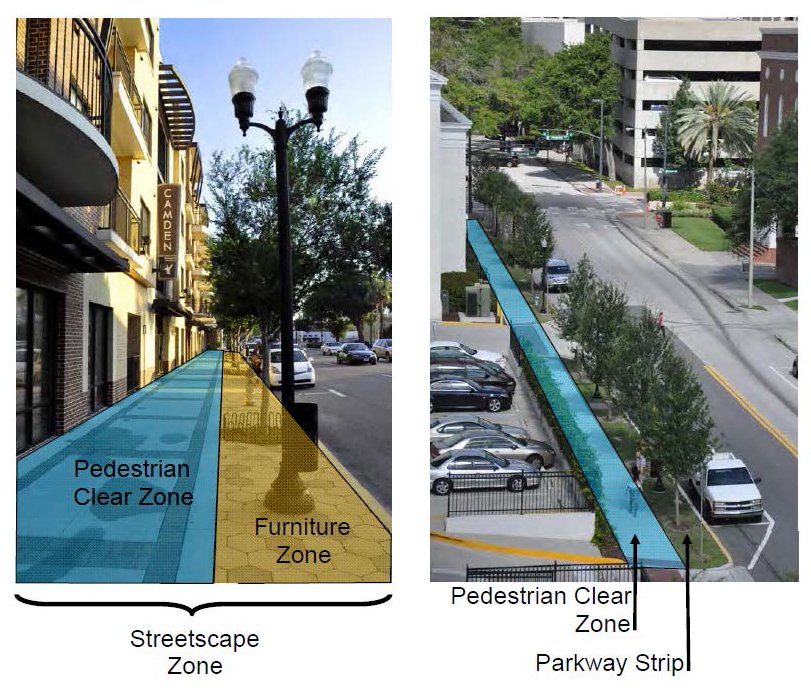
i.
Wireless communication facilities shall be set back a minimum of 25 feet from a traffic signal pole and a set back a minimum of 15 feet from any pedestrian ramp.
j.
Notwithstanding the above, the city may require greater setbacks from these and other fixtures in the right-of-way to ensure proper sign lines for public safety purposes.
k.
When adjacent principal use buildings are located within ten feet of the right of-way, wireless communication facilities shall be located between tenant spaces or adjoining properties where their shared property line intersect the right-of-way.
M.
Modification of existing wireless communication facilities. Co-location, removal, or replacement of reception or transmission equipment for an existing wireless communication facility shall be subject to a right-of-way utilization permit in public rights-of-way or on private roadways, either of which shall include an administrative review for compliance with this section, provided the modification does not:
1.
Increase the height of the wireless communication facility such that it would exceed the maximum height requirements of this schedule.
2.
Involve installation of more than the standard number of new equipment cabinets for the technology involved, not to exceed a total of four cabinets.
3.
Involve any excavation or deployment outside the current site of the wireless communication facility.
4.
Defeat the existing concealment elements of the wireless communication facility.
5.
Violate conditions associated with the prior approval of the wireless communication facility, except for addition of cabinets, or new excavation pursuant to the allowance of this section.
N.
Maintenance.
1.
All wireless communication facilities shall be maintained consistent with city approvals, the requirements of these land development regulations, and in good repair, including exterior finishes, surfaces and structures.
2.
Routine maintenance not modifying the wireless communications facility from the approved permitted drawings may be performed without a permit from the city.
3.
Damaged poles or facilities shall be immediately repaired, removed, or replaced. Within public-rights-of-way, in the event that damage to a wireless communication facility poses a safety hazard to the public, the city has a right of removal at the owner's expense.
4.
All safety practices require by applicable law or accepted industry practices and standards shall be used during the placement or maintenance of communications facilities and wireless communication facilities.
5.
The use of any portion of a wireless communication facility or support pole for the posting of signs or for advertising purposes, including, but not limited to the display of lights, banners and streamers, is strictly prohibited.
O.
Waivers. Waivers related to the following situations for wireless communication facilities located on private roadways or in rights-of-way may be granted by the administrative official upon finding that such waiver would not be contrary to the public interest:
1.
To increase the maximum height of a wireless communication facility up to ten percent if the increased height:
a.
Accommodates the co-location of antennas from more than one wireless provider; or
b.
Improve transmission impacted by surrounding buildings or topography, provided that there is adequate tree canopy to mitigate for the increase in height.
2.
To decrease the separation distance requirement between wireless communication facilities required in section 13.2.L by up to ten percent if:
a.
An existing utility pole is being replaced; or
b.
Impediments such as a dense tree canopy or tall structure interfere with signal transmission.
3.
To reduce the design requirements in section 13.2.K or the placement requirements in section 13.2.L when the administrative official finds the intent of the division is better served by such waiver.
P.
Compliance with franchise agreement. In addition to the requirements contained herein, all applications that involved the utilization of electric utility poles or facilities in city rights-of-way shall provided documentation that the electric utility has complied with the requirements of the franchise agreement for obtaining additional and separate permission from the city to utilize its electric utility system facilities in the city's right-of-ways to provide other, non-electric utility services or products.
Q.
Registration. Registration with the city is required pursuant to chapter 30, communication systems, of this Code prior to applying for permits to place, occupy, or maintain a communications system in the public right-of-way.
(Ord. No. 4427, § 2, 12-11-2017)
Section 14.0. - Compatibility standards for community resource facility.
Proposed community resource facilities shall provide any and all information necessary to ensure that such use(s) and/or activity(ies) are compatible with proximate uses and zoning. It shall be the responsibility of the applicant proposing a community resource facility to prove that the subject community resource facility is compatible prior to permitting such use. Compatibility criteria shall include the following in addition to other generally accepted planning practices and principles:
A.
Consistency with the City of Sanford Comprehensive Plan;
B.
Consistent with and supportive of the City of Sanford Strategic Plan, the Lake Monroe Waterfront and Downtown Sanford Redevelopment Plan and other plans and policies of the City of Sanford;
C.
A development plan that meets all requirements of the City of Sanford land development regulations including, but not limited to, adequate parking and traffic circulation facilities, building setbacks, landscape and buffer requirements;
D.
Separation of at least 1,500 feet from any other activity that the administrative official determines to be another community resource facility. The city commission may waive this provision during the approval process if the commission determines that the proposed community resource facility primarily serves the interests of the specific neighborhood. Churches shall not be included or otherwise considered regarding this 1,500-foot separation provision;
E.
Adequate soundproofing to ensure that noise does not unreasonably disturb neighbors;
F.
Adequate off-street parking and traffic circulation facilities to insure that adjacent neighborhoods and businesses are not adversely impacted by excessive on-street parking and/or traffic circulation;
G.
Provisions to ensure adequate police protection and related public safety considerations;
H.
The proposed use is not detrimental to the character or development trends in the area.
The planning and zoning commission is authorized to recommend and the city commission is authorized to impose reasonable and adequate stipulations and conditions upon community resource facilities in order to ensure that such facilities are compatible to adjacent properties and neighborhoods. The planning and zoning commission shall make a recommendation to the city commission. The city commission has final authority to approve, approve with conditions or deny the use of any property for a community resource facility.
(Ord. No. 3821, § 10, 12-8-2003; Ord. No. 3948, § 14.0, 8-8-2005)
Section 15.0. - Urban infill development projects.
A.
Purpose and intent. The purpose of the urban infill redevelopment program is to encourage the development of vacant infill tracts and lots throughout the city and the redevelopment of properties that may be problematic or otherwise unique. Acknowledging that it may not be economically feasible or attractive to develop or redevelop many of the smaller properties throughout the city under the existing land development regulations, the urban infill program gives the city the flexibility to determine the worthiness of those projects that cannot strictly comply with all the land development regulations that would normally be applied to the project provided that the project can meet the general intent of the comprehensive plan and the land development regulations as applied consistent with the purpose and intent of this section and sound and generally acceptable planning and land use principles and practices.
The urban infill redevelopment program ensures that the proposed development is designed and located utilizing innovative techniques and characteristics that are beneficial to the city. Criteria for the urban infill redevelopment (UIR) projects are intended to ensure that a proposed development improves the character of the neighborhood in which it is located and improves the city as a whole; that flexibility in the design is used to construct a project that is superior to a project strictly and rigidly designed consistent with the land development regulations; and that the use is compatible with the surrounding properties.
In exchange for a better project, the developer may vary some of the standards and criteria of the land development regulations including, but not limited to, density, building setback, height, lot size and floor area ratio pursuant to a negotiated development order with the city.
B.
Permitted use. Urban infill redevelopment projects are permitted uses in all zoning districts.
C.
Conditional use. All urban infill redevelopment projects shall be reviewed as conditional uses.
D.
Standards for nonresidential and multiple-family UIR projects. Nonresidential urban infill projects shall be consistent with the following criteria:
1.
The proposed land uses in the UIR project are permitted within the City of Sanford.
2.
The proposed land uses in the UIR project are compatible with adjacent land uses.
3.
The design creates a form and function that enhances the character of the community.
4.
The flexibility granted by the city, regarding densities, intensities, building height, lot width, building setbacks, and off-street parking standards, is justified by the benefits to the public good and the ability of the project to assist the City of Sanford in achieving its redevelopment, renewal and revitalization goals as stated in the Comprehensive Plan, the Strategic Plan, the Redevelopment Plan and Finding of Necessity for the Community Redevelopment Area (CRA) and/or the Downtown Sanford/Lake Monroe Waterfront Redevelopment Plan.
5.
Adequate off-street parking is available either on site or in the immediate vicinity through a shared parking agreement.
6.
The design of the proposed development complies with the design guidelines for the Downtown Historic District, if applicable.
7.
The proposed project is located in the established areas of the City of Sanford which are served by existing public facilities.
8.
The proposed project complies with the requirements of the St. Johns Water Management District.
E.
Criteria for residential UIR projects. Residential UIR projects shall be consistent with the following criteria:
1.
The proposed land uses in the UIR project are permitted within residential land use categories shown on the City of Sanford Future Land Use Map.
2.
The proposed land uses in the UIR project are compatible with adjacent land uses.
3.
The design creates a form and function that enhances the character of the community.
4.
The flexibility granted by the city, regarding building height, lot width, building setbacks, and off-street parking standards, is justified by the benefits to the community character.
5.
The development of the residential UIR project will improve the surrounding area.
6.
The design of the proposed development complies with the design guidelines for the Downtown Historic District, if applicable.
7.
The proposed project is located in the established areas of the City of Sanford which are served by existing public facilities.
8.
The proposed project complies with the requirements of the St. Johns Water Management District.
(Ord. No. 3821, § 10, 12-8-2003; Ord. No. 3948, § 15.0, 8-8-2005)
Section 16.0. - Multiple-family housing design guidelines.
A.
Purpose. These design guidelines are intended as a reference to assist the designer in understanding the city's goals and objectives for high quality, multiple-family residential development. Multifamily housing, because of its higher densities, tends to generate large parking areas and decreases private open space. If not properly designed, parking facilities can dominate the site and open spaces may be relegated to leftover areas, not related to the structures or the people who live there. The result of such a condition may be that the development is incompatible with existing and planned developments in the surrounding area. However, if special attention is paid to site and building design features, even large multifamily projects can be made compatible with the city's overall character and appearance. In the design of multifamily developments, emphasis should be placed on giving each unit or each small cluster of units a sense of individual identity rather than an anonymous "project" appearance.
B.
Applicability. These design regulations shall apply to all multiple-family residential developments except for those developments located in the Waterfront Downtown Business District (WDBD) where a higher density and more urban character is advocated.
C.
Site plan requirements.
1.
Project entries. The project entry provides the resident and visitor with an overview of the project. Special attention should be given to hardscape and landscape treatments to enhance the overall project image.
A project directory shall be provided near the entry to direct residents and visitors to recreational facilities, manager's offices, clubhouses and residential buildings.
The entry shall be gated. The development shall comply with sections 3.3 and 3.4 of Schedule J, Landscape, Buffer and Tree Requirements of the Sanford land development regulations. In addition, a minimum four-foot masonry wall shall be constructed along all property lines that are not required to have a visual screen pursuant to sections 3.3 and 3.4 of Schedule J, Landscape, Buffer and Tree Requirements of the Sanford land development regulations.
2.
Entry drives. The principal vehicular access into and through a multifamily housing project shall be by means of an entry drive rather than a parking drive. The entry drive shall be similar to a roadway in a single-family subdivision. The entry drive shall provide access to driveways and parking courts. A colored and/or textured paving treatment at the entry to the development is encouraged.
3.
Building siting. Residential buildings shall be sited to relate to the entry drives, so that their "best" side is facing the entry drive. All facades that face a curb or roadway shall be a single-family elevation.
4.
Clustering of units. Clustering of multifamily units shall be a consistent site planning element. Structures composed of a series of simple yet varied planes assure compatibility and variety in overall building form.
5.
Parking. Parking for residential buildings shall be either in garages, driveways or parking courts that are accessed from the main entry drives. Multiple, small parking courts shall be constructed in lieu of large lots. Parking areas shall be adjacent to, and visible from, the residential buildings that use them to allow for causal surveillance. Parking courts should be separated from each other by dwelling units or by a landscaped buffer not less than 30 feet wide. There should be no more than an average of ten spaces of uninterrupted parking, whether in driveways or open parking areas.
6.
Open space. There shall be a minimum of 50 percent open space in each multifamily development. Locate public open spaces so that they can be viewed from individual units.
7.
Mechanical equipment. All mechanical equipment, whether mounted on the roof or ground shall be screened from view. All screening devices shall be compatible with the architecture and color of the dwelling structures.
8.
Common facilities. Common facilities, such as club houses, laundries and management offices, shall be located centrally in the interior of the development and shall be linked to the residential buildings by lighted pedestrian pathways and common open space areas.
Street signs and streetlights shall be of a uniform and decorative design.
All dwelling units shall have individual street addresses.
All multifamily developments shall provide a covered shelter at the entrance to the development where children can wait for the school bus. The design and material of the shelter shall be consistent with that of the dwelling unit buildings and/or of the surrounding decorative wall.
Mail delivery areas shall be covered and conveniently located to the residential buildings.
Trash and recycling areas shall be landscaped on three sides and shall be located at convenient walking distances to each dwelling unit.
All multifamily developments shall contain recreational facilities for the enjoyment of the residents and their guests at a rate of 200 square feet per dwelling unit. Playgrounds shall be centrally located to allow for adult supervision from dwelling units or from a central facility such as a laundry.
All multifamily developments with more than 20 residential units shall contain an area designated and designed as a carwash facility.
D.
Building design. There is no particular architectural style proposed by these regulations for multifamily residential structures. The primary focus should be on constructing a high quality residential environment. The design of multifamily developments shall consider compatibility with the single-family character and scale of the city's residential areas.
1.
Units per building. There shall be no more than eight dwelling units per building.
2.
Building articulation. Long, unbroken facades and box-like forms shall be avoided. Building facades shall be broken up to give the appearance of a collection of smaller structures and each of the units shall be individually recognizable. This can be accomplished with the use of balconies and varied setbacks and projections which help articulate individual dwelling units or collections of units, and by the pattern and rhythm of windows and doors. The use of rows of balconies which give the building a "motel" look shall be avoided.
3.
Dwelling unit access. Breezeways shall be prohibited. Each dwelling unit shall be accessed by a private exterior entry. Entries shall be prominent and visible. This shall be accomplished through the use of distinctive architectural elements. Clusters of entrances shall be avoided. Ground-level entries are preferred for all units. Where exterior stairs are used to access upper-story units, they should be simple and clean and complement the architectural massing and form of the structure. Stairs should be made of smooth stucco, plaster or wood with accent trim of complementary colors. Thin-looking, open metal and prefabricated stairs are prohibited.
4.
Building height. The overall height of the buildings should be similar to that of other buildings in the neighborhood. Buildings shall be no more than two stories on properties adjacent to single-family dwelling units or single-family zoning districts. On other properties, buildings interior to the development and separated from adjacent properties by 200 linear feet and a two-story building may be three stories.
Building rooflines may exceed 35 feet in height provided that the height above 35 feet is for decorative purposes only and does not include habitable space. Rooflines should be varied in height and plane and contain dormers, pediments, chimneys, secondary hipped or gabled rooflines or other decorative embellishments to create visual variety and interest. The height of the roof shall be proportionate to the height and mass of the building.
5.
Balcony/porch requirement. All dwelling units shall have a useful private open space such as a balcony, porch, deck or patio.
6.
Garages and storage. At least 50 percent of the dwelling units in each building shall have garages accessed directly from the dwelling unit. Garages shall be counted toward the parking requirement.
Detached garages and storage units shall be designed in the same style and with the same materials as the dwelling unit buildings. Detached garages or storage units shall be provided in an amount not less than 20 percent of the total number of dwelling units.
All garages shall have sectional roll-up doors with automatic openers.
(Ord. No. 3821, § 10, 12-8-2003; Ord. No. 3948, § 16.0, 8-8-2005)
Section 17.0. - Adult arcade amusement centers.
A.
Conditional use required. Adult arcade amusement centers are hereby permitted in the MI2 and RI1 land use categories/zoning districts or classifications upon the granting of a conditional use/special exception issued in accordance with the processes and procedures set forth in this code; provided, however that bona fide charitable organizations that have been awarded section 501(c)(3) status under the Internal Revenue Code of the United States may operate five or fewer games of amusement, chance or skill on their premises which operation would otherwise subject the premises to regulation under the provisions of this ordinance.
B.
Locational standards for adult arcade amusement centers.
1.
Location. No conditional use/special exception shall be granted for an adult arcade amusement center that would be located within 1,500 feet of a parcel of property which is assigned a land use designation or zoning classification which permits a single family residence or on which a single family residence is located, another adult arcade amusement center, a public or private school, a day care facility, a church or house of worship, a public library, an alcoholic beverage establishment or a public park. The required 1,500 feet minimum separation shall be measured from the nearest point of one use to the nearest point of the other use in a straight line. An adult arcade amusement center shall not be located within the same development, plaza or center as any other adult arcade amusement center regardless of separation distances.
2.
Hours of operations. Adult arcade amusement centers are prohibited from being open past 11:00 p.m. and prior to 9:00 a.m.
3.
Signage. The use of any imagery on a sign referencing gambling including, but not limited to, slot machines, poker wheels, or any other similar machine or device shall not be permitted when visible from the exterior of the enterprise or business including, but not limited to, wall signage and window signage. The use of strip lighting is prohibited.
4.
Parking. Parking requirements for adult arcade amusement center shall be prescribed in the development order granting the conditional use/special exception.
C.
Special permit criteria. The following requirements shall apply to all adult arcade amusement centers and shall be set forth as conditions in all conditional uses/special exceptions issued to permit an adult arcade amusement center:
1.
The person operating or conducting the enterprise or business shall inform the city manager, or designee, as to changes in the information required in this section.
2.
A permit shall not be issued if a person with an interest in the enterprise or business, or an employee of the business, has been convicted of a violation of a federal or state statute or any local ordinance pertaining to gambling or any other crime involving moral turpitude within five years preceding the application for the conditional use/special exception.
3.
The applicant shall be 21 years of age or more.
D.
Occupational license and registration. The requirements set forth herein for the applicant for the conditional use/special exception shall apply to each and every subsequent owner and operator of the enterprise or business operating under the conditional use/special exception:
1.
As a prerequisite to the issuance of an occupational license for the enterprise or business, an inspection shall be made of the premises by the city building official, the city fire marshal, and the city chief of police, or their designee, each of whom must approve the issuance of such occupational license.
2.
Registration for each amusement device, however operated, is required at the time of application for an occupational license. For each machine registered, a numbered metal tag or plastic decal shall be issued to the applicant for each machine so covered. Application for machine registration stickers must disclose the location where the machine is to be operated, the manufacturer of the machine, the manufacturer's serial number, and the software version, if any. Registration stickers are not transferable from person to person, place to place, or machine to machine. No machine will be eligible for a registration sticker if its operation involves any material elements of chance, unless:
a.
The applicant submits with the application, satisfactory proof that the applicant has registered with the United States Department of Justice pursuant to 15 USC 1171; and
b.
The applicant submits with the application, the records required under federal law to be maintained by those who register under 15 USC 1171, and certifies the machine bears the permanent marking required by federal law.
3.
The applicant shall keep the registered machines, the records of acquisition, location and disposition required by federal law, and records of prize awards open to police inspection at any time.
E.
Applications. No person shall operate or conduct an adult arcade amusement center for use by the general public in the city for the reward of money or other reward without first obtaining an occupational license. A person desiring to apply for such a license shall make an application therefor in writing on a form prescribed by the city manager, or designee, which application shall set forth, at a minimum, the following:
1.
The name under which the enterprise or business is to be conducted;
2.
The location at which the enterprise or business is to be carried on;
3.
The name, address, and principal occupation of every person with an interest in the enterprise or business;
4.
The number of machines to be exhibited;
5.
The serial numbers, manufacturer, and name of each machine; and
6.
Whether the applicant has ever been engaged in operating an amusement arcade, of whatsoever type or nature, and when, where and how long in each place within five years preceding the date of application.
F.
Operations. The adult arcade amusement center shall conform to the following requirements:
1.
An adult who is 21 years of age or older shall be on the premises of the adult arcade amusement center and shall supervise the operation thereof at all times during all hours of operation.
2.
No alcoholic beverages including beer and wine shall be consumed on the premises of an adult arcade amusement center.
3.
No person under the age of 18 years is permitted on the premises of an adult arcade amusement center before 4:00 p.m. on any day the public or private schools are in session, unless such person is accompanied by his or her parent or legal guardian.
4.
The violation of any of the provisions of this ordinance shall be sufficient reason for the city commission to revoke the conditional use/special exception issued for the enterprise or business.
G.
Peace disturbances; gambling; intoxicated persons; minors. No licensee or owner of any adult arcade amusement center, or any servant, agent or employee of such a licensee or owner, shall permit upon the premises housing a mechanical amusement device arcade any of the following:
1.
Disorderly persons;
2.
Gambling, or the use, possession or presence of gambling paraphernalia;
3.
Intoxicated persons to loiter on the premises;
4.
Loud noise or music to emerge from the licensed premises, which noise or music is disturbing to the surrounding area; and
5.
Any licensee or owner, or any servant, agent or employee thereof, shall be presumptively deemed to have permitted the conduct enumerated in subsection (G) hereof if it occurs on the premises housing an adult arcade amusement center.
(Ord. No. 3821, § 10, 12-8-2003; Ord. No. 3948, § 17.0, 8-8-2005)
Section 18.0. - Townhouse standards.
A.
Intent. It is the purpose and intent of these regulations to provide for the design and development of innovative housing forms which incorporate a higher density living situation and at the same time preserve the desirability of an individually owned housing unit. This is accomplished by efficiently utilizing buildable space within a given area by allowing reduced lot size as well as lot width and compensating for the reduction by incorporating open spaces, scenic and recreational areas and other amenities. The following standards have been developed to apply to a variety of such attached and semi-attached housing forms including but not limited to townhouses.
Specifically, these regulations are formulated to allow the grouping of separately owned single-family dwelling units into a group of attached housing forms that will be both aesthetically pleasing and conscientiously designed as well as preserve the health, welfare, safety, and convenience of the surrounding neighborhood.
Requirements not listed in this section but noted elsewhere in the land development regulations shall apply unless specifically noted otherwise in this section.
Condominiums not designed to meet these townhouse standards must conform to the multifamily regulations (LDR Schedule E, section 16).
B.
Definitions. These definitions shall apply solely to townhouse developments.
1.
Project site. As used in this Schedule, a townhouse project site is the entire parcel of land for which townhouse units are proposed prior to the creation of any townhouse lots.
2.
Townhouse. Two or more attached privately owned single-family dwelling units that each share a common wall with the adjacent dwelling unit(s). A townhouse is not an architectural style and may contain any number of stories. All townhouses, however, have the following features:
Townhouses never have other units above or below;
Townhouses always have individual exterior entries;
Townhouses have no more than two walls that are common with adjacent units; and
Townhouses have a minimum heated living area of 1,400 square feet.
3.
Townhouse group. A cluster or grouping of townhouse units containing no less than two or more than eight townhouse dwelling units contiguous to each another.
4.
Townhouse lot. A townhouse lot may be either a properly recorded and deeded lot upon which a townhouse unit is located or a condominium unit.
C.
Location. Townhouses are permitted in the multiple-family residential MR-1, MR-2 and MR-3 zoning districts, the multiple-family residential office institutional (RMOI) zoning district, general commercial (GC-2), special commercial (SC-3) and the planned development (PD) zoning districts.
D.
Density. Overall density in a particular townhouse project shall not exceed the maximum density allowed within the zoning district in which it is located.
E.
Lot area. No townhouse lot shall contain an area of less than 1,800 square feet and a minimum lot and building width of 18 feet.
F.
Distances between townhouse groups. Townhouse groups, as defined in this chapter, shall be separated by at least 20 feet and, for each story over one, an additional five feet of separation is required. (Greater separation may be required by the city fire department.)
G.
Townhouse access. Each townhouse unit shall have two separate entries on the ground level.
H.
Garages and Parking Spaces. The parking requirement for each townhouse shall be two spaces. All parking spaces shall be accommodated on the townhouse lot. Each townhouse shall have at least a one-car garage. All garages shall have sectional roll-up doors with automatic openers. Garages shall be counted toward the parking requirement. It is preferred that garages be accessed from the rear of the townhouse lot by alleys or access tracts. Front-load townhouse garages shall not be placed side by side. Boats, recreational vehicles, travel trailers, trailers and similar vehicles shall not be stored in required parking spaces. The townhouse development shall provide parking areas for boats, recreational vehicles, trailers, etc., at a designated location on site. Overflow parking must be provided at a ratio of one space per four dwelling units at convenient locations throughout the site.
I.
Maintenance of common areas. All on site improvements, common areas and facilities including, but not limited to, all internal roadways, stormwater management facilities, recreational facilities, off-street parking and common open space must be privately owned and shall be maintained in a satisfactory manner without expense to the city. In order to ensure the maintenance of, and the payment of taxes on the commonly held nonpublic property, an operating homeowners association shall be created by the developer prior to the sale of any townhouse lot or condominium unit and be recorded in the public records of Seminole County if satisfactory to the city commission. Membership in the association shall be mandatory for all residential property owners within the development.
J.
Conversion. Conversion of existing structures to a townhouse project shall be avoided unless all townhouse development standards as outlined in this section are met without a variance. Compliance with all applicable building and fire codes is also required.
K.
Building and site design. There is no particular architectural style imposed by these regulations for townhouses. However there is a requirement that the front facades of the buildings utilize a variety of materials and be staggered a minimum of four feet with not more than two adjoining units at the same setback. The primary focus should be on constructing a high quality residential environment and avoiding the sameness that comes with an identical straight-line design.
1.
Project entries. The project entry provides the resident and visitor with an overview of the project. Special attention should be given to hardscape and landscape treatments to enhance the overall project image.
The entry shall be gated. The development shall comply with all landscape, buffer and tree requirements of the city's land development regulations. In addition, a minimum four-foot masonry wall shall be constructed along all property lines that are not required to have a visual screen.
2.
Common facilities. Common facilities shall be conveniently located and linked to the residential buildings by lighted pedestrian pathways and common open space areas.
Street signs and street lights shall be of a uniform and decorative design.
All dwelling units shall have individual street addresses.
3.
Setbacks. Yard requirements for front and rear yards and for yards of end dwelling units of townhouse structures shall be the same as the underlying district. Setbacks for the project shall be pursuant to Schedule C and/or Schedule J, as applicable.
4.
Open space. Open space requirements shall be the same as the underlying zoning district, except that open space on individual townhouse lots may exceed such requirements provided that the aggregate open space on the project site shall be same as the underlying zoning district.
5.
Siting of townhouse groups. An efficient and harmonious grouping of structures and space is consistent with sound and generally accepted planning practices and principles and which encourages the individuality of separate townhouse dwelling units within a unifying design concept. The spacing between structures within the project must meet the requirement of this section and should be compatible with spacing between structures in the surrounding neighborhood.
6.
Design of townhouse structures. The design of the townhouse structures and overall site plan shall be compatible with the physical characteristics of the site, with the buildings adjacent to the site, and with the character of the neighborhood. Design compatibility of buildings includes harmonious building style, form, size, color, materials and relationship to site topography. A compatible design is one that preserves or improves the existing neighborhood character, facilitates efficient and convenient internal circulation, is functionally related to the natural topography, utilizes natural characteristics of the site and is an asset to the community.
a.
No more than two abutting townhouses may have a common front building setback.
b.
Variations in the setback of front facades shall be at least four feet.
c.
The roof covering must be tile or architectural shingles or an approved upgrade alternative. Alternative coverings are subject to approval by the planning commission.
d.
Roof style and height variations are encouraged, and shall be incorporated where feasible in the townhouse design.
L.
Trash and recycling. Trash and recycled items shall be picked up at each unit in the same manner as a single-family dwelling. Dumpsters, compactors and recycling areas may be used if designed to fit into the community. Enclosures must be designed to disguise the equipment and fit with the overall design. Locations must be convenient to all homes and easily accessible.
M.
Mechanical equipment. All mechanical equipment, whether mounted on the roof or ground shall be screened from view. All screening devices shall be compatible with the architecture and color of the dwelling structures.
(Ord. No. 3948, § 18.0, 8-8-2005)
Section 19.0. - Exceptional uses.
Exceptional uses are often distinguished by poorly maintained facilities that are not consistent with the character and values of the city. These uses often require additional regulations to ensure that the business is in harmony with the goals and vision of the city. Exceptional uses include, but are not limited to, check cashing facilities, tattoo parlors, body piercing facilities, pawn shops, blood plasma centers, fortunetellers, psychics and palm readers.
A.
Location. An exceptional use shall not be located within a radius of 1,500 feet of another exceptional use nor shall such use be located within 300 feet of a school, church, park or residentially zoned land.
B.
Design. An exceptional use shall be housed in a building that complies with the following regulations:
1.
The building in which the use is located is a building that conforms to all current land development and building regulations.
2.
The building in which the use is located shall be painted in muted colors and finished in materials that are consistent with the character of the city.
3.
There shall be no security bars on the outside of doors or windows visible from a public right-of-way.
4.
Exterior phones and roll up doors shall be prohibited.
5.
Windows shall not be obscured by the placement of signs, dark window tinting, shelving, racks or similar obstructions.
C.
Hours of operation. Exceptional uses shall operate only between the hours of 7:00 a.m. and 10:00 p.m.
D.
Maintenance. The building and site shall be maintained in a neat, clean and orderly condition.
(Ord. No. 3948, § 19.0, 8-8-2005)
Section 20.0 - Right-of-way use in Special Commercial (SC-3) Zoning.
A.
Purpose. The purpose of this section is to support the growth of business, cultural, artistic, and creative endeavors, while ensuring public safety, the smooth flow of pedestrian travel and unobstructed access to structures and facilities while also providing positive visual amenities, enhanced business opportunities and enhanced quality of life for pedestrians through the accommodation of the development of orderly use of sidewalks in the Special Commercial (SC-3) zoning district.
B.
Applicability. Right-of-way use may be permitted on public sidewalks and public plazas in the SC-3 zoning district to accommodate sidewalk cafés, outdoor display, outdoor art, outdoor entertainment, A-frame signs, and planters as accessory uses to the following:
1.
Immobile retail establishments;
2.
Immobile food service establishments;
3.
Immobile beverage establishments with a valid consumption-on-premise license or a package license only.
Right-of-way use is generally prohibited for alcoholic beverage uses at sidewalk cafés except that alcoholic beverage establishments with a quota lawfully possessing a state license which license is assigned the 2-COP or 4-COP license classification permitting the sale of beer and wine may serve beer and wine at sidewalk cafés; provided, however, that only beer and wine may be served at sidewalk cafés in a manner authorized by controlling state law. The owner or operator of a sidewalk café serving either beer or wine shall provide a copy of the state license authorizing such sale at any time requested by city personnel.
C.
Definitions.
Artwork—A sculpture, portable painting, earthwork, print, calligraphy, or other form of physical hard media.
Outdoor art—Use of a public sidewalk, right-of-way, or plaza by an eligible establishment for the creation of artworks.
Outdoor art zone—The area permitted for the use of artist(s) for the creation of artworks. Outdoor art zones may include seating for the artist, easel, moveable workstation for art supplies, mechanical equipment for the creation of artworks, such as a lathe.
Outdoor entertainment—Use of a public sidewalk, right-of-way, or plaza by a retail, food service and/or beverage establishment for live entertainment. The use will be characterized by live music and/or other performing acts such as dance, juggling, magicians, face painters, balloon modeling, portrait painters, caricature artists, performance of acts of skill, and other types of approved entertainment within a specified area.
Pedestrian zone—The area of a sidewalk reserved for pedestrian traffic and which shall be kept free of any obstructions to traffic.
Permit area—The sidewalk area designated on a permit specifying the area of operation for the approved right-of-way use.
Permittee—The person or entity operating a retail, food service and/or beverage establishment who has received a permit authorizing right-of-way use.
Planter—Is a container in which plants are grown and includes hanging baskets, flower boxes, and pots.
Right-of-way use permit—A permit issued by approval of the administrative official and/or the development review team for right-of-way use based on the conditions outlined herein.
Sidewalk café—A use of a public sidewalk, right-of-way, or plaza by a food service and/or beverage establishment for the serving of food and beverages. The use will be characterized by the outdoor use of tables, chairs and umbrellas and appurtenant items associated with the use.
Sidewalk café elements—All tables, chairs, umbrellas, plants, planters, awnings, barriers and any other items of the sidewalk café, which are approved in the right-of-way use permit.
D.
General standards for right-of-way use.
1.
All employees shall be subject to and comply with all applicable requirements including, but not limited to, the following:
• Patrons shall wear shoes and shirts at all times.
• All permit areas shall have an opening for ingress and egress at all times such that pedestrian traffic on the sidewalk may continue unimpeded.
• All right-of-way uses shall adhere to the requirements of this Section and the size, design, layout and any other specifications approved by the city.
• Employees and/or performers shall be fully clothed at all times in attire which shall not be offensive to the general public as determined by the administrative official utilizing contemporary community standards and subject to appeal in accordance with the provisions of this Code.
• All outdoor entertainment shall promote a family friendly atmosphere and may not use elements that are inconsistent or incompatible with contemporary community standards.
2.
Where the city has installed a permanent structure such as a parking meter, planter, light pole or other device, the permittee shall accommodate the required clearance for pedestrian passage. Permittees shall respect the rights of pedestrians traveling past the permit area at all times during the operation of the right-of-way use.
3.
All areas within and surrounding the permit area shall be maintained in a clean, neat, safe, and sanitary condition and shall be policed routinely by the permittee to ensure removal of all wrappings, litter, debris and food. The permittee shall accomplish a daily sanitary cleaning of the permit area. Sidewalks within and adjacent to the permit area shall be swept daily and washed down as needed with mild soap and water. The permittee shall not wash garbage cans or any other container, or other personal property of any nature on the sidewalks. All cleaning shall be performed by the permittee in accordance with applicable federal and state regulations. The permittee shall not use bleach or harsh chemicals on the sidewalk.
4.
The hours when service is allowed within the permit area shall be during the business hours of the permittee.
5.
Cooking and food preparation within the permit area are prohibited and unlawful.
6.
All areas permitted for outdoor art shall use plain brown masking paper (contractor's paper) to protect the work area from damage as well as to delineate the work space. The paper shall be of a suitable thickness to prevent damage to the sidewalk/work area, and shall be secured to the sidewalk with removable tape all as determined by the city.
7.
The use of flammable materials, fire, and aerosols within the permit area are prohibited and unlawful.
8.
It is prohibited and unlawful for a performer or entertainer to accost any person for the purpose of performing or soliciting donations for performance.
9.
Live music entertainment is limited to a maximum of two performers using hand held acoustic instruments.
10.
All live entertainment which incorporates sound into the performance shall be limited to the hours of 5:00 p.m. through 9:00 p.m. Monday through Thursday, from 2:00 p.m. though 9:00 p.m. on Friday and Saturday, and from 2:00 p.m. through 6:00 p.m. on Sunday.
11.
All outdoor entertainment and performing acts shall abide by the city's noise ordinance and may not produce sounds which constitute a nuisance or obscenity. Permittees are required to sign off on receipt and acknowledgement of the city's noise ordinance. No entertainer/performer may amplify sound electronically or otherwise.
12.
All outdoor entertainment and performing acts shall abide by the city's adult entertainment ordinance. Permittees are required to sign off on receipt and acknowledgement of the city's adult entertainment ordinance.
13.
The use of flammable materials, flame, pyrotechnics, chemicals, and aerosols within the permit area is prohibited and unlawful. No entertainer/performer may use any knife, sword, torch, flame, axe, saw, firearm, or other hazardous or potentially hazardous material, equipment, animal, or object that can cause serious bodily harm to any person, or engage in any activity that can cause serious bodily injury to any person.
14.
An entertainer/performer will be liable for any damages or injury to the public resulting from his/her entertainment activities, and will hold the city, its officials and employees, harmless against any and all liability, loss, costs, damages, or expenses which may accrue to the city by reason of negligence, default, or misconduct of any entertainer.
15.
An entertainer/performer may not block or obstruct the free movement of pedestrians. A police officer, fire official, code enforcement official, or other authorized city official may disperse any portion of that crowd that is blocking the public way. If the entertainer/performer cannot conduct a performance without blocking public passage, such city officials may cause the entertainer/performer to leave location.
16.
The storage or mixture of alcoholic beverages in the sidewalk café area is prohibited and unlawful. Equipment necessary for the dispensing of any other items shall be reported as part of the operation of the sidewalk café during the permitting process and is subject to review and approval.
17.
Sidewalk cafés shall be permitted to serve alcohol only to patrons who are seated in the establishments' designated café seating area.
18.
Outdoor dining on private property adjacent to and/or visible from the public right-of-way shall adhere to the requirements outlined herein.
19.
A right-of-way use permit may not be transferred to another address or to another permittee.
20.
Approved right-of-way uses shall abide by the city's noise ordinance.
21.
Complaints regarding right-of-way uses will be investigated by the city and violations of applicable Code provisions, ordinances or rules and regulations will result in citations being issued to the permittee and/or revocation of permittee's right-of-way use permit.
22.
It is the responsibility of the permittee to adequately secure or remove all outdoor components during periods of high winds. All permitted features shall be secured inside by the permittee when a hurricane warning is issued. The issuance of such a warning shall constitute an emergency situation. The city and its officers and employees shall not be responsible for property and fixtures relocated during emergencies.
E.
Design standards. The following design standards shall apply to all right-of-way use permits:
1.
Space and clearances.
a.
Right-of-way use may only be permitted on a sidewalk with a minimum width of ten feet from the property line to face of curb. The area designated for the right-of-way use shall be considered an extension of the franchise. Therefore, the location of the right-of-way use will be restricted to the length of the sidewalk or public right-of-way immediately fronting (measured parallel to the front lot line) the business and may not extend beyond the frontage of the business.
b.
Right-of-way uses shall maintain a clear pedestrian zone of six feet minimum at all times. In areas of higher pedestrian traffic or activity, or in conditions that suggest the need for additional clearance, all as determined by the city, a clear pedestrian path greater than six feet may be required by the city. This area shall be free of any obstructions such as trees, parking meters, utility poles and the like in order to allow adequate pedestrian movement.
c.
Right-of-way use elements shall not interfere with any utilities or other facilities such as telephone poles, fire hydrants, trash receptacles, trees, posts, curbs, signs, parking meters, mailboxes, or benches located on the sidewalk or public right-of-way.
d.
Right-of-way uses shall not impinge or encroach upon any required clear distances for maneuvering around entrances or exits. The permitted area shall be accessible to disabled patrons and employees, and buildings adjacent to a dining area shall have adequate ingress and egress as required by applicable codes and ordinances.
e.
Right-of-way uses shall be located a minimum five feet from pedestrian crosswalks, handicap corner cuts, bus stops, taxi-stands, fire hydrants, driveways and alleys, and ten feet from intersections. These requirements may be modified by the city upon application by the permitted and issuance of a development order, through the city's variance processes, when it is found and determined by the city that unusual circumstances exist that justify the modification.
2.
Furniture, objects, structures and décor.
a.
Right-of-way use elements may consist of some or all of the following: removable barriers, operable facades, café umbrellas, outdoor tables and chairs, fans, and outdoor radiant heating.
b.
Right-of-way use elements shall be of quality design, materials and workmanship, as determined by the city, to ensure the safety and convenience of users and to enhance the visual and aesthetic quality of the urban environment. Tables and related fixtures shall be of significant weight to prevent easy toppling in significant winds as determined by the city. Right-of-way use elements shall be of uniform color, design and style. All elements shall be of commercial grade. Tables and chairs shall be of wrought iron, cast aluminum, steel, heavy grade commercial wood such as farmed exotics or similar materials. Indoor furniture, tables and chairs of plastic, PVC or residential grade are prohibited. A photograph, brochure or design plan shall be submitted to the city for review and approval of the types of furniture, menu boards or other elements to be used by the applicant.
c.
All hanging baskets, flower boxes and pots shall be made for outdoor use. A photograph or brochure will be required for approval of the planter(s) proposed by the applicant.
d.
Planters shall be potted with live plants and flowers during temperate months, and removed during the remainder of the year. To promote a vibrant and interactive sidewalk environment, plant material shall not exceed 48 inches in height measured from the pavement.
e.
If movable planters are used, they shall be at least 20 inches in height and no wider than two feet at the base. Moveable planters may only be constructed of wood or metal.
f.
Tables and chairs shall be placed in the area designated for the right-of-way use only. Appropriate density of tables and chairs will be subject to review and approval by the administrative official and/or the development review team and may be affected by specific conditions of the location. Table sizes shall be kept to a minimum in order to not cause crowding, a disturbance or a nuisance. The maximum allowable dimension for tables shall be 36 inches in diameter, 36 inches in width or length, and 30 inches in height.
g.
Permanent structures prohibited and unlawful. All right-of-way use elements shall not be attached permanently to the sidewalk or public right-of-way. The permittee shall be responsible for the restoration of the sidewalk or public right-of-way if any damage is caused as a result of the issuance of a right-of-way use permit.
h.
It is prohibited and unlawful to permanently or temporarily anchor anything to any portion of the right-of-way.
i.
It is prohibited and unlawful to attach any sign that is not included on the approved plan to any right-of-way use element. A-frame signs shall be free-standing and may not be secured to the sidewalk.
j.
Paper, plastic and Styrofoam products for the consumption of food or beverages are prohibited and unlawful. The administrative official and/or development review team may exempt a café from this regulation upon a finding that the café is self-service and does not employ a wait staff and upon a finding that the permittee shall be responsible for the proper disposal of all products associated with food consumption in his own trash receptacles.
k.
No awning, canopy, or covering of any kind, except individual table umbrellas, are permissible over any portion of the outdoor dining located on public property. Fencing, railing, plantings, or approved café barriers may be erected to delineate the outdoor seating area in the public right-of-way with the approval of the administrative official and/or the development review team. Such appurtenances may not be permanently or temporarily anchored to any portion of the right-of-way.
l.
Displays shall generally be located directly in front of the storefront for which it is intended. Doorways shall not be blocked.
m.
Displays shall not hang from aerial braces but shall rest on the ground.
n.
Displays shall not be allowed when the business is not open.
o.
Displays shall not exceed 30 inches in height.
p.
Displays shall not project more than 24 inches from the building wall facing the street.
q.
Displays shall be not more than two-thirds of the window area as measured in square feet.
3.
Umbrellas. Umbrellas may be utilized if approved by the administrative official and/or development review team as a part of the permitting process. The use of removable umbrellas may be permitted provided they do not interfere with street trees or encroach into the pedestrian zone. No portion of the umbrella shall be less than seven feet above the sidewalk. Umbrella structures shall be designed to be secure during windy conditions and shall be weather resistant. Umbrellas shall be made of canvas or other non-vinyl materials, and shall be cleaned and maintained regularly. Solid-colored umbrellas are recommended; fluorescent colors are prohibited. Umbrellas shall match in all visual qualities, including dimension, color, texture, and fabric as determined by the city. Umbrellas shall be designed for outdoor commercial use, shall be freestanding or table-anchored, and shall not be fastened to the ground.
4.
Removable barriers. Removable, freestanding barriers may be used to establish the boundary of right-of-way use areas. Removable barriers may include café barriers, rope and stanchions, chains and bollards, planter boxes or freestanding fences (between 20 inches to 36 inches in height). Barriers for right-of-way use zones may not be anchored to the ground, to buildings, to trees, or to other street furniture. If used as removable barriers for sidewalk cafés, planter boxes shall be made of safe, sturdy, durable and attractive materials. They shall be 20 inches to 30 inches in height, and no wider than two feet at the base, but shall, at all times, be subject to city approval. Planters shall be potted with live plants and flowers at all times and plant material shall not exceed 48 inches in height measured from the pavement. Removable barriers may be allowed by the city provided the permittee obtains all necessary approvals for such removable barriers from the administrative official and/or development review team and from the historic preservation board, if applicable.
5.
Lighting. Lighting may be utilized if approved by the administrative official and/or development review team as a part of the permitting process. Any such lighting shall compliment the existing building and shall not cause a glare to passing pedestrians or vehicles. Electrical wires are prohibited and unlawful in the permitted area. Possible alternative lighting sources include tabletop candles or low wattage battery operated fixtures. Additional lighting may be attached to the permittee's adjacent establishment provided permittee obtains all necessary approvals for such lighting from the city and the historic preservation board, if applicable.
6.
Outdoor heaters. Outdoor heaters may be utilized upon the approval of the administrative official and/or development review team as a part of the sidewalk café permitting process. All heaters shall be UL (Underwriters Laboratories, Inc.) approved or FM (Factory Mutual) approved.
7.
Vending machines, carts prohibited. Vending machines, carts, or objects for the sale of goods are prohibited and unlawful in the permitted area.
8.
Service and use. All services provided to patrons and all patron activity (i.e., sitting, dining, waiting, etc.) shall occur within the designated permitted area, and shall not impinge or encroach upon the required clear distance for pedestrian passage at any time. Supervision of the permitted area to ensure that the conduct of patrons and operations are in compliance with this Section is the responsibility of the permittee. Subject to the requirements of this Section the permittee shall, as part of the right-of-way use permit, be entitled to remove or exclude persons from the permit area during hours of business operation consistent with all applicable law. No cover charge or minimum purchase may be required for admittance to a permitted area in the public right-of-way.
F.
Insurance required.
1.
Each permittee shall furnish to the city a certificate of insurance evidencing commercial general liability, public liability, food products liability (food serving establishments only), and property damage insurance from all claims and damages to property or bodily injury, including death, which may arise from operations under the permit or in connection therewith.
2.
The insurance shall have limits of not less than $1,000,000.00 per occurrence, $1,000,000.00 in the aggregate combined single limit, for bodily injury, personal injury and property damage liability. The insurance shall provide for 30 days prior written notice to be given to the city if coverage is substantially changed, canceled or non-renewed. At least ten days prior to the expiration date of insurance coverage, the permittee agrees to deliver to the planning and development services department a certificate of insurance naming the city as additional insured. All insurance requirements shall be subject to approval by the city's risk manager.
3.
The city, its officers and employees shall be named as an additional insured on a primary, noncontributory basis for any liability arising directly or indirectly from the operation of a right-of-way use; and the permittee shall indemnify, defend and hold the city harmless from any loss that results directly or indirectly from the permit issuance or the operation of the right-of-way use.
4.
If alcoholic beverages will be served at a sidewalk café, the permittee shall provide proof of liquor liability insurance for the sidewalk café, with limits of not less than $1,000,000.00 in such type as shall be acceptable to the city. All insurance requirements shall be subject to approval by the city's risk manager.
5.
Each permittee shall maintain the insurance coverage required under this section during the permit period. The certificate(s) of insurance shall be presented to the administrative official prior to the issuance of a permit under this section. Failure of the permittee to maintain the insurance required by this section shall result in the revocation of the right-of-way use.
6.
The permittee shall hold harmless the city, its officers and employees and shall indemnify the city, its officers and employees from any claims for damages to property or injury to persons that may be occasioned by any activity carried on under the terms of the permit. Acceptance of the permit shall act as acceptance of this condition and requirement.
G.
Procedures.
1.
All right-of-way use elements shall be subject to review and approval by the administrative official and/or development review team which shall approve, approve with conditions or deny the application for a right-of-way use permit. If located in a historic district, the right-of-way use elements shall also obtain a certificate of appropriateness.
2.
In reviewing right-of-way use elements, the administrative official and/or development review team shall consider the character and appropriateness of design including, but not limited to, scale, texture, materials, color and the relation of elements to the adjacent establishments, to features of structures in the immediate surroundings, as well as to the streetscape and adjacent neighborhood(s), if applicable.
3.
No permit shall be issued pursuant to this section unless the administrative official has determined the following by clear and convincing evidence:
a.
There are no outstanding code enforcement violations, fines, fees, taxes or other charges due and owed to the city by the applicant or the owners of the real property on which the right-of-way use is to be located. All outstanding debts to the city shall be paid in full prior to the issuance of a right-of-way use permit.
b.
The applicant has supplied all of the information required on or by the application, and any additional information requested by the administrative official and/or development review team.
c.
All of the requirements of this section have been met.
4.
The administrative official and/or development review team may impose conditions upon the issuance of a right-of-way use permit in order to protect the use of adjacent right-of-way for its intended purpose, to prevent congestion of vehicular or pedestrian traffic flow and to otherwise carry out the purpose and intent of this section, this article and this Code.
5.
The approval of a right-of-way use permit is conditional at all times. A right-of-way use permit may be revoked or suspended by the administrative official and/or development review team upon a finding that one or more of the conditions of this section have occurred, or the right-of-way use zone is being operated in a manner which constitutes a nuisance, that the use unduly impedes or restricts the movement of pedestrians, or that the use in any way constitutes a public liability or a danger to the public. The revocation or suspension will be in writing, setting forth specific reasons and providing an effective date. Grounds for revocation or suspension of a right-of-way use permit may be based on (but are not limited to) the following:
a.
Any necessary business or health permit or license has been suspended, revoked or canceled.
b.
The permittee does not have insurance which is correct and effective in the minimum amounts required by the city.
c.
Upon receipt of evidence that the permittee has violated state alcoholic beverage requirements.
d.
The permittee exceeds the approved square footage by placing any additional tables, chairs, or other elements within and beyond the approved area.
e.
The permittee has failed to correct violations of this division or conditions of this permit within 72 hours of receipt of a code enforcement notice of such violations delivered in writing to the permittee.
6.
Right-of-way use permits shall be subject to review, approval and renewal based on the right-of-way use regulations in place at the time of renewal and no vested right of any type or nature shall inure to a permittee and all permits issued shall be subject to this condition. Acceptance of the permit shall act as acceptance of this condition and requirement.
7.
Fees shall be established by resolution of the city commission.
(Ord. No. 3948, § 20.0, 8-8-2005; Ord. No. 4258, § 1, 12-12-2011)
Sec. 21.0. - Drug stores and medical marijuana dispensaries.
A.
Purpose. The purpose of this section is to protect the public health, safety, and welfare by prescribing the manner and standards under which a pharmacy/drug store and a medical marijuana dispensing facility may be approved for locating and conducting business in the city. The land development regulations of this section are intended to:
1.
Provide for the lawful, safe sale and distribution of pharmaceuticals including, but not limited to, marijuana for medical use, as authorized by controlling state law, to qualifying persons who are authorized to legally obtain, possess and use medical marijuana under controlling state law or to personal caregivers authorized to obtain and possess medical marijuana in accordance with controlling state law; and
2.
Promote and protect the character and vitality of the city's residential neighborhoods and commercial districts through site development standards for pharmacies/drug stores and medical marijuana dispensaries and limit the location of pharmacy/drug store and medical marijuana dispensaries; and
3.
Protect sensitive land uses from the potential adverse impacts of pharmacies/drug stores and medical marijuana dispensaries by requiring physical separation between such uses as schools; and
4.
Prohibit any cultivation and processing of marijuana within the city limits.
The legislative intent expressed in the enacting ordinances pertaining to the above matters shall also be expressions of the purpose of this section.
B.
Land use regulatory provisions. The following land development regulations shall apply to the location of pharmacies/drug stores and medical marijuana dispensing facility facilities authorized under controlling state law.
1.
Location. A pharmacies/drugs store and medical marijuana dispensing facilities shall not be located within 1,500 feet of another pharmacy or medical marijuana dispensing facility. A pharmacy or medical marijuana dispensing facility shall not be located within 500 feet of the real property that comprises a public or private elementary school, middle school, secondary school or daycare facility unless the planning and zoning commission approves the location as a conditional use at a public hearing, by determining that the proposed use primarily serves the interests of the specific neighborhood and that decision is ratified at a public hearing held by the city commission.
2.
Whenever a pharmacy/drug store or medical marijuana dispensing facility has been lawfully located pursuant to the conditional use process set forth herein and, thereafter, a public, or private elementary school, middle school, secondary school or daycare facility be established within a distance otherwise prohibited by this section, the establishment of such use shall not be cause for revocation of the approved conditions use and shall be deemed existing and lawful non-conforming use.
3.
Distance shall be measured by drawing a straight line between the perimeter property line of the site occupied by the medical marijuana dispensing facility use to the closest property line of the school. These distance separation requirements apply without regard as to whether the uses and facilities are located within or outside the city limits.
C.
Prohibited activities. The preparation, wholesale storage, distribution, cultivation, growing or processing of any form of marijuana or marijuana delivery device and onsite consumption of any marijuana is specifically prohibited at a pharmacy/drug store or medical marijuana dispensing facility.
D.
Performance standards and conditions. All pharmacy/drug store or medical marijuana dispensing facilities shall comply with the following standards:
1.
Drive-through window/facilities are subject to the following:
a.
Limited to pharmacy/drug stores and medical marijuana dispensaries with at least 14,500 square feet and no more than 80,000 square feet.
b.
Pharmacy/drug stores and medical marijuana dispensing facilities with less than 14,500 square feet shall not have a drive thru or drive-in service. All sales, purchases and dispensing shall occur inside the facility.
c.
Pharmacy/drug stores and medical marijuana dispensing facilities shall provide adequate seating for its customers and business invitees and shall not allow customers or business invites to stand, site (including in a parked car), or gather or loiter outside of any building, including in any parking areas, sidewalks, rights-of-way, or neighboring properties for any period of time longer than that reasonably require to arrive and depart.
d.
Pharmacy/drug stores and medical marijuana dispensing facilities shall meet all off-site parking requirements as set forth in Schedule "H" for retail sales and service within the commercial parking category and any parking demand created by the pharmacy/drug store or medical marijuana dispensing facility shall not exceed the parking spaces located or allocated on-site.
E.
Major conditional use approval required.
1.
Any person seeking approval to locate a pharmacy/drug store or medical marijuana dispensing facility that does not meet the location criteria as set forth in this section shall be allowed as a major conditional use upon application, hearing and approval as provided in the Land Development Regulations. An application for a major conditional use of pharmacy/drug store or medical marijuana dispensing facility may be denied, approved or approved with conditions. In considering an application for major conditional use pursuant to this section, the planning and zoning commission and the city commission shall consider the following criteria:
a.
Compatibility of the proposed facility with the surrounding uses;
b.
The size of the lot on which the proposed facility will be located;
c.
The maximum number of persons that can occupy the proposed facility;
d.
The amount of traffic generated by the proposed facility;
e.
The general, health, safety and welfare of the community;
f.
All safety measure to be implemented by the applicant to protect the property, employees and invitees during and outside of its operating hours; and
g.
Meeting all the performance standards and conditions as set forth in this section.
2.
Each application for a major conditional use for pharmacy/drug store or medical marijuana dispensing facility shall be accompanied by a site plan. The site plan shall be drawn to scale indicating property lines, rights-of-way, adjacent uses, and the location of buildings, parking areas, curb cuts and driveways. The site plan shall be submitted to and considered by the planning and zoning commission and the city commission as provided for in the Land Development Regulations prior to the granting of a building permit. Upon such approval, said site plan becomes a part of the building permit and may be amended only by action of the city commission after recommendation by the planning and zoning commission.
F.
Conditional use approval duration.
1.
A conditional use approval for a pharmacy/drug store or medical marijuana dispensing facility shall expire 12 months after approval if the use is not implemented, pursuant to the conditional use procedures set forth in the Land Development Regulations.
2.
Otherwise, a conditional use approval shall remain valid for the duration of the business operation of the pharmacy/drug store or medical marijuana dispensing facility subject to the following:
a.
Complete and continuous compliance with the conditions of approval, all state laws, and all licensing, permitting and operational requirements;
b.
For medical marijuana dispensing facility, sales and dispensing shall be only for marijuana approved by the State of Florida for sale for medical purposes; and
c.
The characteristics of the business and use impact remain the same as set forth in the conditional use approval.
G.
Revocation of conditional use approval; penalties.
1.
Any conditional use approval granted under this section shall be immediately terminated if any of the following occur:
a.
The pharmacy/drug store or medical marijuana dispensing facility owner/operator or owner of the property upon which a pharmacy/drug store or medical marijuana dispensing facility is located provides false or misleading information to the city; or
b.
Anyone on the premises knowingly dispenses, delivers, or otherwise transfers marijuana or marijuana delivery device to an individual or entity not authorized by state law to receive such substance or product; or
c.
The pharmacy/drug store or medical marijuana dispensing facility owner/operator fails to correct any City Code or ordinance violation or to otherwise provide an action plan to remedy the violation acceptable to the city within the timeframes and compliance deadline provided in the notice of violation; or
d.
The pharmacy/drug store or medical marijuana dispensing facility owner/operator fails to correct any state law violation or address any warning in accordance with any corrective action plan required by the state within the timeframes and completion date the pharmacy/drug store or medical marijuana dispensing facility owner/operator provide to the city; or
e.
The state license of the pharmacy/drug store or medical marijuana treatment center under which the medical marijuana dispensing facility is operating authorizing the dispensing of marijuana and marijuana delivery devices expires or is revoked; or
f.
The pharmacy/drug store or medical marijuana dispensing facility dispensing facility owner/operator fails to comply with all conditions set forth in the conditional use approval.
2.
Notwithstanding any provision of this section to the contrary, the city may proceed with any legal remedy or code enforcement process available to it under controlling state law and the penalty provisions of section 1-7 of the City Code shall be fully applicable.
H.
Existing non-conforming uses. Any pharmacy/drug store that is licensed pursuant to F.S. ch. 465, and was approved by the city through a final development order or business tax receipt prior to the effective date of the ordinance from which this section is derived, is permitted to continue operating and continue operation as a lawful nonconforming use if said business is located in a zoning district/classification that does not allow a pharmacy/drug store does not meet the locational criteria as set forth in this section.
I.
Expansion of an existing non-conforming uses. Any pharmacy/drug store that is licensed pursuant to F.S. ch. 465, and enlarges, alters or expands beyond the scope and area of its operation shall be subject to the conditional use procedures and provisions as set forth in this section.
(Ord. No. 2018-4434, § 2(d.)(Exh. C), 2-26-2018)

