
Sanford City Zoning Code
SCHEDULE V
ARCHITECTURAL DESIGN STANDARDS1
Editor's note— Ord. No. 2016-4364, § 1(Exh.), adopted June 13, 2016, set out provisions intended for use as Schedule G. Inasmuch as there were already alternate provisions so designated, and at the editor's discretion, these provisions have been codified as Schedule V.
Section 1.0.- Purpose and intent.
A.
Purpose. The purpose of this schedule is to promote the public health, safety, general welfare and community appearance by providing architectural design standards that foster the development of a well-planned community and create visually compatible and harmonious streetscapes. The intent of the standards is to:
1.
Create and maintain a strong community image, identity and sense of place;
2.
Create and maintain a positive visual ambiance for the community;
3.
Enhance and sustain property values;
4.
Promote a high degree of compatibility between surrounding structures and land uses;
5.
Establish and promote a standard for quality design and enduring quality development; and
6.
Foster civic pride and community spirit by maximizing the positive impact of quality development.
B.
Applicability. These standards shall apply to the following uses as identified in Schedule B such as day care facility, cultural facility, hospital/medical clinic, retail sales and services, business and professional office, bail bond, exceptional uses, nonhazardous research and testing lab, business training schools, restaurant, drive-thru restaurant, pharmacy/drug store and medical marijuana dispensing facility, transient lodging establishment, commercial amusements, motion picture theater, vehicular service, vehicular repair, vehicular rental, vehicular rental office, major equipment rental, major equipment repair, vehicular dealer sales, vehicular accessory sales and installation, funeral home and/or crematory, laundromat, domestic and business service, small animal boarding kennel and veterinarian and animal hospital. All new construction, renovation and expansion projects shall comply with all applicable sections of these standards except projects that do not add more than 2,000 square feet of gross floor area or alter more than 25 percent of the building façade or the site area shall be exempt.
1.
An applicant must submit architectural drawings and a site development plan according to article III and submittal and approval requirements in Schedule G. Architectural drawings must be signed and sealed by a licensed architect who is responsible for preparing the drawings, and who is registered in the State of Florida.
2.
Compliance with these standards shall be demonstrated prior to site development order building plan approval and permit issuance.
3.
Repainting of existing office and commercial buildings shall be subject to this schedule.
C.
Submittal and approval requirements. Submittal and approval of site development plans shall be in accordance with article III, procedures for development approval, section 3.10 site plan submittal requirements and section 3.11 engineering plan review procedures. In addition, the following are required: A licensed architect shall prepare architectural drawings consisting of all structures, and complete front, sides, and rear elevations, and overhead view of roof. Said drawings shall be submitted as part of the development plan application and shall include construction material specifications, color charts, structure dimensions, service area and mechanical equipment locations, outdoor storage area locations, screening devices, master lighting plan and any other information as determined necessary by the administrative official or his or her designee, planning and zoning commission and/or city commission to ensure consistency with the intent of this schedule. Final approval of all required project design submittals shall be by the city as part of the site plan review and approval process. Said approval shall include, but not be limited to, building elevations, roof type, construction materials, lighting, screening, colors and building orientation.
(Ord. No. 2016-4364, § 1(Exh.), 6-13-2016; ; Ord. No. 4432, § 2(e.)(Exh. D), 2-26-2018)
Section 2.0. - Definitions.
Big box development shopping center. All "physically large" structures larger than 50,000 square feet (i.e. department stores, theatres, home improvement stores, wholesale club stores, etc.).
Color Rendering Index (CRI). A measure of a light source's ability to show object colors "realistically" or "naturally" compared to a familiar reference source, either incandescent light or daylight.
Cutoff fixture. An outdoor light fixture that provides a cutoff (shielding) of the emitted light.
Earth tone. A color scheme that draws from a color palette of browns, tans, warm grays and greens. The colors in an earth tone scheme are muted and flat in an emulation of the natural colors found in dirt, moss, trees and rocks.
Fixture. The assembly that houses the lamp or lamps, and may include all or some of the following parts: reflector (mirror), refractor (lens), ballast, housing and other attachment parts.
Florescent color. Intense, brilliant glowing and neon colors.
Foot-candle (f.c.). A measure of light noted as a unit of illuminance amounting to 1 Lumen per square foot.
Form liners. Liners used in the preparation of designs on concrete walls and pavers. The use of form liners often results in more attractive walls for highways, neighborhoods, beaches and parks. Form liners come in different shapes and designs, and can produce a variety of different results on concrete.
Franchise architecture. A building design that is trademarked or identified with a particular franchise, chain or corporation and is generic or standard in nature.
Glare. An intense and somewhat blinding light or the sensation produced by a brightness within the visual field that is sufficiently greater than the intensity of light to which human eyes are accustomed or adapted, thereby causing annoyance, discomfort, visual impairment or loss or reduction of visibility.
High intensity color. A strong or bright hue with high saturation intended for maximum impact.
Hue. The name of a color. i.e., red, blue and purple.
Illuminance. The quantity of light arriving at a surface divided by the area of the lighted surface, measured in foot-candles.
Illuminating Engineering Society of North America (IES or IESNA). The nonprofit professional society of lighting engineers and specialists that has established recommended design standards for various exterior lighting applications.
Induction lighting. A light source that transmits energy via an electro-magnetic field, without metal electrical contacts being used to conduct electricity from the fixture to the light-emitting gas inside the lamp which increases the energy efficiency and life span compared to traditional lamp types.
LED (light emitting diode). A semiconductor light source available across the visible, ultraviolet and infrared wavelengths, capable of producing a greater number of Lumens per watt and having a longer life span compared to traditional lamp types.
Light pollution. Any adverse effect of manmade light, often used to denote a brightness of the night sky, commonly known as urban sky glow.
Light trespass. Light falling where it is not desired, wanted or needed.
Lumen. A quantitative unit measuring the amount of light emitted by a lamp or luminaire.
Luminaire. A complete lighting unit consisting of the lamp, the fixture and other parts designed to distribute the light.
Metallic color. Lustrous, sparkling and shiny hues resembling the characteristics of metal (e.g. gold, silver, brass, bronze, chrome, pewter, nickel and copper).
Metal halide (lamp). A high intensity discharge lamp where the light is produced by radiation from metal-halide vapors, and which renders colors close to their daytime appearance.
Mid-block. Located in the middle of a city block.
Outparcel. Outparcel, a parcel or site located on the outside perimeter of a shopping center fronting a right-of-way and having cross-access with the main shopping center.
Porte-cochere. A covered entrance large enough for motor vehicles to pass through which typically opens into a courtyard.
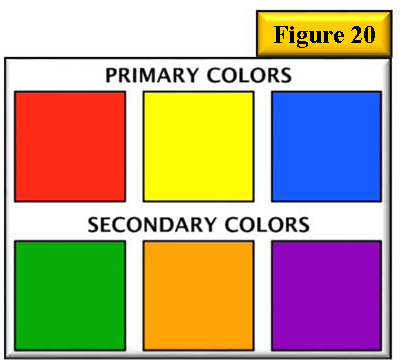
Primary color. A color such as red, yellow, or blue, that in mixture yields other colors.
Sag lens, convex lens or drop lens. A clear or prismatic refracting lens that extends below the lowest opaque portion of a light fixture.
Secondary color. Colors formed by mixing two primary colors to make a new color: green, orange and purple.
Spill light. Light which falls outside the property where the luminaire is sited.
Up light. A lamp, often a light bulb set in a cylinder or other container, placed on the floor or ground so that a beam of light is directed upward.
(Ord. No. 2016-4364, § 1(Exh.), 6-13-2016)
Section 3.0. - Office and commercial standards.
A.
Sanford Historic District. Any development within a City of Sanford Historic District shall comply with the requirements of Schedule S, historic preservation, of these land development regulations.
B.
Architectural style. While no one particular architectural style is preferred over another, it is the intent of this schedule to ensure a harmonious streetscape development that demonstrates compatibility between structures and well-designed transitions between architectural styles from project to project in accordance with sound and generally accepted architectural priorities and principles.
1.
Big box type structures with architectural appliques are not compliant with this schedule and applications for such development approval shall be denied.
2.
Franchises or national chains must follow the standards of this schedule to create a building that is architecturally compatible with the development in its immediate vicinity. If a building is a stand alone structure meeting the requirements of the schedule, franchise architecture may be used. If a franchise or national chain store is part of a larger overall development, said 'prototype' architecture cannot be used if found to be incompatible with the overall design standards.
C.
Building siting orientation.
1.
Building placement shall, to the greatest extent possible, screen mass parking areas from primary views, both from an external and internal viewpoint.
a.
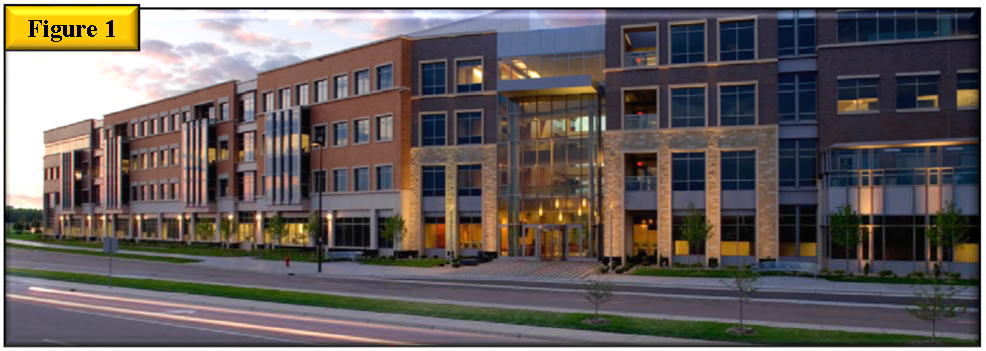
Buildings shall be sited to front onto the street, creating a continuous, comfortable and attractive pedestrian oriented streetscape environment. See figure 1, commercial and mixed-use buildings shall front onto the street to the greatest degree possible.
b.
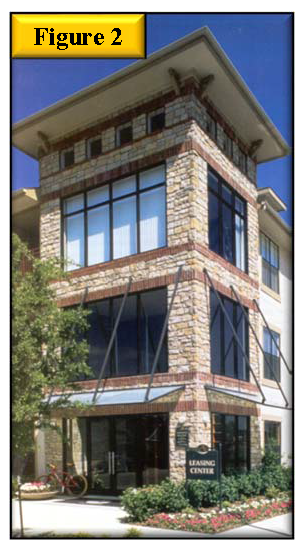
Building corners at primary intersections should be treated as prominent features, taking advantage of the opportunity to create a unique district identity by incorporating well-defined entrances and architectural features. See figure 2, building corners should be prominent.
c.
Buildings shall have their primary axis orientation perpendicular or parallel to the street they front. Primary building facades shall be parallel to the sidewalk (right-of-way).
d.
Parking area shall be located behind or to the side of buildings to encourage continuity of building frontages that support pedestrian activity along the street.
e.
On commercial sites over five acres, multiple buildings shall be clustered to create a "village" feeling and simulate pedestrian activity. Plazas, patios and pedestrian walkways shall be included.
f.
Service areas shall be architecturally integrated into the building, at the side or rear, out of pedestrian circulation and screened from view.
2.
Outparcels:
a.
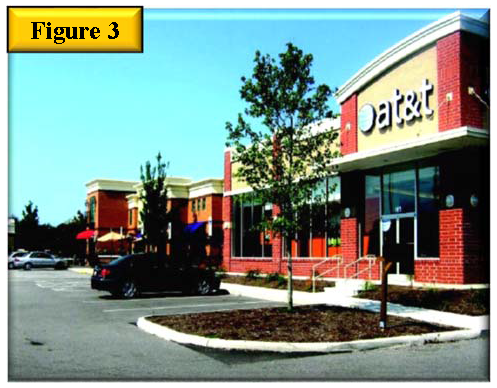
If two or more outparcel sites are located adjacent to one another, then the buildings shall also be located adjacent to one another in groups of two or more. See figure 3, two outparcels sited adjacent to each other to form a street façade.
b.
Grouped outparcel buildings must be sited no more than 100 feet apart.
c.
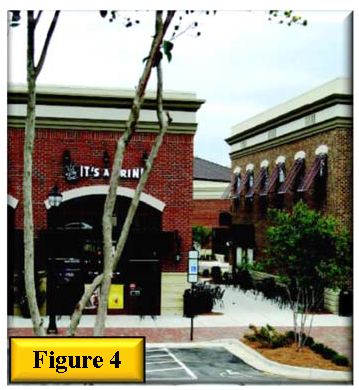
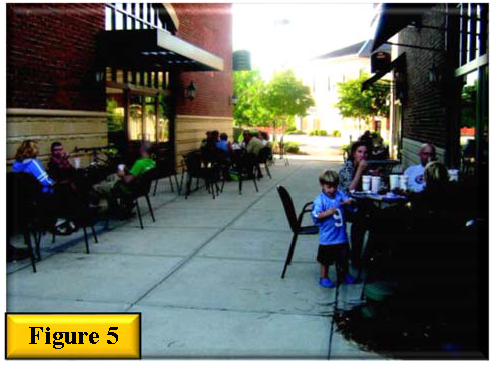
Include a pedestrian connection and/or landscape corridor between outparcel buildings. See figure 4 landscape corridor between two outparcels to help define building edge and figure 5, two buildings showing a pedestrian area between buildings.
d.
Exterior facades of outparcels must be treated as primary facades and must employ architectural, site and landscaping design elements that are common to the theme used on the main development including colors and materials associated with the main structure.
e.
Service areas shall be architecturally integrated into the building, at the side or rear, out of pedestrian circulation and screened from view.
D.
Primary façade standards.
1.
Buildings located along a right-of-way or roadway shall be designed with the main entrance clearly defined and with convenient access from both parking and the street.
2.
Primary facades on the ground floor shall have features along a minimum of 50 percent of their horizontal length. The design of primary facades must include, at a minimum, two of the following design features:
a.
Glazing shall cover a minimum of 30 percent of the primary façade area consisting of window and glazed door openings.
b.
Projected or recessed covered public entry providing a minimum horizontal dimension of eight feet and a minimum area of 100 square feet shall be provided. In addition, a minimum of 20 percent of the primary façade area must be devoted to windows and glazed door openings.
c.
Covered walkway, or arcade (excluding canvas type). constructed with columns at least 12 inches wide, attached to the building, or located no more than 12 feet from the building shall be provided. The structure must be permanent and its design must relate to the principal structure. The minimum width is required to be eight feet, with a total length measuring at least 60 percent of the length of the associated façade.
d.
Porte-cochere shall have a minimum horizontal dimension of 18 feet perpendicular to the building. In addition, a minimum of 20 percent of the primary façade area must be devoted to windows and glazed door openings.
e.
A tower element such as, but not limited to, a clock or bell tower element. In addition, a minimum of 20 percent of the primary façade area must be devoted to windows and glazed door openings.
f.
Awning or canopies with functional placement over windows or doorways only. In addition, a minimum of 20 percent of the primary façade area must be devoted to windows and glazed door openings.
g.
Faux or display casements are permitted in lieu of exterior window treatments for secondary façade or where actual windows are not technically feasible due to unavoidable interior configuration or design.
3.
Upper-floor windows should occupy at least 25 percent of each upper-floor façade area.
E.
Secondary façade standards. All sides of a building not considered a primary façade shall be considered a secondary façade. Any building façade that is not the primary façade and has a frontage along a private drive, parking area, or street, shall be considered a secondary façade.
1.
Secondary facades shall have a clearly-identifiable design quality, using materials and architectural elements similar to the primary façade.
2.
Secondary facades shall provide at least two of the design elements required for primary facades; provided, however, that faux or display casements are permitted in lieu of exterior window treatments only for the secondary façade, or where actual windows are not technically feasible due to unavoidable interior configuration or design.
3.
Upper-floor windows should occupy at least 25 percent of each upper-floor façade area.
F.
Building design treatments. Each building façade must have at least four of the following building design treatments, excluding what has already been provided per section 3.0.D., primary façade standards, and E., secondary façade standards.
1.
Canopies, porticos or porte-cocheres, shall be integrated with the building's massing and style;
2.
Overhangs, maximum of three feet;
3.
Colonnades or arcades, a minimum of eight feet clear in width;
4.
Cornice, a minimum of two feet high with 12 inch projection;
5.
Peaked or curved roof forms;
6.
Arches with a minimum 12 inches recess depth;
7.
Display windows;
8.
Ornamental and structural architectural details; other than cornices, where are integrated into the building structure and overall design;
9.
Clock or bell towers or other such roof treatment (i.e. dormers, belvederes, and cupolas);
10.
Projected, covered or recessed entry, with minimum of eight feet; and a minimum area of 100 square feet;
11.
Emphasized building base, minimum of three feet high, with a minimum projection from the wall of two inches;
12.
Additional roof articulation above the minimum standards;
13.
Curved walls;
14.
Columns;
15.
Pilasters;
16.
Tile roof material; or
17.
Expressed or exposed structural elements.
G.
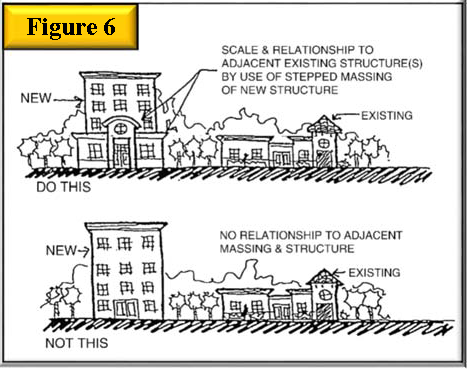
Façade/wall height transition elements. New developments that are located within 150 feet of an existing building and are more than twice the height of any existing building, shall provide massing elements to provide an appropriate structure transition. See figure 6, new buildings that are more than twice the height of any existing building within 300 feet must be designed to provide a transition.
1.
Transitional massing includes, but is not limited to, wall plane changes, roofs, canopies, colonnades, balconies, other similar architectural features, with the minimum depth for projections and recesses relative to the building size, and must meet the following requirements.
a.
For buildings 40,000 square feet or larger in gross building area, projections and recesses must have a minimum depth of ten feet.
b.
For buildings between 20,000 and 39,999 square feet in gross building area, projections and recesses must have a minimum depth of eight feet.
c.
For buildings between 10,000 and 19,999 square feet in gross building area, projections and recesses must have a minimum depth of six feet.
d.
For buildings up to 9,999 square feet in gross building area, projections and recesses must have a minimum depth of four feet.
H.
Building mass. Black facades are prohibited. Buildings shall provide storefront windows, doors, entries, transoms, awnings, cornice treatment and other architectural features to add visual interest.
1.
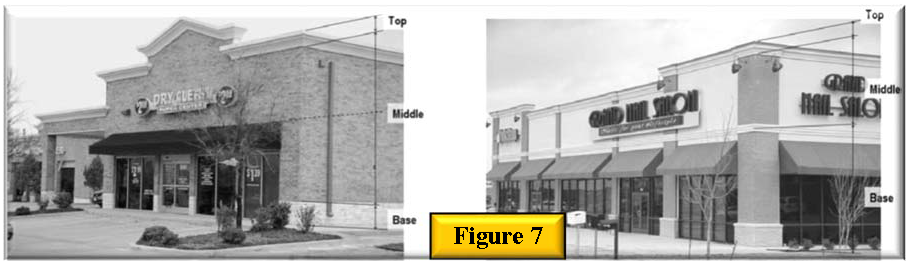
Building mass shall be divided into smaller components, including a base, middle, and top as a means of maintaining a pedestrian scale. See figure 7, example of buildings that are designed and constructed so that they have a distinct base, middle and top.
a.
The base of a building should be defined by appropriately contrasting material or color such as decorative banding (veneers, changes in colors, materials, and texture), low planters and or foundation plantings.
b.
The middle of buildings shall be distinguished through the use of arcades, colonnades, awnings, trellis', or other building elements that provide a change in wall planes and creates shadows.
c.
The top of buildings shall be defined by distinct roof forms, pronounced eaves, parapet design, and/or cornices.
I.
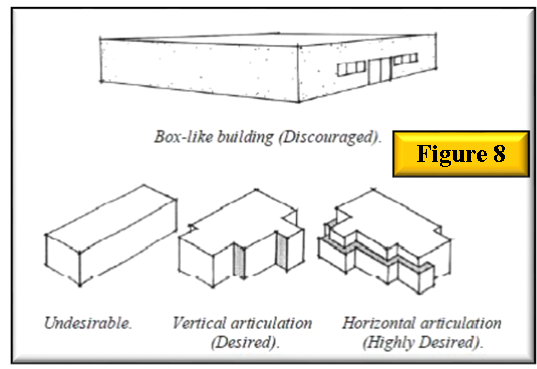
Variation in massing. To avoid a single, large, dominant building and the insubstantial appearance of false front and parapets, all facades, excluding courtyard areas, shall be designed to employ, at a minimum, the following design treatments. See figure 8, the mass and scale of large, box-like buildings should be reduced by articulating the facades (especially those that face the street) with vertical and horizontal wall projections. Articulating the building reduces monotony and creates visual interest.
1.
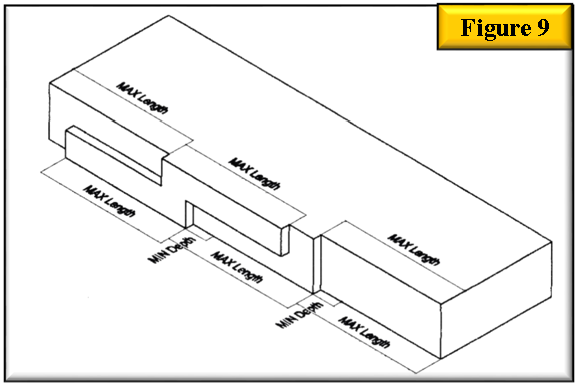
Projections and recesses to reduce the perception of building bulk and scale and to ensure a street frontage that rewards pedestrian interest. See figure 9, façade projection/recesses examples.
a.
For buildings 40,000 square feet or larger in gross building area, a maximum length, or uninterrupted curve of any façade, at any point must be 150 linear feet. Projections and recesses must have a minimum depth of ten feet with 150 linear feet limitation.
b.
For buildings between 20,000 and 39,999 square feet in gross building area, a maximum length, or uninterrupted curve of any façade, at any point must be 125 linear feet. Projections and recesses must have a minimum depth of eight feet within 125 linear feet limitation.
c.
For buildings between 10,000 and 19,999 square feet in gross building area, a maximum length, or uninterrupted curve of any façade, at any point must be 100 linear feet. Projections and recesses must have a minimum depth of six feet within 100 linear feet limitation.
d.
For buildings between 5,000 and 9,999 square feet in gross building area, a maximum length, or uninterrupted curve of any façade, at any point must be 75 linear feet. Projections and recesses must have a minimum depth of four feet within 75 linear feet limitation.
e.
For buildings less than 5,000 square feet in gross building area, maximum length, or uninterrupted curve of any façade, at any point, must be 50 linear feet. Projections and recesses must have a minimum depth of three feet, and a minimum total width of 20 percent of the façade length.
f.
If a building has a projection or recess of 40 feet or more, each is considered a separate façade, and must meet the above requirements for wall plane changes.
J.
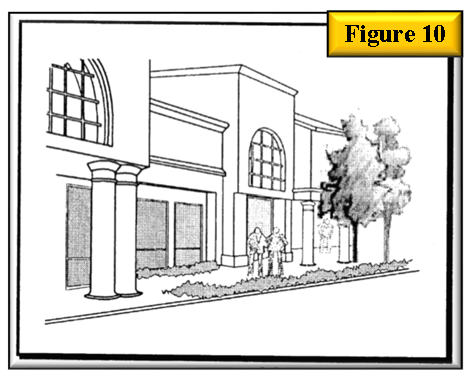
Façade Articulation. Facades shall be designed with sufficient vertical and horizontal articulation to add visual interest and break up the visual mass of the structure. Appropriate forms of articulation include the use of windows; changes in material, texture, color or detail; a change in a wall plane location direction; and variations with the roofline. See figure 10, for example of façade articulation that has variety and no repetitious use of façade elements and is not plain caused by lack of articulation.
1.
Breaks (reveals, recesses) in the surface of the wall itself;
2.
A column or pier at least one foot wide and eight inches deep;
3.
Placement for window and door openings; and
4.
The placement of balconies, awning and canopies.
5.
The design of architectural facades and roof planes shall not be a physical background for signage.
K.
Roofs. Roofs are an integral part of building design and shall be designed and constructed to add interest to and reduce the massing of buildings. Roof features shall be in scale with the buildings mass and complement the character of adjoining structures, developments and neighborhoods. Roofs shall be constructed of durable, high quality materials in order to enhance the appearance and attractiveness of the community. Roofs shall incorporate the design elements and materials listed herein:
1.
Vary roof forms, heights and materials to assist in breaking up the mass of long, linear buildings.
2.
Sloped roofs shall provide articulation and variations in order to break up the massiveness of the roof. Sloped roofs shall include eaves, which are a minimum of two feet in width.
3.
Flat roofs shall be screened with parapets on all sides of the building. If no roof top equipment exists or is proposed, the parapet shall be a minimum of two feet in height.
4.
All parapets shall feature cornice treatments. Parapets shall include a cap element to define the upper edge of the building.
5.
With the exception of non-visible flat roofs, roof materials shall consist of concrete, clay, slate or terra cotta tiles, standing seam metal, metal shingles or asphalt shingles (laminated, 25-year architectural grade or better) or similar materials.
6.
False mansard roofs are prohibited. Mansard roofs are not permitted as the predominant roof design. They may be used on a limited basis to add interest and variety consistent with sound and generally accepted architectural practices and principles and shall require a variance in order to be used. If permitted to be used, mansard roofs shall wrap around the entire perimeter of the structure.
7.
Long, unbroken, monotonous, horizontal rooflines are prohibited. No roofline ridge or parapet shall run unbroken for more than 75 feet. Vertical or horizontal articulation is required.
8.
Roof overhangs or other details that create usable shade on sidewalk areas are desirable. Clipped rooflines, which do not extend outward from the exterior wall, are prohibited.
9.
Vegetated "green" or cool roof designs are encouraged.
10.
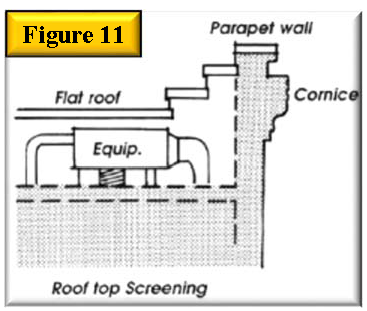
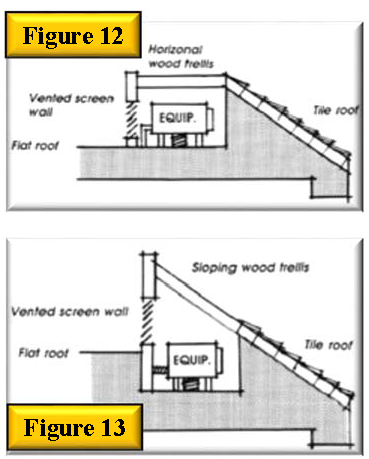
Roof mounted mechanical units shall be located or screened so as not to be visible from adjacent public and private streets or properties. See figure 11, 12, and 13 for example of types of screening for roof top mounted equipment. Roof mounted mechanical screening shall be accomplished by:
a.
Raising the parapet on all sides of the building to screen the highest mechanical unit or vent on the roof.
b.
A secondary roof screening system designed to be as high as the highest mechanical unit or vent. Secondary roof screening systems shall be of complimentary materials and shall appear as an integrated component of the building.
11.
Primary colors, high-intensity colors, metallic or fluorescent colors shall not be used as predominant roof colors and are prohibited.
L.
Awnings and canopies.
1.
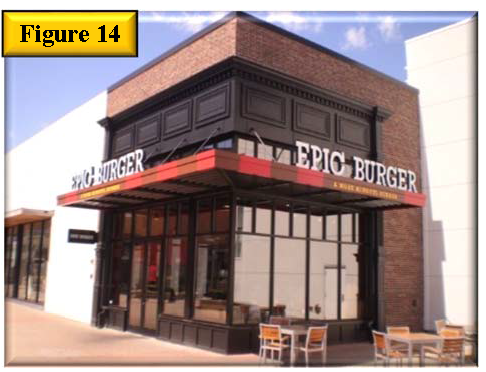
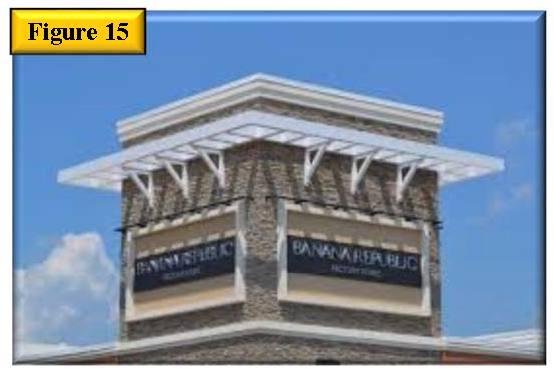
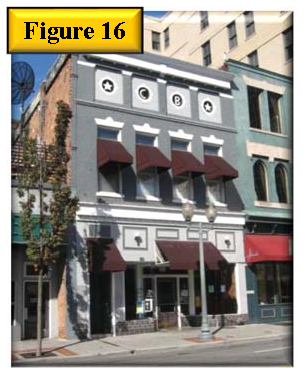
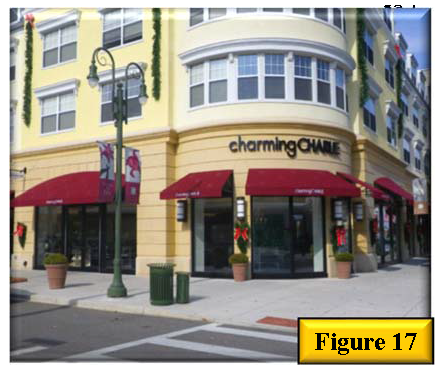
The use of awnings or canopies over sidewalks is encouraged. See figures 14, 15, 16 and 17 for examples of awnings/canopies that complement a façade's design and color scheme and reinforce a building's character.
2.
Awnings or canopies shall project a maximum of four feet from the building when located over pedestrian areas and no less than two feet otherwise.
3.
Awnings or canopies shall maintain a minimum clearance of eight feet above any sidewalk or pedestrian route.
4.
Awnings shall be flat or sloping. Awnings shall be made of metal, wood, canvas or similar materials. Round bubble or plastic awnings are prohibited. Fully glazed awnings are not permitted.
5.
Awnings shall fit within the window bays (either above the main glass or the transom light) so as not to obscure or distract from significant architectural features.
6.
The color of the awning shall be compatible with its attached building.
7.
Awnings shall not be internally illuminated
8.
Where feasible, awnings shall be placed at the same height as those on adjacent buildings in order to maintain a consistent horizontal rhythm along the street front.
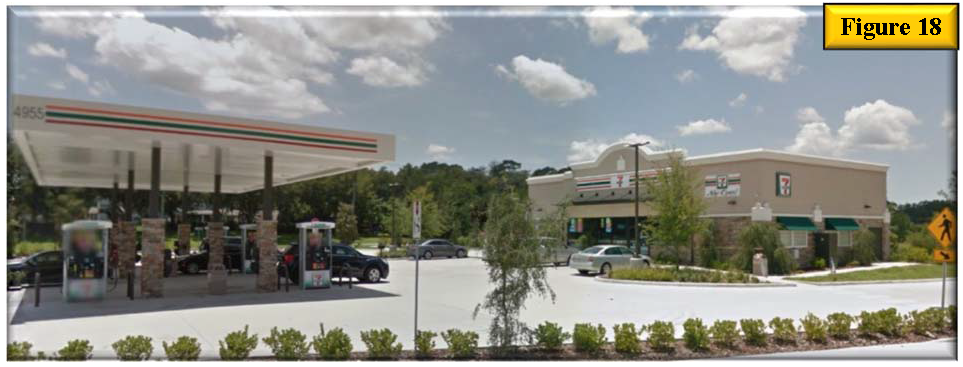
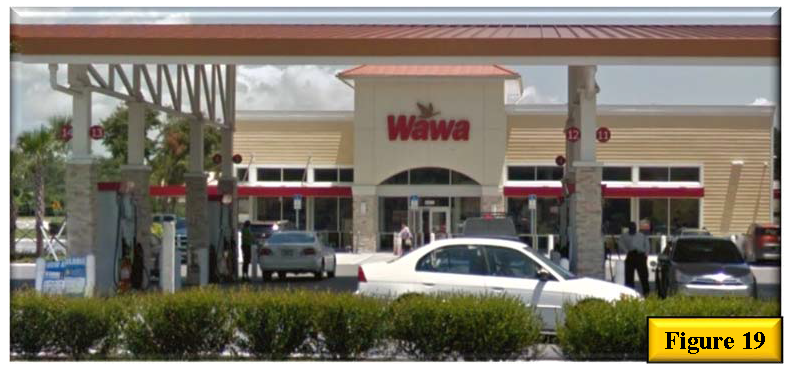
The design of canopies over gas pumps shall be integrated with the overall architectural design of the gas station. See figures 18 and 19 for examples of gas canopy structures that relate to the main component of the building with respect to materials, massing and overall design.
a.
Gas island canopies shall be built of the same quality materials and architecture as the store associated with the gas island.
b.
Gas island canopy structural columns shall be faced with the same architectural materials as the associated building.
c.
Any graphics on canopies shall be considered signage and shall follow the City of Sanford land development regulations for signage.
d.
Lighting luminaries mounted under the canopy structures shall be shielded such that the lamp source is not visible and glare is not created.
e.
Neon and illuminated panels are prohibited on a canopy.
M.
Exterior materials and colors. The purpose and intent of building material and color regulations are to maintain and enhance an attractive physical environment within the city, to enhance and sustain property values and to maximize the positive impact of development.
1.
These requirements shall apply to the exterior of all non-residential buildings and structures.
a.
All new buildings, structures or additions shall comply with these standards.
b.
All buildings shall be faced with materials that exhibit a durable, high quality appearance.
c.
Materials shall be of a low-maintenance type retaining a consistent and clean appearance.
2.
The color of a storefront and/or building helps to establish a mood or feeling about the business. It also reinforces both the individuality of the building and its relationship to its block, area and city.
a.
The original color and texture of stone and brick masonry surfaces shall be retained and not painted or altered without administrative approval.
b.
The use of black or fluorescent colors, or pure primary and secondary colors, is prohibited as the predominant exterior building color(s). See figure 20.
c.
Building trim and accent area may feature any color(s) limited to ten percent of the affected façade segment, with a maximum trim height of 24 inches.
3.
Building materials are classified based on their application as follows:
a.
All facades and businesses within a development shall utilize a consistent palette of materials, textures and colors.
b.
High quality and long lasting materials that offer texture and avoid monotonous surfaces are strongly encouraged in order to meet the intent of this schedule. The look and dimension of material elements shall relate to human scale. Earth tone building materials that have a pleasing visual texture, such as brick and stone, are required.
c.
The type and detailing of building materials shall be consistent on all sides of a structure. Materials used on primary facades, if not used for the entire building, shall return along secondary sides at a minimum of 100 feet or 20 percent whichever is less to maintain visual consistency.
d.
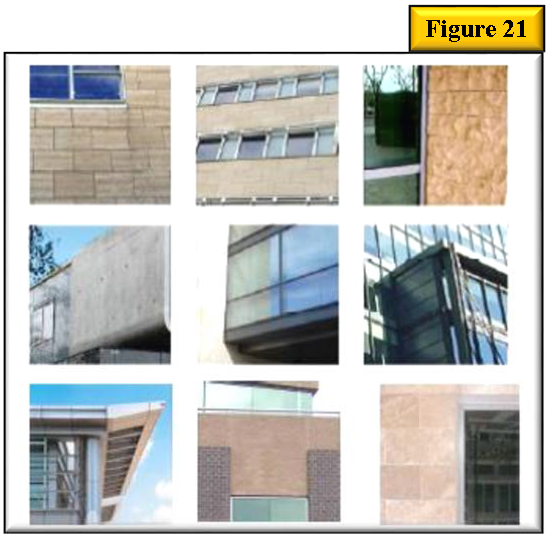
The following is a general guide to the acceptable use of exterior building materials. Use of alternate materials or the extent of material usage may be reviewed on a case-by-case basis, taking into consideration such factors as context and architectural style and the intent of this schedule. See figure 21 for examples of buildings materials that are durable and able to withstand long-term exposure to sun and rain. Additional guidelines related to specific materials are provided below:
i.
Brick and stone—Brick and stone convey permanence and are preferred primary and accent building materials for all building types.
ii.
Cast-in-place concrete—Cast in place concrete may be appropriate for industrial buildings or secondary facades if sufficient articulation and detail is provided to diminish the appearance of a large, blank wall and provide a high quality architectural finish. Cast-in-place concrete is acceptable as an accent material; provided, however, that its appropriateness for primary material applications will be reviewed within the context of the design intent and surrounding character of development.
iii.
Pre-cast concrete—Pre-cast concrete is acknowledged as a durable and quality material. Pre-cast concrete panels should incorporate architectural finishes that comply with the architectural articulation and detailing design guidelines as well as the intent of this schedule. The appearance of panel joints should be minimized. On building faces adjacent to a public right-of-way or pedestrian area where the appearance of masonry is to be conveyed, masonry inlays are generally preferred to be coated or painted form liner application which simulate the look of brick or stone; however, the appropriateness of either will be reviewed based upon the context of the design intent and the surrounding character of development. Buildings that utilize tilt up concrete wall panels shall incorporate articulation and color to add a variety of texture and visual interest.
iv.
Architectural metal cladding—Smooth metal panels with sufficient metal thickness to prevent "oil canning" or deterioration of the surface and promote durability are acceptable. The use of metal should account for the design intent of the building and surrounding character of development.
v.
Concrete masonry units—Concrete masonry unit (CMU) is acceptable as an accent. Split face CMU may be used as a base material in lieu of limestone.
vi.
Wood—Wood may be appropriate in specific historical or cultural context.
vii.
Fiber cement—The use of fiber cement materials shall be limited to accent applications only.
viii.
Stucco—The use of stucco is acceptable for exterior architectural accents.
ix.
EIFS—Exterior insulation and finishing system (EIFS) or Dryvit material shall not to be used as a primary material and should only be limited to accent applications above the pedestrian level (approximately ten (10) feet above ground). If used at grade or below, it shall be factory reinforced.
x.
Siding—Horizontal aluminum, vinyl and residential lap sidings should not be utilized for non-residential applications.
xi.
Other—Contemporary or specialized building materials not addressed herein will be reviewed on a case-by-case basis and will be evaluated based upon such factors as durability, quality, maintenance, architectural intent, aesthetic qualities, characteristics, compatibility with the provisions of these design guidelines, and environmental context.
N.
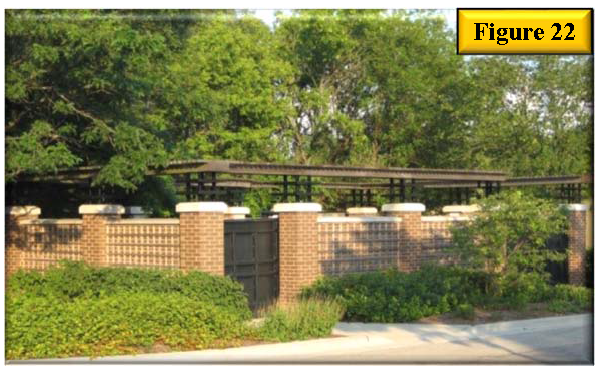
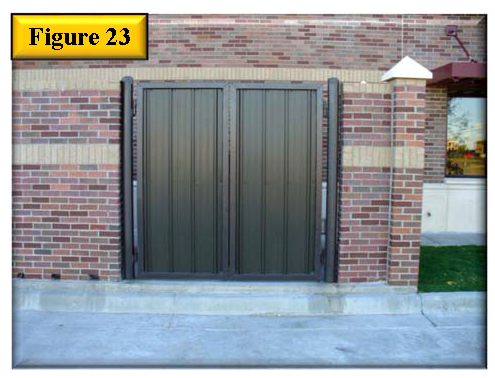
Service and utility areas. Buildings require mechanical equipment and service areas that are normally unsightly and sometimes noisy. Utilities can be a visually dominant element in the landscape. These areas include, but are not limited to loading docks, exterior storage areas, dumpsters, and mechanical equipment such as plumbing vent stacks, HVAC transformers, fans and cooling towers. Visible utility infrastructure should be treated to as to lessen the negative visual impacts. The following address the treatment of service and utility areas to reduce the negative visual impact of such areas. See figures 22 and 23 for examples of screening utility areas, mechanical equipment and dumpster enclosure to be architecturally compatible with the building in terms of style, colors, construction materials and finish.
1.
Locate all service and utility areas away from the street and concealed from building entrances, pedestrian areas, and adjacent residential structures.
2.
Provide adequate spaces for the intended use of service areas with necessary access and egress.
3.
When appropriate, consider joint use of service areas for multiple buildings on a site.
4.
Where possible, utilize building forms and other integral design techniques to conceal service areas from view. Locate trash receptacles and dumpsters adjacent to truck loading areas and screen with walls that are coordinated with the building's architecture.
5.
Where dumpsters are not incorporated within the overall building envelope, apply the following standards:
a.
For dumpsters not located next to the building, use wall, fence or gating on all four sides, with the open (or gated) side facing away from the view of streets or adjacent residential areas. Additional landscape areas are encouraged adjacent to dumpster locations.
b.
Locate dumpsters at edges of specific use areas rather in the middle of an open space, parking lot, or along streets.
6.
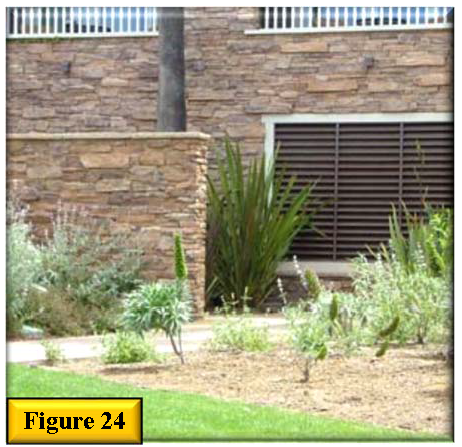
Utility service areas should be screened from public view with architectural materials and colors that are harmonious with the building; and/or with landscape plantings that can be incorporated as a part of visual screen. See figure 24 for example of utilities screened by a low wall that matches the structure.
7.
Locate all above grade utility connections, vents, and other projections through exterior walls away from high visibility areas, such as front facades or pedestrian areas, preferably in the service area of the building. Do not locate any utility projections or equipment, such as air conditioning units or air exchangers on the street side of the building.
8.
Rooftop mechanical equipment shall not be mounted on the buildings unless the roof itself acts as a screen or other integral architectural treatment is provided to screen such equipment from view.
O.
Fence and wall design. Fence and wall design is permitted as a design element as well as for security or to screen site elements.
1.
Any fence and/or wall constructed for purposes of security or to screen site elements shall comply with the architectural, design and landscaping requirements of this schedule and schedule J and other regulations herein.
a.
Fences, railings and walls shall not interfere with pedestrian safety by blocking access from the street to the sidewalk.
b.
Where permitted, all outdoor storage areas shall be visually screened with attractive fencing/walls and landscaping.
c.
Fences and walls shall be constructed of masonry, concrete, wrought iron, tubular metal, dark vinyl-coated chain-link or PVC. The use of chicken-wire, hog-wire, razor wire, or wood fencing is prohibited. Walls shall be constructed of brick or stone (veneers or decorative pre-cast panels may be permitted) to match the primary material of the primary building.
i.
Barbed wire shall be reviewed and may be approved by the planning and zoning commission if a need for such security is demonstrated by the applicant with clear and convincing evidence. Barbed wire is prohibited as part of 1) any residential use; or 2) any mixed-use having a residential component. If barbed wire is used, it shall be oriented away from the interior of the property and included in the overall fence height measurement. Barbed wire is prohibited on any fence within a front yard or a yard along a major street.
d.
The following height requirements shall be imposed:
i.
Front yards: four feet for a fence or wall without landscaping and six feet for a fence or wall of any style landscaped.
ii.
Side and rear yards: eight feet for a fence or wall of any style or a hedge in the side and rear yards or six feet for a fence or wall of any style without landscaping.
iii.
Fences and walls shall not exceed the required height except where determined that increased height is compatible with the use of the property, does not detract from the pedestrian character of the street, and is integrated into the architecture and design.
e.
All fences and walls shall be installed with the finished side facing towards the exterior of adjoining properties and rights-of-ways.
f.
Fence, wall or hedge surfaces shall not be used for advertising or display.
g.
The walls of any building which enclose a yard or are visible from a street frontage shall be stained, painted, or provided with an integral color, as appropriate to the wall surface material used, and permanently maintained.
h.
On commercial or office properties visible from any major street, fences and walls shall be decorative or dark vinyl-coated chain-link (including stands, poles and rails).
i.
The attachment of slats, fabric, shade cloth or other material to a chain link or similar open fence is prohibited except as provided herein. Slats, fabric, shade cloth or other material is not a permitted method for required screening of outdoor storage areas. Slats, fabric, shade cloth or other material may be installed to create a wind barrier for athletic courts or similar situations subject to the following conditions:
i.
Professional installation is required by a licensed contractor.
ii.
The proposed material shall be designed to withstand wind resistance with commercial grade seams and attached at grommets designed in a manner consistent with building regulations.
j.
It is prohibited and unlawful for any person to construct, maintain, place, install or allow or cause to be constructed, maintained, placed, or installed on or about any structure or property any fence, barrier, partition, obstruction or similar structure that is electrically charged or connected with any electrical source in such a manner as to transmit an electrical charge to persons, animals or things which come in contact with fence.
P.
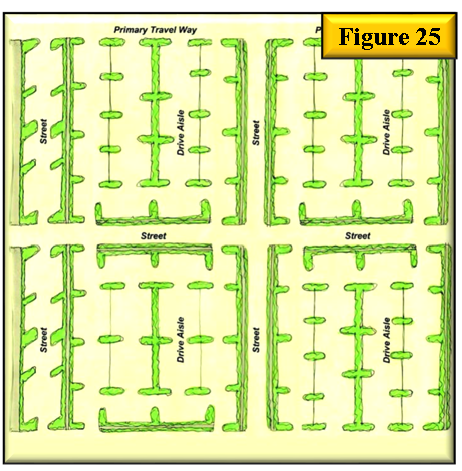
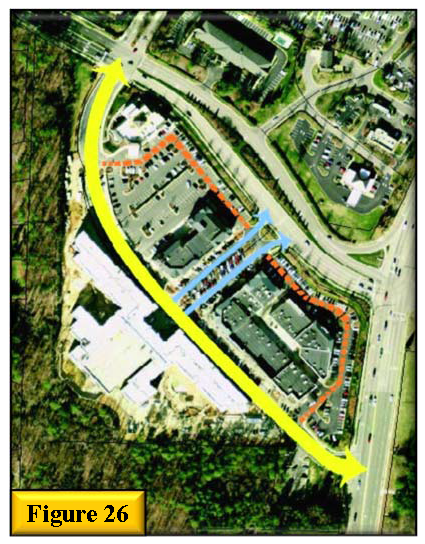
Vehicular circulation. Vehicular circulation within a site is critical for usability of a place. See figures 25 and 26 for examples of parking lots that provide a continuous flow of traffic through the lot. When laying out vehicular circulation the following standards shall be met:
1.
Access drive on side streets are encouraged to maintain efficient traffic flow on major roadways.
2.
The parking lots and driveways must be designed for sufficient movement to avoid conflict with vehicular traffic in the street.
3.
Delivery vehicles shall not be permitted to stop or park and impede traffic and shall use designated delivery spaces for all deliveries.
4.
Delivery and loading operations shall be designed and located in a way that mitigates circulation impacts to internal traffic flow and adjoining residential neighborhoods.
5.
The parking layout shall provide a continuous flow of traffic through the lot.
6.
Place at least 30 percent of parking surface area to the rear or side of buildings and/or away from public streets.
7.
Driveways shall be shared and provide cross-access between adjoining parking areas and circulation drives to reduce the number of turns onto and off of the principal roadways and to minimize conflict points. Adjoining commercial and office sites that are higher traffic generators shall provide cross-access for circulation between sites and to minimize curb cuts. Cross access easement shall be granted use pursuant to a form of easement acceptable to the city attorney.
8.
Transit vehicle access shall be incorporated and attractive and convenient waiting areas and shelters shall be provided to facilitate the use of public transportation for multi-tenant buildings.
Q.
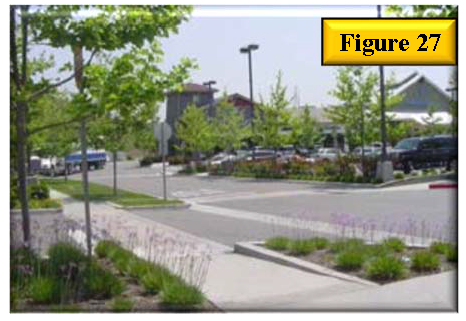
Pedestrian circulation. Defined pedestrian circulation routes shall be provided into and within a site. See figure 27 for example of decorative pavers used in pedestrian crossings that provide clear delineation for pedestrian path of travel. Multiple pedestrian routes may be required based on the size of a site or other conditions.
1.
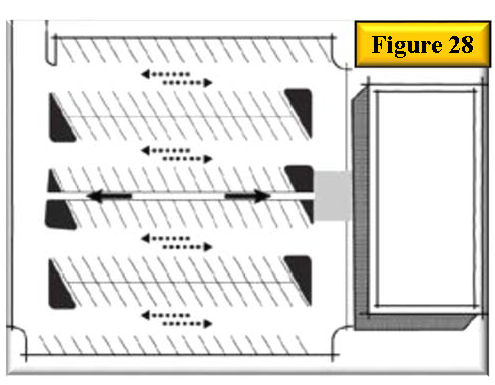
Parking areas shall be designed for pedestrian safety with walkways parallel to parking aisles. The design shall minimize the need for a pedestrian to cross parking aisles and landscape islands to reach building entries. See figure 28 for example of design that places walkways parallel to parking aisles.
Accent materials such as decorative concrete or unit pavers shall be used to emphasize pedestrian crossing at driveways and major circulation aisles.
2.
Outparcels shall have direct pedestrian connections to any adjacent public sidewalk streets and to other adjacent buildings.
3.
Sidewalks are required at vehicular access points into a development, unless a reasonable alternative location is provided, which provides the same function and connectivity.
4.
Multi-tenant buildings shall provide a pedestrian connection from transit stops.
5.
Multi-tenant buildings shall provide a break, or pedestrian pass-through, for every 600 feet of building frontage. The purpose of pedestrian pass throughs is to provide connections to parking, adjacent development, or similar uses. The following requirements are applicable:
a.
Provide logical building breaks.
b.
Align with central pedestrian corridor if allowed.
c.
The minimum width is 15 feet between buildings. Larger building breaks may serve as a pedestrian plaza with appropriate scale, sizing and seating opportunities.
d.
Direct pedestrian access is required to connect parking located on opposite sides of a building.
e.
If a sidewalk between buildings is provided, a landscape area of a minimum five feet in width must remain between the building and sidewalk.
f.
Vehicular access may be incorporated at time of development review.
(Ord. No. 2016-4364, § 1(Exh.), 6-13-2016)
Section 4.0. - Lighting.
A.
Intent. It is the intent of this section to encourage lighting practices that will benefit the public by minimizing light pollution, glare, light trespass and sky glow and maintaining night time safety, utility and security.
B.
Scope and applicability. All exterior outdoor lighting shall comply with the requirements established by this schedule unless otherwise exempted. This schedule does not apply to indoor lighting.
When an outdoor lighting installation is being modified, extended, expanded or added to, the entire light installation shall be subject to the requirements of this section.
When an outdoor lighting installation or replacement is part of a development proposal for which site plan approval is required, the planning and zoning commission shall review and approve the lighting installation as part of its site plan approval.
C.
Exemptions. The following types of lighting are exempted from these regulations:
1.
Reasonable lighting during the period from October 15 to February 15, if the lighting does not create a hazard or nuisance from glare or luminance.
2.
Traffic control signals and devices installed by or at the direction of a public agency.
3.
Temporary emergency lighting in use by law enforcement or government agencies or at their direction.
4.
Temporary lighting, used for a period not to exceed 30 days in any one-year period, for festivals, celebrations or other public activities subject to the same conditions as holiday lighting.
5.
Temporary construction lighting use for a period not to exceed 30 days in any 1 year period unless extension is granted.
6.
Outdoor recreational facilities such as tennis courts, sports fields, golf courses, driving ranges and miniature golf courses; and outdoor assembly uses such as stadiums, arenas, amphitheaters and drive-in movie theaters.
7.
One and two family dwellings.
D.
General requirements.
1.
All exterior lights shall be designed, located, installed and directed in such a manner as to prevent objectionable light trespass and glare across the property lines or disability glare at any location on or off the property.
2.
All light and electrical connection shall be underground, where practicable. No above ground aerial wiring shall be permitted, except as may be exempt under this schedule.
3.
All electrical conduit and sleeving shall be coordinated and adjusted outside all proposed landscape areas and tree root balls to the best extent possible.
4.
All light fixtures, including security and parking lot lighting, shall be cutoff fixtures and shall be incorporated as an integral design element that complements the design of the building or project through style, material and color. Luminaires shall not be tilted. Lighting of or on buildings shall be limited to wall washer type fixtures or up-lights, which do not produce spill light or glare.
5.
A fully cutoff fixture shall be installed in a horizontal position as designed.
6.
Security lighting fixtures and wall packs shall not project above the fascia or roof line of the building on which they are mounted and shall use fully cutoff or fully shielded fixtures. All security lighting fixtures and wall packs shall be shielded and aimed so that illumination is directed only to the designated area and shall not cast direct light on other areas.
7.
Wall packs are permitted only in loading and service areas and shall be cutoff fixtures except those adjacent to an arterial or collector road, in or adjacent to a residential zoning district or adjacent to a dwelling unit which is of the shoe box type. The lighting use or location of the wall pack shall determine the maximum foot-candle allowed except as otherwise provided herein.
8.
Flood lighting is discouraged. If used, flood lights must be shielded to prevent:
i.
Disability glares for drivers or pedestrians.
ii.
Light trespass beyond the property line.
iii.
Light above a 90 degree horizontal plane.
iv.
Otherwise creating a public hazard or nuisance.
9.
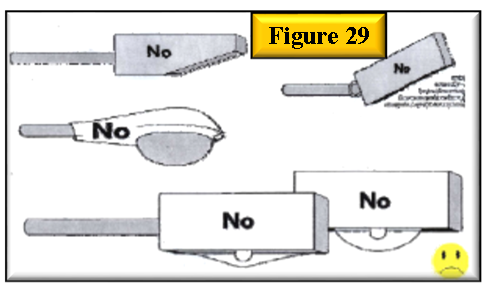
All sag lenses, drop lenses and convex lenses are prohibited. See figure 29.
10.
Adjacent to residential property, no direct light source shall be visible at the property line at ground level or above. Illumination levels at all property lines shall not exceed 0.5 foot-candles (f.c.) when the building or parking areas are located adjacent to residential area, and shall not exceed 1.0 f.c. when abutting other non-residential properties. To avoid glare or spill light from encroaching onto adjacent properties, illumination shall be installed with house side shields and reflectors, and shall be maintained in such a manner as to confine light rays to the premises of the building or project.
11.
All lighting within parking and pedestrian areas shall be coordinated with the landscape plan to prevent canopy conflicts with the proposed or existing trees.
12.
The minimum setback of a light source from a property line shall be a horizontal distance of 20 feet.
13.
Non-residential light shall be installed with time controls to ensure that light levels are reduced not later than 1 hour after the close of operations to the minimum levels needed under IESNA to ensure safety and security (approximately a 50 percent reduction).
14.
To provide lighting that limits distortion of colors of the building, landscape and pedestrian activity areas, all lighting lamp sources within parking and pedestrian areas shall be metal halide, compact fluorescent, LED or high pressure sodium.
15.
All lots with alleys shall have lighting fixtures within five feet of the alley's edge of pavement where it does not conflict with vehicle access and circulation. The fixture shall illuminate the alley, between eight feet and 12 feet in height, and not cause glare into adjacent lots. When a structure in the lot is within five feet of the alley's edge, the lighting fixture shall be attached to the structure and not to a light pole.
16.
Building light fixtures should be designed to be architecturally compatible with the main structure, which should complement the theme of the surrounding area.
17.
Blinking, flashing lights and exposed neon lighting used to illuminate building facades or to outline buildings are prohibited except as may be exempt herein.
18.
The following are general requirements for lighting placement:
a.
At least three feet away from the face of the curb (to avoid damage from car bumpers and door swings).
b.
At least five feet from the point where a curb transitions into a driveway, curb cut or alley.
c.
At least 20 feet from the extended flow line of the nearest intersection.
19.
The following are general requirements for parking area lighting:
a.
Light pole height in all parking areas shall not exceed 25 feet.
b.
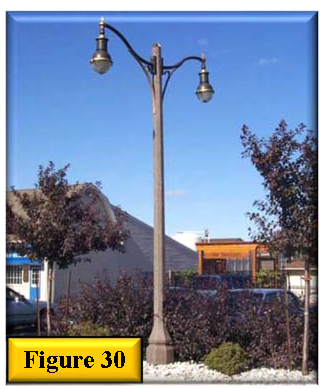
The style of light standards in a parking lot shall relate to the overall architectural design of the commercial uses. See figure 30 for example of pedestrian-scaled parking lot lighting.
c.
Select lighting with a concealed light source of the "cut-off" variety to prevent glare and "light trespass" onto adjacent buildings and sites.
d.
Provide separate, pedestrian scale lighting for all pedestrian ways through parking lots. Locate poles in parking islands wherever possible with a maximum base height of two feet.
e.
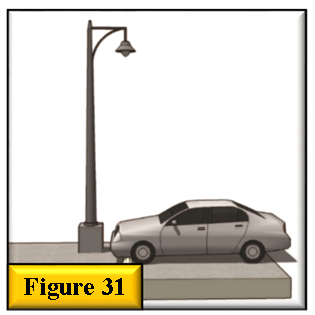
Parking area light poles placed outside of parking islands are permittable if the poles are located in an area that is protected or the pole foundation has been designed to accept minimal levels of vehicular impact. All exposed pole foundations shall be aesthetically designed to match the detailing of the primary structure (i.e. stucco finished with matching paint color) and shall be surrounded by a six-inch foundation curb. See figure 31.
20.
The following are general requirements for pedestrian area lighting:
a.
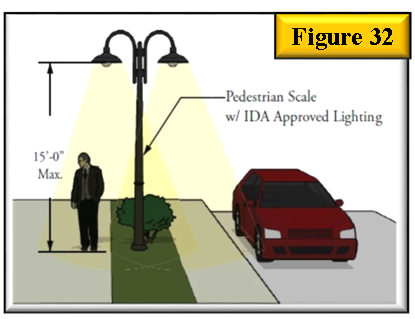
Light pole heights in all parking areas shall not exceed 15 feet. See figure 32.
b.
The light fixture/luminaire shall be decorative in appearance, style and finish.
c.
The lamp source shall be metal halide, LED, or compact fluorescent of a light source that produces a Color Rendering Index (CRI) of 65 or higher. Wattage shall not exceed 100 watts per bulb.
d.
Illumination levels shall range between a minimum of 0.2 f.c. and a maximum of 2.5 f.c.
e.
Pedestrian street lights must be placed two feet from the back of curb on each side of the street and travel lanes, unless otherwise indicated.
f.
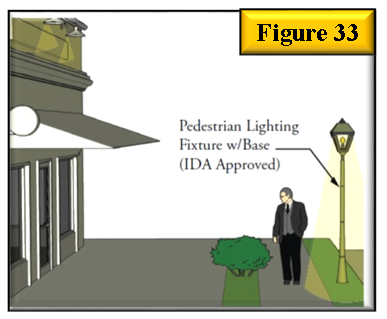
A combination of International Dark-Sky Association ("IDA") permitted pole lights, bollard lighting and landscape accent lighting are an encouraged design.
21.
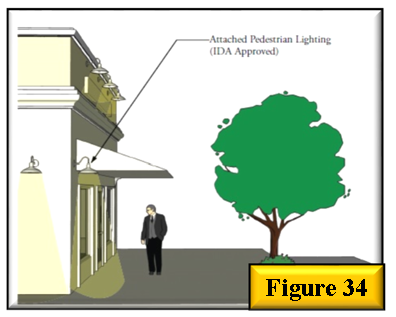
A pedestrian lighting plan shall incorporate a combination of pole light, bollard light and accent lighting. See Figure 32, Figure 33, and Figure 34.
E.
Lighting Standards.
1.
Lighting intensities for buildings, projects, or other uses not specifically regulated by this schedule (for example athletic fields, courts and swimming pools) shall be designed as recommended by the Illuminating Engineering Society of North America (IESNA). However, all such uses shall comply with this schedule for control of glare and light level at the property line.
2.
The city hereby adopts the following outdoor lighting recommendations of the IESNA:
F.
Lighting of gas stations, convenience stores and all outdoor canopies. In addition to the above standards, the following shall apply:
1.
Lighting of gas stations and convenience stores shall not be used to attract attention to the business.
2.
Areas on the apron away from the gasoline pump islands which are used for parking or vehicle storage shall be illuminated in accordance with the requirements for parking areas set forth in schedule G. If no gasoline pumps are provided, the entire apron shall be treated as a parking area.
3.
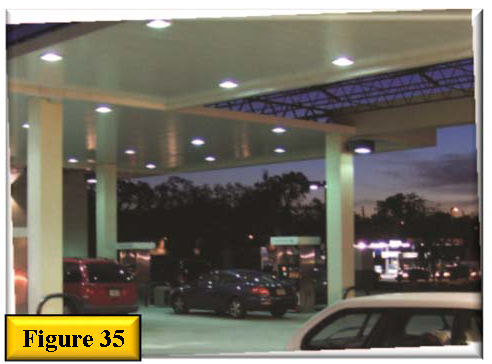
Light fixtures mounted on canopies shall be recessed so that the lens cover is recessed or flush with the bottom surface (ceiling) of the canopy. See figure 35 for example of recessed lighting at gas station canopy that creates a well-lit space without causing glare.
G.
Lighting plan required. The applicant shall submit a lighting plan depicting the foot-candle dispersion on the site and detail of the proposed fixtures as part of the site plan/development application. The plan shall include at least the following:
1.
A site plan, drawn to scale, showing all buildings, landscaping, parking areas, all proposed exterior lighting fixtures;
2.
Specifications (details) for all proposed lighting fixtures including photometric data. designation as IESNA 'cutoff' fixtures, and other descriptive information on the fixtures;
3.
Proposed mounting height of all exterior lighting fixtures;
4.
Analyses and luminance level diagrams showing that the proposed installation conforms to the lighting standards of this section. Off-site lighting shall be considered in the analyses; and
5.
Drawing of all relevant building elevations showing the fixtures, the portions of the walls to be illuminated, the luminance levels of the walls and the aiming points for any remote light fixtures.
H.
Technical deviations. The applicant shall submit a lighting plan depicting the foot-candle dispersion on the site and detail of the proposed fixtures as part of the site plan/development application. The plan shall include at least the following:
1.
Any proposal which includes technical deviations from these lighting standards shall demonstrate the unique aesthetic and/or engineering design that meets or is within the intent and purpose of these regulations. Such presentation shall include appropriate calculation and drawings or illustrations as necessary to explain the request or as may be required by the city.
2.
The building official shall make a determination whether to accept such proposed technical deviation after consulting with a mutually acceptable licensed professional engineer. The cost of making such determination shall be borne by the party requesting the technical deviation.
I.
Certificate of occupancy. The building official shall not issue a certificate of occupancy until a licensed professional engineer delivers a certificate of compliance to the city stating that the exterior lighting at the building and site complies with this schedule unless an exception was granted. However, where a project is of such a small scale that the lighting layout is considered an incidental engineering service, a certificate of compliance may be rendered by the licensed professional rendering the incidental service if allowed by controlling state law.
(Ord. No. 2016-4364, § 1(Exh.), 6-13-2016)

