
Sanford City Zoning Code
Schedule K
SIGN REGULATIONS1
Editor's note— Ord. No. 4589, § 1, adopted Feb. 8, 2021, amended Schedule K in its entirety to read as herein set out. The former Schedule K, §§ 1.0—6.0, 6.1—6.3, 7.0—9.0, and 9.1—10.0, pertained to similar subject matter, and derived from Ord. No. 3773, §§ 1, 2, adopted Jan. 27, 2003; Ord. No. 3977, § 1, adopted Mar. 27, 2006; Ord. No. 4130, § V, adopted Aug. 11, 2008; Ord. No. 4179, §§ 3, 6, adopted June 22, 2009; and Ord. No. 4282, § 2, adopted Jan. 14, 2013.
Section 1.0 - Purpose and intent.
A.
The purpose and intent of the sign regulations, referred to herein as the "Sign Code" from time-to-time, is to provide comprehensive and balanced set of sign regulations that will preserve the right of free speech and expression; avoid excessive levels of visual clutter or distraction that are potentially harmful to traffic and pedestrian safety, property values, business opportunities, and community appearance; and ensure that signs are well-constructed and maintained and expressive of the identity of individual activities and the community as a whole. The purpose and intent of these regulations is such that the City will not be a regulator of content, but shall regulate the time, place and manner of the commercial and non-commercial speech that are associated with signage. The City shall not distinguish between commercial and non-commercial speech in the implementation and enforcement of these regulations.
(Ord. No. 4589, § 1(Exh.), 2-8-2021)
Section 2.0 - Definitions.
The following definitions shall apply to the implementation and interpretation of this Sign Code and definitions set forth in the City Code and the Florida Statutes may also be used.
Beacon Light. Any light with 1 or more beams, capable of being directed in any direction or directions, or capable of being revolved automatically, or having any part thereof capable of being revolved automatically. Beacon lights are prohibited within the City.
Bench Sign. Any sign painted on or affixed to a bench or to a public transportation shelter. Bench signs are subject to approval by the City Commission.
Billboard. Any outdoor advertising sign erected and maintained by an advertising business or service, upon which advertising matter may be displayed and which generally advertise firms and organizations that, along with their goods and services, are not located on the same premises as the sign; and whose surface is sold, rented, or leased for the display of advertising material. New billboards are prohibited within the City.
Façade. Exterior front or face of the building, the appearance presented to the world.
Fence Sign. Any sign attached to a fence or masonry wall utilized as a fence.
Mural. Mural means any inscription, artwork, figure, wall mural, graffiti, marking, hand-painted, hand-tiled, digitally printed restorative image or design, including mixed media, which is observable from the public right-of-way or from a public space. [2]
Out Parcel. Lots platted or leased along the periphery of a shopping center project or large retail store which are intended to be occupied by a single user. Typically such lots are less than 2 acres in area (this is not a criteria and is a mere definitional explanation); are subordinate in size to the parcel which contains a multi-tenant shopping center building or large retail store; and share access, utilities, drainage, parking and open space with the parcel containing the anchor tenant.
Pennant. Any flag-like piece of cloth, plastic or paper attached to any staff, cord, building or other structure that tapers to a point and hangs loosely and is used for the purpose of attracting attention to the site.
Premise(s). The contiguous lot or lots, plots, portions or parcels of land considered a unit for a single development or activity.
Public Safety Sign. A sign necessary for the identification, operation or protection of public service structures or signs incident to a legal process or necessary to the public safety or welfare.
Reader Board. A sign designed to accommodate changeable copy including, but not limited to, individual letters and numbers that can be removed and replaced by hand. Electronic message centers are not considered part of this definition.
Shopping Center. A group of commercial or non-commercial establishments planned, constructed, and managed as a unified entity that share a common on-site parking area for customers and employees, with provision for goods delivery separated from customer access, and with aesthetic considerations and protection from the elements.
Sign. Any object, device, display, structure, or part thereof which is designed to advertise, announce, direct, identify or inform by any means, including words, letters, figures, designs, symbols, fixtures, colors, illumination, or projected images.
Sign, Air-Activated. A sign, all or any part of, which is designed to be moved by action of forced air so as to make the sign appear to be animate or otherwise have motion.
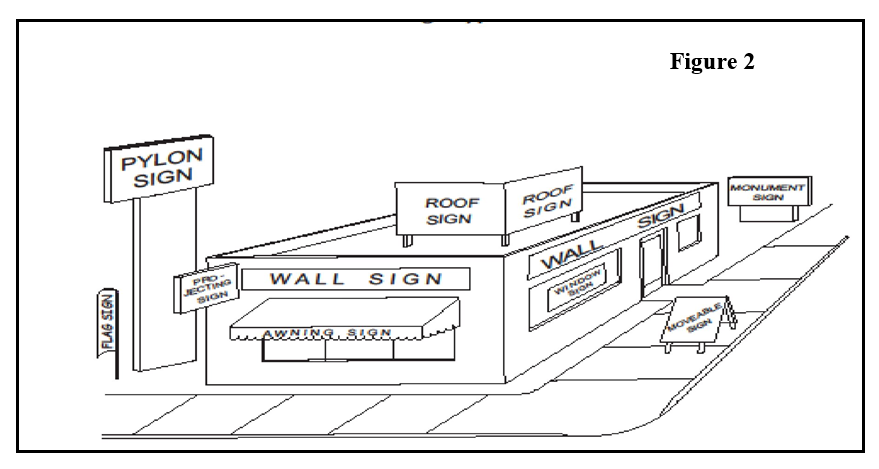
Sign, Awning, Canopy, or Marquee. A sign that is mounted or painted on, or attached to an awning, canopy or marquee. See Figure 2
Sign, Banner. A temporary sign composed of cloth, canvas, plastic, fabric, or similar lightweight, non-rigid materials that can be mounted to a structure with cord, rope, cable, or similar method or that may be supported by stakes in the ground.
Sign, Bench. Any sign painted on or affixed to a bench or to a public transportation shelter. Bench signs are subject to approval by the City Commission based upon time, place and manner determinations and, if the sign relates to government speech, whether the City Commission determines that the content is such that the desires to express as government speech.
Sign, Changeable Copy. A sign on which a copy is changed manually such as reader boards with changeable letters or pictorials or an electrically controlled sign where different copy changes are shown on the same unexposed lamp bank used for time and temperature or as an electronic message center or reader board.
Sign, Copy. The message or advertisement, and any other symbols on the face of a sign.
Sign, Directional. Any sign used to indicate the direction to entrances, exits, parking areas, restrooms, or other non-business related facilities on the site on which the sign is located and which bears no advertising or logo.
Sign, Directory. A sign which gives the names of the businesses, entities or individuals located in the building or complex where located in order to assist the public and others for locations purposes. A directory sign shall be of a unified design and common material, and shall allow for a uniform size sign for each business or unit of space in the development the content of which shall be limited to the name and type of businesses and their location within the building or complex.
Sign, Double-Faced. A sign with 2 faces which are no more than 12" apart at their closest point, and which describe an internal angle between face planes extended no more than 30 degrees.
Sign, Electronic Message. A changeable message sign whose message is electrically activated.
Sign, Externally Illuminated. A sign illuminated by light sources from outside the sign.
Sign, Face. The area or display surface used for the message on a sign.
Sign, Fascia. A sign that is mounted or painted on, or attached to, the flat horizontal surface piece of a building typically located directly above the front door, and sometimes referred to as a signboard or nameplate.
Sign, Fence. Any sign attached to a fence or masonry wall utilized as a fence.
Sign, Flag. Devices generally made of flexible materials, such as cloth, paper, or plastic, and supported by a single vertical pole mounted into the ground or on a portable structure. They may or may not contain sign copy. See Figure 2
Sign, Flashing. A sign which contains an intermittent, scintillating, blinking or traveling light source which includes, but is not limited to, signs that give the illusion of intermittent or flashing light by means of animation, or an externally mounted intermittent light source. Flashing signs are prohibited.
Sign, Freestanding. Any sign which is supported by structures or supports in or upon the ground and independent from any building. Freestanding signs include ground signs, pylon signs, and sign less than four feet in height support by a single pole or post.
Sign, Gutter. A sign affixed to a gutter. Gutter signs are prohibited.
Sign, Height. The distance between the top of a sign and the average grade elevation, directly below it. Berms or other unnatural elevations cannot be used to increase the height of sign.
Sign, Illegal. Any sign not permitted in accordance with controlling land development regulations prior to or after January 27, 2003.
Sign, Inflatable. Any sign that is inflated or supported by wind, air, or pneumatic noncombustible pressure, with or without copy, that serves to draw attention of a site. Inflatable signs are prohibited.
Sign, Illuminated. Any sign which has characters, letters, figures, designs or outlines illuminated, either internally or externally, by electric lights or luminous tubes.
Sign, Internally Illuminated. A sign illuminated by light sources enclosed entirely within the sign cabinet and not directly visible from outside the sign.
Sign, Legal Non-conforming. Any sign permitted in accordance with controlling land development regulations prior to January 27, 2003 that does not conform to the requirements of Schedule K, Part III, Land Development Regulations, Code of Ordinances of the City of Sanford, Florida as of the date of the enactment of this Ordinance.
Sign, Menu Board. A permanently mounted sign displaying the foods, products, or services for a drive-through or walk up facility.
Sign, Mobile Trailer. A sign mounted on a trailer frame and capable of being towed over the road. Mobile trailer signs are prohibited, provided, however, that mobile trailer signs that are not pulled, moved or actually moving are likewise prohibited.
Sign, Monument. A ground mounted sign with vertical structural supports concealed in an enclosed base with a width equal to at least two-thirds (2/3) of the horizontal width of the sign surface and with a base finished with a decorative material. Monument signs must be consistent with the architectural design, materials and color of the buildings on the same premises. All monument signs shall be encased in a planter, two (2) to three (3) feet in height, or a landscaped area of no less than four (4) feet wide on each side of the sign. The planter or landscaped area must contain any combination of shrubs, flowers and groundcovers. See Figure 2
Sign, Motor Vehicle or Trailer. A sign permanently or temporarily attached to or placed on a vehicle or trailer and used primarily as a stationary sign; provided, however, that this definition shall not apply to signage located on motor vehicles that are part of a moving fleet of motor vehicles on roads and streets. See Figure 2
Sign, Moveable. A sign that is not permanently attached to the ground or attached to a building or structure, and which is removed and stored inside daily. See Figure 2
Sign, Noncommercial. Signs expressing personal political, religious, or other opinions, and not advertising any product, service or event.
Sign, Non-Conforming. A sign permitted in the City before February 8, 2021, that does not conform to the requirements of this Sign Code . A sign not permitted prior to the that date shall not be considered a nonconforming sign. Nonconforming signs are regulated by Schedule L, Section 2.0.
Sign, Off-Premise. A sign which is not related to a product sold, a service offered, or identify the property on which the sign is located.
Sign, On-Site. A sign that identifies or advertises only goods, services, facilities, events or attractions available on the premises where the sign is located or which expresses non-commercial speech as desired by the business or entity occupying the premises.
Sign, Parasite. Any unpermitted sign which is attached to another sign. Parasite signs are prohibited.
Sign, Permitted. All signs needing a permit under this Sign Code or, having received a permit, that now exist as non-conforming signs.
Sign, Portable. A sign that has no permanent attachment to a building or to the ground by means of a footing; including, but not limited to, A-frame signs, sandwich signs, sign with wheels or frame or structure with axle or designed to be pulled or towed on a trailer or similar device, pull attachments, or inflatable signs. Portable signs are prohibited.
Sign, Projecting. A sign that is wholly or partly dependent upon a building for support and which projects more than 12" from such building. See Figure 2
Sign, Pylon. A freestanding sign permanently affixed to the ground by a support or supports so that the bottom edge of the sign face is 8' or more above the ground. A pylon sign includes a sign supported by a single poled also referred to as a "pole sign". See Figure 2
Sign, Roof. A sign mounted on the main roof portion of a building, and which is wholly dependent upon the building for support.
Sign, Revolving. Any sign so erected or constructed as to periodically or continuously change the direction toward which any plane containing the display surface area is oriented. Revolving signs are prohibited.
Sign, Seawall. A sign with characters, letters, figures, designs, or outlines painted on the face of the bulkhead or seawall. Seawall signs are prohibited.
Sign, Snipe. A sign of any material, such as paper, cardboard, wood and metal, when tacked, nailed, posted, pasted, glued or attached in any way to trees, poles stakes, wire frames, fences or any other objects where such sign may or may not apply to the premises. Snipe signs are prohibited.
Sign, Swing Or Sign, Suspended. Any sign projecting from an angle on the outside wall or walls of any building, and which is suspended from a projecting structure in such a manner that the sign itself, or any part thereof, is not attached to the building or wall. Swing signs or suspended signs are prohibited.
Sign, Subdivision. Any sign which marks or identifies the entrance or entrances to a residential subdivision.
Sign, Temporary. A sign used to advertise or identify transitory events of 2 weeks or less duration unless specifically permitted for a longer period by this Sign Code.
Sign, Wall. A sign fastened to or painted on the wall of a building or structure in such a manner that the wall becomes the supporting structure for, or forms the background surface of, the sign including, but not limited to, signs located on a parapet wall of a building and signs composed of individual letters, numbers, or symbols.
Sign, Window. A sign that is applied, painted, or attached to exterior or interior of a window or located in such a manner within the building that it can readily be seen from the exterior of the building through a window.
Special event. Special events means any pre-planned meeting, activity, parade or gathering of a group of persons, animals or motor vehicles or combination thereof, having a common purpose, on any public or private street, sidewalk, alley, park, lake, or other public or private place or building, which special event substantially inhibits the usual flow of pedestrian or vehicular travel or which occupies any public or private place or building so as to preempt normal use of space by the general public or which deviates from the established use of a space or building. Special events are activities that are of a temporary, nonpermanent or seasonal nature. Any activity that is not so determined shall comply with all applicable city requirements, including, but not limited to, the city's land development regulations. All off-premises, temporary and seasonal sales shall be deemed special events. [3]
Streamer. A long narrow banner or strip of material waving in the wind.
Structure. Any erection or construction, such as buildings, towers, masts, poles, booms, signs, decorations, carports, machinery and equipment.
(Ord. No. 4589, § 1(Exh.), 2-8-2021)
Same definition as provided in section 2-502 of the city Code.
--- (3) ---
Same definition as provided in section 90-1 of the city Code.
Section 3.0 - Compliance.
It is prohibited and unlawful to locate, erect, move, reconstruct, extend, enlarge, convert or structurally alter a sign in non-conformity to the provisions of this Ordinance and a sign permit issued hereunder, unless exempted from sign permit requirements under Section 6.0 or Section 13.0.
(Ord. No. 4589, § 1(Exh.), 2-8-2021)
Section 4.0. - Non-commercial signs.
Any sign authorized by this Ordinance may contain a non-commercial message. Noncommercial signs shall be subject to the same permit requirements, restrictions on size and type, and other specifications set forth in this Ordinance.
(Ord. No. 4589, § 1(Exh.), 2-8-2021)
Section 5.0. - Existing nonconforming signs.
Signs lawfully existing on February 8, 2021, may be continued although the size or location does not conform with the provisions of this Ordinance. Such signs shall be deemed nonconforming uses or structures and the nonconforming use and structure provisions of this Ordinance shall apply. Maintenance of a nonconforming sign shall comply with Section 10.0.C.
(Ord. No. 4589, § 1(Exh.), 2-8-2021)
Section 6.0. - Exemptions.
The following signs are exempt from the regulations contained in this Ordinance:
A.
A sign posted by the City, a County, State or Federal agency.
B.
A sign integrated into or on an automatic teller machine, coin operated machine or vending machine.
C.
A sign carried by a person; provided, however, that the City may regulate such matters in appropriate conditions and circumstances.
D.
A sign not visible from any public street, highway, sidewalk, bicycle path or park.
E.
Street addresses and numbers that are provide for public safety purposes.
F.
Murals that have been approved as part of the City's Public Art Program.
G.
Holiday lights and decorations containing no commercial message and displayed during the appropriate time of year.
H.
Flags up to a maximum of 4 for each full acre of a parcel with a parcel with a size of less than 1 acre being allowed a 4 signs. If the flag is displayed on a flagpole, the maximum dimension of any flag shall be proportional to the flagpole height, and the house side of the flag shall not exceed 20% of the vertical height of the pole.
(Ord. No. 4589, § 1(Exh.), 2-8-2021)
Note— See Title 4, United States Code, Chapter 1.
Section 7.0. - Abandoned signs.
All signs, sign messages, and/or supporting structures, as applicable, shall be removed by the owner or lessee of the premises upon which a sign is located when the business or purpose it advertises is no longer conducted on the premises, or the structure is dilapidated or beyond repair under the provisions of Section 1.1. of Schedule H of the Land Development Regulations. If the owner or lessee fails to remove such a sign, the City shall give the owner a 30-day written notice by certified mail to remove said sign. Upon failure to comply with the second notice, the City may cause removal to be executed, the expenses which will be assessed to the property on which the abandoned sign is located as set forth in Section 26-121 of the City Code.
(Ord. No. 4589, § 1(Exh.), 2-8-2021)
Section 8.0. - Permit procedures.
A.
Building Permit Required. It is prohibited and unlawful to locate, erect, move, reconstruct, extend, enlarge, convert or structurally alter a sign without a sign permit except those signs exempted in Section 6.0 or Section 13.0 of this Sign Code, and all signs shall fully conform with the provisions of this Ordinance.
The application shall be accompanied, at a minimum, by a to-scaled engineered drawings demonstrating compliance with this Sign Code and showing the message to be displayed, dimensions, including height, width and copy area, construction details, materials, colors, electrical plans, lighting (if any), and dimensions to property lines, buildings, and adjacent signs in respect to the proposed location of the sign to be erected, as well as all the requirements set forth in the Florida Building Code. The request shall identify size, copy area and location of any existing sign proposed to remain, as well as any existing signs planned to be removed.
B.
Duration and Revocation of Permit. If a sign is not installed within 6 months following the issuance of a sign permit (or within 30 days in the case of a temporary sign permit), the permit shall be void without the City taken any action relating thereto.
(Ord. No. 4589, § 1(Exh.), 2-8-2021)
Section 9.0. - Measurement standards.
A.
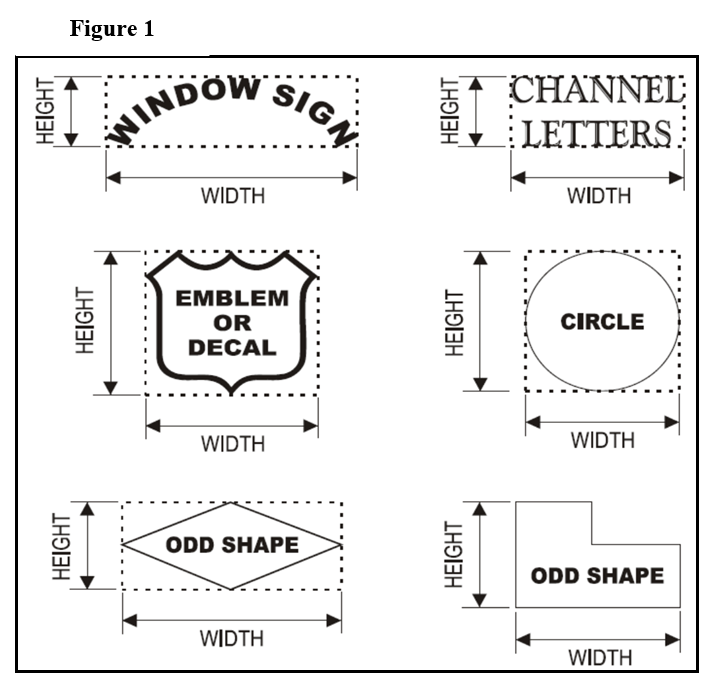
Sign Area. The area enclosed by a single continuous line, connecting the extreme points of edges of a sign. The area shall be determined using the largest sign area or silhouette visible at any time from any point that is off-site. The sign area may extend around a corner. This area does not include the main supporting sign structure; but all other ornamental attachments, inner connecting links, and the like, which are not a part of the main supports of the sign shall be included in determining sign area. The square footage of a free-standing letter or cut letters used as a sign area shall be determined by enclosing the sign area within the smallest rectangular figure needed to encompass completely all letters, insignias, or symbols of the sign, including, but not limited to, horizontal spacing between letters, insignias, symbols, logos, and trademarks, except as otherwise provided herein. See Figure 1
Signs other than free-standing letters, words, insignias, or symbols: the area is the total area of the facing, or the total area within the outer edge of any existing border of the sign. See Figure 1
In every event, computation of allowable sign area includes all existing signs on the premises, whether those signs are conforming or nonconforming.
(Ord. No. 4589, § 1(Exh.), 2-8-2021)
Section 10.0. - Construction, installation, appearance and permitting.
A.
All signs shall comply with the Florida Building Code.
B.
Concealment of Structural Supports. All attached signs shall have concealed structural members except for vertical supports or other supporting members which are design and arranged so as to be an integral part of the aesthetic composition of a sign. Signs in general shall present a good structural appearance and when attached to a building it shall appear to be an integral part of the building.
C.
Maintenance. All signs shall be adequately maintained both front and back, where visible. Such maintenance shall include, but not limited to, proper alignment of structures in a vertical upright position, continued readability of the structure and preservation of the structure with paint or other preservatives. Paint shall not be peeling or flaked. Rust shall not be visible. The Building Official may cause to be removed, after due notice, any sign which shows neglect, which becomes dilapidated or has a surrounding landscaped area or planter around it that is not well maintained. It is prohibited and unlawful to fail to adequately maintain a sign and such failure shall be subject to the code enforcement activities of the City.
D.
Construction and Electrical Permits. No sign shall be constructed, erected, or structurally altered without a sign permit, and if lighted or electrically wired, without an electrical permit. In order to obtain a permit to erect any sign within the jurisdiction of these regulations, an applicant shall submit to the Building Official, at a minimum, an accurate drawing, to scale, showing the material to be displayed, height and dimensions, construction details, electrical plans conforming to the National Electric Code, and distances to property lines and buildings in respect to the proposed location of the sign to be erected. It is prohibited and unlawful to fail to obtain all required permits for a sign and such failure shall be subject to the code enforcement activities of the City.
E.
Site Plan Review. It is prohibited and unlawful to relocate an existing sign or erect a sign upon the premises until such relocation or erection has been approved pursuant to site plan review procedures of this Sign Code.
F.
Application. All applicants requesting approval of signs that require approval by the Planning and Zoning Commission shall submit an application to the City by means of the City's electronic permitting system. Each application shall contain all information necessary to ascertain whether the proposed erection, alteration, use or change in use complies with the provisions of this Sign Code including, but not limited to:
1.
A site map drawn to scale depicting property boundaries, property dimensions, rights-of-way, driveways and parking areas, location of all existing and proposed structures, location of all existing and proposed signs, street corner and access visibility information;
2.
A drawing to scale of each sign being proposed depicting sign dimensions, square footage, sign height, depth, colors, finish, typeface, building materials, structural details and lighting/electrical information;
3.
For all attached signs: building elevations showing proposed and existing permanent signage, window sign and canopy signs;
4.
Current photographs showing existing signs on the premises and dimensions of all existing signs.
(Ord. No. 4589, § 1(Exh.), 2-8-2021)
Section 11.0. - General provisions.
A.
Signs Facing Residential Districts/Classifications. No sign except those permitted in Sections 5.0, 6.0 and 13.0 shall be permitted to face a residential district/classification within 100' of such district/classification, boundary. The distance shall be calculated as the shortest measurable distance between the face of the sign to the edge of the residential zoning district/classification, in a straight line with regard to intervening structures and shall also include those areas lying outside of the City Limits.
B.
Signs Facing Federal Aid Primary Highways. Signs shall meet all the requirements and regulations, including applicable permits, set forth in Florida law and Federal law, and shall fully conform with the provisions of this Ordinance.
C.
Words and phrases on signs shall be minimized to allow reading or interpretation from a moving vehicle at posted speed limits without hazard. A combination of 10 words, sets of numbers, logos or pictures normally will be considered as a guide and the applicant may be requested to modify the sign to delete excessive verbiage or numbers or to provide engineering or other appropriate studies that demonstrate the safety of a sign by competent substantial evidence.
D.
Signs shall not resemble, imitate, or approximate the shape, size, form or color of railroad or traffic signs, signals, or devices and shall not obstruct or interfere with the effectiveness of railroad or traffic signs, signals, or devices.
E.
Signs shall not be placed so as to obstruct or interfere with traffic visibility, nor be lighted in such a way as to cause glare or impair driver visibility upon public ways.
F.
Signs may be illuminated provided they are not in a residential zoning district/classification or residential planned development. signs, other than public traffic controls signs, shall have no elements that are flashing, blinking, rotating or pulsating. Bare (uncovered) light bulbs are prohibited and unlawful. Signs that include changeable copy reader boards and electronic message boards (EMBs) shall not be considered flashing or pulsating signs, provided they comply with all other applicable provisions of this Ordinance.
G.
Sign Colors.
1.
Florescent colors are prohibited and unlawful. Where such colors constitute a component of a standard corporate theme or identity, muted versions of such colors shall be used.
2.
Color Schemes and lettering styles shall be used consistently on all signage used on a single lot or shopping center.
H.
Without in any way limiting any specific provisions of this Sign Code and any act or activity that is prohibited by this Ordinance is prohibited and unlawful and any act or activity that is required to be accomplished in a certain manner, but is not accomplished in accordance with the requirement, is prohibited and unlawful. Any code enforcement or other legal remedy available to the City under controlling law may be used by the City to enforce the provisions of this Sign Code.
(Ord. No. 4589, § 1(Exh.), 2-8-2021)
Section 12.0. - Landscaping.
A.
All ground mounted signs shall be encased in a landscape planter, 2' to 3' in height, or a landscaped area of no less than 4' wide on each side of the sign. The planter or landscaped area must contain any combination of shrubs, flowers and groundcovers.
B.
For Lake Mary Boulevard, Rinehart Road and State Road 46 West of Airport Boulevard overlay zoning district/classification a planter structure shall enclose the foot of the base. The planter shall be between 2' and 3' in height above the ground, with a minimum length equal to the width of the sign and a minimum width of 3'. The base and planter shall be of brick or half-block.
(Ord. No. 4589, § 1(Exh.), 2-8-2021)
Section 13.0. - Signs permitted in all zoning districts/classifications without a permit.
The following signs are permitted in all zoning districts/classifications without a permit, subject to the specified conditions:
A.
Signs carved into or affixed flat to a building in such a way that they are not directly illuminated, are not made of reflecting material, do not contract sharply in color with the building, and do not exceed two' in thickness.
B.
Temporary Freestanding or Wall Signs on properties or building for sale, lease, or rent not exceeding 6 square feet in area on a side or 12 square feet in area on all sides and a maximum of 6' in height in a residential zoning district/classification; or not exceeding 24 square feet in area on one side or 48 square feet in area on all sides and a maximum of 12' in height in other districts/classifications. If not attached to a wall, such signs shall be set back at least 10' from a side or rear lot line, shall not be located in a public right-of-way, and shall be removed within 10 days after the property or building is sold, leased or rented.
C.
A permanent wall sign to exceed 2 square feet in area and mounted flush against a dwelling.
D.
Election signs subject to Section 19.0.A of this Sign Code.
(Ord. No. 4589, § 1(Exh.), 2-8-2021)
Section 14.0. - Signs permitted in agricultural (AG) district/classification with a permit.
The following signs may be permitted in the Agricultural, AG, zoning districts/classifications subject to the following regulations:
A.
A single attached sign not exceeding 12 square feet in sign surface area.
B.
A single ground mounted sign not exceeding 32 square feet in sign surface area not exceeding 12 feet in height above grade on each street side on a parcel containing uses indicated in the land use regulation schedule as agricultural provided such agricultural uses are located within an AG, Agricultural zoning district/classification.
C.
Signs for agricultural uses located within any other land use designation shall be permitted only after approval as a conditional use.
(Ord. No. 4589, § 1(Exh.), 2-8-2021)
Section 15.0. - Signs permitted in residential districts/classifications with a permit.
The following signs may be permitted in all residential zoning districts/classifications subject to the following regulations:
A.
A single 2-sided monument sign at the entrance of the subdivision or complex not exceeding 16 square feet in sign surface area and not exceeding 6' in height above finished grade is permitted. A second entrance to the subdivision may have a second sign. Such sign shall contain interior illumination. If the monument sign is located on a public right-of-way, the sign shall be designed to break away when hit by a vehicle. The design of the sign shall be sealed by a licensed Florida engineer.
B.
Multiple-family dwellings and residential subdivisions shall also be allowed 2 signs attached to the wall surrounding the development and adjacent to the primary entrance provided they are a part of a coordinated entrance design. The signs shall be identical and shall be compatible with any landscaping, paving pattern, water feature or other design elements that comprise the entrance design. Each sign shall not exceed 32 square feet and 3' in height.
All signs on the premises shall be designed using a common design theme including, but not limited to, common building materials, typeface and colors.
C.
Temporary signs on land actively being subdivided or developed, provide the sign shall not exceed 32 square feet in area on one side, and 64 square feet in area on all sides, and shall not be closer than 10' to a public right-of-way or side or rear lot line. The sign shall be removed at the time development has been completed, as determined by the City.
(Ord. No. 4589, § 1(Exh.), 2-8-2021)
Section 16.0. - Signs permitted in non-residential zoning districts/classifications with a permit.
The following signs may be permitted in all non-residential zoning districts/classifications subject to the following regulations:
A.
Non-residential subdivision entrance. A single 2-sided ground mounted sign not exceeding 32 square feet in sign surface area and not exceeding 6' in height above finished grade on each street side from which the subdivision is entered shall be permitted. Such sign shall contain no interior illumination. If the sign is located on public right-of-way, the sign shall be designed to break away when hit by a vehicle. The design of the sign shall be sealed by Florida licensed engineer.
B.
Attached Signs (Wall, Window, Canopy).
1.
Single Occupant Buildings. Each single occupant building may have 1.5 square feet of attached signage per lineal foot of tenant frontage or building length of the primary façade. The maximum amount of wall signage permitted for any building or tenant shall not exceed 150 square feet. A single occupant with a primary building façade of more than 100 linear feet may have an additional wall sign of no more than 50 square feet over each customer entrance. No more than 3 additional signs are permitted.
2.
Multi-tenant buildings. Each unit in an existing multi-unit building that has an individual separate entrance to the exterior of the building may have attached signage not to exceed 1.5 square feet per lineal 1' of tenant storefront façade length. No more than a single attached sign per tenant is permitted.
Anchor occupants in a multi-tenant building, where the anchor exceeds 100' of building frontage, may have 1.5 square feet of attached signage per lineal foot of primary building façade length up to a maximum of 150 square feet of total attached sign area. In addition, a single occupant building may have a single attached sign per primary customer entrance up to a maximum of three attached signs, not to exceed 50 square feet each.
3.
No window sign shall exceed 25% of the total window surface area.
4.
No canopy sign shall exceed 1/3 of the canopy face horizontally and vertically.
C.
Ground Mounted Sign. Ground mounted signs shall be constructed pursuant to the following regulations:
Maximum Permitted Height and Area of Ground Mounted Signs
1.
Number of signs. A single sign may be constructed on the street frontage containing the primary entrance to the premises.
2.
Developments that are located on corner lots may have a second ground mounted sign on the secondary street provided that the signs are separated by a distance of 200 linear feet as measured along the road. The height and square footage of the second sign shall be in compliance with the requirements of C.1.c of this subsection.
3.
Developments with a street frontage exceeding 400 linear feet may have a second ground mounted sign on the frontage provided that the second ground mounted sign does not exceed 8' in height and 48 square feet in total sign area. The distance between the signs shall be a minimum of 300 linear feet.
4.
Address numbers required. All ground mounted signs shall contain the address number of the premises, placed parallel to the sign face, in numbers large enough to be read from the street but in no case less than 3" high. The address numbers shall be an integral part of the sign. Address numbers shall not be included in the square footage of the sign.
D.
Ground Mounted Signs On Certain Roads.
1.
A single sign is allowed per parcel with 400' or less road frontage. If a parcel's road frontage exceeds 400' maximum of 2 ground signs shall be allowed, but no closer than 300' apart. Ground signs along intersecting roadways which are greater than 320' from the corridor roadway centerline must demonstrate that the sign is not visible from the corridor roadway and that the sign is directed to be viewed from the intersecting street.
2.
The maximum height of the entre sign structure shall not exceed 15'.
3.
The maximum allowable ground sign area shall be 1.5 square feet per linear foot of building frontage but shall not exceed 75 square feet for a single-tenant development and 100 square feet for a multi-tenant development.
4.
Address numbers required. All ground mounted signs shall contain the address number of the premises, placed parallel to the sign face, in numbers large enough to be read from the street but in no case less than 3" high. The address numbers shall be an integral part of the sign. Address numbers shall not be included in the square footage of the sign.
E.
Electronic Message Boards (EMBs) and Changeable Copy Reader Boards. EMBS or changeable copy reader boards may be included as part of ground signs, subject to the following requirements.
1.
Changeable copy reader boards and EMBs can be included on ground mounted signs; however, the changeable copy area shall not exceed 50% of the total sign face area.
2.
The changeable copy portion of the sign must occupy a secondary position to the name of the business, development and/or tenant.
3.
EMBs may display static images only. It is prohibited and unlawful for a sign to contain an image that blinks, flashes, moves, or scrolls or to contain an animated message or to flash, scroll, twirl, or otherwise move when changing.
4.
EMBs may change copy or message display once each day. There shall be no more than two messages in any 24 hour period.
5.
The maximum illumination of any electronic message or manual changeable letter sign shall not exceed 15 foot-candles when measured with a light meter held perpendicular to the sign at a distance of 24".
6.
Each sign shall be placed in such a manner so as to not interfere with, confuse, or present any hazard to traffic or pedestrians.
7.
A sign containing an EMB shall not be located closer than 100' from a property assigned a residential zoning district/classification whether located within or outside of the City Limits. The distance shall be calculated as the shortest measurable distance between the face of the sign to the edge of the residential zoning district/classification, in a straight line without regard to intervening structures.
8.
Audio speakers and all forms of pyrotechnics are prohibited and unlawful.
F.
A parcel developed with a drive-through or walk-up food establishment may have 2 on-premise menu boards.
G.
On or off premise wayfinding and directional signs are permittable provided that no such sign shall be placed in a right-of-way, exceeding 4 square feet in area on one side or 8 square feet in area on all sides, or exceed a height of 4' above the ground surface.
H.
Time and temperature signs. Time and temperature signs are permittable on parcels which are assigned a non-residential zoning district/classification. The maximum area for the time and temperature portion of the sign is 20 square feet or 50% of the sign face, whichever is smaller. The area of a time and temperature sign, whether attached or freestanding, shall be included in determining the cumulative area of signs on the property.
I.
Location of signs. Signs shall be located according to the following:
1.
No sign shall be placed within 50 feet of any zoning district/classification in which the principal permitted use is a single family, two-family or multiple-family dwelling or a mobile homes.
2.
Minimum setback from the property line fronting a right-of-way shall be equal to the height of the sign and shall be measured from the edge of the sign.
3.
Signs shall be located to maintain a clearance of 10' to all overhead electrical conductors and a clearance of 3' feet on all secondary voltage service drops.
4.
Signs shall not be located with any public easement, construction easement or similar easement.
J.
Design of Signs. Signs shall be designed according to the following:
1.
All signage shall be designed in a manner compatible with the colors and architectural style of the principal building and with the colors and style of other signs on the premises.
2.
Where individual building establishments are located in a single building or in multiple buildings which are attached, attached signs shall be designed according to a common theme but be sufficiently different in style, color, materials or other characteristics to avoid a sense of uniformity and sameness.
3.
The base of the ground mounted sign shall be designed to be compatible with the architectural style and color of the principal building. Sign bases finished with stucco or wood are prohibited.
(Ord. No. 4589, § 1(Exh.), 2-8-2021)
Section 17.0. - Signs permitted in historic district with a permit.
A.
Approval of the Administrative Official. The Administrative Official is authorized to issue Certificates of Appropriateness for signs in a historic which has a minor impact on the significant historical, architectural, or cultural materials of the historic landmark or historic district. If the Administrative Official determines that there would be a major impact or potential detriment as a result of the proposed action, the application shall be submitted for Board review.
B.
Permitted Signs. The following types of signs are permitted within the City's historic districts and historic landmarks.
1.
Site identification signs (free-standing, detached).
2.
Business identification signs (attached to the building wall or window).
a.
Wall signs (flat against building wall).
b.
Projecting/hanging signs (perpendicular to the building).
c.
Window signs.
d.
Canopy/Marquis and awning signs.
3.
Directory signs (for multi-use developments).
4.
Temporary signs.
5.
Standard sized menus mounted on the wall in cabinets at the entrance to restaurants.
6.
A-Frame signs.
C.
General Design Criteria. The following general design criteria shall apply to all signs located in the historic districts:
1.
Site Identification Signs:
a.
Site identification signs shall only be allowed if the building is setback 15' or more from the front property line.
b.
A single site identification sign per parcel is permittable.
c.
Site identification signs shall be compatible with the surrounding area, as determined by the Historic Preservation Board by issuance of a certificate of appropriateness, and in no case shall exceed 5' in height and 12 square feet per sign face.
d.
Internally illuminated signs are prohibited. Signs may be lit from an external projected light source.
e.
Sign faces shall be either parallel or perpendicular to the face of a building.
2.
Business or Use Identification Signs:
a.
Up to 2 business or use identification signs or permittable per business or use with an additional business or use identification permittable for a business a use located on a corner lot.
b.
Signs shall not cover architectural detailing on historic buildings.
c.
A single business or use identification shall be allowed per sign.
d.
Internally illuminated signs are prohibited and unlawful. Signs may be lit from an external projected light source.
e.
Roof signs are prohibited and unlawful in the historic districts.
f.
Wall Signs.
1.
Wall signs shall be limited to a single business or use and shall not exceed 18" in height and 50% of the primary frontage of the tenant space.
2.
Wall signs shall be placed parallel to the building wall.
3.
Wall signs shall not be painted directly on the surface of the building.
g.
Projecting/Hanging Signs.
1.
Projecting/hanging signs shall be sized no larger than 3' x 4' and must be constructed of wood, metal, or a combination of both. The use of neon is prohibited for hanging signs.
2.
Projecting/hanging signs must be centered on the wall space of the building frontage, for buildings with one business, and must be centered across the frontage for buildings with 2 businesses or uses. No more than 2 hanging signs per building are permittable. In cases where a single tenant occupies a building of 2 stories or greater, the tenant may install a single hanging sign on the second floor wall space, centered across the building frontage only if the sign does not adversely impact architectural features and does not compete with the architectural design of the building as determined by the Historic Preservation Board.
3.
If located under an awning or marquis, the projecting sign shall be located perpendicular to the building face.
h.
Window Signs.
1.
Shall be maintained properly;
2.
Shall be painted or decal only with no background coloring;
3.
Shall not exceed 25% of window area;
4.
Shall not obscure window displays;
5.
All neon signs shall be located inside a building and shall not be flashing;
6.
Signs using neon shall have a maximum luminous output of 300 lumens per foot calculated per foot of tube rather than lamp. A greater illumination may be used if documentation of the need for a higher value is provided to the Administrative Official from the manufacturer of the tubing and substantial competent evidence supports such a determination. Exposed glass tubes must be protected by a clear front.
i.
Canopy/Marquis or Awning Valance Signs.
Fabric canopies, marquis and structural awnings may contain signs. The sign may not exceed 18" in height and 50% of the face of the canopy or awning only. Signs are prohibited on the main body of a fabric canopy.
j.
Directory Signs.
Parcels with 2 or more businesses or uses on the premises are allowed a directory sign. The size and location of directory signs shall be approved by the Historic Preservation Board if competent substantial evidence supports a finding that the signs are compatible with the architectural style of the building and that the signs do not conceal the architecturally significant details of the building.
k.
A-Frame Signs.
1.
A single A-Frame sign is permittable for a ground-floor business.
2.
Shall be no larger than 24" wide by 36" high.
3.
Shall be black metal or stained wood and must have locking hinges.
4.
Signs placed on easels shall be no larger than 24" wide by 24" high.
5.
Plastic A-Frame signs are prohibited and unlawful.
6.
Signs shall be constructed to be permanent, but may have changing verbiage.
7.
Signs shall not impede the flow of pedestrian traffic.
D.
Performance Standards.
1.
Signs shall be constructed with and composed of permanent material.
2.
Signs shall be made of durable materials that retain their appearance for the anticipated life of the sign. Contemporary materials are acceptable but their appearance shall be visually compatible with the surrounding area. Flat signs in shiny or reflective materials, such as plastic or anodized aluminum are prohibited.
3.
New signage, when attached to the building, shall be capable of being removed without causing damage to the building. Fasteners shall go in mortar joints and shall not damage bricks.
E.
Alternative Signage. The Historic Preservation Board shall have the authority to grant variances to this Sign Code relative to signs located within an historic district upon finding competent substantial evidence that the signage is consistent with the purposes and intent of Schedule S and the sign is compatible with the development within the general area of the proposed sign.
(Ord. No. 4589, § 1(Exh.), 2-8-2021)
Section 18.0. - Lighting.
All lighting for signage shall be designed to:
•
Provide adequate light without over-lighting;
•
Control light output in order to limit light to the intended area and reduce glare;
•
Maximize the effectiveness of the lighting fixtures and minimize the adverse effect of lighting beyond property borders; and
•
Provide attractive and energy-efficient illumination.
•
Lighted signs shall be designed and located so as to prevent direct glare or hazardous interference of any kind to adjoining streets or properties.
All lighting for signage shall comply with the following regulations:
A.
Externally Illuminated Signs.
1.
Lighting fixtures shall be aimed and shielded so that light is directed only onto the sign face and not aimed at adjacent streets, roads or properties and so that the source of light is not visible from any point off the premises.
2.
Lighting fixtures shall be mounted on top of the sign structure and utilize only fully shielded cutoff fixtures.
3.
A maximum of 40 lumens per square foot of sign surface is permitted which is the total amount of initial lumens produced by all lamps used to illuminate the sign, divided by the area of the sign.
4.
No colored lights shall be used at any location or in any manner so as to be confused with traffic control devices.
5.
Lighted signs that abut property that is assigned a residential zoning district/classification shall be designed, placed and landscaped in such a manner so that the lighting does not trespass onto residential properties and so that the source of light is not visible off the premises.
B.
Internally Illuminated Signs.
1.
Internally illuminated signs do not require shielding.
2.
Internally illuminated signs, with or without changeable copy, shall only be constructed with blackout or opaque backgrounds and punch out or translucent lettering, logos, symbols, etc.
3.
A lighting engineer or lighting expert acceptable to the City shall certify that the proposed sign design conforms to the requirements of this Section.
4.
No colored lights shall be used at any location or in any manner so as to be confused with traffic control devices.
5.
Lighted signs that abut residential zones shall be designed, placed and landscaped in such a manner so that the lighting does not trespass onto residential properties.
C.
Neon. Signs using neon shall have a maximum luminous output of 300 lumens per foot calculated per foot of tube rather than lamp. A greater illumination may be used if competent substantial evidence supports a need for a higher value is provided to the City from the manufacturer of the tubing. Exposed glass tubes must be protected by a clear front.
D.
Flood lights/Spotlights. Flood lights and spotlights must be either burial fixtures or hidden in the planter surrounding the sign so that the source of light is not visible. Flood lights and spotlights used to illuminate a residential subdivision sign shall not exceed a total of 900 lumens per sign face. Flood lights and spotlights must be completely shielded or baffled so that lighting is restricted to the sign area and does not spill into the night sky.
E.
Prohibited Lighting. The following types of lighting are prohibited and unlawful:
1.
Lighting or motion resembling traffic or directional signals.
2.
Warnings or other similar devices which are normally associated with public safety or regulations.
Lighting or signs which constitute a safety hazard or hindrance because of light, glare, focus, animation, flashing or intensity of illumination.
3.
High intensity lights such as beacon lights, spotlights, search lights or flood lights.
4.
Prisms, mirrors or polished reflecting surfaces used for the purpose of augmenting intensity of light sources.
5.
Hi-intensity lights, laser lights or stroboscopic lights.
F.
Strip Lighting. Strip lighting used solely to outline a structure or any part thereof shall be considered as a sign and is prohibited and unlawful within any zoning district/classification. Strip lighting within the remaining zoning districts/classifications may be permitted provided that such strip lighting is limited to a total footage equivalent to twice the length or width of the principal building located along the street side. Strip lighting, as referred to herein, shall not include holiday decorations and related lights.
G.
Nonconforming. All non-conforming illumination, scintillation, flashing and related lighting devices shall be removed, eliminated or terminated within 1 year from February 8, 2021.
(Ord. No. 4589, § 1(Exh.), 2-8-2021)
_____
Section 19.0. - Temporary signs.
In addition to the temporary signs allowed under Section 5.0 without a sign permit, the following temporary and portable signs may be allowed subject to review and approval of a sign permit.
Footnotes:
1 Planned development agreements shall control over this table, if in conflict.
2 "Primarily" means more than 50%.
3 Temporary commercial banner signs are limited to one per year per premises with a maximum duration of display of no more than a 30 day period per calendar year.
4 The square footage limitation is for a single side of a sign. For example, a limitation of 4 square feet of limitation means that there is a limit of 8 square feet of surface area for a back-to-back sign.
5 Not applicable to signs displayed on flagpoles.
6 In planned developments, the height of the sign shall be determined by the use of the area in which it is proposed, but not more than ten feet.
7 Minimum sign setbacks do not apply to wall signs. All temporary signs are prohibited on public property and public rights-of-way except for those which relate to government speech.
8 There is no limit to the number of separate messages that may appear on the allowable surface(s) of any temporary sign. The maximum aggregate surface area allowed is subject to circumstances that may reduce the maximum aggregate surface area allowable on some premises.
9 Applies to commercial temporary signs only.
_____
A.
Additional signs during elections. Additional temporary non-commercial signage shall be allowed for the 90 days prior to and 7 calendar days following any Federal, State, Seminole County, or City election, not to exceed:
1.
6 square feet per sign, but not to exceed a cumulative total of 30 additional square feet on parcels assigned a residential district/classification.
2.
Up to 64 square feet per sign on parcels assigned a commercial zoning district/classification (including office and industrial), but not to exceed a cumulative total of 320 additional square feet.
3.
Signs are not permitted to be placed in City rights-of-way or on any City property.
4.
In all other respects, these signs must comply with Table 1.
B.
Development standards for temporary signs. All temporary signs shall comply with the following:
1.
Duration for display of temporary commercial sign. If a temporary commercial sign pertains to an event, the temporary sign shall be removed within and by no later than 7 calendar days after the event is concluded. If a temporary commercial sign does not pertain to an event, the temporary commercial sign shall be removed within and by no later than 30 days after being erected.
2.
Display of temporary sign requires permission of real property owner. A temporary sign on any premises shall not be maintained if the placement of the same does not have the permission of the owner of real property.
3.
A temporary sign shall not display any lighting and shall remain static. A temporary sign shall not display any lighting or illuminations that flash, move, rotate, scintillate, blink, flicker, or vary in intensity of color.
4.
A temporary sign shall not incorporate fluorescent color or exhibit fluorescence.
5.
A temporary sign shall not obstruct a permanent sign or the vision between pedestrian and motor vehicles. A temporary sign shall not obstruct the view of a permanent sign as viewed from any public road, street or highway or any public sidewalks, and shall not obstruct the vision between pedestrians and motor using the public right-of-way including, but not restricted to those meeting intersection visibility requirements.
6.
Temporary signs may display multiple messages. A temporary sign may display multiple independent messages on any portion of the sign surface of a temporary sign.
7.
A temporary non-commercial sign does not require a permit issued by the City. A temporary commercial sign requires a permit.
8.
With regard to flag brackets, flag stanchions and flags.
a.
For each premises and development site being used for a residential use, a single flagpole may be installed and 2 flags may be display per flagpole. For each premises and development site that is over 1/2 acre in size and is being used for a non-residential use, up to 3 flagpoles may be installed and up to 2 flags may be displayed per flagpole.
b.
For each principal structure on a premise, up to 2 flag brackets or stanchions may be attached or placed for the display of flags. A flag display from a flag bracket shall not exceed 24 square feet in size.
c.
For the purpose of determining the size of a flag, a single side of the flag shall be counted as the display surface.
d.
Flags on premises in non-residential use may be externally illuminated.
C.
Temporary Banner Signs.
1.
Temporary banner signs shall be located at the store-front of the business, or on a flagpole.
2.
Banner signs shall not exceed a maximum area of 32 square feet per premise.
3.
The banner signage shall not be displayed in excess of 12 feet in height above the ground, unless on a flagpole.
4.
Banner signs shall be attached to the building which is the location of the use advertised.
5.
For duration of display, See Footnote 3 to Table 1.
(Ord. No. 4589, § 1(Exh.), 2-8-2021)
Section 20.0. - Comprehensive sign programs.
1.
Intent. The intent of comprehensive sign programs is to provide property owners with flexibility to develop innovative, creative and effective signage and to improve and protect the aesthetic values of the City. The City recognizes that in many circumstances, there are innovative and creative alternatives to minimum standard signage which are desirable and attractive and which will enhance community character and individual property values.
2.
Purpose. The purpose of comprehensive sign programs is to provide an alternative to minimum standard signage subject to flexibility criteria which ensure that alternative signage will not have an adverse impact on the aesthetic values, community character and quality of life of the City.
3.
Authority. The Planning and Zoning Commission shall have the authority to approve comprehensive sign programs based upon the criteria set forth in this Sign Code.
4.
Applicability.
a.
Any property owner may apply for approval of a comprehensive sign program.
b.
All signs for planned development projects that are comprised of any combination of residential, commercial and office uses shall be subject to approval under the provisions of this Sign Code pertaining to comprehensive sign programs.
c.
All signs for planned development projects of 10 acres or greater shall be approved under the provisions of this Sign Code pertaining to comprehensive sign programs.
5.
Required Elements.
a.
Design Theme. A request for approval of a comprehensive sign program shall include, at a minimum, a distinct theme or idea on which to base the coordinated design of all signs located on the premises.
b.
All signs included. The comprehensive sign program shall detail all signs on the premises including, but not limited to, attached signs, ground mounted signs, directional signs, directory signs and instructional signs.
6.
Flexibility criteria.
a.
Architectural Compatibility. The signs proposed in a comprehensive sign program shall be designed as a part of the architectural theme of the principal buildings proposed or developed on the parcel and shall be constructed of materials and colors which reflect an integrated architectural vocabulary for the parcel proposed for development; or
The design, character, location and/or materials of the signs proposed in a comprehensive sign program shall be demonstrated by competent substantial evidence to be more attractive than signs otherwise permitted on the parcel proposed for development under the minimum provisions of this Sign Code.
b.
Height. The maximum height of all signs proposed in a comprehensive sign program is 15' provided, however, that a single attached sign with a sign face of no more than 12 square feet may be higher.
c.
Total area of sign faces. The total area of sign faces which are proposed as a part of a comprehensive sign program shall not exceed 2 times the total area of sign faces permitted under the minimum sign standards on the parcel proposed for development.
d.
Elimination of signage. The signage proposed in a comprehensive sign program must result in the elimination of existing unattractive, nonconforming and obsolete signage or result in an improvement to the appearance of the parcel proposed for development in comparison to signs otherwise permitted under the minimum sign standards.
e.
Community Character and Property Values. The signage proposed in comprehensive sign program must have a positive impact on the aesthetic appearance of the City and must not negatively impact the value of property in the immediate vicinity of the parcel proposed for development.
f.
Scenic corridor plan. The signage proposed in a comprehensive sign program must be consistent with any scenic corridor plan which the City has adopted for the area in which the parcel proposed for development is located.
(Ord. No. 4589, § 1(Exh.), 2-8-2021)
Section 21.0. - Nonconforming signs.
A.
Amortization of Nonconforming Signs. Any lawfully existing permanent sign which was made non-conforming by the adoption of this Ordinance shall be brought into compliance with the provisions of this Ordinance within 7 years from effective date of this Ordinance and any existing temporary sign which existed on June 22, 2009 must be brought into compliance with the provisions of this Ordinance within 2 years from that date. This amortization schedule shall not apply to any sign subject to the Federal Highway Beautification Act or Chapter 479, Florida Statutes, as from time to time amended.
B.
Repairs and maintenance. The owner of a non-conforming sign may carry out maintenance or repairs that are required by the City Code or that are reasonably necessary or commonly engaged in to maintain the sign in a reasonable usable condition as determined by the City. Repairs or maintenance of a non-conforming sign shall not extend beyond its amortization period; provided, however, that the City may treat said signs as a nuisance and may seek any code enforcement or other remedy available to the City under controlling law.
C.
Damage or destruction. If any non-conforming sign is damaged or destroyed to such an extent that the cost of repair or reconstruction of the sign is 50% or more of the depreciated value of the sign at the time it is damaged or destroyed as determined by the City, then the non-conforming sign shall be made to comply with the provisions of this Sign Code.
D.
Discontinuance. A sign that is discontinued as defined in this Sign Code shall lose its non-conforming status. An intent to abandon is not necessary to establish discontinuance.
E.
Alteration. A non-conforming sign shall not be moved, structurally altered, enlarged or changed in height or size.
F.
Illegal Sign. The use of an illegal sign shall not vest the sign owner or property owner with any right and all illegal signs shall be subject to any code enforcement or other remedy available to the City under controlling law.
(Ord. No. 4589, § 1(Exh.), 2-8-2021)
Section 22.0. - Signs prohibited in any district.
The following signs are not permitted in any zoning district/classification:
A.
Abandoned signs.
B.
Animated signs.
C.
Billboards.
D.
Snipe signs.
E.
Sandwich signs and portable signs.
F.
Seawall signs.
G.
Beacon lights.
H.
Signs located or attached to trash receptacles, gutters or benches, except as specifically permitted upon action by the City Commission based upon time, place and manner determinations and, if the sign relates to government speech, whether the City Commission determines that the content is such that the desires to express as government speech.
I.
Signs on public property. Except as provided in these regulations, signs may not be erected on public property except by a public body or a semi-public body provided such sign is approved by the City Commission, based upon time, place and manner determinations and, if the sign relates to government speech, whether the City Commission determines that the content is such that the desires to express as government speech. It is prohibited and unlawful for a person to paint, paste, print or nail any banner sign, paper sign, or any advertisement or notice of any kind, or cause the same to be done, on any curb, flagstone, pavement or any other portion or part of any sidewalk or street, or upon any tree, lamp post, telephone ore telegraph pole, hydrant or bridge within the limits of any street or public right of way. This provision shall not apply to notices as may be required by law and other exceptions as provided in this Sign Code. All signs wrongfully placed on public property will be confiscated and destroyed and be subject to any code enforcement or other remedy available to the City under controlling law including, but not limited to, assessments under the provisions of Section 26-121 of the City Code.
J.
Obscene displays. Any sign which displays any statement, work, character, or illustration of which is obscene.
K.
Obstructions. Any sign erected in a manner that would impede ingress and egress through any door or emergency exit.
L.
Streamers, spinners and pennants, ribbons, balloons or similar devices except as authorized in this Sign Code.
M.
Advertising motor vehicles or trailers. A motor vehicle, as defined by Section 320.01(1), Florida Statutes, or trailer, as defined by Section 320.01(4), Florida Statutes, which has attached to or located thereon any sign or device for the purpose of advertising a business, product, or service or for directing people to a business or activity. It is prohibited and unlawful for a person to park any such motor vehicle or trailer on a public right-of-way, on public property, or on private property so as to be visible from a public right-of-way. This provision is not intended to prohibit vehicle signs that are part of a moving fleet of motor vehicles.
N.
Signs which emit smoke, vapor, particles, odor or sounds.
O.
Parasite Signs.
P.
Flashing signs.
Q.
Illegal signs.
R.
Fence signs.
S.
Inflatable signs except as provided for in this Sign Code.
T.
Mobile trailer signs.
U.
Off-premise signs.
V.
Roof signs.
W.
Revolving signs.
X.
Obstructions. Any sign erected in a manner that would impede ingress and egress through any door or emergency exit or otherwise create a fire safety or other public safety hazard.
Y.
Signs which violate City (this Sign Code), County, State, or Federal laws or regulations.
Z.
Signs painted, attached or affixed to trees or other living vegetation.
(Ord. No. 4589, § 1(Exh.), 2-8-2021)
Section 23.0. - Figures.
(Ord. No. 4589, § 1(Exh.), 2-8-2021)

