
Sanford City Zoning Code
Schedule F
REQUIREMENTS FOR BUILDINGS, PARCELS, YARDS, BUILDING SETBACKS AND LIGHTING1
Editor's note— Ord. No. 4755, §§ 1(a)(Exh.), adopted Oct. 23, 2023, repealed the former Schedule F, §§ 1.0—5.0, and enacted a new Schedule F as set out herein. The former Schedule F pertained to similar subject matter and derived from Ord. No. 4092, § 3, adopted Mar. 10, 2008; Ord. No. 4364, § 1(Exh.), adopted June 13, 2016; and Ord. No. 4583, § 1(Exh.), adopted Jan. 25, 2021.
Cross reference— Buildings and building regulations, ch. 18.
Section 1.0 - Purpose and intent.
This Schedule establishes design provisions for building location or setback standards within a parcel, impervious surface limitations, vehicular storage allowances, and temporary construction storage and lighting. Unless stated otherwise herein, as permitted by the Land Development Regulations or by the Administrative Official, any deviation from the regulations of this Schedule shall be prohibited and unlawful. The provisions of this Schedule shall be implemented by the Administrative Official by means of the issuance of development orders and denial development orders.
(Ord. No. 4755, § 1(a)(Exh.), 10-23-2023)
Section 2.0. - Buildings.
A.
Minimum frontage or access. It is prohibited and unlawful to erect a building on any parcel with less than the minimum required frontage on a street or an accessway as designated in Schedule C.
B.
Water supply and sewage-disposal facilities. It is prohibited and unlawful to construct any building without water supply and sewage disposal facilities approved by the City. All required certifications, including those of any legally responsible governmental agency, approving proposed and completed public or private water supply and sewage disposal facilities, as applicable, shall accompany all applications for site development permits and/or certificates of completion.
C.
Principal building. Only one principal building and permitted accessory structures may be erected on any tract or lot except for approved site plans and/or approved planned development project plans. Temporary construction activities are permitted during construction only and shall be removed prior to the issuance of a certificate of occupancy for the premises as demonstrated by an affidavit or inspection.
D.
Accessory buildings and structures. The following regulations apply to the construction of all accessory buildings and structures:
1.
Accessory buildings and structures shall be designed to blend aesthetically with the main structure. Accessory buildings or structures equal to or greater than 200 square feet shall match the principal building in materials, color and architectural style.
2.
Accessory buildings and structures are prohibited in front or side yards. Garages and carports greater than 200 square feet that comply with the applicable required district setbacks may be permitted in the side yard.
3.
An accessory building or structure shall not be erected, constructed, or modified for residential purposes, unless specifically provided for in these land development regulations.
4.
The total square footage of all accessory buildings shall not exceed the square footage or height of the principal building.
5.
An accessory building or structure shall not be constructed or erected on a lot prior to the principal use that it serves.
E.
Cargo containers. A cargo or shipping container may be used for either temporary storage or permanent use based on the criteria of this section.
1.
Temporary storage. A cargo or shipping container used for temporary storage may be allowed on a lot or parcel subject to the following:
a.
May be used as storage only:
b.
Shall not be used for storage of motorized passenger vehicles;
c.
Shall not be stacked on top of each other;
d.
Shall not be classified as a High-Hazard Group H occupancy;
e.
Shall not be equipped with plumbing or electrical power or lighting;
f.
Shall not exceed 200 square feet in size; or
g.
Shall not exceed 6 months in duration on a lot within a 1-year period. A time extension may be granted by the Administrative Official who shall apply the purpose and intent of this Schedule together with sound and generally accepted land use planning practices and principles in making such determination.
2.
Permanent use. A cargo or shipping container may be permanently permitted for use on a lot subject to all requirements of the Land Development Regulations and the Florida Building Code for a site-built structure and the following:
a.
May be used for any use with a current City approval;
b.
If utilized as an accessory structure it shall be modified to be architecturally similar to and compatible with the primary structure on the property.
F.
Building color. Building colors shall not be purely a primary or secondary color.
G.
Height exceptions.
1.
Fire towers and water towers are excluded from the height requirements of these regulations.
2.
Height requirements apply to buildings and do not apply to necessary mechanical appurtenances or structures which are not intended for occupancy by human beings unless such mechanical appurtenances or structures exceed 125' in SR-1AA, SR-1A, SR-1, SR-2, MR-1, MR-2, MR-3 and AG zoning districts or 200' in any other zoning district in which case conditional use approval shall be required.
(Ord. No. 4755, § 1(a)(Exh.), 10-23-2023)
Section 3.0. - Parcels.
A.
Reduction of parcel area prohibited. Every parcel, including those comprised of 1 or more adjacent tracts and/or lots of record, shall maintain an area sufficient to comply with all land development regulations.
B.
Double frontage and corner parcels.
1.
Multiple frontage and corner parcels shall comply with front yard requirements and street building setbacks on all adjacent streets.
2.
On corner parcels abutting 2 intersecting streets there shall be only 1 side yard. The remaining parcel line shall be deemed the rear parcel line. The side parcel line shall be determined as follows:
a.
The parcel line opposite the parcel line having the greatest street frontage; or
b.
If the parcel lines abutting on both streets are of equal length, the side parcel line shall be determined by the orientation of the structure.
3.
On corner parcels abutting 3 intersecting streets, the remaining parcel line shall be deemed the side parcel line.
C.
Obstruction to vision at intersections. On corner parcels where front yards and/or building setbacks are required, no obstruction, including, but not limited to, landscaping, are prohibited and unlawful from impeding visibility between a height of 2½' and 10' above the grades of the intersecting streets or alleys at their point of intersection in an area bounded by the intersection of any 2 right-of-way lines of streets, a street and alley, 2 alleys or a street and railroad, and a straight line intersecting those 2 right-of-way lines at points 25' from their intersection.
(Ord. No. 4755, § 1(a)(Exh.), 10-23-2023)
Section 4.0. - Yards and building setbacks.
A.
Permitted encroachments. The following yard and building setback encroachments are permittable:
1.
Breezeways and porte-cocheres. Breezeways and porte-cocheres are permitted in front, rear and side yards, subject to meeting all setback requirements. For commercial and office uses, a porte-cochere shall have a minimum horizontal dimension of 18'. A clear space of not less than 9' shall be provided for residential uses. Breezeways may be designed so that they provide a covered entrance into any building provided, however, that such breezeways shall not be designed so as to be considered as, or function as, an outdoor covered patio area. In addition, no porte-cochere shall be designed so as to be considered as, or function as, a carport.
2.
Swimming pool. Swimming pools and spas are allowed in all zoning districts. However, some neighborhoods are zoned PD (Planned Development) and might have unique development standards. Other neighborhoods may be subject to historic preservation regulations which may include the requirement of a certificate of appropriateness.
A site plan shall be submitted showing the location of the pool and its distance from property lines and structures. Measurements will be made to the pool structure itself—not the water's edge. Location and setback requirements include:
a.
Rear yard. The pool must be located at least 5' from the rear property line.
b.
Side yard. The pool must be located at least 5' from the side property line.
c.
Easements. Pools, pool decks, and pool equipment cannot be located within any easement.
d.
Buildings. Pools shall not exceed a minimum of 3' from buildings with foundations or at least 1' for every 1' of depth—measured to any point of excavation or as required in the Florida Building Code, whichever is greater. For example, if a portion of a pool is 5' deep, that portion of the pool must be located at least 5' from a building that utilizes a foundation. A pool may be located closer than 3', or in violation of the 1:1 ratio, to the foundation if a sealed engineered design is approved by the Administrative Official.
Exception: Above-ground pools and spas do not have a minimum required setback from foundations, but shall comply with property line setback and easement requirements.
e.
Pool equipment. Pool equipment is prohibited and unlawful within the front yard of a lot. Pool equipment must be located a minimum of 5' off the property line and cannot be attached to a common fence separating an adjoining property. Pool equipment shall not be installed in drainage swales and designated drainage flows.
3.
Screened swimming pool enclosure. Any swimming pool enclosure shall be considered as an accessory building for the purposes of determining setbacks even if attached to the principal building.
4.
Patio, deck, and porch. All patios, decks, and porches whether screened, open on the sides, covered, uncovered, attached or unattached to the principle building shall be subject to the following:
a.
Setbacks. Shall have a setback consistent with the principal building in the front, side, or side street yard. If located in the rear yard it shall be consistent with the accessory building setbacks. All setbacks shall be consistent with Schedule C, D, or S, whichever is applicable.
b.
Impervious surface ratio. If constructed of wooden planks with separation between said planks it shall be considered a pervious surface and shall not cover more than 50% of the rear yard or 10% of the front, side or side street yard.
c.
Mean/normal high-water line. Shall be set back at least 15' from the mean high-water mark for all water bodies.
d.
Easements and landscaping. Shall not be located in a utility or drainage easement or encroach into required landscaping areas.
5.
Building projections. Building projections may encroach into front, side and rear yards as follows:
a.
Sills or belt courses may project up to 12" into a yard.
b.
Awnings or canopies shall project a maximum of 4' from the building when located over pedestrian areas and no less than 2' otherwise. Awnings or canopies shall maintain a minimum clearance of 8' above any sidewalk or pedestrian route.
c.
Chimneys, fireplaces or pilasters may project up to 2' into a required yard.
d.
Projected or recessed covered public entry providing a minimum horizontal dimension of 8' and a minimum area of 100 square feet.
e.
Overhangs, maximum of 3'.
f.
Balconies may project a maximum of 2' into any required setback so long as the support structure for the balcony does not encroach into the setback.
B.
Prohibited encroachments.
1.
No electrical, plumbing and mechanical equipment, dumpster or area specifically designated for garbage cans shall be located within a front yard or front yard setback.
2.
Vehicles shall not be parked in the front or side yards of a lot or in the right-of-way adjacent to any lot unless parking occurs in the area of a lot permitted for a driveway with an associated curb cut permit.
(Ord. No. 4755, § 1(a)(Exh.), 10-23-2023)
Section 5.0. - Impervious and other improved residential surfaces.
A.
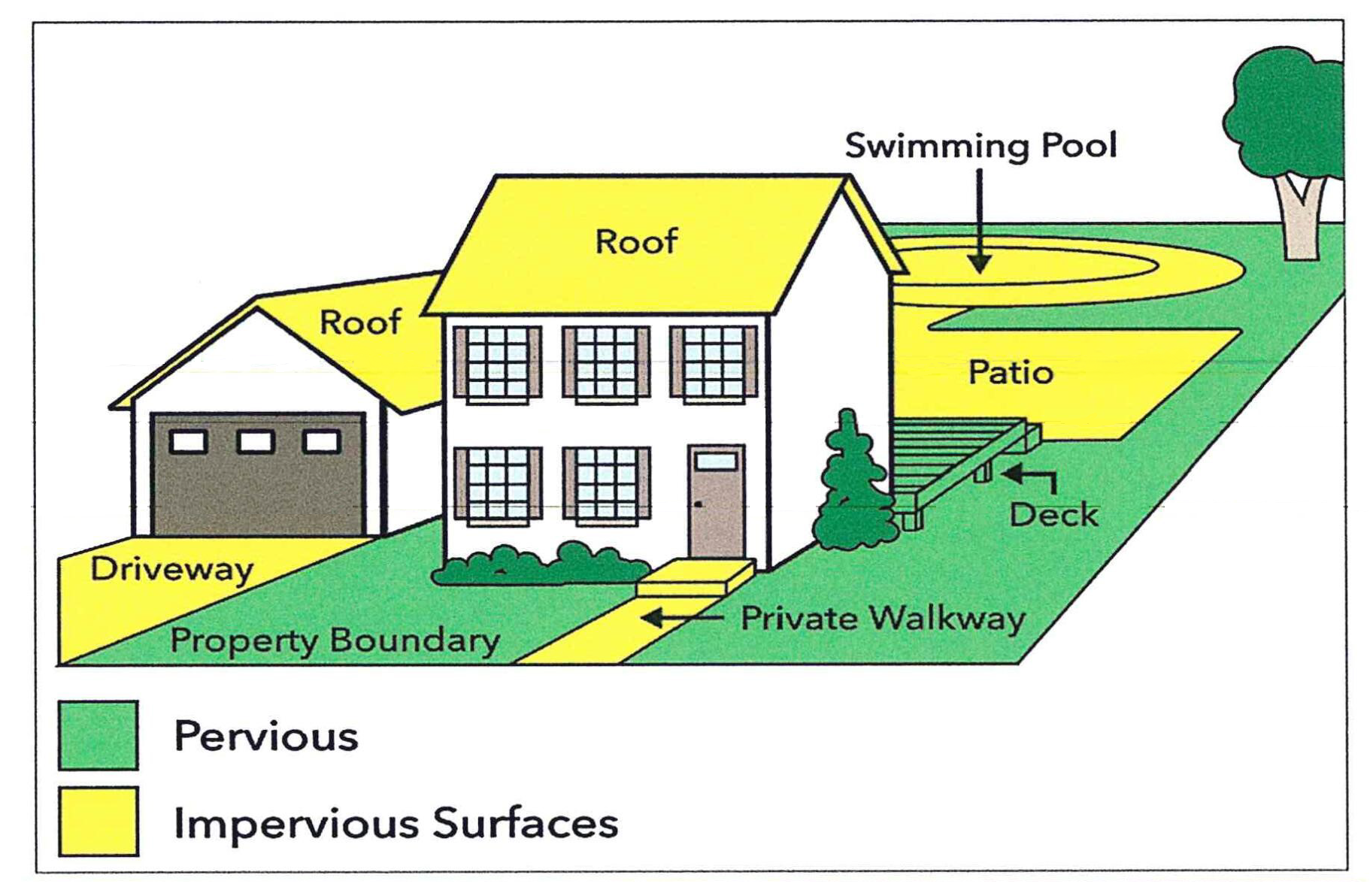
General. "Impervious surface" means all hard surfaces and structures such as a roof, driveway, sidewalk, patio, pool and other similar surfaces that prevent rainwater from naturally soaking into the ground. This includes materials such as concrete, pavers, and asphalt. The increase in impervious area can create flooding, drainage issues or water quality concerns which may occur when runoff picks up pollutants such as oil, pesticides, fertilizer, sediment, and nutrients along the way before entering the storm sewer system.
Adding any building or improvement that adds impervious surface must not bring a lot above the maximum allowed impervious surface limits.
B.
Calculating the impervious surface on your property. Impervious surface ratio (ISR) calculations and other information shall be provided with all applications. Calculations for the ISR shall be determined as follows:
1.
Impervious Area in sq. ft. / Entire Lot Area in sq. ft. = ISR
Example: 4,000 sq. ft. impervious / 10,000 sq. ft. lot = 0.4 or 40% ISR
a.
No more than 50% entire lot ISR is allowed within the following zoning districts: SR-1AA, SR-1A, SR-1, MR-2, MR-3.
b.
No more than 60% impervious for PD zoning as set forth in the controlling development order.
c.
Compacted gravel or mulch and artificial turf are considered impervious.
d.
Pervious pavements or other non-compacted materials that are continually maintained free of clay or fine particles that would prevent water percolation may be considered pervious.
2.
Provide any special requirements of the zoning district.
C.
Excessive impervious area. If a project exceeds the impervious surface percentage limit: options include:
1.
Removing existing unneeded impervious surfaces (i.e., remove excess patio or pool decking) or swap another impervious surface on the property of the same size (i.e., remove old shed to add new patio).
2.
In some circumstances, an application for a variance to exceed the maximum percentage may be filed. The application requires a plan that addresses the increase in runoff resulting from the project.
D.
Additional agency standards. All projects may be subject to other City, State, and other legal requirements such as setbacks, wetland buffers, and design standards.
(Ord. No. 4755, § 1(a)(Exh.), 10-23-2023)
Section 6.0. - Fences and walls.
A.
Requirements.
1.
Permit required. Fences and walls allowed within the applicable zoning district require a building permit.
2.
Materials and design.
a.
All fences shall be constructed of materials appropriate to their purpose and location.
b.
All walls shall have a decorative finish such as masonry, brick, stucco or paint.
c.
Fence or wall made of corrugated or sheet metal are prohibited and unlawful.
d.
Electrified or other potentially injurious, hazardous or noxious materials or construction techniques are prohibited and unlawful.
e.
Barbed wire or similar attachments are permitted, if atop a chain link fence at least 6' in height and oriented toward the interior of the property, when necessary to preclude entry into a hazardous location or facility or to protect the exterior storage of materials or equipment from vandalism or theft provided that the property is not located within or adjacent to properties zoned for residential or park uses.
f.
Wire or chain link fences shall be constructed with a vinyl coat.
g.
Wire or chain link fences shall not have exposed points, wires, or prongs on the top of the fence.
h.
Wire or chain link fences are prohibited and unlawful on the front building line of a property, a special development order may be granted to properties in agricultural districts and to temporarily secure unsafe structures.
3.
Location and size.
a.
Fences and walls placed on the property line or within a setback area shall be oriented so that the finished side of the fence or wall is facing or viewable from a street, right-of-way, or an adjoining property. All support posts and stringers shall face inward toward the property upon which the fence or wall is located.
b.
Any portion of a fence where access is wholly or partially blocked by a building, fence, wall, other structure, or dense foliage located adjacent to, but not necessarily adjoining, the property line, may install the support posts on the outside of the fence. This does not apply to stringers.
c.
To offset the unbroken nature of a fence or wall which exceeds 100' in length in any single horizontal plane along a street right-of-way shall either provide:
1)
Inset areas of at least 8' in width and depth for landscaping treatment.
2)
Non-opaque openings in the walls or fence at a minimum of 8' intervals through the use of wrought iron or similar types of wall treatment; or
3)
Architectural features such as a column or other feature at a minimum of 8' intervals.
d.
All fence or wall located within a required setback that create an enclosed area shall provide an opening or gate of sufficient width to allow access through the fence or wall to any abutting right-of-way for the purpose of facilitating maintenance of any required landscaping and the street right-of-way.
e.
A fence or wall shall not be placed in a location that obstructs required drainage flow or interferes with a drainage facility or structure.
f.
Fences located on commercial, office, or industrial use properties are subject to the architectural guidelines and best planning practices established within the Land Development Regulations.
g.
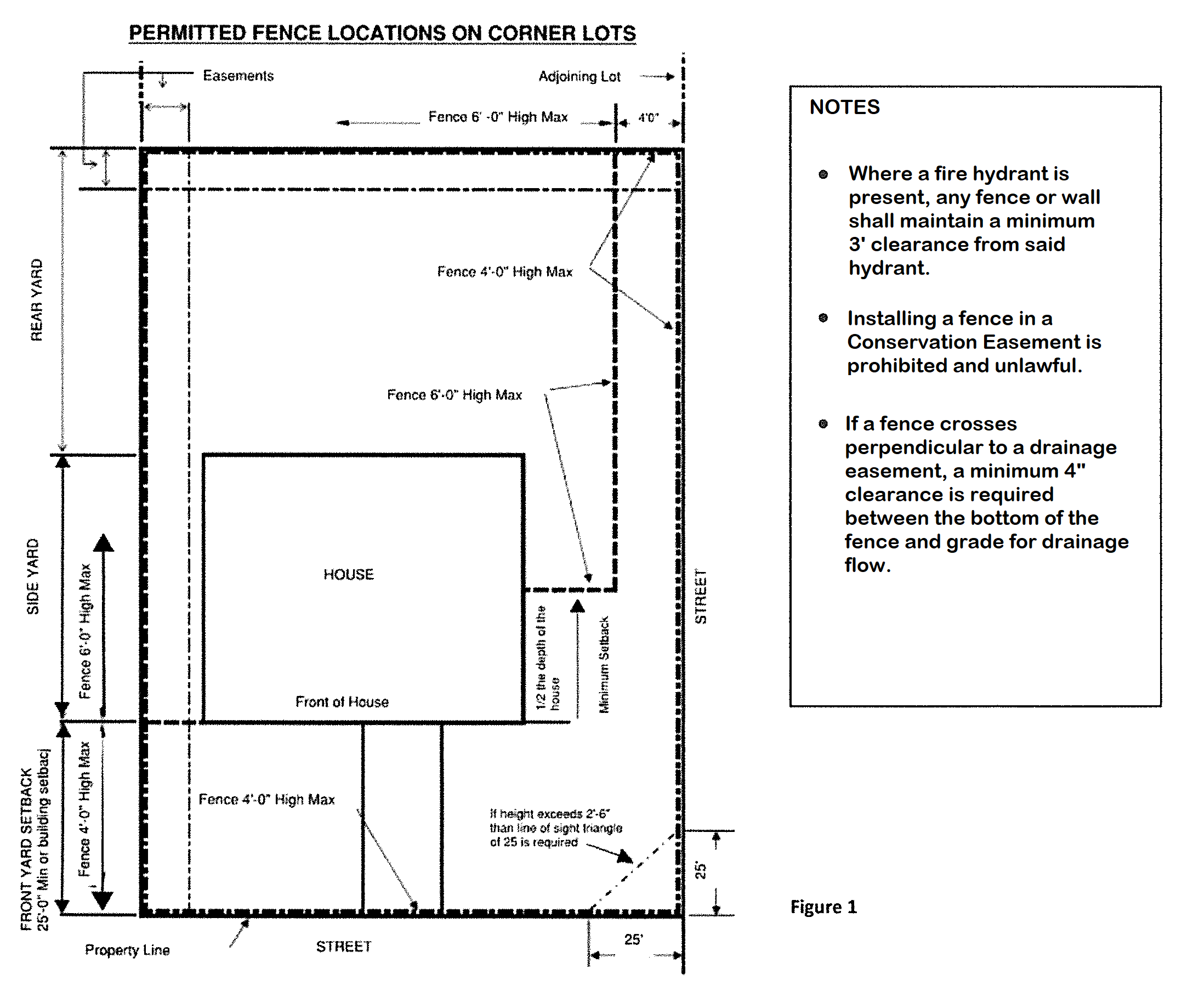
It is prohibited and unlawful to construct a fence within the visibility triangle at roadway intersections as determined by the Administrative Official after consulting with City engineering staff. To effectuate that requirement, fences, walls, hedges, and other structures of vegetation shall not exceed a height of 2'6" within a clear vision triangle and the lower portion of tree crowns shall not be less than 8' clear from the ground within a clear vision triangle.
4.
Installation. Supporting components and posts shall be installed facing inward (towards the property which is subject of the building permit) with the smooth or flat/finish faces on the outside. If both sides of the fence are finished sides with support posts screened, each face shall be of the same type and finish.
5.
Site layout. A land survey or site/plot plan providing the location of the fence clearly indicating where the fence and/or gates will be installed based on a survey is required in support of the building permit application which depicts the location of the proposed fence, number of gate(s), landscaping buffer (if required), total linear feet, height and material for each section of proposed fence. The survey must reflect the layout of the property in its current state.
If a survey is not available and the parcel is of record, an applicant may petition the Administrative Official, or designee, to consider a clean and dimensionally accurate plot plan depicting all of the following:
a.
Lot dimensions (as designated on a plat or as legally described).
b.
Property pins/corners where appropriate.
c.
Street name.
d.
Address, lot, block and unit.
e.
Footprint of the house and all accessory structures with all dimensions and setbacks shown.
f.
Location, dimensions, types and materials of the proposed fence, and any existing fencing, with gates clearly marked.
B.
Height restrictions. Fences, walls and hedges shall not exceed the maximum heights set forth in the following table. See the information below the table for additional requirements.
Fences and walls greater than 6' in height shall require the approval of the Building Official.
1.
Fencing in all front yards. Fences, walls, hedges or screen planting shall not exceed 4' in height in the front yard. All fencing and gates located within a front yard shall be decorative and semitransparent and shall not be solid or shadow-boxed and shall be constructed of materials to enhance the appearance of a property or garden. A fence shall not obstruct visibility into or out of the lot or property.
2.
Decorative/ornamental fences. A decorative fence may be located in the required front yard in any residential zoning district as follows:
a.
No decorative/ornamental fence shall exceed 4' in height.
b.
All ornamental fences must be located a minimum distance of 1' inside all property lot lines, or 2' from any public sidewalk, whichever is greater.
c.
Fences in the public right of way shall be prohibited, including, but not limited to, that area between the curb and the sidewalk.
d.
Materials used in decorative/ornamental fences shall be limited to wood, aluminum picket, wrought iron, vinyl or other materials approved by the Administrative Official and shall not contain any sharp or pointed projections of any kind or in any other way be detrimental to the public health and safety. Fences consisting of chain link, woven or welded wire or sheet metal are strictly prohibited.
3.
Residential fence heights. On property assigned a residential zoning district/classification, the height of a fence may be increased to 8', provided that the top 2' of the fence is constructed of open lattice or other non-opaque construction that is of the same material as the remainder of the fence.
4.
Fencing on residential corner lots. On properties located on a corner (fronting 2 or more streets), fences up to 6' in height may be permitted in the defined side yard fronting a street as follows:
a.
The fence is located at least 4' inset from the property line adjacent to the street;
b.
The area between the property line and the fence shall have landscape, hardscape or groundcover in a manner consistent with all other requirements;
c.
The length of the fence may be installed from the rear property line to no more than half the length of the linear frontage of the house along the street.
C.
Temporary construction fencing plan required.
1.
Construction sites. Temporary fencing (and other types of barriers deemed acceptable to the Administrative Official) may be erected around construction sites for visual buffering and safety. Temporary fencing shall be subject to approval in conjunction with a development or building permit and shall be removed prior to the issuance of a certificate of occupancy or completion. The temporary fencing may contain screening material enhanced with lifestyle graphics, images, pictorials, wraps, photographs, or a combination thereof. However, the screening material allowed shall not conflict with the original intent for said fencing, mesh, and related materials, which is to offer protection from dust, debris, and other airborne particulate matter. The following criteria shall apply:
a.
Allowed materials. A chain link with vinyl coating, vinyl fence mesh or plywood.
b.
Height. Maximum of 6' above grade. When, in the estimation of the Administrative Official, on-site circumstances dictate, height may be increased up to 10'.
c.
Fence plan. The fence plan must clearly indicate location and type of all fencing and gates.
d.
Location. Fencing is allowed only on the property which is subject of the permit.
e.
Screening. On properties abutting roads designated as arterials or collectors only the screening is required for chain link fences. Plywood fencing may only be used when abutting non-trafficways.
f.
Maintenance. Fences shall be kept in good repair at all times.
g.
Art and murals. Murals or other public art are encouraged to be placed on plywood or vinyl mesh fences; subject to administrative approval in accordance with the City Code.
h.
Removal prior to CO. All fencing must be removed prior to issuance of any final certificate of occupancy.
D.
Non-conforming fences and variances.
1.
Non-conforming fences. Where a lawful fence exists at the effective date of the enactment or amendment of this Section that could not be built under the terms of this Section by reason of restrictions on height, materials, required yards or other characteristics of the fence, or its location on the lot, such fence may be continued so long as it remains otherwise lawful, subject to the following provisions:
a.
No such fence may be enlarged or altered in a way which increases its nonconformity.
b.
Should such fence be destroyed by any means to an extent of more than 30% of its overall square footage at time of destruction it shall not be reconstructed:
c.
No such fence may be structurally altered or improved so as to prolong the life of the fence or so as to change the shape, size, type or design of the fence.
2.
Variances. Variances to the requirements of this section may be considered in accordance with the requirements of the Land Development Regulations.
(Ord. No. 4755, § 1(a)(Exh.), 10-23-2023)
Section 7.0. - Residential vehicle storage and screening standards.
A.
Definitions.
Inoperable vehicle means a vehicle which cannot be driven upon the public or private streets for reasons including but not limited to being wrecked, abandoned, in a state of disrepair, or incapable of being moved under its own power.
Improved parking surface means a hard surface consisting of concrete, asphalt, brick, paving stones, block pavers, gravel contained by appropriate border material, or other similar hard surface material used to minimize erosion from a disturbed surface to improve strength and durability. Wood or rubber-based ground cover products are not considered an improved parking surface.
B.
Requirements for boats, trailers and recreational vehicles. Vessels, as defined in F.S. § 327.02 and trailers and recreational vehicles, as defined in F.S. § 320.01 that are parked or stored in a residential zoning district shall be subject to the following:
1.
If the overall length is 22' or less, it may be parked in open view on an improved driveway or surface within the front yard of a lot. No part of the boat, trailer or vehicle shall be permitted to extend across any property line or into a right-of-way and be parked completely within the property lines of the lot.
2.
May be parked in side and rear lot areas only if screened by fences, walls and landscaping, including hedges, trees, etc., having at least 65% opaqueness screening the view of the boat, trailer or recreational vehicle to the adjacent properties.
3.
If parked or stored entirely within a carport, garage or screened from right-of-way it shall not be subject to the time limitations in this section. As used herein, a garage or other enclosed structure shall mean a structure having at least 50% opaqueness.
4.
If the overall length is 23' or more, it may be parked at a residence for a maximum of 24 consecutive hours within a 15-day period in the driveway solely for the purpose of loading, unloading or other related activity incidental to preparing the vehicle for travel or returning from travel. If additional time is needed due to exigent circumstances as proven by the applicant, the Administrative Official may approve a reasonable period of time, only if an application is submitted within 24 hours after such vehicle is so parked. The intermittent moving of a vessel, recreational vehicle or trailer to avoid the limitations of this section shall not be a defense to a code enforcement action initiated by the City.
C.
Commercial vehicle parking standards. The parking of commercial or oversized vehicles that exceed 22' in length or 7' in width in any residential zoning district, shall be subject to the limitations as follows:
1.
Oversized vehicles. Vehicles used primarily for commercial purposes, product or service, including trucks (with a rated capacity over one ton), semi-trailers, truck tractors or any combination thereof or any other truck or special mobile equipment or heavy equipment, building materials and other similar materials is not permitted within the residential zoning districts (SR-1AA, SR-1A, SR-1, MR-2, MR-3, AG or PD).
2.
Buses. Buses may be parked only in designated bus parking areas approved pursuant to issuance of a conditional use development order.
D.
Inoperable vehicle parking standards. In order to address blight and potential detrimental effects on surrounding properties, it is prohibited and unlawful to park or store an inoperable motor vehicle on any premises that is in a state of major disassembly, disrepair, or in the process of being stripped or dismantled. Painting of vehicles is prohibited and unlawful unless conducted inside an approved spray booth.
E.
Residential parking standards.
1.
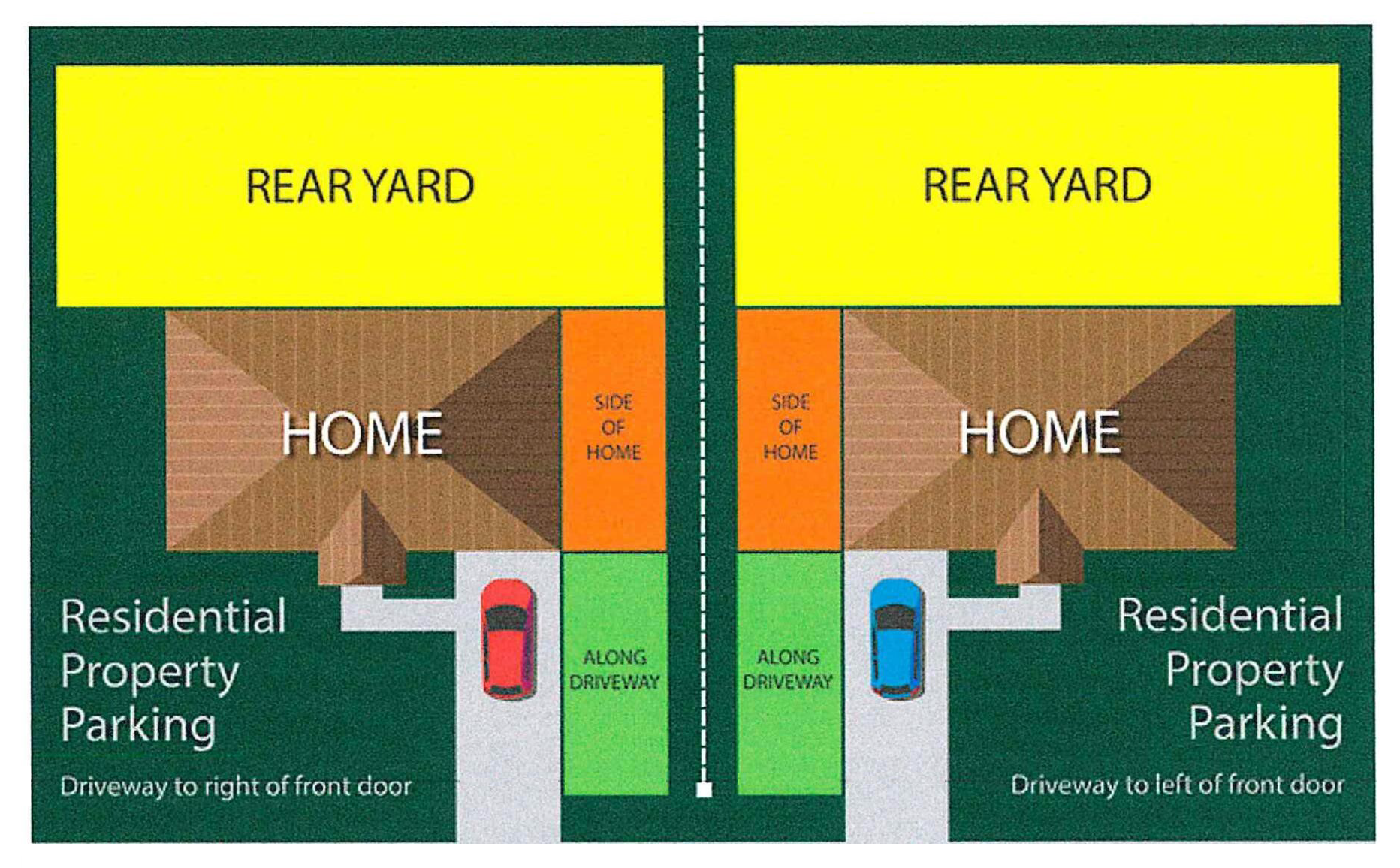
Front yard. Motor vehicles may be parked on the driveway and adjacent to the driveway on the side opposite the front door. Motor vehicles must be parked on an improved parking surface.
2.
Side yard. Motor vehicles, as defined by F.S. § 320.01 may be parked on the side of a residence and shall be on an improved parking surface. When parked on the side of a residence located on a corner lot the motor vehicle must be screened from the adjacent street by a 6' opaque fence, and subject to the following.
a.
Motor vehicles stored shall not exceed the height of the principal structure.
b.
Paving materials shall be setback a minimum of 2' from the property line.
c.
Improved parking surface is required for the entire length and width of the parked motor vehicle.
3.
Rear yard. A single motor vehicle that is operable or inoperable may be parked or stored in the rear yard if enclosed by an opaque fence a minimum of 6' in height.
(Ord. No. 4755, § 1(a)(Exh.), 10-23-2023)
_____
Section 8.0. - Temporary construction and container storage.
A.
Portable mini-storage units. A portable mini-storage unit is a container designed for the storage of personal property that is placed on a lot, parcel or tract, and is designed to be delivered or removed from the site by truck or other street-legal vehicle.
1.
Allowed use. One temporary portable mini-storage unit may be placed on a fee simple lot, parcel or tract containing a single-family residence with a temporary construction permit issued by the Administrative Official and shall be subject to the following conditions and limitations:
a.
If a valid building permit for construction is in place, i.e., the major remodeling of, significant addition to, or damage repair to the single-family residence on the lot, parcel or tract whereon the portable mini-storage unit is requested to be placed; or
b.
If the work involves interior improvements that do not require a building permit; or
c.
If the portable mini storage is being used for the purpose of moving personal items or furnishings to another location;
d.
A mini-storage unit may remain at a site used for residential purposes for up to 30 consecutive days within a calendar year, with one unit allowed at a time. A maximum of 2 allowances per calendar year may be permitted.
2.
Requirements.
a.
The unit cannot exceed 8' in width, 16' in length and 8' in height.
b.
The unit must be placed at ground level and set back a minimum of 10' from the front property line and a minimum of 5' from all other property lines. Additionally, the location must comply with the safe sight distance triangle regulations.
c.
Hazardous materials are prohibited and unlawful if places within the unit.
d.
Mechanical, plumbing or electrical installations or connections are prohibited and unlawful within a unit.
e.
Each unit must be kept clean and in good condition with no visible signs of deteriorations, weathering, discoloration, rust holes or breaks.
f.
The temporary construction permit must be clearly posted on the exterior of the unit.
g.
The name, phone number and address of the company providing the unit must be on the unit, as well as the date the unit was placed on the site.
h.
The unit must be locked at all times when it is not being loaded or unloaded.
i.
The temporary construction permit may be revoked if use of the unit results in an unsafe or unsanitary condition.
j.
Within 12 hours after issuance of any hurricane warning, or an equivalent emergency warning, as determined by the Administrative Official, all mini storage units shall be removed or secured in such a manner so as to minimize the danger of such units causing damage to persons or property from high winds.
B.
Temporary use of dumpsters.
1.
Location and placement. Dumpsters may be temporarily located on residential property but shall not obstruct vehicular or pedestrian traffic at any time.
2.
Duration. A dumpster may remain at a site used for residential purposes for up to 30 calendar days per calendar year, with one dumpster allowed at a time. The Administrative Official may grant additional days if good cause is proven by the applicant.
3.
Construction.
a.
For sites where a dumpster is being used in connection with new construction or extensive renovation or repair of property, dumpsters related to and used for the ongoing construction or demolition during such construction shall be allowed for the period of continuous construction or demolition provided there is an active and valid building or demolition permit for the property. Any dumpster at the site that is not specifically related to and used in connection with the construction or demolition shall be subject to the limits otherwise imposed in this section of the Code. Within 5 calendar days of expiration of a building permit, passage of all final inspections, or issuance of a certificate of occupancy (whichever is later), all dumpsters shall be removed.
b.
In the event of fire, hurricane or natural disaster causing substantial damage to the principal structure on the property, a dumpster shall be allowed on site, subject to all applicable sections of this chapter, for 60 calendar days regardless of the existence of a valid building permit.
4.
High winds. Within 12 hours after issuance of a hurricane warning including Seminole County, all dumpsters shall be removed or secured in such a manner so as to minimize the danger of such units causing damage to persons or property from high winds.
(Ord. No. 4755, § 1(a)(Exh.), 10-23-2023)
Section 9.0. - Lighting standards.
A.
Intent. It is the intent of this Section to encourage lighting practices that will benefit the public by minimizing light pollution, glare, light trespass and sky glow and maintaining night time safety, utility and security.
B.
Scope and applicability. All exterior outdoor lighting installed after the effective date of this Section in any and all zones in the City shall comply with the requirements established by this Section unless otherwise exempted. This Section does not apply to indoor lighting.
When an outdoor lighting installation is being modified, extended, expanded or added to, the entire lighting installation shall be subject to the requirements of this Section.
When outdoor lighting installation or replacement is part of a development proposal for which site plan approval is required, the Planning and Zoning Commission shall review and approve the lighting installation as part of its site plan approval.
For commercial and office uses refer to Schedule G.
C.
Definitions.
Active means an area, entrance or feature that is frequently used and has a high level of activity or movement.
Cut off fixture means an outdoor light fixture shielded or constructed in such a manner that no more than 2½% of the total light emitted by the fixture is projected above the horizontal plane of the fixture.
Footcandle means a unit of measure for luminance. A unit of luminance on a surface that is everywhere 1 foot from a uniform point source of light of 1 candle and equal to 1 lumen per square foot.
Fully cutoff fixture means an outdoor light fixture shielded or constructed in such a manner that it emits no light above the horizontal plane of the fixture.
Fully shielded lighting means lighting constructed in such a manner that all light emitted by the fixture, either directly from the lamp or a diffusing element, or indirectly by reflection or refraction from any part of the luminaire, is projected below the horizontal. Such fixtures usually have a flat, horizontally oriented lens and opaque (usually metal) sides. They are often described as "shoebox" luminaires if the luminaire has a predominantly rectangular form. Fixtures that either has reflecting surfaces or lenses (clear or prismatic) located below the lamp and visible from the side or above and fixtures that can be mounted such that the shielding is ineffective are not considered fully shielded lighting.
Glare means the effect produced by a light source within the visual field that is sufficiently brighter than the level to which the eyes are adapted, to cause annoyance, discomfort or loss of visual performance and ability.
Horizontal luminance means the measurement of brightness from a light source, usually measured in footcandles or lumens, which is taken through a light meter sensor at a horizontal position.
Inactive means an area, entrance or feature that is infrequently used and normally locked.
Light trespass means light from an artificial light source that is intruding into an area where it is not wanted or does not belong as determined by the Administrative Official.
Lumen means a quantitative unit measuring the amount of light emitted by a light source.
Uniformity ratio (U. Ratio) means the average level of illumination in relation to the lowest level of illumination for a given area. Example: U. Ratio is 4:1: the lowest level of illumination should be no less than 25% or 4 times less than the average level of illumination.
Wall pack means a type of light fixture typically flush-mounted on a vertical wall surface.
D.
Exemptions. The following types of lighting are exempted from these regulations:
1.
Reasonable holiday lighting during the period from October 15 to February 15, if the lighting does not create a hazard or nuisance from glare or luminance as determined by the City.
2.
Traffic control signals and devices installed by or at the direction of a public agency.
3.
Temporary emergency lighting in use by law enforcement or government agencies or at their direction.
4.
Temporary lighting, used for a period not to exceed 30 days in any 1 calendar year period, for festivals, celebrations or other public activities subject to the same conditions as holiday lighting or issuance of a development order by the Administrative Official.
5.
Security lighting controlled by a motion sensor switch that remains on for no longer than 10 minutes after activation, but shall in all cases be shielded and directed only to the areas where such lighting is required.
6.
Temporary construction lighting used for a period not to exceed 30 days in any 1 calendar year period when associated with a building permit.
7.
Outdoor recreational facilities such as tennis courts, sports fields, golf courses, driving ranges and miniature golf courses; and outdoor assembly uses such as stadiums, arenas, amphitheaters and drive-in movie theaters when the use is permitted and lawfully conducted.
8.
One and 2 family dwellings.
E.
General requirements.
1.
All exterior lights shall be designed, located, installed and directed in such a manner as to prevent objectionable light trespass and glare across the property lines and/or disability glare at any location on or off the property.
2.
All parking lot lighting shall use fully cutoff fixtures.
3.
All fully cutoff fixtures shall be installed in a horizontal position as designed.
4.
All building lighting for security or aesthetics shall use fully cutoff or fully shielded fixtures, not allowing any upward distribution of light.
5.
Flood lighting is discouraged. If used, flood lights must be shielded to prevent:
a.
Disability glares for drivers or pedestrians.
b.
Light trespass beyond the property line.
c.
Light above a 90° horizontal plane.
d.
Otherwise creating a public hazard or nuisance.
6.
All wall pack fixtures shall be cutoff fixtures except those adjacent to an arterial or collector road, in or adjacent to a residential zoning district or adjacent to a dwelling unit which shall be of the shoe box type. The lighting use or location of the wall pack shall determine the maximum footcandle allowed. Except as noted above, wall packs may be of the non-cutoff type, if located in a commercial or industrial area that cannot be seen from a roadway or residential parcel or district.
7.
Adjacent to residential property, no direct light source shall be visible at the property line at ground level or above.
8.
The maximum height of any outdoor light, as measured from the ground to the top of the lighting fixture or light pole, whichever is higher, shall be 25'.
9.
The location of outdoor lights shall not conflict with landscaping.
10.
The minimum setback of a light source from a property line shall be a horizontal distance of 20'.
11.
Where practicable, electrical service to outdoor lighting installations shall be underground.
12.
The use of high-pressure sodium lamps is recommended.
F.
Lighting standards.
1.
The City hereby adopts the following outdoor lighting recommendations of the Illuminating Engineering Society of North America (IESNA) as land development regulations:
LIGHTING TABLE
G.
Lighting of gas stations, convenience stores and all outdoor canopies. In addition to the above standards, the following shall apply:
1.
Lighting of gas stations and convenience stores shall be used for security and safety purposes and not be used to attract attention to the business in the nature of signage.
2.
Areas on the apron away from the gasoline pump islands which are used for parking or vehicle storage shall be illuminated in accordance with the requirements for parking areas. If no gasoline pumps are provided, the entire apron shall be treated as a parking area.
3.
Light fixtures mounted on canopies shall be recessed so that the lens cover is recessed or flush with the bottom surface (ceiling) of the canopy.
H.
Lighting plan required. The applicant shall submit a lighting plan depicting the footcandle dispersion on the site and detail of the proposed fixtures as part of the site plan/development application, and shall include the following:
1.
A site plan, drawn to scale, showing all buildings, landscaping, parking areas, all proposed exterior lighting fixtures;
2.
Specifications (details) for all proposed lighting fixture photometric data: designation of IESNA "cutoff" fixtures, and other descriptive information on the fixtures;
3.
Proposed mounting height of all exterior lighting fixtures;
4.
Analyses and luminance level diagrams showing that the proposed installation conforms to the lighting level standards of this section. Off-site lighting shall be considered in the analyses;
5.
Drawing of all relevant building elevations showing the fixtures, the portions of the walls to be illuminated, the luminance levels of the walls and the aiming points for any remote light fixtures.
(Ord. No. 4755, § 1(a)(Exh.), 10-23-2023)

