
Sanford City Zoning Code
Schedule S
HISTORIC PRESERVATION1
Editor's note— Ord. No. 4588, § 1(a)(Exh.), adopted Feb. 8, 2021, amended Schedule S in its entirety to read as herein set out. Former Schedule S, §§ 1.0—15.0, App. A, App. B and Map S-1 pertained to similar subject matter, and derived from Ord. No. 4337, § 2, adopted Mar. 23, 2015; Ord. No. 4352, § 2, adopted Sept. 28, 2015; Ord. No. 4428, § 2—4, adopted Dec. 11, 2017; and Ord. No. 4543, § 3, adopted Apr. 27, 2020.
Section 1.0.- Purpose.
Historic landmarks, structures, sites, monuments, streets, areas, and neighborhoods serve as visible reminders of the history and cultural heritage of the City, State and Nation. The purpose of this Schedule is to promote the educational, cultural, and economic welfare of the City residents by preserving and protecting historic and archaeological resources located within the City Limits. This Schedule will safeguard the City's history, heritage, and unique attributes, and will enhance the City's attraction of visitors and support and stimulate the economy from increased tourism. Furthermore, it is the purpose of this Schedule to strengthen the economy of the City by stabilizing and improving property values in historic districts, and to encourage new buildings and developments that will be harmonious with the City's historic, architectural, archaeological, and/or social character. Historic preservation enhances community pride and strengthens the partnership among the past, present and future providing for orderly growth in the life and appearance of the City's history. The City, though its HPB and the Historic Preservation Officer appointed by the City's Administrative Official, are authorized to take any and all actions reasonably necessary to implement and enforce the provisions of this Schedule.
(Ord. No. 4588, § 1(a)(Exh.), 2-8-2021)
Section 2.0. - Definitions.
(a)
The following words and phrases shall be used in the interpretation and implementation of this Schedule unless the context clearly requires otherwise:
Adaptive reuse - The process of converting a building to a use other than that for which it was originally designed.
Addition - New construction added to an existing building or structure.
Administrative Official - The person appointed by the City Manager who is responsible for the overall administration and enforcement of the City's Land Development Regulations or her or his delegatee.
Alteration - Work which impacts the exterior of any property located within an historic district including, but not limited to, demolition, addition, removal, restoration, relocation or other modification, in whole or in part, of a building, structure or appurtenance.
Appurtenances - Includes, but not limited to, walkways and driveways (whether paved or not), fences, gateways, open space, mailboxes, arbors, and similar structures and results of construction activities.
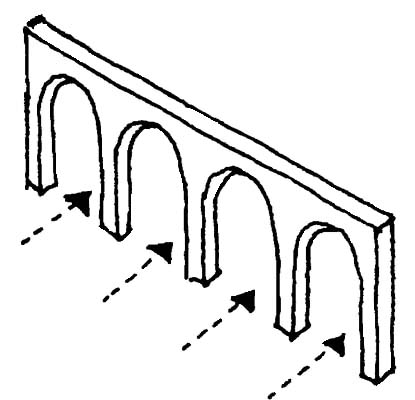
Arcade - A series of arches supported by columns or pillars; a covered passageway; a recessed gallery with columns or piers open to the street.
Arcade
Archaeological resources - Any material remains of past human life, activities or habitation which are of historic or pre-historic significance. Such material includes, but is not limited to pottery, basketry, bottles, weapons, weapon projectiles, tools, structures or portions of structures, pit houses, rock paintings, rock carvings, intaglios, graves, skeletal remains, personal items and clothing, household or business refuse, printed matter, manufactured items, or any piece of any of the foregoing items.
Archaeological site - A property or location which has yielded or may yield information on the City's history or prehistory. Archaeological sites may be found within historic sites, historic districts, private property, public properties, and other areas of the City. Archaeological sites are evidenced by the presence of artifacts and features below and at times above the ground surface indicating the past use of a location by people.
Archaeological zone - A geographically defined area that has or may reasonably be expected to yield information on local history or prehistory based upon broad prehistoric or historic settlement patterns.
Architectural significance - A criterion used in designating a structure that is an outstanding or surviving original example of period, style, detail, unique craftsmanship or method of construction, or represents the work of a locally, statewide or nationally significant architect, designer, or builder.
Articulate - To express the parts or segments of a building clearly; to divide into segments.
Artifacts - Objects which are a product of human modification or objects which have been transported to a site by people.
Balcony - A railed projecting platform found above ground level on a building.
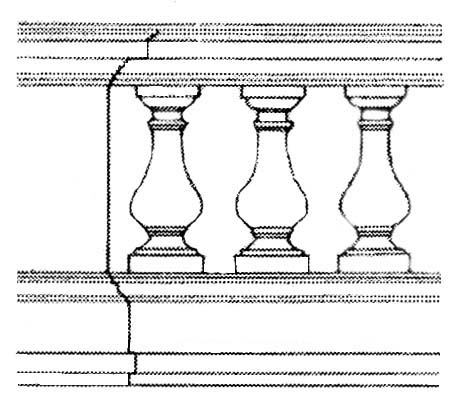
Baluster - 1 of a series of short pillars or other uprights that support a handrail. 1 of the upright, usually rounded or vase-shaped, supports of a balustrade. Related term: picket, spindle.
Balustrade - A row of balusters topped by a rail, serving as an open parapet, as along the edge of a balcony, terrace, bridge, staircase, or the eaves of a building.
Balustrade
Base - The lowest part of a column or architectural structure. A base story is the lowest story of a building.
Bay - A main division of a structure, usually containing a window or door. A building with 3 windows across the front is referred to as 3 bays wide. Also, an enclosed space protruding from the exterior of a building such as a bay window.
Bay window - A projecting window that forms an extension to the floor space of the internal room; usually extending to the ground level.
Board and batten - Siding fashioned of boards set vertically and covered where their edges join by narrow strips call battens.
Bond - A term used to describe the various pattern in which brick, or stone is laid, such as "common bond" or "Flemish bond".
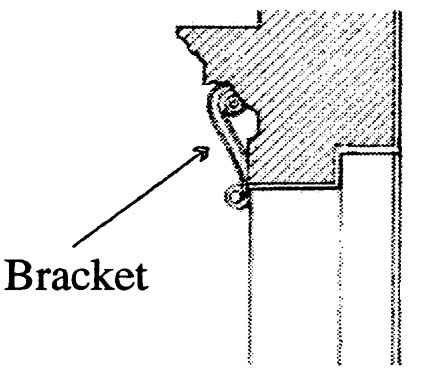
Bracket - A projecting support member found under eaves or other overhangs. Related terms: modillion, corbel.
Building - A structure created to shelter any form of human activity. This may refer to a house, barn, garage, church, hotel, retail store, or similar structure as defined in the Florida Building Code.
Bulkhead - The structural panels just below display windows on storefronts. Bulkheads can be both supportive and decorative in design. Nineteenth century bulkheads are often of wood construction with rectangular raised panels. Twentieth century bulkheads may be of wood, brick, tile, or marble construction. Bulkheads are also referred to as kickplates.
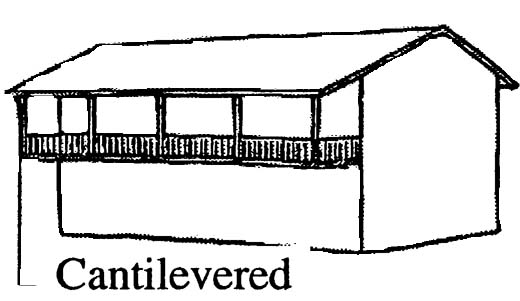
Cantilevered - A projecting structure, such as a beam, that is supported at 1 end and carries a load at the other end or along its length. A member, such as a beam, that projects beyond a fulcrum and is supported by a balancing member or a downward force behind the fulcrum. A bracket or block supporting a balcony or cornice.
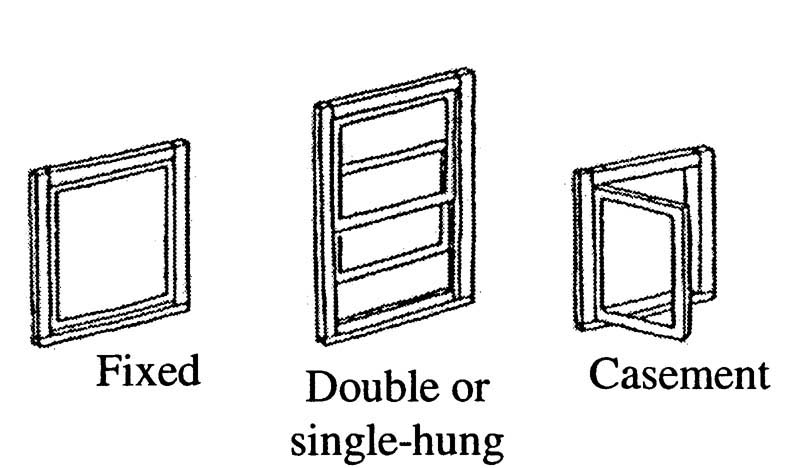
Casement windows - A window with 1 or 2 slashes which are hinged at the sides and usually open outward.
Certificate of Appropriateness or COA - A development order by the HPB permitting a proposed alteration, demolition or new construction in a historic district based upon compliance with the criteria set forth in this Schedule.
Chamfer - A beveled edge.
Character - The qualities and attributes of any structure, site, street or district.
Clapboards - Horizontal wooden boards, thinner at the top edge, which are overlapped to provide a weatherproof exterior wall surface.
Clapboards
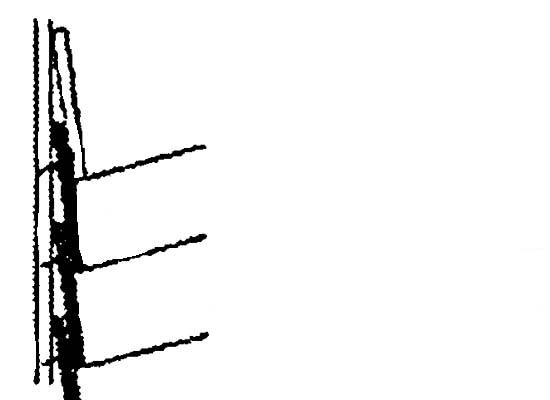
Column - A supporting pillar. The parts of a column in classical architecture are the base, shaft, and capital.
Commercial retail use - For the purposes of this Schedule, a business that is open to the public and displays and sells goods and services directly to the public excluding retail service establishments.
Common bond - A brickwork pattern where most courses are laid flat, with the long "stretcher" edge exposed, but every fifth to eighth course is laid perpendicularly with the small "header" and exposed, to structurally tie the wall together.
Contemporary - Reflecting characteristics of the current period. Contemporary denotes characteristics which illustrate that a building, structure, or detail was constructed in the present or recent past rather than being imitative or reflective of a historic design.
Contributing resource or property - A building, structure, or site which is at least 50 years old and contributes to the overall historic significance of a designated historic district and possesses historic integrity reflecting the character of a time; or is capable of yielding important information about an historically significant period; or independently meets the criteria for designation as a local historic landmark and/or district.
Cornice - The uppermost, projecting part of an entablature, or feature resembling it. Any projection ornament molding along the top of a wall, building, etc.
Crawl space - The area between the ground and the first finished floor, usually 18 to 24 inches.
Cross-gable - A secondary gable roof which meets the primary roof at right angles.
Cultural resource - A structure that has aesthetic, cultural, architectural or historical significance to the City, State or Nation, and that may have been designed as an historic a landmark, significant, recognized or historic district under this Schedule.
Demolition - The complete or constructive removal of a building or structure upon any site when the building will not be relocated intact to a new site.
Demolition by neglect - The failure to provide ordinary and necessary maintenance and repair to a building, structure, historic resource or appurtenance resulting in injury or loss to exterior features, permanent damage, or destruction through abandonment or lack of maintenance.
Design criteria - The standard used for issuing a COA. The criteria includes, but is not limited to, guidelines adopted by the HPB, which are based upon criteria of the Secretary of the Interior's Standards for Rehabilitation.
Design guidelines - Criteria developed and adopted by the HPB to identify design concerns in a historic district, and to help property owners ensure that rehabilitation and new construction respect the character of buildings; provided, however, that guidelines are not mandatory provisions and are a tool for City staff to work with property owners to develop successful projects.
Design review - The process of ascertaining whether modifications to historic structures, sites, or districts meet standards of appropriateness established by the HPB.
Detached - Any new construction not attached to an existing building.
Disturbance - The cumulative digging, excavating, site preparation work or other such construction activities, regardless of the number of individual excavation or construction areas, related to an archaeological site.
Dormer window - A window that projects from a roof.
Double-hung window - A window with 2 sashes, 1 sliding vertically over the other.
Eaves - The edge of a roof that projects beyond the face of a wall.
Elevation - The vertical plane of a façade of a building. An elevation drawing is a view of such vertical plane.
Exterior features - For the purpose of this Schedule, exterior features shall include the architectural style, general design and general arrangement of the exterior of a building or other structure, including the color, the kind and texture of the building material and the type and style of all windows, doors, light fixtures, signs, other appurtenant fixtures and other natural features such as trees and shrubbery.
Fabric - The physical materials of a building, structure, district, or City connoting an interweaving of component parts.
Façade - The face or front elevation of a building.
Fanlight - A semi-circular window usually over a door with radiating muntins suggesting a fan.
Fascia - A flat horizontal member of a building. A fascia sign is 1 attached flat against a building.
Fenestration - The arrangement of windows on a building; openings in an external wall such as doors and windows.
Flashing - Thin metal sheets used to prevent moisture infiltration at joints of roof planes and between the roof and vertical surfaces.
Flemish bond - A brickwork pattern where the long "stretcher" edge of the brick is alternated with the small "header" end for decorative as well as structural effectiveness.
Florida Master Site File - The State's clearinghouse for information on archaeological sites, historical structures, cemeteries and field surveys for such sites. A combination of both paper and computer files, it is administered, at this time, by the Florida Department of State. The Master Site File properties are not required to meet any minimum level of historical or scientific importance, but usually are at least 50 years old, and adequately located and documented.
Foundation - The lowest exposed portion of the building wall, which supports the structure above.
Front facade - The principal face or front elevation of a building.
Gable - The triangular section of a wall to carry a pitched roof.
Gable roof - A pitched roof with 1 downward slope on either side of a central, horizontal ridge.
Gambrel roof - A ridge roof with 2 slopes on either side.
Glazing - Fitting glass into windows and doors.
Hipped roof - A roof with uniform slopes on all sides.
Historic building - A building that is classified as a historic landmark, and a building classified as contributing in the historic districts.
Historic district - An area that includes or encompasses historic sites, historic landmarks, buildings, signs, appurtenances, structures or objects as the City Commission may determine to be appropriate for historical preservation as set forth in this Schedule. A historic district need not be a single enclosed area nor be contiguous to constitute a district. The following are the historic districts located within the City:
A.
National Register District. Sanford's National Register Commercial District, listed in the National Register in 1976, is generally bound by Commercial Street on the north, Oak Avenue on the west, the alley between Palmetto Avenue and Sanford Avenue on the east, and Second Street on the south. The Sanford Residential Historic District was listed on the National Register in 1989. The Georgetown Historic District was listed on the National Register in 2020.
B.
Downtown Commercial Historic District. The Downtown Commercial Historic District was created in 1985 by Ordinance Number 1777 and is generally bounded by Fulton and Commercial Streets on the north, Myrtle Avenue on the west, Sanford Avenue on the east, and Third Street on the south.
C.
Sanford Residential Historic District. The Sanford Residential Historic District, originally designated under the name of Old Sanford District, was established through Ordinance Number 3184 in 1993 and is generally bounded by Second and Third Streets on the north, French and Elm Avenues on the west, Fourteenth Street on the south and Sanford Avenue on the east.
D.
Georgetown Residential Historic District. The Georgetown Residential Historic District was created in 2023 by Ordinance Number 4730 and is generally bounded by East 2nd Street on the north, Bay Avenue and Melonville Avenue to the east, Celery Avenue to the south, and the alley east of Sanford Avenue on the west, corresponding with the Georgetown National Register historic District boundaries excluding Sanford Avenue.
E.
Sanford Avenue Historic District. The Sanford Avenue Historic District was created in 2023 by Ordinance Number 4729 and is generally described as both sides of Sanford Avenue from 2nd Street to Celery Avenue, including all properties facing Sanford Avenue and extending from the alleys.
Historic landmark - A site (including, but not limited to, significant trees or other plant life located thereon), building, object or structure of particular historic or aesthetic significance to the City, the State, or the Nation. Landmarks include, sites, buildings, or structures where cultural, political, spiritual, economic, social or artistic history of the community, State or Nation is reflected or exemplified or which are identified with historic personages or with important events in local, State or national history, or which embody the distinguishing characteristics of an architectural specimen, inherently valuable for a representation of a period, style or method of construction, or a notable work of construction, or a notable work of a master designer or architect whose individual genius influenced her or his age.
Historic Preservation Board or HPB - The City board charged with enforcing provisions of this Schedule.
Historic Preservation Officer - The City employee charged with assisting the HPB in enforcing, and otherwise implementing, the provisions of this Schedule.
Historic resource - Any prehistoric or historic district, site, building, object, or other real or personal property of historical, architectural, or archaeological value. The properties may include, but are not limited to, monuments, memorials, Native American habitations, ceremonial sites, abandoned settlements, sunken or abandoned ships, engineering works, treasure trove, artifacts or other objects with intrinsic historical or archaeological value, or any part thereof, relating to the history, government, and culture of the City, County, State or Nation.
Historical significance - Preservation value of a property in relation to an important historical context or theme related to history, architecture, landscape architecture, engineering or culture.
Historic site - A single lot or portion of a lot containing an improvement, landscape feature, or archaeological site, or a historically related complex of improvements, landscape features or archaeological sites that may yield information on history or prehistory.
Historic survey - A comprehensive survey involving the identification, research and documentation of buildings, sites and structures of any historical, cultural, archaeological or architectural importance.
Indoor furniture - Furniture designed for interior use that is not weather resistant and does not have removable fabric.
Lattice - An open work grill of interlacing wood strips used as screening.
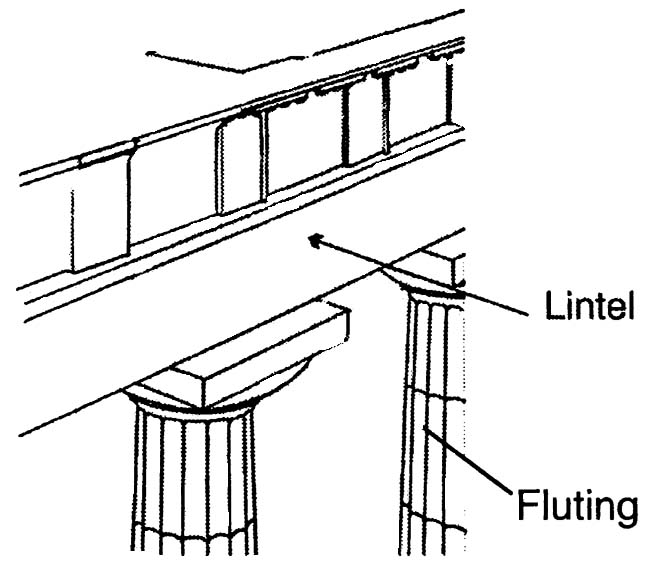
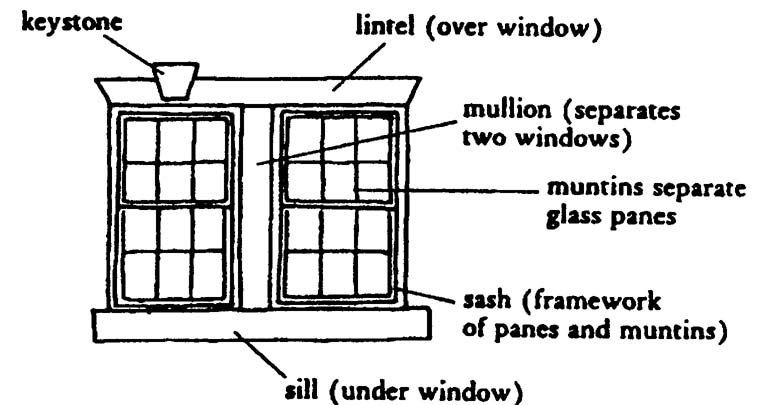
Lintel - A horizontal structural member that supports a load over an opening.
Mansard roof - A roof with a double slope on all 4 sides, with the lower slope being almost vertical and the upper almost horizontal.
Masonry - Exterior wall construction of brick, stone or adobe laid up in small units.
Massing - Composition of a building's volumes and surfaces that contribute to its appearance.
Mitigation - A process designed to prevent adverse impact of an activity on cultural resources, by the systematic removal of the prehistoric, historic, or architectural data and materials in order to acquire the fundamental information necessary for understanding the property within its proper historic context. For structures, at a minimum, this may require primary archival studies, informant interviews, measured drawings, and large-scale photography. For archaeological sites, at a minimum, this may require literature studies, informant interviews, field survey, excavation, and artifact analysis. All mitigation projects require the preparation of reports.
Mortar - A mixture of plaster, cement, or lime with a fine aggregate and water; used for pointing and bonding bricks or stones. Mortars for repainting shall be softer (measured in compressive strength) than the masonry units and no harder than the historic mortar.
Mothballing - The temporary closing of a structure to protect it from weather and secure it from vandalism. Mothballing may include the covering of doors, windows or other openings in a structure by any type of material but does not include the following: (1). Typical hurricane or storm shutters custom manufactured and permanently installed on residences on a year-round basis and then closed during the owner's temporary absence, or (2). The temporary (4-to-5 day maximum) boarding up normally accomplished in preparation for a storm which has resulted in a state of emergency being declared with removal occurring within the same number of days.
Mullion - The vertical bar between coupled windows or multiple windows.
Muntin - One of the thin strips of wood used for holding panes of glass within a window. Related terms; glazing bar, division bar, mullion.
National Register of Historic Places - Established by Congress in 1935, the National Register of Historic Places is a listing of culturally significant buildings, structures, objects, sites, and districts in the United States. The listing is maintained by the U.S. Department of Interior.
Non-Contributing Resource or Property - Means any building, structure, or site which does not contribute to the overall historic significance of a historic district due to alterations, disturbances or other changes and therefore no longer possesses historic integrity, or was not present during the period of historic significance or is incapable of yielding important information about that period, or has been so altered or deteriorated that overall integrity of the building has been irretrievably lost.
Object - A material thing of functional, aesthetic, cultural, historical, or scientific value that may be by nature or design, movable, yet related to a specific setting or environment.
Outdoor furniture - Furniture designed for exterior use that is weather resistant. If covered, such furniture may have removable fabric. Examples of outdoor furniture include, but are not limited to, tables and chairs constructed of wrought iron, cast aluminum, steel, and heavy grade wood such as farmed exotics or similar materials.
Pane - A single piece of window glass. Double hung windows are often described according to the number of panes they have in each sash. For example, a 6 over 6 indicates that each sash has 6 panes.
Paneled door - A door composed of solid panels (either raised or recessed) held within a framework of rails and stiles
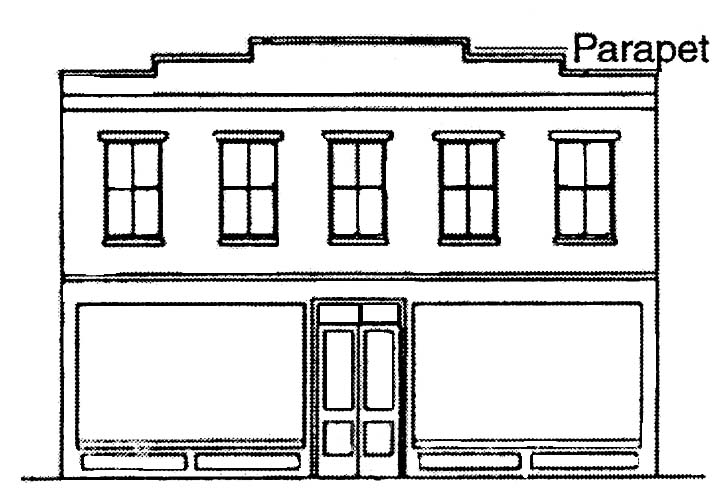
Parapet - A low wall or protective railing often used along the edge of a roof.
Pediment - A triangular crowning element forming the gable of a roof; any similar triangular element used over windows, doors, etc.
Picket - A wooden strip forming part of a fence.
Pitch - The degree of the slope of a roof.
Pointing - The process of removing deteriorated mortar from the joints of a masonry wall and replacing it with new mortar.
Preservation - The identification, evaluation, recordation, documentation, analysis, recovery, interpretation, curation, acquisition, protection, management, rehabilitation, restoration, stabilization, maintenance, or reconstruction of historic structures and properties.
Proportions - The relative size of 2 or more dimensions of a building; many architectural styles use highly developed mathematical proportions to determine the composition of facades and volumes of interior space.
Prospect - Means the use of a probe, metal detector, or any other device or tool to search or test or excavate for artifacts, historic sites or archaeological sites.
Purlin - A horizontal beam that provides intermediate support for the common rafters of a roof construction.
Reconstruction - The authentic reproduction of a building or site that once existed, but disappeared or was demolished.
Rehabilitation - The act or process of returning a property to a State of utility through repair or alteration which makes possible an efficient contemporary use while preserving those portions or features of the property that are significant to its historical, architectural, and cultural values.
Relocation - When a building is moved, intact, to a new site.
Renovation - Modernization of an old or historic building that may produce inappropriate alterations or elimination of important features or details.
Repairable - Structures or building features that can be fixed or restored without creating an imminent hazard to public safety. For the purpose of this Schedule, it is assumed that most damage, including partial termite or partial fire damage, can be repaired. It shall be the applicant's responsibility to demonstrate otherwise.
Resource - Sites, buildings, structures, objects, districts, and areas, public or private, single or in combination.
Restoration - The creation of an authentic reproduction beginning with existing parts of an original object or building.
Ridge - The top horizontal member of a roof where the sloping surfaces meet.
Right-of-way - The strip of land owned or controlled by the City or another governmental agency over which the public has a right of passage, including the streets, parkways, medians, sidewalks and driveways constructed thereon. For the purpose of this section "right-of-way" shall exclude alleys.
Sash - The framework into which windowpanes are set.
Sash Operation
Setback - The distance between the street right-of-way line and the front line of a building or any projection thereof.
Shall - Is used to indicate a mandatory action.
Shed roof - A gently pitched, almost flat roof with only 1 slope.
Siding - The exterior wall covering of a structure.
Sill - The bottom crosspiece of a window frame.
Site - The location of a significant event, activity, building, structure, or archaeological resource.
Spindles - Slender, elaborately turned wood dowels or rods often used in screens and porch trim.
Stoop - A small porch, platform, or staircase leading to the entrance of a house or building.
Streetscape - The distinguishing and pictorial character of a particular street as created by its width, degree of curvature and paving materials, design of the street furniture, and forms of surrounding buildings.
Structure - A work made up of interdependent and interrelated parts in a definite pattern of organized structure as defined in the Florida Building Code.
Stucco - A type of exterior plaster applied as a 2-part or 3-part coating directly onto masonry. Historic stucco consisted primarily of hydrated or slaked lime, water and sand with straw or animal hair as a binder. After 1900, most stucco was composed of Portland cement, mixed with some lime. Many of the contemporary stucco products on the market today are not compatible with historic stucco buildings.
Style - A type of architecture distinguished by special characteristics of structure and ornament and often related in time; also, a general quality of distinctive character.
Traditional neighborhood development - Traditional neighborhood development (TND) refers to the development of a complete neighborhood or town using traditional town planning principles. TND may occur in infill settings and involve adaptive reuse of existing buildings, but often involves all-new construction on previously undeveloped land. To qualify as a TND, a project should include a range of housing types, a network of well-connected streets and blocks, humane public spaces, and have amenities such as stores, schools, and places of worship within walking distance of residences. TND is limited to the scale of neighborhood or town, and should not be confused with new urbanism, which encompasses all scales of planning and development, from building to region. TND projects incorporate many different architectural styles and are not exclusively traditional in aesthetic.
Transom - A horizontal opening (or bar) over a door or window.
Trim - The decorative framing of an opening and other features on a façade.
Turret - A small slender tower.
Veranda - A covered porch or balcony on a building's exterior.
Vernacular buildings - Buildings designed and built without the aid of an architect or trained designer; buildings whose design is based on ethnic, social, or cultural traditions rather than on an architectural philosophy.
Visual compatibility criteria - Factors dealing with height, proportion, rhythms, materials and color, which the Historic Preservation Board uses to determine whether new construction and renovation of existing buildings is visually compatible with the historic district.
Wall dormer - Dormer created by the upward extension of a wall and a breaking of the roofline.
Window - A glazed opening in a wall that provides an interior space with natural light and ventilation. For description of the parts of a window, see: muntin, pane, and sash.
Window
Yard - The land area surrounding the principal building on any parcel which is neither occupied or obstructed by a portion of the principal building from the finished grade to the sky or below the finished grade except where such occupancy, obstruction or encroachment is specifically permitted by this Code. - The following types of yards are applicable to the implementation of this Schedule:
A.
Front yard - That portion of the yard extending the full width of the parcel and measured between the front parcel line and a parallel line tangent to the nearest part of the principal building.
B.
Rear yard - That portion of the yard extending the full width of the parcel and measured between the rear parcel line and a parallel line tangent to the nearest part of the principal building.
C.
Side yard - Those portions of the yard extending from the required front yard to the required rear yard and measured between the side parcel lines and parallel lines tangent to the nearest part of the principal building.
(b)
In addition to the words and phrases defined in this Section, the definitions set forth in the Florida Building Code, the Land Development Regulations of the City as well as those definitions in controlling Federal and State law shall be used in the interpretation and implementation of this Schedule.
(c)
Any rules such as guidelines, policies or related matters adopted by the HPB may use the definitions set forth in this Section.
(Ord. No. 4588, § 1(a)(Exh.), 2-8-2021; Ord. No. 4729, § 4, 4-10-2023; Ord. No. 4730, § 4, 4-10-2023)
Section 3.0. - Historic Preservation Board; powers, duties and jurisdiction; Historic Preservation Officer; code enforcement and related matters.
A.
Establishment of HPB. The HPB has been created and established to conduct activities required in the historic preservation regulations included in Schedule S. The HPB shall consist of 5 members and 2 alternates until September 30, 2020 and, effective October 1, 2020, 7 members, with the alternate members being new full members of the HPB with terms ending on September 30 of the year established by the City Commission. The City Commission may appoint alternate members to serve on the HPB as may be determined to be advisable from time-to-time.
B.
Powers, duties and jurisdiction. The HPB shall have the following powers, duties and jurisdiction.
1.
To safeguard the architectural and cultural heritage of the City through the preservation of historic landmarks and historic districts.
2.
To administer laws, codes, ordinances, rules, regulations, policies and resolutions enacted or adopted by the City Commission, or under the authority of the City Commission, governing the designation, alteration and removal of historic resources and to develop design criteria.
3.
To advocate for historical preservation within the City; provided, however, that the HPB shall ensure that it acts in an objective and unbiased manner in terms of all decisions which it makes a decision of a quasi-judicial nature.
4.
To advise the Planning and Zoning Commission and the City Commission regarding historic resources, heritage tourism, economic development and potential land development regulations.
5.
To recommend areas to the City Commission to be included within historic districts.
6.
To give written notice to the last known address of the owners of all properties to be included in a historic district.
7.
To submit recommendations to the City Commission and Planning and Zoning Commission relative to the provisions of this Schedule S.
8.
To hear applications for certificates of appropriateness which must be made by the property owner of the property which is the subject of the application or by written authorization, in a form approved by the City, of the property owner.
9.
To conduct studies of matters relating to historic preservation.
10.
To develop, monitor, and implement a historic preservation plan.
11.
To coordinate public and private (when appropriate) historic preservation activities.
12.
To recommend and monitor code enforcement actions for violations of this Schedule.
13.
To recommend to the City Commission properties for historic landmark designation.
14.
The jurisdiction of the HPB shall include those elements of development, rehabilitation, alteration, preservation or demolition that affect the exterior visual quality of the historic districts, specifically including exterior appearance of structures within a historic district. The HPB shall not consider the interior arrangement of structures. This Schedule is intended to preserve and protect historic or architecturally worthy buildings, structures, sites, monuments, streetscapes, squares, and neighborhoods of the historic districts. In all zoning districts/classifications within the boundaries of the historic districts, the regulations for both the zoning districts/classifications and this Schedule shall apply.
15.
The HPB shall have authority to adopt and implement design criteria which shall be enforced as are the City's Land Development Regulations once reviewed and approved by the Planning and Zoning Commission by means of a resolution and to adopt design guidelines.
16.
The HPB shall have authority to publish manuals and other publications to assist property owners in adhering to the requirements of this Schedule and the guidelines adopted thereunder.
C.
Composition of HPB. The City Commission shall select the members of the HPB from 1 or more of the following professions:
1.
Architects.
2.
Historians.
3.
Architectural historians.
4.
Archaeologists.
5.
Planners.
6.
Realtors.
7.
Knowledgeable interested citizens.
D.
Terms of office for HPB.Section 2-122 of the City Code shall control the general operations of the HPB and removals from office.
E.
Procedure for issuing certificate of appropriateness.
1.
Prior to issuance or denial of a COA the HPB shall provide notice to property owners likely to be materially affected.
2.
In cases where the HPB determines that the COA would be reasonably likely to impact proximate properties to the property for which the application has been made, it shall hold a public hearing concerning the application. The HPB shall hold a public hearing with regard to all matters that are required to be so heard by a controlling law. Public hearings are required for the following HPB actions:
(a)
COA applications for demolition, relocation, or variance;
(b)
COA applications for 3 dwelling units or greater;
(c)
COA applications for improvements/alterations/new construction in the public realm; and
(d)
COA applications for new commercial development.
3.
All COA applications which require a public hearing, except those relating to single family residences, must comply with noticing, advertising, Citizen Awareness and Participation Plan (CAPP) meeting, and other requirements.
4.
If the HPB determines that the proposed construction, reconstruction, alteration, moving or demolition is appropriate it shall forthwith approve such application and shall issue to the applicant a COA.
5.
If the HPB determines that a COA will not be issued, it shall issue written finding(s) stating the reason(s) for such determination and shall forthwith notify the applicant of such determination by furnishing him or her with a denial development order consistent with the provisions of Section 166.033, Florida Statutes. [2]
6.
The HPB may approve an application in any case where the owner would suffer extreme hardship relative to the reasonable use of the property; provided however, that extreme hardship shall not include solely the loss of profit relative to the value of the property if the COA were not issued.
7.
Any person aggrieved by a determination of HPB may appeal such determination to the City Commission by filing a written appeal with the City Clerk within 30 calendar days of the HPB action and paying the required filing fee. The decision of the City Commission on an appeal shall constitute final action subject only to judicial review.
F.
Investigations and reports. The HPB may make such investigations and studies of matters relating to the protection, enhancement, perpetuation or use of historic landmarks and historic districts, and to the restoration of historic landmarks as the HPB may, from time to time, deem necessary or appropriate for the effectuation of the purposes of this Schedule, and may submit reports and recommendations as to such matters to the City Commission and the City Manager. In making such investigations and studies, the HPB may hold such public hearings as necessary or appropriate after determining whether the proposal would impact properties located within the City or otherwise necessitate public participation.
G.
Historic Preservation Officer. Without limiting in any way the provisions of this Schedule, the Historic Preservation Officer of the City shall assist the HPB in the exercise of its powers, duties and jurisdiction under this Schedule and shall assist City staff and the Building Official relative to code enforcement and related matters.
H.
Procedures relative to code enforcement; penalties. The City may seek any and all remedies available under controlling law and the City Attorney may take any and all actions that may be necessary to enforce the provisions of this Schedule. Should any person fail to obtain a COA prior to engaging in any form of development requiring a COA, or if any person engages in any form of development that is not in compliance with a COA the City shall institute code enforcement activities. If a violation is found due to the failure to obtain a COA, the property owner shall be required to apply for COA and shall be required to pay an application fee in the amount of twice the regular fee and the HPB shall review the application as if it was a new alteration and not consider the fact that the alteration has already been initiated or completed. If the COA is denied, the owner shall comply with the provisions of this Schedule even if it requires partial or total demolition of the improvements regardless economic hardship. Any person or entity violating any of the provisions of this Schedule shall, upon conviction, be punished as provided in Section 1-7 of the City Code.[3]
I.
Implementing administrative actions. Without limiting in any way the provisions of this Section, the Historic Preservation Officer of the City and the City Attorney are hereby authorized and directed to collectively implement the provisions of this Section and to take any and all necessary administrative actions to bring into effect the provisions of this Section.
(Ord. No. 4588, § 1(a)(Exh.), 2-8-2021)
The referenced statute reads as follows:
166.033 Development permits and orders.—
(1) Within 30 days after receiving an application for approval of a development permit or development order, a municipality must review the application for completeness and issue a letter indicating that all required information is submitted or specifying with particularity any areas that are deficient. If the application is deficient, the applicant has 30 days to address the deficiencies by submitting the required additional information. Within 120 days after the municipality has deemed the application complete, or 180 days for applications that require final action through a quasi-judicial hearing or a public hearing, the municipality must approve, approve with conditions, or deny the application for a development permit or development order. Both parties may agree to a reasonable request for an extension of time, particularly in the event of a force majeure or other extraordinary circumstance. An approval, approval with conditions, or denial of the application for a development permit or development order must include written findings supporting the municipality's decision. The timeframes contained in this subsection do not apply in an area of critical state concern, as designated in s. 380.0552 or chapter 28-36, Florida Administrative Code.
(2) When reviewing an application for a development permit or development order that is certified by a professional listed in s. 403.0877, a municipality may not request additional information from the applicant more than three times, unless the applicant waives the limitation in writing. Before a third request for additional information, the applicant must be offered a meeting to attempt to resolve outstanding issues. Except as provided in subsection (5), if the applicant believes the request for additional information is not authorized by ordinance, rule, statute, or other legal authority, the municipality, at the applicant's request, shall proceed to process the application for approval or denial.
(3) When a municipality denies an application for a development permit or development order, the municipality shall give written notice to the applicant. The notice must include a citation to the applicable portions of an ordinance, rule, statute, or other legal authority for the denial of the permit or order.
(4) As used in this section, the terms "development permit" and "development order" have the same meaning as in s. 163.3164, but do not include building permits.
(5) For any development permit application filed with the municipality after July 1, 2012, a municipality may not require as a condition of processing or issuing a development permit or development order that an applicant obtain a permit or approval from any state or federal agency unless the agency has issued a final agency action that denies the federal or state permit before the municipal action on the local development permit.
(6) Issuance of a development permit or development order by a municipality does not create any right on the part of an applicant to obtain a permit from a state or federal agency and does not create any liability on the part of the municipality for issuance of the permit if the applicant fails to obtain requisite approvals or fulfill the obligations imposed by a state or federal agency or undertakes actions that result in a violation of state or federal law. A municipality shall attach such a disclaimer to the issuance of development permits and shall include a permit condition that all other applicable state or federal permits be obtained before commencement of the development.
(7) This section does not prohibit a municipality from providing information to an applicant regarding what other state or federal permits may apply.
--- (3) ---
The provision reads as follows:
Sec. 1-7. General penalty; recoupment of costs incurred by the City.
(a) Unless otherwise provided in this Code or controlled by State or Federal law, violation of or failure to comply with any provision of this Code shall constitute an offense against the City, and where no specific penalty is provided therefor shall subject the offender, upon conviction, to a fine of not to exceed $500.00, or imprisonment for a period of not to exceed 60 days, or both such fine and imprisonment or such other penalty as may be provided in this Code arising from the code enforcement processes and procedures of the City.
(b) Any condition caused or permitted to exist in violation of any of the provisions of this Code or any ordinance of the City shall be deemed a public nuisance and shall be subject to abatement by the City utilizing any remedy available under law.
(c) Each and every act, action or thing done in violation of the provisions of this Code, or any ordinance of the City, shall be construed, deemed and taken as a separate and distinct violation of such provisions of this Code, and in every event that a violation of this Code or any of the provisions of this Code shall continue, each day of such continuance shall be deemed, construed and taken as a separate and distinct violation of the provisions of this Code.
(d) It is the intent of the City to recoup from the responsible party or parties all costs and expenses incurred by the City arising from code enforcement actions and other processes, such as, by way of example only, nuisance abatement activities of the City.
Section 4.0. - Criteria and procedures for establishing and expanding historic districts.
Criteria for creating historic districts. Historic districts shall be consistent with the following criteria for designation:
1.
The properties within the district are associated with events that have made a significant contribution to the broad pattern of the history of the City, State or Nation; or are associated with the lives of persons significant to the City, State or Nation's past; or
2.
The properties embody the distinctive characteristics of a type, period or method of construction or represent the work of a master, or that possess high artistic values, or that represent a significant and distinguishable entity whose components may lack individual distinction; or
3.
The properties within the historic district has yielded, or may be likely to yield, information important in prehistory or history (e.g. a Native American burial mound); or
4.
If based on architecture, there is a concentration of contributing buildings located on properties within the historic district. The number of contributing buildings shall be no less than 50% of the total number of buildings within the historic district.
Procedures for establishing historic districts. The designation of historic districts shall be by amendment to this Schedule in accordance with the following procedures:
1.
The process may be initiated by a property owner within the proposed district, by the HPB, or by the City. For applications initiated by property owners, a petition signed by at least 15% of the property owners within the proposed historic district must accompany an application.
2.
The application or proposal shall contain the following:
(a)
A physical description of the proposed historic district, accompanied by photographs of buildings, structures, objects, or sites showing examples of contributing and non-contributing properties within the proposed historic district;
(b)
A statement of the historical, cultural, architectural, archaeological, or other significance of the proposed historic district;
(c)
A report, prepared by a professional, acceptable to the City, including a description of the typical architectural styles, character-defining features, and types of buildings, structures, objects or sites within the proposed historic district which report shall identify which properties are contributing at the time. The list of contributing structures is intended to be a snapshot in time, since other properties may also become contributing as they turn 50 years old and are determined by a professional approved by the City to meet the criteria to become contributing;
(d)
A map identifying all zoning and land use information, and the location of all buildings, structures, objects or sites within the proposed historic district, noting which are contributing;
(e)
Additional guidelines to be used when reviewing alterations, relocation, demolition, excavation or new construction within the proposed boundaries of the proposed historic district;
(f)
Names and addresses of all property owners within the proposed historic district; and
(g)
Any other pertinent information requested by the HPB.
3.
Not less than 60 days after the transmittal, the HPB shall hold a public hearing, which shall include a written notice to the last known address of the owners of all properties to be included in the proposed historic district. Such notice shall be distributed by first class mail.
4.
After the said public hearing, the HPB shall submit a final report with its recommendations and those of the Planning and Zoning Commission and a draft of the proposed ordinance to the City Commission.
5.
The City Commission may act on the report and recommendations of the HPB in such manner as it deems appropriate.
Criteria for expanding existing historic districts. If an updated report shows that there are additional contributing structures outside of the original boundary of an existing historic district, then the City may consider the expansion of the boundaries of the historic district to incorporate those properties. The ratio of 50% contributing structures required for the creation of new historic districts shall still apply.
Procedures for expanding historic districts. The expansion of a historic district shall be by ordinance enacted by the City Commission, in accordance with the same procedures required for the creation of a new historic district districts, except that the information required shall be applicable to the expansion area only.
(Ord. No. 4588, § 1(a)(Exh.), 2-8-2021)
Section 5.0. - Criteria and procedures for designating local historic landmarks.
A.
Criteria for designating historic landmarks. Properties may qualify if, in the judgment of the HPB, a property is at least 50 years old and is of exceptional significance based on the following criteria:
1.
Historical, architectural or cultural significance;
2.
Suitability for preservation or restoration;
3.
Educational value.
B.
Procedures for designating historic landmarks. The procedure for designating local historic landmarks is as follows:
1.
The applicant submits an application to the City.
2.
Property owner must sign an affidavit stating that he or she or it consents to the designation of his property as a historic landmark.
3.
The City shall agendize a complete application for HPB review.
4.
The HPB shall conduct a public hearing following written notice by mail of the date, time and place of said hearing to the last-known address of the owners of the affected property. In addition, a placard containing the same information shall be placed on the affected property no later than 10 days prior to such hearing.
5.
The HPB may recommend to the City Commission enactment of an ordinance designating 1 or more historic landmarks based on the criteria described in this Section.
6.
Upon recommendation of the HPB, the City Commission may, after holding public hearings preceded by sufficient written notice to the last known address of the owners and occupants of the affected property, enact an ordinance designating 1 or more historic landmarks based on the criteria noted above.
7.
Upon enactment of the ordinance, the owners and occupants of each historic landmark shall be given written notification of such designation by the City Commission.
8.
The ordinance shall also provide for a suitable sign or marker on or near the property indicating that the property has been so designated.
(Ord. No. 4588, § 1(a)(Exh.), 2-8-2021)
Section 6.0. - Historic landmarks.
Historic landmarks. The City has several properties listed on the National Register. The City also has a process to designate local historic landmarks. The City's Historic Preservation Officer shall maintain an inventory of the National Register Listed Properties located within the City as well as local landmarks.
(Ord. No. 4588, § 1(a)(Exh.), 2-8-2021)
Section 7.0. - Archaeological resources.
Identifying historic, archaeological and cultural resources is the initial step to preserving the City's historic heritage. Areas shall be investigated for archaeological resources prior to development. This Section requires mitigation of adverse impacts to significant sites should they be discovered during the course of predevelopment investigation.
A.
Human remains or archaeological resources. If human remains or archaeological resources are encountered during the course of development of any nature to include, but not be limited to, construction, earth movement, clearing, or other site disturbance, all work shall immediately halt, for a period of time not to exceed 30 days, and the applicant or his/her representative shall immediately notify the City's Administrative Official, the City's Historic Preservation Officer and the appropriate office of State government.
If, after consultation with the appropriate office of State government, an area is determined to contain significant archaeological resources, the city will designate the area as a preservation area by designation "PA", or similar designation, on an Archaeological Resources Map that is maintained by the City. It is prohibited and unlawful to cause or participate in a ground disturbance within a preservation area. When human remains or archaeological resources have been completely removed from the property, the preservation area designation shall be removed.
Any archaeological sites identified through the investigation process shall be incorporated as part of the Florida Master Site File Maps and Archaeological Sensitivity Z1 Maps, by whatever name, for the City and Seminole County.
B.
Prospecting and excavations.
1.
Private property. It is prohibited and unlawful to prospect on private property or to remove artifacts which are reasonably likely to be 50 years of age or over from private property without the express written permission of the landowner. The permission must be in the possession of the prospector at all times while searching the private property.
2.
Public property. No individual shall be allowed to prospect on public property including the public rights-of-way, nor can any individual remove artifacts from public property including, but not limited to, right-of-way without the express written permission of the City or the appropriate legal authority controlling the property. The permission must be in the possession of the prospector at all times while searching the public property. Furthermore, no disturbances or construction activities shall be authorized within properties belonging to the City including, but not limited to, rights-of-way, without written authorization by the a City and without such archaeology efforts as may be addressed by this Schedule.
C.
Archaeological site report. If any construction, earth movement, clearing or other site disturbance is proposed to be located on a registered archaeological site, the property owner or her, his or its authorized agent shall engage a professional archaeologist, as approved by the City, to investigate and submit a written report to the City regarding the location, condition and extent of the site, and any recommendations in regard to treatment.
D.
Project approval and permit. A COA for an application requiring a archeologist's report shall not be issued prior to the receipt and approval of the archeologist's report by the City. Based on the information contained in the archeologist's report, project approval will be conditioned in a manner to avoid or minimize impacts to the site consistent with federal and State law.
(Ord. No. 4588, § 1(a)(Exh.), 2-8-2021)
Section 8.0. - Certificate of appropriateness and procedures for altering historic landmarks or structures and new construction within historic districts.
A.
Applicability. The purpose of a COA is to ensure that all construction, alteration, restoration, relocation, or demolition of a historic landmark or any structure located within a historic district is in accordance with the standards, values and characteristics of the particular district or landmark. A COA shall be required for the following activities, whether or not a building permit is required.
1.
Historic landmarks and properties within historic districts. All construction, alteration (including, but not limited to, color), restoration, relocation or demolition of or to any exterior portion of any building, structure, above-ground utility structure, or any type of advertising sign or outdoor display, located within a landmark site or historic district. Exterior features shall include, but not be limited to, the architectural style, general design and general arrangement of the exterior of a building or other structure, including the kind and texture of the building material and the type and style of all windows, doors, light fixtures, signs and other appurtenant fixtures. Certificates of appropriateness shall not be required for interior modifications.
2.
Archaeological resources. A COA shall be required for the excavation of an archaeological site. The HPB shall issue the certificate subject to the following conditions:
a.
The excavation must be conducted so as to protect and preserve archaeological resources affected by, or adjacent to, the excavation; and
b.
The applicant must commit to make reasonable efforts to mitigate and stabilize archaeological resources if they are disturbed. Alternatively, the HPB shall issue a COA for the excavation of an archaeological site upon demonstration by the applicant that an unreasonable economic hardship exists or that unusual or compelling circumstances exist provided that the activity is not in violation of State of Federal law.
B.
Certificate of appropriateness required. Any person who desires to construct, alter, restore, relocate or demolish a historic landmark or property in an historic district, shall make application to the HPB for a COA. In cases where a building permit is not required for the work that is subject to the COA approval process, a COA shall be required before construction can begin and the Building Official shall implement harmony between the provisions of the Florida Building Code, or exemptions therefrom, and the provisions of this Schedule. A COA may not be issued for properties when a code enforcement action has been initiated or a code enforcement order has been issued finding a violation unless the COA is necessary to remedy the pertinent violation that are charged.
1.
Application requirements. The following documents; provided, however, that the Administrative Official may waive any of these requirements if determined to be not applicable to the specific application or request additional information:
•
A survey executed and sealed, by a surveyor licensed in Florida. Surveys are required for new construction including, but not limited to, the construction of fences, walls, accessory structures and additions.
•
For new construction, additions or renovations: a site plan showing the complete property with dimensions of the existing and proposed buildings, spacing, all setbacks, individual parking spaces, access drives fences and accessory structures.
•
A floor plan of the proposed improvements, if there is an anticipated impact on the exterior of the building.
•
Elevations of the exterior facades, if any changes are proposed to the facades.
•
Picture/brochure and dimensions of products such as, by way of illustration and not limitation, windows and doors, to be installed.
•
Paint samples.
•
Recent photographs of the building/building features to be modified in a format approved by the City.
C.
Approval of the HPB. HPB approval is required for alterations, construction, relocation, demolition or other changes to the appearance of a historic landmark or property in an historic district that have a major impact on the significant historical, architectural, or cultural materials of the historic landmark, or property in a historic district. HPB review may also occur at the request of an applicant.
1.
Review criteria. Decisions regarding the application shall be based on a finding of fact stating whether the proposed alteration, demolition, etc. is consistent with the standards and characteristics of this Schedule.
2.
Public hearing. The HPB shall hold a public hearing, and, based upon the application and the requirements of this Schedule, the HPB shall approve, deny or approve the application with conditions. If the application is approved with conditions, the COA shall be issued with the conditions noted, and the property owner must meet all such conditions. Failure to comply with all conditions of a COA shall subject a property to code enforcement action by the City.
3.
Posting. Except for administrative review, a sign giving at least 10 City business days notice of a public hearing on a request for a COA shall be erected on the premises of the building or structure for which a COA is being requested. Such signs shall be furnished by the City and posted by the applicant and shall show, at a minimum, the application number, a statement of the proposed action, the scheduled date, time and place of the hearing, and the telephone number to call for further information. Such signs shall be erected within 10 feet of any traveled public right-of-way to which the structure abuts or faces. The lower edge of the sign shall be of sufficient height to be read from the roadway. The applicant shall not remove the sign until a decision on the application has been rendered by the HPB. If an application for demolition is denied by the HPB, the applicant shall not remove the sign for the period of time set forth relative to demolitions.
D.
Approval of the Administrative Official. The Administrative Official is authorized to issue COAs for construction and alteration of a historic landmark or property in an historic district which has a minor impact on the significant historical, architectural, or cultural materials of the historic landmark or historic district based upon criteria established in a resolution adopted by the HPB. All other COAs shall be submitted to the HPB for action.
COAs shall be issued for a period of 6 months, and are renewable for 6 months upon a showing of good cause by the applicant. The applicant shall submit a written request for extensions, with appropriate support documentation, if required. All work authorized under a COA must be accomplished during the period in which a COA is valid.
E.
Variances to the standards of Schedule S. In addition to the award of a COA on the basis of hardship, the HPB shall have the authority to approve variances to certain requirements of this Schedule.
1.
Variance criteria. Each variance must be consistent with all of the criteria listed below. Each approval of a COA variance shall include a clear finding of fact indicating the basis of the approval with the burden of proof in all respects being upon the applicant with the applicant providing competent substantial evidence in the application materials as explained at the public hearing on the matter:
a.
The hardship is not self-created;
b.
The modification would not confer the applicant a special privilege normally denied by this Schedule to other properties;
c.
The proposed alternative is consistent with the architectural style of the structure;
d.
Approval of the variance will be in harmony with the purpose and intent of this Schedule.
2.
Variances prohibited for certain items. Applications for variance shall not be received for the following:
a.
The materials of fences except as replacement of same or like materials when the general intent of this Schedule is accomplished from a visual perspective;
b.
The materials of windows except as replacement of same or like materials when the general intent of this Schedule is accomplished from a visual perspective;
c.
The materials of doors except as replacement of same or like materials when the general intent of this Schedule is accomplished from a visual perspective.
3.
Applications for variances. Applications for variances shall be submitted to the City.
4.
Posting of property. Properties considered for variances shall be posted by the applicant with a sign for 10 consecutive City business days prior to the HPB hearing. The sign, to be provided by the City shall be located in the front yard of the property, clearly visible from the public right-of-way.
F.
Georgetown Residential Historic District. A certificate of appropriateness is required for demolition of a structure, in whole or part, and new construction in accordance with standards of Schedule "S".
G.
Appeal of HPB decision. Any person aggrieved by a determination of the HPB may appeal such determination to the city commission by filing a written appeal within 30 calendar days of the HPB action. The decision of the city commission on an appeal shall constitute final action.
H.
It is prohibited and unlawful to fail to conform to the provisions of this schedule.
(Ord. No. 4588, § 1(a)(Exh.), 2-8-2021; Ord. No. 4730, § 5, 4-10-2023)
Section 9.0. - Standards for new construction, additions and alterations.
In considering an application for a COA, the HPB shall adhere to the standards contained in this Section. The purpose of these design standards is to ensure that all maintenance, alterations, and additions to structures in a historic district or to an historic landmark are accomplished in accordance with the character of the landmark or district. The design standards also ensure that new construction on the property of an historic landmark or within a historic district is in accordance with the character of the landmark or district.
A.
The Secretary of the Interior's Standards for Rehabilitation. The Secretary of the Interior's Standards for Rehabilitation are basic principles created by the National Park Service to help preserve the distinctive character of a historic building and its site, while allowing for reasonable change to meet new needs. These standards shall apply to all historic landmarks and contributing and non-contributing buildings within a historic district. The standards shall apply to the exterior of historic buildings of all periods, styles, types, materials, and sizes and shall also encompass related landscape features and the building's site and environment as well as attached, adjacent, or related new construction.
The standards are applied to projects in a reasonable manner, taking into consideration economic and technical feasibility.
1.
A property shall be used for its historic purpose or be placed in a new use that requires minimal change to the defining characteristics of the building and its site and environment.
2.
The historic character of a property shall be retained and preserved. The removal of historic materials or alteration of features and spaces that characterize a property shall be avoided.
3.
Each property shall be recognized as a physical record of its time, place, and use. Changes that create a false sense of historical development, such as adding conjectural features or architectural elements from other buildings, shall not be undertaken.
4.
Most properties change over time; those changes that have acquired historic significance in their own right shall be retained and preserved.
5.
Distinctive features, finishes, and construction techniques or examples of craftsmanship that characterize a historic property shall be preserved.
6.
Deteriorated historic features shall be repaired rather than replaced. Where the severity of deterioration requires replacement of a distinctive feature, the new feature shall match the old in design, color, texture, and other visual qualities and, where possible, materials. Replacement of missing features shall be substantiated by documentary, physical, or pictorial evidence.
7.
Chemical or physical treatments, such as sandblasting, that cause damage to historic materials shall not be used. The surface cleaning of structures, if appropriate, shall be undertaken using the gentlest means possible.
8.
Significant archeological resources affected by a project shall be protected and preserved. If such resources must be disturbed, mitigation measures shall be undertaken.
9.
New additions, exterior alterations, or related new construction shall not destroy historic materials that characterize the property. The new work shall be differentiated from the old and shall be compatible with the massing, size, scale, and architectural features to protect the historic integrity of the property and its environment.
10.
New additions and adjacent or related new construction shall be undertaken in such a manner that if removed in the future, the essential form and integrity of the historic property and its environment would be unimpaired.
B.
Architectural styles. Any alteration to an existing historic landmark or a structure within a historic district shall be consistent with its architectural style. Alterations to non-contributing structures within historic districts shall also be consistent with its style, if the style can be determined based on the style descriptions included in this Section.
C.
General standards for all properties. In order to ensure compliance with the Secretary of Interior Standards, the detailed standards contained in the following sections have been established to assist property owners and the HPB when designing/reviewing alterations to historic landmarks or to existing structures within the historic districts. The standards apply to new construction as well as modifications to existing structures.
Lot layout. New buildings, additions and alterations shall be designed so that the front facades of the buildings are closely aligned with other buildings on the block to maintain a uniform setback.
a.
Residential lot layout.
•
Setbacks: Setbacks apply to both principal and accessory structures. Residential lot development shall have the following setbacks:
Front yard: 25 feet;
Rear yard: 2 feet;
Side yard: 5 feet; when a side yard is located adjacent to a street, the side yard setback shall be 7 1/2 feet.
In the case of an infill lot, the setbacks shall match 1 or the other of the existing setbacks on adjacent properties.
•
To protect the pedestrian character of the community and discourage front-loaded garages, new curb cuts are not allowed within the historic districts for properties that have alley access.
•
Driveways visible from the right-of-way may be surfaced with poured concrete, pavers, gravel or natural mulch, and must be confined by appropriate curbing. Driveways not visible from the right-of-way such as those accessed from the alley may be surfaced with concrete, pavers, gravel and mulch.
•
Additional parking spaces visible from the right-of-way must obtain approval from the HPB through the issuance of via a COA and may not adversely impact the character of the building or surrounding historic district.
•
New open porches, balconies, stoops and bay windows shall be permitted to encroach into the front yard and side-corner setback by 10 feet.
•
Where alleys are available, new garages shall be detached and located at the rear of the lot and shall be located no closer than 35 feet to the front property line and curb cuts shall not be allowed.
•
Where alleys are not available, the garages shall be detached and located behind the principal structure. Shared driveways are encouraged.
•
Vehicles shall not be parked in the front or side yards or in the right-of-way adjacent to any street unless on an approved driveway with a permitted curb cut.
b.
Commercial lot layout.
•
Setback. New buildings within the Downtown Commercial District shall have a zero- to 5-feet setback from the front property line.
•
Building facades within the Downtown Commercial Historic District shall extend along the street to a minimum of 90% of the lot width for interior lots, and 60% for corner lots.
•
Vacant lots may be secured with decorative black metal bollards and black metal chain or 4 inches by 4 inches painted wood posts with decorative caps and black metal chain. Bollards may not exceed 4 feet in height and must be spaced 4 feet apart except for alley access, where bollards may be spaced 12 feet apart.
•
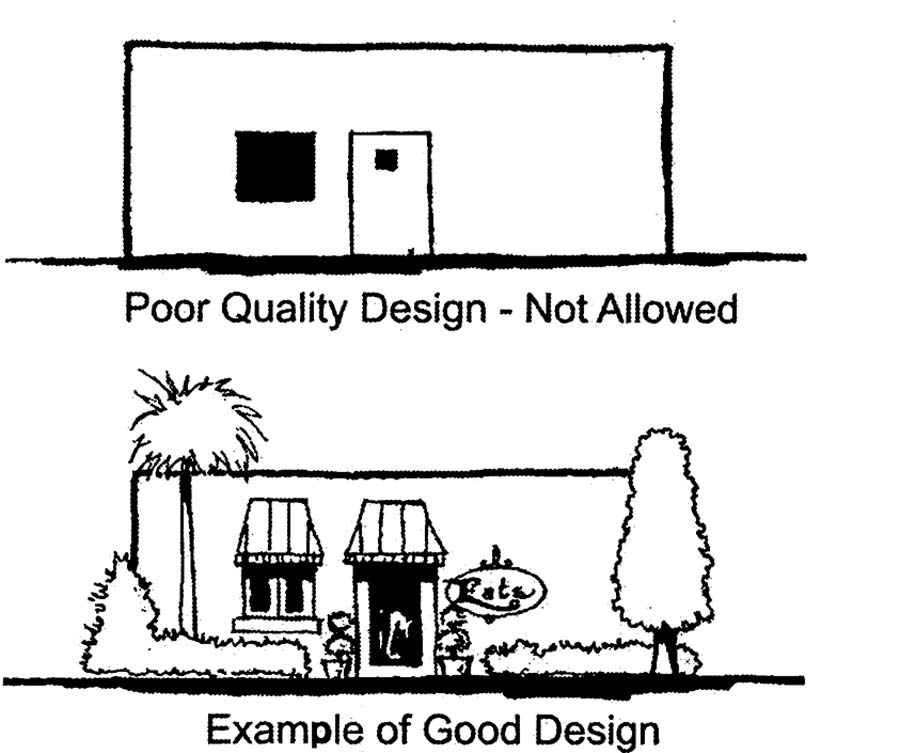
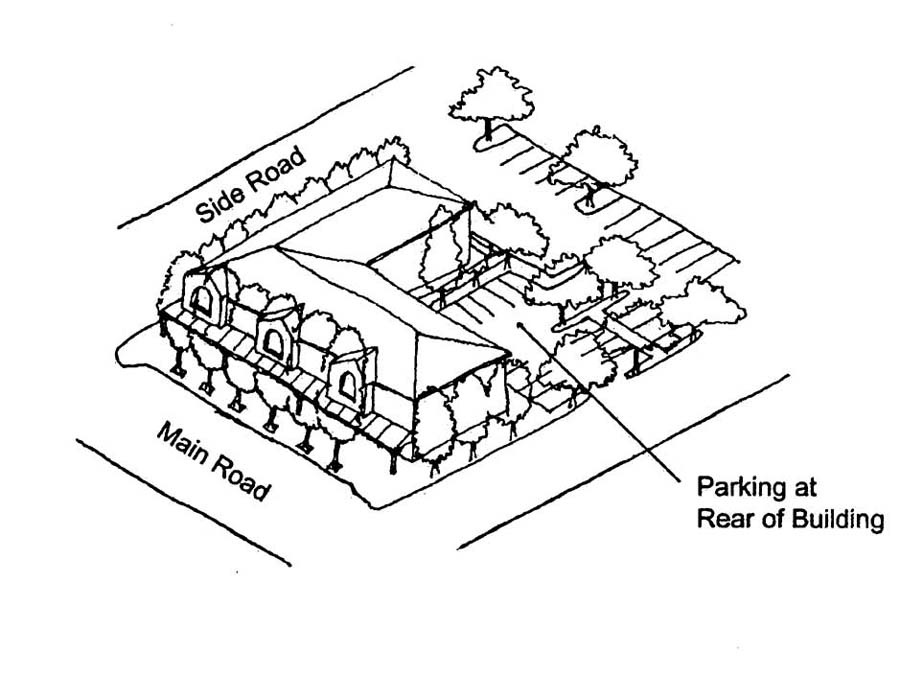
Parking areas shall be located to the side and rear of the building. A secondary pedestrian entrance may be provided in the back of the business to provide direct customer access to the store from parking areas, or a walkway shall be provided to improve circulation between the parking lots and the street. Architectural embellishments, awnings, landscaping and signs shall be used to mark the secondary entrance. The design of the rear of the building shall be consistent with the front façade.
•
Drive-through facilities shall not be allowed within historic districts.
•
Dumpsters shall be placed at an appropriate enclosure and the area around the dumpster must be kept free of any debris.
Building form.
a.
Standards for all structures.
•
New buildings and their components shall be compatible in scale with each other (size of windows and doors in relation to the façade), the human body (use building elements sized for human use), and neighboring structures (predominant scale). To achieve the appropriate scale, the height to width, length to width and solid to void ratios must be considered. The scale (height to width ratio) of a street-facing façade shall be compatible with and maintain the proportions established by the existing structures within the district.
•
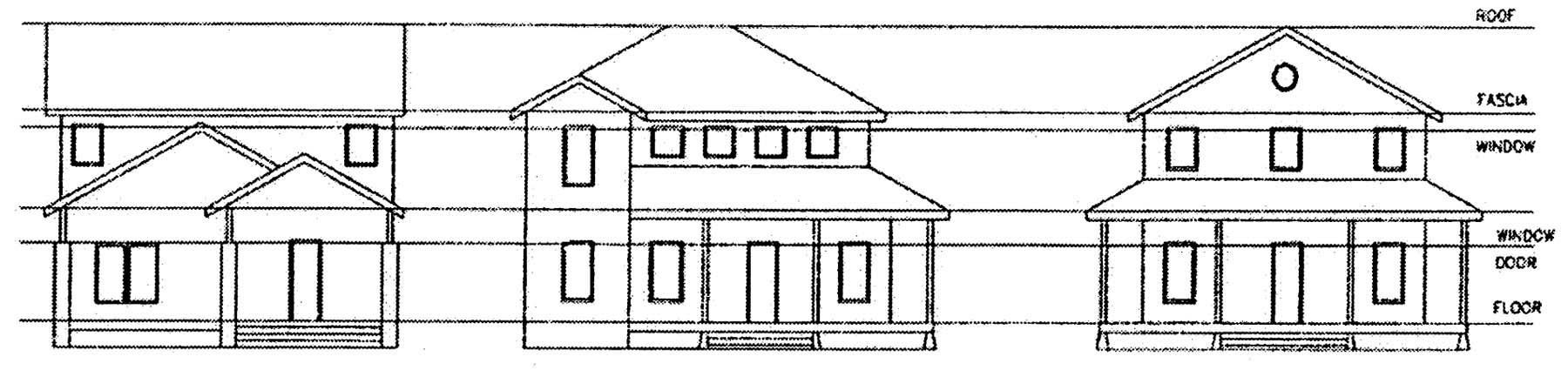
To maintain the predominant scale and proportion in historic districts, new buildings, additions and alterations shall be designed so that elements of the building façade are aligned with the façade elements of the neighboring structures (e.g. windows, doors, canopies, storefronts, awnings, etc.).
Contemporary Design
•
Contemporary design for new construction is permittable when compatible with the size and scale of the property, neighborhood and immediate environment.
•
New construction shall create a sense of layers using steps, brackets, chimneys, vegetation, and other projecting elements to make the buildings look less massive.
•
All new buildings shall have the main entrance oriented to the principal street and in full view from the public right-of-way.
•
Alterations to historic landmarks and contributing structures within a historic district shall be consistent with the design, massing and scale of the existing structure and the surrounding area.
•
New development shall incorporate mailboxes into the design. The use of cluster mailboxes is prohibited and unlawful in the historic districts.
•
The width of new or altered buildings shall be consistent with the predominant building width in the surrounding neighborhood. Larger buildings shall be designed so their facades are divided into smaller elements that relate to those of the surrounding neighborhood.
•
The design of an existing non-contributing structure may be modernized or contain historical references, but shall not be redesigned to create a false historical appearance.
•
Additions or alterations to structures shall be done in such a manner that if such additions or alterations were to be removed in the future, the essential form and integrity of the original structure would be unimpaired.
b.
Residential building form.
•
In the Sanford Residential Historic District, the scale and massing of new structures and their architectural elements shall be similar to the contributing structures of similar use in the historic district.
•
New residential structures shall include a raised foundation to compliment the character of contributing structures in the district.
•
In the Sanford Residential Historic District, new buildings shall not exceed 35 feet in height.
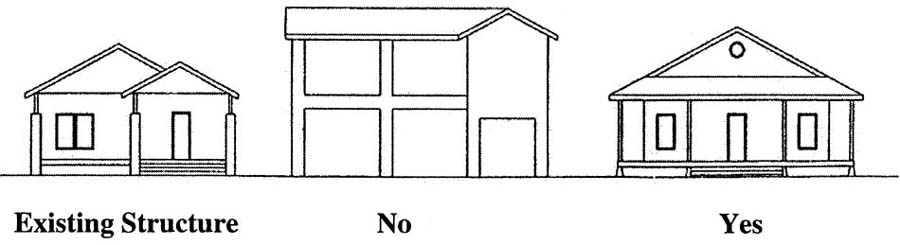
•
Primary residential entries for new structures shall face the street and shall not be recessed more than 6 feet from the face of the primary façade.
•
New development must incorporate mailboxes into the design. Cluster mailboxes are prohibited in the historic districts.
c.
Commercial building form.
•
New buildings shall be designed with architectural features and patterns that provide visual interest from the perspective of the pedestrian, as well as vehicular traffic.
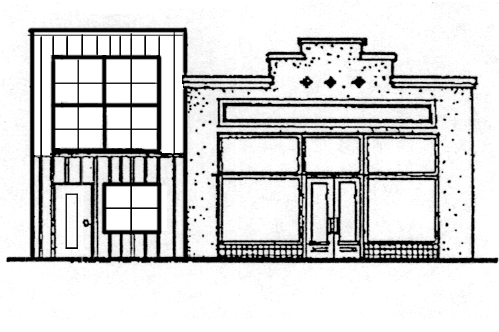
•
New building placing and massing shall relate to nearby buildings and to the urban context.
Yes
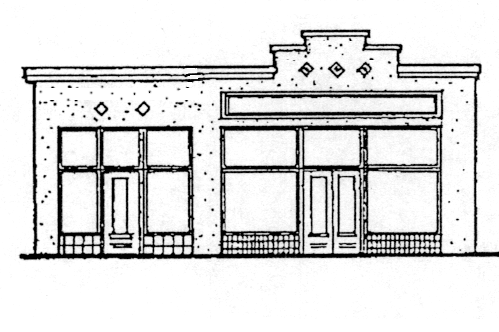
No
•
New buildings and additions shall include substantial variation in massing such as changes in height and horizontal plane. Horizontal masses shall not exceed a height/width ratio of 1 to 3 (1:3) without a substantial architectural element that either projects up or away from the building, such as a tower bay, lattice, or other architectural feature.
•
Buildings in the Downtown Commercial Historic District shall not exceed 4 stories. Buildings at the corner of 2 streets may have embellishments at the corner that are proportionately higher.
•
Storefronts shall be built to integrate the display window with the door and sign area into a single construction.
•
The height of storefront openings in new buildings shall be similar to the storefront openings of the contributing buildings within the historic district.
•
For new construction, there shall be a visual differentiation, such as a change in material or texture, between the first and second story on a 2-story building or between the 2 lower floors and the rest of the building on a building taller than 2 stories. The differentiation shall be at a height similar to the cornice lines or stringcourses of contributing structures in the historic district.
•
The scale and massing of the lower floors of new structures and their architectural elements shall be similar to contributing structures in the historic district. Any new structure that exceeds 50 linear feet along any street frontage shall minimize the façade's mass by adding projections and recesses to make the structure similar in scale to contributing structures in the historic district.
•
New buildings shall have a recognizable top consisting of, but not limited to, cornice treatments, roof overhangs with brackets, steeped parapets, richly textured materials and/or differently colored materials. Colored stripes are not acceptable as the only treatment.
•
Building monument signs shall be recessed in the façade and may not be applied to the face of the façade.
•
New building walls shall be enhanced by the use of vertical elements, articulation and landscaping to break the monotony.
•
Columns and other façade features shall be treated as a total unit and shall extend to the ground.
•
The first floors of new buildings, including structured parking, shall be designed to encourage pedestrian scale activity.
•
Primary customer entrances shall be clearly defined and highly visible through the use of architectural detail for all structures.
•
Mechanical units and their ancillary equipment shall not be visible from the right-of-way.
•
Mechanical equipment shall be integrated into the overall mass of a building by screening it behind parapets or by integrating equipment into roof forms. Plain boxes are not acceptable as screening devices.
•
Structural canopy supports shall be symmetrical across face of façade.
•
Protection from the sun and adverse weather conditions for patrons shall be considered for the entranceways. Overhangs/awnings shall be no less than 3 feet deep to function to protect pedestrians from inclement weather.
•
Fabric awnings located on the second story and above shall match in design, color, texture, dimensions, and other physical features.
•
The use of vinyl or plastic awnings is prohibited and unlawful.
Building features.
•
The distinguishing original characteristics of an existing contributing building, structure or site shall not be destroyed. If replacement is necessary, the new building feature shall match the feature being replaced in composition, color, texture, proportion, style, profile and other visual qualities. Repair or replacement of missing architectural features shall be based on accurate duplications of features, substantiated by historic, physical, or pictorial evidence rather than on conjectural designs or the availability of different architectural elements as seen on other buildings or structures in the area.
•
Alterations and additions to contributing structures shall be compatible with the color, material, and character of the structure, neighborhood or immediate environment.
•
Building features within new construction shall be compatible with the color, material, and character of the property, neighborhood and immediate environment.
•
Balconies within the Downtown Commercial Historic District shall be permitted to encroach into the public right-of-way up to 3 feet from the property line with the approval of the City Engineer, or designee.
•
Basements and foundations, in addition to wall material, may be made of cast-in-place concrete of smooth construction or concrete masonry units, provided that they are given a cement wash where visible.
•
A material consistent with the style of the structure shall enclose the undercroft of decks and foundations with spaced piers. The material shall be slightly recessed from the façade of the building and shall not overlap or be flush with the outer surface of the original piers, supports or siding.
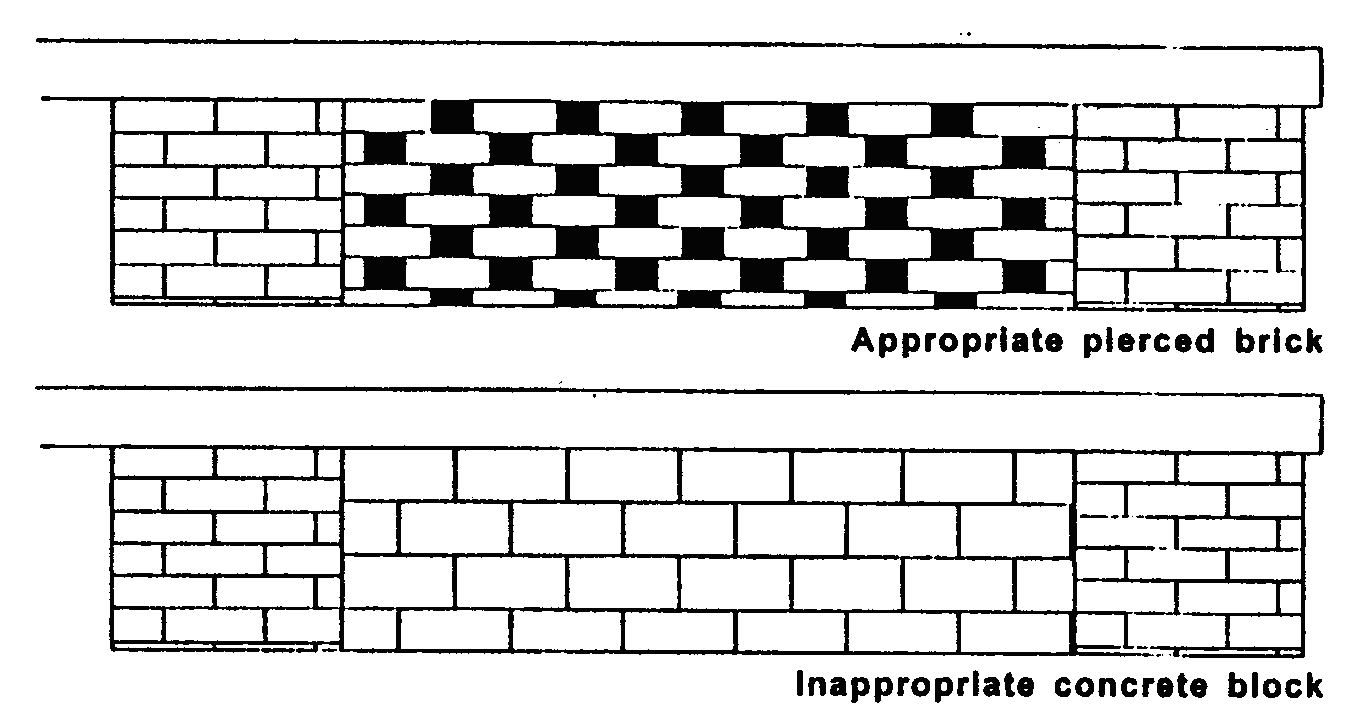
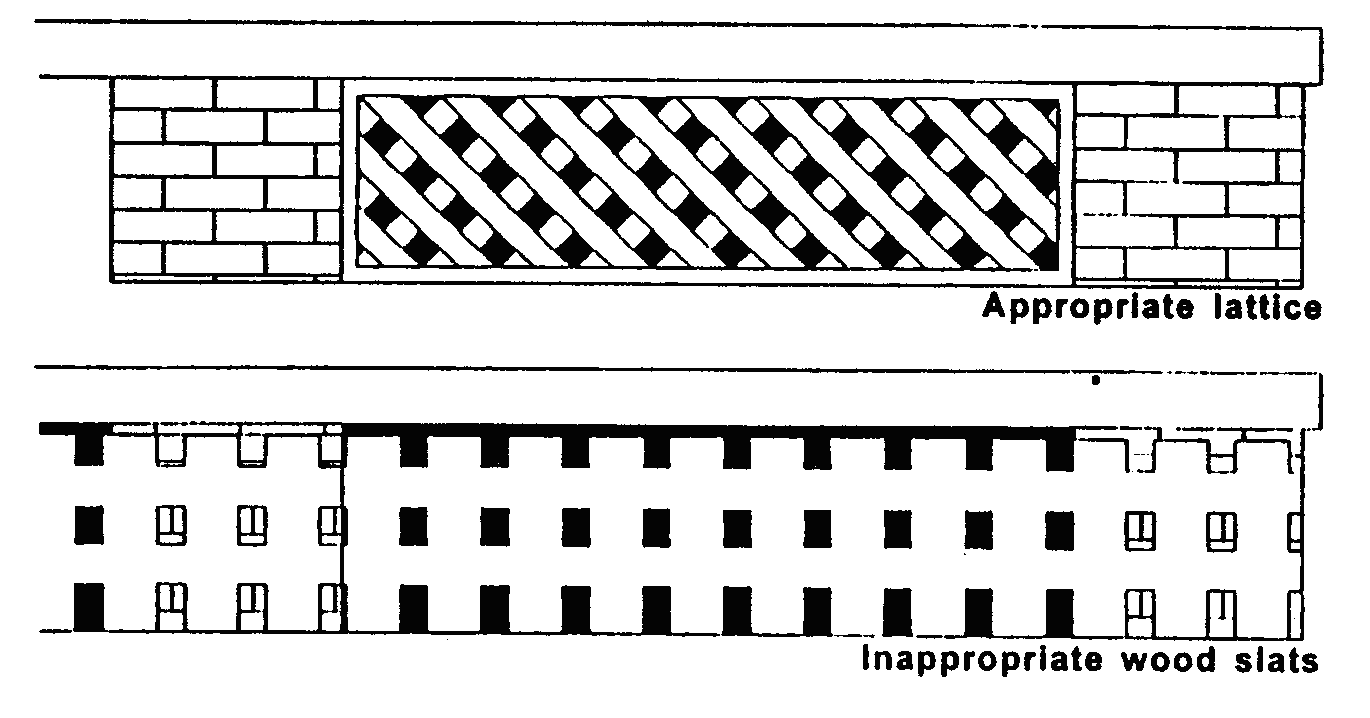
•
Posts, balconies, porches and bay windows, columns, piers and arches, shall use materials consistent with the style of the structure. Balconies shall be built of wrought iron or wood with the railing pattern subject to the approval of the HPB.
•
Chimneys shall have a minimum width of 5 feet at the ground floor, and a dimension of 1 and 1-half feet in either direction above the roofline. The transition shall be tapered.
Chimneys
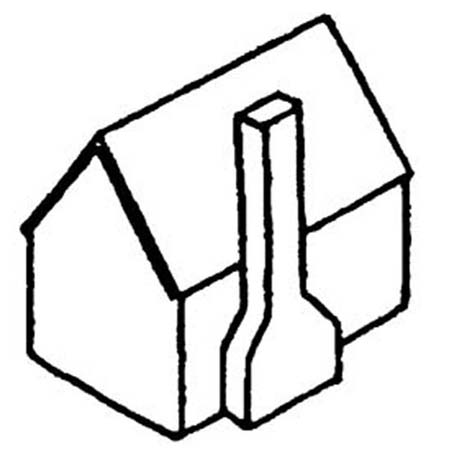
•
Exterior chimneys and foundations shall be finished in brick, stone, or stucco only.
•
New or replacement brackets for cantilevers, and open balconies shall be made of brick, wood, stone or steel, if visible, consistent with the style of the structure.
•
Stoops may be made of brick, stucco, cast concrete or wood.
Exterior walls/materials.
•
For new construction, additions and alterations, use the wall finish most acceptable for the architectural style (see Appendix A).
•
The use of synthetic materials is prohibited and unlawful for exterior wall surfaces with the exception of fiber cement siding, which may be approved by special development order for detached new construction only.
•
Synthetic materials can be allowed for trim details and architectural elements on new construction.
•
The following materials are generally acceptable for principal and accessory structures within the historic districts:
i.
Wood clapboard, wood shingle, wood drop siding, wood board and batten siding or equal as determined by the HPB.
ii.
Brick, stucco; and stone or cast stone.
•
Resurfacing existing historic landmarks or contributing buildings with new material that is inconsistent with the style of the building or was unavailable when the building was constructed, such as artificial stone, brick veneer, asbestos or asphalt shingles, rustic shakes, and vinyl or aluminum siding, is prohibited and unlawful. In cases where artificial siding is currently in place, its removal is not necessary. An owner may retain the material or remove it. If the material is removed, however, it shall be replaced with historically appropriate materials.
•
When siding which is inconsistent with the style of the house is removed, either from the façade of a building or to re-open an enclosed porch, the original façade and the original fenestrations shall be documented prior to the commencement of any rehabilitation construction.
•
Application of non-historic exterior finishes which result in either the removal or covering of historical materials and details is prohibited and unlawful.
a)
Wood facades. Horizontal wood siding is the predominant exterior finish in the Sanford Residential Historic District. Important characteristics of wood siding that shall be considered in its repair or replacement are board size, width of exposure, length, and trim detail such as corner boards.
•
Existing wood siding, trim and details in good condition or repairable shall be retained.
•
Deteriorated wood shall be replaced with wood to match the existing wood in size, profile, shape and texture.
•
Any and all additions to wood sided structures shall match the existing siding in size, profile, shape, color, orientation and texture.
•
Board trim at corners and around openings shall not exceed 6 inches except at the front door surround which may be any size or configuration.
•
Wood posts, where appropriate to a style, shall be no less than 5 inches by 5 inches and chamfered at the corners.
•
Detailing of the wood, such as beveling or beading, shall not be removed.
•
Board width, length and exposure shall be preserved.
b)
Masonry facades. Masonry exterior finishes and detailing such as brick, tile, stucco, coquina, and concrete block can also be found in the Sanford Residential Historic District. Masonry features are important to the historic character of buildings, such as brick cornices or terra cotta detailing, surface treatments, modeling, tooling, bonding patterns, joint size and color.
•
Existing masonry features that are important to defining the overall historical character of the building shall be retained if they are in good condition or repairable. Repair or replacement shall be made with materials duplicating the existing masonry in color, composition and texture.
•
Mortar joints shall be repointed only where there are obvious signs of deterioration such as disintegrating mortar, cracks in the mortar joints, loose bricks, damp walls or damaged plaster work. Repointing shall duplicate the existing mortar joints in size, composition, texture, color and structural strength.
•
Any and all additions to stuccoed structures shall be of stucco to match the existing in color, composition and texture.
•
Any and all additions to concrete block structures shall be of matching concrete block and shall have mortar joints that match the existing.
•
Where brick and other masonry finishes were unpainted, they shall generally remain unpainted. Painting hides detailing and alters the distinguishing original qualities of a building. Under some circumstances, particularly where the brick quality is poor or abrasive cleaning methods have been used, painting brick may be appropriate as a protective measure, if approved by the HPB.
•
When a brick veneer is applied only to a front façade, it shall return onto both side facades a minimum depth of 2 feet.
•
Brick shall be laid in true bonding pattern (no stack pattern) or in Flemish bond or like.
•
Brick mortar joints shall be struck or concave or 3/16 inch flush only.
•
Trim on brick buildings may be made of pre-cast concrete, terracotta, or stone.
•
Stucco shall be applied consistent with the style of the structure, which is typically smooth sand finish for masonry vernacular buildings and rustic for Spanish Colonial Revival.
c)
Existing aluminum or vinyl siding or other simulated wall cladding. Any and all additions to structures that are sided with aluminum or vinyl siding or other simulated cladding shall be clad with materials to match the original historic structure in size, profile, shape, color, orientation and texture.
d)
Facades with a combination of materials. Any and all additions to structures with a combination of cladding materials shall be sided using 1 or more of the existing cladding materials in a manner that is in character with the style and period of the structure.
Porches and balconies.
•
Porches and porch features that are in good condition or repairable and are in character with the style and period of the building shall be retained. Porches and porch features shall be repaired so they match the original in materials, size and configuration.
•
Replacement of existing porches with a design or materials not in character with the style and period of the building is prohibited and unlawful.
•
Porch flooring shall be wood, tongue and groove, and must match original porch flooring in size, shape, orientation, and texture.
•
Porch flooring shall be oriented perpendicular to the building's façade, or shall match the original orientation.
•
Replacement porch flooring shall be keyed in so the repair when completed, is not visible.
•
Screen enclosures attached to historic landmarks and contributing buildings shall be reviewed by the HPB to determine if the proposed structure is consistent with the historic architectural style of the home. Screen enclosures shall not hide defining architectural features of the building. The screen enclosure shall not exceed the height of the main structure.
•
New porch elements, such as, by way of example only and not as a limitation, balusters and columns brackets, trim, and architectural embellishments shall be compatible with the style and period of the building and shall be substantiated by physical and/or pictorial evidence of the subject property.
•
Porches visible from the right-of-way shall not be enclosed with materials such as screening, fabric, glass, wood, aluminum, vinyl, fiberglass or masonry. Temporary shade devices must be approved via a COA and must not be visible from the right of way when retracted.
•
Porches not visible from the right-of-way may be screened. The new materials shall be installed so as not to conceal or damage historical architectural elements. The framing members for screening shall have a design and scale that is in character with the style and period of the building.
•
Porch additions shall have a roof type that is either similar to the existing roof or is in character with the style and period of the building.
Roofs.
•
The original roof shape and material of the principal and accessory buildings shall be retained if it is in good condition or repairable.
•
Deteriorated roofing material shall be replaced with new material that is consistent with the style of the structure, and shall be similar to the existing or original roof in composition, size, shape and texture, except in the case of asbestos shingles, which may be replaced with new materials, such as fiberglass shingles, cement fiber tiles or shingles, or clay tiles that are similar to the original roofing. All shingles shall be architectural.
•
Roof repairs are allowed only if the new roof matches the existing in material, shape, texture, design, dimension, color, and other identifying features.
•
Architectural features that give the roof its character, such as dormers, cornices, towers, decorative brackets, eaves, chimneys, parapets, and exposed rafter ends shall be retained or replicated and not concealed.
•
Roofs on additions shall have similar shape, materials and pitch as the existing structure. New features, such as skylights or solar collectors, shall be flush with the roof and shall not be installed on roofs visible from the public right-of-way.
•
Roof vents shall not be located on a primary façade visible from the right-of-way.
•
A flat roof that is not visible from the ground may have a different material than the rest of the existing roof.
•
All pitched roof planes shall match in material, shape, texture, design, dimension, color, and other identifying features.
•
Plastic roofing membranes shall not be visible from the right-of-way.
•
Metal roofs shall be appropriately maintained at all times. It shall constitute prima facie evidence of a nuisance for a roof to show evidence of significant deterioration (such as rust or other corrosion). It is prohibited and unlawful to allow a metal roof to be in a nuisance condition.
•
Metal roofs shall be standing seam, stamped metal shingle, full corrugated, 5V crimp or must simulate the appearance of standing seam.
•
Metal roofs may be copper, galvanized, silver or gray in color, or otherwise simulate a historic patina.
a)
Residential.
•
Principal building roof shape and materials shall be consistent with the style of the structure. Roofs clad with red cedar or white oak shingles; or with galvanized steel, or asphalt shingles are consistent with most styles in the Sanford Residential Historic District.
•
Shed (monopitch) roofs shall be permitted only if attached to a wall of a principal building. The pitch of a shed roof shall be no less than 3:12.
•
Flat roofs shall be provided only if accessible from an adjacent habitable room and enclosed by parapets no less than 36 feet high.
•
Gutters shall be made of galvanized steel, wood, copper or painted aluminum and may be half-round or low profile-box shaped.
Windows and doors.
a)
All Construction.
•
Windows, frames, glass, muntins, mullions, sills, lintels and pediments in good condition or repairable and in character with the style and period of the building shall be retained. Window types that are no longer permitted by law, such as jalousies, may be replaced with another style of window that is in character with the style and period of the building.
•
If windows or window details are determined to be irreparable, they may be replaced provided that on the primary facades of contributing buildings, replacement windows shall match the existing original windows in size, configuration, material, design and placement. A window survey and specifications for each window must be submitted with the COA application. On secondary facades, replacement windows may be of a different design or type provided the windows are consistent with the style of the building.
•
Only when a change is appropriate to the style and period of the building may a window be relocated, enlarged, reduced or introduced.
•
When replacing existing windows that are inappropriate to the style and period of the building, they shall be replaced with new windows that are appropriate to the style and period of the building.
•
Windows on additions shall have the same orientation and be of a similar size to the existing or original windows of the principal façade except if the addition is on the same plane as the existing principal façade, then the windows of the addition shall match the original windows in orientation, size, materials and configuration.
•
All new windows shall have mullion profiles similar to contributing structures. If single hung or double hung windows are placed in groupings, a 4 to 6 inch trim piece shall separate the windows.
•
If a window contains divided lites, true muntins or simulated true-divided lites (where a wood frame is glued to the exterior of the glass with a very high bond (VHB) adhesive system) shall be used. If double pane windows are installed, an internal shadow bar shall also be used between the glasses. Inserted or removable grilles and flat grilles that do not replicate the profile and characteristics of the original window are prohibited on the exterior of the windowpane. The interior of the windowpane may have an inserted or removable grille provided that the grille is not flat and has a profile.
•
Windows and doors shall be glazed in clear glass with no more than 10% daylight reduction. The use of reflective glass and reflective film is prohibited on all buildings.
•
Windows shall be proportioned such that the height shall be equal to or greater than the width, with the exception of historically appropriate window groupings.
•
Rectangular windows shall be casement and single or double hung; circular and hexagonal windows may be fixed or pivot.
•
When determined appropriate to be used in a development order, storm windows shall be installed on the interior of historic windows.
•
Doors, screen doors, and door details, frames, lintels, fan lights, sidelights, pediments and transoms, in good condition or repairable that are in character with the style and period of the building shall be retained. If doors or door details on principal facades are found to be unrepairable, they shall be replaced with new doors and door details in character with the structure in material, size and configuration.
•
Only when the change is appropriate to the style and period of the building, shall doors be relocated, enlarged, reduced or introduced.
•
Doors with modern designs, flush or sliding glass doors, or any type of door that is inappropriate to the style or period of the structure is prohibited and unlawful.
•
Stained glass and art glass installations are allowed provided they are consistent with the character and the architectural style of the building.
•
Shutters in good condition or repairable and in character with the style and period of the building shall be retained. Missing shutters shall be replaced with wood shutters to match the existing. All replacement shutters shall be similar to the original in size, configuration and style, shall be sized to match the corresponding window openings, and shall not overlap each other on the surface of the wall.
•
New operable wood shutters and canvas awnings are permitted accessories, as long as they are sized to match the corresponding window openings and their shapes, material, proportions, design, color, lettering and hardware are in character with the style of the building. Decorative shutters are permitted when appropriate to the building style.
•
No backlit or interior lit or vinyl awnings shall be allowed.
•
Ornamental iron, grills, or bars on windows are permitted if appropriate to the architectural style of the building and shall be constructed of steel, wrought iron or similar material and painted with a gloss paint of dark color.
b)
Residential windows and doors.
•
The total glazing area on any facade shall not exceed 30% of the facade surface.
•
Windows on new houses shall have definition and a profile. Windows with flat profiles is prohibited and unlawful.
•
Bay windows, when provided, shall be habitable spaces carried to the ground on walls or feathered back to the wall with appropriate moldings.
•
Garage doors that are in good condition or repairable and are in character with the style and period of the building shall be retained. Garage doors shall be repaired so that they match the original materials, size and configuration.
•
If garage doors are determined to be irreparable, they shall be replaced with new doors of a material in the character and style of the principal building and of the garage building.
•
New garage doors may be constructed out of wood, steel or fiberglass and shall not exceed a maximum width of 9 feet for a single door on front loaded garages and 16 feet on alley-facing garages.
•
Garage doors must be architectural, carriage-style doors that complement the main building and garage building.
c)
Commercial windows and doors.
•
Windows and display cases are encouraged along pedestrian corridors.
•
Clear glass 88% light transmission shall be installed on the first floor. Tinted glass allowing a minimum of 50% light transmission shall be allowed only for use on second floor windows provided the tinting is consistent with the architectural style of the building.
•
The covering of storefront windows with plywood, vinyl, and/or metal adversely impacts the character and vibrancy of the Downtown Commercial Historic District and is prohibited. Businesses with an active building permit may utilize plain paper window coverings for the duration of the valid building permit only.
•
Storefront windows shall be similar in placement, size and configuration to the storefront windows found on contributing buildings in the historic district.
•
Storefront frames shall be built entirely of wood, steel or aluminum. The storefront side piers shall be the same material as the upper façade, or covered with stucco.
•
The minimum height of awnings on non-residential buildings shall be 8 feet from the lowest point to the sidewalk. Generally, awnings shall not extend more than 6 feet from the face of the structure. However, the HPB may approve awnings that extend 8 feet from the face of the structure upon a finding of fact that the awning width is consistent with the width of awnings on adjacent buildings. The highest point of a first floor awning shall not be higher than the midpoint of the space between the second story windowsills and the top of the first floor storefront windowsills.
Marquees
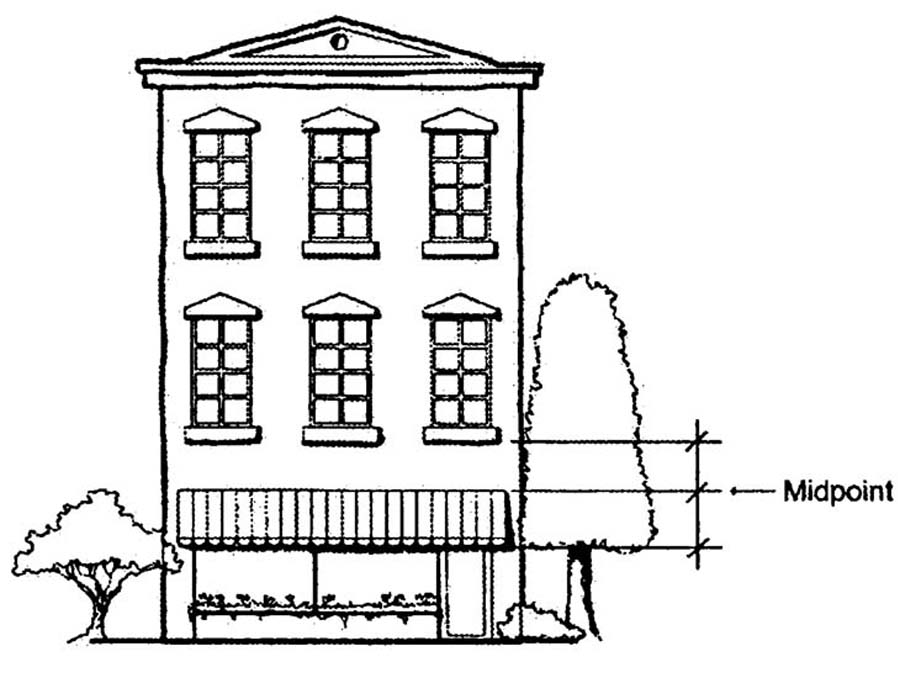
•
Marquees shall be retained where they are an historic element of the building. The design, materials, color, lettering and hardware of a marquee shall reflect the style and period of the building. The highest point of a marquee or its superstructure shall not be higher than the midpoint of the space between the second story windowsills and the top of the first floor storefront window or transom. Marquees shall span the entire façade or entrance. Only 1 marquee shall be permitted on a façade. The minimum height of a marquee shall be 8 feet from the lowest point to the sidewalk.
•
The highest point of a first floor awning shall not be higher than the midpoint between the top of the first story window and the second story windowsill.
•
The use of security shutters, roll cages, and/or security bars are prohibited and unlawful.
Fences and walls. Chain link and vinyl fences are prohibited and unlawful within the historic districts.
a)
Residential.
•
Fences and garden walls in historic districts generally vary in architectural style. Most fences in the City's historic districts are of the painted wood variety. It is important to maintain the architectural integrity of the property through the design of the fence.
•
Where new fences are introduced, the materials shall be compatible with the original style, texture, or exterior materials of the buildings on the site.
•
Construct new front-yard fences of vertical pickets in simple designs, especially on frame vernacular buildings. Limit cast iron fencing to high-styled buildings such as Queen Anne, Colonial Revival, and Spanish Colonial Revival.
•
Fence height shall conform to the City Code.
•
A modification, replacement or addition of a fence will require a COA prior to the commencement of the construction.
•
Garden walls may be of brick or stucco matching the principal building.
•
Brick or stucco garden walls shall be no less than 8 inches wide and capped by a flat round or pitched top, overlapping no less than ¼ of an inch the wall below.
•
Fences shall be made with no more than 3-inch gaps between pickets.
•
The overall design of walls and fences shall present a quality image consistent with the historic characteristics of the structure or the surrounding area.
•
All walls and fences shall have their finished side facing outward.
b)
Commercial.
Screening walls and fences are discouraged in the Downtown Commercial Historic District, except for low street-walls along the lot frontage, as a continuation of the building along street fronts. The street-wall shall be a minimum of 3 feet and a maximum of five feet in height. Walls greater than 3 feet in height above grade shall be no more than 50% solid.
Building color/coatings.
a)
All structures.
•
A color scheme shall be developed for the entire building that coordinates all of the façade/architectural elements and which highlights building features. At least 2 colors shall be selected, 1 for the body of the building and 1 or more for the accents and trims. Refer to the architectural styles section for suggested paint color choices based on style.
•
Shall consider the color palette of surrounding structures to create a harmonized experience along the block on which the structure is located.
•
The use of black or a fluorescent color as a pure primary or secondary color is prohibited and unlawful.
•
Brick, stone, or other materials intended to be naturally unpainted shall remain unpainted, unless the material has been painted before.
•
Paint shall not be removed from materials which were originally painted.
•
Tile roofs may be painted, however, the color selected shall be similar to the natural color of the original roofing material of the building.
•
The use elastomeric, ceramic, and liquid vinyl membranes coatings for historic wall surfaces is prohibited and unlawful due to the lack of permeability which hastens deterioration.
b)
Murals.
As to applications for certificates of appropriateness that relate to murals, only the following matters shall be considered when evaluating whether the application should be approved or denied and such applications shall be considered after approval of a public art application by the Public Art Commission:
•
Murals may only be installed on previously painted structures.
•
Murals may only be installed on the side and rear walls of buildings.
•
Murals many not cover or detract from the significance or character-defining architectural features of a structure.
•
Murals must complement and enhance the structure.
•
Walls on which murals are located must be in good repair with roof, flashing and parapets in good condition.
•
Walls on which murals are located must be cleaned using gentlest means possible and primed with appropriate paint.
•
Paint utilized in the installation of mural must be intended for exterior use and not compromise the integrity of the materials to which it is applied.
•
The use of paint which is reflective neon or fluorescent in installing a mural is prohibited and unlawful.
•
Murals must be located and sized to engage and encourage pedestrian interaction.
•
Murals must exhibit skilled application standards consistent with sound and generally accepted artistic practices and principles.
Accessory structures and pool enclosures.
•
Prefabricated accessory storage structures shall not exceed 100 square feet in area, and are subject to the setback requirements of the district.
•
There shall be a minimum separation of 10 feet between principal and accessory structures.
•
Accessory structures, such as garages, sheds, etc. shall not exceed the height of the main structure.
•
Accessory structures shall be of similar style, color, design and materials as used for the principal residence.
•
Air conditioning, mechanical equipment and other support equipment shall not be placed in a setback and must be screened from view.
•
Mechanical cabinets may be placed in an area not visible from the right-of-way and the wall surface must be horizontal lap siding or match that of the primary building.
•
Temporary or portable structures installed on a site in the historic districts including, but not limited to, temporary storage units and aluminum frame car ports, shall obtain a COA prior to the installation of the unit even if no building permit is required.
•
Satellite antennas. The City has devoted significant public resources to protect its historic district and the historic structures located within the historic district from the encroachment of structures and development that detract from the historic ambience of the historic district. The City has also devoted its comprehensive planning, growth management, and land development regulatory efforts to ensuring that the historic district is protected from harmful modernistic structures, styles and patterns that are incongruent with the requirements relating to the historic district and which would harm the public's ability to relish past times and to further the protection of sites and locales of historical significance that are disappearing from our cultural landscape. In order to further those goals, a single satellite antenna may be permitted on lots and parcels located in the historic district only if the proposed satellite antenna is located on an area of the lot or parcel that is not visible from the public right-of-way (including, but not limited to all abutting sidewalks) and park areas. In the event that this prohibition is believed by a property owner to constitute a material and significant hardship, the property owner may file an application for a variance in accordance with the provisions, processes and procedures of this Code which application, shall, initially, but subsequent to City staff review and analysis, be reviewed by the HPB which shall provide a recommendation relative to the variance application which shall be considered during the course of the reviews and considerations pertaining to the application.
(Ord. No. 4588, § 1(a)(Exh.), 2-8-2021)
Section 10.0. - Relocation of landmarks.
Buildings shall be preserved in their original location on the site where constructed. The relocation of a building can disrupt not only the historic character of the building but the immediate area as well. Relocation is prohibited and unlawful, unless a development order is entered finding that the building is threatened in its original location or renovation and continued use is prohibited by its current location. Relocating a building is a last resort to avoid demolition. Relocated buildings shall be situated on the site in the same orientation as the original location.
The relocation of historic landmarks and contributing buildings require the approval of a COA by the HPB. When reviewing such applications, the HPB shall consider the following criteria:
1.
Whether the historic character and aesthetic interest of the building, structure, or object contributes to its present setting;
2.
Whether there are definite plans for the area to be vacated and the effect of those plans on the character of the surrounding area;
3.
Whether the building, structure, or object can be moved without significant damage to its physical integrity; and
4.
Whether the proposed relocation area is compatible with the historical and architectural character of the building, structure or object.
Applications for relocation shall be submitted at least 10 City business days prior to the HPB meeting, and the site of the subject structure shall be posted for at least 10 consecutive days prior to the HPB meeting.
(Ord. No. 4588, § 1(a)(Exh.), 2-8-2021)
Section 11.0. - Ordinary maintenance.
The purpose of this Section is to establish minimum standards for the maintenance of historic landmarks and properties within established historic districts.
A.
Required maintenance. It is prohibited and unlawful for the owner of a structure within a historic district or of a historic landmark or to permit such structure or landmark to fall into a state of disrepair which may result in the deterioration of any exterior appurtenance or architectural feature so as to produce or to tend to produce, as found by the HPB based upon the criteria set forth herein, a detrimental effect upon the character of the historic district as a whole or the life and character of the historic landmark or structure including, but not limited to:
1.
The deterioration of exterior walls or other vertical supports;
2.
The deterioration of roofs or other horizontal members;
3.
The deterioration of exterior chimneys;
4.
The deterioration or crumbling of exterior plaster or mortar;
5.
The ineffective waterproofing of exterior walls, roofs, and foundations, including broken windows or doors;
6.
The deterioration of any feature so as to create or permit the creation of any hazardous or unsafe condition;
7.
The deterioration of any architectural feature which contributes to the architectural or historic significance and/or integrity of the structure;
8.
The deterioration of exterior appurtenances.
Nothing in this Schedule shall be construed to prevent the ordinary maintenance or repair of any exterior feature of a structure located in an historic district or of any historic landmark which does not involve a change in design, material, color, or other appearance thereof.
Nothing in this Schedule shall prevent the construction, reconstruction, alteration, restoration or demolition that is certified in writing by the Building Official to the Historic Preservation Officer to be required to protect the public, health safety or welfare or because of an unsafe or dangerous condition exists.
B.
Standards for building maintenance.
•
The surface cleaning of structures shall be undertaken with the gentlest means practicable. Sandblasting and other cleaning methods that could damage the historic building materials such as the use of any abrasive, corrosive, or damaging techniques which include blasting with pulverized materials, glass beads or other solids, with or without water is prohibited and unlawful.
•
Abrasive cleaning or paint removal is another threat to historic wooden siding which is prohibited and unlawful. The proper method for removing paint is cleaning, light scraping and sanding down to the next sound layer. If more intensive paint removal is required, the gentlest means practicable shall be used. Harsh abrasive methods such as rotary sanding discs, rotary wires strippers, and sandblasting shall not be used to remove paint from exterior wood. Such methods leave visible circular depressions in the wood; shred the wood, or erode the soft, porous fibers of the wood, leaving a permanently pitted surface.
•
Paint removal is permitted, but it is prohibited and unlawful to leave behind any evidence of methods used. This includes wood damage, gouging or grinding marks left by mechanical tools, burns left by chemicals or burns left by heat sources. Additionally, paint removal processes that put the structure as a whole or in part in danger including, but not limited to, torches and heat guns are prohibited and unlawful. Debris from paint removal shall be collected and disposed of in accordance with federal guidelines.
•
Clean wood using the gentlest means possible. Repair trim and siding before applying paint. Seal holes, caulk cracks, and treat for wood fungus. Remove loose paint using commercial strippers, electric heat guns or plates, wire brushes and scrapers. Hand sand to reduce paint layer differential.
•
While masonry is the most durable historic building material, the cleaning of historic masonry is a special consideration because it is susceptible to damage by improper maintenance or repair techniques and abrasive cleaning methods. Sandblasting and other abrasive cleaning methods are not permitted. Sandblasting changes the visual qualities of brick damages and destroys the exterior glazing. As a result, rapid deterioration of the brick and potential water damage to the interior of the building are possibilities.
It is prohibited and unlawful to fail to use the following techniques when maintaining historic structures:
•
Masonry shall be cleaned only when necessary to halt deterioration or remove heavy soiling.
•
Clean masonry surfaces with the gentlest method possible, such as water and detergents and bristle brushes.
•
Sandblasting of brick or stone surfaces using dry or wet grit or other abrasives is prohibited. Such methods of cleaning permanently erode the surface of the material and accelerate deterioration.
•
Remove damaged or deteriorated paint only to the next sound layer using hand scraping prior to repainting.
•
Paint historically unpainted masonry only if it has been previously painted or as a protective measure to prevent further deterioration caused by poor quality materials prior to abrasive cleaning.
•
Treat mortar joint deterioration from leaking roofs or gutters and differential settlement of the building.
•
Evaluate the overall condition of the masonry to determine whether repairs rather than protection and maintenance are required.
•
Protect leaking roof with plywood and building paper until it can be properly repaired.
•
Protect and maintain masonry by providing proper drainage so that water does not stand on flat, horizontal surfaces or accumulate in curved decorative features.
C.
"Mothballing" structures.
Boarding-up of structure shall be allowed, upon approval of a COA by the HPB, in order to provide temporary protection and stabilization of vacant historic buildings. No windows, doors or other openings may be boarded-up in inhabited buildings.
Together with a COA application, a mothballing program shall be submitted to the HPB. The program shall include:
•
Documentation on the architectural and historical significance of the building;
•
A professional assessment of the condition of the building;
•
Methods of stabilization, pest control and ventilation that will be used prior to mothballing;
•
Methods of securing the building from vandals, break-ins and natural disasters;
•
Plan for periodic maintenance and surveillance monitoring; All mothballing programs shall be consistent with Preservation Brief 31, Mothballing Historic Buildings, Technical Preservation Series, National Park Service.
Any person who boards up, or causes to be boarded up, any structure shall paint or cause to be painted the material used to board up the structure the same color as the building.
The premises of all mothballed structures shall be maintained in accordance with the City Code.
(Ord. No. 4588, § 1(a)(Exh.), 2-8-2021)
Section 12.0. - Demolition.
A.
Criteria for reviewing demolition permits. No landmark or structure within a local historic district shall be demolished or removed, in whole or in part, until after an application for a COA has been approved by the HPB based on the following criteria:
1.
The historic, architectural or environmental significance of the structure.
2.
The historic, architectural or environmental significance of the structure to the overall ensemble of structures within the district and the importance of the structure to the integrity of the district.
3.
The aesthetic interest that the structure adds to the district, or in the case of an historic landmark, to the City.
4.
The number of remaining examples of similar significance in the district or, in the case of an historic landmark, in the City.
5.
The difficulty or impossibility of reproducing such a structure because of its design, texture, material, detail, size, scale or uniqueness of location.
6.
The plans for future utilization of the site and the effect those plans will have on the architectural, historical, archaeological, social, aesthetic or environmental character of the district.
7.
The reasonable measures that can be taken to save the structure from further deterioration, collapse, arson, vandalism or neglect.
8.
Any measures that have been taken to prevent the structure from deteriorating, such as performance of normal maintenance and repairs and provision of normal tenant improvements. In addition, whether the structure was willfully or negligently allowed to deteriorate. Properties cited for demolition by neglect that are not repaired may not be granted a demolition permit.
9.
The determination by the building official that the structure is an imminent hazard to public safety and that repair would be impractical.
10.
The economic hardship imposed on the owner if the application for COA for demolition is denied.
11.
The submittal of a detailed report describing all aspects of the structure's historical and architectural characteristics from the City's historic resources inventory and Florida Master Site File. This report shall be prepared by a qualified person knowledgeable in historic preservation under contract with the City at the applicant's expense.
12.
The submittal of a detailed report describing all aspects of the structure's physical condition prepared by an architect, licensed design professional or registered civil engineer at the applicant's expense.
B.
Procedures for issuing demolition COA. No landmark or structure within a local historic district shall be issued a demolition permit for removal in whole or in part, until after the following procedures are complete:
1.
The demolition permit must accompany a building permit for a replacement structure which meets all regulations and has received all required approvals.
2.
This demolition permit may only be issued after the waiting period has been completed.
3.
Upon approval of the demolition request and prior to issuance of a building permit (time defined as the waiting period), the property owner and contractor shall sign an affidavit to the City that they are aware of the City's definition of a demolition and the penalties associated with an unlawful demolition.
4.
If demolition occurred without the issuance of a demolition permit, the building permit filed for the replacement structure shall have an additional assessment of the demolition permit fee that was not collected, in addition to the after the fact fee.
5.
In all cases, no changes to the previously approved plans may be made except as determined by the Administrative Official in consultation with the HPB to meet current zoning and building code requirements.
6.
When demolition of a structure is allowed, the City shall provide the developer of the structure to be demolished with information about the salvaging of building materials. At least 10 days prior to the date when the demolition is scheduled to commence, the developer shall provide the planning director with written notice, and an advertisement published in a newspaper of general circulation at the applicant's expense, of the availability of materials for salvage, including the name and telephone number of a contact person. Upon request, the planning director may make this information available to persons who may be interested in contacting the owner(s) to arrange for possible salvage of building materials. No salvaging of materials shall occur until a demolition permit has been approved by the building department.
7.
Submittal of documentation requirements in accordance with Appendix B, Documentation Requirements for Buildings Proposed for Demolition and Standards for Architectural Documentation.
C.
Waiting period. If a COA is issued by the HPB for demolition, the COA must include the condition that the applicant must wait for a total period of 180 days before the applicant may perform such demolition or relocation in accordance with this Schedule.
During this period, the HPB may negotiate with the owner of the landmark and with any other party to find a means of preserving the property including the acquisition by gift, purchase, exchange or otherwise of the property or any interest therein.
1.
Extension of waiting period. The 180-day waiting period may be extended for up to an additional 180 days by the City Commission upon a recommendation from the HPB that:
•
There is a program or project in progress which may result in acquisition of the property for the purpose of its preservation and/or restoration; and
•
There is a reasonable ground to believe that the program or project will be successful.
2.
Reduction/waiver in waiting period. The HPB may reduce or waive the waiting period required by this Section in any case where the owner would suffer extreme hardship, not including loss of profit, unless a reduction in the required period were allowed. The HPB shall also have the discretionary authority to waive all or any portion of the required waiting period provided that the alteration, remodeling, relocation or change of use is undertaken subject to conditions agreed to by the HPB insuring the continued maintenance of the historical, architectural, or cultural integrity and character of the property.
D.
Economic hardship. Economic hardship shall be determined in accordance with this Section. When a claim of extreme economic hardship is presented, proof shall be submitted that the applicant cannot realize a reasonable and beneficial use of or economic return from the property. If the property is residential and non-income producing or is an accessory structure, the owner shall not be required to prove economic hardship. In the case of a partial demolition of a structure where the principal facades remain intact, the owner shall not be required to prove economic hardship. The HPB shall make findings based on each of the following factors provided by the applicant:
1.
With respect to economic return, the following shall be considered:
a.
Real estate taxes for the previous 4 years and the assessed value of the land and improvements thereon according to the 2 most recent assessed valuations.
b.
The amount paid for the property and the date of purchase of the property or other means of acquisition of title, such as a gift or inheritance, and the party from whom purchased or otherwise acquired.
c.
The amount paid for the property and the date of purchase of the property or other means of acquisition of title, such as a gift or inheritance, and the party from whom purchased or otherwise acquired.
d.
The fair market value of the property immediately prior to its designation as an historic landmark or designation of the HP overlay district; and the fair market value of the property at the time the application for COA is filed.
e.
Remaining balance on any mortgage or other financing secured by the property and the annual debt service, if any, for the previous 2 years.
f.
All appraisals obtained within the previous 2 years by the property owner/applicant in connection with the purchase, financing or ownership of the property.
g.
Any Federal income tax returns on or relating to the property for the past 2 years.
h.
Form of ownership or operation of the property, whether sole proprietorship, for-profit or not-for-profit corporation, limited partnership, joint venture, or other.
i.
Annual gross income from the property for the previous 2 years.
j.
Itemized operating and maintenance expenses for the previous 2 years, (including proof that adequate and competent management procedures were followed).
k.
Depreciation deduction and annual cash flow, if any, for the previous 2 years before and after debt service, if any during the same period.
l.
Proof that efforts have been made by the owner to obtain a reasonable return on her or his investment based on previous service.
m.
Any other information considered necessary by the HPB to a determination as to whether the property does yield or may yield a reasonable return to the owners.
3.
The marketability or salability of the property, considered in relation to any listing of the property for sale or rent, price asked, and offers received, if any, within the previous 2 years, including testimony and relevant documents regarding:
a.
Any real estate broker or firm engaged to sell or lease the property.
b.
Reasonableness of the price or rent sought by the applicant.
c.
Any advertisements placed for the sale or rent of the property.
4.
The feasibility of adaptive or alternative uses for the property that can earn a reasonable economic return for the property as considered in relation to the following:
a.
A report from a licensed engineer or architect with experience in rehabilitation, as to the structural soundness of any structures on the property and their suitability for rehabilitation.
b.
An estimate of the cost of construction, alteration, demolition, or removal, and estimate of any additional cost that would be incurred to comply with the recommendation and decision of the HPB concerning the appropriateness of proposed alterations.
c.
The estimated market value of the property in the current condition, after completion of the demolition, after completion of the proposed construction, and after renovation of the existing property for continued use.
d.
The testimony of an architect, developer, real estate consultant, appraiser, or other real estate professional experienced in rehabilitation as to the economic feasibility of rehabilitation or use of existing structures on the property.
e.
Proof of the financial ability to complete the replacement project.
f.
The current fair market value of the property, as determined by at least 2 independent appraisers certified by the State of Florida.
5.
Any other information the applicant or the HPB finds is relevant to demonstrate extreme economic hardship or the lack thereof.
The applicant shall submit all necessary materials to the planning department, so that staff may review and comment and consult on the case. Staff comments and any other comments shall be forwarded to the HPB for consideration and review and made available to the applicant for consideration prior to the meeting.
The HPB may require that an applicant furnish such additional information that is relevant to its determination of extreme economic hardship. Staff may also furnish additional information as the HPB or staff believes is relevant and it shall be made available to the applicant and the HPB for consideration prior to the hearing.
E.
Demolition by neglect. Every owner of a property within a historic district shall keep in good repair all the interior and exterior portions of such buildings or structures. In the event that a property within a historic district or a historic landmark is not in good repair and is in the course of being "demolished by neglect", the owner of record shall be notified of the condition of the structure and the items that need repair. The HPB shall request a meeting with the owner or the tenant of the building and the HPB shall present ways to improve the condition of the property. If the owner or tenant fails to take action, the HPB shall notify the building official to institute proceedings before the code enforcement special magistrate under the authority of applicable regulations.
F.
Permits. Prior to the demolition, the applicant shall be required to obtain a building permit for new development based on the standards set forth in this Schedule. Once the City has approved the permit for replacement construction, the demolition permit may be issued. When the permit is for a contributing structure or historic landmark, permits shall not be issued until all plans for the site have received all the necessary approvals.
G.
Documentation requirements. Every contributing building in both the Sanford Residential Historic District and the Downtown Commercial Historic District which is approved for demolition by the HPB or which is determined by the building official to be an imminent hazard and is subsequently demolished shall be documented prior to demolition consistent with the State of Florida Bureau of Historic Preservation Division of Historic Resources' Documentation Requirements For Buildings Proposed For Demolition And Standards For Architectural Documentation. The documentation shall be submitted to the HPB to be kept on file by the City. This documentation, which usually consists of dimensioned drawings, photographs and written data, provides important information on a property's significance for use by scholars, researchers, historians, architects and others interested in preserving and understanding our past. A copy of Documentation Requirements For Buildings Proposed For Demolition And Standards For Architectural Documentation is incorporated herein as 'Appendix B'.
(Ord. No. 4588, § 1(a)(Exh.), 2-8-2021)
Section 13.0. - Sign regulations.
Properties located within historic districts shall comply with the following standards in addition to the standards contained in Schedule K of the City's Land Development Regulations.
(Ord. No. 4588, § 1(a)(Exh.), 2-8-2021)
Section 14.0. - Outdoor storage/sidewalk display.
A.
Outdoor display. Outdoor display upon sidewalks in the Downtown Commercial Historic District shall be provided for in this Section. This Section shall supersede other outdoor display and storage regulations and requirements contained in these regulations. Sidewalks shall include those paved walkways located in the public right-of-way that are intended for pedestrian usage.
1.
Pedestrian traffic. A minimum clear width for pedestrian traffic of five feet shall be provided and maintained along the sidewalk.
2.
Display criteria. The following standards shall apply to all outdoor displays:
•
Displays shall generally be located directly in front of the storefront for which it is intended. Doorways shall not be blocked.
•
Displays shall not hang from aerial braces but shall rest on the ground.
•
Displays shall not be allowed when the business is not open.
•
Displays shall not exceed 30 inches in height.
•
Displays shall not project more than 24 inches from the building wall facing the street.
•
Displays shall be not more than 2/3 of the window area as measured in square feet.
B.
Outdoor storage.
1.
It is prohibited and unlawful to cause the outside storage of personal property other than motor vehicles on property located in an historic district.
2.
It is prohibited and unlawful on property located in an historic district to store on porches, carports, and in exterior areas visible from the right-of-way, regardless of whether covered or uncovered, personal items such as indoor furniture, leisure equipment (hot tubs, pools) sporting and athletic equipment, boxes, toys, tools, machinery, appliances, equipment and building materials.
3.
A single enclosed portable personal storage unit may be placed on property located in an historic district at the rear of the property for up to 6 months if the property has been issued and maintains in effect an active building permit. Portable personal storage units shall be screened from view and must receive approval in advance from the Planning Department. Portable personal storage unit dimensions shall not exceed 8'x8'x10'.
4.
RVs and Boats shall be parked in areas not visible from the public right-of-way, or screened by a 6-feet high fence. However, it is the intent of this regulation to facilitate for residents of the historic district the enjoyment and use of recreational vehicles and boats while still maintaining the historical appearance of the district. Therefore, RVs and boats may be parked in front of residential structures for not more than 2 days per calendar week.
(Ord. No. 4588, § 1(a)(Exh.), 2-8-2021)
Section 15.0. - The Americans With Disabilities Act (ADA).
The ADA extends comprehensive civil rights to individuals with disabilities. The City has a commitment to adherence to and compliance with the ADA. Historic properties, including buildings, sites and landscapes, are not exempt from the ADA and must comply with its regulations in accordance with the requirements of the Supremacy Clause of the United States Constitution. Historic properties often can be made accessible while preserving their architectural character through careful planning and sensitive design. A 3-step approach is recommended to identify and implement accessibility modifications that will protect the integrity and historic character of historic properties:
1.
Review the historical significance of the property and identify character-defining features. Thoroughly inspect and evaluate the character defining features, materials and spaces of a property before upgrading it for handicap accessibility. Significant materials, the form and style of the property, the principal elevations, major architectural and landscape features and the principal public spaces shall be the items identified for preservation.
2.
Assess the property's existing and required level of accessibility. While inspecting a property, features, materials, and spaces of less significance to the historic character of the property shall also be identified. Non-significant spaces, secondary pathways, additions, previous altered areas, utilitarian spaces, and service areas can usually be modified without threatening or destroying a property's historical significance.
3.
Evaluate accessibility options within a preservation context. Modifications for handicap accessibility shall be compatible with the property. They shall be in scale with the property, visually compatible in terms of their design and materials, but be differentiated from the original. They shall be reversible so that if removed in the future, the essential form and integrity of the property would be unimpaired.
Congress recognized the national interest in preserving historic properties when it enacted the ADA. Congress established alternative minimum requirements for qualified historic properties that cannot physically be made accessible without threatening or destroying their significance.
Modifications for handicap accessibility shall be compatible with the property and reversible. They shall be in scale with the property, visually compatible in terms of their design and materials, but be differentiated from the original. They shall be reversible so that if removed in the future, the essential form and integrity of the property would be unimpaired.
Properties listed in or eligible for listing in the National Register of Historic Places and those designated under State or local law are qualified historic properties. Owners of qualified historic properties must first consult with the State Historic Preservation Officer (SHPO) before using the alternative minimum requirements. If the SHPO determines that compliance with the full accessibility requirements would threaten or destroy the significance of a building or facility, the following alternative minimum requirements may be used:
•
1 accessible route must be provided from a site access point to an accessible entrance. Using a ramp with a 1 to 6 (1:6) slope is permissible for a run of up to 2 feet.
•
1 accessible entrance must be provided. If it is not possible to make the public entrance accessible, then an alternative, unlocked entrance is acceptable. Directional signage at the primary entrance and a notification system at the accessible entrance must be provided.
•
If toilets are provided, only 1 must be accessible, and it may be unisex.
•
Public spaces on the level of the accessible entrance must be accessible, and other public levels shall be accessible whenever practicable.
•
Displays and written information shall be located where a seated person can see them. Horizontal signage shall be no higher than 44 inches above the floor.
In limited circumstances, if it is determined in consultation with the SHPO that compliance with the alternative minimum requirements would also threaten or destroy the significance of a historic building, alternative methods of access may be used. The alternative methods of accessibility that may be used to make a buildings program and activities accessible include:
•
Using audio-visual materials and devices to show inaccessible areas of a historic property.
•
Assigning persons to guide individuals with disabilities into or through inaccessible areas of a historic property.
•
Adopting other innovative methods.
(Ord. No. 4588, § 1(a)(Exh.), 2-8-2021)
APPENDIX A:
CHARACTERISTICS OF ARCHITECTURAL STYLES COMMONLY FOUND IN SANFORD
A.
Frame vernacular
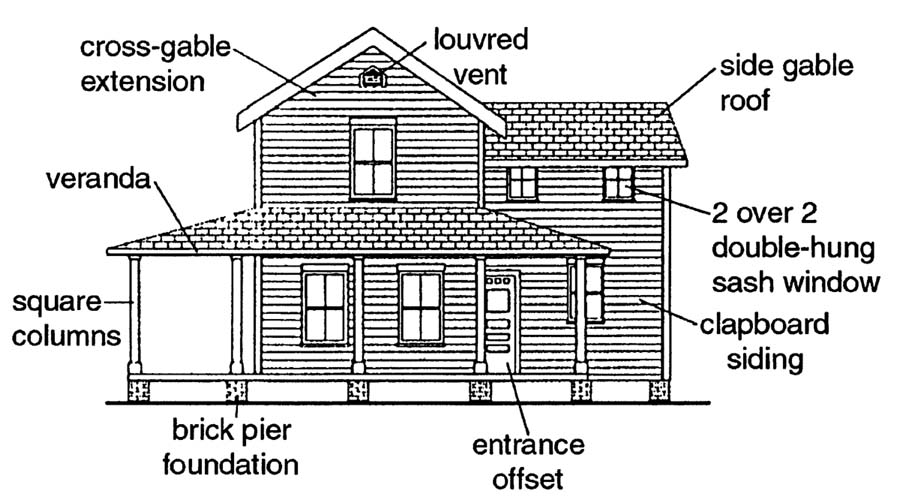
1.
Plan
• Rectangular and L-shaped building plans, although some buildings have irregular plans.
• Buildings range from one to two-and-one-half stories.
2.
Foundation
• Brick or concrete block pier foundation.
• Spaces between piers left open to allow for ventilation and for protection from high water.
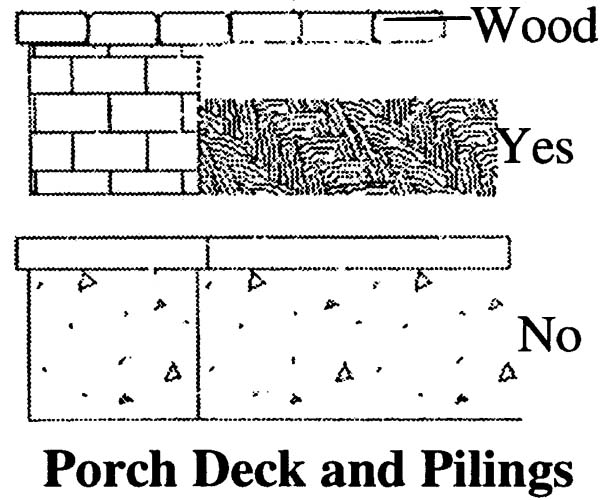
3.
Porches and facades
• Most common are simple entrance or end porches.
• Columns typically narrow and made of wood; usually spaced evenly across the façade, with few details.
• In most cases, porches were built without railings.
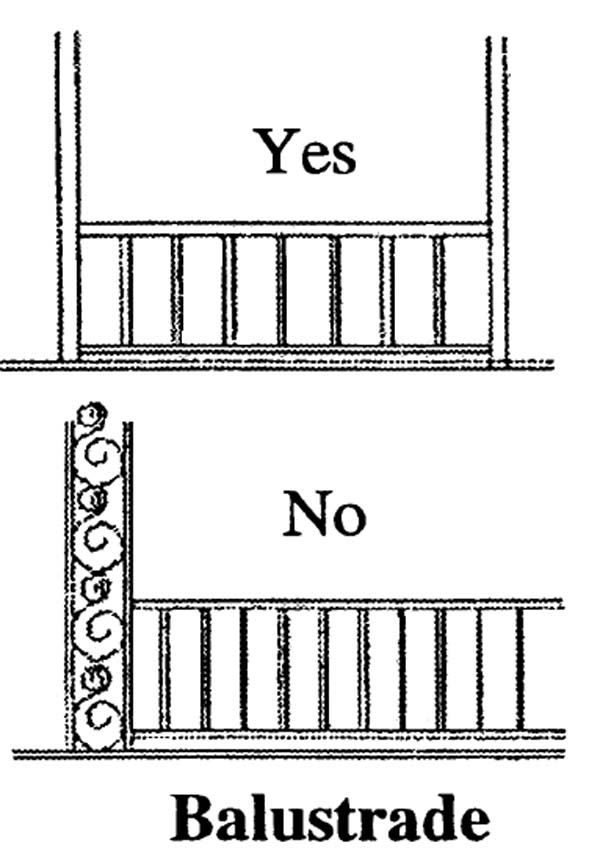
4.
Roof
• Earlier period homes have steep pitches, to accommodate attic space.
• Later period homes have a lowered roof pitch.
• Rafter ends are unadorned, exposed, and extend beyond the face of the wall.
• Wood shingles were often used to cover the roofs in early homes.
• Metal shingles or metal sheets were used on later period structures, or as a replacement roof material.
5.
Exterior material. Primary exterior material is horizontal wood siding; less common are wood shingles and board and batten.
6.
Windows and doors
• Generally, double-hung sash windows made of wood.
• Windows are spaced evenly along all facades.
• Windows are either single-pane, two- or four-pane.
• Doors contain recessed wood panels.
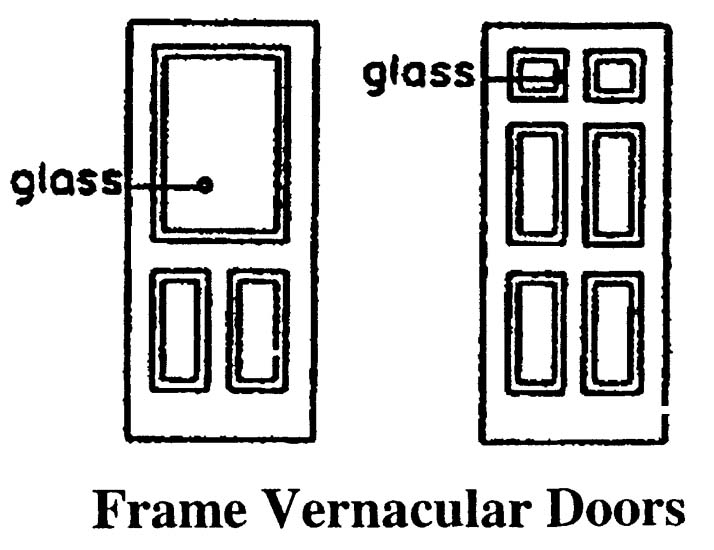
7.
Color. Colors range in the pastel family from light whites, yellows and grays to light pastel colors.
8.
Exterior decoration sparse, limited to ornamental woodwork.
9.
Local examples.
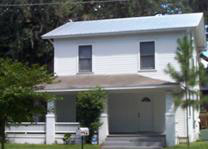
B.
Masonry vernacular.
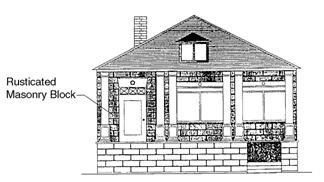
1.
Plan. Rectangular and L-shaped building plans.
2.
Foundation. Foundation is usually a continuous slab, brick or concrete.
3.
Porches and facades. Buildings range from one to two stories.
4.
Roof.
• Gable or hip roofs.
• Pitched roof surfaces are covered with composition shingles, diamond composition shingles, metal, or wood shakes.
• Chimneys are coquina or brick and may be finished with stucco.
5.
Exterior. The primary exterior materials used are brick with common or running bond; stucco with rough texture; or concrete block with rusticated rock-face.
6.
Windows and doors.
• Fixed multi-pane, double-hung sash six over six, three over one, two over two or one over one (6/6, 3/1, 2/2 or 1/1).
• Transoms, fanlights and attic louvers are common.
• Jalousie windows, French doors and simple balconies are used occasionally.
7.
Color. Colors range in the stucco-colored pastel family from light yellows, oranges, browns and grays.
8.
Exterior decoration. Detailing is simple, usually consisting of cast concrete or ornamental brick corbels.
9.
Local example.
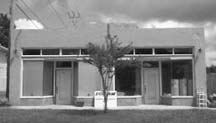
C.
Craftsman bungalow.
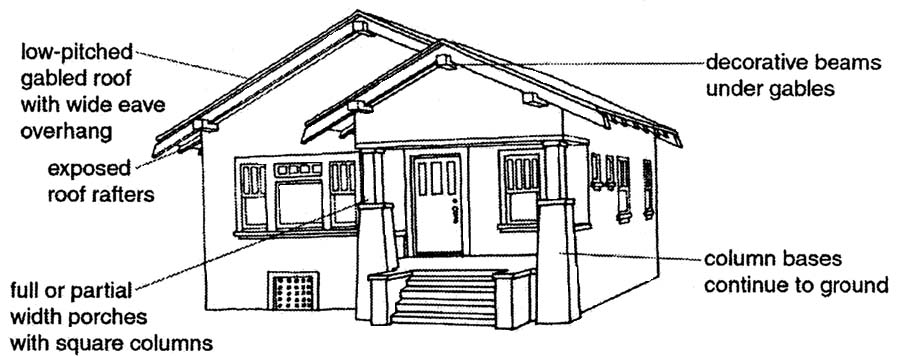
1.
Plan.
• Usually rectangular.
• One or one-and-a-half story.
2.
Foundation.
• Masonry (often brick) piers.
• Spaces between piers left open for ventilation and for protection from high water.
3.
Porches and facades.
• Porches are often the most prominent architectural feature of the house.
• Porches are attached to the main façade and sometimes wrapped around the side.
• Porches are wide enough to feel like an outside room.
• Porches dominated by short, oversized tapered or square columns which rest on massive masonry piers.
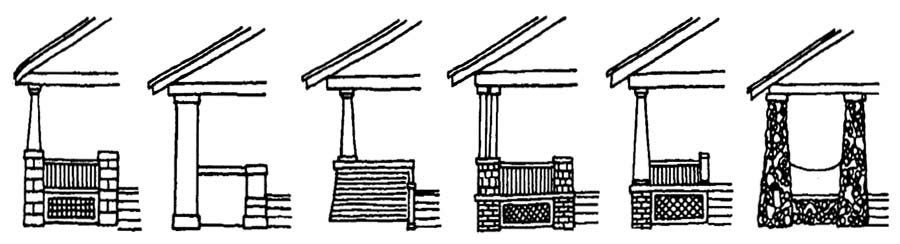
• Columns are made of wood, concrete, or masonry.
• Railings and balusters are occasionally used.
4.
Roof.
• Low-pitched.
• Four types of roofs associated with bungalow:
• Hip roof over one-and-a-half story, with a low dormer on the main facade;
• One or more gables perpendicular to the street, with one being the most dominant, usually above the porch;
• Gable parallel to the street with cross gable intersecting; cross gable typically covers the front porch and entrance to the building; and
• Large one-and-a-half story home with a gable parallel to the street and incorporating a dormer.
• Rafter ends extend beyond the face of the wall, often decoratively cut.
• May be wood, composition, or metal shingles, or crimped metal panels.
• Chimneys are typically brick, with simple decorative caps.
5.
Exterior.
• Wood siding and clapboard are the most common exterior wall surface materials.
• Different siding on the first and second floors—wooden clapboards on the first floor and wooden shingles on the second—although only one material is also common.
6.
Windows and doors.
• Wood windows, either double-hung or casement sash.
• Windows often grouped in clusters of two or three windows.
• Windows can be single-pane, two-pane or four-pane; the upper sashes may be multiple-pane with the lower sashes single pane.
• Simple doors, often with panes of glass.
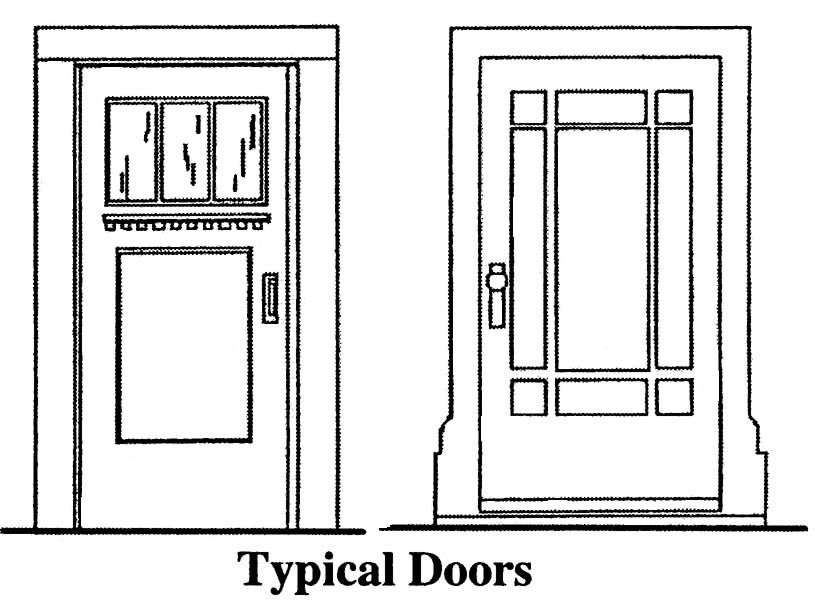
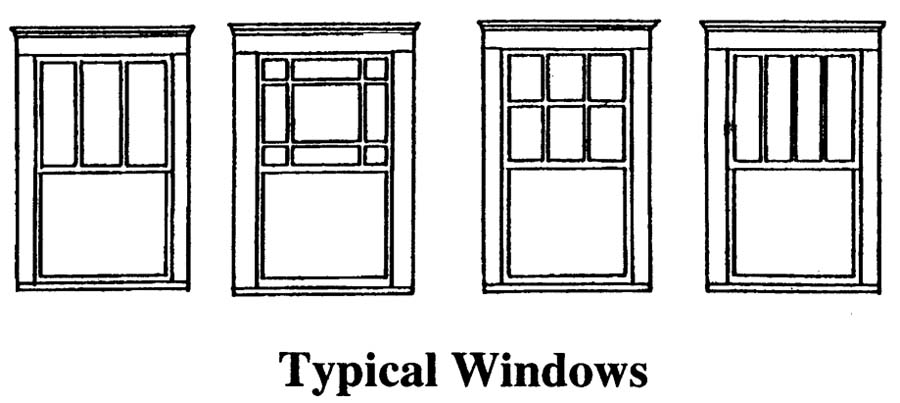
7.
Color.
• Houses with different siding materials often received two different paint colors. These houses usually have natural colors such as earth-browns, moss greens, sand yellows, and terra cotta reds. The body of the house is often unpainted with stained shingles in brown or red. These colors were less saturated and earthier than Victorian-era colors.
• While trim colors were used to bring out architectural details, they were chosen to complement the overall color scheme rather than to emphasize specific architectural elements. Trim colors were often white, light yellow, gray and light green. Doors were left unpainted and were varnished.
8.
Exterior decoration.
• Great degree of ornamentation, but the ornament was used to emphasize the structure and construction of the building rather than to adorn for the sake of adornment.
• Carved rafter ends.
• Decorative gable end trim.
• Window surrounds.
• Column base and capitals.
9.
Local examples.
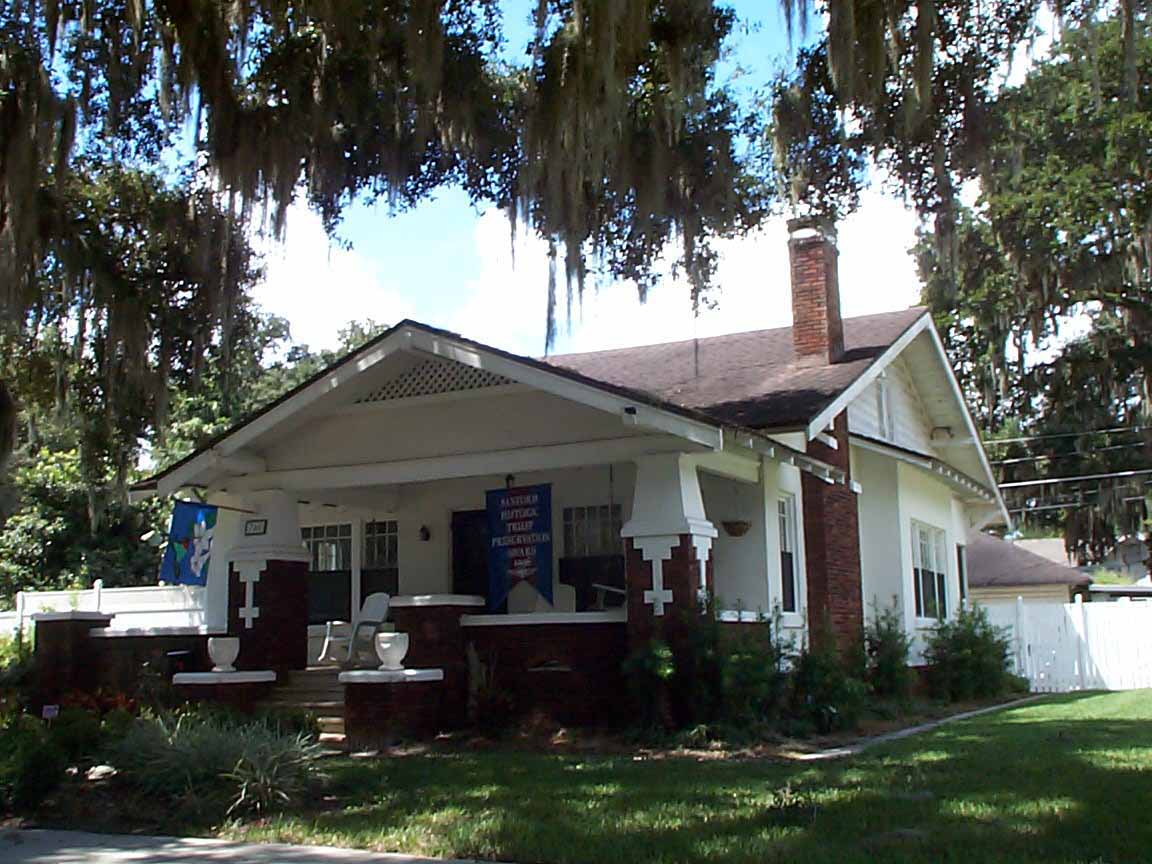
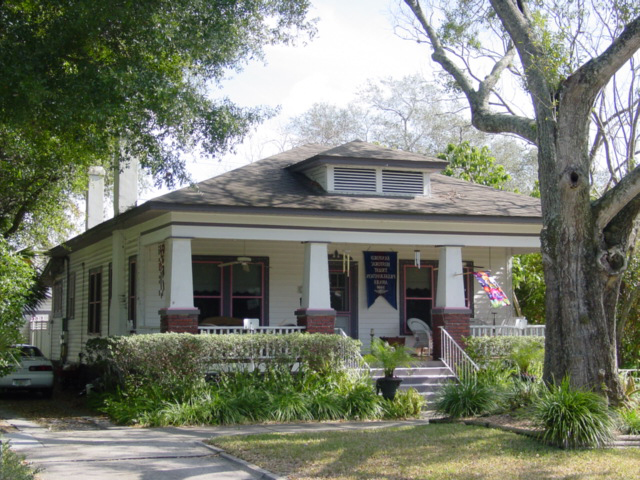
D.
Queen Anne.
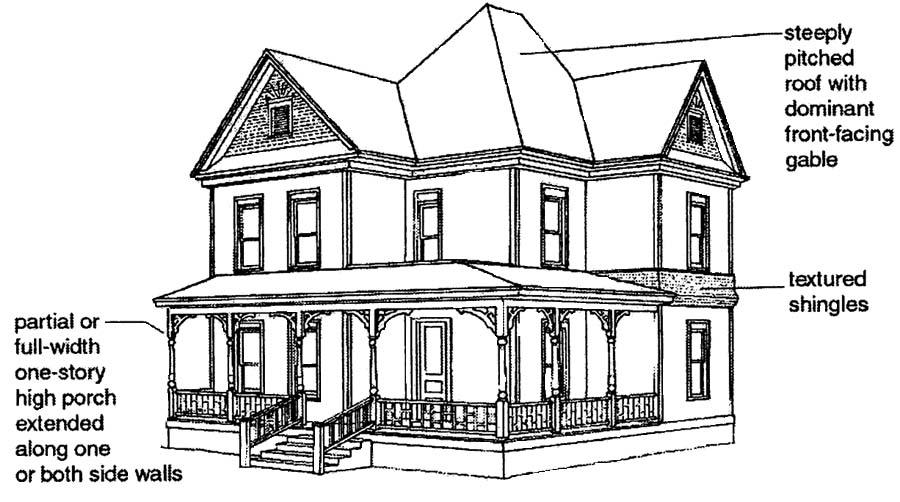
1.
Plan.
• Two to three-and-a-half stories.
• Rambling, asymmetrical plan.
• Vertical orientation.
• Irregular massing of the building and forms.
2.
Foundation.
• Simple brick piers; concrete piers used at later times.
• Spaces between piers left open to allow for ventilation and for protection from high water.
3.
Porches and facades.
• Porches usually one story high. Sometimes small second floor balconies and porches are present.
• Partial or full-width across the front of the home; may wrap either one or both sides of the building.
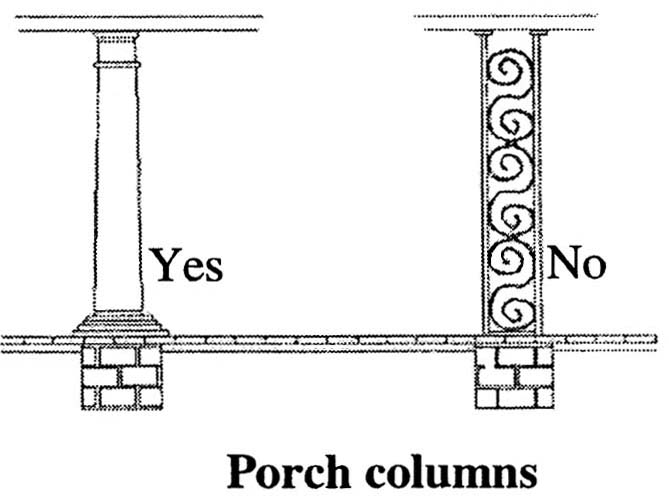
• Porch is intended to accentuate the characteristic asymmetrical façade.
• Main entrance always included in the porch area.
• Simple, classical columns sometimes grouped and raised to the railing level with pedestals.
• Simple railings; occasionally, turned spindles.
4.
Roof.
• Most common form is steeply-pitched main hipped roof with one or more lower cross gables; occasionally a pyramidal roof with no ridge, or a small flat deck crowning the main hip roof.
• Polygonal towers typically placed at one corner of the front façade, with a conical roof.
• Multiple dormers and gables.
• Metal or composition shingles.
• Brick chimneys with decorative patterns or coursing, decorated chimney caps.
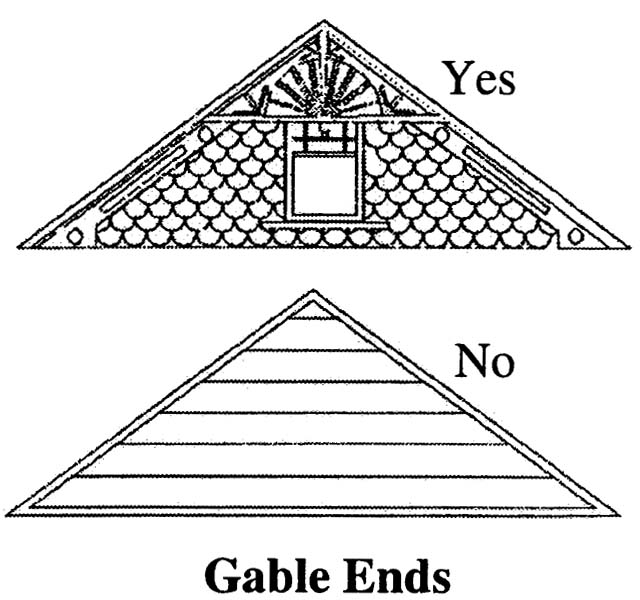
5.
Exterior.
• Horizontal wood siding is most common.
• May combine several types of siding materials (shingles, clapboard, and decorative wood panels) on one house.
6.
Windows and doors.
• Typically, double-hung wood sash windows with single and divided panes.
• Windows may be a mixture of sizes and shapes.
• Queen Anne window, consisting of a single large pane surrounded by smaller rectangular panes.
• Decorative glass, such as diamond-shaped panes or stained glass, is common.
• Windows are detailed with simple moldings.
• Doors have decorative carvings and details often with glass panes in the upper part of the door.
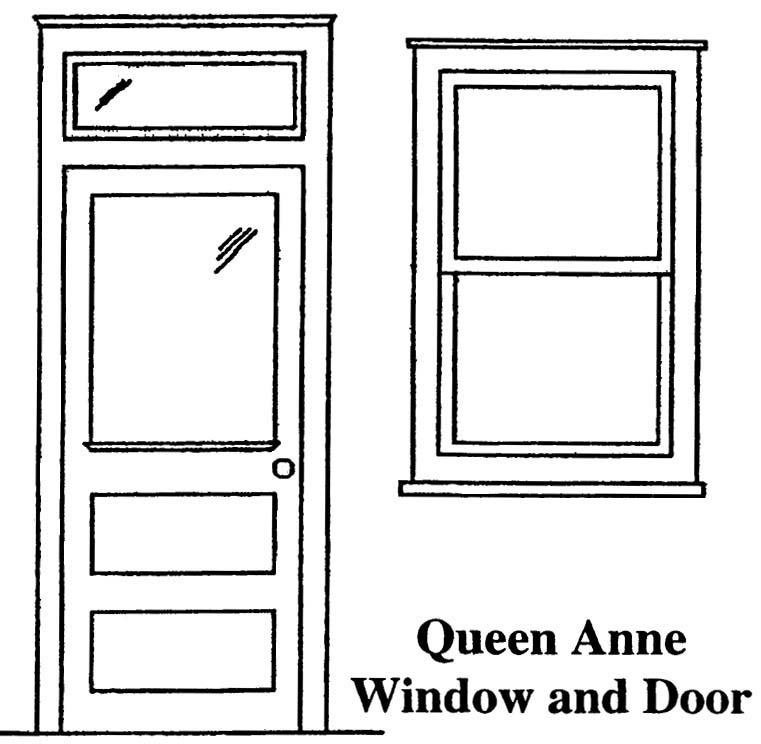
7.
Exterior decoration.
• Eclecticism is the keynote of the Queen Anne style.
• Varied and decoratively rich, with picturesque and asymmetrical silhouettes shaped by turrets, towers, gables and bays.
• Decorative shingle patterns in the gable ends.
• Decorative bargeboards.
• Sunburst detailing.
• Triangular pediments.
• Iron roof cresting.
8.
Color.
• Rich, intense and fairly strong, and contrasting colors were used to bring out different architectural elements. Deep browns, saturated olives, yellow ochres and rich brick reds were color choices for the Victorian era.
• The body of the building often would be medium gray, dark red, dark blue, dark green or brown. While not brilliant, these colors were highly saturated and created a sumptuous, rich palette.
• Architectural elements such as window sashes, trim and carved ornaments are painted in contrasting colors - either darker or lighter - to draw attention to them. These colors for trim were often dark gray, dark brown, olive green, or dark red.
• Because the roof is often very visible in Victorian buildings, shingle colors and patterns shall likewise be taken into consideration in selecting a palette.
• Doors were usually left unpainted, or were varnished or grained.
9.
Local examples.
E.
Classical revival.
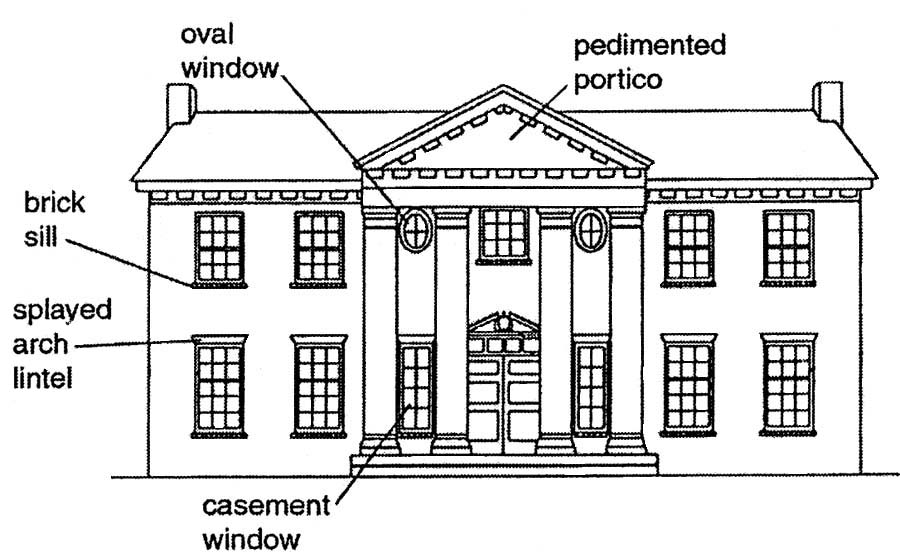
1.
Plan.
• Based on Greek and Roman architectural orders.
• Plan is regular, rectangular or nearly square.
2.
Foundation.
• The foundation is usually of piers or continuous, made of brick or concrete.
• Usually tall foundations, which exaggerate the height of the front façade.
3.
Porches and facades.
• The doorway, cornice line and type of column are the three principal distinguishing features.
• Entry porch dominates the front façade and normally equals it in height.
• Porch roof usually supported by four simple columns (Roman Doric or Tuscan types), each with a shallow square base.
• Columns support a prominent centered gable.
• Semi-circular or elliptical fanlight normally occurs above the paneled front door.
• One or two stories, simple rectilinear houses with side-gable or low-pitched hipped roofs, having the characteristic full-height entry porch.
• Occasionally the front porch is recessed inward.
4.
Roof.
Front or side-gable or low-pitched hipped roofs.
5.
Exterior.
• Wall materials may be either wood, brick, stucco, or stone, in order of decreasing frequency.
• The primary exterior material is usually horizontal wood siding or smooth masonry.
6.
Windows and doors.
• Double-hung sash windows aligned horizontally and vertically in symmetrical rows, usually five ranked on front façade, less commonly three ranked or seven ranked.
• Prominent fanlight over the front door.
• Fixed upper sashes and movable lower sashes, the later held open originally by metal pins.
• Windows frequently arranged with 9 panes (9/9), although other combinations were also found (9/6, 6/9).
• Windows sometimes have elaborate decorative crowns placed above them—cornice mold or decorative frieze. Full-scale pediments are uncommon.
• Wooden frames.
7.
Exterior decoration.
• The exterior detailing is usually classically derived full-facade height ionic columns.
8.
Color.
• Usually white, pale yellow, or pale stone gray in the body of the building.
• Trim color is usually white-yellowish, or off-white, not our modern stark white-and shutters are dark green or black.
• Ornament color is usually cream or warm white.
9.
Local example.
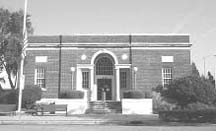
F.
Colonial revival.
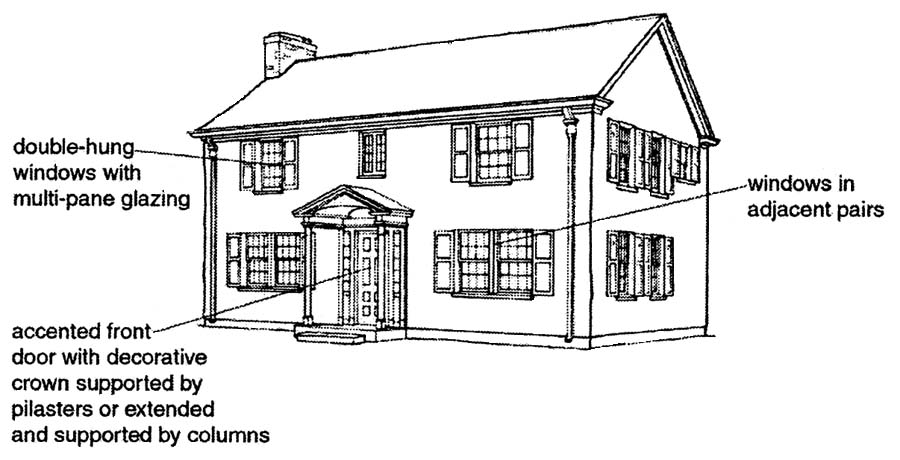
1.
Plan.
• Plan is regular, rectangular or nearly square.
• Height is two to two and one-half stories.
• Entrance stairs typically centered on the main façade.
2.
Foundation.
• The foundation is usually of brick piers or continuous brick. Concrete piers used at later times.
• Spaces between piers left open to allow for ventilation and for protection from high water.
3.
Porches and facades.
• Based on the marble architecture of Greece and Rome.
• May be portico/simple entry porches, or may stretch the length of the building.
• May have a porch on the rear.
• Simple, classical columns spaced evenly across the front façade.
• Simple railings and balusters, when present.
• Symmetrical façade.
4.
Roof.
• Gable, hip or gambrel roof.
• Roof over porch is typically shed or low-sloped hip roof.
• Dormers with hip, gable or shed roofs are a defining characteristic.
• Rafter ends are typically exposed and decoratively cut.
• Composition shingles are the most often used; occasional metal roof coverings.
• Chimneys are brick with simple coursing, shoulder and corbel details.
5.
Exterior. The primary exterior material is usually horizontal wood siding or shingles.
6.
Windows and doors.
• Paired double-hung wood sash windows with six over six (6/6) or two over two (2/2) divided panes; occasionally the upper sash is divided while the lower is a single pane.
• Windows are detailed with simple molding.
• Windows sometimes framed by wooden or wrought iron grills.
Window
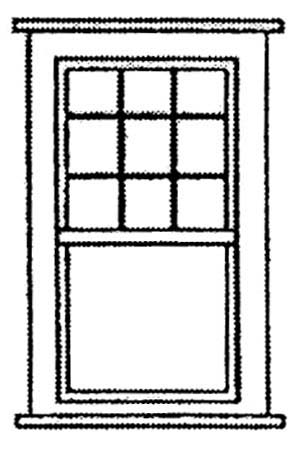
• Doors often flanked by fixed glass sidelights, surrounded by simple classical trim.
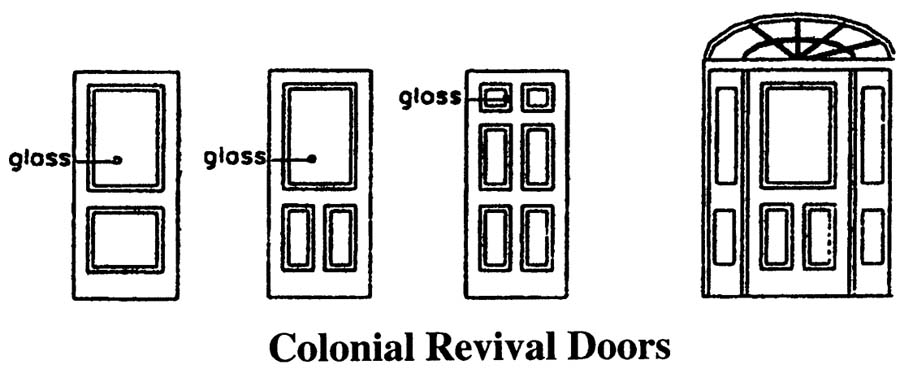
7.
Exterior decoration.
• The exterior detailing is usually classically derived columns, pediments, broken pediments and wood shutters.
8.
Color.
• Usually white, pale yellow, tan, or pale stone gray in the body of the building.
• Trim color is usually white-yellowish, or off-white, not our modern stark white-and shutters are dark green or black.
• Doors were usually left unpainted, or were varnished or grained—olive green.
9.
Local examples.
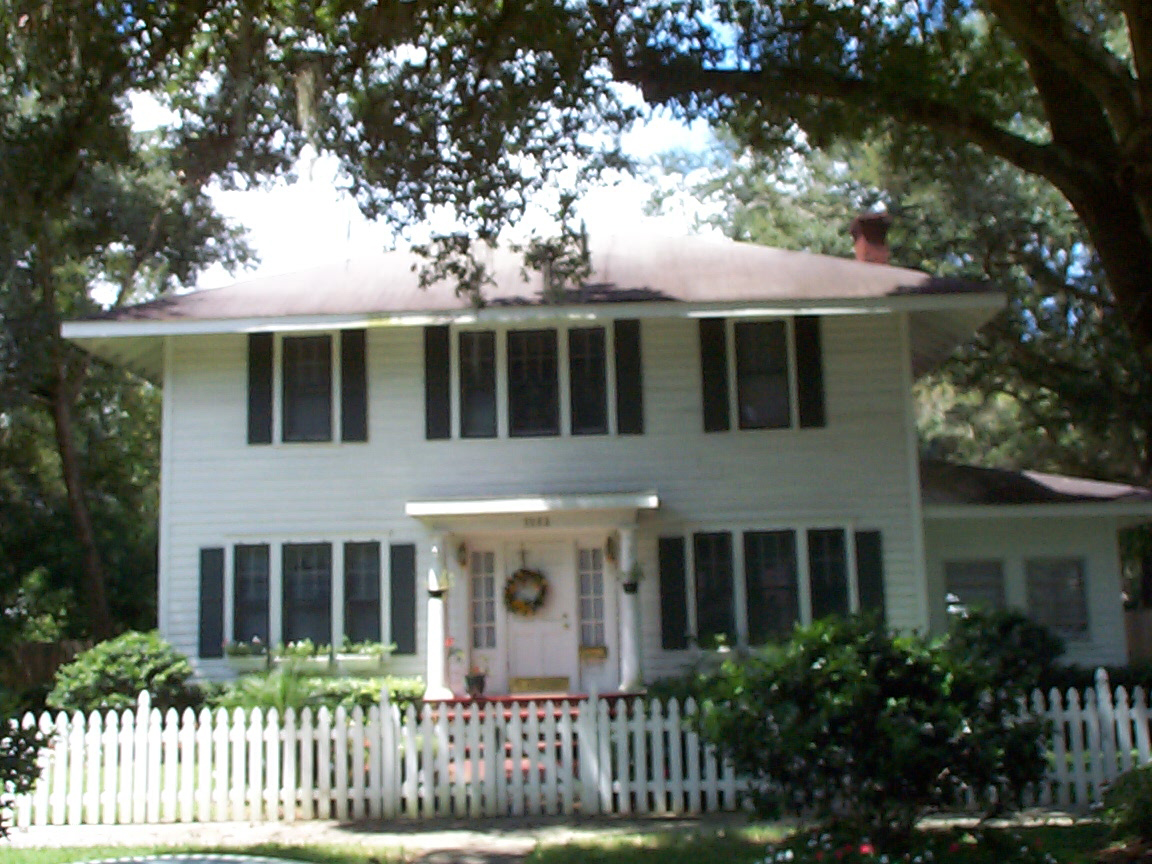
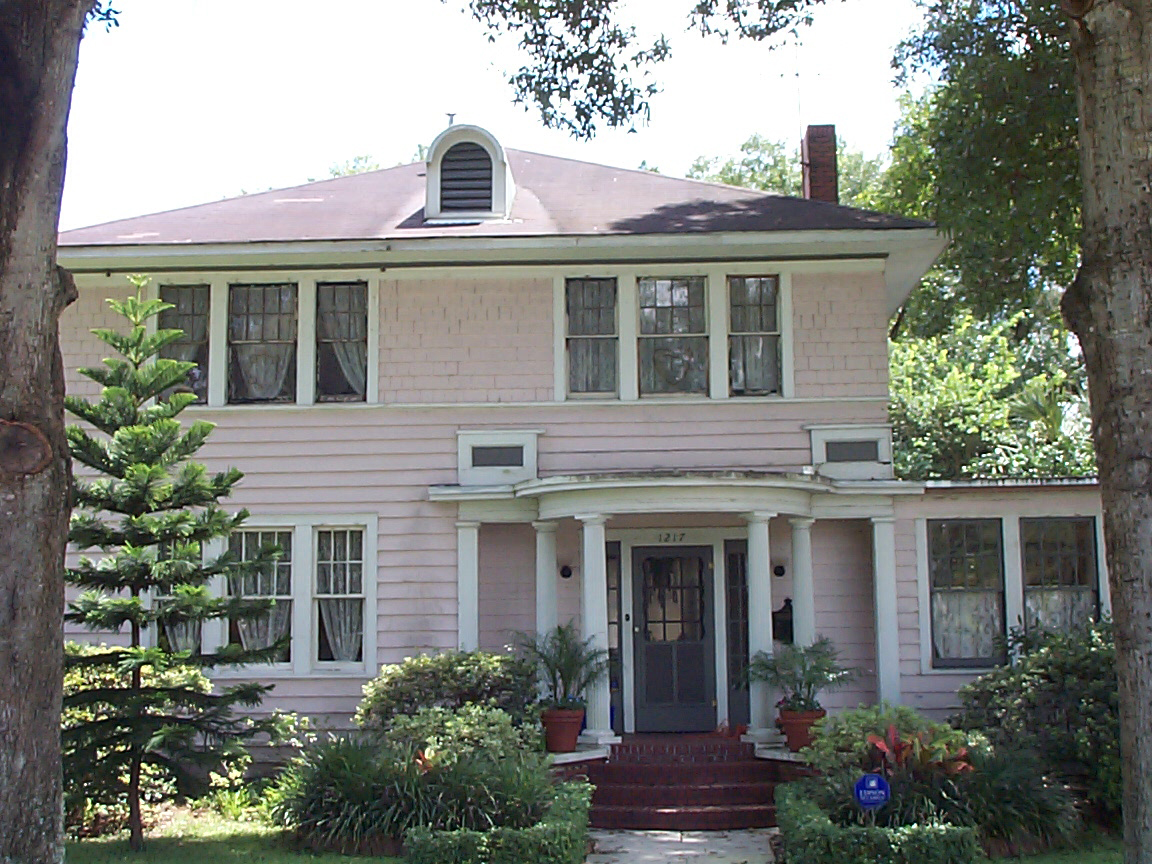
G.
Spanish Colonial Revival (Spanish Eclectic).
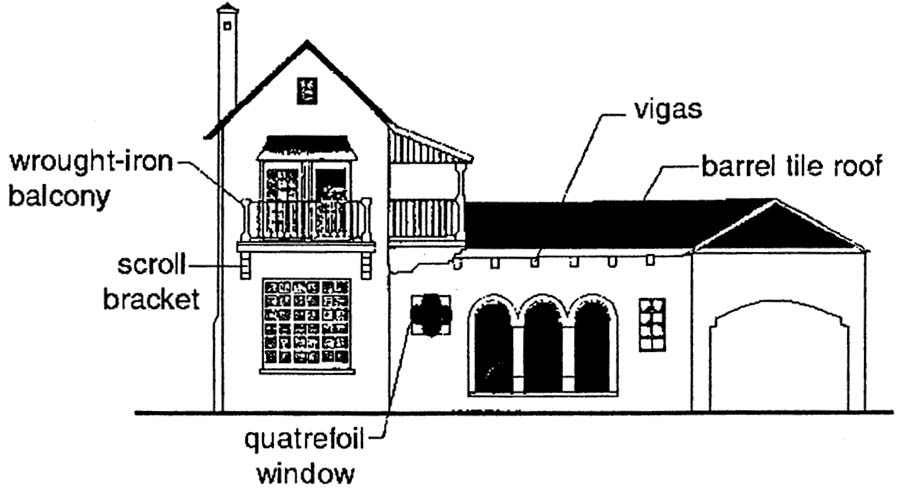
1.
Plan.
• Rectangular, L-shape.
• Partially enclosed patios and gardens/courtyards.
2.
Foundation.
• Masonry; not exposed.
3.
Porches and facades.
• One and two stories are both common, as are wings of differing heights.
• Typically one or more prominent arches placed above door or principal window, or beneath porch roof.
• Façade normally asymmetrical.
• Tile-roofed chimney tops.
• Overhanging balconies.
4.
Roof.
• Red clay barrel tile (half-cylinders) or Spanish tile (S-curve shape).
• Low pitched roof, usually with no eave overhang.
• Side gable, cross-gabled, combination hipped-and-gabled, hipped and flat roof.
• Multi-level roofs.
• Narrow, tile-covered shed roofs are typically added to flat roof structures. These are placed above entryways or projecting windows.
5.
Exterior.
• Wall surface usually stucco; textured stucco.
• Wrought iron work on balconies.
• Arcades, usually leading to a rear garden.
• Sometimes exterior stairs.
6.
Windows and doors.
• Dramatically carved doors.
• Doors usually emphasized by adjacent spiral columns, pilasters, carved stonework, or patterned tiles. Less elaborate entrance doors of heavy wood panels, sometimes arched above, are also common.
• Doors leading to the exterior gardens, patios, and balconies are usually paired and glazed with multiple panes of rectangular glass.
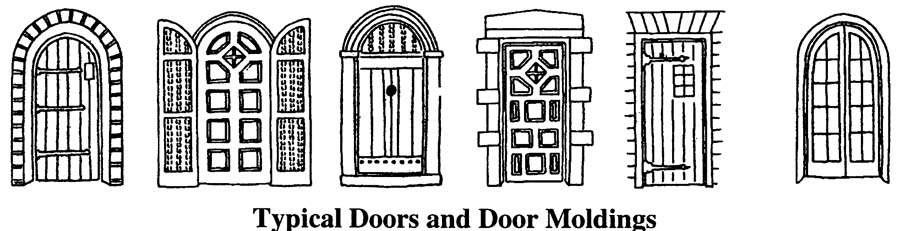
• Many examples have at least one large focal window. Commonly-tripled arched or parabolic in shape and may be filled with stained glass of varying design.
• Decorative window grilles of wood or iron are common, as are similar balustrades on cantilevered balconies, which occur in a variety of shapes and sizes.
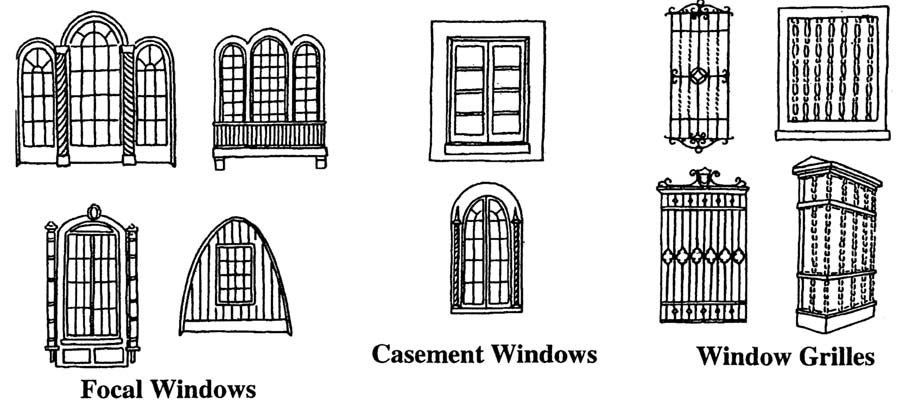
7.
Exterior decoration.
• Decorative details borrowed from the entire history of Spanish architecture (Moorish, Byzantine, Gothic, or Renaissance inspiration).
• Decorative brick or tile vents and rondels.
• Decorative iron sconces, door knockers, etc.
• Fountains.
• Decorative pavers.
8.
Color.
• Range in the pastel family from light pinks and oranges to deep browns and terra-cottas.
9.
Local example.
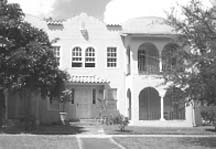
H.
Mission style. Associated with a wide variety of buildings including churches, train stations, government buildings, and private residences.
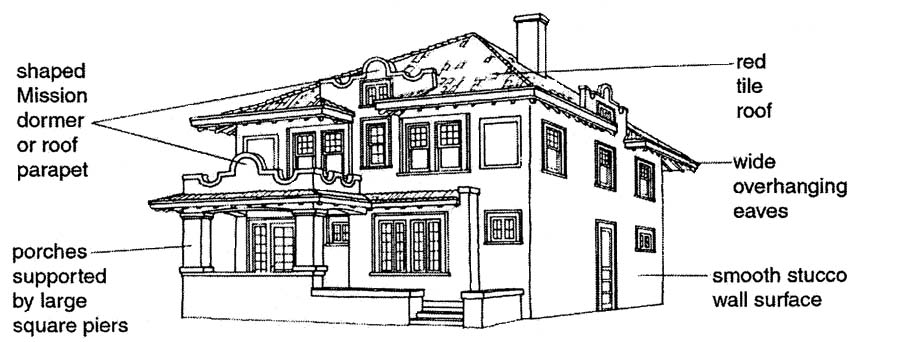
1.
Plan.
• Simple square or rectangular plans.
2.
Foundation. Masonry; not exposed.
3.
Porches and facades.
• Two types of façade:
• Symmetrical—Balanced, symmetrical facade; most commonly of simple square or rectangular plan with hipped roofs.
• Asymmetrical—The façade asymmetry is superimposed on a simple square or rectangular plan. Elaborate, rambling compound plans are found in some.
• Great variety of dormers and roof parapets.
• Prominent one-story porches either at the entry area or covering the full width of the facade; these sometimes have arched roof supports to simulate the arcades of Hispanic buildings.
4.
Roof.
• Some examples have unusual visor roofs. These are narrow, tiled roof segments cantilevered out from a smooth wall surface. They most commonly occur beneath the parapets of flat roofs.
• Open eaves are most common. However, boxed eaves also occur, usually with brackets below.
• Mission-like bell towers occur on a few cases.
5.
Exterior.
• Brick and stucco are the most common materials used. Very few Mission houses used stone.
• Shaped parapets.
• Arches.
• Smooth, flat wall surfaces.
6.
Windows and doors.
• Quatrefoil windows are common.
• Arched windows
7.
Color. Colors range in the pastel family from light whites, creams and yellows to grays and light pastel colors.
8.
Exterior decoration.
• Decorative detailing is generally absent, although patterned tiles, carved stonework, or other wall surface ornament is occasionally used.
9.
Local examples.
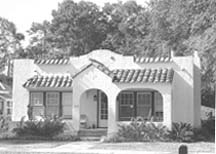
I.
Romanesque revival. Popular style for private homes only among the very wealthy, and was primarily confined to public buildings such as hospitals, jails and schools, and sometimes row houses.
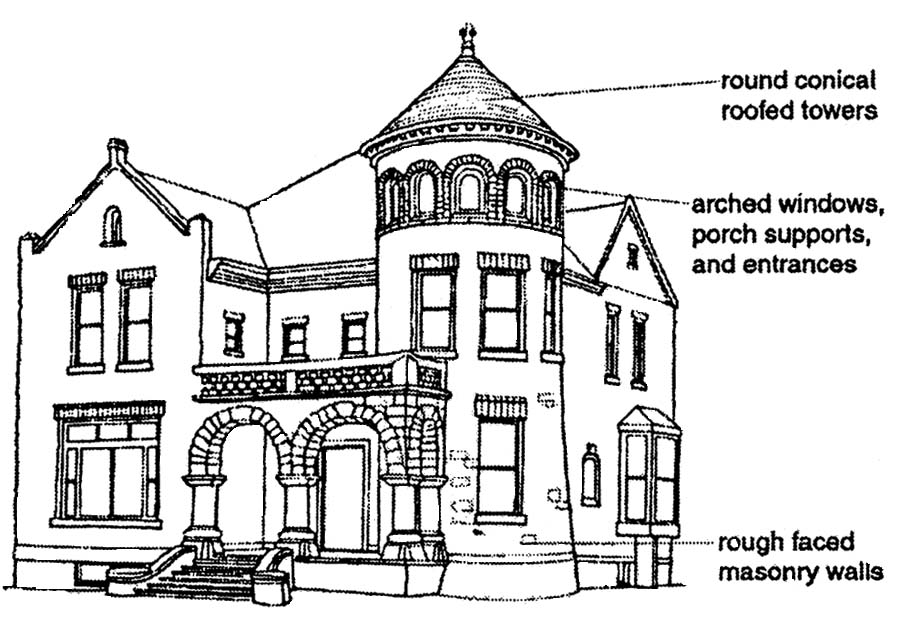
1.
Plan. Asymmetrical plan.
• Inspired by medieval French and Spanish Romanesque architecture.
2.
Foundation.
• Continuous foundation of stone or brick.
3.
Porches and facades.
• Asymmetrical façade.
• Most have towers that are normally round with conical roofs. Some have polygonal or squared towers.
• Wide, round-topped arches occurring over windows, porch supports, or entrance.
• Most commonly, the arches rest on squat columns, but some are supported on massive piers or are incorporated directly into wall surfaces.
• Column capitals and wall surfaces may be ornamented with floral or other decorative details.
• Monumental massive appearance.
4.
Roof.
• Hipped roofs with one or more lower cross gables. Most commonly there are two cross gables, one front facing and the other side-facing, each asymmetrically paced on its respective façade.
• Other common roofs include side-gabled, cross-gabled, mansard, and simple hipped roofs.
• Tower roofs are usually conical, but may be convex.
5.
Exterior.
• Masonry walls, usually with rough-faced, squared stonework.
• Frequently two or more colors or textures of stone or brick are combined to create decorative wall patterns.
6.
Windows and doors.
• Windows are usually deeply recessed into the masonry wall and have only a single pane of glass per sash.
• Arched windows, sometimes with small decorative columns (colonettes) on each side. Groupings of three or more arched or rectangular windows is common.
• Deeply recessed windows.
• Arched doors.
7.
Color.
• The primary exterior color and material is natural brick.
8.
Exterior decoration.
• Decorative plaques.
• Decorative flashing ridge on roof.
9.
Local example.
J.
Prairie style.
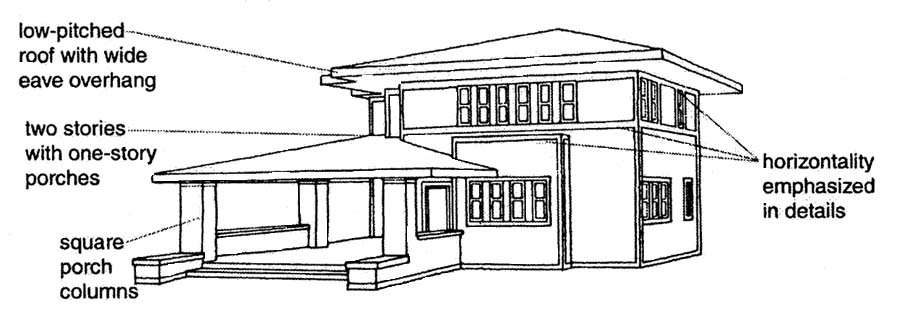
1.
Plan. Simple square or rectangular.
2.
Foundation.
• Continuous foundation of concrete or brick.
3.
Porches and facades.
• Two stories, with one story wings or porches.
• Horizontal decorative emphasis achieved by using contrasting caps on porch and balcony railings; contrasting wood trim between stories; horizontal board-and-batten siding; contrasting colors on eaves and cornice; and selective recessing of only the horizontal masonry joints.
• Eaves, cornices, and façade detailing emphasizing horizontal lines.
• Massive square or rectangular piers of masonry used to support porch roofs.
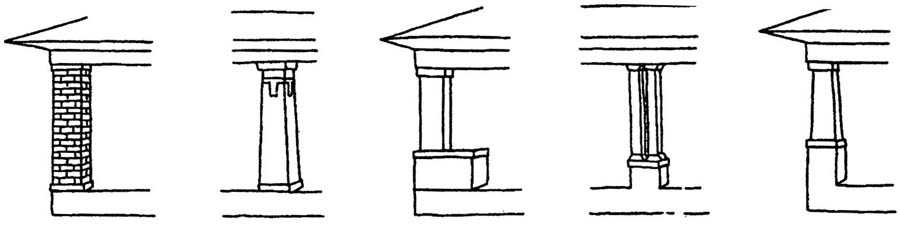
4.
Roof.
• Low-pitched roof, usually hipped, with widely overhanging eaves (peak sometimes projecting farther than the lower edges).
• Broad, flat chimneys.
5.
Exterior.
• Primary exterior material is exposed brick or stucco.
• Contrasting wall materials or trim emphasizing the upper part of the upper story.
• Horizontal patterns in wall materials.
6.
Windows and doors.
• Tall casement windows with geometric pattern of small-pane window glazing (in leaded casement windows, or upper sashes of wooden muntin, double-hung windows).
• Decorative friezes or door surrounds consisting of bands of carved geometric or stylized floral ornamentation.
• Horizontal rows of windows, sometimes wrapping around corners.
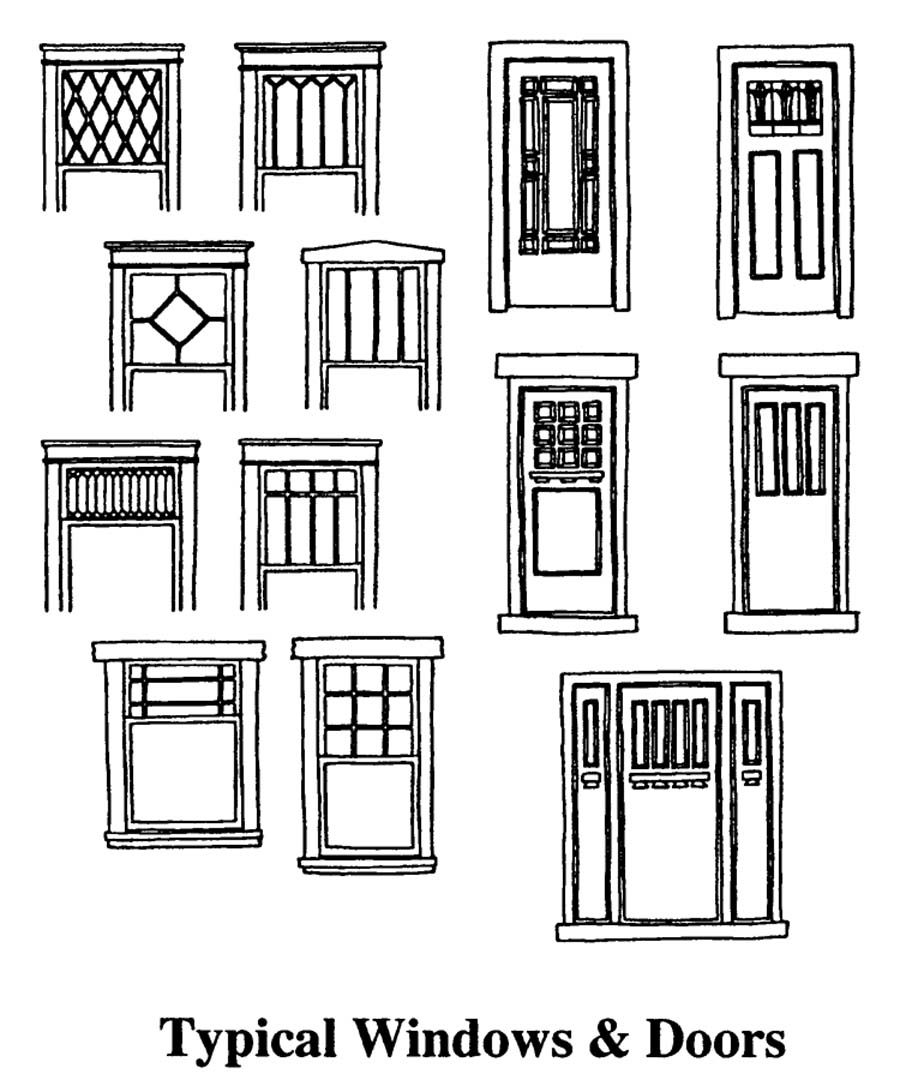
7.
Color.
• Colors are natural browns and tans. Brown was used for trims, and dark green for sashes.
8.
Exterior decoration.
• Window boxes or flattened pedestal urns for flowers.
9.
Local example.
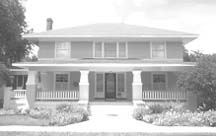
K.
Commercial.
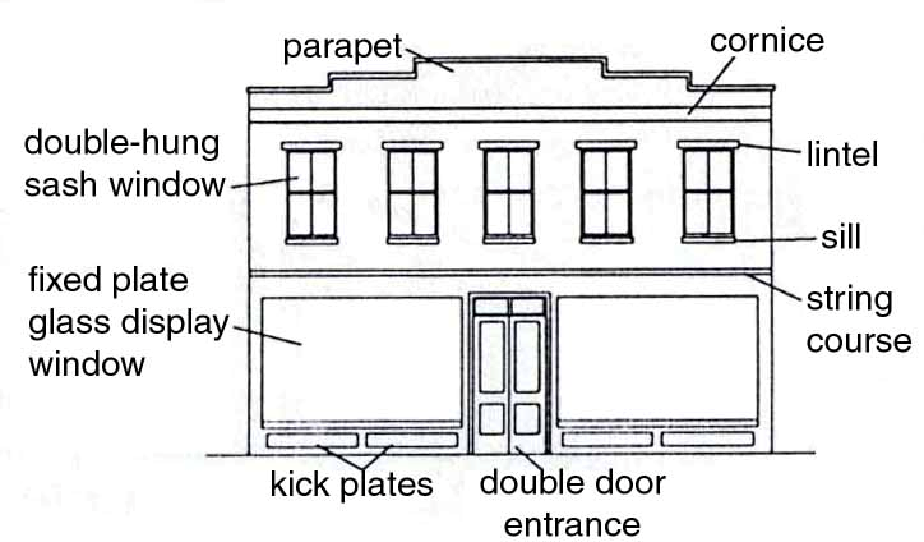
1.
Plan. Rectangular plan.
2.
Foundation. Continuous concrete slab or brick foundation.
3.
Façade.
• Narrow front elevation facing the main street, which is the focus of the design and provides the building's identifying features.
• One to two stories in height.
4.
Roof. Usually flat with parapet.
5.
Exterior. Primary exterior material is brick with common or running bond; rough textured stucco; or rusticated rock-faced concrete block.
6.
Windows and doors. Fixed plate glass display windows in the first floor, and double-hung sash windows in the second floor.
7.
Color. Colors are either exposed brick or painted brick with colors ranging from whites, reds, and pastels.
8.
Exterior decoration.
• Awnings, canopies.
• Cornice.
(Ord. No. 4588, § 1(a)(Exh.), 2-8-2021)
APPENDIX B
DOCUMENTATION REQUIREMENTS FOR BUILDINGS PROPOSED FOR DEMOLITION AND STANDARDS FOR
ARCHITECTURAL DOCUMENTATION PURPOSE
Documentation for historic buildings and structures which are proposed for demolition due to deterioration or the acquisition of a site for new purposes shall be fully and adequately provided in accordance with sound and generally accepted historic preservation and land use planning practices and principles. This documentation shall consist of dimensioned drawings, historical information, photographs and written data, which provides important information on a property's significance for use by scholars, researchers, historians, architects and others interested in preserving and understanding the past. Documentation shall be subject to approval by the Administrative Official and the procedures of the Land Development Regulations.
(Ord. No. 4588, § 1(a)(Exh.), 2-8-2021)
MAP S-1. SANFORD HISTORIC DISTRICTS
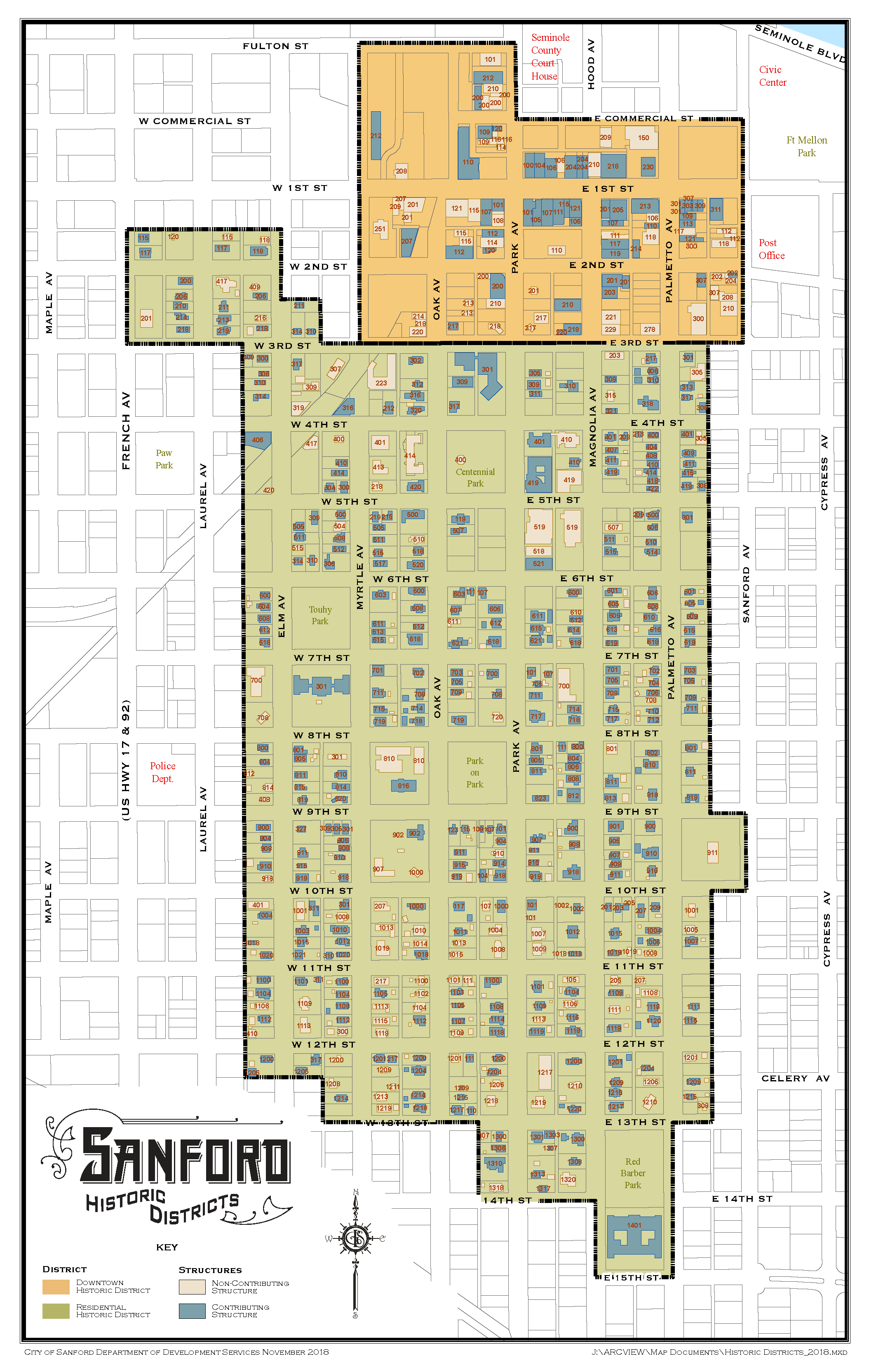
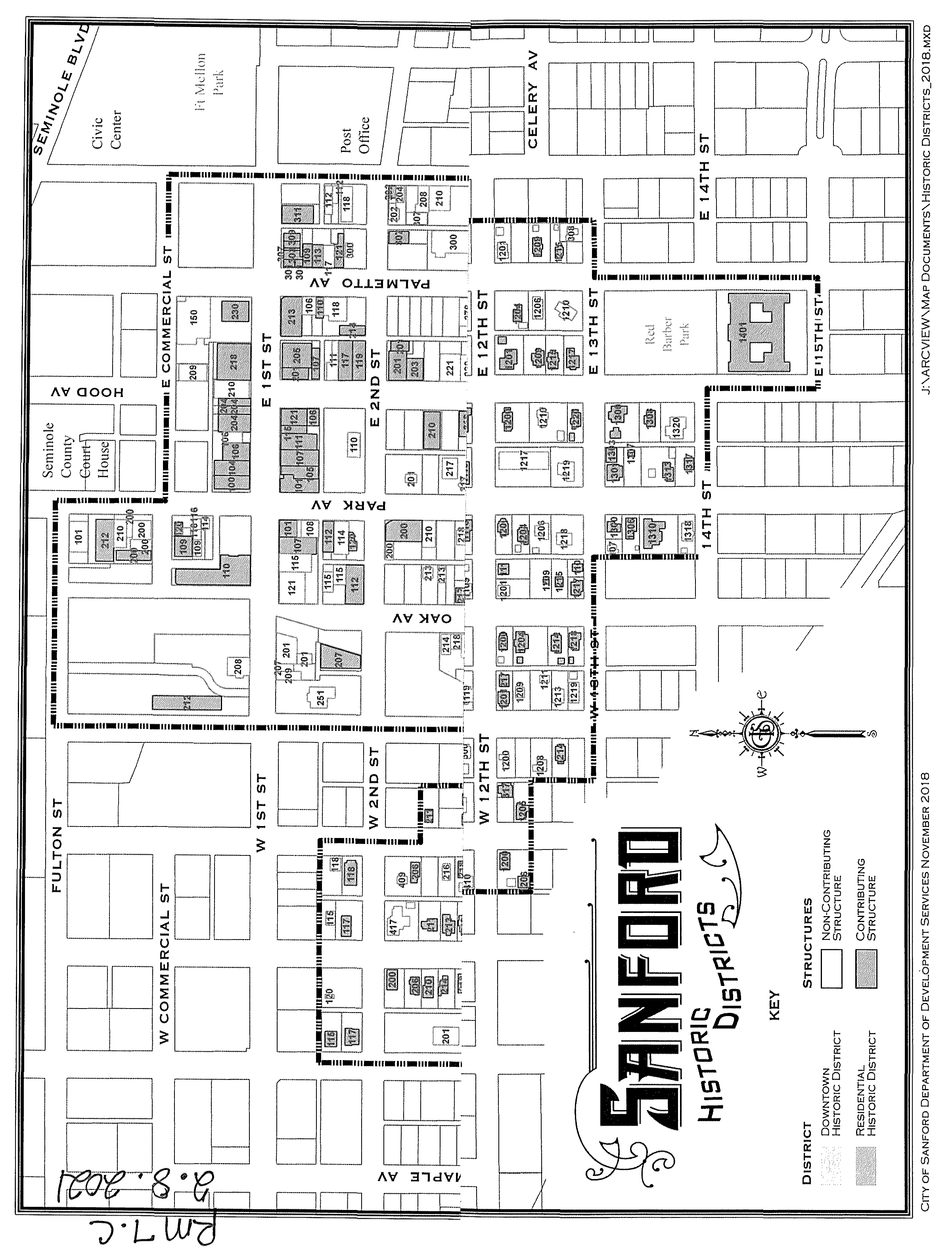
(Ord. No. 4588, § 1(a)(Exh.), 2-8-2021)

