
Sanford City Zoning Code
Schedule J
LANDSCAPE, BUFFER AND TREE REQUIREMENTS1
Legislative findings and intent.
(a)
The city staff report and city commission agenda memorandum relating to this matter are hereby adopted as if fully set forth herein and the provisions of section 1.0 of schedule "J" are hereby ratified and affirmed as well as supplemented by this section.
(b)
The economic benefits derived from trees include increased property values, and additional revenue generated by businesses, visitors and new residents attracted to the urban forest image of the city.
(c)
Trees are a major capital asset to the city and like any valuable asset they require appropriate care and protection.
(d)
The purposes of this schedule include:
(1)
Preserving and growing the City of Sanford's canopy cover by protecting landmark, native and specimen trees on specified areas of private property and expanding the protection of street trees and trees on public property.
(2)
Safeguarding the city's urban forest by providing for the regulation of the protection, planting, maintenance and removal of trees in the city.
(3)
Protecting the visual and aesthetic character of the city.
(4)
Improving and enhancing property values by conserving and adding to the distinctive and unique aesthetic character of the many areas of the City of Sanford such as in the historic districts of the city.
(5)
Improving the quality of life for residents, visitors and urban wildlife.
(6)
Creating favorable conditions for the protection of designated landmark, native and specimen trees, for the benefit of current and future residents of the City of Sanford.
(7)
Maintaining and enhancing the general health, safety and welfare of the city and its residents by assisting in counteracting air pollution and in minimizing soil erosion and other related environmental damage.
(8)
Protecting and maintaining healthy trees in the land use planning processes of the city.
(9)
Establishing procedures and practices for fulfilling the purposes of this schedule.
(Ord. No. 4363, § 2, 2-8-2016)
Editor's note— Ord. No. 4363, § 2, adopted Feb. 8, 2016, Schedule J in its entirety to read as herein set out. Former Schedule J pertained to similar subject matter. See the Code Comparative Table for complete derivation.
Section 1.0.- Purpose and intent.
Landscape, buffer and tree protection requirements serve many purposes in the built-up environment. Landscape provides visual and climatic relief from buildings, structures and broad expanses of pavement; landscape buffers pedestrian and vehicular traffic; trees provide shade, scenic beauty and natural habitat.
In general, landscaping and buffers shall be designed to:
(1)
Enhance the urban development by blending natural and manmade environments.
(2)
Provide shade for paved surfaces.
(3)
Separate vehicular and nonvehicular use areas.
(4)
Define vehicular accessways and access points.
(5)
Screen vehicular movement, noise and glare.
(6)
Provide visual and physical separation of potentially incompatible land uses.
(7)
Incorporate water conservation features such as drought tolerant landscaping and reclaimed water usage as required herein.
(8)
Protect the enjoyment of city parks and the aesthetics of city properties and rights-of-way.
(9)
Regulate, to the extent permitted by law, the activities of utility providers when conducting vegetation maintenance and tree pruning or trimming within the established right-of-way.
Landscape, landscaped areas, buffers and tree protection shall be provided and maintained and/or accomplished for all premises, of whatsoever type or nature, in the manner set forth in this schedule. Required landscaped areas shall be located at or above grade unless otherwise prescribed in these land development regulations. The minimum provision of required landscape, landscaped areas, buffers and trees may be exceeded. Unless otherwise prescribed, the most stringent provision of this schedule shall prevail.
(Ord. No. 4363, § 2, 2-8-2016)
Section 1.1. - Definitions: Landscape, buffers and tree protection.
The words or phrases defined below have special or limited meanings as used in this schedule and as used in this schedule shall mean:
Accent tree. A small tree with attractive flowers, berries, leaves or bark used in the forefront of a landscaped area to provide interest, emphasis or a focal point in the landscape.
Berm. Manmade earth contoured so as to form a mound above the general elevation of the adjacent ground or surface and designed to provide visual interest, screen undesirable view and/or decrease noise.
Buffer. A combination of physical space and vertical elements such as plants, berms, fences, or walls, whose purpose is to separate and screen incompatible land uses from one another.
Caliper. For the purposes of this schedule, caliper shall mean the diameter of a tree measured at breast height (dbh) which is four and one-half feet above the ground.
Canopy tree. Tall trees that form the uppermost leaf layer in a natural landscape as may be required by these regulations.
Clear trunk. The distance between the top of the root ball and the point of the trunk where lateral branching begins.
Commercial. All uses in RC-1, GC-2 and SC-3 zoning districts except one-family dwellings; nonresidential uses in PD zoning districts; all uses in RMOI zoning districts except one-family, two-family and multiple-family dwellings.
Common area. That area which will be maintained by a homeowners association, city service area, or other form of cooperative organization. For purposes of these regulations, "common area" does not include open space which cannot legally be disturbed.
Decorative turf. Turf used purely for ornamental purposes having no use other than aesthetics.
Diameter-at-breast-height (DBH) means the diameter of the tree 4½ feet above ground on the uphill side of the tree. A measuring tape can be used to measure tree trunk circumference and then the circumstance divided by 3.14 to determine diameter.
Drip line. The vertical line running through the outermost portion of the tree crown extending to the ground.
Fully shielded lighting. Lighting constructed in such a manner that all light emitted by the fixture, either directly from the lamp or a diffusing element, or indirectly by reflection or refraction from any part of the luminaire, is projected below the horizontal. Such fixtures usually have a flat, horizontally oriented lens and opaque (usually metal) sides. They are often described as "shoebox" luminaires if the luminaire has a predominantly rectangular form. Fixtures that either have reflecting surfaces or lenses (clear or prismatic) located below the lamp and visible from the side or above and fixtures that can be mounted such that the shielding is ineffective are not considered fully shielded lighting.
Hazard or hazardous means a tree, or part of a tree, that has a high potential for failure and falling on a nearby object because of dead or dying branches, roots or trunk.
Injure means any act or omission which substantially affects or seriously jeopardizes the health of a living tree.
Landmark tree means a tree designated as a landmark as a tree of historic or cultural significance and of importance to the community due to any of the following factors:
(1)
It is one of the largest or oldest trees of the species located in the city;
(2)
It has historical significance due to an association with a historic building, site, street, person or event; or
(3)
It is a defining landmark or significant outstanding feature of a neighborhood.
Groundcover. A low-growing plant, other than turfgrass, that, by the nature of its growth characteristics, completely covers the ground and does not usually exceed two feet in height.
Hatracking or topping. Pruning a tree in such a way that the majority of limbs are removed and the tree is left with only a trunk and the stumps of a few primary limbs, with little or no foliage or other trimming or pruning that has the effect of preventing a tree from attaining its natural height or/or shape.
Hedge. A row of evenly spaced shrubs planted to form a continuous unbroken visual screen.
Industrial. All uses in RI-1 and MI-2 zoning districts.
Landscape. Vegetative and inert materials including, but not limited to, grass, sod, shrubs, vines, hedges, trees, flowers, berms and complementary structural landscape architectural features such as rocks, fountains, sculpture, decorative walls and tree wells or other hardscape features.
Landscaped area. Land area to be provided and maintained with landscape.
Landscaped strip or landscaped island. Required landscaped areas containing ground cover, shrubs, trees and/or other landscape used to divide parking areas into individual bays.
Located or location of a tree means that place where any portion of the trunk of a tree is found at natural grade.
Maintain or maintenance means pruning, trimming, spraying, fertilizing, watering, treating for disease or injury or any other similar act which promotes growth, health, beauty and life of trees.
Mature tree means an otherwise non-protected tree with a diameter-at-breast-height (DBH) of six inches or greater.
Moisture sensing switch. A device which has the ability to shut off an automatic irrigation controller after receiving a determined amount of rainfall.
Mulch. Non-living organic materials such as wood chips that is customarily placed around the base of trees, shrubs and groundcovers for the purpose of retaining moisture and retarding weed infestation and soil erosion. Also used in pathways and play areas.
Multiple-family. Multiple-family dwellings in MR-1, MR-2, MR-3, RMOI and PD zoning districts; mobile homes in SR-2 and PD zoning districts.
Native or naturalizing plant species. Plant species native to the region or introduced which once established are capable of sustaining growth and reproduction under local climatic conditions, without supplemental watering.
Nonresidential. Pursuant to land use category headings reflected in Schedule B, Permitted Uses in these land development regulations, all commercial, transient lodging and entertainment, automotive, miscellaneous business and services, industrial and public/semi-public uses.
Parking area. A paved ground surface area used for the temporary parking and maneuvering of vehicles by employees, customers or residents providing an accessory service to a commercial, industrial, or residential use.
Paved ground surface area. Any paved area, excluding public rights-of-way, used for the purpose of driving, maneuvering, parking, storing or display of motor vehicles, boats, trailers, mobile-homes, and recreational vehicles including new and used automobile sales lots, other parking lot uses, and paved outdoor sales areas.
Pruning means the removal of dead, dying, diseased, live interfering, and weak branches according to the most recent standards of the International Society of Arboriculture. [2]
Poodle cut. Stripping off the lower branches of a tree and rounding or shearing the ends of the greenery to create an unnatural shape.
Required landscape. Any landscape required by this schedule.
Required landscaped area. Any landscaped area required by this schedule.
Residential. All uses in SR-1AA, SR-1A, SR-1, SR-2, MR-1, MR-2, MR-3 zoning districts; one-family, two-family and multiple-family dwellings in RMOI and PD zoning districts; one-family dwellings in AG zoning districts.
Setback. The minimum setback requirement for all structures.
Shrub. A self-supporting woody species of plant characterized by persistent stems and branches springing from the base.
Single-family. One-family dwellings in SR-1AA, SR-1A, SR-1 and PD zoning districts.
Specimen tree. A particularly fine or unusual example of any tree due to its age, size, rarity, environmental value or exceptional aesthetic quality. A tree may also be designated a specimen due to its association with historic events or persons. A specimen tree cannot be of a species that is unacceptable pursuant to section 5.2.
Tree. Any living, self-supporting, woody plant which normally grows to a minimum overall height of 15 feet and usually has a single trunk.
Turf. Upper layer of soil bound by grass and plant roots into a thick mat.
Vehicular circulation area. Streets, rights-of-way, accessways, parking spaces, parking, loading and unloading and other similar or related functions.
(Ord. No. 4363, § 2, 2-8-2016)
Through research, technology, and education, the International Society of Arboriculture (ISA) promotes the professional practice of arboriculture and fosters a greater worldwide awareness of the benefits of trees. The ISA was founded in 1924 when a group of 40 individuals, each engaged in a phase of tree work or research, were called together by the Connecticut Tree Protection Examining Board to discuss shade tree problems and their possible solutions. The ISA continues to be a dynamic medium through which arborists around the world share their experience and knowledge for the benefit of society.
Section 2.1. - Landscape requirements for residential uses.
Landscape shall be provided and maintained for all residential uses in the following manner:
A.
One- and two-family dwellings. At least one tree shall be located in the required front yard of each dwelling unit for one-family dwellings and two-family dwellings.
(Ord. No. 4363, § 2, 2-8-2016)
Section 2.2. - Off-street parking and vehicular circulation areas.
The following provisions and requirements shall apply to all off-street parking areas for automobiles and vehicular circulation areas:
A.
Required internal landscape area. The minimum required internal landscaped area for parking areas shall cover ten percent of the parking area.
1.
Minimum required land area for required landscaped areas. Each required landscaped area shall contain a minimum land area of 200 square feet.
2.
Required landscaped area for rows of parking spaces. A landscaped area shall be provided and maintained at each end of all rows of parking. In addition, at least one landscaped area shall be provided and maintained between every ten parking spaces, provided however, that when double (front-to-front) rows of parking spaces are utilized, each required landscaped area shall contain a minimum land area of 400 square feet. Length shall match that of the adjacent parking space. A 20-foot turning radius shall be accommodated at the end of parking rows.
B.
Required trees. At least one canopy tree shall be provided and maintained in each required landscaped area; provided, however, that two canopy trees shall be provided and maintained for each required landscaped area as prescribed in subsection A.2. The location of required trees in required landscaped areas shall be within an area that has a minimum radius of ten feet measured from the center of the tree trunk to the rear edge of the required landscaped area. Tree species shall be a type that has a natural growth height that corresponds to the size of the landscaped area as determined by the administrative official.
C.
Required shrubs. Each required landscaped area shall be provided and maintained with shrubs in the ratio of five shrubs per each tree required. All landscaped areas shall be covered in groundcover or turf.
D.
Parking space reduction to protect existing trees. The administrative official may reduce the required number of off-street parking spaces when such reduction would result in the preservation of existing trees which are a minimum of six inches in diameter measured at breast height above the ground provided that such reduction in the number of required parking spaces shall result in a reduction in an amount of less than five percent of the total number of required off-street parking spaces.
E.
Two or more parallel driving aisles. In situations where there are four or more rows of parking spaces, the city may require the use of landscaped strips a minimum of ten feet in width to be parallel to the subject driving aisles. In such areas, trees shall generally be spaced at intervals of 25 feet.
(Ord. No. 4363, § 2, 2-8-2016)
Section 2.3. - Landscape adjacent to streets and parcels.
A landscaped strip shall be provided along all parcel lines and abutting street right-of-way lines as required by the provisions of this schedule. The depth of the required landscaped strip shall be measured and provided parallel to the parcel line or abutting street right-of-way in question. Landscaped strips shall be considered to be required landscaped area. A landscaped strip may be included as fulfilling the buffer requirements for the premise in question. However, no part of a landscaped strip required for any use shall be included as fulfilling the landscape or buffer requirements for another use unless specifically provided for in this schedule. Landscaped strips shall be provided in the following manner:
A.
Arterials. Properties fronting on all roads classified as arterials, including, but not limited to, East Lake Mary Boulevard and the Airport Boulevard Extension, shall comply with the following standards:
1.
The developer/property owner shall be responsible for providing and maintaining a minimum 25-foot landscape buffer in the area abutting the designated roadway right-of-way lines. Landscape buffer width may be reduced to a minimum of 15 feet only if the lot is less than 200 feet deep.
2.
The landscape buffer area shall be planted with two rows of canopy trees, six-inch diameter at breast height (dbh) at planting. The trees shall be planted every 50 feet and staggered so as to be midway between each other, and equal distance between each row and right-of-way. A minimum of four sub-canopy trees per 100 feet of frontage shall be planted in and about each access point and intersection. Unless otherwise noted herein, all landscaping shall comply with this schedule.
B.
Collectors. A 15-foot wide landscaped strip shall be provided along all parcel lines abutting a street right-of-way classified as collector roadways in the Traffic Circulation Plan Element of the Comprehensive Plan. Required landscape shall be provided within the required landscaped strip as follows:
1.
Trees. One canopy tree shall be provided for every 30 to 40 linear feet of the parcel line. Tree spacing shall be determined by the administrative official based upon the type of species to be planted. Such trees shall be evenly spaced.
2.
Hedges. When off-street parking, loading, unloading and vehicular circulation areas are to be located adjacent to the street in question, a dense hedge of evergreen-type shrubs shall be provided in the following manner:
a.
At initial planting and installation, shrubs shall be at least 30 inches in height and shall be planted 30 inches or less on center. The hedge shall be planted four feet or more behind the tree trunks.
b.
Within one year of initial planting and installation, shrubs have attained and be maintained at a minimum height of four feet and shall provide an opaque vegetative screen between the street and the use of the premises or the property owner shall take such remedial action as is ordered by the city.
c.
In lieu of a vegetative hedge, the administrative official may approve the use of vegetated berms or other appropriate landscape materials in a manner that results in the visual separation of street right-of-way and the premises in question.
3.
Shrubs. If a hedge is not required, the buffer shall include nine shrubs for every 100 linear feet of parcel line in question. Shrubs shall be at least 30 inches in height at the time of planting.
4.
Groundcover. The buffer area shall be planted with groundcover. The groundcover shall completely cover the area within three months of installation.
C.
Other street right-of-way. A ten-foot wide landscaped strip shall be provided and maintained along all parcel lines abutting a street right-of-way other than streets prescribed in subsections 2.3.A and B. Required landscape shall be provided and maintained in the required landscaped strip as follows:
1.
Trees. One canopy tree shall be provided and maintained for every 30 to 40 linear feet of parcel line in question as determined by the administrative official based upon the type of tree. Such trees shall be evenly spaced.
2.
Hedges. When off-street parking, loading, unloading and vehicular use areas are to be located adjacent to a street, a dense hedge of evergreen-type shrubs shall be provided and maintained in the following manner:
a.
At initial planting and installation, shrubs shall be at least two feet in height and shall be separated by a distance of 30 inches on center. Shrubs shall be placed at least four feet behind the trees.
b.
Within one year of initial planting and installation, shrubs shall have attained and be maintained at a minimum height of three feet and shall provide an opaque vegetative hedge between the street and the use of the premises.
c.
In lieu of a vegetative hedge, the administrative official may approve the use of vegetated berms or other appropriate landscape materials in a manner that results in the visual separation of street right-of-way and the premises.
3.
Shrubs. If a hedge is not required, the buffer shall include nine shrubs for every 100 linear feet of parcel line in question. Shrubs shall be at least 30 inches in height at the time of planting.
4.
Groundcover. The buffer area shall be planted with groundcover. The groundcover shall completely cover the area within three months of installation.
D.
Other parcel lines. When off-street parking, loading, unloading and vehicular circulation areas are to be located adjacent to a parcel line other than parcel lines described in subsection A. or B., above, a ten-foot wide landscaped strip shall be provided and maintained along the parcel line. Landscape shall be provided and maintained in the landscaped strip as follows:
1.
Trees. One canopy tree shall be provided and maintained for every 30 to 40 linear feet of parcel line as determined by the administrative official based upon the type of tree. Such trees shall be evenly spaced.
2.
Hedge. A dense hedge of evergreen-type shrubs shall be provided and maintained in the following manner:
a.
At initial planting and installation, shrubs shall be at least two feet in height and shall be separated by a distance of 30 inches on center. Hedges shall be placed at least four feet behind trees.
b.
Within one year of initial planting and installation, shrubs shall have attained and be maintained at a minimum height of three feet and shall provide an opaque vegetative hedge.
c.
In lieu of a vegetative hedge, the administrative official may approve the use of vegetated berms or other appropriate landscape materials in a manner that results in the visual separation of the premises from the adjacent parcel.
E.
Required trees. When both buffer and landscaped strip requirements apply, required trees shall be provided. In addition, when a landscaped strip is included as fulfilling the buffer requirements for the premise, the more stringent requirements shall apply.
(Ord. No. 4363, § 2, 2-8-2016)
Section 2.4. - Reductions and exceptions to landscape requirements.
A.
Required landscaped strip, required landscaped area and required landscape. The planning and zoning commission may, upon appeal by an applicant or unless otherwise provided for, waive or reduce the required landscape provisions of this article where such requirements would be unreasonable and excessive due to the size of the parcel and/or the fact that the landscape requirement is not necessary due to the unique location and/or natural topographical or other physical character of the specific parcel in question and provided such reduction would not be detrimental to the adjacent parcel or parcels.
B.
One- and two-family dwellings exempted. This section shall not apply to one-family dwellings or two-family dwellings.
(Ord. No. 4363, § 2, 2-8-2016)
Section 2.5. - Credit for healthy existing trees and plant materials.
Healthy trees and shrubs existing on the premises may be credited toward meeting the requirements of this schedule provided however, that such tree or shrub is not listed as a restricted tree in this article. Trees shall be a minimum of four inches in caliper and 12 feet in height and shrubs shall be a minimum of three feet in height in order to be credited toward meeting the requirements of this schedule. Palm tree species may not be credited for more than 50 percent of the total tree requirement for the premises. A certified arborist shall determine the health of all trees proposed for credit. At the expense of the applicant seeking credit, the administrative official shall determine which trees shall receive credit in accordance with this section.
(Ord. No. 4363, § 2, 2-8-2016)
Section 2.6. - Foundation landscaping.
The following provisions shall apply to all building facades with frontage along a street right-of-way with the exception of zero lot line buildings:
A.
Required landscaped area. Excluding space necessary for ingress and egress, a minimum five-foot wide landscaped area shall be located along 100 percent of a building facade with frontage along a street right-of-way.
B.
Required trees. Within the required landscaped area there shall be at least two accent trees or three palms for every 40 linear feet of building facade.
C.
Required shrubs. Within the landscaped area there shall be a minimum of one shrub for every 20 square feet of required landscaped area. A minimum of 50 percent of the area shall contain shrubs with the remainder to be ground cover.
(Ord. No. 4363, § 2, 2-8-2016)
Section 2.7. - Comprehensive landscape program.
The landscape requirements of this schedule may be waived or modified as part of a site plan approval if the application includes a comprehensive landscape program which satisfies the following criteria:
A.
Architectural theme. The landscape in a comprehensive landscape program shall be designed as a part of the architectural theme of the principal buildings proposed or developed on the parcel proposed for development.
B.
Superior design. The design, character, location and/or materials of the landscape treatment proposed in the comprehensive landscape program shall be demonstrably more attractive than landscaping otherwise permitted on the parcel proposed for development under the minimum landscape standards.
(Ord. No. 4363, § 2, 2-8-2016)
Section 3.1. - General explanation of requirements.
Land use compatibility requirements shall apply along all parcel lines as required by the provisions of this schedule. Such requirements shall include three parts: 1) setback, 2) buffer and 3) visual screen. Unless otherwise provided for in this schedule, the buffer shall be located within the setback and the visual screen shall be located within the buffer.
(Ord. No. 4363, § 2, 2-8-2016)
Section 3.2. - Buffer.
A.
Location. A buffer shall be provided along all parcel lines and abutting street right-of-way lines as required by the provisions of this these land development regulations. The depth of the required buffer shall be measured and provided parallel to the parcel line or abutting street right-of-way in question. No part of a buffer required for any use shall be included as fulfilling the buffer requirements for another use unless specifically provided for in this schedule.
B.
Maintenance. The required buffer shall, unless otherwise provided for in this schedule, be planted and maintained in lawn or other landscaping materials including, but not limited to, flower beds, shrubs, hedges or trees, planted so as not to obscure the vision of vehicular traffic both on and off the premises. The required buffer shall be maintained in a healthy, growing condition which is neat and orderly in appearance and shall be kept free of refuse and debris.
C.
Uses in buffer. The following uses shall be permissible within a required buffer:
1.
Vehicular access to off-street parking, loading, unloading and service area space subject to the following provisions:
a.
All of the provisions of the schedule relating to vehicular access points to off-street parking, loading, unloading and service area space shall be complied with throughout the entire depth of the required buffer.
b.
All such vehicular access shall be required to be generally perpendicular to the street right-of-way line throughout the entire depth of the required buffer.
2.
Required project improvements.
3.
Permitted public service structures.
4.
Walkways with improved surfaces.
5.
Permitted signs.
6.
Required landscaped areas.
D.
Vehicular encroachment prohibited. All off-street parking and/or loading, unloading and service areas and all other vehicular circulation areas shall be located, designed and arranged so as not to encroach upon any required buffer. In addition, all off-street parking spaces located adjacent to a required buffer shall be provided with appropriate tire stops, curbs, or other vehicular bumper guards designed to prevent any encroachment of vehicles upon the required buffer.
(Ord. No. 4363, § 2, 2-8-2016)
Section 3.3. - Visual screen.
A visual screen shall be provided as required by the provisions of this schedule. The required visual screen shall be approved by the planning and zoning commission and shall be maintained in good condition and in conformity with this schedule for as long as the use continues to exist. The required visual screen shall be free of all advertising or other signs. Two types of visual screen shall be defined as follows:
A.
Type One, masonry wall. A Type One visual screen shall mean a continuous, non-perforated and solid masonry wall at least six feet in height, except where a lesser or greater height is required by these land development regulations. Such required wall shall be constructed of cement block, brick or other similar masonry material. If the wall is constructed of cement block, with the exception of decorative concrete block, the side facing the abutting use shall be faced with stucco or another similar decorative finish. If no solid wall or fence exists on the adjoining property, the landscape material shall be placed on the side of the wall adjacent to the adjoining property. The landscape buffer area shall be planted with two rows of canopy trees. The trees shall be four inches in diameter at breast height at planting. The trees shall be spaced every 25 feet in each row. Between rows, the trees shall be staggered so as to be midway between each other, an equal distance between each row and right-of-way. A minimum of 12 shrubs, three feet in height or greater at planting, shall be planted for every 100 linear feet of required buffer.
B.
Type Two, hedge. A Type Two visual screen shall mean a continuous hedge of dense shrub plantings which shall attain a height of at least six feet within 18 months of the time of planting, except where a lesser or greater height is required by these land development regulations. Such required hedge shall be not less than four feet in height at the time of planting. The maximum distance between shrub foliage at time of planting shall be two feet. In addition, one tree shall be provided every 25 feet along the hedge.
C.
Berms. Earthen berms may be utilized to provide all or a portion of the required height of visual screening. Such berms shall generally be centered within a minimum area of ten feet in width and shall utilize a slope of 3:1 or less and shall be fully landscaped.
(Ord. No. 4363, § 2, 2-8-2016)
Section 3.4. - Application of requirements.
A.
Side and/or rear yards. Table A, below, shall be used to determine the application of alternative land use compatibility requirements along side and/or rear parcel lines of the proposed use:
_____
Table A
_____
B.
Front yard buffer and visual screen requirements for proposed commercial and industrial uses. Front yards of commercial and/or industrial uses abutting residential uses shall provide a ten-foot buffer and a Type One or Type Two visual screen.
C.
Visual screen for certain proposed uses in certain zoning districts that abut existing one-family dwellings. Nonresidential uses in RMOI, RC-1, GC-2, and/or SC-3 zoning districts that abut a one-family dwelling in an RMOI, RC-1 SC-3 and/or a GC-2 zoning district shall provide a Type One or Type Two visual screen within a ten-foot buffer along the side and/or rear yard adjacent to the one-family dwelling.
D.
Visual screen for proposed residential uses abutting existing commercial and/or industrial uses. When the side and/or rear parcel line of a proposed residential use abuts an existing commercial and/or industrial use that does not comply with visual screen requirement provisions of this schedule, the proposed residential use shall provide a Type One or Type Two visual screen along the parcel line in question.
(Ord. No. 4363, § 2, 2-8-2016)
Section 3.5. - Modifications to land use compatibility requirements.
The planning and zoning commission may grant a variance in order to modify land use compatibility requirements as specifically described herein (article III, section 3.8).
A.
Visual screen and setback waiver. The planning and zoning commission may, upon request by an applicant, waive or reduce the required visual screen and/or setback where such requirement(s):
1.
Would be unreasonable and excessive due to the size of the parcel and/or the fact that the required visual screen or setback;
2.
Would result in an arbitrary and undesirable obstruction from a major thoroughfare; or
3.
Is not necessary due to the unique location and/or natural topographical or other physical character of the specific parcel.
Such waiver or reduction may be granted only if such waiver or reduction would not be detrimental to the adjacent parcel or parcels. The planning and zoning commission shall approve only the minimum waiver or reduction in the said requirement necessary to remedy the hardship.
Where significant elevation change exists between two parcels of incompatible use which would render the required visual buffer types ineffective, the planning and zoning commission may require a more stringent buffer sufficient to effectively screen uses.
B.
Railroad sidings. The planning and zoning commission, upon request by an applicant, may waive or reduce the required buffer where such buffer would prevent structures from locating adjacent to railroad sidings provided such reduction would not be detrimental to surrounding areas.
(Ord. No. 4363, § 2, 2-8-2016)
Section 3.6. - Screening of equipment.
All nonresidential and multifamily dumpsters, recycling bins, trash/garbage areas, mechanical equipment located below the roofline, backflow preventers and electrical transformers shall be screened on a minimum of three sides.
A.
Screening material. A hedge or solid fence not to exceed six feet in height shall be used as a screening material. If landscape material is used, it shall be a minimum of 30 inches from the existing grade at the time of planting and maintained at the height of the device; in no case shall the landscape material exceed six feet.
B.
Mechanical equipment. Trees or shrubs shall be installed to shade mechanical equipment and aide in energy conservation. Landscape material shall be installed in such a manner that it does not interfere with the normal operations and maintenance of mechanical equipment.
C.
Residential air conditioners. Single and two-family residences and mobile homes shall install trees or shrubs to shade all exterior air-conditioning units located below the roofline of the structure.
(Ord. No. 4363, § 2, 2-8-2016)
Section 3.7. - Buffer lighting.
All lighting located within a buffer area adjacent to a single-family residential zoning district shall be fully shielded lighting. The lighting shall be designed and located so that adjacent residential lots are not directly illuminated.
(Ord. No. 4363, § 2, 2-8-2016)
Section 4.1. - Site development permit required.
A site development permit shall be required prior to any action to directly, or indirectly, cut down, destroy, remove or move, or effectively destroy through damaging, or authorize the cutting down, destroying, removing, or moving, or damaging of any living tree situated on the premises. The procedures for review and issuance of such a permit shall be as follows:
A.
Preliminary subdivision plans and site plans. Applications shall accompany all proposed preliminary subdivision plans and all proposed site plans. All required submittal information and supplementary materials prescribed in section 4.3, shall be submitted with the proposed preliminary subdivision plan or proposed site plan in question. Procedures for approval and issuance shall be the same as the procedures for review and approval of subdivisions and development plans as prescribed in this schedule.
B.
All others. In cases other than those described in section 4.1, the applicant shall submit a proposed site development permit to the administrative official. The administrative official shall review the proposed permit and shall issue or deny the proposed permit based on the criteria set forth in section 4.2 and the information supplied by the applicant prescribed in section 4.3. The administrative official's review of such application may include a field check of the premises in question and referral of the application for recommendation to other city officials, departments or agencies.
(Ord. No. 4363, § 2, 2-8-2016)
Section 4.2. - Criteria for tree removal, replacement and relocation.
A.
Tree removal. Prior to the issuance of a site development permit to remove a tree(s), the administrative official shall find that one of the following conditions exists:
1.
The tree is located where a structure or improvement is to be placed and said tree unreasonably restricts the permitted use of the property.
2.
The tree is dead, diseased, injured, in danger of falling.
3.
The tree is too close to existing or proposed structures so as to endanger such structures.
4.
The tree interferes with utility services.
5.
The tree creates unsafe vision clearance.
B.
Replacement and relocation. As a condition of the granting of a site development permit to remove, replace and/or relocate a tree(s), the administrative official shall have the authority to require the relocation or replacement of the trees being removed. If tree replacement is required, such replacement shall be at a three-for-one basis if the replacement trees are smaller than the tree being removed. In no case shall the number of calipers removed be less than the total number of calipers in the replacement trees. Tree replacement or tree relocation shall be on the premise. In determining the required relocation or replacement of trees, the administrative official shall consider the needs of the intended use of the property together with an evaluation of the following prepared by a certified arborist or a biologist at the cost of the applicant:
1.
Existing tree coverage;
2.
Number of trees to be removed on the entire property;
3.
Area to be covered with structures, parking, and driveways;
4.
Topography and drainage of the site and its environs;
5.
Character of the site and its environs;
6.
Ecology of the site; and
7.
Characteristics and amount of shrubs, grass, and trees proposed for planting on the premise by the applicant.
C.
In right-of-way. With the exception of plantings initiated by the City or Seminole County, within the public right-of-way, planting of trees and/or removal of existing trees shall require a right-of-way utilization permit. Vegetation maintenance, tree pruning, tree removal, and tree trimming within rights-of-way may only be implemented in accordance with a written plan, approved, in writing, by the city manager, or designee, and the plan, when applied to public utility providers, shall not be inconsistent with the minimum requirements of the National Electrical Safety Code as adopted by the Public Service Commission; provided, however, such a plan shall not require the planting of a tree or other vegetation that will achieve a height greater than 14 feet in an established electric right-of-way. The city manager may promulgate rules to implement this provision.
(Ord. No. 4363, § 2, 2-8-2016)
Section 4.3 - Submittal requirements.
Applications for a site development permit to remove, replace and/or move trees shall be accompanied by such permit fee as shall, from time to time, be established by duly adopted by resolution of the city commission. Each such application shall be accompanied by the following:
A.
Written statement. State the reasons for the requested action. For trees that are to be saved or retained, each application shall contain a statement of how these tree areas are to be protected during and after construction activities.
B.
Site layout. Two copies of a legible site layout drawn to the largest practicable scale indicating the following:
1.
Location of all trees which are a minimum of six inches in diameter measured four and one-half feet above the ground on the site within 30 feet of the buildable area. Identify trees to be retained, altered, removed, relocated, or replaced. Smaller trees to be retained may also be shown by the applicant to assist the administrative official in determining replacement requirements. Groups of trees in close proximity may be designated as "clumps" or "clusters" of trees with the estimated number and type of trees noted. Only those trees to be removed, altered, relocated, or replaced must be named (common or botanical name).
2.
Tree information required shall be summarized in legend form on the plan and shall include the reason for the proposed alteration, removal, relocation or replacement.
3.
Location of all existing or proposed structures, improvements and uses, including the location and dimension of property lines, building and structure setbacks, and yard requirements.
4.
Properties with existing buildings, structures and uses may depict only that portion of the premises directly involved plus adjacent structures, landscaping, and natural vegetation.
5.
Proposed changes, if any, in elevation, grade and major contour.
6.
Locations of existing or proposed utility services.
(Ord. No. 4363, § 2, 2-8-2016)
Section 4.4. - Exceptions and exemptions.
A.
Dangerous trees. In the event that any tree endangers health or safety and requires immediate removal, such as, but not limited to, the cutting of emergency fire lanes by firefighting units, verbal authorization may be given by the administrative official and the tree removed without obtaining a written permit as herein required. Such verbal authorization shall later be confirmed in writing by the administrative official.
B.
Emergencies. In the case of emergencies such as hurricane, windstorm, flood, freeze, or other disasters, the requirements of this section may be waived by the city manager. At the earliest possible meeting of the city commission, the city manager shall set forth in detail those findings establishing that such waiver is necessary so that public or private work to restore order in the city will not be impeded. Said waiver must be for a time certain and may not be for an indefinite period.
C.
Notification requirements pertaining to utility companies. Whenever any electric, water, telephone or other public utility firm or corporation wishes to extend, maintain or relocate service such that any tree on an unimproved lot or tract will be removed, they shall make application for a permit to do so. Any public utility wishing to prune trees on a right-of-way shall notify the administrative official in writing in advance of the time and place those pruning activities will take place. The administrative official shall supervise these activities as necessary and shall have the authority to regulate or halt such pruning when these actions are deemed detrimental to the trees or beyond that needed to insure continued utility service.
D.
Exempt trees. The following types of trees shall be exempt from the provisions of this section:
American Mulberry (Morus rubra)
Australian Pine (Casuarina spp.)
Black Cherry (Prunus serotina)
Brazilian Pepper (Shinus terebinthifolius)
Cajeput Tree (Melaleuca Leucadendra)
Camphor Tree (Cinnamomum camphora)
Cherry Laurel (Prunus laurocerasis)
Chinaberry (Meliaa Azedarach)
Chinese tallow tree (Sapium sebiferum)
Containerized trees and nursery stock trees grown for resale
Ear Trees (Enterolobium cyclocarpum) (Enterolobium contortisliquum)
Eucalyptus Robusta (Eucalyptus robusta)
Jacaranda (Jacaranda acutifolia)
Golden Rain tree (Koelreuteria elegans)
Orchid Tree (Bauhinia)
Rosewood (Dalbergia sissoo)
Sand Pine (Pinus clausa)
Silk Oak (Grevillea robusta)
(Ord. No. 4363, § 2, 2-8-2016)
Section 4.5. - Specimen trees.
A.
Purpose. It is the purpose of this subsection to acknowledge the existence of certain trees within the city that are rare or unique due to factors such as age, size, historical association, ecological value or type and to protect such trees through their designation as specimen trees.
B.
Designation as specimen. Designation as a specimen tree may commence in any of the following ways:
1.
An applicant may request such designation as part of any master plan, preliminary subdivision or site plan review application. To do so, the applicant shall submit an expert evaluation by a horticulturalist or ISA certified arborist to the administrative official.
2.
A property owner may request such designation at any time. To do so, the applicant shall submit an expert evaluation by the city landscape architect or a horticulturalist or certified arborist to the administrative official on a form prepared by the administrative official.
3.
The administrative official may request such designation.
4.
Any tree which achieves a "Florida State Champion Tree Status."
5.
The administrative official may develop specific standards for designating specimen trees.
C.
Designation by city commission. The administrative official shall present all tree designation requests for specimen trees to the city commission for its consideration and designation at a public hearing.
(Ord. No. 4363, § 2, 2-8-2016)
Section 4.6. - Violations and penalties.
A.
Violations. It is prohibited and unlawful to destroy, cut down or remove any living tree without first obtaining a permit. It is also prohibited and unlawful to prune, top, hatrack or poodle cut a tree or shrub required by these land development regulations to a shape other than the tree's natural shape.
B.
It is prohibited and unlawful to allow any tree, shrub or plant located primarily on private property to create a hazard or to create danger or likelihood of harm to any public place or general public.
(Ord. No. 4363, § 2, 2-8-2016)
Section 5.1. - Required trees and shrubs.
A.
Required trees. Required trees shall have a minimum height of 12 feet and a caliper requirement of four inches measured four and a half feet above the ground unless otherwise prescribed in this schedule. However, in order for a crepe myrtle to be considered a tree, is shall be a single trunk specimen of 15 feet in height or more. In addition, palm trees shall be clustered in groups of three in order to be considered as meeting the requirement for one tree as required in this schedule. Palms shall have four feet of clear trunk for tree-form palms and five feet from the ground surface to the apical bud for shrub-form palms.
B.
Required shrubs. Required shrubs shall be a minimum of three gallon containers unless otherwise prescribed in this schedule. Drought tolerant plants should be used where possible to conserve water. Required hedges shall be of non-deciduous species and planted and maintained so as to form a continuous unbroken solid, visual screen within a maximum of one year after planting.
(Ord. No. 4363, § 2, 2-8-2016)
Section 5.2. - Unacceptable plant species.
The following species shall not be acceptable to meet landscape requirements of this schedule, nor shall such species be considered as a required tree, replacement tree or a required shrub:
A.
Unacceptable trees. Unacceptable trees shall be the same as exempt trees listed under paragraph D, section 4.4, above, excluding containerized trees and nursery stock trees.
B.
Unacceptable plants.
(Ord. No. 4363, § 2, 2-8-2016)
Section 5.3. - Installation of required landscape and trees.
All required trees and landscaping shall be installed according to generally accepted commercial planting procedures. Soil, free of limerock, rocks, and other construction debris, shall be provided. All landscaped areas shall be protected from vehicular encroachment by permanent wheel-stops or curbing.
A.
Florida No. 1 Quality. All required plant materials including, but not limited to, trees and shrubs shall equal or exceed the standards for Florida No. 1 as established and revised by the Florida Department of Agriculture and Consumer Services except as otherwise provided in this schedule. Grass sod shall be healthy and reasonably free of weeds, pests and disease.
B.
Proper planting and anchoring. All plant material shall be mulched to a depth of three to four inches. Wherever new trees are installed they shall be provided with anchoring for a period of at least one year, in order to provide sufficient time for their roots to become established. Trees with trunks under four inches in diameter should be staked with one to three stakes while trees with a diameter of four inches or more (measured four feet from the ground) should be guyed with three- to four-guy wires.
C.
Irrigation. All required landscaped areas shall be watered with an underground irrigation system or a drip irrigation system designed to allow differential operation schedules for high and low water requirement areas. To avoid operation of the system during periods of increased rainfall, an operational moisture sensor switch shall be required on all irrigation systems equipped with automatic controls that will override the irrigation cycle of the sprinkler system when adequate rainfall has occurred. The use of reclaimed water as a water supply source for irrigation shall be required when such source is available or anticipated to be available within 100 feet of an existing or proposed city reclaimed water line. In areas where food is served or consumed, such as outdoor eating areas of restaurants, a dual supply source distribution system shall be installed whereby potable water shall serve as the source for the food serving and/or consumption areas and reclaimed water shall serve as the supply source in all other landscaped areas.
The administrative official may require or otherwise approve water supply provisions for unusual landscape conditions provided, however, that a readily available water source shall be located within 100 feet of any required landscaping plant material.
D.
Berm. When a berm is used to form a required visual screen in lieu of, or in conjunction with a required hedge or wall, such berm shall not exceed a slope of 30 degrees and shall be completely covered with shrubs, trees, or other living ground cover.
E.
Grass. When utilized, grass shall be plugged or sodded with the exception of swales, berms or other areas that are subject to erosion in which case such areas shall be completely sodded.
F.
Ground cover. Ground cover shall be installed and maintained for all improved parcels, including residential, in order to prevent erosion and dust. Ground cover used in lieu of grass shall be planted in such a manner so as to present a finished appearance and reasonably complete coverage within three months after planting.
G.
Intersection visibility. When an accessway intersects a public right-of-way, landscape shall be used to define the intersection; provided, however, that all landscape within the triangular areas described below shall provide unobstructed cross-visibility at a level between two and one-half and ten feet. Trees shall be trimmed in such a manner that no limbs or foliage extend into defined triangular areas. Landscape, except grass and groundcover, shall not be located closer than three feet from the edge of any accessway pavement.
The triangular areas are defined as follows:
1.
The areas of property on both sides of an accessway formed by the intersection of each side of the accessway and the public right-of-way pavement line with two sides of each triangle being ten feet in length from the point of intersection and the third side being a line connecting the ends of the other two sides.
2.
The area of property located at a corner formed by the intersection of two or more public streets with two sides of the triangular area being measured 25 feet in length along the abutting edge of pavement, from their point of intersection, and the third being a line connecting the ends of the other two lines.
H.
Location. All plant material shall be planted in a manner which is not intrusive to utilities or pavement.
I.
Recommended plant list. A list of recommended plants is found at the end of this schedule as Appendix 1.
J.
Unacceptable plant species. All prohibited species, as enumerated in section 4.4.D., shall be removed from the site prior to the development of the site.
(Ord. No. 4363, § 2, 2-8-2016)
Section 5.4. - Tree preservation during development and construction.
A.
Protective barriers. During construction, protective barriers shall be placed, as necessary, and/or as directed by the administrative official to prevent the destruction or damaging of trees. Trees destroyed or receiving major damage must be replaced before occupancy or use unless approval for their removal has been granted under the provisions of this article. All trees not designated for removal may be required to be protected by barrier zones erected prior to construction of any structures, roads, utility service, or other improvements, and may be required to comply with the following if determined to be necessary by the administrative official.
1.
The protective barrier shall be constructed to the following standards:
a.
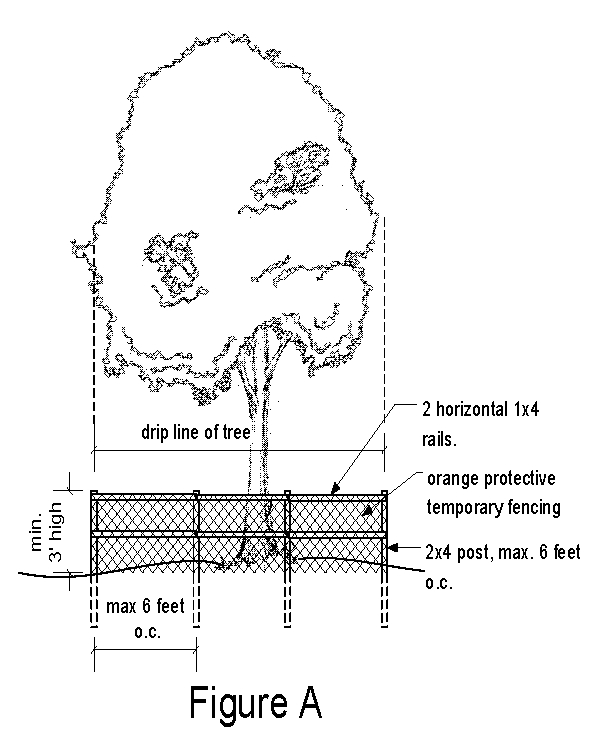
The protective barrier shall be constructed outside the drip line of the tree (See Figure A).
b.
The protective barrier shall be a minimum of three feet high.
c.
Protective barrier posts shall be two inches by four inches or larger and shall be no more than six feet apart.
d.
The barrier shall have two one by four-inch horizontal railings affixed securely to the posts.
e.
The entire protective zone shall be wrapped in orange safety fencing material, a minimum of three feet in height.
f.
The protective barriers shall be inspected by the department prior to the commencement of construction.
2.
No grade changes shall be made within the protective barrier zones without prior approval of the administrative official. Where roots greater than one inch diameter are exposed, they shall be cut cleanly.
3.
Protective barrier zones shall remain in place and intact until such time as landscape operations begin or construction is complete, whichever occurs first.
4.
The administrative official may conduct periodic inspections of the site before work begins and during clearing, construction and post-construction phases of development in order to insure compliance with these land development regulations and the intent of this chapter.
5.
No building materials, machinery or temporary soil deposits shall be placed within protective barrier zones defined in subsection 5.4A above.
6.
No attachments or wires other than those of a protective or nondamaging nature shall be attached to any tree.
B.
Regulations pertaining to utility companies. Whenever any electric, water, telephone or other public utility firm or corporation wishes to extend, maintain or relocate service such that any tree on an unimproved lot or tract will be removed, they shall make application for a permit to do so. Any public utility wishing to prune trees on a right-of-way shall notify the administrative official in writing in advance of the time and place those pruning activities will take place. The administrative official shall supervise these activities as necessary and shall have the authority to regulate or halt such pruning when these actions are deemed detrimental to the trees or beyond that needed to insure continued utility service.
(Ord. No. 4363, § 2, 2-8-2016)
Section 6.0. - Drought tolerant plant standards applicable to required landscaping.
Drought tolerant plants which shall be used in required landscaping are native, non-invasive plants which will survive and flourish with comparatively little supplemental irrigation.
Industrial, commercial, civic, and multi-family residential buildings or structures; common areas of single family or multi-family residential developments shall incorporate drought tolerant trees, shrubs, and groundcovers in landscape plans as a water conservation measure. A list of plants which require minimal water are included in the Florida water management districts' publication: Waterwise, Florida Landscapes. In addition, mulches and drought tolerant groundcovers shall replace narrow turf areas where irrigation is impractical. Interior remodels or minor modifications to the exterior of a structure are not subject to this requirement.
(Ord. No. 4363, § 2, 2-8-2016)
Section 7.0. - Maintenance of required landscape.
All plant material shall be maintained according to the following standards:
A.
All required trees, shrubs and landscaped areas shall be maintained in good and healthy condition for as long as the use continues to exist. Maintenance shall consist of mowing, removing of litter and dead plant material, necessary pruning, pest control, water and fertilizing.
B.
Maintenance also includes, but is not limited to, the replacement of plants damaged by insects, disease, vehicular traffic, acts of God and vandalism. Necessary replacements shall be made within a time period not to exceed 30 days after notification by the city of a violation of this schedule.
C.
In order to increase the tree canopy within the city, give shade to paved surfaces, buffer pedestrian and vehicular traffic and provide scenic beauty and natural habitat, as well as prevent decay, sunburn and hazards to trees, all landscape material required under this schedule shall be pruned to maintain the natural shape of the plant. No topping, hatracking, poodle cutting, excess pruning or excess crown reduction shall be performed and such actions are unlawful.
D.
The city shall encourage the standards of the International Society of Arboriculture and the National Arborist Association for tree care operations, plant maintenance and proper pruning methods by providing guidance, upon request, to applicants.
(Ord. No. 4363, § 2, 2-8-2016)
APPENDIX 1. - LIST OF PLANTS RECOMMENDED FOR SANFORD
Understory Trees
Canopy trees Spaced 40 Feet Apart
Canopy Trees Spaced 30 Feet Apart
Ornamental Landscape Trees Small Trees
Large Ornamental Trees and Palms
Shrubs and Minimum On-Center (OC) Requirements
for Visual Screens
Groundcovers
Grasses

