


Starkville City Zoning Code
SECTION 14
Development Standards
14.1 Purpose
The purpose of this section is to implement the guiding principles of the comprehensive plan by:
14.2 Intent
The development standards in this section are not meant to stifle innovative design or creativity. Instead, they are intended to serve as the minimum standards and guidelines necessary to ensure that new development and redevelopment meets the purpose described above.
14.3 Applicability
The following development standards shall be applied by zoning district in accordance with the Development Standards Chart and the General Development Standards section. These requirements shall apply to any lot or building that is being developed, redeveloped, or remodeled and requires site plan review by the development review committee.
14.4 Relation To Overlay Districts
These standards shall apply in all overlay districts in accordance with the underlying zoning district, unless an alternative standard is set forth in the local historic district through the certificate of appropriateness process. Then the alternative standards for that local historic district shall apply.
14.5 General Development Standards
The following sections provide general development standards for developments.
- Signs (Section 14.7)
- Infrastructure Sufficiency (Section 14.8)
- Surface Water Drainage (Section 14.9)
- Parking and Vehicular Circulation (Section 14.10)
- Sidewalk and Pedestrian Circulation (Section 14.11)
- Buffers (Section 14.12)
- Landscaping (Section 14.13)
- Addressing (Section 14.14)
2024-03
2023-03
2024-02
2022-05-1
2024-06
14.1.1 Protecting And Enhancing
Protecting and enhancing Starkville’s unique aesthetic character.
14.1.2 Supporting Streets And Public Spaces
Supporting high quality streets and public spaces.
14.1.3 Encouraging Architecture
Encouraging architecture that blends harmoniously with the natural surrounding and neighboring developments
14.1.4 Safeguarding
Safeguarding property values and long-term economic assets.
14.6.1 Organization
The development standards are organized by requirements per zoning district as shown on the Development Standards Chart.
- Signs
- Parking and Vehicular Circulation
- Sidewalk and Pedestrian Circulation
- Site Lighting and Building Illumination
- Building Design Standards
- Accessory Structures
- Buffers
- Landscaping
14.7.1 Purpose And Intent
The purpose of these standards is to balance the need to protect public safety and welfare, the need for a well maintained and attractive community, and the need for adequate identification, communication, and advertising. The regulations are further intended:
- To allow businesses, institutions, and people to exercise their right to free speech by displaying messages on a sign, and to allow audiences to receive such information;
- To enhance the economy and the business industry of the City by promoting the reasonable, orderly, and effective display of signs and thereby encourage increased communication with the public;
- To ensure that signs are designed, constructed, installed, and maintained according to minimum standards to safeguard life, health, property, and public welfare;
- To reflect and support the desired ambiance and development patterns of the various zoning districts and overlay districts, and promote an attractive built environment; and
- To allow for adequate and effective signs whose dimensional characteristics further the interests of public safety and the needs of the motorist and pedestrians, where signs are viewed from a street, sidewalk, bike path, or other forms of transportation infrastructure.
14.7.2 General Rules And Applicability
- Sign types allowed for each district can be found in the development standards chart.
- Applications for sign permits will be reviewed only with respect to sign structure or placement excluding any reference to message, category, subject, topic, or viewpoint.
- Signs containing noncommercial speech are permitted anywhere that advertising or business signs are permitted.
- It shall hereafter be unlawful for any person to erect, place, relocate, expand, modify, illuminate, maintain, or otherwise alter a sign in the City except in accordance with these standards.
- Any overlay district or specific use standard shall take precedence over these standards.
- Signs shall not be placed within a sight distance triangle of a street or driveway.
- All permanent signs must be designed to withstand sustained wind speeds of ninety (90) miles per hour with three (3) second gusts.
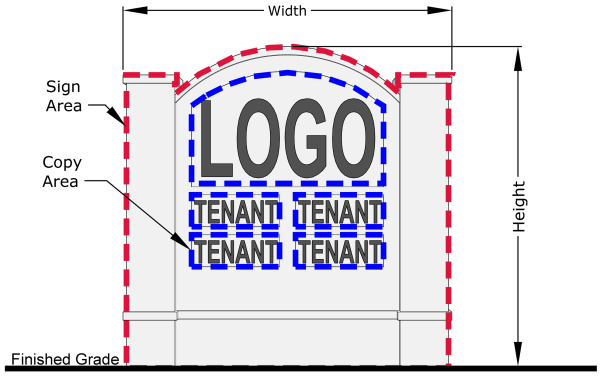 Fig 14.7-1
 - The sign area shall be calculated by the total face of the sign including the structure and the copy area.
- The sign height for site signs shall be calculated from the finished grade at the base of the sign.
- Copy area shall be defined as the square or rectangular area which fully encloses the extreme limits of the message, copy, announcement, or decoration on a sign.
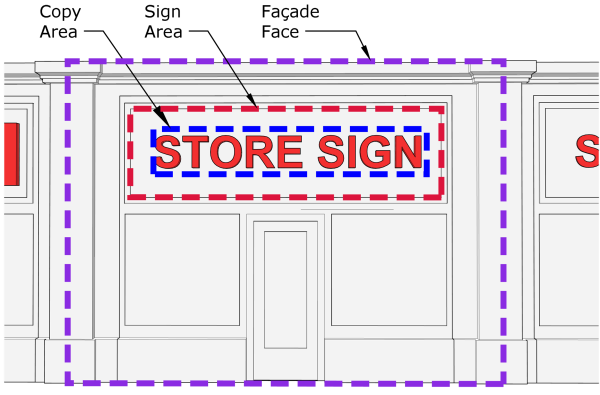 Fig 4.7-2
 - Facade face measurements shall be calculated as the square footage of a wall of a building or the square footage of the wall of the tenant leased area on the exterior wall of a building. The facade face shall be measured in its entirety without regard to the placement or number of windows and doors.
14.7.3 Prohibitions
- Any sign not permitted by this article shall be prohibited.
- No sign shall be placed in the right-of-way with the exception of official traffic control signs unless approved by the Board of Aldermen. This shall include any sign placed on any curb, sidewalk, post pole, hydrant, bridge, tree, or other surface located on, over, or across any public street, right-of-way, property, or thoroughfare unless authorized by the Board of Aldermen and/or specifically allowed in this code.
- Inflatable displays are not permitted except in residential use districts.
- Non-seasonal decorative lighting that is used to attract the attention of pedestrians or motorists that is not part of a seasonal display or outdoor gathering space is not permitted.
- Signs that mechanically move are prohibited.
- Signs placed on a roof unless specifically allowed in a zoning district or by use specific standards are prohibited.
- Any use of searchlights except for airport operations is not permitted.
- Pennants, balloons, and streamers are prohibited.
- No sign shall be erected that would obstruct or be confused with, by its location, color, size, shape, nature or message, with official traffic signs or other signs erected by governmental agencies.
- The removing, damaging, or trimming of any tree or shrub within the public right-of-way for the purpose of increasing or enhancing the visibility of any sign is prohibited except with approval by the Board of Aldermen after a determination is made of a danger to public safety.
- Vehicle signs, whether moving or stationary, are prohibited except when the vehicle is actively engaged in making deliveries, pick-ups, or otherwise actively in use and in which its primary purpose is some use other than advertising. Allowed vehicle signs must be stored in a manner when not in use so as to be screened from view from the right-of-way. This shall not apply to work vehicles parked at a place of residence of the person authorized to use the vehicle or parked at the primary place of business during non-operating hours
- Electronic message center signs located on the inside of a building visible from any public street are not permitted.
- Off-premise signage shall be prohibited in all zoning districts. An off-premise sign is a sign of any sign type which directs attention to a business, commodity, service, or entertainment conducted, sold, or offered at a location other than the premises on which the sign is located with the exception of outdoor advertising signs as defined in Section 14.7.11(D).
14.7.4 Nonconforming Signs
- Any sign existing at the effective date of the adoption of this article which could not be built under the terms of Section 14.7 shall be considered a nonconforming sign with the exception of outdoor advertising signs as defined in Section 14.7.11(D).
- A discontinued sign is any sign which no longer identifies an activity conducted or present on the premises where the sign is located. Discontinued signs not in use for a period of forty-five (45) days or more shall have the sign face removed, by either painting over the sign face or replacing the sign face with a blank insert.
- Any nonconforming sign and its supporting structure that is discontinued for a period of forty-five (45) days or more shall be removed in its entirety at the expense of the property owner. No building or sign permits shall be issued until arrangements have been made for the removal of all nonconforming signs and their supporting structures from the subject property.
- Any existing sign that would normally be classified as conforming that is determined to be unsafe, an unsightly nuisance, or damaged to the extent of fifty percent (50%) of the replacement cost of the sign shall be considered nonconforming and subject to immediate removal. No building or sign permits shall be issued until arrangements have been made for the removal of the nonconforming sign and its supporting structure.
- A nonconforming sign shall not be enlarged or altered in any way which increases its nonconformity. Any alteration or maintenance such as the painting of panels or frame, face change, or repairs to frame or panel requires a sign permit.
14.7.5 Amortization Of Nonconforming Signs
- All nonconforming signs as defined by the previous sign ordinance adopted on April 5, 2011, by the Board of Aldermen and still existing at the time of the adoption of the Unified Development Code shall be removed by May 5, 2022.
- All nonconforming signs that exist at the time of annexation into the City, shall have a ten (10) year amortization period that shall begin from the effective date of the annexation into the City.
- Upon determination by the City of Starkville that a sign remains nonconforming after the termination of the amortization period provided above, the city shall notify the sign owner and/or the owner of the land on which the nonconforming sign is located, and such owner shall have thirty (30) days after written notice is received within which to remove said sign or bring it into compliance. At the end of the thirty (30) day period, if the sign has not been removed or brought into compliance, the code enforcement officer shall issue a summons to municipal court.
- If, having received notice of a violation, the owner fails to remove the nonconforming sign or bring it into compliance within the thirty (30) day period, the City may seek, and the municipal court or any other court of competent jurisdiction may grant, any remedy allowed by Section 3.19 of the Unified Development Code and/or by any other applicable law.
- If the owner complies with the amortization requirements in this section, or having received notice of a violation, removes a nonconforming sign or brings it into compliance within the thirty (30) day period, the City shall waive fees on a new sign permit for a replacement sign.
- The requirements of Section 14.7.5 (A) and 14.7.5 (B) shall not apply to Class I type outdoor advertising (billboard) signs as defined in Section 14.7.11(D)(1)(i).
14.7.6 Enforcement
- The Code Enforcement Officer shall enforce all of the provisions of this section in accordance with the process and procedures for code enforcement.
- The City Planner shall be responsible for the interpretation of all provisions of this section.
- All violations of this section shall be classified as a nuisance.
- Any removable sign not complying with this section may be collected by code enforcement. Signs that are removed will be stored by the City for a period not to exceed ten (10) days. All unclaimed signs after ten (10) days will be discarded.
14.7.7 Variances And Use Exceptions
- The City of Starkville Board of Adjustments and Appeals shall review any variance requests regarding the dimensional requirements of this article at a public hearing during a regularly scheduled meeting in accordance with Section 3.7.
- The City of Starkville's Planning and Zoning Commission shall review any requested use exceptions from this section at a public hearing during a regularly scheduled meeting of the Planning and Zoning Commission upon application to the planning department.
- Signs approved as part of a variance or use exception will only apply to the specific business or entity making the request. Re-approval of the variance or use exception will be required to reuse the sign.
14.8.1 General Purpose
- To lessen congestion in the streets, to facilitate the efficient and adequate provision of transportation, water, and sewage, and to secure safety from fire, every site plan shall be subject to a determination of the sufficiency of infrastructure, as defined below according to the established levels of service in this Article
- Infrastructure shall be considered sufficient where it is demonstrated to have available capacity to accommodate the demand generated by the proposed development.
14.8.2 Streets
- The City Engineer may require the applicant to prepare and submit a traffic impact study for any proposed site that would generate one-hundred (100) or more total trips during the peak hour of the traffic generator or the peak hour of the adjacent street as outlined and illustrated in the latest versions of the Mississippi Department of Transportation Access Management Manual or for a proposed project that may generate traffic issues.
- The Traffic Impact Study format and requirements shall conform to the City of Starkville Standards of Design and Specifications for Subdivisions.
- Where the traffic impact study indicates impact greater than the allowable thresholds, the applicant shall prepare and submit a traffic mitigation plan to the City Engineer. The mitigation plan shall identify capital projects and phasing strategies that would bring the development impact to within the acceptable thresholds. This plan may identify improvements undertaken by the private sector, the public sector or both. Site plan approval shall not be granted until the City Engineer determines that the plan provides reasonable and adequate mitigation. Factors to be considered include whether: the cost of the mitigation measures exceed the value of the proposed development; transportation demand management strategies including multi-modal improvements are included; alternative access strategies are considered.
- Turning lanes shall be provided at heavily traveled intersections as determined by the City Engineer. It will be the responsibility of the developer to pay for the costs for the roadway improvements; however, the City Board of Aldermen may elect to participate in some of the construction costs upon written request of the developer.
14.8.3 Water Supply
- Water supply shall be determined based on system capacity and average and peak flows.
- The minimum size of any water line shall meet the current version of the City of Starkville Minimum Water and Sewer Specifications and may require off-site improvements.
14.8.4 Electric Supply
Electric supply shall be determined based on available capacity.
14.8.5 Wastewater Disposal
- Wastewater disposal shall be determined based on system capacity and average and peak flows.
- The minimum size of any wastewater line shall meet the current version of the City of Starkville Minimum Water and Sewer Specifications and may require off-site improvements.
14.8.6 Fire Suppression
- Required fire flow shall be determined using the methodology of the Insurance Services Office (ISO).
- In determining the impact of the proposed development on fire suppression, the City shall consider water pressure available to the development.
14.8.7 Stormwater
Where proposed stormwater runoff is to be connected to existing stormwater infrastructure, (e.g. storm sewers, open channels, box culverts, etc.) an analysis of the existing structure and its ability to convey additional runoff will be required. In the event the downstream infrastructure cannot convey the required runoff, the City Engineer may require further mitigation of peak flow or off-site improvements to accommodate additional flows.
14.8.8 Bike Lanes, Cycle Tracks, And Trails
Conventional, on- street bike lanes, cycle tracks, or trails may be required by the City Engineer if:
- There are existing bike facilities on the proposed development site;
- There are existing bike facilities adjacent to the proposed development site; or
- The bike and pedestrian plan propose bike facilities in the future on the site.
14.8.9 Transit Facilities
- Accommodations for a bus or transit stop may be required by the City Engineer or City Planner in a proposed development if:
- The development is along a current transit route, and presents an opportunity and need for alternative transportation options.; or
- The future transit plan proposes a bus stop or route in the future near the proposed development.
- Transit facility design, materials, and construction shall conform with the National Association of City Transportation Officials (NACTO) and Federal Transit Administration Design guidance, along with input from the local transit authority.
14.9.1 Connection To Sanitary Sewer Prohibited
No surface water drainage shall empty into a sanitary sewer.
14.9.2 Stormwater Drainage Systems
- The design of stormwater drainage systems shall insure adequate control of stormwater runoff through the use of properly sized and positioned drainage structures including, but not limited to: curb and gutter, curb and open-throat inlets, storm drains, box culverts, open channels and bridges.
- Drainage facilities shall be designed to prevent excessive runoff onto adjacent properties and to reduce long term maintenance by the City or property owner.
- Stormwater drainage systems shall include headwalls, inlets, junction boxes, rip rap and other appurtenances generally recognized as necessary for the proper functioning of the system.
- Design, materials, and construction shall conform to the City of Starkville Standards of Design & Specifications for subdivisions and Section 16.9 Stormwater Management.
14.9.3 Piping Of Watercourses
- This section applies to all storm drainage piping of watercourses except those crossing public or private streets.
- The City encourages retaining stormwater onsite through rainwater harvesting, infiltration, and/or evaporation and through preserving natural drainage features. All natural watercourses shall remain open and unaltered unless piping, enclosing or altering is requested and justified by the developer and approved as part of site plan or infrastructure plan approval, but then only when the following conditions are met:
- The developer must do all grading and provide all structures necessary to properly connect to the existing storm drainage system;
- All design and construction must be to City standards; and
- Pipes, drains, catch basins, and open channels must be designed in accordance with the City of Starkville Standards of Design & Specifications and Section 16.9 Stormwater Management.
- The area around a natural watercourse shall be designated a natural watercourse protection area. The extent of the protection area shall be made by the City Engineer and/or City Planner based on the physical characteristics of the drainage basin. Existing trees within the protection area shall be preserved in accordance with Section 16.7.8.
14.10.1 General Provisions
- Permanent off-street parking for all structures and uses of land shall be provided and conform to the minimum requirements of this section and Section 13 Use Standards. The amount of required parking is determined by the parking requirements for the use categories. The property owner is ultimately responsible for ensuring that sufficient parking is provided.
- Any lot that is being developed, redeveloped, or remodeled and requires site plan review by the development review committee shall provide parking per the development standards and use standards and must conform to all design standards.
- Any new development shall only be required to construct the amount of parking required per the use standards. However, during site plan review, the developer will be required to show on the site plan adequate space for a future expansion of the parking area if needed to accommodate the highest parking standard for that use district. The expansion of the parking area shall be noted on the approved site plan.
- Change in Use
- A change in use must comply with the parking requirements unless the use has the same or a lesser parking demand than the previous use as determined by the City Planner.
- Where, according to the use standards for that use, the required number of parking spaces for a new use is less than a twenty-five percent (25%) increase from the previous use requirements, no additional parking is required.
- Where, according to the use standards for that use, the required number of parking spaces for a new use is more than a twenty-five percent (25%) increase from the previous use requirements, additional parking shall be required. A reduction of up to fifty percent (50%) of the required additional spaces may be granted at the discretion of the City Planner.
14.10.2 Vehicular Access
- General Access Requirements
- All existing and proposed development must provide a satisfactory means of vehicular, pedestrian, and bicycle ingress and egress to and from a street or an abutting site.
- All off-street parking areas must have vehicular access from a street, alley, drive aisle, or cross-access easement.
- All off-street parking areas must be designed to allow vehicles to enter and exit the parking area in a forward motion unless otherwise excluded in this section or determined by the City Engineer that the street type and/or posted speed limit does not create a safety issue. Backing out into an alley is permitted.
- Street Signage & Traffic Control
- All traffic signs and street name signs shall be purchased by the Developer and installed by or to the satisfaction of the City before the Certificate of Occupancy is issued.
- Traffic flow and direction shall be shown on the site plan and be subject to modification by the City Engineer.
- Regulatory signs shall be in compliance with the current Manual on Uniform Traffic Control Devices (MUTCD) and shall be installed accordingly. The placement and number of signs shall be approved by the City Engineer.
- All streets and crosswalks within the public right-of-way shall use thermoplastic materials for striping.
- Site signage and traffic control design, materials, and construction shall conform to the City of Starkville Standards of Design and Specifications for subdivisions.
- All Driveways
- All driveway design and construction must comply with the City of Starkville Standards of Design & Specifications, or the Fire Code when conflict exists, except for single unit and duplex residential uses on a single lot.
- Driveway dimensions measured at the street right-of-way shall be in accordance with the following table.
Table 14.10-1: Driveway Dimension Requirements
Width (min)
Width (max)
Radius (max)
Single Unit and Duplex Residential
8’
20’
5’
Multi-Unit Residential with less than 6 off-street parking spaces)
10’
18’
10’
Multi-Unit Residential 7+ off-street parking spaces (one-way)
12’
16’
10’
Multi-Unit Residential 7+ off-street parking spaces (two-way)
20’
24’
10’
Mixed-Use/Commercial (one-way)
12’
18’
10’
Mixed-Use/Commercial (two-way)
20’
32’
15’
Industrial
30’
40'
- The City Engineer may require wider driveways where unusual traffic, grade, or site conditions exist.
- Driveways for Single Unit and Duplex Residential Uses
- When an alley is provided, all driveways shall take access from the alley.
- No residential lot shall have more than two (2) driveways on the same street. Multiple driveways that service one (1) lot may be no closer than forty (40) feet to each other.
- Maximum driveway width within the right-of-way shall be twenty (20) feet. Driveway widths up to thirty (30) feet may be allowed by administrative adjustment only within an SD-2 or SD-6 zoning district.
- Driveways for single and attached duplex dwelling residential shall be a minimum of twenty (20) feet from the intersection of two (2) street rights-of-way.
- Driveways for multi-dwelling residential shall follow the City’s access management policy and be reviewed during site plan approval.
- Driveways shall meet parking setback requirements per zoning district.
- Parking areas shall not constitute more than forty percent (40%) of the front yard.
- Only single and attached duplex dwelling residential shall be permitted to back out directly into a street unless it is determined by the City Engineer that the street type and/or posted speed limit creates a safety issue.
- Gravel driveways shall have a concrete apron that is a minimum of eight (8) feet from the property to the edge of the pavement at the street. The design of the apron shall prevent loose gravel from being deposited on the sidewalk and roadway.
- Driveways for Multi-Unit Residential, Mixed-Use, and Non-Residential
- When an alley is provided, access from an alley is required and new curb cuts along the public right-of-way are not allowed.
- Driveway locations shall follow the City’s access management policy and be reviewed during site plan approval.
- Driveways shall meet parking setback requirements per the zoning district.
- Cross-Access between Adjoining Development
- The internal vehicular circulation system shall be designed to allow for vehicular cross-access between adjoining lots or to the boundary of adjoining vacant land zoned to allow non-residential or mixed-use development.
- Cross-access ways shall provide for two-way vehicular traffic between the vehicle use areas on the adjoining lots through the use of a single driveway or drive aisle that is at least twenty-two (22) feet wide or through the two (2) one-way driveways or aisles that are each at least eleven (11) feet wide.
- Cross-access ways should be offset from the driveway intersection a minimum of fifty (50) feet to reduce vehicular conflicts.
- The City Engineer and City Planner may waive or modify the requirement for vehicular cross- upon determining that such cross-access is impractical or undesirable due to the presence of topographic conditions, natural features, or vehicular safety factors.
- Easements allowing cross-access to and from properties served by a vehicular cross-access, along with agreements defining the maintenance responsibilities of property owners, shall be recorded with the Office of the Chancery Clerk of Oktibbeha County before a temporary or final certificate of occupancy is granted.
14.10.3 Calculation Of Required Parking
- The number of parking spaces required shall be calculated in accordance with the parking for that use. Where the use is not specifically listed or only a broad use category is shown, the City Planner shall be responsible for categorizing the use and determining the minimum number of parking spaces.
- For a multi-tenant development with a combination of commercial or institutional uses, the parking requirements are the sum of the requirements for each use, and no parking space for one (1) use can be included in the calculation of parking requirements unless otherwise permitted in this section.
- Institutional and commercial uses that share a parking lot with other commercial uses may not exceed their minimum parking by more than twenty-five percent (25%).
14.10.4 Parking Reductions For Required Parking
Parking Occupancy Rates | ||||||
Uses | M - F | M - F | M - F | SAT & SUN | SAT & SUN | SAT & SUN |
8 AM - 6 PM | 6 PM - 12 AM | 12 AM - 8 AM | 8 AM - 6 PM | 6 PM - 12 AM | 6 PM - 12 AM | |
Residential Mixed Use | 60% | 100% | 100% | 80% | 100% | 100% |
Hotels, Motels, or Inns | 70% | 100% | 100% | 70% | 100% | 100% |
Offices Professional | 100% | 20% | 5% | 5% | 5% | 5% |
Retail Sales and Services | 90% | 80% | 5% | 100% | 70% | 5% |
Eating & Drinking Establishments | 70% | 100% | 100% | 70% | 100% | 10% |
Theater | 40% | 80% | 10% | 80% | 100% | 10% |
Entertainment | 40% | 100% | 10% | 80% | 100% | 5% |
Conference and Convention | 100% | 100% | 5% | 100% | 100% | 5% |
Places of Worship | 20% | 20% | 5% | 100% | 50% | 5% |
- Mixed-use development. For developments on the same lot with more than one use, the total number of parking spaces required may be adjusted downward to the highest total demand calculated for each weekday (night, daytime, and evening periods) and weekend (night, daytime, and evening periods) according to the Parking Occupancy Rates chart. The weekday or weekend time period generating the highest demand shall indicate the new minimum parking space requirement for that specific combination of uses.
- Proximity to transit. A ten percent (10%) reduction in the number of required parking spaces is allowed for commercial uses with a main entrance within a walking distance of thirteen hundred and twenty (1,320) feet of an operating transit stop. This reduction does not apply to form-based districts or used in conjunction with the reduction allowed with the Parking Occupancy Rate Chart.
- Bicycle parking. Within a commercial use district, form-based district, or multiple dwelling unit districts, the overall parking space requirements can be reduced by two spaces if bicycle parking is provided. Bicycle parking shall be provided for all developments located along a dedicated bike path or bike lane.
14.10.5 Off-Street Parking
- Required parking spaces must be located on the same lot they are intended to serve unless otherwise permitted in accordance with this Section 14.10.5.
- Parking shall only be permitted on a hard surface unless otherwise permitted in accordance with this Section 14. Parking shall not be permitted on the open lawn area from the front façade of the building to the street.
14.10.6 Off-Site Parking
- Required parking spaces may be permitted on an off-site parking area separate from the site on which the principal use is located if the off-site parking is located within five hundred (500) feet. Newly constructed off-site parking areas may require a special exception per the use standards.
- Off-site parking is measured as the walking distance from the nearest point of the shared parking area to the primary entrance of the use served. All off-site parking shall be reviewed and approved as part of site plan approval and/or building permit review.
- Prior to the issuance of a permanent or temporary certificate of occupancy, a recorded perpetual easement to the parking area must be filed in the office of the Chancery Clerk of Oktibbeha County. Easements for shared parking shall be reviewed and approved by the City Attorney.
14.10.7 On-Street Parking
- This section defines the parking criteria for adding on-street parking adjacent to a development. Parking may be allowed on Local and Minor Collector streets at the discretion of the City Engineer. Parking shall not be allowed on Major Collector or Arterial streets.
- Parallel parking is permitted on certain streets as approved by the City Engineer.
- For all streets in which parking is limited or not allowed, “No Parking” street signs may be required as part of the approved site plan.
- The addition of perpendicular or angled parking shall not be allowed on City public streets.
- Parking inset from the curb line may be allowed by the City subject to the approval of the City Engineer.
- An on-street parking space within the right-of-way shall be designed with a minimum clearance of six (6) feet offset from the edge of a driveway unless additional clearance is required by the City Engineer.
- An on-street parking space within the right-of-way shall be designed with a minimum clearance of thirty (30) feet from the nearest edge of the intersection. The designer shall establish the minimum clearance by reviewing sight distance requirements in the AASHTO Policy on Geometric Design of Highways and Streets.
- Special consideration shall be given to mailbox locations near on-street parking such that parked vehicles do not interfere with mail delivery.
- On-street parking cannot be privately metered o reserved.
14.10.8 Tandem Parking
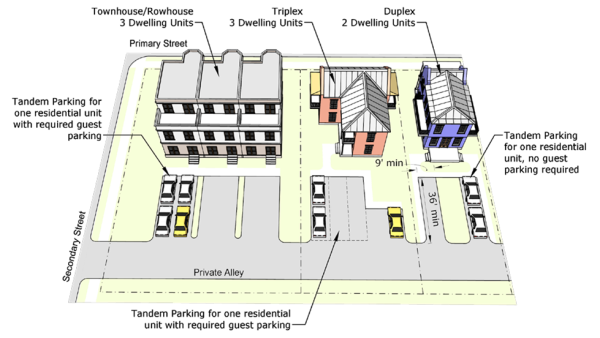
Fig. 14.10-1
- Tandem parking is allowed for the following residential use categories: detached dwelling and accessory dwelling unit.
- Tandem parking is allowed for the following residential use categories with a maximum of three (3) dwelling units within one (1) structure: attached duplex, attached triplex, and townhouse/rowhouse.
- A maximum of two (2) parking spaces may be in one (1) tandem parking space with a minimum dimension of 9 feet in width by thirty-six (36) feet in length.
- Both parking spaces in tandem must be assigned to the same dwelling unit and signed appropriately
14.10.9 Queuing Areas
- Adequate space must be made available on-site for stacking, storage, and queuing of vehicles.
- Vehicles using drive-thru facilities may not encroach on or interfere with the public use of streets and sidewalks by vehicles or pedestrians.
- Each stacking space must be a minimum of twenty (20) feet in length and ten (10) feet in width along straight portions. Stacking spaces and stacking lanes must be a minimum of twelve (12) feet in width along curved segments.
- See use standards for specific requirements for drive-thru facilities.
14.10.10 Loading Areas
Loading areas shall be required based on the specific use as stated in the use standards.
14.10.11 Medians Within Driveways Accessing Public Right-Of-Way
If medians are included and are placed either entirely or partially in the public right-of-way, they shall meet the following standards for design:
- No obstruction. The medians may not obstruct the designed vehicle turns.
- Visibility. The medians must be placed such that the required visibility in the intersection is not obstructed.
- Undiminished Use. Medians must be placed so they do not diminish the intersection use except when designing a right-in/right-out intersection.
- Median Maintenance. Medians shall be maintained.
- Pedestrian refuge islands shall be required if a median is intersected by a required pedestrian crossing.
- Signage is allowed within medians.
14.10.12 Pedestrian Crossings
- Pedestrian crossings across all entrances shall be ADA compliant.
- Pedestrian crossings shall be marked and/or signed as required by City Engineer and/or ADA Coordinator.
14.10.13 Parking Location For Commercial, Industrial, Institutional, Mixed-Uses, And Residential Uses With Three (3) Or More Dwellings Per Site
- Required parking spaces must be located on the same lot they are intended to serve, except where specifically allowed under off-site parking requirements.
- All off-street parking must be arranged so that no vehicle is forced onto any public street, not including an alley, to gain access from one (1) parking aisle to another parking aisle.
- Vehicles shall not back out directly onto any public street.
- Parking shall only be permitted on a hard surface. Parking shall not be permitted on the open lawn area from the front façade of the building to the street.
- Driveway width and location shall be determined based on the adopted city access management policy.
14.10.14 Parking Layout
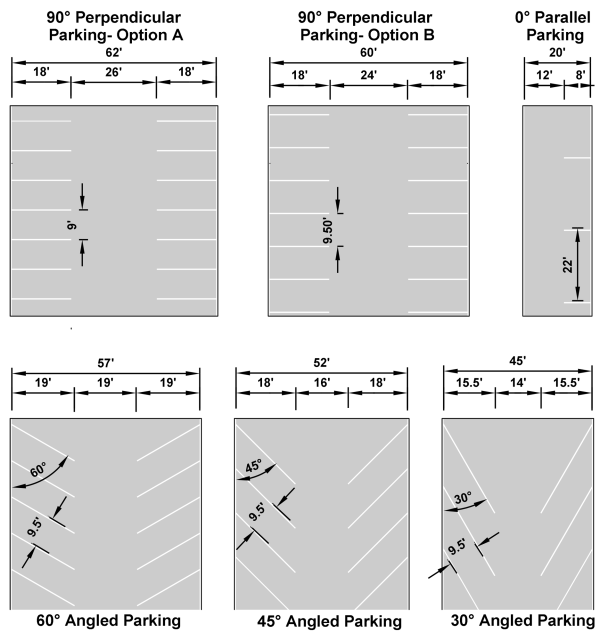 Fig 14.10-2
- Ninety degree (90°) perpendicular parking option A. Parking spaces shall have a minimum dimension of nine (9) feet wide by eighteen (18) feet long with a minimum drive aisle width of twenty-six (26) feet.
- Ninety degree (90°) perpendicular parking option B. Parking spaces shall have a minimum dimension of nine and a half (9 1/2) feet wide by eighteen (18) feet long with a minimum drive aisle width of twenty-four (24) feet.
- Sixty degree (60°) angled parking. Parking spaces shall have a minimum dimension of nine and a half (9 1/2) feet wide by nineteen (19) feet long with a minimum drive aisle width of nineteen (19) feet.
- Forty-five degree (45°) angled parking. Parking spaces shall have a minimum dimension of nine and a half (9 1/2) feet wide by eighteen (18) feet long with a minimum drive aisle width of sixteen (16) feet.
- Thirty degree (30°) angled parking. Parking spaces shall have a minimum dimension of nine and a half (9 1/2) feet wide by fifteen and a half (15 1/2) feet long with a minimum drive aisle width of fourteen (14) feet.
- Zero degree (0°) parallel parking. Parking spaces shall have a minimum dimension of eight (8) feet wide by twenty-two (22) feet long with a minimum drive aisle width of twelve (12) feet.
- Other angled parking. All other angled parking lot dimensions not stated above shall require approval by the City Planner and/or City Engineer based on the dimensional standards of the two (2) closest angled parking categories.
- Fire lanes and access drives. Drive aisle width requirements in this section shall not apply to any required fire lanes or fire access drives. Aisle widths for fire lanes and fire access drives shall be as required by the latest adopted edition of the International Fire Code or other applicable adopted building codes.
- Parking lot islands. All parking lots shall provide for perimeter islands, terminal islands, interior islands, and median islands as required by the Development Standards Chart and the Landscape Sections (see Fig. 14.10-2).
- Required curbs. Interior islands, terminal islands, median islands, and parking lot perimeter shall have a six (6) inch high by six (6) inch wide concrete curb. Wheel stops cannot be used as the only means of protection. If median islands are being used for stormwater management, the requirement for a concrete curb may be removed only with the approval of the City Planner and/or City Engineer.
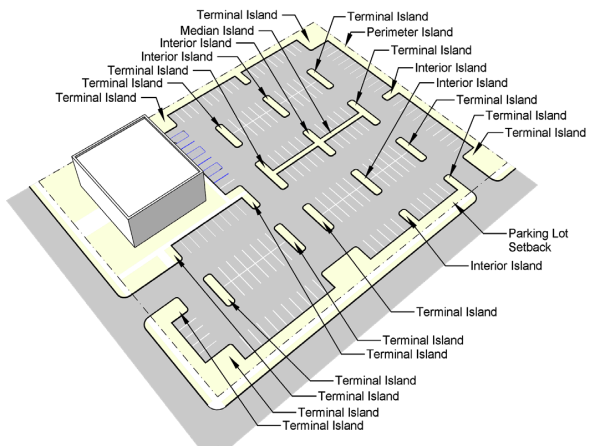
Fig. 14.10-3
14.10.15 Recreational Vehicles And Equipment
For the purposes of this section, recreational vehicles shall include travel trailers, motor homes, boats, personal watercraft, and all-terrain vehicles. Equipment shall include ,any type of trailer used to haul material or vehicles
- Recreational vehicles and equipment shall be stored behind the nearest portion of a building to the street in either the side yard, rear yard, garage, carport, or an enclosed building. For loading and unloading, recreational vehicles and equipment shall be permitted to park anywhere on the property for a maximum of twenty-four (24) hours.
- Parking of recreational vehicles and equipment is not permitted on any public street for a period in excess of twenty-four (24) hours.
- Recreational vehicles cannot be used as a dwelling or short-term residential rental. Recreational vehicles can be used as temporary sleeping quarters on property that is the primary residence of the property owner during home game weekends for Mississippi State University for a maximum of three (3) nights consecutively and not to exceed thirty (30) days within a calendar year as well as during city-recognized holidays. During this temporary period, one (1) recreational vehicle may be parked in the driveway of an occupied dwelling as long as the vehicle does not block public sidewalks or protrude into the street.
- Recreational vehicles shall be allowed on the side of the front yard on a hard surface by Administrative Adjustment.
14.10.16 Exceptions From Off-Street Parking Requirements
- Parking of automobiles is permitted in the front yard for private events for a period not to exceed twelve (12) hours. Private event parking exceptions shall be limited to no more than three (3) events within a calendar year.
- Parking of automobiles is permitted in the front yard during home game weekends for Mississippi State University from 12:00 pm Friday to 12:00 pm Sunday.
- Equipment shall be permitted in the front yard of any structure with an active building permit. All utility trailers and temporary storage containers shall be removed once construction activities have ended, stopped, and/or a certificate of occupancy has been issued.
14.10.17 Variances
Any deviation from the number of required spaces and/or the off-street parking requirements not approved by the City Planner as an administrative adjustment shall be required to receive approval through the Variance process.
14.11.1 Sidewalks Required By Subdivision
Within all newly platted subdivisions, sidewalks shall be required. The installation shall be required in accordance with Section 15.3.3.H.
14.11.2 Sidewalks Required By Site Plan
- The developer or property owner of any development or redevelopment shall be required to bring existing sidewalks adjacent to the property into compliance with current sidewalk and/or ADA standards. Existing sidewalks that comply with ADA standards may vary in required width up to eighteen inches (18") if approved by the City Engineer and/or Building Official.
14.11.3 Sidewalks Required By Building Permit
- On any construction project that does not require site plan approval within the sidewalk development zone (see Fig 14.11-1) with a cost for improvements that is greater than fifty thousand dollars ($50,000), sidewalks shall be required unless any of the following conditions exist:
- The project is a single dwelling unit located on a single lot that is not part of a development that requires sidewalks.
- The installation cost of the required sidewalk is greater than thirty percent (30%) of the cost for the improvements. The improvement cost shall include all improvements on the site, structure, and/or building for all phases. The installation cost of the sidewalks shall be based on unit prices. The unit prices shall be determined based upon quarterly posted construction bid averages provided by the Mississippi Department of Transportation (MDOT). The unit price used to determine the installation cost shall be reviewed and approved by the City Engineer.
- The developer or property owner of any development or redevelopment shall be required to bring existing sidewalks adjacent to the property into compliance with current sidewalk and/or ADA standards.
14.11.4 General Requirements
- Sidewalks shall be designed and constructed to comply with the Americans with Disabilities Act and most current version of the Americans with Disabilities Act Accessibility Guidelines. Developments on a corner lot shall be responsible for providing handicapped access curb ramps on the corner.
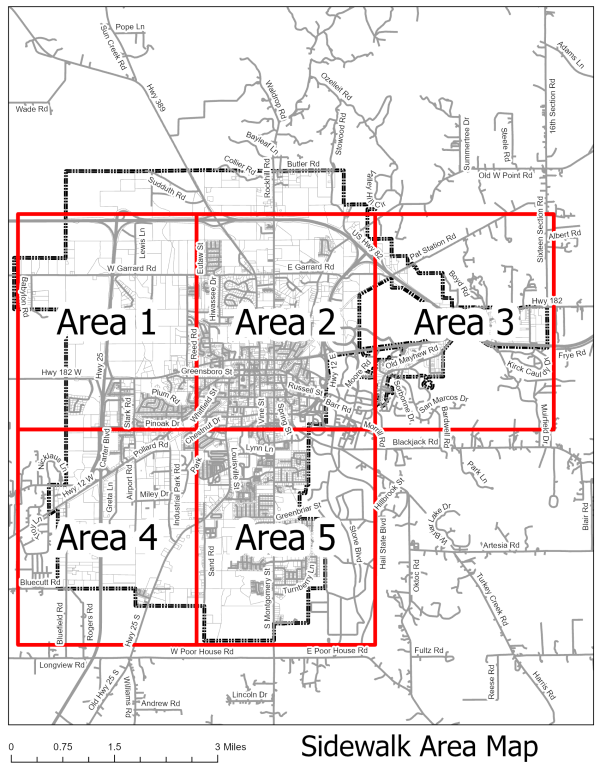
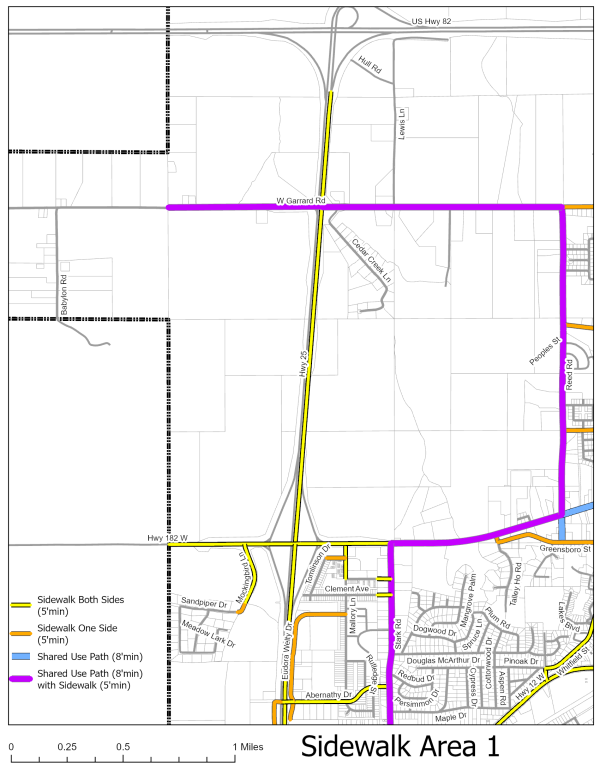
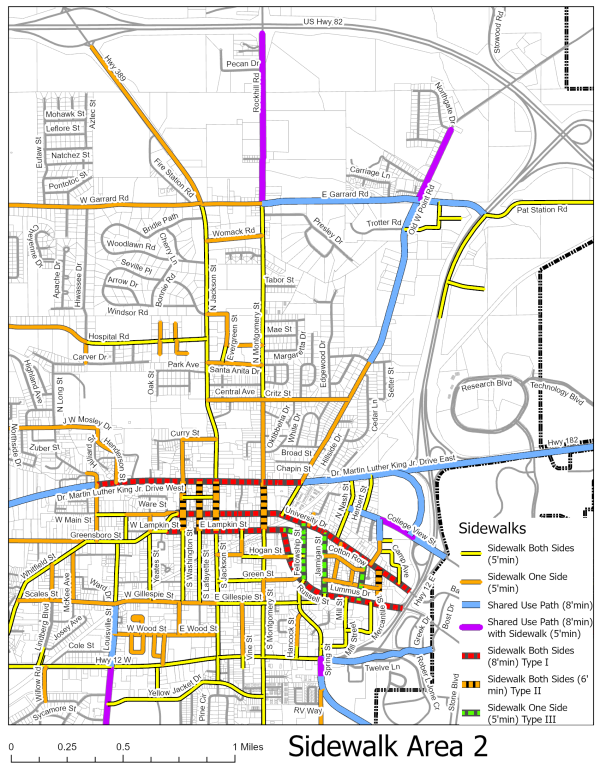
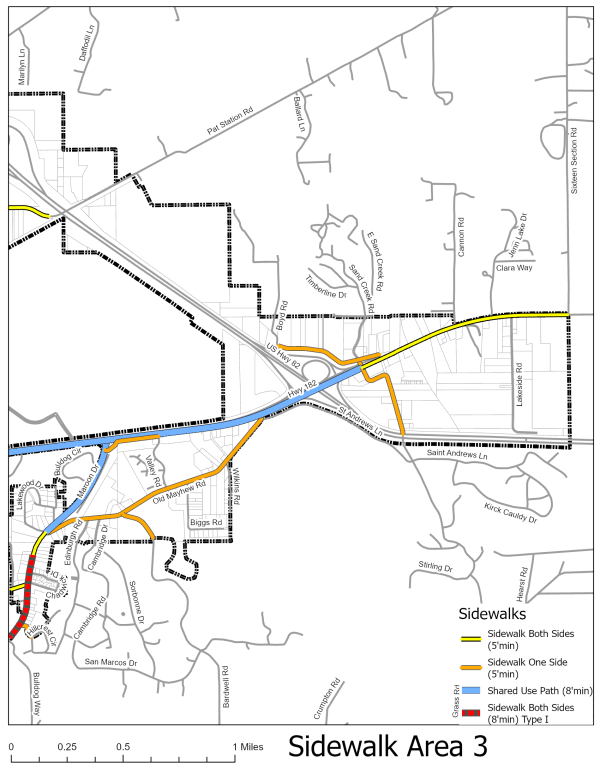
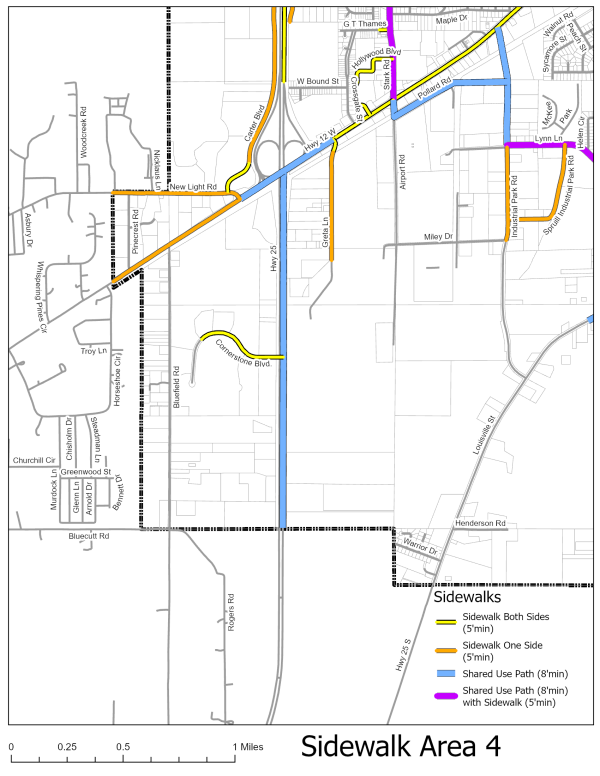
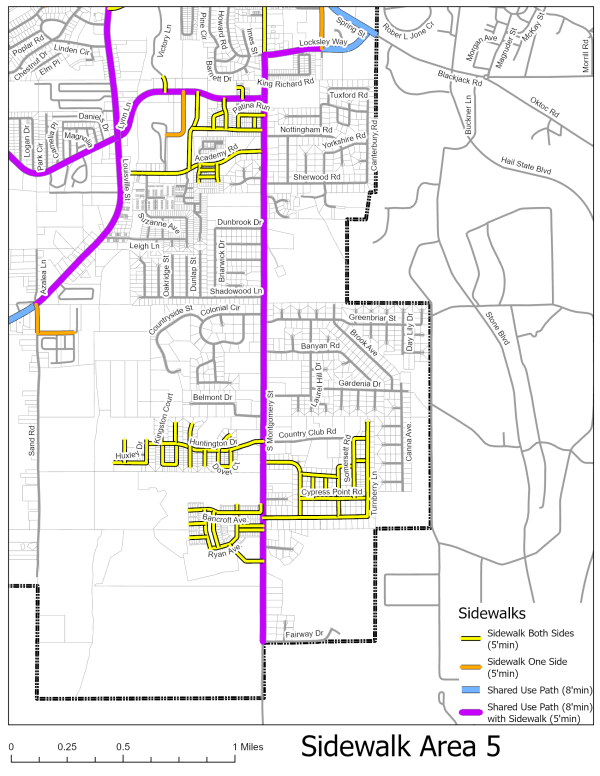
- Required sidewalks shall be located within the right-of-way adjacent to the subject property in accordance with the Sidewalk Area Map (Fig 14.1-6). Sidewalks shall be provided along all public and private streets from lot line to lot line and align with existing sidewalks on adjacent properties. Sidewalks that cannot be located within the right-of-way shall be located as close to the right-of-way as possible in an easement allowing for public access and maintenance. Sidewalk easements width shall be six (6) feet plus the width of the sidewalk.
- Unless otherwise specified by the Development Review Committee, sidewalks shall be located closer to the right-of-way line than the back of curb of a street. Thus, creating an area for the planting of sod or other landscape materials.
- Sidewalk material shall be in accordance with the Development Standards Chart.
- The width of the sidewalk shall be as shown on the Sidewalk Area Map (Fig 14.1-6). In locations with higher current or anticipated pedestrian use, a wider sidewalk may be required as deemed necessary by the City Planner and/or the City Engineer.
- Sidewalk crossings at any driveway shall provide an ADA compliant connection between the sidewalk ends.
- Crosswalks shall be required and striped in conformance with the latest edition of the Manual on Uniform Traffic Control Devices or to the current City standard.
- If required, Internal pedestrian circulation shall be provided and meet the requirements of the Development Standards Chart.
- Repair and Maintenance. Upon issuance of a certificate of occupancy, the city shall be responsible for the repair and maintenance of sidewalks and multi-use paths within public right-of-way. The expense of repairing any sidewalk shall be incurred by the city. Sidewalks not located within a public right-of-way or an approved sidewalk easement, are the responsibility of the property owner. It shall be the responsibility of the property owner to have sidewalks evaluated by city staff prior to any action which may result in damage or removal by an owner, renter, or contractor during work done at a property. Sidewalks that are damaged or removed by direct action shall be repaired/replaced by property owner. The evaluation shall determine whether the sidewalk condition warrants repair or reconstruction.
- Obstructions. The owner and/or occupant of every lot or premises adjoining any street shall clear and keep all sidewalks or multi-use paths adjoining such lots or premises from any obstructions including, but not limited to, structures, vehicles, materials, debris, vegetation, or other items. The owner and/or occupant shall also keep clear the area which is located directly over the sidewalk, up to a height of eight (8) feet, in a manner which will allow reasonable travel without interference from obstructions as defined above.
- Sidewalk Protection During Construction. Construction activities adjacent to a public sidewalk shall adhere to the following:
- Protection Area. Sidewalk protection areas shall have a clear unobstructed width of not less than six (6) feet in all areas.
- Open Sidewalk. At the building official’s discretion, the open sidewalk should be separated from the adjacent work zone by a chain link fence or other similar barrier. Any gate in the fence must swing inward toward the work zone. The fence must be properly anchored but cannot be bolted or attached in any similar manner into the sidewalk.
- Barricades. During construction, sidewalks that are not protected by a physical barrier (curb and cutter, grass strip, etc.), the property owner may be required to provide water filled barricades as determined by the Development Review Committee during site plan review.
- Sidewalk Overhead Protection (sidewalk bridge, a protective canopy or sidewalk shed). As part of site plan approval, the Development Review Committee may require overhead protection for public sidewalk.
- A sidewalk shed must be erected whenever materials will be hoisted over the sidewalk, regardless of building height or horizontal distance between the building and sidewalk. Without a sidewalk shed, no construction operation is allowed over the sidewalk.
- Specifications and drawings of the sidewalk shed must be submitted with the traffic control plan during site plan review and, if applicable, lane closure permit application.
- The drawing must show the side view, front view, and cross section view of the sidewalk shed.
- The sidewalk shed shall have a clear unobstructed ceiling height of not less than eight (8) feet.
- Roof materials shall consist of planking no less than the industry standard nominal thickness of two (2) inches, closely laid, made watertight, and covered with exterior grade fire resistant plywood.
- Sidewalks within a sidewalk shad shall be lit with approved temporary lighting.
- All walking surfaces within a sidewalk shed shall be compliant with the American Disabilities Act Accessibility Guidelines.
- Permit for obstruction of sidewalk. When and where it shall be necessary in the construction or repair of buildings, structures, or sites, the Building Official and/or City Engineer may approve obstructing the sidewalk during construction with an active permit, permitting the applicant to obstruct the free and unimpeded use of the sidewalk. A pedestrian traffic plan shall be required. If the provisions and conditions of permit are not strictly adhered to, a stop work order for the entire project shall be issued.
- Review and Approval Procedure
- Sidewalks shall be subject to review and approval as part of the site plan review process.
- No certificate of occupancy shall be issued until all required sidewalks are completed in accordance with the approved site plan.
- If required sidewalks are incomplete, a temporary certificate of occupancy may be issued in accordance with section 17.5.2.B.
- Variance from sidewalk requirements. Any variance from sidewalk requirements in Section 14.11 shall follow the procedures and processes of Section 3.7.5
- Administrative Adjustments from sidewalk requirements. Any administrative adjustments from sidewalk requirements in Section 14.11 shall follow the procedures and processes of Section 3.6.
- Sidewalk Types Required.
- If the sidewalk is required to be placed on the opposite side of the street from the subject property, the owner/developer is only responsible for providing fifty percent (50%) of the required length of the sidewalk. If an administrative adjustment is granted, the owner/developer is only responsible for providing either an alternate sidewalk equal to fifty percent (50%) of the area of the required sidewalk or a fee-in-lieu equal to fifty percent (50%) of the calculated amount of the required sidewalk.
- The following types of sidewalks shall be placed adjacent to the subject property in a location determined by the City Engineer and/or City Planner.
- Sidewalk Both Sides (5' min)- A five (5) foot sidewalk is required on both sides of the street.
- Sidewalk One Side (5' min)- A five (5) foot sidewalk is required on one side of the street.
- Shared Use Path (8' min)- An eight (8) foot wide shared use path is required on one side of the street.
- Shared Use Path (8" min) with a Sidewalk (5' min)- An eight (8) foot wide shared use path and a five (5) foot wide sidewalk is required. The location of both the shared use path and sidewalk may be on the same side of the street or opposite sides of the street from each other.
- Sidewalk Both Sides (8' min) Type I- An eight (8) foot sidewalk is required on both sides of the street as part of the additional setback requirement in Section 5.3
- Sidewalk Both Sides (6' min) Type II- A six (6) foot sidewalk is required on both sides of the street as part of the additional setback requirement in Section 5.3
- Sidewalk One Side (5' min) Type III- a five (5) foot sidewalk is required on one side of the street as part of the additional setback requirement in Section 5.3
14.12.1 General Provisions
- Buffers shall be required for developments that are adjacent to existing detached single dwelling units and/or subdivisions for the following development or redevelopment types: commercial developments, multi- dwelling unit developments, special district developments, industrial developments, and single dwelling unit subdivisions with a gross density more than fifty percent (50%) higher than the adjacent existing detached single dwelling unit and/or subdivision.
- Required buffers can be placed within required building and/or parking setbacks or within a platted common area.
- Canopy trees in a required buffer shall be evergreen or semi-evergreen trees that meet the minimum requirements of a canopy tree as defined in the landscape requirements section.
- Shrubs in a required buffer shall be evergreen with an expected height and spread of at least four (4) feet within three (3) years of planting.
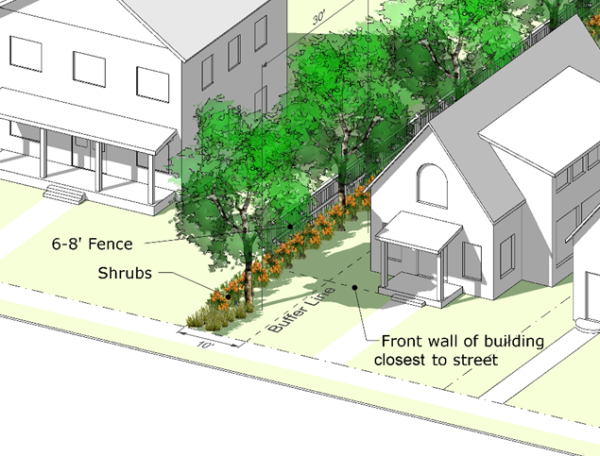
- Fences and walls shall be located next to adjacent property with the buffer landscaping facing the interior of the property.
- Within the front yard of any property adjacent to a required buffer, canopy trees and shrubs shall be required to extend to the property line.
- Fences and walls shall not extend beyond the front wall of closest building to the street adjacent to a required buffer except for Type D buffers. Fences and walls in Type D buffers shall extend to the property line
14.12.2 Type
The following types of buffers shall be used:
- Type A. Used to separate commercial, multi- dwelling unit residential, and mixed-use developments in T-4, T-5D, T-5C and T-5U from single-dwelling unit residential developments in TN-E.
- Type B. Used to separate higher density single- dwelling unit residential developments from lower density single-dwelling unit residential developments in RN, SD-2, SD-6, TN-N, TN-E, and O districts with TND use designation.
- Type C. Used to separate commercial, multi- dwelling unit residential, special-medical, mixed- use, and special-educational developments in CN, C, CR, S-M, S-E, and O districts with commercial use designation from single-dwelling unit residential developments in RN, SD-2, SD-6, TN-N, and TN-E districts.
- Type D. Used to separate industrial developments in I and O districts with industrial use designation from single-dwelling and multi- dwelling unit residential developments in RN, SD- 2, SD-6, TN-N, TN-E, MU-9, MU-20, and O districts with TND and conservation development use designation.
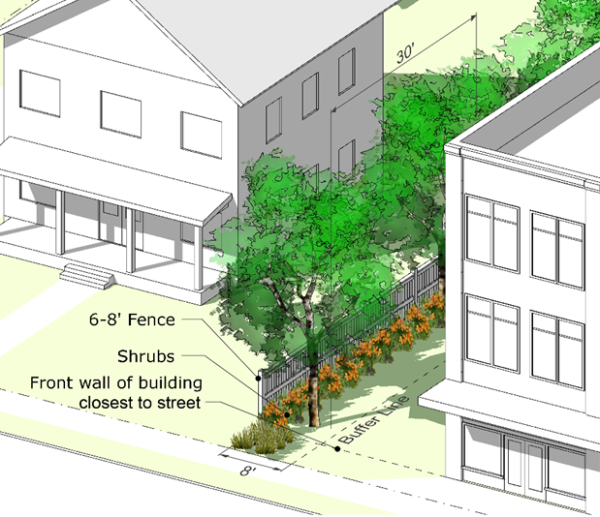
- Type A
- Used to separate commercial, multi-dwelling unit residential, and mixed-use developments in T-4, T-5D, T- 5C and T-5U from single-dwelling unit residential developments in TN-E.
- The buffer shall be a minimum width of eight (8) feet with a six (6) to eight (8) foot opaque fence. The buffer width may be reduced to five (5) feet if a solid masonry wall is used in the place of a fence.
- A minimum of one (1) canopy tree shall be planted every thirty (30) feet along the entire length of the buffer.
- A row of shrubs shall be planted along the entire length of the buffer with a maximum spacing of ninety percent (90%) of the shrubs expected spread within three (3) years of planting.
- All existing trees with a DBH of twenty-four (24) inches or greater within a required buffer area shall be preserved. Construction activities such as grading and trenching shall not affect more than forty-five percent (45%) of the critical root zone of the tree to be preserved.
Fig 14.12-1
- Type B
- Used to separate higher density single-dwelling unit residential developments from lower density single- dwelling unit residential developments in RN, SD-2, SD-6, TN-N, TN-E, and O districts with TND use designation.
- The buffer shall be a minimum width of ten (10) feet with a six (6) to eight (8) foot opaque fence. An additional ten (10) feet of buffer shall be required if the proposed development has a density more than double the existing adjacent development unless a solid masonry wall is used in the place of a fence.
- A minimum of one (1) canopy tree shall be planted every thirty (30) feet along the entire length of the buffer.
- A row of shrubs shall be planted along the entire length of the buffer with a maximum spacing of ninety percent (90%) of the shrubs expected spread within three (3) years of planting.
- A minimum of fifty percent (50%) of all existing trees with a DBH of ten (10) inches or greater within a required buffer area shall be preserved. Construction activities such as grading and trenching shall not affect more than forty-five (45%) of the critical root zone of the tree to be preserved.
Fig. 14.12-2
- Type C
- Used to separate commercial, multi-dwelling unit residential, special-medical, mixed-use, and special- educational developments in CN, C, CR, S-M, S-E, and O districts with commercial use designation from single- dwelling unit residential developments in RN, SD-2, SD-6, TN-N, and TN-E districts.
- The buffer shall be a minimum width of twenty (20) feet with a six (6) to eight (8) foot opaque fence. The buffer width may be reduced to ten (10) feet if a solid masonry wall is used in the place of a fence.
- A minimum of one (1) canopy tree shall be planted every thirty (30) feet along the entire length of the buffer.
- Two (2) rows of shrubs shall be planted along the entire length of the buffer with a maximum spacing of ninety percent (90%) of the shrubs expected spread within three (3) years of planting.
- A minimum of fifty percent (50%) of all existing trees with a DBH of ten (10) inches or greater within a required buffer area shall be preserved. Construction activities such as grading and trenching shall not affect more than forty-five percent (45%) of the critical root zone of the tree to be preserved.
.png)
Fig. 14.12-3
- Used to separate commercial, multi-dwelling unit residential, special-medical, mixed-use, and special- educational developments in CN, C, CR, S-M, S-E, and O districts with commercial use designation from single- dwelling unit residential developments in RN, SD-2, SD-6, TN-N, and TN-E districts.
- Type D
- Used to separate industrial developments in I and O districts with industrial use designation from single- dwelling and multi-dwelling unit residential developments in RN, SD-2, SD-6, TN-N, TN-E, MU-9, MU-20, and O districts with TND and conservation development use designation.
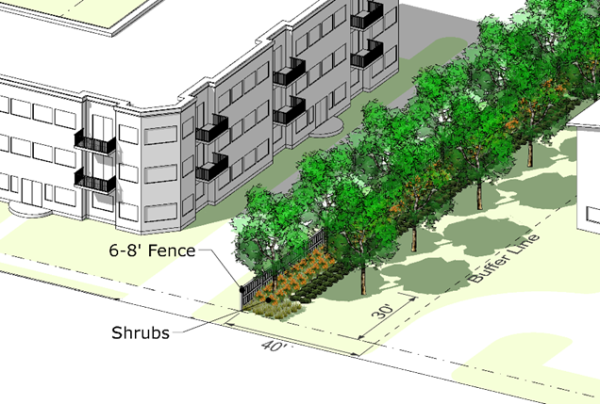
- The buffer shall be a minimum width of forty (40) feet with a six (6) to eight (8) foot fence.
- A minimum of two (2) canopy trees shall be planted staggering every thirty (30) feet along the entire length of the buffer.
- Four (4) rows of shrubs shall be planted along the entire length of the buffer with a maximum spacing of ninety percent (90%) of the shrubs expected spread within three (3) years of planting.
- A minimum of fifty percent (50%) of all existing trees with a DBH of ten (10) inches or greater within a required buffer area shall be preserved. Construction activities such as grading and trenching shall not affect more than forty-five percent (45%) of the critical root zone of the tree to be preserved.
Fig. 14.12-4
14.12.3 Location
- The required buffer must be located within the outer perimeter of the lot, parallel to and extending to the property boundary line. A required buffer must be provided along the entire property line immediately abutting the protected adjacent property.
- A required buffer may not be located within any portion of an existing, dedicated, or reserved right-of-way.
- The buffer is not permitted within a public utility easement but the required buffer may abut the easement.
14.12.4 Encroachments
- The parking of vehicles and the placement of buildings, signs, or accessory structures, except for walls and fences, is not allowed in a required buffer.
- Breaks in the buffer for pedestrian, bicycle, and vehicle access shall be permitted. Driveways and walkways must cross a buffer at or near a perpendicular angle with appropriate site triangle visibility.
14.12.5 Credit For Existing Vegetation
- Existing canopy trees that are preserved with a minimum caliper of ten (10) inches measured at breast height may be used to reduce the amount of required canopy trees to be placed within a required buffer. Any area under the canopy of an existing canopy tree, will not be required to plant additional canopy trees in that area or be used in the calculation of the quantity of required canopy trees.
- The City Planner or their designated representative has the discretion to determine if a tree that is to remain is acceptable based on species, location, health, and possible detrimental effects on neighboring property or public property.
14.13.1 General Purpose
- Landscaping shall be required on all lots in all zoning districts that are being developed, redeveloped, or remodeled and require site plan review by the development review committee. Landscape designs shall incorporate appropriate plant material that will survive and flourish with comparatively little supplemental irrigation. These plants should be native and drought tolerant. Invasive species shall not be used. All open areas within a site shall contain grass, ground cover, or other living plant material.
- The following development activities are exempted from the landscape requirements:
- Additions or modifications to existing lots with existing detached dwellings and attached duplex dwellings.
- Land disturbing activities conducted for the purpose of restoration of streams, stream banks, riparian zones, or other environmentally protected areas.
- Repairs and/or construction deemed emergency in nature as determined by the Building Official, City Engineer, and/or City Planner.
14.13.2 Plant Material Standards
- Trees. Trees shall be separated into two (2) types: canopy trees and small trees.
- Canopy trees shall be a minimum of ten (10) feet in height and two (2) inches in caliper at the time of planting. A canopy shall obtain a minimum height at maturity of thirty-five (35) feet.
- Small trees shall be a minimum of eight (8) feet in height and one and a half (1 ½) inches in caliper or three-fourths (¾) inch in caliper per trunk for multi trunk trees at time of planting. A small tree shall obtain a minimum height at maturity of eighteen (18) feet and a maximum height of thirty-five (35) feet.
- Tree caliper shall be measured six (6) inches above the ground from the soil line of the container or root ball.
- Shrubs. Required shrubs shall be a minimum of number three (#3) container size at the time of planting. Shrubs shall be planted at a maximum on center distance of seventy-five percent (75%) of their mature spread.
- Grass. Grass areas may be sodded, plugged, sprigged, or seeded except that only sod shall be used on slopes, swales, detention ponds, or any other areas that are subject to erosion as determined by the city engineer during the review process. When grass seed is sown it shall be a variety of seed that produces complete coverage within ninety (90) days from sowing and in accordance with the City of Starkville Standards of Design & Specification.
- Ground cover. Ground cover areas shall be a maximum of eighteen (18) inches in height at maturity. Ground covers shall be planted at a spacing that would allow for complete coverage within three (3) growing seasons.
- Mulch. Mulch shall be provided in all landscape beds. Mulch shall be pine straw, pine bark, or shredded hardwood. Inorganic material such as rock, glass, or rubber chips is not considered mulch and shall not be permitted. Rock can be used as part of a stormwater management facility with the approval of the City Planner and/or City Engineer.
14.13.3 Plant Quality And Installation
All plant materials shall be of a species adaptive to the Starkville, Mississippi area and shall conform to the standards of the current edition of the American Standard for Nursery Stock
- Plant Quality.
- Trees, shrubs, and groundcovers shall be nursery grown and meet ANSI Z60.1 Standards. Materials should be free of disease and insect adults, eggs, pupae, or larvae. Plants should have well developed root systems and be free from physical damage or other conditions that would prevent correct growth habits.
- All grass sod shall be clean and reasonably free of stones or other debris, diseases, or noxious pests and also USDA- certified to be free of insect infestation, especially imported fire ants.
- Mulch shall be free of stones, debris, disease, and insect adults, eggs, pupae, or larvae.
- Installation.
- Landscape installation shall follow the approved site plan or landscape plan, including plant species, locations, sizes, quantities, and other green space requirements. Any proposed modification to the landscape plan of an approved site plan shall be subject to approval by the City Planner.
- All landscaping materials shall be installed in a professional manner, and according to accepted professional planting procedures. Any landscape material that fails to meet the minimum requirements at the time of installation shall be removed and replaced with acceptable materials.
- Planting areas that may be compacted or poorly drained such as landscaped parking islands and planting beds around buildings and roadways, should be backfilled with quality soil and organic matter to promote better plant establishment and growth.
- Irrigation systems are not required but are recommended to help maintain and promote the health and quality of the landscape.
- All trees, shrubs, and groundcovers shall be in a live and healthy condition as determined by the City Planner prior to issuance of a certificate of occupancy
14.13.4 Maintenance
- Trees, shrubs, and other landscaping materials approved as part of the site development plan, shall be considered binding elements of the project in the same manner as parking, building, materials, and other details. The applicant, owner, subsequent owners and their agents shall be responsible for the continued maintenance of all landscaping materials.
- All staking and guy wires shall be removed from any required tree within one (1) year of planting.
- Any watering bag attached to the trunk of a tree shall be monitored and adjusted so as not to damage the trunk of the tree. Attached watering bags should be within three (3) years of planting.
14.13.5 Landscape Standards
The following standards shall apply to all lots in all zoning districts that are being developed, redeveloped, or remodeled that require site plan review by the development review committee.
- Lot frontage along roadway
- The frontage along the roadway of all lots that do not contain parking or buildings shall require a landscaped area containing canopy trees.
- The spacing, height, and quantity of required canopy trees shall be as specified in the Development Standards Chart.
- If existing overhead utilities located along the property lines are not being proposed to be relocated on an existing site, canopy trees may be replaced with small trees only with the approval of the City Planner.
- Canopy trees planted within a sidewalk area must have a minimum open area around the base of the tree of four (4) feet by six (6) feet. The open area can be either planted or paved with pervious pavers.
- A minimum soil volume available for root growth shall be established under each tree. The minimum required soil volume for a street canopy tree shall be seven-hundred fifty (750) cubic feet with a minimum depth of two (2) feet. The use of soil cells under the pavement is highly encouraged.
- Within the sight triangle of access to a street, shrubs shall be replaced with approved ground covers. Canopy trees shall be planted as required.
- Parking lot perimeter islands
- The perimeter islands shall be planted with canopy trees, shrubs, groundcovers, and/or grass as required. Street screens, unless already required by the zoning district, may be used to reduce the number of required shrubs only with the approval of the City Planner. Perimeter islands with only mulch are not permitted.
- The spacing and quantity of plant material within perimeter islands shall be as specified in the Development Standards Chart.
- If existing overhead utilities located along the perimeter parking area(s) are not being proposed to be relocated on the site, canopy trees may be replaced with small trees only with the approval of the City Planner in coordination with the electric utility service provider.
- Perimeter parking area landscape beds shall be protected from damage by a six (6) inch by six (6) inch concrete curb. Wheel stops cannot be used as the only means of protection unless the perimeter parking area is part of an approved stormwater management plan.
- The amount of canopy trees and shrubs required may be reduced if it is determined by the City Planner that the proposed trees would adversely affect neighboring trees on adjacent property or right-of-way.
- Parking lot terminal islands
- The terminal islands shall be planted with canopy trees, shrubs, groundcovers, and/or grass as required. Terminal islands with only mulch are not permitted.
- The spacing and quantity of plant material within terminal islands shall be as specified in the Development Standards Chart.
- Landscape islands shall be protected from damage by a six (6) inch by six (6) inch concrete curb. Wheel stops cannot be used as the only means of protection unless the landscape island is a part of an approved stormwater management plan.
- If the proposed placement of any utilities or site lighting interferes with the landscape requirements of the terminal island, the terminal island shall be expanded to adequately accommodate the requirements of both. Canopy tree requirements for a landscape island shall not be reduced or removed to accommodate utilities or site lighting.
- Parking lot interior islands
The spacing and quantity of plant material within interior islands shall be as specified in the Development Standards Chart.
- The interior islands shall be planted with canopy trees, shrubs, groundcovers, and/or grass as required. Interior islands with mulch only are not permitted.
- Landscape islands shall be protected from damage by a six (6) inch by six (6) inch concrete curb. Wheel stops cannot be used as the only means of protection unless the interior island is part of an approved stormwater management plan.
- If the proposed placement of any utilities or site lighting interferes with the requirements of the landscape island, the landscape island shall be expanded to adequately accommodate the requirements of both. Canopy tree requirements of a landscape island shall not be reduced or removed to accommodate utilities or site lighting.
- Parking lot median islands
- The median islands shall be planted with canopy trees, shrubs, groundcovers, and/or grass as required. Median islands with only mulch are not permitted.
- The spacing and quantity of plant material within median islands shall be as specified in the Development Standards Chart.
- Median islands shall have a minimum inside bed area width of five (5) feet and be planted with a combination of canopy trees, shrubs, and groundcovers. Median islands with a minimum inside bed area width greater than twelve (12) feet can substitute shrubs and groundcover with grass for up to seventy-five percent (75%) of the bed area.
- If the proposed placement of any utilities or site lighting interferes with the requirements of the median island, the median island shall be expanded to adequately accommodate the requirements of both. The canopy tree requirements of a median island shall not be reduced or removed to accommodate utilities or site lighting.
- The maximum spacing requirements may be adjusted by the City Planner if existing trees are proposed to be saved with adequate protection from grading and pavement.
- Open space
- Open space shall include all areas that are outside of the undisturbed site areas, building(s) footprint, a parking area(s), hardscape areas, stormwater facilities, overhead utility easements, and are not part of the roadway frontage, perimeter parking, and interior parking areas requirements.
- Any existing canopy tree with a minimum caliper of ten (10) inches measured at breast height that is proposed to remain and will be properly protected from damage by construction activities can be included in the percentage of canopy coverage for open space requirement. The City Planner has the discretion to determine if a tree is acceptable based on species, location, health, and possible detrimental effects on neighboring property or public property.
- An existing canopy tree used as part of the percentage of canopy coverage calculation that is lost during or after construction shall be replaced with three (3) canopy trees.
14.13.6 Review And Approval Procedure
- Landscape plans shall be subject to review and approval as part of the site plan review process.
- Substitutions of plant material species can be approved by the City Planner without reapproval of the site plan.
- No certificate of occupancy shall be issued until all landscaping is completed in accordance with the approved site plan.
- If landscaping is incomplete, a temporary certificate of occupancy may be issued in accordance with section 17.5.2.A.
14.16.7 Landscape Waiver
Any deviation from the landscaping requirements on the development standards chart or in this section shall be required to receive approval through the Landscape Waiver process in accordance with section 3.11.
14.14.1 Private Drives Within New And Existing Developments With Multiple Buildings May Be Addressed Off Of The Name Of The Private Drive At The Discretion Of The City Planner
Private drives within new and existing developments with multiple buildings may be addressed off of the name of the private drive at the discretion of the City Planner. In no case shall names of private drives duplicate or be confused with existing street names located within the City of Starkville or Oktibbeha County.
14.14.2 Similar Use Of Words
Words that are part of a name and are generic in their meaning (e.g. “river,” “woods,” “hills”) shall not be considered as duplicates of other similar uses of words.
14.14.3 House And Building Numbers
House or building numbers shall conform to the system established for the City.
14.15.1 General Provisions
- The requirements of this section shall apply to any condominium. Existing structures shall not be converted into condominiums unless the building and site meet all current development standards, use standards, and building codes. The burden of demonstrating compliance shall be placed on the applicant.
- No person shall commence the construction or conversion of a condominium without first obtaining an approved condominium plat and building permits. Site plan approval and building design plan may be required in accordance with sections 3.9 and 3.10.
- Condominiums may be commercial, residential, industrial, or mixed-use. Single-dwelling unit developments shall not be permitted to be approved as or converted to a condominium, unless as a part of an approved cottage court development.
14.15.2 Improvements
- Building Code. All applicable provisions of the adopted Building Code shall be complied with.
- Use Standards and Development Standards. All applicable provisions of the Use Standards and Development Standards shall be complied with.
- Establishment and maintenance of utilities. Utility lines located within a lot or parcel of land and serving only one lot or parcel shall not be maintained by the city except as notated on the approved site plan.
- Connectivity Required. A public road may be required by the City Engineer or Development Review Committee to connect to adjacent property or adjacent public roads. Determination of the location of connections shall be made by the Development Review Committee based on adjacent existing developments, proposed future development, and/or potentially developable vacant land.
- Streets.
- The City Engineer shall review the proposed public road and shall classify all the roads in one of the categories listed in the City of Starkville Standards of Design & Specifications.
- New public streets shall be built in accordance with section 15.4.
- The City Engineer may require the applicant to prepare and submit a traffic impact study for any proposed site that would generate one hundred (100) or more total trips during the peak hour of the traffic generator or the peak hour of the adjacent street as outlined and illustrated in the latest versions of the Mississippi Department of Transportation Access Management Manual or for a proposed project which may generate traffic issues.
- The Traffic Impact Study format and requirements shall conform to the City of Starkville Standards of Design and Specifications for Subdivisions.
- Where the traffic impact study indicates an impact greater than the allowable thresholds, the applicant shall prepare and submit a traffic mitigation plan to the City Engineer. The mitigation plan shall identify capital projects and phasing strategies that would bring the development impact to within the acceptable thresholds. This plan may identify improvements undertaken by the private sector, the public sector, or both. Condominium plat approval shall not be granted until the City Engineer determines that the plan provides reasonable and adequate mitigation. Factors to be considered include whether: the cost of the mitigation measures exceeds the value of the proposed development; transportation demand management strategies including multi-modal improvements are included; alternative access strategies are considered.
- Turning lanes shall be provided at heavily traveled intersections as determined by the City Engineer. It will be the responsibility of the developer to pay for the costs for the roadway improvements; however, the City Board of Aldermen may elect to participate in some of the construction costs upon written request of the developer.
- Utility Easements. Appropriate access and utility easements shall be provided as depicted in the private street cross-sections as included in the applicable code section(s) in the Starkville Code of Ordinances, chapter 98, streets, sidewalks, and other public places. The following language shall be included on both the face of the plat as well as in the condominium declaration regarding easements: "The undersigned owner of (condominium development), as shown on the condominium plat and as described in the condominium declarations, does convey to the City of Starkville, Mississippi, along with the right of ingress and egress, all utilities and utility easements to be used by the City of Starkville, Mississippi for providing public services, along with permanent, and perpetual utility easements. It is understood and agreed that the City of Starkville is held harmless from liability or payment of compensation to the abutting property owners, or entity deriving therefrom, for damages resulting from utility line failures or damages to improvements within the aforementioned easements, up to, but not limited to buildings, light fixtures, mailboxes, ornamental landscaping, turf grass, fences, along with private road surfaces, curbs and gutters, sidewalks, as a result of ingress, egress and the maintenance or replacement of utilities."
- Parking. If the City Engineer determines that the road type is appropriate and the Development Review Committee approves, parallel on-street parking may be allowed along public roads. On-street parking shall not be included in the minimum required parking for the use unless otherwise allowed in the Unified Development Code.
- Sidewalks.
- Sidewalks shall be constructed to allow for interior connectivity between all common spaces and public spaces to individual units.
- Sidewalk access shall be provided from each building within a condominium development or by a shared sidewalk connecting all common spaces and individual units to the street. The location of the shared sidewalk shall be approved by the Development Review Committee.
- Sidewalks shall be required along the public right-of-way in accordance with section 14.11.
14.15.3 Variances And Administrative Adjustments
Any deviation from the requirements of this section shall be in accordance with the procedures and processes in Section 3 in this Unified Development Code.
14.6.2.4 - Site Lighting And Building Illumination
| Site Lighting and Building Illumination | RN | SD-2 | SD-6 | TN-N | TN-E | MDU-9 | MDU-20 | CN | C | CR | I | T-4 | T-5D | T-5C | T-5U | S-M | S-I | S-E | O-TND | O-CD | O-I | O-C | O-E | O-TN |
| Streets, driveways, parking lots, pedestrian areas, and service areas shall be adequately illuminated as evenly as possible. The maximum light level of any light fixture cannot exceed half (0.5) a foot candle measured at the property line of any Residential District and two (2) foot candles measured at the right-of-way line of a street. Lighting intensity shall be demonstrated by means of a site lighting plan illustrating compliance. | ⬜ | -- | -- | ⬜ | ⬜ | ⬛ | ⬛ | ⬛ | ⬛ | ⬛ | ⬛ | ⬜ | ⬛ | ⬛ | ⬛ | ⬛ | ⬛ | ⬛ | ⬜ | -- | ⬛ | ⬛ | ⬜ | ⬜ |
| Lighting shall be shielded, shaded, or directed to prevent light from being cast on adjacent property. Pole-mounted lighting shall be fully cut off with shields, reflectors, or refractor panels to direct and cut off emitted light at ninety (90) degrees or less. | ⬛ | ⬛ | ⬛ | ⬛ | ⬛ | ⬛ | ⬛ | ⬛ | ⬛ | ⬛ | ⬛ | ⬛ | ⬛ | ⬛ | ⬛ | ⬛ | ⬛ | ⬛ | ⬛ | ⬛ | ⬛ | ⬛ | ⬛ | ⬛ |
| No exterior lighting fixture shall be placed or directed so as to interfere with the operation of vehicles within the public right-of-way. | ⬛ | ⬛ | ⬛ | ⬛ | ⬛ | ⬛ | ⬛ | ⬛ | ⬛ | ⬛ | ⬛ | ⬛ | ⬛ | ⬛ | ⬛ | ⬛ | ⬛ | ⬛ | ⬛ | ⬛ | ⬛ | ⬛ | ⬛ | ⬛ |
| No exterior light shall have any blinking, flashing, or fluttering light, or other illuminating device which has a changing light intensity or brightness of color. | ⬛ | ⬛ | ⬛ | ⬛ | ⬛ | ⬛ | ⬛ | ⬛ | ⬛ | ⬛ | ⬛ | ⬛ | ⬛ | ⬛ | ⬛ | ⬛ | ⬛ | ⬛ | ⬛ | ⬛ | ⬛ | ⬛ | ⬛ | ⬛ |
| Pole mounted lighting shall be required within a parking lot with more than fifteen (15) parking spaces. | ⬛ | -- | -- | ⬜ | ⬜ | ⬛ | ⬛ | ⬛ | ⬛ | ⬛ | ⬛ | ⬜ | ⬛ | ⬛ | ⬛ | ⬛ | ⬛ | ⬛ | ⬛ | ⬛ | ⬛ | ⬛ | ⬛ | ⬜ |
| Pole mounted lighting shall not exceed twenty (20) feet in height within a parking lot, vehicular display area, or service area. | ⬛ | -- | -- | ⬜ | ⬜ | ⬛ | ⬛ | ⬛ | -- | ⬛ | -- | ⬜ | ⬛ | ⬛ | ⬛ | -- | -- | -- | ⬛ | ⬛ | -- | -- | ⬛ | ⬜ |
| Pole mounted lighting shall not exceed thirty (30) feet in height within a parking lot, vehicular display area, or service area. Pole mounted lighting within fifty (50) feet of residential use districts cannot exceed twenty (20) feet in height. | -- | -- | -- | -- | -- | -- | -- | -- | ⬛ | -- | ⬛ | -- | -- | -- | -- | ⬛ | ⬛ | ⬛ | -- | -- | ⬛ | ⬛ | -- | -- |
| Pole mounted lighting shall not exceed a maximum height of fifteen (15) feet within pedestrian areas. | -- | ⬛ | ⬛ | ⬛ | ⬛ | ⬛ | ⬛ | ⬛ | ⬛ | ⬛ | -- | ⬛ | ⬛ | ⬛ | ⬛ | ⬛ | ⬛ | ⬛ | ⬛ | ⬛ | -- | ⬛ | -- | ⬛ |
14.6.2.7 - Buffers
| Buffers | RN | SD-2 | SD-6 | TN-N | TN-E | MDU-9 | MDU-20 | CN | C | CR | I | T-4 | T-5D | T-5C | T-5U | S-M | S-I | S-E | O-TND | O-CD | O-I | O-C | O-E | O-TN |
| Separation Buffers shall be required according to Development Standards. | -- | ⬛ | ⬛ | ⬛ | ⬛ | ⬛ | ⬛ | ⬛ | ⬛ | ⬛ | ⬛ | ⬛ | ⬛ | ⬛ | ⬛ | ⬛ | ⬛ | ⬛ | ⬛ | ⬛ | ⬛ | ⬛ | -- | ⬛ |
14.7.8.A Wall Sign
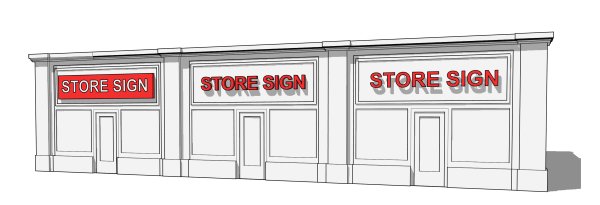 Fig 14.7-3
- Description
- A wall sign is a sign attached flat to, painted on, or mounted away from but parallel to the building wall.
- A sign permit is required for a wall sign.
- Size Requirements
- The copy area or sign area, whichever is greater, of a wall sign shall not exceed fifty percent (50%) of the square footage of the facade face of the building and not to exceed one hundred fifty (150) square feet in size.
- The sign area of a wall sign in Form-based districts shall not exceed three (3) feet in height and ninety percent (90%) of the width of the facade face.
- The sign area of a wall sign in TN-N, TN-E, MU-9, and MU-20 districts shall not exceed three (3) feet in height and fifty percent (50%) of the width of the facade face up to a maximum of fifty (50) square feet in size.
- Wall signs shall not extend out more than twelve (12) inches from the building wall.
- Location
- No portion of a wall sign may extend above the roof line of a building without a parapet wall. No portion of a wall sign shall extend above the parapet without a use exception being granted.
- No wall sign may extend above the lower eave line of a building with a pitched roof.
- The minimum clearance above a walkway or public sidewalk from the bottom of a wall sign shall be eight (8) feet.
- Additional Standards
- The font height of wall signs in the TN-N, TN-E, and Form-based Districts shall not exceed eighteen (18) inches.
- Wall signs in the TN-N, TN-E, and Form-based Districts shall not be internally illuminated. Halo-type or backlit illumination is not considered internally illuminated. Push thru letters with an opaque letter face are allowed.
- If the primary structure is located more than two hundred (200) feet from the nearest adjacent street, the square footage of a wall sign may be increased to two hundred and fifty (250) square feet in a Commercial, Industrial, Optional- Commercial use district, or Optional- Industrial use district if the sign is not visible from the nearest adjacent street.
- Painted wall signs shall meet all size and location requirements in addition to being painted in a professional and contextually complementary manner. An artistic mural that is not related to the use of the building or site is not considered a wall sign and is not regulated by this section.
- This sign type is only allowed in RN and O-E zoning districts with an approved commercial or multi-dwelling unit residential use.
- This sign type is only allowed in TN-N and TN-E zoning districts with an approved commercial use or use exception for existing use.
14.7.8.B Projecting Sign
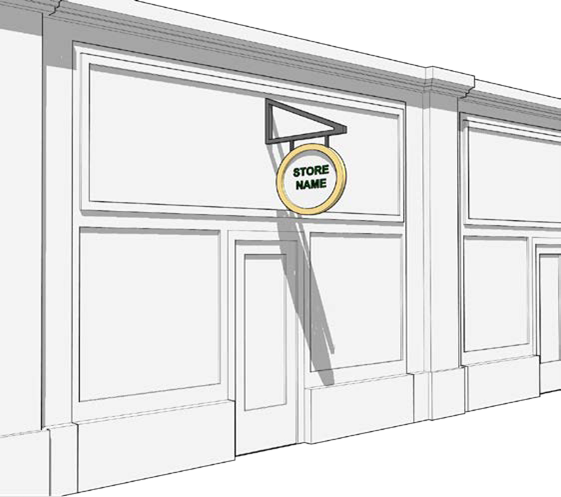
Fig 14.7-4
- Description
- A projecting sign is a two-sided sign mounted onto the building facade at a right angle to the building facade. These signs are small, pedestrian scaled, and easily read from both sides.
- A sign permit is required for a projecting sign.
- Size Requirements
- The sign area of a projecting sign shall not exceed six (6) square feet in area.
- The maximum width and height dimension is four (4) feet.
- The font height shall be a maximum of eight (8) inches.
- Location
- The minimum clearance above a walkway or public sidewalk from the bottom of a wall sign shall be eight (8) feet.
- The maximum projection of the sign from the building facade shall be four and a half (4 ½) feet.
- A maximum of one (1) projecting sign per tenant per street frontage is allowed.
- Additional Standards
- Projecting signs in Form-based Districts shall not be internally illuminated. Halo-type or backlit illumination is not considered internally illuminated. Push thru letters with an opaque letter face are allowed.
- This sign type is only allowed in RN and O-E zoning districts with approved commercial or multi-dwelling unit residential use.
14.7.8.C Suspended Sign
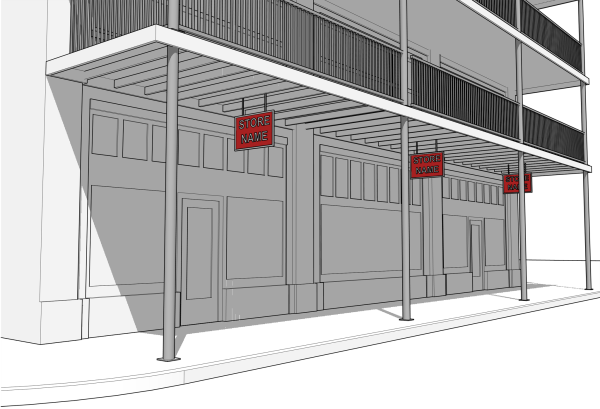
Fig 14.7-4
- Description
- A suspended sign is a two-sided sign mounted to the underside of beams or ceilings of a porch, gallery, arcade, breezeway, or similar covered area. They are typically hung in a manner that permits them to swing slightly. These signs are small, pedestrian scaled, and easily read from both sides.
- A sign permit is required for a suspended sign.
- Size Requirements
- The sign area of a suspended sign shall not exceed six (6) square feet in area.
- The maximum width and height dimension is four (4) feet.
- The font height shall be a maximum of eight (8) inches.
- Location
- A minimum clearance above a walkway or public sidewalk from the bottom of a suspended sign shall be eight (8) feet.
- A maximum of one (1) sign per tenant per street frontage is allowed.
- Additional Standards
- Suspended signs in Form-based Districts shall not be internally illuminated. Halo-type or backlit illumination is not considered internally illuminated. Push thru letters with an opaque letter face are allowed.
- This sign type is only allowed in RN and O-E zoning districts with approved commercial or multi-dwelling unit residential use.
14.7.8.D Awning Sign
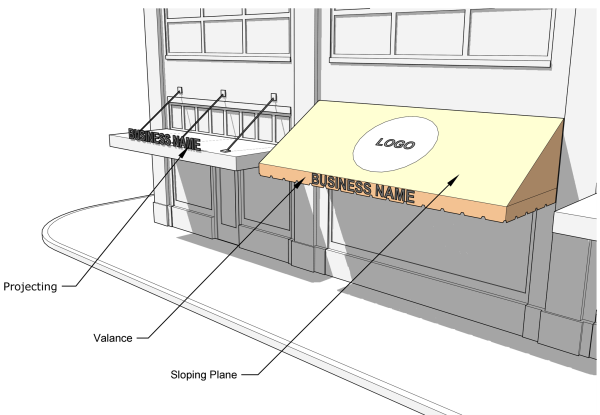
Fig 14.7-6
- Description
- An awning sign is a sign where lettering or logos are applied directly to any portion of an awning or gallery.
- A sign permit is required for an awning sign.
- Size Requirements
- Projecting:
- The font height shall be a maximum of sixteen (16) inches.
- The font depth shall be a maximum of six (6) inches.
- Sloping Plane:
- A maximum of twenty-five (25) square feet of surface area can be covered by logos, pictures, or fonts.
- The font height shall be a maximum of eighteen (18) inches.
- Valance:
- A maximum of seventy-five percent (75%) of the surface area can contain lettering and logos.
- The font height shall be a maximum of ten (10) inches.
- Projecting:
- Additional Standards
- Awning signs shall not extend outside the overall length or width of an awning or gallery or extend above the height of the building wall from which the awning or gallery is attached.
- Only one (1) awning sign with signage on the sloping plane per facade face per tenant is allowed.
- This sign type is only allowed in RN and O-E zoning districts with approved commercial or multi-dwelling unit residential use.
14.7.8.E Marquee Sign
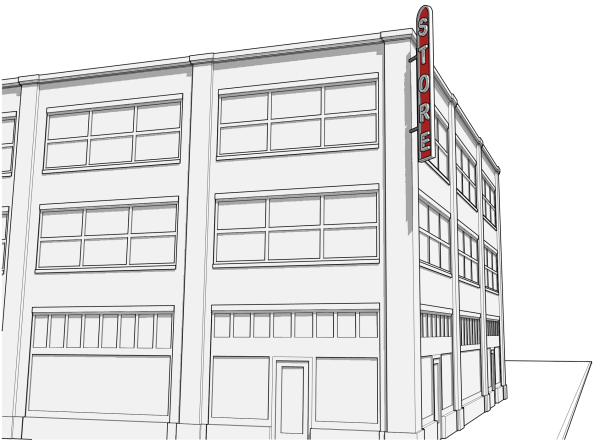
Fig 14.7-7
- Description
- A marquee sign is a vertical sign that is located at the street or alley corner of the building located on a corner lot, where it projects at a forty- five (45) degree angle. Marquee signs often extend beyond the parapet of the building, but may also terminate below the cornice or eave.
- A sign permit is required for a marquee sign.
- Size Requirements
- The maximum width is twenty-four (24) inches and the depth is ten (10) inches.
- The font height shall be a maximum of eighteen (18) inches.
- Location
- A minimum clearance above a walkway or public sidewalk from the bottom of a wall sign shall be eight (8) feet.
- Marquee signs may extend a maximum of three (3) feet above the parapet of the building.
- Marquee signs may not extend beyond the eaves of a pitched roof.
- Additional Standards
- Neon lettering may only be used in conjunction with painted lettering backing the neon.
- Marquee signs shall only be located along or oriented toward a street frontage.
- Only one (1) sign is allowed per building with a maximum of one (1) sign per block face.
- Existing marquee type signs prior to the adoption of this code shall be allowed to remain and be replaced with similar signage.
- Marquee signs in Form-based Districts shall not be internally illuminated. Halo type or backlit illumination is not considered internally illuminated. Push thru letters with an opaque letter face are allowed.
- This sign type is only allowed in RN and O-E zoning districts with approved commercial or multi-dwelling unit residential use.
14.7.8.F Window Sign

Fig 14.7-8
- Description
- A window sign is an on-premise sign attached to or parallel to the inside of a window and within thirty-six (36) inches of the surface of the window.
- Window signs shall not interfere with the primary function of windows, which is to enable passersby and public safety personnel to see through windows into premises and view product displays.
- Vinyl window graphics, either perforated or frosted, shall be considered a window sign.
- A sign permit is not required for a window sign, but requirements must be followed.
- Size Requirements
- A window sign shall not exceed twenty-five percent (25%) of coverage for any individual window or door.
- Perforated vinyl window graphics shall be measured from the outside edge of the graphic. The perforation shall not be used to measure the percent of coverage for any individual window or door.
- Additional Standards
- This sign type is only allowed in RN and O-E zoning districts with approved commercial or multi-dwelling unit residential use.
14.7.8.G Nameplate Sign
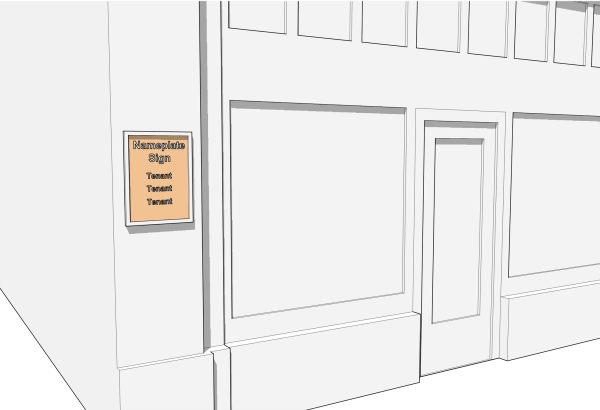
Fig 14.7-9
- Description
- A nameplate sign is a sign consisting of either a panel or individual letters applied to a building that lists the names of a building’s tenants.
- A sign permit is not required for a nameplate sign and it is limited to one (1) per address, but requirements must be followed.
- Size Requirements
- The sign area of a nameplate sign shall not exceed three (3) square feet in area.
- The maximum width and height dimension are twenty-four (24) inches.
- The maximum depth is three (3) inches.
- The font height shall be a maximum of six (6) inches.
- Location
- A nameplate sign shall be placed on a wall adjacent to the entrance between four (4) and seven (7) feet above the walkway.
- Additional Standards
- This sign type is only allowed in RN and O-E zoning districts with approved commercial or multi-dwelling unit residential use.
14.7.8.H Address Sign
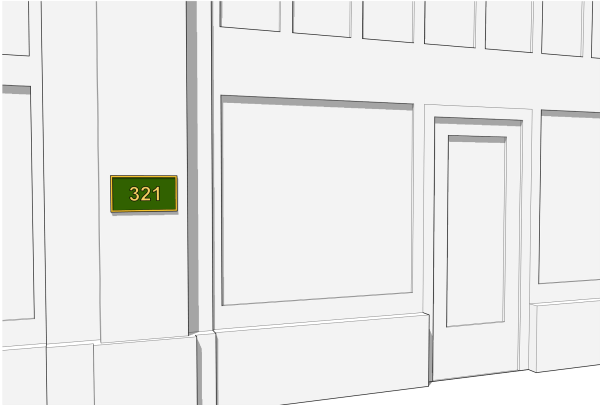
Fig 14.7-10
- Description
- An address sign is generally applied to a building wall or as a part of a permitted freestanding sign. Addressing on mailboxes are exempt from these requirements.
- A sign permit is not required for an address sign and is limited to one (1) per address, but requirements must be followed.
- Size Requirements
- The sign area of an address sign shall not exceed two (2) square feet in area.
- The maximum width is twenty-four (24) inches.
- The maximum height is twelve (12) inches.
- The maximum depth is three (3) inches.
- The font height shall be a maximum of six (6) inches.
- Location
- Address signs shall be placed between four (4) and eight (8) feet above the walkway if applied to the building.
14.7.8.I Outdoor Display Case
Fig 14.7-11
- Description
- An outdoor display case is a sign type that consists of a lockable metal or wood framed cabinet with a transparent window or windows, mounted onto a building wall or freestanding support. It allows the contents, such as menus, maps, or directories to be maintained and kept current.
- A sign permit is not required for an outdoor display case and it is limited to one (1) per address, but requirements must be followed.
- Size Requirements
- The outdoor display case shall not exceed eight (8) square feet in area.
- The maximum height is forty (40) inches.
- The maximum width is forty (40) inches.
- The maximum depth is four (4) inches.
- Location
- Outdoor display cases shall be placed between four (4) and eight (8) feet above the walkway.
- Additional Standards
- Outdoor display cases may be internally illuminated.
14.7.9.A Monument Signs
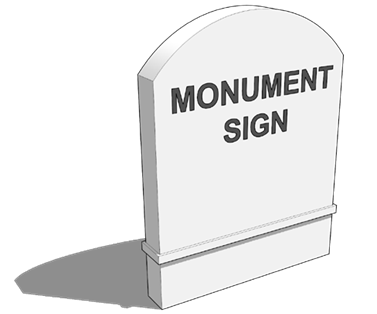
Fig 14.7-12
- Description
- A monument sign is a freestanding on-premise sign with one (1) or two (2) sides attached to a permanent foundation or decorative base and not attached or dependent on support from any building, pole, posts, or similar uprights on a site with one (1) or multiple tenants.
- A sign permit is required for a monument sign.
- Size Requirements
- Monument signs shall not exceed eighty (80) square feet in sign area.
- The maximum height is eight (8) feet above the finished grade.
- The maximum width is twelve (12) feet.
- The maximum depth is twenty-four (24) inches.
- Location
- No sign shall be placed closer than five (5) feet to the right-of-way of a street.
- No sign shall be placed within a sight triangle of a street or driveway.
- Only one (1) sign is allowed for every three-hundred and thirty (330) linear feet of street frontage and a minimum separation of two-hundred (200) feet between multiple signs is required on a site.
- Additional Standards
- A planted and maintained landscape area of thirty-six (36) inches wide shall be provided around the base of every monument sign.
- Electronic message centers can be attached to monument signs per zoning district requirements.
- Monument signs shall have exterior finishes matching or complimenting the finishes on the facade of the primary building and shall comply with minimum facade standards for that district.
- Hand painted lettering or logos shall not be permitted to be attached to or a part of monument signs unless otherwise approved by the City Planner.
- Monument signs can be internally or externally illuminated. The use of exposed neon tubing is not permitted.
- In zoning districts where monument signs are permitted, the maximum square footage may be increased to one hundred and sixty (160) square feet and the overall height increased to sixteen (16) feet if located adjacent to US Highway 82 and/or US Highway 25 where the posted speed limit is sixty (60) miles per hour or more.
- In MU-9 zoning districts sign area shall be less than forty (40) square feet with a maximum height of six (6) feet.
- This sign type is only allowed in RN and O-E zoning districts with approved commercial or multi-dwelling unit residential use.
- In T-5D, T-5U, and T-5C, zoning districts sign area shall be less than sixty (60) square feet with a maximum height of six (6) feet. Monument signs shall only be allowed on lots where the existing building exceeds the maximum setback for that zoning district. Corner lots are not eligible for monument sign types unless approved as a Use Exception.
14.7.9.B Multi-Tenant Signs
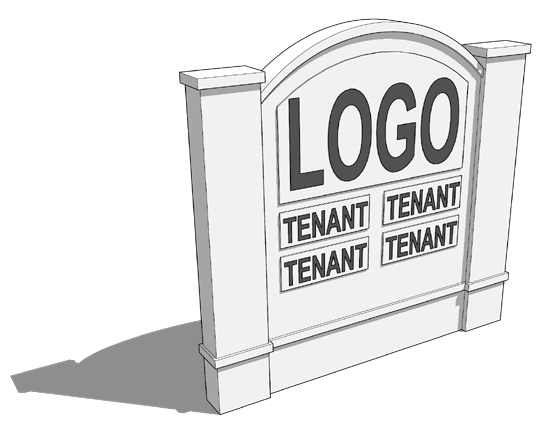
Fig 14.7-13
- Description
- A multi-tenant sign is a freestanding on-premise sign with one (1) or two (2) sides attached to a permanent foundation or decorative base and not attached or dependent on support from any building, poles, posts, or similar uprights on a site with more than three (3) tenants and more than twenty-five thousand (25,000) square feet of gross floor space.
- A sign permit is required for a multi-tenant sign.
- Size Requirements
- A multi-tenant sign shall not exceed one hundred (100) square feet in sign area.
- The maximum height is twelve (12) feet above the finished grade.
- The maximum width is eighteen (18) feet.
- The maximum depth is twenty-four (24) inches.
- Location Requirements
- No sign shall be placed closer than five (5) feet to the right-of-way of a street.
- No sign shall be placed within a sight triangle of a street or driveway.
- Only one (1) sign is allowed for every three-hundred and thirty (330) linear feet of street frontage and a minimum separation of two-hundred (200) feet between multiple signs is required on a site.
- Additional Standards
- A planted and maintained landscape area of thirty-six (36) inches wide shall be provided around the base of every multi-tenant sign.
- Electronic message centers can be attached to multi-tenant signs per zoning district requirements.
- Multi-tenant signs shall have exterior finishes matching or complimenting the finishes on the facade of the primary building and shall comply with minimum facade standards for that district.
- Hand painted lettering or logos shall not be permitted to be attached to or a part of monument signs unless otherwise approved by the City Planner.
- Multi-tenant signs can be internally or externally illuminated. The use of exposed neon tubing is not permitted.
- In zoning districts where multi-tenant signs are permitted, the maximum square footage may be increased to one hundred and ninety (190) square feet and the overall height increased to sixteen (16) feet if located adjacent to US Highway 82 and/or US Highway 25 where the posted speed limit is sixty (60) miles per hour or more.
- This sign type is only allowed in RN and O-E zoning districts with approved commercial or multi-dwelling unit residential use.
14.7.10.A Standards Applying To All Temporary Signs
- Standards Applying to All Temporary Signs
- Temporary signs shall not be mounted, attached, affixed, installed, or otherwise secured in a manner that will make the sign a permanent sign.
- No temporary sign shall be allowed to protrude above the roofline of a structure.
- Temporary signs shall not be illuminated.
- No temporary sign shall require a foundation, support, wiring, fittings, or elements that would traditionally require a building permit or electrical permit.
- No streamers, spinning, flashing, or similarly moving devices shall be allowed as part of or attached to a temporary sign.
- All temporary signs shall be secured in such a manner as to prevent swinging or other significantly noticeable movement resulting from the wind that could pose a danger to people, vehicles, or structures.
- Mobile signs on wheels, runners, casters, parked trailers, parked vehicles, or other temporary or movable sign types shall not be permitted unless otherwise specifically stated in this chapter.
- Because of the nature of materials typically used to construct temporary signs and to avoid the unsightliness of deteriorating signs and all safety concerns which accompany such a condition, temporary signs shall be removed or replaced when such a sign has deteriorated as determined by the Code Enforcement Officer.
14.7.10.B Sidewalk
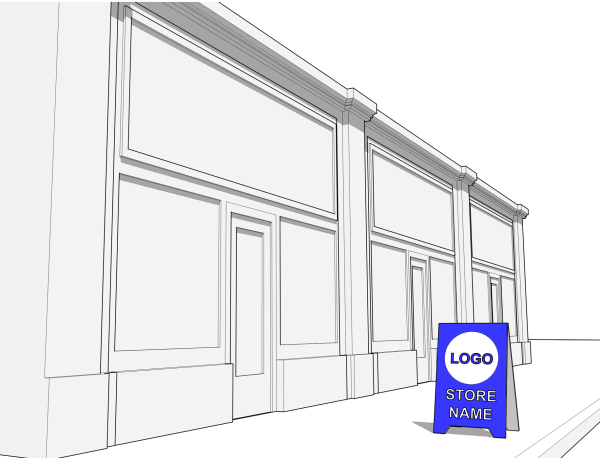
Fig 14.7-14
- Description
- A sidewalk sign is an A-Frame or T-Frame type sign that is readily movable and is not permanently attached to the ground or any structure.
- A sign permit is not required for a sidewalk sign and it is limited to one (1) per tenant, but requirements must be followed.
- Size Requirements
- The maximum height is forty-two (42) inches.
- The maximum width is twenty-six (26) inches.
- Location
- Sidewalk signs can be located on a walkway or on a public sidewalk if a minimum of four (4) feet of clear path for pedestrians is maintained.
- A sidewalk sign shall not obstruct access to parking meters, bicycle racks, and other features legally in the right-of-way. The sign must not interfere with: the opening of doors of legally parked cars, with the operation of wheelchair lifts and ramps, access to a loading zone, visibility of a fire hydrant, or access to bus stops.
- A sidewalk sign is only allowed adjacent to the building occupied by the tenant.
- Duration
- Signs shall only be displayed during the operating hours of the tenant.
- Additional Standards
- Sidewalk signs are allowed for commercial uses approved by a use exception or a special exception in TN-N districts.
14.7.10.C Banner Sign
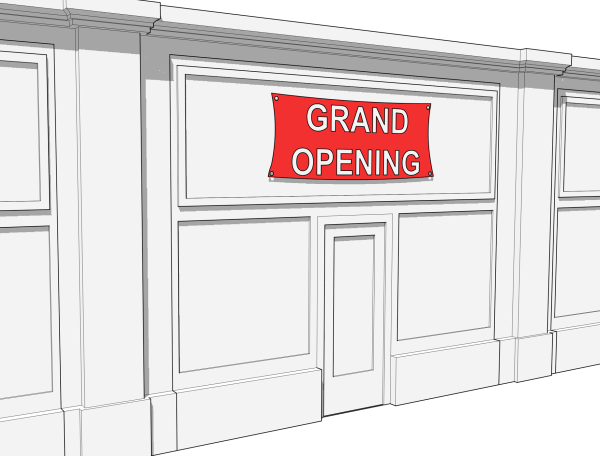
Fig 14.7-15
- Description
- A banner sign is constructed of canvas, plastic, fabric, or similar lightweight, non-rigid material that can be mounted to a permanent structure with cord, rope, cable or a similar method.
- There shall be a maximum of two (2) faces to a banner sign, mounted back-to-back. Double-sided and back-to-back banners shall be measured by the surface area of one (1) face.
- Banner signs across a public street require approval by the Board of Aldermen as part of a Special Event application.
- A sign permit is required for a banner sign.
- Approved special events and recurring events on city property are exempt from these provisions.
- Banners on public property placed by a non-profit organization shall be allowed to locate multiple banners under one permit with no fee.
- Residential districts
- Size Requirements
- The maximum banner sign size shall be six (6) square feet.
- Location
- No banner sign shall be placed closer than five (5) feet to the right-of-way of a street unless attached to a building that is closer than five (5) feet to the right-of-way.
- No banner sign shall be placed within a sight distance triangle of a street or driveway.
- Duration
- The maximum duration for any banner sign shall be three (3) days per permit period with a maximum of six (6) permit periods per year.
- Size Requirements
- Non-residential districts and mixed-use districts
- Size Requirements
- The maximum banner sign size shall be twenty-four (24) square feet.
- The maximum banner sign size shall be sixty (60) square feet across a public street with approval by the Board of Aldermen as part of a Special Event application. The banner shall have perforations to reduce the wind load and have eyelets spaced a maximum of twenty-four (24) inches along the top and bottom for mounting.
- Location
- No banner sign shall be placed within a sight distance triangle of a street or driveway.
- In a multi-tenant building, a banner sign shall be allowed for each tenant.
- Duration
- The maximum duration for any banner sign shall be fifteen (15) days per permit period with a maximum of six (6) permit periods per year.
- Size Requirements
14.7.10.D Yard Sign
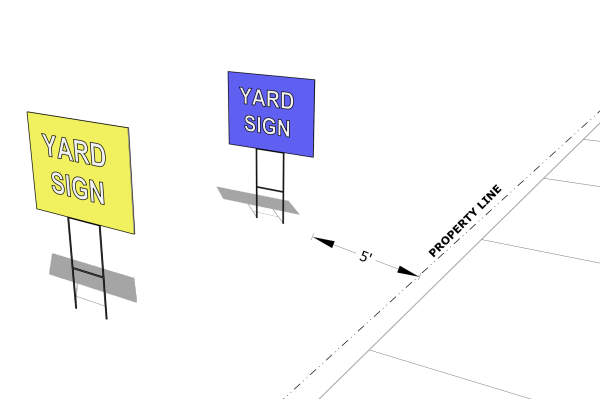
Fig 14.7-16
- Description
- A yard sign is any temporary sign placed on the ground or attached to a supporting structure, posts, or poles, and that is not attached to any building or permanently attached to the ground.
- There shall be a maximum of two (2) faces to the sign, mounted back-to-back. Double-sided or back-to-back signs shall be measured by the surface area of one (1) face.
- A sign permit is not required for a yard sign, but requirements must be followed.
- Residential districts
- Size Requirements
- For lots less than two (2) acres, a maximum individual sign size of four (4) square feet is permitted. The total square footage of all individual signs shall not exceed sixteen (16) square feet.
- For lots greater than two (2) acres, a maximum individual sign size of sixteen (16) square feet is permitted. The total square footage of all individual signs shall not exceed sixteen (16) square feet.
- Location
- No sign shall be placed closer than five (5) feet to the right-of-way of a street.
- No sign shall be placed within a sight triangle of a street or driveway.
- Duration
- The maximum duration for any yard sign shall be ninety (90) days or until the conclusion of the event.
- Size Requirements
- Non-Residential and Mixed-Use Districts
- Size Requirements
- The maximum total square footage of all temporary signs on any non-residential or mixed-use district zoned property with an existing building is four (4) square feet.
- The maximum total square footage of all temporary signs on any vacant non-residential or mixed-use district zoned property is sixteen (16) square feet.
- The maximum total square footage of all temporary signs on any vacant non-residential or mixed-use district zoned property is thirty-two (32) square feet if located adjacent to US Highway 82 and/or US Highway 25 where the posted speed limit is sixty (60) miles per hour or more.
- Location
- No sign shall be placed within a sight triangle of a street or driveway.
- No sign shall obstruct any walkway or public sidewalk.
- Duration
- The maximum duration for any yard sign shall be thirty (30) days or until the conclusion of the event.
- Size Requirements
14.7.10.E Fence Screen Sign
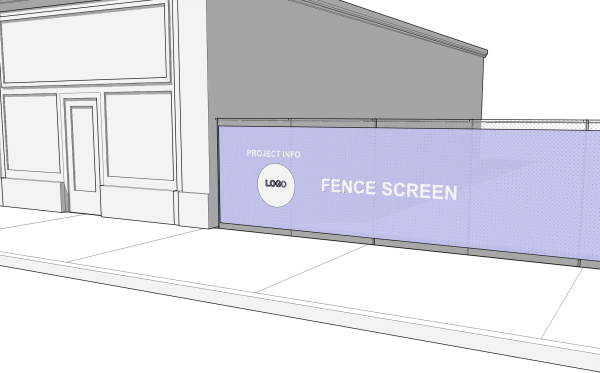
Fig 14.7-17
- Description
- A fence screen sign is signage applied to a required fence screen to prohibit views into an active construction site.
- Both a sign permit and an active building permit are required for a fence screen sign.
- Size Requirements
- A fence screen sign shall be sufficiently sized to completely cover the required fence screen.
- Location
- Fence screen signs shall be placed on the outside street facing portion of any required fence screen.
- Fence screens shall not block any pedestrian walkway or street unless approved by the Development Review Committee as part of the site plan approval process.
- No sign shall be placed within a sight triangle of a street or driveway.
- Duration
- A fence screen shall be allowed from the issuance of a building permit until the issuance of a certificate of occupancy.
14.7.10.F Construction Sign
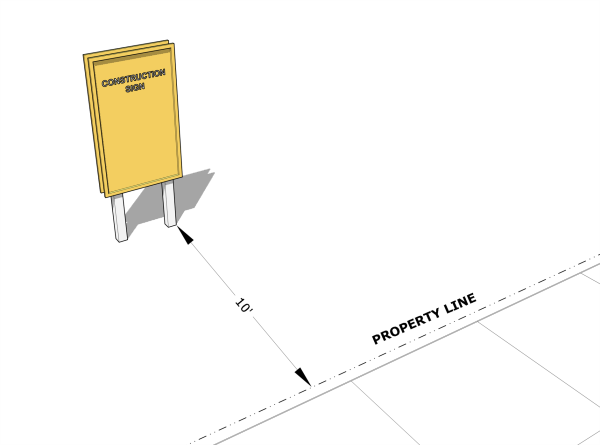
Fig 14.7-18
- Description
- A construction sign is a temporary sign attached to a supporting structure on the site or building premises of an active construction site.
- Both a sign permit and an active building permit are required for a construction sign.
- Residential Use Districts
- Size Requirements
- The maximum sign size is sixteen (16) square feet.
- The maximum height is six (6) feet.
- Location
- No sign shall be placed closer than ten (10) feet to the right-of-way of a street.
- No sign shall be placed within a sight triangle of a street or driveway.
- Size Requirements
- Nonresidential Districts and Mixed-Use Districts
- Size Requirements
- The maximum sign size is thirty-two (32) square feet.
- The maximum height is six (6) feet.
- Location
- No sign shall be placed closer than ten (10) feet to the right-of-way of a street.
- No sign shall be placed within a sight triangle of a street or driveway.
- Duration
- A construction sign shall be allowed from the issuance of a building permit or approved site plan until the issuance of a certificate of occupancy.
- Size Requirements
14.7.11.A Residential Development Entrance Sign
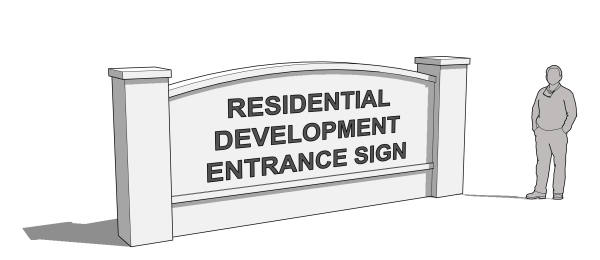
Fig 14.7-19
- Description
- A residential development entrance sign is a freestanding ground sign identifying the name of a platted residential subdivision.
- A sign permit is required for a residential development entrance sign.
- Size Requirements
- The sign area shall be a maximum of ninety (90) square feet.
- The copy area of the sign shall be a maximum of forty percent (40%) of the sign area.
- The average sign height shall be a maximum of six (6) feet.
- The sign width shall be a maximum of fifteen (15) feet.
- Location
- A maximum of one (1) sign per side of the entrance is allowed.
- Signs shall not be placed in the right-of-way unless an encroachment agreement is approved by the Board of Aldermen.
- All proposed platted residential subdivisions shall provide space for a development entrance sign during design approval or be prohibited from receiving an encroachment agreement after the certificate of occupancy.
- Additional Standards
- The placement of a residential development sign shall only be allowed on platted residential subdivisions that are a minimum of two and a half (2 ½) acres in size with a minimum of three (3) tenants or lots. Master planned developments or subdivisions, including condominiums, that do not meet the minimum acreage requirements may place a monument sign that meets the monument sign requirements of section 14.7.9.1.
- A residential development entrance sign may be placed on a wall, fence, or retaining wall if it meets all dimensional requirements. The maximum copy area of such signs shall not exceed fifty-four (54) square feet regardless of the size of a wall, fence, or retaining wall.
- Signs shall not be internally illuminated. Halo-type illumination is not considered internally illuminated.
14.7.11.B Development Entrance Sign

Fig 14.7-20
- Description
- A development entrance sign is a freestanding ground sign identifying the name of a non-residential master planned development with multiple tenants and/or multiple lots.
- A sign permit is required for a development entrance sign.
- Size Requirements
- The sign area shall be a maximum of two-hundred (200) square feet.
- The copy area of the sign shall be a maximum of sixty percent (60%) of the sign area.
- The average sign height shall be a maximum of eight (8) feet.
- The sign width shall be a maximum of twenty-five (25) feet.
- Location
- A maximum of one (1) sign per side of the entrance is allowed.
- Signs shall not be placed in the right-of-way unless an encroachment agreement is approved by the Board of Aldermen.
- All proposed master planned developments with multiple tenants or multiple lots shall provide space for a development entrance sign during design approval or be prohibited from receiving an encroachment agreement after the certificate of occupancy.
- Additional Standards
- The placement of a development sign shall only be allowed on non-residential master planned developments that are a minimum of two and a half (2 ½) acres in size with a minimum of three (3) tenants or lots. Master planned developments that do not meet the minimum acreage requirements may place a monument sign that meets the monument sign requirements of section 14.7.9.1.
- A development entrance sign may be placed on a wall or retaining wall if it meets all dimensional requirements. The maximum copy area of such signs shall not exceed one hundred and twenty (120) square feet regardless of the size of a wall, fence, or retaining wall.
- Signs shall not be internally illuminated. Halo-type illumination is not considered internally illuminated.
14.7.11.C Electronic Message Center
- Description
- An electronic message center is an electronic sign that is capable of displaying words, symbols, figures, or images that can be electronically changed by remote or automatic means.
- Electronic message centers shall be a part of either a wall sign, monument sign, or multi-tenant sign type. Standalone electronic message centers are prohibited in all districts.
- Electronic message centers shall be prohibited from being part of a residential development sign and/or a development sign.
- Signs placed by the City, County, or State in the right-of-way associated with transportation or public transit are not classified as electronic message centers.
- A sign permit is required for an electronic message center unless it is included as a part of an application for a new wall sign, monument sign, or multi-tenant sign permit. No permit fee will be assessed for government owned facilities.
- Special-Institutional and Special-Educational
- Size Requirements
- The maximum total square footage of a copy area is thirty (30) square feet.
- Location
- It is only allowed on an approved wall or monument sign.
- Only one (1) sign shall be permitted per block face.
- Size Requirements
- Commercial Neighborhood, Commercial Rural, University Form-Based District, and Corridor Form-Based District
- Size requirements
- The maximum height per copy area is twelve (12) inches.
- The maximum width per copy area is thirty-six (36) inches.
- The maximum total square footage of all copy areas per facade face shall be six (6) square feet.
- Location
- In a commercial neighborhood and commercial rural, electronic message centers are only allowed on an approved wall or monument sign.
- In university form-based district and corridor form-based districts electronic message signs are only allowed on site signage approved as part of a special exception or on the facade of a pump island canopy as a part of a convenience store and gas station. A maximum of one (1) electronic message center is allowed per street facing facade.
- Size requirements
- Commercial, Industrial, Optional-Commercial, and Optional-Industrial Use Districts
- Size Requirements
- A maximum total square footage of a copy area shall not exceed forty percent (40%) of the total sign area.
- Location
- It is only allowed on an approved wall or monument sign.
- No electronic message center shall be mounted to any sign closer than five (5) feet to the right-of-way of a street.
- No electronic message center shall be mounted to any sign placed within a sight triangle of a street or driveway.
- Size Requirements
- Additional Standards
- Electronic message centers shall not use blinking, fading, rolling, shading, dissolve, scroll, or similar effects.
- All messages shall change instantaneously as seen by the human eye.
- Messages shall post for a minimum of thirty (30) seconds.
- All electronic message centers shall be installed with ambient light monitors that automatically adjust the brightness level of the message based on ambient light conditions.
- A maximum brightness of light emitted from an electronic message center shall not exceed 0.3-foot candles over ambient light levels measured at a distance of one (1) hundred and fifty (150) feet.
- Written certification from the sign manufacturer must be provided at the time of application for a sign permit certifying that the light intensity of the electronic message center has been preset not to exceed the illumination levels established by this section.
- The owner of any electronic message center shall demonstrate at the City’s request and the satisfaction of the Code Enforcement department that the electronic message center does not exceed the maximum brightness set forth in this section.
14.7.12.D Outdoor Advertising Signs
- Classes of Outdoor Advertising Signs (Outdoor Advertising Signs- Billboards). All existing outdoor advertising signs within the City of Starkville shall be divided into two (2) classes as follows:
- Class 1: Class 1 Outdoor Advertising Signs (Billboards) shall be those subject to the provisions of Sections 49-23-1 through 49-23-29 of the Mississippi Code of 1972 as the same exists on the effective date of the adoption of this ordinance, January 4, 2018.
- Class 2: Class 2 Outdoor Advertising Signs (Billboards) shall include all such signs within the City of Starkville which are not regulated by the provisions of 49-23-1 through 49-23-29 of the Mississippi Code of 1972
- Prohibited Signs (Billboards). Billboards are hereby declared prohibited signs within the City of Starkville, subject to the right to remain within the City as Non- conforming Billboards.
- Non-conforming Billboards. Outdoor Advertising Signs (Billboards) which were legally in existence prior to January 4, 2018 are declared Non-conforming Billboards. It is the intent of this section to recognize that the eventual elimination, as expeditiously and fairly as possible, of Non- conforming Billboards is as much a subject of health, safety, and welfare as it is the prohibition of new signs that would violate the provisions of this Ordinance. All Outdoor Advertising Signs (Billboards) heretofore lawfully constructed within the City of Starkville are hereby declared legal Nonconforming Billboards. All such Class 1 Non-conforming Outdoor Advertising Signs shall be classified as Class 1 Non-conforming Billboards. All such Class 2 Outdoor Advertising Signs are classified as Class 2 Non-conforming Billboards.
- Continuance of Class 1 Non-conforming Billboards. Class 1 Non-conforming Billboards may continue provided that the non-conforming billboard shall not be:
- Changed to or replaced with another non-conforming sign except to periodically change the sign face.
- Structurally altered so as to extend their useful life
- Expanded.
- Relocated except as hereinafter provided.
- Re-established after damage of more than fifty percent (50%) of the value at the time of such damage or destruction.
- Modified in any way that would increase the degree of non-conformity of such sign.
- Continuance of Class 2 Non-Conforming Billboards
- Any non-conforming sign or sign structure which is partially destroyed by fire, accident, or natural cause beyond fifty percent (50%) of its current physical replacement costs shall thereafter be removed or reconstructed in conformance to the provisions of this Ordinance.
- Class 2 Non-conforming Billboards shall be removed according to the following schedule: a. Signs with an original construction cost of less than $250,000.00 – Ten Years b. Signs with an original construction cost of $250,000.00 or more –Twelve (12) Years.
- It is the intent that all Class 2 Signs shall be removed not later than twelve (12) years from the effective date of this ordinance. No improvements, relocations, repairs or modifications shall extend beyond the specified amortization period as defined above.
- The amortization of Class 2 Billboards shall begin as of the effective date of the adoption of this Ordinance on January 4, 2018.
- Strengthening or Restoring to a Safe Condition. Nothing in this Ordinance shall prevent the strengthening or restoring to a safe condition of any portion of a sign or structure declared unsafe by the Building Inspector. Such signs may be improved only to the extent that such improvement does not exceed fifty percent (50%) of the current physical replacement costs of the existing sign structure.
- Removal. Upon the determination of the City of Starkville that a sign remains non-conforming after termination of the allowable time periods provided for hereinabove, the City shall notify the sign owner and/or the owner of the land on which the non-conforming sign is located and such owner shall have thirty (30) days after such written notice within which to remove said sign. At the end of the thirty (30) day period, if the sign has not been removed or brought into compliance, the City shall issue a summons in Municipal Court.
- Abandonment. A billboard that upon the recommendation of the Community Development Department and approval of the Starkville Board of Aldermen, is determined to be Abandoned and/or Obsolete, as defined in Section 18 Definitions, shall terminate immediately the right to maintain such a sign. The Sign Owner shall have thirty (30) days to remove said sign after written notice from the City of Starkville at the owner(s) sole expense with no compensation from the City.
- An “Available for Lease” or similar message that concerns the availability of the sign itself does not constitute advertising matter. A sign with such a message will be treated as an obsolete sign.
- A sign whose message has been partially obliterated by the owner so as not to identify a particular product, service or facility is considered to be an obsolete sign.
- Annexation. In the event a sign becomes subject to this ordinance as a result of annexation the amortization period set out above shall apply from and after the effective date of such annexation.
- Petition. The owner of any existing billboard may voluntarily petition the Mayor and Board of Aldermen to allow the relocation or modification of an existing billboard. Approval of any such Petition shall be conditioned on an overall net reduction in the number of billboards within the city by voluntary removal. The approval of the Mayor and Board of Aldermen is discretionary. At a minimum, the Petition shall set out the following:
- A description of any modification to an existing sign.
- The existing and proposed locations of a relocated sign.
- The location of any signs proposed to be removed from within the City of Starkville.
- An acknowledgement that the request is voluntary and that to the extent that compensation may have otherwise been required any such compensation is waived.
- The time required to remove any existing signs.
- Other such information as may be requested by the Community Development department.
- Net Reduction Required for Modification or Removal. No billboard may be substantially modified or moved unless the modification or relocation results in the removal of one (1) or more existing billboards. The result must be a net reduction in the number of billboards in the City of Starkville.
- Modification. Modification(s) to existing billboards shall only be made upon approval by the Mayor and Board of Aldermen upon the Petition of the owner of the billboard. Any such modification(s) must be reviewed by the Community Development Department who may provide a recommendation to the Mayor and Board of Aldermen. The approval of the Mayor and Board of Aldermen is discretionary. Approval shall only be granted if the Mayor and Board of Aldermen make an affirmative finding that the grant of the Petition will further the purposes of this Ordinance. If the petition is approved by the Board of Aldermen, then any such approved sign shall become a legal conforming sign.
- Permitting. All billboards erected or relocated by approval of a petition shall be permitted by the Community Development Department. A fee established by the Board of Aldermen shall be paid for each permit issued. The owner or operator of such sign must furnish acceptable proof of the sign's cost in the form of construction cost and/or bill of sale including installation cost. Any permit granted hereunder shall in no way create any rights not heretofore available to the owner of any billboard.
14.7.12.E Flags
- Description
- A flag and/or means a piece of fabric or cloth attached to a flag pole or other support on one side, where the length at right angles to the support is at least as long as the length of the attached side.
- There shall be a maximum of two (2) faces to the flags, mounted back-to-back. Double-sided or back-to-back signs shall be measured by the surface area of one (1) face.
- A sign permit is not required for a flag, but requirements must be followed.
- These requirements shall not apply to the official current flag of the United States of America.
- Residential Districts
- Size Requirements
- A maximum sign size of fifteen (15) square feet is permitted per flag.
- The maximum height to length ratio for a flag shall be 1:2.
- The maximum number of flags may not exceed three (3) flags per acre of site area, rounded up to the nearest whole acre.
- Location
- No flag shall be placed closer than five (5) feet to the right of- way of a street.
- No flag shall be placed within a sight triangle of a street or driveway.
- Size Requirements
- Non-Residential and Mixed-Use Districts
- Size Requirements
- A maximum sign size of twenty-five (25) square feet is permitted per flag.
- The maximum height to length ratio for a flag shall be 1:2.
- The maximum number of flags may not exceed two (2) flags per twenty-five (25) feet of frontage up to a maximum of eight (8) flags per premises. Corner lots shall be allowed up to a maximum of twelve (12) flags total along both frontages.
- Location
- No flag shall be placed closer than five (5) feet to the right of- way of a street.
- No flag shall be placed within a sight triangle of a street or driveway.
- No flag shall obstruct any walkway or public sidewalk.
- Size Requirements
14.6.2.1.1 - Building Signs
| Building Signs | Residential | Commercial/Industrial | Form-Based | Special | Optional | |||||||||||||||||||
| RN | SD-2 | SD-6 | TN-N | TN-E | MDU-9 | MDU-20 | CN | C | CR | I | T-4 | T-5D | T-5C | T-5U | S-M | S-I | S-E | O-TND | O-CD | O-I | O-C | O-E | O-TN | |
| Wall Sign | A | A | A | UE | UE | A | A | A | A | A | A | A | A | A | A | A | A | A | A | A | ||||
| Projecting Sign | A | A | P | P | P | A | A | A | P | A | A | P | P | A | A | |||||||||
| Suspending Sign | A | A | P | P | P | A | A | A | P | A | A | P | A | A | ||||||||||
| Awning Sign | A | A | A | A | A | A | A | A | A | A | A | A | A | A | ||||||||||
| Marquee Sign | A | A | A | A | A | A | A | A | A | A | A | A | ||||||||||||
| Window Sign | A | A | A | A | A | A | A | A | A | A | A | A | A | A | ||||||||||
| Nameplate Sign | A | A | P | P | P | P | P | P | P | P | A | A | A | A | ||||||||||
| Address Sign | P | P | P | P | P | P | P | P | P | P | P | P | P | P | P | P | P | P | P | P | P | P | P | P |
| Outdoor Display Case | A | A | A | A | A | A | ||||||||||||||||||
P = Permitted Use, A= Permitted Use with Additional Standards, UE = Use Exception, SE = Special Exception, Blank =Not Permitted
14.6.2.1.2 - Site Signs
| Site Signs | Residential | Commercial/Industrial | Form-Based | Special | Optional | |||||||||||||||||||
| RN | SD-2 | SD-6 | TN-N | TN-E | MDU-9 | MDU-20 | CN | C | CR | I | T-4 | T-5D | T-5C | T-5U | S-M | S-I | S-E | O-TND | O-CD | O-I | O-C | O-E | O-TN | |
| Monument Sign | A | A | A | A | A | A | A | A | A | A | A | A | A | A | A | A | ||||||||
| Multi-tenant Sign | A | A | A | A | A | A | A | |||||||||||||||||
P = Permitted Use, A= Permitted Use with Additional Standards, UE = Use Exception, SE = Special Exception, Blank =Not Permitted
14.6.2.1.3 - Temporary Signage
| Temporary Signs | Residential | Commercial/Industrial | Form-Based | Special | Optional | |||||||||||||||||||
| RN | SD-2 | SD-6 | TN-N | TN-E | MDU-9 | MDU-20 | CN | C | CR | I | T-4 | T-5D | T-5C | T-5U | S-M | S-I | S-E | O-TND | O-CD | O-I | O-C | O-E | O-TN | |
| Sidewalk Sign | A | P | P | P | P | P | P | A | ||||||||||||||||
| Banner Sign | P | P | P | P | P | P | P | P | P | P | P | P | P | P | P | P | P | P | P | P | P | P | P | P |
| Yard Sign | P | P | P | P | P | P | P | P | P | P | P | P | P | P | P | P | P | P | P | P | P | P | P | P |
| Fence Screen Sign | P | P | P | P | P | P | P | P | P | P | ||||||||||||||
| Construction Sign | P | P | P | P | P | P | P | P | P | P | P | P | P | P | P | P | P | P | P | P | P | P | P | |
P = Permitted Use, A= Permitted Use with Additional Standards, UE = Use Exception, SE = Special Exception, Blank =Not Permitted
14.6.2.1.4 - Other Signs
| Other Signs | Residential | Commercial/Industrial | Form-Based | Special | Optional | |||||||||||||||||||
| RN | SD-2 | SD-6 | TN-N | TN-E | MDU-9 | MDU-20 | CN | C | CR | I | T-4 | T-5D | T-5C | T-5U | S-M | S-I | S-E | O-TND | O-CD | O-I | O-C | O-E | O-TN | |
| Development Entrance Sign | A | A | A | A | A | A | A | A | A | A | A | A | A | A | A | A | A | A | A | |||||
| Electronic Message Center Sign | A | A | A | A | A | A | A | A | A | A | ||||||||||||||
| Flags | A | A | A | A | A | A | A | A | A | A | A | A | A | A | A | A | A | A | A | A | A | A | A | A |
P = Permitted Use, A= Permitted Use with Additional Standards, UE = Use Exception, SE = Special Exception, Blank =Not Permitted
14.6.2.2.1 - General Parking Requirements
| General Parking Requirements | RN | SD-2 | SD-6 | TN-N | TN-E | MDU-9 | MDU-20 | CN | C | CR | I | T-4 | T-5D | T-5C | T-5U | S-M | S-I | S-E | O-TND | O-CD | O-I | O-C | O-E | O-TN |
| Curb cuts locations for driveways shall be reviewed by the Development Review Committee as part of site plan approval in accordance with the City's access management policy. | ⬜ | -- | -- | ⬜ | ⬜ | ⬛ | ⬛ | ⬛ | ⬛ | ⬛ | ⬛ | ⬜ | ⬛ | ⬛ | ⬛ | ⬛ | ⬛ | ⬛ | ⬜ | ⬛ | ⬛ | ⬛ | ⬜ | ⬜ |
| Entrances and exits to the site shall be located such that parking spaces and traffic aisles do not conflict with entering and exiting traffic. | ⬜ | -- | -- | ⬜ | ⬜ | ⬛ | ⬛ | ⬛ | ⬛ | ⬛ | ⬛ | ⬜ | ⬛ | ⬛ | ⬛ | ⬛ | ⬛ | ⬛ | ⬜ | ⬛ | ⬛ | ⬛ | ⬜ | ⬜ |
| Shared driveways may be required as part of site plan approval. | ⬜ | -- | -- | ⬜ | ⬜ | ⬛ | ⬛ | ⬛ | ⬛ | ⬛ | ⬛ | ⬜ | ⬛ | ⬛ | ⬛ | ⬛ | ⬛ | ⬛ | ⬜ | ⬛ | ⬛ | ⬛ | ⬜ | ⬜ |
| The number of required on-site parking spaces shall be determined by the requirements in Section 13. Use Regulations. | ⬛ | ⬛ | ⬛ | ⬛ | ⬛ | ⬛ | ⬛ | ⬛ | ⬛ | ⬛ | ⬛ | ⬛ | ⬛ | ⬛ | ⬛ | ⬛ | ⬛ | ⬛ | ⬛ | ⬛ | ⬛ | ⬛ | ⬛ | ⬛ |
| Parking lot setbacks shall not be paved and shall comply with base dimensional standards for the zoning district | ⬛ | ⬛ | ⬛ | ⬛ | ⬛ | ⬛ | ⬛ | ⬛ | ⬛ | ⬛ | ⬛ | ⬛ | ⬛ | ⬛ | ⬛ | ⬛ | ⬛ | ⬛ | ⬛ | ⬛ | ⬛ | ⬛ | ⬛ | ⬛ |
| Parking and/or loading areas shall be designed to prevent vehicles from backing out directly into any public street. | ⬜ | -- | -- | ⬜ | ⬜ | ⬛ | ⬛ | ⬛ | ⬛ | ⬛ | ⬛ | ⬜ | ⬛ | ⬛ | ⬛ | ⬛ | ⬛ | ⬛ | ⬜ | ⬜ | ⬛ | ⬛ | ⬜ | ⬜ |
| Parking lots shall be either asphalt, concrete, or pavers. | -- | -- | -- | ⬜ | ⬜ | ⬛ | ⬛ | ⬛ | ⬛ | -- | -- | -- | -- | -- | -- | ⬛ | -- | -- | -- | -- | -- | ⬛ | -- | -- |
| Parking lots adjacent to the street shall be either asphalt, concrete, pavers, or gravel. Gravel lots shall provide a six (6) inch vertical concrete curb to contain loose gravel within the parking lot. Gravel lots shall also provide a minimum of an eight (8) foot concrete or paver apron at each entrance to the lot measured from the property line. | ⬜ | -- | -- | -- | -- | -- | -- | -- | -- | ⬛ | -- | ⬛ | ⬛ | ⬛ | ⬛ | -- | -- | ⬛ | ⬜ | -- | ⬛ | -- | ⬜ | ⬜ |
| Parking lots adjacent to the street shall be either asphalt, concrete, pavers, or gravel. Gravel lots shall provide a minimum of an eight (8) foot concrete or paver apron at each entrance to the lot measured from the property line. | -- | -- | -- | -- | -- | -- | -- | -- | -- | -- | ⬛ | -- | -- | -- | -- | -- | ⬛ | -- | -- | -- | -- | -- | -- | -- |
| Residential driveways adjacent to the street shall be either asphalt, concrete, pavers, or gravel. Gravel driveways must have a minimum of an eight (8) foot concrete apron adjacent to the street measured from the property line to prevent gravel from being deposited into the street. | ⬛ | ⬛ | ⬛ | ⬛ | ⬛ | -- | -- | -- | -- | -- | -- | ⬛ | ⬛ | ⬛ | ⬛ | -- | -- | -- | ⬛ | ⬛ | -- | -- | ⬛ | ⬛ |
| Parking lots adjacent to a street shall be screened from view from the street by a building or brick masonry wall at least four (4) feet in height. | -- | -- | -- | -- | -- | -- | -- | -- | -- | -- | -- | -- | ⬛ | ⬛ | ⬛ | -- | -- | -- | -- | -- | -- | -- | -- | -- |
| Parking lots adjacent to a street with more than four (4) parking spaces shall be screened from view from the street by a building or brick masonry wall at least four (4) feet in height or a decorative wood fence at least four (4) feet in height planted with evergreen shrubs three (3) feet in height at time of planting. | -- | -- | -- | -- | -- | -- | -- | -- | -- | -- | -- | ⬜ | -- | -- | -- | -- | -- | -- | ⬜ | -- | -- | -- | -- | -- |
14.6.2.2.2 - Parking Layout
| Parking Layout | RN | SD-2 | SD-6 | TN-N | TN-E | MU-9 | MU-20 | CN | C | CR | I | T-4 | T-5D | T-5C | T-5U | S-M | S-I | S-E | O-TND | O-CD | O-I | O-C | O-E | O-TN |
| Perimeter islands shall be provided in accordance with the parking setbacks for the use and zoning district. | ⬜ | -- | -- | ⬜ | ⬜ | ⬛ | ⬛ | ⬛ | ⬛ | ⬛ | ⬛ | ⬜ | ⬛ | ⬛ | ⬛ | ⬛ | ⬛ | ⬛ | ⬜ | ⬜ | ⬛ | ⬛ | ⬜ | ⬜ |
| A terminal island with a minimum dimension of nine (9) feet by eighteen (18) feet, measured from face of curb, shall be required at the end of each row of parking. | ⬜ | -- | -- | ⬜ | ⬜ | ⬛ | ⬛ | ⬛ | ⬛ | ⬛ | ⬛ | ⬜ | ⬛ | ⬛ | ⬛ | ⬛ | ⬛ | ⬛ | ⬜ | ⬜ | ⬛ | ⬛ | ⬜ | ⬜ |
| An interior island not less than nine (9) feet wide and eighteen (18) feet in length, measured from face of curb, shall be installed for every twelve (12) parking spaces. For lots with less than fifteen (15) parking spaces, no interior island is required. | -- | -- | -- | ⬜ | ⬜ | ⬛ | ⬛ | ⬛ | ⬛ | -- | -- | ⬜ | ⬛ | ⬛ | ⬛ | ⬛ | -- | ⬛ | ⬜ | ⬜ | -- | ⬛ | -- | ⬜ |
| An interior island not less than nine (9) feet wide and eighteen (18) feet in length, measured from face of curb, shall be installed for every twenty (20) parking spaces. For lots with less than fifteen (15) parking spaces, no interior island is required. | ⬜ | -- | -- | -- | -- | -- | -- | -- | -- | ⬛ | ⬛ | -- | -- | -- | -- | -- | ⬛ | -- | -- | -- | ⬛ | -- | ⬜ | -- |
| All parking space are to striped with a minimum of a four (4) inch white stripe unless the parking area is gravel. | ⬜ | -- | -- | ⬜ | ⬜ | ⬛ | ⬛ | ⬛ | ⬛ | ⬛ | ⬛ | -- | ⬛ | ⬛ | ⬛ | ⬛ | ⬛ | ⬛ | ⬜ | ⬜ | ⬛ | ⬛ | ⬜ | ⬜ |
| Median islands may be combined as part of an innovative stormwater management solution if approved by the Development Review Committee as part of site plan approval. The combined area shall be equal to or greater than the required area of required medians and be located within the off-street parking area. | ⬜ | -- | -- | ⬜ | ⬜ | ⬛ | ⬛ | ⬛ | ⬛ | ⬛ | ⬛ | -- | ⬛ | ⬛ | ⬛ | ⬛ | ⬛ | ⬛ | ⬜ | ⬜ | ⬛ | ⬛ | ⬜ | ⬜ |
| A median island shall be provided between every four (4) single parking rows. For lots with less than fifteen (15) parking spaces, no median island is required. Median islands shall have a minimum inside width of 5 feet with a six (6) inch high by six (6) inch wide concrete curb. | -- | -- | -- | ⬜ | ⬜ | ⬛ | ⬛ | ⬛ | ⬛ | -- | -- | -- | ⬛ | ⬛ | ⬛ | ⬛ | -- | ⬛ | ⬜ | ⬜ | -- | ⬛ | -- | ⬜ |
| A median island shall be provided between every six (6) single parking rows. For lots with less than fifteen (15) parking spaces, no median island is required. Median islands shall have a minimum inside width of nine (9) feet with a six (6) inch high by six (6) inch wide concrete curb. | ⬜ | -- | -- | -- | -- | -- | -- | -- | -- | ⬛ | ⬛ | -- | -- | -- | -- | -- | ⬛ | -- | -- | -- | ⬛ | -- | ⬜ | -- |
| All ADA accessible parking spaces shall be dimensioned, signed, and striped in accordance with the Americans with Disability Act requirements. | ⬜ | -- | -- | ⬜ | ⬜ | ⬛ | ⬛ | ⬛ | ⬛ | ⬛ | ⬛ | -- | ⬛ | ⬛ | ⬛ | ⬛ | ⬛ | ⬛ | ⬜ | ⬜ | ⬛ | ⬛ | ⬜ | ⬜ |
14.6.2.3.1 - External To Site
| External to Site | RN | SD-2 | SD-6 | TN-N | TN-E | MDU-9 | MDU-20 | CN | C | CR | I | T-4 | T-5D | T-5C | T-5U | S-M | S-I | S-E | O-TND | O-CD | O-I | O-C | O-E | O-TN |
| Sidewalks shall be broom finished concrete designed and finished to match adjacent sidewalks. The use of asphalt and gravel is prohibited. | ⬛ | ⬛ | ⬛ | ⬛ | ⬛ | ⬛ | ⬛ | ⬛ | ⬛ | ⬛ | ⬛ | -- | -- | -- | -- | ⬛ | ⬛ | ⬛ | -- | ⬛ | ⬛ | -- | ⬛ | ⬛ |
| Sidewalks shall be broom finished concrete designed and finished to match adjacent sidewalks. The use of brick pavers or concrete pavers shall only be allowed with the approval of the City Engineer. The use of asphalt and gravel is prohibited. | -- | -- | -- | -- | -- | -- | -- | -- | -- | -- | -- | ⬛ | ⬛ | ⬛ | ⬛ | -- | -- | -- | ⬛ | -- | -- | ⬛ | -- | -- |
14.6.2.3.2 - Internal Circulation
| Internal Circulation | RN | SD-2 | SD-6 | TN-N | TN-E | MDU-9 | MDU-20 | CN | C | CR | I | T-4 | T-5D | T-5C | T-5U | S-M | S-I | S-E | O-TND | O-CD | O-I | O-C | O-E | O-TN |
| Internal pedestrian circulation shall be provided to create interconnected walkways safely conveying pedestrians from adjacent streets and parking areas to the site destination. | ⬜ | -- | -- | ⬜ | ⬜ | ⬛ | ⬛ | ⬛ | ⬛ | ⬛ | -- | ⬜ | ⬛ | ⬛ | ⬛ | ⬛ | ⬛ | ⬛ | ⬜ | -- | -- | ⬛ | ⬜ | ⬜ |
| Sidewalk material may include brick pavers, concrete pavers, stone, washed aggregate concrete, broom finished concrete, or stamped concrete. The use of asphalt and gravel is prohibited. | -- | -- | -- | -- | -- | -- | -- | ⬛ | ⬛ | ⬛ | ⬛ | ⬜ | ⬛ | ⬛ | ⬛ | ⬛ | ⬛ | ⬛ | -- | -- | -- | -- | -- | -- |
| Pathways that are located within a common area of a development or associated with a recreational use may consist of brick pavers, concrete pavers, stone, washed aggregate concrete, broom finished concrete, stamped concrete, asphalt, or gravel. Gravel pathways shall have edge protection to contain loose gravel. | ⬛ | ⬛ | ⬛ | ⬛ | ⬛ | ⬛ | ⬛ | ⬛ | ⬛ | ⬛ | ⬛ | |||||||||||||
| Crosswalks shall be designated by white pavement striping or materials of a different color and texture from the surrounding surface but conforming to the overall color scheme of the development. | ⬜ | -- | -- | ⬜ | ⬜ | ⬛ | ⬛ | ⬛ | ⬛ | ⬛ | -- | ⬜ | ⬛ | ⬛ | ⬛ | ⬛ | ⬛ | ⬛ | ⬛ | ⬛ | -- | ⬛ | -- | ⬜ |
| Walkways shall be distinguished from driving surfaces by using varied paving treatments and by raising walkways to curb level. | ⬜ | -- | -- | ⬜ | ⬜ | ⬛ | ⬛ | ⬛ | ⬛ | ⬛ | -- | ⬜ | ⬛ | ⬛ | ⬛ | ⬛ | ⬛ | ⬛ | ⬜ | -- | -- | ⬛ | ⬜ | ⬜ |
14.6.2.5.1 - Building Form And Materials
| Building Form and Materials | RN | SD-2 | SD-6 | TN-N | TN-E | MDU-9 | MDU-20 | CN | C | CR | I | T-4 | T-5D | T-5C | T-5U | S-M | S-I | S-E | O-TND | O-CD | O-I | O-C | O-E | O-TN |
| Buildings adjacent to the street shall be oriented parallel to the streets they face. | ⬛ | ⬛ | ⬛ | ⬛ | ⬛ | ⬛ | ⬛ | ⬛ | ⬛ | ⬛ | ⬛ | ⬛ | ⬛ | ⬛ | ⬛ | ⬛ | ⬛ | ⬛ | ⬛ | ⬛ | ⬛ | ⬛ | ⬛ | ⬛ |
| The primary public entrance of any building adjacent to a street shall be located along the street that the building fronts. | ⬛ | ⬛ | ⬛ | ⬛ | ⬛ | ⬛ | ⬛ | ⬛ | ⬛ | ⬛ | ⬛ | ⬛ | ⬛ | ⬛ | ⬛ | ⬛ | ⬛ | ⬛ | ⬛ | ⬛ | ⬛ | ⬛ | ⬛ | ⬛ |
| All non-single dwelling residential structures shall be architecturally compatible with the character of the adjacent area. Compatibility shall be determined by comparing the consistency of existing and proposed design elements, colors, materials, height, and massing to the surrounding area. | -- | -- | -- | ⬜ | ⬜ | ⬜ | ⬜ | -- | -- | -- | -- | ⬜ | -- | -- | -- | -- | -- | -- | ⬜ | -- | -- | -- | -- | ⬜ |
| Materials and colors used on the street façade face shall continue to the sides and rear of the building where visible from a street right-of-way or adjacent residence. | -- | -- | -- | ⬜ | ⬜ | ⬛ | ⬛ | ⬛ | ⬛ | -- | -- | ⬜ | ⬛ | ⬛ | ⬛ | ⬛ | ⬛ | ⬛ | ⬜ | -- | -- | ⬛ | -- | ⬜ |
| Interior walls shall not be placed closer than five (5) feet to any window required as part of the transparency requirement for that district. | -- | -- | -- | -- | -- | -- | -- | -- | -- | -- | -- | ⬜ | ⬛ | ⬛ | ⬛ | -- | -- | -- | -- | -- | -- | -- | -- | -- |
| Articulation in building facades shall be required for all street facing building facades more than sixty (60) feet in length. At least two (2) portions of the street-facing building facade must have wall variations (projections or recessions) of at least two (2) feet in depth. The combination of the required length of the wall variations shall total no less than fifteen percent (15%) of the length of the building. Building facades less than sixty (60) feet shall have at least one (1) wall variation of at least two (2) feet in depth and a length greater than five (5) feet. | -- | ⬜ | ⬜ | ⬜ | ⬜ | ⬛ | ⬛ | ⬛ | ⬛ | -- | -- | ⬜ | ⬛ | ⬛ | ⬛ | ⬛ | ⬛ | ⬛ | ⬜ | -- | -- | ⬛ | -- | ⬜ |
14.6.2.5.2 - Roofing
| Roofing | RN | SD-2 | SD-6 | TN-N | TN-E | MDU-9 | MDU-20 | CN | C | CR | I | T-4 | T-5D | T-5C | T-5U | S-M | S-I | S-E | O-TND | O-CD | O-I | O-C | O-E | O-TN |
| All newly constructed buildings and accessory structures, except for detached dwellings, visible from the street, shall have a pitched roof of not less than 4/12. Roofing material shall be either standing seam metal or architectural shingle. The color of all roofing material shall be approved by the Architecture Review Board. | -- | -- | -- | ⬜ | ⬜ | ⬛ | -- | -- | -- | -- | -- | ⬛ | -- | -- | ⬛ | -- | -- | -- | ⬜ | -- | -- | -- | -- | ⬜ |
| All newly constructed buildings adjacent to a street shall have a parapet style roof. The parapet shall be constructed to match the facade of the building using the same material and colors. The parapet facade shall be designed such that the reverse side of all elements shall not be visible from any street. False mansards are prohibited. All parapet roof designs shall be approved by the Architecture Review Board. | -- | -- | -- | -- | -- | -- | -- | -- | -- | -- | -- | -- | ⬛ | -- | -- | -- | -- | -- | -- | -- | -- | -- | -- | -- |
| All newly constructed buildings adjacent to a street shall have either a parapet style roof or a pitched roof of not less than 4/12. A parapet shall be constructed to match the facade of the building using the same material and colors. The parapet facade shall be designed such that the reverse side of all elements shall not be visible from any street. False mansards are prohibited. The roofing material for pitched roofs shall be either standing seam metal or architectural shingle. The Parapet roof design and color of all roofing material for pitched roofs shall be approved by the Architecture Review Board. | -- | -- | -- | -- | -- | -- | ⬛ | ⬛ | ⬛ | -- | -- | -- | -- | ⬛ | -- | ⬛ | ⬛ | ⬛ | -- | -- | -- | ⬛ | -- | -- |
| Rooftop equipment must be screened from public view. | -- | ⬜ | ⬜ | ⬜ | ⬜ | ⬛ | ⬛ | ⬛ | ⬛ | -- | -- | ⬛ | ⬛ | ⬛ | ⬛ | ⬛ | ⬛ | ⬛ | ⬜ | -- | -- | ⬛ | -- | ⬜ |
14.6.2.5.3 - Facade Materials
| Facade Materials | RN | SD-2 | SD-6 | TN-N | TN-E | MDU-9 | MDU-20 | CN | C | CR | I | T-4 | T-5D | T-5C | T-5U | S-M | S-I | S-E | O-TND | O-CD | O-I | O-C | O-E | O-TN |
| The use of printed building wraps on the facade of a building, accessory building, or accessory dwelling unit is prohibited. Art Murals are not considered building wraps. | ⬛ | ⬛ | ⬛ | ⬛ | ⬛ | ⬛ | ⬛ | ⬛ | ⬛ | ⬛ | -- | ⬛ | ⬛ | ⬛ | ⬛ | ⬛ | ⬛ | ⬛ | ⬛ | ⬛ | ⬛ | ⬛ | ⬛ | ⬛ |
| All newly constructed buildings shall have facade materials selected from any of the following: brick, cementitious stucco, and cast stone. Dryvit or EIFS may only be used for wall surfaces above the first floor and in banding, decorator strips, cornice lines, and wall capping on any floor. | -- | -- | -- | -- | -- | -- | -- | -- | -- | -- | -- | -- | ⬛ | -- | -- | -- | -- | -- | -- | -- | -- | -- | -- | -- |
| All newly constructed buildings shall have facade materials selected from any of the following: brick, cementitious stucco, fiber cement siding, and cast stone. Dryvit or EIFS may only be used for wall surfaces above the first floor and in banding, decorator strips, cornice lines, and wall capping on any floor. | -- | -- | -- | ⬜ | ⬜ | ⬛ | -- | -- | -- | -- | -- | -- | -- | ⬛ | -- | -- | -- | -- | ⬜ | -- | -- | -- | -- | ⬜ |
| All newly constructed buildings shall have facade materials selected from any of the following: cementitious stucco, fiber cement siding, vertical board and batten, and wood siding. Dryvit or EIFS may only be used for wall surfaces above the first floor and in banding, decorator strips, cornice lines, and wall capping on any floor. Brick may be allowed if approved by the Architecture Review Board. | -- | -- | -- | -- | -- | -- | -- | -- | -- | -- | -- | ⬜ | -- | -- | ⬛ | -- | -- | -- | -- | -- | -- | -- | -- | -- |
| All buildings shall have facade materials selected from any of the following: brick, cementitious stucco, fiber cement siding, and wood siding. Dryvit or EIFS may only be used for wall surfaces when separated by a minimum of a five (5) foot planted and maintained landscape bed from vehicular or pedestrian circulation and in banding, decorator strips, cornice lines, and wall capping. Architectural metal panels may be used only with the approval of the Architecture Review Board. | -- | -- | -- | -- | -- | -- | ⬛ | ⬛ | ⬛ | -- | -- | -- | -- | -- | -- | ⬛ | ⬛ | ⬛ | -- | -- | -- | ⬛ | -- | -- |
| All newly constructed buildings shall have the street facing facade materials selected from any of the following: brick, cementitious stucco, fiber cement siding, architecture metal panels, vertical board and batten, and wood siding. Dryvit or EIFS may only be used for wall surfaces when separated by a minimum of a five (5) foot landscape bed from vehicular or pedestrian circulation and in banding, decorator strips, cornice lines, and wall capping. All other facade faces not facing a street can consist of R Panel type metal panels. | ⬜ | ⬜ | ⬜ | -- | -- | -- | -- | -- | -- | ⬛ | ⬛ | -- | -- | -- | -- | -- | -- | -- | -- | -- | -- | -- | ⬜ | -- |
| All newly constructed buildings, with a visible façade from Highway 82, highway 25, or Highway 389 shall have the visible facade materials selected from any of the following: brick, cementitious stucco, fiber cement siding, architecture metal panels, EIFS, and split-faced block. All other facades not requiring facade treatments may use metal panels | -- | -- | -- | -- | -- | -- | -- | -- | -- | -- | -- | -- | -- | -- | -- | -- | -- | -- | -- | -- | ⬛ | -- | -- | -- |
14.6.2.5.4 - Facade Color
| Facade Color | RN | SD-2 | SD-6 | TN-N | TN-E | MDU-9 | MDU-20 | CN | C | CR | I | T-4 | T-5D | T-5C | T-5U | S-M | S-I | S-E | O-TND | O-CD | O-I | O-C | O-E | O-TN |
| The primary facade colors shall be low reflectance, subtle, neutral, or earth tones. The use of high intensity, metallic flake, or fluorescent colors is prohibited. | ⬜ | -- | -- | ⬜ | ⬜ | ⬛ | ⬛ | ⬛ | ⬛ | ⬛ | ⬛ | ⬛ | ⬛ | ⬛ | ⬛ | ⬛ | ⬛ | ⬛ | ⬛ | ⬛ | ⬛ | ⬛ | ⬜ | ⬜ |
14.6.2.6.1 - Fences
| Fences | RN | SD-2 | SD-6 | TN-N | TN-E | MDU-9 | MDU-20 | CN | C | CR | I | T-4 | T-5D | T-5C | T-5U | S-M | S-I | S-E | O-TND | O-CD | O-I | O-C | O-E | O-TN |
| Fences and walls within a development shall be compatible design and materials of the surrounding area. | -- | -- | -- | -- | -- | -- | -- | ⬛ | ⬛ | ⬛ | ⬛ | ⬛ | ⬛ | ⬛ | ⬛ | ⬛ | ⬛ | ⬛ | ⬛ | ⬛ | ⬛ | ⬛ | -- | -- |
| Fences and walls shall be constructed such that the “finished” part of the fence or wall is located toward and facing the exterior of the property. | ⬛ | ⬛ | ⬛ | ⬛ | ⬛ | ⬛ | ⬛ | ⬛ | ⬛ | ⬛ | ⬛ | ⬛ | ⬛ | ⬛ | ⬛ | ⬛ | ⬛ | ⬛ | ⬛ | ⬛ | ⬛ | ⬛ | ⬛ | ⬛ |
| Uncoated or coated chain link and other wire material fences shall not be permitted in a front yard unless the fence is part of a recreational use. | ⬜ | ⬛ | ⬛ | ⬛ | ⬛ | ⬛ | ⬛ | ⬛ | ⬛ | -- | -- | ⬛ | ⬛ | ⬛ | ⬛ | ⬛ | ⬛ | ⬛ | ⬛ | ⬛ | -- | ⬛ | ⬜ | ⬛ |
| The maximum height of fences and walls that are not part of a required screen shall be three and a half (3 1/2) feet above street grade when located in a front yard. Otherwise, the maximum height of a fence is eight feet. | ⬛ | ⬛ | ⬛ | ⬛ | ⬛ | ⬛ | ⬛ | -- | -- | ⬛ | -- | ⬛ | -- | -- | -- | ⬛ | ⬛ | ⬛ | ⬛ | ⬛ | -- | -- | ⬛ | ⬛ |
| Fences, other than ones required for alcohol service, shall not be permitted in the front yard. | -- | -- | -- | -- | -- | -- | -- | ⬛ | ⬛ | -- | -- | -- | ⬛ | ⬛ | ⬛ | -- | -- | -- | -- | -- | ⬛ | -- | -- | |
| The maximum height of fences and walls shall be eight (8) feet above grade. | -- | -- | -- | -- | -- | -- | -- | -- | -- | -- | ⬛ | -- | -- | -- | -- | -- | -- | -- | -- | -- | ⬛ | -- | -- | -- |
14.6.2.6.2 - Retaining Walls
| Retaining Walls | RN | SD-2 | SD-6 | TN-N | TN-E | MDU-9 | MDU-20 | CN | C | CR | I | T-4 | T-5D | T-5C | T-5U | S-M | S-I | S-E | O-TND | O-CD | O-I | O-C | O-E | O-TN |
| Concrete retaining walls that are visible from the right-of-way or adjacent residential property shall be finished with an approved stamped concrete pattern, brick, natural stone, artificial stone, or stucco. All retaining walls six (6) feet tall or less shall have a coping or cap on the top of the wall. | -- | -- | -- | ⬜ | ⬜ | ⬛ | ⬛ | ⬛ | ⬛ | -- | -- | ⬜ | ⬛ | ⬛ | ⬛ | ⬛ | ⬛ | ⬛ | ⬜ | -- | -- | ⬛ | -- | ⬜ |
| Segmented retaining walls shall be tinted with subtle, neutral, or earth tone colors that fit in the context of the surrounding property. | -- | -- | -- | ⬜ | ⬜ | ⬛ | ⬛ | ⬛ | ⬛ | -- | -- | ⬜ | ⬛ | ⬛ | ⬛ | ⬛ | ⬛ | ⬛ | ⬜ | -- | -- | ⬛ | -- | ⬜ |
| Wood retaining walls are not permitted. | -- | -- | -- | ⬜ | ⬜ | ⬛ | ⬛ | ⬛ | ⬛ | -- | ⬛ | ⬜ | ⬛ | ⬛ | ⬛ | ⬛ | ⬛ | ⬛ | ⬜ | -- | ⬛ | ⬛ | -- | ⬜ |
14.6.2.6.3 - Location And Screening Of Solid Waste Containers
| Location and Screening of Solid Waste Containers | RN | SD-2 | SD-6 | TN-N | TN-E | MDU-9 | MDU-20 | CN | C | CR | I | T-4 | T-5D | T-5C | T-5U | S-M | S-I | S-E | O-TND | O-CD | O-I | O-C | O-E | O-TN |
| Dumpsters, waste oil, and grease container areas shall be considered solid waste containers and comply with Chapter 94- Solid Waste | ⬛ | -- | -- | ⬜ | ⬜ | ⬛ | ⬛ | ⬛ | ⬛ | ⬛ | ⬛ | ⬛ | ⬛ | ⬛ | ⬛ | ⬛ | ⬛ | ⬛ | ⬛ | ⬛ | ⬛ | ⬛ | ⬛ | ⬜ |
| The vehicular access gate for dumpster enclosures shall be constructed with a sturdy metal frame and hinges. Hinge assemblies shall be strong and durable to prevent sagging. Gates shall be cladded with an opaque non-see-through material. The use of a chain-link gate with or without slats is prohibited. Gates shall not swing over the property line or into the public right-of-way. | ⬜ | -- | -- | ⬜ | ⬜ | ⬛ | ⬛ | ⬛ | ⬛ | ⬛ | ⬛ | ⬜ | ⬛ | ⬛ | ⬛ | ⬛ | ⬛ | ⬛ | ⬛ | ⬛ | ⬛ | ⬛ | ⬜ | ⬜ |
| A separate pedestrian access enclosure gate may be required during site plan review by the Development Review Committee. | -- | -- | -- | ⬜ | ⬜ | ⬛ | ⬛ | ⬛ | ⬛ | -- | -- | ⬜ | ⬛ | ⬛ | ⬛ | ⬛ | ⬛ | ⬛ | ⬜ | ⬛ | ⬛ | ⬛ | -- | ⬜ |
| Enclosure walls shall be constructed of brick or split-face masonry block. The veneer of the enclosure shall complement the materials used on the primary building. The use of wood, artificial wood, and vinyl shall only be permitted when the enclosure is not visible from any public right-of-way as determined during site plan review by the Development Review Committee. | -- | -- | -- | -- | -- | ⬛ | ⬛ | ⬛ | ⬛ | -- | ⬛ | ⬛ | ⬛ | ⬛ | ⬛ | -- | -- | -- | ⬜ | ⬛ | ⬛ | ⬛ | -- | -- |
| Enclosures shall not be located within twenty (20) feet of the front wall of the primary building or within any setback adjacent to a street. | -- | -- | -- | ⬜ | ⬜ | -- | -- | -- | -- | -- | -- | ⬜ | ⬛ | ⬛ | ⬛ | -- | -- | -- | ⬛ | -- | -- | -- | -- | ⬜ |
| Enclosures shall be located in the rear of the property behind the rear wall of the primary building. | -- | -- | -- | -- | -- | ⬛ | ⬛ | ⬛ | ⬛ | ⬛ | ⬛ | -- | -- | -- | -- | ⬛ | ⬛ | ⬛ | -- | ⬛ | ⬛ | ⬛ | -- | -- |
| Enclosures adjacent to residential use districts shall be placed as far as possible from the adjacent residential property within the rear of the property. | ⬜ | -- | -- | ⬜ | ⬜ | ⬛ | ⬛ | ⬛ | ⬛ | ⬛ | ⬛ | ⬜ | ⬛ | ⬛ | ⬛ | ⬛ | ⬛ | ⬛ | ⬛ | ⬛ | ⬛ | ⬛ | ⬜ | ⬜ |
| No front-end-loaded refuse container shall be located within six (6) feet of any building or structure, nor sited below obstructing wires, electrical service equipment, fire protection equipment, nor any roof overhangs nor sited adjacent to any other obstruction to the container dumping process. A service height clearance of twenty-five (25) feet is required in the container service access area. | ⬛ | ⬛ | ⬛ | ⬛ | ⬛ | ⬛ | ⬛ | ⬛ | ⬛ | ⬛ | ⬛ | ⬛ | ⬛ | ⬛ | ⬛ | ⬛ | ⬛ | ⬛ | ⬛ | ⬛ | ⬛ | ⬛ | ⬛ | ⬛ |
14.6.2.8.1 - Landscaping Lot Frontage Along Roadway
| Landscaping Lot Frontage Along Roadway | RN | SD-2 | SD-6 | TN-N | TN-E | MDU-9 | MDU-20 | CN | C | CR | I | T-4 | T-5D | T-5C | T-5U | S-M | S-I | S-E | O-TND | O-CD | O-I | O-C | O-E | O-TN |
| One (1) canopy tree shall be required for every sixty (60) linear feet of a lot’s frontage not containing parking or building(s). | ⬜ | -- | -- | -- | -- | -- | -- | -- | -- | ⬛ | ⬛ | -- | -- | -- | -- | -- | -- | -- | -- | -- | ⬛ | -- | ⬜ | -- |
| One (1) canopy tree shall be required for every thirty (30) linear feet of a lot’s frontage not containing parking or building(s). | -- | -- | -- | ⬜ | ⬜ | ⬛ | ⬛ | ⬛ | ⬛ | -- | -- | -- | -- | -- | -- | ⬛ | ⬛ | ⬛ | -- | -- | -- | ⬛ | -- | ⬜ |
| One (1) canopy tree per lot shall be placed in the front yard of each newly platted detached and/or duplex residential subdivision within twenty (20) feet of the right-of-way. For lots with a lot frontage greater than one hundred (100) feet, an additional canopy tree shall be required for every one hundred (100) feet. | ⬛ | ⬛ | ⬛ | ⬛ | ⬛ | ⬛ | ⬛ | -- | -- | -- | -- | -- | -- | -- | -- | -- | -- | -- | ⬛ | ⬛ | -- | -- | ⬛ | ⬛ |
| One (1) canopy tree per lot shall be placed within either the front setback of the lot or the right-ofway adjacent to the lot. For lots with a lot frontage greater than fifty (50) feet, an additional canopy tree shall be required for every fifty (50) feet. Trees shall be planted in open beds without tree grates. | -- | -- | -- | -- | -- | -- | -- | -- | -- | -- | -- | ⬛ | ⬛ | ⬛ | ⬛ | -- | -- | -- | -- | -- | -- | -- | -- | -- |
14.6.2.8.2 - Landscaping Parking Lot Perimeter Island
| Landscaping Parking Lot Perimeter Island | RN | SD-2 | SD-6 | TN-N | TN-E | MDU-9 | MDU-20 | CN | C | CR | I | T-4 | T-5D | T-5C | T-5U | S-M | S-I | S-E | O-TND | O-CD | O-I | O-C | O-E | O-TN |
| One (1) canopy tree shall be required for every thirty (30) linear feet and a continuous row of shrubs shall be planted along the entire length of the perimeter island next to street frontage or adjacent property with a minimum mature height of three (3) feet and a maximum spacing of ninety percent (90%) of the shrubs expected spread within three (3) years of planting. Buffer requirements shall take precedence. | -- | -- | -- | ⬜ | ⬜ | ⬛ | ⬛ | ⬛ | ⬛ | -- | -- | ⬜ | ⬛ | ⬛ | ⬛ | ⬛ | ⬛ | ⬛ | ⬛ | ⬛ | -- | ⬛ | -- | ⬜ |
| One (1) canopy tree shall be required for every fifty (50) linear feet along street frontage and a continuous row of shrubs shall be planted along the entire length of the perimeter island next to street frontage or adjacent property with a minimum mature height of three (3) feet and a maximum spacing of ninety percent (90%) of the shrubs expected spread within three (3) years of planting. Buffer requirements shall take precedence. | ⬜ | -- | -- | -- | -- | -- | -- | -- | -- | ⬛ | ⬛ | -- | -- | -- | -- | -- | -- | -- | -- | -- | ⬛ | -- | ⬜ | -- |
14.6.2.8.3 - Landscaping Parking Lot Terminal Islands
| Landscaping Parking Lot Terminal Islands | RN | SD-2 | SD-6 | TN-N | TN-E | MDU-9 | MDU-20 | CN | C | CR | I | T-4 | T-5D | T-5C | T-5U | S-M | S-I | S-E | O-TND | O-CD | O-I | O-C | O-E | O-TN |
| One (1) canopy tree shall be required for each row with a terminal island. | ⬜ | -- | -- | ⬜ | ⬜ | ⬛ | ⬛ | ⬛ | ⬛ | ⬛ | ⬛ | ⬜ | ⬛ | ⬛ | ⬛ | ⬛ | ⬛ | ⬛ | ⬛ | ⬛ | ⬛ | ⬛ | ⬜ | ⬜ |
| In addition to the required canopy tree(s), terminal islands with less than two hundred (200) square feet shall be planted with shrubs and/or groundcovers to provide complete coverage within three (3) years of planting. Any additional area within the terminal island may be grassed. | -- | -- | -- | ⬜ | ⬜ | ⬛ | ⬛ | ⬛ | ⬛ | -- | -- | ⬜ | ⬛ | ⬛ | ⬛ | ⬛ | ⬛ | ⬛ | ⬛ | ⬛ | -- | ⬛ | -- | ⬜ |
| In addition to the required canopy tree(s), terminal island may be planted entirely with grass. | ⬜ | -- | -- | -- | -- | -- | -- | -- | -- | ⬛ | ⬛ | -- | -- | -- | -- | -- | -- | -- | -- | -- | ⬛ | ⬜ | -- |
14.6.2.8.4 - Landscaping Parking Lot Interior Islands
| Landscaping Parking Lot Interior Island | RN | SD-2 | SD-6 | TN-N | TN-E | MDU-9 | MDU-20 | CN | C | CR | I | T-4 | T-5D | T-5C | T-5U | S-M | S-I | S-E | O-TND | O-CD | O-I | O-C | O-E | O-TN |
| One (1) canopy tree shall be required for each interior island. | ⬜ | ⬜ | ⬜ | ⬛ | ⬛ | ⬛ | ⬛ | ⬛ | ⬛ | ⬛ | ⬛ | ⬜ | ⬛ | ⬛ | ⬛ | ⬛ | ⬛ | ⬛ | ⬛ | ⬛ | ⬛ | ⬛ | ⬜ | ⬛ |
| In addition to the required canopy tree(s), interior islands less than two-hundred (200) square feet shall be planted with shrubs and/or groundcovers to provide complete coverage within three (3) years of planting. Interior islands that are more than two hundred (200), may use a combination of shrubs, groundcovers, and turf for the areas greater than two-hundred (200) square feet. | -- | ⬜ | ⬜ | ⬛ | ⬛ | ⬛ | ⬛ | ⬛ | ⬛ | -- | -- | ⬜ | ⬛ | ⬛ | ⬛ | ⬛ | ⬛ | ⬛ | ⬛ | ⬛ | -- | ⬛ | -- | ⬛ |
| In addition to the required canopy tree(s), interior island may be planted entirely with grass. | ⬜ | -- | -- | -- | -- | -- | -- | -- | -- | ⬛ | ⬛ | -- | -- | -- | -- | -- | -- | -- | -- | -- | ⬛ | ⬜ | -- |
14.6.2.8.5 - Landscaping Parking Lot Median Islands
| Landscaping Parking Lot Median Island | RN | SD-2 | SD-6 | TN-N | TN-E | MDU-9 | MDU-20 | CN | C | CR | I | T-4 | T-5D | T-5C | T-5U | S-M | S-I | S-E | O-TND | O-CD | O-I | O-C | O-E | O-TN |
| One (1) canopy tree shall be required for every thirty (30) linear feet of a median island. | -- | ⬜ | ⬜ | ⬛ | ⬛ | ⬛ | ⬛ | ⬛ | ⬛ | -- | -- | ⬜ | ⬛ | ⬛ | ⬛ | ⬛ | ⬛ | ⬛ | ⬛ | ⬛ | -- | ⬛ | -- | ⬛ |
| One (1) canopy tree shall be required for every fifty (50) linear feet of a median island. | ⬜ | -- | -- | -- | -- | -- | -- | -- | -- | ⬛ | ⬛ | -- | -- | -- | -- | -- | -- | -- | -- | -- | ⬛ | -- | ⬜ | -- |
| In addition to the required canopy tree(s), median island less than seven (7) feet in width shall be planted with a minimum of fifty percent (50%) shrubs and/or groundcovers. Any additional area within the interior island may be grassed. | ⬜ | -- | -- | ⬜ | ⬜ | ⬛ | ⬛ | ⬛ | ⬛ | ⬛ | ⬛ | -- | ⬛ | ⬛ | ⬛ | ⬛ | ⬛ | ⬛ | ⬛ | ⬛ | ⬛ | ⬛ | ⬜ | ⬜ |
| In addition to the required canopy tree(s), median island more than seven (7) feet in width shall be planted with a minimum of twenty-five percent (25%) shrubs and/or groundcovers. Any additional area within the interior island may be grassed. | ⬜ | -- | -- | ⬜ | ⬜ | ⬛ | ⬛ | ⬛ | ⬛ | ⬛ | ⬛ | -- | ⬛ | ⬛ | ⬛ | ⬛ | ⬛ | ⬛ | ⬛ | ⬛ | ⬛ | ⬛ | ⬜ | ⬜ |
| The median island may be planted entirely with grass. | ⬜ | -- | -- | -- | -- | -- | -- | -- | -- | ⬛ | ⬛ | -- | -- | -- | -- | -- | -- | -- | -- | -- | ⬛ | -- | ⬜ | -- |
14.6.2.8.6 - Landscape Open Space
| Landscape Open Space | Residential Use Districts | Commercial / Industrial Use Districts | Form-Based Districts | Special Districts | O-Use Categories | |||||||||||||||||||
RN | SD-2 | SD-6 | TN-N | TN-E | MDU-9 | MDU-20 | CN | C | CR | I | T-4 | T-5D | T-5C | T-5U | S-M | S-I | S-E | O-TND | O-CD | O-I | O-C | O-E | O-TN | |
Open space shall be planted with canopy trees to provide a percentage of canopy coverage of thirty percent (30%) | ⬛ | ⬛ | ⬛ | ⬛ | | | ⬛ | |||||||||||||||||