


Starkville City Zoning Code
SECTION 16
Environmental
16.1 Nuisance
A nuisance shall be a condition or situation that results in an interference with the use and enjoyment of public and private property. To protect the health, safety, and welfare of the public, maintaining, using, placing, depositing, leaving, or permitting of any item or action classified as a nuisance shall not be permitted.
16.2 Sound And Noise
Violations of the regulations of this section relating to sound and noise are hereby declared to be and constitute a nuisance.
16.3 Junk Vehicles
Violations of the regulations of this section relating to junk vehicles are hereby declared to be and constitute a nuisance. A junk vehicle is any vehicle which does not have a valid license plate and/or which is wrecked, dismantled, partially dismantled, abandoned, and/or has been inoperable for a continuous period of more than ten (10) days.
16.4 Sidewalks And Parking Lots
Violations of the regulations of this section relating to sidewalks, parking lots and driveways are hereby declared to be and constitute a nuisance.
16.5 Mowing And Vegetative Standards
Violations of the regulations of this section relating to mowing and vegetative standards upon any lot, tract, tract, or parcel of land within the City are hereby declared to be and constitute a nuisance.
16.6 Outdoor Storage Standards
Violations of the regulations of this section relating to outdoor storage are hereby declared to be and constitute a nuisance.
16.11 Public Right Of Way Protection
Violations of the requirements and regulations of this section relating to right-of-way protection within the City of Starkville are hereby declared to be and constitute a nuisance.
2023-01
2024-02
2023-03
2022-05-1
2024-06
2022-05-2
2024-03
16.1.1 General Nuisance
Nuisance shall include but not be limited to:
- Accumulation of noxious weeds and other rank vegetation.
- Accumulations of rubbish, trash, refuse, junk and other abandoned materials, metals, lumber or other things.
- Any condition which provides harborage for rats, mice, snakes and other vermin.
- Any structure or equipment, as defined and regulated by the adopted technical codes of Section 17, which is in such a dilapidated condition that it is unfit for human habitation, or kept in such an unsanitary condition that it is a menace to the health of people residing in the vicinity thereof, or presents a more than ordinarily dangerous fire hazard in the vicinity where it is located.
- All unauthorized noises and vibrations, including animal noises.
- All obnoxious odors and stenches, as well as the conditions, substances or other causes which give rise to the emission or generation of such odors and stenches.
- The carcasses of animals or fowl not disposed of within a reasonable time after death.
- The pollution of any public well or cistern, stream, lake, canal or body of water by sewage, dead animals, creamery or industrial wastes or other substances.
- Any building, structure or other place or location where any activity which is in violation of local, state or federal law is conducted, performed or maintained.
- Any accumulation of stagnant water permitted or maintained on any lot or piece of ground.
- The creation of dense smoke, noxious fumes, gas, soot, or cinders in unreasonable quantities.
16.1.2 Nuisance Prohibited
It shall be unlawful for any person to cause, permit, maintain or allow the creation or maintenance of a nuisance.
16.1.3 Nuisance Violation
Whenever a nuisance is found to exist, the Code Enforcement Officer shall follow the process and procedures for issuance of a code violation as stated in Section 3.19.
16.2.1 Noise In A Residential Zoning District
- It shall be unlawful for any person, business, or responsible party to use, operate, or permit to be used or operated, any personal audio device, sound equipment, or produce any other sound within a residential zoning district or in any zoning district that immediately abuts a residential zoning district in excess of the following amounts at the designated times:
Receiving Property Within Residential District (RN, SD-2, SD-6, TN-N, TN-E, MDU-9, MDU-20, T-4, and Optional District with Residential Uses) Weekdays 7 am to 9 pm Weeknights 9 pm to 7 am Weekend Days 8 am to 10 pm Weekend Nights 10 pm to 8 am Measured outside at any receiving property line within a residential district or upon any public street or right-of-way adjacent to a residential district 65db(A) and/or 75db(C) (Leq) 55db(A) and/or 65db(C) (Leq)
65db(A) and/or 75db(C) (Leq) 55db(A) and/or 65db(C) (Leq) Observed inside from within any residential dwelling within a residential district that can be heard by a code enforcement officer and/or law enforcement officer Plainly audible within any receiving property for a one (1) minute duration Weekdays shall include: Monday, Tuesday, Wednesday, Thursday, and Friday Weeknights shall include: Sunday, Monday Tuesday, Wednesday, and Thursday Weekend Days shall include: Saturday, Sunday, and any City Holiday. Weekend Nights shall include: Friday, Saturday, and any night preceding a City Holiday. - For sound measured at the receiving property line or upon any public street or right-of-way, sound level limits are based on the Leq during the measurement interval, using a minimum measurement interval of 1 minute for a constant sound source, or a one-hour measurement for a non-continuous sound source.
- During a measurement interval, Lmax may exceed the exterior sound level limits shown in Section 16.2.2.A by no more than 15 dB(A).
16.2.2 Exceptions
The following are exempt from the requirements of this section:
- Emergency and public work. Noise or sound created in the performance of public service by governmental agencies or their contractors; emergency work engaged in by persons for the public safety, health or welfare, or to restore property to a safe condition following a public emergency; or work to restore essential public services, including construction activities directly related to the abatement of any emergency.
- Noises from authorized activities. Noise or sound created by air traffic at the George M. Bryan Airfield or associated with a hospital, approved special events, athletic games, recreational activities at a public park, or functions approved by the Board of Aldermen.
- Sirens, horns and whistles. Noise or sound created by any siren, whistle, horn or bell used by emergency vehicles or emergency management or used by motor vehicles and trains as warning devices to avoid collisions.
- Bells or chimes. Noise or sound created by any bells, chimes, or speakers for the production or reproduction of the sound associated with a clock or timekeeping device associated with a church, school, or municipal building.
- Security alarms. Noise or sound created by any security alarm or security device; provided however, that no burglar alarm or security device shall sound for more than 15 minutes after being activated.
- Construction activity or equipment. Noise or sound created by any equipment associated with a permitted construction activity operating between the hours of 7 am until 9 pm.
- Outdoor power equipment. Noise or sound created by any outdoor power equipment including but not limited to lawnmowers, grass trimmers, leaf blowers, etc. operating between the hours of 7 am until 9 pm on weekdays, and 8 am to 10 pm on weekends.
- Motor vehicles and trains. Noise or sound created by the normal and . An unmodified motor vehicle shall include any motor vehicle with a muffler in good working order and in constant operation to prevent excessive or unusual noiseusual operation of unmodified motor vehicles and trains.
16.3.1 Location Of Junk Vehicles
A junked vehicle shall not be located on any lot within the City with the following exceptions:
- Any junk vehicle that is stored within an enclosed building and is not visible from the public right-of-way or adjacent property.
- Any vehicle on private property associated with a vehicle repair and maintenance business.
- Any licensed or unlicensed inoperable vehicle stored on private property either in an enclosed structure or outdoors, provided that the area the vehicle is stored in meets the following:
- That the area is maintained in such a manner that it does not constitute a health hazard.
- That the vehicle is not visible from the right of way.
- That the vehicle is situated so as to not cause any substantial devaluation of property within the area.
- That the area is fenced to prevent the area from becoming an attractive nuisance for children.
16.3.4 Exception
Nothing in this article shall affect ordinances that permit immediate removal of a vehicle left on public property which constitutes an obstruction to traffic.
16.4.1 Sidewalks
Any sidewalk located on private property of a commercial use or multi-unit dwelling residential use that provides pedestrian access to the primary entrance of a building from the right-of-way or pedestrian access that is part of an ADA accessible route shall be kept in a proper state of repair and maintained free from hazardous conditions.
- Surfaces that are broken, heaved, collapsed, or missing shall be repaired.
- Vegetation that encroaches upon sidewalks so as to impede the use of the walking surface shall be trimmed or removed so as to not impede the use of the walking surface.
16.4.2 Parking Lots
Any parking lot or driveway on private property of a commercial use or multi-unit dwelling residential use that provides for access to on-site parking or on-site parking shall be kept in a proper state of repair and maintained free from hazardous conditions so as to provide a safe driving surface.
- Vegetation shall not be allowed to grow through the paved surface.
- Paved surfaces that are broken, heaved, collapsed, or missing shall be repaired.
- Spalling and cracking of concrete surfaces that have eroded away the top surface of the concrete leaving a rough, crumbling surface area shall be repaired.
- All pavement areas shall be maintained to prevent the accumulation of water thereon.
- Pavement areas shall not be allowed to degenerate to a point where there is loose gravel, broken up pavement, dirt, or potholes.
- Potholes and surface cracks shall be filled and sealed in a timely fashion using appropriate fill material.
- Parking lot striping for stalls and pedestrian crossings shall be maintained on a regular basis so that striping is visible.
16.5.1 Mowing Standards
- Improved Property. Grass or weeds shall be less than twelve (12) inches in height measured above the ground.
- Unimproved Property. Grass or weeds shall be less than twenty-four (24) inches in height measured above the ground. Unimproved properties of five (5) acres or more shall be mowed a minimum of four times during the annual growing season, beginning April 1st and ending October 31st.
- Right-of-Way. Mowing of the right-of-way shall be the responsibility of the responsible party of the property immediately adjacent to the right-of-way.
- Exceptions. The requirements of this section shall not apply to the following:
- Properties utilized for agriculture or forestry as defined by the Unified Development Code.
- Residentially-zoned properties, two (2) acres or less in size, which have been previously developed or improved but are actively maintained in a semi- natural vegetative state to provide food and habitat for birds and other non- dangerous wildlife, shall be exempt from the requirements of this section upon certification from a recognized organization such as a federal or state agency, special interest group, extension service, garden club, or horticultural society. Areas within the right-of-way shall be mowed to a height of less than twelve (12) inches measured above the ground.
- Disposal of Yard Debris. It shall be a violation of this code for any person to place or cause or allow to be placed or dropped brush cuttings, grass clippings, and/or rubbish within any street in the corporate limits of the city in such a manner that the same may be washed by the flow of water into any city maintained stormwater drainage system.
16.5.2 Vegetative Standards
- Sites with Approved Site Plans. Trees, shrubs, and other landscaping materials approved as part of the site development plan shall be maintained in good condition with at least the same quality and quantity of the landscaping originally approved. Landscape beds shall be maintained in a weed free condition. Plant materials that exhibit evidence of insects, disease, and/or damage shall be appropriately treated. Dead plants shall be removed and replaced following notification by the City. Failure to maintain landscaping shall be considered a violation of this code.
- Dangerous Trees. Any tree or part of any tree on private property that is dead, diseased, and/or damaged that constitutes a hazard to life and/or poses a risk of damaging adjacent public or private property shall be immediately remedied or removed. Failure to remedy or remove the risk shall be considered a violation of this code.
- Visibility at Intersection. Any vegetation on private property that violates the visibility requirements of Section 4.6.12 shall be immediately remedied or removed. Failure to remedy or remove the risk shall be considered a violation of this code.
16.6.1 Outdoor Furniture
No person shall store or maintain any indoor upholstered furniture, case goods, or furniture not specifically manufactured for outdoor use, including, but not limited to, upholstered chairs, upholstered couches, upholstered recliners, mattresses, coffee tables, end tables, dining room tables and chairs, in any outdoor areas, porches, balconies, and/or patios unless screened from view from the street and/or adjacent properties.
16.6.2 Exceptions
The requirements of this section shall not apply to the following:
- Furniture placed in an outside location in order to allow it to be moved during a move of a resident or residents.
- Furniture placed curbside for disposal in a lawful manner.
- Furniture placed in the rear yard not visible from the street and/or adjacent property at ground level.
- Furniture associated with a permitted and active garage or yard sale
16.7.1 General Purpose
Except as provided and permitted in this section, it shall be unlawful to cut down, remove, deface, burn, poison, injure, mutilate, disfigure, or substantially trim any tree protected by this section in such a manner or to such a degree that the aesthetic, ecological, or economic value of the tree is lost or that such action ultimately results in the loss of the protected tree.
16.7.2 Applicability
- For all land disturbance activities which require site plan or infrastructure plan approval in accordance with Section 3.9, a Tree Protection Plan (TPP) shall be provided prior to starting any land disturbance activities.
16.7.3 Exemptions
- The requirements of this section shall apply to all privately-owned property located within the city limits except for the following:
- With the exception of trees in the right-of-way, trees located on an existing detached residential lot with or without an existing residential structure are exempt from these regulations.
- Repairs and/or construction deemed emergency in nature as determined by the Building Official.
- Property that is part of an agriculture and forestry use as defined in Section 13.9.6.
16.7.4 General Requirements
- For existing lots, the building setbacks as required by zoning shall be used to determine the tree protection area. The tree protection area shall be equal to the building setbacks.
- For subdivided lots, the building setbacks as required by zoning shall be used to determine the tree protection areas for the parent parcel that is to be subdivided. The tree protection area shall be equal to the front setback on the front and street side property line. The tree protection area shall be equal to the side setback on the side and rear property line. Newly created lots in the subdivision shall be restricted from removal of protected trees by the covenants of the subdivision and shall be excluded from the exceptions of Section 16.7.1(B).
- A minimum of fifty percent (50%) of all existing canopy trees with a minimum diameter at breast height of ten (10) inches located within the tree protection area of a lot shall be preserved and protected.
- Any canopy tree with a minimum diameter at breast height of thirty (30) inches located within the tree protection area of a lot shall be preserved and protected unless a tree removal permit is approved by the Board of Aldermen.
- Any tree that is located within a tree protection area of a lot that is damaged to the extent that it creates a threat to the general health, safety, and welfare of the general public and/or an immediate threat to public or private property may be removed at the expense of the property owner at any time.
- The contractor and City inspector shall meet on site to review and inspect tree protection devices, as designated in the Tree Protection Plan in the approved site plan. Upon a satisfactory inspection from city staff, land disturbance activities on the site may begin. The tree protection inspection may occur simultaneously with the inspection of the land disturbance control measures as shown in Section 16.8.3 (C) and (D).
- Any construction site operating under an approved site plan shall be subject to ongoing tree protection inspections by the City inspector. The city may at any time request additional or replacement tree protection measures for any measures that seem inadequate or non-functional.
16.7.5 Protection Of Trees During Construction
- Protection of Structural Root Plate
- Structural root plate is the area of the root zone comprised of structural roots of the tree. Damage to this area could cause the tree to become structurally unstable.
- Trenching, grading, or any other invasive construction is prohibited within a root plate zone of any protected tree.
- Root plate zone is measured as the distance of half (1/2) foot for every one (1) inch of caliper measured at breast height from the trunk of a tree in all directions. For example, a twelve (12) inch caliper tree will have a root plate zone of six (6) feet around the trunk of the tree.
- Protection of Critical Root Zone
- Critical root zone is the area of the root zone comprised of the transport and feeder root system of the tree. Damage to this area will likely reduce the tree’s health and survivability.
- Trenching, grading, or any other invasive construction is limited to a maximum of twenty-five percent (25%) of the total area within a critical root zone of any protected tree. Disturbance of the structural root plate is not permitted.
- Critical root zone is measured as the distance of one and a quarter (1.25) foot for every one (1) inch of caliper measured at breast height from the trunk of a tree in all directions. For example, a twelve (12) inch caliper tree will have a critical root zone of fifteen (15) feet around the trunk of the tree. The critical root zone area for a twelve (12) inch caliper tree is four hundred and fifty-two (452) square feet. The maximum amount of disturbed area within the critical root zone area is one hundred and thirteen (113) square feet (Critical Root Zone Area x .25=Maximum Disturbance).
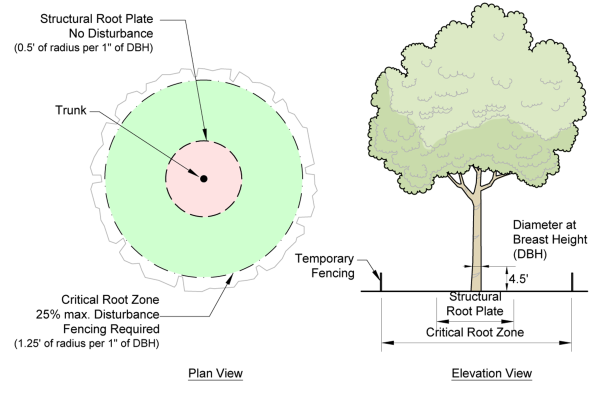
Fig. 16.7-1
- Tree Protection Fencing
- A three (3) foot high clearly visible temporary fence shall be erected around the perimeter of the critical root zone for all protected trees.
- Protective fencing shall be erected before construction begins and kept intact until final inspection for certificate of occupancy.
- The storage of materials and/or the use of machinery within a tree protection fence is prohibited and shall be subject to fines and/or penalties.
16.7.6 Credit For Protected Trees
- Existing canopy trees that are preserved may be used to reduce the amount of required canopy trees to be placed within a required lot frontage area, parking area, or open space. Any area under the canopy of an existing canopy tree, will not be required to plant additional canopy trees in that area or be used in the calculation of the quantity of required canopy trees.
- The City Planner, under advisement from the Landscape Advisory Board, has the discretion to determine if a tree that is to remain is acceptable based on species, location, health, and possible detrimental effects on neighboring property or public property.
16.7.7 Right-Of-Way Tree Protection
- All trees, regardless of species and/or size, located within the right-of-way of a public street shall be protected. Any action to cut down, remove, deface, burn, poison, injure, mutilate, disfigure, or substantially trim any tree located within the right-of-way shall be prohibited except for the following:
- An action taken by a publicly owned utility as part of maintenance, repair, and/or installation of existing or new service, provided that the destruction of any canopy tree with a minimum caliper of thirty (30) inches measured at breast height shall be limited to the minimum amount necessary in order to provide service.
- An action taken by a City department as part of maintenance, repair, and/or installation of existing or new public infrastructure, provided that the destruction of any canopy tree with a minimum caliper of thirty (30) inches measured at breast height shall be limited to the minimum amount necessary for the improvement.
- As part of an approved site plan or infrastructure plan for a development. Replanting of new trees within the right-of-way in an amount and in a location determined by the Development Review Committee shall be required as part of site plan or infrastructure plan approval.
- Any tree that is located within a right-of-way and is damaged to the extent that it creates a threat to the general health, safety, and welfare of the general public and/or an immediate threat to public or private property may be removed by the City at any time.
- The unauthorized removal or damaging of any tree located within the right-of-way shall be subject to fines and/or penalties.
16.7.8 Watercourse Tree Protection
- The designation of a natural watercourse protection area and its extent shall be made by the City Engineer and/or City Planner based on the physical characteristics of the drainage basin.
- All trees, regardless of species and/or size, located within a natural watercourse protection area shall be protected.
- Any action to grade, cut down, remove, deface, burn, poison, injure, mutilate, disfigure, substantially trim, or remove any tree located within the natural watercourse protection area shall be prohibited except for the following:
- An action taken by a City department as part of maintenance, repair, and/or installation of existing or new public infrastructure.
- As part of an approved site plan or infrastructure plan for a development.
- Any tree that is located within a watercourse protection area and is damaged to the extent that it creates a threat to the general health, safety, and welfare of the general public and/or an immediate threat to public or private property may be removed by the City at any time.
16.7.9 Violations
Any violation of the regulations of this section relating to tree protection are hereby declared to be and constitute a nuisance.
16.7.10 Waiver
Any variance from the requirements of this section shall be done in accordance with Section 3.11 as a landscape waiver.
16.7.11 Maintenance And Replacement Of Protected Trees
Protected Trees approved as part of the site development plan, shall be considered binding elements of the project in the same manner as parking, building, materials, and other details. The applicant, owner, subsequent owners, and/or their agents shall be responsible for the continued maintenance of protected trees. All protected trees shall be maintained in good living condition. Any damaged, dead, or dying protected tree shall be replaced with additional canopy tree(s). The amount and species of replacement tree(s), shall be determined by the Board of Aldermen upon the recommendation of the Landscape Advisory Board. Recommendations shall be based on the specific site conditions, location of the existing protected tree(s), and ecological benefit to the community of the proposed replacement tree(s).
16.8.1 Scope
- Construction sites, land disturbance, and earthwork loosen soil and remove vegetation. This loosened soil is easily transported downstream during rain events and contributes to the degradation of land surfaces, water quality in streams and lakes, and air quality. This degradation often manifests in the form of erosion, siltation, dusty conditions, clogged storm sewers, polluted waterways, increased runoff and localized flooding. Degradation and the subsequent damage increase maintenance costs for roadways, storm sewers, and other infrastructure. It is the intent of this ordinance to protect the health and safety of residents and to protect adjoining or nearby property in the city including land, streams, hills, and vegetation through the oversight of land disturbance activities.
- The regulations set forth in this article shall apply to all real property within the city limits now and in the future. This article shall be a minimum standard.
16.8.2 Applicability And Exemptions
- Applicability. It shall be unlawful for any entity to clear, clear cut, grade, level, excavate or fill in the process of construction or as a preliminary to construction or development (hereinafter land disturbance), perform land disturbance activities on any property within the city limits without having first obtained a Land Disturbance Permit (LDP) from the City of Starkville Building Department that is greater than one-thousand (1000) square feet or which requires a building permit, whichever is smaller.: However, no LDP shall be issued for the following:
- Any property for which a preliminary subdivision plat is required, as determined by the city engineer, which has not been approved by the Planning and Zoning Commission and the Mayor and Board of Aldermen.
- Any property for which a site plan approval is required, as determined by the building official, which has not been approved by the Planning and Zoning Commission.
- Exemptions. The following development activities are exempted from this article. However, exempt activities shall still include construction entrances where entering a public roadway, and must prevent pollution to adjacent property owners and water courses, natural or manmade.
- Repairs and/or construction deemed emergency in nature as defined by the City Engineer or City Planner;
- Any logging, timber harvesting, or agricultural activity;
- Public utility repairs;
- Ditch or channel cleaning;
- Drainage maintenance for any conveyance systems, natural or manmade.
16.8.3 Submission Of Land Disturbance Permits
- Permits Required.
- For all land disturbance activities greater than one-thousand (1000) square feet or which requires a building permit (whichever is smaller), an LDP must be secured from the City of Starkville Building Department prior to starting any land disturbance activities after the site plan has been approved. This provision shall not apply to single lot residential detached dwellings.
- For all new subdivision developments, an LDP must be secured from the City of Starkville BuildingStarkvilleBuilding Department prior to starting any land disturbance activities after the infrastructure plans have been approved.
- For all residential detached dwelling construction, an LDP must be secured from the City of Starkville Building Department prior to starting any land disturbance activities after the building plans have been approved.
- No permit shall be issued for any land disturbance activities until the LDP has been reviewed and approved by the Engineering orEngineeringor Community Development Departments.
- Required Information: The LDP applications shall contain the following information:
- The total lot area or property boundary area with corresponding dimensions;
- All plans to scale, no more than one (1) inch equals one hundred (100) feet,
- Intended use of the property;
- The name and location of the project;
- The name, address and telephone number of the owner, owner's agent or lessee of the property;
- The specific BMP’s proposed;
- The name, address, and telephone number of the entity performing such work;
- The total land disturbance area;
- General description of work to be performed.
- SWPPP for all projects whose property boundary is one acre or greater
- QCP information (name, address, telephone number, description of qualifications) for all non-single dwelling unit residential land disturbance projects.
- Control Measures Permit (CMP).
- After a full LDP application has been submitted, the Building Department will issue a CMP which will specify the initial control devices. This will allow the applicant to install silt fencing around the property boundary, install any required construction entrances, and provide appropriate protection for any existing stormwater structures or natural conveyance systems.
- No other land disturbance activities, including clearing, grading, grubbing, or other land clearing activities, shall be performed untilperformeduntil an inspection from city staff has been made of these items.
- The City Engineer may require that a heavy-duty apron be installed as part of the CMP if there is an existing sidewalk across the construction access location. All sidewalk and pedestrian facilities shall remain open and functional during construction. Pedestrian detours may be allowed at the discretion of the City Engineer and ADA Coordinator if said detour meets all City, ADA, MUTCD, and other safety requirements.
- Once all initial control devices have been installed in accordance with the CMP, the contractor shall request a CMP inspection.
- Land Disturbance Permit.
- The contractor and inspector will meet on site to review the initial control devices, as designated in the CMP. Upon a satisfactory inspection from city staff and the subsequent approval of the LDP, the applicant may begin land disturbance activities on the site
- No permit will be issued for any property, contractor, or owner on which indebtedness to the city exists.
- The fee for issuance of permits shall be set by the latest fee schedule.
- For sites requiring a stormwater permit from the MississippiDepartment ofof Environmental Quality (MDEQ), a copy of such approved permit shall also be submitted as part of the application for the permit.
- Any land disturbance to be performed within any 100-year floodplain area shall also be identified on maps or plats showing theshowingthe existing elevations of the property, 100-year floodplain and floodway areas, and location and elevation of proposed fill material.
- No permit shall be required in an emergency situation to repair or restore utility service.
- During and throughout construction, any party that has obtained an LDP shall be subject to ongoing erosion control inspections. The city may at any time request additional or replacement BMP’s and/or erosion control measures for any measures that seem inadequate or non-functional.
16.8.4 Design And Implementation Of Erosion Control Plan
All erosion and sediment control practices as well as water crossings for both design and implementation shall meet the design criteria set forth in the most recent versions of the MDEQ Handbook for EC and the Field Manual. The erosion control plan shall be designed and certified by a QCP, as defined in the definitions portion of this ordinance, for all non-single dwelling unit residential lot construction projects.
- General Design. The erosion control plan shall require, and the entity shall install, specific erosion control plans which shall be maintained in proper working condition for so long as work is being conducted on the property or for so long as an active permit of any nature is issued for the project. Erosion control devices required by the LDP may include, but are not limited to, silt fences, hay bales, retention ponds, sedimentation ponds, mulch, sod, rip-rap, vegetation barriers, washing stations and any other measures outlined in the Design Guide for EC or Field Manual that will adequately prevent sediment from being eroded onto adjoining property or into manufactured or natural stormwater conveyances systems.
- Clearing and grading.
- Clearing and grading of natural resources, such as wetlands, waterways, and watercourses, shall not be permitted, except when in compliance with all other chapters of this Code and any and all federal, state and local regulations.
- Clearing techniques that retain natural vegetation and natural drainage patterns are strongly encouraged.
- For natural or manmade streams and/or watercourses, a buffer area within the front, side, and rear setbacks is required. The buffer area can either be the existing vegetation that is left undisturbed or re-establishment by planting new vegetation if clearing or grubbing is required within setbacks. If setbacks are not required, perimeter control measures are expected to act as buffer. The buffer shall be fifteen (15) feet in width as measured perpendicular to the top-of-bank.
- Multi-stage phasing may be required on sites, with the size of each phase to be established by the QCP and approved by the city. The erosion control plan and/or stormwater pollution prevention plan should clearly delineate each phase of clearing and the estimated duration of exposed soils.
- Any clearing or land disturbance, except as is necessary to install the initial BMPs, shall not begin until the city's BMP minimum requirements are met.
- Cut and fill slopes shall be no steeper than 3:1, except as approved by the city.
- Developers requesting city sewer and/or water services must obtain site plan approval prior to clearing regardless of property location.
- Erosion control.
- Permanent erosion control measures shall be applied to denuded areas which have been either partially or wholly cleared or removed by development activities within seven (7) days after final grade is reached on any portion of the site. Soil stabilization shall also be applied within seven (7) days to any denuded area which may not be at final grade, but will remain dormant (undisturbed by construction activity) for longer than fourteen (14) days. Any temporary soil stockpiles shall be stabilized or protected with sediment trapping measures to prevent erosion. Applicable erosion control measures shall include establishment of vegetation, mulching, and the early application of gravel base on areas to be paved. Selected permanent or temporary erosion control measures should be appropriate for the time of year, site conditions, and estimated duration of use.
- If vegetative erosion control methods, such as seeding, have not germinated to a coverage of at least 90 percent within fourteen (14) days, the city may require that the site be reseeded, sodded, or stabilized with alternative cover. All land disturbance projects shall be stabilized prior to the issuance of a final plat, certificate of occupancy or temporary certificate of occupancy unless otherwise approved by the Engineering and Community Development Departments.
- On slopes that are tributary to any waterways, watercourses, or any other conveyance system, special techniques that meet or exceed design criteria outlined in the Field Manual shall be used to ensure stabilization.
- Soil stockpiles must be stabilized at the end of each work week or if a rain event is predicted.
- Techniques, as referenced the Field Manual shall be employed to prevent the blowing of dust or sediment from the site onto adjacent properties. The use of chemical agents in or near critical areas is discouraged.
- Right-of-way disturbances shall be stabilized with sod or a combination of sod and seed/mulch unless otherwise directed by the City Engineer. Seed and mulch alone shall not be acceptable.
- Techniques shall be employed to divert upland runoff past or around disturbed slopes.
- Sediment controls.
- All silt fencing shall be installed with wire backing and steel posts on all developments.
- Sediment controls shall be provided in the form of perimeter controls, such as silt fences, sediment basins and/or sediment traps.
- Where possible, sediment basins shall be designed in a manner that allows adaptation to provide long term stormwater management.
- Adjacent properties shall be protected from any and all types of pollutants.
- For project sites greater than or equal to five (5) acres, a sedimentation pond is required. The installation of the pond shall occur prior to the mass grading of the site.
- Waterways and watercourses.
- When a watercourse must be crossed regularly during construction, a temporary stream crossing shall be provided. When applicable, approval must be obtained from the United States Army Corps of Engineers, state and federal agencies, and the city.
- When in-channel work is conducted, the channel shall be stabilized after the work is completed.
- Any construction of a crossing of a waterway or watercourse in a floodway must be engineered with a no-rise certificate and shall have minimal temporary or permanent disturbance of the floodways bottom condition.
- All on-site stormwater conveyance channels shall be designed according to the criteria outlined in the Field Manual.
- Outlets of all pipes and paved channels shall have adequate stabilization to prevent erosion. Riprap or Flexamat may be required for stabilization if vegetative measures prove to be ineffective at controlling erosion in waterways or watercourses.
- Construction site access.
- A stabilized construction access (e.g. construction entrance) shall be required on all development and construction sites, including single-family lot construction, at any point where construction traffic will be entering and leaving the construction site in order to ensure sediment is not tracked on to public streets from the construction site. All construction entrances shall conform to MDEQ Handbook for Erosion Control, Sediment Control and Stormwater Management on Construction Sites and Urban Areas Chapter on Construction-Exit Pad (CEP) or the city’s erosion control requirements, whichever is more stringent. Stone pads shall be a coarse aggregate meeting the requirements for MDOT's Size I aggregate (ranging from 3/8 to 1 inch), be six inches thick and shall be placed a minimum width equal to the existing drive or as defined below, whichever is greater. The length of stone pad will be sufficient to prevent sedimentation from entering public streets from the construction site and adhere to the requirements below.
- For single lot residential dwelling unit construction, the construction entrance shall be at a minimum sixteen (16) feet in width by fifty (50) feet in length;
- All other sites shall provide construction entrances, at a minimum, are twenty (20) feet in width by one-hundred (100) feet in length.
- The City Engineer and/or Building Official may increase or decrease the dimensional requirements of constructionentrances.
- Sediment accumulation and tracking on public rights-of-way, such as streets, alleys, storm drains or sanitary sewers, ditches and sidewalks, is not allowed and shall be removed daily.
- A stabilized construction access (e.g. construction entrance) shall be required on all development and construction sites, including single-family lot construction, at any point where construction traffic will be entering and leaving the construction site in order to ensure sediment is not tracked on to public streets from the construction site. All construction entrances shall conform to MDEQ Handbook for Erosion Control, Sediment Control and Stormwater Management on Construction Sites and Urban Areas Chapter on Construction-Exit Pad (CEP) or the city’s erosion control requirements, whichever is more stringent. Stone pads shall be a coarse aggregate meeting the requirements for MDOT's Size I aggregate (ranging from 3/8 to 1 inch), be six inches thick and shall be placed a minimum width equal to the existing drive or as defined below, whichever is greater. The length of stone pad will be sufficient to prevent sedimentation from entering public streets from the construction site and adhere to the requirements below.
- Maintenance. The responsibility of the property owner and its agents shall be jointly and severally with the entity performing the work for the maintenance of all erosion control devices, which shall be maintained in a condition so as to prevent erosion of sediment on the property.
- Completion of construction activities. All open channels and ditches shall be permanently vegetated upon final building inspection. Seed and mulch shall not be accepted. If sod is used on slopes, corners will need to be pinned per the Field Manual.
- Common areas, such as detention basins, shall be permanently stabilized upon final inspection. Seed and mulch shall not be accepted.
- Prior to final inspection, all construction waste and debris, silt fences, hay bales, inlet protection, and other BMPs shall be removed, except those required for the next phase of construction, or those deemed necessary for continued stabilization by the building official or City Engineer.
- The responsible party shall submit a letter to building official requesting termination of the LDP upon completion of all construction activities and stabilization of property. No certificate of occupancy or final plat approval will be issued or executed until the site is fully stabilized unless otherwise approved by the Engineering and Community Development Departments.
16.8.5 Performance Bonds
Prior to the issuing of a permit for any land disturbance activity in excess of five acres, and for smaller areas when potentially hazardous soil or drainage conditions exist due to types of soils, steep grades, floodplain development, or critical areas such as nearby lakes, streams, large drainage ditches, roads or wetlands, as determined by the city staff, the applicant shall be required to provide a performance bond or similar form of security acceptable to the city to complete all land and grade stabilization measures and improvements as shown in the approved plan. The city staff shall establish the amount and time period of the bond, based on the estimated cost and time for completing the plan.
16.8.6 Violations On Municipal Property
- It shall be unlawful for any entity to cause, permit or allow any sediment to be washed or otherwise disposed upon any municipal property within the city. In the event any entity shall allow such sediment to be deposited upon municipal property, such entity shall immediately remove such sediment from said municipal property.
- It shall be unlawful for an entity, upon notice from the city official of a violation of subparagraph (1) above, to not immediately remove such sediment. Once notice is given, if the entity does not act immediately to remove such sediment, the city official shall issue a stop work order on such project. If the sediment is not removed within 24 hours of notice by the city official, and the city official determines that a dangerous situation exists with regard to the sediment, the city may remove such sediment and charge the entity with all reasonable costs associated with the removal of the sediment.
- Notice by the city official is deemed sufficient if the notice is orally given to the entity. Written notice may then be mailed or hand delivered to such entity or its representative. Such notice is deemed given when orally transmitted, and not at any time associated with the giving or receiving of the written notice.
16.9.1 Purpose
During rainfall, a portion of precipitation is either captured by plants or infiltrates into the ground; any remaining precipitation flows over the ground, typically to the nearest conveyance system. This remaining precipitation is known as stormwater runoff. In developed areas where there are high percentages of impervious surfaces, a majority of precipitation becomes stormwater runoff. This increase in water flowing along the ground, rather than infiltrating into the soil, can cause localized and regional flooding due to the increased runoff volumes, velocities and flow rates. Furthermore, loss of infiltration due to impervious surfaces increases the number of pollutants and sediment that are transported downstream and can cause significant degradation both in manmade stormwater conveyance systems and natural conveyance systems (e.g. creeks, streams, channels).
The purpose of this article is to diminish threats to public health and safety caused by stormwater runoff; reduce economic losses to individuals and the community at large; and protect, conserve, and promote the orderly development of land, water, and all-natural resources. The provisions of this article further regulate, guide, and control:
- The subdivision layout, new development, redevelopment, land disturbance activities, changes in ground cover, and improvement of lands located within the City of Starkville.
- The construction of buildings and drainage of the sites on which structures are located, including parking and other paved surfaces.
- The design, construction, and maintenance of stormwater management facilities.
- The provisions of this article may also further regulate, guide and control any development located outside the city limits which seeks water and/or sewer service(s) to be provided by the City of Starkville as a part of a Developer's Agreement.
16.9.2 General Criteria And Standards
- Applicability. This article shall be applicable within the City of Starkville's jurisdictional area and may be applicable to any development located outside the city limits which seeks water and/or sewer service(s) to be provided by the City as a part of a Developer's Agreement, and shall apply to:
- New development or redevelopment that is greater than or equal to one-half (1/2) acres and less than two (2) acres and having fifty (50) percent or greater impervious surface as calculated based on a weighted average ;
- New development or redevelopment that is two (2) acres or greater;
- Land development activities that are smaller than the minimum applicability criteria established in 16.9.2.A.1-16.9.2 A—2ii. above, if such activities are part of a larger common plat (plan of development), even though multiple separate and distinct land development activities may take place at different times on different schedules (such as a phased residential subdivision).
- Exemptions
- The following development activities are exempted from this article: Existing, individual single-family residential lots less than ten (10) acres, provided that single-family lots that are part of a new subdivision or phased development project are not exempt from this article;
- Additions or modifications to existing single-family structures;
- Developments or redevelopments that are less than one-half (1/2) acre, provided they are not part of a larger common development plan;
- Property that is part of an agriculture and forestry use as defined in Section 13.9.6.;
- Land disturbing activities conducted for the purpose of restoration of streams, stream banks, riparian zones, or other environmentally protected areas; and
- Repairs and/or construction deemed emergency in nature.
- Mitigation of Excess Stormwater Runoff. The increased stormwater runoff resulting from the proposed development or redevelopment meeting the minimum applicability criteria of in 16.9.2.A shall be mitigated by proper stormwater management facilities. Said mitigation will be designed so that the peak flows of stormwater runoff from the site, in the final condition in which it is proposed to be developed, will not exceed the rate of runoff from the site in its pre-development state for the 2-year, 10-year and 25-year, 24-hour storm events.
- Storage Capacity. Stormwater management facilities shall be designed with sufficient capacity to accommodate all runoff caused by the development in excess of that runoff which would occur from the site if left in its pre-development state. Stormwater storage shall be sufficient to store all excess flows and volumes for the design storms of this ordinance. The stormwater management facilities shall be designed so that the peak flow rate at any exit point in the post-developed condition shall be less than or equal to the peak flow rate for that exit point in the pre-developed condition for the design storms of this ordinance.
- Initial Storage Estimate: As part of a rezoning, conditional use, special exception, pre-application, or a preliminary plat, the City Engineer may require an initial storage estimate concurrent with NRCS TR-55, Chapter 6 Storage Volume for Detention Basins. If required, the resultant storage estimate should be relatively the same as that provided by the proposed detention/retention structure.
- Downstream Runoff Analysis. An important consideration of a new development or redevelopment is the increased volume of water that is added to downstream areas. Even when peak flows have been properly attenuated, at the discharge location downstream flooding can still occur due to increased duration of peak flow rates. These longer flow durations can combine with existing downstream flows to create flooding that may not have previously existed. A downstream analysis of the design events may be required based on the proposed development for the following conditions:
- Developments between two (2) acres and twenty (20) acres will be required to perform a stormwater analysis subject to the standards of this ordinance at a point five-hundred (500) feet downstream or to a significant point of interest, as determined by the City Engineer, of the development for the required design events to ensure that increased runoff durations do not create an increase in peak flow downstream that did not exist during pre-development. This analysis shall be based on the time of concentration of the overall basin draining to the point five-hundred (500) feet downstream, not just that of the proposed site.
- Developments twenty (20) acres or greater will be required to perform a “10% Rule” analysis, as described in the Georgia Stormwater Management Manual (current edition).
- In the event the downstream runoff analysis concludes a potential for increased peak flows downstream, the City Engineer may require further mitigation through additional or reduced stormwater management facilities or other methods to protect downstream properties.
- Stormwater Management Facilities in Floodplains. If stormwater storage is provided within a FEMA recognized Special Flood Hazard Area of any zone, no facility or storage volume may be provided below the 100-year base flood elevation (BFE) established for that floodplain. If not established, a study prepared by a design professional registered or licensed in the state of Mississippi utilizing standard engineering practices approved by FEMA shall be submitted to determine the base flood elevation. A copy of this study shall be submitted to the City Engineer for review and approval. Special consideration may be given by the City Engineer if no alternate location of the stormwater management facility is practical. Stormwater Bypass. Stormwater management facilities shall have adequate capacity to bypass, through the development, the existing flow from all upstream areas. Bypass conveyance should be designed such that they do not overtop or surcharge from the bypass system. Bypass flow should not be conveyed through proposed on-site stormwater management facilities unless otherwise approved by the City Engineer. A supplemental drainage report will be required that accounts for all upstream contributing areas and the flows that said areas impose on the proposed development. The bypass system shall be designed to convey for the 100-year, 24-hour storm event.
- Drainage Way Protection. It shall be unlawful to dump trash, debris, landscape waste, and other deleterious materials in any and all drainage ways in the city.
- Regulation of Flow Distribution. Detailed information shall be provided for each runoff exit point from the property which determines the pre-development flow distribution and location. Flow must exit the property in the post-developed condition in the same flow distribution and location as it exited the property in the pre-developed condition, to the greatest extent possible. In rare and extenuating circumstances where the flow distribution is increased at any given point, the post-development flow at that point shall not increase from its pre-development state, even if the entire site runoff collectively is less than pre-development unless otherwise approved by the City Engineer.
- Connection to Existing Stormwater Facilities. Where proposed stormwater runoff is to be connected to existing stormwater infrastructure (e.g. storm sewer, open channel, box culvert, etc.), an analysis of the existing structure and its ability to convey additional runoff will be required. and shall be appropriately surveyed and modeled to accurately determine the impacts of the downstream system on the proposed system In the event the downstream infrastructure cannot convey the required runoff, the City Engineer may require further mitigation or improvement.
- Redevelopments. For redevelopment that requires site plan approval such that post-developed conditions may:
- Decrease or maintain the current weighted curve number, it will be required to reduce the stormwater runoff to an amount of less than or equal to ninety-five (95) percent of the pre-development condition for the 2-year, 24-hour storm event.
- Increase the weighted curve number, it will be required to reduce the stormwater runoff to the lesser of the following unless approved otherwise by the City Engineer:
- Pre-development condition for the 2-year, 10-year, and 25-year, 24-hour storm events; or
- An amount of less than or equal to ninety-five (95) percent of the post-development condition for the 2-year, 10-year, and 25-year, 24-hour storm event
- For larger redevelopment sites where only a portion is being developed or redeveloped, when the new development area is twenty (20) percent of the total existing site area or less, only the new development area is to be mitigated. Percentage of the site to be cumulative over a ten (10) year period if the site is redeveloped in multiple phases
- Phased Development. For developments designed to occur in phases, the stormwater management facilities, including both conveyance and detention, shall be designed to individually comply with the regulations set forth in this ordinance and in the City of Starkville Standards of Design and Specifications at the end of each phase such that the system would meet these requirements even if future phases do not occur. As additional phases develop, the stormwater management facilities may be expanded and modified to meet the requirements of future phases.
- Regional Stormwater Management. The Drainage Plan for each land development project shall provide for stormwater management measures located on the site of the project unless provisions are made to manage stormwater by an offsite or regional facility. The City Engineer, with the approval of the Planning and Zoning Commission, may make allowance for an offsite or regional facility based on a development’s location, lot size, percentage of the lot used, stormwater management facility design, and other factors that the City Engineer in their professional opinion may deem relevant. The offsite or regional facility, if applicable, must comply with the following:
- The offsite or regional facility must be on property legally dedicated for the purpose and this purpose run with the land by filing either deed, easement, or plat;
- For purposes of use, only developments contiguous to the offsite or regional facility or developments that have obtained legal and binding easements allowing the transfer of stormwater across all properties involved to gain access to the offsite or regional facility are eligible;
- A drainage easement for the conveyance of stormwater to the regional facility is required; and
- There must be a legally obligated entity responsible for the long-term operation, inspection, and maintenance of the offsite or regional facility.
- Stormwater Management during Construction. Stormwater management shall be implemented during all stages of site development. Stormwater management facilities shall be implemented as part of the initial land disturbance activities and incorporated into the development’s Stormwater Pollution Prevention Plan and Erosion Control Plan. Erosion control measures, such as stormwater retention devices or sediment traps, may be used as temporary stormwater management facilities during the development’s construction process. At a minimum, a temporary stormwater management facility must be capable of managing runoff from the 2-year and 10-year storm events. Stormwater management facilities, permanent or temporary, must be properly maintained during all stages of site development.
16.9.3 Improvement Regulation
- Required Information. A Drainage Plan shall be prepared and certified by a registered professional engineer licensed in the State of Mississippi and submitted with the plans for each proposed development. The stormwater report shall use the United States Department of Agriculture Soil Conservation Service (SCS) method for determining runoff rates and volumes, the TR-55 Method for time of concentration values, and shall follow the format and regulations set forth in this ordinance and in the City of Starkville Standards of Design and Specifications.
- Pre-development Calculations. Calculations shall be provided which show the pre-development rate of runoff for the design storm events provided in this ordinance. These calculations shall use the SCS Runoff Curve number method in accordance with the United States Department of Agriculture Soil Conservation Service Technical Release 55. The City Engineer reserves the right to allow alternate methods. Recommended curve number values can be found in the City of Starkville Standards of Design and Specifications and shall be in accordance with TR-55. and shall be specific to on-site soil types determined through the USDA Web Soil Survey or through an appropriate number of on-site soil bores Precipitation frequency estimates should be obtained from the National Oceanic and Atmospheric Administration (NOAA) website.
- Post-development Calculations (without mitigation). Calculations shall be provided which show the post-development rate of runoff for the design storms provided in this ordinance. These calculations shall use the same methodology that is used to calculate the pre-development peak flow rates.
- Routed/Detained Calculations. Calculations shall be provided which show the total planned release rate after detention has been provided for the design storms provided in this ordinance. These calculations shall use the same methodology that is used to calculate pre-development and post-development peak flow rates. The Rational Method shall not be used for detention, retention, or storage design.
- Drainage Plan: A comprehensive Drainage Plan shall be designed to safely and completely accommodate existing stormwater runoff, convey and detain proposed stormwater runoff and to manage increased stormwater runoff. This plan shall adhere to the necessary documents, calculations, and guidelines set forth in this ordinance and in the City of Starkville Standards of Design and Specifications, and shall include and be designed based upon the following:
- For all stormwater management facilities, design hydrographs of inflow, outflow and routed/detained conditions for the design storms provided in this ordinanceflows from the site under pre-development, post-development, and routed/detained conditions.b.
- Time of concentration path including length, slope and type of flow (e.g. sheet, shallow-concentrated, channel, closed conduit, etc.). Calculation method for time of concentration shall be performed in accordance with the TR- 55 method. Furthermorefurthermore, sheet flow shall not exceed one-hundred (100) linear feet for any time of concentration calculation for a post-development scenario and shall not include any flow paths representative of a natural or designed conveyance system including but not limited to curb and gutter, swales, ditches, graded channels, etc.
- Stormwater Management Facilities: Stormwater management facilities, including detention and retention facilities, are designed primarily to detain increased runoff that occurs from development and additional impervious areas. These facilities must meet the requirements set forth in this ordinance and in the City of Starkville Standards of Design and Specifications.
- Location of Facilities: Surface stormwater management facilities (e.g. dry pond or retention pond) shall be located to the side or read of a development to the greatest extent possible. If site conditions warrant the placement of the surface stormwater management facilities in the front of the development or along public right-way, it-of shall to the greatest extent possible serve as an aesthetic and landscape amenity through means including but not limited to gradual side slopes, shallow depths, enhanced landscaping, implementation of alternate best management practice methods, etc. Landscaping shall be appropriately designed to meet the landscape standards of this section.
- Maintenance of Facilities: All improvements, including landscaping, shall be maintained in perpetuity and cannot be developed for any other use which would limit or cause to limit the use of the improvements. In the case of shared stormwater management facilities, the improvements shall be owned and/or maintained by the property owner's association of the development. A special note to this effect shall appear on any final plat of subdivision or any plat of condominium and their declarations. A property owner's association shall be formed by the developer in perpetuity for the maintenance of the improvements. Membership shall be mandatory for all property owners. Articles of agreement of the property owner's association must be approved by the Board of Aldermen of the City of Starkville before recording. When problems arise due to inadequate maintenance, the City Engineer or his designated agent of the City of Starkville may inspect the improvements and compel the correction of the problem by issuing a written notice of violation to the owner of the property. If remediation of the violation and/or restoration of affected property is required, the notice shall set forth a deadline of thirty (30) days within which such remediation or restoration must be completed. In accordance with the authority of the municipality granted by MCA 1972 § 21-17-5, said notice shall further advise that, should the violator fail to remediate or restore within the established deadline, the work will be done by a designated governmental agency or a contractor and the expense thereof shall be charged to the violator.
- Inspection of Facilities: Inspection of Facilities: The City Engineer or his designated agent shall inspect all stormwater management facilities while under construction. All stormwater management facilities located on private property shall be accessible at all times for inspection by the City Engineer or other responsible public official. A final inspection by the City Engineer or his designated representative is required before the release of any certificates of occupancy or performance securities can occur.
- As-built Documentation. Upon completion of a project or a phase of a phased project, the registered landscape architect or the licensed professional engineer is responsible for submitting a signed/stamped certification that the completed project is in accordance with the approved Drainage Plan. All applicants are required to submit actual "as-built" plans for any stormwater management facilities or practices after final construction is completed. See the City of Starkville Standards of Design and Specifications for as-built documentation requirements.
- Location of Facilities: Surface stormwater management facilities (e.g. dry pond or retention pond) shall be located to the side or read of a development to the greatest extent possible. If site conditions warrant the placement of the surface stormwater management facilities in the front of the development or along public right-way, it-of shall to the greatest extent possible serve as an aesthetic and landscape amenity through means including but not limited to gradual side slopes, shallow depths, enhanced landscaping, implementation of alternate best management practice methods, etc. Landscaping shall be appropriately designed to meet the landscape standards of this section.
16.9.4 Maintenance Access Easement
The owner or responsible party must ensure access from a public right-of-way to the stormwater management facilities. A permanent access easement shall be secured to ensure access to the stormwater management facilities to perform regular inspections, maintenance, and repairs. Such access shall be sufficient for all necessary equipment for maintenance activities and repairs. All such easements shall be noted on any plat, survey, site plan, or other application or map provided to the City of Starkville for any purpose.
16.10.1 Statutory Authorization, Findings Of Fact, Purpose, And Objectives
- Statutory Authorization. The Legislature of the state of Mississippi has in Title 17, Chapter 1, Mississippi Code of 1972 Annotated delegated the responsibility to local government units to adopt regulations designed to promote the public health, safety, and general welfare of its citizenry. Therefore, the Mayor and Board of Aldermen for the City of Starkville, Mississippi does hereby adopt the following floodplain management regulations.
- Finding of Fact
- The City of Starkville, Mississippi is subject to periodic inundation, which results in loss of life and property, health and safety hazards, disruption of commerce and governmental services, extraordinary public expenditures for flood protection and relief, and impairment of the tax base, all of which adversely affect the public health, safety and general welfare.
- These flood losses are caused by the cumulative effect of obstructions, both inside and outside the identified Special Flood Hazard Areas, causing increases in flood heights and velocities and by the occupancy in flood hazard areas by uses vulnerable to floods or hazardous to other lands which are inadequately elevated, floodproofed, or otherwise unprotected from flood damages
- Statement of Purpose. It is the purpose of this ordinance to promote the public health, safety, and general welfare and to minimize public and private losses due to flood conditions in specific areas by provisions designed to:
- Restrict or prohibit uses which are dangerous to health, safety, and property due to water or erosion hazards, which result in damaging increases in erosion or in flood heights or velocities;
- Require that uses vulnerable to floods, including facilities which serve such uses, be protected against flood damage at the time of initial construction;
- Control the alteration of natural floodplains, stream channels, and natural protective barriers which are involved in the accommodation of flood waters;
- Control filling, grading, dredging, and other development which may increase erosion or flood damage, and;
- Prevent or regulate the construction of flood barriers which will unnaturally divert floodwaters or which may increase flood hazards to other lands.
- Objectives. The objectives of this ordinance are:
- To protect human life and health;
- To minimize expenditure of public money for costly flood control projects;
- To minimize the need for rescue and relief efforts associated with flooding and generally undertaken at the expense of the general public;
- To minimize prolonged business interruptions;
- To minimize damage to public facilities and utilities such as water and gas mains, electric, telephone and sewer lines, streets and bridges located in floodplains;
- To help maintain a stable tax base by providing for the sound use and development of flood prone areas in such a manner as to minimize flood blight areas, and;
- To ensure that potential homebuyers are notified that property is in a flood prone area.
- Methods of Reducing Flood Losses. In order to accomplish its purposes, this ordinance includes methods and provisions for:
- Restricting or prohibiting uses which are dangerous to health, safety, and property due to water or erosion hazards, or which result in damaging increases in erosion or in flood heights or velocities;
- Requiring that uses vulnerable to floods, including facilities which serve such uses, be protected against flood damage at the time of initial construction;
- Controlling the alteration of natural floodplains, stream channels, and natural protective barriers, which help accommodate or channel flood waters;
- Controlling filling, grading, dredging, and other development which may increase flood damage, and;
- Preventing or regulating the construction of flood barriers that will unnaturally divert floodwaters or may increase flood hazards in other areas.
16.10.2 Definitions
Unless specifically defined below, words or phrases used in this ordinance shall be interpreted so as to give them the meaning they have in common usage and to give this ordinance it’s most reasonable application. A
A Zone is the Area of Special Flood Hazard without base flood elevations determined.
AE Zone is the Area of Special Flood Hazard with base flood elevations determined.
Accessory structure (Appurtenant structure) means a structure, which is located on the same parcel of property as the principal structure and the use of which is incidental to the use of the principal structure. Accessory structures should constitute a minimal initial investment, may not be used for human habitation, and be designed to have minimal flood damage potential. Examples of accessory structures are detached garages, carports, storage sheds, pole barns, and hay sheds.
Addition (to an existing building) means any walled and roofed expansion to the perimeter or height of a building. Any addition shall be considered new construction. If the addition is more than 50% of the market value of the structure, then the addition and the existing structure are now new construction.
Appeal means a request for a review of the Floodplain Administrator’s interpretation of any provision of this ordinance or a request for a variance.
AR/AE, AR/AH, AR/AO, and AR/A Zones are SFHAs that result from the decertification of a previously accredited flood protection system or levee that is in the process of being restored to provide a one percent chance or greater level of flood protection. After restoration is complete, these areas will still experience residual flooding from other flooding sources.
A99 Zone is that part of the SFHA inundated by the one percent chance flood to be protected from the one percent chance flood by a Federal flood protection system or levee under construction, no base flood elevations are determined.
Area of shallow flooding means a designated AO or AH Zone on the community’s Flood Insurance Rate Map (FIRM) with flood depths from one to three feet where a clearly defined channel does not exist, where the path of flooding is unpredictable and indeterminate, and where velocity flow may be evident. Such flooding is characterized by ponding or sheet flow.
Area of special flood hazard is the land in the floodplain within a community subject to a one percent or greater chance of flooding in any given year. This area is also referred to as the Special Flood Hazard Area (SFHA).
B
Base flood means the flood having a one percent chance of being equaled or exceeded in any given year (also called the “one percent chance flood”).
Base Flood Elevation (BFE) is the elevation shown in the Flood Insurance Study (FIS) for Zones AE, AH, AR, AR/A, AR/AE, AR/AH, AR/AO, and VE that indicates the water surface elevation resulting from a flood that has a one percent or greater chance of being equaled or exceeded in any given year.
Basement means any portion of a building having its floor sub-grade (below ground level) on all sides.
Breakaway Wall means a wall that is not part of the structural support of the building and is intended through its design and construction to collapse under specific lateral loading forces without causing damage to the elevated portion of the building or the supporting foundation system. This is associated with VE Zone construction.
Building see Structure.
C
Coastal High Hazard Area is an area of special flood hazard. Extending from offshore to the inland limit of the primary frontal dune along an open coast and any other area subject to high velocity wave action from storms or seismic sources. The area is designated on the FIRM as VE Zone.
Community is a political entity and/or its authorized agents or representatives that have the authority to adopt and enforce floodplain ordinances for the area under its jurisdiction.
Community Floodplain Management Map means any map produced by the community utilizing best available base flood elevation and floodway data that is from a federal, state, or other accepted technical source.
Community Rating System (CRS) is a program developed by the Federal Insurance Administration to provide incentives for those communities in the Regular Program that have gone beyond the minimum floodplain management requirements to develop extra measures to provide protection from flooding.
Community Flood Hazard Area (CFHA) is an area that has been determined by the Floodplain Administrator (or other delegated, designated, or qualified community official) from available technical studies, historical information, and other available and reliable sources, which may be subject to periodic inundation by floodwaters that can adversely affect the public health, safety and general welfare. This includes areas downstream from dams. Critical facility (also called critical action) means facilities for which the effects of even a slight chance of flooding would be too great. The minimum floodplain of concern for critical facilities is the 0.2 percent chance flood level. Critical facilities include, but are not limited to facilities critical to the health and safety of the public such as: emergency operations centers, designated public shelters, schools, nursing homes, hospitals, police, fire and emergency response installations, vital data storage centers, power generation and water and other utilities (including related infrastructure such as principal points of utility systems) and installations which produce, use or store hazardous materials or hazardous waste (as defined under the Clean Water Act and other Federal statutes and regulations).
D
D Zone is an area in which the flood hazard is undetermined.
Dam is any artificial barrier, including appurtenant works, constructed to impound or divert water, waste water, liquid borne materials, or solids that may flow if saturated. All structures necessary to maintain the water level in an impoundment or to divert a stream from its course will be considered a dam.
Development means any man-made change to improved or unimproved real estate, including, but not limited to, buildings or other structures, mining, dredging, filling, grading, paving, excavating, drilling operations, or storage of materials or equipment.
Dry Floodproofing means any combination of structural and nonstructural additions, changes, or adjustments to structures, which reduce or eliminate flood damages to real estate or improved real estate property, water, and sanitary facilities, structures, and their contents. Structures shall be floodproofed with a minimum of 12 inches of freeboard (more is recommended) in relation to the base flood elevation. Dry floodproofing of a pre-FIRM residential structure that has not been substantially damaged or improved is allowed. Dry floodproofing of a post-FIRM residential building is not allowed. Non-residential structures may be dry floodproofed in all flood zones with the exception of the Coastal High Hazard Area or the Coastal AE Zone.
E
Elevated building means for insurance purposes, a non-basement building which has its lowest elevated floor raised above ground level by foundation walls, shear walls, posts, pilings, columns, or piers.
Elevation Certificate is a FEMA form used as a certified statement that verifies a building’s elevation information.
Emergency Program means the first phase under which a community participates in the NFIP. It is intended to provide a first layer amount of insurance coverage for all insurable buildings in that community before the effective date of the initial FIRM.
Enclosures below the Lowest Floor see “Lowest Floor.”
Encroachment means the advance or infringement of uses, plant growth, fill, excavation, buildings, structures or development into a floodplain, which may impede or alter the flow capacity of a floodplain. Executive Order 11988 (Floodplain Management) this order requires that no federally assisted activities be conducted in or have the potential to affect identified Special Flood Hazard Areas, unless there is no practicable alternative.
Executive Order 11990 (Wetlands Protection) this order requires the avoidance of adverse impacts associated with the destruction or modification of wetlands.
Existing Construction means structures for which the “start of construction” commenced before date January 1, 1975. Existing construction may also be referred to as existing structures.
Existing manufactured home park or subdivision means a manufactured home park or subdivision for which the construction of facilities for servicing the lots on which the manufactured homes are to be affixed (including at a minimum the installation of utilities, the construction of streets, and either final site grading or the pouring of concrete pads) is completed before the effective date of the floodplain management regulations adopted by a community.
Expansion to an existing manufactured home park or subdivision includes the preparation of additional sites by the construction of facilities for servicing the lots on which the manufactured homes are to be affixed (including the installation of utilities, the construction of streets, and either final site grading or the pouring of concrete pads).
F
Fill means a deposit of earthen materials placed by artificial means.
Five-Hundred Year Flood means the flood that has a 0.2 percent chance of being equaled or exceeded in any year. Areas subject to the 0.2 percent chance flood have a moderate risk of flooding.
Flood or flooding means a general and temporary condition of partial or complete inundation of normally dry land areas from:
- The overflow of inland or tidal waters.
- The unusual and rapid accumulation or runoff of surface waters from any source.
- Mudslides (i.e. mudflows) which are proximately caused by flooding as defined in paragraph (A)(2) of this definition and are akin to a river of liquid and flowing mud on the surfaces of normally dry land areas, as when earth is carried by a current of water and deposited along the path of the current.
- The collapse or subsidence of land along the shore of a lake or other body of water as a result of erosion or undermining caused by waves or currents of water exceeding anticipated cyclical levels or suddenly caused by an unusually high water level in a natural body of water, accompanied by a severe storm, or by an unanticipated force of nature, such as flash flood or an abnormal tidal surge, or by some similarly unusual and unforeseeable event which results in flooding as defined in paragraph (A)(1) of this definition
Flood (insurance definition) means a general and temporary condition of partial or complete inundation of two or more acres of normally dry land areas or of two or more properties (e.g. a building and a public street) from (1) overflow of inland or tidal waters (2) unusual and rapid accumulation or runoff of surface waters (3) mudflows caused by flooding.
Flood Insurance Rate Map (FIRM) means an official map of a community, on which FEMA has delineated both the areas of special flood hazard and the risk premium zones applicable to the community.
Flood Insurance Study (FIS) is the document which provides an examination, evaluation, and determination of flood hazards and, if appropriate, corresponding water surface elevations, or an examination, evaluation, and determination of mudslide and/or flood-related erosion hazards.
Floodplain means any land area susceptible to being inundated by flood waters from any source.
Floodplain Administrator is the individual appointed to administer and enforce the floodplain management regulations.
Floodplain management means the operation of an overall program of corrective and preventive measures for reducing flood damage and preserving and enhancing, where possible, natural resources in the floodplain, including but not limited to emergency preparedness plans, flood control works, floodplain management regulations, and open space plans.
Floodplain management regulations means this ordinance and other zoning ordinances, subdivision regulations, building codes, health regulations, special purpose ordinances, and other applications of police power which control development in flood-prone areas. This term describes federal, state, or local regulations in any combination thereof, which provide standards for preventing and reducing flood loss and damage.
Floodproofing Certificate is an official FEMA form used to certify compliance for non-residential structures in non Coastal High Hazard Areas as an alternative to elevating buildings to or above the base flood elevation.
Floodway See Regulatory Floodway.
Floodway fringe means that area of the special flood hazard area on either side of the regulatory floodway.
Flood Protection Elevation is the base flood elevation plus the community freeboard. In areas where no base flood elevations exist from any authoritative source, the flood protection elevation can be historical flood elevations or base flood elevations determined and/or approved by the floodplain administrator plus freeboard.
Freeboard means a factor of safety, usually expressed in feet above the BFE, which is applied for the purposes of floodplain management.
Functionally dependent use means a use which cannot perform its intended purpose unless it is located or carried out in close proximity to water. The term includes only docking facilities, port facilities that are necessary for the loading and unloading of cargo or passengers, ship building and ship repair facilities. The term does not include long-term storage, manufacture, processing functions, sales, administrative functions, or service facilities. H
Hardship (as related to variances of this ordinance) means the exceptional difficulty that would result from a failure to grant the requested variance. The Mayor and Board of Aldermen requires that the variance is exceptional, unusual, and peculiar to the property involved. Mere economic or financial hardship alone is NOT exceptional. Inconvenience, aesthetic considerations, physical handicaps, personal preferences, or the disapproval of one’s neighbors likewise cannot, as a rule, qualify as an exceptional hardship. All of these problems can be resolved through other means without granting a variance, even if the alternative is more expensive, or requires the property owner to build elsewhere or put the parcel to a different use than originally intended.
Hazard potential means the possible adverse incremental consequences that result from the release of water or stored contents due to failure of a dam or mis-operation of a dam or appurtenances. The hazard potential classification of a dam does not reflect in any way on the current condition of a dam and its appurtenant structures (e.g. safety, structural integrity, and flood routing capacity).
High hazard dam means a class of dam in which failure may cause loss of life, serious damage to residential, industrial, or commercial buildings; or damage to, or disruption of, important public utilities or transportation facilities such as major highways or railroads. Dams which meet the statutory thresholds for regulation that are proposed for construction in established or proposed residential, commercial, or industrial areas will be assigned this classification, unless the applicant provides convincing evidence to the contrary
Highest adjacent grade means the highest natural elevation of the ground surface, prior to construction, next to the proposed walls of a building.
Historic Structure means any structure that is:
- Listed individually in the National Register of Historic Places (a listing maintained by the Department of Interior) or preliminarily determined by the Secretary of the Interior as meeting the requirements for individual listing on the National Register;
- Certified or preliminarily determined by the Secretary of the Interior as contributing to the historical significance of a registered historic or a district preliminarily determined by the Secretary to qualify as a registered historic district;
- Individually listed on the State of Mississippi inventory of historic structures, or;
- Individually listed on a local inventory historic places in communities with historic preservation programs that have been certified by an approved state program as determined by the Secretary of the Interior.
Hydrologic and hydraulic engineering analyses means the analyses performed by a professional engineer, registered in the state of Mississippi, in accordance with standard engineering practices as accepted by FEMA, used to determine flood elevations and /or floodway boundaries. I
Increased Cost of Compliance (ICC) coverage means under the standard flood insurance policy the cost to repair a substantially flood damaged building that exceeds the minimal repair cost and that is required to bring a substantially damaged building into compliance with the local flood damage prevention ordinance. Acceptable mitigation measures are floodproofing (nonresidential), relocation, elevation, demolition, or any combination thereof. All renewal and new policies with effective dates on or after June 1, 1997, include ICC coverage.
L
Letter of Map Change (LOMC) is an official FEMA determination, by letter, to amend or revise effective Flood Insurance Rate Maps, Flood Boundary and Floodway Maps, and Flood Insurance Studies. LOMC's are broken down into the following categories.
- Letter of Map Amendment (LOMA) An amendment based on technical data showing that a property was incorrectly included in a designated SFHA, was not elevated by fill (only by a natural grade elevation), and will not be inundated by the one percent chance flood. A LOMA amends the current effective FIRM and establishes that a specific property is not located in a SFHA.
- Letter of Map Revision (LOMR) A revision based on technical data that, usually due to manmade changes, shows changes to flood zones, flood elevations, floodplain and floodway delineations, and planimetric features. One common type of LOMR, a LOMR-F, is a determination concerning whether a structure or parcel has been elevated by fill above the BFE and is, therefore, excluded from the SFHA.
- Conditional Letter of Map Revision (CLOMR) A formal review and comment by FEMA as to whether a proposed project complies with the minimum NFIP floodplain management criteria. A CLOMR does not revise effective Flood Insurance Rate Maps, Flood Boundary and Floodway Maps, or Flood Insurance Studies.
Levee means a man-made structure; usually earthen embankments designed and constructed in accordance with sound engineering practices to contain, control, or divert the flow of water so as to provide protection from temporary flooding.
Levee system means a flood protection system which consists of a levee, or levees, and associated structures, such as closure and drainage devices, which are constructed and operated in accordance with sound engineering practices. For a levee system to be recognized, the following criteria must be met. All closure devices or mechanical systems for internal drainage, whether manual or automatic, must be operated in accordance with an officially adopted operation manual (a copy of which must be provided to FEMA by the operator when levee or drainage system recognition is being sought or revised). All operations must be under the jurisdiction of a Federal or State agency, an agency created by Federal or State law, or an agency of a community participating in the NFIP.
Limit of Moderate Wave Action (LiMWA) is the limit of the AE Zone category area exposed to wave attack from wavers greater than 1.5 feet during the base (one percent chance) flood on open coastal and inland areas exposed to erosion and wave propagation.
Low hazard dam means a class of dam in which failure would at the most result in damage to agricultural land, farm buildings (excluding residences), or minor roads.
Lowest adjacent grade means the elevation of the sidewalk, patio, deck support, or basement entryway immediately next to the structure and after the completion of construction. It does not include earth that is placed for aesthetic or landscape reasons around a foundation wall. It does include natural ground or properly compacted fill that comprises a component of a building’s foundation system.
Lowest floor means the lowest floor of the lowest enclosed area (including basement). An unfinished or flood resistant enclosure, used solely for parking of vehicles, building access, or storage, in an area other than a basement, is not considered a building’s lowest floor, provided that such enclosure is not built so as to render the structure in violation of the non-elevation provisions of this code.
M
Manufactured home (44 CFR 59.1 definition / FEMA) means a structure, transportable in one or more sections, which is built on a permanent chassis and designed to be used with or without a permanent foundation when attached to the required utilities. The term manufactured home does not include a “recreational vehicle.”
Manufactured housing (24 CFR 3280.3 and 3285.5 definitions / HUD) means “…a structure, transportable in one or more sections, which in the traveling mode is 8 body feet or more in width or 40 body feet in length or which when erected on-site is 320 or more square feet, and which is built on a permanent chassis and designed to be used as a dwelling with or without a permanent foundation when connected to the required utilities.”
Manufactured home park or subdivision means a parcel (or contiguous parcels) of land divided into two or more manufactured home lots for rent or sale.
Map Amendment means a change to an effective NFIP map that results in the exclusion from the SFHA or an individual structure or a legally described parcel of land that has been inadvertently included in the SFHA (i.e., no alterations of topography have occurred since the date of the first NFIP map that showed the structure or parcel to be within the SFHA.
Map Panel Number means the four-digit number followed by a letter suffix assigned by FEMA on a FIRM. The first four digits represent the map panel, and the letter suffix represents the number of times the map panel has been revised.
Market value means the property value (as agreed between a willing buyer and seller); excluding the value of land as established by what the local real estate market will bear. Market value can be established by independent certified appraisal; replacement cost depreciated by age of building (Actual Cash Value); or adjusted assessed values.
Mean Sea Level means, for the purposes of the National Flood Insurance Program, the National Geodetic Vertical Datum (NGVD) of 1929, North American Vertical Datum (NAVD) of 1988, or other datum, to which base flood elevations shown on a community’s Flood Insurance Rate Map (FIRM) are referenced. N
National Flood Insurance Program (NFIP) is the federal program that makes flood insurance available to owners of property in participating communities nationwide through the cooperative efforts of the Federal Government and the private insurance industry.
National Geodetic Vertical Datum (NGVD) means a vertical control, corrected in 1929, used as a reference for establishing varying elevations within the floodplain.
New Construction means a structure or an addition to an existing structure for which the start of construction commenced on or after the effective date of a floodplain management regulation adopted by a community and any subsequent improvements to such structure or the addition.
New manufactured home park or subdivision means a manufactured home park or subdivision for which the construction of facilities for servicing the lots on which the manufactured homes are to be affixed (including at a minimum, the installation of utilities, the construction of streets, and either final site grading or the pouring of concrete pads) is completed on or after the effective date of floodplain regulations adopted by a community.
Non-Residential means, but is not limited to; small business concerns, churches, schools, farm buildings (including grain bins and silos), pool houses, clubhouses, recreational buildings, mercantile structures, agricultural and industrial structures, warehouses, and hotels and motels with normal room rentals for less than 6 months duration. North American Vertical Datum (NAVD) of 1988 means a vertical control, corrected in 1988, used as a reference for establishing varying elevations within the floodplain.
O
Obstruction means, but is not limited to, any dam, wall, wharf, embankment, levee, dike, pile, abutment, protection, excavation, channel construction, bridge, culvert, building, wire, fence, rock, gravel, refuse, fill, structure, vegetation or other material in, along, across or projecting into any watercourse which may alter, impede, retard or change the direction and/or velocity of the flow of water, or due to its location, its propensity to snare or collect debris carried by the flow of water, or its likelihood of being carried downstream.
One Percent Flood (aka 100-Year Flood) is the flood that has a one percent chance of being equaled or exceeded in any given year. Any flood zone that begins with the letter A or V is subject to inundation by the one percent chance flood. Over the life of a 30-year loan, there is a 26-percent chance of experiencing such a flood within the SFHA.
P
Participating Community is any community that voluntarily elects to participate in the NFIP by adopting and enforcing floodplain management regulations that are consistent with the standards of the NFIP.
Post-FIRM Construction means new construction and substantial improvements for which start of construction occurred after December 31, 1974, or after the effective date of the initial FIRM of the community, whichever is later.
Pre-FIRM Construction means new construction and substantial improvements for which start of construction occurred before December 31, 1974, or before the effective date of the initial FIRM of the community, whichever is later.
Probation is a means of FEMA formally notifying participating communities of the first of the two NFIP sanctions due to their failure to correct violations and deficiencies in the administration and enforcement of the local floodplain management regulations.
Public safety and nuisance means anything which is injurious to the safety or health of an entire community or neighborhood, or any considerable number of persons, or unlawfully obstructs the free passage or use, in the customary manner, of any navigable lake, or river, bay, stream, canal, or basin.
R
Recreational vehicle means a vehicle that is:
- Licensed and titled as an RV or park model (not a permanent residence);
- Built on a single chassis;
- 400 square feet or less when measured at the largest horizontal projection;
- Has no attached deck, porch, or shed;
- Has quick-disconnect sewage, water, and electrical connectors;
- Designed to be self-propelled or permanently towable by a light duty truck, and;
- Designed primarily not for use as a permanent dwelling but as temporary living quarters for recreational, camping, travel, or seasonal use.
Regular Program means the second phase of the community’s participation in the NFIP in which second layer coverage is available based upon risk premium rates only after FEMA has competed a risk study for the community.
Regulatory floodway means the channel of a river or other watercourse and the adjacent land areas that must be reserved in order to discharge the base flood without cumulatively increasing the water surface elevation more than one foot.
Repair means the reconstruction or renewal of any part of an existing building for which the start of construction commenced on or after the effective date of a floodplain management regulation adopted by a community and all such regulations effective at the time of permitting must be met.
Repetitive Loss means flood-related damages sustained by a structure on two separate occasions during a 10-year period for which the cost of repairs at the time of each such flood event, on the average, equals or exceeds 25 percent of the market value of the structure before the damage occurred.
Repetitive Loss Property is any insurable building for which two or more claims of more than $1,000 were paid by the National Flood Insurance Program (NFIP) within any rolling 10-year period, since 1978. At least two of the claims must be more than ten days apart but, within ten years of each other. A RL property may or may not be currently insured by the NFIP.
S
Section 1316 means that section of the National Flood Insurance Act of 1968, as amended, which states that no new flood insurance coverage shall be provided for any property that FEMA finds has been declared by a duly constituted state or local zoning authority or other authorized public body to be in violation of state or local laws, regulations, or ordinances that are intended to discourage or otherwise restrict land development or occupancy in flood-prone areas.
Severe Repetitive Loss Structure means any insured property that has met at least one of the following paid flood loss criteria since 1978, regardless of ownership:
- Four or more separate claim payments of more than $5,000 each (including building and contents payments); or
- Two or more separate claim payments (building payments only) where the total of the payments exceeds the current market value of the property.
In either case, two of the claim payments must have occurred within ten years of each other. Multiple losses at the same location within ten days of each other are counted as one loss, with the payment amounts added together.
Significant hazard dam means a dam assigned the significant hazard potential classification where failure may cause damage to main roads, minor railroads, or cause interruption of use, or service of relatively important public utilities.
Special flood hazard area (SFHA) means that portion of the floodplain subject to inundation by the base flood and/or flood-related erosion hazards as shown on a FHBM or FIRM as Zones A, AE, AH, AO, AR, AR/AE, AR/AO, AR/AH, AR/A, A99, or VE.
Start of construction (for other than new construction or substantial improvements under the Coastal Barrier Resources Act P. L. 97-348), includes substantial improvement, and means the date the building permit was issued, provided the actual start of construction, repair, reconstruction, or improvement was within 180 days of the permit date. The actual start means the first placement of permanent construction of a building (including a manufactured home) on a site, such as the pouring of slabs or footings, installation of piles, construction of columns, or any work beyond the stage of excavation or placement of a manufactured home on a foundation. Permanent construction does not include land preparation, such as clearing, grading and filling; nor does it include the installation of streets and/or walkways; nor does it include excavation for a basement, footings, piers or foundations or the erection of temporary forms; nor does it include the installation on the property of accessory buildings, such as garages or sheds not occupied as dwelling units or not part of the main building. For substantial improvement, the actual start of construction means the first alteration of any wall, ceiling, floor, or other structural part of a building, whether or not that alteration affects the external dimensions of the building.
Structure (for floodplain management purposes), means a walled and roofed building, including a gas or liquid storage tank that is principally above ground, as well as a manufactured home. Structure (for insurance purposes), means a building with two or more outside rigid walls and a fully secured roof, that is affixed to a permanent site; a manufactured home built on a permanent chassis, transported to it site in one or more sections, and affixed to a permanent foundation; or a travel trailer without wheels, built on a chassis and affixed to a permanent foundation, that is regulated under the community’s floodplain management and building ordinances or laws. The term does not include a recreational vehicle or a park trailer or other similar vehicle, except as described in the last part of this definition, or a gas, or a liquid storage tank.
Subrogation means an action brought by FEMA when flood damages have occurred, a flood insurance claim has been paid, and all or part of the damage can be attributed to acts or omissions by a community or other third party.
Substantial Damage means damage of any origin sustained by a structure whereby the cost of restoring the structure to it’s before damaged condition would equal or exceed 50 percent of the market value of the structure before the damage occurred. Substantial damage also means flood-related damages sustained by a structure on two separate occasions during a 10-year period for which the cost of repairs at the time of each flood event, on the average, equals or exceeds 25 percent of the market value of the structure before the damage occurred
Substantial Improvement means any combination of reconstruction, rehabilitation, or other improvement of a structure taking place during a 10 year period in which the cumulative percentage of improvement equals or exceeds 50 percent of the current market value of the structure before the “start of construction” of the improvement. The designated 10-year period begins at the date of the initial improvement to the structure. The costs for determining substantial improvement include the costs of additions. This term includes structures which have incurred repetitive loss or substantial damage, regardless of the actual repair work performed. The term does not apply to:
- project for improvement of a building required to correct existing violations of state or local existing health, sanitary, or safety code specifications which have been identified by the Code Enforcement Official and which are minimum necessary to assure safe living conditions, provided that said code deficiencies were not caused by neglect or lack of maintenance on the part of the current or previous owners or;
- Any alteration of a “historic structure” provided that the alteration will not preclude the structure’s continued designation as a “historic structure.”
Substantially improved existing manufactured home parks or subdivisions means manufactured home parks or subdivisions where the repair, reconstruction, rehabilitation or improvement of the streets, utilities and pads equals or exceeds 50 percent of the value of the streets, utilities and pads before the repair, reconstruction or improvement commenced.
Suspension means the removal, with or without probation, of a participating community from the NFIP because the community failed to adopt and enforce the compliant floodplain management regulations required for participation in the NFIP. V
VE Zone see “Coastal High Hazard Area”
Variance is a grant of relief from the requirements of this ordinance.
Violation means the failure of a structure or other development to be fully compliant with this ordinance. A structure or other development without the elevation certificate, other certifications, or other evidence of compliance required in this ordinance is presumed to be in violation until such time as that documentation is provided.
W
Watercourse means any flowing body of water including a river, creek, stream, or a branch. Water surface elevation means the height, in relation to the National Geodetic Vertical Datum (NGVD) of 1929, the North American Vertical Datum (NAVD) of 1988, (or other datum, where specified) of floods of various magnitudes and frequencies in the floodplains of coastal or riverine areas.
Wet floodproofing means a method of construction which allows water to enter a structure in such a way that will minimize damage to the structure and its contents. Wet floodproofing is appropriate for functionally dependent use and uses that facilitate open space use by variance only, structures utilized for parking or limited storage, or when all other techniques are not technically feasible. Wet floodproofing shall not be utilized as a method to satisfy the requirements of this ordinance for bringing substantially damaged or improved structures into compliance. Wet floodproofing is not allowed in lieu of complying with the lowest floor elevation requirements for new residential buildings.
X
X Zones (shaded) are areas of 0.2 percent chance flood that are outside of the SFHA subject to the one percent chance flood with average depths of less than one foot, or with contributing drainage area less than one square mile and areas protected by certified levees from the base flood.
X Zones (unshaded) are areas determined to be outside the 0.2 percent chance floodplain.
Z
Zone means a geographical area shown on a Flood Hazard Boundary Map or a Flood Insurance Rate Map that reflects the severity or type of flooding in the area.
16.10.3 General Provisions
- Lands to Which This Ordinance Applies. This ordinance shall apply to all areas of special flood hazard (SFHA) areas within the corporate limits of the City of Starkville, Mississippi.
- Basis for Establishing the Area of Special Flood Hazard. The areas of special flood hazard identified by the Federal Emergency Management Agency in the current scientific and engineering report entitled “The Flood Insurance Study (FIS), Number 28105CV000A, for Oktibbeha County, Mississippi and Incorporated Areas”, dated February 17, 2010 with accompanying Flood Insurance Rate Maps (FIRM) panel numbers 0063, 0064, 0068, 0132, 0151, 0152, 0153, 0154, 0158, 0161, 0162, 0166, and the Oktibbeha County Map Index, for the City of Starkville (Community Number 280124), Oktibbeha County, Mississippi, and other supporting data are adopted by reference and declared to be part of this ordinance. The Flood Insurance Study and maps are on file at the City of Starkville's Building Department.
- Establishment of Floodplain Development Permit. A development permit shall be required in conformance with the provision of this ordinance prior to the commencement of any development activities in identified areas of special flood hazard within the community.
- Compliance. No structure or land shall hereafter be located, extended, converted or structurally altered without full compliance with the terms of this ordinance and other applicable regulations.
- Abrogation and Greater Restrictions. This ordinance is not intended to repeal, abrogate, or impair any existing easements, covenants, or deed restrictions. However, where this ordinance and another conflict or overlap, whichever imposes the more stringent restrictions shall prevail.
- Interpretation. In the interpretation and application of this ordinance all provisions shall be:
- Considered as minimum requirements;
- Liberally construed in favor of the governing body, and;
- Deemed neither to limit nor repeal any other powers granted under state statutes.
- Warning and Disclaimer of Liability. The degree of flood protection required by this ordinance is considered reasonable for regulatory purposes and is based on scientific and engineering consideration. Larger floods can and will occur on rare occasions. Flood heights may be increased by man-made or natural causes. This ordinance does not imply that land outside the areas of special flood hazard or uses permitted within such areas will be free from flooding or flood damages. This ordinance shall not create liability on the part of the Mayor and Board of Aldermen for the City of Starkville, Mississippi or by any officer or employee thereof for any flood damages that result from reliance on this ordinance or any administrative decision lawfully made hereunder.
- Enforcement, Penalties, and Violations. Civil penalties. Violation of the provisions of this ordinance or failure to comply with any of its requirements, including violation of conditions and safeguards established in connection with grants of variance or special exceptions, shall constitute a misdemeanor. Any person who violates this ordinance or fails to comply with any of its requirements shall, upon conviction thereof, be fined not more than $1,000.00 or imprisoned for not more than 90 days, or both, and in addition, shall pay all costs and expenses involved in the case. Each day such violation continues shall be considered a separate offense. Nothing herein contained shall prevent the Floodplain Administrator from taking such other lawful actions as are necessary to prevent or remedy any violation.
16.10.4 Administration
- Designation of Flood Damage Prevention Ordinance Administrator. The Mayor and Board of Aldermen for the City of Starkville, Mississippi hereby appoints the City Engineer to administer and implement the provisions of this ordinance and is herein referred to as the Floodplain Administrator and/or the administrator.
- Permit Procedures. Application for a Development Permit shall be made to the Floodplain Administrator on forms furnished by him or her prior to any development activities, and may include, but not be limited to, the following plans in duplicate drawn to scale showing the nature, location, dimensions, and elevations of the area in question; existing or proposed structures, earthen fill, storage of materials or equipment, drainage facilities, and the location of the foregoing. Specifically, the following information is required:
- Application Stage.
- Elevation in relation to mean sea level of the proposed lowest floor (including basement) of all buildings, which will be submitted on a FEMA Elevation Certificate Form FF-206-FY-22-152 by a state of Mississippi registered engineer or surveyor;
- Elevation in relation to mean sea level to which any non-residential building in an A Zone will be floodproofed;
- Certificate from a state of Mississippi registered professional engineer or architect that the non-residential flood-proofed building will meet the floodproofing criteria in Section 16.10.4.2 (A) (2) and Section 16.10.5.2 (B);
- No floodplain development permit can be issued to any mobile, modular, or permanently constructed residence, building or facility unless the owner, lessee, or developer obtains a Notice of Intent from the Mississippi State Health Department, pursuant to the MS Individual On-Site Wastewater Disposal System Law (2009), for a recommendation of a sewage system or Proof of Compliance from the proper Sewer and Water District;
- Description of the extent to which any watercourse will be altered or relocated as a result of proposed development.
- Construction Stage. Upon establishment/placement of the lowest floor, before framing continues, to include any approved floodproofing method by whatever construction means, it shall be the duty of the permit holder to submit to the Floodplain Administrator a certification of the NAVD or NGVD elevation of the lowest floor or floodproofed elevation, as built, in relation to mean sea level. Said certification shall be prepared by or under the direct supervision of a registered land surveyor or professional engineer, who is authorized by the State of Mississippi to certify such information, and certified by same. When floodproofing is utilized for a particular building said certification shall be prepared by or under the direct supervision of a professional engineer or architect, who is authorized by the state of Mississippi to certify such information, and certified by the same. Floodproofing shall be required to be above the base flood elevation. (PARAGRAPH DOWN). Any work undertaken prior to submission of the certification shall be at the permit holder's risk. The Floodplain Administrator shall review the lowest floor & floodproofing elevation survey data submitted. The permit holder immediately and prior to further progressive work being permitted to proceed shall correct deficiencies detected by such review. Failure to submit the survey or failure to make said corrections required hereby shall be cause to issue a stop-work order for the project.
- Finished Construction. Upon completion of construction, a FEMA Elevation Certificate Form FF-FY-22-152206-32 which depicts all finished construction elevations is required to be submitted to the Floodplain Administrator. If the project includes a floodproofing measure, a FEMA floodproofing certificate is required to be submitted by the permit holder to the Floodplain Administrator.
- Application Stage.
- Powers, Duties, and Responsibilities of the Floodplain Administrator. The Floodplain Administrator and his or her designated staff is hereby authorized and directed to enforce the provisions of this ordinance. The Administrator is further authorized to render interpretations of this ordinance, which are consistent with its spirit and purpose.
- Right of Entry
- Whenever necessary to make an inspection to enforce any of the provisions of this ordinance, or whenever the Administrator has reasonable cause to believe that there exists in any building or upon any premises any condition or ordinance violation which makes such building, structure or premises unsafe, dangerous or hazardous, the Administrator may enter such building, structure or premises at all reasonable times to inspect the same or perform any duty imposed upon the Administrator by this ordinance.
- If such building or premises are occupied, the Administrator shall first present proper credentials and request entry. If such building, structure, or premises are unoccupied, he shall first make a reasonable effort to locate the owner or other persons having charge or control of such building or premises.
- If entry is refused, the Administrator shall have recourse to every remedy provided by law to secure entry.
- When the Administrator shall have first obtained a proper inspection warrant or other remedy provided by law to secure entry, no owner or occupant or any other persons having charge, care or control of any building, structure, or premises shall fail or neglect, after a proper request is made as herein provided, to promptly permit entry therein by the Administrator for the purpose of inspection and examination pursuant to this ordinance.
- Stop Work Orders. Upon notice from the Administrator, work on any building, structure or premises that is being performed contrary to the provisions of this ordinance shall immediately cease. Such notice shall be in writing and shall be given to the owner of the property, or to his or her agent, or to the person doing the work, and shall state the conditions under which work may be resumed.
- Revocation of Permits
- The Administrator may revoke a permit or approval, issued under the provisions of this ordinance, in case there has been any false statement or misrepresentation as to the material fact in the application or plans on which the permit or approval was based.
- The Administrator may revoke a permit upon determination that the construction, erection, alteration, repair, moving, demolition, installation, or replacement of the structure for which the permit was issued is in violation of, or not in conformity with, the provisions of this ordinance.
- Duties of the Administrator. The duties of the administrator shall include, but not be limited to:
- Review all development permits to assure that the permit requirements of this ordinance have been satisfied.
- Review proposed development to assure that all necessary permits have been received from those governmental agencies from which approval is required by Federal or State law, including section 404 of the Federal Water Pollution Control Act Amendments of 1972, 33 U.S.C. 1334. Additionally, require the permittee to obtain and submit copies of any required federal or state permits and maintain them on file with the development permit.
- Perform a minimum of three inspections to ensure that all applicable ordinance and floodplain development requirements have been satisfied. The first inspection upon the establishment of the Base Flood Elevation reference mark at the development site; the second upon the establishment of the structure’s footprint prior to pouring the slab or the establishment of the lowest floor in an elevated foundation system; and the final inspection upon completion and submission of the required finished construction elevation certificate.
- Verify any required setback distances.
- Verify that all placement of fill or grading is according to certified plans. Assure that any fill being used as part of the structure’s foundation system (not allowed in a CHHA) is both clean material and properly compacted and placed. A professional certification that any structure built on fill is reasonably safe from flooding can be requested of the builder/developer.
- Verify adequate placement and size of any required flood vents in regard to the number of openings, their location, size, and height above ground level.
- Ensure that a crawlspace has adequate vents or openings and that the interior grade is at or above the exterior grade.
- Verify that the structure’s utilities, duct work, and HVAC systems are at or above the base flood elevation.
- Notify adjacent communities, the NFIP State Coordinator, and other federal and/or state agencies with statutory or regulatory authority prior to any alteration or relocation of a watercourse.
- Assure that maintenance is provided within the altered or relocated portion of said watercourse so that the flood-carrying capacity is maintained.
- Verify and record the actual elevation (in relation to mean sea level) of the lowest floor (including basement) of all new construction and substantially improved buildings, in accordance with Section 16.10.4.2 (B). Information must be recorded on the FEMA Elevation Certificate Form FF-206-FY-22-15232 and record the actual elevation (in relation to mean sea level) to which the new construction and substantially improved buildings have been floodproofed, in accordance with Section 16.10.4.2 (B). Information must be recorded on the FEMA Elevation Certificate Form FF-206-FY-22-15232.
- Review certified plans and specifications for compliance.
- Make the necessary interpretation where interpretation is needed as to the exact location of boundaries of the areas of special flood hazard (for example, where there appears to be a conflict between a mapped boundary and actual field conditions). The person contesting the location of the boundary shall be given a reasonable opportunity to appeal the interpretation as provided in this Article.
- Obtain, review and reasonably utilize any base flood elevation and floodway data available from a federal, state or other source when base flood elevation data or floodway data have not been provided in accordance with Section 16.10.3.2, in order to administer the provisions of Section 16.10.5.
- Provide information, testimony, or other evidence, as needed during variance request hearings.
- Conduct the following actions when damage occurs to a building or buildings:
- Determine whether damaged structures are located within the Special Flood Hazard Area;
- Conduct damage assessments for those damaged structures located in the SFHA, and;
- Make a reasonable attempt to notify the owner(s) of damaged structure(s) of the requirement to obtain a building permit / floodplain development permit prior to repair, rehabilitation, or reconstruction.
- Perform such other inspections as may be required to ensure compliance with the other provisions of this ordinance.
- Right of Entry
16.10.5 Provisions For Flood Hazard Reduction
- General Standards for All Zones. In all areas of special flood hazard the following provisions are required:
- New construction and substantial improvements shall be anchored to prevent flotation, collapse and lateral movement of the structure.
- Manufactured homes shall be anchored to prevent flotation, collapse, and lateral movement. Methods of anchoring may include, but are not limited to, use of over-the-top or frame ties to ground anchors. Dry stacked blocks (stacked without the use of mortar or cement to bond them together) are not to be used as an anchor/elevation method. This standard shall be in addition to and consistent with applicable state requirements for resisting wind forces.
- New construction and substantial improvements shall be constructed with materials and utility equipment resistant to flood damage.
- New construction or substantial improvements shall be constructed by methods and practices that minimize flood damage.
- Electrical, heating, ventilation, plumbing, air conditioning equipment and other service facilities shall be designed and/or located so as to prevent water from entering or accumulating within the components during conditions of flooding, such facilities shall be located a minimum of two feet above the Base Flood Elevation.
- New and replacement water supply systems shall be designed to minimize or eliminate infiltration of flood waters into the system.
- New and replacement sanitary sewage systems shall be designed to minimize or eliminate infiltration of flood waters into the systems and discharges from the systems into flood waters.
- On-site waste disposal systems shall be located and constructed to avoid impairment to them or contamination from them during flooding.
- Any alteration, repair, reconstruction or improvements to a building that is in compliance with the provisions of this ordinance shall meet the requirements of “new construction” as contained in this ordinance.
- Any alteration, repair, reconstruction or improvements to a building that is not in compliance with the provisions of this ordinance, shall be undertaken only if said non-conformity shall meet the requirements of “new construction” as contained in this ordinance.
- All gas and liquid storage tanks (both above and below ground) shall be adequately anchored to prevent floatation, lateral movement resulting from hydrodynamic forces, and the effects of buoyancy.
- When new construction and substantial improvements are located in multiple flood zones or in a flood zone with multiple base flood elevations, they shall meet the requirement for the more stringent flood zone and the highest base flood elevation.
- .
- Specific Standards for Riverine Zones. In all areas of special flood hazard designated on the community’s FIRM, where base flood elevation data have been provided (excluding CHHA and Coastal AE Zone), as set forth in Section 16.10.3.2, the following provisions, in addition to the standards of Section 16.10.5.1, are required:
- Residential Construction. New construction and substantial improvement of any residential building (including manufactured home) shall have the lowest floor, including basement, elevated to no lower than two feet above the base flood elevation. Should solid foundation perimeter walls be used to elevate a structure, flood openings sufficient to automatically equalize hydrostatic flood forces on exterior walls of enclosures that are subject to flooding, shall be provided in accordance with standards of Section 16.10.5.2 (D). New development proposals will be designed, to the maximum extent practicable, so residential building sites, walkways, driveways, and roadways are located at natural grade with elevation not less than the base flood elevation and with evacuation routes leading directly out of the special flood hazard area.
- Non-Residential Construction. New construction and substantial improvement of any commercial, industrial, or non-residential building (including manufactured building) shall have the lowest floor, including basement, elevated to no lower than two feet above the base flood elevation. Buildings located in all A Zones may, together with attendant utility and sanitary facilities, be floodproofed in lieu of being elevated provided that all areas of the building below the base flood elevation plus two feet plus a minimum of one (1) foot of freeboard are water tight with walls substantially impermeable to the passage of water, and use structural components having the capability of resisting hydrostatic and hydrodynamic loads and the effect of buoyancy. Dry floodproofing is allowed only where flood velocities are less than or equal to five feet per second. A registered professional engineer or architect shall certify that the standards of this subsection are satisfied. A Flood Emergency Operation Plan and an Inspection and Maintenance Plan must be provided by the design professional for the building. Such certification shall be provided to the Floodplain Administrator. New development proposals will be designed, to the maximum extent practicable, so non-residential building sites, walkways, driveways, and roadways are located at natural grade with elevation not less than the base flood elevation and with evacuation routes leading directly out of the special flood hazard area.
- In special flood hazard areas with base flood elevations (AE Zones) but without floodways, no encroachments, including fill material or structures, shall be permitted unless certification by a registered professional engineer is provided demonstrating that the cumulative effect of the proposed development, when combined with all other existing and anticipated development, will not increase the water surface elevation of the base flood more than one foot at any point within the community. The engineering certification must be supported by technical data that conforms to standard hydraulic engineering principles.
- Enclosures. New construction and substantial improvements that include fully enclosed areas formed by foundation and other exterior walls below the lowest floor shall be designed to preclude finished living space and designed to allow for the entry and exit of floodwaters to automatically equalize hydrostatic flood forces on exterior walls. Enclosed areas, including crawl spaces, shall be used solely for parking of vehicles, building access, and storage.
- Designs for complying with this requirement must either be certified by a professional engineer or architect or meet or exceed the following criteria:
- Provide a minimum of two openings, on different sides of each enclosed area; if a structure has more than one enclosed area below the base flood elevation, each shall have openings on exterior walls;
- The total net area of all openings shall be at least one square inch for each square foot of enclosed area, or the openings shall be designed and the construction documents shall include a statement that the design and installation will provide for equalization of hydrostatic flood forces on exterior walls by allowing for the automatic entry and exit of floodwaters;
- The bottom of all openings shall be no higher than one foot above interior grade (which must be equal to in elevation or higher than the exterior grade);
- Openings may be equipped with screens, louvers, valves or other coverings or devices provided they permit the automatic flow of floodwaters in both directions and automatically equalize hydrostatic flood loads on exterior walls, and;
- Access to the enclosed area shall be the minimum necessary to allow for parking of vehicles (garage door) or limited storage of maintenance equipment used in connection with the premises (standard exterior door) or entry to the living area (stairway or elevator); and,
- The interior portion of such enclosed area shall not be finished or partitioned into separate rooms.
- Property owners shall be required to execute a flood openings/venting affidavit acknowledging that all openings will be maintained as flood vents, and that the elimination or alteration of the openings in any way will violate the requirements of Article 5, Section B. Periodic inspections will be conducted by the Floodplain Administrator to ensure compliance.
- Designs for complying with this requirement must either be certified by a professional engineer or architect or meet or exceed the following criteria:
- Detached storage buildings, sheds, or other like accessory improvements, including detached garages, carports, and boat houses, shall solely be used for parking of vehicles and storage. Such storage space shall not be used for human habitation and shall be limited to storage of items that can withstand exposure to the elements and have low flood damage potential. The storage space shall be constructed of flood resistant or breakaway materials, and equipment and service utilities, such as electrical outlets, shall be limited to essential lighting and other incidental uses, and must be elevated or floodproofed. Flood openings in accordance with the standards of Section 16.10.5.2 (D) shall also be required. These accessory structures shall be constructed and placed on the building site so as to offer the minimum resistance to the flow of floodwaters. Accessory improvements and other appurtenant structures shall be firmly anchored to prevent flotation that may result in damage to other structures.
- Property owners shall be required to execute and record with the structure’s deed a non-conversion agreement declaring that the area below the lowest floor of the structure or the detached accessory building shall not be improved, finished or otherwise converted; the community will have the right to inspect the enclosed area.
- Standards for Manufactured Homes and Recreational Vehicles.
- All manufactured homes placed, or substantially improved, on individual lots or parcels, in existing manufactured home parks or subdivisions, in expansions to existing manufactured home parks or subdivisions, in new manufactured home parks or subdivisions or in substantially improved manufactured home parks or subdivisions, must meet all the requirements for new construction, including elevation and anchoring and the flood openings requirements of Section 16.10.5.2 (D). Manufactured homes must be:
- Elevated on a permanent foundation to have its lowest floor elevated no lower than two feet above the base flood elevation, and;
- Securely anchored to an adequately anchored foundation system to resist flotation, collapse, and lateral movement.
- All manufactured homes placed or substantially improved, except manufactured homes that have incurred substantial damage as a result of a flood, in an existing manufactured home park or subdivision must be elevated so that:
- The lowest floor of the manufactured home is elevated to no lower than 2 feet above the base flood elevation and be securely anchored to an adequately anchored foundation support system to resist flotation, collapse, and lateral movement.
- All recreational vehicles placed on sites must either:
- Be on site for fewer than 180 consecutive days and shall leave the site and obtain a new permit before returning to the same site,
and; - Be fully licensed and ready for highway use, or
- Must meet all the requirements for new construction, including anchoring and elevation requirements of this Section 16.10.5.2 (F) (1) or Section 16.10.5.2 (F) (2) (i) above.
A recreational vehicle is ready for highway use if it is licensed and insured in accordance with the state of Mississippi motor vehicle regulations, is on its wheels or jacking system, is attached to the site only by quick disconnect type utilities and security devices and has no permanently attached additions.
- Be on site for fewer than 180 consecutive days and shall leave the site and obtain a new permit before returning to the same site,
- Floodways. Located within areas of special flood hazard adopted by reference in Section 16.10.3.2, are areas designated as floodways. Since the floodway is an extremely hazardous area due to the velocity of flood waters which carry debris, potential projectiles and has erosion potential, the following provisions shall apply:
- Encroachments, including fill, new construction, substantial improvements, and other development, are prohibited.
- The placement of manufactured homes (mobile homes) is prohibited.
- Permissible uses within the floodway may include: general farming, pasture, outdoor plant nurseries, horticulture, forestry, wildlife sanctuary, game farm, and other similar agricultural, wildlife, and related uses. Also lawns, gardens, athletic fields, play areas, picnic grounds, and hiking and horseback riding trails are acceptable uses, provided that they do not employ structures or fill. These permissible uses may require certification (with supporting technical data) by a registered professional engineer demonstrating that encroachments shall not result in any increase in flood levels during occurrence of the base flood discharge. The uses in this subsection are permissible only if and to the extent that they do not cause any increase in flood levels during the base flood discharge.
- On a case-by-case basis existing structures located in floodway or that become incorporated into a floodway may be allowed to provide routine maintenance and remodeling of the structure. Those maintenance and remodeling measures shall not include any enlargement of the building, additional impervious areas, or any other modifications that would have any impact of any kind on the existing floodway. Regardless, no property in the floodway shall be substantially improved.
- All manufactured homes placed, or substantially improved, on individual lots or parcels, in existing manufactured home parks or subdivisions, in expansions to existing manufactured home parks or subdivisions, in new manufactured home parks or subdivisions or in substantially improved manufactured home parks or subdivisions, must meet all the requirements for new construction, including elevation and anchoring and the flood openings requirements of Section 16.10.5.2 (D). Manufactured homes must be:
- Standards for Streams Without Base Flood Elevations and Floodways. When base flood elevation data and floodway data are not available in accordance with Section 16.10.3.1, in Special Flood Hazard Areas and Community Flood Hazard Areas without base flood elevation data, new construction and substantial improvements shall be elevated or floodproofed to elevations established by the community. The following provisions in addition to the standards of Section 16.10.5.1and the enclosure standards of Section 16.10.5.2 (D) shall apply:
- Require that all new subdivision proposals and other proposed developments (including proposals for manufactured home parks and subdivisions) greater than five lots or five acres, whichever is lesser, include within such proposals base flood elevation data;
- The Floodplain Administrator shall obtain, review, and reasonably utilize any base flood elevation and floodway data available from a federal, state, or other source, in order to administer the provisions of Section 16.10.5. When such data are available, standards of Section 16.10.5.2, shall apply. If data is not available from Section 16.10.5.3 (A) or outside sources, then the following provisions shall apply.
- No encroachments, including fill material or other development, shall be located within a distance of the stream bank equal to five times the width of the stream at the top of the bank or twenty feet each side from the top of the bank, whichever is greater, unless certification by a registered professional engineer is provided demonstrating that such encroachment shall not result in any increase in flood levels during the occurrence of the base flood discharge. The enclosure standards of Section 16.10.5.2 (D) shall apply.
- The Floodplain Administrator shall require that a single lot applicant develop the base flood elevation for the development site, utilizing accepted engineering practices and procedures. Upon review of the submitted data, the Administrator may accept or reject the proposed base flood elevation. When such data is accepted, standards of Section 16.10.5.2, shall apply.
- Notify, in riverine situations, adjacent communities and the State Coordinating Office prior to any alteration or relocation of a watercourse, and submit copies of such notifications to FEMA. Assure that the flood carrying capacity within the altered or relocated portion of any watercourse is maintained.
- Require that all manufactured homes be placed or installed using methods and practices which minimize flood damage. Manufactured homes must be elevated and anchored to resist flotation, collapse, or lateral movement. Dry stacked blocks (stacked without the use of mortar or cement to bond them together) are not allowed within the Special Flood Hazard Area.
- Standards for Subdivision Proposals and Other Proposed Development.
- All subdivision proposals shall be consistent with the need to minimize flood damage;
- All subdivision proposals shall have public utilities and facilities such as sewer, gas, electrical and water systems located and constructed to minimize flood damage;
- All subdivision proposals shall have adequate drainage provided to reduce exposure to flood hazards, and;
- Base flood elevation data shall be provided for all new subdivision proposals and other proposed development (including manufactured home parks and subdivisions), which is greater than five lots or five acres, whichever is the lesser.
- The subdivider/applicant shall comply with the following:
- Show the floodplain boundary on the face of the subdivision plat, referencing the flood insurance rate map panel number and effective date.
- Indicate the lowest finished floor elevation (FFE) and building pad elevations for each lot located within the special hazard flood area on the face of the subdivision plat. All preliminary plans for platted subdivisions shall identify the flood hazard areas and elevations of the base flood.
- All preliminary and final subdivision plats shall provide the boundary of the special flood hazard area, the floodway boundary, and the base flood elevation.
- Approval shall not be given for new streets which would be subject to flooding in the base flood. All street surfaces must be located at or above the base flood elevation.
- Critical Facilities. Construction of new and substantially improved critical facilities shall be located outside the limits of the special flood hazard area (one percent chance floodplain). Construction of new critical facilities shall be permissible within the SFHA only if no feasible alternative site is available and access to the facilities remains available during a 0.2 percent chance flood. Critical facilities constructed within the SFHA shall have the lowest floor elevated three feet six inches (3’6”) above the base flood elevation at the site (or to the 0.2 percent chance flood elevation whichever is greater). Floodproofing and sealing measures must be implemented to ensure that toxic substances will not be displaced by or released into floodwaters. Multiple access routes, elevated to or above the 0.2 percent flood elevation, shall be provided to all critical facilities to the maximum extent possible. Critical facilities must not only be protected to or above the 0.2 percent chance flood, but must remain operable during such an event. The community’s flood response plan must list facilities considered critical in a flood, since loss of access can cause a critical situation. Other facilities in low risk flood zones that may also be needed to support flood response efforts must be included on the critical facility list. The use of any structure shall not be changed to a critical facility, where such a change in use will render the new critical facility out of conformance with this section. The list of the operators of the critical facilities affected by flooding must be updated at least annually, as part of the community critical facility planning procedures.
16.10.6 Variance Procedures
- Designation of Variance and Appeals Board. The Board of Aldermen for the City of Starkville, Mississippi shall hear and decide appeals and requests for variances from the requirements of this ordinance and is herein referred to as the board.
- Duties of Variance and Appeals Board. The board shall hear and decide appeals when it is alleged an error in any requirement, decision, or determination is made by the Floodplain Administrator in the enforcement or administration of this ordinance. Any person aggrieved by the decision of the board may appeal such decision to the Oktibbeha County Circuit Court as provided in Mississippi Code Annotated, § 11-51-75 (1972).
- Variance Procedures. In passing upon such applications, the board shall consider all technical evaluations, relevant factors, and standards specified in other sections of this ordinance, and:
- The evaluation must be based on the characteristics unique to that property and not be shared by adjacent parcels. The characteristics must pertain to the land itself, not to the structure, its inhabitants, or its owners;
- Variances shall not be granted for multiple lots, phases of subdivisions, or entire subdivisions;
- The danger that materials may be swept onto other lands to the injury of others;
- The danger of life and property due to flooding or erosion damage;
- The susceptibility of the proposed facility and its contents to flood damage and the effect of such damage on the individual owner and the community;
- The importance of the services provided by the proposed facility to the community;
- The necessity of the facility to be at a waterfront location, where applicable;
- The availability of alternative locations for the proposed use which are not subject to flooding or erosion damage;
- The compatibility of the proposed use with existing and anticipated development;
- The relationship of the proposed use to the comprehensive plan and floodplain management program for that area;
- The safety of access to the property in times of flood for ordinary and emergency vehicles;
- The expected heights, velocity, duration, rate of rise, and sediment transport of the floodwaters and the effects of wave action, if applicable, expected at the site, and;
- The costs of providing governmental services during and after flood conditions, including maintenance and repair of public utilities and facilities such as sewer, gas, electrical, and water systems, and streets and bridges and culverts.
- Upon consideration of factors listed above, and the purpose of this ordinance, the board may attach such conditions to the granting of variances as it deems necessary to further the purposes of this ordinance.
- Variances shall not be issued within any designated floodway if any increase in flood levels during the base flood discharge would result.
- Conditions for Variance.
- Variances shall only be issued when there is:
- A showing of good and sufficient cause;
- A determination that failure to grant the variance would result in exceptional hardship, and;
- A determination that the granting of a variance will not result in increased flood heights, additional threats to public expense, create nuisance, cause fraud on or victimization of the public, or conflict with existing local laws or ordinances.
- The provisions of this ordinance are minimum standards for flood loss reduction; therefore, any deviation from the standards must be weighed carefully. Variances shall only be issued upon a determination that the variance is the minimum necessary deviation from the requirements of this ordinance, considering the flood hazard, to afford relief.
- Any applicant to whom a variance is granted shall be given written notice specifying the difference between the base flood elevation and the elevation to which the lowest floor is to be built and stating that the cost of flood insurance will be commensurate with the increased risk resulting from the reduced lowest floor elevation.
- The Floodplain Administrator shall maintain the records of all appeal actions and report any variances to the Federal Emergency Management Agency and Mississippi Emergency Management Agency upon request (Section 16.10.6.E).
- Upon consideration of the factors listed above and the purposes of this ordinance, the board may attach such conditions to the granting of variances as it deems necessary to further the purposes of this ordinance.
- Variances shall not be issued “after the fact.”
- Variances shall only be issued when there is:
- Variance Notification. Any applicant to whom a variance is granted shall be given written notice over the signature of a community official that:
- The issuance of a variance to construct a structure below the base flood elevation will result in increased premium rates for flood insurance up to amounts as high as $25 for $100 of insurance coverage, and;
- Such construction below the base flood level increases risks to life and property. A copy of the notice shall be recorded by the Floodplain Administrator in the Office of the Chancery Clerk and shall be recorded in a manner so that it appears in the chain of title of the affected parcel of land.
The Floodplain Administrator will maintain a record of all variance actions, including justification for their issuance, and report such variances to the Federal Emergency Management Agency and the Mississippi Emergency Management Agency upon request.
- Special Conditions. Upon consideration of the factors listed in Section 16.10.6, and the purposes of this ordinance, the City of Starkville may attach such conditions to the granting of variances, as it deems necessary to further the purposes of this ordinance.
- Floodway. Variances shall not be issued within any designated regulatory floodway if any increase in flood levels during the base flood discharge would result.
16.10.7 Severability
Severability. If any section, clause, sentence, or phrase of the Ordinance is held to be invalid or unconstitutional by any court of competent jurisdiction, then said holding shall in no way affect the validity of the remaining portions of this Ordinance.
16.11.01 Purpose
To regulate and protect the city's right-of-way from unauthorized encroachments, obstructions, or alterations. This includes the protection and management of existing vegetation and trees within the right-of-way. This section aims to ensure the safety of pedestrians, motorists, and property by preserving the integrity and functionality of the city's infrastructure. Also by maintaining the health and aesthetic value of the urban environment through the proper care and maintenance of existing vegetation and trees and infrastructure within the public right-of-way
16.11.02 Damage To Public Infrastructure
All pavements (including base, subbase, and/or subgrade), sidewalks, curb & gutters, or above-ground infrastructure, including but not limited to drainage inlets, ADA ramps, public trash receptacles, utility poles, manholes, water taps, trees, landscaping, irrigation and/or any other publicly maintained infrastructure, shall be protected from:
- Any corrosive or other substance that may disintegrate or injure such infrastructure, not including salt or salt mixtures placed thereon to melt snow or ice.
- Any object placed or dropped thereon of such weight or other characteristic as to crack, break, or disturb such infrastructure, not including ordinary wear and tear from vehicular traffic.
- Any concrete, plaster, or other material likely to adhere to the pavement.
- Any concrete, asphalt, or other debris that enters manholes, drainage inlets, or other structures.
- Any damages from any type of equipment that cause scarring, cutting, breaking, or other disturbance.
- Any repetitive damage caused by construction-related traffic and equipment, delivery vehicles, or other vehicles, whether intermittent or perpetual.
- Any dirt or debris placed or tracked into the right-of-way
16.11.03 Permits
- Permits Required. No person, entity, or organization shall conduct any work or activity within the city's right-of-way without first obtaining a permit from the city's Community Development Department. Work within the right-of-way may be permitted as part of an approved building permit for property adjacent to the right-of-way. Work performed by any city department and/or contractor working on behalf of any city department does not require additional right-of-way permitting. Work or activities within the right-of-way subject to permit requirements include but are not limited to:
- Trimming or removal of any existing tree or vegetation
- Installation, repair, or modification of driveways, culverts, curbs, sidewalks, or drainage structures
- Excavation, trenching, or construction activities
- Placement of temporary or permanent structures
- Any other construction activity within the right-of-way of any kind
- Permit Application Process
- Permit applications shall be submitted to the Community Development Department on forms provided by the city
- The scope of the project shall be included in the application with the following information:
- Description of the proposed work or activity
- Location and dimensions of the work zone
- Proposed duration of the work
- Anticipated dates and times for closure of sidewalks, bike lanes, or travel lanes
- Traffic control plan
- Any additional information deemed necessary by the city.
- Proof of required licenses and/or certifications
- The applicant shall pay the required permit fee as established by the city's fee schedule
- The city may require the applicant to provide plans, drawings, or other documentation as necessary to evaluate the proposed work
- Permit Approval Conditions
- The city may approve, approve with conditions, or deny a permit application based on factors including, but not limited to, public safety, impact on traffic flow, and compliance with applicable regulations.
- Permit approval may be subject to conditions, including but not limited to:
- Compliance with applicable standards and specifications such as the Unified Development Code and/or the City of Starkville’s Standards of Design & Specifications.
- Implementation of traffic control measures.
- Restoration of the right-of-way to current requirements upon completion of the work.
- The permit shall specify the approved work, duration, conditions, and any other requirements imposed by the city.
- Depending on the scope of work and impacts to the right-of-way, additional improvements above and beyond the existing conditions may be required.
16.11.04 Requirements
Each permit holder shall comply with all requirements of this section, the permit approval conditions, the City of Starkville’s Standards of Design & Specifications and any specific requirements of the City Engineer related to the scope of the work.
- Trimming or Removal of Any Existing Tree or Vegetation. Tree trimming and pruning shall be performed only by or under the direct supervision of an ISA (International Society of Arboriculture) Certified Utility Specialist. ANSI A300 standards shall be followed when engaging work of repairing, maintaining, trimming, or pruning of trees. The scope of any and all trimming, pruning, and/or removal shall be identified in the permit prior to the commencement of work. Unauthorized work shall constitute a violation of this code.
- Driveways, Culverts, Curbs, Sidewalks, or Drainage Structures. The installation, repair, or modification of driveways, culverts, sidewalks, or drainage structures within the right-of-way shall be in accordance with the City of Starkville’s Standards of Design & Specifications and/or any specific requirements of the City Engineer. Unauthorized work shall constitute a violation of this code.
- Excavation, trenching, or construction activities. Each permit holder must cover open excavations in roadways with non-skid steel plates at least one (1) inch thick during non-working hours. The plates should be three times the width of the trench, with the ends resting on the pavement and the middle over the trench. The plates should not be wider than for (4) feet unless approved by the City Engineer. For excavations outside roadways, cover them with three-quarter (¾) inch plywood on two-by-four (2x4) boards and properly fence them to prevent pedestrian access. Alternatively, backfill the trench with crushed limestone as required by the City Engineer. Failing to meet these requirements is a violation of this code.
- Erosion Control. The City Engineer may require erosion control measures based on the project type and location. The permit holder is responsible for installing and maintaining erosion control to prevent the tracking of debris into the roadway and/or allowing debris to enter the storm sewer system or drainage channels. Failure to provide and maintain required erosion control shall constitute a violation of this code.
- Work Outside of Scope. Any work in the public right-of-way outside the boundaries, times, and description set forth in the approved public right-of-way permit by the permit holder, shall constitute a violation of this code.
- Work zone and traffic control. Each permit holder shall erect and maintain the required and approved work zone and traffic control for the duration of the work. Upon notice from the City Engineer that the work zone and/or traffic control is insufficient or otherwise requires modification, the permit holder shall promptly and immediately correct any deficiencies in the work zone and/or traffic control. Failure to correct deficiencies shall constitute a violation of this code.
- Removal of debris. Each permit holder shall keep the area surrounding the work zone clean and free of loose dirt or other debris in a manner deemed satisfactory to the City Engineer. Work zones shall be cleaned and all excess excavated material removed at the completion of each workday. Any debris associated with tree pruning or vegetation removal shall be removed from the work zone at the completion of each workday. Failure to remove debris in accordance with this section shall constitute a violation of this code.
- Storage of materials and equipment. Materials and equipment that are to be used on the work site within seven (7) calendar days may be stored at the site, except that fill material, sand and aggregate may be stored at the site no longer than two (2) days and only if it is stored at least fifteen (15) feet from the edge of the roadway and in no way obstructs the visibility or travel way of motorists and pedestrians. Storage of materials and/or equipment in a manner other than what is permitted shall constitute a violation of this code.
- Restoration. If the public right-of-way is excavated or disturbed by construction activities, the permit holder must restore it according to the City of Starkville’s Standards of Design & Specifications or any specific requirements set by the City Engineer. At a minimum, restoration of a sidewalk, street, or roadway must include resurfacing to a consistent width equal to the widest part of the excavation but no wider than thirteen (13) feet. The replacement material must match the existing material using standard construction methods. Any greenspace or landscape area disturbed by construction activities shall, at a minimum, be restored to its previous state. Failure to restore the right-of-way as required will constitute a violation of this code.
- Duration. Permits to operate within the right-of-way are valid for up to ninety (90) calendar days. Once construction begins, the permit holder has thirty (30) calendar days to complete the work. The city Engineer may grant extensions and impose stricter time limits as needed. Working without a permit or with an expired permit is a violation of this code.
- Incomplete or incorrect work; completion by the city. If the permitted work or activity is not completed or restored as required by the approved permit, the City Engineer may issue a written order to the permit holder to correct or finish the work within a specified time. If the permit holder fails to comply with this order, the City Engineer may complete the work as deemed necessary. The permit holder must reimburse the city for any costs incurred, including administration, construction, consultants, equipment, inspection, notification, remediation, repair, restoration, or any other related expenses. Failure to reimburse the city constitutes a violation of this code.