
Altamonte Springs City Zoning Code
DIVISION 42
SIGN REGULATIONS2
Editor's note— Ord. No. 1577-07, §§ 1, 2, adopted Oct. 16, 2007, amended Div. 42 in its entirety and enacted similar provisions as set out herein. At the city's request, prior history notes have been retained to facilitate tracking of amendments to this division.
3.42.1 - Purpose and intent.
(a)
The regulations and requirements set forth herein are adopted for the following purposes:
(1)
To preserve, protect and promote the public health, safety and welfare, and general aesthetic quality of the City of Altamonte Springs;
(2)
To enhance the economy and the business and industry of the City of Altamonte Springs by promoting the reasonable, orderly and effective display of signs, and encouraging better communication with the public;
(3)
To enhance the physical appearance of the city by preserving the scenic and natural beauty of the area;
(4)
To protect the general public from damage and injury caused by the faulty and uncontrolled construction and use of signs within the city;
(5)
To protect pedestrians and motorists from damage or injury caused by the distractions, obstructions and hazards created by certain signs;
(6)
To reduce sign or advertising distractions that may increase traffic accidents;
(7)
To protect the physical and mental well-being of the general public by recognizing and encouraging a sense of aesthetic appreciation for the visual environment;
(8)
To preserve the value of private property by assuring the compatibility of signs with surrounding land uses.
(b)
The whereas clauses set forth in Ordinance No. 1577-07, adopting this division of article III of the city land development code are hereby incorporated herein as if fully set forth herein.
(Ord. No. 1577-07, § 1, 10-16-07)
3.42.2 - Applicability
This division and the sign regulations herein shall not be interpreted in the direction to allow any signs in the rights-of-way, unless specifically authorized herein.
(Ord. No. 1577-07, § 1, 10-16-07)
3.42.3 - Definitions.
Abandoned sign. A sign which for a period of 90 days or more no longer correctly directs or informs any person, advertises a bona fide business, lessor, owner, product or activity conducted, or project available on the premises where such sign is displayed.
Animated sign. Any sign which includes action, motion, or illusion of motion, designed electrically or electronically, usually to give messages by means of slight progressive changes. This definition includes signs with rotating panels, generally referred to as trivision signs. Such signs are not permitted, except for certain trivision billboard signs as specifically authorized herein.
Area of copy. The entire area of the advertising display surface area encompassed within any sign.
Area of sign. The area within a perimeter which forms the outside shape including any frame which forms an integral part of the display, but excluding the necessary supports or uprights on which the sign may be placed. If the sign consists of more than one section or module, all areas will be totaled, including the spaces between sections or modules. On any sign with more than one face, only the square footage of the face visible from any one direction at a time will be counted, provided that all faces are equal in size and contained in a common perimeter.
Attention-getting device. Any pennant, flag, valance, banner, propeller, spinner, streamer, search light, balloon, statue, vehicle, or similar device or ornamentation designed for or having the effect of attracting attention, promotion or advertising.
Awning sign. A roof-like cover extending over or in front of a building, structure, window or door supported by a rigid frame, and which does not rely on the ground for support.
Billboards. A large offsite signboard, usually outdoors and for sale or for lease, used for advertising or message purposes.
Building frontage. The linear length of a building facing the right-of-way.
Building frontage (retail), primary. The linear front footage of a building or lease space, which may or may not contain the main entrance but does face a public or private road or internal parking aisle, designated to determine allowable sign copy area for the building or lease space. This does not allow copy area for lease space that does not have separate store front access.
Building height. The vertical distance of a building from the finished grade level to the highest point of the roof, excluding chimneys, spires, and similar appurtenances.
Building identification sign. See on-site sign.
Canopy or marquee. A structure, other than an awning, made of cloth, metal or other material with frames attached to a building, and carried by a frame supported by the ground or sidewalk.
Changeable copy sign. A sign whereon provision is made for letters or characters to be placed in or upon the surface area manually.
Commercial promotion. An on-site message placed on a sign, flag, banner or other similar medium the primary purpose of which is to advertise or promote for a commercial purpose, a commercial product or service. A sign, flag or banner which only contains corporate or business identification shall not be considered a commercial promotion.
Compact vehicle sign. A sign used to identify parking spaces reserved for compact vehicles.
Construction project sign. A sign, individually or jointly erected and maintained on the premises while undergoing construction by an architect, contractor, developer, finance organization, subcontractor or materials vendor upon which property such individual is furnishing labor, services and/or material.
Copy. The wording, symbol or message on a sign surface either in permanent or removable letter form.
Directory sign. A sign listing the names and/or uses, or location of more than one business, activity or professional office conducted within a building, group of buildings or commercial center. Such sign contains no other identifying/advertising message than that listed above.
Directional or instructional sign. A sign which provides direction or instruction and is located entirely on the property to which it pertains and does not in any way advertise a business (these include signs identifying restrooms, public telephones, walkways or signs providing direction such as parking lot entrances, exit signs, no trespassing signs, etc.); however, a business logo of not more than 25 percent of the directional or instructional sign face may be located on said sign.
Disabled sign. A sign required by law for the welfare of the disabled. Such signs shall include both the official disabled symbol and caption, "Parking by Disabled Permit Only."
Electronic digital sign. A sign on which the sign face consists, either in whole or in part, of a digital or electronic image. The image may include a series of static slides, video, or animation. Electronic digital signs are prohibited.
Electronic message center (automatic). A sign on which the copy changes automatically on a lampbank or through mechanical or electronic means, e.g., electrical or electronic message centers. Electronic message centers are prohibited except for those displaying only time and temperature.
Embellishment. An extension of the perimeter of a sign face, which is commonly irregular in shape, and which is added solely for the purpose of accomplishing a creative design.
Note: Any portion of an embellishment which contains copy shall be deemed copy area.
Erected. This term shall mean attached, altered, built, constructed, reconstructed, enlarged or moved, and shall include the painting of wall signs, but does not include copy changes on any sign.
Exempt signs. Signs exempted from normal permit requirements.
Face of sign. The entire area of sign on which copy could be placed.
Finished grade level. The completed or settled level of the ground, asphalt, or pavement on which a sign is erected.
Flashing sign. Any sign which contains an intermittent or flashing light source, or which includes the illusion of intermittent or flashing light by means of animation, or an externally mounted intermittent light source. Automatic changing signs such as public service, time, temperature and date signs or electronically controlled message centers are classed as "animated signs" not "flashing signs."
Freestanding sign. A sign (having no more than two faces) on a frame, pole, or other support structure not attached to any building. Freestanding sign shall include ground signs, monument signs and pole signs.
Government sign. A sign erected, owned, or leased or maintained by the city, county, state (any of its agencies or political subdivisions), or the federal government, for the purpose of discharging any governmental function.
Ground sign. A sign (having no more than two faces) erected on a free-standing structure, mast or pole and not attached to any building.
Height of sign. The vertical distance measured from the finished grade to the highest point of the structure.
Ideological sign. A sign advertising a political, social, or ideological issue not to be voted upon in an election or referendum.
Illuminated sign, external. Any sign which reflects light from a source intentionally directed upon it; e.g., by means of floodlights, gooseneck reflectors or externally mounted fluorescent light fixtures.
Illuminated sign, internal. Any sign designed to provide artificial light either through exposed lighting on the sign face or through transparent or translucent material from a light source within the sign.
Instructional sign. See directional or instructional sign.
Limited highway access sign. Any sign identifying premises where food, lodging or places of business are located that engage in supplying goods and services essential to normal operation of motor vehicles and where such businesses are directly dependent upon the adjacent limited highway access for business.
Logo. A picture, symbol or icon of a particular business, entity, corporation or the like.
Lot frontage. The linear length of the right-of-way facing the building.
Mansard. A sloped roof or roof-like facade architecturally comparable to a building wall.
Marquee. See canopy sign.
Master sign plan. A signage plan that presents the planned signage for a multi-unit commercial center or office complex. The master sign plan is allowable only for properties located within a designated activity center. The plan is submitted with the application for preliminary site plan review and must be approved by the planning board, or development review committee, as appropriate. Freestanding, single use nonresidential uses shall conform to the appropriate signage regulations for the land use.
Master sign plan, temporary. A signage plan that presents the planned temporary promotional or information signage for a project in conformance with the specific requirements described in this division. A temporary master sign plan is allowable only for properties ten acres or greater and located within a designated activity center, and must be approved by the development review committee.
Monument sign A freestanding sign supported primarily by an internal structural framework or integrated into landscaping or other solid structural features other than support poles.
Multi-unit center. A center consisting of three or more commercial establishments, mixed-uses, or professional offices utilizing a common parking area and/or entranceway.
Multi-unit sign. A sign which pertains to the uses of a parcel of property, or parcels of contiguous property, where three or more separate establishments exist on the parcel(s) of property.
Nameplate. A nonelectric sign identifying only the name and occupation or profession of the occupant of premises on which the sign is located.
Off-site sign. (This term also includes those signs commonly known as advertising signs, billboards and posterboards.) A sign which directs attention to a use, business, commodity, service or activity not conducted, sold or offered upon the premises where the sign is located.
On-site sign. (This term also includes those signs commonly known as building identification signs.) Any sign identifying or advertising a business, person, activity, goods, products or services located on the premises where the sign if installed and maintained.
Parapet. The extension of a false front or wall above a roof line.
Pole sign. See freestanding sign.
Political sign. A sign concerning candidacy for public office or urging action on any ballot issue in a forthcoming public election, or pertaining to or advocating political views or policies.
Portable sign. Any sign not designed and intended to be attached to the ground or a building.
Projecting sign. A sign, other than a wall sign, which is attached to and projects from a structure or building wall more than 12 inches therefrom.
Public service information sign, temporary. Any sign intended primarily to promote items of general interest to the community; such as charity drives or community events.
Real estate sign. A sign erected by the owner, or his agent, advertising the real property upon which the sign is located for rent, for lease or for sale.
Roof sign. A sign erected upon, against or directly above a roof or on top of or above the parapet of a building. Roof signs are not allowed.
Rotating sign. Any sign or portion of a sign which moves in a revolving or similar manner.
Sign. Any object or device or part thereof which is used to advertise or identify an object, person, institution, organization, business, product, service, event or location by any means including words, illumination or projected images. Signs do not include the following (unless they are used as an attention-getting device):
(1)
Flags of nations, or an organization of nations, states and cities, fraternal, religious and civic organizations;
(2)
Merchandise, pictures, models or projects incorporated in a window display;
(3)
National, state, religious, fraternal, professional and civic symbols or crests;
(4)
Works of art which in no way identify a project or business.
Note: See exempt signs for regulations pertaining to accent lighting on buildings.
Sign structure. Any structure which supports or is capable of supporting a sign, including decorative cover.
Snipe sign. A temporary sign or poster affixed to a tree, fence, [or] post or placed in or on the ground.
Street frontage or property frontage. The length of the property line along the right-of-way on which the property borders. "Right-of-way" does not include the right-of-way of a limited-access highway.
Subdivision entrance sign. A sign which designates the name of a subdivision or a multifamily development and is located at or in close proximity to the entrance.
Swinging sign. A sign that is not permanently fastened to an upright pole or a wall so as to prevent it from moving back and forth either by design or due to natural forces.
Temporary sign. A sign, including attention-getting devices, which is not designed or permitted to be permanently affixed. Advertising on retail equipment, vehicles, trailers, real estate signs and the outside placement of products or displays except where specifically provided for in the approved site plan, are examples of temporary signs.
Time and temperature. Electronic sign designed to alternate from time to temperature only.
Trailer sign. See temporary sign.
Under-canopy sign. A sign suspended beneath a canopy, ceiling, roof or marquee.
Vehicle sign. Any sign applied to, affixed to, or placed upon a vehicle in such a manner as to be visible to the public.
Wall sign/facia sign. A single-face sign mounted, attached to, or painted on the exterior wall of a building or structure in a plane parallel to that of the supporting wall. A wall sign may not project more than 12 inches from the plane of the structure to which it is attached. A wall sign is sometimes referred to in this Code as a "facia sign." The terms are mutually exclusive [interchangeable].
Window. A glazed opening in the external wall of a building to provide natural light, views to the outdoors or provide ventilation. Does not include spandrel glass or panels.
Window sign. A sign installed inside or painted on a window so as to be visible from outside the premises. This term does not include merchandise located in a window. Window signs are calculated as wall signs unless they meet the exemption requirements for temporary or promotional window signs set forth in this division.
Window sign, temporary or promotional. A window sign of a temporary nature used to direct attention to the sale of merchandise, or a change in the status of the business, including signs for sales, specials, going out of business, grand openings, etc.
(Ord. No. 1344-99, § 16, 12-5-00; Ord. No. 1577-07, § 1, 10-16-07)
3.42.4 - Building permit required.
3.42.4.1 Permitting. Except for customary and routine maintenance, it shall be a violation of these regulations for any person to arrange for, or assist or participate in, the construction, alteration, maintenance or repair of any sign without first obtaining a building permit from the city.
3.42.4.2 Application. The application for a sign permit shall set forth in writing the name and address of the business for which the sign is intended, the name and address of the sign contractor, the legal description of the property, plans showing exact location of proposed sign, including setback dimensions from right-of-way lines, plans showing design, height, dimension, distance from ground to bottom of sign and specifications for its construction. All plans for ground or pole signs shall be signed and sealed by an architect or engineer as required by the building code. A sign permit must be issued, denied or comments requiring resubmittal provided within 30 working days of application submission, unless unusual circumstances (force majeure, fires, floods, strikes, embargoes, acts of public enemy, unusually severe weather, outbreak of war, restraint of government, riots, civil commotion, act of God, or for any other cause of the same character which is unavoidable through the exercise of due care and beyond city control) require a longer time period for processing the application or unless the permit application fails to satisfy the requirements of the land development code and Florida Building Code. In the event the city has not acted to approve, deny or provide comments requiring resubmittal of a sign permit application within 30 days of receipt of the application, the city shall issue a sign permit upon receipt of payment of the permit fee.
(Ord. No. 1577-07, § 1, 10-16-07)
3.42.4.3 Temporary banner. Upon application for a sign permit for a business in a new location, the applicant may be granted a permit for use of a banner to advertise the business until the permanent sign is in place.
(a)
The banner may not be placed until the space is occupied by the business and the permit for the permanent sign has been approved and all fees paid.
(b)
The temporary banner may be in use for 30 consecutive days and then must be removed.
(c)
The fee for the temporary banner is $50.00.
(d)
The banner cannot exceed 32 square feet in size and shall be placed on the structure.
3.42.4.4 Exempt operations. The following operations shall not be considered as creating a sign insofar as requiring the issuance of a sign permit:
(a)
Changing of the advertising copy on an existing approved changeable copy sign.
(b)
Painting, repainting, cleaning or other normal maintenance and repair of a sign not involving structural changes.
(1)
Exact replacement or repainting of a plastic or painted sign face with a new plastic or painted face containing the same colors, text, and graphics will be included as an exempt operation provided that it is due to a change caused by the breakage and/or deterioration of the face, the sign is conforming to the provisions and requirements of these regulations, and the original sign was constructed with a city building permit and in compliance with all other applicable laws or regulations of the city.
(2)
The substitution of a new or different advertiser or a new or different sign face, or replacement or repainting not meeting the requirements of subsection 1, above, requires issuance of a city sign face change authorization.
(Ord. No. 1344-99, § 16, 12-5-00; Ord. No. 1577-07, § 1, 10-16-07)
3.42.4.5 Exempt signs. Refer also to exempt signs, section 3.42.12.
(Ord. No. 1577-07, § 1, 10-16-07)
3.42.5 - Construction and maintenance standards for all signs.
(a)
Signs shall be constructed and maintained in accordance with all applicable building and electrical codes and in strict conformity with the Standard Building Code and all other applicable city regulations.
(b)
Every sign, regardless of whether a permit or fee is required, shall be maintained in a safe, presentable and good structural condition at all times. The building official shall require compliance with all standards of these regulations, including the replacement of defective parts, painting, cleaning, and other acts required for proper maintenance. If any sign is not made to comply with all applicable standards, the building official shall require its removal or repair in accordance with these calculations.
(Ord. No. 1577-07, § 1, 10-16-07)
3.42.6 - Permitted signs by zoning districts or use.
3.42.6.1 R-1AAA, R-1AA, R-1A, R-1, R-2, R-M districts:
(a)
Subdivision entrance signs (only as approved in subdivision plan).
(b)
Nonresidential uses:
(1)
House of worship: One identification wall sign not to exceed 12 square feet and one wall, ground freestanding or bulletin sign not to exceed 20 square feet on each street frontage.
(2)
Nursing home: One wall or ground freestanding sign not to exceed 16 square feet per face on each street side.
(3)
Child care center: One wall or ground freestanding sign not to exceed 16 square feet.
(4)
Cemeteries: Decorative identification signs for entryways of cemeteries, provided signs shall contain only the name and address of cemetery.
(c)
No freestanding sign shall exceed eight feet above ground level from the bottom of the sign (also see section 3.42.8.2).
3.42.6.2 Multifamily projects and subdivisions:
(a)
Subdivision entrance signs.
(b)
Multiple-family dwelling complex: One freestanding sign per street frontage, not to exceed two signs and not to exceed 32 square feet per face, to identify a multifamily complex. Alternatively, two entry wall signs may be permitted, one sign on either side of one entrance, not to exceed 16 square feet each.
(c)
Nonresidential uses:
(1)
House of worship: One identification wall sign not to exceed 12 square feet and one wall, ground or bulletin sign not to exceed 20 square feet on each street frontage.
(2)
All other nonresidential uses: One identification sign not to exceed 16 square feet per face.
(d)
No freestanding sign shall exceed eight feet above ground level from the bottom of the sign (also see section 3.42.8.2).
3.42.6.3 PUD district, mixed-use districts, multi-use districts, and multi-unit centers (MOC-3, MOC-2, MOC-1, MOR-3, MOR-2, MOR-1, MOI-2, MOI-1, MUD):
(a)
All signs for PUD and mixed-use districts and multi-unit centers located in these areas shall be the same as provided in the district regulations with regard to size and height for the use most similar to the sign(s) in question. The copy area for tenant identification in a multi-unit center shall be subject to the regulations in section 3.42.7. The determination of which regulations will apply to a PUD or a mixed-use district will be made by the growth management director. Where appropriate as determined by the growth management director, the sign regulations pertaining to multi-unit centers will apply toward PUDs and mixed-use projects. When a mixture of uses exists within a PUD or a mixed-use district, different regulations may be applied without regard to phases or artificial boundaries.
(b)
For projects located in the regional business center (RBC) the following provisions apply to allowable sign area for buildings exceeding 80 feet in height.
(1)
Wall signs:
a.
Such signs shall be placed on not more than two sides of any building, and shall be placed upon the wall or parapet of the building. If two signs are utilized, both signs shall be identical.
b.
Such signs shall be placed a minimum of 30 feet above ground level, and shall not extend above the roof line of any building except when placed upon a parapet, in which case the sign shall not extend above the parapet wall.
c.
No more than one-half of the allowable sign allocation shall be used on one side of the building.
d.
All such signs must clearly be on-site signs. Should circumstances change so that said signs are no longer on-site signs, they shall be deemed illegal and be removed.
e.
The maximum sign area for wall signs higher than 30 feet above ground level shall be three square feet for every 1,000 square feet of gross floor area, provided, however, that in no event shall the total sign area exceed 800 square feet, with a maximum of 400 square feet permitted for each of the two sides of a building.
f.
In addition to the above provisions, one wall sign lower than 30 feet above ground level is permitted, not to exceed 18 square feet in size.
(2)
One monument sign shall be permitted for project identification, not to exceed 32 square feet in size and ten feet above ground level in height. A pole sign is not permitted to fulfill this allowance.
(c)
For projects located in these districts that are office or mixed-use projects, and are not eligible for the RBC provisions above, additional and/or supplemental signs may be requested on the structure with a master sign plan that is part of the preliminary site plan application.
3.42.6.4 Office uses:
(a)
One freestanding sign not to exceed 32 square feet for project ID only and one wall sign or projecting sign. Total signage not to exceed 50 square feet.
(b)
Awning signs: Signage will be permitted on awnings provided the total copy area does not exceed eight square feet and 12 inches in height. This signage will be exempt from the total allowable signage for the project.
(c)
As an alternative to the above, the owner/developer can incorporate the allowed wall sign onto the awning. This signage would be part of the total allowable signage for the project or property. A sign permit must be obtained and the appropriate district signage allowances shall be applied.
(d)
Two-unit parcels or multi-unit centers (see section 3.42.7.1).
(e)
For projects located in the regional business center refer to section 3.42.6.3 in PUD and mixed-use projects for additional wall sign area allowances on buildings exceeding 35 feet in height.
(f)
No freestanding sign shall exceed 12 feet above ground level (also see section 3.42.8.2).
3.42.6.5 Commercial use:
(a)
One freestanding sign and one wall or projecting sign not to exceed one square foot for each lineal foot of street (lot) frontage or one and one-half square feet for each lineal foot of building frontage, whichever is greater provided total signage shall not exceed 150 square feet per parcel of land regardless of street or building frontage.
(b)
For projects located in the regional business center (RBC) refer to section 3.42.6.3 in PUD and mixed-use projects for additional wall sign area allowances on buildings exceeding 35 feet in height.
(c)
No freestanding sign shall exceed 100 square feet in size and 20 feet above ground level in height (also see section 3.42.8.2).
(d)
Two-unit parcels or multi-unit centers, see section 3.42.7.
(e)
Awning signs: Signs will be permitted on awnings provided the total copy area does not exceed eight square feet and 12 inches in height. This signage will be exempt from the total allowable signage for the project. Such awning signs shall be permitted on only one awning.
(f)
As an alternative to the above, the owner/developer can incorporate the allowed wall sign onto the awning. This signage would be part of the total allowable signage for the project or property. A sign permit must be obtained and the appropriate district signage allowances shall be applied.
3.42.6.6 Light industrial use:
(a)
One freestanding and one wall or projecting sign not to exceed one square foot for each lineal foot of street (lot) frontage or one and one-half square feet for each lineal foot of building frontage, whichever is greater, provided total signage shall not exceed 200 square feet regardless of street or building frontage. Signage for individual business wall signs shall be calculated in accordance with standards for commercial uses.
(b)
No freestanding sign shall exceed 20 feet in height above ground level (also see section 3.42.8.2).
(c)
Off-site signs (see section 3.42.13).
(d)
Awning signs: Signs will be permitted on awnings provided the total copy area does not exceed eight square feet and 12 inches in height. This signage will be exempt from the total allowable signage for the project.
(e)
As an alternative to the above, the owner/developer can incorporate the allowed wall sign onto the awning. This signage would be part of the total allowable signage for the project or property. A sign permit must be obtained and the appropriate district signage allowances shall be applied.
3.42.6.7 Conservation use: One sign as required for identification and directional purposes not to exceed 12 square feet in area at each entrance for each activity on the premises, and not more than two additional signs elsewhere on the premises. Said signs shall not exceed 16 square feet.
3.42.6.8 Hotel/motel use:
(a)
One freestanding sign not to exceed 100 square feet in size and 20 feet above ground level in height (also see section 3.42.8.2). With the submission of a master sign plan and with the approval of the planning board, signs may be permitted on limited conditions to exceed these height and size dimensions; provided that in no event shall the sign area exceed 200 square feet or sign height between 20 feet and not exceeding 40 feet, (see subsection (f), below).
(b)
Two wall signs not to exceed a total of 300 square feet in size.
(c)
Two off-site directional signs, located either on private property or public right-of-way, not to exceed eight square feet in size per sign, provided the following specific terms and conditions are met:
(1)
Approval is granted by the planning board;
(2)
Where two or more hotels and/or motels are located within one city block of each other, at least two hotels and/or motels must be identified on one sign;
(3)
Approval is granted by the property owner, if placed in a right-of-way, or by the appropriate local, state or federal agency.
(d)
Awning signs: Signs will be permitted on awnings provided the total copy area does not exceed eight square feet and 12 inches in height. This signage will be exempt from the total allowable signage for the project.
(e)
As an alternative to the above, the owner/developer may incorporate the allowed wall sign onto the awning. This signage would be counted towards the total allowable signage for the project or property. A sign permit must be obtained and the appropriate district signage allowances shall be applied.
(f)
Hotels or motels located within 1,000 linear feet of the edge of the right-of-way of Interstate 4 shall be allowed, in lieu of section 3.42.6.8(a), above, the following pole and monument signs:
a.
One freestanding sign not to exceed 300 square feet in size and between 40 feet to 75 feet above ground level in height. Upon a showing by the applicant to the planning board of a compelling need for increased site distance from the Interstate 4/State Road 436 interchange, signs may be permitted on limited conditions to exceed these height and size dimensions; provided that in no event shall the sign area exceed 400 square feet or sign height between 75 feet to 100 feet above ground level in height.
b.
One monument sign shall be permitted for project identification, not to exceed 32 square feet in size and ten feet above ground level in height. A pole sign is not permitted to fulfill this allowance.
(Ord. No. 1173-94, § 26, 6-7-94; Ord. No. 1344-99, § 16, 12-5-00; Ord. No. 1577-07, § 1, 10-16-07)
3.42.6.9 Automotive service station or convenience store with gasoline uses:
(a)
Freestanding and wall signs. One double-faced freestanding sign, and one wall, projecting or marquee sign shall be permitted. Such signs shall meet total height and area requirements as set forth for the appropriate zoning district.
(b)
Gasoline pump signs. Signs on gasoline pumps must be an integral part of the pump structure.
(c)
Product or service advertising:
a.
No more than four product/service advertisements shall be allowed.
b.
Signs must be grouped on one sign structure per street frontage.
c.
Individual product/service advertisements shall not exceed four square feet in size.
(d)
Fuel price signs. One double-faced sign per street frontage, not to exceed 12 square feet total area.
(e)
Rack or cabinet signs. Includes those signs which are an integral part of a rack or cabinet; such as display of oil, wiper blades, etc.
(f)
Attention-getting advertising media. Banners, streamers, whirligigs, flashing, intermittent electrical or iridescent devices, and similar attention-getting advertising media are prohibited (except where provided for in other sections of this Code).
(g)
Signs located on buffer wall. No sign for an automotive service station shall be placed, painted or otherwise erected on any buffer wall.
(h)
Signs interfering with sight distance. No sign or sign structure shall be positioned in such a manner that it interferes with any recognized vehicular sight distance needs or requirements.
(Ord. No. 1344-99, § 16, 12-5-00; Ord. No. 1577-07, § 1, 10-16-07)
3.42.7 - Signs accessory to two-unit parcels and multi-unit centers.
3.42.7.1 Two-unit parcels. For purposes of this subsection, a two-unit parcel is defined as a development where there exist two distinct businesses or tenants on one parcel of land. Two-unit parcels shall be allowed a slightly modified signage package based upon the single-unit sign criteria for the use category of the business (i.e., office, commercial or light industrial). Each tenant or each distinct business shall be permitted one wall sign, and both businesses shall be permitted to share one ground sign. For two-unit parcels, the permitted signage package shall be the same as allowed for single-unit signs of the same use category with the following exceptions:
(a)
In order to qualify for a wall sign, an individual tenant shall have a separate exterior building entrance.
(b)
Each of the two individual tenants shall be permitted to have one wall sign. An individual tenant wall sign shall not exceed one and one-half square feet for each linear foot of primary building frontage for the tenant space.
(c)
One ground sign shall be permitted for both tenants to use. The ground sign shall not exceed the maximum height and area standards for single-unit ground signs for the use.
(d)
The cumulative area shall not exceed the single-unit sign size allowance for the use category of the businesses. However, for projects with 150 feet or greater of lot frontage and which utilize a ground sign and wall signs, the maximum allowable cumulative sign area shall be increased as follows:
(1)
Office uses: Increase from 50 square feet to a maximum of 70 square feet.
(2)
Commercial uses: Increase from 150 square feet to a maximum of 200 square feet.
(3)
Light industrial uses: 200 square feet maximum.
(e)
Awning signs shall be permitted consistent with the standard awning sign criteria in the sign regulations.
3.42.7.2 Multi-unit centers. For purposes of this subsection a multi-unit center is defined as three or more commercial uses and/or buildings either under single, joint, or separate ownership designed and developed to offer a safe, efficient, and attractive center, usually with common off-street parking areas, a pedestrian mall, controlled access and uniform and compatible signage and include such facilities even if designed as or subsequently sold as separate units.
3.42.7.2.1 Multi-unit freestanding sign. In addition to the sign area allowed for the individual businesses and/or offices, one sign (which may be illuminated) on each street abutting the property may be allowed and not to exceed two signs (ground and/or pole). Such signs shall not extend beyond the property line or into the right-of-way and shall be used solely to identify the multi-unit center.
(a)
The standards for such signs shall be as follows (see also section 3.42.8.2):
(1)
Multi-unit office and retail centers. Sign area shall not exceed 64 square feet per face for office uses or 150 square feet per face for commercial and light industrial uses.
(2)
The maximum height for multi-unit center signs shall not exceed the height restrictions for signs as set forth for that particular use or district, or as set forth by any applicable activity center design guidelines or standards.
(3)
No additional multi-unit or additional ground or pole signs shall be permitted in any multi-unit center.
(4)
Project identification sign panel shall be at least one-third of the sign area and at least 20 square feet in size. The project identification sign panel shall indicate the city authorized name of the multi-unit center.
(5)
All tenant names on the sign shall not exceed more than two-thirds of the sign area.
(6)
All tenant sign panels shall be of the same size and shape around the perimeter of the sign panels, but in no case shall the size exceed 16 square feet per panel. There shall be allowed only one tenant sign panel per tenant or business. The background color of all tenant panels shall be the same.
(7)
Letter color shall be the same on all panels except for the project identification panel and logos incorporated on the sign. Logos incorporated into tenant panels may occupy no more than 25 percent of the area of the tenant panel.
(8)
Multi-unit center project identification signs shall have street address numbers on each side of the sign facing traffic. The numbers shall be not less than six inches in height, shall be of a contrasting color with the immediate background on which such numbers are affixed, and shall otherwise comply with the requirements of article XIV, Uniform Building Numbering System. Such address numbers, when no greater than one square foot in area, shall be exempt from counting toward the sign area requirements.
(b)
Sign permit applications for multi-unit center signs shall be required to indicate on the drawing the tenant panel background color and font color that is to be used for all of the tenant panels in order to demonstrate compliance with the above requirements. The drawing shall also identify if the sign has been authorized through a master sign plan or board of zoning appeals variance.
(c)
Changing a project identification panel or tenant panel sign face to a new or different advertiser or a new or different sign face requires the prior issuance of a city sign face change authorization by the Growth Management Department [per section 3.42.4.4(b)(2)].
(d)
Changing the project name, which is indicated on the project identification panel, shall require the prior issuance of a project name change approval by the growth management department.
(Ord. No. 1344-99, § 16, 12-5-00; Ord. No. 1577-07, § 1, 10-16-07)
3.42.7.2.2 Individual business or office wall signs: One wall or projecting sign not to exceed one and one-half square feet for each linear foot of primary building frontage shall be allowed. This allowance may be applied to each tenant lease space individually for spaces with individual entranceways. Any individual signs shall not exceed 200 square feet. A second wall sign may be permitted for a corner space when facing two adjacent right-of-ways or internal driveway aisles or when two sides of the building exceed 500 linear feet. Maximum area copy area for all signs shall not exceed 300 square feet regardless of total building frontage. Wall and projecting signs shall be erected on the exterior wall of the tenant bay of the business associated with that sign (i.e., no second floor signs for a first-floor business).
(a)
Awning signs: Signs will be permitted on awnings provided the total copy area does not exceed eight square feet and 12 inches in height. This signage will be exempt from the total allowable signage for the project. Such awning signs shall be permitted on only one awning; however, in multi-unit centers, a second eight foot by 12 inch awning sign shall be permitted on the second frontage of a corner space when facing two rights-of-way or internal driveway aisles.
(b)
Multi-unit office or retail centers that have a common primary entrance may be allowed only one wall or projecting sign. Wall and projecting signs for each individual business within such a center are not permitted.
(Ord. No. 1344-99, § 16, 12-5-00; Ord. No. 1577-07, § 1, 10-16-07)
3.42.7.2.3 Special regulations pertaining to multi-tenant projects. In the mixed-use zoning districts, individual business signs shall meet the restrictions and formulas of the primary tenant located in the project or building. This size limitation shall supersede any other size of signs or formulas permitted in this division. (Example: A commercial business located in an office complex in a project zoned MOR-2 will have to meet office sign requirements.)
(Ord. No. 1173-94, § 26, 6-7-94; Ord. No. 1577-07, § 1, 10-16-07)
3.42.8 - Special regulations pertaining to projecting signs and freestanding signs.
3.42.8.1 Requirements for projecting wall signs:
(a)
When permitted. For districts or uses where projecting signs are permitted, such signs shall be instead of, but not in addition to, the allowable wall signs.
(b)
Projection. Projecting signs shall be attached to a structure or building wall and project out at a right angle to the building wall. A projecting sign's interior edge shall be no more than 12 inches from the wall to which the sign is attached, and the sign's leading edge shall not project more than 60 inches from the wall.
(c)
Sign area and thickness. Projecting signs shall meet the following requirements:
(1)
Projecting signs shall not be more than 32 square feet in area.
(2)
The sign face of projecting signs shall be a minimum of 24 inches wide and a maximum of 48 inches wide.
(3)
The thickness of projecting signs shall not exceed ten inches.
(4)
Projecting signs may not have more than two back-to-back faces, and no copy or graphics may be placed on the sign edges. For projecting signs with two faces, square footage shall be calculated pursuant to the definition of area of sign.
(5)
The perimeter of projecting signs shall be in the shape of a square or rectangle. "Cut-out" shapes or signs in the shape of a product or other type of object shall not be permitted. However, products or other types of objects may be depicted in the sign face.
(d)
Height and wall location. Projecting signs shall meet the following requirements:
(1)
Projecting signs shall not exceed 20 feet in height above the ground on one-story buildings and shall not exceed 33 feet in height above the ground on two-story buildings. Projecting signs on two-story buildings shall be positioned between the bottom of the second story windows and roofline or top of the parapet.
(2)
Projecting signs shall be prohibited above two stories.
(3)
Projecting signs shall not be located in front of any window openings, shall not extend above a roof or the top of a parapet of a building, and shall only be allowed on buildings with sufficient parapet walls and/or marquees.
(e)
Clearance. Signs shall have a minimum clearance of nine feet between the bottom of the sign and the ground. The leading edge of any projecting sign shall not extend over a public or private right-of-way or parking lot drive aisle.
(Ord. No. 1577-07, § 1, 10-16-07; Ord. No. 1617-09, § 5, 12-1-09)
3.42.8.2 Requirements for freestanding signs.
(a)
Location. For districts or uses where freestanding signs are permitted, such signs shall only be permitted when the lot upon which they are placed has a minimum of 40 feet of frontage. Freestanding signs may be erected at the property line with a minimum setback of five feet from the existing or proposed right-of-way to the leading edge of the sign provided no part of the sign projects over the road. In areas where the sign is located in an exit/entrance driveway or visibility is affected, a height of eight feet shall be maintained from ground level to the bottom of the sign face.
(b)
Number of sign faces. A maximum of one sign having no more than two faces is permitted to be placed on a freestanding sign structure. A sign may have two faces arranged back-to-back in order to advertise in each direction, provided each side is equal in size and perimeter consistent with the definition of "area of sign". If a sign face consists of multiple sign cabinets, panels, sections, or modules, the cabinets, panels, sections, or modules shall be erected such that they abut each other in order to form one sign face without gaps. Alternatively, cladding may be applied to the sign to cover and fill in gaps, and cladding equal to up to five percent of the total sign area shall not count toward the sign area. If cladding is used it must cover gaps between cabinets or modules on all sides of the sign and must be architecturally compatible with the sign structure. (Example: Brown sign pole and cabinet will use brown cladding or covering of same or similar materials.)
(Ord. No. 1173-94, § 26, 6-7-94; Ord. No. 1577-07, § 1, 10-16-07)
3.42.9 - Trailer signs.
3.42.9.1 A trailer sign shall be considered a temporary portable sign and, as such, the copy area of a trailer sign shall not be considered as part of the maximum allowable copy area for on-site signs. However, no such signs shall be permitted where either:
(a)
The parcel on which the sign is proposed has an existing changeable copy sign; or
(b)
The parcel has requested and been granted a variance which has the effect of increasing the sign size or making the sign more visible to passing motorists.
3.42.9.2 The following requirements shall apply to trailer signs:
3.42.9.2.1 Permitting requirements for installation:
(a)
Prior to displaying each trailer sign upon any premises, the applicant shall secure a permit from the building division.
(b)
A permit fee as established by the city shall be as required prior to displaying of a trailer sign and shall be submitted with a completed application to the building division.
3.42.9.2.2 Requirements for placement:
(a)
Trailer signs shall be limited to commercial and industrial districts.
(b)
The use of flashing illumination shall be prohibited on all trailer signs as constituting a hazard to traffic.
(c)
Each trailer sign, when in use, shall in some manner be securely fastened to a permanent structure or to the ground; further, each trailer sign having wheels shall have its own wheels locked so that only the persons renting, leasing, owning or providing the sign shall have the capability of unlocking the wheels.
(d)
All incandescent bulbs in, on, or attached to any trailer sign shall be P.A.R.-rated outdoor lamps of not more than 100 watts; however, spot-type bulbs shall be prohibited.
(e)
There shall be a maximum of one trailer sign per business or multi-unit center location with a minimum spacing of 300 feet between any two trailer signs; provided however, a second sign may be permitted on multi-unit sites where the site abuts two rights-of-way, but the same advertiser/business will not be permitted to utilize the two allowed signs.
(f)
Trailer signs, exclusive of the transportation mechanism, shall not exceed the exterior measurements of eight feet in height or 14 feet in length, and shall not exceed 100 square feet in area per face.
(g)
The placement of a trailer sign in a parking space which is required to meet the minimum parking requirements shall be prohibited.
(h)
Trailer signs may be placed at the property line provided no traffic hazard is created. If the building official determines that any trailer sign may constitute a traffic hazard if placed at or near the property line, a safe setback for such sign shall be established.
(i)
Each trailer sign shall additionally comply with the requirements of the building and electrical codes of Altamonte Springs.
(j)
Each trailer sign shall have permanently affixed and prominently displayed, the name, the business address and/or telephone number of the owner of the sign.
(k)
No trailer sign shall be placed on the right-of-way of any street, road, or public way, or on public property.
3.42.9.2.3 Time limitations for trailer signs:
(a)
A permit shall not be valid for longer than a period of 15 days. Such sign shall be removed within 24 hours after the expiration of the permit. Failure to remove a sign within such time period shall be unlawful, and a fine of $20.00 per day shall be assessed against the violator. For purposes of this section all businesses and other locations within a multi-unit center shall be assessed against the violator.
For purposes of this section all businesses and other locations within a multi-unit center shall be considered as being on the same premises.
(b)
A permit cannot be renewed nor can another permit be obtained on the same premises within a period of 90 days after the removal of a trailer sign from a location on such premises.
(c)
The board of zoning appeals may waive time limits on reinstallation of temporary signs if, due to no fault of the applicant or owner(s) of the premises, a unique hardship exists.
(Ord. No. 1577-07, § 1, 10-16-07)
3.42.10 - Political signs.
Political signs shall be considered temporary signs and may be placed on private property provided each candidate:
(1)
Shall deposit $100.00 with the finance department to ensure removal of said signs when the individual is no longer an active candidate. The deposit will be returned when all candidate's signs have been removed and provided that all requirements of this section have been adhered to. Violation of any portion of this section shall result in forfeiture of the deposit.
(2)
May place said signs after the candidate's qualification for an election and must remove said signs within seven days after the general election, or after the primary if the individual is no longer a viable candidate, or the deposit will be forfeited.
(3)
Shall prior to placing any political sign, obtain one building permit to cover all signs. Prior to issuance of the building permit the candidate must present proof of the aforementioned deposit having been made and shall pay the permit fee of $25.00.
(4)
In residential districts, political signs shall not exceed 16 square feet per face.
(5)
In commercial districts, signs shall not exceed 32 square feet per face.
(6)
No political sign shall be placed on any public property or rights-of-way nor on any private property without the express permission of the owner.
(Ord. No. 1173, § 26, 6-7-94; Ord. No. 1577-07, § 1, 10-16-07)
3.42.11 - Master sign plans for temporary promotional or informational signs.
3.42.11.1 Applicability. The requirements of this subsection are applicable only to temporary signs for development project promotional signage or public service informational signage as described herein, and only as part of a temporary master sign plan approved by the development review committee (DRC) for properties located within designated activity centers. Activity centers boundaries are more particularly described in exhibits I, II, III, and IV in this division and are also available in the offices of the growth management department.
3.42.11.2 Purpose. The purpose of temporary master sign plans is to provide a flexible tool for large projects to establish a master-planned, unified, decorative signage program for temporary signage as an alternative to the standard allowances for real estate signs, development project promotional signs, public service informational signage, or other similar types of signs. The two types of temporary signage provided for in this section are as follows.
(a)
Temporary development project promotional signage. For new development project promotion or pre-construction advertising, may be used to create a master planned, unified real estate or promotional sign program. However, this provision may not be used for leasing of existing (developed/built) projects or for construction signs.
(b)
Temporary public service informational signage. May be used to promote items of general interest to the community, such as charity drives or community events, with greater flexibility than the general regulations for temporary public service informational signs provided within this division. Typically, such signs are to be used by a public body or a fraternal, benevolent, charitable, philanthropic, altruistic, civic, community, veteran, educational organization or other organization of like or similar nature, and the sign advertises an event, function, or item of public interest which is open to the general public.
3.42.11.3 General requirements for all temporary master sign plans:
(a)
Overall project must be ten acres or larger and located within a designated activity center.
(b)
Written authorization of all property owners involved shall be provided to the city with the application materials.
(c)
A temporary master sign plan shall be in lieu of other temporary signage, such as, but not limited to, real estate signs or temporary public service information signs. The temporary master sign plan shall indicate all existing and proposed signs on the subject property or properties for reference purposes.
(d)
Signage may not be located within rights-of-way. Requests for off-site signage may be considered for parcels which do not have any property fronting on a collector or arterial roadway.
(e)
All freestanding and banner signs shall be of a uniform color and style, and must be identical in design and materials; however, the message content of individual signs may vary. All freestanding signs shall be similar sizes; banner sign sizes can vary depending upon the size of the building they are located upon.
(f)
Signs shall not convey specific sales information, such as prices or specials.
(g)
As this regulation is intended to provide flexibility in appropriate situations, the DRC shall have the ability to approve alternative standards and specifications as may be proposed by an applicant and provided as part of the temporary master sign plan review. Approval of alternatives shall be at the sole discretion of the DRC and shall be consistent with the intent of the Sign Regulations. The DRC shall also have the authority to limit the standards herein and shall be authorized to place reasonable conditions upon approvals when such limitations or conditions are deemed to be necessary.
3.42.11.4 Additional requirements for freestanding signs:
(a)
Setback and placement requirements.
(1)
Freestanding signs shall be set back a minimum of five feet from rights-of-way to the leading edge of the sign. In areas where the sign is located where sight visibility may be affected, the sign shall comply with standard sight visibility requirements.
(2)
One freestanding sign per parcel shall be allowed, except for corner parcels which may have one sign per street frontage, up to a maximum of two signs per parcel.
(b)
Size and height requirements. Freestanding sign sizes and heights, regardless of type, shall be consistent with the sizes for temporary real estate signs as described elsewhere in this division, and shall be a maximum height of ten feet.
(c)
Design. Freestanding signs shall include decorative support posts and caps or finials.
(d)
Illumination. Freestanding signs may be illuminated. If the sign has exterior lighting fixtures, they shall be oriented so as to prevent glare or impairing vision of the driver of any motor vehicle.
(e)
Timeframes. Timeframes for freestanding signs shall be determined as part of the plan review process.
3.42.11.5 Additional requirements for banners on buildings:
(a)
Placement requirements:
(1)
A maximum of one temporary sign or banner per building shall be permitted under this section.
(2)
Banners shall only be permitted to be located on building walls. In order to qualify for a temporary banner sign under this section, the building upon which the sign is located shall be a minimum of five stories in height.
(b)
Size and height requirements. The maximum banner size shall be 10 percent of the building wall on which the banner is located or 200 square feet, whichever is less. Banners may not extend higher than the roof of the building.
(c)
Illumination. Temporary banners and signs on buildings shall not be illuminated.
(d)
Timeframes:
(1)
A banner used for development project promotion during the building construction phase shall be allowed to be displayed for a maximum of six months. A banner for the project's opening or leasing phase shall also be allowed to be displayed for an additional six months. The time periods for the two banner allowances shall not overlap.
(2)
Banners for other purposes shall be allowed to be displayed for a maximum of two months.
(e)
No streamers, pennants, flags, ribbons, spinners, balloons, or other devices shall be incorporated with the display of a banner approved under this section.
3.42.11.6 Review and approval process:
(a)
Site plan review. A sign plan based upon the site plan shall be submitted with each application for a temporary master sign plan, and will be reviewed by the development review committee (DRC) according to the standards contained herein. The sign plan shall include, at a minimum, a table of signage and sizes, sign details and dimensions for each sign, and the proposed timeframes for each sign.
(b)
Sign permit requirements. If less than or equal to 32 square feet shall not be considered as creating a sign insofar as requiring the issuance of a sign permit. If greater than 32 square feet, shall be required to provide to the building/fire safety division engineering plans for structural design to meet 110 mile-per-hour wind speed and obtain a sign permit and inspection to document compliance.
(c)
Compliance. Signs erected pursuant to a temporary master sign plan shall be inspected by the city. Signage found to be inconsistent with the approved temporary master sign plan shall be subject to code enforcement action and possible revocation of the sign plan approval.
(Ord. No. 1577-07, § 1, 10-16-07)
3.42.12 - Exempt signs.
Notwithstanding the exemptions provided below, construction and maintenance of all signs must be in compliance with all applicable building, structural and electrical laws and regulations.
3.42.12.1 Temporary exemptions from sign limitations:
3.42.12.1.1 Construction project signs.
(a)
Construction project signs shall be erected no more than five days prior to the beginning of construction for which a valid building permit has been issued, shall be confined to the site of construction, and shall be removed five days after completion of construction and prior to occupancy.
(b)
One sign per construction project not exceeding 16 square feet per face in residential districts or 32 square feet per face in commercial or industrial districts shall be permitted.
(c)
A permanently mounted construction company name sign on one company construction trailer shall be permitted.
(d)
Temporary construction office trailer signs. If no permanent construction company name sign already exists on a construction office trailer, one additional construction project sign not exceeding 16 square feet per face may be located on the construction office trailer or located immediately adjacent thereto.
(Ord. No. 1577-07, § 1, 10-16-07)
3.42.12.2 Exemptions from permit requirements. The following signs if 32 square feet or less shall not be considered as creating a sign insofar as requiring the issuance of a sign permit. The following signs if greater than 32 square feet shall be required to provide to the building/fire safety division engineering plans for structural design to meet 110 mile-per-hour wind speed and obtain a sign permit and inspection to document compliance.
(Ord. No. 1577-07, § 1, 10-16-07)
3.42.12.2.1 Bulletin boards and identification signs for public, charitable or religious institutions located on the premises of said institution and not exceeding 12 square feet. Notice bulletin boards not to exceed 24 square feet for medical, public, charitable or religious institutions where the same are located on the premises of said institution and such bulletin boards are not visible from a public street.
3.42.12.2.2 Community event notification signs, trailer signs or banners erected by a governmental entity or its approved agent (such signs may be located in a right-of-way as authorized by the city, see section 3.42.13).
(Ord. No. 1577-07, § 1, 10-16-07)
3.42.12.2.3 Directional or instructional signs (see definition) exempt, provided signs do not exceed four square feet per face.
3.42.12.2.4 Flags and banners.
(a)
Permanent banners. Non-illuminated banners mounted on interior parking lot light posts when such posts are set back at least 30 feet from any frontage adjacent to a right-of-way shall be allowed without a permit provided said banners advertise on-site products or services or are non-commercial; provided said banners are no greater than eight square feet per face (using four-foot by two-foot banners only); provided not more than two banners are located on any light post; and provided only 25 percent of all light posts on a parcel may have banners located on said posts. Two banners on any one light post shall be separated by at least 90 degrees. In order to locate permanent banners on interior parking lot light posts as set forth herein, the light post must be a minimum height of 15 feet, and the banner must be at least ten feet above grade. Banners located on posts within five feet of a drive aisle shall be at least 13 feet six inches above grade. No banners shall be located within 15 feet of any single-family residential property. The intent of this subsection is to orient all banners to on-site patrons. No trees may be trimmed or removed to accommodate a banner or viewing of the banner.
(b)
Flags and flag poles. Property zoned for commercial or multi-family use may locate three flag poles per site, provided that a building permit for the pole(s) is obtained. The maximum height for any flag pole is 50 feet. Flag poles located on a structure shall not be higher than ten feet above the highest part of the structural roof and shall not be mounted on or supported by the roof unless approved by the city during site plan approval. Flags being utilized for commercial promotion are not considered exempt signs hereunder, and must be permitted or removed.
(c)
Flag sizes. Flag sizes shall not exceed:
1.
Four feet by six feet on a 20-foot flagpole.
2.
Five feet by eight feet on a 25-foot flagpole.
3.
Six feet by ten feet on a 30- to 35-foot flagpole.
4.
Six feet by ten feet to eight feet by 12 feet on a 40- to 45-foot flagpole.
5.
Eight feet by 12 feet through ten feet by 15 feet on a 50-foot flagpole.
(Ord. No. 1577-07, § 1, 10-16-07)
3.42.12.2.5 Garage sale sign, provided that not more than one sign is placed on the property to which such sign pertains and provided that such sign does not exceed four square feet and that such sign shall not exceed a maximum exposure period of five days.
3.42.12.2.6 Governmental signs for control of traffic and other regulatory purposes, street signs, railroad crossing signs and signs of public service companies and aid of service or safety.
3.42.12.2.7 Holiday decorations. Signs of a primarily decorative nature, clearly incidental and customary and commonly associated with any national, local or religious holiday; such signs shall be displayed for a period of not more than 45 consecutive days, nor more than 60 days in any one year, and shall be set back ten feet from all boundary lines.
3.42.12.2.8 House numbers and nameplates not exceeding two square feet in area for each residential unit. Other building number sizes to be determined by building and life safety services.
(Ord. No. 1344-99, § 16, 12-5-00)
3.42.12.2.9 Interior signs located within the interior of any building or stadium or within an enclosed lobby or court of any building or entrance of any theater that are not visible from the public right-of-way. This does not, however, except such signs from the structural, electrical or material specifications as set out in this Code.
3.42.12.2.10 Machinery and equipment signs, i.e., those signs that are integrated into machinery and equipment and that are visible from the street, including but not necessarily limited to, vending machines telephone booths, mail drop-boxes, and newsracks.
(Ord. No. 1577-07, § 1, 10-16-07)
3.42.12.2.11 Memorial signs or symbols, including plaques or tablets and commemorative dates, which such signs are placed flat against the building and are constructed of bronze or other noncombustible materials.
3.42.12.2.12 Menu signs, providing the sign is not intended to be read from off the premises.
3.42.12.2.13 Nameplates (see house numbers).
3.42.12.2.14 Plaques (see memorial signs).
3.42.12.2.15 Public notices. Official notices posted by public officers or employees in the performance of their duties.
3.42.12.2.16 Public service information sign, temporary. Such signs are permitted provided such signs do not exceed 32 square feet in area per face, and that said signs are posted no more than seven days before said drive or event and are removed no more than two days after such event.
3.42.12.2.17 Real estate signs.
(a)
In residential districts, one real estate sign, not to exceed six square feet per face, shall be allowed on parcels less than two acres. For parcels greater than or equal to two acres, the real estate sign shall not exceed 32 square feet per face.
(b)
In residential districts where a subdivision is being developed or offered for sale, one combination real estate and identification sign, maximum size of 100 square feet, may be erected on the property which is being developed or offered for sale until such time as the subdivision is completed.
(c)
In residential districts, no sign over six square feet per face shall be erected closer than 100 feet from the nearest existing house.
(d)
In all nonresidential districts one real estate sign, not to exceed 32 square feet per face shall be allowed.
(Ord. No. 1577-07, § 1, 10-16-07)
(e)
In large-scale mixed-use or commercial/office developments, one combination real estate and identification sign to be permitted only on developments with a total land area of five or more acres, and to be permitted only from time of site plan approval by the city until construction is complete. If construction plans have not been submitted to the city for the total land area within 180 days after site plan approval, the sign shall be removed and will not be approved for replacement until a building permit has been issued by the city for the project. In all cases, such signs shall be removed within five days following the issuance of a certificate of occupancy for the project. In addition, the sign shall not exceed 100 square feet per face except along a limited-access highway (e.g. Interstate 4) where the size of the sign shall not exceed 128 square feet per face along the limited access highway frontage only, nor 25 feet in height and shall be set back a minimum of 30 feet from all street rights-of-way and shall meet all other state and federal regulations. One such sign shall be permitted for each street frontage with a maximum of two signs per site.
(f)
Any lot or parcel located on a corner lot may have one real estate sign on each street frontage with a maximum of two signs per site.
(g)
Lease space signs. Advertisement of tenant lease space within a multi-tenant center shall meet the following requirements: Multi-tenant centers may be allowed one lease space sign per street frontage, not to exceed 32 square feet per face, eight feet high, when 20 percent or more of the total leasable square footage is vacant and available for lease.
(Ord. No. 1344-99, § 16, 12-5-00; Ord. No. 1577-07, § 1, 10-16-07)
3.42.12.2.18 Temporary signs in public parks or any other park as approved by the city manager or his or her designee.
(Ord. No. 1577-07, § 1, 10-16-07)
3.42.12.2.19 Under-canopy signs (see definition) exempt, provided signs do not exceed four square feet per face.
(Ord. No. 1577-07, § 1, 10-16-07)
3.42.12.2.20 Window sign, temporary or promotional, provided that not more than 25 percent of any window pane area is covered, and further provided that the sales transaction area is not obstructed from view from the outside of the building as well as any other area which may be deemed by the police department to be an area necessary for viewing from outside of the building for safety reasons.
(Ord. No. 1577-07, § 1, 10-16-07)
3.42.12.3 Accent lighting on buildings. Subdued accent lighting on buildings, such as indirect wall lighting and channelized lighting behind opaque lenses, shall be allowed provided:
(a)
The lighting is an integral decorative or architectural feature of the building and not connected or give the appearance of any connection to the overall signage of the project.
(b)
The lighting may not be exposed and used only for back lighting allowing for partial exposure toward the building and not towards the street or adjacent properties.
(Ord. No. 1173-94, § 26, 6-7-94; Ord. No. 1344-99, § 16, 12-5-00; Ord. No. 1577-07, § 1, 10-16-07)
3.42.12.4 Visible neon and fiber-optic lighting on buildings. Visible neon, fiber-optic, and similar lighting on buildings shall be allowed provided:
(a)
The lighting is an integral decorative or architectural feature of the building, and is used to accent three-dimensional building architectural elements.
(b)
Is not connected or gives the appearance of any connection to the overall signage of the project.
(c)
Visible neon, fiber-optic, or similar lighting is permitted on any side of a building and shall not count toward the maximum allowable sign area provided:
(1)
The lighting does not exceed one linear foot of neon or fiber-optic tube for each linear foot of building facade on the side of the building the tube is to be placed upon.
(2)
The lighting does not exceed a total maximum of 150 linear feet for the entire building.
(3)
Such lighting in excess of the aforesaid requirements shall count toward the project maximum allowable sign area.
(4)
Visible neon, fiber-optic, or similar lighting shall be calculated as sign area square footage at a rate of six inches times the length of the tube or tubes. A sign permit shall be required for all visible neon and fiber-optic lighting.
(Ord. No. 1344-99, § 16, 12-5-00)
3.42.12.5 Temporary portable sidewalk signs. Temporary portable sidewalk signs, such as "sandwich board" signs, shall be allowed provided:
(a)
Temporary portable sidewalk signs shall be allowed for businesses which are part of a mixed-use development project. As defined in section 1.2.1 of this code, a mixed-use project has mixed-use zoning (MOR-1, MOR-2, MOR-3, MOC-1, MOC-2, MOC-3, MOI-1, MOI-1, MUD, or PUD-MO) and consists of two or more revenue-producing uses such as retail, office, residential, hotel/motel, and entertainment/cultural/recreational. Retail with a restaurant shall be considered to consist of only one use.
(b)
Signs within a development project shall be of a uniform size and shape, and utilize consistent sign frames if frames are used.
(c)
There shall be a limit of one sign per business.
(d)
Signs shall be located within 15 feet of the front door, shall be located on private property and not within the right-of-way, and shall not obstruct sidewalk accessibility (five-foot-width minimum clearance required) or traffic sight visibility. The sign must be safely secured and removed under windy conditions. The sign must be removed when the business is not open.
(e)
Signs shall be a maximum size of four feet in height and not more than two feet in width, shall not use iridescent colors or moving elements, and may not have attention-getting devices or other items attached to them (i.e., no balloons, no banners). Signs shall not be lit and shall not be connected to any electrical sources (including solar) to power lighting or other electrically-operated features.
(f)
Signs within the development project shall be consistent with the requirements of this subsection, including sign dimensions, frame design, location, and uniformity with other signs within the development project.
(g)
Temporary portable sidewalk signs shall comply with all other requirements of the Sign Regulations.
(Ord. No. 1577-07, § 1, 10-16-07)
3.42.13 - Off-site identification and directional signs.
3.42.13.1 Special regulations relating to off-site signs. Off-site signs shall be permitted only when a land development project does not have any property fronting on a collector or arterial roadway. A site plan shall be submitted with each application for an off-site sign, and will be reviewed by the development review committee (DRC) according to the standards in the subsequent paragraphs. Off-site signs shall only be permitted in the following districts: C-G, I-L, MOR-3, MOR-2, MOR-1, MOC-2, and MOC-3.
3.42.13.2 Setback requirements for off-site signs:
(a)
Off-site signs shall be set back a minimum of five feet from the rights-of-way.
(b)
There shall be a minimum separation of 50 feet between any other signs located on the site that the off-site sign will be placed.
3.42.13.3 Standards for off-site signs:
(a)
Off-site signs shall not be larger than 32 square feet.
(b)
No off-site sign shall be erected to a height greater than 20 feet if mounted on a pole; nor shall it be less than eight feet from the bottom of the sign to the level of the ground upon which the sign is placed if mounted on a pole, or above the crown of the adjacent roadway, whichever is higher. Ground signs will be allowed, not to exceed eight feet in height.
(c)
Off-site signs may be illuminated. If the sign has exterior lighting fixtures, they shall be attached to the base of the face of the sign and directed upward in order to prevent glare or impairing vision of the driver of any motor vehicle.
3.42.13.4 Existing signs. Any existing sign which does not conform with the requirements of this Code, but was lawfully constructed and in existence on April 30, 1992, whether by means of variance or in accordance with the regulations in effect at the time the building permit was issued, shall be permitted to remain as a nonconforming sign, provided that upon any modification or reconstruction of such sign which requires a building permit, other than normal and customary maintenance, the sign must come into compliance with the appropriate sign regulations for the property no later than April 30, 2006, and will be required to meet all current regulations of the city. Any sign granted a variance after April 30, 1992, will be considered to be in conformance with these sign regulations.
(Ord. No. 1344-99, § 16, 12-5-00; Ord. No. 1577-07, § 1, 10-16-07)
3.42.13.5 Other standards:
(a)
Placement of the signs on an off-site location will require notarized permission by the current owner of record.
(b)
A site plan will be submitted for review by the development review committee (DRC) to determine placement.
(c)
Any directional signs placed within any city rights-of-way will need to be approved by the city engineer and will need to be located in a manner so as not to create a traffic safety hazard and shall be no larger than similar roadway signs. One of the conditions of the approval would be to enhance the safety of the motorist to access the site.
(d)
A sign permit will be required.
3.42.13.6 Temporary off-site signs. Any temporary off-site sign placed within any city right-of-way will need to be approved by the city engineer and will need to be located in a manner so as not to create a traffic safety hazard and shall be no larger than similar roadway signs. One of the conditions of the approval would be to enhance the safety of the motorist to access the site. A temporary off-site sign placed within any city right-of-way and approved by the city engineer shall be exempt from the requirements set forth in sections 3.42.13.1 through 3.42.13.5.
(Ord. No. 1173-94, § 26, 6-7-94; Ord. No. 1577-07, § 1, 10-16-07)
3.42.14 - Billboard regulations.
3.42.14.1 Permitted/prohibited locations.
3.42.14.1.1 Maximum number of permitted billboards. The maximum number of billboard structures allowed within the city boundaries shall be 19, with a maximum number of 63 billboard faces. Every billboard structure in the City of Altamonte Springs shall contain a minimum of one face and shall contain no more than six faces. Billboard structures with only one side will need to meet the construction standards as stated in section 3.42.14.4 and specifically paragraph (e). Billboard structures removed pursuant to this division may be replaced outside of the exclusion zones within one year of their removal upon application by the owner removing the structure and approval of a requisite sign permit consistent with the city's land development regulations. After the expiration of one year from removal of a billboard structure, or the effective date of this ordinance whichever is later, the number of faces not replaced shall become available for use by any other person, so long as the total number of faces in the city does not exceed the maximum number of 63.
3.42.14.1.2 Sign permit required. A permit shall be required for any structural change or adding or deleting additional faces, etc., except for customary or routine maintenance. The purpose of this provision is for structural requirements for the purpose of enforcing the maximum number of structures and faces allowed within the city boundaries.
3.42.14.1.3 Exceptions:
(a)
The maximum number of billboard structures and faces allowed within city boundaries will be adjusted as property is annexed into the city by the number of billboard structures and faces located on the annexed parcel.
(1)
Any billboard structure located on annexed property that becomes a part of the city exclusionary zones shall be allowed to remain as a non-conforming billboard structure, and shall not be counted toward the allowable number of billboard structures and faces allowed within the city.
(Ord. No. 1577-07, § 1, 10-16-07)
(b)
Any existing, legally erected billboard adjacent to the right-of-way of Interstate 4, located in an exclusion zone may be removed, with its structure and sign face credits applicable to either:
(1)
Upgrading the same sign location being removed to meet the requirements of sections 3.42.14.3 and 3.42.14.4. Said sign may be relocated on the same parcel or any adjacent parcel owned or controlled by the same party.
(2)
An applicant may use the existing structure and face credits of a sign located in an Interstate 4 exclusion zone to upgrade another existing structure within an exclusion zone along Interstate 4. The net effect of any such action will reduce the number of billboard structures within the city by one. Variances may be granted to allow such upgraded structure to be re-erected at any site of an existing sign location.
3.42.14.1.4 Exclusion zone concept. Four exclusion zones are identified within the activity center boundaries and are more particularly described in exhibits I, II III, and IV in this article [division] and also available in the offices of the growth management department. In these areas, no new billboard locations will be permitted.
(Ord. No. 1577-07, § 1, 10-16-07)
3.42.14.1.5 Inside activity centers. Within the activity center boundaries, new billboards may be permitted on developed and undeveloped property, outside established exclusion zones. New billboards will only be permitted outside established exclusion zones as follows:
(a)
On parcels zoned C-G and MOC-2 .
(b)
Along Interstate 4 parcels when the parcel is not zoned for residential use.
(c)
On MOC-1, MOI-2, or PUD-MO parcels along limited access highways (Interstate 4 and Maitland Boulevard) and when not used for residential use. A billboard sign approved under this division and located on undeveloped or redeveloping property will not have to be removed if the site is developed or redeveloped unless there is a conflict with the proposed site plan and the billboard is in a required parking space or building setback in which case the billboard may be relocated on-site. Alternatively, an off-site billboard location outside of an exclusion zone may be secured with a mutually agreed upon relocation agreement between billboard owner and city, subject to meeting all code requirements.
(Ord. No. 1577-07, § 1, 10-16-07)
3.42.14.1.6 Outside activity centers. Outside activity center boundaries, new billboard locations may be permitted only when outside established exclusion zones as follows:
(a)
On parcels zoned C-G and I-L.
(b)
On parcels zoned for nonresidential use when adjacent to Interstate 4.
(c)
On parcels zoned MOC-1, MOI-2, or PUD-MO along limited access highways (Interstate 4 and Maitland Boulevard) and when not used for residential use.
3.42.14.1.7 Additional standards:
(1)
No part of the billboard face or pole shall be located over a building.
(2)
The planning board will approve the location of a billboard on the site and any other appropriate restrictions necessary, in order to approve the request or shall deny the request with specific reasons for denial.
(Ord. No. 1344-99, § 16, 12-5-00; Ord. No. 1577-07, § 1, 10-16-07)
3.42.14.2 Special regulations relating to billboard signs.
3.42.14.2.1 Billboards shall be permitted only by conditional use (see section 3.4.3.4 of the land development code for procedures), only when outside established exclusion zones, and only as follows:
(a)
On parcels zoned C-G, I-L, and MOC-2.
(b)
On parcels zoned for nonresidential use when adjacent to Interstate 4;
(c)
On parcels zoned MOC-1, MOI-2, or PUD-MO along limited access highways (Interstate 4 and Maitland Boulevard) and when not used for residential use.
3.42.14.2.2 A site plan shall be submitted with each application for a billboard sign, and determination whether the proposed off-site billboard sign shall be allowed by conditional use will be based upon whether the proposed sign will be adverse to the public interest upon consideration of the following criteria in addition to the other requirements of this section.
(a)
Whether the size of the site and the sign are suitable, considering the relationship of the proposed site to adjacent parcels of land and development patterns in the area;
(b)
The impact which the proposed sign may have on the view of significant features of the landscape by motorists and adjacent property owners;
(c)
The proposed location and setback of the sign on the site, and its aesthetic impact on surrounding properties;
(d)
The effect the proposed sign will have on traffic and highway safety;
(e)
Any accompanying or unique feature of the proposed sign, including plans for illumination and landscaping; and
(f)
Any other factor that is related to the suitability of the proposed sign for the proposed site, including any conditions or limitations offered by the developer.
(Ord. No. 1344-99, § 16, 12-5-00; Ord. No. 1577-07, § 1, 10-16-07)
3.42.14.3 Spacing and setback requirements for billboard signs:
(a)
Billboard signs on the same street side shall not be placed closer together than 1,000 feet, except as otherwise provided in these regulations.
(b)
At the intersection of two streets, single-faced signs at right angles to and therefore facing traffic on street "A" may be situated closer than 1,000 feet to a similarly positioned sign across the street at angles to and therefore facing traffic on street "B".
(c)
No part of any billboard sign shall be closer to any street line than the required building setback line.
(d)
When a billboard sign is erected between two buildings which are within 100 feet of the sign structure, no part of the sign structure shall be closer to any street line drawn from the nearest front corner of the two buildings or at the required building setback line whichever is greater.
(e)
No billboard sign shall be erected nearer to a street right-of-way line than the required front yard for the district in which the sign is located.
(f)
No billboard sign shall be allowed within 200 feet of the nearest property line of any residential district, public park, hospital, church, or any private or public school unless such sign is separated from the property or structure by an arterial road.
3.42.14.4 Construction standards for billboard signs:
(a)
No billboard sign shall be erected lower than 30 feet nor shall the height of said billboard exceed 40 feet from the top of the sign, nor shall it be less than 15 feet from the bottom of the sign to the level of the ground upon which the sign is placed, or above the crown of the adjacent roadway, whichever is higher.
(b)
Billboard signs shall not exceed 300 square feet per sign face, with no more than one sign facing in one direction. Billboards along Interstate 4 shall be allowed (outside exclusion zones) at a maximum size of 400 square feet.
(c)
Billboard signs shall be erected only on painted or galvanized all-steel material and with no more than one upright support with no portion of the supporting structure visible above any advertising display area.
(d)
Billboard signs may be illuminated provided that the lighting fixtures are attached to the base of the face of the sign and are directed upward in order to prevent glare or impairing vision of the driver of any motor vehicle or direct light onto any adjacent properties.
(e)
Where there is only one side of the billboard structure, elements of the unadvertised side of the structure shall be covered and constructed in a manner consistent with materials used for the structure and architecturally compatible with the billboard structure and surrounding land uses.
EXAMPLE: Brown monopole and structural elements will use brown covering of same or similar materials.
(Ord. No. 1344-99, § 16, 12-5-00; Ord. No. 1577-07, § 1, 10-16-07)
3.42.14.5 Eligibility on developed lots. Billboards will be permitted on developed lots in the C-G and I-L zoning districts outside activity center areas subject to the following criteria:
(a)
The billboard can be located in an open space/green space area, an extra parking space converted to a green space area, and can be located in or overhang into a retention/detention area.
(b)
The billboard shall not be located in a required building setback, a required parking space or extend over a building, except for an accessory structure.
3.42.14.6 Nonconforming billboards in exclusion zones. All nonconforming billboards will be subject to the requirements in section 3.44.20.
3.42.14.7 Prohibited billboard signs:
(a)
No V-type signs.
(b)
No portion of the advertising message shall extend outside of the perimeter of the 300 or 400 square foot sign area.
(c)
No animated signs or electronic digital signs.
(d)
Trivision signs are signs which contain triangular tubes which rotate at fixed intervals to display different advertising messages. Trivision signs shall only be allowed on structures that conform to all the requirements as stated herein and only to replace an equal or greater number of billboard faces on structures rendered nonconforming by this division. Once permitted, a trivision unit face may be relocated to another existing, permitted non-trivision billboard face of the same size.
(Ord. No. 1173-94, § 26, 6-7-94; Ord. No. 1577-07, § 1, 10-16-07)
3.42.15 - Bus shelter signs.
Advertising signs may be permitted on bus shelters subject to the following conditions:
(1)
Maximum sign area. Signs shall not be greater than six feet by four feet, including materials which form the perimeter of the sign.
(2)
Sign location. No more than one sign shall be permitted on each bus shelter; provided, however, signs may be double faced. The location of the sign shall be designated at the time a sign permit is issued. A change in the face (copy) of a sign shall not require a new sign permit. No signs shall be permitted on the roof or along the roof line of a bus shelter.
(3)
Residential districts. Bus shelter signs shall be prohibited in all single-family residential districts.
(4)
Minimum distance between signs. No bus shelter sign shall be located closer than 400 linear feet from any other bus shelter sign facing the same direction and located on the same side of the road.
(Ord. No. 1577-07, § 1, 10-16-07)
3.42.16 - Nonconforming signs (except for billboards).
(a)
Any sign (with the exception of billboards) located within the city limits on or before April 30, 1992, or located in an area annexed to the city after such date, and which does not conform with the provisions and requirements of these regulations is hereby permitted to remain as a nonconforming sign up to April 30, 2006, provided that upon any modification which occurs prior to April 30, 2006, to any nonconforming sign which requires a building permit, except for face change permits, the sign will lose its nonconforming status and will be required to meet all current regulations of the city at such earlier date.
(1)
Notwithstanding the above, multi-unit center ground and/or pole signs that do not conform to the individual sign panel size or letter type, style, or color requirements of section 3.42.7.2.1 (4) through (8), and were constructed with a city building permit and in compliance with all other applicable laws or regulations of the city shall not be considered nonconforming solely due to said sign panel size, lettering, or color noncompliance. This provision does not exempt signs that are nonconforming for other reasons, including overall sign area, from the compliance requirements. Multi-unit center signs which have tenant panel size or letter type, style, or color nonconformities and other nonconformities must correct the tenant panel nonconformities.
(b)
When a change in use occurs on a property, any nonconforming signage must comply with current sign regulations.
(c)
No sign shall be construed to be a nonconforming sign if it was erected without a building permit having been obtained or without complying with any other applicable laws or regulations of the city.
(d)
Upon the adoption of this Code, any outstanding building permits for off-site signs which do not conform with this Code are hereby declared void unless substantial construction has taken place in reliance on such permit.
(e)
Any nonconforming sign constructed and in existence on April 30, 1992, whether by means of variance or in accordance with the regulations in effect at the time the building permit was issued, shall be classified as nonconforming sign and will have 168 months, up to April 30, 2006, to comply with the appropriate sign regulations for the property.
(f)
Any sign granted a variance by the board of zoning appeals after April 30, 1992, will be considered conforming to the requirements of this Code, unless otherwise designated by the board of zoning appeals.
(Ord. No. 1173-94, § 26, 6-7-94; Ord. No. 1344-99, § 16, 12-5-00)
3.42.17 - Prohibited signs, general.
Any sign not expressly permitted or exempted by this Code is prohibited in the City of Altamonte Springs.
(Ord. No. 1577-07, § 1, 10-16-07)
3.42.18 - Prohibited signs, specifically.
The following signs are prohibited within the City of Altamonte Springs:
(1)
Any sign or sign structure which constitutes a hazard to public health or safety.
(2)
Abandoned signs.
(3)
Animated signs.
(4)
Any sign which obstructs a free ingress to or egress from a fire escape, door, window or other required exit way.
(5)
Attention-getting devices (see definitions) except for certain special occasions such as grand openings, and then only after having obtained a permit from the building division. Such attention-getting devices shall be limited to a 15-consecutive-day period within any six-month time period on single-tenant or single-use commercial properties, and shall be limited to a ten-consecutive-day period within any three-month time period (four times per year) on any multi-tenant or multi-unit commercial properties. The maximum height of any helium balloons or similar attention-getting devices is 30 feet above roof level.
(6)
Bench signs.
(7)
Electronic digital signs.
(8)
Electronic message centers, except for time and temperature.
(9)
Flashing signs (including lights).
(10)
Miscellaneous signs and posters. The tacking, pasting or otherwise affixing of signs of a miscellaneous character, visible from a public way, located on the walls of buildings, barns, sheds, on trees, poles, posts, fences or other structures is prohibited unless otherwise permitted in this Code.
(11)
No structure or framework may be exposed by removal of sign faces or advertising copy for a period in excess of 15 days.
(12)
Obscenities. Signs which bear or contain statements, words or pictures of an obscene, pornographic or immoral character.
(13)
Parking of advertising vehicles prohibited. Any vehicle or trailer with a sign or signs attached thereto; placed or painted thereon, visible from any public right-of-way, shall be prohibited, subject to the following exceptions:
a.
Any vehicle or trailer which is actively engaged in making deliveries, pickups or otherwise actively in use. Such vehicle or trailer when not in use shall be parked so as not to be visible from any public right-of-way.
b.
Any alternate location for parking shall be approved by the director of growth management or as located on an approved site plan, where no allowable location is reasonably available. Such alternate location shall be inconspicuous from the public right-of-way as possible.
(14)
Portable signs, unless they are specifically permitted by another section of this Code.
(15)
Rights-of-way signs (other than those erected by a governmental agency or required to be erected by a governmental agency) except as specifically provided in this Code.
(16)
Roof signs. Signs erected upon, against or directly above a roof or on top of or above the parapet of a building. Roof signs are not allowed.
(17)
Rotating signs, except for the rotation of barber poles or permissible animated signs. This excludes vehicular signage such as a sign attached to a bus or lettered on a motor vehicle.
(18)
Signs consisting of a string of hanging lights or a cluster or series of lights except on such time or temperature signs or holiday decoration during the appropriate holiday season as may be permitted in this Code.
(19)
Signs or sign structures with exposed fluorescent lighting.
(20)
Signs which by reason of size, location, content, coloring or manner of illumination obstruct the vision of drivers or pedestrians or obstruct or detract from the visibility or effectiveness of any traffic sign or control device on public streets or roads.
(21)
Signs which make use of the words such as "STOP", "LOOK", "ONE-WAY", "YIELD", "DANGER", or any similar words as to interfere with, mislead or confuse traffic or which are of similar design to standard traffic signs.
(22)
Snipe signs.
(23)
Swinging signs.
(Ord. No. 1173-94, § 26, 6-7-94; Ord. No. 1344-99, § 16, 12-5-00; Ord. No. 1577-07, § 1, 10-16-07)
3.42.19 - Removal of abandoned signs.
Abandoned signs shall be removed by the owner, or by the occupant, lessee, or person having the beneficial use of the property upon which such sign may be found. If such person fails to remove the sign, the director of growth management shall give the owner of the premises 14 days' written notice to remove it. Upon failure to comply with this notice, the enforcement official may remove the sign with all costs to be borne by the owner of the premises on which the sign is located. The costs of removal shall constitute a lien upon said premises and may be enforceable as provided in section 3.42.20(c).
(Ord. No. 1577-07, § 1, 10-16-07)
3.42.20 - Removal of unsafe or unlawful signs.
(a)
If the director of growth management shall find that any sign or sign structure is without permit, unlawful, unsafe, insecure, or is a menace to the public or has been constructed, erected, or is being maintained in violation of the provisions of this Code, the director of growth management shall give written notice stating the violation to the permittee thereof, or to the owner of the premises as shown on the most recent tax roll and to the person having the beneficial use of the sign. If, after five days from the date of written notice, the permittee or owner fails to obtain a proper permit, or remove or alter the structure so as to comply with the standards of this ordinance, not withstanding any other provision of this Code, the building official may cause removal of said sign at the expense of the permittee or owner of the property upon which it is located. Any sign which is an immediate or imminent peril to persons or property may be removed summarily and without notice.
(b)
Unsafe or unlawful temporary signs i.e. snipe signs, attention-getting devices or right-of-way signs, must be removed by the owner/lessee immediately upon being notified by the director of growth management, the building official or designee.
(c)
In the event that the city removes or alters an unsafe or unlawful sign, and all removal or alteration or impoundment fee expenses remain unpaid for more than 30 days after said removal or alteration is performed and expense incurred by the city, and bill for the same was mailed to the permittee or owner by certified or registered mail, said unpaid charge shall constitute a lien upon the real estate and the city attorney is hereby authorized in accordance with law, to file a notice of lien in the office of the Clerk of Circuit Court of Seminole County, Florida. The lien may be foreclosed in the same manner as a mechanic's lien, or a separate civil suit may be brought to county court to collect the amount due. Included in the expenses recoverable by the city are the costs of filing the notice and legal expense incurred in connection with the collection of the amount due hereunder.
3.42.21 - Interpretation.
The regulation of signs is intended to restrict the proliferation of signs and to encourage use of architecturally compatible signs as much as possible. It is the specific intent of these regulations that interpretation of these requirements by the director of growth management be restrictive rather than permissive.
(Ord. No. 1344-99, § 16, 12-5-00; Ord. No. 1577-07, § 1, 10-16-07)
3.42.22 - Protection of First Amendment rights.
Any sign, display or device allowed under this article [division] may contain, in lieu of any other copy, any otherwise lawful noncommercial message that does not direct attention to a business operated for profit or to a commodity or service for sale, and that complies with all other requirements of this division.
(Ord. No. 1577-07, § 1, 10-16-07)
Exhibit I. - Regional Business Center (Central Business District)
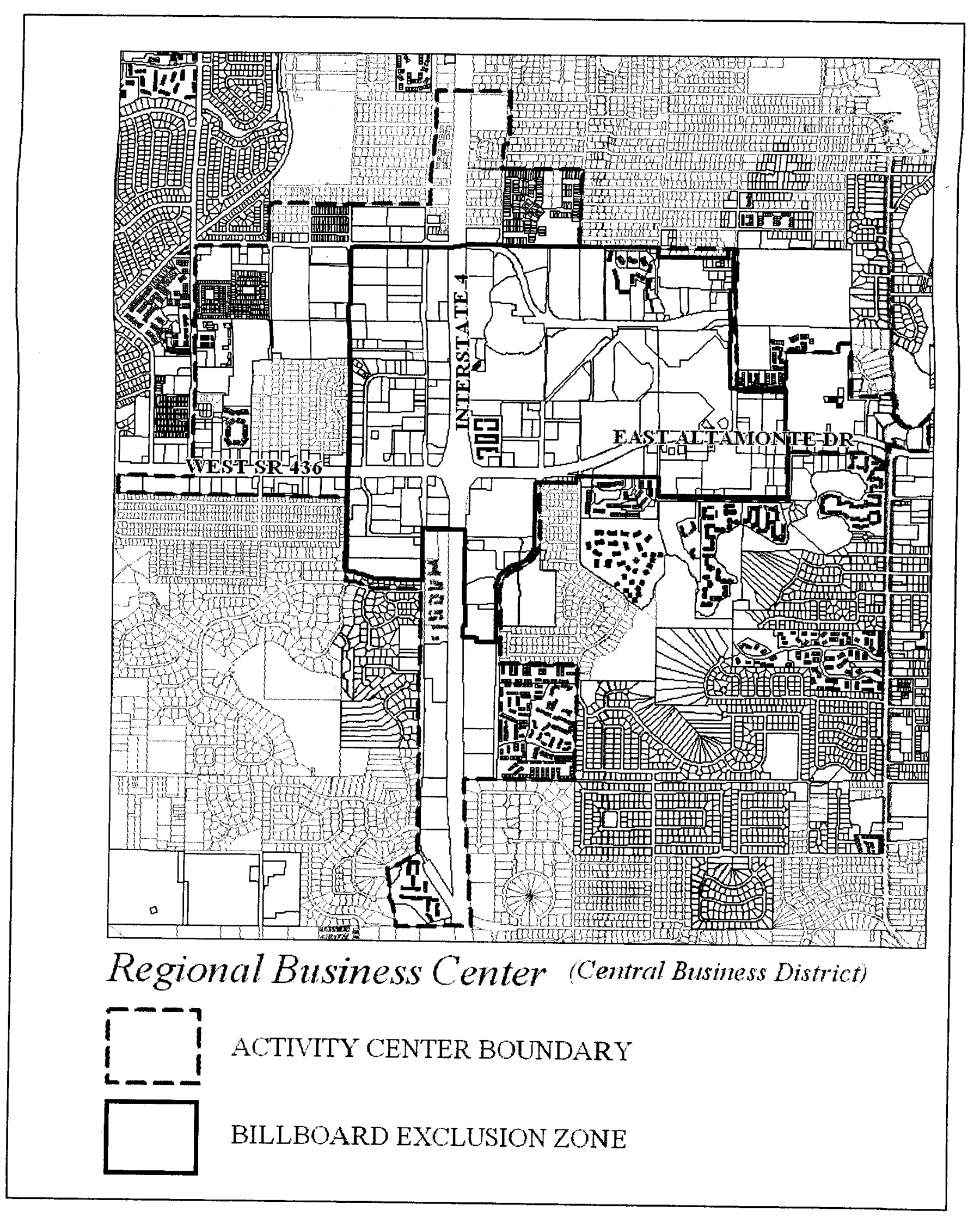
(Ord. No. 1344-99, § 16, 12-5-00; Ord. No. 1577-07, § 2, 10-16-07)
Exhibit II. - West Town Activity Center
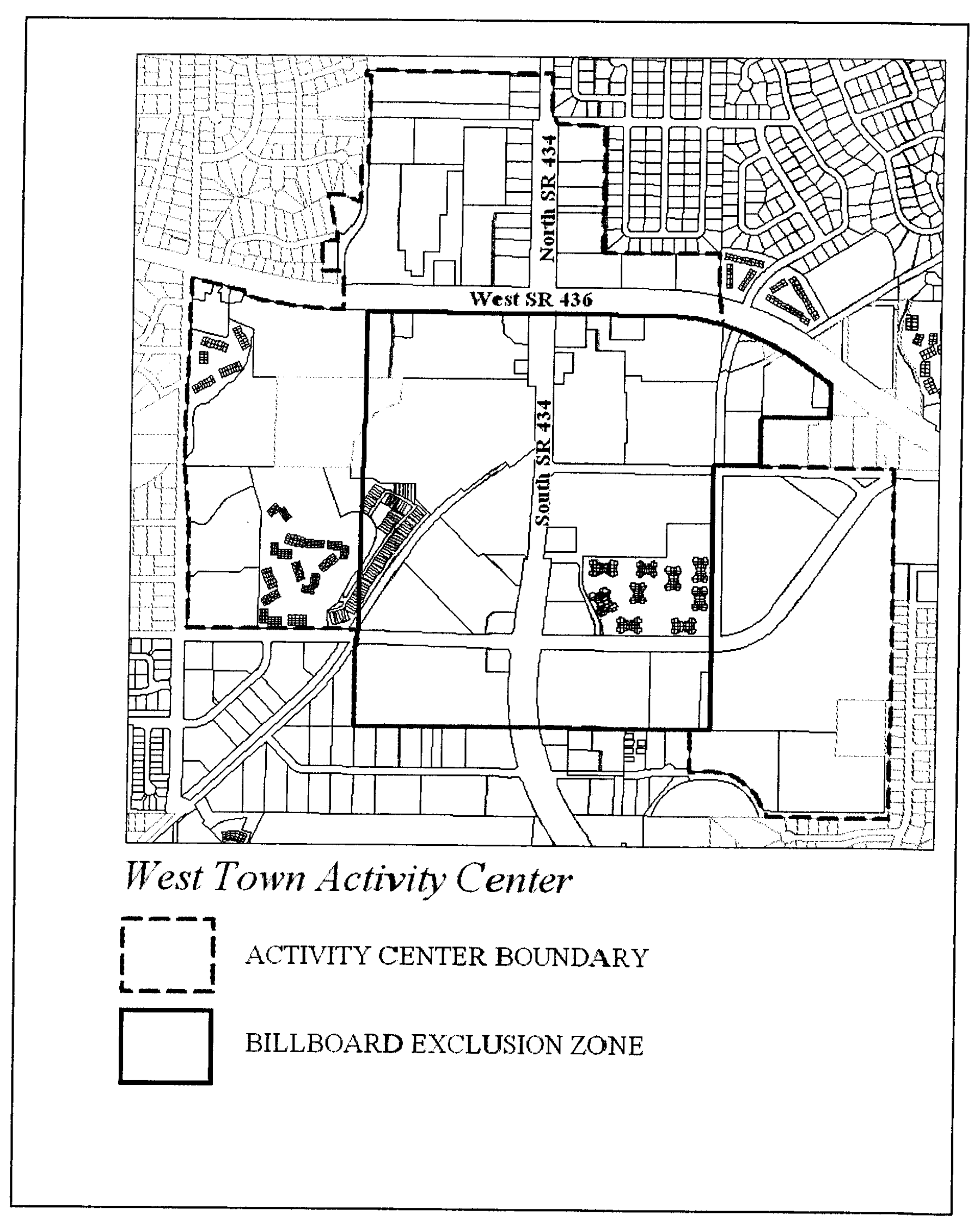
(Ord. No. 1344-99, § 16, 12-5-00; Ord. No. 1577-07, § 2, 10-16-07)
Exhibit III. - East Town Activity Center
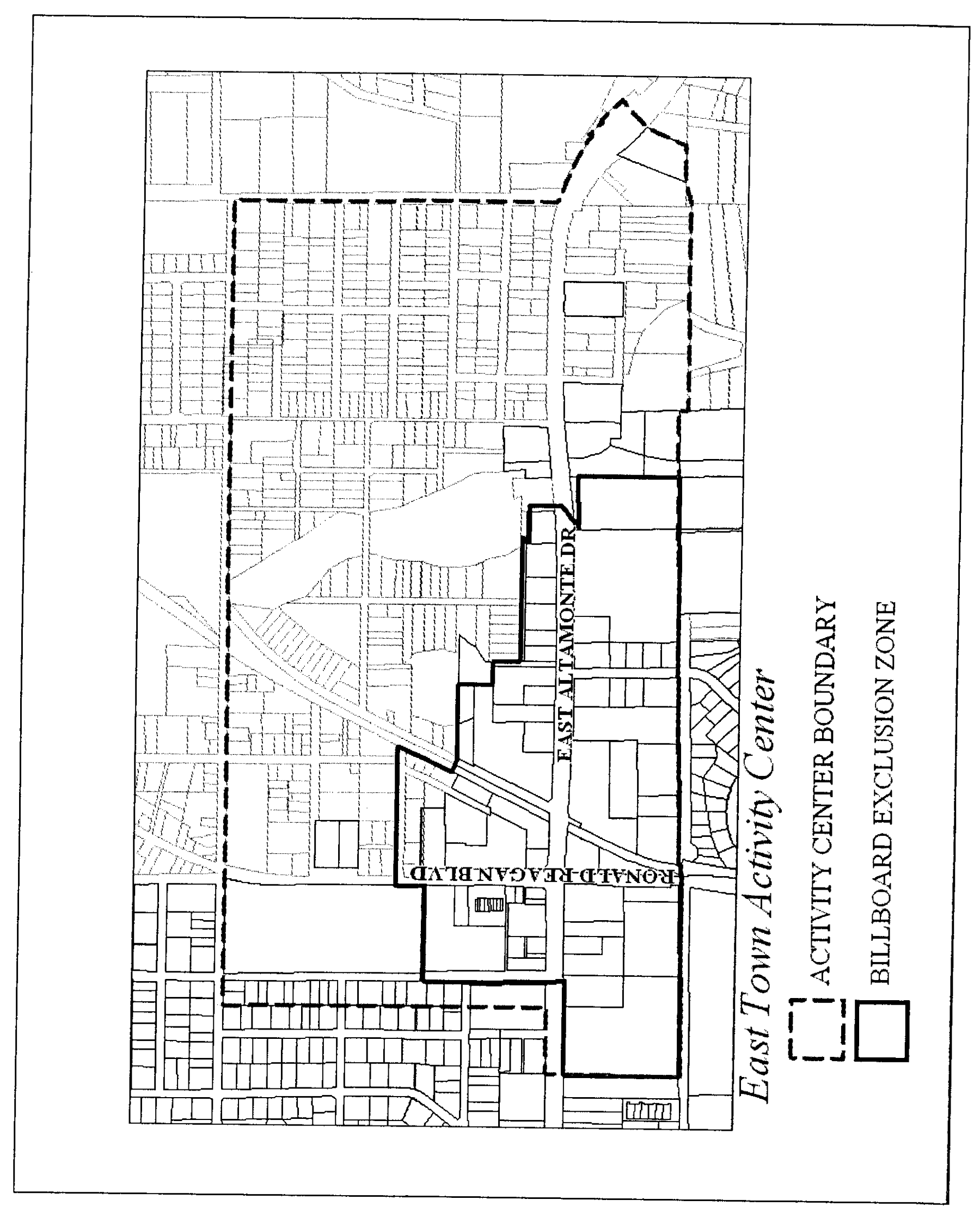
(Ord. No. 1344-99, § 16, 12-5-00; Ord. No. 1577-07, § 2, 10-16-07)
Exhibit IV. - Gateway Activity Center
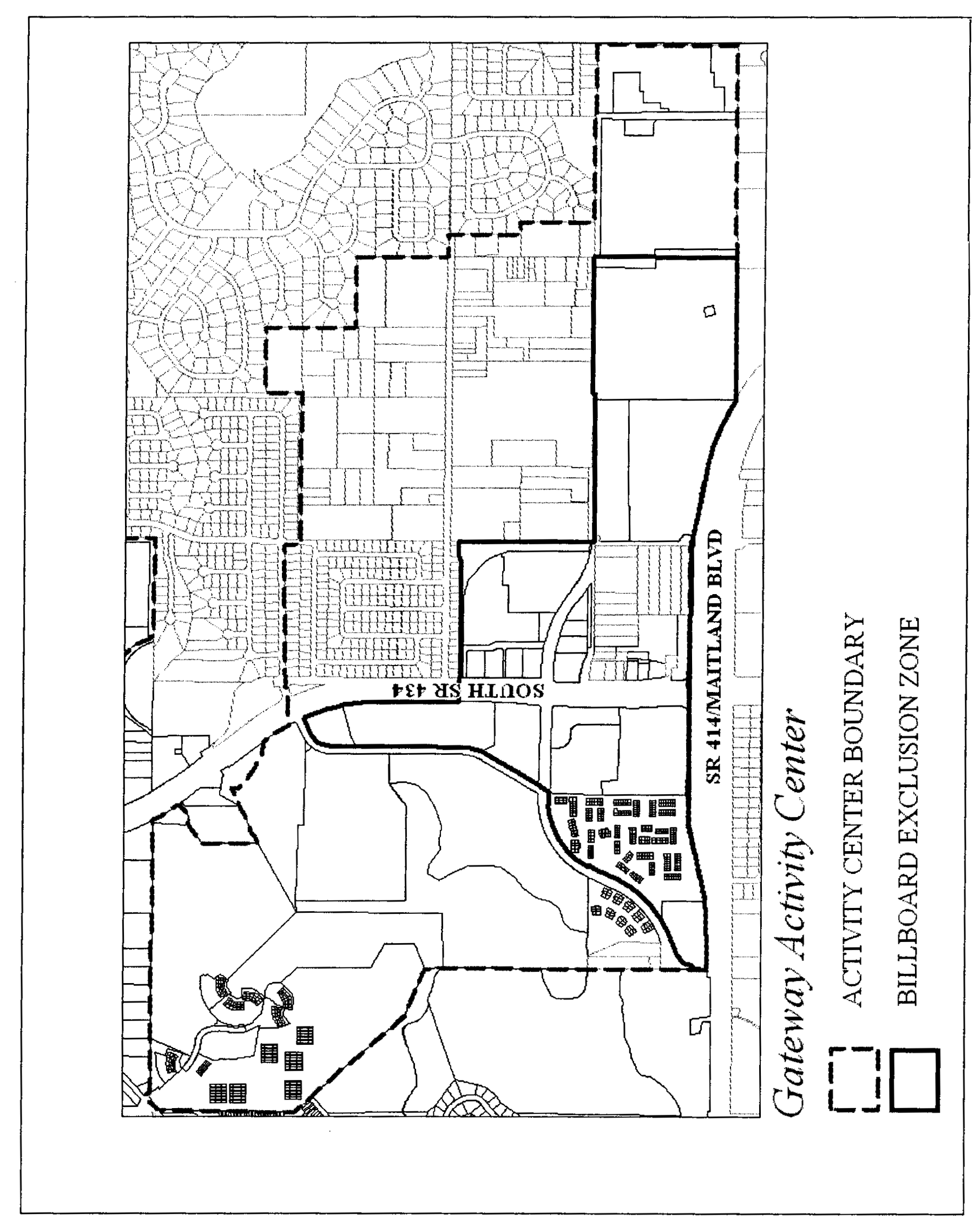
(Ord. No. 1344-99, § 16, 12-5-00; Ord. No. 1577-07, § 2, 10-16-07)

