
Belton City Zoning Code
CHAPTER 22
LANDSCAPING AND SCREENING
Sec. 22-1.- Applicability.
(a)
All new structures, buildings and parking lots must comply with the landscaping and screening standards of this chapter.
(b)
If an addition is proposed to a building; an additional building is proposed for a lot; or if an expansion is proposed to an existing parking lot, the existing and expanded parking lot shall comply with the provisions of this chapter.
(c)
For properties in the North Scott Corridor please see section 18-8, North Scott Corridor Overlay District. Additionally, please see site design standards, landscaping and buffering in the North Scott Corridor Overlay District + Guidelines plan, page 10.
(UDC 2010, § 14.1; Ord. No. 2017-4393, § 5, 11-28-2017)
Sec. 22-2. - Landscaped area requirements.
(a)
Where required. All uses must provide and maintain a landscaped area as provided in this section. Landscaped areas may not include rights-of-way and accessory uses, and must be maintained as a permeable and uncovered surface that contains living material. No more than 20 percent of the required landscaped area may consist of porous non-living materials.
(b)
Foundation landscaping. A landscaped area a minimum of five feet wide must be provided along the foundation of all apartments, commercial, and industrial buildings, excluding building entrances, loading areas and areas where an eight-foot sidewalk is required adjacent to the building. This landscaped area may count toward the required landscape area for the lot. Foundation plantings shall include a mix of plant materials and species, including deciduous and evergreen shrubs and ornamental grasses.
(c)
Common open space tract landscaping. Open space tracts adjacent to any streets or access drives, parking areas, or included buildings shall meet all landscaping requirements for parking buffers, foundation landscaping, and street frontage trees. Additionally, the following landscaping is required based on site amenities:
(1)
Trails. A minimum of one shade tree shall be provided for every 50 feet of trail length and one small shade or ornamental tree shall be provided for every 25 feet of trail length. Wherever possible, trees shall alternate on each side of trail. Shade trees shall be staggered as close to the 50 feet separation as possible to achieve the desired shade impact as trees mature. Small shade or ornamental trees may be clustered, provided that no tree is greater than 100 feet apart.
(2)
Stormwater detention or retention facilities. A mix of shade, ornamental, and evergreen trees shall be provided within ten feet of the perimeter of the top of the slope of the facility. A minimum of one shade trees is required per 50 feet and one small shade or ornamental or evergreen tree per 25 feet. Shade trees shall be staggered as close to the 50 feet separation as possible. Small shade, ornamental, or evergreen trees may be clustered, provided that no tree is greater than 100 feet apart.
(3)
Other open spaces. All other open spaces that do not have trails, stormwater facilities, or other buildings or structures, shall be landscaped. A minimum of one tree shall be provided for every 2,500 square feet of tract area. Street frontage trees may be counted towards the minimum requirement.
(UDC 2010, § 14.2; Ord. No. 2025-4901, § 5 (Exh. C), 3-11-2025)
Sec. 22-3. - Parking area landscaping.
(a)
Interior parking lot landscaping.
(1)
Landscape islands with at least one shade tree and three shrubs or ornamental grasses must be provided at a minimum of one for every ten parking spaces in all off-street parking areas. Flexibility in placement of landscape islands may be allowed for creative parking lot design and preservation of existing trees and vegetation. Landscape islands that include a light pole may eliminate the required shade tree provided the shade tree is included elsewhere in the required landscaped area.
(2)
Landscape islands include those areas that are a minimum of eight feet wide and 128 square feet in area, and are open to the parking area on at least three sides. "Bump-out" landscape areas will be considered landscape islands if they meet these criteria.
(b)
Perimeter parking and entryway lot landscaping.
(1)
Applicability. All new off-street parking areas must install perimeter parking lot landscaping. Areas counted toward interior parking lot landscaping requirements (such as bump-outs) may not be counted as perimeter parking lot landscaping.
(2)
Parking areas abutting residential districts. When a parking area abuts a residential district, a type A opaque landscape screen must be provided to shield the parking area from view at any point within the residential district.
(3)
Exterior perimeter parking area buffers. When an off-street parking area is located between a building and a public or private street or common access drive, a minimum landscape buffer at least six feet wide must be provided along the length of the street or drive, excluding driveways. The following shall be planted within the perimeter buffer:
a.
One shade tree per 40 linear feet with a combination of shrubs and ornamental grasses to create a continuous landscaped hedge.
b.
Where appropriate, decorative masonry walls or metal picket fences in keeping with the site and building design up to three feet in height may be used in combination with plantings to achieve visual screening.
(4)
Interior perimeter parking area buffers. When an off-street parking area is located within 15 feet of an interior property line where more extensive screening requirements per section 22-6 are not required, a minimum six-foot wide landscape buffer must be provided along the length of the parking area and include one tree and four shrubs or ornamental grasses per 50 feet. Shared parking lots are exempt from this requirement.
(5)
Loading areas. All loading areas abutting a residential district must be permanently screened from view along the abutting property line(s) by a type A opaque landscape screen.
(6)
Entryway features and monument signs. Entryway features and monument signs shall be landscaped with a mix of shrubs, ornamental grasses, perennial and annual flowers, and ground cover (non-turf-grasses) plants. The primary entrance to all residential developments with over 50 units, commercial developments over 50,000 square feet in gross floor area, and industrial developments over 100,000 square feet in gross floor area shall include entryway features or monument signs. For monument signs, the landscape area must be a minimum of three feet wide on all sides of the monument base. All landscaping shall meet sight triangle requirements at maturity. At site entrances where signage is not proposed, other decorative elements are encouraged, such as pillars, boulders/rocks, and masonry walls or decorative fences to define the site.
(UDC 2010, § 14.3; Ord. No. 2025-4901, § 5 (Exh. C), 3-11-2025)
Sec. 22-4. - Residential landscaping requirements.
(a)
General requirements. All land areas which are to be unpaved or not covered by buildings shall be brought to finished grade and planted with turf or native grass or other appropriate ground cover. In addition to the minimum number of trees required to be planted by this chapter, an appropriate number or amount of shrubs, ground cover and/or turf area plantings shall be included within each project, to be determined by the design criteria for the project relating to visual safety, species and landscape function. In addition to the landscaping required in this section, all residential developments with common open spaces shall meet the landscaping requirements in section 22-2 based on open space type.
(b)
Landscaping plan required. All plans submitted in support of a final development plan, site plan, building permit or land use permit, except for any residential use in districts R-1 and R-2, shall include a landscaping plan signed by the registered landscape architect. Property located within district A, agriculture, is excluded from this requirement. All landscaping plans shall include the following information:
(1)
North point and scale.
(2)
Topographic information and final grading adequate to identify and properly specify planting for areas needing slope protection.
(3)
The location, size and surface of materials of all structures and parking areas.
(4)
The location, size and type of all above-ground and underground utilities and structures with proper notation, where appropriate, as to any safety hazards to avoid during installation of landscaping.
(5)
The location, size type and quantity of all proposed landscaping materials, along with common and botanical names of all plant species. The size, grading and condition shall be specified according to American Association of Nurserymen Standards.
(6)
The location, size, and common name of all existing plant materials to be retained on the site.
(7)
Mature sizes of plant materials shall be drawn to scale and called out on the plan by a common name or appropriate key.
(8)
Location of hose connections and other watering sources.
(9)
The location of all trees, 12-inch caliper or larger, measured at 4½ feet above ground level, that are proposed for removal.
(10)
All screening required by this chapter.
(c)
Minimum tree and planting requirements.
(1)
In all single-family and two-family zoning districts, a minimum of two shade trees per dwelling unit shall be planted prior to occupancy. Street frontage trees may be counted towards meeting this requirement. In addition to shade trees, the following must be planted adjacent to the front of each dwelling unit:
a.
Ten deciduous or evergreen shrubs or ornamental grasses, or
b.
Five deciduous or evergreen shrubs or ornamental grasses and one small deciduous, ornamental, conifer, or evergreen tree.
(2)
In multi-family zoning districts, the following landscaping is required:
a.
One tree per 40 feet of public or private street frontage, which may be clustered or arranged as needed to accommodate driveways and other obstructions.
b.
For attached single-family units (e.g. triplexes, fourplexes, rowhouses, and similar), at a minimum, one of the following must be planted adjacent to the front of each dwelling unit:
1.
Ten deciduous or evergreen shrubs or ornamental grasses, or
2.
Five deciduous or evergreen shrubs or ornamental grasses and one small deciduous, ornamental, conifer, or evergreen tree.
3.
For development with three or more buildings, variations in landscaping shall be provided to avoid monotony.
c.
For apartment buildings, foundation plantings and perimeter parking buffer area landscaping shall be provided as required in this chapter.
d.
In addition to the trees required based upon street frontage, 0.75 tree for every dwelling unit shall be planted on site. Trees shall be dispersed throughout the site to the extent possible.
(3)
Existing trees saved on the site during construction may be credited toward the minimum number of trees required as specified for each zoning district, provided that such trees are a minimum of four-inch caliper as measured 4½ feet above ground for medium and large deciduous species or three feet in height for ornamental and evergreen species. All existing plant material saved shall be healthy and free of mechanical injury.
(4)
Clear cutting of lots shall be discouraged. Any areas in which the natural vegetation has been disturbed for development purposes, erosion control measures approved by staff shall be placed on disturbed areas immediately after the disturbance takes place. Such areas shall be planted with ground covering vegetation or laid with sod within 30 days of the disturbance. In cases where planting or sodding are not feasible due to weather or other natural causes, a cash escrow or irrevocable letter of credit in an amount equal to 1½ times the estimated cost of the landscaping, the said estimated cost to be certified by a landscaping provider, shall be posted with the city.
(d)
Minimum planting size requirements. Minimum planting size requirements shall be as follows:
(1)
Medium and large deciduous shade trees: one-inch caliper as measured six inches above ground.
(2)
Small deciduous or ornamental trees: six feet in height, with the exception of true dwarf species.
(3)
Conifers: five to six feet in height.
(4)
Upright evergreen trees: four feet in height, except for true dwarf species.
(5)
The size of deciduous and conifer shrubs, including spreader and globe trees forms, shall be determined by the applicant.
(6)
Ground cover plants, whether in the form of crowns, plugs or container, shall be planted in a number as appropriate by species to provide 50 percent surface coverage after two growing seasons.
(7)
All areas shall be sodded with the following exceptions, which may be seeded, subject to cash escrow requirements per section 22-17 and that no final occupancy shall be issued until ground cover has been fully germinated and established:
a.
Inaccessible or unprogrammed areas of common tracts as determined by the director. Areas with significant slope may be required to be sodded to establish erosion control.
b.
Rear yards of single-family and two-family lots over 15,000 square feet or lots with a depth of over 200 feet front and side yards shall be sodded. On corner lots, the side yard to be sodded shall include the entire depth of the lot along the side street frontage.
c.
Any other exceptions approved by the planning commission or city council through a development plan or plat.
(UDC 2010, § 10.5.8; Ord. No. 2005-3142, 3-22-2005; Ord. No. 2011-3737, § 1, 7-26-2011; Ord. No. 2011-3738, § 1(14.16), 7-26-2011; Ord. No. 2025-4901, § 5 (Exh. C), 3-11-2025)
Sec. 22-5. - Street frontage trees.
Street frontage trees are required along the frontage of all public and private streets subject to the following conditions:
(1)
Street frontage trees shall be planted within ten feet of the property line adjacent to a public or private street.
(2)
A minimum of one tree per 40 feet of frontage is required.
(3)
All new residential subdivisions shall provide a street tree plan with a preliminary plat or a preliminary development plan for approval of tree counts, spacing, and species diversity, as required in this chapter.
(UDC 2010, § 14.4; Ord. No. 2018-4436, § 3, 5-15-2018; Ord. No. 2025-4901, § 5 (Exh. C), 3-11-2025)
Sec. 22-6. - Screening requirements.
(a)
Applicability. All uses must provide and maintain screening as required by this section. In cases where a use would be required to provide both landscaping and screening at the same location, the two requirements may overlap; however, the most restrictive requirement applies. Additionally, screening requirements may be counted toward the percent of landscaped area.
(b)
Screening table. The following table establishes which type of screen is required. To determine the type required, first identify the zoning of the subject lot (the new or expanded use) in the rows. Then identify the zoning of each adjacent lot in the columns. Non-residential land uses in residential zoning districts shall provide a type A buffer adjacent to any residential land use.
(UDC 2010, § 14.5; Ord. No. 2018-4436, § 3, 5-15-2018; Ord. No. 2025-4901, § 5 (Exh. C), 3-11-2025)
Sec. 22-7. - Types of screens.
(a)
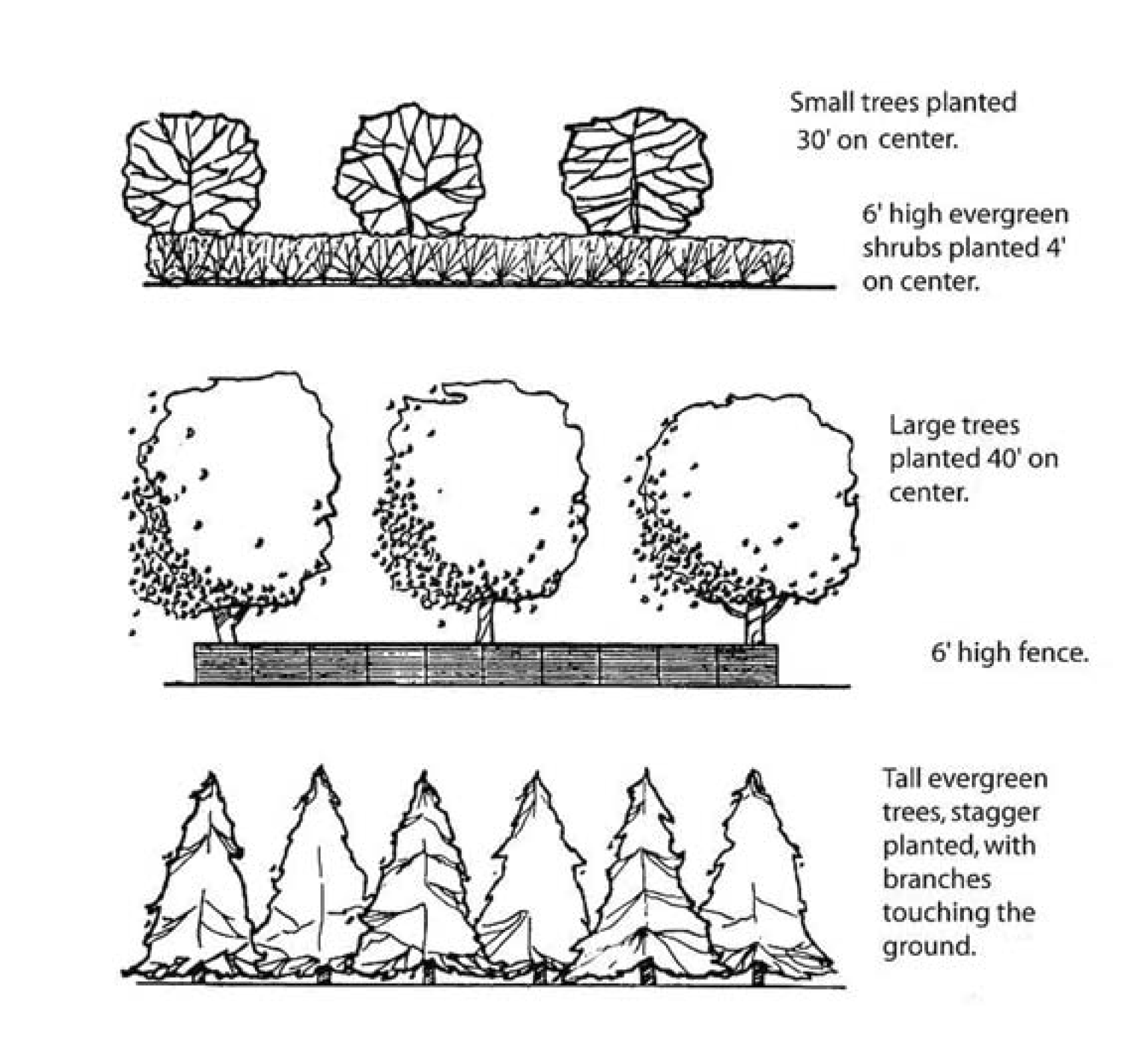
Opaque screen, Type A. An opaque screen is intended to exclude all visual contact between uses and to create a strong impression of special separation.
(b)
Height. Type A screens must be opaque from the ground to a height of at least six feet, with intermittent visual obstructions to a height of at least 12 feet.
(c)
Materials and installation.
(1)
The opaque screen may be composed of wall, vinyl fence, landscaped earth berm, planted vegetation or existing vegetation. When a wall or fence is used, it must be articulated every 50 feet.
(2)
Compliance of planted vegetative screens or natural vegetation will be judged on the basis of the average mature height and density of foliage of the subject species or field observation of existing vegetation.
(3)
The opaque portion of the screen must be opaque in all seasons of the year. At maturity, the portion of intermittent visual obstructions may not contain any completely unobstructed openings more than ten feet wide. The portion of intermittent visual obstructions may contain deciduous plants.
(4)
Planting areas for the placement of these screens must be a minimum of five feet wide.
(d)
Example. Suggested planting patterns that will achieve this standard are included in the following diagram.
(e)
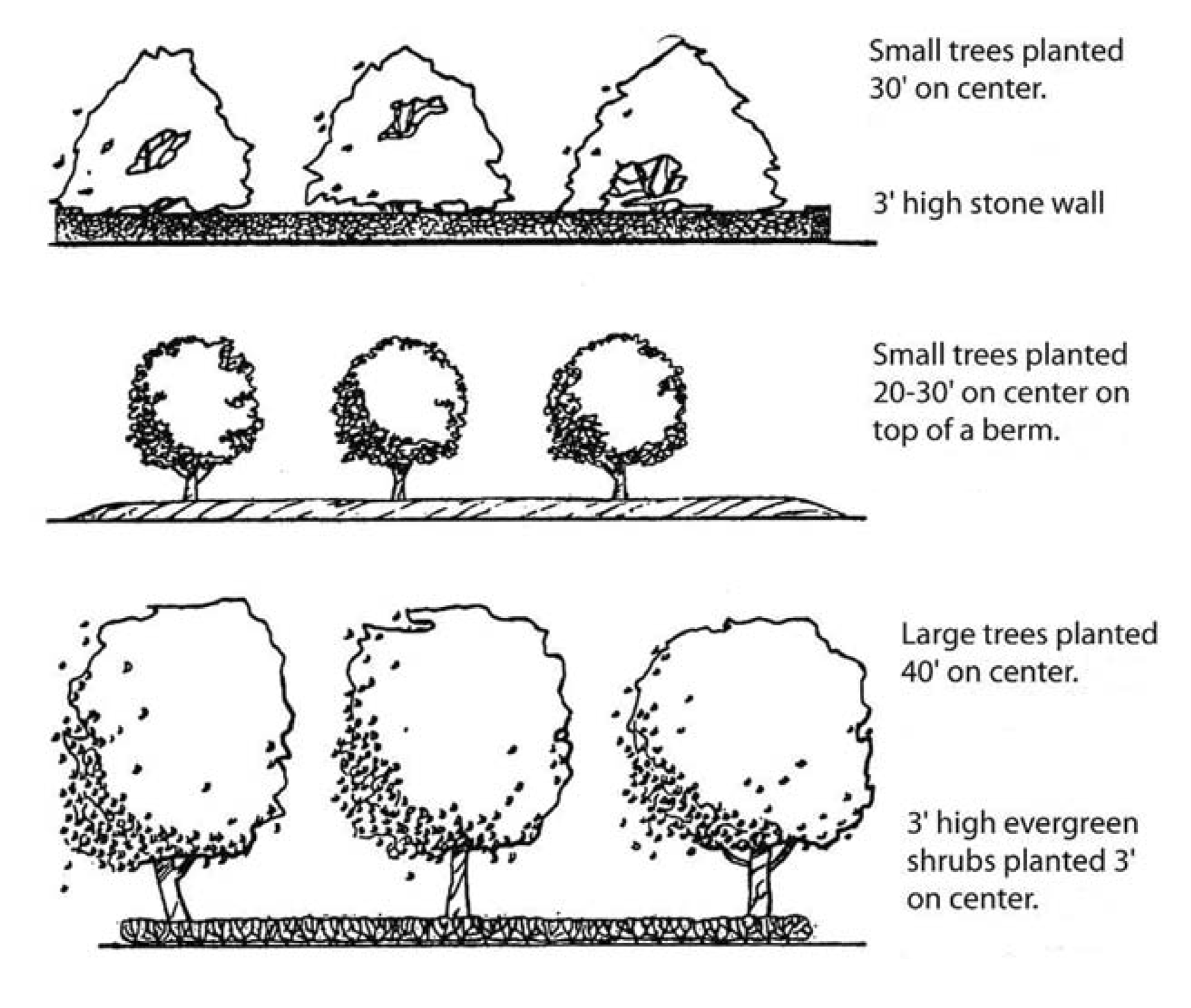
Semi-opaque screen, Type B. The semi-opaque screen is intended to partially block visual contact between uses and create a strong impression of the separation of spaces.
(f)
Height. Type B screens must be opaque from the ground to a height of three feet, with intermittent visual obstructions to a height of at least 12 feet.
(g)
Materials and installation.
(1)
The semi-opaque screen may be composed of a wall, vinyl fence, landscaped earth berm, planted vegetation or existing vegetation.
(2)
Compliance of planted vegetative screens or natural vegetation will be judged on the basis of the average mature height and density of foliage of the subject species or field observation of existing foliage.
(3)
At maturity, the portion of intermittent visual obstructions may not contain any completely unobstructed openings more than ten feet wide. The zone of intermittent visual obstruction may contain deciduous plants.
(4)
Planting areas for the placement of these screens must be a minimum of five feet wide.
(h)
Example. Suggested planting patterns that will achieve this standard are included in the following diagram.
(i)
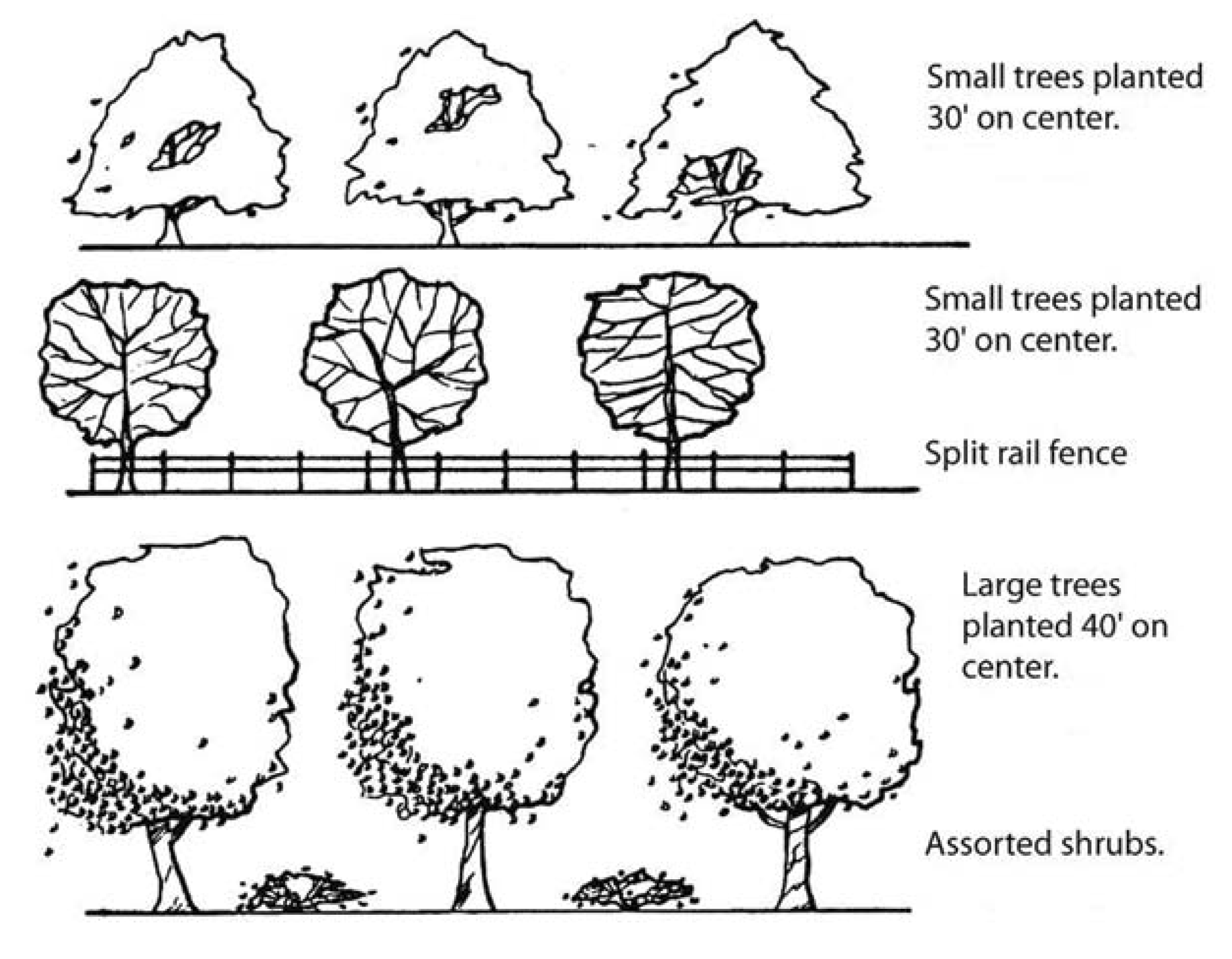
Broken screen, Type C. The broken screen is intended to create the impression of a separation of spaces without necessarily eliminating visual contact between the spaces.
(j)
Height. Type C screens must be composed of intermittent visual obstructions from the ground to a height of at least 12 feet.
(k)
Materials.
(1)
The broken screen may be composed of a wall, vinyl fence, landscaped earth berm, planted vegetation or existing vegetation.
(2)
Compliance of planted vegetative screens or natural vegetation will be judged on the basis of the average mature height and density of the foliage of the subject species or field observation of existing vegetation. The screen may contain deciduous plants.
(3)
Planting areas for the placement of these screens must be a minimum of five feet wide.
(l)
Example. Suggested planting patterns which will achieve this standard are included in the following diagrams.
(m)
Location of screens. Screening required by this section must be located along the common lot line(s) of adjacent uses. Where uses are separated by an intervening right-of-way, screening is not required. In its review of a site plan, the planning commission may require the location or dimensions to be modified to better achieve the desired level of screening on a particular site.
(UDC 2010, § 14.6)
Sec. 22-8. - Planting list and tree diversity.
(a)
Required species. All required trees and shrubs shall be of a species identified in the planting list. The planting list shall be maintained by the community development director and made available to all applicants and to any other person who requests a copy. The planting list may be amended by the director based on local best practices and recommendations from local horticulturists, landscape architects, arborists, and other experts in landscaping materials and design.
(b)
Prohibited plants. Plants listed as nuisance species or prohibited plants in the planting list are prohibited in required landscape areas. Prohibited plants include those that are invasive, potentially damaging to streets, sidewalks, utilities, drainage improvements, and foundations.
(c)
Tree preservation and existing vegetation.
(1)
The city may require the preservation of existing trees and/or vegetation on a property as part of a rezoning, conditional use permit, preliminary plat, final plat or site plan application.
(2)
Existing vegetation may be used to satisfy the landscaping and screening requirements of this Code if protected and maintained during site development and construction phases of work and if such trees or plants are not otherwise prohibited.
(3)
Preserved trees will be credited toward satisfying the tree planting requirements of this chapter if they meet the minimum size and species requirements of this chapter. Tree credits will be granted by the community development director. Multiple credits may be given to encourage preservation of existing mature trees.
(4)
Tree diversity. Required trees planted shall promote diversity in the urban forest to both improve community aesthetics and to limit the spread of disease and significant tree loss. The following selection criteria shall be applied to tree species:
In subdivisions or developments with multiple blocks, tree diversity may be achieved over multiple blocks if the planting of a more limiting number of species is needed to create a desirable urban design effect. Exceptions will be reviewed for approval as part of a street tree plan submitted with a preliminary plat or preliminary development plan.
(UDC 2010, § 14.7; Ord. No. 2025-4901, § 5 (Exh. C), 3-11-2025)
Sec. 22-9. - Trash receptacle screening.
(a)
All outdoor trash receptacles, garbage areas, grease traps and trash compactors for multifamily residential and all nonresidential uses must be permanently screened from view on all sides by a fence of 100 percent opacity and a minimum height of six feet. The fence must be constructed to prevent accidental dispersal of material within the storage area.
(b)
Where commercial trash receptacles are used and where allowed by city codes, such receptacles must be screened as follows:
(1)
All screens for trash receptacles that are part of new construction projects must match the primary color and material of the structure served;
(2)
Doors accessing storage areas must remain closed at all times when not being accessed;
(3)
Existing trash receptacles of any size within 150 feet of an arterial street must be screened from view of the arterial street. The screen may not require full enclosure to accomplish screening; and
(4)
Chainlink and slat screening is only allowed in industrial zones. The screen must be opaque and include substantial masonry pillars every 30 feet.
(c)
No trash receptacle may be located in a required front or side yard unless located in an existing enclosure or if the existing developed site does not afford any other option; in such a case, the trash receptacle should be located in the side yard if possible and must comply with the screening requirements of this section. The community development director will have the authority to grant an administrative variance where it is demonstrated that screening is impossible. After a request for such relief, the community development director will notify the applicant of the determination in writing within 30 days.
(d)
Temporary trash receptacles are not required to comply with this section.
(UDC 2010, § 14.8)
Sec. 22-10. - Screening of equipment.
(a)
Rooftop equipment shall be screened from view from adjacent properties and any adjacent street with an architectural treatment which is compatible with the building architecture. The height of the screen shall be no lower than the height of the mechanical unit as measured from the roof surface. The equipment shall be screened with vertical extensions of the building walls or with parapets or other architectural design features of the same or compatible materials used on the walls of the building.
(b)
All ground-mounted and building-mounted equipment including, but not limited to, mechanical equipment, electrical equipment, utilities, and meters, shall be screened from view from adjacent properties and any adjacent street with an architectural treatment compatible with the building architecture. Evergreen landscaping may be utilized as a substitute or in combination with architectural treatments to screen equipment.
(c)
Accessory utility facilities shall be screened per the above requirements.
(d)
Screening requirements shall be met with all new construction, when an addition or expansion is made to an existing building to accommodate a change of use, and when additional or significantly larger units are added to an existing building or site. The replacement of pre-existing units in the same general location with a comparable size shall not require screening to be brought into compliance with these standards.
(UDC 2010, § 14.9; Ord. No. 2024-4836, § 6, 2-27-2024; Ord. No. 2025-4901, § 5 (Exh. C), 3-11-2025)
Sec. 22-11. - Plant materials.
All plant materials used to satisfy the requirements of this chapter must conform to the plant quality standards of the American Nursery and Landscape Association (ANLA).
(UDC 2010, § 14.10; Ord. No. 2025-4901, § 5 (Exh. C), 3-11-2025)
Sec. 22-12. - Minimum planting sizes.
(a)
Trees.
(1)
Deciduous shade trees shall be 2½ - to three-inch caliper as measured six inches above ground.
(2)
Evergreen trees shall be six to eight feet in height.
(3)
Ornamental trees shall be one- to 1½-inch caliper as measured six inches above ground. The smallest trunk of multi-trunk clusters (three or more trunks) shall be three-fourths inch.
(b)
Shrubs and hedges.
(1)
Deciduous and evergreen shrubs must have a minimum container size of three to five gallons depending upon species and spacing.
(2)
Hedges, where required, must be planted and maintained to form a continuous, visual screen within a maximum of one year after time of planting.
(c)
Vines. Vines must be a minimum of 30 inches in height immediately after planting and may be used in conjunction with fences, screens or walls to meet physical barrier requirements as specified.
(UDC 2010, § 14.11)
Sec. 22-13. - Ground covers.
(a)
In lieu of grass. Ground covers used in lieu of grass in whole or in part must have a finished appearance and reasonably complete coverage within three months after planting.
(b)
Grass.
(1)
Land disturbance activities. When a land disturbance permit has been issued, seeding may be utilized for erosion and sediment control when completed in accordance with this chapter. Seeding is also an acceptable grass cover for any land awaiting development.
(2)
Building permits. When a building permit has been issued for a principal structure upon a lot, the lot must either have sod or hydro-seeding installed wherever grass is required to be installed. The hydro-seeding or sod must be installed prior to the issuance of any permanent certificate of occupancy.
(UDC 2010, § 14.12)
Sec. 22-14. - Installation.
(a)
The building inspector will inspect all landscaping and no certificates of occupancy or similar authorization will be issued unless the landscaping is completely installed in compliance with the approved landscape plan and this chapter.
(b)
All landscaping materials must be installed according to current accepted good planting procedures and in compliance with all applicable ordinances and Code requirements.
(c)
Plant materials must be free from disease and installed in a fashion that ensures the availability of sufficient soil and water to sustain healthy growth.
(UDC 2010, § 14.13)
Sec. 22-15. - Maintenance.
(a)
All landscaping materials must be maintained in good condition so as to present a healthy, neat and orderly appearance and must be kept free from refuse and debris.
(b)
All landscaping must be periodically trimmed so that it does not obstruct a public right-of-way.
(c)
Diseased and dead landscape material and damaged non-living materials must be replaced within 60 days of receipt of notice from the city by materials equal in size, density and appearance as originally required at the time of site plan approval.
(d)
The owner, tenant and their agent, if any, will be jointly and severally responsible for the maintenance of all landscaping.
(e)
Irrigation systems for all areas of turf, trees, shrubs, annual gardens or perennial gardens are required in the R-3A, C-1, C-2, C-3, PO, and BP districts and must be shown on the landscape plan. All irrigation systems must be maintained in proper working condition.
(UDC 2010, § 14.14)
Sec. 22-16. - Right-of-way ground surface.
No plant material or barrier may be located in a public right-of-way. The ground surface within the public right-of-way must be planted with sod or hydro-seeded, with the exception of driveways, sidewalks and paths. Materials prohibited in the public right-of-way, unless required by this code or specifically approved by the city, include other groundcovers, shrubs, brick pavers, gravel, stone, asphalt and concrete; except those used for driveways, sidewalks and paths.
(UDC 2010, § 14.15)
Sec. 22-17. - Time landscaping required to be in place.
All required landscaping materials, both living and non-living, shall be in place prior to the time of issuance of a final certificate of occupancy, weather permitting. In periods of adverse weather conditions, a temporary certificate of occupancy may be issued, subject to the posting of a cash escrow or irrevocable letter of credit in an amount equal to 1½ times the estimated cost of the landscaping, the said estimated cost to be certified by a landscaping provider. The cash escrow or irrevocable letter of credit may be forfeited if the landscaping is not completed within one year after the issuance of the temporary certificate of occupancy. Forfeiture of any cash escrow or irrevocable letter of credit shall not relieve the owner of the responsibility to complete the required landscaping.
(UDC 2010, § 20.27.5(part))
Sec. 22-18. - Maintenance of landscaping.
(a)
Trees, shrubs, and other landscaping materials depicted on landscaping plans approved by the city shall be considered to be elements of the project in the same manner as parking, building materials and other details. The developer, its successor and/or subsequent owners and their agents shall be responsible for maintenance of landscaping on the property on a continuing basis for the life of the development. Plant materials which exhibit evidence of insect pests, disease and/or damage shall be appropriately treated, and dead plants promptly removed and replaced within the next planting season after installation. All landscaping will be subject to periodic inspection by the city's zoning officer, or his or her designee. Should landscaping not be installed, maintained and replaced as needed to comply with the approved plan, the owner and its agent or agents shall be considered in violation of the terms of the certification of occupancy. The city manager or his or her designee is empowered to enforce the terms of this chapter.
(b)
As a condition to issuance of a final certificate of occupancy, a cash escrow or irrevocable letter of credit in the amount of 25 percent of the initial landscaping costs shall be posted to ensure the needed replacement of materials and the continued maintenance of the same for a period of two years after initial installation. Said cash escrow or irrevocable letter of credit may be forfeited if the necessary maintenance and replacement has not been performed in a satisfactory manner within the two-year period. Further, should it be determined that the landscaping as approved on the landscaping plan is not being maintained as specified beyond the initial two-year maintenance period, resubmission of the approved plan and the posting of an additional maintenance escrow may be required by the city.
(c)
Tree topping. It shall be unlawful as a normal practice for any person, firm, or city department to top any street tree, park tree, or other tree on public property. Topping is defined as the severe cutting back of limbs to stubs larger than three inches in diameter within the tree's crown to such a degree so as to remove the normal canopy and disfigure the tree. Trees severely damaged by storms or other causes, or certain trees under utility wires or other obstructions where other pruning practices are impractical, may be exempted from this ordinance at the discretion of the tree board.
(UDC 2010, § 20.27.5(part); Ord. No. 2013-3889, § 3, 3-12-2013)

