
Belton City Zoning Code
CHAPTER 12
COMMERCIAL, INDUSTRIAL, PARKS, RECREATION AND PUBLIC USE ZONING DISTRICTS
Sec. 12-1.- Business, commercial and industrial districts.
(a)
PO Professional Office District. The PO Professional Office District is intended to accommodate professional office uses in individual buildings, not in large campus-like settings. Site design within this district must ensure that adequate access, parking and screening is provided so as not to negatively impact adjoining residential neighborhoods, and to protect the office uses from higher-intensity commercial and industrial uses.
(b)
C-1 Neighborhood Commercial District. The C-1 Neighborhood Commercial District is intended to accommodate small-scale professional office, service and retail uses primarily located within buildings with a design and scale that is compatible with surrounding residential development. This district is intended to provide goods and services primarily for residents in the surrounding neighborhoods. Site design within this district must ensure that adequate access, parking and screening is provided so as not to negatively impact adjoining residential neighborhoods.
(c)
C-2 General Commercial District. The C-2 General Commercial District is intended to accommodate mid-size retail and commercial businesses along commercial corridors. Uses in the C-2 district have the potential to generate significant automobile traffic. Therefore, care must be taken to ensure that traffic and other related impacts are minimized. Since this district is located along major arterials and collectors that serve as gateways into Belton, quality building architecture, landscaping and other site improvements will be required to ensure development enhances Belton's image.
(d)
C-3 Regional Commercial District. The C-3 Regional Commercial District is intended to provide locations along major arterials for shopping centers and business uses that draw patrons from Belton, surrounding communities and the broader region. The C-3 district consists primarily of large-scale development that has the potential to generate significant automobile traffic. Development in this district must be designed in a coordinated manner with an interconnected street network that is consistent with the city's growth management plan. Uncoordinated, piecemeal development of small parcels that do not fit into the larger context is strongly discouraged in the C-3 district. Because this district is primarily located at high-visibility locations, the building architecture, landscaping and other site improvements must be of superior aesthetic and functional quality.
(e)
BP Business Park District. The BP Business Park District is intended to accommodate office, research and development, and limited service, manufacturing and warehousing uses that are located within a campus-like setting. Site design will include larger setbacks and increased landscaping and buffering from non-related uses and public rights-of-way.
(f)
BP-R Business Park Restricted District. The BP-R, Business Park Restricted District, is intended to allow for business and industrial operations. The performance standards for this district are intended to establish and maintain high quality site planning, architecture, signage, and landscape design to create an attractive and unified development character. The Business Park Restricted District may be applied to the Business Park District as an overlay zone in order to provide for higher development standards in areas that may be considered sensitive to the city's image or growth.
(g)
M-1 Light Industrial District. The M-1, Light Industrial District is intended to accommodate light manufacturing, warehousing and wholesaling operations that are compatible with more intensive commercial uses. Uses within this district require good accessibility to highways. The M-1 district should be used as a buffer or transition between industrial development and commercial or multifamily residential development.
(h)
M-2 General Industrial District. The M-2 General Industrial District is intended to accommodate industrial uses not otherwise permitted in other districts. The intensity of the uses in this district makes it necessary to separate it from all residential districts and most commercial districts.
(i)
PR Parks, Recreation and Public Use District. The PR Parks, Recreation and Public Use District is a special purpose district that is intended to accommodate land uses that offer a variety of active and passive recreational opportunities and other public uses.
(j)
FCI Flex Commercial/Industrial District. The FCI Flex Commercial/Industrial District is intended to allow for business, retail and industrial uses. The performance standards for this district are intended to establish and maintain high quality site planning, architecture, signage and landscape design to create an attractive and unified development.
The FCI Flex Commercial/Industrial District is intended to be applied to property within an established overlay district including the North Scott Overlay District.
The regulations and requirements for the FCI Flex Commercial/Industrial District are contained within the North Scott Corridor Overlay District + Guidelines (official copy dated November 7 2017, and on file with the city clerk of the City of Belton, Missouri). When a standard or code requirement is not covered by the North Scott Corridor Overlay District + Guidelines, the regulations for the BP-R Business Park Restricted District and the regulations as contained elsewhere within City Code shall apply.
(UDC 2010, § 11.1; Ord. No. 2017-4393, § 3, 11-28-2017)
Sec. 12-2. - Bulk and dimensional standards table.
(a)
For bulk and dimensional standards table for properties in the North Scott Corridor please see section 18-8, North Scott Corridor Overlay District. Additionally, please see site design standards in the North Scott Corridor Overlay District + Guidelines plan, page 8.
(UDC 2010, § 11.3; Ord. No. 2011-3737, § 2, 7-26-2011; Ord. No. 2017-4393, § 4, 11-28-2017)
Sec. 12-3. - Exceptions to dimensional standards table.
(a)
Projections into required yards. Required yards must be unobstructed and unoccupied from the ground to the sky except that certain building features and structures are allowed to project into required yards.
In addition to allowed accessory structures and uses in section 4-1, the following features are allowed within setbacks:
(1)
Awnings, canopies, and roof overhangs may project up to four feet or up to 30 percent into a required setback, whichever is less.
(2)
Balconies may project up to four feet or up to 30 percent into a required setback, whichever is less.
(3)
Bay windows, architectural features, cantilevered floors, chimneys, and other ornamental features of the building may project up to four feet or up to 30 percent into a required setback, whichever is less.
(4)
Steps, stairs, stoops, landings, and uncovered fire escapes may project up to 30 percent into a required setback. Steps included as part of a walkway to the front property line may be located within the front setback.
(5)
Wheelchair lifts and ramps that meet federal, state, and local accessibility standards may be located within any setback.
(6)
Air conditioning units and other mechanical units may project up to five feet into a required setback.
(7)
Fences and walls may be located within any setback subject to the standards in section 28-8.
(8)
Signs and flagpoles as allowed in chapter 30.
(9)
Ornamental and security lighting subject to outdoor lighting standards, where applicable.
(10)
Driveways and unenclosed parking spaces subject to driveway and parking standards.
(11)
Utility poles and wires.
(b)
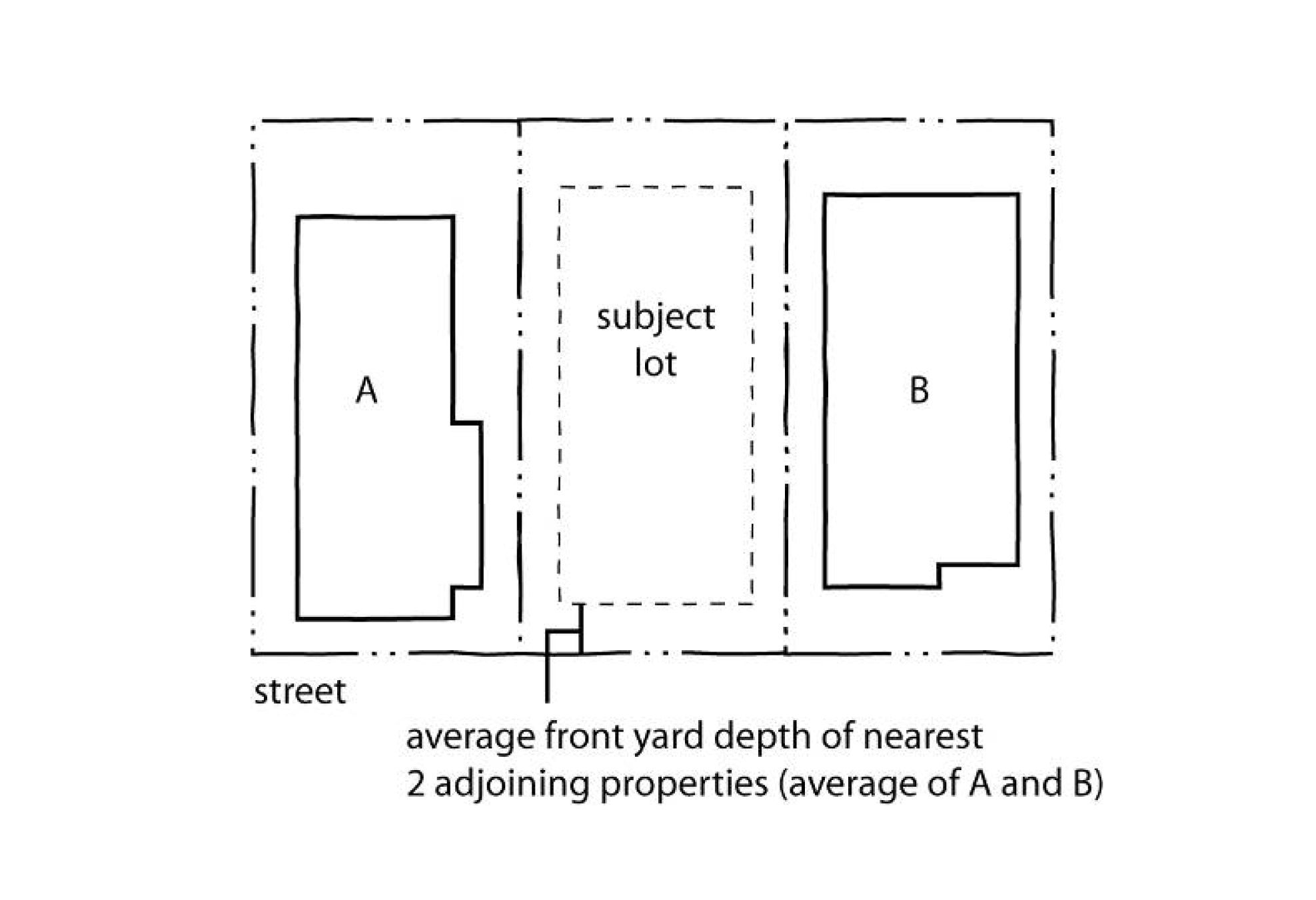
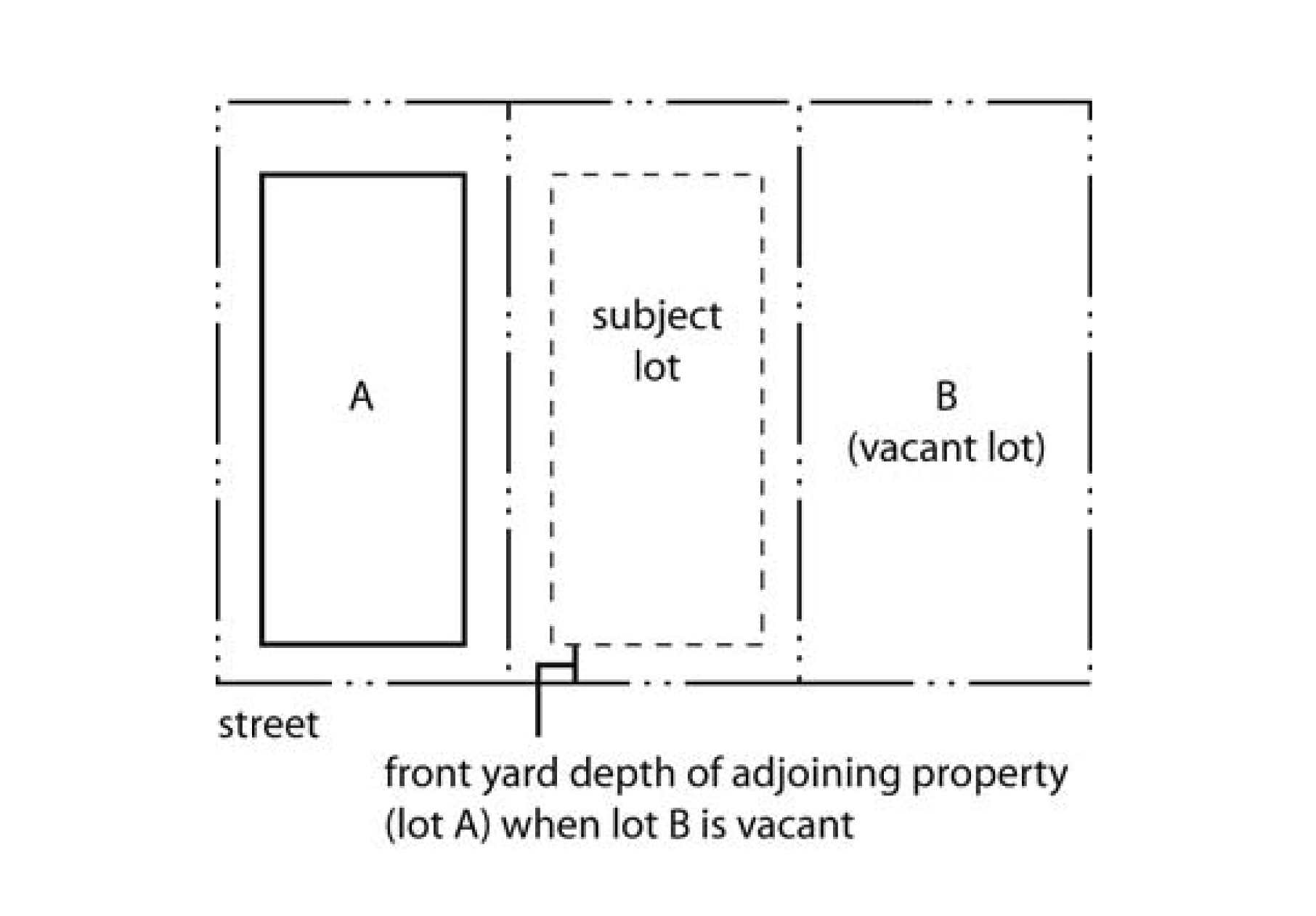
Exception for lots that utilize average front yard. Where 50 percent or more of the frontage on one side of a street between two intersecting streets is developed with buildings that have a front yard with less depth than required by this Code, then:
(1)
Where a building is to be constructed on a parcel of land that is within 100 feet of the existing buildings on both sides, the minimum front yard may be an average of the front yards as measured from the two closest front corners of the adjacent buildings on the two sides; or
(2)
Where a building is to be erected on a parcel of land that is within 100 feet of an existing building of one side only, such building may be erected as close to the street as the existing adjacent building.
(UDC 2010, § 11.4; Ord. No. 2011-3737, § 2, 7-26-2011; Ord. No. 2025-4901, § 4 (Exh. B), 3-11-2025)
Sec. 12-4. - Additional regulations.
(a)
Operational performance standards. All uses in the business, commercial and industrial districts must comply with the operational performance standards.
(b)
Outdoor display or storage of merchandise. Outdoor display or storage of merchandise is permitted in business, commercial and industrial districts subject to the following:
(1)
No display or storage of merchandise shall occur within:
a.
Required parking spaces;
b.
Landscaped areas;
c.
Fire lanes;
d.
On sidewalks if pedestrian accessibility is blocked;
e.
Building setback areas; or
f.
Under un-sprinkled overhangs of sprinkled buildings.
(2)
If a property has an excess of parking spaces, the excess spaces may be utilized for display or storage of merchandise.
(c)
Fully enclosed building required. All business, servicing, manufacturing or processing of materials normally allowed in commercial districts shall be conducted within a fully enclosed building.
(UDC 2010, § 11.5; Ord. No. 2011-3737, § 2, 7-26-2011; Ord. No. 2021-4672, § 2, 11-30-2021)

