
Belton City Zoning Code
CHAPTER 28
PERFORMANCE STANDARDS
Sec. 28-1.- Building design standards.
(a)
Applicability.
(1)
The regulations of this section apply to all commercial uses regardless of location, and to industrial uses within 300 feet of any street designated by the city as a collector, minor arterial or major arterial, or are within 500 feet of any residentially zoned property.
(2)
Large retail sales uses (on sites that include, in aggregate, 100,000 square feet or more of gross floor area) shall also comply with the regulations of this Code. Where the regulations conflict with the requirements of this section, the more restrictive requirement will control.
(3)
The standards of this section apply to all walls of buildings. For purposes of this section, the front wall is the wall most parallel to the adjacent right-of-way. Where uncertainty exists as to the applicability of these regulations, a determination will be made by the community development director.
(4)
Additions to existing buildings may be permitted by the planning commission where the addition does not meet strict compliance to this section. The purpose of this section is to continue a similar exterior architectural treatment where appropriate, and to reduce the appearance of an addition being added to the building.
(5)
For properties in the North Scott Corridor please section 18-8, North Scott Corridor Overlay District. Additionally, please see building design standards in the North Scott Corridor Overlay District + Guidelines plan, page 19.
(b)
Building location and design.
(1)
Relationship to adjacent development.
a.
The form and proportion of buildings shall be consistent or compatible with the scale, form and proportion of existing development in the immediate area.
b.
The rhythm of structural mass to voids, such as windows and glass doors, of a front facade should relate to the rhythms established in adjacent buildings.
(2)
Facade articulation.
a.
A facade consisting of a single undifferentiated plane with a single texture or color, excluding windows, doors or overhead doors, is prohibited.
b.
A minimum of 15 percent of the area of each facade shall be recessed, projected, or alternately staggered from the primary plane of the wall not less than one foot in depth or projection, excluding windows, doors or overhead doors.
c.
Where large structures are proposed with overly long facades (walls), where one dimension exceeds the length of the perpendicular dimension, such as warehouses, building mass shall be articulated with variations of a depth to create shadows visible from the nearest adjacent street in the building plane and parapet height and through the use of other unique design, landscape or site plan features.
d.
Overly long horizontal facades shall be articulated. Variation in the building plane, parapet height, materials, colors, entrance canopies and landscaping can be used to add articulation and variation to a facade. Parking lots along the facade can also relieve the plane horizontally through the use of landscaped fingers and islands containing trees and shrubs.
e.
Monotony of design in single or multiple building projects shall be avoided. Variation of detail, form and siting shall be used to provide visual interest.
f.
Long expanses of overhead doors should be relieved by matching their color to the wall or trim, recessing the doors, or adding architectural details to diminish the dominance of the doors.
(c)
Performance standards.
(1)
Compliance required. Except as otherwise provided herein, no land, building or structure in any district shall be used or occupied in any manner so as to create any dangerous, injurious, noxious or otherwise objectionable, fire, explosive or other hazard; noise or vibration; smoke, dust or other form of air pollution; heat, cold, dampness, electrical or other substance, condition or dangerous element in such a manner or in such amount as to adversely affect the surrounding area or adjoining premises. Permitted uses as set forth in this chapter shall be undertaken and maintained only if they conform to the regulations of this section.
(2)
Exterior noise. All uses in all zoning districts shall comply with the noise and peace disturbance regulations of the city Code.
(3)
Vibration. No vibration from any use within any zoning district shall be permitted which is perceptible without instruments at any residential property line within any residential zoning district. For the purpose of determining compliance with this standard, vibration is to be measured at residential property lines within residential zoning districts.
(4)
Glare. Primary and secondary glare (both direct and reflective) having a source on private property shall not be permitted to produce visual discomfort for viewers on other property in a residential zoning district on adjacent street rights-of-way. Direct glare which produces visual discomfort is to be corrected or avoided by reducing the intensity of the light source and/or the uses of directional lighting or shading devices.
(5)
Particulate matter. No emissions, dust, fumes, vapors, gases or other forms of air-pollution shall be permitted in violation of the rules and regulations of the Environmental Protection Agency (EPA).
(UDC 2010, §§ 19.1, 19.7; Ord. No. 2017-4393, § 6, 11-28-2017)
Sec. 28-2. - Building materials.
(a)
Masonry construction.
(1)
A minimum of 50 percent of front and side facades shall consist of materials described by this subsection (a).
(2)
Masonry construction shall include all masonry construction which is composed of solid, cavity, faced or veneered-wall construction, or similar materials approved by the planning commission.
(3)
Stone materials used for masonry construction may consist of granite, sandstone, slate, limestone, marble or other hard and durable all-weather stone. Ashlars, cut stone and dimensioned stone construction techniques are acceptable.
(4)
Brick material used for masonry construction shall be composed of hard-fired (kiln-fired), all-weather common brick or other all-weather common brick or all-weather-facing brick.
(5)
Concrete finish or precast concrete panel (tilt wall) construction shall be exposed or aggregate, hammered, sandblasted or other finish as approved by the planning commission.
(6)
Stucco or approved gypsum concrete/plaster materials are also permitted.
(b)
Building design. The following standards apply to all building facades and exterior walls that are visible from adjoining streets or properties.
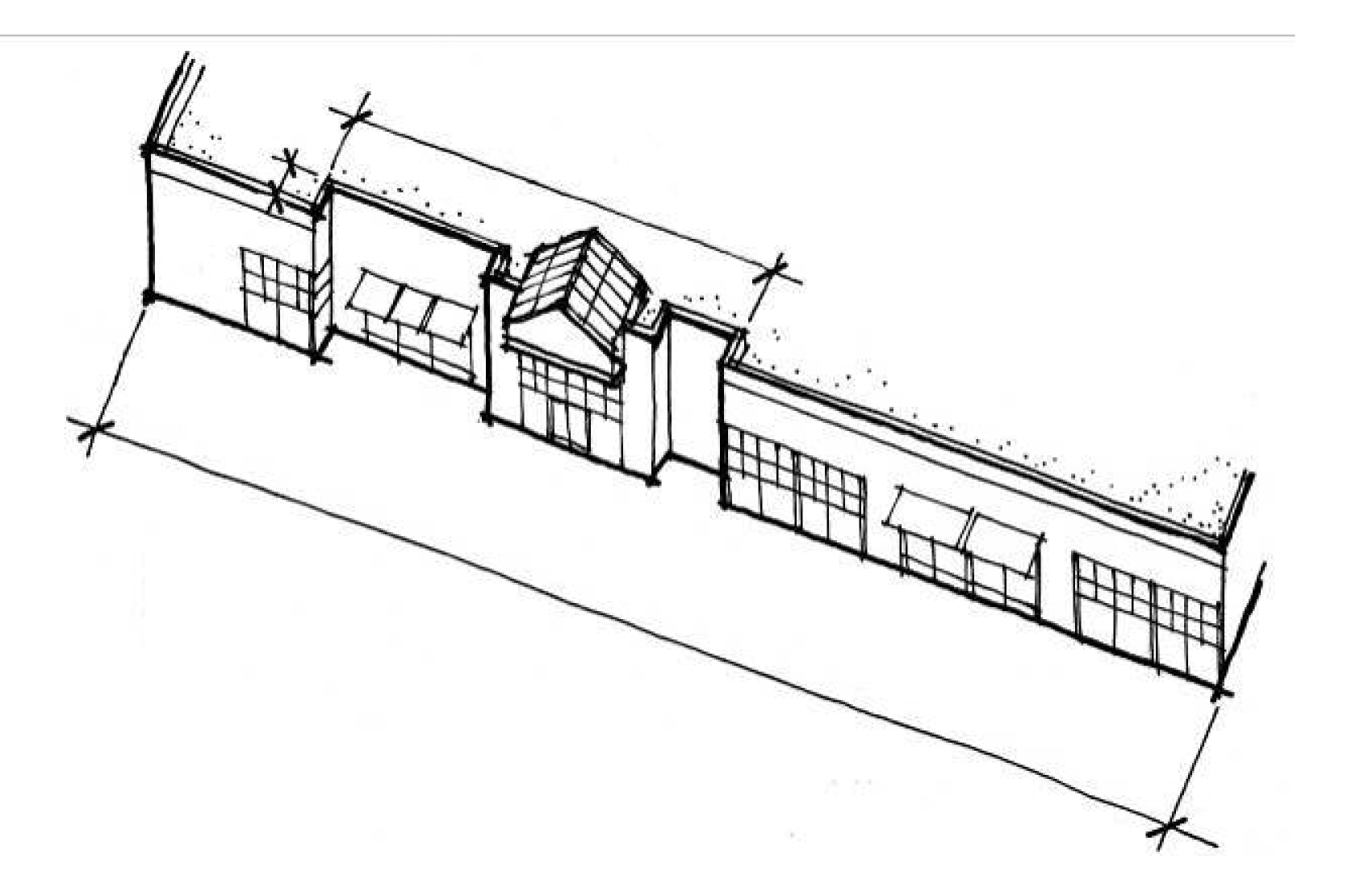
Example: large retail building with recesses and projections, wall plane off-sets, canopies, and a clearly defined entrance.
(1)
Buildings visible from public streets must include at least two of the following features:
a.
Variations in roof form and parapet heights;
b.
Clearly pronounced recesses and projections;
c.
Wall plane off-sets (dimension established by building module);
d.
Reveals and projections and changes in texture and color of wall surfaces;
e.
Deep set windows with mullions;
f.
Ground level arcades and second floor galleries/balconies; or
g.
Other features that reduce the apparent mass of a building.
(2)
Buildings must have architectural features that conceal rooftop equipment, such as HVAC units, from public view.
(3)
Each building must have a clearly defined, highly visible customer entrance featuring at least three of the following elements:
a.
Canopies or porticos;
b.
Overhangs;
c.
Recesses/projections;
d.
Arcades;
e.
Raised corniced parapets over the door;
f.
Peaked roof forms;
g.
Arches;
h.
Outdoor patios;
i.
Display windows;
j.
Architectural details such as tile work and moldings that are integrated into the building structure and design; or integral planters or wing walls that incorporate landscaped areas and/or places.
(c)
Glass walls. Glass walls shall include glass-curtain walls or glass-block construction. A glass-curtain wall shall be defined as an exterior wall which carries no floor or roof loads and which may consist of a combination of metal, glass and other surfacing materials supported in a metal frame.
(d)
Metal walls.
(1)
The use of metal siding is permitted only in industrial districts and only for side and rear facades. The materials used on the front facade shall be incorporated into any facade visible from a public street to break up the monotony of those facades.
(2)
The use of corrugated panels, with a depth of less than three-quarter inch or a thickness less than U.S. Standard 26 gauge is prohibited.
(3)
The use of unpainted metal panels, excluding panels made from copper, weathering steel, or stainless steel, is prohibited. The color finish of metal panels and exposed fasteners shall have extended durability with high resistance to fade and chalk.
(4)
Corrugated metal facades shall be complemented with masonry, whether brick, stone, stucco or split-face block. Architectural metal panels may be an acceptable substitute for masonry. Appropriate landscaping shall be used to complement and enhance a building's design, color and material.
(UDC 2010, § 19.2)
Sec. 28-3. - Building form.
Building form shall adhere to the following guidelines:
(1)
The use of unusual shapes, color and other characteristics that cause new buildings to call excessive attention to them and create disharmony shall not be allowed;
(2)
Architectural design shall create visual interest through the use of different textures, complementary colors, shadow lines and contrasting shapes. The use of walls in a single color, with little detailing or completely blank, is discouraged;
(3)
Careful consideration of durable materials, proportions and shapes, emphasizing the importance of roofs as integral and embracing elements of the overall design, is particularly important;
(4)
Evaluation of building materials shall be based on the quality of its design and relationship and compatibility to building materials in the immediate neighborhood; and
(5)
Architectural treatments (e.g., building materials, colors, facade design, roof lines, screening) shall be consistent and compatible on all sides. Treatment that is uniform on all sides will be deemed to meet the requirements of this principle. Adjacent land uses, visibility from public streets, use of screening devices (walls, fences, berms, landscaping) are criteria to be considered when varying this treatment. The applicant will have the burden of demonstrating the reasons for differing treatment on different sides (e.g., the need for truck access on one side and pedestrian access on another).
(UDC 2010, § 19.3)
Sec. 28-4. - Mechanical equipment screening requirements.
Mechanical equipment shall be screened according to the requirements of section 22-10.
(UDC 2010, § 19.4)
Sec. 28-5. - Site design.
(a)
The form and proportion of buildings shall be consistent or compatible in scale, form, proportion, and design with others on the site.
(b)
Buildings shall connect to sidewalks and other pedestrian connections within the site and to adjacent building sites.
(c)
Other site features must be reasonably compatible within the development, including signage materials or design and landscape location and design.
(d)
Parking must be arranged within the site in such a way that all areas of the site may be accessed safely by pedestrians.
(UDC 2010, § 19.5; Ord. No. 2021-4672, § 5, 11-30-2021)
Sec. 28-6. - Maintenance.
The exposed walls and roofs of buildings shall be maintained in a clean, orderly and attractive condition, free of cracks, dents, punctures and breakage, and other forms of visible marring. Materials that become excessively faded, chalked or other wise deteriorated shall be refinished or repainted. "Excessively faded" shall be defined as a color change exceeding seven Delta E (Hunter) units under ASTM D2244. "Excessively chalked" shall be defined as chalk in excess of ASTM D 759 number 6 rating.
(UDC 2010, § 19.6)
Sec. 28-7. - Outdoor lighting.
(a)
The purpose of this section is to regulate the spill-over of light and glare on operators of motor vehicles, pedestrians, and land uses in the proximity of the light source. With respect to motor vehicles in particular, safety considerations form the basis of the regulations contained herein. In other cases, both the nuisance and hazard aspects of the glare are regulated.
(b)
The following standards are required of all outdoor lighting except the outdoor recreational uses specifically exempted in subsection (b)(2) of this section. This section is not intended to apply to public street lighting.
(1)
Maximum height and illumination.
a.
The maximum permitted light post height is dependent on amount of cutoff provided. This is designed as a protection against excessive glare and light spilling over to neighboring properties. The exceptions which are permitted provide adequate protection for neighboring residential property.
b.
Light level at the property line may not exceed one footcandle except as otherwise specified by this chapter.
c.
Outdoor lighting shall meet one of the following standards:
1.
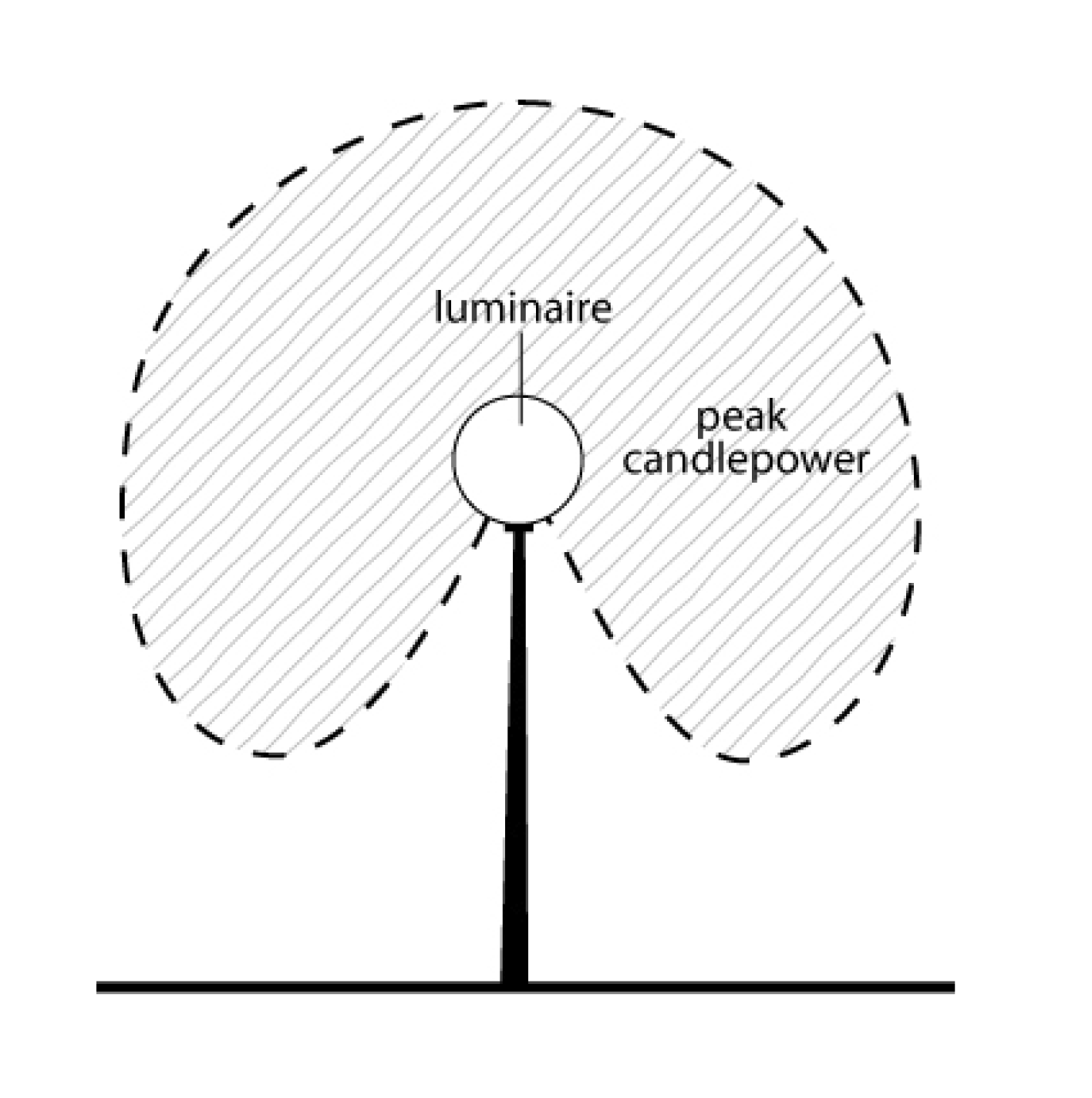
No cutoff. Luminaries with no cutoff must incorporate decorative design elements such as globes, finials, finished posts, pedestals, cross arms, scrolls, or other decorative embellishments. When a luminary has no cutoff, the maximum permitted luminary height shall be:
Example:
2.
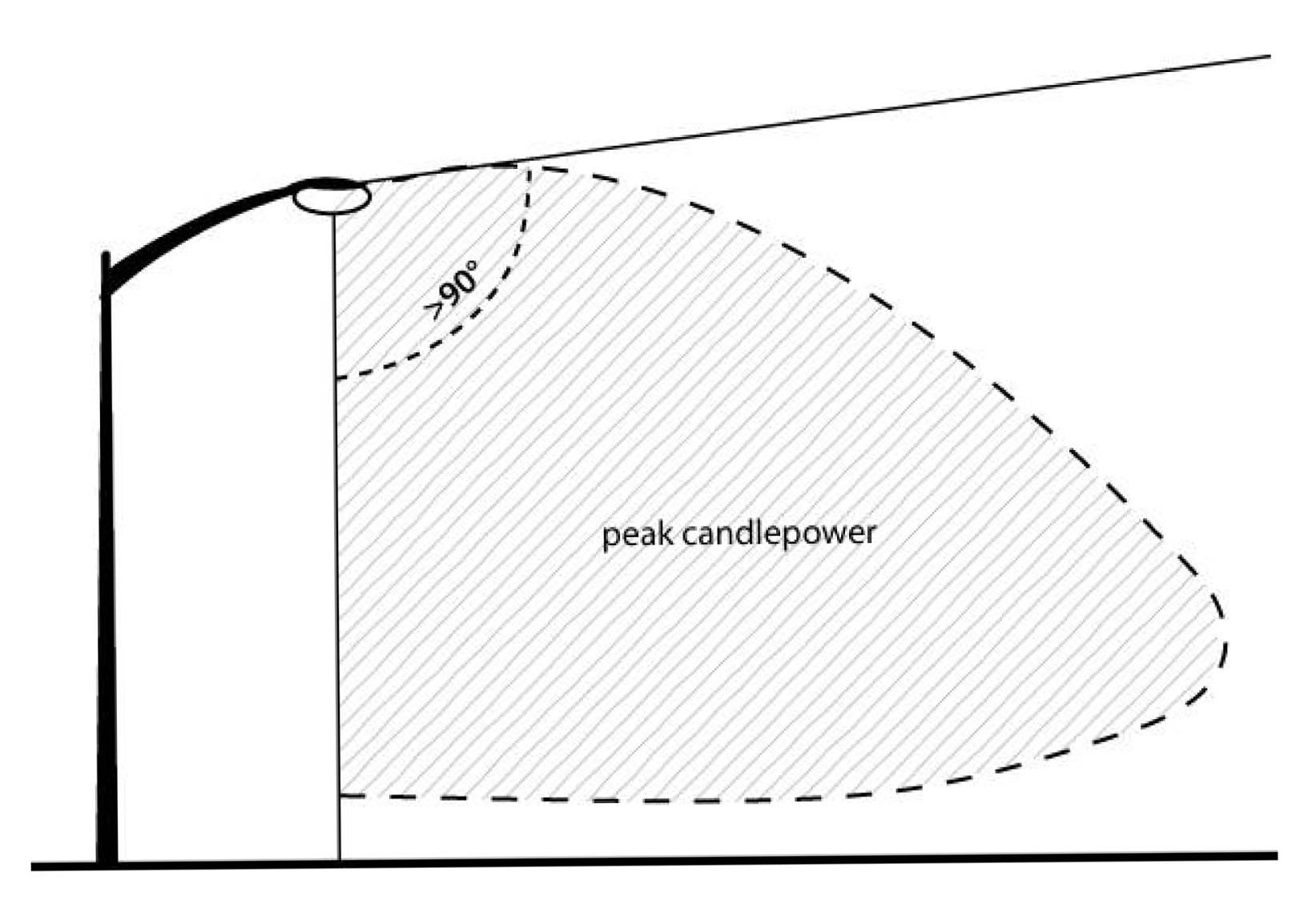
Total cutoff 90 degrees or more. When a luminary has total cutoff of an angle equal or greater than 90 degrees, the maximum permitted luminary height shall be:
Example:
3.
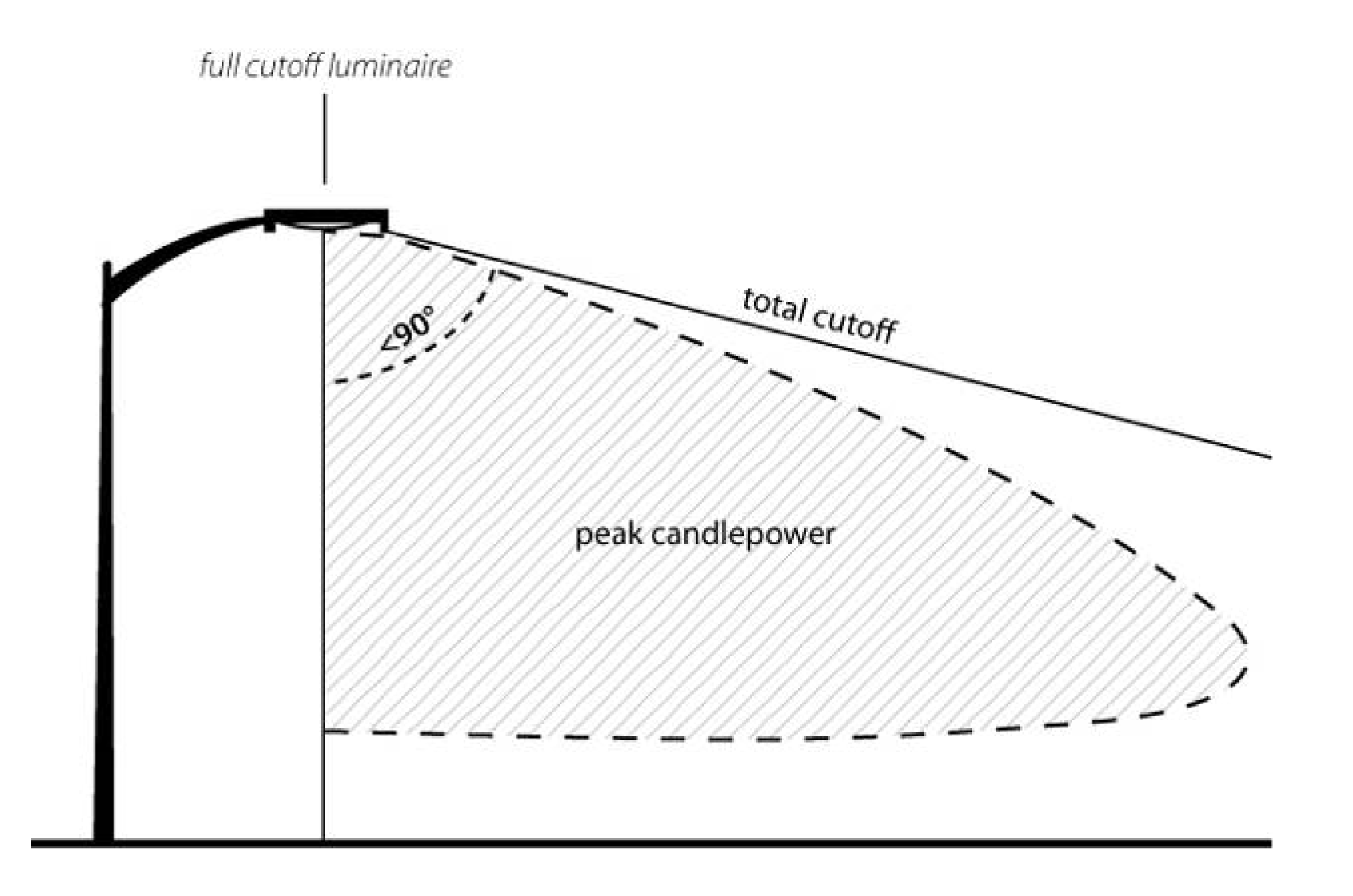
Total cutoff less than 90 degrees. When a luminary has total cutoff of light at an angle less than 90 degrees and is located so that the bare light bulb, lamp or light source is completely shielded from the direct view of an observer five feet above the ground at the point where the cutoff angle intersects the ground, then the maximum permitted height of the luminary shall be:
Example:
(2)
Outdoor recreational uses.
a.
Because of their unique requirements for nighttime visibility and their limited hours of operation, public ball diamonds, playing fields, and tennis courts are exempted from the maximum height standards of this section. These outdoor recreational uses must meet all other requirements of this section and of this chapter.
b.
The outdoor recreational uses specified in subsection (b)(2)a of this section may not exceed a maximum permitted post height of 80 feet.
c.
The outdoor recreational uses specified in subsection (b)(2)a of this section may exceed a total cutoff angle of 90 degrees, provided that the luminary is shielded to prevent light and glare spill over to adjacent residential property. The maximum permitted illumination at the lot line shall not exceed two footcandles.
(3)
Flashing lights. No flickering or flashing lights shall be permitted.
(4)
Parking and loading areas.
a.
Any lighting used to illuminate off-street parking or loading areas must be directed away from residential properties in such a way as not to interfere with the residential use.
b.
Light poles shall be located within perimeter landscaped areas, landscaped islands and/or made part of cart return bays.
(5)
Measurement. Lighting levels shall be measured in footcandles with a direct-reading, portable light meter.
(6)
Exterior lighting plan. At the time any exterior lighting is installed or substantially modified, and whenever a building permit is sought, an exterior lighting plan shall be submitted to the community development director in order to determine whether the requirements of this section have been met.
(UDC 2010, §§ 19.8—19.14)
Sec. 28-8. - Fences.
(a)
General standards. The following standards apply to all fences in all districts:
(1)
Permit required. Prior to the installation of a fence or retaining wall, a permit is required.
(2)
Construction. All fences and walls shall be constructed with a finished surface facing outward from the property. Posts and support beams shall be on the inside of the finished surface.
(3)
Fence location.
a.
No fence shall be constructed within the sight triangle.
b.
Fences are permitted within a platted easement provided that:
1.
There are no plat restrictions prohibiting fences in an easement.
2.
The property owner removes the fence, or portion thereof, necessary for the city or utility company to gain access to the easement for maintenance purposes. Should the property owner fail to remove the fence sections located within the easement, the city or utility company may do so.
3.
No fence shall be installed or maintained within any drainage way, detention facility, or engineered swale which will create ponding on adjacent, divert water onto the adjoining property, or impede drainage.
4.
Any fence installed or maintained across a fire access easement shall have a gate in accordance with the adopted IFC.
(b)
Retaining walls. In all zoning districts, a retaining wall may be permitted where it is reasonably necessary due to the changes in the slope on the site and where the wall is located at least two feet from any street right-of-way. Where the wall extends more than 30 inches above the ground level, a guardrail must be installed for safety purposes if required by the building code.
(c)
Materials.
(1)
Privacy fences. Materials allowed for construction of a privacy fence include solid wood (maximum board width of 12 inches), vinyl, or similar material. Walls may be constructed of stone, brick, concrete with stone or brick veneer, or precast concrete simulated stone or brick. Additional structural and permit reviews may be required for walls depending on height and location.
(2)
Decorative fences. Materials allowed for construction of a decorative fence include wood, vinyl, galvanized or wrought iron, or similar materials and may include split-rail, picket, wrought iron, or similar open fence styles. Decorative fences shall be a minimum 50 percent transparent.
(3)
Nonconforming fences. Any fence legally erected prior to the date of adoption of this Code, and not in compliance with the provisions of this section, shall be considered a nonconforming structure. Any new or replacement fences shall be in compliance with the location, height, design, and materials standards of this Code, unless the replacement fence is the same location, height, design, and materials of the nonconforming fence. Fences may not be replaced in a sight triangle or in a drainage easement if it is determined that the fence has or may impede visibility or stormwater. Any other repair or replacement to a nonconforming fence shall only be made in compliance with this Code.
(4)
Prohibited fences. Mesh and wire fences are prohibited except for construction and/or emergency purposes. Bright colors such as orange, yellow, or red are not permitted, except for construction and/or emergency purposes. Non-solid wood fences are prohibited, including plywood and particle board.
(d)
Agricultural districts. In agricultural districts the following standards apply:
(1)
Decorative and chainlink fences up to a maximum height of six feet are permitted on any portion of the lot.
(2)
Privacy fences and walls up to a maximum height of six feet are permitted on any portion of the lot provided a minimum setback of 50 feet from all street rights-of-way is maintained.
(3)
Barbed wire and electric fences (above ground) are permitted on any portion of the lot.
(e)
Residential districts. In residential districts the following standards apply:
(1)
Decorative fences up to a maximum height of four feet are permitted on any portion of the lot.
(2)
Decorative, privacy, and chainlink fences, and walls up to a maximum height of six feet are permitted in the side and rear yards provided the fence or wall in a corner side yard is setback a minimum of six feet from the corner side property line. On double-frontage lots where the rear yard abuts a street right-of-way, no setback is required, provided the fence does not encroach into a platted landscape buffer or easement and there is no direct access to the street.
(3)
Barbed wire and electric fences (above ground) are prohibited in all residential districts.
(4)
A decorative fence constructed to a maximum height of six feet that is integrated into the design of a subdivision or development may be permitted adjacent to a street right-of-way in a common landscape tract. The fence may be utilized as a perimeter fence for the entire subdivision or development and shall be approved with a final development plan.
(5)
All fences and walls within the North Scott Corridor Overlay District shall meet the site design standards for walls and fences within the overlay guidelines per section 18-8.
(f)
Commercial and industrial districts. In commercial and industrial districts, the following standards apply:
(1)
Decorative fences up to a maximum height of four feet are permitted on any portion of the lot.
(2)
On properties larger than ten acres, decorative metal security fences up to a maximum height of six feet are permitted on any portion of the lot for security purposes.
(3)
Decorative, privacy, and chainlink fences, and walls up to a maximum height of six feet are permitted in the side and rear yards provided the fence or wall in a corner side yard is setback a minimum of six feet from the corner side property line. On double-frontage lots where the rear yard abuts a street right-of-way, no setback is required, provided the fence does not encroach into a platted landscape buffer or easement and there is no direct access to the street.
(4)
In industrial zoning districts, security fences up to a maximum height of eight feet are permitted in the side and rear yards provided the fence or wall in a corner side yard or on a double-frontage lot is setback a minimum of six feet from the corner side and rear property lines. Barbed wire is only permitted along the top portion of a fence that is eight feet in height. No portion of the barbed wire shall be closer than eight feet to the ground.
(5)
Electric fencing (above ground) is prohibited.
(6)
A decorative fence constructed to a maximum height of six feet that is integrated into the design of a subdivision or development may be permitted adjacent to a street right-of-way in a common landscape tract or easement. The fence may be utilized as a perimeter fence for the entire subdivision or development and shall be approved with a final development plan.
(7)
All fences and walls within the North Scott Corridor Overlay District shall meet the site design standards for walls and fences within the overlay guidelines per section 18-8.
(UDC 2010, §§ 19.15—19.20; Ord. No. 2009-3517, 1-27-2009; Ord. No. 2011-3750, § 1, 9-27-2011; Ord. No. 2017-4367, § 1, 6-13-2017; Ord. No. 2021-4604, § 2, 1-12-2021; Ord. No. 2022-4741, § 3, 9-27-2022)
Sec. 28-9. - Intersection visibility.
(a)
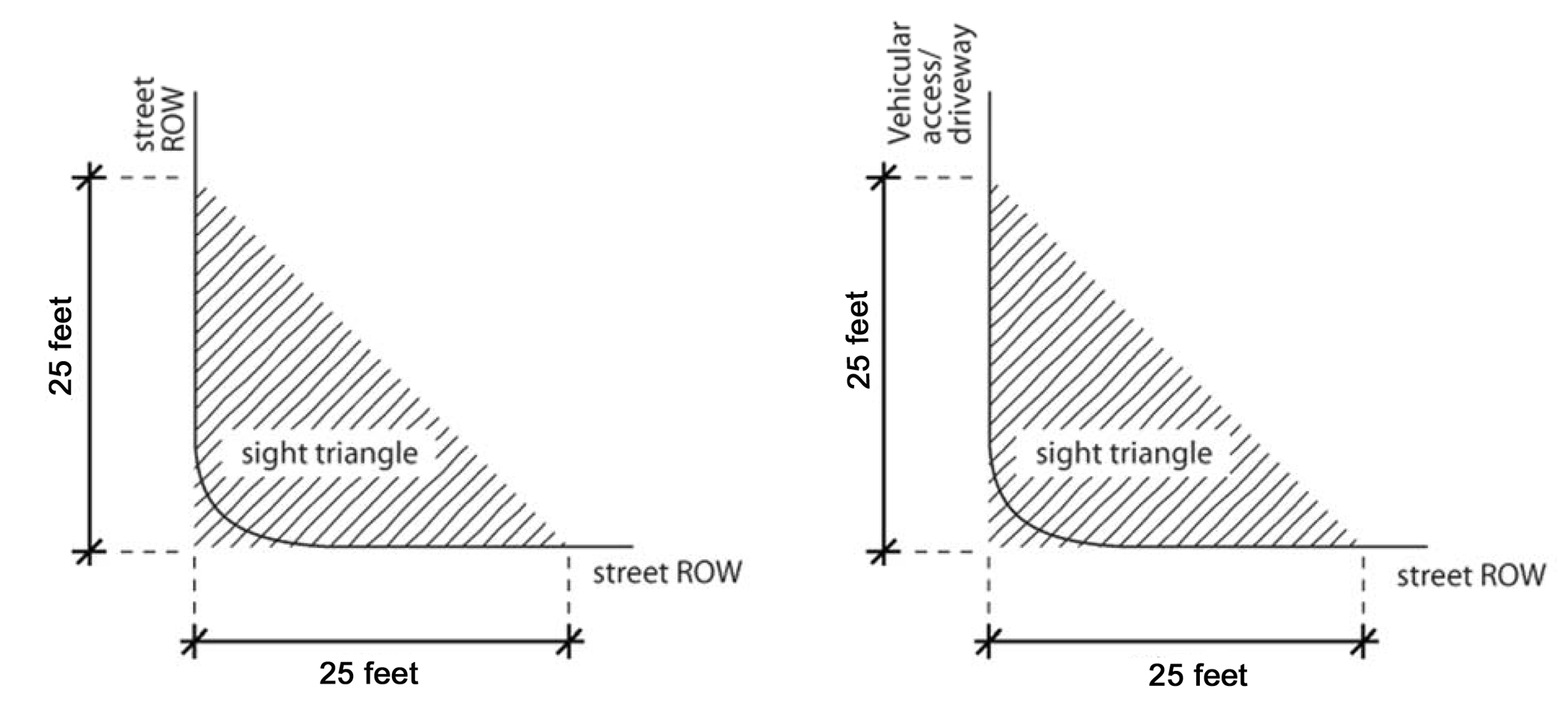
No sign, fence, wall, shrub or other obstruction with a height between 2½ and eight feet shall be located in a sight triangle.
(b)
Sight triangles must be provided at:
(1)
All street intersections; and
(2)
The intersection of a vehicular access way or driveway and a street, except for single-family and two-family dwellings.
The sight triangle includes the area created by a line extending from a point 25 feet
from the street intersection. Where a street intersects a vehicle access way or driveway,
the sight triangle includes the area created by the edge of the street and the edge
of the drive extending 25 feet from their intersection.
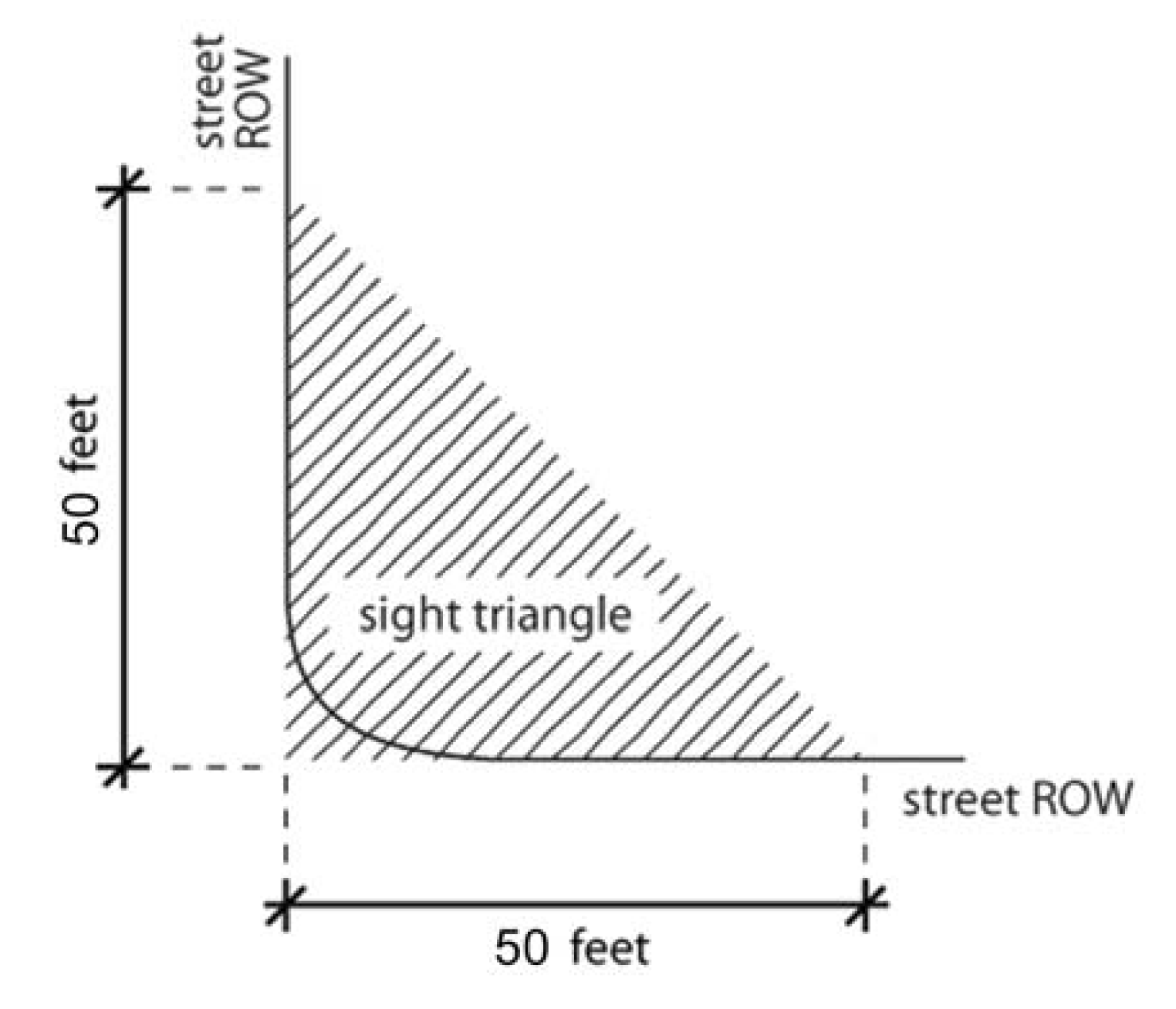
When an arterial street intersects another arterial street or railway, the sight triangle
is increased to 50 feet from the intersection of the right-of-way lines.
The City of Belton is authorized to trim, remove or order removal of structures, signs, landscaping, or other materials that violate this section.
(UDC 2010, § 19.21)
Sec. 28-10. - Residential fire sprinkler performance incentive.
(a)
In order for these provisions to be permitted, the residential sprinkler option must be indicated on the plat and recorded as a requirement for the building permit.
(b)
When the option of providing every residential dwelling with an automatic fire sprinkler installed in accordance with NFPD 13D, the following provisions shall be allowed:
(1)
Cul-de-sac length. The length of a cul-de-sac may be increased by 50 percent.
(2)
Street width. All internal public and private streets may be reduced in width by two feet except that no street may be less than 24 feet wide as measured from back-of-curb.
(3)
Fire hydrant spacing. Spacing between hydrants may be increased by 50 percent. Hydrant layout and placement standards shall apply.
(4)
Water lines. Internal water lines serving the dwellings may be reduced by one pipe size (10" to "8," etc.). Minimum fire flow requirements as established by the fire code shall apply.
(UDC 2010, § 19.22)

