
Belton City Zoning Code
CHAPTER 26
PARKING, LOADING AND ACCESS
Sec. 26-1.- Applicability.
(a)
New development. The requirements of this chapter apply to all new buildings, structures and uses established in all zoning districts.
(b)
Expansion of residential development. The requirements of this chapter apply whenever additional dwelling units are added to an existing building or use.
(c)
Expansion of non-residential development. If an addition is proposed to a building; an additional building is proposed for a lot; or if an expansion is proposed to an existing parking lot, the existing and expanded parking lot shall comply with the provisions of this chapter.
(d)
Change of use. The requirements of this chapter apply to a change of use of an existing building or lot.
(e)
Existing parking and loading areas. Existing required parking and loading areas may not be used to satisfy required off-street parking or loading areas for new or expanded buildings, structures or uses. Existing parking and loading spaces must be maintained and may not be reduced as long as the main building, structure or use remains, unless an equivalent number of spaces are provided elsewhere as permitted by this chapter.
(UDC 2010, § 13.1)
Sec. 26-2. - Off-street parking requirements.
(a)
Parking spaces required. Off-street parking spaces are required as specified in the following table:
(UDC 2010, § 13.2)
Sec. 26-3. - Rules for computing requirements.
(a)
Multiple uses. When a building or development contains multiple uses, the off-street parking requirement shall be calculated for each individual use and the total parking requirement shall be the sum of the individual parking requirements unless shared parking is provided.
(b)
Fractions. When determination of the number of off-street parking spaces required by this chapter results in a requirement of a fractional space, the fraction of less than one-half may be disregarded, and a fraction of one-half or more shall be counted as one parking space.
(c)
Area measurements. All square-footage-based parking requirements are based on gross floor area.
(d)
Occupancy- or capacity-based standards. All occupancy- or capacity-based parking requirements are based on the largest number of individuals working on a single shift, the maximum enrollment or the maximum occupancy based on the building code, whichever is applicable and whichever results in the greater number of spaces. For uses with benches or similar seating, one seat consists of 22 linear inches of bench length.
(1)
Uses not listed. In the case of buildings or uses not mentioned in this chapter, the community development director must determine which standard is most appropriate. The community development director may require the applicant to submit a parking study or other evidence to help determine the most appropriate parking standard for the proposed use.
(UDC 2010, § 13.3)
Sec. 26-4. - Parking area design and construction.
(a)
Parking area location.
(1)
Off-street parking is considered an accessory use to the use for which the parking is provided. Parking not located on the same tract as the principal use shall not be located within a residential zoning district.
(2)
Off-street parking required by this chapter must be located within 600 feet of the use it serves, measured along lines of public access. Parking for non-residential uses may not be located in a residential zoning district.
(b)
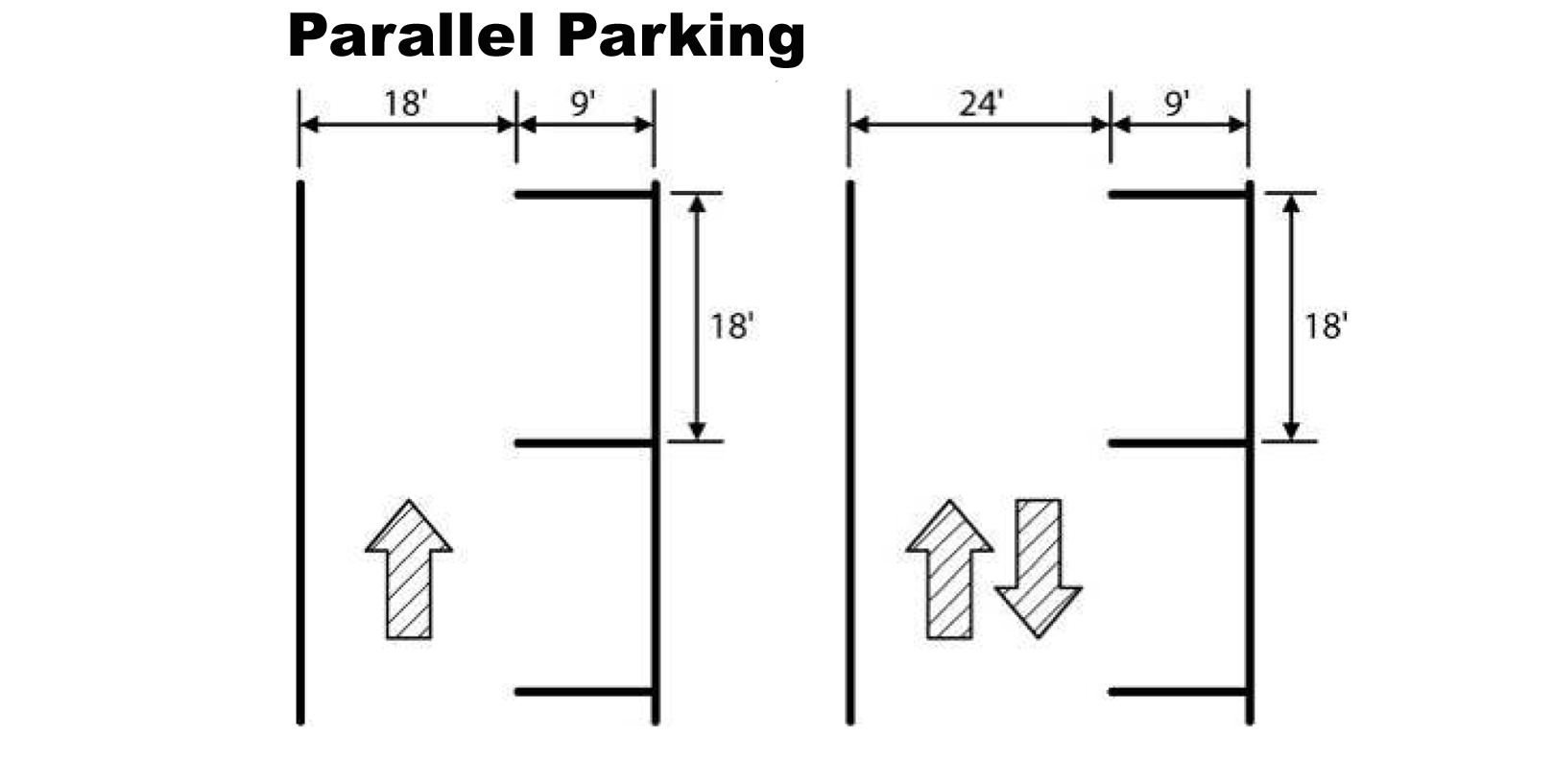
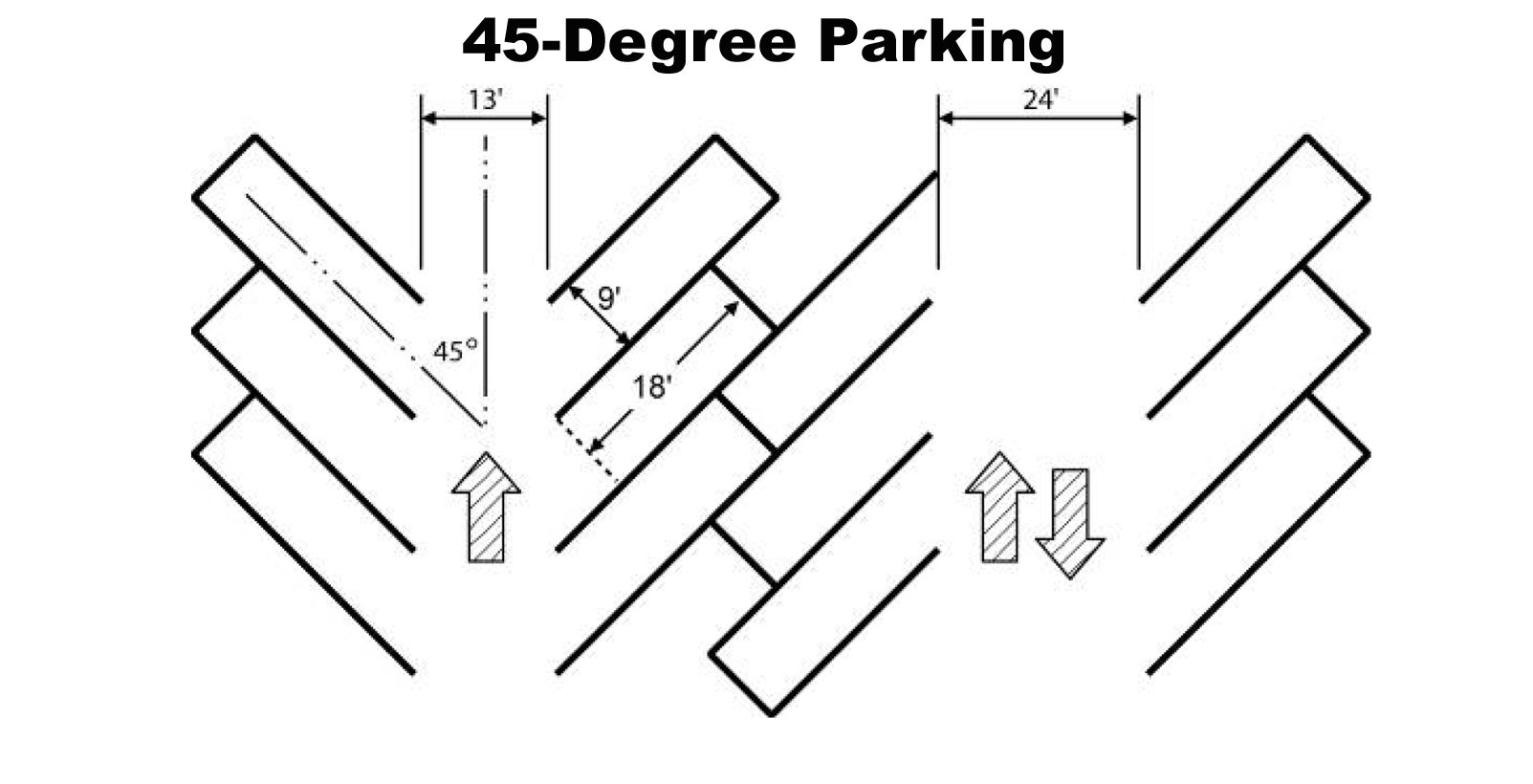
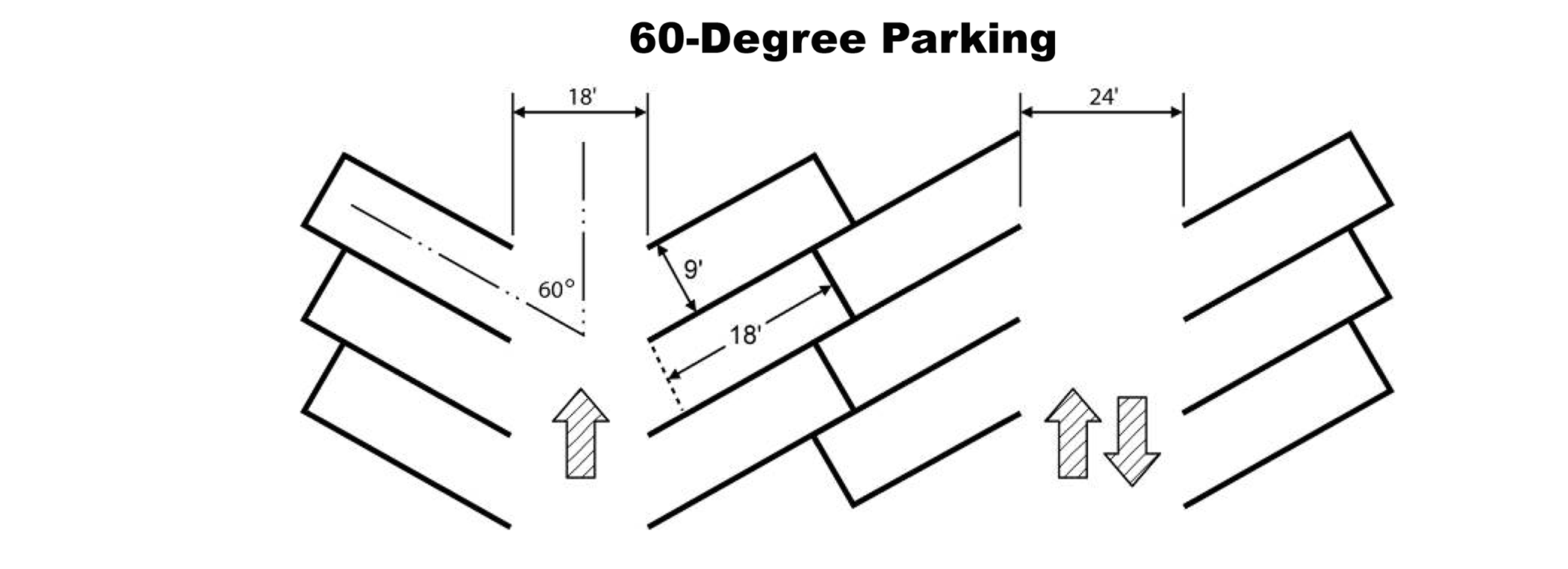
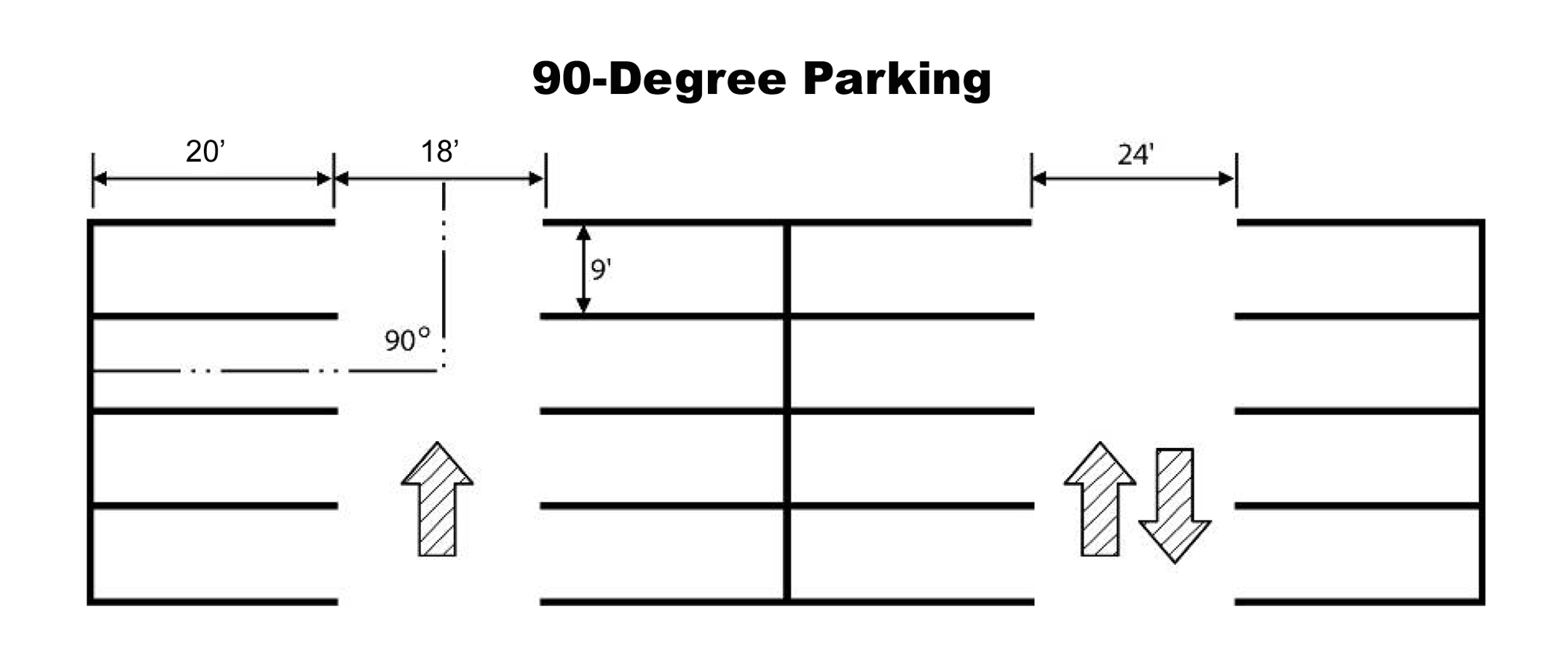
Dimensions. Off-street parking areas must comply with the following standards:
Where parking is located within a fire department access, a 20-foot minimum driving
aisle width shall apply.
(c)
Parking space access.
(1)
Each off-street parking space must open directly onto an aisle that complies with the aisle width standards of this chapter.
(2)
Direct access to parking spaces from a primary access drive is prohibited.
(3)
Direct access to off-street parking spaces from the street is prohibited.
(4)
No parking spaces shall be accessible from an access driveway within 20 feet of the street right-of-way line.
(d)
Wheel stops.
(1)
Parking spaces abutting an adjoining property line or street right-of-way shall be provided with wheel guards or bumper guards located so that no part of a normally parked vehicle will extend beyond the property line. When wheel guards are used, they must be centered 2½ feet from the property line for 90-degree parking; 2.3 feet for 60-degree parking, and two feet for 45-degree and 30-degree parking.
(2)
Plant material, fences, walls and berms must be protected from damage by motor vehicles through the use of concrete curbing or wheel stops. Plant material must be installed in a manner that is not intrusive to utilities or pavement.
(e)
Curb and gutter.
(1)
All off-street parking areas are required to have concrete curbs and gutter.
(2)
Temporary asphalt curbs may be used in areas to be expanded only as shown and approved on the site plan.
(f)
Use of off-street parking areas.
(1)
Off-street parking areas required by this chapter must be used solely for the parking of operable motor vehicles for patrons, occupants or employees of the use.
(2)
No motor vehicle repair work, storage, sales or service of any kind may take place in any off-street parking area.
(3)
No person shall park a vehicle to include, but not be limited to, motor vehicles, motor homes, trucks, trailers, boats and recreational vehicles upon any roadway or private or public parking lot with the exception of private residential driveways, commercial vehicle dealerships or by the owner of the property, if not in conflict with any other section of this Code, for the principal purpose of:
a.
Displaying such vehicle for sale.
b.
Greasing or repairing such vehicle except repairs necessitated by an emergency.
(g)
Surfacing. All vehicles shall be parked on a hard surface. All required off-street parking and loading areas shall be surfaced with a permanent material such as asphalt, concrete, paving blocks, or other approved material meeting the standards of the city.
(h)
Maintenance. Vehicle parking and loading areas including drives and drive aisles shall be maintained in proper repair, with the required surfacing and curbing. Pot holes and surface cracks shall be filled and sealed in a timely manner.
(i)
Parking lot striping.
(1)
Every parking space shall be clearly demarcated by lines painted on or otherwise applied to the parking lot surface.
(2)
One-way access aisles shall be clearly marked with arrows painted or otherwise applied to the parking lot surface.
(3)
If right-turn or left-turn lanes are provided for vehicles exiting the parking area, arrows shall be painted or otherwise applied to the parking lot surface to demarcate appropriate turn lanes.
(4)
No wording, markings, pictures or other means of advertisement shall be painted on or otherwise applied to the parking lot stripes or surface, except for those required for fire lane marking, loading zone identification or other markings required by City of Belton codes and regulations.
(5)
Striping shall be maintained in a manner that the lines remain clearly demarcated on the parking lot surface.
(j)
Pedestrian access.
(1)
Pedestrian access to buildings shall be provided from rights-of-way and parking areas by means of a pathway leading to the principal public entrance. The pathway must be clear of all obstructions related to construction activity prior to the opening of the building to the general public.
(2)
Parking areas must be distributed around large retail uses on not less than two sides in order to shorten the distance to other buildings and public sidewalks and to reduce the perceived scale of parking areas and paved surfaces.
(3)
Walkways no less than eight feet in width must be provided along the full length of the building along any facade featuring a customer entrance, and along any facade abutting public parking areas.
(4)
Where curbs exist along the pathway, approaches or curb cuts a minimum of four feet wide and not exceeding a slope of 1:12 must be provided for access by wheelchairs.
(k)
Drive-thru facilities. Permitted drive-thru facilities shall be designed in accordance with standards.
(UDC 2010, § 13.4; Ord. No. 2018-4414, § 4, 3-13-2018)
Sec. 26-5. - Residential driveways.
The following standards apply to all residential driveways providing ingress or egress to a public or private street. Residential driveways include all single-family detached and attached housing types. Multi-family developments with shared access and parking facilities shall follow the commercial and industrial driveway standards in section 26-6 of this Code.
(1)
Driveway openings. One driveway opening is permitted to a parcel from any abutting street provided that access is not otherwise controlled or restricted. The following exceptions to the one driveway opening restriction apply:
a.
On corner lots, one driveway opening is permitted in the front yard and one driveway opening is permitted in the corner side yard provided that access is not otherwise controlled or restricted and no off-street parking areas are located in a sight triangle.
b.
On double frontage lots, one driveway opening is permitted in the front yard and one driveway opening is permitted in the rear yard provided that access is not otherwise controlled or restricted and no off-street parking areas are located in a sight triangle. Double frontage lots include those with rear alley access.
c.
On lots zoned "A" (Agriculture) or "R-1B" (Single family large lot), a second driveway opening is permitted on lots one acre or larger.
d.
On lots with a frontage width 125 feet or greater at the front property line, a circle or horseshoe driveway is permitted provided that the driveway width at the right-of-way for both access drives is a minimum of 12 feet to a maximum of 18 feet.
(2)
Driveway sizes and coverage limits. All driveways shall meet the following minimum and maximum width and coverage limits:
a.
The minimum driveway width in the right-of-way shall be 12 feet up to a maximum driveway width of 25 feet in the right-of-way. A driveway may flare out outside of the right-of-way to provide access to garage spaces, parking pads, or access for accessory structures in the side or rear yard.
b.
The maximum driveway coverage in a front or corner side yard shall not exceed 50 percent of the front or corner side yard area.
c.
Unless approved as a shared driveway, all driveways shall be located at least five feet from an interior side property line in the right-of-way and at least two from an interior property line on the lot.
d.
Driveways accessing a garage from a public or private street shall be at least 20 feet in depth from the right-of-way to the garage to accommodate a parking pad in front of the garage. Driveways accessing a garage from an alley shall be at least five feet in depth from the alley property line. Minimum parking requirements may require additional driveway or parking pad depths.
(3)
Driveway paving materials. All driveways shall be paved with a permanent material such as asphalt, concrete, paving blocks, or other approved material meeting the standards of the city. Driveway aprons or access in the right-of-way shall be concrete to meet the standard specifications for public improvements in the right-of-way. The entire driving and parking surface of a driveway shall be paved, with the following exceptions:
a.
In interior side yards and rear yards, when a driveway is extended for the purposes of a parking pad or accessing an accessory structure or an attached garage in the side or rear yard, a concrete or paver block ribbon driveway may be used in lieu of a fully paved surface. Ribbon driveways shall be a minimum of eight feet to a maximum of 12 feet in width. Each paved strip shall be a minimum of two feet in width to a maximum of three feet in width. The unpaved surface between the two paved strips shall be turf grass or low-growing ground cover.
b.
On lots zoned "A" (Agriculture), driveways 200 feet or longer in length may utilize gravel for driving and parking surfaces provided that the first 50 of the driveway outside of the right-of-way is paved and that any driveway accessing a garage attached to a residential dwelling unit has a minimum of 20 feet of paved surface up to the garage door.
(UDC 2010, § 13.5; Ord. No. 2017-4371, § 1, 7-25-2017; Ord. No. 2018-4414, § 4, 3-13-2018; Ord. No. 2021-4672, § 4, 11-30-2021; Ord. No. 2022-4741, § 2, 9-27-2022; Ord. No. 2025-4930, § 2 (Exh. B), 7-22-2025)
Sec. 26-6. - Commercial and industrial driveways.
The following standards apply to all commercial and industrial driveways providing ingress or egress to a public or private street:
(1)
General performance standards.
a.
Off-street parking spaces must be arranged so that no vehicle will back directly onto a street or primary access aisle in a shopping center. All private parking areas and circulation drives must be located off of the street right-of-way. Divisional islands and curbs must be constructed where necessary to provide such protection.
b.
Access to property is allowed only across such driveways, and all other frontage on the property shall not be used for egress, ingress or parking on the right-of-way.
c.
All driveway designs must allow an entering vehicle turning speed of 15 miles per hour to help reduce interference with through street traffic. Radii of driveways must be sufficient to achieve this standard.
d.
Sufficient space must be provided so that vehicles waiting to park or exit do not interfere with street traffic.
e.
Provisions for circulation between adjacent parcels shall be provided through coordinated or joint parking systems.
f.
Driveway placement shall be such that loading and unloading activities will in no way hinder vehicle ingress or egress.
g.
Direct-access driveway placement shall provide exiting vehicles an unobstructed sight distance according to the following schedule.
h.
Driveways shall be designed so that vehicles entering the driveway from the street will not encroach upon the exit lane of a two-way driveway. Also, a right-turning exiting vehicle must be able to use only the first through traffic lane available without encroaching into the adjacent through lane. No design shall obstruct fire department access.
(2)
Standards for right turn lanes and tapers. Right turn lanes and tapers are required when:
a.
Expected right-turn ingress movements meet or exceed 50 vehicles per hour during a typical weekday peak traffic period;
b.
Driveway volumes are expected to meet or exceed 1,000 vehicles per day calculated using Institute of Transportation Engineers site generated traffic standards for the closest matching land use category as set forth in the Trip Generation Manual;
c.
The director of public works can document through traffic analysis that such treatment is necessary to avoid congestion and/or unsafe conditions on the public street; or
d.
Identified as necessary by a submitted traffic study.
(UDC 2010, §§ 13.6—13.8)
Sec. 26-7. - Driveway profiles.
Driveway profiles must be determined based upon the grade of a two-way, one-way or divided commercial driveway and shall not exceed two percent for a minimum distance of 25 feet from the edge of the pavement.
(1)
Driveway spacing. Driveways must be spaced at least 125 feet apart, whether they are on a single lot or adjoining lots. Spacing is to be measured from the center of the driveway throat to the center of the adjoining driveway throat.
(2)
Number of driveways per parcel.
a.
One driveway opening is permitted to a parcel from any abutting street provided that access is not otherwise controlled or restricted.
b.
Additional driveways may be permitted as part of site plan review.
c.
Parcels with 200 feet of frontage or less may apply for a second driveway if it will be shared with an adjoining parcel, provided that minimum driveway spacing required by this chapter is maintained, and subject to the approval of the director of public works.
d.
For purposes of this provision, a "parcel" is defined as a piece of land that contains one business or is owned by one owner even though the land may have been subdivided into smaller lots.
(3)
Corner clearance. All direct-access driveways must be constructed so that the point of tangency of the curb return radius closest to a signalized or stop sign-controlled intersection is at least 120 feet from the curb face of the intersecting street. Using a 15-foot driveway radius, the edge of the driveway throat must be 135 feet from the curb face of the intersecting street. The driveway radius may not compound with the intersection corner radius.
(4)
Driveway width. Except for dual driveways approved by the director of public works, the width of the driveway throat may not exceed 35 feet.
(5)
Failure to comply. Failure to comply with any of the requirements of this chapter will be grounds for disapproval of the proposed plan or application for a building permit.
(UDC 2010, § 13.9)
Sec. 26-8. - Accessible parking for people with disabilities.
(a)
Applicability. The accessible parking standards of this section apply to all new parking lots for nonresidential uses and multifamily dwellings.
(b)
Spaces required. Accessible parking spaces shall be provided as required in the following parking space table from the ADA Standards for Accessibility Design.
Total number of parking spaces provided (per lot):
(c)
Layout and design.
(1)
Location. Accessible parking spaces must be located on the shortest possible route of travel between the parking area and an accessible building entrance.
(2)
Access aisles. Access aisles must be included to provide space adjacent to vehicles for passenger loading and unloading. All access aisles must:
a.
Be at least five feet wide;
b.
Be located on the passenger side of the parking space;
c.
Extend the full length of the parking space; and be marked to indicate that parking in the access aisle is prohibited;
d.
One in every eight accessible spaces, but not less than one, must be served by an access aisle that is a minimum of eight feet wide and must be designated "van accessible."
(d)
Slope. Accessible spaces and access aisles may not have a slope greater than two percent. Access aisles must be at the same level as the parking space.
(e)
Vertical clearance. Accessible parking spaces must have a vertical clearance of eight feet two inches.
(f)
Signs and identification. All accessible parking spaces must be identified by signs complying with the Manual of Uniform Traffic Control Devices and the Department of Justice, Code of Federal Regulation 28 CFR part 36, ADA Standards for Accessible Design. The sign must be vertically mounted on a post or wall no more than five feet from the space and centered on the width of the space.
(g)
Shared parking. Within a C-2 or C-3 district, the planning commission may approve a reduction of up to 20 percent of the total parking required when a shared parking agreement between two or more lots is provided.
(UDC 2010, § 13.10; Ord. No. 2018-4414, § 4, 3-13-2018)
Sec. 26-9. - Off-street loading requirements.
(a)
Applicability.
(1)
Off-street loading spaces must be provided on the same lot as any new or expanded use, building, structure or part thereof that is involved in the receipt or distribution of materials, merchandise or other items by motor vehicle. Off-street loading spaces must be located and configured to avoid undue interference with public use of streets, alleys, and walkways and shall be adequately identified by signage and striping. No part of any vehicle may extend into a public right-of-way while being loaded or unloaded.
(2)
Loading spaces or facilities shall be designed so as to not interfere with any fire exits or emergency access to a building, fire department feature, or site.
(b)
Spaces required. For all commercial uses except office uses in all commercial districts (PO, C-1, C-2 and C-3), off-street loading spaces must be provided as specified in the following table:
For all uses in the business park and industrial districts (BP, M-1 and M-2), off-street loading spaces must be provided as specified in the following table:
(UDC 2010, § 13.11)

