
Belton City Zoning Code
CHAPTER 30
SIGNS
Sec. 30-1.- Purpose.
The purpose of this chapter is to achieve balance among the following differing, and at times, competing goals:
(1)
To encourage the effective use of signs as a means of communication for businesses, organizations and individuals in the city;
(2)
To provide a means of way-finding in the community, thus reducing traffic confusion and congestion;
(3)
To provide for adequate business identification, advertising, and communication;
(4)
To prohibit signs of such excessive size and number that they obscure one another to the detriment of the economic and social well-being of the city;
(5)
To protect the safety and welfare of the public by minimizing hazards to pedestrian and vehicular traffic;
(6)
To preserve property values by preventing unsightly and chaotic development that has a blighting influence upon the community;
(7)
To differentiate among those signs that, because of their location, may distract drivers on public streets and those that may provide information to them while they remain in their cars but out of active traffic;
(8)
To minimize the possible adverse effects of signs on nearby public and private property; and to implement the goals and objectives of the growth management plan.
(UDC 2010, § 18.1; Ord. No. 2022-4741, § 4, 9-27-2022)
Sec. 30-2. - Applicability.
The regulations of this chapter apply to all signs within the corporate limits of the city unless otherwise expressly stated.
(1)
For properties in the North Scott Corridor please see section 18-8, North Scott Corridor Overlay District + Guidelines. Additionally, please see site design standards, signage in the North Scott Corridor Overlay District + Guidelines plan, page 17.
(UDC 2010, § 18.2; Ord. No. 2017-4393, § 7, 11-28-2017; Ord. No. 2022-4741, § 4, 9-27-2022)
Sec. 30-3. - Permits required.
(a)
Except as otherwise provided in this chapter, it is unlawful for any person to erect, construct, enlarge, move or convert any sign in the city or cause the same to be done without first obtaining a sign permit from the community development director. Permits are required for all permanent signs except for those specifically exempt per section 30-5, commercial temporary signs, and inflatable signs.
(b)
Permits are not required for:
(1)
Replacing or altering the message on a changeable copy sign; or
(2)
Painting, repairing, cleaning or maintaining a sign unless a structural change is made or the alteration or painting is being done due to a change in ownership of the business or premises.
Permits will be issued in accordance with the sign permit procedures of this chapter.
The fee for a sign permit will be as established in Appendix A of the UDC.
(UDC 2010, § 18.3; Ord. No. 2017-4364, § 1, 6-13-2017; Ord. No. 2022-4741, § 4, 9-27-2022; Ord. No. 2024-4828, § 2(Exh. B), 1-23-2024)
Sec. 30-4. - Signs exempt from regulation.
(a)
The following signs are exempt from regulation under this chapter:
(1)
Traffic or other municipal or informational signs in rights-of-way; legal notices; parks and recreation board signs or notices; railroad crossing signs; danger, warning and such temporary, emergency or non-advertising signs necessary for traffic control or as may be approved by the city council;
(2)
Memorial signs or tablets, names of buildings and date of construction or establishment when cut into any masonry surface;
(3)
Signs inside buildings, inside windows or painted on windows or on glass portions of doors of buildings;
(4)
Banners on public utility pole brackets placed by public entities for public events or campaigns, such as "Welcome to Belton" banners;
(5)
Signs carried by a person; and
(6)
A wall-mounted flag no larger than 20 square feet, limited to one per property.
(b)
These exemptions do not relieve the sign owner or installer from the responsibility for sign location, construction, maintenance, appearance and removal.
(UDC 2010, § 18.4; Ord. No. 2022-4741, § 4, 9-27-2022; Ord. No. 2024-4828, § 2(Exh. B), 1-23-2024)
Sec. 30-5. - Signs allowed without a permit.
The following signs are allowed without a permit but are subject to all other applicable regulations of this chapter:
(1)
Real estate signs;
(2)
Real estate directional signs;
(3)
Garage sale signs;
(4)
Directional signs for private engagements;
(5)
Political signs;
(6)
Temporary public and private event signs;
(7)
Grand opening signs, except as required in this Code;
(8)
Construction signs;
(9)
Non-commercial message signs;
(10)
Flags, subject to the following standards:
a.
Limited to a maximum of three flags per individual business, development, or property.
b.
No flag shall exceed 40 square feet in area and no flagpole shall exceed 35 feet in height.
c.
All flagpoles shall be ground-mounted and setback at a minimum distance to where the flag will not interfere with any buildings, structures, or utilities, but at a minimum be ten feet from any property line.
(11)
Wall-mounted incidental signs.
(UDC 2010, § 18.5; Ord. No. 2022-4741, § 4, 9-27-2022; Ord. No. 2024-4828, § 2(Exh. B), 1-23-2024)
Sec. 30-6. - Prohibited signs.
The following signs are prohibited:
(1)
Snipe signs;
(2)
Vehicle signs;
(3)
Portable signs;
(4)
Any sign or other advertising structure displaying any obscene, indecent or immoral matter;
(5)
Any sign that obstructs or is attached to a fire escape;
(6)
Any sign that obstructs a window, door, opening required for legal ventilation, or any other opening; or prevents free passage from one part of the roof to another;
(7)
Attention-attracting devices, electrical signs, displays or illuminated signs that may impair night vision, are a hazard to traffic or interfere with or conflict with traffic signals, whether inside or outside the building;
(8)
All signs in the public right-of-way or on public property, whether permanent or temporary, except signs installed by a government entity;
(9)
New pole signs;
(10)
Roof signs; and
(11)
Abandoned signs.
(UDC 2010, § 18.6; Ord. No. 2021-4604, § 3, 1-12-2021; Ord. No. 2022-4741, § 4, 9-27-2022)
Sec. 30-7. - Sign measurement and interpretation.
(a)
Measurement of area of individual signs. The area of a sign face will be computed by means of the smallest square, circle, rectangle, triangle or combination thereof that will encompass the extreme limits of the writing, representation, emblem or other display, together with any material or color forming an integral part of the background of the display or used to differentiate the sign from the backdrop or structure against which it is placed. The area of a sign face does not include any supporting framework, bracing or decorative fence or wall when the fence or wall otherwise meets the regulations of this chapter and is clearly incidental to the display itself.
(b)
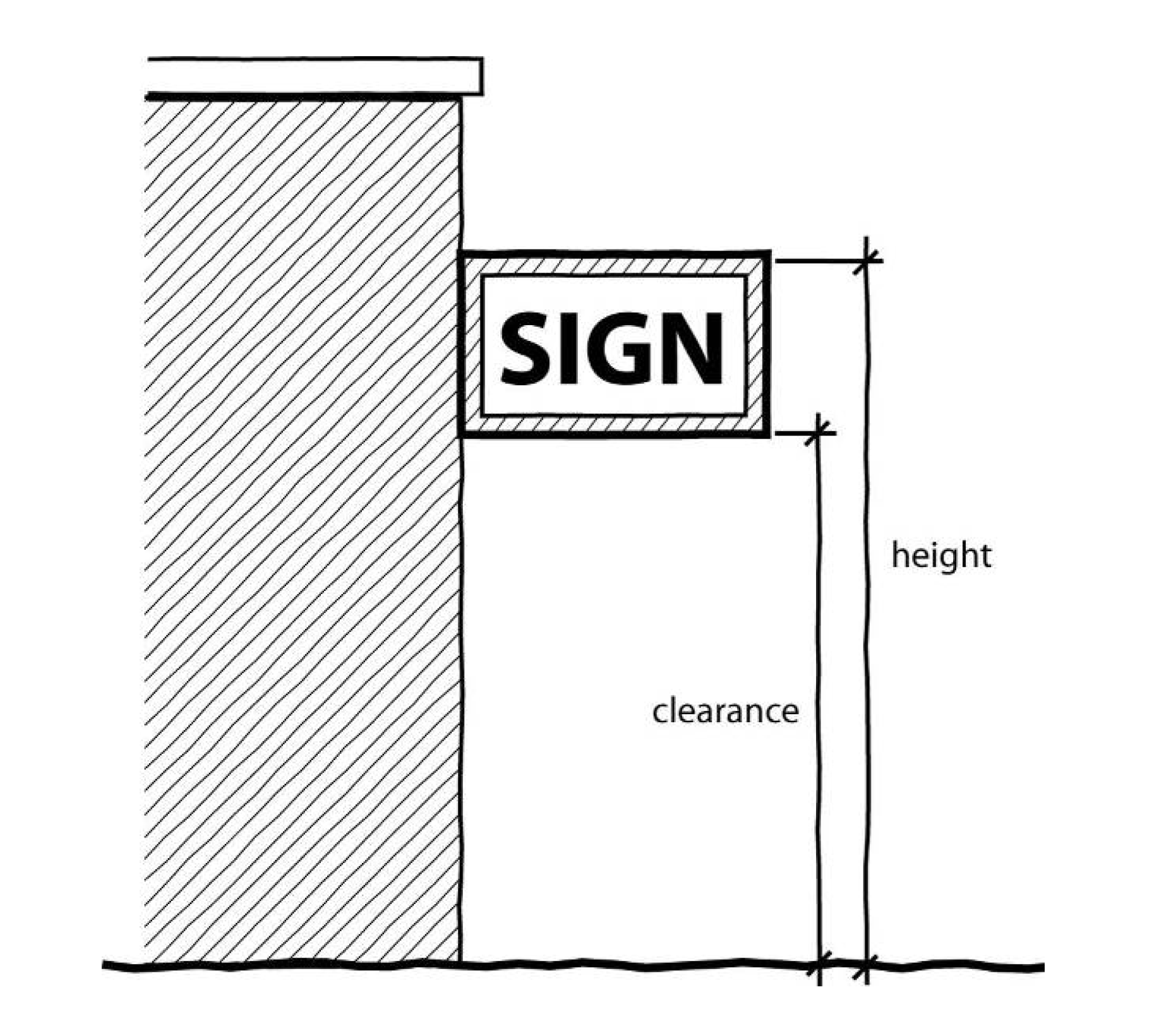
Sign height measurement. The height of a sign will be computed as the distance from the highest point of the sign structure to the lowest point on the ground directly below the sign.
(c)
Building façade area measurement. Building façade area includes the entire area of a building wall, including doors, windows, recessed and projecting areas, and all other features, measured from the ground to the top of the roof, including architectural features.
(d)
Determination of visibility or legibility.
(1)
Where this chapter requires a determination of "visibility" or "legibility," the standard will be based on the eyesight of an adult eligible to receive a Missouri driver's license (wearing any corrective lenses required by the license). Where the height of the person is material to the determination, the person will be presumed to be more than five feet and less than six feet tall.
(2)
In determining visibility of a sign from a residential property, it will be assumed that a two-story residence will occupy the property with second-story windows facing toward the sign.
(e)
Sign face separation. For the purposes of computing sign area, a single sign becomes two signs if there is an angle created between the two outer surfaces of the sign greater than 45 degrees.
(UDC 2010, § 18.7; Ord. No. 2022-4741, § 4, 9-27-2022)
Sec. 30-8. - Standards of general applicability.
(a)
Materials and construction.
(1)
Except as otherwise expressly stated in this chapter, all permanent signs, sign structures and non-structural trim must be constructed of approved combustible or non-combustible materials.
(2)
All permanent signs shall be well constructed of permanent materials and shall be constructed with similar materials as used in buildings on the site.
(3)
All signs shall be maintained:
a.
In good structural condition;
b.
In compliance with all building and electrical codes; and
c.
In conformance with this chapter at all times.
(4)
Letters, figures, characters or representations in cutout or irregular form maintained in conjunction with, attached to or superimposed upon any sign must be safely and securely built or attached to the sign structure.
(5)
Illuminated signs produced in quantity (as opposed to signs custom-built for specific locations) must be constructed in accordance with the "Standards for Electric Signs" (U.L. 48) of the Underwriters' Laboratories, Inc.
(6)
All electrical signs, either temporary or permanent, must be connected to permanent electrical service installed according to the requirements of the electrical code. All wiring for newly constructed detached signs must be underground. Temporary signs may be exempted from this underground wiring requirement by the building official.
(7)
Any sign, other advertising structure, marquee, canopy or awning as defined in this chapter must be designed and constructed to withstand a wind pressure of not less than 25 pounds per square foot of net surface area; and must be constructed to receive dead loads as required in the building code and/or other city ordinances.
(8)
Any sign drawing submitted with a sign permit application for a monument or projecting sign shall include the signature and seal of the design professional.
(b)
Illumination. Illumination of signs is permitted only as specified in this Code.
(c)
Obstructions.
(1)
All signs must comply with the intersection visibility standards.
(2)
No sign may interfere with, block or obstruct:
a.
Any vehicular entrance or exit to a parking lot;
b.
Any vehicular accessway;
c.
Any parking space; or
d.
Any pedestrian sidewalk, path or crosswalk.
(d)
Landscaping. All monument signs for new developments must be landscaped with shrubs, perennial and annual flowers, or ground cover (non-turf-grasses) plants. The landscaping area must be a minimum of three feet wide on all sides of the monument base.
(e)
Non-commercial messages. Any sign allowed under this chapter may contain, in lieu of any other message or copy, any lawful noncommercial message, so long as the sign complies with the size, height and other requirements of this chapter.
(f)
Master signage plan. A master signage plan shall be submitted with a final development plan application for new developments in which signage is proposed. The signage plan should generally depict location and design of freestanding, building-mounted, and incidental signs. The actual tenant name does not need to be identified on the signage plan.
(g)
Sign types permitted. Signs are permitted in each zoning district as follows:
(h)
Premises. The property, principal structure, or portion of a principal structure and its appurtenances that are associated with a principal use. The Director may expand the definition of premises to include multiple properties when:
(1)
A sign permit application is submitted:
a.
By the property or homeowners' association or similar in control of the expanded definition of premises; or
b.
With the written consent of all property owners that own property within the expanded definition of premises;
(2)
All properties are either contiguous or located within the same development;
(3)
No sign shall be permitted larger than the original definition of premises would allow;
(4)
Messages that are off-premises according to the original definition of premises may only be displayed on a monument sign; and
(5)
One of the following occurs:
a.
Common ownership or management of the properties;
b.
A shared parking agreement, cross-access easement, or sign easement is recorded at the county; or
c.
Common architectural features, colors, or building materials.
(UDC 2010, § 18.8; Ord. No. 2011-3749, § 1, 9-27-2011; Ord. No. 2022-4741, § 4, 9-27-2022; Ord. No. 2023-4751, § 6, 1-10-2023; Ord. No. 2024-4828, § 2(Exh. B), 1-23-2024)
Sec. 30-9. - Additional standards for specific sign types.
(a)
Wall signs. A wall sign that is attached to a masonry wall shall be secured by means of anchors, bolts and expansion screws, masonry nails or similar connectors. A wall sign that is attached to a wall of wood may be anchored with wood blocks and screws. A canopy sign shall be considered a wall sign, provided it does not project above the height of the façade on which it is located.
(b)
Projecting signs.
(1)
Projecting signs may not project more than 5½ feet beyond the face of the building.
(2)
Projecting signs must be a minimum of eight feet above the level of any sidewalk from the bottom of the sign.
(3)
Any projecting sign within 25 feet of a street or alley intersection must be a minimum of 14 feet above the sidewalk from the bottom of the sign.
(c)
Under canopy signs. Under canopy signs of greater than four square feet must be rigidly mounted, and there must be eight feet of clearance between the base of any under canopy sign and the sidewalk.
(d)
Freestanding signs.
(1)
All permanent freestanding signs must be monument signs supported with a base that is at least 80 percent of the width of the sign at its widest point.
(2)
Permanent freestanding signs are not permitted within any utility or drainage easement.
(3)
Signs shall be set back a minimum of ten feet from all property lines.
(e)
Off-premises signs.
(1)
Special use permit required. In addition to complying with the terms of this article, a special use permit must be obtained in accordance with the procedures set forth in section 40-2 of the Unified Development Code prior to the erection of an off-premises sign.
(2)
Placement of off-premises signs.
a.
Off-premises signs shall be located on private property;
b.
Off-premises signs shall be permitted only along interstate highways and U.S. 71-Highway, within 600 feet of the nearest edge of the right-of-way;
c.
An off-premises sign shall not be located closer than 500 feet of a freestanding sign or closer than 2,000 feet apart, per roadway side, and all off-premises signs must comply with the Missouri Department of Transportation (MoDOT) setback regulations;
d.
Off-premises signs shall not be located adjacent to or within 1,500 feet of any interchange, intersection at grade, or safety rest area that is existing or approved for construction;
e.
To preserve adjoining property values and avoid adverse aesthetic impacts, off-premises signs shall not be located within 1,500 feet of land zoned for residential purposes; and
f.
Off-premises signs shall be permitted only in areas zoned C-2, M-1, and M-2.
(3)
Lighting.
a.
Off-premises signs shall not include any revolving or rotating beams or beacons of light;
b.
Off-premises signs shall not include any flashing, intermittent or moving light or lights, except electronic message boards designating public service information such as time, date, temperature or similar information;
c.
Off-premises signs may be lighted by external lighting such as floodlights, thin line and gooseneck reflectors, provided the light source is directed upon the face of the off-premises sign and is effectively shielded so as to prevent beams or rays of light from being directed into any portion of the main traveled way of the interstate or highway or into any portion of adjacent properties and the lights are not an intensity so as to cause glare, impair the vision of the driver of a motor-vehicle, or otherwise interfere with a driver's operation of a motor vehicle;
d.
Off-premises signs shall not be illuminated so that they interfere with the effectiveness of, or obscure an official traffic sign, device or signal; and
e.
Off-premises signs shall not have a maximum average lighting intensity level that exceeds 20 foot-candles.
(4)
Size. Off-premises signs shall not exceed a maximum area for any one sign of 1,200 square feet with a maximum height of 30 feet and a maximum length of 60 feet, inclusive of border and trim but excluding the base or apron, supports and other structural members. The maximum size limitations shall apply to each side of a sign structure, and signs may be placed back-to-back, double-faced, or in a v-type construction with not more than two displays to each facing, but the sign structure shall be considered as one sign.
(5)
Setback and height of off-premises signs.
a.
To provide a safety zone to prevent injury or property damage from collapse caused by acts of nature or other causes, off-premises signs shall meet the following minimum setback requirements from all points of the sign:
1.
At least 90 feet from its nearest edge to the rights-of-way of any interstate or primary highway;
2.
At least 90 feet from all property lines and all roofed structures; and
3.
At least 90 feet from any other structure that would require a building permit for its construction.
(f)
Subdivision entrance signs. Subdivision entrance signs may be located at entrances to the subdivision and shall be within a sign easement, common area, or private property. The developer or property owners association is responsible for the maintenance and upkeep of the identification signs. Location of signs shall be subject to the provisions of this Code as well as other applicable ordinances. Such signs shall be monument signs.
(1)
Residential subdivision signs. Residential subdivisions are allowed one subdivision entrance monument sign per street, limited to 32 square feet of sign face area and six feet in height, or as approved by the planning commission with a final development plan. Monument signs must be supported with a base that is at least 80 percent of the width of the sign at its widest point. Pole and pedestal signs are prohibited. Internal subdivision amenity or directional signs are limited to six square feet in area. No signs are permitted in the sight triangle.
(2)
Materials. All subdivision monument signs shall have a masonry or concrete substructure with surfaces consisting of clay brick, split-face concrete block, stone or stucco. No paint or wood is permitted.
(3)
Lighting. Ground-mounted indirect lighting is permitted, placed five feet from the sign, and shall be directed at the sign only. High intensity lights, such as flood lights, shall not be used to illuminate the sign. Signs shall not be internally illuminated.
(4)
Electrical signs. All electrical signs, either temporary or permanent, shall be connected to permanent electrical service installed according to the requirements of the electrical code for the City of Belton, Missouri. All wiring for new constructed detached signs shall be underground, unless this is determined to be prohibited by the building inspector. Electrical power to the sign is the sole responsibility of the homeowner's association.
(5)
Landscaping. Landscaping is required at the base of the sign at one-half the height of the sign in length and two feet wider than the sign width.
(g)
Incidental signs. Incidental signs are permitted subject to the following limitations:
(1)
Incidental signs used for directing traffic and are subject to the following limitations:
a.
A maximum of two signs may be permitted per driveway from a public or private street;
b.
Shall not exceed nine square feet in area or three feet in height; and
c.
Exceptions to the maximum number, size, and location of signs may be approved by the planning commission with a final development plan.
(2)
Incidental signs used for ordering products, such as drive-thru menu boards, are limited to two signs per drive-thru lane. No sign shall exceed 32 square feet with a cumulative maximum total of 48 square feet per drive-thru lane. No sign shall exceed eight feet in height.
(3)
All other incidental signs must be wall signs and shall not exceed nine square feet in area.
(h)
Electronic message center signs. Electronic message center signs are permitted subject to review by special use permit.
(1)
Electronic message center signs are not allowed as part of a temporary sign.
(2)
Any portion of the message or image must have a minimum duration on screen of eight seconds. An exception to this requirement is made for a sign that displays time and temperature.
(3)
The change from one message to the next shall not take more than one second and shall not involve flashing or movement of text or images.
(4)
In case of malfunction, the sign display shall be defaulted to a blank screen.
(5)
Prior to the issuance of a sign permit, the applicant shall provide written certification from the sign manufacturer that the light intensity has been factory pre-set not to exceed 7,000 NITS during daylight hours and 2,500 NITS between dusk and dawn and that the intensity level is protected from end-user manipulation.
(6)
The sign shall not display light of such intensity or brilliance to cause glare or otherwise impair the vision of the driver, or result in a nuisance to the driver.
(i)
Temporary signs.
(1)
General.
a.
The following signs may be installed as temporary signs:
1.
Real estate.
2.
Real estate directional.
3.
Construction.
4.
Political.
5.
Public event.
6.
Private event.
7.
Sidewalk sign.
8.
Garage sale.
9.
Peddler's.
10.
Vehicle.
11.
Grand opening event.
12.
Inflatable signs.
b.
All other temporary signs not listed above shall be considered a commercial temporary sign.
c.
Temporary signs may be installed as a freestanding sign or a wall sign.
(2)
Permits.
a.
A temporary sign permit and applicable fee is required prior to the placement of any inflatable sign and commercial temporary signs.
b.
Except as otherwise provided by this chapter, a maximum of four temporary sign permits will be issued per establishment per calendar year, for a maximum of 30 days each.
(3)
Size. Except as specifically provided elsewhere in this chapter, no temporary sign shall exceed six feet in height or 32 square feet in area, except a temporary feather flag sign may be a maximum of 12 feet in height.
(4)
Location. Temporary signs must be located entirely on private property. Except as specifically otherwise provided elsewhere in this section, all temporary signs must be located on the premises where the advertised goods, service or event is available.
(5)
Number. Except as specifically otherwise provided elsewhere in this section, only one temporary sign is permitted per business at any one time.
(j)
Real estate signs.
(1)
Real estate signs offering a property for sale or lease may be erected on private property subject to the following limitations:
a.
Sign must be located on the property for sale/lease.
b.
Only one sign is permitted per street frontage, except multi-family developments on a single lot or common tract may be permitted up to three signs per street frontage.
c.
Sign may be erected or installed on a property in addition to any other sign permitted by this chapter.
d.
Sign shall be removed if the property is no longer offered for sale or lease.
(2)
Real estate directional signs directing traffic to a property are subject to the following limitations:
a.
Sign may not be installed until 5:00 p.m. on Friday and must be removed by 8:00 a.m. on the following Monday.
b.
Permission from the property owner upon whose property the sign is erected or installed must be obtained.
c.
Only one sign is permitted per property directing traffic to another property.
d.
Maximum size permitted is six square feet; maximum height permitted is four feet.
e.
Signs shall not be illuminated.
(k)
Construction signs. Construction signs may be erected on private property subject to the following limitations:
(1)
No limit on the number of signs permitted.
(2)
No sign shall exceed 32 square feet in area or ten feet in height.
(3)
All signs shall be removed prior to the issuance of a certificate of occupancy.
(4)
Signs for property development shall be removed prior to the acceptance of any public improvements.
(5)
Permitted construction signs may be erected or installed on a property in addition to any other sign permitted by this chapter.
(l)
Political signs. Political signs may be erected on private property as follows:
(1)
One political sign per candidate or ballot issue is permitted per street frontage on a lot with permission of the property owner.
(2)
The maximum size of any political sign shall be 32 square feet in a commercial or industrial zoning district.
(3)
The maximum size of any political sign shall be six square feet in a residential zoning district.
(4)
No political sign shall be installed within the right-of-way.
(m)
Temporary public event signs. Temporary signs for special events for public purpose, charitable, religious, not-for-profit athletic associations or fraternal organizations, including fireworks tents, are permitted, subject to the following limitations:
(1)
A maximum of 18 signs with a maximum size of six square feet are allowed per event (maximum sign size for the property on which the event is taking place shall be 32 square feet.)
(2)
No more than six signs may be placed on a single parcel of land.
(3)
No public event sign shall be located within the right-of-way.
(4)
Such signs may not be placed earlier than 14 days prior to the event and must be removed within three days of the event.
(5)
Off-premises signs are permitted with owner's consent.
(n)
Temporary private event signs. Temporary signs such as garage sale signs, directional signs for private engagements, etc., shall:
(1)
Not exceed two feet in height by three feet in width.
(2)
Not be placed more than 24 hours prior to the date of the event.
(3)
Be removed immediately following the sale or event.
(4)
A maximum of four signs.
(5)
Off-premises signs are permitted with owners consent.
(6)
No sign shall be located in the right-of-way.
(o)
Sidewalk signs.
(1)
Sidewalk signs may be permitted on the public sidewalk of businesses with Main Street frontage, subject to the following:
a.
One sign is permitted per building entrance with a maximum of six square feet and shall convey a commercial message relevant to the business;
b.
The sign shall only be displayed on the sidewalk during hours in which the business is open to the public. The sign shall be removed from the sidewalk during all non-business hours.
c.
All minimum required pedestrian access shall remain clear of encroachments.
d.
The sign may be subject to removal or confiscation if it does not adhere to the above requirements.
(p)
Inflatable signs. Inflatable signs are only permitted upon approval of an inflatable sign permit per section 30-10.
(q)
Illumination of signs.
(1)
Signs may be illuminated as permitted in this Code and other provisions of this chapter. The lighting for any sign that would be visible from any residentially zoned property shall be designed so that no direct glare from any light source is focused, beamed or directed at such property.
(2)
Flashing lights, rapidly changing or intermittent-type illumination, rotating beams, or illumination resembling emergency lights is prohibited for the illumination of signs.
(3)
The electric wiring for all illuminated signs must be located underground.
(4)
An electrical permit shall be obtained for any illuminated sign.
(r)
Murals. Murals may be painted on walls, fences or structures in non-residential zoning districts, provided the design is permitted by the property owner and subject to approval of a sign permit:
(1)
Murals deemed advertising signs or billboards are not permitted. However, an original design or representation which contains limited references to the establishment, product, or service provided on the site may be permitted.
(2)
Murals shall not imitate or appear to imitate any official traffic sign or device which appears to regulate or direct the movement of traffic or which interferes with the proper operation of any traffic sign or signal, or which obstructs or physically interferes with a motor vehicle operator's view of approaching, merging, or intersecting traffic.
(3)
Murals shall not contain vulgar, obscene or offensive material, including offensive material of a sexual nature. This includes material that when taken as a whole:
a.
Applying contemporary community standards, its predominant appeal is to prurient interest in sex; and
b.
The average person, applying contemporary community standards, would find the material depicts or describes sexual conduct in a way patently offensive way; and
c.
A reasonable person would find the material lacks serious literary, artistic, political or scientific value.
(4)
Murals shall be kept in good condition and preserved in the manner in which they were originally created.
(s)
Grand opening event signs. Additional signage for businesses to utilize during their initial opening to the public to promote their business are subject to the following limitations:
(1)
All signage must be placed on the premises of the business;
(2)
Signage is limited to a maximum of 60 consecutive days, beginning on the date of the opening of the business. Opening of the business shall be defined as the date the business is open to the general public, or in the case of businesses not open to the general public, the date on which a business license was issued. Businesses without a premises or in which a business license is not required are not permitted an exception for the additional signage allowed for a grand opening event; and
(3)
A total of six temporary signs may be issued for a grand opening event. Signs are limited to banners and feather flags. Permitting, size, and location requirements are subject to the temporary sign requirements of section 30-9 (i). An inflatable sign permit may be issued for a grand opening event with an inflatable sign permit (an inflatable sign will be counted as four temporary signs) for a maximum of 30 days; and
(4)
The exception for additional signage for a grand opening event shall only be used once per business per premises. The following shall not qualify for additional temporary signage: changes in ownership, management, or business name, or remodeling, renovation, or expansion to the building or premises.
(t)
Window signs. Signs attached or applied directly onto the exterior surface of a transparent window or door are subject to the following standards:
(1)
Signs are limited to transparent windows and doors located on the first and second stories of a building in non-residential zoning districts. Window signs are not permitted in residential zoning districts.
(2)
Window signs shall not cover more than 50 percent of the total area of transparent windows and doors on each façade. Window signs are not subject to the maximum façade coverage applied to wall signs.
(3)
Window signs shall consist of semi-permanent materials, such as decals, stickers, or similar signs, and are subject to the maintenance requirements of this section. Signs not meeting the maintenance requirements shall be removed.
(UDC 2010, § 18.9; Ord. No. 2008-3448, 4-22-2008; Ord. No. 2012-3850, § 1, 10-23-2012; Ord. No. 2021-4604, §§ 4—6, 1-12-2021; Ord. No. 2022-4741, § 4, 9-27-2022; Ord. No. 2023-4751, § 7, 1-10-2023; Ord. No. 2024-4828, § 2(Exh. B), 1-23-2024)
Sec. 30-10. - Inflatable sign permit.
In order to install an inflatable sign, an application shall be filed for an inflatable sign permit.
(1)
Applications. An application for an inflatable sign permit may be obtained from the community development director.
(2)
Review. Factors to consider when reviewing an application for an inflatable sign permit include:
a.
Proximity to other inflatable signs;
b.
Size and height of inflatable sign (maximum height is ten feet);
c.
Proposed location upon the property;
d.
Length of time requested to display the inflatable sign (maximum 30 days);
e.
Compliance with city requirements on any previous inflatable sign;
f.
Permit or temporary sign permit issued; and
g.
Any other reasonable factor or condition related to the public health, safety and general welfare.
(3)
Conditions of approval. In approving an inflatable sign permit, the community development director may impose reasonable conditions, safeguards and restrictions upon the applicant.
(UDC 2010, § 18.10; Ord. No. 2022-4741, § 4, 9-27-2022; Ord. No. 2024-4828, § 2(Exh. B), 1-23-2024)
Sec. 30-11. - Maintenance, abandonment, and removal of signs.
(a)
Maintenance of all signage.
(1)
All signs, together with all their supports, braces, guys and anchors, must be kept in good repair and shall maintain a clean appearance and be in a safe condition.
(2)
Any sign that is broken, has peeling paint, intermittent lighting, visible rust, or is not maintained in an upright and plumb fashion shall be subject to the enforcement provisions of chapter 2 of this Code.
(b)
Maintenance and required compliance of existing legal non-conforming signs.
(1)
All existing legal non-conforming signs may continue in use according to the plans and terms approved by its valid sign permit and further limited to the following:
a.
General repairs and maintenance, including repainting, electrical repairs, and light repair or replacement; and
b.
Changes of sign face, panels, or message that neither alters, enlarges, expands, or increases the sign structure nor adds any feature to the sign that did not previously exist, such as illumination or an electronic message center.
(2)
When there is a request to obtain a sign permit to alter, enlarge, expand, or increase the sign structure or add any feature to the sign that did not previously exist, such as illumination or electronic message center, the sign permit may be approved, and the sign shall keep its legal non-conforming status when the request:
a.
Meets the placement standards; and
b.
Does not alter any feature of the existing sign, except it may bring the sign closer to conformance by reducing both of the following non-conformities, as applicable:
1.
Height. The height of the sign shall be reduced by no less than one-half the height above the maximum allowed height (e.g. a 12 foot pole sign on a property only allowed a six foot tall monument sign may be reduced to a nine foot pole sign); and
2.
Sign area. The sign area of the sign shall be reduced by no less than one-half the sign area above the maximum (e.g. a 64 square foot sign with a 32 square foot maximum sign area may be reduced to 48 square feet).
(c)
Removal of abandoned signs.
(1)
After any business has abandoned its location or tenant space, the owner, agent or person having beneficial use of the building, structure or lot where such business was located shall remove all signs relating to such business within 90 days of the premises being vacated by the business.
(2)
Any sign that provides notice of a temporary public or private event or any other temporary purpose that has occurred in the past shall be deemed to have been abandoned.
(3)
Abandoned signage shall be subject to the enforcement provisions of chapter 2 of this Code.
(d)
Removal of existing legal non-conforming signs.
(1)
Any existing sign shall lose its legal non-conforming status and be immediately brought into compliance with this Code or removed if any of the following conditions occur:
a.
When the sign becomes damaged to the extent of 50 percent or more of its structural value prior to such damage, regardless of the cause of the damage;
b.
When the sign becomes an imminent danger to public safety;
c.
When there is a request to obtain a building permit to make improvements to 25 percent or more of the façade on which the sign is located;
d.
When there is a request to obtain a building permit to construct a building addition that increases the existing building area by 25 percent or more on the property on which the sign is located; or
e.
When a period of 90 consecutive days elapses after the premises on which the sign is located has been deemed a vacant premise.
f.
When a period of 90 consecutive days elapses after a legal non-conforming sign conveys either no message (i.e., a blank sign or empty cabinet) or a message that is no longer pertinent (e.g., reference to a business that no longer exists on the premises).
(2)
Removal of signage that loses its legal non-conforming status shall be subject to the enforcement provisions of chapter 2 of this Code.
(e)
Removal of illegal signs.
(1)
Illegal signs include the following:
a.
Prohibited signs per section 30-6 of this chapter; and
b.
Signs installed without a permit per section 30-3.
(2)
Illegal signs shall be subject to the enforcement provisions of chapter 2 of this Code.
(Ord. No. 2022-4741, § 4, 9-27-2022)

