
Coppell City Zoning Code
ARTICLE 29
- SIGN REGULATIONS
Sec. 12-29-0.- Purpose.
Signs use private land and the sight lines created by the public right-of-way to inform and persuade the general public by publishing a message. This section provides standards for the erection and maintenance of private signs. All private signs not exempted shall be erected and maintained in accordance with these standards. The general objectives of these standards are to promote health, safety, welfare, convenience and enjoyment of the public, and in part to achieve the following:
1.
Safety: To promote the safety of persons and property by providing signs that:
(A)
Do not create a hazard due to collapse, fire, collision, decay or abandonment;
(B)
Do not obstruct fire fighting or police surveillance; and
(C)
Do not create traffic hazards by confusing or distracting motorists, or by impairing the driver's ability to see pedestrians, obstacles, or other vehicles, or to read traffic signs.
2.
Communications efficiency: To promote the efficient transfer of information in sign messages by providing that:
(A)
Those signs which provide messages and information most needed and sought by the public are given priorities.
(B)
Businesses and services may identify themselves.
(C)
Customers and other persons may locate a business or service.
(D)
No person or group is arbitrarily denied the use of the sight lines from the public right-of-way for communication purposes.
(E)
Persons exposed to signs are not overwhelmed by the number of messages presented, and are able to exercise freedom of choice to observe or ignore said messages, according to the observer's purpose.
3.
Landscape quality and preservation: To protect the public welfare and to enhance the appearance and economic value of the landscape, by providing that signs:
(A)
Do not interfere with scenic views;
(B)
Do not create a nuisance to persons using the public right-of-way;
(C)
Do not create a nuisance to occupancy of adjacent and contiguous property by their brightness, size, height or movement; and
(D)
Are not detrimental to land or property values.
(Ord. No. 91500-A-129)
Sec. 12-29-1. - Definitions.
Unless the context clearly indicates otherwise, the following words and phrases shall have meanings respectively ascribed to them by this section. Where terms are not defined, they shall have their ordinary accepted meanings within the context with which they are used. Webster's Third New International Dictionary of the English Language, Unabridged, copyright 1981, shall be considered as providing ordinarily accepted meanings.
Building: means a structure which has a roof supported by columns, walls or air for the shelter, support, or enclosure of persons, animals or chattel.
Effective area, attached sign: means the sum of the areas of the minimum imaginary rectangles of vertical and horizontal lines enclosing each word attached to any particular facade. Effective area shall also be referred to as size. If a design, outline, illustration, or interior illumination surrounds or attracts attention to a word, then it is included in the calculation of effective area. (See Appendix Illustration 16)
Effective area, detached (monument) sign: means the area within an imaginary rectangle of horizontal and vertical lines that fully contain all extremities of the sign location above the ground including the sign base. The measurement is to be calculated from a viewpoint which gives the largest rectangle of that kind. The effective area shall also be referred to as size. If elements of the sign are movable or flexible, such as a flag or string of lights, the measurement is taken when the elements are fully extended and parallel to the plane of view. (See Appendix Illustration 16)
Facade: means any separate face of a building, including parapet walls and omitted wall line, or any part of a building which encloses or covers usable space. Where separate faces are oriented in the same direction, or in the directions with 45 degrees of one another, they are to be considered as a part of a single facade.
Front facade: means one of the following:
(A)
The facade (as defined herein) which faces the public street, where the lot on which the facade is located adjoins only one public street right-of-way;
(B)
The combination of facades (as defined herein) each of which faces a public street, where the lot on which the facades are located adjoins more than one public street right-of-way; or
(C)
The facades (as defined herein) which contain one or more doors open to the public during conduct of business, where no facade faces a public street.
Frontage: means the total width of the front facade, as defined herein.
Graffiti: means any rude or otherwise unauthorized inscription, design, motto, or pictograph, scratched, drawn, painted, or in any way marked on the surface of any wall, fence, rock, escarpment, or any other exposed surface of any public or private property without first having obtained permission from the owner of such property.
Logo. Means a graphic emblem or name which has been registered as a trademark or is protected as a common law trademark and used by a business or organization to promote its business or purpose.
Luminous gaseous tubing: means exposed tubes used in or as signs and which contain luminescent inert gases including, but not limited to, neon, argon and krypton.
Model home: means a single-family dwelling structure that is open for inspection by the general public and is not used as a dwelling.
Premises: means a lot or unplatted tract, or a combination of contiguous lots or unplatted tracts if the lot or tract, or combination thereof is under single ownership that is reflected in the plat records of the city.
Premises, dwelling: means a lot zoned SF, TH, or 2F that is occupied by a residential housing structure.
Public right-of-way: means a dedicated road or street including the easement for that road or street.
Sign: means any device, flag, banner, light, figure, picture, letter, word, message, symbol, plaque, poster, display, design, painting, drawing, billboard, wind device or other thing visible from outside the premises on which it is located and that is designed, intended or used to inform, to advertise or to attract the attention of persons not on those premises.
Signs, attached: means any sign attached to, applied on, or supported by, any part of a building (such as a wall, window, awning, arcade, or marquee) which encloses or covers usable space, with the exception of any window sign as defined herein.
Sign, banner: means a sign which is not permanently affixed.
Sign, blade: means a small sign less than ten square feet, which is suspended from an overhang, canopy or awning, or is suspended from a mounting attached directly to the building wall, and hangs perpendicular to the building wall.
Sign, can: means a sign constructed of a frame, usually steel, surrounded by sheet goods, usually sheet metal and/or plastic, within which light fixtures may be placed.
Sign, detached: means any sign connected to the ground that is not an attached, portable or vehicle sign.
Sign, monument: means any detached sign which is of monolithic or semi-monolithic construction being made from masonry, concrete materials, wood or plastic provided that a masonry base is incorporated into the sign, with no separation between the base of the sign and grade. (See Appendix Illustration 17)
Sign, movement control: means a sign which directs vehicular or pedestrian movement within or onto the premises on which the movement control sign is located.
Sign, off-premise: means a sign displaying advertising copy that pertains to a business, person, organization, activity, event, place, service, or product not principally located or primarily manufactured or sold on the premises on which the sign is located.
Sign, pole: means any detached sign which is not a monument sign.
Sign, political: means any type of sign which refers only to the issues or candidates involved in a political election.
Sign, portable: means a sign that is not securely connected to the ground in such a way that it cannot easily be moved from one location to another, and that is not an attached sign, vehicular sign, or a sign that refers solely to the sale or lease of the premises.
Sign, premise: means a sign identifying or advertising a business, person, or activity, and installed and maintained on the same premises as the business, person or activity.
Sign, protective: means any sign which is commonly associated with safeguarding the permitted uses of the occupancy, including, but not limited to, "bad dog," "no trespassing," and "no solicitors."
Sign, pylon: means a freestanding sign supported by two vertical pole supports encased in brick, stone or other appropriate materials.
Sign, subdivision: means a sign that identifies the name of the subdivision only.
Sign support: means any pole, post, strut, cable, or other structural fixture or framework necessary to hold and secure a sign, providing that said fixture or framework is not imprinted with any picture, symbol or word using characters in excess of one inch in height, nor is internally or decoratively illuminated.
Sign, vehicular: means any sign on a vehicle moving along the ground or on any vehicle parked temporarily, incidental to its principal use for transportation. This definition shall not include signs which are being transported to a site of permanent erection.
Sign, window: means any sign not government mandated, which is attached to either side of the glass within a window or which is located within a window opening and, as viewed from outside, is forward of the plane of the inside face of an exterior wall.
Zoning district, business: means any zoning district designated by this ordinance as O, R, C, TC, HC, or LI. Any PD district with the previous listed zoning prefix is also included in this list, unless specifically excluded by this provision.
Zoning district, non-business: means any zoning district not designated as a business district as defined herein.
(Ord. No. 91500-A-129; Ord. No. 91500-A-321, § 1, 4-9-02; Ord. No. 91500-A-606, § 1, 12-11-12; Ord. No. 2014-1380, § 3, 7-8-14; Ord. No. 2022-1580, § 1, 7-12-22)
Sec. 12-29-2. - Permit procedures and fees.
1.
Permits: No person shall erect, construct, relocate, alter, or repair a sign without first having obtained a permit, except as otherwise provided in this section. This section does not apply to government signs.
2.
Application: Application for a permit shall include a drawing to scale of the proposed sign and all existing signs maintained on the premises and visible from the right-of-way, a drawing of the lot plan or building facade indicating the proposed location of the sign, and the sign specifications.
3.
Fees: Every applicant, before being granted a permit, shall pay the applicable fee established by resolution of the city council.
(A)
It shall be unlawful for any person to repair or make alterations, excluding repainting to restore original color(s), unless the colors are non-conforming, to any sign requiring a permit without first obtaining a repair permit and payment of the required fee.
(B)
Any person who erects, places, alters, repairs or relocates a sign, or commences work thereon, without first having obtained a permit, shall pay a late fee equal to twice the amount of the applicable sign permit fee.
(C)
A permit for a sign, shall expire if the work is not commenced within 45 days from the date of issuance of such permit, or if work authorized by such permit is suspended or abandoned at any time after work is commenced for a period of 45 days.
4.
Electrical permit: Prior to issuance of a sign permit for a sign in which electrical wiring and connections are required, an electrical permit must be obtained from the city. The electrical inspector shall examine the plans and specifications submitted with the application to ensure compliance with the electrical code of the city. No sign shall be erected, repaired or altered in violation of the electrical code.
(Ord. No. 91500-A-129; Ord. No. 91500-A-321, § 6, 4-9-02)
Sec. 12-29-3. - Provisions for all zoning districts.
1.
Imitation of traffic and emergency signs prohibited: No person shall cause to be erected or maintained any sign using any combination of forms, words, colors, or lights, which imitate standard public traffic regulatory, emergency signs, or signals.
2.
Special purpose signs:
(A)
Movement control signs: Movement control signs may be erected at any occupancy or any premises, other than single-family or duplex premises, may be attached or detached, and may be erected without limits as to number; provided that such signs shall comply with all other applicable requirements of this section. Movement control signs shall be premise signs only and shall not be construed as any sign listed in sections 12-29-4 or 12-29-5. The occupant who erects a movement control sign on the premises shall comply with the following requirements:
i.
Each sign must not exceed three square feet in effective area;
ii.
If a sign is an attached sign, the words must not exceed six inches in height;
iii.
Each sign must convey a message which directs vehicular or pedestrian movement within or onto the premises on which the sign is located;
iv.
The signs must contain no advertising identification message unless it is a logo, then the logo may cover ten percent of the sign.
(B)
Protective signs: The occupant may erect not more than two protective signs on the premises, in accordance with the following:
i.
Each sign must not exceed two square feet in effective area;
ii.
Detached signs must not exceed two feet in height;
iii.
Letters must not exceed four inches in height.
(C)
Vehicular signs: Vehicular signs shall:
i.
Contain no flashing or moving elements;
ii.
Not project beyond the surface of a vehicle; and
iii.
Not be attached to a vehicle so that the driver's vision is obstructed from any angle.
(D)
Government signs: Signs which are legally required or necessary to the essential functions of government agencies, such as flags, insignia, legal notices, or informational, directional, or traffic signs, shall be exempt from the provisions of this section.
(E)
Holiday lights and decorations: Temporary lights and holiday decorations shall be exempt from the provisions of this section.
3.
Prohibited signs: The following types of signs are specifically prohibited.
(A)
Portable signs.
(B)
Balloons, streamers, bunting, banners, flags, flag poles, pole signs or signs that contain moving parts unless otherwise specifically allowed by this section.
(C)
Signs erected in violation of the building or electrical code of the city.
(D)
Signs attached to or maintained upon any tree or public utility pole or structure.
(E)
Signs attached to or painted on the outside of a fence, railing or wall that is not a structural part of a building.
(F)
Signs attached to or painted on any sidewalk, curb, gutter, or street (except house address numbers).
(G)
Signs illuminated to an intensity to cause glare or brightness to a degree that could constitute a hazard or nuisance.
(H)
Signs that move, flash light intermittently, change color or revolve unless specifically allowed by this section.
(I)
Off-premise signs except otherwise allowed under Chapter 6, Article 6-15, of the Code of Ordinances.
(J)
Signs erected in the public right-of-way except as otherwise allowed in Chapter 6, Article 6-15, of the Code of Ordinances.
(K)
Signs attached to a vehicle advertising the sale of the vehicle where the vehicle is parked in such a way that the sign attracts the attention of or informs persons using the public right-of-way.
(L)
Luminous gaseous tubing, including within an enclosed building, behind glass and visible outside from the public right-of-way through a window, except "open" signs shall be permitted. "Open" signs shall not include any other wording or advertising and shall not flash, blink, or contain any movement.
(M)
A-framed signs (signs located in the back of a truck or other vehicle).
(N)
Can signs made of plastic or similar translucent materials.
(O)
Signs attached to roofs or canopies.
(P)
Signs which advertise or refer to the sale or consumption of alcoholic beverages by words or symbols.
4.
Flags: All flags shall conform to the following requirements:
(A)
Nothing in this section shall be construed to prevent the display of a national, state or city flag.
(B)
A business may erect one corporate flag and flag pole, per location, for a bonafide company or corporate office located within the city.
5.
Obscenity: No person shall display on any sign any obscene, indecent or immoral matter. Any sign which contains any obscene, indecent or immoral matter shall be removed or the obscene, indecent or immoral matter must be removed within 24 hours of notice.
6.
Obsolete signs: All signs relating to a product no longer available for purchase by the public and all signs relating to a business which has closed or relocated shall be removed or the advertising copy shall be removed. Painted wall signs shall be painted over with a color that resembles or matches the wall and does not allow the sign message to be visible after overpainting. The owner of the property on which the sign is located shall be responsible for removal of the sign within 30 days of obsolescence.
7.
Maintenance of signs: Sign and sign supports shall be maintained in a state of good repair and neat appearance at all times.
8.
Graffiti: Graffiti is specifically prohibited within the city. The owner of property on which graffiti is located shall remove all graffiti with 72 hours of notice.
9.
Monument signs: Monument signs may be indirectly lit for a halo effect.
10.
Address: All address numbers shall be six inches in height.
(Ord. No. 91500-A-129; Ord. No. 91500-A-319, § 4, 3-19-02; Ord. No. 91500-A-321, § 2, 4-9-02; Ord. No. 91500-A-445, § 1, 12-12-06; Ord. No. 91500-A-473, § 1, 8-14-07; Ord. No. 91500-A-494, § 1, 4-8-08; Ord. No. 91500-A-606, § 1, 12-11-12)
Sec. 12-29-4. - Provisions for business zoning districts.
Signs are permitted in any business zoning district subject to the following restrictions.
1.
Signs adjoining non-business district boundaries: Signs which are located within 25 feet of a non-business district boundary shall conform to the requirements of non-business zoning district signs found in section 12-29-5.
2.
Monument signs: Monument signs are permitted in business zoning districts as follows.
(A)
Monument signs must be built on a monument base, as opposed to a pole base, with no separation between the base of the sign and natural grade. A monument sign shall contain only the name, logo, address, product or service of the establishment except as provided herein:
i.
In the case of fuel service stations only, the price per gallon of fuel;
ii.
In the case of governmental, public and private schools and religious organizations only, changeable letters are permitted.
iii.
In the case of multi-tenant office and/or retail buildings, the individual tenant names may be listed subject to:
(a)
All individual tenant name plates must be the uniform size, color and font, in accordance with this ordinance.
(b)
Minimum letter size shall be six inches,
(c)
If a tenant vacates the lease space, the name plate must be removed within 30 days of such vacancy by the monument sign owner, owner of the property where the sign is located, or other party having control over such sign.
No other advertising or promotional information is permitted thereon. Such sign may be single or double faced. Can signs made of plastic or similar materials are not permitted as detached (monument) signs. Backlit plastic is not permitted within detached (monument) signs.
(B)
One monument sign is permitted on the premises as follows:
i.
On sites greater than two acres in area.
Maximum size—60 square feet.
Maximum height—Six feet.
Minimum setbacks:
a.
15 feet from street right-of-way. Where parking perpendicular to the street exists in the front yard, then the monument sign may be located 10 feet from the right-of-way line to allow for additional visibility.
b.
75 feet from property lines other than those property lines fronting the street right-of-way. In the event that the lot is less than 150 feet wide, then the sign must be located at the midpoint of the lot. If the director of planning determines that the sign may not be placed at the midpoint of the lot, the monument sign may be placed anywhere along the frontage but not closer than 20 feet from the side property lines.
ii.
On-sites two acres in area or less.
Maximum size—40 square feet.
Maximum height—Four feet.
Minimum setbacks:
a.
15 feet from street right-of-way. Where parking perpendicular to the street exists in the front yard, then the monument sign may be located 10 feet from the right-of-way line to allow for additional visibility.
b.
75 feet from property lines other than those property lines fronting the street right-of-way. In the event that the lot is less than 150 feet wide, then the sign must be located at the midpoint of the lot. If the director of planning determines that the sign may not be placed at the midpoint of the lot, the monument sign may be placed anywhere along the frontage but not closer than 20 feet from the side property lines.
iii.
In LI districts, one monument sign shall be allowed at each curb entrance with a minimum distance of 125 feet from center to center, on the same lot.
(C)
Two monument signs are permitted on the premises as follows:
i.
Provided that the premises is not a corner lot, two monument signs are permitted on premises greater than two acres in size having frontage on two or more streets, as follows:
Maximum size—40 square feet.
Maximum height—Four feet each.
Minimum setbacks:
a.
15 feet from street right-of-way. Where parking perpendicular to the street exists in the front yard, then the monument sign may be located 10 feet from the right-of-way line to allow for additional visibility.
b.
75 feet from property lines other than those property lines fronting the street right-of-way. In the event that the lot is less than 150 feet wide, then the sign must be located at the midpoint of the lot. If the director of planning determines that the sign may not be placed at the midpoint of the lot, the monument sign may be placed anywhere along the frontage but not closer than 20 feet from the side property lines.
Maximum number of signs—One per street frontage.
Maximum total number—Two.
ii.
Provided that the premises has frontage on more than one street and that the frontage on each street is 500 feet or more, two monument signs are permitted on premises greater than five acres in size as follows:
Maximum size—60 square feet.
Maximum height—Six feet each.
Minimum setbacks:
a.
15 feet from street right-of-way. Where parking perpendicular to the street exists in the front yard, then the monument sign may be located 10 feet from the right-of-way line to allow for additional visibility.
b.
75 feet from property lines other than those property lines fronting the street right-of-way. In the event that the lot is less than 150 feet wide, then the sign must be located at the midpoint of the lot. If the director of planning determines that the sign may not be placed at the midpoint of the lot, the monument sign may be placed anywhere along the frontage but not closer than 20 feet from the side property lines.
Maximum number of signs—One per street frontage.
Maximum total number—Two.
iii.
Provided that the premises is zoned for industrial uses, has frontage on more than one street and that the frontage on each street is 500 feet or more, one monument sign shall be permitted for each ten acres. In any event, no more than one monument sign shall be permitted per building per each adjacent public street with a maximum of two signs per building as follows:
Maximum size—60 square feet.
Maximum height—Six feet each.
Minimum setbacks—15 feet from street right-of-way, 75 feet from property lines, other than those property lines fronting a street right-of-way.
All monument signs within the development shall be constructed of the same material and design.
iv.
A maximum of two Industrial Park identification signs are permitted for master planned industrial parks exceeding 100 acres, as follows:
Maximum size—60 square feet.
Maximum height—Six feet each.
Minimum setbacks—15 feet from street right-of-way, 75 feet from property lines, other than those property lines fronting a street right-of-way.
All monument signs within the development shall be constructed of the same material and design.
(D)
Fuel service stations shall mount price per gallon signs on monument signs only.
3.
Pylon signs: Pylon signs are permitted in the Highway Commercial zoning district as follows.
(A)
One pylon sign, in addition to the allowable monument signage, is permitted for each Conceptual Planned Development fronting on SH 121, Sam Rayburn Tollway or IH 635, as follows:
i.
Maximum size per elevation—800 square feet.
ii.
Maximum height—40 feet.
iii.
Minimum setbacks—15 feet from street right-of-way (measured from the closest point), 75 feet from property lines, other than those property lines fronting a street right-of-way, 200 feet from residentially zoned property.
iv.
Signs shall be located within 50 feet from the street right-of-way (measured from the farthest point).
v.
Signs located within 300 feet from residential districts:
a.
Shall submit a visibility study showing that it is not directly visible from a residence.
b.
May not be illuminated between the hours of 11:00 pm and 7:00 am.
vi.
Pylon signs shall be double sided, shall have a minimum 10-foot masonry (brick or stone) base and be architecturally compatible with the main building or structures within the development. If monument signs are present or proposed, then the pylon sign shall be of a similar design. The materials shall be of a neutral/earth tone color.
vii.
There shall be a minimum five-foot landscape area around the pylon sign to soften the appearance at ground level.
viii.
The sign structure, if illuminated, shall be from the top downward.
ix.
The illumination source shall be shielded from adjacent properties. No light from the sign shall be above .25 foot candles at the adjacent property line where residentially zoned.
x.
Pylon signs shall be allowed only to include tenant names within the overall development, including those considered off-premises provided that they are within the Conceptual Planned Development.
xi.
Tenant names shall be on dark, neutral color, aluminum panels (no channel lettering). Panel width shall be a minimum size of 24 inches. Text/Logo shall be routed-out from the panel, no less than 16 inches in height and the verbiage shall be white, contrasting in color from the background. There shall be a minimum of a four-inch margin on each panel to create separation between tenant names for better legibility.
xii.
Panels shall be single stacked (not side by side) and illuminated from behind with a white light.
xiii.
The lowest panel shall be a minimum ten feet from the bottom of the sign, measured from grade.
xiv.
No temporary signs may be affixed to the pylon sign.
xv.
A tenant name shall be removed within 90 days and replaced with a blank panel if the tenant is no longer in operation.
Example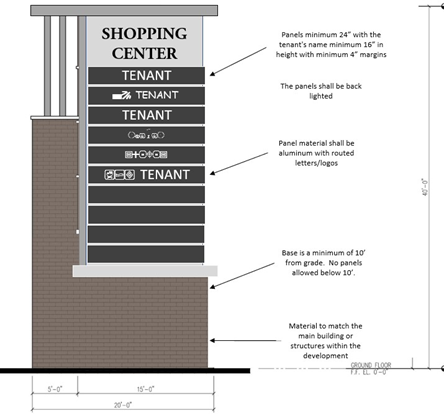
4.
Attached signs: Attached signs are permitted in business areas in accordance with the following provisions:
(A)
Mounting: All signs shall be mounted parallel to the building surface to which they are attached, and shall project no more than 18 inches from that surface. Signs shall not be mounted on or to the roof surface and support members shall not project above the roof.
i.
Attached signs shall consist of individually-mounted channel letters and comply with the following rules:
a.
If the sign consists of a logo only, the logo may cover 100 percent of the sign and use any color.
b.
If the sign only contains words and no logo, the lettering may occupy 100 percent of the sign and must be black, white, ivory, or neutral colors.
c.
If the sign has lettering and a logo, the logo may only cover 20 percent of the sign and the letters must be white, ivory, black or neutral colors.
d.
In the event that a building has existing attached signs of all one color, not compliant with the colors specified herein, then the new sign may either match the color of the existing signs on the building, or be white, ivory, black or neutral. It is the intent of this provision that all tenant signage be the same color in any individual building.
e.
Raceways shall match the color of the materials to which they are mounted.
f.
All illumination shall be limited to white or off white. No illumination shall have exposed bulbs whether they are LED or any other type.
g.
Logos in any color shall be permitted, but shall not exceed 20 percent of the area of the sign. If the logo does not contain any letters, the 20 percent area of the sign limitation does not apply.
h.
Attached signs in areas zoned Light Industrial are exempt from the color and logo size restrictions. Refer to section 12-29- 4.3(D) for additional regulations on attached signs in Industrial zoned areas.
(B)
Effective area: Attached signs shall not exceed the following:
i.
For buildings and leaseholds with one front facade, (front facade being defined as the building surface directly facing a dedicated street, or where street frontage does not exist, it shall be defined as the width of the lease space which contains the main entry), attached signs located at a height of 36 feet or less are permitted a maximum aggregate effective area equal to one-square foot per lineal foot of building or leasehold frontage as applicable, or 300 square feet, whichever is less.
ii.
If a building or business has two or multiple facades that face two public streets, the signs can have an aggregate effective area equal to one square foot per aggregate linear foot of footage on all streets. In no case shall any sign exceed a one square foot per linear foot facade width ratio. The total shall not exceed 300 square feet. The signage may be placed on both facades. A leasehold may not use this provision and the expanded area allowed by subsection IV of this section.
iii.
Attached signs located at a height above 36 feet shall be permitted an increase in maximum effective area. Such increase shall not exceed four square feet of effective area for each additional one foot of height above 36 feet measured from the base of the sign. Such signs may be increased to a maximum effective area of 400 square feet.
iv.
Attached signs for lease spaces less than 5,000 square feet which are in retail buildings whose facade is located greater than 300 feet from a right-of-way in which it fronts, may increase the size of the attached sign up to ten percent over the maximum aggregate effective area as permitted based on the ratio of one-square foot per lineal foot of building or leasehold frontage as applicable. A leasehold may not use this provision and the allowances under Subsection ii. of this section.
(C)
Canopies: Signs shall not be attached to canopies, e.g., gasoline service station canopies.
(D)
Industrial zoned property: Buildings located within an area zoned LI are permitted to have attached signs as follows:
i.
Letter/logo height and effective area:
a.
Horizontal and vertical signs shall not exceed 75 percent of the wall width (or height, if vertical) of such building or store front.
b.
One letter or one logo may be 25 percent taller than maximum letter/logo height.
ii.
Maximum number of signs: One sign per elevation per business. Rear wall signs are prohibited.
5.
Window signs: On any one facade of a building, the aggregate area of window signs shall be limited to ten percent of the aggregate area of all windows within that facade. The outlining of a window on two or more of any sides with lighting, luminescent gaseous tubing, or by any similar means shall constitute 100 percent of the total window area as a sign.
6.
Employees wanted/now hiring signs are allowed but may not exceed ten square feet.
7.
Blade signage: Externally illuminated blade signage shall be allowed in addition to other permitted attached signage and shall not exceed ten square feet in area. An eight-foot clearance is required between a blade sign and finished grade and the sign shall not project more than five feet from the building wall to which it is mounted.
(Ord. No. 91500-A-129; Ord. No. 91500-A-319, § 3, 3-19-02; Ord. No. 91500-A-321, §§ 3, 7, 4-9-02; Ord. No. 91500-A-376, § 1, 5-11-04; Ord. No. 91500-A-388 § 1, 9-14-04; Ord. No. 91500-A-419, § 1, 10-11-05; Ord. No. 91500-A-473, § 1, 8-14-07; Ord. No. 91500-A-494, § 2, 4-8-08; Ord. No. 91500-A-606, § 1, 12-11-12; Ord. No. 2014-1380, § 4, 7-8-14; Ord. No. 2022-1580, § 2, 7-12-22; Ord. No. 91500-A-795, § 1, 8-8-23)
Sec. 12-29-5. - Provisions for non-business zoning districts.
Signs are permitted in any non-business zoning district, and within 25 feet of a non-business zoning district boundary subject to the following restrictions:
1.
Illumination: No sign shall be illuminated in such a manner so as to produce intense glare or direct illumination across any property line.
2.
Monument signs: Churches, model homes, apartments, town homes, schools or government facilities or buildings may have monument signs subject to the following restrictions:
(A)
Number of signs: There shall be no more than one monument sign on the premises, provided however, that where the premises has more than 750 feet of frontage along a public right-of-way, other than an alley, there shall be no more than one additional detached monument sign for each 750 feet of additional frontage. Signs shall be a minimum of 750 feet apart.
(B)
Setback and effective area: A minimum setback of 15 feet from the public right-of-way is required of all monument signs. The minimum setback for a model home sign shall be three feet from the sidewalk. No monument sign shall exceed 36 square feet.
3.
Attached signs: Churches, model homes, apartments, town homes, schools or government facilities or buildings may have one attached sign subject to the following restrictions:
(A)
Mounting: All signs and their words shall be mounted parallel to the building surface to which they are attached and shall not be placed over or attached to pilasters or columns. No sign or word shall project more than 18 inches from that surface. Signs shall not be mounted on or to the roof surface and support members shall not project above the roof.
(B)
Effective area: Attached signs may not exceed 36 square feet in effective area.
(Ord. No. 91500-A-129; Ord. No. 91500-A-321, § 4, 4-9-02; Ord. No. 91500-A-473, § 1, 8-14-07)
Sec. 12-29-6. - Nonconforming signs.
It is the declared purpose of this section that in time all privately owned signs shall either conform to the provisions of this section or be removed. By the passage of this ordinance and its amendments, no presently illegal sign shall be deemed to have been legalized unless such sign complies with all current standards under the terms of this ordinance and all other ordinances of the city. Any sign which does not conform to all provisions of this ordinance shall be either a non-conforming sign if it legally existed as a conforming or nonconforming sign under prior ordinances, or an illegal sign if it did not exist as a conforming or non-conforming sign, as the case may be. It is further the intent and declared purpose of this ordinance that no offense committed, and no liability, penalty or forfeiture, either civil or criminal, incurred prior to the time this ordinance was adopted shall be discharged or affected by such passage, but prosecution and suits for such offenses, liabilities, penalties or forfeitures may be instituted, and causes presently pending may proceed.
1.
Impoundment: Any sign erected in or over a public right-of-way either prior to or after the adoption of this ordinance, except those signs allowed under subsections 12-29-3(2)(F), 12-29-3(2)(G), 12-29-5(5) and 12-29-7(5), shall be construed a public nuisance and the city may, without notice, remove and impound any such signs.
2.
Removal of certain non-conforming signs: Non-conforming signs which have been blown down or otherwise destroyed or dismantled for any purpose other than maintenance operations or for changing the letters, symbols, or other matter on the sign shall be removed or brought into compliance with this section if the cost of repairing the sign is more than 60 percent of the cost of erecting a new sign of the same type at the same location. No person may repair a non-conforming sign where the effect of such repair shall be to enlarge or increase the structure of the non-conforming sign.
3.
Recovery and disposal of impounded signs: Impounded signs may be recovered by the owner within ten days of the date of impoundment. Signs that are not recovered within ten days of impoundment will be destroyed.
4.
Notwithstanding the provisions of this section, if an otherwise non-conforming monument sign was built prior to the adoption of this ordinance and is not a pole sign as defined in this article, and has been in constant use, it can be rebuilt in the same location with the same height and width provided it is architecturally compatible with the main structure on site.
(Ord. No. 91500-A-129; Ord. No. 2025-1626, § 1, 4-8-25)
Sec. 12-29-7. - Digital signs.
Notwithstanding anything to the contrary herein, pursuant to a public project two new off-premises advertising sign structures totaling no more than four faces shall be permitted within the city adjacent to IH-635 on right-of-way owned or controlled by the Dallas Area Rapid Transit Authority (DART). Such new signs shall be subject to the following conditions:
1.
New sign faces may be electronic or printed, at the sign owner's option.
2.
All electronic signs shall operate in accordance with the standards set by the Texas Department of Transportation and shall conform to any federal regulations applicable to I-635.
3.
Public benefits shall be provided in the form of public service and emergency messaging on the new electronic sign faces.
4.
The city manager or designee(s) may issue the appropriate sign and building permits a provided in the Code of Ordinances.
(Ord. No. 2022-1580, § 2, 7-12-22)
Sec. 12-29-8. - Variances.
The board of adjustment may authorize variances to the requirements of this article.
(Ord. No. 91500-A-129)

