
Coppell City Zoning Code
ARTICLE 34
- LANDSCAPE REGULATIONS
Sec. 12-34-1. - Purpose.
It is the purpose of this section to establish certain regulations pertaining to landscaping within the City of Coppell. These regulations provide standards and criteria for new landscaping which are intended to promote the value of property, enhance the welfare, and improve the physical appearance of the city.
(Ord. No. 91599-A-30)
Sec. 12-34-2. - Scope.
The standards and criteria contained within this section are deemed to be minimum standards and shall apply to all new construction occurring within the city, except that single-family detached dwellings shall be exempt since such uses rarely fail to comply with the requirements set forth in this section.
(Ord. No. 91599-A-30)
Sec. 12-34-3. - Enforcement.
The provisions of this section shall be administered and enforced by the building official or his designee. If, at any time after the issuance of a certificate of occupancy, the approved landscaping is found to be in nonconformance to the standards and criteria of this section, the building official shall issue notice to the owner, citing the violation and describing what action is required to comply with this section. The owner, tenant, or agent shall have 30 days from date of said notice to restore the landscaping as required. If the landscaping is not restored within the allotted time, such person shall be in violation of this chapter.
(Ord. No. 91599-A-30)
Sec. 12-34-4. - Permits.
As required in section 12-39-2.3, a landscape plan shall be part of the site plan review which shall be submitted to the planning and zoning commission for its recommendation and city council for its approval. In the event that the proposed development requires an approved subdivision plat, site plan, or master development plan, no such final approval shall be granted unless a landscape plan is submitted and approved.
Prior to the issuance of a certificate of occupancy for any building or structure, all screening and landscaping shall be in place in accordance with the landscape plan required in section 12-34-1-5.
In any case in which an occupancy certificate is sought at a season of the year in which the building official determines that it would be impractical to plant trees, shrubs or grass, or to lay turf, an occupancy certificate may be issued notwithstanding the fact that the landscaping required by the landscape plan has not been completed, provided the applicant deposits cash in an escrow account in the amount equal to 110 percent of the estimated cost of such landscaping. Such escrow deposit shall be conditioned upon the installation of all landscaping required by the landscaping plan within six months of the date of the application and shall give the city the right to draw upon the escrow deposit to complete the said landscaping if the applicant fails to do so.
(Ord. No. 91599-A-30; Ord. No. 91500-A-318, § 9, 3-19-02)
Sec. 12-34-5. - Landscape plans.
As required in section 12-39-2.3, a landscape plan shall be part of the site plan review which shall be submitted to the planning and zoning commission for its recommendation and city council for its approval. The building official or a designee, shall review such plans and shall approve same if the plans are in accordance with the criteria of these regulations. If the plans are not in accord, they shall be disapproved and shall be accompanied by a written statement setting forth the changes necessary for compliance.
Landscaping plans shall be prepared by a landscape architect. Landscape plans shall contain the following information:
(A)
Minimum scale of one inch equals 50 feet;
(B)
Location of all trees to be preserved and planted;
(C)
Location of all plant and landscaping material to be used including plants, paving, benches, screens, fountains, statues, or other landscape features;
(D)
Species of all plant material to be used;
(E)
Size of all plant material to be used;
(F)
Spacing of plant material where appropriate;
(G)
Layout and description of irrigation, sprinkler or water systems including placement of water sources;
(H)
Description of maintenance provisions for the landscape plan;
(I)
Person(s) responsible for the preparation of landscape plan.
(Ord. No. 91599-A-30; Ord. No. 91500-A-318, § 10, 3-19-02)
Sec. 12-34-6. - Maintenance.
The owner, tenant and their agent, if any shall be jointly and severally responsible for the maintenance of all landscaping. All required landscaping shall be maintained in a neat and orderly manner at all times. This shall include mowing, edging, pruning, fertilizing, watering, weeding, and other such activities common to the maintenance of landscaping. Landscaped areas shall be kept free of trash, litter, weeds and other such material or plants not a part of the landscaping. All plant materials shall be maintained in a healthy and growing condition as is appropriate for the season of the year. Plant materials which die shall be replaced with plant material of similar variety and size.
(Ord. No. 91599-A-30)
Sec. 12-34-7. - General standards.
The following criteria and standards shall apply to landscape materials and installation.
(A)
Quality. Plant materials used in conformance with the provisions of this ordinance shall conform to the standards of the american standards for nursery stock, or equal thereto. Grass seed, sod and other material shall be clean and free of weeds and noxious pests and insects.
(B)
Trees. Trees referred to in this section shall be chosen from the approved plant palette located in Table 1. Trees shall have an average spread of crown of greater than 15 feet at maturity. Trees having a lesser average mature crown of 15 feet may be substituted by grouping the same so as to create the equivalent of 15 feet spread of crown. At time of planting trees shall be a minimum of three inches in caliper, measured 12 inches above the ground, and a minimum of seven feet in height.
(C)
Shrubs and hedges. Shrubs shall be a minimum of two feet in height when measured immediately after planting and shall be chosen from the approved plant palette located in Table 1. Hedges, where installed, shall be planted and maintained so as to form a continuous, unbroken, solid, visual screen which will be three feet high within one year after time of planting.
(D)
Vines. Vines shall be a minimum of two feet in height immediately after planting and may be used in conjunction with fences, screens, or walls to meet screening requirements as specified. Vine material shall be chosen from the approved plant palette located in Table 1.
(E)
Ground cover. Ground covers used in lieu of grass in whole and in part shall be planted in such a manner as to present a finished appearance and reasonably complete coverage within one year of planting. Ground cover material shall be chosen from the approved plant palette located in Table 1.
(F)
Lawn grass. Grass areas may be sodded, plugged, sprigged or seeded except that solid sod shall be used in swales, berms, or other areas subject to erosion.
(G)
Credit for existing trees. Any trees preserved on a site meeting the herein specifications shall be credited toward meeting the tree requirement of any landscaping provision of this section. Trees of exceptional quality due to size, large canopy cover, trunk diameter, rareness, age or species may, at the discretion of the building official, be credited as two trees to meet the minimum requirement.
TABLE I
PLANT PALETTE
* Recommended Texas Smartscaping Plant with Low Water (LW) needs.
(Ord. No. 91599-A-30; Ord. No. 91500-A-189, § 1, 5-12-98; Ord. No. 91500-A-306, § 1, 10-9-01; Ord. No. 91500-A-576, § 1, 1-10-12; Ord. No. 91500-A-676, § 2, 8-11-15)
Sec. 12-34-8. - Minimum requirements for off-street parking and vehicular use areas.
With two exceptions, open off-street surface parking, loading and vehicular use areas, including driveways, shall be landscaped according to the criteria outlined in paragraphs (B) and (C) of this section. The exceptions are explained in paragraph (A).
(A)
Areas exempt from landscaping requirements. An area used for vehicular movement, parking, loading or storage shall be exempt from the provisions of paragraphs (B) and (C) of this section when:
1.
The area has restricted access and effective screening.
a.
Restricted access shall consist of denial to the public of parking privileges through limiting the number of driveway entrances and placing either physical barriers there or signage to indicate that the area is for private use only.
b.
Effective screening shall consist of buildings located on the building lot and walls located either on the building lot or adjacent to it. Buildings and walls shall be sufficiently high to obstruct the view of a person standing on the ground of adjacent property or adjacent public street right-of-way. The view through driveway entrances, however, shall be permitted.
Any such area of restricted access, surrounded on all sides by one or more masonry walls at least six feet high used separately or in combination with one or more buildings, shall qualify for this exemption.
2.
The area is located on or within a building.
(B)
Interior landscaping. A minimum of ten percent of the gross nonexempt area utilized for off-street parking and loading shall be devoted to living landscaping which includes grass, ground cover, plants, shrubs and trees. Gross area is to be measured from the edge of the parking, loading and/or driveway pavement and shall include all adjacent sidewalks. In addition:
1.
Interior landscape areas shall be protected from vehicular encroachment through appropriate wheel stops or curbs.
2.
There shall be a minimum of one tree planted for each 400 square feet or fraction thereof of required interior landscape area.
3.
Exclusive of pavement that is exempt from the requirements of this section and truck courts, interior areas of parking pavement shall contain planting islands. The total number of planting islands shall be an amount which is no less than 12 percent of the total number of non-exempt parking spaces. Planting islands shall be located at each terminus of each single row of parking and, when a single row of parking contains more than 15 parking spaces, at intervals between each terminus. The intervals shall be such that planting islands within a single row of parking shall be separated by no more than 15 parking spaces. Planting islands shall contain at least one tree. In addition, planting islands shall be landscaped with shrubs, lawn, ground cover mulch (if located in a single island less than 200 square feet or located in a double island less than 400 square feet) and/or other appropriate material not to exceed three feet in height. Such planting islands shall have a minimum area of 150 square feet and a minimum width of nine feet. In double rows of parking a planting island required for one row may be combined with a planting island required for another row, in which case the minimum area shall be 300 square feet and the minimum width shall be nine feet.
(C)
Perimeter landscaping. A landscape buffer shall be provided along all property lines. All off-street parking, loading and vehicular use areas, including driveway pavement, shall also be screened from all abutting properties and/or public rights-of-way by a wall, fence, hedge, berm or other durable landscape barrier. Plants and materials used in living barriers shall be at least 30 inches in height at the time of planting and shall be of a type and species that will attain a minimum height of three feet one year after planting. Any landscape barrier not containing live plants or trees shall be a minimum of three feet in height at time of installation. In addition:
1.
Loading areas and loading docks shall be governed by paragraph 12-31-3 4. of article 31. All other off-street vehicular use areas, including driveway pavement and parking, shall be separated from public street right-of-way by a perimeter landscape area of at least 15 feet in width. A landscape screen or barrier shall be installed in the perimeter landscape area and the remainder shall be landscaped with at least grass or other ground cover. Necessary accessways from the public street right-of-way shall be permitted through all such landscaping. The maximum width for accessways shall be: 50 feet for non-residential two-way movements; 30 feet for residential two-way movements; 20 feet for non-residential one-way movement.
2.
All off-street parking, loading, driveways and vehicular use areas shall be separated from alley rights-of-way and other property by a perimeter landscape area as specified below. A landscape screen or barrier shall be installed in the perimeter landscape area and the remainder shall be landscaped with at least grass or other ground cover. Accessways to non-residential alleys and between lots may be permitted through all perimeter landscape areas. Maximum width of accessways shall be 25 feet.
a.
All off-street parking and loading areas shall be separated from alley rights-of-way and other property by a perimeter landscape area of at least ten feet in width.
b.
All driveways and vehicular use areas shall be separated from alley rights-of-way by a perimeter landscape area of at least ten feet in width.
c.
Except for shared driveways as hereinafter described, all driveways and vehicular use areas shall be separated from other property by a perimeter landscape area of at least ten feet in width. When at least 45 percent of a width of a driveway is shared by an adjoining property owner, then a minimum 10 foot width of landscaping shall be provided on each side of the driveway pavement.
3.
Perimeter landscape areas shall contain at least one tree for each 50 linear feet or fraction thereof of perimeter landscape area. The trees along the right-of-way may be clustered to allow optimal signage visibility.
4.
When other provisions of this ordinance require that a masonry wall be located on the property line, no additional screening shall be required; however, sufficient landscaping shall be provided within a required perimeter landscape area to provide concealment of wall foundations and to satisfy tree requirements.
(Ord. No. 91500-A-105; Ord. No. 91500-A-276, §§ 1, 2, 12-12-00; Ord. No. 91500-A-318, § 11, 3-19-02; Ord. No. 91500-A-332, § 1, 8-13-02; Ord. No. 91500-A-576, § 2, 1-10-12; Ord. No. 2014-1380, § 6, 7-8-14)
Sec. 12-34-9. - Landscaping requirements for nonvehicular open space.
Non-vehicular open spaces on a developed lot shall provide landscaping as follows.
(A)
In all non-residential zoning districts, there shall be an area devoted to feature landscaping. The size of that area shall equal at least 15 percent of that portion of the lot not covered by a building or by buildings. Not less than 50 percent of the feature landscaping shall be located in the required front yard. Landscaping specified by subsection 12-34-1 8. shall be in addition to this requirement.
(B)
In all residential zoning districts, except single-family districts, a minimum of 15 percent of the landscaping shall be located in the required front yard.
(C)
Grass, ground cover, shrubs, and other landscape materials shall be used to cover all open ground within 20 feet of any building or paving or other use, such as storage.
(D)
All structures shall be treated with landscaping so as to enhance the appearance of the structure and to screen any detractive or unsightly appearance.
(E)
Trees shall be planted in non-vehicular open space to meet the following requirements. Existing trees that are preserved on a developed lot may be credited to satisfy these requirements.
(Ord. No. 91500-A-105)
Sec. 12-34-10. - Landscaping requirements for lots two acres in size or less.
Platted lots which contain two acres or less shall be landscaped in accordance with Sections 12-34-8 and 12-34-9, except that:
A maximum of 30% of the lot shall be required to be landscape area, and a maximum of 5% of this landscape area may be enhanced paving (hardscaping), such as decorative plazas, sidewalks, drive aisles, etc.
(Ord. No. 2014-1380, § 7, 7-8-14)
Sec. 12-34-2-1. - Purpose.
The purpose of the tree preservation ordinance is to set the standards for the preservation and protection of a diminishing natural resource, our native and other adapted existing site trees, and to encourage the planting of trees to replace and supplement our urban forest during the development, construction, and redevelopment processes.
(Ord. No. 91500-A-203)
Sec. 12-34-2-2. - Intent.
It is the intent of the City Council of the City of Coppell that the terms of article 34, division 2 shall:
(A)
Establish rules and regulations governing the protection and preservation of established trees growing within the city.
(B)
Regulate the removal and replanting of trees during development, construction and redevelopment.
(C)
Require a tree removal permit when removal is deemed necessary.
(D)
Provide the administrative structure to monitor and enforce compliance with the tree preservation ordinance.
(E)
Provide assistance to property owners, developers, and builders in understanding proper guidelines, methods, and regulations of tree preservation and protection within the city.
(F)
Establish the City of Coppell Reforestation and Natural Areas Fund.
(Ord. No. 91500-A-203)
Sec. 12-34-2-3. - Administration.
Administration and enforcement of the tree preservation ordinance shall be the responsibility of the department of leisure services, under the supervision of the city manager or his designee.
(A)
The city manager or his designee will issue a notice of violation to persons, firms, and corporations failing to comply with provisions of the tree preservation ordinance which will be adjudicated through the municipal court system.
(B)
The city manager or his designee, building official, or an authorized representative shall have the authority to place a stop work order on any activity which is effectively removing protected trees or is in violation of article 34, division 2.
(Ord. No. 91500-A-203)
Sec. 12-34-2-4. - Definitions.
The following definitions shall apply to this chapter:
(A)
Appraised value means the monetary value for a tree based on the formula established by The Council of Tree and Landscape Appraisers (CTLA) and published by the International Society of Arboriculture.
(B)
Bore utilities means The practice of tunneling at a depth below the effective root system of a tree, generally at a depth of 18 to 24 inches, for the purpose of running underground utilities.
(C)
Critical root zone means the top 12 inches of undisturbed natural soil around the tree, defined by a concentric circle with a radius equal to the distance from the trunk to the outermost portion of the drip line, wherein roots critical to its survival are growing.
(D)
DBH or diameter at breast height means the diameter, in inches, of a tree as measured through the main trunk at a point four and one-half feet above the natural ground level.
(E)
Drip line means the periphery of the area encompassing a tree determined by dropping imaginary vertical lines from the outermost portion of its canopy to the ground.
(F)
Historic tree means any tree that is either a minimum size of 40-inch caliper DBH or 100 years of age or older.
(G)
Leaf litter means the normal organic matter lying on the forest floor.
(H)
Mulch means pre-decomposed organic material.
(I)
Person means any corporation, partnership, firm, association or other artificial entity; or any individual; or any agent or employee of the foregoing.
(J)
Protected tree means any living tree species, six inches DBH or larger, which is not on the "unprotected tree list" that shall be subject to the preservation, protection, and replanting requirements of article 34, division 2.
(K)
Protective fencing means a barrier from entry, constructed from chain link, orange plastic, or other similar material at a minimum height of four feet above ground level, restricting access to a tree protection zone.
(L)
Reforestation and natural areas fund means the fund established by the city for the purpose of collecting monetary reparation to provide for urban reforestation, purchase and preservation of natural areas, public education, as well as costs associated therein by the department of leisure services, in conjunction with the park and recreation board.
(M)
Replacement tree means a nursery-grown tree of a protected tree species, as defined in article 34, division 2, with a minimum DBH of three inches and height of seven feet.
(N)
Specimen tree means a tree that is a minimum size of 24-inch caliper DBH.
(O)
Tree For the purposes of article 34, division 2, any self-supporting woody perennial plant which has a trunk DBH of six inches or greater which normally attains an overall height of at least 20 feet at maturity, usually with one main stem or trunk and many branches.
(P)
Tree board A board, established by the city council, which is charged with advising the city manager or his designee in the administration of this division, as well as promoting tree awareness, tree planting, and urban forestry education and practice in the city.
(Q)
Tree protection zone means any area designated, or required, for the sole purpose of preserving a protected tree, or group of trees, wherein no activities prohibited by article 34, division 2 shall take place.
(R)
Tree removal permit a permit which must be approved by the city manager or his designee prior to the removal of any tree. (appendix, item I).
(S)
Understory vegetation means forest plants or smaller trees which grow beneath the canopy of larger trees.
(T)
Unprotected tree means a tree of an undesirable species, as determined by article 34, division 2, which does not require preservation, protection measures, or replanting.
(Ord. No. 91500-A-203; Ord. No. 91500-A-676, § 3, 8-11-15)
Sec. 12-34-2-5. - Applicability.
The terms and conditions of article 34, division 2 shall be applicable to all real property and development, construction, and redevelopment within the city including, but not limited to, the following:
(A)
Subdivisions (single and multi-family).
(B)
Non-residential.
(C)
Undeveloped property.
(Ord. No. 91500-A-203)
Sec. 12-34-2-6. - Exemptions.
Article 34, division 2 shall not apply to the following:
(A)
Any property located in a residential development which has received preliminary plat approval or site plan approval and any non-residential use property which has received site plan approval prior to the effective date of this article.
(B)
Any single family residential property after the first date that said residence was occupied, so long as said property is not being developed, redeveloped, platted, replatted, or subdivided.
(C)
On that portion of property owned or operated by a plant and/or tree nursery, on which trees are planted and/or grown for commercial sale.
(D)
Tree removal or trimming activities of public utility companies or other entities as may be authorized by prior agreements with the city.
(E)
Trees which are diseased, injured, or determined by the city manager or his designee to be in a hazardous or dangerous condition so as to endanger the public health, welfare or safety and require immediate removal without delay.
(F)
Actions deemed necessary in accordance with city policy during a period of emergency such as tornado, storm, flood or other act of God.
(G)
Where this article and the Coppell Flood Plain Management Ordinance are in conflict, the flood plain management ordinance shall take precedence.
(H)
Public utility construction and maintenance.
(I)
In areas zoned LI (Light Industrial), trees located within the building footprint, as indicated on the site plan approved by city council, shall not be considered as protected trees under this section and shall not be subject to tree reparation payment.
(Ord. No. 91500-A-203; Ord. No. 91500-A-397, § 1, 11-9-04)
Sec. 12-34-2-6A. - Municipal, schools and religious institutions.
(A)
The City of Coppell, public school districts or any church, shall endeavor to preserve all trees protected by the requirements of article 34, division 2 wherever practicable in order to preserve the natural beauty of environment as to provide for the safety, health, and welfare of the citizenry.
(B)
Except as noted herein, article 34, division 2 shall not apply to any property owned, leased, controlled real property, development, constructed and/or redevelopment by the City of Coppell or public school districts; or to any church property owned, leased, controlled real property, development, constructed and/or redevelopment, provided that such uses is only for church purposes.
(C)
In all development, construction, and/or redevelopment, except the construction, reconstruction, development of public roads, streets, rights-of-way, that is not funded or permitted, after the effective date of this ordinance, the City of Coppell, public school districts, or church shall comply with the provisions of section 12-34-2-7 protected tree designation, section 12-34-2-9 (a—c) guidelines for tree protection and section 12-34-2-10 prohibited activities, unless such requirements defeat or impede the public purpose of such municipal or school construction, development or redevelopment.
(Ord. No. 91500-A-203)
Sec. 12-34-2-7. - Protected tree designation.
(A)
Any tree which has a six inch DBH or greater, which is not listed as an unprotected tree species in section 1234-2-7B or not exempted in section 12-34-2-6, is a protected tree and must be retained and protected or replaced if removed.
(B)
Protection and replacement will not be required for the following species of unprotected trees less than ten caliper inches.
This list is subject to change and will be periodically updated by the city manager or his designee with the approval of the park and recreation board.
(C)
All protected trees on the development or construction site must be preserved and protected according to section 12-34-2-9, guidelines for tree protection, unless a tree removal permit has been obtained.
(Ord. No. 91500-A-203; Ord. No. 91500-A-282, § 1, 1-9-01)
Sec. 12-34-2-8. - Tree survey.
(A)
Purpose. The tree survey is the heart of the tree preservation ordinance. Its purpose is not to penalize, but to aid those in protecting our valuable natural resources during development and construction. Additionally, the tree survey will also help determine the quantity of trees, if any, that must be removed or cannot be safely and adequately protected during the street, utility, and construction phases of development.
(B)
Scope. A tree survey shall be conducted and be current to within the 24 months immediately prior to submission for any of the following:
1.
Preliminary plat.
2.
Re-plat.
3.
Final plat and approval.
4.
Site plan review.
5.
Application for building permit.
(C)
Detail:
1.
The tree survey shall be performed by qualified personnel meeting the requirements of the City of Coppell. These persons must register and be approved by the city manager or his designee prior to the conducting of the tree survey. Minimum qualification must be one of the following:
a.
International Society of Arboriculture Certified Arborist.
b.
Texas Association of Nurserymen Member.
c.
A degree in a related field (i.e. forestry, landscape architecture, botany, horticulture) with five years field experience.
2.
The tree survey shall include location, size (DBH), species, canopy type, ordinal points of canopy spread, and condition of all trees with a six-inch DBH or larger. Trees will be measured at four and one-half feet above natural ground level, or DBH (diameter at breast height). The tree survey information will be compiled in a tabular format with each tree identified by a number corresponding to a numbered tree on the site plan. (appendices A, B and C).
3.
The entire parcel being proposed for development shall be included in the tree survey, except for any portion located farther than 50 feet from any planned development or construction activities.
4.
Once the tree survey has been accomplished and submitted to the city, all trees on the tree survey shall be classified as protected trees, with the exception of those unprotected tree species listed in subsection 12-34-2-7B or exempted by section 12-34-2-6.
5.
The tree survey shall then be used to determine:
a.
The number of protected trees that must be removed for the development of essential streets, utilities, and building construction.
b.
Potential specimen or historic trees.
c.
The total amount of required tree replacement or reparation.
d.
The amount of tree preservation credit.
(Ord. No. 91500-A-203)
Sec. 12-34-2-9. - Guidelines for tree protection.
A major purpose of article 34, division 2 is to protect all existing quality site trees which are not required to be removed for approved development and construction to occur. The following are minimum requirements for the protection of all protected trees within 50 feet of all development and construction activities related, but not limited, to streets, parking lots, building sites, driveways, and sidewalks.
(A)
Prior to construction or land development, the developer or builder must clearly mark all protected trees within 50 feet of all public rights-of-way, public easements, or construction areas. The protected trees will be flagged with bright, fluorescent survey ribbon wrapped around the main trunk at a height of four feet from natural grade such that the tape is very visible to construction workers and equipment operators.
(B)
Prior to construction or land development, the developer or builder shall establish designated parking areas for the parking and maintenance of all vehicles, trailers, construction equipment, and related items, as well as stockpile areas for the storage of construction supplies and materials. After approval by the city manager or designee, the location and dimensions of said designated areas shall be clearly identified on construction and site plans and at the construction site.
(C)
In those situations where the drip line of a protected tree is not directly affected by construction but construction related activities may infringe on said drip-line, protective fencing shall be installed at minimum around the drip-line designating a tree protection zone. The fencing must be a minimum of four feet in height with silt fencing attached to the base of the fence. Bright, fluorescent survey ribbon must be attached to the protective fencing at ten-foot intervals. (appendices D and E).
(D)
Bilingual (English and Spanish) signage will be conspicuously located on all protective fencing designating a tree protection zone. (appendix F).
(E)
Every effort will be made to retain understory vegetation and leaf litter during all phases of development and construction. If understory vegetation and/or leaf litter is removed, the critical root zone within the tree protection zone will be mulched with three to six inches of organic material to aid in keeping soil temperatures down and in the retention of soil moisture.
(F)
Underground utilities may be bored if the line of the utility passes within a tree protection or critical root zone. (appendix G).
(G)
Grade changes in excess of four inches cut or fill within a tree protection or critical root zone will require a retaining wall or tree well, made of rock or brick, to be constructed around the protected tree no closer than 75 percent of the distance between the trunk and the drip line. The top of the retaining wall should be constructed at the new grade. Additional measures to maintain proper oxygen and water exchange with the protected tree roots may also be required. (appendix H).
(H)
All protected trees shall be provided with a permeable surface under a minimum of 75 percent of the existing drip line of the tree(s).
(Ord. No. 91500-A-203)
Sec. 12-34-2-10. - Prohibited activities.
The following activities shall be prohibited on any development or construction site within a tree protection zone or the drip line of any protected tree:
(A)
No construction vehicle or equipment traffic or parking shall take place.
(B)
No materials intended for use in development or construction, or waste materials accumulated due to excavation or demolition, shall be placed or stored.
(C)
No equipment shall be cleaned or liquids deposited or allowed to flow overland. This includes, but is not limited to, paint, oil, solvents, asphalt, concrete, mortar, and similar materials.
(D)
Grade changes in excess of four inches shall not be made unless properly protected by a retaining wall or tree well as described in section 12-34-2-9.
(E)
No water, which accumulates due to construction-related activities, shall be permitted to remain around any protected tree.
(F)
No signs, wires, or other attachments, other than those of a protective nature, shall be attached to any protected tree.
(G)
Except for these aforesaid exemptions in section 12-34-2-6, under no circumstances shall there be a clear cutting of trees on a property for any purpose at any time.
(H)
No person, directly or indirectly, shall cut down, destroy, effectively destroy through damaging, remove, or move any tree, protected tree, specimen tree, or historic tree without a tree removal permit at any time unless exempted by section 12-34-2-6.
(I)
No person, directly or indirectly, shall act in concert with an owner, occupant, lessor, lessee or any person claiming an interest in property to enter into any agreement, contract, negotiation, letter of intent or any other type of arrangement to circumvent the prohibitions contained herein or to otherwise qualify for an exemption from the provisions of this ordinance.
(Ord. No. 91500-A-203)
Sec. 12-34-2-11. - Tree removal permit.
(A)
In the event it becomes necessary to remove a tree for development or construction, a tree removal permit will be required. Permits for tree removal may be requested by making application on a form prescribed by the city to the city manager or his designee. (appendix I).
(B)
Upon receipt by the city of a completed tree removal permit application, an administrative fee shall be paid to the city by the applicant.
(C)
The tree removal permit application shall be accompanied by a preliminary plat or site plan showing the exact location, size (DBH), common name, and reason for request of removal of each tree on site.
(D)
Submission of a tree removal permit application to the city shall authorize the city manager or his designee or his designee to conduct field inspections of the site as necessary for purposes related to the provisions of the tree preservation ordinance.
(E)
After thorough review of the tree removal permit application and accompanying documents, the city manager or his designee will approve, approve with conditions, or disapprove the application. Disapproved applications may be revised and resubmitted to the city free of charge.
(F)
After the initial tree removal permit is issued, higher mitigation fees will apply to any differing trees requested to be removed. These shall be mitigated at two times the standard fee described in section 12-34-2-12.
(Ord. No. 91500-A-203; Ord. No. 91500-A-676, § 4, 8-11-15)
Sec. 12-34-2-12. - Protected tree replacement.
Removal of any protected tree(s) will require a tree removal permit and replacing or replanting of tree(s) on site or on public land, as designated by the city manager or his designee. Required tree replacement will be determined as follows:
(A)
In as much as it is reasonable and feasible, replanting on the development or construction site will be made to restore the original natural landscape character of the site.
1.
Protected trees will be replanted at a replacement ratio of one inch DBH of replacement tree for each one inch DBH of removed tree.
2.
Specimen trees will be replanted at a replacement ratio of ten inches DBH of replacement tree for each one inch DBH of removed tree.
3.
Historic trees must be preserved and cannot be removed unless "hardship" is applied for and approved by the city council.
a.
If a hardship is approved, trees shall be replanted at a replacement ratio of ten inches DBH of replacement tree for each one inch DBH of removed tree.
4.
Replacement trees must be a minimum of three inches DBH, seven feet in height, and be of the same, or more desirable, protected species.
(B)
To the extent that tree replacement is not feasible, the city manager or his designee shall determine the amount of indemnification to be paid by the developer. Upon determination of indemnification, said payment shall be made to the City of Coppell Reforestation and natural area funds based on amounts indicated which is as follows:
1.
For protected trees, reparation will be made in the amount of $100.00 per one inch DBH for trees less than 12 inches DBH and $200.00 per one inch DBH for trees 12 inches DBH and greater.
2.
For specimen trees, reparation will be made for the appraised value of the removed tree as determined by CLTA (council of landscaping tree appraisers) guidelines.
3.
Historic trees must be preserved and cannot be removed unless "hardship" is applied for and approved by the city council.
a.
If a hardship is approved, reparation will be made for the appraised value of the removed tree as determined by CLTA (council of landscaping tree appraisers) guidelines.
(C)
If any protected and/or replacement tree dies within two years of initial planting or issuance of certificate of occupancy and is brought to the attention of the city manager or his designee, the original permit applicant shall be subject to the same replacement as a protected tree in section 12-34-2-12.
(D)
Money paid in lieu of tree replacement made in compliance with article 34, division 2 shall be considered contributions to the City of Coppell Reforestation and Natural Areas Fund. This fund shall be used for purposes of, but not limited to:
1.
Planting of trees in city parks, on public lands, and along public rights-of-way.
2.
Purchasing of wooded, natural areas, particularly floodplain acreage, to preserve these highly-sensitive environmental areas for public protection and passive recreational enjoyment.
3.
Educational projects, such as construction of outdoor learning centers or classroom/group tours led by foresters or park staff.
(E)
Except for one six-month extension approved by the city manager or his designee due only to seasonal limitations that would make planting of trees impractical and require an escrow deposit in an amount equal to 110 percent of the estimated cost of tree planting, no certificate of occupancy will be issued for any building or structure on the development or construction site until all required tree replacement and/or monetary reparation has been made in full.
(Ord. No. 91500-A-203; Ord. No. 91500-A-292, § 1, 5-8-01; Ord. No. 91500-A-676, § 5, 8-11-15)
Sec. 12-34-2-13. - Tree replacement credits.
Credits may be earned to reduce required tree replacement or money paid in lieu of tree replacement, if any, due to compliance with the tree preservation ordinance. (See appendix J)
(A)
Non-residential property. The following credits shall be given to reduce the amount of reparation incurred, if any, from development and construction on non-residential property which is not adjacent to residential use (appendix K):
1.
Preservation credit:
a.
A preservation credit, based on the percentage of protected trees (DBH) preserved on site, shall be given.
b.
Only those trees in good condition, with an excellent prospect for long-term survival and preserved in accordance with provision of this ordinance, shall be considered for preservation credit.
c.
Non-residential property which is adjacent to residential use may qualify for the preservation credit if a minimum 50 foot permanent buffer, meeting all tree protection zone requirements, is maintained adjacent to all residential property lines.
2.
Landscaping credit.
a.
For each one inch DBH of approved species tree planted on site, a landscaping credit of one inch DBH shall be earned.
b.
This credit shall include any trees planted to fulfill city landscaping requirements.
c.
The landscaping credit may be applied to offset up to 50 percent of required reparation as provided in subsection 3.
3.
Applicability of landscaping credit. In an exceptional case a landscape credit may be applied to offset up to 50 percent of a required reparation as provided herein. An exceptional case shall be defined by the city manager or his designee by adoption of reasonable guidelines based on all of the following:
(a)
Intensity/use of the development;
(b)
Acreage and/or location of the property;
(c)
The number of trees which may be affected;
(d)
The location of the property in relation to surrounding development;
(e)
Frontage on major thoroughfares;
(f)
Environmental disruption or sensitivity to surrounding arboreal growth; and
(g)
Disruption to surrounding wildlife.
These guidelines shall be adopted, and, may amended from time to time by resolution of the city council.
(B)
Residential and adjacent non-residential properties. The following credits, in exceptional cases, as defined herein in section 12-34-2-13 (A) (3), shall be given to reduce the amount of reparation incurred, if any, from development and construction on residential properties and those non-residential properties adjacent to residential use that do not maintain a minimum of a 50-foot permanent buffer, as described in section 12-34-2-13A above (appendix L).
(C)
Credit determination.
1.
Determination of expected credit shall be made by the city manager or his designee upon approval of a tree removal permit application.
2.
The city manager or his designee shall verify credits upon completion of the site improvements, and for this purpose, may include an field inspection of the site.
3.
If actual landscaping and tree preservation is not in accordance with the plan on which credits were based, an adjustment shall be made and, if necessary, require the applicant to make additional reparation either in the form of additional tree planting or contribution to the City of Coppell Reforestation and Natural Areas Fund.
4.
Only in exceptional cases may landscaping credit be given to reduce reparation incurred or in the event of tree removal for floodplain reclamation purposes.
(Ord. No. 91500-A-203)
Sec. 12-34-2-14. - Unauthorized tree removal.
Each unauthorized tree removed shall constitute a distinct and separate offense and shall also be punishable by the maximum fine allowed under law.
(Ord. No. 91500-A-203)
Sec. 12-34-2-15. - Appendices.
The following appendices are adopted by the city.
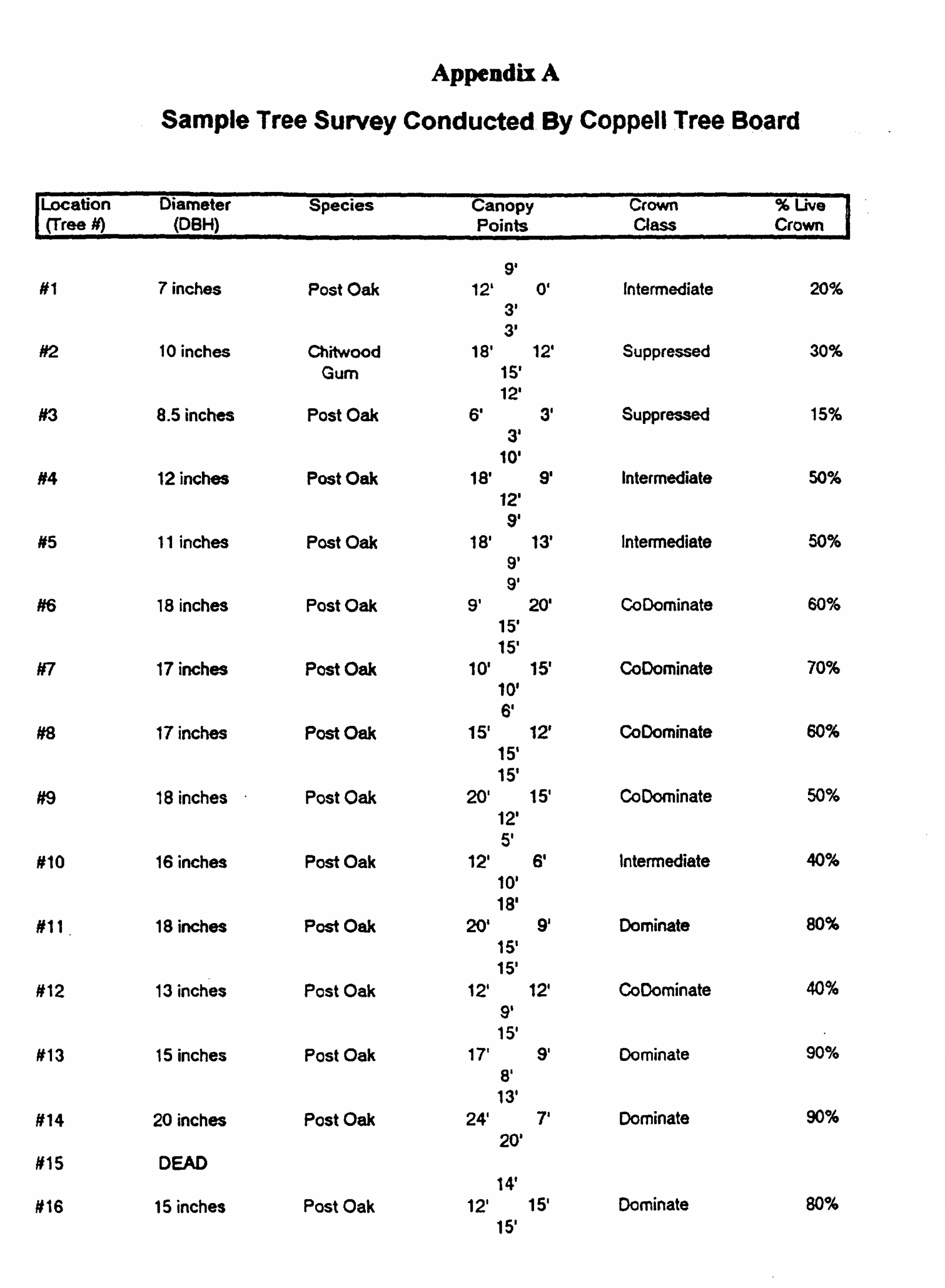
Appendix A—Sample Tree Survey
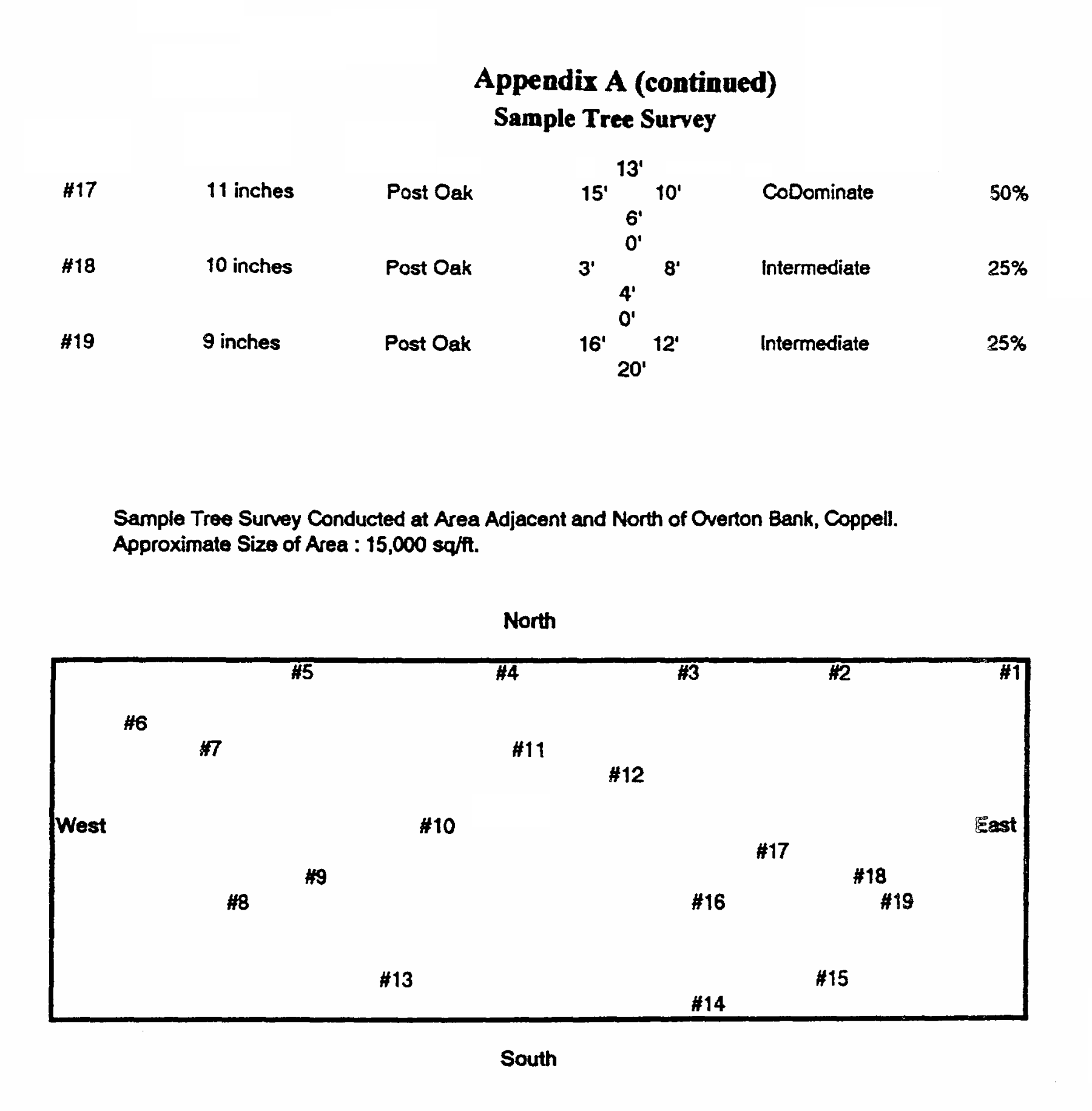
Appendix A—Sample Tree Survey
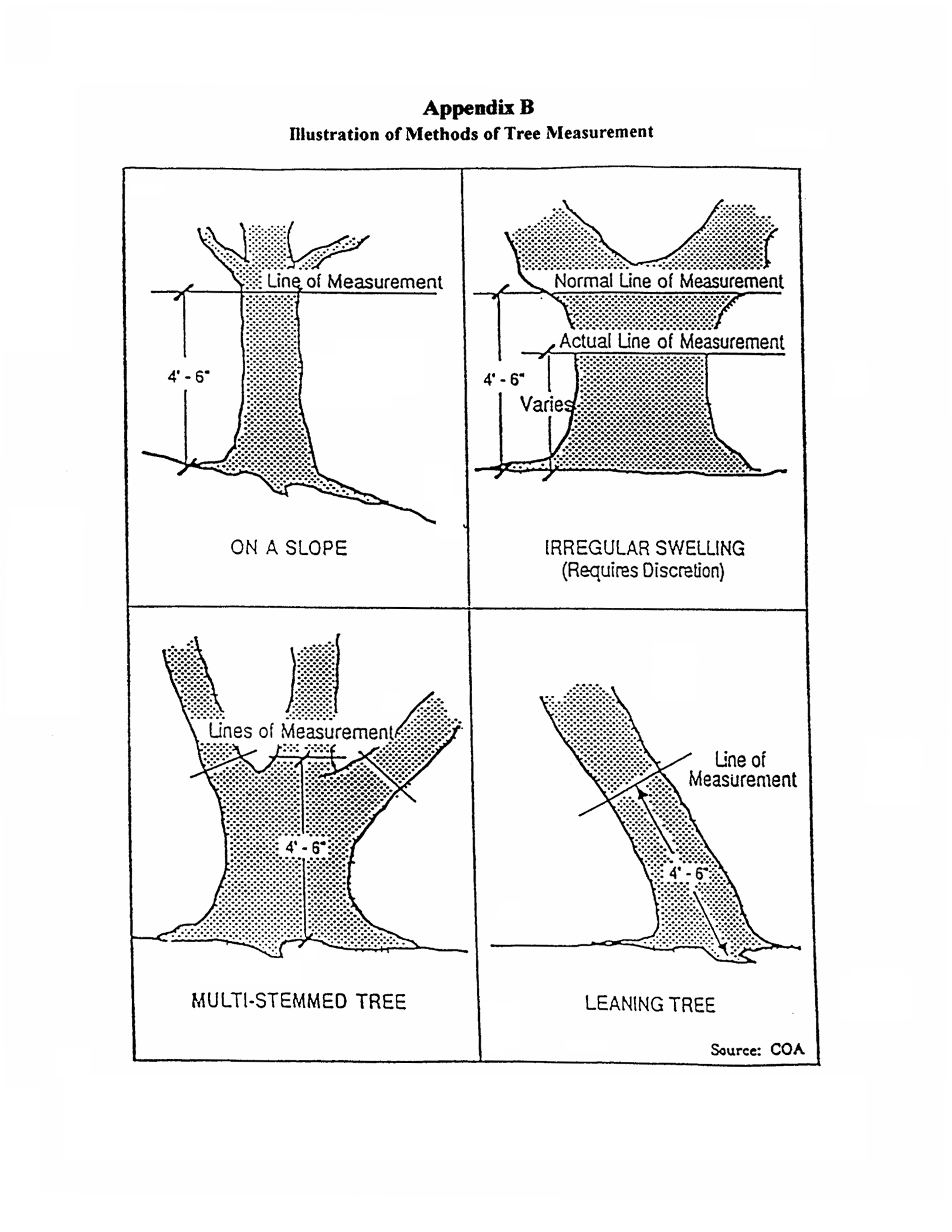
Appendix B—Methods of Tree Measurement
Diameter measurement: The diameter of the protected tree shall be measured as shown. The diameter of a multi-trunk tree shall be determined by adding the total diameter of the largest trunk to one-half the diameter of each additional trunk.
Appendix C
Illustration of Canopy Trees
Crown class is a description of the form of a tree relative to others in the stand,
usually as dominant (D), codominant (CO), intermediate (I) and suppressed (S).
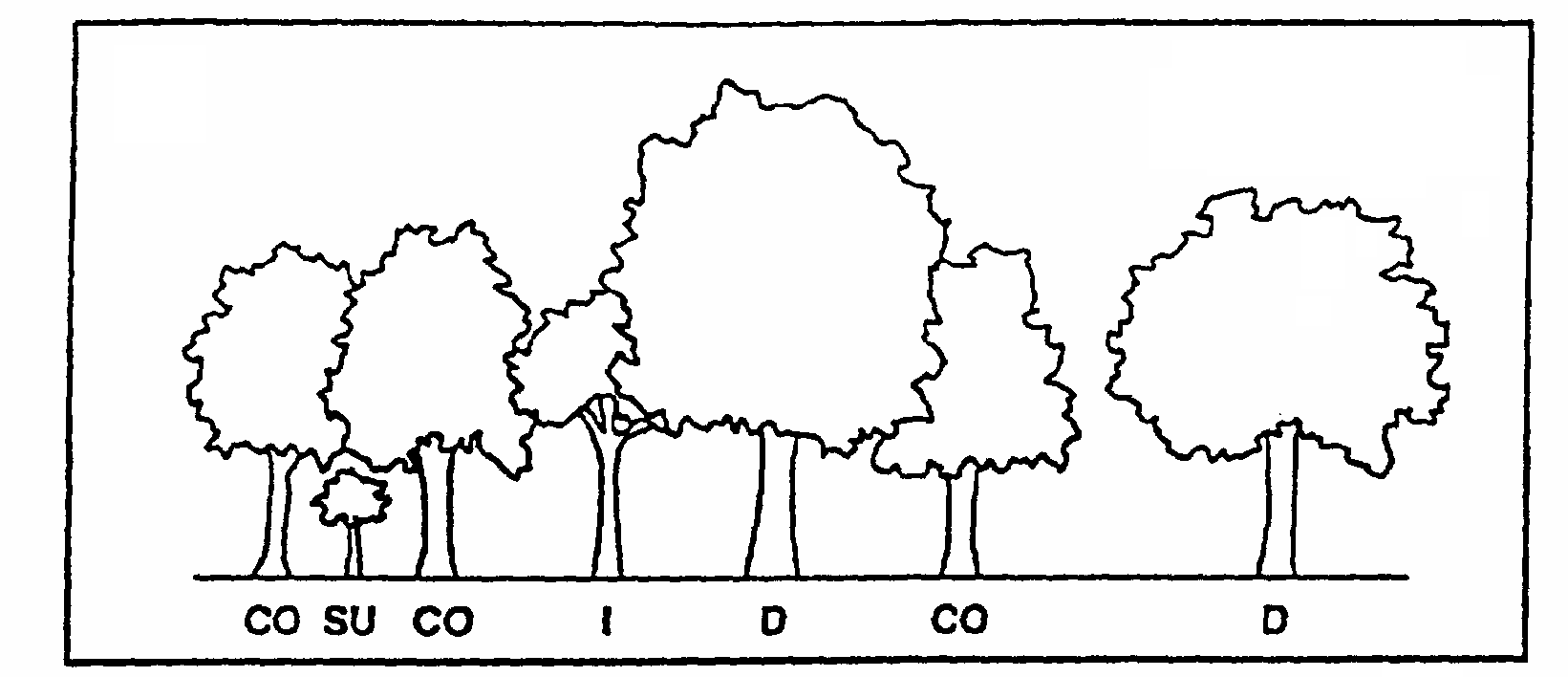
Appendix C—Crown Class
Adapted from the Hazard Tree Assessment Program, Recreation and Park Department, City of San Francisco.
_____
Live crown ratio is the ratio of the foliage canopy to the total height of the tree.
Trees grown in stands usually have a lower live crown ratio than trees grown in the
open.
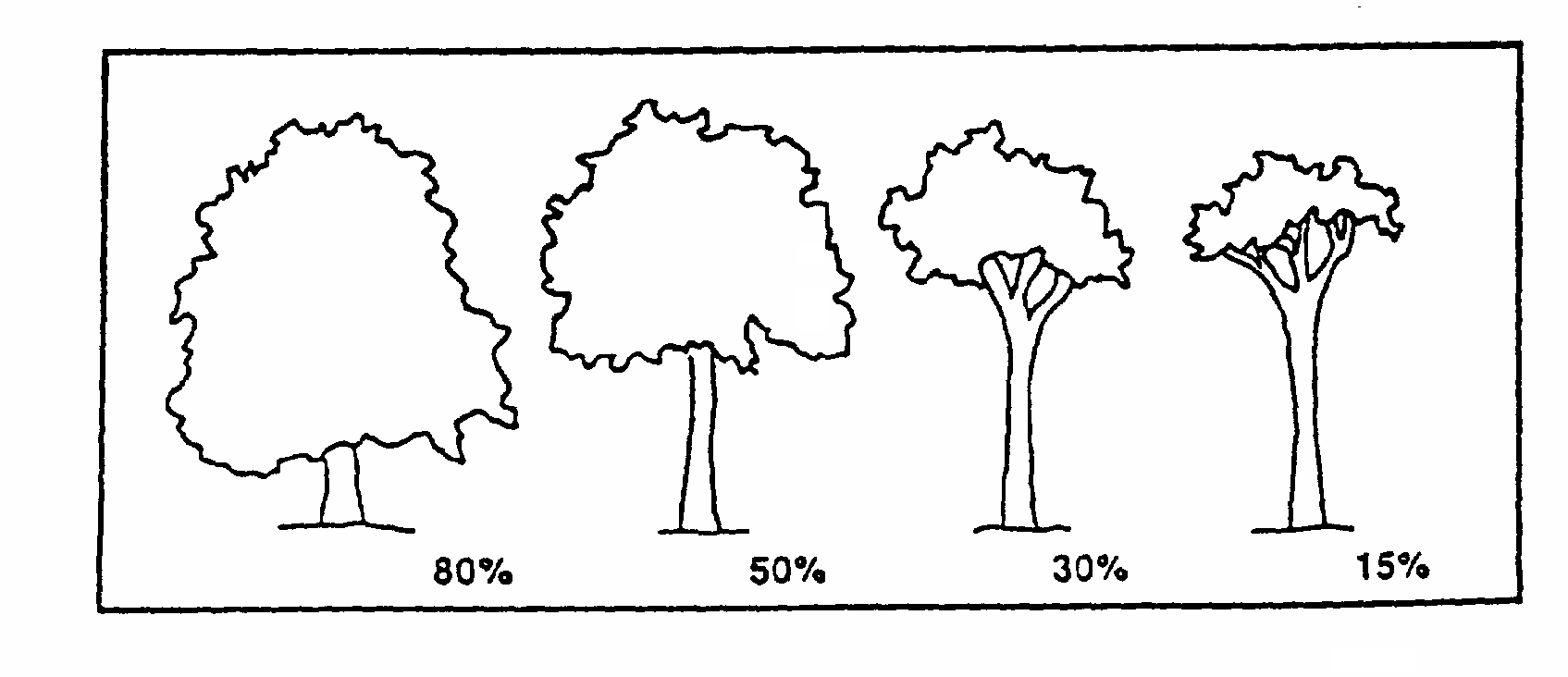
Appendix C—Crown Ratio
Adapted from A Photographic Guide to the Evaluation of Hazard Trees in Urban Areas (2nd Edition). N. Matheny and J. Clark 1994. International Society of Aboriculture. Savoy IL.
Appendix D
Illustration of typical tree structure and physiology, in particular focusing on the
root system.
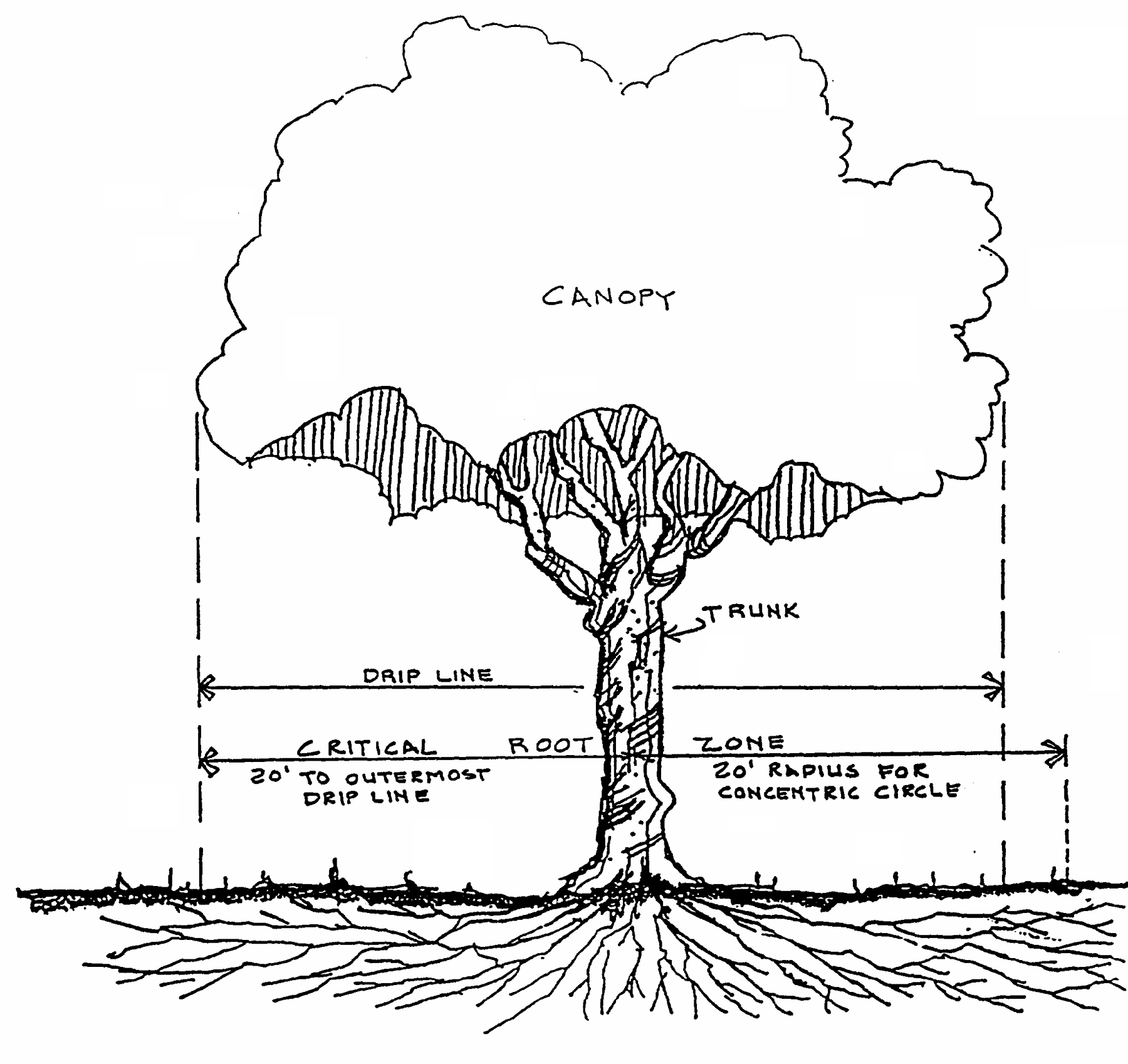
Appendix D—Typical Tree Structure
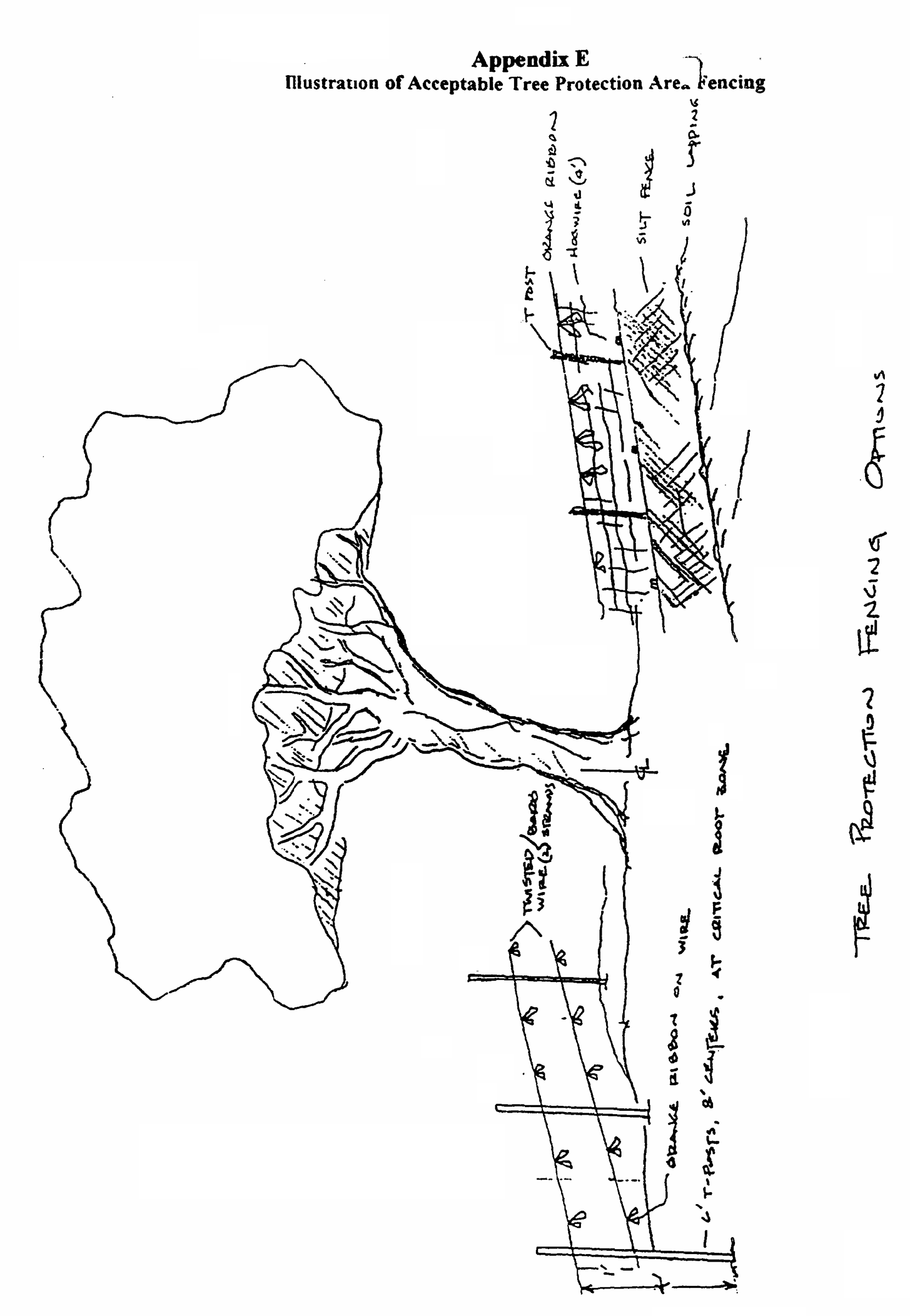
Appendix E—Tree Protection Fencing Options
Appendix F
Illustration of Protective Signage
TREE PROTECTION ZONE
_____________________
ZONA
de
CONSERVACION
ARBOLES
Appendix G
Illustration of Trenching versus Boring
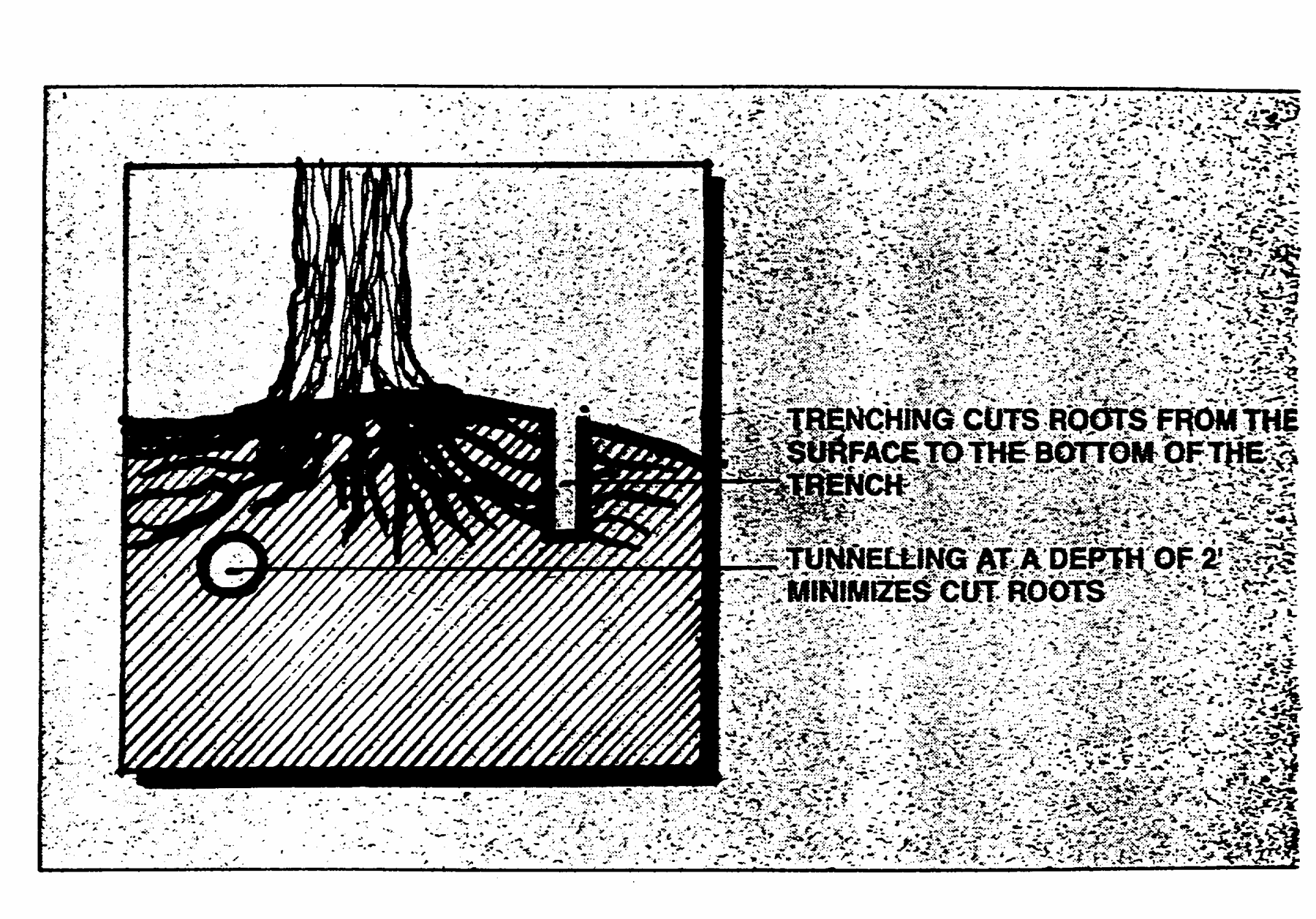
Appendix G—Trenching versus Boring
Appendix H
Illustration of Methods to Ameliorate Grade Change
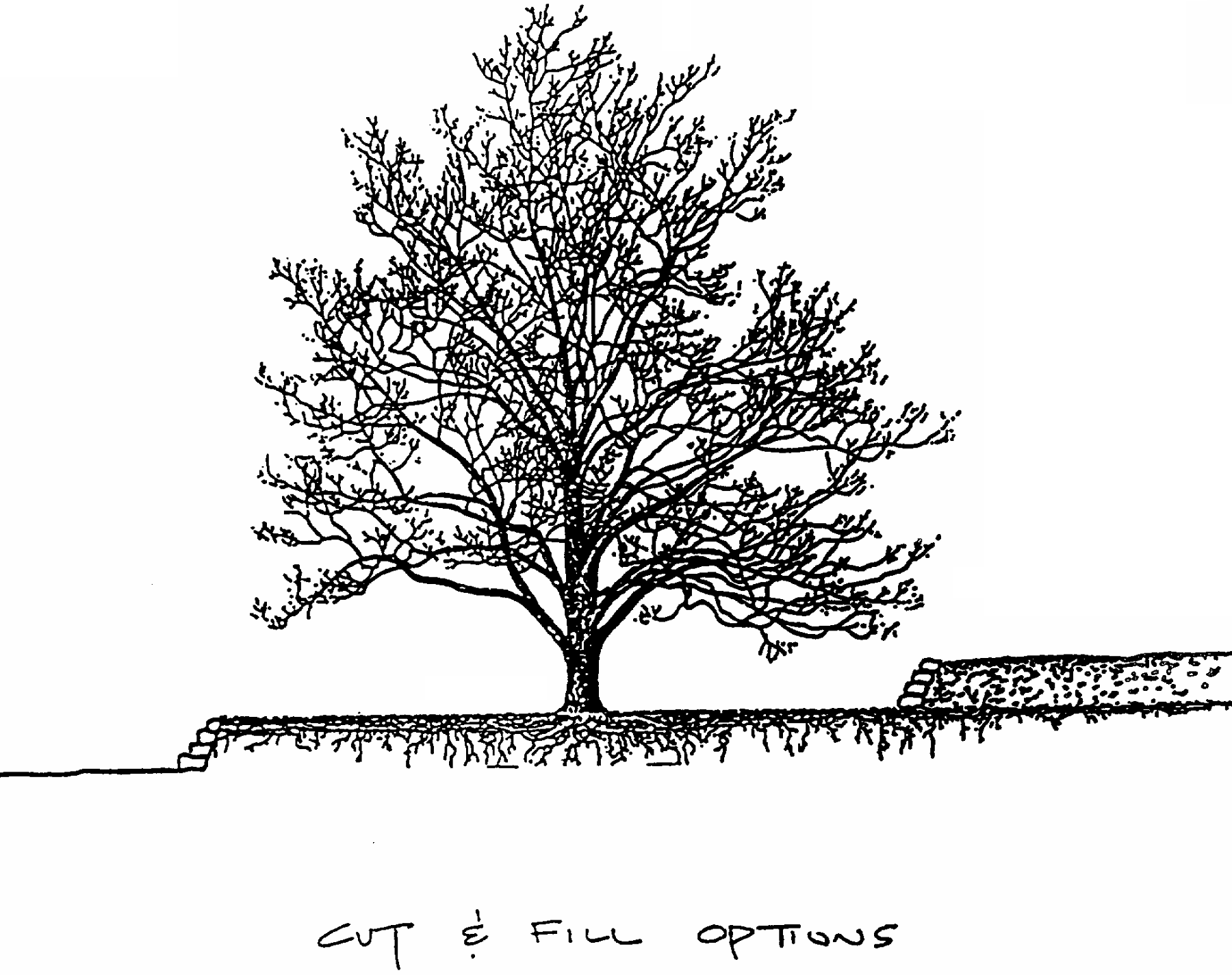
Appendix H—Cut and Fill Options
Appendix I
Tree Removal Permit Application
TREE REMOVAL PERMIT APPLICATION
City of Coppell, Texas
Property Location: _____
Applicant Name:___________
Address:___________
___________
Phone:___________
Property Owner Name:___________
Contractor:___________
_____
Attach additional sheets as necessary.
This application must be accompanied by a Plan or Preliminary Plat of the site.
Proposed new development must attach a Tree Survey.
_____
I understand this application is subject to all rules and regulations pertaining to Section 34-11 of the Zoning Ordinance Code Book of the City of Coppell, Texas.
Applicant Signature:___________
_____
For Staff Use Only
Approved/Disapproved By: ___________ Date:________
Comments:
Fee Paid: _______ Receipt No. _______
Appendix J
1. DETERMINATION of GROSS RETRIBUTION
for
PROTECTED TREES
2. DETERMINATION of GROSS RETRIBUTION
for
SPECIMEN and HISTORIC TREES
Determination in Dollars:
The appraised value of the tree as determined by the Council of Landscaping Tree Appraisers (CLTA) Guidelines.
Appendix K
DETERMINATION of RETRIBUTION CREDITS
Non-Residential Property
Appendix L
DETERMINATION of RETRIBUTION CREDITS
Residential and Adjacent Non-residential Property
**DEVELOPERS ONLY**
(Ord. No. 91500-A-203)

