
Coppell City Zoning Code
ARTICLE 42
- SPECIAL DEFINITIONS
Sec. 12-42-1.- Definitions.
Certain words in this Ordinance not heretofore defined are defined as follows: Words used in the present tense include the future; words in the singular number include the plural number, and words in the plural number include the singular number; the word "building" includes the word "structure"; the word "lot" includes the words "plot" or "tract"; the word "shall" is mandatory and not discretionary.
Accessory building or use: One which: (a) is subordinate to and serves a principal use; and (b) is subordinate in area, extent, or purpose to the principal building or principal use served; and (c) contributes to the comfort, convenience and necessity of occupants of the principal building or principal use served; and (d) is located on the same building lot as the principal use served. "Accessory" when used in the text shall have the same meaning as accessory use. An accessory building may be a part of the principal building. Servants' quarters, as defined, are an accessory building or use.
Alley: A public right-of-way which affords a secondary means of access to abutting property.
Alterations: Any change, addition, or modification in construction, any change in the structural members of a building, such as walls or partitions, columns, beams or girders, the consummated act of which may be referred to herein as "altered" or "reconstructed."
Apartment: A dwelling unit in an apartment building occupied as a place of residence.
Apartment building: An "apartment building" is a building or any portion thereof, which contains three or more dwelling units, located in the same building lot. An apartment building is a multi-family dwelling.
Assembly and manufacturing (limited): The assembly, repair, disassembly and manufacturing of finished products or parts from previously prepared materials and parts. Fabrication may be used in limited form to shape or define the final product, but shall not comprise the primary activity of such operations. Basic industrial processing, which transforms raw materials into a new substance, compound or product, is not permitted. Excluded uses include, but are not limited to, meat packing, chemical and petroleum processing and manufacturing, and foundries.
Auto laundry: A building, or portion thereof containing facilities for washing automobiles using automated methods including chain conveyor, blower, steam cleaning device, or other mechanical devices. A self-service type car wash is an auto laundry.
Automobile repair, major: Major repair, rebuilding, or reconditioning of engines or transmissions for motor vehicles; wrecker service with vehicle storage; collision services including body, frame or fender straightening or repair; customizing; overall painting or paint shop; those uses listed under "automobile repair, minor"; and other similar uses.
Automobile repair, minor: Minor repair or replacement of parts, tires, tubes, and batteries; diagnostic services; minor motor services such as grease, oil, spark plug, and filter changing; tune-ups; emergency road service; replacement of starters, alternators, hoses, brake parts; mufflers; automobile washing, steam cleaning, and polishing; performing state inspections and making minor repairs necessary to pass said inspection; servicing of air-conditioning systems, and other similar minor services for motor vehicles except heavy load vehicles, but not including any operation named under "automobile repair, major" or any other similar use.
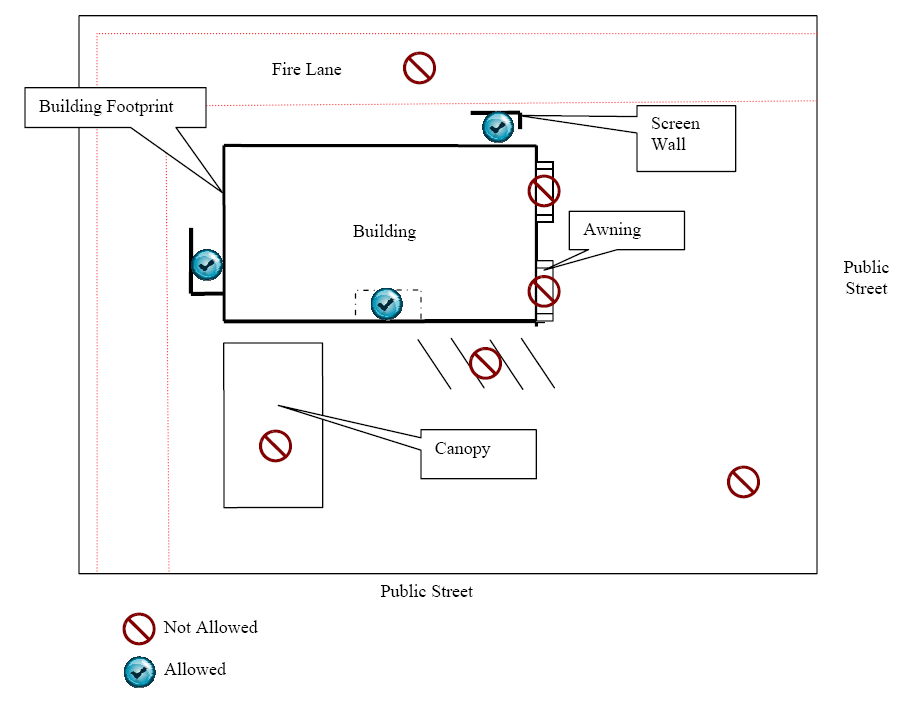
Awning: A shelter supported entirely from the exterior wall of a building; a temporary or permanent nonloadbearing projection from an exterior wall of a building designed to provide shade or protection from elements, having a pitched surface which may not be used for any other purpose. A rooflike structure of fabric stretched over a rigid frame projecting from the elevation of a building designed to provide continuous overhead weather protection.
Basement: A story wholly or partly (at least 50 percent) measured from floor to ceiling, below the level of the ground on the street side of the building. A basement or cellar is not counted when measuring the height of a building.
Bakery: A place for preparing, baking and selling all products on the premises where prepared.
Block: A tract of land bounded by streets, or by a combination of streets and public parks, cemeteries, railroad rights-of-way, highways, streams, or corporate boundary lines. There may be more than one numbered block as shown on a plat falling within a single block as herein defined.
Block face: A word used as a term of measurement. It shall mean the distance along a side of a street between the nearest two streets which intersect said street on the said side.
Board: Shall mean the board of adjustment established in article 41 of this ordinance.
Build: To erect, convert, enlarge, reconstruct, or alter a building or structure.
Buildable width of a building site: The width of the building site left to be built upon after the required side yards are provided.
Building: Any structure built for the support, shelter, or enclosure of persons, animals, chattels, or movable property of any kind.
Building, detached: A building surrounded by yards or open space on the same building lot.
Building height: See height.
Building line: The rear line of a required front yard which is generally parallel to the street line forming the front lot line.
Building lot: A single tract of land located within a single block which, (at time of filing for a building permit) is designed by its owner or developer as a tract to be used, developed, or built upon as a unit, under single ownership or control. It shall front upon a street or approved place. Therefore, a "building lot" may be subsequently subdivided into two or more "building lots", and a number of "building lots" may be cumulated into one "building lot", subject to the provisions of this ordinance and the subdivision ordinance.
Building, mixed: A building used partly for residential use and partly for community facility and/or commercial use. A mixed building is a commercial use.
Building official: The administrative official charged with responsibility for issuing permits and enforcing the zoning ordinance and building code.
Building, principal: A building in which the principal use of the lot, on which it is located, is conducted. All residential uses, except bona fide servants quarters, are principal uses.
Building, residential: A building which is arranged, designed, used, or intended to be used for residential occupancy by one or more families or lodgers.
Canopy: A roofed structure constructed of metal, wood or any other solid material supported by the building or by support extending to the ground directly under the canopy [and] placed so as to extend outward from the building providing a protective shield from doors, windows, and other openings.
Carport: A structure open on a minimum of three sides designed or used to shelter the owner's vehicle(s), not to exceed 24 feet on its longest dimension.
Cellar: See basement.
Certificate of occupancy or compliance: An official certificate issued by the city through the enforcing official which indicates conformance with or approved conditional waiver from the zoning regulations and authorizes legal use of the premises for which it is issued.
Charity house or transitional housing: Shall mean short or long-term temporary occupancy of a single family residential structure, uncompensated or de minimis fee, for person(s) that are sick, very poor, homeless or have special needs or disabled. This definition does not include assisted living, group homes, half-way house or other type of temporary house licensed under state law or defined in the Code of Ordinances.
City: Shall mean the City of Coppell, Texas.
City council: The governing body of the City of Coppell, Texas.
City manager: The chief city administrative officer.
Clinic: The office of one or more medical doctors, dentists, optometrists, or similar members of the medical professions who may or may not have associated in the practice of their professions.
Cleaning: A custom cleaning shop not exceeding 5,000 square feet of floor area.
Clustering: A land development concept whereby the buildings on a site are grouped closely together but not attached to allow for communal open space and economies in development. Clustering permits variation in lot size, shape and orientation without an increase in the overall density of the development.
Community club: Any club, (other than a private club), service club, sorority, fraternity, lodge or other private organization or club where alcoholic beverages are not served pursuant to a private club permit issued by the State of Texas.
Concrete block: Any of the molded load-bearing or non-load-bearing concrete units normally 8" x 8" x 16".
Convalescent home: Any structure used for or customarily occupied by persons recovering from illness or suffering from infirmities of age.
College or university: An institution established for educational purposes and offering a curriculum similar to the public schools or an accredited college or university, but excluding trade and commercial schools.
Convenience store: A small retail store, generally under 3,000 square feet, which typically sells groceries and retail sales of non-food items or prepared foods, hot and cold beverages and packaged beverages or a combination. The outside storage or display and sale in the open, outside the building of groceries, packaged beverages and consumer goods and drive-through or drive-up service is prohibited.
Court: An open, unoccupied space, bounded on more than two sides by the walls of a building. An inner court is a court entirely surrounded by the exterior walls of a building. An outer court is a court having one side open to a street, alley, yard, or other permanent open space.
Coverage: The percent of a lot or tract covered by the first floor or the largest floor of a building or structure whichever is larger, including all covered porches, patios, garages, accessory buildings, etc. Unsupported roof overhangs and other allowed architectural projections shall be excluded from coverage computation.
Curb line: A line created by following the edge of the street or curb.
Cumulative zoning: The successive addition of uses allowed in more restrictive zoning districts to lesser restrictive zoning districts.
Custom personal service: A tailor, shoe repair, barber, beauty shop, health studio or travel consultant.
Day nursery or day care center: An establishment where four or more children are left for care or training during the day or portion thereof.
Density: The relationship of the total number of dwelling units to the area of the total site area commonly expressed as "dwelling units per acre."
Depth of lot: The mean horizontal distance between the front and rear lot lines. See illustration # 12.
Development, or to develop: The construction of a new building or any structure on a building lot, the relocation of an existing building on another building lot, or the use of open land for a new use. To "develop" is to create a development.
Distribution center: An established location that stores goods purchased by the operator for resale, that does engage in storing goods for hire, and where goods are not sold to retail customers.
District: A zoning district which is a part of the city wherein regulation of this Ordinance is uniform.
Dwelling, one-family: A dwelling having accommodations for and occupied by not more than one family, or by one family and not more than four boarders and lodgers.
Dwelling, two-family: A dwelling having separate accommodations for and occupied by not more than two families, or by two families and not more than four boarders and lodgers. (Two boarders or lodgers to each unit).
Dwelling, multiple-family: Any building or portion thereof, which is designed, built, rented, leased, or let to be occupied as three or more dwelling units or apartments or which is occupied as a home or residence of three or more families.
Dwelling unit: A building or portion of a building which is arranged, occupied, or intended to be occupied as living quarters of a family and including facilities for food preparation and sleeping.
Family: Consists of one or more persons, each related to the other by blood, marriage, or adoption; or a group of not more than four persons (excluding servants) who are living together in a dwelling unit.
Farm: An area of five acres or more which is used for growing of usual farm products, vegetables, fruits, trees and grain and for the raising thereon of the usual farm poultry and farm animals such as horses, cattle and sheep and including the necessary accessory uses for raising, treating and storing products raised on the premises, but not including the commercial feeding of offal or garbage to swine or other animals and not including any type of agriculture or husbandry specifically prohibited by ordinance or law.
Floor area: The total square feet of floor space within the outside dimensions of a building including each floor level, but excluding cellars, carports, or garages.
Floor area ratio (FAR): An indicated ratio between the number of square feet of total floor area in the main building(s) on a lot and the total square footage of land in the lot; it is the number resulting from dividing the main building floor area by the lot area. (See appendix illustration No. 15)
Fulfillment center: An established location operated to receive orders from retail customers, placed primarily over the Internet through the use of websites, for purchase of goods held in inventory at that location that are shipped or delivered from the center directly to the place designated by purchaser. A fulfillment center does not store goods for hire. It keeps or retains goods for sale to retail customers in the regular course of business. It is not a warehouse or a distribution center.
Garage, private: An accessory building designed or used for the storage of motor vehicles owned and used by the occupants of the building to which it is necessary.
Garage, public: A building or portion thereof, other than a private or storage garage, designed or used for storing motor driven vehicles.
Garden center: The growing, displaying, and/or wholesale or retail sale or handling of plants, shrubs, trees, soils and related materials conducted within or without an enclosed building.
Gasoline station or filling station: Any building or premises used for the dispensing, sale, or offering for sale at retail of any automobile fuels or oils. If the dispensing, sale or offering for sale is incidental to a public garage, the premises shall be classified as a public garage.
Gross acreage: The total size of the property including floodplains, easements, and other non-buildable areas located on the property.
Health service: A charitable or government operated facility offering to the public medical examinations, diagnosis and limited treatment not for profit.
Heavy load vehicle: A self-propelled vehicle having a load capacity greater than one and one-half tons, such as large recreation vehicles, tractor-trailers, buses, and other similar vehicles; the term "truck" shall be construed to mean "heavy load vehicle" unless specifically stated otherwise.
Height: The vertical distance of a building measured from the average established grade at the street line or from the average natural front yard ground level, whichever is higher, to (1) the highest point of the roof's surface if a flat surface, (2) to the deck line of mansard roofs or, (3) to the mean height level between eaves and ridge for hip and gable roofs and, in any event, excluding chimneys, cooling towers, elevator bulk heads, penthouses, tanks, water towers, radio towers, ornamental cupolas, domes or spires, and parapet walls not exceeding ten feet in height. If the street grade has not been officially established, the average front yard grade shall be used for a base level.
Home occupation:A business, occupation, or profession conducted within a residential dwelling unit by the resident thereof, and which shall have the following characteristics:
1.
The activity shall employ only members of the immediate family of the resident of the dwelling unit;
2.
There shall be no external evidence of the occupation detectable at any lot line, said evidence to include advertising signs or displays, smoke, dust, noise, fumes, glare, vibration, electrical disturbance, storage of materials or equipment, or traffic or parking of vehicles in a manner evidencing the conduct of a business;
3.
Said home occupation shall not have a separate entrance for the business and shall not include appointed visits by the general public. Any business, occupation or profession conducted within a dwelling unit and which does not meet the aforesaid characteristics shall be construed to be a commercial activity and shall therefore be cause for the city to order a cease to all such activity within said dwelling unit.
Hospital: A legally authorized institution in which there are complete facilities for diagnosis, treatment, surgery, laboratory, x-ray, and the prolonged care of bed patients. Clinics may have some but not all of these facilities.
Hotel: An establishment offering lodging to the traveling public for compensation. Access to the majority of the guest rooms is through a common entrance and lobby. The establishment furnishes customary hotel services and may contain a restaurant, club, lounge, banquet hall and/ or meeting rooms. Microwave and small (under the counter) refrigerator is permitted in the rooms, however other kitchen facilities, such as cooktop, oven (except microwave) and full size refrigerator would not be permitted. A hotel is a non- residential use.
Household appliance service and repair: An enclosed facility for repair of household and home equipment, including appliances, lawnmowers, power tools, radios, TV and similar items.
Junk or salvage yard: A lot upon which waste or scrap materials are bought, sold, exchanged, stored, packed, disassembled, or handled, including but not limited to scrap iron and other metals, paper, rags, rubber tires and bottles. A "junk yard" includes an automobile wrecking yard and automobile parts yard. A "junk yard" does not include such uses conducted entirely within an enclosed building.
Landscaping contractors yard: A lot upon which landscaping items such as trees, plants and shrubs may be stored for future sale.
Loading space: A space within the main building or on the same lot therewith, providing for the standing, loading or unloading of trucks, and having minimum dimensions of 12 by 60 feet for industrial and warehouse uses and 12 by 30 feet for commercial, retail and institutional uses with a vertical clearance of at least 14 feet, together with access and maneuvering areas provided on the same building lot as the principal use for which the loading space is intended.
Lodging house: The rental of any single-family residence or its residential structure, mobile home, manufactured house or a portion of a single-family residence or residential structure including but not limited to pools, garages, and outdoor accessory structures for a period of less than 30 days. This term includes but not limited to:
1.
Bed and breakfast;
2.
Boarding home or hostel;
3.
Vacation home;
4.
Short-term rentals (STR); or
5.
Corporate housing.
The term does not include:
1.
A unit that is used for a nonresidential purpose, including an educational, retail, restaurant, banquet space, or event center purpose or other commercial purposes another similar use;
2.
A hotel/residence hotel;
3.
A place for residence or use as a licensed health care or assisted living facility licensed by the State; or
4.
Parsonage on the premise of a church, mosque or synagogue.
5.
A commercial storage facility.
Lot area: The area of a horizontal plane intercepted by the vertical projections of the front, side, and rear lot lines of a building lot. (See appendix illustration No. 12)
Lot area per dwelling unit: The lot area required for each dwelling unit located on a building lot.
Lot, corner: A building lot situated at the intersection of two streets, the interior angle of such intersection not to exceed 135 degrees.
Lot depth: The mean horizontal distance between the front lot line and the rear lot line of a building lot measured at the respective mid points of the front lot line and rear lot line within the lot boundary. (See Appendix Illustration No. 12)
Lot line: A boundary of a building lot.
Lot line, front: That boundary of a building lot which is the line of an existing or dedicated street. Upon corner lots either street line may be selected as a front lot line providing a front and rear yard are provided adjacent and opposite, respectively, to the front lot line. (See appendix illustration No. 11)
Lot line, side: That boundary of a building lot which is not a front lot line or a rear lot line.
Lot line, rear: That boundary of a building lot which is most distant from and is, or is most nearly, parallel to the front lot line.
Lot of record: An area of land designated as a lot on a plat of a subdivision recorded, pursuant to statutes of the State of Texas, with the county clerk of Dallas County, Texas or an area of land held in single ownership described by metes and bounds upon a deed recorded of registered with the county clerk.
Lot, reverse corner: A corner lot, rear lot line of the street which abuts the side lot line of the lot to its rear.
Lot, through: A "double frontage" lot is a building lot not a corner lot, both the front and rear lot lines which adjoin street lines. On a "through lot" both street lines shall be deemed front lot line.
Lot width: The minimum distance between the side lot lines of a building lot measured along a straight line at the rear of the required front yard and parallel to the street line or a line tangent thereto. (See appendix illustration No. 11)
Manufactured home: A factory-built dwelling unit, attached or detached, which is wholly or partially constructed away from its building lot and moved to a building lot where it is affixed or situated as a permanent building. A manufactured home is a residential use. A manufactured home shall not be construed to be a mobile home.
Masonry: Brick, stone, concrete or other similar materials but excluding stucco and "concrete blocks". The masonry requirement shall be computed for the area from the foundation to the top plate of the first floor and from plate to plate for each floor above the first.
Mini-warehouse (convenience storage): A building or group of buildings containing one or more individual compartmentalized storage units for inside storage of customer's goods or wares, where no unit exceeds 500 square feet in floor area. No outside storage, storage of explosives, flammable materials, materials emitting noxious odors or other similar activities shall be allowed. Caretaker's quarters are required as an accessory use.
Mobile home: A vehicle used for living or sleeping purposes and standing on wheels or on rigid supports, but which when properly equipped and situated can be towed behind a motor vehicle. A trailer coach is a mobile home.
Mobile home park: Any premises on which two or more mobile homes are parked or situated and used for living or sleeping purposes, or any premises used or held out for the purpose of supplying to the public a parking space for two or more mobile homes whether such vehicles stand on wheels or on rigid supports. A trailer park is a mobile home park.
Modular home: A factory-built dwelling unit, attached or detached, which is wholly or partially constructed away from its building lot and moved to a building lot where it is affixed or situated as a permanent building. A modular home is a residential use. A mobile home shall not be construed to be a modular home.
Motorcycle: A usually two-wheeled self-propelled vehicle having one or two saddles or seats, and may have a side car attached. For purposes of this ordinance, motor bikes, motorscooters, mopeds, and similar vehicles are classified as motorcycles.
Motor freight terminal: A building or area in which freight brought by motor truck is assembled and/or stored for shipping in interstate and intrastate commerce by motor truck. A motor freight terminal is a truck terminal.
Net acreage: The total buildable area of a lot. Net acreage shall not include floodplain area, public rights-of-way, or other areas where buildings can not be located.
Nonconforming use: Any building or land lawfully occupied by a use at the time of the adoption of this ordinance or amendments thereto, not permitted by the use regulations, lot requirements or other regulations of this ordinance of the district in which it is attained.
Noxious matter: A material which is capable of causing injury to living organisms by chemical reaction or is capable of causing detrimental effects upon the physical or economic well-being or comfort of humans.
Occupancy: The use or intended use of the land or buildings by proprietors or tenants.
Open space: That part of a building lot, including courts or yards, which:
1.
Is open and unobstructed from its lowest level to the sky, and
2.
Is accessible to all residents upon a building lot, and
3.
Is not part of the roof of that portion of the building containing dwelling units.
Open storage: The storage of any equipment, machines, commodities, raw, semi-finished materials, and building materials, not accessory to a residential use which is visible from any point on the building lot line when viewed from ground level to six feet above ground level.
Outside storage and display—Retail stores and shops shall mean the display or offer of all types of consumer goods for sale in the open, outside a building footprint and under a roofline canopy of such building footprint, of groceries, packaged beverages, consumer goods, new or used automobiles, heavy machinery, building materials, used appliances, furniture, vending machines or salvage materials typically not in a fixed position and capable of rearrangement, designed and used for the purposes of advertising or identifying a business, product, or service. For the purpose of this section, the definition of canopy does include any such structure extending outside the building footprint into an area used for motor vehicle traffic. (See Fig. 42-1 for graphic explanation of this definition).
Parking space: An enclosed or unenclosed all-weather surfaced area not on a public street or alley, together with an all-weather surfaced driveway connecting the area with a street or alley permitting free ingress and egress without encroachment on the street or alley. Any parking adjacent to a public street wherein the maneuvering is done on the public street shall not be classified as off-street parking in computing the parking area requirements for any use.
Patio home: A single-family detached dwelling unit on an individually platted lot. The structure is situated on or near one side lot line to facilitate use of the remaining side yard on the opposite side of the building.
Planning director: The administrative official responsible for the administration of this ordinance during the platting and/or rezoning process.
Planning and zoning commission: The agency appointed by the city council as an advisory body to it and which is authorized to recommend changes in the zoning and review of subdivision plats.
Plat: A plan of a subdivision of land creating building lots or tracts and showing all essential dimensions and other information essential to comply with the subdivision standards of the City of Coppell subject to review by the planning and zoning commission and approval by the city. Reference to a plat in the ordinance means an official plat of record which has been reviewed by the planning and zoning commission and approved by the city and filed in the plat records of Dallas County.
Premises: Land together with any buildings or structures occupying it.
Private club: a club where alcoholic beverages belonging to members of the club are stored, possessed, mixed on the club premises and served for on-premises consumption to members of the club, their families and guests pursuant to a private club permit issued by the State of Texas.
Public park: Any publicly owned park, playground, beach, parkway, greenbelt, or roadway within the jurisdiction and control of the city.
Recreation area: A privately owned park, playground, or open space maintained by a community club, property-owners association, or similar organization.
Residence hotel: A multi-dwelling, extended stay lodging facility consisting of efficiency units or suites with a complete kitchen (which are defined as containing a stove top and oven and full size refrigerator) suitable for long-term occupancy. Customary hotel services such as linens, maid service and telephone are provided.
Residential districts:Includes the following districts: SF-ED, SF-18, SF-12, SF-9, SF-7, SF-O, 2F-9, TH-1, TH-2, MF-1, MF-2 and MH.
Residential structure: Any single-family, multi-family, or apartment building, condominium project, town home, zero lot line home as defined by the Federal Department of Housing and Urban Development.
Rest home or nursing home: A private facility for the care of children or the aged or infirm or a place of rest for those suffering bodily disorders. Such homes do not contain facilities for surgical care or the treatment of disease or injury.
Restaurant: A commercial establishment primarily where food and beverages are prepared, served and consumed within the principal building, on the premises or for take out.
Retail store(s), shop(s) and retail center: Established locations that display and sell goods in-person to consumers, but excluding the display and sale in the open, outside a building, of new or used automobiles, heavy machinery, building materials, used appliances, furniture or salvage materials.
School: A school under the sponsorship of a public or religious agency having a curriculum generally equivalent to public elementary or secondary schools, but not including private or trade or commercial schools.
Screened from view from an adjacent public street: A permanent structure of sufficient height to screen material and which in no event extends higher than the exterior wall of the primary building and constructed of the same or similar color and material as the primary building.
Screening device: A "screening device" shall consist of a barrier of stone, brick, uniformly colored wood, or other permanent material of equal character, density, and acceptable design, at least six feet in height.
Servant's quarters: An accessory building or portion of a main residential building located on the same lot as the principal residential building, occupied only by such persons and their families as are employed full time by the occupants of the principal residence.
Showroom: A room or area in excess of 1,000 square feet where durable goods are displayed for retail sales to consumers.
Story: That part of a building between the surface of a floor and the ceiling immediately above. A standard story is 11 feet, six inches.
Street: A public right-of-way which affords a primary means of access to abutting property. A driveway or alley which serves only to give secondary vehicular access to a building lot or to an accessory parking or loading facility, or to allow vehicles to take or discharge passengers at the entrance to a building shall not be considered a street.
Street, private: A street which has no publicly dedicated right-of-way.
Street line: A "street line" is the right-of-way of a street.
Stucco: A continuous plaster or mortar exterior veneer, finished by hand troweling over wire lath.
Technology equipment facility: A structure that is occupied by telecommunications, computer and similar high technology equipment that provide electronic data switching, transmission, routing or other telecommunication functions between computers. Ancillary uses may include an office for personnel, conference room, back-up power generators, and fuel storage, which shall only be permitted as an accessory use to the back-up power generators.
Tennis or swim club: A private recreational club with restricted membership, usually of less area than a country club, but including a club house and swimming pool, tennis courts and similar recreational facilities, none of which are available to the general public.
Top plate line: That point at which the ceiling plane of the upper most story intersects the vertical wall plane.
Townhouse: Attached single-family dwelling units on individually platted lots.
Toxic materials: Those materials which are capable of causing injury to living organisms by chemical means when present in relatively small amounts.
Use: The purpose or activity for which the land, or building thereon, is designed, arranged, or intended, or for which it is occupied or ;maintained, and shall include any manner of such activity with respect to the standards of this ordinance.
Use, principal: The main use of land or buildings as distinguished from a subordinate or accessory use.
Video amusement: Arcade and other commercial indoor coin operated amusement facility.
Visual screen: A wall, not of living plant material, permanently affixed to the ground in which the area of all openings and cracks in each square foot of wall is of sufficient height so that the objects being screened are not visible from any point on the lot line when viewed from any height between ground level and six feet above ground level. No wall shall exceed eight feet in height.
Warehouse: An established location engaged in storing goods for hire for multiple parties that does not sell goods in the regular course of business and that does not store goods that the operator has purchased for resale.
Wind energy system/wind turbine: A wind energy conservation system consisting of a wind turbine, a tower, mounting components and associated control or conversion electronics, or any combination thereof.
Yard: An open space on the same building lot with a building, unoccupied and unobstructed by any portion of a structure from the ground upward, except as otherwise provided. In measuring a yard for the purpose of determining the width of a side yard, the depth of a rear yard, and the depth of a front yard, the minimum horizontal distance between the building site and the lot line shall be used. A "yard" extends along a lot line and at right angles to such lot line to a depth or width specified in the yard regulations of the zoning district in which such building is located. (See appendix illustration No. 13)
Yard, front: A yard extending along the whole length of the front lot line between the side lot liens, and being the minimum horizontal distance between the street line and the main building or any projections thereof other than steps, planter box, unenclosed porches, and driveways. (See appendix illustration No. 13)
Yard, rear: A yard extending across the rear of a lot between the side lot lines and being the minimum horizontal distance between the rear lot line and the rear of the principal building or any projections thereof other than steps, unenclosed balconies, unenclosed porches, or driveways.
Yard, side: An open unoccupied space on the same lot with the building, situated between the building and the side property line of the lot, and extending through to the street or the front property line. (See appendix illustration No. 13)
Zoning district map: The map or maps incorporated into this ordinance as a part thereof by reference thereto.
(Ord. No. 91500; Ord. No. 91500-A-105; Ord. No. 91500-A-331, § 1, 8-13-02; Ord. No. 91500-A-334, § 1, 8-13-02; Ord. No. 91500-A-377, § 1, 5-11-04; Ord. No. 91500-A-434, § 4, 6-13-06; Ord. No. 91500-A-445, § 3, 12-12-06; Ord. No. 91500-A-473, § 2, 8-14-07; Ord. No. 91500-A-544, § 2, 3-23-10; Ord. No. 91500-A-551, § 2, 5-11-10; Ord. No. 2016-1433, § 3, 4-12-16; Ord. No. 91500-A-790, § 6, 5-9-23; Ord. No. 91500-A-814, § 3, 4-9-24; Ord. No. 91500-A-824, § 5, 4-8-25)

