
Coppell City Zoning Code
ARTICLE 33
- SCREENING STANDARDS
Sec. 12-33-0.- Purpose.
To encourage the most appropriate use of land and conserve and protect the privacy and value of adjacent permitted uses, regulations are prescribed for the location and type of various screening devices to be used when required in the various zoning districts or in this section in accordance with the following standards.
(Ord. No. 91500-A-30)
Sec. 12-33-1. - Location of required screening.
1.
Where the side, rear, or service side of an apartment, or the side, rear, or service side of a non-residential use is adjacent to a single-family or two-family residential district, a screening wall not less than six feet in height shall be erected separating the use from the adjacent residential district. In addition, a perimeter landscape area at least ten feet wide shall adjoin the screening wall. The perimeter landscape area shall contain trees spaced no less than 40 feet apart and include such landscaping as outlined in Table 1 of article 34. No screening is required adjacent to a street except as required in paragraph 2. in this section. All screening walls shall conform to 12-33-1.8. All trees and landscape areas shall comply with sections 12-34-1-6 and 12-34-1-7.
2.
When the side, rear or service side of a non-residential or multi-family use is adjacent to a public thoroughfare with greater than 60 feet of right-of-way screening six feet in height shall be provided. All screening walls shall conform to 12-33-1.8.
3.
In a non-residential district where parking space for motor vehicles is provided adjacent to or within ten feet of a residential district, whether the district boundary lines are separated by a street or alley or not, screening two feet in height shall be provided between the boundary of such parking areas and the residential district. This requirement does not waive the requirements of paragraph 1, however, providing screening as required in paragraph 1. may fulfill the requirements of this paragraph.
4.
In all districts where screening of loading areas facing a street is required, screening shall be provided not less than six feet in height adjacent to the loading area at the property line. Said screening shall be required parallel to all streets and located 30 feet from the street R.O.W./property line except where such use was in existence at the date of adoption of this Ordinance. Screening adjacent to a street shall conform to 12-33-1.8. Screening may be allowed 15 feet behind the front property line provided that a landscape plan has been submitted and approved by the planning commission that clearly indicates the screening wall location.
5.
In all districts where screening of open storage is required such screening shall be required only for those areas used for open storage. A six feet high screening wall shall be provided and maintained parallel to the property line adjacent to the area to be screened. If the screening wall for open storage is required along a street edge, the screening wall shall be located 30 feet from the street R.O.W./property line and shall conform to 12-33-1.8. Screening may be allowed 15 feet behind the front property line provided that a landscape plan has been submitted and approved by the planning commission that clearly indicates the screening wall location.
6.
Refuse storage areas for all uses other than single-family, duplex and townhome dwellings shall be visually screened by a six-foot high solid masonry enclosure on all sides except the side used for refuse pickup service, which shall have gates of solid screening material. These gates shall remain closed at all times when not in active use.
7.
Ground and wall mounted and roof-mounted mechanical and utility equipment.
(A)
All ground and wall mounted mechanical and utility equipment including, but not limited to, air conditioning units, generators, and transformers shall be visually screened by a solid screening wall at a minimum height so as to provide visual screening of such equipment from adjacent properties and public rights-of-way. Installation of evergreen landscaping material, as deemed acceptable to the director of planning, may be substituted in lieu of the screen wall, under circumstances where the topography, zoning and use of such property would promote the general health, safety, and welfare of the community.
(B)
All roof-mounted utility and mechanical equipment including, but not limited to, fans, vents, air conditioning units, cooling towers, and satellite dishes, shall be screened so as not to be visible at ground level from the adjacent properties and/or public rights-of-way, that complies with fire code requirements. In general, the screening of roof mounted utility and mechanical equipment shall be provided by a parapet wall, unless otherwise permitted by the city council.
i.
Overall screening height shall be the height of the highest element of roof-mounted equipment.
ii.
The outside of the screening device, if independent of the building facade, shall be painted or otherwise finished in a color similar to the building facade, trim, or roof surface, whichever color is more effective in minimizing the visibility of the equipment and screen from public rights-of-way and/or adjacent properties.
8.
The city council may waive or modify, in exceptional cases, the requirements of this section. All forms of screening shall conform to the requirements of the ordinances of the city governing the sight distance for traffic safety and other city ordinances. The types of permissible screening are:
(A)
A brick wall with a minimum height of six feet and a maximum height of eight feet shall be located on the street right-of-way line. The color of the wall shall be limited to earth-tone colors, (i.e. brown, tan, red, gray, etc.). The color of the wall shall be uniform and/or compatible on both sides of a thoroughfare for the entire length of the thoroughfare between two intersecting thoroughfares. When walls are built in sections, the colors shall be as closely similar as possible, but shall, in no case, be incompatible. Plans and specifications for the wall shall be approved by the city. Masonry columns shall be separated at a minimum of ten feet and a maximum of 30 feet on centers and shall be taller than the remainder of the wall.
Brick, stone or masonry elements at the top of the wall shall be of contrasting brick, stone or masonry and produce a change in plane or texture. Developers are encouraged to create offsets in the wall face to provide visual variety. All brick, stone or masonry walls permitted under this article shall, in addition to any other requirement, consist of two brick solder course walls (thick wall), stacked stone wall or stone/brick veneer with core block as provided in Figures 1 and 2.
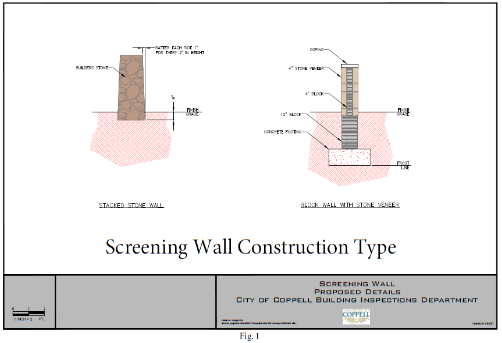
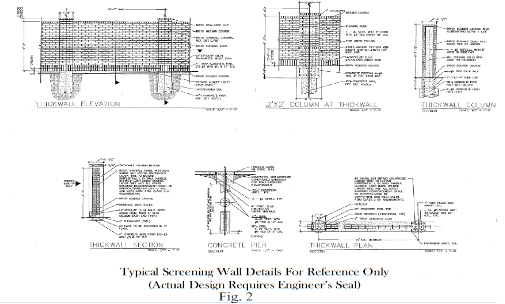
All construction wall plans and evaluations shall be sealed by an engineer, licensed under Texas law, prior to issuance of a building permit. Trees shall be planted in the landscape strip between the curb and screening wall according to the standards set forth in article 34 for residential and multi-family lots.
(B)
Where appropriate, as long as the view beyond the fence is appropriately landscaped and is not a view of the rear yards or fences of housing, a combination of brick and ironwork can be utilized. The masonry portion shall be constructed according to the criteria described in the previous paragraph (A). Landscaping and maintenance requirements are also identical except that a landscaped area must be provided behind open ironwork to provide an appropriate view beyond. These landscaped areas beyond shall also become the responsibility of an owners association or individual property owner to provide proper maintenance.
(C)
Where subdivisions are platted so that the side yards of single-family residential lots are adjacent to a roadway that is identified as a primary or secondary image zone in the approved city streetscape plan, the developer shall provide a screening wall to screen the rear portion of the lots. The wall shall conform to criteria established in paragraphs A and B of this subsection. The length of wall shall be equal to one-half of the depth of the lot or to the fenced in rear portion of the lot, whichever is greater.
(D)
Where subdivisions are platted so that the side yards of single-family residential lots are adjacent to a dedicated roadway and where a cul-de-sac approaches the paved roadway, but does not intersect with it, the developer shall provide, at his sole expense, a living screen composed of plants in the approved plant palette. Plants shall be a minimum of three feet in height. Plant spacing shall vary, depending on the type of plants, as required by the city council; however, suggested maximum spacings are 25 feet for trees and 12 feet for shrubs. A solid living screen is not required. The living screen shall not be planted opposite the front yard of residential lots which front on streets which intersect with the paved roadway. The developer shall provide total maintenance for the living screen until adjacent lots are sold. At the end of the maintenance period, all plants in the living screen shall be in a healthy and growing condition. The living screen shall be planted between the sidewalk and the right-of-way line.
(E)
At development and subdivision entry features, all walls and raised planter beds shall be of brick or stone construction unless otherwise approved by the planning and zoning commission and city council. The wall construction and landscaped requirements of paragraphs (A) and (B) shall apply to development and subdivision entry features. In addition, the design of the entry feature must conform to the visibility requirements of the subdivision and zoning ordinances. Paving materials should be incorporated into the design of the pavement at entry features in a manner compatible with that used at major or secondary intersections in the city.
(F)
In the light industrial zoned district where the site is not adjacent to a residential zoned district or a residential use screening walls shall be constructed of a masonry material and design that is compatible with the adjacent building.
9.
Where subdivisions are platted so that the rear yards of single-family, two-family, or townhouse residential lots are adjacent to a dedicated roadway, or separated from a roadway by an alley or service road, the developer shall provide, at his sole expense, screening that conforms to section 12-33-1.8.
(Ord. No. 91500-A-30; Ord. No. 91500-A-287, § 1, 2-13-01; Ord. No. 91500-A-419, § 1, 10-11-05; Ord. No. 91500-A-552, § 1, 5-11-10; Ord. No. 91500-A-658, § 1, 11-11-14)
Sec. 12-33-2. - Maximum height and widths.
All required plant screening material shall be trimmed and pruned to prevent heights and widths which will cause visibility problems for traffic or other safety hazards, but not to a height less than the required minimums.
(Ord. No. 91500-A-30)

