Keokuk City Zoning Code
CHAPTER 20
12 - DEFINITIONS
Sections:
20.12.010 - Generally.
For the purpose of this title, certain terms and words are defined in this chapter. Words used in the present tense include the future; the singular number includes the plural and the plural the singular. "Shall" is mandatory and not directory.
(Ord. 1519 § 1, 1990)
20.12.020 - Accessory building.
"Accessory building" means a subordinate building, the use of which is incidental to and customary in connection with the principal building or use and which is located on the same lot with such principal building or use.
(Ord. 986 (part), 1965: prior code § 26-1.1)
20.12.030 - Accessory use.
"Accessory use" means a subordinate use which is incidental to and customary in connection with the principal building or use, and is located on the same lot with such principal building or use.
(Ord. 986 (part), 1965: prior code § 26-1.2)
20.12.040 - Alley.
"Alley" means a thoroughfare which affords only a secondary means of access to abutting property.
(Ord. 986 (part), 1965: prior code § 26-1.3)
20.12.050 - Apartment house.
For a definition of apartment house, see "dwelling, multiple," Section 20.12.150.
(Ord. 986 (part), 1965: prior code § 26-1.4)
20.12.055 - Bar.
"Bar" means premises used primarily for the sale of dispensing of alcoholic beverages by the drink for onsite consumption not including a restaurant or similar establishment where the main purpose is to serve food. This definition also includes pubs, nightclubs, and taverns.
(Ord. No. 2012, § 1, 12-17-20)
20.12.060 - Basement.
"Basement" means a story having part but not more than one-half its height below grade. A basement is counted as a story for the purpose of height regulations if subdivided and used for dwelling purposes other than by a janitor employed on the premises.
(Ord. 986 (part), 1965: prior code § 26-1.5)
20.12.070 - Boardinghouse.
"Boardinghouse" means a building other than a hotel, where, for compensation and by prearrangement for definite periods, meals, or lodging and meals, are provided for three or more persons, but not exceeding twenty persons.
(Ord. 986 (part), 1965: prior code § 26-1.6)
20.12.072 - Brewery, micro.
"Brewery, micro" means a facility for the production and packaging of malt beverages of low alcoholic content for distribution, retail, or wholesale, on or off-premises; with a capacity of not more than ten thousand barrels per year. The development may include other uses such as standard restaurant, bar, or live entertainment as otherwise permitted in the zoning district.
(Ord. No. 2012, § 1, 12-17-20)
20.12.074 - Brew pub.
"Brew pub" means a restaurant which includes the brewing of beer as an accessory use. The brewing operation processes water, malt, hops, and yeast into beer or ale by mashing, cooking, and fermenting. By definition, these establishments produce no more than ten thousand barrels of beer or ale annually.
(Ord. No. 2012, § 1, 12-17-20)
20.12.080 - Building.
"Building" means any structure used or intended for sheltering any use or occupancy.
(Ord. 1519 § 2, 1990)
20.12.090 - Building, height of.
"Height of building" means the vertical distance from the grade to the highest point of the coping of a flat roof or to the deck line of a mansard roof, or to the mean height level between eaves and ridge for gable, hip and gambrel roofs.
(Ord. 986 (part), 1965: prior code § 26-1.8)
20.12.100 - Cellar.
"Cellar" means a story having more than one-half of its height below the curb level or below the highest level of the adjoining ground. A cellar shall not be counted as a story for purpose of height measurement.
(Ord. 986 (part), 1965: prior code § 26-1.9)
20.12.102 - Clear zone.
An area at a street intersection in which nothing shall be erected, placed, planted or allowed to grow in such a manner as to impede vision or exceed a height of two and one-half feet above street grade, measured from the point of intersection of the public rights-of-way, twenty-five feet in either direction along the right-of-way lines.
(Ord. 1829 § 1, 2007)
20.12.110 - Clinic, medical.
"Medical clinic" means an establishment where patients are not lodged overnight, but are admitted for examination or treatment by a group of physicians or dentists and including medical and related health groups practicing medicine together.
(Ord. 1030 § 1, 1967: Ord. 986 (part), 1965: prior code § 26-1.10)
20.12.120 - Club.
"Club" means a building or portion thereof or premises owned or operated by a corporation, association, person or persons for a social, educational or recreational purpose, but not primarily for profit or to render a service which is customarily carried on as a business.
(Ord. 986 (part), 1965: prior code § 26-1.11)
20.12.124 - Condominium.
"Condominium" means multiple units wherein the fee title to each is held independently and where there are also commonly owned areas and facilities.
(Ord. 1419 § 1, 1985)
20.12.130 - District.
"District" means a section or sections of the city for which the regulations governing the use of buildings and premises, the height of buildings, the size of yards and the intensity of use are uniform.
(Ord. 986 (part), 1965: prior code § 26-1.12)
20.12.140 - Dwelling.
"Dwelling" means any building or portion thereof which is designed and used exclusively for residential purposes.
(Ord. 986 (part) 1965: prior code § 26-1.13)
20.12.150 - Dwelling, multiple.
"Multiple dwelling" means a building having accommodations for and occupied exclusively by more than two families.
(Ord. 986 (part), 1965: prior code § 26-1.16)
20.12.160 - Dwelling, single-family.
"Single-family dwelling" means a building having accommodations for and occupied exclusively by one family.
(Ord. 986 (part), 1965: prior code § 26-1.14)
20.12.170 - Dwelling, two-family.
"Two-family dwelling" means a building having accommodations for and occupied by two families.
(Ord. 986 (part), 1965: prior code § 26-1.15)
20.12.180 - Factory-built home.
"Factory-built home" means a structure, transportable in one or more sections, which is built on a permanent chassis and is designed for use with or without permanent foundation when connected to the required utilities.
(Ord. 1519 § 7, 1990)
20.12.181 - Factory-built home park or subdivision.
"Factory-built home park or subdivision" means a parcel (or contiguous parcels) of land divided into two or more factory-built home lots for rent or sale.
(Ord. 1519 § 8, 1990)
20.12.182 - Factory-built home park development plan.
"Factory-built home park development plan" means a custom-made design for a specific site or area consisting of drawings, maps and engineering details to set forth the boundary, topography and overall park or subdivision design, including streets, parking facilities, factory-built home space locations and service facilities.
(Ord. 1519 § 9, 1990)
20.12.183 - Factory-built home space.
"Factory-built home space" means a plot of ground within the factory-built home park or subdivision designed for the accommodation of one factory-built home.
(Ord. 1519 § 10, 1990)
20.12.185 - Family.
"Family" means an individual or two or more persons related by blood or marriage or a group of not more than five persons (excluding servants) who need not be related by blood or marriage living together in a dwelling unit.
(Ord. 1519 § 3, 1990)
20.12.190 - Filling station.
"Filling station" means any building or premises used for sale at retail of any automobile fuels or oils, or accessories or for servicing or lubricating motor vehicles or installing or repairing parts and accessories, but not including the repairing or replacement of motors, bodies or fenders of motor vehicles, or painting motor vehicles, and excluding public garages.
(Ord. 986 (part), 1965: prior code § 26-1.18)
20.12.200 - Frontage.
"Frontage" means all the property on one side of a street between two intersecting (crossing or terminating) streets measured along the line of the street, or if the street is dead-ended, then all of the property abutting on one side between an intersecting street and the dead-end of the street.
(Ord. 986 (part), 1965: prior code § 26-1.19)
20.12.210 - Garage, private.
"Private garage" means a building or part thereof accessory to a main building and providing for the storage of motor vehicles owned and used by the occupant of the residence to which is accessory.
(Ord. 1828 § 1, 2007)
20.12.220 - Garage, public.
"Public garage" means a building or portion thereof, other than a private or storage garage, designed or used for equipping, repairing, hiring, servicing, selling or storing motor-driven vehicles. "Repairing" does not include dismantling or storage of wrecked or junked vehicles.
(Ord. 986 (part), 1965: prior code § 26-1.21)
20.12.230 - Garage, storage.
"Storage garage" means a building or portion thereof designed or used exclusively for housing more than three motor-driven vehicles.
(Ord. 986 (part), 1965: prior code § 26-1.22)
20.12.240 - Grade.
"Grade" means:
(1)
For buildings having walls adjoining one street only, the elevation of the sidewalk at the center of the wall adjoining the street;
(2)
For buildings having walls adjoining more than one street, the average of the elevation of the sidewalk at the center of all walls adjoining the streets;
(3)
For buildings having no wall adjoining the street, the average level of the finished surface of the ground adjacent to the exterior walls of the building;
(4)
Any wall approximately parallel to and not more than five feet from a street line is to be considered as adjoining the street. Where no sidewalk exists the grade shall be established by the city engineer.
(Ord. 986 (part), 1965: prior code § 26-1.23)
20.12.250 - Home occupation.
(a)
"Home occupation" means any occupation or activity which is clearly incidental and secondary to the use of the premises for dwelling and which is carried on wholly within a main building or accessory building by a member of the family residing on the premises, provided that:
(1)
No person not a resident on the premises is employed, except one part-time person;
(2)
No internal or external alterations or special construction of the premises are involved, except that which would require proper sanitation. City route garbage collection for discarded manufacturing refuse is prohibited;
(3)
No equipment shall be used which creates offensive noise, vibration, sound, smoke, dust, odors, heat, glare, x-ray or electrical disturbance to radios or television instruments;
(4)
No increase of vehicular or pedestrian traffic or parking demand is created;
(5)
There is no other exterior indications that the building is being used for any purpose other than a dwelling, except a sign, not greater than two square feet, may be allowed and may be lighted, indirectly;
(6)
All raw materials which are explosive, caustic, corrosive or otherwise dangerous alone or in conjunction with one another may not be used in the production process. All storage of raw materials and finished product must be within enclosed, covered areas within the home or any accessory building. Work required for completion or repair of product must be accomplished within the home or any accessory building. Exterior display of finished goods with advertising is prohibited.
(b)
"Home occupations" shall be required to obtain a special use permit as provided for in Chapter 20.68.
Exceptions: the following uses shall not be considered "home occupations": child care for not more than six children at a time, including the provider's children; teaching and tutoring of not more than two pupils at a time; phone and/or door-to-door sales; recordkeeping activities involved in small service-oriented businesses, such as electricians, plumbers, heating and air conditioning and general contractors who normally travel to other locations to work.
(c)
New start-up "home occupations" shall be required to obtain a special use permit as provided for in Chapter 20.68. Existing "home occupations," which have not already been granted permission to operate by the board of adjustment, at the time of final passage of the ordinance codified in this section, shall be required to register, within ninety days of final passage and continuing on an annual basis, with the city clerk or community development office. Fees for such registration shall be determined by the city council by resolution and may be modified at any time. If the standards for home occupation contained in subsection (a) of this section cannot be met or any unusual hardship or circumstance is caused by such standard, a hearing as provided for in Chapter 20.68, upon payment of fees normally required for such requests, shall be required and determination made by the board of adjustment to allow continued operation.
(d)
Failure to register or apply for special use permit or follow conditions attached to a special use permit issued by the board of adjustment as set forth in this section, shall constitute a nuisance and shall be remedied by issuance of a civil citation to the property owner or responsible party, charging that person with a municipal infraction. The enforcement officer may, but shall not be required to give notice to abate by regular mail prior to issuance of a civil citation. Each day that the nuisance is permitted to continue shall constitute a separate offense.
(Ord. 1519 § 4, 1990)
20.12.260 - Hotel.
"Hotel" means any building containing six or more guest rooms intended or designed to be used, or which are used, rented or hired out to be occupied, or which are occupied, for sleeping purposes by guests.
(Ord. 1519 § 5, 1990)
20.12.270 - Institution.
"Institution" means a building occupied by a nonprofit corporation or a nonprofit establishment for public use.
(Ord. 986 (part), 1965: prior code § 26-1.26)
20.12.275 - Laboratory—Research, testing and development.
A building or portion of a building in which are located facilities for scientific or technical research, investigation, testing, experimentation, or observation or study but not facilities for the manufacture or sale of products, except as incidental to the main purpose of the laboratory.
(Ord. No. 1967, § 1, 3-16-17)
20.12.280 - Loading space.
"Loading space" means a space on the lot accessible to an alley or street, not less than ten feet in width, twenty feet in depth and ten feet in height.
(Ord. 986 (part), 1965: prior code § 26-1.27)
20.12.290 - Lodginghouse.
"Lodginghouse" means any building or portion thereof containing not more than five guest rooms where rent is paid in money, goods, labor or otherwise.
(Ord. 1519 § 6, 1990)
20.12.300 - Lot.
"Lot" means a parcel of land occupied or intended for occupancy by a use permitted in this title, including one main building together with its accessory buildings, the open spaces and parking spaces required by this title, and having its principal frontage upon a street or upon an officially approved place.
(Ord. 986 (part), 1965: prior code § 26-1.29)
20.12.310 - Lot, corner.
"Corner lot" means a lot abutting upon two or more streets at their intersection.
(Ord. 986 (part), 1965: prior code § 26-1.30)
20.12.320 - Lot, depth of.
"Depth of lot" means the mean horizontal distance between the front and rear lot lines.
(Ord. 986 (part), 1965: prior code § 26-1.31)
20.12.330 - Lot, double frontage.
"Double frontage lot" means a lot having a frontage on two nonintersecting streets, as distinguished from a corner lot.
(Ord. 986 (part), 1965: prior code § 26-1.32)
20.12.340 - Lot, interior.
"Interior lot" means a lot other than a corner lot.
(Ord. 986 (part), 1965: prior code § 26-1.33)
20.12.350 - Lot of record.
"Lot of record" means a lot which is a part of a subdivision, the map of which was recorded in the office of the recorder of Lee County, Iowa, at Keokuk; or a parcel of land, the deed to which was recorded in the office of the recorder of Lee County, Iowa at Keokuk prior to July 8, 1965.
(Ord. 986 (part), 1965: prior code § 26-1.34)
20.12.400 - Motel or motor court.
"Motel" or "motor court" means a building or group of buildings on the same lot, usually around a court, containing sleeping accommodations and providing one parking space for each guestroom on the premises.
(Ord. 986 (part), 1965: prior code § 26-1.35)
20.12.410 - Motorized home.
"Motorized home" means a portable structure designed and constructed as an integral part of a self-propelled vehicle to render it suitable for use for temporary living purposes.
(Ord. 1095 § 7, 1970: prior code § 26-1.59)
20.12.420 - Nonconforming use.
"Nonconforming use" means any building or land lawfully occupied by a use on July 8, 1965; which does not conform after July 8, 1965 with the use regulations of the district in which it is situated.
(Ord. 986 (part), 1965: prior code § 26-1.36)
20.12.430 - Nursing, rest or convalescent home.
"Nursing home," "rest home" or "convalescent home" means a home for the aged or infirm in which three or more persons not of the immediate family are received, kept or provided with food and shelter or care for compensation, but not including hospitals, clinics or similar institutions devoted primarily to the diagnosis and treatment of the sick or injured.
(Ord. 986 (part), 1965: prior code § 26-1.37)
20.12.440 - Office.
"Office" means a place where business or services for others is transacted, and not a place where chattels or goods, wares or merchandise are commonly created, exchanged or sold.
(Ord. 986 (part), 1965: prior code § 26-1.38)
20.12.450 - Parking area.
"Parking area" means an open, unoccupied space used or required for use for parking of vehicles exclusively and in which no gasoline or vehicular accessories are sold or no other business is conducted and no fees are charged.
(Ord. 986 (part), 1965: prior code § 26-1.39)
20.12.460 - Parking lot.
"Parking lot" means an open surfaced area used exclusively for the temporary storage of motor vehicles and within which motor fuels and oils may be sold and fees charged, but no vehicles are to be equipped, repaired, rented or sold.
(Ord. 986 (part), 1965: prior code § 26-1.39(1))
20.12.470 - Parking space.
"Parking space" means an all-weather surfaced area not in a street or alley and having an area of not less than one hundred eighty square feet, exclusive of driveways, permanently reserved for the temporary storage of one automobile and connected with a street or alley by an all-weather surfaced driveway which affords ingress and egress for an automobile without requiring another automobile to be moved.
(Ord. 986 (part), 1965: prior code § 26-1.39(2))
20.12.480 - Pickup coach.
"Pickup coach" means a structure designed primarily to be mounted on a pickup truck chassis and with sufficient equipment to render it suitable for use as temporary living purposes.
(Ord. 1095 § 9, 1970: prior code § 26-1.60)
20.12.490 - Place.
"Place" means open unoccupied space other than a street or alley permanently reserved as the principal means of access to abutting property.
(Ord. 986 (part), 1965: prior code § 26-1.40)
20.12.500 - Porch, open or unenclosed.
"Open or unenclosed porch" means a roofed structure attached to a building and open on two or more sides. A screened-in porch shall not be considered open.
(Ord. 986 (part), 1965: prior code § 26-1.41)
20.12.505 - Recycling center.
"Recycling center" shall mean the land or appurtenances thereon and structures where recyclable waste is collected or sorted for processing. It may or may not be open to the public for personal deposit of recyclable materials. Recyclable materials usually include, but are not limited to metals, plastics, paper, cardboard, wood, and organic waste, and such a facility may include the bailing, compacting, grinding, shredding, or other similar functions of recyclable materials.
(Ord. No. 1961, § 4, 11-3-16)
Editor's note— Ord. No. 1961, § 4, adopted November 3, 2016, set out provisions intended for use as § 20.12.507. For purposes of classification, and at the editor's discretion, these provisions have been included as § 20.12.505.
20.12.507 - Redemption center.
"Redemption center" means a facility, licensed or "approved" by the Iowa Department of Natural Resources (DNR), at which consumers may return empty beverage containers and receive payment for the refund value of the empty beverage containers, including those utilizing.
(a)
Minor Redemption Facility. A "minor redemption facility" is a "redemption center" which is not the primary use of the parcel, business, or center.
(b)
Major Redemption Facility. A "major redemption facility" is a "redemption center" which is the primary use of a parcel, business, or center, including only sorting of recyclable materials, but does not include bailing, compacting, grinding, shredding, or other similar functions.
(Ord. No. 1961, § 4, 11-3-16)
Editor's note— Ord. No. 1961, § 4, adopted November 3, 2016, set out provisions intended for use as § 20.12.505. For purposes of classification, and at the editor's discretion, these provisions have been included as § 20.12.507.
20.12.508 - Restaurant.
"Restaurant" means a use engaged in the preparation and retail sale of food and beverages, including the sale of alcoholic beverages when conducted as an accessory and secondary feature and producing less than fifty percent of the gross income.
(Ord. No. 2012, § 1, 12-17-20)
20.12.510 - Roominghouse.
For a definition of "roominghouse," see "lodginghouse," Section 20.12.290.
(Ord. 986 (part), 1965: prior code § 26-1.42)
20.12.515 - Storage container.
"Storage container" means a container, including what is sometimes referred to as storage "pods" or "portable on demand storage units"; any box van that has been disconnected from a chassis; and similar intermodal type shipping/cargo containers, that are (a) designed and commonly used for storing, shipping or transporting products and materials, and (b) are typically transported by a separate motorized vehicle or upon a trailer.
(Ord. No. 1936, § 2, 9-18-14)
Editor's note— Ord. No. 1936, § 1, adopted September 18, 2104, repealed the § 20.12.515, and enacted a new § 20.12.515 as set out herein. The former § 20.12.515 pertained to storage container or storage trailer and derived from Ord. No. 1800, 2005.
20.12.517 - Storage trailer.
"Storage trailer" includes any dry freight van, semi-trailer, tractor trailer, refrigerated van, or similar type trailer, whether connected to a chassis or trailer or not, used for storage and/or warehousing purposes or any purpose or intent other than that for which the container or trailer was originally designed, that being for the shipping and transporting of products and materials.
(Ord. No. 1936, § 2, 9-18-14)
20.12.520 - Story.
"Story" means that portion of a building, other than a cellar, included between the surface of any floor and the surface of the floor next above it or, if there is no floor above it, then the space between the floor and the ceiling next above it.
(Ord. 986 (part), 1965: prior code § 26-1.44)
20.12.530 - Story, half.
"Half story" means a space under a sloping roof which has the line of intersection of roof decking and wall face not more than three feet above the top floor level, and in which space not more than sixty percent of the floor area is finished off for use.
(Ord. 986 (part), 1965: prior code § 26-1.45)
20.12.540 - Street.
"Street" means all property dedicated or intended for public or private street, highway, freeway or roadway purposes or subject to public or private easement therefor.
(Ord. 986 (part), 1965: prior code § 26-1.43)
20.12.550 - Street line.
"Street line" means a dividing line between a lot, tract or parcel of land and a contiguous street.
(Ord. 986 (part), 1965: prior code § 26-1.46)
20.12.560 - Structural alterations.
"Structural alterations" means any change in the supporting members of a building, such as bearing walls or partitions, columns, beams or girders, or any complete rebuilding of the roof or the exterior walls.
(Ord. 986 (part), 1965: prior code § 26-1.48)
20.12.570 - Structure.
"Structure" means that which is built or constructed, an edifice or building of any kind, or any piece of work artificially built up or composed of parts joined together in some definite manner.
(Ord. 1519 § 11, 1990)
20.12.580 - Tourist or trailer camp.
"Tourist camp" or "trailer camp" means an area intended to provide space where one or more tents or trailers can be parked for overnight camping not to exceed two weeks.
(Ord. 1095 § 1, 1970: Ord. 986 (part), 1965: prior code § 26-1.49)
20.12.584 - Townhouse.
"Townhouse" means a building with four, but not more than ten, one-family dwelling units erected in a row as a single building on adjoining lots, each being separated from the adjoining unit or units by a party wall or walls extending from the basement floor to the roof along the dividing lot line, and each such building being separated from any other building by space on all sides.
(Ord. 1519 § 12, 1990)
20.12.590 - Reserved.
Editor's note— Ord. No. 1936, § 1, adopted September 18, 2014, repealed § 20.12.590, which pertained to trailer and derived from prior code § 26-1.50; Ord. No. 98, 1965 and Ord. No. 1095.
20.12.600 - Yard.
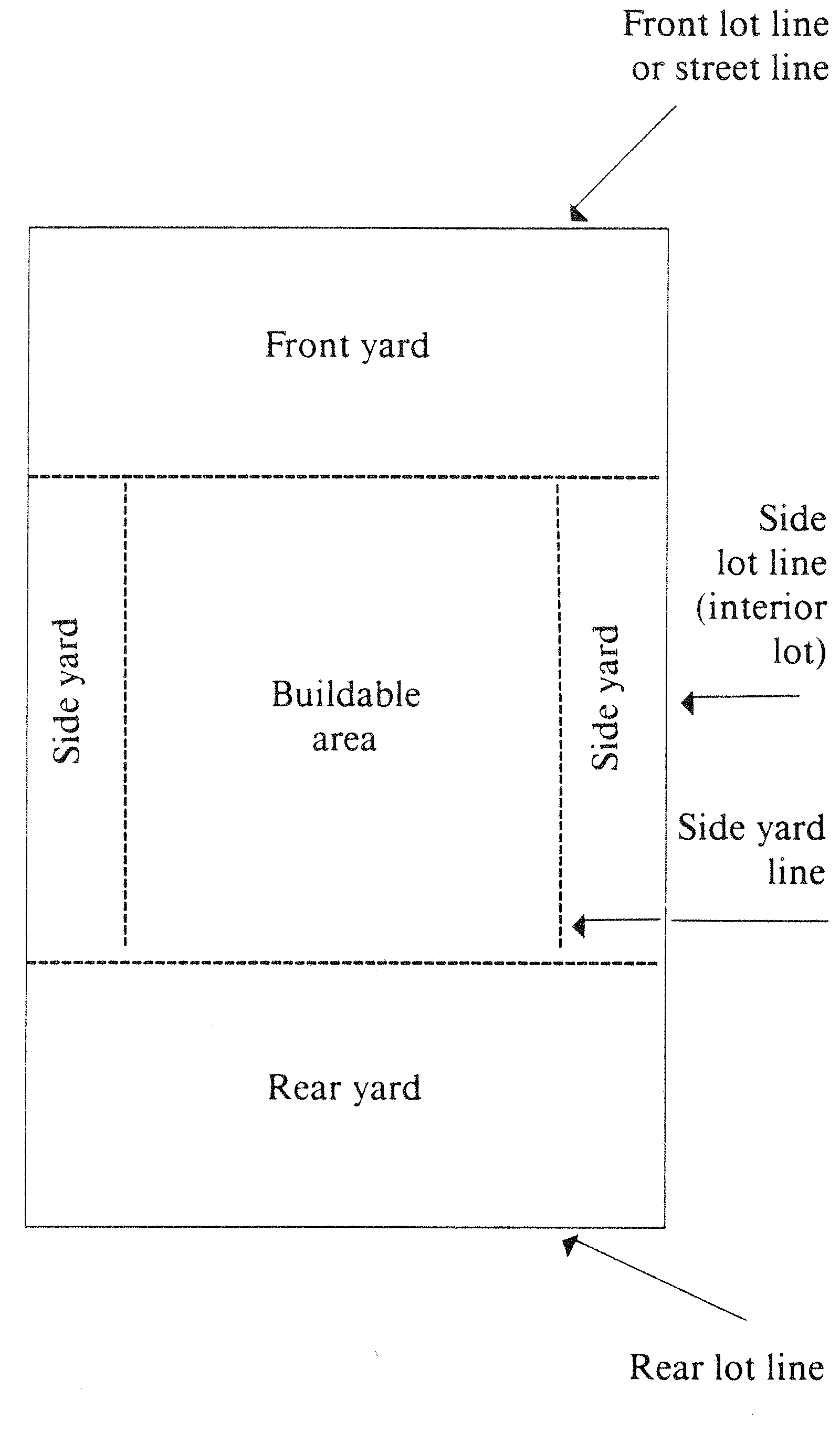
"Yard" means an open space on the same lot with a building, unoccupied and unobstructed by any portion of a structure from the ground upward, except as otherwise provided in this title. In measuring a yard for the purpose of determining the width of a side yard, the depth of a front yard or the depth of a rear yard, the minimum horizontal distance between the lot line and the main building shall be used.
(Ord. 986 (part), 1965: prior code § 26-1.51)
20.12.610 - Yard, front.
"Front yard" means a yard extending across the front of a lot between the side lot lines, and being the minimum horizontal distance between the street line and the main building or any projections thereof other than the projection of the usual steps, unenclosed balconies or open porches.
(Ord. 986 (part), 1965: prior code § 26-1.52)
20.12.620 - Yard, rear.
"Rear yard" means a yard extending across the rear of a lot, measured between the side lot lines, and being the minimum horizontal distance between the rear lot line and the rear of the main building or any projections other than steps, unenclosed balconies or unenclosed porches. On corner lots the front line of the rear yard shall be considered as parallel to the street upon which the lot has its least dimension. On both corner lots and interior lots the rear yard shall in all cases be at the opposite end of the lot from the front yard.
(Ord. 986 (part), 1965: prior code § 26-1.53)
20.12.630 - Yard, side.
"Side yard" means a yard between the main building and the side line of the lot, and extending from the front yard line to the rear yard line.
(Ord. 986 (part), 1965: prior code § 26-1.54)