
Largo City Zoning Code
CHAPTER 9
ACCESS MANAGEMENT, TRAFFIC CIRCULATION AND PARKING STANDARDS
Section 9.1 - Purpose
The regulations in this section govern transportation systems within the City, including vehicular and non-vehicular parking, driveways, intersections, and lighting. These standards are established to provide safe and efficient circulation, and to implement the objectives and policies of the Comprehensive Plan. While it is recognized that the automobile is the predominant mode of transportation within the City at this time, the parking requirements outlined in this chapter are intended to encourage bicycling, walking, as well as the use of transit, Transportation Demand Management (TDM), and shared use of parking, generally throughout the City and specifically within the Activity Centers by providing a range of acceptable parking that is responsive to the market conditions and individual project needs. The City's "Engineering Design and Construction Standards," 2002 edition, and other applicable standards referenced in Chapter 18, Construction Standards, shall be used for construction in City rights-of-way and for all roads, utilities, sidewalks, bikeways, parking lots, or other required paving. Site plans requiring access to Pinellas County roads or access to State roads shall be submitted to Pinellas County or the Florida Department of Transportation (FDOT), respectively, for review and approval. In addition to the requirements of this CDC, Pinellas County and FDOT standards shall be used for construction in county and state rights-of-way, respectively.
Section 9.3 - Fire Safety
Fire Safety shall be provided per Florida Fire Prevention Code In addition:
A.
Fire lanes - Fire lanes shall be provided in accordance with the requirements of Florida Fire Prevention Code;
B.
No blocking - No parking space may block pedestrian travel, fire hydrants and/or standpipes, meter rooms, doorways, or overhead doors (except for the garage of a private dwelling); and
C.
Fire hydrants - Fire hydrants shall be located and spaced in accordance with Section 13-20 of the Code of Ordinances.
Section 9.5 - Vehicular Parking
A.
Purpose - To ensure the provision of adequate parking facilities without negative impacts upon adjacent uses and to encourage the use of bicycles as a clean, energy efficient, and inexpensive alternative means of transportation.
9.2.1 - Access Management Standards
A.
Objective - To provide safe and efficient circulation, while ensuring that on-site circulation will minimally interrupt the traffic flow of public road facilities, and to implement the objectives and policies of the adopted Comprehensive Plan. Internal streets, roads, driveways and parking, loading, and service areas shall be designed to provide safe and convenient vehicular access to all uses and facilities.
B.
Modifications - The access management requirements of this CDC may be modified by:
(1)
The City Engineer in accordance with permits issued by other agencies which have jurisdiction; or
(2)
To meet the needs of a specific situation where strict application of the requirement would be technically impractical due to existing conditions, property size, natural conditions, safety engineering/design/construction practices, or similar conditions.
C.
Public safety at access connections - In the interest of public safety, the City reserves the right to close, modify, or relocate roadway access connections where the City Engineer deems that there exists a hazard to the general public.
D.
Culs-de-sac - Culs-de-sac are allowed if approved by the City Engineer and the Development Control Officer (DCO). Culs-de-sac shall be designed to meet the City's Engineering Design and Construction Standards.
E.
Intersection separation - Where feasible, when measuring from centerline to centerline:
(1)
Intersections of roads that are designated as arterial roads should not be less than 1,320 feet apart;
(2)
Intersections of roads designated as collector roads should not be less than 660 feet apart;
(3)
Intersections of roads designated as local roads should not be less than 150 feet apart (see Figure 9-1 for illustration);
Figure 9-1: Minimum Intersection Separation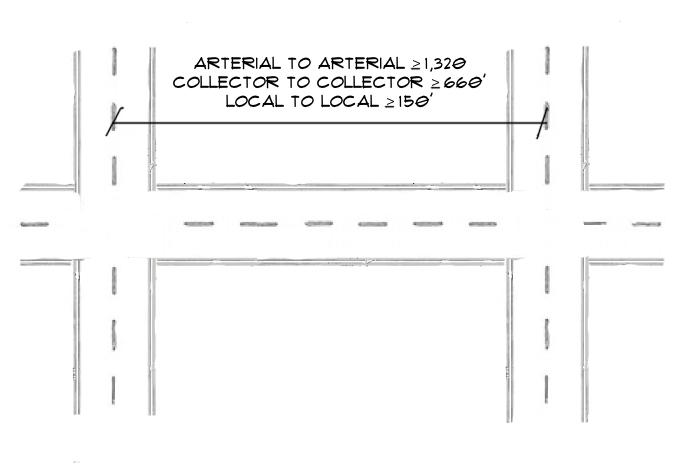
F.
Cross access - The City recognizes cross access easements, which connect adjacent properties, as an effective tool to maximize the existing roadway system capacity, improve traffic flow on arterials and collectors, improve traffic flow within development projects, protect residential areas from cut-through traffic, and assist in effective deployment of emergency services such as police and fire. Properties shall utilize cross access easements to connect adjacent properties and to allow the traveling public to more conveniently enter and exit commercial, office, and multifamily properties. It is the intent of the City to allow residents, people conducting business within the City, emergency vehicles, and special services vehicles such as transit vehicles to be able to use the cross access easements. Refer to illustration 9-2, where appropriate.
Figure 9-2: Conceptual Cross Access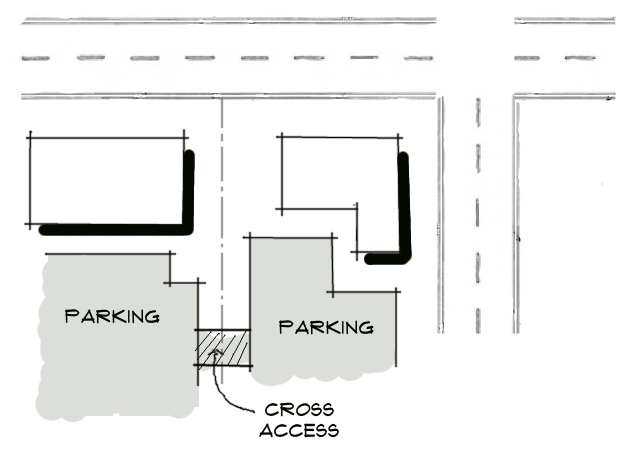
(1)
Properties fronting on arterial and collector streets shall provide cross access easements and construct cross access connections, as required by the City, as a condition of new development, redevelopment, infill development, or change of use, unless approved by the DCO.
(2)
The property owner shall grant the cross access easement to the City in the form of a cross access easement agreement acceptable to the City Attorney, which shall be recorded in the official records of Pinellas County at the owner's expense.
(3)
The cross access shall be constructed and maintained in good and useful condition by the property owner so as to reasonably implement and facilitate the use of the easement area for the easement purposes stated in this section and in the cross access easement agreement.
(4)
Cross access easements are not intended to be, nor shall they become, public rights-of-way.
(5)
Cross access easements must be a minimum of twenty-four (24) feet in width, in order to accommodate two-way vehicular travel.
(6)
Should an immediate connection to adjacent properties not be possible, or should implementation of the connection join dissimilar land uses (i.e., commercial to multifamily), the owner shall dedicate a cross access easement with a future construction obligation, which shall be in writing, in a form acceptable to the City Attorney, and shall be recorded in the official records of Pinellas County at the owner's expense.
G.
Site lighting - Lighting is required within the parking areas and walkways of all private developments. A lighting plan depicting the foot-candle illumination level limits at grade shall be submitted as part of the site plan review process.
Exposed sources of light shall be controlled so that illumination in the horizontal or vertical plane at a point five feet inside the lot line of residential properties shall not exceed one foot candle. The use of solar powered light fixtures is encouraged. The final location and intensity of the lighting shall be approved by the City Engineer.
(Ord. No. 2025-08, § 32, 6-17-2025)
9.2.2 - Driveways/Curb Cuts
The following circulation and access standards shall be met, when applicable, as a condition of site plan approval.
Figure 9-3: Minimum Distance Between Driveways and Intersections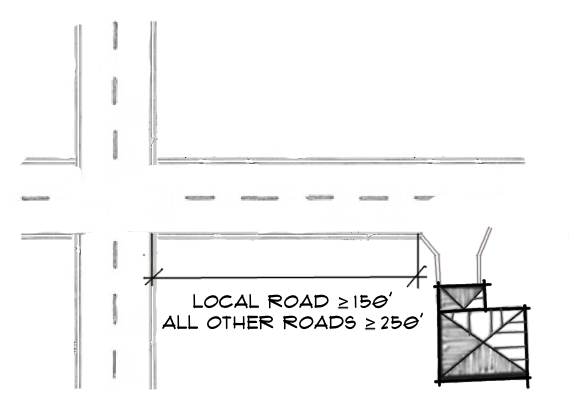
A.
Location
(1)
Driveway entrances and exits shall be located as far as possible from street intersections consistent with Figure 9-3. Except where approved by the City Engineer, curb cuts or access points shall be no closer than one hundred fifty (150) feet measured from the edge of the driveway to the edge of pavement. Curb cuts or access points along collector or arterial roadways, shall be no closer than two hundred fifty (250) feet measured from the edge of the driveway to the edge of pavement;
(2)
Curb cuts and access points along roadways constructed and/or maintained by the County or FDOT shall meet the design requirements of the City as well as the specific maintenance entity, whichever is more restrictive. Where existing driveway connections are removed, all associated right-of-way improvements must also be removed;
(3)
Driveways should align with opposite driveways, wherever feasible, when access is planned on a public road;
(4)
Curb cuts for driveways shall be minimized, and the location and number of cuts should relate to lot size, turnover rate, relationship to adjoining streets, functional classification of the roadway, and the type of clientele served;
(5)
Nonresidential lots having frontage on two (2) or more streets shall only be provided access to the street(s) with the lowest functional classification, unless approved by the DCO;
(6)
Private driveways shall have access onto the lower classification road (for example: [a] no access onto arterial roadways if access along a local road is available; and [b] no access onto local roadways if access along an improved alley is available.);
(7)
Joint curb cuts with adjacent development parcels shall be provided wherever feasible; and
(8)
Reverse-frontage lots, where the plat clearly indicates that primary access is from a local street, shall not have access from a higher classification street, unless approved by the DCO.
B.
Design
(1)
Merging and turnout lanes and traffic dividers shall be provided on abutting roadways and on-site where existing or anticipated heavy flows of traffic indicate the need;
(2)
Traffic circulation and maneuvering shall be accomplished on-site;
(3)
Except where approved by the City Engineer, driveways shall not exceed forty (40) feet in width at their junction with the street or highway pavement in commercial and industrial districts or twenty-four (24) feet in width at the property line in all other districts;
(4)
All turn radii into and within the development shall be designed to adequately accommodate emergency vehicles;
(5)
All driveways and all sidewalks crossing through driveways shall be designed and built in conformance with the Driveway Cross Section specifications in the City of Largo's Engineering Design and Construction Standards, 2008 Edition, and on file with the City Clerk; and
(6)
All front yard parking in residential areas shall be designed and built in conformance with the Driveway Cross Section specifications in the City of Largo's Engineering Design and Construction Standards, 2008 edition, and on file with the City Clerk, to provide specific design standards. Front yard parking must be on a paved surface (i.e. asphalt, concrete, bricks or pavers) and built to these design specifications.
(Ord. No. 2025-08, § 33, 6-17-2025)
9.2.3 - Visibility Triangles
A.
Purpose - Visibility triangles are portions of private property and the abutting right-of-way that must be maintained clear of visibility obstructions. Visibility triangles must be maintained at street intersections, intersections of private access points as well as intersections of private access points with sidewalks.
B.
Design standards
(1)
Street layout - Streets shall be laid out to intersect as nearly as possible at right angles. Multiple intersections involving the juncture of more than two streets shall be prohibited;
(2)
General features in the visibility triangle - Nothing shall be erected, placed, planted, or allowed to grow in such a manner as to materially obstruct vision within the visibility triangle between a height of three (3) feet and eight (8) feet above the crown of the road, with the exception of utility poles and traffic control devices. This prohibition also applies to the location of vehicle parking spaces and signs;
(3)
Sign placement - Generally, to avoid obstructing the visibility triangle, signs and other possible obstructions should be placed outside of the required visibility triangle, a minimum of twenty (20) feet away from the front edge of curb. Sight distance shall be provided to comply with the provisions of this Section;
(4)
Visibility triangle from street intersections - For all other intersecting rights-of-way and connections to public roadways, sight distance requirements shall adhere to FDOT Roadway and Traffic Design Standards, Index Number 546 (Sight Distance at Intersections), see Figure 9-4. Deviations from this standard may be made on a case by case basis, as approved by the City Engineer;
(5)
Visibility from private access points - To provide a clear view from private access drives (such as from an apartment complex, or shopping center), there shall be a triangular area of clear vision that shall meet the design requirements of the City as well as the specific maintenance entity, whichever is more restrictive.
The City Engineer reserves the right to adjust the legs of a particular visibility triangle to assure the safety of the general public; and
(6)
Visibility triangle from intersections of private access points and sidewalks - To provide a clear view from private access points and sidewalks, a triangle with five (5) foot sides extending from the intersection formed from the edge of the sidewalk and the edge of the alley or driveway access point shall be provided.
Figure 9-4: Visibility Triangle from Street Intersections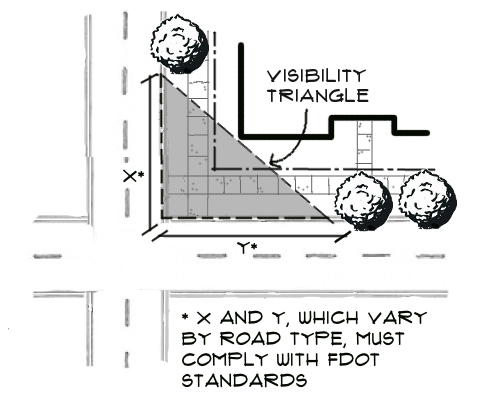
C.
Landscaping - When a public and/or private street, or driveway intersects a public right-of-way, landscaping may be used to define the intersection; provided, however, that all landscaping within the triangular areas shall provide unobstructed cross-visibility at a level between a height of two (2) and eight and one-half (8.5) feet (Figure 9-5). Trees having limbs and foliage trimmed in such a manner that no limbs or foliage extend to inhibit visibility shall be allowed, provided they are located so as not to create a traffic hazard for vehicles, pedestrians, and/or bicyclists. Landscaping, except sod or other groundcover, shall be at least three (3) feet from the edge of any right-of-way pavement.
Figure 9-5: Landscape Clear Zone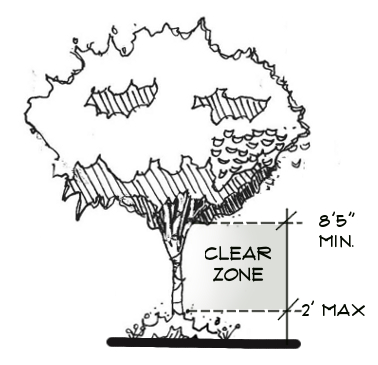
D.
Maintenance - Maintenance of the visibility triangle is the responsibility of the adjacent property owner.
9.2.4 - Rights-of-Way
A.
Objective - To maintain the adopted Levels of Service (LOS) on the transportation system by requiring the dedication and/or reservation for acquisition of rights-of-way for bikeways, pedestrian ways, and/or vehicular rights-of-way.
B.
Functional classification of rights-of-way - The roadways within the City are classified according to existing and projected future traffic counts and the type of service to be provided. Each classification has its own general design criteria and primary function. Minimum planned setbacks are established from the centerline of a road. Roadways constructed and/or maintained by the County or FDOT shall meet the design requirements of the specific maintenance entity.
The Future Transportation Map Series of the Comprehensive Plan and any amendments hereto are hereby made a part of this CDC. This map is the basis for requiring reservation or dedication of right-of-way for road improvements.
Minimum Right-of-Way Widths
Principal Arterial: 150'
Minor Arterial: 100'
Major Collectors: 80'
Minor Collectors: 60'
Local/Private Roads: 50'
Alley: 20'
C.
Dedication or reservation of rights-of-way - Dedication or reservation of rights-of-way shall be a condition of site plan approval when the width of the adjacent right-of-way is less than as shown in Table 8-3.
(1)
The DCO shall be authorized to offer incentives to encourage dedication of right-of-way by granting relief of a CDC requirement where it can be shown that the dedication would be of greater public benefit;
(2)
Required road right-of-way shall either be dedicated to the City of Largo or reserved for future acquisition;
(3)
A Phase I Environmental Audit, meeting the standards in this CDC, shall be performed on all areas to be dedicated prior to dedication and at the property owner's expense;
(4)
If an area is being reserved for future dedication, the required stormwater improvements, along with public improvements such as sidewalks and approved access driveways, may be provided within the reserved area. No buildings, parking lots, landscaping buffers, or other site improvements shall be allowed within areas reserved for future dedication; and
(5)
If an area will be dedicated at the time of site plan, no improvements of any kind shall occur within that area subject to the dedication; however, the dedicated land may be eligible for credit toward payment of Multimodal Impact Fees.
(Ord. No. 2025-01, § 26, 12-17-2024)
9.4.1 - Pedestrian Mobility (Includes Sidewalks)
A.
Objective - The proper location of sidewalks reduces reliance on fossil-fuel powered vehicles, and creates safer access and pedestrian movement for wheelchairs, strollers, the elderly, children, and pedestrians in general. Special consideration shall be made for development and redevelopment adjacent to public school facilities per the Public Schools Facilities Element (PSFE) of the Comprehensive Plan.
B.
Design standards - Sidewalks shall be installed within the right-of-way of each public and private street and in any pedestrian area within a development project.
(1)
All sidewalks shall be constructed in accordance with the Engineering Design and Construction Standards of the City;
(2)
All sidewalks must be of the same paving material and tie into sidewalks already in place; and
(3)
For property within a two (2) mile radius of any existing or planned public school facility, the developer(s) shall be responsible for the construction of sidewalk(s) along the right-of-way contiguous to the property being developed that directly serves the public school facility.
C.
Pedestrian access standards - Pedestrian access shall be arranged to provide safe and convenient routes to and from the development and need not be adjacent to, or in the vicinity of, vehicular access routes. Pedestrian ways to be used by substantial numbers of children shall be located and controlled to minimize contact with vehicular traffic. Passages over and under vehicular routes may be required. Developed recreation space and other open space intended for pedestrian use and pedestrian oriented structures, e.g., schools and churches, shall be accessible from related structures, such as dwellings and office buildings with a minimum of street crossings. Where possible, such uses shall be interconnected by a common pedestrian system. Pedestrian access shall be provided from a public right-of-way to any dedicated parkland.
9.4.2 - Bicycle Parking
A.
Purpose - Bicycle parking requirements are intended to encourage the use of bicycles as a means of transportation within the City, by ensuring the provision of bicycle parking facilities at travel destinations.
B.
Bicycle parking requirements - The provision of adequate and properly located bicycle parking shall be a condition of site plan approval.
(1)
Applicability - The City's minimum bicycle parking requirements shall apply to all new developments, redevelopments, and expansion of use that exceeds a Level I, small scale review by the City, with the exception of single-family, duplex and triplex residential lots.
(2)
Minimum bicycle parking requirement - All applicable (re)development projects, shall be required to provide no fewer than one (1) bicycle rack per building, up to the number required in Table 9-2. A bicycle rack is equivalent to five (5) bicycle parking spaces. The required number of bicycle parking spaces will be rounded up or down to the nearest interval of five (5) to determine the total number of required bicycle racks.
(3)
Maximum bicycle parking requirement - The City shall not require more than fifty (50) bicycle parking spaces, or ten (10) bicycle racks per (re)development.
(4)
Modifications - This requirement may be administratively reduced or waived by the DCO if the applicant can demonstrate that provision of the required bicycle parking would be unnecessary or inappropriate. The evidence of this claim may be provided or supported by the submission of a traffic impact analysis/parking generation study, if requested by the DCO. The minimum bicycle parking requirements for the various land uses are summarized as follows:
C.
Types of bicycle parking facilities - The type of the bicycle parking facility will depend on the use of the site and the average length of the time that bicycles are parked. The types of bicycle parking facilities and the recommended facilities are described as follows:
(1)
Short-term parking shall consist of bicycle racks or lockers that are not protected from the weather;
(2)
Long-term parking shall consist of bicycle lockers or bicycle racks located in covered areas protected from the weather, such as under a roofline; and
(3)
The provision of weather-protected bicycle parking is required for no fewer than twenty-five (25) percent of all required number of bicycle spaces on sites where the average length of parking exceeds four (4) hours per day (examples include office/industrial employee parking, educational facilities, and community facilities).
D.
Design standards - The following standards apply to all bicycle parking facilities:
(1)
The bicycle rack shall be designed to allow each bicycle to be supported by its frame, anchored to resist removal of bicycle, accommodate a variety of bicycle types and to facilitate easy locking without interfering with the surroundings in color and design and be incorporated into the building and site furniture design;
(2)
A minimum twenty-eight (28) inch clearance from the center line of adjacent bicycles shall be provided on each side, so as to allow parked bicycles to be locked to the parking rack. Said rack shall also be placed at least ten (10) inches from walls or other obstructions. Bicycle parking spaces shall be at least six (6) feet deep;
(3)
A surface of stabilized aggregate such as shale, mulch over a stabilized surface, porous asphalt, or porous concrete shall be provided in all bicycle parking areas; and
(4)
The use of grid- or fence-style bicycle racks is prohibited.
E.
Placement of facilities - Placement of bicycle parking facilities shall be approved by the DCO and:
(1)
Separated from vehicle parking by physical barriers such as curb stops or similar methods to prevent damage to the bicycles by cars;
(2)
Conveniently located adjacent to the main entrance(s) without obstructing pedestrian walkways;
(3)
Located outside required buffer areas; and
(4)
Located in a highly visible and well lighted areas including adjacent to primary building accesses, transit stops or similar.
9.4.3 - Transit Mobility
A.
Purpose - The standards contained within this Section are intended to encourage development of an environment where higher numbers of people are placed close to transit through higher densities, intensities and mixed use amenities, promoting higher ridership levels, and justifying higher service frequencies, thereby enabling transit to be more competitive with the automobile.
B.
General standards
(1)
Sidewalks shall provide direct connections from adjacent street to building entrances and civic spaces;
(2)
Transit facilities shall be easily accessible for pedestrians and bicyclists through short and direct connections from buildings, surrounding neighborhoods, and employment areas through the use of lighting, sidewalks, and signage;
(3)
Pedestrian walkways and crosswalks shall be provided from the parking areas to the building entrances;
(4)
Transit facilities shall be located, designed and constructed consistent with Pinellas Suncoast Transit Authority (PSTA) standards;
(5)
The provision of no fewer than one (1) sheltered transit facility is required for the following (re)development scenarios:
a.
(Re)development projects within a ¼-mile radius of major bus transfer facilities;
b.
Any "Large Scale Retail" (re)development, subject to all the provisions of Chapter 13 of this CDC; or
c.
Any multifamily (re)development on a parcel of land with the RH land use designation; and
(6)
Modifications: The DCO may waive the requirement for a sheltered transit facility based on PSTA requirements or if there are similar, sheltered transit facilities present or immediately adjacent to the site.
9.5.1 - Off-Street Parking
A.
Purpose - The parking space range provided in this Section is based on case study research of current parking trends of the various types of land use. The City recognizes that the requirement for excess amounts of parking can serve as a detriment to promote other modes of transportation including bicycling, walking, and transit. An excess supply of parking also results in inefficient use of land at the expense of additional building area, civic space, or landscaping. In general, the space requirement has been reduced from the previously adopted standards, in order to address the problems associated with excess parking.
B.
Applicability - At the time of construction of any building or structure, when any building or structure is enlarged or increased in capacity by ten (10) percent or 2,500 gross square feet, whichever is less, when a more intensive use occupies a parcel, or when dwelling units are added, off-street parking spaces, with adequate provisions for ingress and egress, shall comply with the requirements of Table 9-2. Unless otherwise noted, off-street parking requirements for non-residential uses are primarily based on the square footage of the gross floor area (GFA) of the use. Off-street parking requirements for residential uses shall be based on number of dwelling units.
C.
Minimum and maximum thresholds - Developments shall not provide less than ninety (90) percent of the minimum required parking or more than one hundred and ten (110) percent of the maximum parking except where provisions for shared parking and/or multi-use parking facilities are proposed or as approved by the DCO upon submission of an approved parking study.
D.
Other uses - Parking requirements for uses not listed in the table shall be determined by the DCO and the City Engineer.
E.
Community Redevelopment Districts (CRDs) -
(1)
Parking. In general, parking standards may be met by one or a combination of the following methods:
a.
Surface or Structured Parking - Surface or structured parking may be provided on- or off-site from the parcel it serves. Parking lots and garages will be located no closer to the front property line than the facade of the building they serve. Side and rear yard areas may be used for parking.
(i)
Surface parking lots fronting street rights-of-way shall not exceed thirty percent (30%) of the parcel length, and must be screened from view by a wall, fence, landscaping, or combination thereof.
(ii)
For residential-only properties that adjoin an improved alley, vehicular access to parking shall be provided from the alley rather than a street frontage.
b.
Payment in lieu of parking spaces - The City of Largo may explore the creation of a City Parking Trust Fund. Payment in-lieu-of parking spaces, up to a percentage of total required parking, could contribute to a parking fund created to provide public parking within the Community Redevelopment Districts.
c.
On-Street Parking - On-street parking along street adjacent to the development may be counted toward fulfilling the parking requirements.
d.
Alternatives to automobile parking - The City may consider additional alternative parking measures from those previously listed.
(i)
Bicycle parking in lieu of off-street parking: A development may provide additional bicycle parking spaces, greater than the number required in the CDC. The additional spaces may be counted toward fulfilling the required automobile parking spaces at a ratio of 1:1 up to a maximum of ten percent (20%) of the required automobile spaces.
(ii)
Commuter Choice Program: A development may provide a comprehensive commuter choice program administered by an Employee Transportation Coordinator in lieu of a maximum of twenty percent (20%) of the required automobile spaces. The program will include participation in Pinellas Suncoast Transit Authority (PSTA) Universal Pass Program (UPASS) and/or Vanpool Program and the inclusion of a relevant transit amenity (e.g. bus shelter, bus bay, dedicated vanpool parking spot, etc.). The program may also include flextime, vanpool/carpool subsidies, designated vanpool/carpool parking, and multimodal promotion programs.
e.
Parking Reductions. The required number of parking spaces may be reduced by up to twenty-five percent (25%) pursuant to the following:
(i)
Proximity to premium transit stops - Developments within a quarter mile of a premium transit stop are eligible for a parking reduction, provided the use is connected to the premium transit stop by sidewalks, pedestrian walkways, shared use paths, or other means of pedestrian access.
(ii)
Affordable Housing - A parking reduction is available for those developments utilizing the affordable housing bonuses outlined in tables 7-2 and 7-6 for each CRD.
F.
Pervious parking - Pervious pavement is an acceptable Low Impact Development (LID) strategy, subject to the approval of the DCO/City Engineer prior to construction and or implementation. Pervious parking must be designed consistent with the City's Engineering Standards Manual. Pervious parking shall not be located within the minimum required buffer, required open space area, or retention area. Up to fifty (50) percent of the parking spaces may remain unpaved, subject to the DCO's approval. The applicant shall supply evidence demonstrating that the lack of paving would have no detrimental effects such as erosion, reduced air or water quality, or other significant degradation of the natural or built environment. Driveway aisles must be fully paved.
G.
Parking for compact vehicles/alternative vehicles - In cases where a development complies fully with the minimum required number of parking spaces, a maximum of twenty-five (25) percent of the required spaces may be reserved for use by compact vehicles and/or alternative vehicles. All compact parking areas must be clearly designated through the use of signage and pavement markings. Compact parking spaces must be distributed throughout the entire parking area with no more than fifty (50) percent of the proposed compact parking spaces located in any one (1) area.
H.
Minimum parking dimensions - Minimum space width shall be consistent with the Engineering Standards Manual and in no case be less than eight feet and six inches (8'6") and eighteen (18) feet in depth. The proposed parking area layout shall be subject to approval by the City Engineer.
I.
Off-site parking - One (1) or more parking areas needed to meet the applicable parking requirements for a primary development site may be located on noncontiguous lots or parcels, subject to the following conditions:
(1)
The availability of the off-site parking areas must be guaranteed in perpetuity by virtue of common ownership with the primary site, recorded easements, or other binding agreements acceptable to the City;
(2)
The off-site parking areas shall be located within a ¼-mile radius of the primary site, as measured from the driveway to the main building entrance on the primary site. Sidewalks, shade structures (such as awnings, or landscape materials providing shading), as well as pedestrian lighting to ensure safe pedestrian access to and from the off-site parking shall be provided;
(3)
The off-site parking areas and the primary area shall meet the development standards applicable to the primary site;
(4)
A nonresidential use proposing off-site parking on a residential parcel shall be reviewed under the conditional use standards of this CDC, whereby compatibility with the neighborhood shall be required. The burden of proof that the proposed parking lot will not create negative impacts upon the neighborhood it encroaches upon shall fall on the applicant proposing the off-site parking and not the residents of the impacted neighborhood.
(5)
When a parking area is developed separately from the primary site, a permit application shall be made to the Engineering Department.
(Ord. No. 2025-01, § 27, 12-17-2024; Ord. No. 2026-07, § 26, 5-19-2026)
9.5.2 - Alternatives to the Provision of Required Off-Street Parking
A.
On-street parking - On-street parking along local roads and minor collectors, is permitted where designated. On-street parking is allowed along major collectors, arterials, and limited access facilities only when a traffic study demonstrates adjustments to the roadway facility will compensate for the loss of capacity and provide for a safe means of entering and exiting parking spaces, as approved by the DCO. A reduction in the number of off-street parking spaces required may be granted by the DCO, if the conditions of the on-street parking otherwise meet the requirements of Section 9.5.1.
B.
Provision of multimodal site design elements - Parking reductions may be granted by the DCO for a project that incorporates multimodal design features which correspondingly reduce the requirements for parking on-site. Such design features may include but are not limited to:
(1)
Cross-access for pedestrian bikeway circulation as part of an overall system;
(2)
Participation by business owners in a shuttle bus service system;
(3)
The provision of bus parking facilities; or
(4)
Integration of transit facilities that are above and beyond the requirements of this CDC.
If the DCO determines that a development provides two or more of the above elements, or similar, the DCO may reduce the required minimum parking requirement by ten (10) percent without the requirement for a parking study or may allow the development to exceed the maximum pervious pavement ratio of fifty (50) percent by an additional five (5) percent.
C.
Shared parking - The DCO may authorize a reasonable reduction in the total number of required parking spaces for two (2) or more contiguous developments which jointly provide off-street parking when the hours of maximum parking demand of said developments do not normally overlap or where an adjacent existing development may have parking capacity in excess of that currently required by this CDC or there is available on-street parking within ¼-mile of the property(s). Said excess parking capacity may be credited toward the minimum requirement for the primary site.
The following conditions must be met:
(1)
Sufficient data to demonstrate that hours of maximum parking demand of the respective developments do not normally overlap must be submitted to the City and found to be valid by the City Engineer;
(2)
There must be one (1) or more paved driveway connections or one (1) or more pedestrian connections between the parking areas of the developments involved. The number, location(s), and design specifications of said driveway(s) and pedestrian connections must be acceptable to the City Engineer; and
(3)
A cross-access and cross-parking easement agreement, in recordable form acceptable to the City, must be executed by the owners of all developments involved. Said agreement must guarantee the joint use of a specified number of parking spaces, approved by the City, until additional parking sufficient to comply fully with the applicable provisions of this CDC has been provided elsewhere. The easement shall be recorded in the official records of Pinellas County at the owner's expense.
D.
Parking modification - An applicant can request modification from the parking requirements (minimum or maximum adopted parking range) in conjunction with submission of traffic impact analysis/parking generation study. If supported by the findings of the analysis or study, the DCO may approve a modification in the number of required parking spaces.
9.5.3 - Accessible (ADA) Parking Space Requirements
A.
Number of spaces - The number of required accessible parking spaces shall be based on the requirements as listed in the following table. Accessible Parking spaces are permitted to be counted towards the total number of required spaces. Accessible parking design shall comply with Chapter 553, Part II, Florida Statutes (F.S.).
9.5.4 - Parking Lot Design
A.
Development review - The City Engineer and the DCO shall review and approve all proposed parking lot designs.
B.
Drainage - All off-street parking facilities shall be drained so as not to cause any nuisance to adjacent or public property.
C.
Lighting
(1)
Any lighting thereon shall be so oriented and shielded to prevent any glare or excessive light on adjacent property;
(2)
Light poles should be arranged on the perimeter of the lot. Large parking lots may include light poles within landscaped areas of the interior of the parking lot;
(3)
Light poles are not permitted within drive aisles or in stall lines between parking spaces; and
(4)
A combination of lighting heights should be used to reflect different lighting functions, i.e. driveways - 30 feet; parking areas 20—25 feet; pedestrian areas 10—15 feet.
D.
Layout -
(1)
Parking facilities shall be arranged for convenient access and safety of pedestrians and vehicles. Parking that is attached to the immediate front of a building should be avoided. Parking stall aisles should be perpendicular to the building in order to provide safer building access;
(2)
Access aisles and driveways shall be of sufficient size to accomplish traffic circulation and maneuvering on site;
(3)
Interior throughways within parking areas shall be separated from parking aisle areas; and
(4)
Where "dead-end" parking aisles are proposed, they should not exceed one hundred (100) feet in length. In addition, adequate reserve maneuvering space, a minimum of five (5) feet, must be provided to prevent use of buffers for turning Sign the reserve space with a "no parking" sign.
E.
Landscaping - All landscape shall be provided consistent with Chapter 10 of this CDC for interior vehicular use areas to provide visual and climatic relief from broad expanses of pavement and to channelize and define pedestrian, bicycle, and vehicular traffic.
F.
Primary drive aisles - Parking spaces shall not be permitted on primary drive aisles within one hundred fifty (150) feet of the intersection of a driveway and a public or private roadway as measured from the edge of pavement of the public or private road where the drive aisle serves to provide access to multiple parking fields, two or more lots or is approved as an access easement. The City Engineer may waive this requirement as part of a site plan. This requirement shall not apply where only the drive aisle serves less than twenty-five (25) parking spaces or does not provide connection to adjacent properties.
G.
Large parking lots - Additional parking lot design standards consistent with those contained in Chapter 13 Large Scale Retail Uses are required within all new or redeveloped parking areas. For sites containing more than one hundred (100) parking spaces, sites shall be defined so that no more than fifty (50) spaces of the total required spaces are part of a clearly defined grouping of spaces. Such groups shall be broken into individual areas and/or separated by landscaping and/or by design components of the site or building. The DCO may waive certain standards necessary to meet the needs of a specific situation where strict application of the requirement would be technically impractical due to existing conditions, property size, natural conditions, safety constraints, engineering/design/construction practices, or similar conditions.
(Ord. No. 2025-01, § 28, 12-17-2024)
9.5.5 - Reserved
Editor's note— Ord. No. 2025-08, § 34, adopted June 17, 2025, repealed § 9.5.5, which pertained to electric vehicle (EV) readiness within activity centers and multimodal corridors and derived from Ord. No. 2022-02, § 4, adopted March 15, 2022.

