
Largo City Zoning Code
CHAPTER 13
LARGE SCALE RETAIL DEVELOPMENT STANDARDS
13.1.1 - Purpose
To set forth standards for the architectural and site design for large scale retail uses to enhance the function of commercial development, minimize community impacts associated with such uses, and improve the visual appearance of large scale retail uses.
13.1.2 - Applicability
The standards of this section shall apply to commercial uses as identified in Chapter 6, Table 6-1 Allowable Uses Within Land Use Classifications, subject to the following thresholds for gross floor area of the building:
A.
New construction of freestanding retail uses, which shall include but not be limited to a home improvement store, retail warehouse club, pet store or supermarket equal to or greater than 50,000 square feet.
B.
New construction of a shopping center equal to or greater than 75,000 square feet.
C.
Any addition of 25,000 square feet or more to an existing freestanding commercial structure of 50,000 square feet or more.
13.2.1 - Maximum Building Footprint
A maximum building footprint for all freestanding retail uses and home improvement stores is 125,000 square feet. The Development Controls Officer (DCO) shall be authorized to require a minimum building separation between adjacent buildings to ensure that the development is consistent with the intent and purpose of this Section.
13.2.2 - Building and Site Design
A.
Building design
(1)
Architectural Unity:
a.
All buildings on the same development site shall be architecturally unified through consistent architectural style, color scheme, building materials and roof treatments.
b.
All sides of each building shall have a finished appearance with consistent architectural style, color scheme, building materials, trim features and roof treatments.
(2)
Exterior Materials:
a.
Predominant exterior building materials shall be composed of high quality materials, such as architectural block, brick, concrete with an architectural finish, stucco, or glass.
b.
Exterior building materials shall not include unfinished concrete panels, pre-fabricated metal panels or smooth face concrete block.
c.
Facade colors shall be neutral or muted colors. The use of bright "primary" colors shall be prohibited. Accent colors may be brighter and more intense but shall harmonize with the dominant building color.
(3)
Facades:
a.
Facades greater than one hundred (100) feet in linear length shall be articulated with recesses and projections. Recesses or projections shall be a minimum of three (3) percent of the cumulative width of the length of that facade.
b.
Ground floor primary facades shall include a minimum of four (4) of the design elements listed in this subsection along no less than sixty (60) percent of their length.
c.
All facades other than the primary facade shall contain a minimum of two of the following design elements listed in this Section along no less than forty (40) percent of their length:
(i)
Arcades;
(ii)
Clear glass display windows that cover at least twenty (20) percent of one facade or thirty (30) percent of two facades;
(iii)
Awnings, located over windows and doors;
(iv)
A repeating pattern such as banding, color change, texture change or material change;
(v)
Overhanging eaves extending out from the wall at least three (3) feet with a minimum eight (8) inch fascia;
(vi)
Gable, mansard or parapet roof forms;
(vii)
Prominent roofline over a customer entrance;
(viii)
Decorative light fixtures or wall sconces;
(ix)
Clock or bell tower;
(x)
Decorative landscape planters; and/or
(xi)
Architectural details other than those listed above, which are integrated into the building and overall design, such as artwork, tile mosaic, decorative columns/pilasters, or reveals.
(4)
Entryways:
a.
Multiple entryways - Buildings shall have multiple exterior customer entrances as follows:
(i)
Structures 75,000 square feet or greater shall provide a public entrance at a minimum of one (1) per 300 linear feet of facade facing an abutting public street or parking area.
(ii)
At least one entrance shall be visible from the public street and connected to that street by a pedestrian sidewalk aligned with the primary entrance.
(iii)
No customer entrances shall be required from the rear of the building designed for delivery and service uses.
b.
Primary Entrance - The primary entrance shall be clearly defined and highly visible. The entrance shall be accentuated with at least three (3) of the following design features:
(i)
Architectural features such as outdoor patios or plazas;
(ii)
Display windows;
(iii)
Integral planters or wing walls;
(iv)
Canopies;
(v)
Arcades;
(vi)
Parapets;
(vii)
Peaked roofs;
(viii)
Arches;
(ix)
Architectural details other than those listed above, such as details of building design.
(5)
Roof Treatments:
a.
Roof treatments shall be designed to conceal flat roof lines, and rooftop equipment, i.e., heating, ventilating and air-conditioning units, from view from adjacent properties and rights-of-way through use of parapet walls or sloping roof planes (see Figure 13-1).
b.
Roof lines shall contain variations in roof lines to add interest to and reduce the scale of large scale retail buildings, using a change in height and type to provide visual interest.
Figure 13-1: Concealed Roof Equipment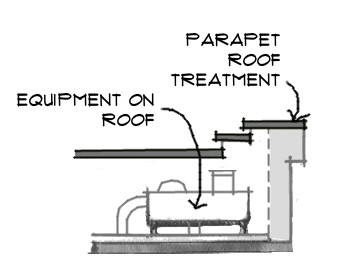
(6)
Signage: Signage shall be of a complimentary material, color, and design to the primary building,
B.
Site design - Sites shall be interconnected to surrounding land uses and easily accessible from pedestrian and transit facilities.
(1)
Parking lot design and orientation - Parking lots shall be distributed around the building to reduce the overall scale of the parking area and provide convenient access to the building entrance.
a.
No more than sixty (60) percent of the off-street parking area shall be located between the front facade of the building and the street for buildings facing on a single public street, except as provided in this Section.
b.
No more than seventy-five (75) percent of the off-street parking area shall be located between the front facade of the building and the street for buildings facing on two (2) public streets.
c.
Public parking areas shall not be required to be located at the rear of that portion of a building designed for delivery and services uses. The Development Controls Officer shall be authorized to approve a site plan that varies from the maximum parking standard based upon a finding that the compliance would require parking in the rear of the building and that the alternative plan fulfills the purpose and intent of this Section or complies to the maximum extent practicable considering the configuration of development in existence prior to the effective date of this Chapter of the CDC.
d.
Parking areas shall be designed so that the overall parking field is broken up into clearly defined groupings of spaces of no more than 100 spaces within each grouping (150 spaces for uses that require 501 or more parking spaces). Such groups shall be broken into individual areas and/or separated by landscaping and/or by design components of the site or building.
e.
To reduce conflicts with overall traffic flow, parking stalls shall not be located on major entry drives.
(2)
Connectivity - Building sites shall be designed to promote connectivity to surrounding land uses and streets. Techniques may include development of internal street systems, interconnected driving aisles and shared access, pedestrian access, and siting of buildings in relationship to adjacent development.
a.
Internal streets, which are specifically constructed to serve the new development, and new streets shall connect to existing streets or be designed to facilitate future connections to the maximum extent possible.
b.
Interconnected driving aisles and shared access shall be provided to connect with adjoining sites.
c.
Internal street systems shall be required for sites containing multiple buildings.
d.
Siting of buildings shall take into consideration the relationship of the site to adjacent buildings and internal street systems and driving aisles to promote interconnectivity between adjacent land uses. Separation of buildings by internal streets or driving aisles may be required to promote connectivity and pedestrian orientation.
e.
Pedestrian and bicycle circulation:
(i)
Pedestrian connections between the primary building entrance and parking fields, external sidewalks, outparcel buildings, and transit facilities shall be provided using landscaped areas, sidewalks, and pavement markings or pavers when crossing vehicular use areas (see Figure 13-2).
Figure 13-2: Pavement Markers or Pavers Crossing Vehicular Use Area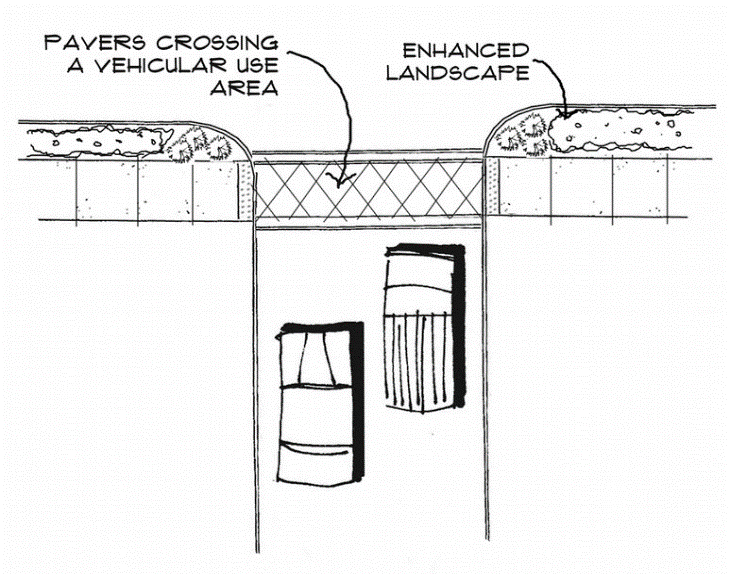
(ii)
Sidewalks shall be provided along the full length of the primary facade building.
(iii)
Pedestrian amenities, such as covered seating areas, are strongly encouraged.
f.
Transit facilities - Developments shall designate a minimum one hundred (100) square foot area on the site plan as a transit stop, if requested by the Pinellas Suncoast Transit Authority.
g.
Outdoor storage, display areas, trash collection and loading areas:
(i)
Long-term storage of shopping carts shall be accommodated within the building, or screened by a wall a minimum of four (4) feet in height of a consistent material with the building facade.
(ii)
Short-term shopping cart corrals must be designed using durable, decorative material that is consistent with the building facade.
(iii)
Areas for outdoor storage, trash collection and compaction, truck parking, loading docks, utility and other service functions shall be incorporated into the overall design of the building using decorative and durable materials consistent with the building facades.
(iv)
All containers for outdoor storage, trash collection and compaction are required to be screened from the right-of-way and all adjacent properties. Enclosures shall be a minimum of six (6) feet in height and constructed of solid masonry walls with solid gates that totally conceal all of the contents. Where possible, they should be located behind buildings, away from streets, and obscured from public view from driveways.
(v)
Additional plantings shall be provided adjacent to outdoor storage areas that are visible from the public right-of-way to further enhance the appearance of the enclosure (see Figure 13-3).
Figure 13-3: Enclosed and Landscaped Trash Collection Area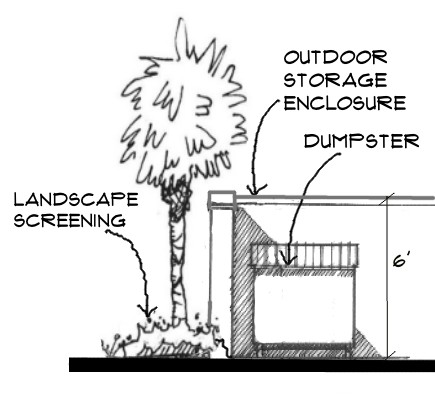
13.2.3 - Determination of Compliance
The DCO shall be authorized to determine compliance with the provisions of this Section. The DCO may approve a site plan that varies from these standards in order to accommodate unique site features or to provide a more innovative site design, provided that the DCO finds that the alternative plan fulfills the purpose and intent as set forth in Section 13.1 or complies to the maximum extent practicable considering the configuration of development in existence prior to the effective date of this Chapter of the CDC.

