
Largo City Zoning Code
CHAPTER 15
SUPPLEMENTAL STANDARDS
Section 15.1 - Reserved[1]
Editor's note—Ord. No. 2025-01, § 30, adopted Dec. 17, 2024, repealed Section 15.1, §§ 15..1.1—15.1.7, which pertained to duplex and triplex dwelling units and derived from the 2018 CDC. The user's attention is directed to Section 8.6, Small-Type and Medium-Type Housing.
Section 15.2 - Residential Care Facilities (including Assisted Living Facilities, Community Residential Homes, Halfway Houses/Rehabilitation Facilities and similar uses)[2]
Editor's note—Ord. No. 2018-31, § 4, adopted August 7, 2018, amended the title of Section 15.2 to read as herein set out. The former section was entitled "Assisted Living Facilities (ALFs)."
Section 15.8 - Property Designated as Residential High (RH)
Development on a parcel of land with the RH land use designation shall be governed by the following restrictions:
A.
Direct road access - Development shall have direct access to at least one principal/minor arterial road;
B.
Maximum dwelling units per acre - No development shall exceed thirty (30) dwelling units per acre;
C.
Placement within an activity center - All developments shall be located within either the Largo Mall Activity Center or the Largo Tri-City Special Area Plan, as defined by the City of Largo Comprehensive Plan;
D.
Intersection proximity - All developments shall be located within a half-mile radius of the intersections between principal/minor arterial roads. Upon petition by the applicant, the Development Control Officer (DCO) may waive the half-mile radius requirement provided the applicant clearly demonstrates the proposed development is compatible with the surrounding land use;
E.
Setbacks from residential - Building setbacks from a shared property line with single family homes or a low density (7.5 dwelling units per acre or less) residential FLUM designation shall be a minimum of fifteen (15) feet. The setback area shall consist of landscaped green space. Parking, driveways and loading areas are not permitted within this setback area;
F.
Building height step-downs - Buildings adjacent to single family homes or a property with a low density (7.5 dwelling units per acre or less) residential FLUM designation shall be buffered, in accordance with Chapter 10 of the CDC, and stepped down in height to minimize impacts on the single family homes or future low density development;
Figure 15-3: RH Property Next to Low Density Residential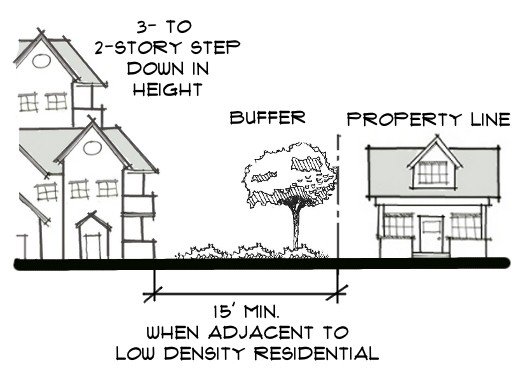
G.
Transit facility - A bus transit facility shall be provided to serve the proposed development, unless the applicant can adequately demonstrate there are sufficient transit facilities present near the site to serve the proposed development or the Pinellas Suncoast Transit Authority (PSTA) determines such a transit facility is not economically viable or desirable;
H.
Sidewalk connection - A direct sidewalk connection from the proposed development shall be provided connecting to the public sidewalk network;
I.
Plan support - Only proposed developments that support the redevelopment policies contained within the City's Comprehensive Plan and Strategic Plan shall be considered for the RH designation; and
J.
Neighborhood information meeting - Development subject to site plan review as defined in the CDC located adjacent to residential properties shall have a neighborhood information meeting with surrounding property owners, in accordance with Subsection 3.3.2 of this CDC.
(Ord. No. 2025-08, § 39, 6-17-2025)
Section 15.10 - Temporary Recreational Vehicle Storage
A.
Purpose - To set forth standards that will allow the safe, convenient, temporary storage of recreational vehicles within residential land uses, while preserving and protecting the aesthetics of the City's residential neighborhoods. In terms of this subsection of the Code "temporary" shall mean for a period not to exceed one (1) year.
B.
Standards - Temporary recreational vehicle storage is allowed in all residential and nonresidential areas, subject to meeting all appropriate performance standards. In addition, all of the following standards shall be met as conditions for approval:
(1)
A neighborhood information meeting shall be required.
(2)
All temporary recreational vehicle storage areas shall be required to be fenced or otherwise secured to provide security. All fences shall conform to the accessory use requirements for fences.
(3)
Proper maintenance of the site including erosion control and tree protection standards of this CDC shall be applied to the property. Failure to comply will result in the revocation of approval.
(4)
The site shall be used only for storage purposes, and none of the recreational vehicles on-site shall be used for residential purposes. No sewer, water, or other utility hookup to the stored recreational vehicles shall be permitted.
(5)
A Business Tax Receipt shall be required.
(6)
At the end of one (1) year, approval of the use may be continued only after the owner re-applies for a temporary recreational vehicle storage facility permit, meets the required criteria, and renews the occupational license. If, upon application for renewal, the Community Development Department has no history of complaints about the site, the compatibility meeting may be waived by the DCO.
(7)
Signage shall conform to the sign standards of this CDC (Chapter 12).
Section 15.17 - Supplemental Standards for Community Redevelopment Districts
Under the City's two Community Redevelopment Districts (CRDs) there are certain instances where additional standards are necessary to determine if proposed uses are consistent with the CDC and Comprehensive Plan. Established to create mixed-use urban environments, to regenerate the traditional downtown in a modern context, these supplemental standards are meant to blend uses in with the existing community, while still allowing flexibility to a property owner.
(Ord. No. 2019-16, § 4, 3-19-2019)
Section 15.18 - Short-Term Vacation Rentals
Short-term vacation rentals shall be permitted in all future land use designations that allow for residential uses provided they are in compliance with this section. No person shall rent or lease all or any portion of a dwelling unit as a short-term vacation rental, as defined in this section, without complying with the following criteria:
A.
Definitions -
1.
Designated Responsible Party. The term "designated responsible party" means the owner, or any person eighteen (18) years of age or older designated by the owner, tasked with responding to requests for complaints, and other problems relating to or emanating from the short-term vacation rental. There shall only be one designated responsible party for each short-term vacation rental. An owner may retain a private property management company to serve as the designated responsible party.
2.
Owner. The term "owner," shall mean the person or entity holding legal title to the short-term vacation rental property, as reflected in the Pinellas County Tax Collector's records.
3.
Short-Term Vacation Rental. A "short-term vacation rental" means any unit or group of units in a condominium or cooperative or any individually or collectively owned single-family, two-family, three-family, or four-family house or dwelling unit within a single complex of buildings which is rented to guests more than three (3) times in a calendar year for periods of less than thirty (30) days or one (1) calendar month, whichever is less, or which is advertised or held out to the public as a place regularly rented to guests but that is not a timeshare property, as defined in chapter 721, Florida Statutes, all as defined and as may be amended by Sections 509.242(1)(c); (g), and 509.013(4)(a)1., Florida Statutes.
4.
Transient Occupants. Any person or guest or invitee of such person, who occupies or is in actual or apparent control or possession of a short term vacation rental. There shall be a rebuttable presumption that any person who holds themselves out as being an occupant or guest of an occupant of a short term vacation rental is a transient occupant.
B.
Minimum life/safety requirements -
1.
Compliance with applicable laws. All short-term vacation rental units must meet the minimum standards for habitable structures set forth in the Florida Building Code, the Florida Fire Code, the Florida Life Safety Code; and the City's Comprehensive Development Code.
2.
Swimming pool, spa and hot tub safety. All swimming pools, spas and/or hot tubs at short-term vacation rentals shall comply with the standards of the Residential Swimming Pool Safety Act, Chapter 515, Florida Statutes.
3.
Fire extinguisher. A portable, multi-purpose dry chemical 2A:10B:C fire extinguisher shall be installed, inspected and maintained in accordance with NFPA 10 on each floor/level of each dwelling unit of a short-term vacation rental. The extinguisher(s) shall be installed on the wall in an open common area or in an enclosed space with appropriate markings visibly showing the location.
4.
Internal posting. The following information shall be posted in a visually unobstructed area within each unit of a short-term vacation rental, all in a form prescribed by the City: the name and telephone number of the designated responsible party required by this Section; notice that all transient occupants must comply with the requirements of the City's Code of Ordinances including the maximum occupancy, parking, and minimum life/safety requirements prescribed in this section, as well as the City's Code of Ordinances governing noise, nuisances, and litter; the scheduled days of trash pick-up and recycling; the location of the nearest hospital; and a statement that all transient occupants must promptly evacuate the short-term vacation rental upon posting of any evacuation order issued by state or local authorities.
C.
Maximum occupancy - The maximum occupancy for each short-term vacation rental unit is one (1) person per one hundred fifty (150) gross square feet of permitted, conditioned living space.
D.
Parking - All short-term vacation rental units within the City are required to provide one (1) off-street parking space per three (3) transient occupants. On-street parking shall not count towards this minimum parking requirement. Garage spaces may count towards this minimum parking requirement if the space is open and available and the transient occupants are given vehicular access to the garage.
E.
Designated responsible party -
1.
The name and telephone number of the designated responsible party shall be either (i) prominently posted on the front exterior of the short-term vacation rental in a place visible to the public; or (ii) if there is a City of Largo Police Department Emergency Decal Registration associated with the short-term vacation rental and the name and telephone number of the designated responsible party has been provided as part of the Emergency Decal Registration, the encoded Emergency Decal may be posted in a place visible to the public instead of the name and telephone number of the designated responsible party.
2.
The designated responsible party must be available at the posted telephone number twenty-four (24) hours a day, seven (7) days a week and capable of directly responding, or directing a designated agent to directly respond to and resolve any issues or concerns raised by transient occupants, City staff, or law enforcement when the short-term vacation rental is occupied. If necessary, the designated responsible party must be willing and able to come to the short-term vacation rental unit within two (2) hours following notification to address any issue that is not capable of being addressed via telephone.
F.
Other standards - Any other standards contained the City's Code of Ordinances and Comprehensive Development Code shall apply to short-term vacation rentals to the extent allowable by law.
G.
Enforcement - The provisions of this section shall be enforced using the procedures set forth in Chapter 9 of the City Code and/or Chapter 162, Florida Statutes.
(Ord. No. 2019-28, § 2, 3-19-2019)
Section 15.19 - Hotels
A.
Purpose - To set forth standards that will allow hotels in the City of Largo, expand opportunities within the lodging industry, and contribute to the economic vitality. The intent of hotels, where allowable, is to provide amenities and services to the business community, and provide temporary lodging to visitors and business travelers.
B.
Applicability - The supplemental standards created in this section shall apply to hotels providing for transient accommodation use:
(1)
Hotels must be registered with the Department of Revenue as a bona fide hotel operation and are required to pay the levied tourist development tax established by Pinellas County. Hotels that are not registered with the Department of Revenue or do not pay the tourist tax will be subject to the density limitations and property development regulations for multi-family developments.
C.
Standards - Hotel facilities can be achieved by following the guidelines, standards and review processes in this Section:
(1)
Location Restrictions - Hotels are allowed in Commercial Neighborhood (CN), Commercial General (CG), Residential/Office/Retail (R/O/R), Residential/Office General (R/OG), and Industrial Limited (IL) land use classifications.
Hotels are conditionally allowed in Commercial Recreation (CR) and shall meet the standards herein and be processed in accordance with Section 4.2: Level III, Conditional Use Review (Class 2) of the CDC.
Additionally, hotels are allowed in the Mixed Use Corridor (MUC) and Medical Arts (MA) districts of the Community Redevelopment Districts (CRDs). Hotel development within the CRDs shall comply with the standards herein, Chapter 7: Special Designations & Overlays of the CDC, and the applicable Community Redevelopment District Plan.
(2)
Maximum Density - Hotel rooms may be established at the maximum densities (dwelling unit/acre) determined by the underlying land use classification or character district of the site. A multiplier of 1.67 rooms per maximum density shall be applied in converting residential units to hotel rooms.
Hotels subject to a Development Agreement (DA), except hotels within R/OG, may utilize up to a 2.5 multiplier conversion of rooms per maximum density in accordance with Section 4.6: Level IV, Development Agreement (DA) of the CDC.
Hotels established within the Industrial Limited (IL) land use classification are measured by the maximum floor area ratio (FAR), impervious surface ratio (ISR), and shall not exceed a maximum area of five (5) acres (Section 5.2.4 P).
Accessory uses (i.e. commercial, office, arts, recreation and entertainment uses) to the hotel are measured by the maximum floor area ratio (FAR) and impervious surface ratio (ISR) of the underlying land use classification.
(3)
Design Standards -
(a)
Building Landscaping. A five-foot minimum landscaped area shall be provided to separate ground floor units from pedestrian walkways, project amenities and drive aisles/parking areas. All areas not used for buildings and parking shall be landscaped according to Section 10.5.2.
(b)
Pedestrian Walkways. A primary pedestrian walkway must be a minimum of eight feet wide. Primary walkways are those that connect a pedestrian from the street to the main entry and from the building to any on-site amenities. All other secondary walkways are to be a minimum of four (5) feet in width, exclusive of vehicle overhang.
(c)
Drop-off Zones. A porte-cochere and/or covered drop-off zone for vehicles and pedestrians, independent of drive aisles, shall be provided to accommodate guest loading and drop-off and serve as the formal entry to the hotel.
(d)
Open Space. A minimum of four hundred (400) square feet of common open space shall be provided, exclusive of required setbacks. If the project exceeds thirty (30) units, the common open space shall be increased by ten (10) square feet for each unit exceeding thirty (30) units.
(e)
Lobby. Interior floor area shall be devoted for an inside main lobby, front desk, and/or office supervised by a person at all hours. Interior floor area shall be devoted for corridors that connect to the hotel rooms and accessory uses.
(f)
Exterior Building. Building design, including elevations, facade treatments, entrance and porch or balcony projections, window pattern and roof forms shall be compatible in terms of context-sensitive design, and the scale and placement of the proposed use. At least fifty (50) percent of street facades shall have architectural articulation.
(4)
Target Employment Center Overlay (TECo) Alternative Standards - This overlay designation is applied to the following applicable land use classification with sufficient size to support integrated industrial/mixed-use projects: Commercial General (CG). The TECo bonuses outlined below cannot be combined with those bonuses outlined for target employment uses in Table 7-14 and Table 7-15.
(a)
Maximum Density and Intensity - Hotel rooms, associated parking structures, and uses accessory to the hotel may be established at the maximum densities (dwelling unit/acre) and intensities determined by the underlying land use classification of the site, plus up to one hundred (100) percent for a floor area ratio (FAR). A multiplier of 2.5 rooms per maximum density shall be applied in converting residential units to hotel rooms.
(b)
Supplemental Design Standards - Applicable only to hotels located within the TECo and that are utilizing any additional intensities determined by the underlying land use classification in accordance with Subsection (4)(a). Hotels shall meet the design standards in Section 15.19C.(3) in addition to providing:
(1)
Amenities. Outdoor and/or indoor amenities are required to be provided which shall include, but are not limited to spa, pool, weight room/training stations or business center.
(2)
Meeting/Conference Rooms. There shall be a minimum of twenty (20) square feet per guest room devoted for meeting rooms, conference rooms, banquet and/or convention spaces. Areas designated for dining, breakfast and lobby areas do not count towards this requirement.
D.
Accessory Uses - Subject to the permitted intensity (FAR and ISR) of the underlying use, hotels may include accessory uses, such as associated parking structures, recreational facilities, personal services, meeting space, fitness centers, spa facilities, clubs, swimming pools, or shuttle services between hotels, airports or other destination points.
(1)
Hotels with fifty (50) or more units may have restaurants, nightclubs, dining rooms or bars. Such uses shall be located within the principal building(s) although outside seating may be provided in conjunction with a restaurant, dining room or bar.
(2)
Hotels with one hundred (100) or more units may provide retail stores, personal service shops and convention facilities for guests or residents. Such uses shall be located within the principal building(s) and shall only be accessed through the main lobby of the facility.
(3)
The aggregate gross floor area of all permitted accessory uses shall not exceed thirty (30) percent of the gross floor area of the principal building(s).
E.
Restrictions -
(1)
No conversion of a hotel to residential dwelling units shall be permitted unless the conversion is in compliance with the CDC with respect to the permitted residential density, multi-family development standards, and where applicable, the intensity for associated nonresidential uses.
(2)
Hotels shall obtain all required licenses, which shall be kept current.
(3)
A reservation system shall be required as an integral part of the hotel.
(4)
Hotels must have sufficient signage that complies with Chapter 12 and is viewable by the public designating the use as a hotel.
(Ord. No. 2019-34, § 5, 9-3-2019; Ord. No. 2026-03, § 15, 3-17-2026; Ord. No. 2026-07, § 28, 5-19-2026)
Section 15.20 - Gas Stations within the Largo Tri-City SAP
A.
Purpose To set forth standards that will allow a gas station within the Largo Tri-City SAP, while preserving and protecting the aesthetics and intended purpose of the SAP.
B.
Applicability The supplemental standards created in this section apply to any structure or area of land or portion thereof used primarily for the retail sale of automobile fuel, oil, and accessories, where repair services and/or an automatic car wash, if present, is incidental and which meets the locational requirements of subsection C below.
C.
Location Restrictions - Gas stations shall be permitted in allowable land use categories, per CDC, Chapter 6, Table 6-1, within the SAP Activity Center overlays.
D.
Design Standards -
(1)
The orientation of the facility shall be such that pump dispensers are located on the side or rear of the property and are not directly adjacent to a public right-of-way. In the case of intersecting streets, pumps must be located to the rear of the property.
(2)
The property shall be screened from any abutting residential use by a six (6) foot opaque wall or fencing.
(3)
Outdoor storage of materials, parts and equipment is prohibited.
(4)
An associated convenience store shall have a maximum of one thousand (1,000) square foot gross floor area.
(5)
The sale of vehicles is prohibited.
(6)
Pedestrian circulation within the site shall be well marked, both for the operator of a vehicle and for the pedestrian. Pedestrian circulation markings include, but are not limited to, pavers, reflective paint, and elevated sidewalks/crosswalks.
E.
Conditional Use Approval - Drive-thru facilities allowed by the underlying future land use designation and proposed at either of the following locations shall require conditional use approval to ensure compliance with the intent of the Largo Tri-City Special Area Plan and mitigation of impacts to the multimodal transportation system:
(1)
Within the Activity Center Transit Core Scale Overlay.
(2)
Within the Multimodal Corridor Overlay along Roosevelt Boulevard and not immediately adjacent and accessible to a signalized intersection by vehicle.
(Ord. No. 2021-32, § 12, 3-2-2021)
Section 15.21 - Self-Storage Facilities in the Tri-City Special Area Plan
A.
Purpose - To set forth criteria to establish self-storage facilities within the Tri-City Special Area Plan (SAP), while maintaining the intent, character, and aesthetics of the plan to create active ground floor spaces and support multimodal access consistent with Countywide Plan Rules.
B.
Applicability - The criteria set forth in this supplemental standard shall apply to the establishment of any business whose primary operation involves self-storage facilities.
C.
Location Restrictions - Storage facilities shall be permitted in allowable land use categories, per CDC, Chapter 6, Table 6-1, within the SAP Activity Center Urban Scale and Multimodal Corridor overlays. Storage facilities proposed within the Activity Center Transit Core Scale Overlay shall require conditional use approval.
D.
Design Standards - The intent of these self-storage facility design standards is to ensure active ground floor/mixed uses along street frontages consistent with the SAP.
(1)
Self-storage facilities are not permitted to be the only use in multi-tenant building sites or on parcels fronting a public street. Storage facilities shall be designed as to allow for a minimum of 50% ground-floor uses, not associated with the storage facility, along public streets measured by linear building frontage. The ground-floor uses not associated with the storage facility may be commercial, office, institutional or medical as allowed by the future land use designation. See Figure 15-5.
(2)
Self-storage facilities that do not incorporate a separate ground floor use shall be set back from the street frontage at a distance adequate enough to meet the minimum lot size for the remaining portion of the site to be developed for a non-storage facility use. See Figure 15-6
(3)
Outdoor storage of materials, parts and equipment is prohibited.
E.
Conditional Use Approval - Self-storage facilities allowed by the underlying future land use designation and proposed within the Activity Center Transit Core Scale Overlay shall require a conditional use approval to ensure compliance with the intent of the SAP and mitigation of impacts to the multimodal transportation system.
Figure 15-5: Ground Floor Mixed Use Self-Storage Facility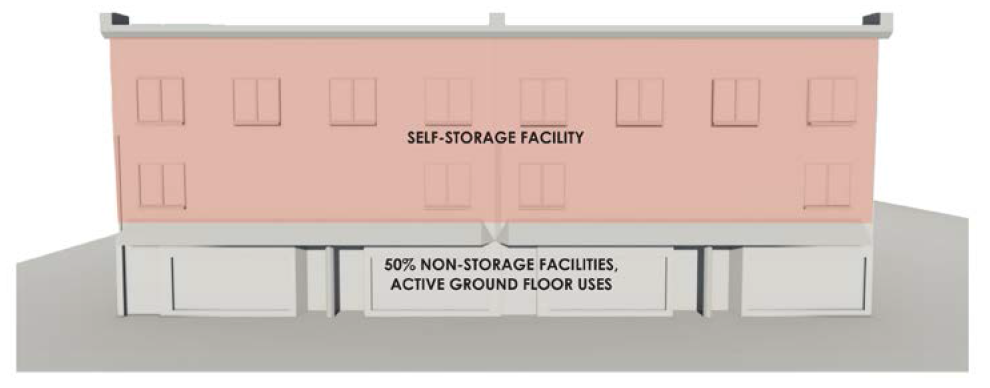
Figure 15-6: Self-Storage Facility Setback From Street Frontage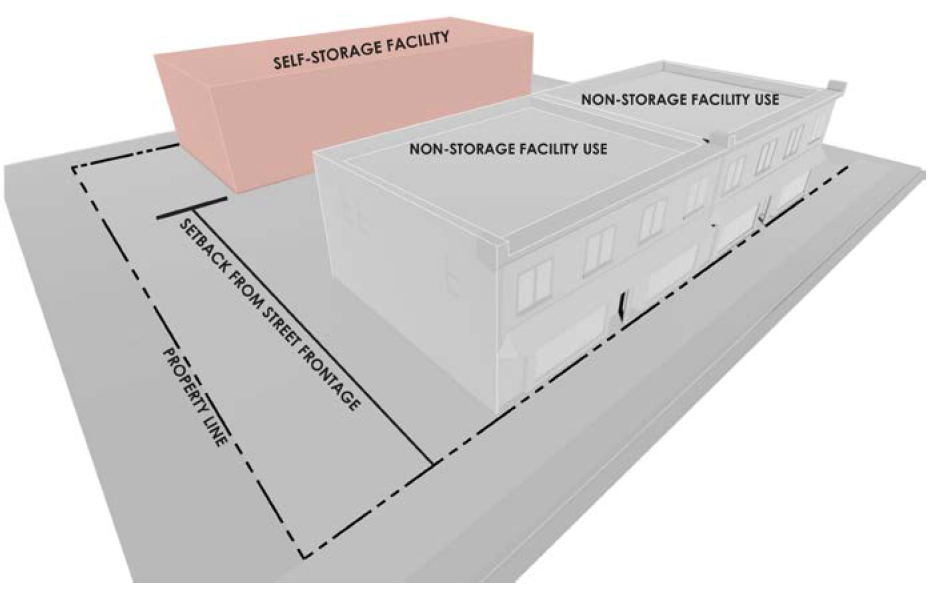
(Ord. No. 2021-32, § 13, 3-2-2021)
15.2.1 - Purpose
To set forth standards for the protection of the health, safety, and welfare of the residents of a facility and the community at large. Residential Care Facilities allow persons who are unable to live independently to remain in the community. Nothing contained herein is intended nor shall be construed to discriminate against any particular race, religious view, sex, national origin, familial status, or any person with a disability as that term is defined in 42 U.S.C. § 12102, or to treat similarly situated property differently based on the abilities or disabilities of potential occupants, nor shall it be construed as a policy against or refusal to make reasonable accommodations in City rules, policies, practices, or services when such accommodations are requested and when such accommodations would be necessary to afford a person with a disability the equal opportunity to use and enjoy a dwelling. All requests for reasonable accommodation to these standards shall be made in writing to the City Manager and the City Manager may, after determining that the request qualifies for a reasonable accommodation, grant such accommodations which would not fundamentally alter the nature of the City's zoning regulations, and would not impose an undue financial or administrative burden. All requests for reasonable accommodations will be determined on a case-by-case basis.
(Ord. No. 2018-31, § 4, 8-7-2018)
15.2.2 - Applicability
These standards are supplementary to the performance standards of this CDC. Included among Residential Care Facilities are Assisted Living Facilities, Community Residential Homes, Halfway Houses/Rehabilitation Facilities and similar uses. These uses may be predominantly residential in nature, providing care to a small number of persons in a single-family home or institutional-type facilities. All facilities, regardless of the number of clients, are subject to the City's Business Tax Receipt requirements, applicable State of Florida Regulatory agency requirements, and all applicable construction standards included in Chapter 18 of this CDC. If the development consists of bonafide dwelling units, rather than sleeping quarters only, and does not provide the types of personal care normally associated with a Residential Care Facility, such as shared dining, transportation, recreational programs, on-site medical treatment, social services, then it is not subject to these supplemental standards, but must comply with the requirements for residential developments of this CDC.
(Ord. No. 2018-31, § 4, 8-7-2018)
15.2.3 - Restrictions
A.
Residential Care Facilities are not allowed in coastal high hazard areas, regardless of the number of clients served.
B.
Facilities located in or adjacent to residential areas shall conform to the character of the surrounding neighborhood. This applies to design, density, lot size, landscaping, or other factors affecting the neighborhood character. This will prevent disruption of a neighborhood due to the introduction of a dissimilar structure.
C.
Locational restrictions, which apply depending on the total number of clients served by the facility, are set forth in Table 6-1 and Table 6-2.
(Ord. No. 2018-31, § 4, 8-7-2018; Ord. No. 2025-01, § 31, 12-17-2024)
15.2.4 - Review Procedures
A.
Six (6) or fewer clients - Facilities licensed under Chapter 419, F.S., provides that a facility housing six (6) or fewer clients is the functional equivalent of a single-family home and is, therefore, allowable in a single- or multi-family residential area and is not subject to either a Level I or II administrative review. If the facility is not licensed under Chapter 419, F.S., and is conditionally allowed, it shall be subject to review by the Planning Board (Level III).
B.
Seven (7) to fourteen (14) clients - Where allowable, these facilities shall be administratively reviewed (Level I or II). If the facility is conditionally allowed, it shall be subject to review by the Planning Board (Level III).
C.
More the fourteen (14) clients - Where allowable, facilities housing more than fourteen (14) clients shall be subject to review by the Planning Board (Level III).
(Ord. No. 2018-31, § 4, 8-7-2018; Ord. No. 2025-01, § 31, 12-17-2024)
15.2.5 - Additional Standards
A.
Density - Densities shall be calculated using a residential equivalency standard of two and one-half (2.5) beds equals one dwelling unit.
B.
Parkland and Recreation Facilities Impact Fee - The required impact fee for Residential Care Facilities shall be due as provided for in Chapter 8 Section 8.7.2.
C.
Signs - All signs of a Residential Care Facility with six (6) or fewer clients shall conform to the same sign regulations and requirements for residential uses within the land use category applied to the property.
D.
Parking - The DCO may authorize a reasonable reduction in the total number of required parking spaces upon submittal of a parking demand analysis which is based upon the mobility of the clients served and the medical accommodations provided. The following conditions must be met:
(1)
Sufficient data to demonstrate limited access and usage of vehicles by clients must be submitted to the City and found to be valid by the City Engineer. The information submitted shall include the following:
a.
The marketing of the facility, i.e., type of clients expected to be housed;
b.
The types of medical care services provided;
c.
The expected mobility of residents;
d.
Number of employees on the largest working shift; and
e.
Expected visitation rate and visitor policies.
(2)
Although the number of parking spaces may be initially reduced, a land area sufficient to provide the total required number of parking spaces shall be reserved in case of the future conversion or modification of the facility. In no case shall the reserved area be used as the minimum required buffer, parkland, or retention area accommodations.
(3)
Retention area requirements shall be calculated based upon the assumption that the required parking area is to be paved. An allowable alternative is to reserve an area to accommodate retention, in the event of paving.
E.
Accessory use - Residential Care Facilities having more than fourteen (14) clients may include on-site medical offices to serve the health care needs of both on-site residents and off-site patients of the resident physician(s) subject to review by the Planning Board as a conditional use. In addition, the following restrictions shall apply:
(1)
The on-site medical offices must be clearly incidental to the Residential Care Facility. The maximum floor area devoted to the on-site medical offices shall be no more than ten (10) percent of the gross floor area of the Residential Care Facility assisted living facility, or 3,500 square feet, whichever is less;
(2)
Signage shall be limited to Address/Occupant Identification Displays, as required by Chapter 12, and shall be located on the wall only. No freestanding signs identifying the occupants shall be allowed;
(3)
The Residential Care Facility shall dedicate parking spaces to the on-site medical offices based on the parking requirements for medical offices provided in Section 9.5; and
(4)
The addition of on-site medical offices to an existing Residential Care Facility having more than fourteen (14) clients must receive site plan approval as per Chapter 3.
(Ord. No. 2018-31, § 4, 8-7-2018; Ord. No. 2025-01, § 31, 12-17-2024)
15.3.1 - Purpose
To recognize the importance of manufactured housing in the provision of low- and moderate-cost housing in the community and to protect the health, safety, and welfare of the community by setting forth necessary criteria for appropriate location and use of manufactured homes.
(Ord. No. 2025-01, § 32, 12-17-2024)
15.3.2 - Applicability
This Section applies to all manufactured home units, existing manufactured home developments, and new manufactured home developments.
(Ord. No. 2025-01, § 32, 12-17-2024)
15.3.3 - Locational Restrictions
Manufactured homes shall be allowed only within approved manufactured home developments. New and expanded manufactured home developments are allowed only on a property with the Residential Urban land use designation. No new or expanded manufactured home developments shall be allowed within the Coastal High Hazard Area (CHHA) or the Special Flood Hazard Area (SFHA) as defined in Chapter 20 and outlined in Section 7.6.1, nor within the City's Community Redevelopment Districts.
(Ord. No. 2025-01, § 32, 12-17-2024)
15.3.4 - Allowed Manufactured Homes
To be allowed, manufactured homes must be certified as meeting U.S. Department of Housing and Urban Development (HUD) mobile home construction and safety standards as indicated by a red certification label on the exterior of each transportable section, or determined upon inspection by a licensed engineer, to be in compliance with all the relevant housing codes and determined safe and fit for residential occupancy. Criteria for determining condition shall be the same as those applied to housing inspections (see Chapter 18 of this CDC).
(Ord. No. 2025-01, § 32, 12-17-2024)
15.3.5 - Prohibited Units
Manufactured homes or any other manufactured housing units which do not meet the criteria of Section 15.3.4 shall be considered nonconforming under this CDC and shall not be permitted to be installed or relocated within the City.
(Ord. No. 2025-01, § 32, 12-17-2024)
15.3.6 - Permitting Procedures For Individual Units
Developments which have received City approval may replace or install units up to the maximum approved number of units without site plan review. All units must obtain a Development Permit prior to placement within the City of Largo.
A.
Individual units
(1)
All Units - All manufactured homes must comply with anchor and tie-down installation standards in accordance with the Department of Highway Safety and Motor Vehicles Chapter 15C-1. Additional installation requirements for replacement of individual manufactured homes in the SFHA and CHHA are provided in Section 11.17 of this CDC.
(2)
Pre-Owned Units -
a.
Prior to relocation, units shall be inspected by a licensed engineer, to be in compliance with all the relevant housing codes and safe and fit for residential occupancy.
b.
Following relocation, a second inspection shall be performed by a licensed engineer to verify that the unit remains in a safe and fit condition. A Certificate of Occupancy shall not be issued until these conditions are met.
(3)
Individual units may also be replaced with other types of housing that meet the Florida Building Code, either site-built or modular in construction. Individual sites in a manufactured home development may be reconfigured to accommodate these housing types provided the Florida Building Code's fire separation requirements are met. The following types of Florida Building Code compliant detached homes may replace existing units:
a.
A tiny house, if built to Florida Building Code standards (see Section 15.22)
b.
A single-family house
c.
A cottage court (to replace two or more existing units) (meeting standards in Section 8.6)
d.
A modular home that meets the same standards as any of the other types listed in subsection (3).
B.
Special Flood Hazard Area (SFHA) and Coastal High Hazard Area (CHHA) - The following additional rules apply to all manufactured homes in the SFHA or CHHA as described in Section 7.6.1:
(1)
Manufactured home units that are being placed or replaced in manufactured home developments within the SFHA or CHHA must meet the elevation requirements for manufactured homes in Section 11.17.5 and 11.17.6.
(2)
Manufactured home units located on individually platted lots within the SFHA or CHHA shall be replaced with standard housing construction material such as single-family homes, regardless of lot size. New housing must meet the elevation requirements in the Florida Building Code.
(Ord. No. 2019-43, § 14, 5-21-2019; Ord. No. 2025-01, § 32, 12-17-2024)
15.3.7 - Procedures for New, Expanded, and Redeveloped Manufactured Home Developments
A.
New developments - An application for approval of a new, expanded, or redeveloped manufactured home development shall be reviewed by the Planning Board (Level III Review) and shall be developed in accordance with the performance standards of this CDC applicable to single-family residential infill standards.
B.
Small expansion of an existing development - Expansion of an approved manufactured home development by fewer than nine (9) lots above the maximum number of units indicated on an approved site plan shall be administratively reviewed (Level I Review). An expansion of nine (9) or more units shall be reviewed by the Planning Board (Level III Review) as a conditional use.
C.
Shelter space after a natural or man-made disaster - Manufactured home developments redeveloping after a natural or man-made disaster which have had fifty (50) percent or more of the units destroyed shall provide hurricane shelter space as required in this Section and shall be required to come into compliance with Section 15.3.8 Development Standards.
D.
Redevelopment of manufactured home developments after a disaster - Consistent with Section 723.041(5), Florida Statutes, a manufactured home development that is damaged or destroyed due to wind, water, or other natural force may be rebuilt on the same site with the same density as was approved, permitted, and built before the development was damaged or destroyed. Individual units that are placed into the rebuilt park must comply with all other standards in Section 15.3 and with the elevation requirements for manufactured homes in Sections 11.17.5 and 11.17.6.
(Ord. No. 2025-01, § 32, 12-17-2024)
15.3.8 - Development Standards for New and Expanded Manufactured Home Developments
New and expanded manufactured home developments shall be designed and developed in accordance with standards applicable to single-family subdivisions, except for setbacks and distance between structures, and the following standards:
A.
Minimum lot size and location - The minimum land area for a new manufactured home development shall be fifteen (15) acres. No part of the required fifteen (15) acres may be located in the CHHA or the SFHA, nor within the Community Redevelopment Districts.
B.
Setbacks
(1)
Every manufactured home shall be located at least eight (8) feet from any internal abutting street.
(2)
The minimum setback distance between a manufactured home (including allowable accessory buildings) and a side or rear lot line shall be five (5) feet. This distance shall be measured at the narrowest space between the structure and the lot line, whether the living unit itself or an allowable accessory building (e.g., carport, storage building).
(3)
If there are no individual lots designated, the minimum distance between structures shall meet fire and building codes.
C.
Hurricane shelters - Effective January 1, 1995, hurricane shelter space shall be provided at a ratio of ten (10) square feet per resident. The shelter area shall meet all the following requirements:
(1)
Be certified for a wind load capacity to meet the requirements of the Florida Building Code 8th Edition (2023);
(2)
Meet the American Red Cross (ARC) standard for hurricane shelters as outlined in ARC publications 3031 and 4496;
(3)
Be equipped with storm shutters or comparable window protection as outlined in the Florida Building Code 8th Edition (2023) for such protective devices; and
(4)
Have a base floor elevation high enough to avoid storm surge from a Category 3 hurricane.
In addition, the shelter shall:
(5)
Contain sanitary sewer facilities;
(6)
Be equipped with a power supply capable of operating 110 and 220 volt appliances for a minimum of 72 hours; and
(7)
Contain adequate potable water supplies as outlined by the ARC.
The manufactured home development owner shall also be required to coordinate with the City of Largo Emergency Management Coordinator and the ARC on the necessary supplies for the shelter. Furthermore, the owner shall cooperate with authorities in assisting all residents of the manufactured home development to promptly evacuate upon the issuance of an evacuation order for that area.
Nothing in this Section shall be construed as requiring the manufactured home development owner to admit the general public into the above-referenced hurricane shelter.
(Ord. No. 2021-33, §§ 5, 7, 4-6-2021; Ord. No. 2024-19, § 3, 5-7-2024; Ord. No. 2025-01, § 32, 12-17-2024; Ord. No. 2025-08, § 37, 6-17-2025)
15.3.9 - Conversion of Manufactured Home Developments
A.
Conversion to a condo or cooperative - The conversion of a manufactured home development to a condominium or cooperative may be allowed, subject to City approval of deed restrictions and platting requirements and in accordance with provisions of Chapter 723, Florida Statutes.
B.
Conversion to a single-family subdivision - The conversion of a manufactured home development to a single-family subdivision may be allowed if the platted lots meet the minimum lot area requirements for the respective land use classification. Fee simple ownership of lots less than the minimum area may be allowed, subject to approval of deed restrictions and platting requirements. Density bonuses are available for the development of small-type and medium-type housing during these conversions (see Section 8.6.6).
(Ord. No. 2025-01, § 32, 12-17-2024)
15.4.1 - Purpose
To provide development standards for the proper location of commercial campground uses and seasonal recreational vehicle (RV) parks.
(Ord. No. 2025-01, § 33, 12-17-2024)
15.4.2 - Applicability
This Section applies to commercial campgrounds and seasonal RV parks. Commercial campgrounds and seasonal RV parks are considered heavy commercial uses that are allowed only as specified in Table 6-1 and Table 6-2. No new or expanded commercial campgrounds or seasonal RV parks shall be allowed within the Coastal High Hazard Area (CHHA) or the Special Flood Hazard Area (SFHA) as defined in Chapter 20 and outlined in Section 7.6.1, nor within the City's Community Redevelopment Districts. No permanent or long-term installation of units on individual rental sites shall be allowed. Portions of campgrounds and RV parks that have lawfully allowed permanent or long-term installations shall be subject to the supplemental standards for manufactured homes contained in Section 15.3.
(Ord. No. 2025-01, § 33, 12-17-2024)
15.4.3 - Standards
A.
The location and development of commercial campgrounds and seasonal RV Parks shall be subject to the following standards:
(1)
The minimum land area shall be five (5) acres.
(2)
The net density shall not exceed fifteen (15) rental sites/acre; however, this standard shall not apply to those portions of commercial campgrounds or seasonal RV parks devoted to tent camping.
(3)
Each rental site shall be a minimum of one thousand five hundred (1,500) square feet in area.
(4)
Sufficient separation shall be maintained between units to permit access by emergency vehicles as specified in the Florida Fire Prevention Code and the adequate provision of light and air, as specified in other applicable codes referenced in Chapter 18.
(5)
Permanent structural additions such as carports, canopies, storage buildings, pavers, cement slabs, decks etc., shall not be permitted on individual rental sites.
(6)
A minimum of five (5) percent of the gross site area shall be allocated for recreation/open space activities.
(7)
A central service building containing the necessary toilet and other plumbing fixtures specified by the Florida State Board of Health shall be provided within four hundred (400) feet of each rental site.
(8)
Only temporary potable water, sanitary sewer, and electrical connections shall be provided to individual rental sites. No permanent connections are allowed.
(9)
All performance standards applicable to single-family subdivisions with regard to drainage, streets, signage and fire department access shall apply.
(10)
Seasonal Recreational Vehicles (RVs) Parks - Seasonal recreational vehicles are allowed in seasonal RV parks subject to the following additional requirements:
a.
The RV may only remain on a site for fewer than 180 consecutive days.
b.
The RV must be fully licensed and ready for highway use. A recreational vehicle is ready for highway use if it is on its wheels or jacking system, is attached to the site only by quick-disconnect-type utilities and security devices, and has no permanently attached additions.
c.
Setbacks
(i)
Every seasonal RV shall be located at least eight (8) feet from any internal abutting street.
(ii)
The minimum setback distance between a seasonal RV and a side or rear lot line shall be five (5) feet. The distance shall be measured at the narrowest space between the structure and the lot line.
(iii)
If there are no individual lots designated, the minimum distance between structures shall be ten (10) feet.
(11)
Commercial campgrounds and seasonal RV parks may utilize density bonuses when converting to permanent housing types, including the Small-type and Medium-type Housing Density Bonus outlined in Section 8.6.6. See Section 8.9 for information on other available Bonus Densities.
(Ord. No. 2025-01, § 33, 12-17-2024)
15.5.1 - Purpose
To promote the use of existing structures or the joint use of new towers outside of residential areas in order to minimize adverse visual impacts while allowing telecommunication service providers to furnish services quickly, effectively, and efficiently.
15.5.2 - Applicability
The requirements of this Section shall govern the construction of telecommunication towers and antennas within the City.
15.5.3 - Determination of Need
Prior to submitting an application for placement of a new telecommunication tower, copies of documents supporting the representation that an existing tower with a suitable location is not available shall be submitted to the Development Controls Officer (DCO). The DCO shall review the information provided and prepare a report containing a positive or negative determination of the availability of other alternative sites based upon application content, outside engineering review, and the regulations contained in this CDC. Actual costs incurred by the City to verify applicant's representations that a new communication tower is required shall be borne by the applicant. Such costs shall be in addition to the normal site review charges. The costs may include the review of the applicant's supporting documents by a registered engineer specializing in the technical aspects of communication tower siting.
Evidence submitted to demonstrate that no existing structure or tower can accommodate the proposed antenna shall, at a minimum, include a discussion of all applicable issues including:
A.
Existing towers or structures geographic location - The applicant must demonstrate that there are no existing towers or structures located within the relevant geographic area that meet applicant's engineering requirements.
B.
Existing towers or structures height - Existing towers or structures are not of sufficient height to meet applicant's engineering requirements.
C.
Existing towers or structures structural strength - Existing towers or structures do not have sufficient structural strength to support applicant's proposed antenna and related equipment.
D.
Electromagnetic interference - The applicant's proposed antenna would cause electromagnetic interference with, or would be interfered with by, other antennas if placed on an existing tower or structure.
E.
Structure sharing costs - The fees/costs required of the owner or service provider to share an existing tower or structure, for a time period of twenty-five (25) years, exceed the cost of constructing a new tower.
F.
Modification costs - The financial feasibility of modifying or replacing an existing tower to accommodate the proposed antenna.
G.
Other factors - Other limiting factors that render existing towers and structures unsuitable.
15.5.4 - Application Requirements
Upon determination by the DCO that no acceptable alternative for a new communication tower exists, the applicant shall address the following issues and provide appropriate documents and drawings in compliance with the design standards provided in this Section and any applicable performance standards of this CDC.
A.
Information to other service providers - To promote co-location of antenna arrays anticipated to be installed by other providers, applications for new communication towers shall include evidence that a good faith effort has been made to inform other service providers of the pending construction of a new communication tower.
B.
Geographic area description - All applications shall include a description of the geographic area in which the proposed antenna array must be located to meet engineering requirements of the system.
C.
Federal Communications Commission (FCC) license copy - A copy of the FCC license in effect for the service area must be submitted.
D.
Prior approval from relevant entities - Locating of telecommunication facilities including, but not limited to, antennas and towers in the public rights-of-way are subject to prior approval by the City of a lease, license, permit, or other specific grants of authority to utilize said rights-of-way for such purpose.
E.
Justification of new tower (if applicable) - Where new telecommunication towers are proposed within one mile of an existing tower, justification for the new tower must be provided on the application. For purposes of this section, existing towers shall mean those located within the City as well as those located outside the City.
F.
Radiation standards - All applicants shall provide evidence that the proposed antennas do not exceed radiation standards established by the FCC. Documented certification received from the FCC may serve as the required evidence.
15.5.5 - Review Procedures
A.
Administrative review
(1)
Towers adjacent to residential land use - Towers to be located adjacent to residential land uses will be reviewed administratively when the distance from the base of the tower to the property line is equal to or greater than the ultimate height of the tower, measured from the finished ground elevation to the highest attached part of the structure. Towers where the ultimate height of the tower will be greater than the distance from the base of the tower structure to the property line shall require a public hearing and review by the Planning Board (see Figure 15-1).
Figure 15-1: Tower Spacing Adjacent to Single Family Development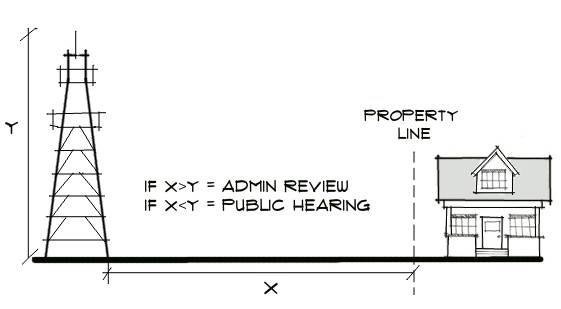
(2)
Towers adjacent to buffered multifamily development - For multifamily developments, where required parking or drainage separates any building (with living units) more than fifty (50) feet from the property line, the distance shall be measured from the base of the tower to the nearest wall of a structure containing a typical dwelling unit (see Figure 15-2).
Figure 15-2: Tower Spacing Adjacent to Buffered Multifamily Development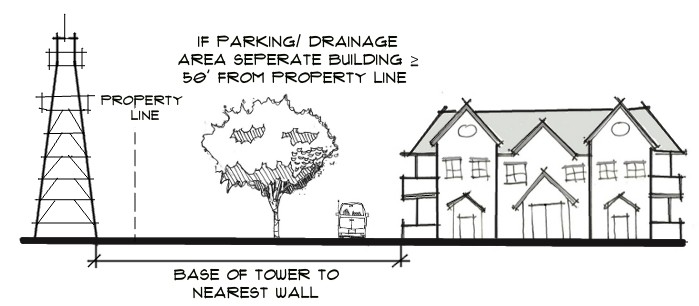
(3)
Future height increase - A tower that is originally built to less than the maximum approved height may be increased to its ultimate height without further development review. However, a Building Permit will be required prior to implementing the height increase.
(Ord. No. 2025-08, § 38, 6-17-2025)
15.5.6 - Stealth Antenna Facilities
A.
Permitted location - Stealth antenna facilities shall be allowed in all land use designations and in public rights-of-way. Stealth antennas may be installed in rights-of-way, utility easements, and on existing structures such as buildings, light poles, electrical power poles, or other freestanding structures, provided the antenna, measured from the top of the antenna to the lowest member of the support structure, adds no more than twenty (20) feet to the height of the existing structure and provided all other applicable standards are met. The installation of an antenna on a building which is nonconforming shall not be deemed to constitute the expansion of a nonconforming use.
B.
Qualification - To qualify as a stealth facility, illustrations or pictures of facilities similar to that proposed must be presented at the time of application for a development permit.
C.
Final determination - Stealth antenna facilities shall be reviewed administratively. The DCO or his/her designee shall make the final determination as to whether the proposed facility qualifies as a stealth facility.
15.5.7 - Non-Stealth Antenna Facilities
Antennas not qualifying as stealth facilities shall comply with the locational restrictions and design standards.
A.
Locational restrictions
(1)
Non-stealth antennas are allowed in all nonresidential land use designations and the Residential Medium and Residential High land use designation.
(2)
In no case shall a commercial telecommunications antenna, not qualifying as a stealth facility, be installed or constructed on a single-family residential structure, lot, or parcel.
B.
Design standards
(1)
The antenna and associated electrical and mechanical equipment must be of neutral color that is identical to or compatible with the color of the supporting structure, so as to make the antenna and equipment as visually unobtrusive as possible, unless otherwise required by the FCC or FAA.
(2)
Equipment cabinets similar in size and type to traffic signal control boxes may be placed in proximity to the pole within rights-of-way, but must be outside required sight triangles.
(3)
No lighting shall be permitted unless required by the Federal Aviation Authority (FAA) or FCC.
(4)
No advertising shall be permitted on antennas, equipment, or support structures.
15.5.8 - Communication Towers
The construction of new communication towers shall be in compliance with the following requirements.
A.
Location - The proposed location must have a Commercial, Mixed Use, Industrial, Recreation/Open Space, or Public/Semi-Public land use designation.
B.
Design standards
(1)
Setbacks
a.
Telecommunication towers must be set back from all property lines no less than five (5) feet for each ten (10) feet of vertical height.
b.
Equipment cabinets measuring one hundred (100) square feet or less may be set back three feet from the property line. Equipment buildings exceeding one hundred (100) square feet shall be subject to the setback standards listed above.
(2)
Height - It is the express preference of the Largo City Commission that each new communication tower be designed and constructed so as to accommodate more than one antenna array through co-location. However, it is recognized that co-location is not technically feasible in all cases and that co-location requires an increase in height and mass of a tower. Total heights shall be measured from the finished ground elevation to the top of the highest supporting structure.
a.
Towers designed for single users shall not exceed ninety (90) feet in height.
b.
Towers designed for two users shall not exceed one hundred and forty (140) feet in height.
c.
Towers designed for three or more users shall not exceed one hundred and ninety (190) feet in height.
(3)
Locational restrictions - New telecommunication towers and all associated facilities shall not be located within any recorded easement or right-of-way, unless otherwise allowed in this Section.
(4)
Down guys or anchors - Tower guys or anchors shall be located on the same parcel as the tower to which they are attached and shall not cross property lines or be located off-site. Guy anchors shall not be located within applicable setbacks or buffers.
(5)
Parking - Each new communication facility shall provide one (1) parking space. The space may be on-site or off-site but within three hundred (300) feet. If located off-site, the applicant must include documentation from the land owner establishing the right to use the parking space. Required spaces on the off-site parcel shall not be decreased by the telecommunication facility space.
(6)
Towers and supporting structures - Towers and supporting structures shall be a neutral, non-glare color or finish, so as to reduce visual obtrusiveness, and shall meet applicable standards of the FAA.
(7)
Equipment buildings - Equipment buildings shall be enclosed by security fencing not less than eight (8) feet in height, which shall be equipped with an appropriate anti-climbing device.
Equipment cabinets may be freestanding without fencing or located within equipment building enclosures.
(8)
Landscaping and buffering
a.
Telecommunication facilities are considered transportation/utility uses and must comply to the applicable buffer and landscaping standards of this CDC (Chapter 10).
b.
Landscaping shall be required around the perimeter of the telecommunication tower and all associated facilities, installed on the outside of fences. The DCO may waive this requirement for those sides of the proposed telecommunication facility that are located outside of public view.
(9)
Signage - No tower shall be used for advertising of any type. However, the name of the facility owner with an emergency contact number and one or more "No Trespassing" signs shall be affixed to the security fence with occupant signs not exceeding one (1) square foot in area each. Placement of signs, other than those described, is strictly prohibited.
(10)
Parcel/lot size
a.
There is no minimum required lot or parcel size on land leased for internal placement of a telecommunication facility where the land's primary use is other than the tower.
b.
Minimum required parcel or lot size on land where a telecommunication facility is the primary use shall be five thousand (5,000) square feet, except in the Transportation/Utility category which has no minimum.
15.5.9 - Replacement
Change-out and replacement towers may be constructed in the same location as the original tower, including within easements and/or rights-of-way, up to fifty (50) feet from the original location, so long as there is compliance with required setbacks and all other applicable standards of this Section.
15.5.10 - Telecommunication Facilities on City-Owned Property
A.
Siting on City-owned properties - The siting of new telecommunication facilities is encouraged on appropriate City-owned properties. Table 15-1 lists City-owned properties that may be considered. This list is not exhaustive and other sites may be considered. Locating of telecommunication facilities on City-owned property requires approval by the City of a lease, which indicates the grant of authority to utilize City-owned property for such purpose.
B.
Expedited review - Applications for telecommunication facilities sited on City-owned property shall have an expedited review.
C.
Waiver request - All new tower justification, setback, fencing, and landscaping standards shall apply unless waived by the DCO. Written justification for a requested waiver shall accompany the siting application.
D.
Building standards and lease requirements - The telecommunication facility owner shall comply with all applicable building standards and lease requirements, including indemnification of the City from any liability resulting from natural or man-made events.
15.5.11 - Federal Requirements, Safety Standards, and Inspections
(1)
Communication towers and antennas must meet current standards and regulations of the FAA, FCC, and any other agency of the federal revised standards and regulations shall constitute grounds for removal of the tower or antenna at the owner's expense.
(2)
Towers and antennas must be constructed, installed, and maintained in accordance with applicable building and associated codes and engineering specifications and, in addition, must meet the standards set forth by the Electronic Industries Association. If the Building Official at any time finds that the structural integrity of a telecommunication facility constitutes a hazard to persons or property, the owner of the facility shall be given written notice of the condition.
The owner will have up to thirty (30) days to remove the hazard or make the telecommunication facility structurally sound in accordance with the standards set forth in the applicable codes as determined by the Building Official.
(3)
Every two (2) years from the date of original building permit issuance, telecommunication tower facility owners shall inspect the facilities and submit to the City certification of structural integrity and electrical and radio frequency compliance with applicable law at the time of the certification and shall be signed by an engineer licensed to practice in the State of Florida. Failure to inspect and provide the required certification shall result in inspection by the City with costs being borne by the facility owner.
15.5.12 - Removal of Abandoned Telecommunication Facilities
Any telecommunication facility which is not operated for a period of twelve (12) consecutive months shall be considered abandoned. The Building Official shall determine the date of abandonment. Upon written demand by the City, the owner of an abandoned telecommunication facility or the land owner shall remove it according to the schedule set by the DCO. Cost of removal shall be borne by the original telecommunication facility applicant or land owner. Upon removal, all previous development permits shall expire, and any future applications for construction of a new telecommunication facility shall be processed as if no previous facility had been constructed on the site.
15.5.13 - Application and Approval Procedures
A.
Applications for installation of new antennas or antenna arrays, and applications for antenna co-location installations not requiring new communication towers, shall be reviewed by the Building Official or his/her designee and a development permit issued upon a determination that the applicant has complied with all appropriate standards.
B.
Applications for minor modifications to existing telecommunication facilities, specifically applications requesting to increase or decrease the height of existing towers by no more than twenty (20) percent, change-out an existing tower with a new one, or similar activities, shall be processed and development permits issued by the Building Official or his designee provided there is compliance with all other applicable standards.
15.5.14 - Appeals
A decision by the DCO that an acceptable alternative to a new communication tower is available may be appealed to the Planning Board, per the requirements contained in Section 4.5.
15.6.1 - Purpose
To allow the exercise of religion as protected by the First Amendment of the U.S. Constitution while safeguarding the rights of established businesses in the community.
15.6.2 - Applicability
All religious institutions, as defined in Chapter 20.
15.6.3 - Restrictions
A.
Storefront religious institutions
(1)
Amendments to a storefront religious institution shall not generate more traffic or other impacts that would result in a shopping center to exceed the permitted capacity for parking and other development standards.
(2)
If one or more religious institutions will occupy a combined total of ten (10) percent or more of the gross leasable floor area of a shopping center or structure, the site must undergo the site plan review process.
(3)
Establishment of a storefront religious institution in an existing shopping center does not require site plan review.
(4)
The location of a religious institution shall be allowed within three hundred (300) feet of an existing conforming adult use or an alcohol licensed premise. However, the conforming status of the adult use or alcohol licensed premise shall cease upon vacation of the premises for one hundred eighty (180) days or more.
B.
Development standards - The development of a religious institution shall undergo compatibility review and may be subject to more stringent requirements than provided under the performance standards of this CDC in order to mitigate potential impacts of traffic circulation, parking, and noise.
C.
Accessory uses - Only those uses specifically allowed within each land use designation, as provided in Table 6-1 of this CDC, shall be allowed as accessory uses to religious institutions.
Examples:
(a)
Within the Residential Low Medium land use designation, a religious institution, such as a church, may have a day care center as an accessory use, but it shall not be allowed to have a halfway house or homeless shelter as an accessory use.
(b)
Within the Commercial General land use designation, a religious institution may have a day care center, an accessory dwelling unit, a halfway house, and/or homeless shelter as an accessory use.
(Ord. No. 2025-01, § 34, 12-17-2024)
15.7.1 - Purpose
To protect less intensive surrounding uses from the potential negative impacts of light manufacturing uses.
15.7.2 - Applicability
Light manufacturing involves the manufacture, predominantly from previously prepared materials, of finished products or parts, including processing, fabrication, assembly, treatment, packaging, storage, sales, and distribution of such products.
15.7.3 - Standards
This type of use is typically not externally identifiable as a manufacturing use due to the relatively "clean" and self-contained nature of its operation. The following standards shall supplement the other standards of this CDC:
A.
Noise standards - All uses must be in compliance with noise standards contained in the City Code of Ordinances.
B.
Exterior storage - Outdoor activities are allowed only if approved as part of the site plan review process. All outdoor activities are limited to no more than fifty (50) percent of the total site area, excluding all areas required for buffers, parking, and vehicular access. Outdoor storage is prohibited on properties classified as Residential/Office General (R/OG) or Residential/Office Retail (R/OR).
(Ord. No. 2026-03, § 14, 3-17-2026)
15.9.1 - Applicability
A drive-thru facility is a commercial facility which provides a service directly to a motor vehicle or where the customer drives a motor vehicle onto the premise and to a window or mechanical device through or by which the customer is serviced without exiting the vehicle. Fueling stations, or the accessory functions of a car wash and/or vacuum cleaning stations are not considered drive-thru facilities.
15.9.2 - General Placement
Drive-thru facilities must be placed to the rear or interior of the site. Drive-thru facilities may be placed adjacent to streets if one or more of the following conditions is present:
A.
The rear or interior side of the site is less than thirty (30) feet from an adjacent residential property line as measured at the narrowest point between the residential property line to the closest point of the drive-thru lane.
B.
Location in the rear or interior side of the site is impractical due to the physical constraints of the lot or concerns regarding vehicle and pedestrian safety.
15.9.3 - Design Standards
A.
Stacking lane requirements - Drive-thru lanes shall be constructed with the necessary vehicle stacking capacity so that vehicles using drive-thru lane do not overflow into the on-site parking aisles, public street right-of-way or public streets.
(1)
Number - All facilities must provide no fewer than three (3) stacking spaces total (includes two stacking spaces plus one space per window).
(2)
Dimensions - Stacking spaces shall be a minimum of ten (10) feet wide by twenty (20) feet long.
(3)
Location - Stacking lanes shall not conflict with the following:
a.
Parking space access;
b.
Required loading and trash storage areas; or
c.
Pedestrian access ways.
B.
Bypass lane(s), ingress and egress locations - The location of bypass, ingress and egress locations shall be determined at the time of site plan review and as approved by the City Engineer. If required, bypass lane(s) shall be at least nine (9) feet wide.
C.
Drive-thru entrance - The entrance into the drive-thru lanes shall not conflict with general access to the site.
15.9.4 - Compatibility Standards
A.
Residential separation - The minimum distance from a drive-thru lane to any residential area shall be thirty (30) feet as measured at the narrowest point between the residential property line to the closest point of the drive-thru lane.
B.
Residential alleys or driveways - Alleys or driveways in residential areas adjacent to drive-thru facilities shall not be used for circulation of customer traffic.
C.
Other issues - More strict development standards may be applied to properly mitigate site specific compatibility problems.
15.9.5 - Design Standards in the West Bay Drive Community Redevelopment District
In addition to the requirements of Section 15.9.1-4, drive-thru within the West Bay Drive CRD must meet the following standards:
A.
Placement of drive-thru service window(s), bays or lanes and all stacking lanes - Shall be located as far as practical from any street or major pedestrian route and shall be located at the rear and/or side of the building.
B.
Pedestrian circulation
(1)
Pedestrian circulation within the site shall be well marked, both for the operator of a vehicle and for the pedestrian.
(2)
The design of drive-through facilities shall allow for convenient, comfortable, and safe pedestrian movement between the building and street sidewalks and transit stops.
C.
Architecture and site design - The architecture and site design within the West Bay Drive CRD shall conform to the design standards contained in the West Bay Drive Community District Redevelopment Plan, 2010 edition.
D.
Restrictions - Between Missouri Avenue/ Seminole Boulevard and Clearwater Largo Road, there shall be no entrances or exits to drive-thrus onto West Bay Drive.
Figure 15-4: Conceptual Drive-Thru Site Plan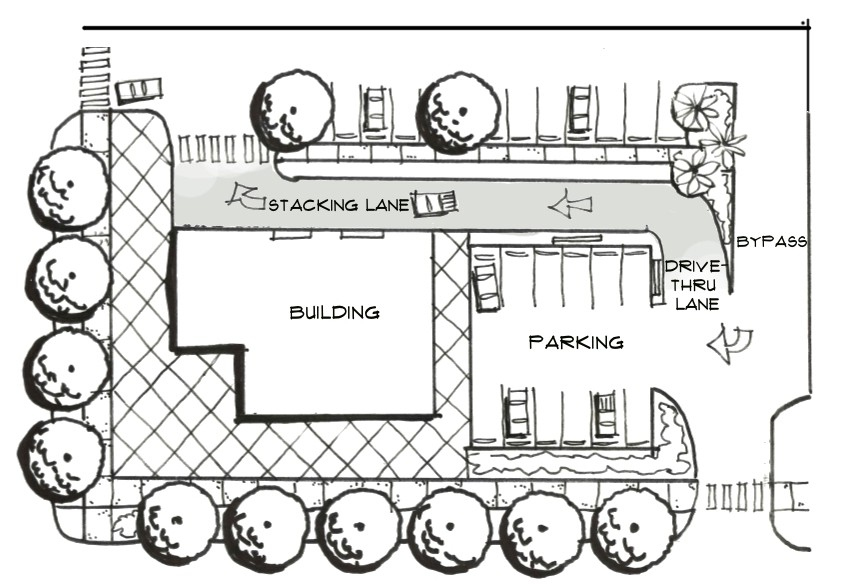
15.9.6 - Design Standards in the Largo Tri-City SAP
In addition to the requirements of Section 15.9.1-4, drive-thru within the Largo Tri-City SAP must meet the following standards:
A.
Placement of drive-thru service window(s), bays or lanes and all stacking lanes - Shall be located to the rear of the building and away from any pedestrian access or walkways. Service windows and stacking lanes are not permitted within the front of buildings.
(1)
No drive-through speaker shall be oriented to face a single-family residential use or neighborhood zoning district.
B.
Pedestrian circulation
(1)
Pedestrian circulation within the site shall be well marked, both for the operator of a vehicle and for the pedestrian. Pedestrian circulation markings include, but are not limited to, pavers, reflective paint, and elevated sidewalks/crosswalks.
(2)
The design of drive-through facilities shall allow for convenient, comfortable, and safe pedestrian movement between the building and street sidewalks and transit stops.
(3)
Drive-thru facilities shall be oriented so that service entrances and exits result in minimal interaction with pedestrian walkways.
(4)
Drive-through lanes that obstruct the pathway between parking areas and entries into the building shall be designed with a pedestrian crossing that is delineated by landscaping, curbing, raised or decorative pavement,
C.
Design Standards - The architecture and site design shall conform to the design standards contained in the Largo Tri-City Special Area Plan.
D.
Landscaping and screening - Landscaping requirements for drive-thru facilities shall adhere to the standards outlined in Chapter 10. When practical, applicable buffering requirements should be utilized as screening of service windows and stacking lanes in order to provide aesthetic appeal and mitigate potential impacts of odor and noise on surrounding land uses.
(1)
Drive-through stacking lanes shall be delineated from other vehicular use areas by means of one of the following prioritized divider median options;
(a)
In the case that stacking lines are situated within the side or rear of the building, a landscaped divider median will be installed in order to separate them from other vehicular uses on site.
(b)
When site dimensions do not allow for the practicality of side or rear stacking lanes, a separating wall shall serve as a buffer between stacking lanes and the adjacent right of way. This divider shall conform to the architectural and design standards outlined within the Tri-City SAP Plan.
E.
Hours of Operation - When the drive-through facility abuts a residential use, drive-through services shall be prohibited between the hours of 11:00 p.m. and 6:00 a.m. weekdays and between 12:00 a.m. and 6:00 a.m. on Saturday, Sunday and holidays.
F.
Conditional Use Approval - Drive-thru facilities allowed by the underlying future land use designation and proposed at either of the following locations shall require conditional use approval to ensure compliance with the intent of the Largo Tri-City Special Area Plan and mitigation of impacts to the multimodal transportation system:
(1)
Within the Activity Center Transit Core Scale Overlay
(2)
Within the Multimodal Corridor Overlay along Roosevelt Boulevard and not immediately adjacent and accessible to a signalized intersection by vehicle.
(Ord. No. 2021-32, § 11, 3-2-2021)
15.9.7 - Determination of Compliance
The DCO shall be authorized to determine compliance with the provisions of this Section. The DCO may approve a site plan that varies from these standards in order to accommodate unique site features or to provide a more innovative site design, provided that the DCO finds that the alternative plan fulfills the purpose and intent of this Section.
(Ord. No. 2021-32, § 11, 3-2-2021)
15.11.1 - Purpose
To protect the aesthetics, cleanliness, and character of the City of Largo and to mitigate the potential negative impacts of unattended donation bins upon adjacent properties and the health, safety and welfare of Largo's citizens by reducing or eliminating the nuisance, blighted and neutral manner, based upon reasonable time, place and manner restrictions, that this section is not intended to and does not operate to discriminate against any particular viewpoint or content, and that this section is not intended to and does not operate to discriminate based on the charitable or other purpose of the owner or operator of the donation bin.
15.11.2 - Applicability
The standards of this Section apply to donation bins as defined in Chapter 20.1.D(19) of the Comprehensive Development Code.
15.11.3 - Standards
A.
Dimensions of the Donation Bin - shall not exceed the following:
(1)
Maximum Height - Seven (7) feet.
(2)
Maximum Width - Five (5) feet.
(3)
Maximum Length - Five (5) feet.
B.
Construction and Maintenance - Donation bins shall adhere to the following construction and maintenance standards:
(1)
Construction - Shall be constructed of durable, waterproof, non-flammable material and shall be maintained with no structural damage, holes, graffiti, or visible rust.
(2)
Surrounding Area - Donation bins shall be emptied of their contents as often as necessary, but no less than one (1) time per calendar week, to prevent overflow.
(3)
Content Retrieval - The interior of donation bins shall be accessed by use of a receiving door which shall remain locked at all times to prevent access to the interior of the donation bin by anyone other than those persons responsible for retrieval of contents.
C.
Location - Donation bins are to be located so as not to interfere with visibility triangles, on-site pedestrian and vehicular circulation, required setbacks for an accessory use, landscape buffers, required on-site parking, or any other requirements of the Comprehensive Development Code or any other requirement or condition that may be imposed as part of an approved site plan for the premises. Donation bins shall not be located within the proximity of any storm water utility or drainage system. No donation bin shall be located within five hundred (500) feet of any other donation bin. Provided, however, that a donation bin existing in the City on July 1, 2016, will be grandfathered in from complying with the limitation on placement of a donation bin within five hundred (500) feet of another donation bin as long as that donation bin is not moved to another location, whether on the same property or a different property, and is not abandoned. A donation bin shall be considered abandoned when, for a period of sixty (60) days or more it is not emptied as required by this section, and/or when the individual/entity responsible for the donation bin fails to respond to the City's requests to maintain and empty the date notice is sent to the donation bin operator and/or property owner that the donation bin has been identified as abandoned.
(1)
Future Land Use - Donation bins are prohibited from being placed in the following Future Land Use classifications: Residential Rural, Residential Urban, Residential Estate, Residential Low, Residential Low-Medium, Residential Medium, Residential Suburban, and Residential High.
D.
Disclosure - All donation bins within the City of Largo are required to display the name, address, telephone number, and, if available, the Internet Web address and email address of the organization owning/operating the donation bin clearly on the exterior of the bin. All individuals or entities owning/operating donation bins in the City shall be responsible to register each donation bin with the City by providing the City's Community Development Department the same disclosure information identified above for display on the donation bins, any additional contact information the owner/operator has made available to the property owner where the donation bin is located, in addition to identifying the location of each donation bin by address and/or parcel identification number. This registration shall be updated annually with the City on or before October 1st of each year.
(Ord. No. 2024-04, § 3, 11-21-2023)
15.12.1 - Purpose
To provide development standards for the proper location of retail medical cannabis dispensing facilities operated by a Medical Marijuana Treatment Center as defined in Article X, Section 29(b)(5) of the Florida Constitution and approved by the Florida Department of Health or its successor agency.
15.12.2 - Applicability
This Section applies to medical cannabis dispensing facilities operated by a Medical Marijuana Treatment Center as defined in Article X, Section 29(b)(5) of the Florida Constitution.
15.12.3 - Locational Restrictions
A.
Medical Marijuana Treatment Center Dispensing Facilities shall be allowed in the same future land use designations where retail is allowed.
B.
No Medical Marijuana Treatment Center Dispensing Facility shall be located within 500 feet of the real property that comprises a public or private elementary, middle, or secondary school.
(Ord. No. 2025-08, § 40, 6-17-2025)
15.12.4 - Review Procedures
A.
Medical Marijuana Treatment Center Dispensing Facility(ies) - Where allowable, these facilities shall be administratively reviewed (Level I or II).
B.
At time of application and at all times through such use and occupancy, the applicant shall produce current written evidence from the Florida Department of Health, or its successor agency, that the applicant is approved as a Medical Marijuana Treatment Center as defined in Article X, Section 29(b)(5) of the Florida Constitution.
15.12.5 - Standards
A.
Medical Marijuana Treatment Center Dispensing Facilities shall be subject to the same standards for permitting and determining their location as those standards for permitting or determining the locations for pharmacies licensed under chapter 465, Florida Statutes.
B.
Parking shall be provided in accordance with the General Commercial parking requirements contained in Table 9-2.
C.
The dispensing location of a Medical Marijuana Treatment Center shall comply with all sign restrictions in Section 381.986(8)(h)(1), Florida Statutes.
D.
The operator shall at all times be approved by the Florida Department of Health, or its successor agency, as a Medical Marijuana Treatment Center under Section 381.986(8)(a), Florida Statutes (2017) and shall produce evidence of such approval upon request.
15.13.1 - Purpose
Microbreweries and micro-distilleries represent a unique combination of industrial and commercial activities and are typically located in industrial and commercial land uses. This section is intended to protect less intensive surrounding uses from the potential negative impacts of a microbrewery or micro-distillery in transitional locations.
(Ord. No. 2024-43, § 3, 11-19-2024)
15.13.2 - Applicability
This section applies to all microbreweries and micro-distilleries.
15.13.3 - Standards
In addition to the general development standards, a microbrewery or a micro-distillery shall comply with the following:
A.
Taprooms, tasting rooms, sit-down restaurants, and retail sales are considered to be a function of a microbrewery or micro-distillery and may be allowed in conjunction with the microbrewery or micro-distillery use provided that:
(1)
On properties classified as Residential/Office/Retail (ROR), a microbrewery or micro-distillery shall only be permitted in conjunction with a taproom, tasting room, restaurant, or retail sales.
(2)
On properties classified as Commercial Neighborhood (CN), a sit-down restaurant within a microbrewery or micro-distillery must obtain conditional use approval.
B.
No more than seventy-five (75) percent of the total gross floor area of the establishment shall be used for the microbrewery or micro-distillery function including, but not limited to, the brewhouse, boiling and water treatment areas, bottling and kegging lines, milling, storage, fermentation tanks, conditioning tanks and serving tanks.
C.
All mechanical equipment visible from the street (excluding alleys) or adjacent to residential uses shall be concealed.
D.
Distance separation requirements under Chapter 4 of the Code of Ordinances are to be adhered to when an establishment seeks to provide alcoholic beverages for consumption on premises, however, conditional use approval can be requested to shorten the distance separation requirements from religious institutions by an applicant when a microbrewery or micro-distillery does not meet the distance separation requirement. To apply for conditional use approval, the applicant shall submit the required items for a conditional use review pursuant to Section 4.2 of this Code, in addition to the following materials:
(1)
A map showing the distance from the religious institution located within the required distance separation radius. The distance is to be measured in a straight line from the real property line of the religious institution nearest to the outer edge or wall of the structure in which alcohol will be sold for consumption on premises.
(2)
The hours of operation in which the sale of alcoholic beverages for consumption on premises is proposed to occur.
(3)
Signed letter(s) from the religious institution stating no objection to the reduced distance separation request and the designated hours of operation for the microbrewery or micro-distillery's tap room or tasting room.
(Ord. No. 2024-43, § 3, 11-19-2024; Ord. No. 2025-08, § 41, 6-17-2025)
15.14.1 - Purpose
Regional Breweries are considered industrial uses and are typically allowed in commercial or industrial land use classifications. This section is intended to protect less intensive surrounding uses from the potential negative impacts of a regional brewery in transitional locations.
(Ord. No. 2024-43, § 4, 11-19-2024)
15.14.2 - Applicability
This section applies to all regional breweries.
15.14.3 - Standards
In addition to the general development standards, an establishment that meets the definition of a regional brewery shall comply with the following:
A.
Regional breweries shall comply with the supplemental standards for light manufacturing uses contained in Section 15.7 of this Code.
B.
A minimum of fifty percent (50%) of the total gross floor area of the establishment shall be used for the brewery function including, but not limited to, the brewhouse, boiling and water treatment areas, bottling and kegging lines, malt milling and storage, fermentation tanks, conditioning tanks and serving tanks.
C.
Taprooms, tasting rooms, and retail sales are to be considered a function of regional breweries and shall be allowed as ancillary uses. Restaurant uses may also be permitted in conjunction with a regional brewery if allowed in the underlying land use classification in accordance with Section 6.2 of this Code.
D.
Distance separation requirements under Chapter 4 of the Code of Ordinances are to be adhered to when the establishment seeks to provide alcoholic beverages for consumption on premises, however, conditional use approval can be requested to shorten the distance requirement from religious institutions by the business owner when a regional brewery does not meet the distance separation requirement. To apply for a conditional use review, the applicant shall submit the required items for conditional use review pursuant to Section 4.2 of this Code, in addition to the following materials:
(1)
A map showing the distance from the religious institution located within the required distance separation radius. The distance is to be measured in a straight line from the real property line of the religious institution nearest to the outer edge or wall of the structure in which alcohol will be sold for consumption on premises;
(2)
A map showing the distance from the religious institution located within the required distance separation radius. The distance is to be measured in a straight line from the real property line of the religious institution nearest to the outer edge or wall of the structure in which alcohol will be sold for consumption on premises;
(3)
The opening and closing times for the sale of alcoholic beverages for consumption on premises; and
(4)
Signed letter(s) from the religious institution stating no objection to the reduced distance separation requirement and the designated opening and closing times for the regional brewery's tap room or tasting room operations.
(Ord. No. 2024-43, § 4, 11-19-2024; Ord. No. 2025-08, § 42, 6-17-2025)
15.15.1 - Purpose
To set forth standards that will allow safe, convenient and clean animal care facilities to provide services in the community, while preserving and protecting the aesthetics of the City. In terms of this subsection of the Code, "kennel" shall mean a small shelter for a dog or cat, which may include animal boarding facilities and animal grooming establishments as defined within the standards set forth.
15.15.2 - Standards
Kennels are subject to meeting the following appropriate performance standards to be met as conditions for approval:
A.
Location - Kennels may be located in a Commercial, Mixed Use or Industrial land use designation.
B.
Design Standards
(1)
Setback - Any outdoor pen or run-feeding station must be seventy-five (75) feet from abutting residential property;
(2)
Indoor animal boarding is permitted;
(3)
All outdoor runs shall be screened by an opaque barrier such that the runs are not visible from adjacent properties or public rights-of-way and separate "doggie walk" from drainage facilities;
(4)
If adjacent to residential property, no animal shall be permitted in open run areas between the hours of 7:00pm and 7:00am; and
(5)
An animal waste management plan shall be provided at the time of site plan review.
C.
Accessory uses - Animal grooming may be permitted as an accessory.
15.16.1 - Purpose
To set forth standards that will allow safe, convenient and clean animal grooming facilities to provide services in the community, while preserving and protecting the aesthetics of the City.
15.16.2 - Standards
Animal grooming establishments are subject to meeting the following appropriate performance standards to be met as conditions for approval:
A.
Location - Animal grooming establishments may be allowed in Commercial, Mixed Use, Medical Arts, or Professional Office land use designations.
B.
Design Standards -
(1)
All animals shall be keep indoors; and
(2)
An animal waste management plan shall be provided at the time of site plan review.
C.
Accessory Uses - Animal grooming establishments shall not keep any animal overnight for the purpose of boarding. No animal grooming establishment shall be utilized as living quarter by any person, nor shall the same be equipped or furnished with sleeping or cooking facilities for humans.
(Ord. No. 2019-16, § 3, 3-19-2019; Ord. No. 2025-08, § 43, 6-17-2025)
15.17.1 - Accessory Dwelling Units (ADUs) (Mother-in-Law Suites, Guest Houses, Garage Apartments)
Accessory dwelling units (ADUs) in Community Redevelopment Districts and citywide are regulated by Chapter 16, Accessory Uses. Section 16.14 contains regulations for ADUs.
(Ord. No. 2019-16, § 4, 3-19-2019; Ord. No. 2025-01, § 35, 12-17-2024)
15.17.2 - Bed and Breakfast Establishment
A.
Purpose - The intent of requiring additional supplemental standards for bed and breakfast establishments is to ensure the location and general operation of such facilities is consistent with the surrounding area in terms of appearance, scale, and traffic generation rates. It is specifically not intended for these to be rental apartments or other mid to long term rental units.
B.
Applicability - The supplemental standards created in this section apply to owner-occupied residences that provide six (6) or fewer lodging rooms and/or accommodate no more than twelve (12) adults, which meet the locational requirements of subsection C below, and which is classified as a bed and breakfast pursuant to section 509.242(1)(f), Florida Statutes, as may be amended from time to time
C.
Location Restrictions -
(1)
Bed and Breakfast establishments are allowed in the Mixed Use Corridor (MUC) Character District of the CRDs subject to full compliance with the standards, regulations and criterial contained within the CRD Plans (whichever applies) and this CDC.
(2)
Supplemental standards are required for Bed and Breakfast establishments that are allowed in City Home (CH) District of the CRDs subject to full compliance with the standards, regulations and criteria contained in the Plans, this CDC, as well as these supplemental standards.
D.
Standards -
(1)
Facility shall be designed and operated so as to maintain the residential character of the neighborhood.
(2)
Parking - Provisions must be made for one off-street parking space per guest room, plus two off-street parking spaces for the owner. The parking area must be a hard surface, and dust free. All parking areas on property (except driveways) shall be behind any building lines and must be screened from the view of adjacent residences to a height of six feet by a solid screening fence, or dense shrubs and vegetation and meet the parking standards of Table 9-2 of this CDC, and such screening is compatible with the surrounding area.
(2)
Signage - Signs are limited to four square feet, attached to the building or mailbox, non-illuminated. No additional outdoor signage is allowed.
(3)
The facility shall be licensed by and shall comply with all requirements, rules, and regulations of the State including, but not limited to, those set forth in chapter 509, Florida Statutes.
(4)
Density shall not exceed the allowable residential density for the character district in which the establishment is located. Two (2) bedrooms or lodging rooms shall be the equivalent of one (1) residential dwelling unit for purposes of calculating the allowable density of a bed and breakfast. Where the equivalent number of residential dwellings contains a fraction, the number shall be rounded up to the next whole number. All bedrooms shall be counted in the determination of density, whether occupied by the owner, the owner's family and/or guests within the bed and breakfast establishment.
(5)
The owner of the bed and breakfast must obtain a business tax receipt before operating the bed and breakfast.
(Ord. No. 2019-16, § 4, 3-19-2019)
15.17.3 - Daycare Center/Preschool
A.
Purpose - To set forth standards that will allow licensed Daycare Centers in the Neighborhood Residential (NR) and City Home (CH) Character Districts in the CRDs, while preserving and protecting the aesthetics of these districts.
B.
Applicability - The supplemental standards created in this section apply to any establishment operated in order to provide care, protection and guidance to one or more children or adults on a regular basis, for periods of less than twenty-four (24) hours per day, in a place other than the child's or adult's own dwelling unit in exchange for a payment or fee, which meets the locational requirements of subsection C below.
C.
Location Restrictions -
(1)
Licensed daycare centers and preschools are allowed in the Mixed Use Corridor (MUC) Character District, Medical Arts (MA) District and Professional Office (PO) Character Districts of the CRDs subject to full compliance with the standards, regulations and criteria contained in the CRD Plans, and this CDC.
D.
Design Standards -
(1)
Outdoor play area shall meet the criteria set forth by the State license issued to the establishment. Such play area shall be located in the side or rear yard and shall be completely enclosed by a fence or wall a minimum of four (4) feet in height.
(2)
An off-street pick-up / drop-off area for at least one automobile shall be provided, which may be a driveway, provided it is kept free of parked vehicles and other obstructions to leave sufficient space for direct access.
(3)
If operated within a structure that previously was occupied as a residence, the use shall maintain the residential character and appearance of the structure.
(4)
The use shall provide care for not more than six (6) children on the premises at any one time.
(5)
One (1) non-illuminated identification sign, not to exceed four (4) square feet, may be attached to the residence.
(6)
Hours of operation are limited to 6:00 a.m. to 8:00 p.m.
(7)
Owner of the licensed daycare center or preschool must obtain a business tax receipt before beginning operations.
(Ord. No. 2019-16, § 4, 3-19-2019)
15.17.4 - Religious Institutions
A.
Purpose - To allow the exercise of religion as protected by the First Amendment of the U.S. Constitution while safeguarding the rights of the established neighborhoods in the CRDs.
B.
Applicability - The supplemental standards created in this section apply to any site, premise, or location within the CRDs which is used principally, primarily, or exclusively for purposes of the exercise of religion as protected by the First Amendment of the U.S. Constitution, and which meet the locational requirements of subsection C below..
C.
Location Restrictions -
(1)
Religious institutions are allowed in the Mixed Use Corridor (MUC) and the Medical Arts (MA) Character Districts of the CRDs subject to full compliance with the standards, regulations and criteria contained in the CRD Plans, and this CDC.
D.
Design Standards -
(1)
When abutting residential use, all outdoor activity shall occur no earlier than 8:00 a.m. and no later than 9:00 p.m.
(2)
The following activities shall be prohibited in association with religious uses: retreat centers; overnight lodging facilities and/or other temporary sleeping quarters; and any use not specifically identified as an allowable accessory use. Notwithstanding the prohibition of overnight lodging, one (1) residential dwelling unit may be provided as a parsonage.
(Ord. No. 2019-16, § 4, 3-19-2019)
15.17.5 - Home Improvement Store
A.
Purpose - To set forth standards that will allow a Home Improvement Store within the CRDs, while preserving and protecting the aesthetics of these districts and the neighborhood that surround them.
B.
Applicability - The supplemental standards created in this section apply to any establishment in the CRDs that sells bulky, durable goods, including but not limited to lumber, hardware and lawn equipment which require extensive floor area for display and which meets the locational requirements of subsection C below.
C.
Location Restrictions - Home Improvement Stores are allowed within the Mixed Use Corridor (MUC) Character District of the CRDs subject to full compliance with the standards, regulations and criteria contained in the CRD Plans, this CDC, and these supplemental standards.
D.
Design Standards - Any use which exceeds the thresholds for gross floor area contained within Chapter 13, Large Scale Retail Development Standards, must also abide by the standards of Chapter 13. In addition:
(1)
All outside storage shall be completely screened from the right-of-way and all adjacent properties.
(2)
Security fencing constructed of solid masonry walls with solid gates that totally conceal all of the contents, a minimum of six (6) feet in height, shall be provided around the outside of all storage areas.
(Ord. No. 2019-16, § 4, 3-19-2019)
15.17.6 - Reserved
Editor's note— Ord. No. 2025-01, § 36, adopted Dec. 17, 2024, repealed § 15.17.6, which pertained to single-family developments, attached (townhome/villa) and derived from the 2018 CDC; Ord. No. 2019-16, § 4, adopted March 19, 2019.
15.17.7 - Gas Stations
A.
Purpose - To set forth standards that will allow a gas station within the CRDs, while preserving and protecting the aesthetics of the CRDs and the neighborhoods that surround them.
B.
Applicability - The supplemental standards created in this section apply to any structure or area of land or portion thereof used for the retail sale of automobile fuel, oil, and accessories, where repair services and/or an automatic car wash, if present, is incidental and which meets the locational requirements of subsection C below.
C.
Location Restrictions - Gas stations are allowed in the Mixed Use Character (MUC) and Medical Arts (MA) Districts of the CRDs subject to full compliance with the standards, regulations and criteria contained in the CRD Plans, this CDC, and these supplemental standards.
D.
Design Standards -
(1)
The site shall have frontage that borders and has access to a street classified as a collector, arterial or highway.
(2)
The maximum allowance for a gas station is four (4) multi-pump dispensers and twenty-four (24) hoses.
(3)
The property shall be screened from any abutting residential use by a six (6) foot sight-obscuring fence or wall.
(4)
Outdoor storage of materials, parts and equipment is prohibited.
(5)
An associated convenience store shall have a maximum of one thousand (1,000) square foot gross floor area.
(6)
The sale of vehicles is prohibited.
(7)
Pursuant to section 553.79(20)(a)(1), Florida Statutes, notwithstanding the foregoing, if any provision of this section conflicts with or impairs corporate trademarks, service marks, trade dress, logos, color patterns, design scheme insignia, image standards, or other features of corporate branding identity on real property or other improvements thereon used in activities conducted under chapter 526, Florida Statutes (Sales of Liquid Fuels; Brake Fluid), the property owner shall present evidence of such conflict to the Community Development Director and, upon sufficient evidence of such conflict, the site shall be exempt from the provision in conflict only.
(Ord. No. 2019-16, § 4, 3-19-2019; Ord. No. 2025-08, § 44, 6-17-2025)
15.17.8 - Reserved
Editor's note— Ord. No. 2024-04, § 4, adopted Nov. 21, 2023, repealed § 15.17.8, which pertained to alternate master sign plan for non-residential developments and derived from Ord. No. 2019-16, § 4, adopted March 19, 2019.
15.22.1 - Applicability and Standards
A.
A "tiny house" is a small residential structure.
B.
Classification - A tiny house may be constructed to various standards, such as:
(1)
A tiny house would be considered the same as any other dwelling unit if it was built on-site or off-site (modular home) built to Florida Building Code standards.
(2)
A tiny house would be considered a "manufactured home" if it was built to HUD standards. See definition of "manufactured home" in Section 20.1.M.
(3)
A tiny house would be classified as a recreational vehicle should it meet the CDC's definition of recreational vehicle in Section 20.1.R.
C.
Where allowed - Tiny houses shall be allowed in the same locations as the classifications listed above are allowed in the CDC. A tiny house may also be used as an Accessory Dwelling Unit (ADU) if it meets the Florida Building Code (either site-built or a modular home), but not if it qualifies as a manufactured home or a recreational vehicle.
(Ord. No. 2025-01, § 37, 12-17-2024; Ord. No. 2025-08, § 45, 6-17-2025)

