
Largo City Zoning Code
CHAPTER 17
NONCONFORMING LOTS, USES AND STRUCTURES
Section 17.2 - Continued Existence of a Nonconforming Structure
Nonconforming structures may continue until they are removed voluntarily, by economic forces, acts of God, or by legal or other means. Maintenance and repair, in conformance with Section 17.6, is allowed. However, once a nonconforming structure is changed to a conforming structure, the nonconforming structure shall not be re-established. Reconstruction of a nonconforming structure is allowed in accordance with subsection A below. Assessed value shall be determined by reference to the official property tax assessment rolls immediately prior to the time the structure is destroyed or damaged.
A.
Nonconforming structures incurring damage of less than fifty (50) percent of the assessed value of the entire structure(s), may be restored and reconstructed as before, provided that such restoration is commenced within six (6) calendar months from the date damages were incurred, as evidenced by poured footers, slab foundations.
B.
Nonconforming structures incurring damage of more than fifty (50) percent of the assessed value of the entire structure(s), shall be made to fully comply with the provisions of this CDC.
Section 17.3 - Continued Existence of a Nonconforming Use
Nonconforming uses must be made conforming to the standards of this CDC under any of the following conditions:
A.
The nonconforming use is abandoned. Abandonment occurs when the landowner uses the property or structure for a conforming use for any period of time or intentionally or voluntarily forgoes the nonconforming use of the property for a period of one hundred eighty (180) consecutive days or more, whichever occurs first. Following abandonment, the property must conform to the standards of this CDC. Alternatively, if a nonconforming use is replaced with a conforming use, for any period of time, the nonconforming use may not be re-established.
B.
The nonconforming use is discontinued as a result of economic forces, acts of God, or by legal or other means.
(Ord. No. 2025-08, § 53, 6-17-2025)
Section 17.4 - Proof of a Legal Nonconformity
The burden of establishing the prior existence of a nonconformity is on the applicant. When applying for any permit or any other approval related to a nonconformity, the applicant may be required to submit evidence of a prior permit or other documentation showing that the nonconformity existed prior to the date on which it became nonconforming.
Section 17.5 - Modifications or Improvements to a Nonconformity
Nonconforming structures and uses shall be brought into conformance with the provisions of this CDC through the building permit process. No building permits shall be issued for construction or alterations on parcels containing a nonconformity unless the permit:
A.
Will not increase the nonconformity (See Figure 17-1 for an example of a permissible and non-permissible improvement of a structure);
Figure 17-1: Examples of Permissible and Non-Permissible Additions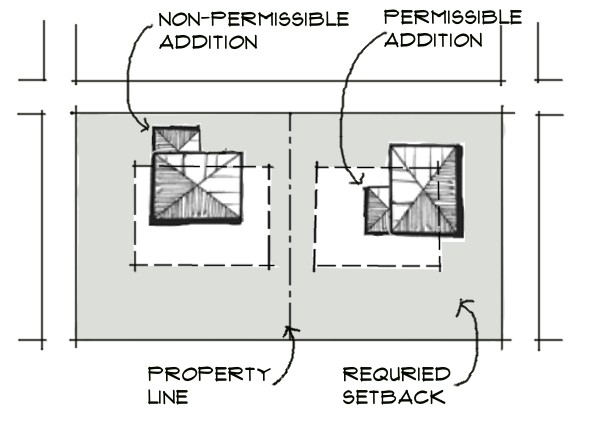
B.
Is for the purpose of bringing the nonconformity into compliance; or
C.
Is for the performance of necessary maintenance (see Section 17.6).
In addition:
D.
The provision of required off-street parking or loading spaces is allowed, provided that such extension does not involve structural alteration or enlargement of structure(s) containing the nonconforming structure or use in question;
E.
No nonconformity shall be moved, in whole or in part, for any distance whatsoever, to any other location on the same or any other lot unless the entire structure and use shall thereafter conform to the requirements of this CDC;
F.
No use or structure which is accessory to a principal lawful nonconforming use or structure shall continue after such principal use or structure is abandoned or loses its legal nonconforming status;
G.
No principal use or structure shall be established on a lot of record unless the lot conforms to the minimum lot size requirements in this CDC for the Future Land Use Map designation in which it is located. However, per Section 8.3, if an existing residential lot, as subdivided prior to 1983 or as originally platted, contains less than the minimum area required for a single-family dwelling under this CDC, then one single-family dwelling shall nevertheless be allowable on that lot or parcel, provided that yard dimensions and other requirements not involving lot area or lot width, or both, of the lot shall conform to the regulations for the lot. This provision shall apply even though such lot fails to meet the requirements for lot area, or lot width, or both, that are generally applicable to the land use designation. Variation of setback requirements shall only be obtained through the hardship relief process before the Planning Board; and
H.
If two or more nonconforming lots or combinations of lots and portions of lots with continuous frontage are in single ownership and if all or part of the lots do not meet the requirements for lot width and lot area as established by this chapter, the lots involved shall be considered to be an undivided lot for the purposes of this Section. No portion of said undivided lot shall be used or sold which does not meet lot width and lot area requirements established by this Section, nor shall any division of the lot be made which leaves remaining any lot not meeting the requirements of this Section. Any division of said lot containing a nonconforming use of a structure shall conform to the minimum lot area requirements for authorized uses.
(Ord. No. 2023-04, § 4, 2-7-2023)
Section 17.6 - Demolition of Structures and Cleared Sites
A clear site shall be deemed capable of redevelopment in full compliance with all applicable standards of this CDC. Demolition of structures shall not constitute improvement of nonconforming structures and sites within the context of this Section.
Section 17.7 - Maintenance and Repair
Normal maintenance and incidental repair of a legal nonconformity shall be permitted, provided that no other Section of this CDC is violated. Normal maintenance and repair is limited to activities that restore the structure or use to its previously existing, authorized and undamaged condition. Nothing in this Section shall be deemed to prevent the strengthening or restoration to a safe condition of a structure in accordance with an order of the Building Official. The Building Official may declare such structure to be unsafe and order its restoration, provided such repairs are the minimum necessary to bring the property to a safe condition.
17.1.1 - Purpose
To guide future uses and development in a direction consistent with City policy in order to promote the conversion of nonconformities into conformance with the provisions of the Comprehensive Plan and this CDC.
17.1.2 - Applicability
Legal nonconformities are lots, uses, and/or structures, that were existing at the time of the adoption of this CDC and its subsequent amendments, which complied with applicable regulations at the time the use was established and were properly permitted at that time, but do not conform to the standards, requirements, and/or regulations of this CDC. This Section of the CDC does not apply to nonconforming signs. Nonconforming sign regulations are contained in Section 12.7 of this CDC. Specifically, this Section refers to the following types of nonconformities:
A.
Nonconforming lots - lots that were legal when they were originally platted or subdivided but do not meet the current requirements for width, depth, access, or other related requirements in this CDC.
B.
Nonconforming uses - land uses, uses of land or building uses, which were established before this CDC went into effect and do not conform to the regulations of this CDC.
C.
Nonconforming structures - structures, which were erected before this CDC went into effect and do not conform to the regulations of this CDC, and instead encroach into the current yard setbacks or exceed the current height, area, density or intensity limitations that are provided for in this CDC. An existing nonconforming manufactured home which meets the criteria in Section 15.3.5 is also considered a nonconforming structure.
(Ord. No. 2025-01, § 43, 12-17-2024)
17.1.3 - Exemptions
A.
As of January 1, 1998, properties developed in unincorporated Pinellas County that have a Commercial zoning and Industrial land use designation per the Countywide Land Use Plan, upon annexation, will be considered conforming with the City's Industrial Limited land use designation if the primary use of such properties is Industrial and the secondary use is Commercial.
B.
Legally authorized construction of any structure whose placement, structural design, or intended use is rendered nonconforming by adoption of this CDC, and for which the final Certificate of Occupancy has not been issued as of the enactment date of this CDC, may continue, without change, but will be subject to the provisions of this Section of the CDC.

