
Largo City Zoning Code
CHAPTER 16
ACCESSORY USES AND STRUCTURES
Section 16.1 - Accessory Uses and Structures, in General
Accessory uses and structures are incidental to but customarily associated with a specific principal use, located on the same lot or parcel.
A.
Purpose - To protect the health, safety, and welfare of the community while allowing the development of accessory uses, and to protect adjacent properties from potential adverse impacts.
B.
General Standards - Accessory uses and structures shall be truly subsidiary to a principal use and shall:
(1)
Comply with all standards of this CDC pertaining to a principal use, unless specifically exempted;
(2)
Not be located within a right-of-way or easement, unless specifically allowed;
(3)
Be included in impervious surface calculations and stormwater runoff calculations, unless specifically exempted; and
(4)
Be considered a building addition only if added building square footage is integrated with the primary structure via a roof and walls.
C.
Required Submissions
(1)
All accessory use and structure applications require the submission of an up-to-date survey or a plot plan drawn to scale of the property, indicating the location of all permanent structures and easements, property lines, streets as well as the exact proposed location of the accessory use or structure and any other requirements provided for on the City's application form.
(2)
The location of the proposed accessory use must be drawn to scale on the required survey or plot plan.
(3)
Any other requirements listed under each accessory use.
(Ord. No. 2025-01, § 39, 12-17-2024)
Section 16.2 - Detached Storage Buildings and Gazebos/Pergolas[1]
Editor's note—Ord. No. 2024-34, § 3, adopted June 18, 2024, amended the title of Section 16.2 to read as herein set out. The former section was entitled "Detached Storage Buildings (Sheds, Carports, Garages and Greenhouses) and Gazebos/Pergolas."
Section 16.11 - Patrons' Dogs in Designated Outdoor Dining Areas of Public Food Service Establishments
A.
Purpose - The purpose of this Section is to provide an exemption procedure to certain provisions of the Food and Drug Administration Food Code to allow patrons' dogs within designated outdoor portions of public food service establishments. The Dixie Cup Clary Local Control Act, Section 509.233, Florida Statutes, grants the City of Largo the authority to provide exemptions from Section 6501.115, 2001 FDA Food Code, as adopted and incorporated by the Division of Hotels and Restaurants in Chapter 61C4.010(6), Florida Administrative Code. The procedure adopted pursuant to this section provides an exemption for those public food service establishments which have applied for and received a permit to those sections of the Food and Drug Administration Food Code that prohibit live animals in food service establishments.
B.
Applicability - As used in this Section "public food service establishments" shall mean eating and retail food establishments as defined by Section 509.013(5) of the Florida Statutes. "Employee" or "employees" shall include, but is not limited to, the owner or owners of the public food service establishment. No dog shall be in a public food service establishment unless allowed by state law and the public food service establishment has received and maintains a valid and unexpired permit pursuant to this Section allowing dogs in designated outdoor areas of the establishment.
C.
Permit required - Requires a Building Permit.
D.
Regulations - Public food service establishments that receive a permit for a designated outdoor area pursuant to this Section shall require that:
(1)
All employees shall wash their hands promptly after touching petting or otherwise handling any dog(s).
(2)
Employees are prohibited from touching, petting or otherwise handling any dog while serving or carrying food or beverages or while handling or carrying tableware or before entering other parts of the public food service establishment from the designated food area.
(3)
Patrons in a designated outdoor area shall be advised by appropriate signage at conspicuous locations, that they should wash their hands before eating. Waterless hand sanitizer shall be provided at all tables in the designated outdoor area.
(4)
Patrons shall keep their dogs on a leash with a maximum length of 6 feet, pursuant to Article II, Section 533 of the City of Largo Code of Ordinances, at all times and shall keep their dogs under direct control.
(5)
Employees and patrons shall not allow dogs to come into contact with serving dishes, utensils, tableware, linens, paper products or any other items involved with food service operations.
(6)
Employees and patrons shall not allow any part of a dog to be on chairs, tables, or other furnishings. Dogs must remain on the floor/ground level and shall not be permitted in the lap of the patron.
(7)
Employees shall clean and sanitize all table and chair surfaces with an approved product between seating of patrons.
(8)
Employees shall remove all dropped food and spilled drink from the floor or ground as quickly as possible but in no event less frequently than between seating of patrons at the nearest table.
(9)
Employees and patrons shall remove all dog waste immediately and the floor or ground shall be immediately cleaned and sanitized with an approved product. A kit with the appropriate materials for this purpose shall be kept near the designated outdoor area. Ingress and egress to the designated outdoor area shall not require entrance into or passage through any indoor area or non-designated outdoor portions of the public food service establishment.
(10)
Employees and patrons shall not permit dogs to be in, or travel through, indoor or non-designated outdoor portions of the public food service establishment.
(11)
A sign or signs notifying the public that the designated outdoor area is available for the use of patrons and patrons' dogs shall be posted in a conspicuous manner, as determined by the City, so as to place the public on notice. The mandatory sign shall not be less than eight and one-half inches in width and eleven inches in height (8½ inches by 11 inches) and printed in easily legible type face of not less than twenty (20) point font size.
(12)
A sign or signs informing patrons of these laws shall be posted on premises in a conspicuous manner and place as determined by the City. The mandatory sign shall be not less than eight and one-half inches in width and eleven inches in height (8½ inches by 11 inches) and printed in easily legible type face of not less than twenty (20) point font size.
(13)
The public food service establishment and designated outdoor area shall comply with all permit conditions and the approved diagram.
(14)
Employees and patrons shall not allow any dog to be in the designated outdoor areas of the public food service establishment if the public food service establishment is in violation of any of the requirements of this section or if they do not possess a valid permit.
(15)
Permits shall be conspicuously displayed in the designated outdoor area.
(16)
Failure to comply with any one the requirements outlined herein shall constitute a violation of this Section. Each instance of a dog on the premises of a public food service establishment without a permit is a separate violation. Each violation of any of the requirements of this section is to be considered a separation violation.
(17)
All dogs shall wear a current license tag or rabies tag and the patron shall have a current license certificate or rabies certificate immediately available upon request.
(18)
Employees and patrons shall not permit patrons' dogs to be in food preparation areas.
E.
Required submissions
(1)
Public food service establishments must apply for and receive a permit from the City before patrons' dogs are allowed on the premises. The City shall establish a reasonable fee to cover the cost of processing the initial application and renewals. The application for a permit shall require such information from the applicant as is deemed reasonably necessary to enforce the provisions of this Section, but shall require, at a minimum, the following information:
a.
Name, location, mailing address, and license number of the public food service establishment issued by the Division of Hotels and Restaurants.
b.
Name, mailing address and telephone contact information of the permit applicant.
c.
A diagram and description of the outdoor area which is requested to be designated as available to patrons' dogs, including dimensions of the designated area; a depiction of the number and placement of tables, chairs, and restaurant equipment, if any; the entryways and exits to the designated outdoor area; the boundaries of the designated area; and of the other outdoor dining areas not available for patrons' dogs; any fences or other barriers; surrounding property lines and public rights-of-way, including sidewalks and common pathways.
d.
The diagram shall be accurate and to scale but does not need to be prepared by a licensed design professional. A copy of the approved diagram shall be attached to the permit.
e.
A description of the days of the week and hours of operation that patrons' dogs will be permitted in the designated outdoor area.
(2)
Indemnification Requirement
a.
The public food service establishment, its officials, boards, members, agents and employees, shall indemnify, and defend with counsel reasonably acceptable to the City, and hold the City, its mayor, commissioners, officers, employees, attorney, agents and representatives of, from, and against all liability and expense including reasonable attorneys' fees and costs, and including the reasonable value of any services rendered by any officer or employee of the City in connection with any and all claims, including claims of injunctive or equitable relief, and damages whatsoever for personal injury death or property damage, including loss of use, arising out of any permit granted to the public food service establishment or the regulation and enforcement of the provisions of this section hereunder, regardless of whether the act or omission complained of is authorized, allowed or prohibited by this section, except to the extent any losses arise from the negligence or willful omissions of the City, its mayor, commissioners, officers, employees, attorneys, agents or representatives.
b.
Notwithstanding anything contained herein to the contrary, this indemnification provision shall not be construed as a waiver of any immunity from or limitation of liability to which the City is entitled to pursuant to Section 768.28 Florida Statutes. Furthermore, this provision is not intended to nor shall be interpreted as limiting or in any way affecting any defense the City may have under Section 768.28 Florida Statutes and is not intended to and shall not be interpreted to alter the extent of the City's waiver of sovereign immunity under Section 768.28 Florida Statutes. Nothing herein is intended to serve as a waiver of sovereign immunity by either party, and nothing herein shall be construed as consent by either party to be sued by third parties in any manner arising out of this Ordinance. This indemnification provision shall survive the expiration or termination of Section 509.233 Florida Statutes, however or whenever expired or terminated.
F.
Expiration and revocation
(1)
A permit issued pursuant to this section shall expire automatically upon the sale of the public food service establishment and cannot be transferred to a subsequent owner. The subsequent owner may apply for a permit pursuant to this Section if the subsequent owner wishes to continue to allow patrons' dogs in a designated outdoor area of the public food service establishment.
(2)
A permit may be revoked by the City if, after notice and reasonable time in which the grounds for revocation may be corrected, the public food service establishment fails to comply with any condition of approval, fails to comply with the approved diagram, fails to maintain any required state or local license, or is found to be in violation of any provision of this section. If the grounds for revocation is a failure to maintain any required state or local license, the revocation may take effect immediately upon giving notice of revocation to the permit holder.
(3)
If a public food service establishment's permit is revoked, no new permit may be approved for the establishment until the expiration of 90 days following the date of revocation, providing that all issues continued within the revocation have been satisfied. This includes any outstanding fines associated with enforcement of this ordinance.
G.
Complaints and reporting
(1)
Complaints may be made in writing to the Community Development Department which shall accept, document and respond to all complaints and shall timely report to the Division of Hotels and Restaurants all complaints and the response to such complaints.
(2)
The City shall provide the Division of Hotels and Restaurants with a copy of all approved applications and permits issued.
(3)
All applications, permits, and other related materials shall contain the Division issued license number for the public food service establishment.
(4)
The patron or the designated person in charge of the public food service establishment, or both, may be issued civil citations for each violation of this ordinance.
16.2.1 - Purpose
To protect the character of neighborhoods and prevent any negative impacts upon adjacent properties.
16.2.2 - Required Permits
Requires a Building Permit and an inspection.
(Ord. No. 2024-34, § 3, 6-18-2024)
16.2.3 - Applicability
The standards of this Section are intended to apply, but not be limited to, detached storage buildings, such as sheds, carports, garages, and greenhouses, and gazebos and pergolas on residential properties.
(Ord. No. 2024-34, § 3, 6-18-2024)
16.2.4 - Standards
A.
Detached storage buildings, gazebos and pergolas less than or equal to one hundred and fifty (150) square feet
(1)
Placement - Detached accessory use structures must be placed in the side or rear yards and cannot be placed in the front yard, buffer area, or within recorded easements.
(2)
Maximum square footage - One hundred fifty (150) square feet.
(3)
Maximum height - Ten (10) feet.
(4)
Maximum quantity -
a.
Properties less than two (2) acres are limited to one (1) per dwelling unit or property.
b.
Properties two (2) acres or more may have two (2) detached accessory structures up to 150 square feet each.
(5)
Minimum separation from the principal structure - As required in the Florida Building Code 8th Edition (2023).
(6)
Setback - Three (3) feet from side and rear property lines.
B.
Detached storage buildings, gazebos and pergolas greater than one hundred fifty (150) square feet
(1)
Placement - Detached accessory use structures must be placed in the side or rear yards and cannot be placed in the front yard, buffer area, or within recorded easements.
(2)
Maximum square footage - The following square footage provisions apply to detached storage buildings, gazebos and pergolas, with the exception of detached garages.
a.
Properties less than two (2) acres are limited to no greater than twenty-five (25) percent of the principal structure's gross floor area with a maximum of five hundred (500) square feet.
b.
Properties two (2) acres or more shall apply for a Class 2 approval of detached accessory structures over 500 square feet.
(3)
Maximum height - The maximum height cannot exceed the peak roof line of the principal structure or one (1) story, whichever is lower.
(4)
Maximum quantity - One (1) per dwelling unit or lot.
(5)
Minimum separation from the principal structure - As required in the Florida Building Code 8th Edition (2023).
(6)
Setbacks:
Front Yard - Not permitted.
Side Yard - Same as the principal use setbacks for the land use designation.
Rear Yard - Same as the principal use setbacks for the land use designation.
(7)
Architectural style - Compatible with the architectural style of the principal structure.
(8)
Construction materials - Compatible with the construction materials and color scheme of the principal structure.
C.
Reserved
(Ord. No. 2020-32, § 3, 8-18-2020; Ord. No. 2021-33, §§ 8—10, 4-6-2021; Ord. No. 2024-19, §§ 4, 5, 5-7-2024; Ord. No. 2024-34, § 3, 6-18-2024)
16.3.1 - Purpose
These standards are established to minimize adverse impacts upon adjacent property owners.
16.3.2 - Applicability
Fences, walls or any other similar man-made barrier erected for the purpose of enclosure, exclusion, protection, privacy, security, retainment, buffering or aesthetics in accordance with Section 10.5.2 of this CDC. This section applies to all properties within the City of Largo.
(Ord. No. 2021-55, § 6, 10-19-2021; Ord. No. 2025-08, § 46, 6-17-2025)
16.3.3 - Required Permits
A building permit is required to install a fence, wall or other man-made barriers with the following exception:
Single-family residential properties are exempt from required permitting for maintenance or replacement of fencing with like for like materials not to exceed ten (10) linear feet (including 2 posts) and fence access gates not to exceed six (6) feet (including 2 posts). Repair, installation, or replacement of fences and gates that are part of a swimming pool barrier are not exempt from permitting.
(Ord. No. 2021-55, § 7, 10-19-2021)
16.3.4 - Standards
A.
Construction standards - Construction of fences, walls and other man-made barriers shall comply with the construction standards of Chapter 18 of this CDC.
B.
Maximum height
(1)
Single-Family, Duplex and Triplex Residential - The maximum height for fences and walls on all properties is four (4) feet within the front yards and six (6) feet within the side and rear yards. For the placement of fences and walls on corner lots, a lot with frontage on two intersecting streets will be considered to have two (2) front yards with a maximum fence or wall height of four (4) feet. See Figures 16-1 through 16-4 for most typical site scenarios. Fence placement, as depicted in Figure 16-5, must also comply with the following standards:
i.
There must be an existing fence with this configuration; and
ii.
The proposed fence must be outside of the road visibility triangle.
(2)
Multifamily, subdivisions, and mobile home communities - The maximum fence height is six (6) feet on all lot sides. Decorative columns, gates and gate support posts, or other similar embellishments may extend up to eight (8) feet in height.
(3)
Commercial - The maximum fence height is six (6) feet in the side and rear yards and four (4) in the front yard.
(4)
Industrial - The maximum fence height for industrial properties is eight (8) feet on all lot sides.
(5)
Athletic - The installation of athletic fences, to protect against errant balls or other objects, may be approved due to unusual site or course layout circumstances.
a.
The maximum height of an athletic fence is twenty-five (25) feet, unless approved by the DCO.
b.
Golf ball fences may only be developed on lots that directly abut a golf course or driving range, however, they may not be developed within any front or street-side yard.
c.
Poles and gates must be constructed of metal and painted a color that blends in with background features as viewed from neighboring properties to minimize their visibility. Net color, if applicable, shall be black.
(6)
Approval to exceed maximum height limitations may be administratively granted by the DCO, upon receipt of satisfactory evidence of the need to exceed height standards.
C.
Road visibility triangle - Fences may not obstruct the road visibility triangle. See Chapter 9, Section 9.2.3 for applicable standards.
D.
Wood Quality (if applicable) - Support posts must be resistant to decay, corrosion, and termite infestation. Wooden posts must be pressure-treated for strength and endurance. Wood fences are only allowed on single-family, duplex and triplex properties.
E.
Orientation - All fences and walls must be constructed and installed with the finished side facing towards the exterior or adjoining properties and rights-of-way. For fences and walls between adjoining properties, this requirement may be waived by the DCO and with the written, signed approval of the adjoining property owners.
F.
Walls - Solid block or concrete walls require the approval of the City Engineer to ensure that no obstruction of the stormwater system will occur.
G.
Barbed wire
(1)
Land use classification - Barbed wire may be allowed on properties with an industrial land use designation, along the top of a fence. Barbed wire shall be prohibited in all other land use designations.
(2)
Overhang not allowed - In no case shall the barbed wire be allowed to overhang or extend outside of the property line of the site on which the fence is installed.
H.
Low-voltage electric fences - In line with Section 553.793, Florida Statutes, are prohibited on all properties within the residential future land use classifications (Residential Rural, Residential Estate, Residential Suburban, Residential Low, Residential Urban, Residential Low Medium, Residential Medium, and Residential High) in the City. A low-voltage electric fence must meet all of the following requirements to be permitted as a low-voltage alarm system project, and no further permit shall be required for the low-voltage alarm system project other than as provided in Section 553.793, Florida Statutes:
(1)
The electric charge produced by the fence upon contact must not exceed energizer characteristics set forth in paragraph 22.108 and depicted in Figure 102 of International Electrotechnical Commission Standard No. 60335-2-76, Current Edition.
(2)
A nonelectric fence or wall must completely enclose the outside perimeter of the low-voltage electric fence. The low-voltage electric fence must be 2 feet higher than the perimeter nonelectric fence or wall.
(3)
The low-voltage electric fence must be identified using warning signs attached to the fence at intervals of not more than 60 feet.
(4)
The low-voltage electric fence shall not enclose the portions of a property which are used for residential purposes.
Figure 16-1: Residential Fence Placement, Scenario 1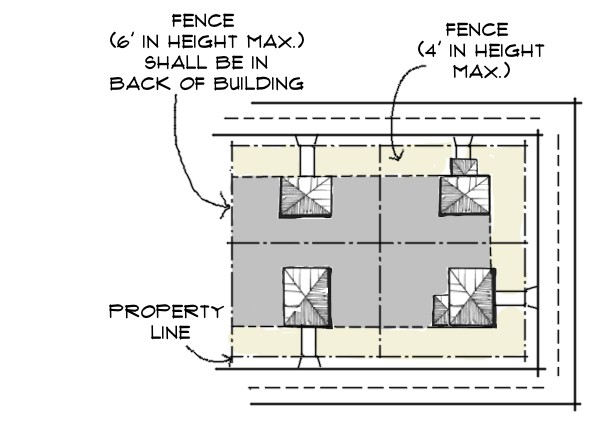
Figure 16-2: Residential Fence Placement, Scenario 2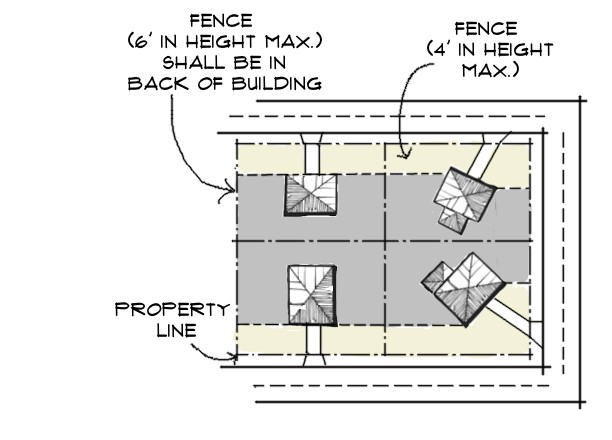
Figure 16-3: Residential Fence Placement, Scenario 3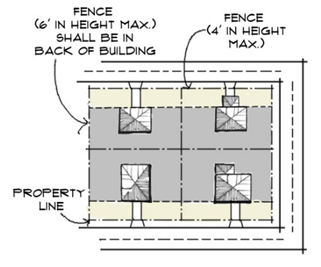
Figure 16-4: Residential Fence Placement, Scenario 4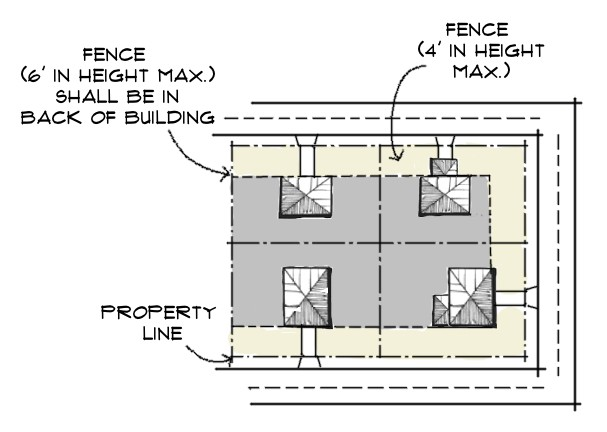
Figure 16-5: Residential Fence Placement, Scenario 5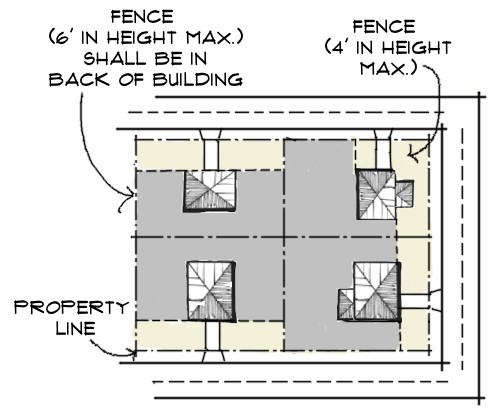
(Ord. No. 2021-55, §§ 8—12, 10-19-2021; Ord. No. 2025-08, § 47, 6-17-2025)
16.4.1 - Purpose
Swimming pools can be an attractive nuisance; therefore, standards for location are set forth to protect the safety of the general public.
16.4.2 - Applicability
This Section applies to all above- and in-ground pools on residential properties, with the exception of above-ground pools that are designed to hold twenty-four (24) inches or less of water.
(Ord. No. 2025-08, § 48, 6-17-2025)
16.4.3 - Required Permits
Requires a Building Permit.
16.4.4 - Standards
A.
Construction standards - All swimming pools shall comply with all applicable requirements contained in Chapter 18 of this CDC.
B.
Setbacks
(1)
Swimming pools shall be permitted only in side and rear yards.
(2)
All parts of a pool including, but not limited to, decking, walkways, and screened pool enclosure, otherwise known as a birdcage, shall be constructed a minimum of five (5) feet from the rear or side property line.
C.
Easements and utilities
(1)
No part of the pool deck, walkways, or enclosure shall encroach onto any utility or drainage easement or right-of-way.
(2)
Overhead electric power lines shall meet the standards of the National Electrical Code (NEC).
(Ord. No. 2022-27, §§ 2, 3, 6-7-2022)
16.5.1 - Purpose
To protect the character of residential neighborhoods while promoting activities that reduce automobile trips resulting in less air pollution and traffic congestion.
16.5.2 - Applicability
All residential dwelling units may choose to incorporate an HOC. Residential dwelling units located within mixed use designations may also, as an alternative to HOC, undergo site plan review to add an allowable non-residential use to the property where live/work units are allowed.
16.5.3 - Required Permits
A business tax receipt from the City of Largo is required.
(Ord. No. 2025-01, § 40, 12-17-2024)
16.5.4 - Standards
All HOCs shall conform to the following standards:
A.
The activities of the HOC shall be clearly secondary to the property's principal use as a dwelling unit and must be conducted entirely within the dwelling or a legal accessory structure located on the premises.
B.
There shall be no external modifications made to the dwelling unit or accessory structure to accommodate a HOC that would not be compatible or appropriate to its residential use and architectural character.
C.
No more than two employees or independent contractors who do not reside at the dwelling unit may work at the dwelling unit in addition to those living in the dwelling unit. The HOC may have additional remote employees that do not work at the dwelling unit.
D.
Retail transactions shall only be conducted from the dwelling unit.
E.
The HOC shall not create noise, vibration, heat, smoke, dust, glare, fumes, or noxious odors, detectable to the normal senses at the lot line, or beyond the lot line if the HOC is conducted in a detached dwelling, or beyond the exterior or any common walls in an attached dwelling.
F.
The use can qualify for all local, state and federal licenses, certificates and permits.
G.
All HOC activities must comply with all local, county, state, and federal regulations related to the HOC with respect to the use, storage, or disposal of any corrosive, combustible, or other hazardous or flammable materials or liquids.
H.
No traffic shall be generated by such HOC in greater volume than would normally be expected in the neighborhood.
I.
Parking related to the HOC activities shall comply with the parking requirements of City Code; however, the HOC shall not generate a need for parking, per the requirements of City Code, that exceeds the volume expected at a similar residence where no business is conducted.
(Ord. No. 2025-01, § 40, 12-17-2024)
16.5.5 - Noncompliance
Failure to comply with all of the provisions of the HOC or violation of any of the restrictions or other applicable regulations shall result in a notice of violation and loss of the HOC privilege.
16.6.1 - Purpose
This Section provides for the orderly and effective management of temporary events allowed for limited periods and provides for the administrative review of these special types of land uses. These provisions are designed to allow certain temporary events while minimizing adverse impact upon the public health and welfare by ensuring that temporary events do not obstruct traffic circulation, create a negative impact upon adjacent uses, or interfere with the use and enjoyment of a site by a properly licensed business.
16.6.2 - Required Permits
A.
A Temporary Event Permit shall be required for all temporary events except as provided herein.
B.
The following temporary events are authorized and shall require a permit.
(1)
Temporary sales, including, but not limited to:
a.
Outdoor seasonal sales in advance of specific yearly holidays.
b.
Roadside Vendors - Temporary retail sales and display of merchandise or food, other than seasonal sales, and not associated with the principal use of the lot.
c.
On-site promotional events associated with a business located on the property. The cost of a Temporary Event Permit and Grand Opening/Promotional Sign Permit is waived for a new business or development having a grand opening promotional event provided that the business or development has a valid Business Tax Receipt (BTR) or certificate of occupancy (CO), if applicable.
(2)
Special events such as entertainment, carnivals, educational, religious, sports, or similar special events.
C.
Events held on City property shall not be required to obtain a temporary events permit, however all required building permits shall be obtained.
D.
Events held on single-family, duplex and triplex residential properties shall not be required to obtain a temporary events permit. All such events shall conform with the use standards applicable to the property.
E.
Private events shall not be required to obtain a special event permit, provided that all required Building Permits are obtained and provided that the event:
(1)
Is not open to the public, such as outdoor weddings and employee parties;
(2)
Is located on a site with a single user and/or tenant; and
(3)
Will not generate noise, traffic, or other negative impacts on adjacent properties.
F.
The City of Largo Library Bookmobile and not-for-profit mobile blood donation banks shall not be required to obtain a temporary events permit.
(Ord. No. 2019-24, § 2, 3-19-2019; Ord. No. 2024-04, § 5, 11-21-2023)
16.6.3 - Restrictions
The following restrictions shall apply:
A.
Temporary events shall be subject to the time limitations for each property, listed in Table 16-1.
B.
Approval from the property management is required for events to be located within properties with multiple tenants. The approval must include a statement that the property management will be responsible for notifying all tenants and responding to any complaints.
C.
Approval must be obtained from the Community Development Department, Fire Marshal, Police Department, and Solid Waste Division (if required).
(Ord. No. 2024-04, § 6, 11-21-2023)
16.6.4 - Required Submissions
A.
A site plan depicting the location and details of the event and also showing the total number of existing parking spaces on the site, the existing tenant mix, and total square footage of the property must be provided.
16.6.5 - Standards
The following standards shall apply:
A.
Land use compatibility - Temporary events shall be compatible with the uses allowed in the Future Land Use Classification of the property where the event is permitted. Non-compatible uses may be allowed at the discretion of the DCO.
B.
Development order compliance - Properties must be in full compliance with all applicable Development Orders.
C.
Parking obstruction - No more than twenty (20) percent of the total required parking spaces may be obstructed during the event.
D.
Restroom location - The location of restroom facilities to serve the event must be depicted on the site plan.
E.
Traffic and visibility triangle obstruction - Traffic circulation and the visibility triangle must not be obstructed, unless approved by those City staff listed in Section 16.6.3.C. Any changes to the traffic circulation pattern must be clearly depicted on the site plan.
F.
Stormwater obstruction - Stormwater flow shall not be obstructed unless approved by the City Engineer.
G.
Sign standards - Signs for the event must comply with the standards of this CDC (See Chapter 12).
H.
Setback standards - The event must comply with setback standards for the property.
I.
Code of Ordinances - The event must not violate any provisions of the City Code of Ordinances.
J.
Business Tax Receipt and vendor's license - If applicable, the applicant shall have an active vendor's license and the property on which the event will occur shall have an active business tax receipt.
K.
Negative impact generation - The event shall not generate negative impacts such as excessive noise, electrical interference, fumes, excessive trash, or hazards.
16.6.6 - Temporary Off-site Signage
Temporary off-site signage is not allowed.
16.7.1 - Purpose
These standards are established to minimize adverse impacts of private docks and seawalls upon the natural resources of the waters of the County and adjacent property owners. This section applies to all properties within the City of Largo adjacent to waterways.
(Ord. No. 2025-08, § 49, 6-17-2025)
16.7.2 - Required Permits
A building permit for installation of plumbing or electrical facilities shall be issued by the City only upon approval from Pinellas County Environmental Management, in accordance with Ordinance No. 90-19, as amended.
16.7.3 - Dimensional Standards
A.
Private docks - Pinellas County Ordinance No. 90-19, as amended, entitled, "Pinellas County Water and Navigation Control Authority Regulations," requires local government to establish length, width, and setback standards for private docks within its corporate boundaries. The City's standards are as follows:
(1)
Width - The width of the dock shall not exceed twenty-five (25) percent of the width of the property at the waterfront.
Width = Width of property at waterfront × 0.25
(2)
Length - The length of the dock shall not exceed fifty (50) percent of the width of the property at the waterfront. The dock length shall be measured from the seawall, or in the absence of a seawall, the dock length shall be measured from the mean high water line.
Length = Width of property at waterfront × 0.5
(3)
Setback - Docks and boat lifts shall be constructed a minimum of fifteen (15) feet from each adjacent property line.
B.
Seawalls - All proposed seawalls shall comply with the construction standards established by the City and require a building permit.
16.7.4 - Waiver or Reduction in Dimensional Standards for Private Docks
Requirements A.(1) through (3), above, may be waived or reduced by the DCO upon approval by the City Engineer and when letters of no-objection from both adjacent waterfront property owners have been received by the DCO.
Figure 16-7: Private Dock Dimensional Standards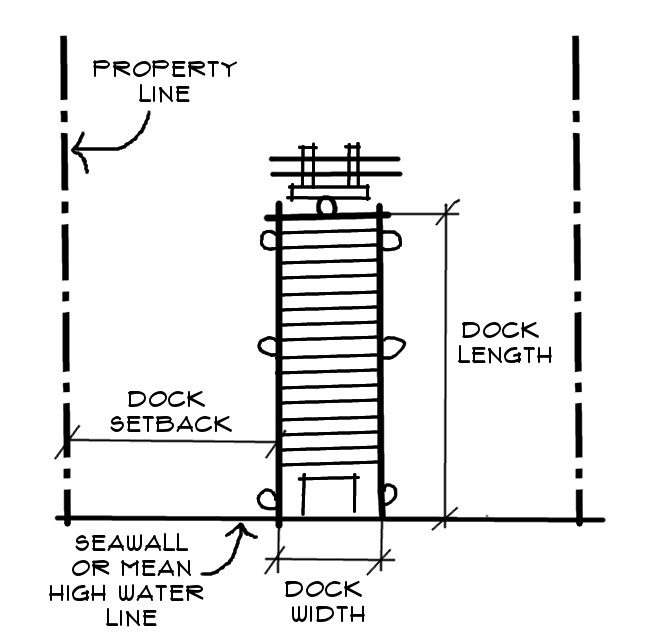
16.8.1 - Purpose
To protect the character of neighborhoods and prevent any negative impacts upon adjacent properties.
16.8.2 - Applicability
Conversion of a garage or attached carport on residential properties into habitable living space is permitted subject to receiving a Building Permit which is reviewed and permitted in compliance with the Florida Building Code 8th Edition (2023).
(Ord. No. 2021-33, § 11, 4-6-2021; Ord. No. 2024-19, § 6, 5-7-2024; Ord. No. 2025-01, § 41, 12-17-2024; Ord. No. 2025-08, § 50, 6-17-2025)
16.8.3 - Required Permits
Requires a Building Permit and an inspection.
16.8.4 - Standards
A.
If the garage provides the only parking space, a replacement on-site parking space must be provided outside the enclosed garage space. Parking spaces must be located on the owner's property and shall not block the sidewalk.
B.
The garage enclosure must be architecturally consistent with the existing residential unit in regard to style, materials and color.
C.
If all or part of the garage enclosure will be used as an accessory dwelling unit, it must meet the requirements of Section 16.14 Accessory Dwelling Units.
D.
Must comply with all applicable Residential Infill Standards contained in Section 8.3.
(Ord. No. 2025-01, § 41, 12-17-2024)
16.9.1 - Purpose
This Section sets forth standards which do not impair but, at the same time, ensure the safe installation of such antennas in order to forestall their being installed in unsafe locations or becoming dislodged and creating a hazard during severe weather events. Privately-owned ham and citizens band radios and satellite service reception antennas described under "(B) Exemptions" of this Subsection shall be considered accessory structures. Microwave relay, cellular, personal communications services, and similar types of commercial wireless communication towers, including emergency services communications towers, satellite earth stations with antennas that exceed the standards in "(B) Exemptions," and commercial radio and television station broadcast towers are not considered accessory uses but rather primary or subsidiary development, because they provide public benefit.
16.9.2 - Pre-emptions and Exemptions
The following antennas, together with the associated support structures, are exempt from regulation except as specified in this Section:
A.
Pre-emptions - Pursuant to Section 207 of the Federal Telecommunications Act of 1996, local regulations impairing reception of certain forms of electronic communication are preempted by the Act. Impairments exist if rules, laws, regulations, or restrictions unreasonably delay, prevent, or increase the cost of installation, maintenance, or use or preclude reception of an acceptable quality signal. The pre-emptions include:
(1)
Television broadcast signals, direct broadcast signals, direct broadcast satellite services, or multichannel multipoint distribution services using antennas that are one meter or less in diameter or diagonal measurement ("dish A" antenna);
(2)
Satellite earth station antennas that are two meters or less in diameter and are located or proposed to be located in any area where commercial or industrial uses are generally permitted by non-federal land use regulations;
(3)
Regulation of antennas larger than two meters found to be unreasonable after petition to the FCC and exhaustion of all local administrative remedies.
B.
Exemptions - Amateur radio and citizens band antennas and support structures shall be exempted from regulations except as specified in Sections 16.9.2 and 16.9.5 below.
(Ord. No. 2025-08, § 51, 6-17-2025)
16.9.3 - Height Measurements
Height shall be measured from the average elevation of the finished grade to the highest point of the antenna or support structure.
16.9.4 - General Standards
These standards serve to promote public safety by mitigating potential dangers to adjacent property owners resulting from natural or man-made events. All antennas and support structures covered under the provisions of this Subsection, regardless of land use category designation, shall be installed and maintained so as to further the following:
A.
Public safety and use - Structure must meet the public safety and use standards outlined in this Section;
B.
Building and electrical code compliance - Structure must be in compliance with the building and electrical codes. An inspection shall be required of the base or attachment installation for all antenna support structures exceeding twelve (12) feet above the highest roof peak;
C.
Vertical and horizontal clearances - Structure shall maintain vertical and horizontal clearances from any electrical, utility, or power lines in conformance with the latest edition of the "National Electric Safety Code";
D.
FCC rule compliance - Structure shall meet all Federal Communications Commission (FCC) and manufacturers' rules and requirements;
E.
Color and reflectiveness - Structure shall be non-reflective and colored so as to blend in with the surroundings; and
F.
Signage or advertising - Structure shall not display advertising or signage of any type.
16.9.5 - Specific Residential and Non-Residential Standards
The following specific requirements shall apply within residential and nonresidential land use categories for privately-owned antennas and support structures not included under 16.9.2 of this Section:
A.
Number - The number of antennas and support structures shall be limited to those necessary to receive or transmit signals while not causing a negative impact on adjacent property or residents. Negative impacts may include electromagnetic interference, safety hazards, and installations which detract from the aesthetic character of the neighborhood.
B.
Placement - Antennas, including those specified under 16.9.2 of this Section shall, to the greatest extent possible without impairing signal reception, be erected in rear yards only; however, line-of-sight, ham, and citizens band radio antennas may be mounted on roofs of multistory structures which may be single or multifamily in construction. No antenna shall be placed within the front yard, side yards abutting a right-of-way, buffer areas, or adjacent to a public right-of-way (with the exception of alleys).
(1)
Ground-mounted, solid-dish, satellite service reception antennas located in side yards shall be screened from view to the maximum extent possible without impairing signal reception.
NOTE: Solid-dish, satellite service reception antennas are much more obtrusive than mesh antennas. Mesh antennas have a built-in "soft" appearance. Screening is necessary to soften, or make less obtrusive, the appearance of solid-dish satellite antennas.
(2)
Antennas must be mounted at a fixed point.
(3)
A long-pole installation shall be placed adjacent and parallel to the sidewall of a dwelling unit and shall be braced to it.
(4)
Roof-mounted antennas not included under 16.9.2 of this Section are allowed within nonresidential land use categories, subject to the following requirements:
a.
Roof-mounted antennas and the roofs upon which they are placed must be designed, engineered, and constructed in compliance with wind and structural loading requirements of the Standard Building Code.
b.
The maximum height of a roof-mounted radio communications antenna shall be in compliance with FCC height and installation requirements.
16.9.6 - Maximum Allowable Dimensions for Antennas Not Included in This Section
A.
Satellite service reception antennas - The maximum satellite service reception antenna diameter is twelve (12) feet. The maximum height is fifteen (15) feet for a short-pole installation with a minimum one (1) foot ground clearance. Long-pole installations exceeding twelve (12) feet above the peak of the roof shall require a permit and inspection to verify the safety of the installation. Only mesh-type satellite service reception antennas shall be permitted on long poles.
16.9.7 - Antennas Permitted Prior to This CDC Adoption
Any antenna legally permitted to exist on the date of the adoption of this CDC shall be allowed to remain unless it is relocated or replaced. If relocated or replaced, any legally non-conforming antenna shall be brought into compliance with this CDC.
16.10.1 - Purpose
These standards for solar energy systems are designed to protect access to solar radiation for both active and passive solar systems. Nothing in this Section shall be deemed to guarantee unrestricted access.
NOTE: In the usual passive system, solar energy is "collected" through south-facing glass, absorbed in the mass of the building (or in special storage elements), and distributed to adjacent areas by radiation and convection. A concrete floor or wall of water-filled drums are examples of such storage masses. The thermal mass uses the natural properties of certain material to retain and re-radiate heat. Passive systems often do not use any moving parts to transfer heat, although fans are frequently employed in some systems. Active systems generally use a collector, which is a separate device, to transform solar radiation to useable heat. Energy accumulated in the collector is transferred by air, water, or other fluids to the place where it is used or to the place where it is stored for future use.
16.10.2 - Standards
(1)
A solar energy system may be allowed as an accessory use in any land use designation, provided that it can be located in full compliance with provisions of this CDC.
(2)
Unless specifically prohibited by any section of this CDC, a structure or building may be located on a parcel in such a way as to take maximum advantage of solar radiation for either active or passive use. This includes, but is not limited to, the building design, paving, landscaping, etc.
(3)
Unless shading from structures or plants is already in existence on a site, a portion of a site may be protected from shading. Calculations for determining the area to be free from shading are given below.
(4)
Shading areas of trees and buildings must be calculated at 9:00 a.m. Eastern Standard Time (E.S.T.) and 3:00 p.m. (E.S.T.), which are the end time periods for the six (6)-hour non-shading period. These time periods are to be calculated at a December 21 standard (winter solstice) when solar day casts the longest shadow. (It is usually safe to assume that if the longer shadows do not shade a solar collector, then shorter shadows will not either).
The following information is needed:
a.
The height of any object, building, tree, large shrub, or any other object tall enough to cast a shadow upon a neighboring solar collector shall be shown upon the shadow plan.
b.
Latitude of the area in question. Table 16-2 is for use in the City.
Example:
A thirty (30) foot high tree is on land that slopes to the southeast at a ten (10) percent grade.
Step One:
From the above table, find the shadow length value for a.m., noon, and p.m. Read the intersection of the columns labeled "SE" and "10%", as indicated on the chart.
Step Two:
The values given on the table are for a one (1) foot high tree, so they must be multiplied by the height of the tree, in this case thirty (30) feet.
*(a.m. value) × (tree height) = (a.m. shadow length) 2.2 × 30 = 66 ft.
*(noon value) × (tree height) = (noon shadow length) 1.4 × 30 = 42 ft.
*(p.m. value) × (tree height) = (p.m. shadow length) 3.3 × 30 = 99 ft.
Step Three:
Scale the shadow lengths out on paper as viewed from overhead and connect the end points.
c.
Slope of the individual site is needed, as well as direction of the slope.
(5)
In order to protect a portion of a site from shading, a shadow plan must be prepared, submitted along with a Development Order application, reviewed, and approved by the DCO.
(6)
Any solar collector owner may, to ensure adequate and consistent access to solar radiation, purchase or acquire covenants or easements from adjoining, abutting, or neighboring properties.
Repeat this procedure for each object shown on the site plan.
Figure 16-9: Example Shadow Plan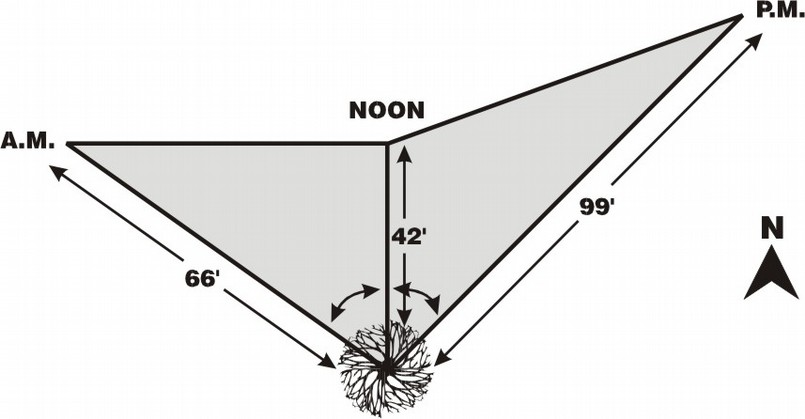
16.12.1 - Purpose
This Section provides for the orderly and effective management of vending of food from an approved vending site by a Mobile Food Dispensing Vehicle (MFDV), as defined in Chapter 20, Section 20.1.M., in order to allow limited operations and provide administrative review of this special type of accessory land use. These provisions are designed for property owners to allow vending to the public by MFDV businesses, while minimizing adverse impacts upon the public health and welfare by ensuring MFDVs do not vend in the public right-of-way, obstruct traffic circulation, create a negative impact upon adjacent uses, or interfere with the use and enjoyment of a site by the primary business use or other licensed business.
(Ord. No. 2019-15, § 1, 2-19-2019)
16.12.2 - Required Permits
A.
An approved MFDV Vending Site is required for the purposes of vending of food from MFDVs except:
1.
Temporary events, as defined in Section 16.6.2(B) are exempt from this requirement.
2.
Private events, not open to the public, as defined in in Section 16.6.2(E) are exempt from this requirement.
(Ord. No. 2019-15, § 1, 2-19-2019)
16.12.3 - Required Submissions
A.
An application for an MFDV Vending Site shall include:
1.
A site plan depicting the location and details of the MFDV vending area on the site, also showing, ingress and egress to the site, internal driveway circulation, the total number of existing parking spaces on site, the existing buildings, and total square footage of the parcel.
2.
Approval from the property owner or from the property management for properties that have multiple tenants is required for the MFDV Vending Site. The approval must include a statement that the property management will be responsible for notifying all tenants and responding to any complaints. The signature of the property owner or the property management company must be notarized.
3.
Approval shall be obtained from the Community Development Department, Engineering Department, Fire Marshal, and Police Department.
(Ord. No. 2019-15, § 1, 2-19-2019)
16.12.4 - Standards and Restrictions
The following standards and restrictions shall apply to MFDV Vending Sites:
A.
Land use compatibility - MFDV Vending Sites are permitted on properties that are designated with the following Future Land Use Classifications:
1.
Commercial General, Industrial Limited, Industrial General, and Community Redevelopment Districts, within Mixed Use Corridor designated properties only.
B.
MFDV Vending Sites are subject to the following standards and restrictions:
1.
Public right-of-way - Vending from MFDVs is not permitted in the public right-of-way.
2.
Vacant or abandoned properties - MFDV vending sites are not permitted on vacant or abandoned properties, where no business is currently operating.
3.
Hours of Operation - All business activity related to the MFDV shall be of a temporary nature. Operating hours of the MFDV shall be limited to the operating hours of the primary business use of the parcel, but no later than 2:00 a.m., nor before 6:00 a.m. MFDVs shall not be permitted to operate between the hours of 2:01 a.m. and 5:59 a.m. and shall be removed from the parcel during this time.
4.
Maximum area for vending site - The MFDV vending site shall not exceed more than two (2) parking spaces per MFDV. However, at no time may the number of parking spaces required for the principal use of the property under this Code be rendered nonconforming due to MFDV's occupation of the site.
5.
Maximum number of MFDVs per site - The maximum number of MFDVs allowed parked in the vending area, per site is two (2). An MFDV with an attached trailer or smoker shall be considered for the purposes of this section as two (2) MFDVs. Operating more than two (2) MFDVs at a time on a MFDV Vending Site will be permitted only in accordance with a Temporary Event Permit issued pursuant to Section 16.6.
6.
Furniture and equipment - No tables, chairs, furniture, tents, canopies, outdoor grills, or other equipment, other than the MFDV and a waste receptacle, shall accompany the MFDV.
7.
Signage and awnings - Signage is not allowed, with exception to the vinyl wrapping, decals, stickers, painted text and/or graphics, and menu boards affixed to the MFDV.
8.
Parking, traffic and visibility triangle obstruction - The MFDV shall not interfere with required parking, loading and unloading spaces, or the vehicular access to those spaces for the principal use of the site. Traffic circulation and the visibility triangle must not be obstructed. Obstructions shall not be placed or kept near fire hydrants, fire department inlet connections, or fire protection system control valves in a manner that would prevent such equipment or fire hydrants from being immediately visible and accessible. An approved clear and unobstructed path of a width at least eight (8) feet shall be provided and maintained for access to the fire department inlet connections.
9.
Amplified music - Amplified music or other sounds from any MFDV is prohibited and MFDV businesses shall operate in compliance with all applicable noise and public nuisance regulations.
10.
Illegal discharge - MFDVs shall be prohibited from discharging fat, oil, grease, or waste water into the sanitary sewer system. Any violation of this provision shall be subject to the penalties and enforcement/mitigation procedures set forth in the City's Code of Ordinances.
11.
Development order compliance - Properties must be in full compliance with all applicable Development Orders in order to be approved as a MFDV Vending Site.
(Ord. No. 2019-15, § 1, 2-19-2019; Ord. No. 2025-08, § 52, 6-17-2025)
16.13.1 - Purpose
To protect the character of neighborhoods, businesses and public/semi-public places while mitigating any negative impacts upon adjacent properties that could result from the use of portable storage containers.
(Ord. No. 2020-32, § 2, 8-18-2020)
16.13.2 - Applicability
The standards of this section are intended to apply, but not be limited to, portable storage containers such as conex boxes, or similar large, reusable containers that are designed for shipping cargo or, when modified, for use as storage.
Portable storage containers shall adhere to the following standards:
A.
Permanent Placement - The permanent use of portable storage containers is limited to industrial land uses, which includes parcels with Industrial General, Industrial Limited, and Transportation/Utility future land use classifications pursuant to the City's Future Land Use Map.
(1)
Required Permits - Permanent placement of portable storage containers requires a Building Permit and an inspection.
(2)
Maximum floor area - No portable storage container may exceed three hundred twenty (320) square feet.
(3)
Maximum height - Ten (10) feet.
(4)
Maximum quantity - One (1) per lot.
(5)
Review process - All submissions must be reviewed through the Small Scale Review process.
(6)
Minimum separation from the principal structure - As required in the Florida Building Code and Florida Fire Protection Code.
(7)
Placement - Portable storage containers must be placed in the side or rear yards and cannot be placed in the front yard, buffer area, within recorded easements, access roads or fire access lanes, or in areas marked for parking.
(8)
Setbacks:
a.
Front Yard - Not permitted.
b.
Side Yard - Same as the principal use setbacks for the land use designation.
c.
Rear Yard - Same as the principal use setbacks for the land use designation.
(9)
Construction and maintenance:
a.
Portable storage containers must have all wheeled assemblies removed;
b.
Portable storage containers must be placed on a foundation;
c.
Portable storage containers must be painted to match the primary building on the lot or roofed and sided;
d.
Portable storage containers must be maintained in a state of good repair.
(10)
Use Portable storage containers may not be used for anything other than storage.
B.
Temporary Placement - Temporary use of portable storage containers are permissible for periods of time that are based on the use of the property.
(1)
Duration:
a.
Single-family, duplex, and triplex areas: Seven (7) calendar days.
b.
Recreation/open space/preservation: Three (3) calendar days.
c.
All other nonresidential uses: Thirty (30) calendar days.
At least 30 calendar days shall pass between the removal and subsequent placement of portable storage containers at any site. For construction sites involving any land use, the time limit for portable storage containers related to and used for the ongoing construction shall be restricted to the period of continuous construction as defined in Chapter 20 of the CDC. Any portable storage container at the site of construction, and not specifically related to and used for construction, shall be subject to all provisions of this section.
(2)
Placement: Portable storage containers placed on land with a non-residential future land use classification shall not reduce existing on-site parking, obstruct traffic circulation aisles, encroach into drainage areas or landscaping buffers or obstruct parking spaces or stormwater flow. Portable storage containers placed on land with a residential future land use classification shall be located in the driveway or on a hard surface. Stacking of portable storage containers on top of each other shall not be permissible in any future land use classification. At no time may a storage container hinder emergency or sanitation vehicle access, any access roads to the structure or limit the means of access and egress to the site.
(3)
Quantity: No more than 1,200 cubic feet of storage as measured in individual or multiple portable storage containers shall be allowed per dwelling unit on a single-family, duplex, or triplex platted parcel. No more than one portable storage container, regardless of future land use classification, shall be allowed per leased retail space within a multi-tenant shopping center or freestanding commercial parcel at any one time.
(4)
Exemptions: The following exemptions to the requirements of this subsection 16.3.2B shall apply provided conditions for temporary placement of portable storage containers set forth in subsection B(2) of this section are complied with: (i) portable storage containers used for deliveries and placed at a site for less than 72 hours: (ii) portable storage containers which are not visible from the adjacent public right-of-way and any adjoining residential area; businesses located on parcels which have reverse frontage: mobile home communities, condominiums, and apartment complexes.
(5)
Permitting and Compliance: No permit fee shall be required for temporary placement of portable storage containers regardless of future land use classification. However, each container placed in accordance with this subsection B shall have affixed to its side a placard which can be plainly seen in public indicating the date of placement and the volume of storage expressed in cubic feet.
C.
Seasonal Outdoor Storage for Big Box Retail Stores - A single tenant retail store which is at least 100,000 square feet in size may apply for a Level I Small Scale Site Plan Review, pursuant to section 3.3 of the City of Largo Comprehensive Development Code, to allow portable storage containers as temporary outdoor storage and shall comply with such approved site plan.
(1)
Requirements:
a.
The property must have a future land use classification of Commercial General (CG), pursuant to the City's Future Land Use Map.
b.
Portable storage containers shall not remain on the property longer than 90 days, and are restricted to a single, consecutive 90 day period within a calendar year.
c.
Portable storage containers shall not be placed in the front yard between a building and any public right-of-way.
d.
If the portable storage containers are visible from the public right-of-way, then the portable storage containers must be screened. Whether or not such screening is satisfactory shall be determined solely by the City's Development Controls Officer.
e.
Portable storage containers shall not obstruct any required parking spaces pursuant to the City of Largo Comprehensive Development Code or the governing approved site plan.
f.
Portable storage containers shall not impede site-circulation traffic.
g.
Portable storage containers shall not obstruct or negatively affect the stormwater flow or drainage of the property.
h.
Portable storage containers placed on the property shall not unreasonably effect neighboring properties or structures, as determined by the City's Development Controls Officer.
i.
The applicant must abide by all other applicable laws including but not limited to the Florida Building Code, the Florida Fire Code, the Florida Life Safety Code, the City of Largo Comprehensive Development Code, and the City of Largo Code of Ordinances.
j.
Approval of the seasonal placement of portable storage containers must be renewed each calendar year with a new Level I Small Scale Site Plan Review application submittal.
k.
Total square footage of all portable storage containers allowed on site shall not exceed five (5) percent of the total floor area of the principal structure.
(Ord. No. 2020-32, § 2, 8-18-2020)
16.14.1 - Purpose
The intent of ADUs, where allowable, is to provide an alternative housing option to City residents. ADUs contribute to a healthy mix of living options that respond to changing needs of residents, make more efficient use of the existing residential infrastructure, and contribute to the revitalization of the existing housing stock. An ADU is a residential unit that is secondary to the primary use of the property. The ADU can be constructed within a primary structure on the property, an attached unit, or a freestanding unit on the same lot as the primary residence or business. To encourage the creation of ADUs, an ADU will not be counted against the applicable maximum dwelling units per acre density standard.
(Ord. No. 2025-01, § 42, 12-17-2024)
16.14.2 - Applicability
This Section applies to ADUs that are accessory to a single-family home, a small-type housing development (except for Cottage Courts), or to a non-residential use in accordance with the allowable uses in Table 6-1 and Table 6-2. ADUs must meet the definition in Chapter 20. Established standards apply to new ADU structures and the redevelopment of existing structures into ADUs on a lot. ADUs are not permitted for multi-family developments.
(Ord. No. 2025-01, § 42, 12-17-2024)
16.14.3 - Required Submissions
ADUs will require a boundary survey, building permit, and related permit inspections. ADUs on single-family and small-type housing residential properties also require the property owner to sign a notarized Accessory Dwelling Unit Affidavit to attest that the unit, if rented, will only be rented at an affordable rate to extremely-low-income persons, very-low-income persons, low-income persons, or moderate-income persons, as defined in Section 163.31771, Florida Statutes, and to acknowledge owner occupancy requirements.
(Ord. No. 2025-01, § 42, 12-17-2024)
16.14.4 - Standards
A.
ADUs on residential properties are permitted subject to the following requirements:
(1)
An ADU must be located on the same parcel as the principal use or structure.
(2)
No ADUs shall be permitted in the CHHA or SFHA.
(3)
ADUs in detached buildings must be placed in the side or rear yards and shall not be placed within front yards, buffer areas, or within recorded easements.
(4)
ADUs must be designed and constructed with architectural styles, construction materials, and color schemes similar to that of the principal structure or use to maintain the aesthetic character of the neighborhood.
(5)
No more than one (1) ADU per residential lot is allowed. ADUs are not permitted on lots with Cottage Courts and medium-type housing.
(6)
Either the primary dwelling unit or the ADU must be occupied by the property owner.
(7)
The establishment of an ADU is not permitted before construction of the primary dwelling unit has commenced or a lawful principal structure is established, unless if the ADU is being built concurrently with the primary dwelling unit or principal structure.
(8)
The gross floor area of any accessory dwelling unit shall not exceed eight hundred (800) square feet or fifty (50) percent of the living floor area (air conditioned/heated) of the principal structure, whichever is less. If fifty (50) percent of the living floor area of the principal dwelling unit is less than four hundred (400) square feet, the maximum ADU size is 400 square feet.
(9)
If the ADU is in a detached building, the height of the ADU shall not exceed the height of the principal structure or two stories, whichever is lower. If an ADU is attached to the primary structure, the maximum height calculation, including the garage or primary unit below, is two (2) stories.
(10)
All exterior facing doorways and outdoor living areas such as porches or balconies shall be oriented to minimize effect on neighboring properties including avoiding sight lines to adjacent properties.
(11)
Where an ADU is in a detached building, it must follow the following setbacks:
Front Yard - Not Permitted.
Side Yard - Same as the principal use setbacks for the land use designation.
Rear Yard - Same as the principal use setbacks for the land use designation.
(12)
Where an ADU is in a detached building, it must follow the adopted Florida Building Code standards for minimum separation of distance from the principal structure.
(13)
The proposed ADU must not reduce the number of parking spaces to the primary residential structure below the parking minimums established by Section 9.5 Vehicular Parking.
(14)
A separate exit/entrance to the ADU must be provided in accordance with all requirements of the CDC, and any other applicable legal requirements. ADUs will be assigned a separate street address to assist with mail delivery and emergency medical services.
(15)
ADUs must meet current Florida Building Code standards, whether site-built or modular. Manufactured homes, campers, and recreational vehicles are not eligible to be used as ADUs.
(16)
ADUs may be allowed to connect to the principal structure's utilities or have separate metered utility connections.
B.
ADUs on non-residential properties are permitted subject to the following requirements:
(1)
An ADU must be located on the same parcel as the principal use or structure.
(2)
No ADUs shall be permitted in the CHHA or SFHA.
(3)
ADUs in detached buildings must be placed in the side or rear yards and shall not be placed within front yards, buffer areas, or within recorded easements.
(4)
ADUs must be designed and constructed with architectural styles, construction materials, and color schemes similar to that of the principal structure or use.
(5)
No more than one (1) ADU per lot is allowed.
(6)
The establishment of an ADU is not permitted before construction of the primary dwelling unit has commenced or a lawful principal structure is established, unless if the ADU is being built concurrently with the primary dwelling unit or principal structure.
(7)
The gross floor area of any accessory dwelling unit shall not exceed 800 square feet.
(8)
Where an ADU is proposed, all exterior facing doorways and outdoor living areas such as porches or balconies shall be oriented to minimize effect on neighboring properties including avoiding sight lines to adjacent residential properties.
(9)
Where an ADU is in a detached building, it must follow the following setbacks:
Front Yard - Not Permitted.
Side Yard - Same as the principal use setbacks for the land use designation.
Rear Yard - Same as the principal use setbacks for the land use designation.
(10)
Where an ADU is in a detached building, it must follow the adopted Florida Building Code standards for minimum separation of distance from the principal structure.
(11)
The proposed ADU must not reduce the number of parking spaces to the primary structure below the parking minimums established by Section 9.5 Vehicular Parking.
(12)
A separate exit/entrance to the ADU must be provided in accordance with all requirements of the CDC, and any other applicable legal requirements. ADUs will be assigned a separate street address to assist with mail delivery and emergency medical services.
(13)
ADUs must meet current Florida Building Code standards, whether site-built or modular. Manufactured homes, campers, and recreational vehicles are not eligible to be used as ADUs.
(14)
ADUs may be allowed to connect to the principal structure's utilities or have separate metered utility connections.
(Ord. No. 2025-01, § 42, 12-17-2024)

