
Largo City Zoning Code
CHAPTER 12
SIGN STANDARDS1
Editor's note—Ord. No. 2024-04, § 2, adopted Nov. 21, 2023, amended Ch. 12 in its entirety to read as herein set out. Former Ch. 12, §§ 12.1—12.11, pertained to similar subject matter, and derived from the 2018 CDC and Ord. No. 2019-26, §§ 2, 3, adopted April 2, 2019.
Section 12.1 - Purpose and Intent
The purpose of this Chapter is to regulate the number, size, type, use, design, construction and location of signs within the City. These standards are established to promote the overall economic well-being of the businesses in the City, while at the same time promoting the health, safety, and general welfare of citizens through implementation of reasonable, consistent, and nondiscriminatory sign standards. The sign standards in this Chapter are content-neutral and not intended to censor speech or regulate viewpoints, but instead are intended to regulate the time, place, and manner of speech and to preserve and enhance the City of Largo as a desirable community in which to live, visit, and do business. These sign standards are intended to meet the following objectives:
A.
To regulate the time, place, and manner in which signs may be exhibited;
B.
To protect the right of free speech;
C.
To encourage the effective use of signs as a means of communication in the City and aid in the identification and location of an establishment, organization, and/or neighborhood;
D.
To maintain and enhance the aesthetic environment and thereby the City's ability to attract sources of economic development and growth, including enhancing the tourism industry;
E.
To minimize the possible adverse effect of signs on nearby public and private property;
F.
To ensure that signs are compatible with the surrounding built environment, including adjacent architecture and neighborhoods, and that they complement each other rather than detract from one another;
G.
To lessen the visual clutter that may otherwise be caused by the proliferation, improper placement, illumination, animation, excessive height, and excessive size (area) of signs which compete for the attention of pedestrian and vehicular traffic;
H.
To allow signs that are compatible with their surroundings and contribute to wayfinding, while precluding the placement of signs that contribute to sign clutter or that conceal or obstruct adjacent land uses or signs;
I.
To encourage and allow signs that are appropriate to the land use designation in which they are located and consistent with the category of use and function to which they pertain;
J.
To establish sign size in relationship to the scale of the lot and building on which the sign is to be placed or to the category of use and function to which it pertains;
K.
To categorize and regulate signs based upon their function;
L.
To preclude signs from conflicting with the principal permitted use of the site and adjoining sites;
M.
To regulate signs in a manner so as to not interfere with, obstruct the vision of or distract motorists, bicyclists or pedestrians;
N.
To provide exemptions and exception for certain sign types and required permits to the extent expressly preempted by state or federal law, while ensuring that such signs are constructed, installed and maintained in a safe and satisfactory manner;
O.
To allow for traffic control devices consistent with national standards and whose purpose is to promote highway safety and efficiency by providing for the orderly movement of road users on streets and highways, and that notify road users of regulations and provide warning and guidance needed for the safe, uniform and efficient operation of all elements of the traffic stream;
P.
To protect property values by precluding, to the maximum extent possible, sign-types that create a nuisance to the occupancy or use of other properties as a result of their size, height, illumination, brightness or movement;
Q.
To protect property values by ensuring that sign-types, as well as the number of signs, are in harmony with buildings, neighborhoods and other signs in that area;
R.
To regulate the appearance and design of signs in a manner that preserves the beauty and unique character of the City by protecting it from visual blight and providing a pleasing environmental setting and community appearance, which is deemed vital to the attraction and retention of business and commerce;
S.
To streamline the approval process by requiring master signage plans;
T.
To allow for governmental signs placed within the community that promote the City's tourism and provide information to citizens and visitors;
U.
To reduce the number of nonconforming signs in the City;
V.
To promote signage and support structures that employ sustainable designs and technologies with respect to their construction, maintenance, and operation (e.g., recycled materials, energy efficient, low energy usage bulbs, etc.); and
W.
To provide for the administration of this chapter and enable the fair and consistent enforcement of these sign regulations.
(Ord. No. 2024-04, § 2, 11-21-2023)
Section 12.2 - Authority
This Chapter of the CDC implements the City's adopted Comprehensive Plan and Strategic Plan and is consistent with requirements of Section 163.3202(2)(f), Florida Statutes.
(Ord. No. 2024-04, § 2, 11-21-2023)
Section 12.4 - Substitution
This Chapter is not intended to in any way prohibit the placement of non-commercial content on any legally permitted sign. Any sign, display or device allowed under this Chapter may contain, in lieu of any other copy, any non-commercial message that complies with all other requirements of this Chapter. The non-commercial message may occupy the entire sign area, or any portion of the sign area, and may substitute for or be combined with the commercial message. The sign's message may be changed from commercial to non-commercial, or from one non-commercial message to another, as frequently as desired by the sign's owner, provided that the sign is not prohibited, and the sign continues to comply with all requirements of this Chapter.
(Ord. No. 2024-04, § 2, 11-21-2023)
Section 12.5 - Severability
If any one or more provisions of this Chapter 12 is held to be invalid, illegal, or unenforceable in any respect by a court of competent jurisdiction, the validity, legality, and enforce-ability of the renaming provisions hereof shall not in any way be affected or impaired thereby and this Chapter 12 shall be treated as though the invalidated portions(s) had never been a part thereof.
(Ord. No. 2024-04, § 2, 11-21-2023)
Section 12.12 - Master Sign Plans
A.
Objective - A Master Sign Plan provides information about what signs already exist on a property when an application for a permit is made and eliminates the need to recompute the dimensions and location of each permitted sign when a sign administration or enforcement question arises. The Master Sign Plan is used to determine the maximum aggregate sign area allowance for a property or tenant space for multiple tenant buildings or complexes. Section 12.8.3.G details how maximum aggregate signage area is calculated and Tables 12-1 and 12-2 summarizes the details.
B.
Applicability - A Master Signage Plan Form shall be filed with the Community Development Department and kept up to date by filing a new Master Signage Plan Form when conditions change. A Master Signage Plan Form shall be required under the following circumstances:
(1)
As a condition of the Development Order (DO) to develop or redevelop a property;
(2)
All permit applications involving a sign or its light source; and
(3)
All permit applications involving exterior renovations to a building with attached signs.
C.
Submission requirements -
(1)
The applicant shall complete the Master Signage Plan Form and include items listed under 12.11.2 as part of the permit submission requirements.
(Ord. No. 2024-04, § 2, 11-21-2023)
12.3.1 - Applicability
A.
This Chapter applies to all signs within the City unless specifically exempted. If a sign type is not specifically exempt or allowed through these sign standards, it shall be considered prohibited under this Chapter.
B.
This Chapter applies to all permanent and temporary signs, sign structures, awnings, and other types of signs within the City, without regard to whether a sign contains commercial or non-commercial message.
C.
This Chapter shall apply to any person who erects, constructs, enlarges, moves, changes the copy of, modifies, or converts any signs, or causes the same to be done.
D.
This Chapter will not be construed to allow any sign related activity that violates local, state, or federal law. If any provision of this Chapter conflicts with other standards of the CDC or the Largo City Code, whichever imposes the more stringent restrictions shall prevail.
(Ord. No. 2024-04, § 2, 11-21-2023)
12.3.2 - Exemptions
The provisions of this Chapter do not apply to the following types of signage; however, such signage may be subject to permitting requirements as required pursuant to the Florida Building Code. If required, applicants shall be responsible for securing permits or permissions prior to erecting or modifying the following types of signage:
A.
Any sign, posting, notice placed, installed or required by law by the City, Pinellas County, or a Federal or State governmental agency in carrying out its responsibility to protect the public health, safety, and welfare. Such signs may be erected in the right-of-way or on fences, and include, but are not limited to the following:
(1)
Emergency and warning signs necessary for public safety or civil defense;
(2)
Traffic and parking signs erected and maintained by an authorized public agency or approved by an authorized public agency;
(3)
Traffic control message signs installed in accordance with applicable provisions of the Traffic Control Manual published by the Florida Department of Transportation (FDOT);
(4)
Signs directing the public to points of interest (e.g., wayfinding signs only erected by the City); and,
(5)
Signs showing the location of public facilities.
B.
Numerals and lettering identifying the street address numbers that are necessary to assist emergency vehicle drivers and other motorists with identifying the location of properties within the City. All buildings and suites with multiple tenant buildings or complexes are required to display street address numbers that have been assigned in accordance with a method approved by the Authority Having Jurisdiction (AHJ). Assigned addresses shall not be changed unless approved by that AHJ. The display of approved street address numbers must be clearly visible from the right-of-way and shall be a minimum of four (4) inches high with a minimum stroke width of ½-inch in accordance with the Florida Fire Prevention Code (FFPC) adopted by the City of Largo and incorporated into the Largo City Code (Chapter 13, Article II, Section 13-19);
C.
Signs wholly within a building or enclosed space, excluding window signs which are covered under Section 12.10.2;
D.
Holiday and seasonal decorations, including rope lights, string lights, or mini-lights;
E.
Integral signs, when cut into any masonry surface or when constructed of bronze or other noncombustible materials and fully and permanently incorporated into the surface of the building;
F.
Signs that are permanently painted or wrapped on the surface of a vehicle, adhesive vinyl film affixed to the interior or exterior surface of a vehicle window, or signs magnetically attached to motor vehicles or rolling stock that are actively used in the conduct of the business (see Figure 12-1). Such vehicles must be parked on-premises in a lawfully designated parking space or an area authorized for outdoor storage. The vehicle must be operable and bear a current license plate or have a current registration. Prohibited vehicle signs are outlined under Section 12.6.2;
G.
Signs that constitute an integral part of a permitted vending machine located outside of a business. Such signs must be permanently installed by the manufacturer and incorporated into and designed as part of the vending machine;
H.
Grave markers;
I.
Flags of non-commercial content;
J.
Public art shall not be considered as signage and is allowed on any property with permission from the property or building owner. Public art may contain graphics or text as long as the art has no commercial message. Any such commercial message shall be counted as a sign and subject to sign area allowances in accordance with Table 12-1;
K.
Signs located in stadiums, arenas, and sports fields which are intended for viewing by only persons within the facility. Such signs shall be oriented towards the interior of the field and the viewing stands;
L.
Signs, printed or attached to construction screening at sites by the property owner or authorized contractors that have been issued a permit may remain as long as the issued permit remains active and is not abandoned. Such signage must be professionally manufactured, durable, and securely attached to withstand all weather conditions; and
M.
Under the First Amendment to the United States Constitution, every citizen in the country has the right to free speech and to peacefully gather in a group. Nothing in this Chapter shall be construed to prohibit a person from holding a sign while legally protesting or demonstrating on public property that has been determined to be a traditional or designated public forum so long as the person holding the sign is peaceful, does not promote unlawful activities, does not stop others from using the public space (e.g., blocking ingress and egress from buildings or public property, creating a safety hazard by impeding travel on sidewalks, in bike or vehicle lanes, or on trails), or violate any other reasonable time, place, and manner restrictions adopted by the City, State, or Federal governments
(Ord. No. 2024-04, § 2, 11-21-2023)
12.6.1 - Objective
To promote community aesthetics and lessen the visual clutter that may otherwise be caused by the proliferation of uncontrolled signage and signage that is detrimental to the safety and welfare of the community.
(Ord. No. 2024-04, § 2, 11-21-2023)
12.6.2 - Prohibited Signs
Unless specifically authorized in this Chapter or other chapters of the CDC, examples of prohibited signs include, but are not limited to the following:
A.
Illegal signs including signs: constructed, erected, altered, repaired, replaced, or relocated without approval of a permit (if required); erected in non-compliance with the CDC as it existed at the time the sign was erected or altered; not specifically exempt or allowed; or that violate any provision in this Chapter;
B.
Abandoned or damaged signs, as defined in Section 20.1.S, with exceptions noted under Section 12.7.2;
C.
Pole signs are prohibited except the following: legal nonconforming pole signs regulated under Section 12.7; permitted on properties with frontage along US Highway 19 in accordance with Section 12.9.5; or exempt as outlined under Section 12.3.2 or Section 12.10.2;
D.
Signs on vehicles and trailers when the vehicle or trailer is used as an advertising platform and such signs project from the vehicle or trailer or a vehicle or trailer is used as a sign or as the base for a sign (see Figure 12-1). Exempt vehicle signs are outlined under Section 12.3.2.F;
E.
Billboards, except as allowed by Section 12.9.6;
F.
Flag signs (including feather flag signs), pennants, banners, searchlights, twirling signs, balloon or inflatable signs, except as allowed under sections 12.9.7 and 12.10.2;
G.
Portable signs, including portable "A" frame signs or similar portable signs, except as exempt from permits under Section 12.10.2 or as allowed to be permitted under sections 12.9.7 and 12.13.3;
H.
Bench signs; and,
I.
Signs used as fencing.
Figure 12-1: Vehicle Advertising Example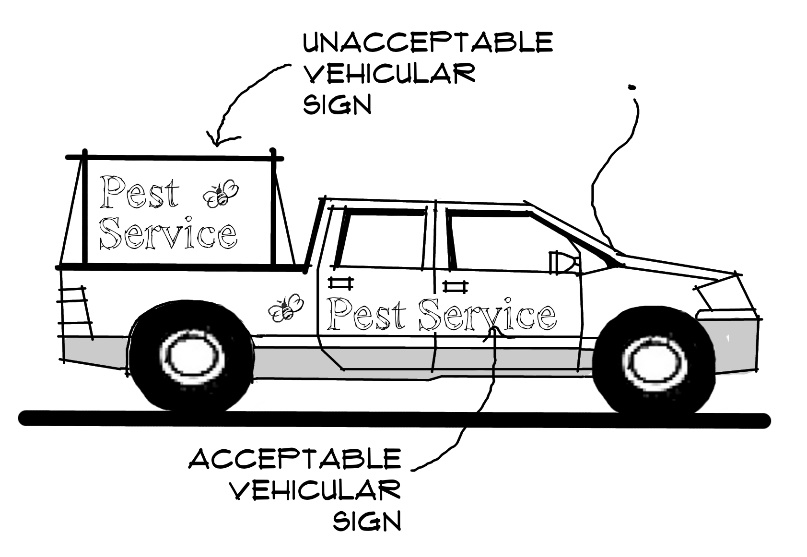
(Ord. No. 2024-04, § 2, 11-21-2023)
12.6.3 - General Signage Restrictions
A.
Location Restrictions - Unless specifically authorized in this Chapter or other chapters of the CDC, signs shall not be placed in the following locations:
(1)
Signs shall not occupy a sight triangle or obstruct visibility for vehicles, pedestrians or bicyclists as further detailed in CDC Section 9.2.3;
(2)
Signs shall not obstruct or otherwise interfere with official traffic signs, signals or devices;
(3)
Except signs erected by duly authorized government agencies and/or public utility providers, signs shall not be erected on or allowed to project over public property, rights-of-way, or easements without permission of the controlling jurisdiction;
(4)
Signs shall not be erected within a private easement without permission of the easement holder;
(5)
Except signs erected by duly authorized government agencies and/or public utility providers, signs shall not be affixed to any trees, plants, fences, utility poles, telecommunication facility, fire hydrants, traffic lights, governmental signs, benches, or similar infrastructure;
(6)
Signs and their supporting structures shall not interfere with surface and underground utility and communications lines or equipment;
(7)
Signs or supporting structures shall not interfere with free passage from or obstruct any fire escape, emergency exit, downspout, door, stairway, ladder, or opening intended as a means of ingress or egress from a building;
(8)
Signs or supporting structures shall not obstruct any window to such an extent that the light or ventilation is reduced below that required by any provision of the CDC and/or other applicable laws, regulations and technical codes;
(9)
Signs shall not impede vehicular or pedestrian traffic on any street, alley, sidewalk, bikeway or other pedestrian or vehicular travel way;
(10)
No freestanding sign shall obscure more than ten (10) percent of an existing conforming freestanding sign that is within one hundred (100) feet. An obstruction determination shall be measured from the same side of the right-of-way while standing on the property line at a distance of two hundred (200) feet from the obscured sign;
(11)
No signs shall be erected on vacant and/or undeveloped property unless otherwise provided within this Chapter (e.g., limited duration signs under Section 12.10.2 or grand opening/promotional signs under Section 12.9.7). Abandoned signs must be removed in accordance with Section 12.7.2;
(12)
No person shall erect or construct a new sign on a site that contains illegal signs;
(13)
No wall, canopy, or projecting sign shall be higher than eighteen (18) inches above the highest point of the roof or building wall on which the sign is mounted; and,
(14)
Signs which are placed above pedestrian walkways or parking areas shall have a minimum clearance of eight (8) feet from the bottom edge of the sign.
(15)
Signs shall not be located adjacent to trees that will create a visual obstruction at the time of planting or in the future (see Figure 10-5). Chapter 10 — Landscape Standards allow clustering of trees to prevent obstruction of signs.
B.
Display restrictions - Unless specifically authorized by this Chapter or other chapters of the CDC, signs with the following display features are prohibited:
(1)
Highly reflective signs and components and elements of faces of signs that move, shimmer, or contain reflective devices that hamper the vision of motorists, pedestrians, or bicyclists;
(2)
External or indirectly illuminated signs that are not shielded and create a hazardous glare for motorists, pedestrians, or bicyclists and/or adjacent properties and rights-of-way;
(3)
Signs with internal illumination systems that emit or cause the reflection of glaring or flashing light onto adjacent properties and rights-of-way or that create a hazardous glare for motorists, pedestrians, or bicyclists;
(4)
Sign illumination systems that interfere with the effectiveness of any official sign;
(5)
Signs that may, by reason of size, shape, location, movement, coloring, or manner of illumination, be erroneously construed as traffic signals, traffic signs, or emergency vehicle lights;
(6)
Digital message displays that contain animation, streaming video, or text or images that flash, pulsate, move, or scroll travel are prohibited. Each complete digital message must fit onto one screen and not change more than once every five (5) seconds, with no transition graphics (e.g., no fade-out or fade-in). Illuminated window signs that are no greater than two and one-half (2.5) square feet in area are exempt from this requirement;
(7)
Signs wholly or partially illuminated by flashing or intermittent lights which may include rotary beacon lights, zip lights, strobe lights, or similar devices;
(8)
Digital displays and other signs that interfere with, distract or confuses motorists, pedestrians, or bicyclists;
(9)
Signs that emit audible sound, contain open flames or which emit any odor, noise or visible matter other than light;
(10)
Signs equipped with moving, rotating or otherwise animated parts; and,
(11)
Signs with obscene messages or content, as defined by federal court precedent.
C.
Material restrictions - Unless specifically authorized by this Chapter or other chapters of the CDC, the following signs are prohibited based on the material used in their construction:
(1)
Signs not able to withstand weather elements; and
(2)
Signs constructed of cardboard or paper and not made of sturdy material such as metal, wood, hard plastic, vinyl, engineered wood, or particle board.
(Ord. No. 2024-04, § 2, 11-21-2023)
12.6.4 - Enforcement
A.
Objective - To have all prohibited signs or signs violating general signage restrictions removed in an expeditious manner.
B.
Applicability - Unless specifically authorized by this Chapter or other chapters of the CDC, these enforcement criteria only pertain to prohibited signs or signs violating general signage restrictions located on private or public property (including rights-of-way). Removal criteria applicable to nonconforming signs and abandoned and/or damaged signs are outlined under Section 12.7.
C.
Removal and compliance - The City shall require all prohibited signs or signs found to be in violation of general signage restrictions to be removed or brought into compliance in accordance with the following procedures:
(1)
Signs on public property, including rights-of-way, may be removed and disposed of by the City without prior notice.
(2)
Signs on private property must be brought into compliance or removed within twenty-four (24) hours of written notice to the property owner and/or occupant of the property. Additional time shall be afforded (as determined by the Building Official) to bring such signs into conformance when a permit is required for such a sign to be removed or altered; and,
(3)
Signs that are not brought into compliance within required time frames, or that represents an immediate threat or imminent danger to the public (as determined by the Building Official) may be removed by the City without the owner's consent and at the owner's expense. The sign's owner may secure the release of an impounded sign upon payment of the cost incurred in removing the sign, plus daily storage fees. Signs not reclaimed within thirty (30) days shall become property of the City and may be disposed of or used as deemed appropriate by the City. The City shall not be held liable for damage or disposal of such a sign.
(Ord. No. 2024-04, § 2, 11-21-2023)
12.7.1 - Nonconforming Signs
A.
Objective - To have all previously permitted signs that no longer conform to the standards of this Chapter (i.e., nonconforming signs) removed in an expeditious manner.
B.
Applicability - Any nonconforming sign, as defined in Section 20.1.S(11)r, shall be removed by the sign owner in accordance with removal requirements outlined under Section 12.7.1.C.
C.
Removal requirements - When one or more of the following circumstances apply to a property containing a nonconforming sign, the sign shall be removed within thirty (30) days of written notice to the property owner and/or occupant of the property, and a permit may be required for such sign to be removed. Removal criteria for other types of prohibited signs or signs violating general signage restrictions are outlined under Section 12.6.4.
(1)
A permit is required for work on any new or existing sign or its light source;
(2)
A Development Order (DO) is required for development or (re)development of the property (i.e., a Level II Full Scale Review as described under Section 3.1.2); and
(3)
If the property becomes vacant and the nonconforming sign is abandoned and/or damaged it must be removed in accordance with time frames outlined under Section 12.7.2.C(2).
D.
Exceptions - Any nonconforming sign that is not abandoned or required to be removed because of circumstances described under Section 12.7.1.C, may be maintained in accordance with nonstructural maintenance or replaceable copy that does not require a permit (see Section 12.11.4).
(Ord. No. 2024-04, § 2, 11-21-2023)
12.7.2 - Abandoned and/or Damaged Signs
A.
Objective - To have all abandoned and/or damaged signs removed, repaired, or replaced in an expeditious manner.
B.
Applicability - Any sign that is abandoned (defined in Section 20.1.S(11)a) and/or damaged (defined in Section 20.1.S(11)h) shall be removed, repaired, or replaced, by the sign owner in accordance with Section 12.7.2.C.
C.
Removals, repairs, and replacements - The following requirements apply to a property containing an abandoned and/or damaged sign and a permit may be required for such sign to be removed, repaired, or replaced. Removal criteria for other types of prohibited signs or signs violating general signage restrictions are outlined under Section 12.6.4.
(1)
Conforming signs
a.
Any conforming sign that is abandoned shall be removed by the sign owner within ninety (90) days after receiving written notification from the City of Largo; or, after one hundred eighty (180) days if the face of the abandoned conforming sign is replaced with a blank or a temporary covering (e.g., a sign banner or sign bag) that is weather resistant and maintained in good condition.
b.
Any conforming sign that is damaged shall be repaired, replaced, or removed by the sign owner within ninety (90) days after receiving written notification from the City of Largo.
(2)
Nonconforming signs
a.
Any nonconforming sign that is abandoned shall be removed by the sign owner within thirty (30) days after receiving written notification from the City of Largo.
b.
Any nonconforming sign that is damaged and that requires a permit to be repaired, shall be removed by the sign owner within thirty (30) days after receiving written notification from the City of Largo.
D.
Exceptions - Any nonconforming sign that is not abandoned or not required to be removed because of circumstances described under Section 12.7.1.C, may be maintained in accordance with simple, nonstructural maintenance, or replaceable copy that does not require a permit (see Section 12.11.4).
(Ord. No. 2024-04, § 2, 11-21-2023)
12.8.1 - Objective
To systematically regulate permitted signs in a manner consistent with the purpose and intent of this Chapter and to provide general standards for permitted signs pertaining to location, construction, maintenance, aesthetic, display, measurement, street address number identification, and removal.
(Ord. No. 2024-04, § 2, 11-21-2023)
12.8.2 - Applicability
These general standards apply to all sign types that require a permit (see Section 12.9) to be constructed on residential and nonresidential properties throughout the City. These standards do not apply to signs exempt from this Chapter described under Section 12.3.2 or exempt from permitting requirements described under Section 12.10.
(Ord. No. 2024-04, § 2, 11-21-2023)
12.8.3 - General Standards
A.
Permits - No person shall erect, alter, repair, replace, or relocate any sign requiring a permit without issuance of a permit as described under Section 12.11.
B.
General signage restrictions - All sign types requiring a permit shall adhere to general signage restrictions included under Section 12.6.3.
C.
Construction standards - All signs requiring a permit shall be constructed and erected in compliance with the standards set forth in this Chapter and in accordance with the provisions and requirements of the building and technical codes adopted by reference under CDC Section 18.1.1. Construction standards related to signs include, but not limited to, the following:
(1)
All signs may be double faced;
(2)
All signs shall be constructed of durable and sturdy materials such as metal, wood, hard plastic, vinyl, engineered wood, or particle board of sufficient thickness to withstand the weather elements;
(3)
All signs shall be fastened using noncorrosive fittings and shall be structurally safe and erected or installed in strict accordance with the Florida Building Code; and
(4)
All signs shall be adequately designed, constructed, and installed to preserve public safety.
D.
Maintenance standards - As specified under CDC Section 18.2 - Property Maintenance Codes, all components of permitted signs (e.g., electrical systems, fasteners, the sign, and sign structure as a whole) shall be always maintained in a safe condition and in neat appearance including but not limited to the following:
(1)
Signs and support structures shall be structurally sound, kept in a vertical, upright position and securely attached to the applicable supporting foundation;
(2)
If the sign is lighted, all lights shall be maintained in working order and functioning in a safe manner;
(3)
Internal electrical, mechanical or structural components shall not be exposed;
(4)
Exposed surfaces shall be clean and free of rust, dents and holes;
(5)
Damaged faces or structural members shall be promptly repaired and permits obtained as required.
(6)
All signs and display surfaces shall be neat in appearance, and neatly painted or posted, and not ripped, tattered or faded;
(7)
If the sign is painted, the painted surface shall be kept in good condition and shall not be peeling or flaked;
(8)
Every sign shall be kept in such manner as to constitute a complete or whole sign and all sign information shall be clearly legible and complete;
(9)
No trash shall be allowed to accumulate in the area around a freestanding sign and all weeds shall be kept out; and,
(10)
Types of sign maintenance exempt from permitting requirements are listed in Section 12.11.4.
E.
Aesthetic Standards -
(1)
Signs shall include a color scheme and design that complements the building and architecture. For example, the base of a freestanding monument sign may be made of the same materials as the building and may echo the style of the building facade.
(2)
Freestanding pole signs permitted along the US Highway 19 roadway, in accordance with Section 12.9.5, shall have a minimum 200 square foot landscaped area located at the base of the sign, excluding the area occupied by the base of the sign, designed in accordance with the landscaping design standards of Chapter 10.
F.
Display Standards -
(1)
Changeable copy - Property owners may integrate manual or electronic message centers (EMCs), poster panels or cabinets, and similar displays into the design of conforming freestanding and wall signs on the property.
a.
Changeable copy on freestanding and wall signs shall be at least four (4) inches in height with six (6) inches or larger is preferable.
b.
Digital message displays that contain animation, streaming video, or text or images that flash, pulsate, move, or scroll travel are prohibited. Each complete digital message must fit onto one screen and not change more than once every five (5) seconds, with no transition graphics (e.g., no fade-out or fade-in). Illuminated window signs that are no greater than two and one-half (2.5) square feet in area are exempt from this requirement.
(2)
Sign illumination - Sign illumination shall be designed to minimize light and glare on surrounding rights-of-way and properties and to not create a hazardous glare for motorists, pedestrians, or bicyclists in accordance with the following standards:
a.
Display restrictions related to illumination are outlined under Section 12.6.3.B.
b.
LED neon lighting is encouraged for energy conservation and to allow for creatively designed and attractive signs.
c.
Sign illumination shall be designed to be shielded and limited to the extent possible to reduce light pollution (i.e., artificial light that shines outward and upward into the sky, where it's not wanted, instead of focusing downward or where it is needed).
d.
No portion of an illuminated sign shall have a luminance greater than two hundred (200) foot candles (2,153 Nits) as measured within six (6) inches of the sign face; however, the United States Sign Council Foundation (USSCF) Best Practice Recommendations & Standards for On-Premise Sign Lighting shall be used as a guide for illuminated signs. For illuminated signs, the maximum sign brightness at night shall not exceed seven hundred (700) Nits or sixty-five (65) Foot-candles. All illuminated signs must comply with maximum luminance level throughout the night; after sunrise, the sign may resume luminance levels appropriate for daylight conditions.
G.
Measurement standards - In addition to general measurement criteria outlined under this Section, more specific area and height calculations for permitted sign types are included under Section 12.9.
(1)
Determining maximum aggregate sign area - The maximum aggregate sign area allowance for properties is used to determine the number, area, and height of freestanding monument and wall signage. The total sign area of all freestanding signs and wall-mounted signs may not exceed a property's maximum aggregate sign area allowance. A property's maximum aggregate sign area is based on whether it is used for residential or nonresidential purposes and the following measurement standards apply:
a.
Nonresidential - The maximum aggregate sign area is determined by its location along one or more than one roadway, the linear feet of building frontage abutting roadways of certain classifications (e.g., principal arterials/highways or other), and whether the property has multiple buildings or tenants or both (see Table 12-1). For all nonresidential properties, the maximum aggregate sign area is calculated as follows: 2.5 square feet per one (1) linear foot of building frontage along principal arterial or highways, 2 square feet per one (1) linear foot of building frontage along all other streets, up to the maximum allowable dimensions. Additional freestanding monument directory signs are allowed subject to standards outlined under Section 12.10.2.E.
b.
Residential subdivisions, multi-family developments, mobile home parks - The maximum aggregate sign area is based on the number of subdivision entrances. For all residential type developments, the maximum aggregate sign area is calculated as follows: (2) single-faced signs per entrance, one on each side of the entrance if the subdivision/development is located on both sides of the entry, or one (1) double-faced sign per entrance. A maximum of three (3) entrances are allowed to have signage. The maximum allowable sign face area for each sign is fifty (50) square feet with a maximum height of eight (8) feet. Residential subdivision signs shall not be internally illuminated.
c.
Community Redevelopment District (CRD) properties - The maximum aggregate sign area is based on the linear feet of lot frontage, rather than building frontage, abutting roadways of certain classifications (see Section 12.13, Table 12-2).
d.
Information submitted as part of the Master Sign Plan is used to determine a property's maximum aggregate sign area allowance and is used as the basis for the allocation of sign area to individual signs (see Section 12.12). Alternate master sign plans are available for properties that consist of multi-building/tenant campuses of regional size and significance, particularly located along high traffic corridors and in activity centers. Properties that qualify are provided additional for sign size, height, placement, and design standards for both project and tenant visibility (see Section 12.12.1).
(2)
Determining sign area -
a.
The area of a sign shall mean the area of all lettering, wording, and accompanying designs, logos, and symbols.
b.
For a wall sign which is framed, outlined, painted, or otherwise prepared and intended to provide a background for a sign display, the area and dimensions shall include the entire portion within such background or frame.
c.
For freestanding monument signs, the area of a sign shall not include any supporting framework, bracing or trim which is incidental to the display, if it does not contain any lettering, wording, or symbols.
d.
The following measurement standards apply to freestanding monument signs with more than one display face:
(i)
Only one (1) side shall be considered when determining the sign area, provided that the faces are equal in size, the interior angle formed by the faces is less than forty-five (45) degrees, and the two faces are not more than eighteen (18) inches apart (see Figure 12-2).
(ii)
Where the faces are not equal in size, but the interior angle formed by the faces is less than forty-five (45) degrees and the two faces are not more than eighteen (18) inches apart, the larger sign face shall be used as the basis for calculating sign area.
(iii)
When the interior angle formed by the faces is forty-five (45) degrees or greater, or the faces are greater than eighteen (18) inches apart, all sides of such sign shall be considered in calculating the sign area (see Figure 12-3).
(iv)
The sign area for signs with three (3) or four (4) display faces is fifty (50) percent of the sum of the areas of all sign faces (See Figure 12-4).
e.
Signs with individual mounted letters or symbols (raised elements):
(i)
When a sign is composed of individual mounted letters or symbols, the sign surface area shall be determined by means of the total or the smallest contiguous square, rectangle, circle, triangle, or combination thereof that will encompass each letter, representation, logo, emblem, or other display (see Figure 12-5).
(ii)
Any visible structural, mechanical, or fastening component shall be included within the computation of surface area for signs with individual mounted letters or symbols.
f.
Sign with individual cabinet or panels (flush elements):
(i)
Compute by means of the smallest geometric shape, or combination thereof that will encompass the extreme limit of the copy, representation, logo, emblem, or other display, together with any material or color forming an integral part of the background or the display or used to differentiate the sign from the backdrop or structure against which it is attached or affixed.
(ii)
Any support framework, bracing, or decorative fence or wall shall not be included within the computation of surface area for signs with individual cabinet or panels if it is clearly incidental to the display itself and otherwise meets the pertinent land use regulations.
g.
For signs with flexible parts (e.g., flags and banners), the entirety of signs with flex parts shall be used to compute sign face. Such measurement is taken when the elements are fully extended and parallel to the plane of view.
Figure 12-2: Measuring Sign Face, Less Than or Equal to 45 Degrees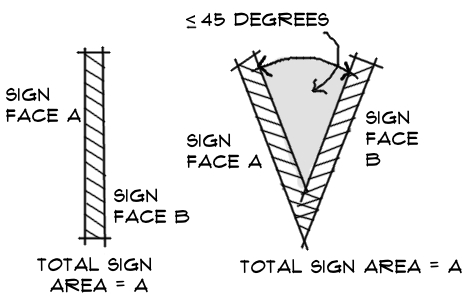
Figure 12-3: Measuring Sign Face, 45 Degrees or Greater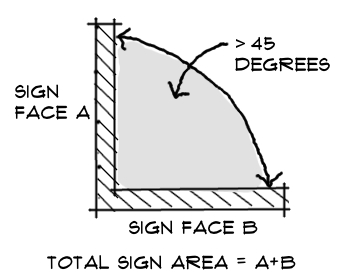
Figure 12-4: Measuring Sign Face, 3 or 4 Display Faces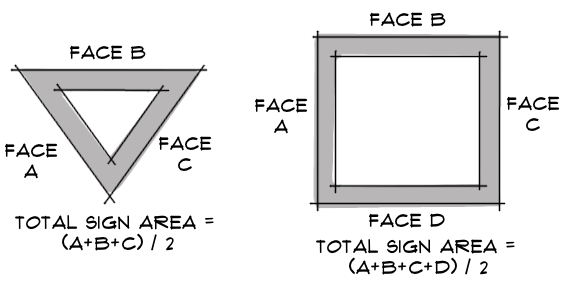
Figure 12-5: Measuring Sign Lettering for Aggregate Area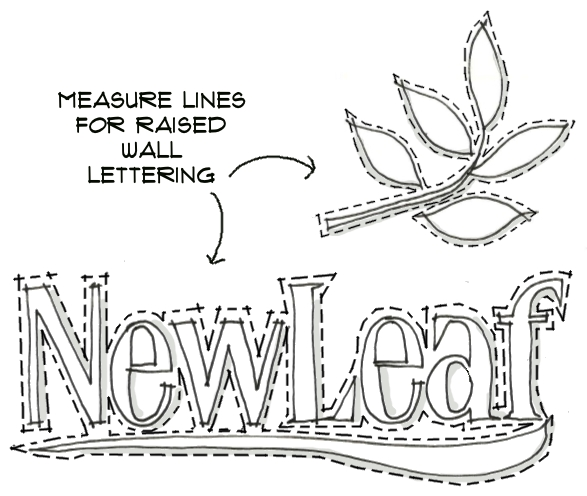
(3)
Determining sign height -
a.
Sign height for freestanding monument signs shall be measured from the ground at the base of the sign or crown of the adjacent road, whichever is highest in elevation, to the topmost portion of the sign (see Figures 12-6 and 12-7). No brimming under signs, for the purpose of elevating the sign, is allowed.
b.
Clearance for projecting signs shall be measured from the base of the sign or canopy to the ground below. A minimum of eight (8) feet of clearance is required over pedestrian areas. A minimum of fourteen (14) feet is required over vehicular use areas (Figure 12-8).
c.
The top of a wall, canopy, or projecting sign shall be no higher than eighteen (18) inches above the highest point of the roof or building wall, whichever is highest.
Figure 12-6: High Road Crown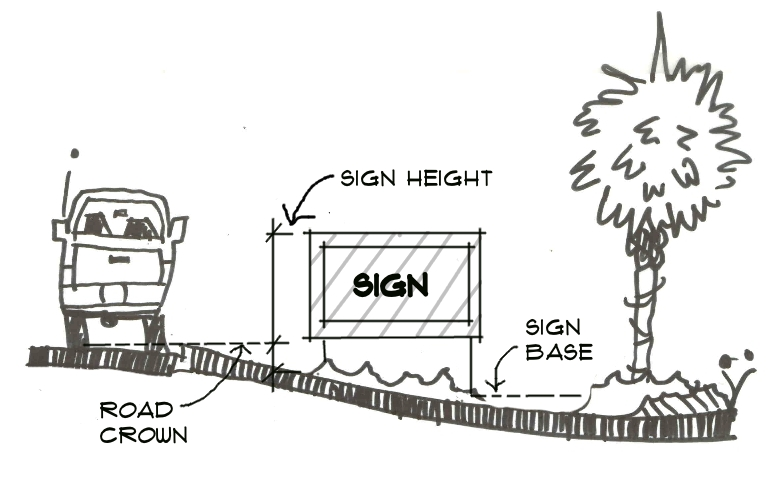
Figure 12-7: Low Road Crown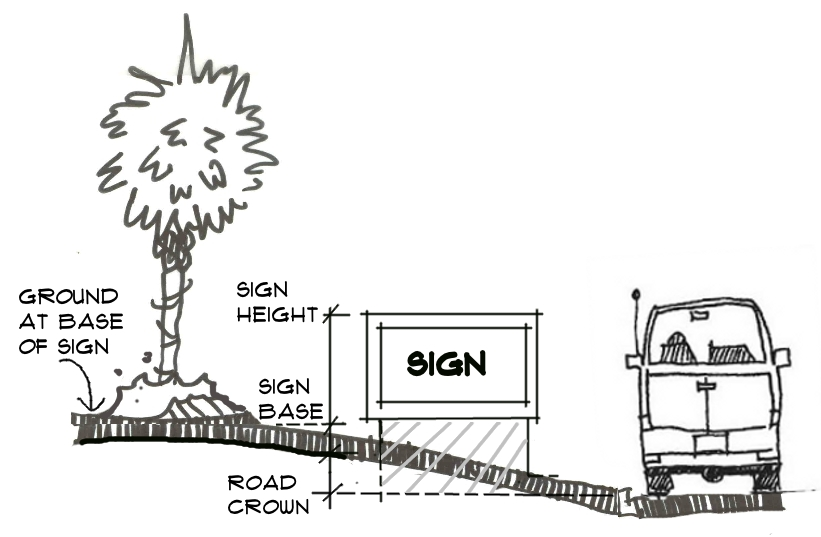
Figure 12-8: Projecting Sign Minimum Clearance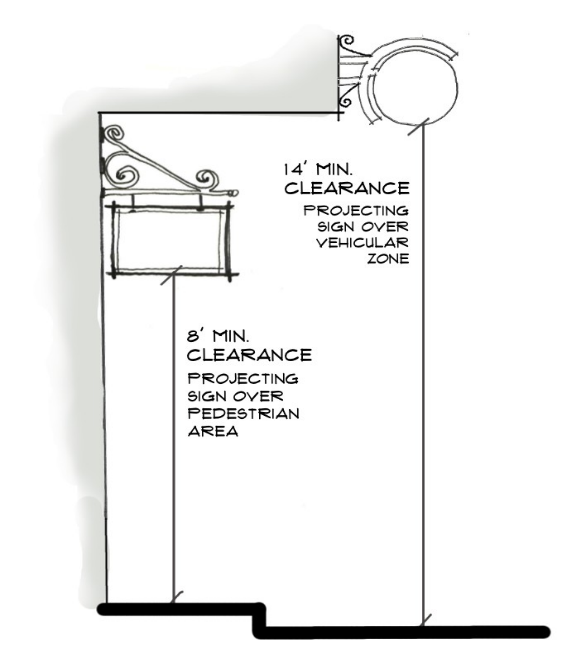
(4)
Determining sign spacing - The spacing between sign structures shall be measured as a straight-line distance between the closest edges of each sign. For nonresidential properties afforded more than one (1) freestanding monument sign, each sign must have at least three-hundred (300) feet of separation. All sign types requiring a permit shall adhere to locational restrictions included under Section 12.6.3.A and no freestanding sign may obscure other existing conforming freestanding signs in accordance with Section 12.6.3.A(10).
(5)
Determining length of building frontage - For all properties outside the CRDs, the length of building frontage abutting roadways with specific classifications is one component used to determine the maximum number of signs as well as the total sign area and height allowed. The length of building frontage is determined as follows:
a.
The length of building frontage shall be the sum of all wall lengths parallel, or nearly parallel, to a public street. This includes both primary and secondary building frontages but excludes any such wall length determined by the Development Control Officer as clearly unrelated to the frontage criteria.
b.
For buildings with two or more frontages, the length of the wall and allowable sign area shall be calculated separately for each such building frontage.
c.
The building frontage for a building unit is equivalent to the tenant space on the first floor and shall be measured from the centerline of the party walls defining the building unit. The frontage of a building unit is used to determine the permissible area for that unit's wall-mounted sign. Individual tenant spaces are not allowed to have separate freestanding monument signs.
H.
Street address identification standards - Numerals and lettering identifying the street address numbers are necessary to assist emergency vehicle drivers and other motorists with identifying the location of property within the City. All buildings and suites within multiple tenant buildings or complexes are required to display street address numbers that have been assigned in accordance with a method approved by the Authority Having Jurisdiction (AHJ). Assigned addresses shall not be changed unless approved by that AHJ. The display of approved street address numbers must be clearly visible from the right-of-way and shall be a minimum of four (4) inches high with a minimum stroke width of ½-inch in accordance with the Florida Fire Prevention Code (FFPC) adopted by the City of Largo and incorporated into the Code of Ordinances (Chapter 13, Article II, Section 13-19). Street address numbers must also be displayed on all freestanding signs.
(1)
On single tenant buildings - All new and existing buildings in the City are required to have approved street address numbers placed in a position to be plainly legible and visible from the street or road fronting the property (see Figure 12-9). The following conditions shall apply:
a.
Address numbers on buildings shall be a minimum of four (4) inches high with a minimum stroke width of one-half (½) inch;
b.
Address numbers shall contrast with their background; and
c.
Address numbers shall be Arabic numerals or alphabet letters.
(2)
On multiple tenant buildings or complexes - Each occupant of a multiple tenant building or complex in the City are required to have approved street address numbers placed in a position to be plainly legible and visible from the street or road fronting the property (see Figure 12-9). The following conditions shall apply:
a.
Address numbers shall be displayed on both the primary front and rear entrance either on or within five (5) feet of the door;
b.
Address numbers on multiple tenant suites shall be a minimum of four (4) inches high with a minimum stroke width of one-half (½) inch;
c.
Address numbers shall contrast with their background; and
d.
Address numbers shall be Arabic numerals or alphabet letters.
Figure 12-9: Placement of Business Address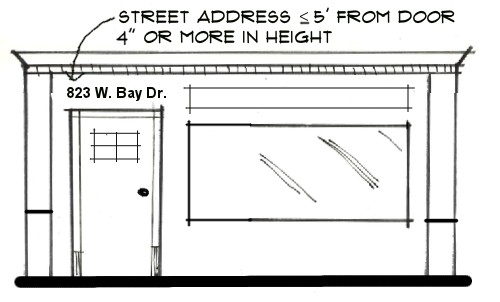
(3)
On freestanding signs - All freestanding, monument signs in the City are required to have approved street address numbers (or the address range assigned to occupants of the property) placed in a position to be plainly legible and visible from the street or road fronting the property (see Figure 12-10). The following conditions shall apply:
a.
Address numerals/letters shall be a minimum of six (6) inches high;
b.
Address numbers shall contrast with their background and be legible to vehicular traffic on the adjacent right-of-way.
c.
Decorative accouterments containing only property addresses are exempt from calculation as sign face area, provided that the accouterments do not increase the sign's area by more than twenty (20) percent.
d.
Addresses incorporated into the sign face shall be calculated as part of the sign area.
Figure 12-10: Address on Free Standing Monument Sign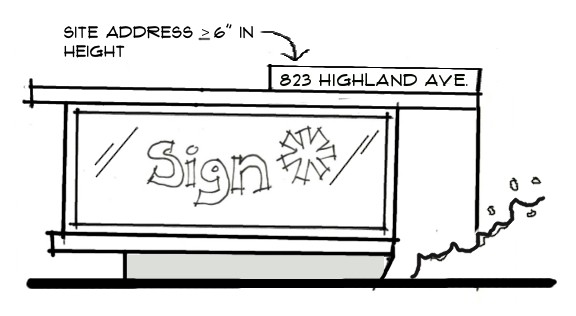
(4)
Optional -
a.
Canopies or awnings - Approved street address number integrated into the fringe or leading edge of a canopy or awning shall be exempt from calculation as sign face area. Address numerals/letters shall be a minimum of six (6) inches high.
b.
Suspended under canopies - Approved street address numbers and/or occupant identification signs suspended from canopies covering pedestrian walkways shall be exempt from permit requirements and from calculation as sign face area provided that such sign meets all other requirements under Section 12.10.2.E(7).
c.
Street names - Display of the street name associated with address numbers is not required and optional.
I.
Enforcement and removal standards - A permit may be required to remove a permitted sign and property owners should consult either a licensed contractor, structural engineer, or the Building Official before removing. Any sign found to be in a state of disrepair shall be declared a nuisance and must be brought into compliance or removed. Abandoned and/or damaged signs shall comply with the requirements of Section 12.7.2.
(Ord. No. 2024-04, § 2, 11-21-2023)
12.9.1 - Objective
To systematically regulate and permit signs by type in a manner consistent with the purposes set forth in this Section.
(Ord. No. 2024-04, § 2, 11-21-2023)
12.9.2 - Applicability
This Section pertains to sign types on residential and nonresidential properties that require a permit to be constructed. These standards do not apply to signs exempt from this Chapter described under Section 12.3.2 or exempt from permitting requirements described under Section 12.10. Supplemental standards and requirements for permitted sign types in CRDs are outlined under Section 12.13.
(Ord. No. 2024-04, § 2, 11-21-2023)
12.9.3 - Freestanding Monument Signs
All freestanding signs shall be monument style and freestanding pole signs are prohibited except for the following: legal nonconforming pole signs regulated under Section 12.7; permitted on properties with frontage along US Highway 19 in accordance with Section 12.9.5; or exempt as outlined under Section 12.3.2 or Section 12.10.2. Measurement criteria used to determine the sign face of a freestanding monument sign and how to calculate the maximum aggregate sign area allowance are outlined under Section 12.8.3.G.
A freestanding monument sign is a sign with a base that is no less than seventy-five (75) percent of the proposed sign width. The distance between the bottom of the sign face and finished grade shall not be more than five (5) feet (see Figure 12-11).
Figure 12-11: Freestanding Monument Sign Dimensions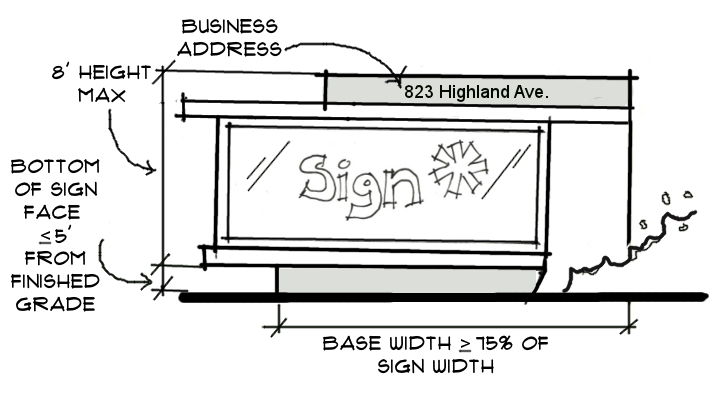
A.
Location, number, and area - Freestanding monument sign are not allowed on single-family, duplex, and/or triplex properties. All other properties are afforded at least one (1) freestanding monument sign and the maximum sign face area is between forty-eight (48) and one hundred sixty (160) square feet depending on the property's aggregate sign area allowance (see Table 12-1). Individual tenants (building units) in multiple tenant building complexes spaces are not allowed to have separate freestanding monument signs.
B.
Height - Maximum height of freestanding monument signs is between eight (8) feet and twelve (12) feet depending on the property's aggregate sign area allowance (see Table 12-1). Larger properties with frontage along a principal arterial/highway are afforded freestanding monument signs up to twelve (12) feet in height if they consist of a multi-building or multi-tenant property with five hundred (500) feet or more of building (see Table 12-1).
(Ord. No. 2024-04, § 2, 11-21-2023)
12.9.4 - Wall-mounted signs (canopy, lettering and/or projecting)
A.
Location, number, and area - Wall-mounted signs are not allowed on single-family homes, duplexes, and/or triplexes. Wall-mounted signs are allowed in common areas of residential subdivisions. There is no maximum number of wall-mounted signs allowed on properties with other land uses and such signs may be distributed on any of the building or perimeter subdivision walls however, fences shall not be considered walls for the purposes of this Section. The subdivision sign may incorporate, or be incorporated into, accessory entrance structural features such as a project wall or landscaping, but may not be incorporated into a fence. Total area allowances for wall-mounted signs shall be limited to the following maximum square footage:
•
Residential subdivisions (e.g., townhomes and condominiums), multi-family, and mobile home parks: Maximum fifty (50) square feet
•
Nonresidential: Maximum one hundred fifty (150) square feet
Measurement criteria used to determine the sign face of a wall-mounted sign and how to calculate the maximum aggregate sign area allowance are outlined under Section 12.8.3.G.
B.
Free-standing buildings - In addition to the maximum sign area identified under Section 12.9.4.A, wall-mounted signs on free-standing buildings shall not exceed that property's maximum aggregate sign area allowance.
C.
Multiple occupancy properties - Wall-mounted signs permitted for individual tenant spaces (building units) in multiple tenant building complexes shall not exceed maximum square footages identified under Section 12.9.2.A; however, the tenant's wall-mounted sign shall not be subject to the property's aggregate sign area allowance. Each tenant space shall be allowed one (1) wall-mounted sign and the sign face shall be based on each occupant's portion of the building frontage oriented toward the means of customer access (regardless of the building's orientation toward the street). For these purposes, tenant space building frontage shall be measured as the distance from fire-wall separation to fire-wall separation or exterior wall. Occupants which are interior to the building or another occupant's space shall not be allocated separate wall-mounted signage.
D.
High-rise buildings - For buildings over three (3) stories in height, additional wall sign area shall be permitted above the third floor of the building. The additional allowable sign area shall be three (3) square feet per each vertical foot of building height (excluding antennas and other attachments) up to a maximum of three hundred (300) square feet. The additional sign area allowed for buildings over three (3) stories cannot be transferred to projecting signs, monument signs, or signs located below the third story.
(Ord. No. 2024-04, § 2, 11-21-2023)
12.9.5 - US Highway 19 Signs
A.
Location, number, and area - Parcels which are immediately adjacent to US Highway 19, with direct access to the roadway via a service or frontage road, are permitted one (1) freestanding monument sign or pole sign located adjacent to US Highway 19. The sign face area allowable on all applicable parcels immediately adjacent to US Highway 19 shall be determined based on roadway classification, the total amount of building frontage and land use designation applicable to the subject parcel where the sign is to be located and in accordance with Table 12-1. Freestanding signs constructed pursuant to this Section may be increased by up to an additional twenty-five (25) percent. Any increase in sign face square footage granted pursuant to the Section is not transferable to any other sign located on the subject parcel or any other parcel.
B.
Height - The height of freestanding monument or pole signs located adjacent to US Highway 19 may extend up to a maximum of fourteen (14) feet in height above the crown of the road. The crown of the road is measured as the highest point of the driving surface of the road, excluding any sidewalls, "jersey barriers," etc. as depicted in Figure 12-12.
C.
Landscape at pole sign base - Freestanding signs permitted along the US Highway 19 roadway shall have a minimum two hundred (200) square foot landscaped area located at the base of the sign, excluding the area occupied by the base of the sign, designed in accordance with the landscaping design standards of Section 10.5.2.D(13).
Figure 12-12: US-19 Signage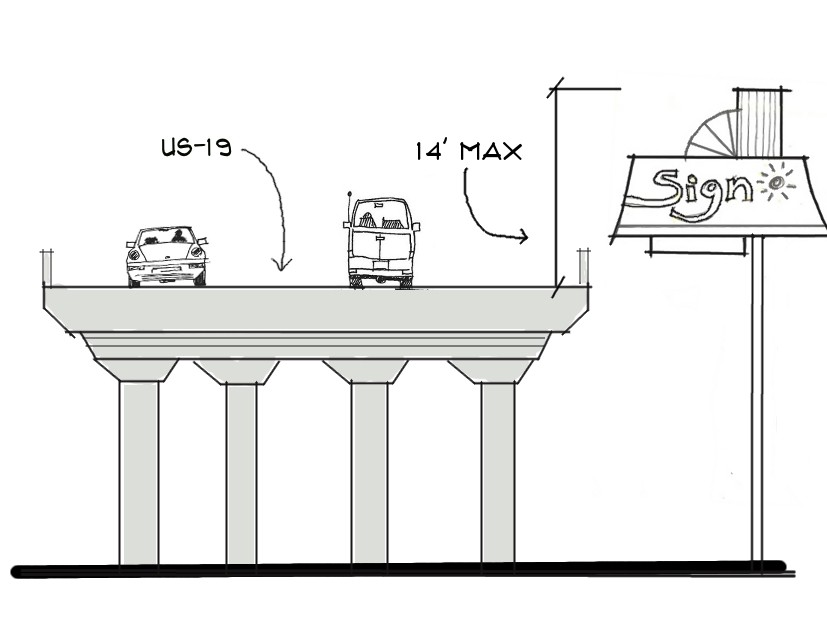
(Ord. No. 2024-04, § 2, 11-21-2023)
12.9.6 - Off-Site Signs and Billboards
A.
Existing billboards - Regulated pursuant to the Development Outdoor Advertising/Billboard Agreements with various sign companies as adopted by City Commission. Annexed properties with billboards are governed through either annexation agreements or through agreements between the sign company and the City.
B.
Proposed billboards or off-site signs - No off-site commercial signs shall be permitted except signage erected by the City of Largo for governmental speech such as promoting City sponsored events or municipal branding/themes, and grand opening/promotional signs as outlined under Section 12.9.7.F(2). No new billboards shall be allowed except as permitted by a written agreement between the City and the company proposing to construct the new billboard.
(Ord. No. 2024-04, § 2, 11-21-2023)
12.9.7 - Grand Opening/Promotional Signs
A.
Applicability - These signs are not intended for permanent installation and are designed for short periods of display on property where new businesses, grand openings and special business events or promotions are scheduled. Grand opening/promotional signs include banner signs, feather signs, as well non-conventional forms of advertisement which encompasses persons dressed as characters or products or persons holding signs/waving and/or inflatables, as well as portable messaging signs. Grand opening/promotional sign standards and permit requirements do not apply to City-sponsored events but do apply to events on City property that are not City-sponsored. Grand opening/promotional signs may not include prohibited signs and may not violate general signage restrictions outlined under Section 12.6.
B.
Time limits - Grand opening/promotional signs may be displayed in continuous increments, per permit, up to the maximum time allowed per year for temporary event types included under Table 16-1. New businesses or developments having an on-site promotional event associated with a grand opening may have a one time, thirty (30) day continuous display of grand opening/promotional signs per quantity guidelines under Section 12.9.7.C; this one-time display allowance does not count towards the maximum time allowed per year for temporary event types included under Table 16-1.
C.
Quantity - A maximum of one (1) banner or freestanding grand opening/promotional sign and/or one (1) inflatable or one (1) non-conventional grand opening/promotional sign may be displayed per permit up to the maximum dimensions included under Section 12.9.7.G. and maximum time allowed per year for temporary event types included under Table 16-1. There are no restrictions on the number of grand opening/promotional signs allowed per permit when a Temporary Event Permit is applied for and issued in conjunction with a Grand Opening/Promotional Sign Permit; however, sign time limits apply.
D.
Use types - Shall be allowed on all properties except for single-family, duplex, and triplex residential properties.
E.
Permit and fee - The cost of a Grand Opening/Promotional Sign Permit is waived for a new business or development having a grand opening promotional event provided that the business or development has a valid Business Tax Receipt (BTR) or certificate of occupancy (CO), if applicable. All other applicants shall submit a fee in accordance with then current fee schedule. All Grand Opening/Promotional Sign Permit applications are required to submit the following:
(1)
A Grand Opening/Promotional Sign Permit application with a letter of authorization from the property owner(s) or authorized agent;
(2)
A current, legal survey, or dimensioned sketch, showing the location of the grand opening/promotional sign(s) in relations to property lines, rights-of-way, easements, and improvements (buildings, driveways, etc.) within, and adjacent to, the property; and
(3)
A Temporary Event Permit is required to be issued for all inflatables and non-conventional grand opening/promotional signs, and if an applicant requests an unlimited number of grand opening/promotional signs per Section 12.9.7.C.
F.
Placement -
(1)
All grand opening/promotional signs must be located on the property where the event is being held and set back at least three (3) feet from the public right-of-way and shall not conflict with visibility triangles and other General Signage Restrictions under Section 12.6.
(2)
Temporary off-site grand opening/promotional signs may be erected only upon compliance with the following:
a.
Grand opening/promotional signs associated with a permitted temporary event may be located off-site within one (1) mile of the property where the event is permitted to be held.
b.
A letter of authorization from the property owner(s) or authorized agent consenting to the placement of the off-site grand opening/promotional signs.
c.
There shall be no more than two (2) off-site grand opening/promotional signs on any one (1) property.
d.
The size, height, and placement of the sign shall comply with the requirements set forth in Section 12.9.7.G.
e.
No grand opening/promotional sign shall be erected on or within any right-of-way.
G.
Maximum dimensions -
(1)
Affixed to building - Banner signs are not to exceed thirty-two (32) square feet each. Signs must be securely affixed to a building.
(2)
Freestanding signs - Freestanding signs (including feather signs) are not to exceed thirty-two (32) square feet total and twelve (12) feet in height. The maximum overall dimension of a portable A-frame sign shall be twenty-six (26) by forty-two (42) inches (see Figure 12-13).
(3)
Inflatables - One (1) inflatable, twenty-five (25) feet in height. Must be ground mounted. Copy on an inflatable shall be in lieu of, and subject to the standards for, allowable grand opening/promotional sign area, which is limited to thirty-two (32) square feet total.
(4)
Non-conventional forms of advertisement - One (1) person dressed as a character or product. The person may also hold or wave a sign and/or inflatable.
H.
Other conditions -
(1)
Grand opening/promotional signs shall be constructed of sturdy material such as wood, hard plastic, vinyl, engineered wood, or particle board of sufficient thickness to withstand the weather elements. Cardboard and paper faced temporary signs are strictly prohibited unless safely fastened, in entirety, to a backing made of sturdy material.
(2)
No grand opening/promotional sign shall be erected which, by reason of its size, location or construction constitutes a hazard to the public.
(Ord. No. 2024-04, § 2, 11-21-2023)
12.9.8 - Drive-through signs
Drive-through or carryout services may have a sign which carries only the name of the establishment and the current list and price of goods or services available in the establishment. Drive-through signs shall not count towards the allowable aggregate signage area.
(Ord. No. 2024-04, § 2, 11-21-2023)
12.10.1 - Applicability
The following activities and sign types are exempt from the permitting process but are not exempt from the requirements imposed by this Section or from all applicable requirements and restrictions included in this Chapter. Signs that comply with the requirements in this Section shall not be included in the determination of the type, number, or area of signs allowed to be permitted on a property. Unless stated otherwise, the requirements listed for each sign included in this Section shall apply to both commercial and non-commercial signs.
12.10.2 - Signs Exempt from Permits
Applicants shall be responsible for securing any other required permits, if applicable, and meet all other standards of the CDC as well as other local, state, and federal regulations prior to performing the following activities or erecting or modifying the following signs:
A.
Forms of signage listed as exempt from this Chapter under Section 12.3.2.
B.
Types of maintenance and replaceable copy exempt from permitting listed under Section 12.11.4.
C.
Window signs and coverings - Permanent and temporary window signs or coverings displaying commercial and non-commercial content shall be permitted on nonresidential land uses only. Groups of multiple windows or doors within six (6) inches of one another on the same building façade shall be considered as one (1) window or door for the purpose of sign face area calculation.
(1)
Occupied buildings -
a.
An occupied nonresidential building, or individual tenant space in such a building, may have one (1) sign, thirty-two (32) square feet in size, and eight (8) feet high displayed in any window. In lieu of one (1) large sign, several smaller signs may be displayed in any window as long as no more than twenty-five (25) percent of the window area is covered or the total area of all signs in the window do not exceed one hundred (100) square feet, whichever is less (see Figure 12-13).
b.
Window signs that meet the definition of governmental signs are allowed and have no size limitations.
c.
An electrical permit may be required, if applicable.
Figure 12-13: Allowable Coverage by Window Signs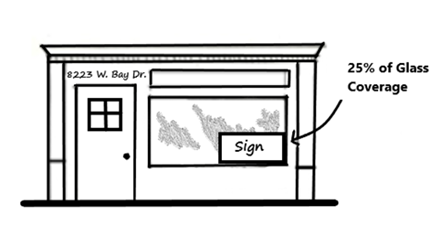
(2)
Vacant or unoccupied buildings -
a.
If a nonresidential building, or individual tenant space in such a building, is unoccupied and vacant for more than thirty (30) days or is undergoing construction/renovation with an active building permit, one hundred (100) percent of any window may have window coverings including but not limited to brown kraft paper or decorative, non-commercial window coverings.
b.
This applies to all first or ground floor windows facing the street, public right-of-way, or any public sidewalk to prevent a clear view into the interior of the building.
c.
Windows may not be covered with plastic garbage bags, plywood, cardboard, or soaping of windows.
D.
Flags - Flags containing commercial advertisement (e.g., company names, tradenames, trademarks, business logos, and/or symbols) may be allowed as freestanding, wall-mounted, or projecting signs, and, if so used, the area of the flag shall be included in and limited by the aggregate allowable area for signs on the property and shall require a permit in accordance with Section 12.9. The following standards apply to the flagpoles for all flags (commercial or noncommercial).
(1)
Location -
a.
Flags and flagpoles shall not be located within any right-of-way and may be placed on residential and nonresidential parcels.
b.
Flagpoles on nonresidential parcels must be setback at least fifteen (15) feet from property lines or a minimum distance equal to or greater than the height of the flagpole or mounting device, whichever is greater. Flag poles along US Highway 19 which exceed thirty-five (35) feet in height must be setback from adjacent residential properties a minimum distance equal to or greater than the height of the flagpole.
c.
Flagpoles may be erected vertically or, alternatively, may be attached to a building horizontally or at an angle.
(2)
Maximum height and dimensions -
a.
Size - The horizontal length of the flag should be approximately ¼ to ⅓ the height of the flagpole.
b.
Flagpoles over twenty (20) feet in height shall comply with all applicable building and engineering construction requirements and must be approved through the building permit review process prior to installation.
c.
Flagpoles may not exceed thirty-five (35) feet in height on all residential and nonresidential properties that are not immediately adjacent to U.S. Highway 19.
d.
Nonresidential properties immediately adjacent to U.S. Highway 19, with direct access to the roadway via a service or frontage road, are permitted up to a maximum flagpole height of seventy-five (75) feet above the crown of the road. The crown of the road is measured as the highest point of the driving surface of the road, excluding any sidewalls, "jersey barriers," etc.
e.
Flagpole heights shall meet the current standards and regulations of the Federal Aviation Authority (FAA).
E.
Historical site markers - Historical markers erected at historical or memorial sites in accordance with section 267.074, Florida Statutes, including plaque signs are allowed on residential and nonresidential properties. Such signs shall meet Florida Historical Markers and State Historical Marker Program requirements outlined in section 267.074, Florida Statutes.
F.
Signs during construction on public right-of-way - The DCO, or his/her designee, shall decide, based on sixty (60) percent plans, when temporary signage is required to overcome decreased visibility resulting from public right-of-way construction projects lasting one (1) month or longer in duration.
(1)
The DCO, or his/her designee, shall notify the occupants of each affected property of their eligibility for said signage.
(2)
Each affected property is limited to a signage area of thirty-two (32) square feet and may not exceed eight (8) feet in height.
(3)
Signs erected during public right-of-way construction may be in the public right-of-way but shall not obstruct visibility triangles.
(4)
The applicant shall submit a fee in accordance with the then current fee schedule for temporary signage and may keep the temporary signage in place throughout the duration of construction activity.
G.
Incidental signs - Incidental signs of a non-commercial nature are intended primarily for the convenience of the public and may also provide direction to pedestrian and vehicular traffic. Incidental signage may be subject to permitting requirements under the technical building codes, as determined by the Building Official. Such signs are allowed in addition to all other signs when they are of such a size and location that satisfy their intended purpose and do not constitute additional advertising. Incidental signs must adhere to the following standards:
(1)
Maximum sign face - Each incidental sign face may not exceed four (4) square feet.
(2)
Maximum height - Each incidental sign shall be a maximum of three (3) feet in height including support posts unless required pursuant to regulatory agency requirements.
a.
Height restrictions do not apply to wall-mounted incidental signs on principal structures, but projecting signs shall meet minimum clearance requirements as depicted in Figure 12-9.
(3)
Exemptions - Larger/higher incidental signs may be used when required pursuant to other regulatory agency requirements or when the DCO deems necessary for safety or visibility for the public. The location and design of larger/higher incidental signs not mounted flush against principal structures must be approved by both the Building Official and the City Engineer.
(4)
Prohibited - Any sign that imitates or resembles official traffic or governmental signs and signals, or otherwise presents a potential traffic or pedestrian hazard, including signs which obstruct visibility, are not allowed under this section.
H.
Temporary signs - Temporary signs are non-permanent signs designed for short periods of display. Each parcel of land within the City shall be allowed temporary sign(s) at any given time on the parcel based on the following standards:
(1)
Maximum number and size - Each parcel of land shall have no more than two (2) temporary signs at any one time and each individual sign shall be no more than three (3) square feet in size.
(2)
Periods of display - Unlimited with exceptions noted under 12.8.2.K(3).
(3)
Exceptions - Beginning ninety (90) days prior to and extending no more than seven (7) days following any election in which residents of the City are eligible to vote, additional temporary signs shall be allowed up to a maximum of five (5) signs per parcel. Each sign erected during this specific time period shall be no more than ten (10) square feet in size.
I.
Limited duration signs - Limited duration signs are non-permanent signs that typically require longer display times. Each parcel of land within the City shall be allowed limited duration sign(s) at any given time on the parcel without a permit based on the following standards. Unless otherwise stated, the requirements listed below shall apply to both commercial and non-commercial signs.
(1)
Residential -
a.
Freestanding sign(s) may be erected on a residential property during the time of sale, lease or rental of a lot or dwelling unit, provided that the following conditions are met:
(i)
Maximum number - One (1) sign per street frontage if the signs are not visible simultaneously, plus one (1) sign per each additional three-hundred (300) feet of frontage;
(ii)
Maximum size and height - Each sign may not exceed six (6) square feet in area and eight (8) feet in height. On lots of more than two (2) acres, each sign area may be increased to sixteen (16) square feet and eight (8) feet in height;
(iii)
Minimum separation - Each sign must have a minimum separation of three-hundred (300) feet or not be visible simultaneously; and,
(iv)
Periods of display - Unlimited, provided that the sign is removed within 15 days of the sale, lease or rental of the lot or dwelling unit.
(v)
Exceptions - For any property that received development approval from the City to construct a townhome subdivision, all the conditions noted under this subsection shall apply except that the maximum size of each sign area may be increased to sixteen (16) square feet and, for properties between two (2) and four (4) acres in size, the maximum size of each sign area may be increase to thirty-two (32) square feet. For properties greater than four (4) acres in size the maximum size of each sign area may be increased to sixty-four (64) square feet. Such signs may be erected after approval of a Development Order and remain until issuance of a building permit for the last lot to be sold or completion of the development project.
b.
Freestanding sign(s) may be erected on a residential property during the time of construction or remodeling of a property provided building permit(s) have been issued and the following conditions are met:
(i)
Maximum number - One (1) sign per street frontage if the signs are not visible simultaneously, plus one (1) sign per each additional three-hundred (300) feet of frontage;
(ii)
Maximum size and height - Each sign may not exceed six (6) square feet in area and eight (8) feet in height. On lots of more than two (2) acres, each sign area may be increased to sixteen (16) square feet and eight (8) feet in height;
(ii)
Minimum separation - Each sign(s) on the same parcel must have a minimum separation of three-hundred (300) feet or not be visible simultaneously;
(iv)
Periods of display - Allowed for the duration of active construction or remodeling (i.e., from permit issuance to final inspection/Certificate of Occupancy); and
(v)
Exceptions - For any property that received development approval from the City to construct a townhome subdivision, all the conditions noted under this subsection shall apply except that the maximum size of each sign area may be increased to sixteen (16) square feet and, for properties between two (2) and four (4) acres in size, the maximum size of each sign area may be increase to thirty-two (32) square feet. For properties greater than four (4) acres in size the maximum size of each sign area may be increased to sixty-four (64) square feet. Such signs may be erected after approval of a Development Order and remain until issuance of a building permit for the last lot to be sold or completion of the development project.
(2)
Nonresidential -
a.
Freestanding sign(s) may be erected on a nonresidential property during the time of sale, lease or rental of a lot or dwelling unit, provided that the following conditions are met:
(i)
Maximum number - One (1) sign per street frontage if the signs are not visible simultaneously, plus one (1) sign per each additional three hundred (300) feet of frontage;
(ii)
Maximum size and height - Each sign may not exceed sixteen (16) square feet in area and eight (8) feet in height. On lots of more than two (2) acres, each sign area may be increased to thirty-two (32) square feet and eight (8) feet in height;
(iii)
Minimum separation - Each sign on the same parcel must have a minimum separation of three hundred (300) feet or not be visible simultaneously; and,
(iv)
Periods of display - Unlimited, provided that the sign is removed within 15 days of the sale, lease or rental of the lot or dwelling unit.
b.
Freestanding sign(s) may be erected on a nonresidential property during the time of construction or remodeling of a property provided building permit(s) have been issued and the following conditions are met:
(i)
Maximum number - One (1) sign per street frontage if the signs are not visible simultaneously, plus one (1) sign per each additional three hundred (300) feet of frontage;
(ii)
Maximum size and height - Each sign may not exceed sixteen (16) square feet in area and eight (8) feet in height. On lots of more than two (2) acres, each sign area may be increased to thirty-two (32) square feet and eight (8) feet in height;
(iii)
Minimum separation - Each sign on the same parcel must have a minimum separation of three hundred (300) feet or not be visible simultaneously;
(iv)
Periods of display - Allowed for the duration of active construction or remodeling (i.e., from permit issuance to final inspection/Certificate of Occupancy).
J.
Portable A-frame signs - Portable A-frame signs are allowed in the CRDs, Activity Centers, and Multimodal Corridors on nonresidential and mixed-use properties. Such A-frame signs shall be allowed on private property without issuance of a permit and shall not affect the amount or type of signage otherwise allowed by this Chapter. The following standards shall apply:
(1)
One (1) A-Frame sign shall be allowed per separate business.
(2)
The maximum overall dimension of an A-frame sign shall be twenty-six (26) by forty-two (42) inches (see Figure 12-14);
(3)
No A-frame sign shall interrupt the normal flow of vehicle, pedestrian or bicycle traffic and shall provide a minimum of three (3) feet of clear passage for pedestrians on a sidewalk where a sidewalk exists;
(4)
No A-frame sign shall obstruct a visibility triangle;
(5)
All A-frame signs shall only be displayed during the sign owner's business hours and shall be stored indoors when the business is not open, during tropical storm/hurricane watches and warnings, and other severe weather advisories;
(6)
A-frame signs shall be placed adjacent to the business displaying the sign;
(7)
A-frame signs shall be professionally constructed of a durable material including but not limited to aluminum, cast metal, molded plastic, PVC, recycled plastic, lumber, metal, wood or other similar materials; and,
(8)
A-frame signs shall not be illuminated, animated, electrically powered.
Figure 12-14: A-Frame Sign Dimensions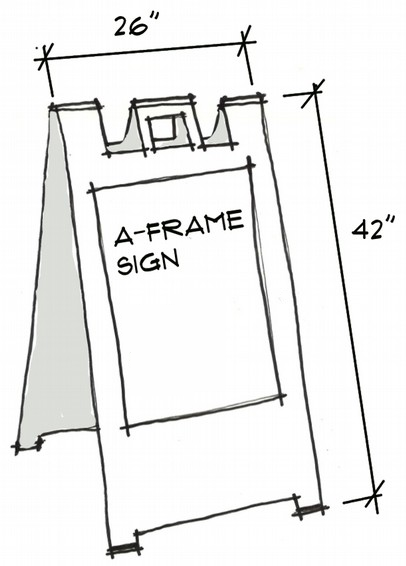
(Ord. No. 2024-04, § 2, 11-21-2023)
12.10.3 - Requirements
It is the property owner's responsibility to ensure that signs exempt from permit requirements are designed and installed to preserve public safety and do not constitute prohibited signs and do not violate general signage restrictions outlined under Section 12.6.
(Ord. No. 2024-04, § 2, 11-21-2023)
12.11.1 - Applicability
Unless noted otherwise within these regulations, no person shall erect, alter, enlarge, extend, repair, replace, or relocate a sign, sign structure, or sign lighting source without approval of a city building permit. These permit submission requirements do not apply to signs exempt from this Chapter described under Section 12.3.2 or exempt from permitting requirements described under Section 12.10.
(Ord. No. 2024-04, § 2, 11-21-2023)
12.11.2 - Permit Submission Requirements
Except as exempted elsewhere in this Chapter, all permit applications for signs shall be submitted by a licensed professional, and all electrical, mechanical, or plumbing work shall be performed only by individuals licensed for such work, and must include the following information and documents:
A.
Parcel identification number and address of the proposed sign(s) location;
B.
Future land use map designations for the property on which the sign(s) will be located and a description of the actual use of the property where the sign(s) will be installed;
C.
Applicant's contact information (e.g., name, address, phone number, email);
D.
Property owner's contact information (e.g., name, address, phone number, email);
E.
A notarized affidavit or statement of authorization signed by the property owner consenting to the installation and placement of the proposed sign(s) on the property;
F.
For freestanding signs, a current legal survey or site plan of the property is required. All other proposed sign types require either the submission of a legal survey or a plot plan, drawn to scale. All plans must show the location and dimensions of all property lines, rights-of-way, easements, and improvements (e.g., overhead utility lines; location and dimensions of onsite buildings; driveways, etc.) within and adjacent to the property. The location(s) of all existing and proposed freestanding signs must be indicated;
G.
Elevation drawing(s) showing the location and dimensions of all existing and proposed signs attached to building(s), including but not limited to wall, canopy, and projecting signs. When a building is occupied by multiple tenants and/or is in a CRD, the drawings shall also indicate each occupant's linear building frontage;
H.
Scale drawings(s) showing the dimensions and construction of all existing and proposed sign structures. The drawings shall detail the proposed sign type(s) to be installed with dimensions included (e.g., sign face width, height and area, overall height, depth, color scheme, structural details, materials, illuminated or non-illuminated, and lighting scheme). When submitted as part of a sign permit application, these drawings must be signed and sealed by a registered engineer;
I.
The value of the proposed sign(s);
J.
A letter of "No Objection" from utility providers (e.g., Duke Energy) or other jurisdictional agencies, as applicable, for any signs located within ten (10) feet of a right-of-way or a utility easement;
K.
If the applicant for a proposed freestanding sign wishes to measure sign height from the crown of the adjacent roadway, a legal boundary survey must be submitted for the subject parcel depicting the roadway crown elevation;
L.
If the proposed freestanding sign is to be located on a parcel immediately adjacent to US Highway 19, a legal boundary survey must be submitted for the subject parcel depicting the highest point of US Highway 19 adjacent to the subject parcel(s)' property line(s). The highest point of US Highway 19 adjacent to the subject parcel(s) shall be measured as described in Section 12.9.5; and,
M.
A Master Signage Plan, as described in Section 12.12, if it is required to be submitted and kept on file with the Community Development Department by that section.
(Ord. No. 2024-04, § 2, 11-21-2023)
12.11.3 - Permit Conditions and Processes
A.
Fees - No permit shall be issued until the appropriate application has been filed with the Building Official and/or his or her designee and all permit fees have been paid.
B.
Review process -
(1)
Review criteria - The permit application for a sign shall be reviewed for a determination of whether the proposed sign meets the applicable requirements of this Chapter and consistency with the approved Master Signage Plan for the property as well as any other applicable provision of the CDC.
(2)
Application review deadlines - The review of the permit application for signs shall be completed within fifteen (15) business days after the receipt of the completed application by the Community Development Department. The application shall be approved or denied within that time frame. If the application is denied, the reasons for denial shall be set forth in writing and delivered to the applicant within fifteen (15) business days.
C.
Inspection process - The Community Development Department may make, or require, any inspections to ascertain compliance with the provisions of this Chapter as well as any other applicable provisions of the CDC, and/or other applicable laws, regulations, and technical codes.
D.
Permit duration - Shall be in accordance with Section 18.1.1 Building Codes.
E.
Failure to obtain a permit - Any work performed without a permit, when one is required, shall result in the entire sign being considered illegal and subject to immediate removal at the property owner's expense. Should it be determined that the sign is legally permissible, the property owner shall pay three (3) times the normal application fee to obtain a permit to retain the sign.
(Ord. No. 2024-04, § 2, 11-21-2023)
12.11.4 - Permit Exceptions
Forms of signage listed as exempt from this Chapter under Section 12.3.2 and sign types exempt for permitting requirements are listed in Section 12.10. In addition, no permit shall be required to perform the following actions:
A.
Replaceable copy on sign - Change the copy on a sign which is specifically designed for the use of replaceable copy. This shall include the replacement of sign panels, provided it does not materially alter the sign structure or require a permit. This provision does not exempt a property owner from the requirement to bring nonconforming signs into conformance, when applicable.
B.
Simple, nonstructural maintenance - Simple nonstructural maintenance of a sign which shall include:
(1)
Paint, stucco, or other similar treatments applied to the sign's structure to improve aesthetics and/or inhibit rust and deterioration; and
(2)
Replacement of defective parts and expendable components (e.g., lighting elements, vinyl letters).
(Ord. No. 2024-04, § 2, 11-21-2023)
12.12.1 - Alternate Master Sign Plan
The purpose of the Alternate Master Sign Plan is to provide flexibility for sign size, height, and placement responding to the special needs for both project and tenant visibility of multi-building/tenant campuses of regional size and significance, particularly located along high traffic corridors and in activity centers.
A.
Nonresidential developments outside CRDs -
(1)
Required characteristics - To qualify for an alternate master sign plan, a nonresidential development must have all the following characteristics:
a.
The site is a campus or complex of nonresidential buildings and/or nonresidential multi-tenant spaces (such as a medical campus or shopping center); and
b.
The site is at least three (3) acres in size; and,
c.
All parcels and buildings are either under a single ownership or there is a shared ownership across all parcels and buildings (represented by a property owners association, a unity of title, unified management, or similar mechanism showing joint ownership); and,
d.
All parcels and buildings are served by shared internal vehicular circulation and parking, and the site functions as a unified development; and,
e.
The site has frontage on at least one (1) major collector, principal arterial or highway.
(2)
Design standards - All freestanding signs approved for nonresidential developments under an alternate master sign plan are subject to the following design standards:
a.
Signs shall reflect the architecture of the buildings on the site, using similar materials, styles, and architectural treatments;
b.
The maximum height for a freestanding monument sign on a nonresidential site that has the required street frontage and aggregate area multiplier shall not exceed twelve (12) feet with one hundred sixty (160) square feet of sign face unless a bonus height and area is applied for and approved based on criteria outlined under Section 12.2.2. With approval of an Alternate Master Sign Plan that grants bonus height and area, freestanding monument signs shall not exceed twenty-four (24) feet in height and 200 square feet in area.
c.
Freestanding monument signs above twelve (12) feet in height may be partially open at the base; however, the opening shall not exceed half the height of the proposed sign at the base for better visibility, as long as the sign is supported by at least two (2) structural supports that are designed to match the primary sign utilizing similar architectural design and materials, including but not limited to color and any trim work.
(3)
Freestanding identification signs - Freestanding identification signs for the entire campus (including individual tenant or owner identification as well as directory signage) may be proposed to be placed on any parcel contained within the campus/complex, subject to a finding by the DCO that the proposed sign location(s) appropriately serve to identify the entire campus/complex. Directory or directional signage that is designed to be part of an identity plan for an entire campus/complex may be placed appropriately throughout the campus/complex and will not be counted toward the maximum allowed sign area.
B.
Nonresidential developments inside CRDs -
(1)
Required characteristics - To qualify for an alternate master sign plan, a nonresidential development in one of the CRDs must have all the following characteristics:
a.
The site is a campus or complex of nonresidential buildings and/or nonresidential multi-tenant spaces (such as a medical campus or shopping center); and
b.
The site is at least three (3) acres in size; and,
c.
All parcels and buildings are either under a single ownership or there is a shared ownership across all parcels and buildings (represented by a property owners association, a unity of title, unified management, or similar mechanism showing joint ownership); and,
d.
All parcels and buildings are served by shared internal vehicular circulation and parking, and the site functions as a unified development; and,
e.
The site has frontage on at least one (1) major collector, principal arterial or highway.
(2)
Design standards - All freestanding signs approved for nonresidential developments under an alternate master sign plan are subject to the following design standards:
a.
Signs shall reflect the architecture of the buildings on the site, using similar materials, styles, and architectural treatments;
b.
No freestanding monument sign will be allowed within the CRDs above eight (8) feet in height unless approved as part of an alternate master sign plan, and the maximum height that can be granted is twelve (12) feet. Monument signs approved up to twelve (12) feet in height may be partially open at the base; however, the opening shall not exceed half the height of the proposed sign at the base for better visibility, as long as the sign is supported by at least two (2) structural supports that are designed to match the primary sign utilizing similar architectural design and materials, including but not limited to color and any trim work.
(3)
Freestanding identification signs - Freestanding identification signs for the entire campus (including individual tenant or owner identification as well as directory signage) may be proposed to be placed on any parcel contained within the campus/complex, subject to a finding by the DCO that the proposed sign location(s) appropriately serve to identify the entire campus/complex. Directory or directional signage that is designed to be part of an identity plan for an entire campus/complex may be placed appropriately throughout the campus/complex and will not be counted toward the maximum allowed sign area.
(4)
Location restrictions - Alternate master sign plans for nonresidential developments are allowed in the Mixed-Use Character (MUC), Medical Arts (MA), and Professional Office (PO) Districts of the CRDs subject to full compliance with the standards, regulations and criteria contained in the CRD Plans and supplemental standards.
C.
Residential multifamily developments and Assisted Living Facilities (ALFs) -
(1)
Required characteristics - To qualify for an alternate master sign plan, multifamily developments and assisted living facilities must have all the following characteristics:
a.
The site is a campus or complex of buildings containing at least 50 dwelling units; and,
b.
The site is at least six (6) acres in size;
c.
All parcels and buildings are either under a single ownership or there is a shared ownership across all parcels and buildings (represented by a property owners association, a unity of title, unified management, or similar mechanism showing joint ownership);
d.
All parcels and buildings are served by shared internal vehicular circulation and parking, and the site functions as a unified development.
(2)
Design standards - All freestanding signs approved for multifamily developments and assisted living facilities under an alternate master sign plan are subject to the following design standards:
a.
Freestanding signs shall be limited to seventy-two (72) square feet in area and a height of twelve (12) feet.
b.
Shall meet any other applicable requirements of this CDC.
(3)
Freestanding identification signs - Freestanding identification signs for the entire campus (including individual tenant or owner identification as well as directory signage) may be proposed to be placed on any parcel contained within the campus/complex, subject to a finding by the DCO that the proposed sign location(s) appropriately serve to identify the entire campus/complex. Directory or directional signage that is designed to be part of an identity plan for an entire campus/complex may be placed appropriately throughout the campus/complex and will not be counted toward the maximum allowed sign area.
(4)
Location restrictions - Shall not apply to Mobile Home Park communities and single-family subdivisions, duplex or triplex properties.
(Ord. No. 2024-04, § 2, 11-21-2023)
12.12.2 - Bonus Height and Area for Alternate Master Sign Plans
As part of a proposed Alternate Master Sign Plan, the Development Control Officer (DCO) may make a finding that additional bonus height and/or size for a freestanding sign(s) is warranted. Signs shall not exceed twenty-four (24) feet in height and 200 square feet in area. The provision of this additional height and square footage may be granted by the DCO, based on the following:
A.
A proposed freestanding sign(s) provides a level of architectural quality significantly above that required by this Section and a special need for visibility is demonstrated based on the characteristics of the adjacent street(s); or
B.
The site is a campus or complex of buildings and/or multi-tenant spaces with regional significance and identification needs.
(Ord. No. 2024-04, § 2, 11-21-2023)
12.13.1 - Objective
To identify specific sign code standards for special use designations and overlays applied to areas of the City that serve as local retail, financial, governmental, residential, and employment focal points. These areas have specific development standards and bonus densities designed to encourage redevelopment in one or a combination of uses, with good access to mass transit.
(Ord. No. 2024-04, § 2, 11-21-2023)
12.13.2 - Applicability
The sign standards contained within this Section of the CDC apply to residential and nonresidential properties within the Clearwater Largo Road and West Bay Drive CRDs (See Map 7-2). Sign types not specifically regulated in this Section shall follow all standards and restrictions contained in Chapter 12 including but not limited to prohibited signs or signs violating general signage restrictions outlined under Section 12.6.4.
(Ord. No. 2024-04, § 2, 11-21-2023)
12.13.3 - Permitted Sign Types in CRDs
Allowable signage for developed properties in the CRDs shall be based on the use of the property, not the land use designation of the property. The type, number, and dimensional standards for sign types that require a permit on properties within the CRDs are outlined in this Section and Table 12-2. All CRD properties shall be required to submit a Master Signage Plan Form as set forth in Section 12.12.
A.
Freestanding monument signs -
(1)
All properties, except for single-family, duplex, and triplexes, in the CRDs shall be permitted one (1) freestanding monument sign, in compliance with the maximum sign dimensions illustrated on Figure 12-15 and established in Table 12-2.
(2)
Signage shall be integrated with the design and materials of the building. The base of the sign may be made of the same materials as the building and may echo the style of the building facade.
(3)
An additional freestanding monument sign shall be allowed if the (re)development has more than five hundred (500) linear feet of road frontage on a single roadway, or if the (re)development takes vehicular traffic from more than one arterial roadway. Free standing monument signs on sites with multi-tenants or multi-buildings must follow the City-wide standards contained in Section 12.9.3 and Table 12-1.
(4)
Allowable freestanding monument sign area may be transferred and added to the maximum allowable wall signage. The additional sign area allowed for buildings over three (3) stories cannot be transferred to projecting signs, monument signs, or signs located below the third story.
Figure 12-15: Maximum Signage Area Allowances in the CRDs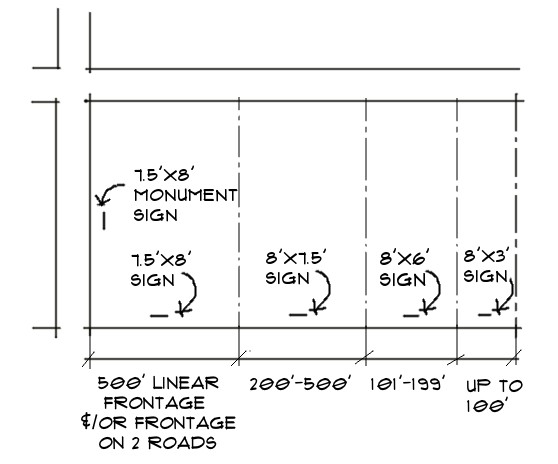
B.
Wall-mounted signs (canopy, lettering, and/or projecting) -
(1)
One (1) projecting sign shall be allowed for each business located within a (re)development, in compliance with the maximum sign dimensions established in Table 12-2.
(2)
One (1) or more wall/canopy signs shall be allowed for each separate business within a (re)development, up to the maximum sign areas allowed per applicant, in compliance with the maximum sign dimensions established in Table 12-2.
(3)
Trail related uses which abut the Pinellas Trail, Duke Energy Trail, or any other designated urban trail shall be allowed one (1) additional wall sign or projecting sign not to exceed thirty-two (32) square feet located on the side of the building facing the Pinellas Trail or the designated urban trail.
(3)
Signs located on (or overhanging upon) a public right-of-way shall require a hold harmless agreement to indemnify the City from any and all loss resulting from injury to, or death to, persons or damage to property arising out of, resulting from, or in any manner caused by the presence, location, use, operation, installation, maintenance, replacement, or removal of such canopy area.
(4)
Allowable freestanding sign area may be transferred and added to the maximum allowable wall signage. The additional sign area allowed for buildings over three (3) stories cannot be transferred to projecting signs, monument signs, or signs located below the third story.
C.
Light projection signs - Light projection signs, which project light onto a building façade and include commercial content are allowed and must calculate the commercial content as part of the maximum wall sign area in accordance with Table 12-2.
(1)
Light projection signs may not:
a.
Project on parts of buildings that are used for residential or lodging purposes;
b.
Shine, either fully or partially, on any property, building, or public right-of-way, including a street or sidewalk other than the building where the image will appear;
c.
Flash, animate, or scroll text;
d.
Distract or inhibit the vision of pedestrians, bicyclists, and motorists;
d.
Be controlled through social media or by any person other than the property owner; or
e.
Be displayed at any time outside the hours of 7:00 a.m. to 2:00 a.m.
(2)
Light Projection signs displayed by the City of Largo to promote are allowed and have no size maximums. These light projecting signs may be used for city-authorized special events and municipal messaging and are considered governmental signs.
(Ord. No. 2024-04, § 2, 11-21-2023)
12.13.4 - Signs Exempt from Permits and Requirements in CRDs
Unless otherwise noted below, standards for signs exempt from permits and requirements under Section 12.10 also apply to CRD properties.
A.
Downtown promotional banners - Banners erected by the City of Largo are allowed and have no size maximums or display time limits. These banners may be used for city-authorized special events and municipal messaging and are considered governmental signs.
B.
Window signs and coverings - Permanent and temporary window signs or coverings displaying commercial and non-commercial content shall be permitted on nonresidential land uses in CRDs. Groups of multiple windows or doors within six (6) inches of one another on the same building façade shall be considered as one (1) window or door for the purpose of sign face area calculation.
(1)
Occupied buildings -
a.
An occupied nonresidential building, or individual tenant space in such a building, may cover a maximum of twenty-five (25) percent of the window area.
b.
Window signs that meet the definition of governmental signs are allowed and have no size maximums.
c.
An electrical permit may be required, if applicable.
(2)
Vacant or unoccupied buildings -
a.
If a nonresidential building, or individual tenant space in such a building, is unoccupied and vacant for more than thirty (30) days or is undergoing construction/renovation with an active building permit, one hundred (100) percent of any window may have window coverings including but not limited to brown kraft paper or decorative, non-commercial window coverings.
b.
This applies to all first or ground floor windows facing the street, public right-of-way, or any public sidewalk to prevent a clear view into the interior of the building.
c.
Windows may not be covered with plastic garbage bags, plywood, cardboard, or soaping of windows.
(Ord. No. 2024-04, § 2, 11-21-2023)

