
Miami City Zoning Code
ARTICLE 7
PROCEDURES AND NONCONFORMITIES
Amendments to Article 7
| ORDINANCE | DATE APPROVED | DESCRIPTION | LEGISLATIVE ID |
|---|---|---|---|
| 13159 | 04-22-2010 | Requirements for PZAB members | 10-00287zt |
| 13235 | 11-18-2010 | Minor and non-substantial modifications throughout the Code | 10-00956zt |
| 13238 | 12-16-2010 | Requirements for sheds and other structures; loading berth substitutions; requirements for public and commercial storage facilities; distance separation requirements for ALF’s; distance separation requirements for uses and structures | 10-00963zt |
| 13240 | 12-16-2010 | Modification of door spacing requirements and removal of public easement requirements | 10-00968zt |
| 13251 | 01-27-2011 | To add procedures for Unity of Title | 10-01335zt |
| 13265 | 05-12-2011 | Incentives for construction of Affordable Housing | 11-00022zt |
| 13269 | 05-26-2011 | Modification to non-conformities | 11-00151zt |
| 13362 | 02-28-2013 | Atlas amendment dates | 12-01296zt |
| 13464 | 05-22-2014 | Sign Regulations Amendment | 12-00941zt1 |
| 13499 | 02-26-2015 | Modification of voting requirements | 14-00515zt |
| 13507 | 03-12-2015 | Modification of successional zoning chart to include T6-24b | 14-01198zt |
| 13566 | 09-24-2015 | Amend Time Extensions for Nonconforming Uses | 14-01304zt1 |
| 13577 | 11-19-2015 | Modification of Adaptive Use Parking Requirements | 14-01075zt |
| 13594 | 01-28-2016 | Updates PZAB to Hear Appeals of CU Revocation | 15-01249zt |
| 13690 | 06-22-2017 | Joining of persons with entities when submitting applications for rezoning. | 2192 |
| 13728 | 12-14-2017 | Parking standards and placement for frontages and underground parking | 3003 |
13831 | 03-22-2019 | Freeboard | |
13817 | 12-13-2019 | T6-24B | |
13878 | 10-10-2019 | Allows CIL in “T3-O,” Sub-Urban Transect Zone | |
| 13945 | 11-19-2020 | Requires approval by additional officials for release of a unity of title, covenants and others | |
| 13952 | 12-10-2020 | Historic Sites or Contributing Structures | |
| 13958 | 11-19-2020 | Exempts rezonings of properties by the City of Miami to "CS" or "T-1" from minimum size and frontage requirements | |
| 13114 | 01-12-2023 | Amend Article 7, Section 7.1.1.4, Titled " Procedures and Nonconformities/Planning, Zoning and Appeals Board" | 12924 |
| 14157 | 03-09-2023 | To replace or strike references to the Neighborhood Enhancement Team ("NET") | 12614 |
| 14177 | 05-25-2023 | To provide the issuance of the Certificates of Use in certain limited instances where a property or building on a property is subject to pending code compliance or building violations. | 12838 |
| 14178 | 05-25-2023 | To provide clarification on circumstances in which an application shall not be scheduled for a public hearing nor any approvals be issued by the City of Miami ("CITY") if the property subject to the hearing or request has open vilolation(s) and/or owes monies to the City and to provide consistency with section 2-208 of the code of the City of Miami, Florida. | 13539 |
| 14183 | 06-08-2023 | To allow and establish definitions and regulations for Co-Living Residential Uses. | 13541 |
| 14210 | 09-28-2023 | It allows structures containing a nonconforming use to resume such use when the owner complies with the timeframes in the structure order. | 14112 |
| 14234 | 11-16-2023 | To clarify and amend the Waiver process relating to alterations to nonconforming residences. | 14195 |
| 14235 | 11-16-2023 | Add new definition (Article 1); clarify the Waiver processes relating to elderly housing (Article 3); clarify Waiver processes relating to substitution of loading berths (Article 4); clarify the Waiver processes relating to service and parking access from a Principal Frontage (Article 5); clarify the Waiver processes relating to reservoir parking spaces (Article 6); clarify the Waiver processes relating to nonconforming properties and update the Waivers summary list (Article 7). | 14196 |
| 14236 | 11-16-2023 | Introduces a flexible lot coverage program, clarifies the application of Waivers, and amends the 10% Waiver. | 14202 |
| 14237 | 11-16-2023 | Clarifies the minor modification allowance of a footprint of a building | 14679 |
| 14249 | 12-12-2024 | Harmonize the Public Notice requirements for Planning and Zoning matters to the language found Chapter 62 of the code of the City of Miami | 16789 |
| 14250 | 01-11-2024 | Updates the waivers summary list | 14192 |
| 14302 | 07-25-2024 | It modifies the requirements for proposed demolitions | 14197 |
| 14336 | 11-21-2024 | Streamlines development approvals by introducing an administrative site plan review, simplifying permit processes, extending approval timelines, revising phased project rules, clarifying waiver restrictions, and applying changes to previously approved applications, with immediate effect. | 16433 |
| 14354 | 02-13-2025 | Addition of a Portico definition; increase Driveway design options; clarifications of the maximum Height of ground-floor Story and raised decks within T3; clarify the Freeboard regulations within the T3; additional detail and the reformatting of language regarding Height and disposition of Fences and walls in T3; flexibility relating to parking within the T3; flexibility provided to Encroachments to the rear of T3; and Waiver to allow additional height for raised decks. | 16869 |
| 14360 | 03-13-2025 | To allow the reestablishment of specific-purpose structures, either designated historic sites or over 50 years old, for their original uses through a warrant or exception process. | 16955 |
| 14374 | 06-17-2025 | Allows existing nonconforming public storage facilities in T5/T6 zones to extensively repair, remodel, or alter structures if they meet design criteria and get approval. | 17163 |
| 14378 | 07-10-2025 | Updates criteria for denying or revoking a Certificate of Use. | 17596 |
| 14380 | 07-10-2025 | Exception added to zoning rules allowing development-related zoning applications by the City of Miami despite code violations. | 17385 |
| 14379 | 07-10-2025 | Amends zoning ordinance to update definitions, parking standards, design criteria, and housing regulations. Includes clarifications, incentives, and procedural consistency. | 17531 |
| 14428 | 12-11-2025 | Amends the code to establish a reasonable accommodation(s) procedure for land use regulations. | 18180 |
DIAGRAM 14 PERMITTING PROCESS
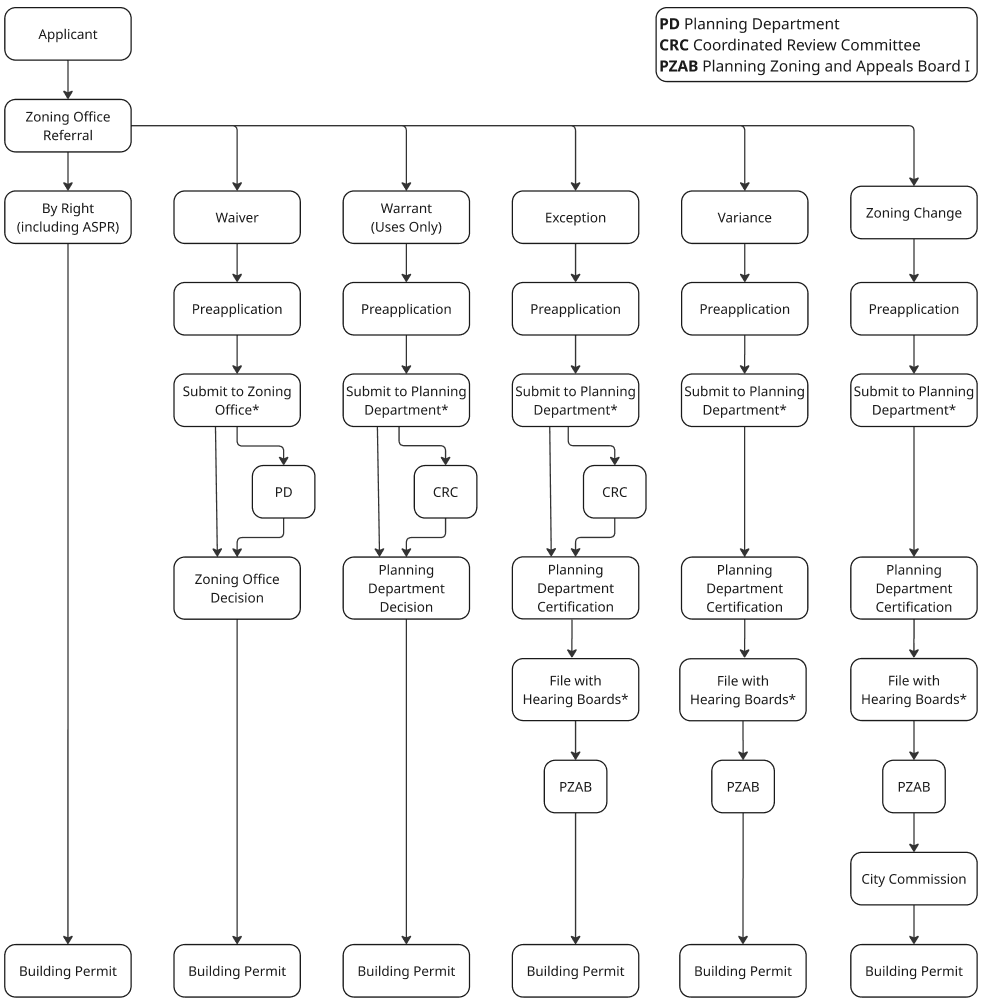
Note: The above table summarizes only the most common processes. In certain circumstances, the Miami 21 Code, the City Code, and the Miami-Dade County Code of Ordinances may require additional reviews such as but not limited to from the UDRB, the Historic and Environmental Preservation Board, or Miami-Dade County’s Biscayne Bay Shoreline Development Review Committee.
7.2 NONCONFORMITIES: STRUCTURES; USES; LOTS; SITE IMPROVEMENTS; AND SIGNS
7.1.2 Permits
- The permits that may be necessary to develop property under the Miami 21 Code include the following: Warrant; Waiver; Exception; Variance; Administrative Site Plan Review; and amendment to the Code (including text amendments, rezoning and Special Area Plans). The permits are illustrated in Article 7, Diagram 14.
- In addition, certain approvals may be necessary to confirm that uses are permitted uses under the Code, which are zoning approval (by right), certificate of use, planning determination, or zoning interpretation.
- Permits issued in error shall convey no rights to any party, and the Zoning Administrator shall require corrections to be made, except in the following circumstances:
- construction has commenced on that portion of the construction that was permitted in error; or
- correction of an error in an approved Warrant, Waiver, Exception, Variance, or Administrative Site Plan Review that is not discovered prior to application for building permit may only be required during the building permit review process if such error results in a structure or property: containing a Use prohibited by this Code; exceeding maximum allowed Density, Intensity, or Height provided in this Code; violating minimum Setback requirements provided in this Code; presenting a threat to life safety as determined by the Building Department; or containing a violation of a requirement administered exclusively by the City Department of Resilience and Public Works or successor department responsible for public works.
- The time to act upon any approval granted pursuant to this Code shall be tolled during the pendency of (i) any appeal or other litigation challenging such approval and (ii) any appeal or other litigation concerning another development permit, development order, or other permit or approval that the City requires for the development that is the subject of such approval.
7.1.4 Quasi-Judicial Procedures
7.1.5 Appeals
Appeals to the appropriate appellate body from the following decisions shall be made as follows:
a. Fifteen (15) days from the posting on the city website of the decision of the Zoning Administrator on an application for zoning interpretation or Waiver, and fifteen (15) days from the denial or revocation of a Certificate of Use: to the Planning, Zoning and Appeals Board.
b. Fifteen (15) days from the posting on the city website of the decision of the Planning Director on a Warrant or planning determination: to the Planning, Zoning and Appeals Board.
c. Fifteen (15) days from the decision of the Planning, Zoning, and Appeals Board on an Exception or a Variance: to the City Commission.
d. Fifteen (15) days from the decision of the Planning, Zoning and Appeals Board on a zoning interpretation appeal, denial or revocation of a Certificate of Use appeal, planning determination appeal or Warrant appeal: to the City Commission.
e. Thirty (30) days from the appellate decision of the City Commission on a zoning interpretation appeal, denial or revocation of a Certificate of Use appeal, planning determination appeal, Warrant appeal, Variance appeal or Exception appeal: to the circuit court of the eleventh judicial circuit in the manner set forth in the rules of the court.
f. Thirty (30) days from the decision of the City Commission on a code amendment: to the circuit court of the eleventh judicial circuit in the manner set forth in the rules of the court.
7.1.6 Notice of Hearings
Notice of hearings shall be as set forth in Chapter 62 of the City Code or as set forth in the Miami 21 Code.
7.1.7 Unity of Title
7.1.8 Reasonable Accommodation
- Intent. The City has elected to create a more expansive accommodation procedure than is required by state and federal law. The more expansive reasonable accommodation procedure shall further accommodate the City’s disabled residents beyond the accommodations set forth by the City’s Waiver, Variance, and other special permit procedures, which disabled and non-disabled persons may enjoy equally. A reasonable accommodation regarding the City's zoning and land use regulations, rules, policies, and practices may be requested by individuals with disabilities, pursuant to the Fair Housing Amendments Act of 1988, the Americans with Disabilities Act of 1990, the Rehabilitation Act of 1973, and applicable state laws. This more expansive process shall further ensure equal access to housing, further facilitate the development of housing for individuals with disabilities, and further foster additional flexibility in the application of land use and zoning regulations, policies, practices, and procedures, when necessary to eliminate barriers to housing opportunities for a person with a disability.
Accommodations must be considered on a case-by-case basis based on the nature and extent of a disability, the requirements of Miami 21, the reasonability of the requested accommodation, and any other circumstances that indicate the requested accommodation is reasonable. The grant of a Request for a Reasonable Accommodation shall not be deemed to be a rezoning of property, or to allow uses or deviations that would otherwise require a zoning Warrant, Exception, Variance or Waiver pursuant to Miami 21.
The City is not required to agree to requested accommodations that are unreasonable. In lieu of granting a requested accommodation, the City may provide an alternative accommodation that is reasonable and more tailored to the specific regulatory barrier. - Applicability.
- Reasonable Accommodations shall apply to persons with disabilities (as defined in the Fair Housing Act, Rehabilitation Act, Americans with Disability Act, or any applicable state laws) for the purposes of waiving or modifying zoning and land use regulations, including but not limited to certified recovery residences as defined in the Florida Statutes.
- The accommodation granted shall be considered personal to the individual(s) and shall not run with the land. The accommodation shall be in force and effect as long as the person(s) or group of persons with disabilities for whom the accommodation was sought resides on the property that is the subject of the accommodation. An accommodation is not transferable to a new owner or resident unless a new owner or resident renews or modifies a granted reasonable accommodation in accordance with this Section. It is the duty of the owner, on behalf of himself or herself or any resident in need of a continuing accommodation, to notify the Director of Planning and the Zoning Administrator of a request to renew or modify a granted reasonable accommodation. In the event that the reasonable accommodation is not renewed or modified within 60 days from the date of change in ownership, the accommodation will lapse and the structure shall comply with this Code or the structure/ accommodation will be considered non-conforming pursuant to Article 7 of this Code.
- Reasonable accommodations for a certified recovery residence may be revoked should a violation of the condition of approval or the lapse, revocation, or failure to maintain certification or licensure required under Florida Statutes, if not reinstated within 180 days.
- The City is not obligated to expend any funds to achieve a reasonable accommodation except and to the extent required by state or federal law.
- A reasonable accommodation shall not alter a person with a disability's obligation to comply with any other applicable regulations, including but not limited to state, federal, Miami-Dade County, and City laws.
- Application process.
- An application for an accommodation may be made by any person(s) with a disability, his or her representative, or a developer or provider of housing for a person with a disability, including but limited to certified recovery residences.
- A request for accommodation may be submitted at any time to afford the person with a disability equal opportunity to use and enjoy the dwelling.
- Requests for a reasonable accommodation may be made to the Planning Department and Office of Zoning in writing on the appropriate City form. However, if the applicant of a reasonable accommodation is unable to fill out the form due to his or her disability or makes their request orally to the designated City employee from the Planning Department or Office of Zoning, the designated City employee from the Planning Department or Office of Zoning shall assist the applicant with filling out a written application on the appropriate City form. Such form shall instruct the applicant what information or documents are required for the application. In the event that the applicant cannot read the form, the designated City employee from the Planning Department or Office of Zoning shall read it aloud to them. The application at minimum shall require the following:
- The name and contact information of the applicant or the applicant’s authorized representative, including the e-mail address associated with the application.
- The property address and parcel identification number.
- A description of the applicant’s disability.
- A description of the requested accommodation, which must include the specific regulation or policy from which the requested accommodation is sought.
- A description of the relationship between the person's disability and the need for the requested accommodation.
- Upon receipt of the Request for a Reasonable Accommodation application:
- The application shall be date stamped “received”.
- The Planning Director and Zoning Director, or their designees, shall confer to determine whether the application is complete within thirty (30) days of the City’s receipt of the application. If it is determined that the application is not complete, written notice shall be provided to the applicant within that period of thirty (30) days and specify what additional information is required to deem the application complete.
- When requesting additional information, the Planning Director and Zoning Administrator, or their designees, may not ordinarily inquire as to the nature and severity of an individual's disability. However, reliable disability-related information may be requested that: (1) is necessary to verify that the person meets the Fair Housing Act, Rehabilitation Act, or Americans with Disability Act's definition of "disability" (2) identifies the need for the requested accommodation and (3) indicates the relationship between the person's disability and the need for the requested accommodation.
- Upon the City’s submission of a written notice that an application is incomplete, the applicant has forty (40) days from the City’s submission of that written notice to respond.
- No fees or costs may be imposed for a request for a reasonable accommodation application.
- Department Decision.
- The Planning Director and Zoning Director, or their designees, shall make the decision on the application based upon the following criteria:
- Whether the applicant meets the definition of a disabled person pursuant to the Fair Housing Act, Rehabilitation Act, Americans with Disability Act, or any applicable state laws;
- Whether there is an identifiable relationship, or nexus, between the requested accommodation and the person's needs/disability;
- Whether a sufficient alternative to the specific initial request exists, if the initial request is determined to be not reasonable;
- Whether granting the request would change the essential nature of the Zoning Code as compared to strict application of the Zoning Code to the circumstances of the request; and
- Whether the request would impose undue financial and administrative burdens on the City.
- It is the City's intent that reasonable accommodations be granted where required by federal law. If the Planning Director and the Zoning Director, or their designees, determine that the specific request is not reasonable, they shall offer, where possible, some other accommodation which would meet the requester's needs. No additional standards of review for requests for a reasonable accommodation are required. In making this determination, it shall not be a factor whether there are other neighborhoods or dwellings that could accommodate the person.
- The Planning Director and Zoning Director, or their designees, are entitled to obtain information that is necessary to evaluate if a requested reasonable accommodation may be necessary because of a disability. If a person's disability is obvious, or otherwise known to the Planning Director and Zoning Director, or their designees, and if the need for the requested accommodation is also readily apparent or known, then any additional information about the applicant's disability or the disability-related need for the accommodation may not be requested. However, if the applicant's disability is known or readily apparent to the Planning Director and Zoning Director, or their designees, but the need for the accommodation is not readily apparent or known, information that is necessary to evaluate the disability-related need for the accommodation may be requested. The Planning Director and Zoning Director, or their designees, may not ordinarily inquire as to the nature and severity of an individual's disability, however, reliable disability-related information may be requested that: (1) is necessary to verify that the person meets the Fair Housing Act, Rehabilitation Act, or Americans with Disability Act's definition of "disability" (2) identifies the need for the requested accommodation and (3) indicates the relationship between the person's disability and the need for the requested accommodation. Depending on the individual's circumstances, information verifying that the person meets the definition of disability can usually be provided by the individual, but also may come from a doctor or medical professional, a peer support group, a non-medical service agency, or a reliable third party who is in a position to know about the individual's disability. Once the Planning Director and Zoning Director, or their designees, have established that the applicant meets the definition of a disabled person, only information necessary to evaluate if the request is needed because of a disability should be requested from the applicant. Nothing herein prevents the applicant from providing additional information regarding the disability and/or need for the requested accommodation.
- The Planning Director and Zoning Director, or their designees, shall make the decision on the application based upon the following criteria:
- Final Written Determination:
- The Planning Director and Zoning Administrator, or their designees, shall issue a joint written decision on a request for accommodation within sixty (60) days after receipt of a completed application. However, if the City made a request for additional information, the running of the sixty (60) days to issue a decision is stayed until the applicant responds to the City’s request for information. If a final written determination is not issued within sixty (60) days after receipt of a completed application for a certified recovery residence, the request associated with the certified recovery residence is deemed approved unless the parties agree in writing to a reasonable extension of time. In all other scenarios, an applicant seeking a reasonable accommodation must notify the Zoning Administrator, the Director of Planning, and the City Attorney of any failure to provide a Final Written Determination within sixty (60) days after the City’s receipt of a completed application. Upon the City’s receipt of such notice, the City shall issue its Final Written Determination within seven (7) days.
- In the Final Written Determination, the City may:
- Approve the request in whole or in part, with or without conditions; or
- Deny the request, indicating the objective, evidence-based reasons for denial and identifying any deficiencies or actions necessary for reconsideration.
- The notice of the decision shall be sent to the applicant by electronic mail as indicated on the application.
- The Final Written Determination is final unless the applicant files an appeal to the City Manager or the City Manager’s designee within the time period for such appeals. Nothing herein shall prohibit the applicant or the applicant’s authorized representative from reapplying for an accommodation provided that it is based on additional or supplemental grounds, including changed circumstances.
- Appeal.
- An applicant or an applicant’s authorized representative may appeal the Final Written Determination no later than thirty (30) days from the date the Final Written Determination is electronically mailed.
- An appeal must be in writing (or reduced to writing as provided by subsection 3., below) and include the grounds for appeal. Any personal information related to the disability status identified by the applicant as confidential shall be retained in a manner so as to protect the privacy rights of the applicant and shall not be made available for public inspection unless required by the Floridia Public Information Act.
- If an applicant needs assistance transcribing his reasons for appealing the Final Written Determination, the City Manager or the City Manager’s designee shall take reasonable efforts to ensure that the appellate process remains accessible to the applicant.
- An applicant shall not be required to pay a fee to appeal a Final Written Determination.
- An appeal will be decided by the City Manager, or his or her designee. In considering an appeal of a Final Written Determination, the City Manager, or designee, shall consider the following to provide a final decision on the appeal:
- The criteria listed in Section 7.1.8.d.1.
- The reasonableness of the requested accommodation as stated in the reasonable accommodation application;
- The Planning Director and Zoning Director’s, or designees’, Final Written Determination;
- The applicant's written grounds for the appeal; and
- The provisions of this section and any other applicable laws for providing reasonable accommodations for disabled individuals.
- If the City Manager, or designee, does not issue a written decision on the appeal within forty-five (45) days from the date the City receives a timely appeal, the decision of the Planning Director and Zoning Director, or their designees, shall be deemed affirmed without the need for a written decision.
- The decision of the City Manager, or designee, is final.
7.2.1 Generally
- Definition
A nonconformity as used in this Code is an existing Use, Structure, Lot or site improvement that is in compliance with the zoning regulations that were applicable to it when it was established, and for which all required permits were issued, but which does not conform in whole or in part to the regulations of this Code. Such nonconformity is legal and may continue except as regulated by this section.- A nonconformity may also be created where the lawful use of eminent domain or an order of a court of competent jurisdiction has affected the lawfully existing Use, Structure, Lot or site improvement in a way so that the property does not comply with this Code. In this instance, the nonconformity is legal and may continue except as regulated by this section.
- A change in tenancy, ownership, or management of a nonconforming Use, Structure, Lot or site improvement shall not be construed to create a nonconformity, provided the change is otherwise lawful and in compliance with this Code.
- Intent concerning nonconformities generally.
It is the intent of this Code that nonconformities may continue but are not encouraged to expand or enlarge, and once they cease they may not be re-established, except under the terms of Section 7.2. - The existence of nonconformity shall not be used as a reason to add new Uses, Structures, or site improvements that are not allowed by the regulations of the Transect Zone in which it is located.
- The temporary or illegal Use of property shall not be sufficient to establish the existence of a nonconformity or to create rights in the continuation of a nonconformity until it shall come into compliance with the regulations of this Code.
- If at any time a nonconforming Structure, or any Structure containing a nonconforming Use, becomes unsafe or unlawful by declaration of the City of Miami, Miami-Dade County Unsafe Structures Board, or other government agency having jurisdiction, the Use shall not be reestablished except in conformity with the regulations of the Transect Zone in which it is located unless the Structure has been repaired within the timeframes prescribed in the decision order finding the Structure to be unsafe.
7.2.2 Structures and Uses in the Event of Disaster
- Single-Family Residences, Duplexes and Multi-Family Structures
In the event of a natural disaster, explosion, fire, act of God, or the public enemy, the Zoning Administrator may permit the reconstruction of any nonconforming Single-Family Residence, duplex or multi-family structures to the same or decreased nonconformity as existed immediately prior to the disaster, upon proof satisfactory to the Zoning Administrator of the configuration of the prior Single-Family Residence, duplex or multi-family structures, and only in compliance with the Florida Building Code. An application for reconstruction of the Single-Family Residence, duplex or multi-family structures shall be filed within twelve (12) months of the event of its destruction, unless the City Commission authorizes the Zoning Administrator to extend the twelve (12) month time period city-wide. - All Other Structures
- Where a nonconforming Structure is destroyed by natural disaster, explosion, fire, act of God, or the public enemy, the Zoning Administrator may, by Waiver, allow the replacement or reconstruction of the nonconforming Structure in whole or in part upon finding that the Waiver criteria of this Code and the criteria of paragraph 2 below are met.
- Criteria for approval. Replacement or reconstruction may be permitted if the following findings are made.
- The cause of destruction was not the deliberate action of the owner of the Structure or his agents.
- The replacement or reconstruction is reasonably necessary to allow the conforming Use of the Structure.
- The replacement or reconstruction meets the Florida Building Code.
- An Application for the reconstruction or repair shall be filed within a period of twelve (12) months from the date of the destruction unless the City Commission authorizes the Zoning Administrator to extend the twelve (12) month time period city-wide.
- Nonconforming Uses
- The restoration of a nonconforming Use within a Structure that is destroyed by natural disaster, explosion, fire, act of God, or the public enemy, may be approved by Warrant. The Use must be restored in a conforming Structure or Structure approved by Waiver, and of equal or lesser size and on the same Lot. The approval shall further find that the criteria of paragraph 2 below are met.
- Criteria for approval. The restoration of the nonconforming Use may be permitted if all of the following are found to be met:
- The cause of destruction was not the deliberate action of the owner of the Structure or his agents; and
- Nothing contained in the provisions of this Code or the City Code requires termination of such nonconforming Use; and
- There is substantial public advantage in continuance of the nonconforming Use; and
- Replacement or reconstruction in the manner proposed, with related actions imposed in conditions and safeguards, will reduce any previous adverse effects of the Use on neighboring properties; and
- The Use will not be enlarged or intensified.
- The application for restoration shall be filed within twelve (12) months of destruction and be diligently carried to completion. Unless restoration is so initiated and completed, the nonconforming Use shall terminate and not be resumed.
7.2.3 Alterations and Expansion of Nonconforming Structures
- Single-Family Residences and Duplexes
- Interior alterations to a nonconforming Single-Family Residence or duplex for interior work such as repairs or interior remodeling shall be allowed.
- Alterations, additions, repairs and maintenance to a nonconforming Single-Family Residence or duplex shall be permitted as long as there is no enlargement of any nonconformity that affects the exterior of the Building or premises.
- Where alteration, addition, repair or maintenance enlarges a nonconformity affecting the exterior of the Building or premises, the enlargement may be permitted by process of Waiver.
- All other Structures
- Less than fifty percent (50%) of square footage of Structure.
Alterations which enlarge the nonconformity of a nonconforming Structure to an extent of less than fifty percent (50%) of the total square footage of the nonconforming Structure may be permitted by Exception from the Planning, Zoning and Appeals Board. - Fifty percent (50%) or more of square footage of the Structure.
Except as allowed for in Section 7.2.3(e), a nonconforming Structure may be altered to enlarge the nonconformity of the Structure by fifty percent (50%) or more of the total square footage of the nonconforming Structure only if the Structure thereafter conforms to the Transect Zone in which it is located. The raising of a nonconforming Structure, in order to bring the finished floor elevation above the Base Flood Elevation as determined by FEMA and does not enlarge the nonconformity, shall be permitted.
- Less than fifty percent (50%) of square footage of Structure.
- Computation of alterations
The extent of alteration will be calculated to include the sum of all alterations over a period of three consecutive years. - Expansion, repairs, remodeling and maintenance that do not enlarge the nonconformity of a nonconforming Structure.
All expansions, repairs, remodeling and maintenance that do not enlarge the nonconformity of the Structure are permitted consistent with the Florida Building Code. - A nonconforming Public Storage Facility in the “T5” Urban Center Zone or in the “T6” Urban Core Zone may be repaired, remodeled, or altered to enlarge the nonconformity of the Structure by fifty percent (50%) or more of the total square footage of the nonconforming Structure only if the Structure thereafter conforms to the Design Review Criteria of Article 4, Table 12. The Lot Area of the existing building site shall not be expanded.
7.2.4 Moving a Nonconforming Structure on the Same Lot
A nonconforming Structure may be moved on the same Lot only pursuant to an Exception. In addition to satisfying the Exception criteria, the following criteria apply:
- The proposed movement must reduce the degree of nonconformity to the maximum extent reasonably feasible, or eliminate the nonconformity;
- The Structure shall in no case be moved in such a manner as to increase the degree of nonconformity; and
- Where a nonconforming Structure is moved to a location not on the same Lot, the Structure and all new construction shall thereafter conform to the regulations for the Transect Zone to which it is moved.
7.2.5 Locally Designated Historic Resources—Nonconformities
- Definition
A locally designated historic resource is a Building or Structure listed in the Miami Register of Historic Places that has been deemed individually significant for its contribution to Miami’s history and sense of place; or is a part of a locally designated historic district where the individual Building or Structure is deemed to add to the historic architectural qualities or historical associations, and the Building or Structure has been so designated through the formal public process provided in Chapter 23 of the City Code. - Generally
Nonconforming locally designated historic resources shall be subject to the regulations of this section, except as they may be granted certain waivers or an exception for preservation purposes by the Historic and Environmental Preservation Board pursuant to Chapter 23 of the City Code.
7.2.6 Nonconforming Uses
- Time Limitation
Where, at the effective date of adoption or amendment of this Code, a lawful Use exists which would not be permitted under this Code, the Use may be continued for twenty (20) years from the date the Use first became legal nonconforming and consistent with the regulations of this section. The Use shall not be allowed to continue automatically upon expiration of the twenty (20) years. Upon application, the City Commission may grant by Exception an extension for continuance of the Use for an additional term of up to twenty (20) years. However, accessory parking abutting T3-R areas that were approved as transitional Uses under prior zoning codes and were legally nonconforming prior to the adoption of this Code will not have a continued automatic twenty-year (20) extension as provided in this section, but shall instead seek an Exception before the City Commission within sixty (60) days of renewal of a Certificate of Use. - Legally established alcoholic beverage establishments, having a valid Certificate of Use or certificate of occupancy and all other required permits, may continue in existence despite subsequent establishment of a church or school within the distance limitations of Chapter 4 entitled “Alcoholic Beverages” of the City Code.
- Replacement and Expansion of Structures that Contain Nonconforming Use
- No enlargement, extension, replacement, or reconstruction of an existing Structure which contains a nonconforming Use shall be permitted except to change the Use to a conforming Use, except as provided below:
- Interior Arrangement
A nonconforming Use may be extended throughout any parts of a Structure which was clearly designed or arranged for the nonconforming Use at the time that the Use became nonconforming. If a portion of a Structure was unoccupied or not manifestly designed for the nonconforming Use, the Use may not be expanded within the Structure. - Alterations to the extent of less than fifty percent (50%) of the square footage of a Structure containing a nonconforming Use
Where an alteration of a Structure containing a nonconforming Use is less than fifty percent (50%) of the square footage of the Structure at the time of alteration, the nonconforming Use may be permitted to continue pursuant to an Exception. - Exterior
No nonconforming Use which exists outside a Structure shall be extended to occupy more area than was occupied at the time the Use became nonconforming, except as approved by Exception and to comply with the non Use regulations of the Transect in which it is located. In this case, the occupancy of the new location shall be construed as remaining a nonconforming Use.
- Interior Arrangement
- Extending / Transferring the Nonconforming Use
No nonconforming Use shall be extended to occupy any other Structure on the same Lot or parcel if the other Structure was not used for the nonconforming Use at the time the Use became nonconforming. - Subdivision or structural additions
Structures used for nonconforming Uses shall not be subdivided, nor shall any Structures be added on the premises, except for conforming Uses and Structures. - Public Storage Facilities
As indicated in this Code, a nonconforming Public Storage Facility Use in the “T5” Urban Center Zone or in the “T6” Urban Core Zone may be repaired, remodeled, or altered to enlarge the nonconforming use by fifty percent (50%) or more of the total square footage of the Structure only by Exception and if the Structure thereafter conforms to the Design Review Criteria of Article 4, Table 12. In addition, upon the demolition and redevelopment of an existing nonconforming Public Storage Facility Use in the “T5” Urban Center Zone or the “T6” Urban Core Zone, the nonconforming Public Storage Facility Use may be reestablished in the new Structure by Exception, subject to the following conditions: a. Bulky waste pickup related to the Public Storage Facility Use must be fully internalized within the Structure; and b. the Structure shall be reviewed for compliance with the Design Review Criteria of Article 4, Table 12. In no circumstance shall the Lot Area of the existing building site be expanded.
- No enlargement, extension, replacement, or reconstruction of an existing Structure which contains a nonconforming Use shall be permitted except to change the Use to a conforming Use, except as provided below:
- Discontinuance or Abandonment of a nonconforming Use
If, for a period of more than six (6) months, a nonconforming Use is documented as being discontinued or a Certificate of Use for a nonconforming Use lapses, any subsequent Use shall conform to the regulations of this Code. Provided, however, the time period shall not include any time during which the discontinuance is caused by governmental action which impedes access to the premises. - Exception for specific purpose structures
Structures clearly designed or arranged specifically for a Use or Uses that are no longer in conformity with the regulations of the Transect Zone in which they are located may be permitted to reestablish the non-conforming Use or Uses upon demonstrating said non-conforming Use or Uses can be rendered compatible with their present context and provided that:- The Structure is Nationally, State or locally designated as a historic site or contributing structure in a historic district and the Use for the historic site or contributing structure is processed by Warrant with a recommendation from the HEPB to the Planning Director; or
- The Structure is 50 years old or older and is processed by Exception with a recommendation from the HEPB.
Upon the demolition and redevelopment of an existing nonconforming Public Storage Facility in the “T5” Urban Center Zone or the “T6” Urban Core Zone, the nonconforming Public Storage Facility Use may be reestablished in the new Structure by Exception, subject to the following conditions:
Bulky waste pickup related to the Public Storage Facility Use must be fully internalized within the Structure.
The Structure shall be reviewed for compliance with the Design Review Criteria of Article 4, Table 12.
In no circumstance shall the Lot Area of the existing building site be expanded.
This process is limited to reestablishing Uses that are currently permitted in the City under this Code.
7.2.7 Nonconforming Lots
- Nonconforming Lot
A nonconforming Lot may continue and may be used as provided by this section. A nonconforming Lot is one shown on the latest recorded plat or described by deed, both as recorded in the public records of Miami-Dade County, which met the width, length and area requirements in effect when the Lot became of record, and which Lot would not conform to the requirements of this Code. - Street or alley closure
When a Lot has become nonconforming due to a street or alley vacation or closure, the Lot may be modified pursuant to an approval by the Director of the Public Works Department as long as the degree of nonconformity created by the vacation or closure is not increased. - Rules concerning combinations of contiguous nonconforming Lots in the same ownership and with common Frontage for T3 Transects only.
- Combinations required
- If two or more Lots, or combinations of Lots and portions of Lots, with continuous Frontage in the same ownership exist at the time of passage or amendment of this Code, and if all or part of the Lots do not meet the requirements for Lot width and area, the lands involved shall be considered an “undivided parcel” for the purposes of this Code. Except as provided below in paragraph c.2., no portion of an undivided parcel shall be used or sold in a manner diminishing compliance with general Transect requirements for Lot width and area.
- The undivided parcel shall be considered one Lot for which only one Single-Family Residence or duplex may be constructed, regardless of how many nonconforming Lots make up the parcel.
- A unity of title, or covenant in lieu of unity of title, which complies with all applicable requirements of the City Code shall be required on all undivided parcels prior to the issuance of any building permits, including demolition permits.
- Exceptions to the combination requirement
Notwithstanding paragraph c.1, where nonconforming Lots with continuous Frontage in the same ownership exist at the time of passage or amendment of this Code, such Lots may be developed individually, in accordance with the applicable code requirements and pursuant to a Waiver, if such Lots individually comply with any of the following exceptions.- Duplex Lots restricted to Single-Family Residences
The owner of two or more adjoining nonconforming duplex Lots must by covenant (in a form acceptable to the City Attorney) restrict the Use of the Lots to the development of no more than one Single-Family Residence per Lot and must comply with all Miami 21 Code requirements except for minimum Lot width. - The ninety percent (90%) rule
The Lots must individually comply with ninety percent (90%) of the requirements for Lot width, area, and Principal Front Setback under the Miami 21 Code regulations. - The one thousand (1,000) feet radius rule
- Duplex Lots restricted to Single-Family Residences
- Combinations required
The width or size of such nonconforming Lots must be equal to or larger than the majority of the existing Building sites within the same Transect Zones and either within a minimum one thousand (1,000) foot radius of the nonconforming Lot perimeter, or extending no further than the immediate vicinity, whichever is less. “Building site” shall mean a Lot, group of Lots or parcel upon which a Single-Family Residence or duplex is located. “Immediate vicinity” shall mean either an area in which a parcel of land is located that is physically, functionally or geographically identifiable as a distinct realm, place or neighborhood, or an area within a radius of one-half mile from the nonconforming Lot, whichever is smaller.
7.2.8 Nonconforming Site Improvements
Where legal non-conforming site improvements exist, such as Off-street Parking and loading, access, fences, walls, lighting, landscaping, or similar site improvements, such nonconformities may continue and the site may be altered only as provided below.
- Non-conforming site improvements shall be required to conform to the provisions of this Code if fifty percent (50%) or more of the Floor Area on a Lot is demolished or removed. Docks and Piers shall be exempt from this requirement.
- No change shall be made to any non-conforming site improvement which increases the non-conformity. Changes that result in a reduction of the non-conformity by twenty percent (20%) or more shall be approved By Right. Changes that do not result in a reduction of the non-conformity by twenty percent (20%) or more may be approved by process of Waiver.
- Except in a T3 or T4-R Transect Zone or within an area of the City for which a parking trust fund has been established and is in effect pursuant to Chapter 35 of the City Code, where existing Off-street Parking is nonconforming to the requirements of this Code or any other City standards to any Use permitted in the Transect Zone, Adaptive Use, shall not require the provision of additional parking or loading. If the prior Use of such structure was single-family, duplex, or lodging and the site abuts a T3 Transect Zone, additional parking for the Adaptive Use shall be provided pursuant to Article 4, Table 4 of this Code. No modifications may be permitted which increase the degree of the existing nonconformity. The modifications to Off-street Parking may be approved by Waiver, and the Waiver may be conditioned on safeguards that reduce the degree of nonconformity to the extent reasonably feasible in the circumstances of the case.
7.2.9 Nonconforming signs
The following provisions shall apply to nonconforming signs:
7.1.1.1 Zoning Administrator
- Functions, powers and duties. A Zoning Administrator, appointed by and responsible to the City Manager, shall be responsible for administration and enforcement of the Miami 21 Code as provided herein, with such assistance as the City Manager may direct. For purposes of this Code, the functions, powers and duties of the Zoning Administrator more specifically include:
- To determine whether applications for ASPRs or building permits as required by the Building Code are in accord with the requirements of this zoning ordinance. No ASPR or building permit shall be issued without approval of zoning compliance by the Zoning Administrator that plans and applications conform to applicable zoning regulations, except as provided in Section 7.1.2.
- To determine whether the Use of any Structure or premises hereafter created, erected, changed, converted, enlarged or moved, wholly or partly, in Use or in Structure, is in accordance with this Miami 21 Code and to issue a Certificate of Use if the plans and applications conform to applicable zoning regulations. Certificates of Use for home occupations in residential districts shall be issued annually to cover the period from January 1 through December 31 of each year.
- To approve, deny or approve with conditions applications for administrative Waiver, with the recommendation as may be required of the Planning Director and pursuant to the standards of the Miami 21 Code.
- To assist the Code Enforcement Department to enforce vigorously the provisions of the Miami 21 Code.
- To maintain records of all official administrative actions.
- To decide questions of zoning interpretation pursuant to Section 7.1.2.3 of this Code.
- To participate in the review of Warrants and Exceptions.
- To serve in an advisory capacity on zoning matters to the Planning, Zoning and Appeals Board, the City Commission, and other officers or agencies of the City, and to prepare such reports as may be appropriate in that capacity.
- To review and issue sign permits.
- To determine whether changes made to applications are substantial modifications pursuant to Section 7.1.3 that require additional review and evaluation by city staff or a new notice prior to a hearing.
- It shall be the duty of all employees of the city, and especially of all officers and inspectors of the Department of Planning, Department of Building, Office of Zoning, the Fire Rescue Department, and the Police Department, to report to the Code Enforcement Department any suspected violations of the Miami 21 Code.
7.1.1.2 Planning Director
- Functions, powers and duties. A Planning Director, appointed by and responsible to the City Manager, shall be responsible for administration of the Miami 21 Code, as provided herein, with such assistance as the City Manager may direct. For purposes of this Code, the functions, powers and duties of the Planning Director more specifically include:
- To make determinations concerning Uses where there is substantial doubt as to whether a particular Use or Uses, or classes of Uses, or characteristics of Use not specifically identified in the Miami 21 Code are of the same general character as those listed as permitted, Warrant or Exception Uses, either upon request from any administrative agency or officer of the city or upon his own initiative.
- To approve, deny or approve with conditions any applications for Warrant, upon review by members of the Coordinated Review Committee as the Director may request, and pursuant to the standards of the Miami 21 Code.
- To review and provide findings and recommendations to the Zoning Administrator regarding certain applications for ASPR and administrative Waiver pursuant to the standards of the Miami 21 Code.
- To prepare recommendations regarding an application for Exception, upon review by members of the Coordinated Review Committee as the Director may request, and to certify the application and accompanying recommendations to be filed with the Office of Hearing Boards for consideration by the Planning, Zoning and Appeals Board .
- To prepare recommendations regarding an application for Variance and to certify the application and accompanying recommendations to be filed with the Office of Hearing Boards for consideration by the Planning, Zoning and Appeals Board.
- To prepare recommendations regarding an application for amendment to the Miami 21 Code, including rezoning, and to certify the application and accompanying recommendations to be filed with the Office of Hearing Boards for consideration by the Planning, Zoning and Appeals Board and the City Commission.
- To prepare recommendations regarding an application for a Special Area Plan, and to certify the application and accompanying recommendations to be filed with the Office of Hearing Boards for consideration by the Planning, Zoning and Appeals Board and the City Commission.
- To coordinate and chair the work of the Coordinated Review Committee.
- To serve in an advisory capacity on Miami 21 Code matters to the Planning, Zoning and Appeals Board, the City Commission, and other officers or agencies of the city, and to prepare such reports as may be appropriate in that capacity.
- To make referrals to the Urban Development Review Board (UDRB) as defined in Chapter 62 of the City Code for projects that exceed 200,000 square feet or as the Director may deem necessary.
7.1.1.3 Coordinate Review Committee
a. Establishment
There is hereby established a committee to be known as the Coordinated Review Committee. The Coordinated Review Committee shall consist of the following members: the Planning Director who shall serve as the chair of the committee, the Zoning Administrator, the City Attorney, and the Public Works Director, and other city, county, school board and governmental and utility officials with the necessary expertise that the Planning Director may require for any particular application review.
b. Functions, powers and duties
The Coordinated Review Committee shall provide review of applications for Warrants and for Exceptions, and for Special Area Plans, pursuant to the review criteria of Section 7.1.2 and Article 3, Section 3.9, as the case may be. The Planning Director shall determine to which members of the committee any particular application shall be referred for review and advice. The committee shall meet together only as requested by the Planning Director. Upon the Planning Director’s request, the review reports of each member shall be provided to the Planning Director, who shall consider them in making a decision regarding an application for a Warrant and in making a recommendation to the Planning, Zoning and Appeals Board regarding an application for an Exception or for a Special Area Plan.
c. Notice
The applicant shall be given an opportunity, upon a minimum of seven days’ notice, to attend any meeting, if any, of the Coordinated Review Committee that may be held to review and evaluate its application. Failure of the applicant to appear shall result in the withdrawal of the item from the committee meeting agenda. The applicant shall receive notice of the Planning Director’s preliminary decision or recommendation on its application, as applicable, at least twenty-one (21) calendar days prior to the Director’s final decision or recommendation. Within fourteen (14) calendar days of receipt of notice, the applicant may request an opportunity to revise its application or provide additional information to address any comments or concerns raised by the Coordinated Review Committee. If such a request is made, the Director’s final decision or recommendation shall not be issued until the applicant has had a reasonable opportunity, as determined by the Planning Director, to make its revisions or to provide additional information.
7.1.1.4 Planning, Zoning and Appeals Board
- Establishment
There is hereby established a board to be known as the city Planning, Zoning and Appeals Board. The Planning, Zoning and Appeals Board shall consist of eleven voting members, one alternate member to be appointed in the manner hereinafter set out in this section, and one ex-officio, non-voting member appointed by the school board. The school board appointee shall be invited to attend such meetings at which comprehensive plan amendments, re-zonings and Special Area Plans are considered which, if granted, increase residential Density. The school board appointee shall not be counted in determining whether a quorum is present at any meeting.
b. Functions, Powers and Duties
The Planning, Zoning and Appeals Board with the assistance of the planning department and all other city departments as necessary, shall have the functions, duties and powers as follows:
- To act as the local planning agency pursuant to section 163.3174, Florida Statutes.
- To serve as the local land development regulation commission pursuant to section 163.3194(2), Florida Statutes.
- To prepare and recommend to the City Commission ordinances, regulations and other proposals promoting orderly development of the city.
- To make or cause to be made any necessary special studies on the location, adequacy and conditions of specific facilities of the city. These may include, but are not limited to, studies on housing, commercial and industrial conditions and public facilities, recreation, public and private utilities, conservation of natural resources, roads and traffic, transportation, parking and the like.
- To determine whether proposed developments of regional impact conform to the requirements of the Miami 21 Code, and with section 380.06, Florida Statutes, and to make recommendations to the City Commission in that regard. When acting in this capacity, its work shall be deemed advisory and recommendatory, and only advisory and recommendatory, to the City Commission.
- To determine whether Special Area Plans and rezonings that are regulated by the Miami 21 Code conform to the requirements of the Miami 21 Code, and to make recommendations to the City Commission in that regard. When acting in this capacity, its work shall be deemed advisory and recommendatory, and only advisory and recommendatory, to the City Commission.
- To determine whether specific proposed developments that are regulated by the Miami 21 Code and that require an approval of an Exception conform to the requirements of the Miami 21 Code. In performing its authority to grant, deny or grant with conditions an Exception, the board shall serve as a quasi-judicial body and observe the requirements of quasi-judicial procedures as set out in the Miami 21 Code and under applicable state law.
- Rescission: The board, after a quasi-judicial hearing, may rescind, modify or change any resolution granting an Exception if, upon application filed by the Director at any time after the grant of an Exception, the board finds that there has been a violation of any conditions, restrictions or limitations in the subject resolution. Such a hearing shall not be held until published notice (per section 62-129 of the City Code) has first been given. If the Director, upon written request of any aggrieved party, refuses or fails to make an application for such rescission, modification or change, the aggrieved party may request the City Commission, through the City Manager, to instruct the Director to do so. The decision of the board shall be appealable to the City Commission in the same manner as an appeal of a board decision regarding an Exception.
- To determine whether an application for a Variance conforms to the requirements of the Miami 21 Code. In performing its authority to grant, deny or grant with conditions a Variance, the board shall serve as a quasi-judicial body and observe the requirements of quasi-judicial procedures as set out in the Miami 21 Code and under applicable state law.
- To hear, de novo, and make a ruling on an appeal of the following administrative decisions:
- A Planning Determination of Use by the Planning Director;
- The decision of the Zoning Administrator regarding a Waiver;
- The decision of the Planning Director regarding a Warrant;
- A zoning interpretation by the Zoning Administrator;
- The decision of the Zoning Administrator regarding a denial or revocation of a Certificate of Use.
In performing its appeal authority, the board shall serve as a quasi-judicial body and observe the requirements of quasi-judicial procedures as set out in this Code and under applicable state law.
11. The Planning, Zoning and Appeals Board shall perform such other functions as may be given it by the City Commission.
c. Appointments; qualifications
- Nomination. Each City Commissioner shall nominate candidates to serve the terms of two members of the board, taking into consideration the required qualifications for membership as provided herein.
- Terms of office. The terms of office shall be as provided under section 2-885 of the City Code.
- Qualifications. It is intended that members and alternate members of the board be persons of knowledge, experience, mature judgment, and background; having ability and desire to act in the public interest; and representing, insofar as may be possible, the various special professional training, experience, and interests required to make informed and equitable decisions concerning preservation and appropriate development of the physical environment. To that end, qualifications of members and the alternate member shall be as follows:
- Eleven (11) members and one alternate shall be from the electorate of the City of Miami with demonstrated knowledge and interest in the appropriate growth and development of the city.
- The City Commission shall appoint the board members from the nominations made by each City Commissioner, for ten members of the board. The mayor shall appoint one member and the alternate member. Appointees shall be persons in a position to represent the public interest, and no person shall be appointed having personal or private interests likely to conflict with the public interest. No person shall be appointed who has any interest in the profits or emoluments of any contract, job, work, or service for the City. No person shall be appointed who holds any elective office or is employed in a full-time capacity by any governmental authority in the county or the City. Before making any appointment, the City Commission shall determine that the person so appointed satisfies the requirements of sections 2-611 et seq. of the City Code, and no person shall be confirmed in appointment who has not filed the statement required by section 2-615 of the City Code. In addition, the code of ethics of Miami-Dade County shall apply to members and the alternate member of the Planning, Zoning and Appeals Board.
- Persons appointed shall be electors of the City and otherwise meet the requirements of Chapter 2, Article XI of the City Code.
- No member or alternate member of the Planning, Zoning and Appeals Board shall be confirmed in his appointment until he signs a statement agreeing to participate in at least one seminar on planning or zoning to be held in Florida or elsewhere, and approved by the City, during the course of each calendar year he shall remain a member or alternate member of the board. Failure to meet this requirement each and every year after assuming board membership or alternate membership may be grounds for removal.
- Vacancies
- Vacancies in the membership or alternate membership of the Planning, Zoning and Appeals Board shall be filled by the City Commission and mayor by appointment in the manner herein set out and for the unexpired term of the member or alternate member affected, provided the City Commission may appoint an alternate member of the board to a vacancy as a full member of the board without resort to the procedural requirements of paragraph (1) above.
- The executive secretary of the Planning, Zoning and Appeals Board shall notify the City Clerk within ten days after a vacancy occurs, and the City Clerk shall promptly transmit such information to the City Commission for appropriate commission action as set out herein.
- Educational Component. The City Commission shall make provision for the payment of actual and necessary expenses, in accordance with City policy, for the attendance of each member and alternate member of the board at one City-authorized planning or zoning seminar or conference each calendar year. The City Manager, City Attorney and City Clerk shall coordinate and present or cause to be presented said seminar or conference and make such course available at least annually.
- Removal
- Members and alternate members of the board are removed if replaced by another member pursuant to this applicable Sections of this subsection (c).
d. Proceedings of the Board
- Officers and voting. The Planning, Zoning and Appeals Board shall select a chairman and vice-chairman from among its members and may create and fill such other offices as it may determine. All members, or the alternate member sitting in the place of a member, shall be required to vote on matters before the Planning, Zoning and Appeals Board, subject to the provisions of subsections (e) and (f) of this section and applicable Florida Statutes. The Planning Director shall attend all meetings of the board. The Office of Hearing Boards, or its successor, shall be the executive secretary of the Planning, Zoning and Appeals Board.
- Rules of procedure. The Planning, Zoning and Appeals Board shall establish rules of procedure necessary to its governing and the conduct of its affairs, in keeping with the applicable provisions of Florida law, and the City charter, ordinances and resolutions. Such rules of procedure shall be available in written form to persons appearing before the board and to the public upon request. Quasi-judicial procedures as provided in this Miami 21 Code and as required by state law shall apply to its decisions and recommendations, including rezoning; Special Area Plans; Exceptions; Variances; and appeal decisions by the board.
- Meetings. The Planning, Zoning and Appeals Board shall hold at least two regularly scheduled meetings each month, except the month of August, on days to be determined by the board. Other regularly scheduled meetings may be set by the board, and additional meetings may be held at the call of the chairman and at such other times as the board may determine. Meetings that are not regularly scheduled shall not be held without at least ten (10) days written notice to each member and the alternate member, provided that upon concurrence of the chairman of the Planning, Zoning and Appeals Board and the city manager, an emergency meeting may be called at any time and with appropriate notice.
- Quorum; public records. Quorum requirements are governed by the provisions of section 2-887 of the City Code. However, no action to recommend adoption of amendments to the city Comprehensive Plan, or to recommend the amendment of the text of the Miami 21 Code, rezoning, or Special Area Plan, or to approve an Exception shall be taken without the concurring votes of a supermajority of board members present. Said supermajority consists of one (1) more member than a simple majority. The Executive Secretary of the Planning, Zoning and Appeals Board shall keep minutes of board proceedings, showing the vote of each member or alternate member, if sitting for a member, or if absent or failing to vote under paragraphs five (5) and six (6) below, indicating such fact. It shall be the responsibility of the executive secretary of the Planning, Zoning and Appeals Board to handle all procedural activities for all public hearings held by the board, including the preparation of detailed minutes and official records of such hearings. The official records of such public hearings shall be filed with the City Clerk.
- Status of alternate member. In the temporary absence or disability of a member, or in an instance where a member is otherwise disqualified to sit on a particular matter, the chairman of the Planning, Zoning and Appeals Board, or the vice-chairman in his absence, shall designate the alternate member to sit as a board member to obtain a full membership of eleven or, as nearly as possible, a full membership. When so acting, the alternate member shall have full rights of participation and voting as members; his vote shall be deemed that of a member in reaching a decision on a matter. In instances where the alternate member is not sitting as a member, he shall have the right to participate in board discussions and to ask questions, but he shall have no right to vote or make motions. Where the alternate member has been duly designated to sit as a member on a particular matter and consideration of that matter has begun, the alternate shall continue to sit as a board member through disposition of the matter; and he shall not be replaced, should the member in whose stead he is sitting later be present.
- Disqualification of members or alternate. If any member of the Planning, Zoning and Appeals Board or the alternate member called on to sit in a particular matter shall find that his private or personal interests are involved in the matter coming before the board, he shall, prior to the opening of the hearing on the matter, disqualify himself from all participation of whatsoever nature in the cause. Alternatively, he may be disqualified by the votes of not less than six (6) members of the board, not including the member or alternate member about whom the question of disqualification has been raised. No member or alternate member of the Board may appear before the City Commission, Planning Advisory Board, Zoning Board or Planning, Zoning and Appeals Board as agent or attorney for any other person.
e. All city departments and employees shall, under the direction of city manager and upon request and within a reasonable time, furnish to the Planning Department such available records or information as may be required in the work of the Planning, Zoning and Appeals Board. The city manager shall assign a member of the Public Works Department, Planning Department, Zoning Office, Neighborhood Enhancement Team, the Code Enforcement Department and Fire-Rescue Department, or their successors, to attend public hearings of the Board and to advise the board when necessary, and to furnish information, reports and recommendations upon request of the board. The city attorney shall attend public hearings of the board to advise the board when necessary and to furnish information, reports and recommendations upon request of the board.
f. The Planning, Zoning and Appeals Board or representatives of the Planning Department may, in the performance of official duties, enter upon lands and make examinations or surveys in the same manner as other authorized city agents or employees and shall have other powers as are required for the performance of official functions in carrying out the purposes and responsibilities of the board.
7.1.1.5 City Commission
The City Commission, in addition to its duties and obligations under the City Charter, the City Code, and other applicable law, shall have the following duties specifically in regard to the Miami 21 Code:
- To approve, deny or approve with conditions applications for developments of regional impact pursuant to Chapter 380, Florida Statutes.
- To consider and act upon proposed amendments, including rezoning, to the Miami 21 Code, after consideration of the recommendation by the Planning, Zoning and Appeals Board.
- To consider and act upon proposed Special Area Plans, after consideration of the recommendation by the Planning, Zoning and Appeals Board.
- To consider and act upon proposed amendments to the Comprehensive Plan which relate to the Miami 21 Code, after consideration of the recommendation by the Planning, Zoning and Appeals Board.
- To hear appeals of the ruling of the Planning, Zoning and Appeals Board on the appeal of a zoning interpretation, Certificate of Use denial or revocation, planning determination of Use, Warrant, Variance or Exception.
- To consider and adopt ordinances, regulations and other proposals as it deems appropriate for promoting orderly development within the areas of the city that are regulated by the Miami 21 Code.
- To establish a schedule of fees and charges for the applications made pursuant to the Miami 21 Code.
- To appoint members to the Planning, Zoning and Appeals Board, as set forward in this Miami 21 Code.
- To hear appeals from the Planning and Zoning Appeals Board in connection with decisions on a Variance or Exception, or any appeals of any administrative decision on a Waiver or Warrant application, or any other administrative decision or determination made in connection with a proposed Affordable Housing Development qualifying under Section 3.15. Such appeals shall be specially set for the first available City Commission hearing that is at least fifteen (15) days after the Planning, Zoning and Appeals Board hearing.
7.1.2.1 Permitted Uses
An ASPR or building permit for those permitted Uses as set forth in Article 4, Table 3 of this Code shall be approved By Right when the Use meets all of the applicable standards of the Miami 21 Code, and the other specific requirements that may be enumerated elsewhere in the City Code.
- Zoning approval
- Subject to Section 7.1.2, an ASPR or building permit shall be issued only after a zoning approval from the Zoning Administrator has been obtained indicating that the application meets the applicable provisions of the Miami 21 Code.
- Upon an affirmative finding by the Zoning Administrator that plans and application submitted are complete and in compliance with the applicable requirements of the Miami 21 Code, an approval shall be entered on the application and on the applicable ASPR or building permit and, if otherwise lawful, the permit shall be issued to the applicant, together with one copy of the approved plan.
- Except as provided in Section 7.1.2, if the application and plan are not in full in compliance with the requirements of the Miami 21 Code, the application shall not be approved and the applicant notified in writing of the reasons for such decision, with citation to the legal authority for any denial of a permit.
- Where a Warrant, Waiver, Exception, Variance, or ASPR has been approved in accordance with this Code, zoning and planning department review of a building permit application shall be limited to ensuring conformity with the approved permit, except as provided for in Section 7.1.2 or to the extent the building permit application contains a modification to a previously approved component.
- Certificate of Use
- For new or altered Structures and Uses.
No person shall Use or permit the Use of any Structure or premises hereafter created, erected, changed, converted, enlarged or moved, wholly or partly, in Use or in Structure, until a Certificate of Use reflecting Use, extent, location, and other matters related to Miami 21 Code shall have been issued to the owner or tenant. Application shall be made to the Zoning Administrator on forms provided therefore. The Zoning Administrator shall issue the Certificate of Use (or to approve its issuance where final responsibility for issuance lies with other officers or agencies) if he finds that all the requirements of this Miami 21 Code have been met, and to withhold such certificate (or to prohibit its issuance) unless he finds that all of the requirements of this Miami 21 Code have been met. If the Certificate of Use is denied, the denial shall provide a citation to the legal authority for any denial. No Certificate of Use is necessary for fewer than three (3) Single-Family Structures, attached or detached, on a Lot or for fewer than two (2) duplex Structures on a Lot. - Certificates of Use for other existing Uses.
Any owner or tenant engaged in existing Use of Structures or premises, other than a nonconforming Use at the time of the adoption of this Miami 21 Code, may apply for a Certificate of Use certifying that such Use is lawful under this Code. The Zoning Administrator if necessary shall inspect to determine the facts in the case and to either issue the certificate if the administrator finds the Use lawful, or to withhold the certificate and take such remedial action as is appropriate if the administrator finds otherwise. A denial shall include a citation to the legal authority for the denial. - Denial and revocation of a Certificate of Use shall further be pursuant to Section 2-211 of the City Code.
- For new or altered Structures and Uses.
- Zoning Approval or Certificates of Use issued by the Zoning Administrator on the basis of plans and applications authorize only the Use, arrangement, and construction set forth in the approved plans and applications, subject to any conditions or safeguards attached thereto, and no other. Use, arrangement, or construction at variance with that authorized, or failure to observe conditions and safeguards, shall be deemed a violation of this Miami 21 Code.
7.1.2.2 City Request for Planning Determination of Use
Where there is substantial doubt as to whether a particular Use, or classes of Uses not specifically identified in the Miami 21 Code are of the same general character as those listed as permitted, by Warrant or by Exception, the Planning Director shall make a written determination in the matter. The Planning Director shall give due consideration to the intent of this Miami 21 Code concerning the Transect Zone involved and the character of the Use in question.
Requests for such determinations shall be made only by officers or agencies of the City and may originate during the permit process. However, such requests shall not involve those circumstances where the Zoning Administrator has made a negative finding on a zoning interpretation, in which case appeal may be taken to the Planning, Zoning and Appeals Board and then to the City Commission, as set forth in Section 7.1.2.3.
a. Notifications concerning determinations.
Upon making the determination, the Planning Director shall notify any other officer or agency of the city likely to be affected by such ruling. Additionally, notice of the determination shall be published to the public on the official city website.
b. Effect of findings.
If, in making the determination, the Planning Director finds that the particular Use or class of Use or characteristics of Use are of unusual or transitory nature, or are unlikely to recur frequently, and unless his determination is reversed on grounds of error on appeal to the Planning, Zoning and Appeals Board or the City Commission, the determination shall thereafter be binding on all officers and agencies of the city as an administrative ruling, and without further action on or amendment to the Miami 21 Code.
Where the Planning Director finds, in making the determination, that the particular Use or class of Use or characteristics of Use are likely to be common or recurrent, and that omission of specific reference in the Miami 21 Code is likely to lead to public uncertainty and confusion, the Director shall initiate a proposed amendment to the Miami 21 Code to rectify the omission. Until final action has been taken on such proposed amendment, the determination of the Director shall be binding on all officers and agencies of the city as an interim administrative ruling.
c. Appeal to Planning, Zoning and Appeals Board
An appeal of a planning determination, if sought, shall be de novo and taken to the Planning, Zoning and Appeals Board, and must be initiated within fifteen (15) calendar days of the publication of the determination on the City’s official website. The appeal shall be filed with the Hearing Boards Office.
The Board shall determine whether the administrative determination is upheld or rescinded. The ruling of the Planning, Zoning and Appeals Board may be further appealed to the City Commission, de novo and must be filed with the Office of Hearing Boards within fifteen (15) calendar days of the Board’s issuance of its ruling.
The filing of the appeal shall state the specific reasons for such appeal, together with payment of any required fee. The appeal may be filed only by the applicant or any person who is aggrieved by the action of the Planning, Zoning and Appeals Board.
7.1.2.3 Zoning Interpretation
Except where the Miami 21 Code specifically places responsibility in other officers or agencies, questions of interpretation of this Code shall first be presented to the Zoning Administrator.
a. Notifications concerning interpretations.
Upon making his interpretation, the Zoning Administrator shall notify the party requesting the interpretation, as well as any other officer or agency of the City likely to be affected by such ruling the official representatives of all registered neighborhood and homeowner associations in the designated area applicable to the subject property, and the City shall post the interpretation on the City’s official website.
b. Appeal to Planning, Zoning and Appeals Board.
An appeal of a zoning interpretation, if sought, shall be de novo and presented to the Planning, Zoning and Appeals Board within fifteen (15) calendar days of the publication of the interpretation on the City’s official website. The appeal shall be filed with the Hearing Boards Office.
The Planning, Zoning and Appeals Board shall determine whether the administrative interpretation is upheld or rescinded. The ruling of the Planning, Zoning and Appeals Board may be further appealed to the City Commission, de novo and must be filed with the Office of Hearing Boards within fifteen (15) calendar days of the Board’s issuance of its ruling.
The filing of the appeal shall state the specific reasons for such appeal, together with payment of any required fee. The appeal may be filed only by the applicant or any person who is aggrieved by the action of the Planning, Zoning and Appeals Board.
7.1.2.4 Warrant
The Warrant permits those Uses listed in Article 4, Table 3 of this Code as requiring a Warrant, upon review by the Planning Director or with the additional review of the Coordinated Review Committee.
- Required notice and hearing.
All Abutting property owners, including those across a street or alley, shall be notified by mail as described as Administrative Notice in Chapter 62, Article IV, of the City Code. In the case of Abutting condominiums, only one (1) notice to the condominium association need be sent.
Additionally, all registered Neighborhood and homeowner associations in the designated area applicable to the subject property shall be notified via the official representatives of such registered associations, by mail, of the application. Neighborhood and homeowner associations who wish to receive such notice must register on an annual basis at the City Manager’s Office, or its designated City Department.
The decision on a Warrant shall be posted on the City website within five (5) days of the written decision. - Review and approval process.
- The Planning Director shall review each submitted application for a Warrant for completeness. If the Warrant application involves a project in excess of two hundred thousand (200,000) square feet of floor area, it shall be referred to the Coordinated Review Committee, which shall review the application and provide its comments and recommendations to the Planning Director.
- Applications for projects equal to or less than two hundred thousand (200,000) square feet of floor area shall be reviewed by the Planning Director and the Zoning Administrator without need for review by the Coordinated Review Committee, unless the Planning Director determines that review by the Coordinated Review Committee is necessary. Where there is no referral to the Coordinated Review Committee, the Planning Director shall issue an intended decision within twenty-one (21) calendar days of a determination that the application is complete. The applicant shall have seven (7) calendar days from receipt of the notice of the intended decision to request a conference with the Planning Director to discuss revisions or additional information regarding the application. Within ten (10) calendar days of the conference, or if no conference is requested, the Planning Director shall issue written findings and determinations regarding the applicable criteria set forth in this section and any other applicable regulations. The applicant and the Planning Director may mutually consent to an extension of the time for issuance of the final decision. The findings and determinations shall be used to approve, approve with conditions or deny the Warrant application.
- The Planning Director shall approve, approve with conditions or deny the Warrant application, but in no event shall a Warrant be issued prior to thirty (30) days from the time the notice of the application is provided to the registered neighborhood homeowner associations. Approvals shall be granted when the application complies with all applicable regulations; conditional approvals shall be issued when the applications require conditions in order to be found in compliance with all applicable regulations; denials of applications shall be issued if after conditions and safeguards have been considered, the application still fails to comply with all applicable regulations. The decision of the Director shall include an explanation of the code requirements for an appeal of the decision and shall be provided to the official representatives of all registered neighborhood and homeowner associations in the designated area applicable to the subject property, and the City shall post on the City’s website. The Director shall include a citation to the legal authority for any denial of a Warrant.
- A Warrant shall be valid for a period of three (3) years, during which a building permit or Certificate of Use must be obtained. This excludes a demolition or landscape permit. All Warrants that are unexpired as of December 1, 2024 and for which a one-year extension as previously provided in this paragraph were not already obtained are deemed extended by one (1) year.
- Review criteria.
As appropriate to the nature of the Warrant involved and the particular circumstances of the case, the following criteria shall apply to a Warrant application. The application shall be reviewed for compliance with this Code. The review shall consider the intent of the Transect, the guiding principles of the Miami 21 Code, and the manner in which the proposed Use will operate given its specific location and proximity to less intense Uses. The review shall also apply Article 4, Table 12, Design Review Criteria, as applicable - Appeal to the Planning, Zoning and Appeals Board.
Appeal of the determination of the Planning Director shall be de novo and taken to the Planning, Zoning and Appeals Board. An appeal shall be filed with the Hearing Boards Office within fifteen (15) calendar days of the posting of decision by the Planning Director on the City’s website. The Board shall determine whether the Warrant is upheld or rescinded.
The ruling of the Planning, Zoning and Appeals Board may be further appealed to the City Commission, de novo and must be filed with the Office of Hearing Boards within fifteen (15) calendar days of the Board’s issuance of its ruling.
The filing of the appeal shall state the specific reasons for such appeal, together with payment of any required fee. The appeal may be filed only by the applicant or any person who is aggrieved by the action of the Planning, Zoning and Appeals Board.
7.1.2.5 Waiver
The Waiver permits minor deviations from the Miami 21 Code in certain specified circumstances as provided in the various articles of this Code and as consistent with the Guiding Principles in Article 2 of this Code. Waivers are not intended to relieve specific cases of financial hardship, nor to allow circumventing of the intent of this Code. A Waiver may not be granted if it conflicts with the City Code or the Florida Building Code.
- Specific Waivers are described in the various articles of this Code and are referenced here only for convenience. The specific parameters of each Waiver are further described in the articles in which each Waiver appears in this Code.
- Parking reductions for Elderly Housing or for Adaptive Reuses in Community Redevelopment Areas (Article 3, Section 3.6.1 and 3.6.7).
- Setbacks for irregular Lots (Article 3, Section 3.3.3.c)
- Setbacks for the property to be developed to match the dominant Setback in the Block and its Context. (Article 3, Section 3.3.5; Article 5, Sections 5.5.1.g, 5.6.1.g and 5.8.1.g)
- Shared Access for adjoining Lots (Article 3, Section 3.6.3.k).
- Barbed wire fences in D1, D2 and D3 (Article 3, Section 3.7.2).
- Additional height for raised decks where there is an atypical geographical elevation change (Article 5, Section 5.3.1.g).
- The relaxation of Setbacks or Off-street Parking requirements for the preservation of natural features of land (Article 3, Section 3.13.1.d).
- Decrease of required parking by thirty percent (30%) within the half-mile radius of a TOD (Article 4, Table 4).
- Reserved.
- Reserved.
- Reserved.
- Extensions above maximum Building Heights for church spires, steeples, belfries, monuments, water towers, flagpoles, vents, ornamental Building features, decorative elements, or similar Structures. (Article 3, Section 3.5.3, Article 5, Sections 5.3.2.g; 5.4.2.g; 5.5.2.h; 5.6.2.h, 5.9.2.g and 5.10.2.g).
- Encroachment of mechanical equipment, such as air conditioning units, pumps, exhaust fans or other similar noise producing equipment for existing Buildings (Article 5, Sections 5.3.2.d and 5.4.2.d).
- Reserved.
- Pedestrian and vehicular entry spacing. (Article 5, Section 5.5.1.f, 5.5.4.e, 5.6.1.f and 5.6.4.g).
- Adjustments to Building spacing and to Setbacks above the Podium for Lots having one dimension one hundred (100) feet or less (Article 5, Section 5.6.1.g, and Article 5, Section 5.6.1.h).
- Adjustments to Transect regulations in CI. (Article 5, Section 5.7.2.4.d).
- Reserved.
- Primary and Secondary Frontage Parking placement (Article 5, Sections 5.5.4.d, 5.5.4.e, 5.6.4.d and 5.6.4.e).
- Reserved.
- Gas Station Building Frontage requirement (Article 6).
- Modifications in Setbacks up to fifty percent (50%) when Liner Uses are provided along parking Structures in Major Sports Facility. (Article 6, Table 13).
- Replacement or reconstruction of a nonconforming Structure (other than Single-Family, duplex or multi-family) destroyed by natural disaster, explosion, fire, act of God, or the public enemy. (Article 7, Section 7.2.2.b).
- Alterations to nonconforming Single-Family Residence or duplex Structures to enlarge a nonconformity affecting the exterior of the Building or premises. (Article 7, Section 7.2.3).
- Development of Single Family or duplex Structures on certain nonconforming Lots in T-3 zones. (Article 7, Section 7.2.7).
- Modification to nonconforming Off-street Parking facilities involving restoration or rehabilitation of an existing Building or an adaptive Use. (Article 7, Section 7.2.8).
- Reserved.
- Encroachment of stairs and ramps into the setback for existing buildings being raised above the Base Flood Elevation plus Freeboard. (Article 5, Sections 5.3.2.b, 5.4.2.b, 5.5.2.b, and 5.6.2.c)
As appropriate to the nature of the Waiver involved and the particular circumstances of the case, a ten percent (10%) deviation of numerical standards specified in this Code may be approved by process of Waiver. Application of this Waiver shall be consistent with the Guiding Principles in Article 2, promote the intent of the particular Transect Zone, and be in compliance with the criteria listed in subsections (a), (b), or (c). A ten percent (10%) Waiver shall not be combined with any other specified Waiver of the same standard.
A ten percent (10%) Waiver shall not be applied to the following standards:
Density;
Intensity;
Height;
Floorplate Area;
Floorplate Length;
Access aisle width;
Loading berth type and size dimensional standards (except for vertical clearance);
Lot Coverage where a Flexible Lot Coverage program is available;
Side and Rear Setbacks on a T5 or T6 Lot for those sides or rear Lot lines sharing an adjacent property line to a T3 Lot; or
Distance thresholds triggering the requirement of a cross-Block Passage.
A ten percent (10%) Waiver may be applied to Setbacks, Minimum Building Separation above the Podium, and Lot Coverage in a T3 Transect Zone (excluding those items listed in subsection (a) above) as follows:
It is demonstrated that the Lot has one (1) or more atypical condition(s) as listed below and as such a ten (10%) percent Waiver is justified so as to not disadvantage the Development as compared to a Lot lacking such condition(s).Non-conforming Lots;
Dedications greater than five percent (5%) of the Lot area;
Existing legal Buildings that are proposed to remain on the Lot;
An irregular shaped Lot;
A Lot with an atypical geographical elevation change;
Restrictive Easements; or
A Lot with an atypical characteristic uncommon to the majority of Lots similarly situated in the City though such characteristic may be common amongst such Lots in the immediate subdivision or Neighborhood.
A ten percent (10%) Waiver may be applied to other standards of this Code (excluding those items listed in (a) and (b) above) where there is a practical difficulty in complying with the strict requirements of this Code.
Reductions in Parking and Setback requirements for Affordable and Workforce Housing (Article 3, Section 3.15.4.h, 3.15.5.b., and 3.16.4.b.)
Off-street Loading Requirements in Downtown Flagler Parking and Loading Improvement District (Article 3, Section 3.6.9.b., Article 4, Table 4)
Adjustments to Waterfront Walkway Design Standards (Article 3, Section 3.11.a.2.2 and 3.11.b.6.)
Adjustments to Height of Fences and Walls for Major Facilities in CI-HD (Article 5, Section 5.8.2.h)
- Prior to submitting an application for an administrative Waiver, the prospective applicant shall meet in a preapplication meeting with the Zoning Administrator to obtain information and guidance as to matters related to the proposed application.
- Required notice and hearing.
All Abutting property owners, including those across a street or alley, shall be notified by mail as described as Administrative Notice in Chapter 62, Article IV, of the City Code. In the case of Abutting condominiums, only one (1) notice to the condominium association need be sent.
Additionally, all registered Neighborhood and homeowner associations in the designated area applicable to the subject property shall be notified via the official representatives of all such registered associations, by mail, of the application. Neighborhood and homeowner associations who wish to receive such notice must register on an annual basis at the City Manager’s Office, or its designated City Department.
The decision on a Warrant shall be posted on the City website within five (5) days of the written decision.
- Review criteria and approval process.
The Zoning Administrator shall review the Waiver application, as required under this Code, in regard to compliance with the standards applicable to the specific Waiver and guiding principles in Article 2 of the Miami 21 Code. Recommendations and findings from the Planning Director shall be forwarded to the Zoning Administrator when applicable or when requested by the Zoning Administrator. The review by the Planning Director shall apply Article 4, Table 12 Design Review Criteria, as applicable. Based on these findings, and the applicable findings and determinations of the Zoning Administrator, the Zoning Administrator will issue a final decision on the Waiver request within ten (10) calendar days of receiving the Planning Director’s recommendation and findings. The application shall be approved, approved with conditions or denied. A citation to the legal authority shall be included for any denial of a Waiver. In no event shall a Waiver be issued prior to thirty (30) days from the time the notice of the application is provided to the registered neighborhood homeowner associations. The decision of the Zoning Administrator shall include an explanation of the code requirements for an appeal of the decision and shall be provided to the registered neighborhood homeowner associations by distributing the Waiver to the official representatives of all registered neighborhood and homeowner associations in the designated area applicable to the subject property, and the City shall post on the City’s website.
Approvals shall be granted when the application complies with all applicable regulations; conditional approvals shall be issued when such applications require conditions in order to be found in compliance with all applicable regulations; denials of applications shall be issued if, after conditions and safeguards have been considered, the application still fails to comply with all applicable regulations. - Appeal to the Planning, Zoning and Appeals Board.
Appeal of the determination of the Zoning Administrator shall be de novo and taken to the Planning, Zoning and Appeals Board. An appeal shall be filed with the Hearing Boards Office within fifteen (15) calendar days of the posting of decision on the City’s website. - A Waiver shall be valid for a period of three (3) years, during which a building permit or Certificate of Use must be obtained. This excludes a demolition or landscape permit. All Waivers that are unexpired as of December 1, 2024 and for which a one-year extension as previously provided in this paragraph were not already obtained are deemed extended by one (1) year.
7.1.2.6 Exception
As identified in Article 4, Table 3 of this Code, a Use may be permitted by Exception in specific Transect Zones if it conforms to criteria of this Miami 21 Code. Exceptions may also be permitted as provided in this Code, such as for adjustments to nonconformities as provided in Section 7.2. Except as otherwise provided in this Code, the Planning, Zoning and Appeals Board shall determine whether an Exception may be granted.
- Prior to submitting an application for an Exception under this Code, the prospective applicant shall meet in a preapplication meeting with the Zoning Administrator and the Planning Director to obtain information and guidance as to matters related to the proposed application. The Planning Director may request the attendance of other city departments to assist the applicant in submitting a complete preliminary application.
- Review by Planning Director and Coordinated Review Committee.
- The Planning Director shall determine if a submitted preliminary application is complete for purposes of further review.
- If the Exception preliminary application meets or exceeds two hundred thousand (200,000) square feet of floor area it shall be referred to the Coordinated Review Committee, which shall review the preliminary application and provide its comments and recommendations to the Planning Director.
- Projects equal to or less than two hundred thousand (200,000) square feet of floor area shall be reviewed by the Planning Director and the Zoning Administrator without need for review by the Coordinated Review Committee, unless the Planning Director and Zoning Administrator determine that review by the Coordinated Review Committee is necessary.
- As appropriate to the nature of the Exception involved and the particular circumstances of the case, the following criteria shall apply to an application for an Exception. The application shall be reviewed for compliance with the regulations of this Code and a traffic study shall be provided as required by the Planning Director. The review shall consider the manner in which the proposed Use will operate given its specific location and proximity to less intense Uses and shall apply Article 4, Table 12 Design Review Criteria, as applicable.
- The Director shall prepare recommendations and certify the preliminary application and accompanying recommendations to be filed with the Office of Hearing Boards for consideration by the Planning, Zoning and Appeals Board. Upon filing with the Office of Hearing Boards the application shall be placed on the agenda of the Planning, Zoning and Appeals Board.
- Decision by the Planning, Zoning and Appeals Board.
- Notice and hearing.
A quasi-judicial hearing shall be held on the application for Exception.
Posting of the property which is the subject of the hearing and newspaper notice shall be required as provided in Chapter 62 of the City Code.
Public hearing notification for an application shall be provided pursuant to Chapter 62, Article IV of the City Code. - Review and findings.
The Planning, Zoning and Appeals Board shall give full consideration to the Planning Director’s recommendations, and shall determine whether to grant an application for Exception, to grant with conditions and safeguards or to deny the application. The Planning, Zoning and Appeals Board shall issue written findings that the applicable requirements of the Miami 21 Code have or have not been met. In no event shall an Exception be issued prior to thirty (30) days from the time the notice of the application is provided to the registered neighborhood homeowner associations. The decision of the Planning, Zoning and Appeals Board shall include an explanation of the code requirements for an appeal of the decision and shall be provided to the registered neighborhood homeowner associations by distributing the Exception to the official representatives of all registered neighborhood and homeowner associations in the designated area applicable to the subject property, and the City shall post on the City’s website. The Planning, Zoning and Appeals Board shall include a citation to the legal authority for any denial of an Exception.
Approvals shall be granted when the application complies with all applicable regulations; conditional approvals shall be issued when such applications require conditions in order to be found in compliance with all applicable regulations; denials of applications shall be issued if, after conditions and safeguards have been considered, the application still fails to comply with all applicable regulations.
- Notice and hearing.
- Appeal to the City Commission.
Appeal of the decision of the Planning, Zoning and Appeals Board shall be de novo applying the Exception criteria in this Code and taken to the City Commission, pursuant to Section 7.1.5 of this Miami 21 Code. The appeal shall be filed with the Hearing Boards Office. Notification of the appeal shall be provided by the City in the same manner as provided for the original application in Section 7.1.2.6.c. of this Code.
The filing of the appeal shall state the specific reasons for such appeal, together with payment of any required fee. The appeal may be filed only by the applicant or any person who is aggrieved by the action of the Planning, Zoning and Appeals Board. - An Exception shall be valid for a period of three (3) years, during which a building permit or Certificate of Use must be obtained. This excludes a demolition or landscape permit. All Exceptions that are unexpired as of December 1, 2024 and for which a one-year extension as previously provided in this paragraph were not already obtained are deemed extended by one (1) year.
7.1.2.7 Variance
a. Variance defined; limitations.
A Variance is a relaxation of the terms of the Miami 21 Code, and is permitted only in those exceptional circumstances when such action will not be contrary to the public interest and where, owing to conditions peculiar to the property and not the result of actions of the applicant, a literal enforcement of the Miami 21 Code would result in unnecessary and undue hardship on the property. A Variance shall be authorized only for Lot size, Lot Coverage, dimensions of side or rear Setbacks, parking and loading requirements, and Open Space requirements. Variances shall be prohibited for anything not included in the listing above, except as specifically provided by this Code. A Variance from the terms of the Miami 21 Code shall not be granted unless and until every mitigating measure to offset the impact of the relaxed requirement can be shown to have been taken.
Regulations of this Miami 21 Code that are not eligible for adjustment by Variance may be eligible for administrative Waiver. See Section 7.1.2.5.
Unachievable maximum Density, Height, or floor-plate, nonconforming Use of neighboring lands, Structures or Buildings in the same Transect, and permitted Use of lands, Structures or Buildings in any other Transect, shall not be considered grounds for the granting of a Variance.
b. Criteria for approval.
An application for a Variance shall be approved only if it demonstrates all of the following:
- Special conditions and circumstances exist that are peculiar to the land, Structure or Building involved and that are not applicable to other lands, Structures, or Buildings in the same Transect;
- The special conditions and circumstances do not result from the actions of the applicant;
- Literal interpretation of the provisions of the Miami 21 Code deprives the applicant of rights commonly enjoyed by other properties in the same Transect Zone and results in unnecessary and undue hardship on the applicant;
- Granting the Variance requested conveys the same treatment to the individual owner as to the owner of other lands, Buildings or Structures in the same Transect Zone;
- The Variance, if granted, is the minimum Variance that makes possible the reasonable Use of the land, Building, or Structure; and
- The grant of the Variance is in harmony with the general intent and purpose of the Miami 21 Code, and is not injurious to the Neighborhood, or otherwise detrimental to the public.
- The Variance if granted, is consistent with the applicable criteria as set forth in Article 4, Table 12 as such relates to the particular location for which the Variance is being sought.
c. Prior to submitting an application for a Variance under this Code, the prospective applicant shall meet with the Zoning Administrator and the Planning Director in a preapplication meeting to obtain information and guidance as to matters related to the proposed application.
d. Review by Planning Director.
The Planning Director shall determine if a submitted preliminary application for a Variance is complete. Upon making a completeness determination, the Planning Director shall prepare recommendations, and shall certify the preliminary application and accompanying recommendations to be filed with the Hearing Boards Office for consideration by the Planning, Zoning and Appeals Board.
e. Review by the Planning, Zoning and Appeals Board.
- Notice.
A quasi-judicial hearing shall be conducted by the Planning, Zoning and Appeals Board on the Variance application.
Posting of the property which is the subject of the hearing and newspaper notice shall be required as provided in Chapter 62, Article IV of the City Code.
Public hearing notification for an application shall be provided pursuant to Chapter 62, Article IV, of the City Code. - Decision by the Planning, Zoning and Appeals Board.
The Planning, Zoning and Appeals Board shall consider the recommendations of the Planning Director, conduct a quasi-judicial hearing, and shall issue written findings that the application meets or does not meet the applicable criteria allowing for a Variance from the regulations of the Miami 21 Code. In no event shall a Variance be issued prior to thirty (30) days from the time the notice of the application is provided to the registered neighborhood homeowner associations. The decision of the Planning, Zoning and Appeals Board shall include an explanation of the code requirements for an appeal of the decision and shall be provided to the registered neighborhood homeowner associations by distributing the Variance to the official representatives of all registered neighborhood and homeowner associations in the designated area applicable to the subject property, and the City shall post on the City’s website. The Planning, Zoning and Appeals Board shall include a citation to the legal authority for any denial of a Variance. - Conditions and safeguards.
In any Variance, the Planning, Zoning and Appeals Board may prescribe appropriate mitigating conditions and safeguards in conformity with the Miami 21 Code. Violation of such conditions and safeguards, when made a part of the terms under which the Variance is granted, shall be deemed a violation of the Miami 21 Code and grounds for revocation of the Variance.
f. Appeal to the City Commission.
Appeal of the decision of the Planning, Zoning and Appeals Board shall be made to the City Commission, as a de novo hearing, and as set forth in Section 7.1.5 of this Miami 21 Code. The appeal shall be filed with the Hearing Boards Office. Notification of the appeal shall be provided by the City in the same manner as provided for the original application in Section 7.1.2.7.e. of this Code.
The filing of the appeal shall state the specific reasons for such appeal, together with payment of any required fee. The appeal may be filed only by the applicant or any person who is aggrieved by the action of the Planning, Zoning and Appeals Board.
g. A project for which the Variance has been obtained shall be valid for a period of three (3) years, during which a Building Permit or Certificate of Use must be obtained. This excludes a demolition or landscape permit. All such projects that are unexpired as of December 1, 2024 and for which a one-year extension as previously provided in this paragraph were not already obtained are deemed extended by one (1) year.
7.1.2.8 Amendment to Miami 21 Code
- Successional Zoning. The City’s growth and evolution over time will inevitably require changes to the boundaries of certain Transect Zones. These changes shall occur successionally, in which the zoning change may be made only to a lesser Transect Zone; within the same Transect Zone to a greater or lesser intensity; or to the next higher Transect Zone, or through a Special Area Plan. All changes shall maintain the goals of this Code to preserve Neighborhoods and to provide transitions in Intensity, Density, Building Height and Scale.
- When a CI zoned property ceases to be used for Civic functions, the successional rezoning is determined by identifying the lowest Intensity Abutting Transect Zone, and rezoning to that Zone’s next higher Intensity Zone.
- For a property of nine (9) acres or more, a successional change shall require a Special Area Plan as described in Article 3.
- For all successional zoning changes of less than nine (9) acres, refer to the table below.*The Planning Department shall make a recommendation as to which Transect Zone will yield the most coherent pattern given the established zoning pattern and context in the immediate vicinity.
TRANSECT ZONE FLR SUCCESSIONAL ZONE FLR T1 -- T1 -- T2 -- N/A -- T3 -- T4, CI -- T4 -- T5, CI -- T5 -- T6-8, CI 6 T6-8 5 T6-12. CI 8 T6-12 8 T6-24a, CI 7 T6-24a 7 T6-24b, T6-36a, CI 16 T6-24b 16 T6-36a, CI 12 T6-36a 12 T6-60a, CI 11 T6-48a 11 T6-60a, CI 11 T6-60a 11 T6-60b, CI 18 T6-48b 18 T6-60b, CI 18 T6-36b 22 T6-60b, CI 18 T6-60b 18 N/A, CI -- T6-80 24 N/A, CI -- CI -- Abutting Zones CI-HD 8 T6-24 7 D1 -- T6-8*, T5, CI, D2 5 (T6-8)* or -- all others D2 -- D1, CI -- D3 -- T6-8L, T6-8 O, CI --
- The Miami 21 Code may be amended by amending the Miami 21 Atlas or by amending the text of this Code.
- Miami 21 Atlas amendments (also referred to as a “rezoning”, including Special Area Plans) may only be applied for at two times of the year, which times shall be set yearly by the City Commission. A rezoning to a CS Transect Zone, and any rezoning initiated by the City shall be exempt from the twice yearly schedule. The Planning, Zoning and Appeals Board shall make recommendations to the City Commission for such amendments to the Miami 21 Code.
- Every two years, the City may conduct a comprehensive review of the Miami 21 Atlas to evaluate the development direction of the City’s neighborhoods and determine if additional amendments are appropriate.
- Amendments to the text of the Miami 21 Code (including tables and diagrams) may be made only upon application of a city official and may be considered at any time during the year.
- Applications for rezoning (Miami 21 Atlas amendment).
- Except where the proposal for the rezoning of property involves an extension of an existing Transect boundary, no rezoning of land shall be considered which involves less than forty thousand (40,000) square feet of land area or two hundred (200) feet of street Frontage on one (1) street. A rezoning to a “CS,” Civic Space Transect Zone, or “T1,” Natural Transect Zone, initiated by the City shall be exempt from the minimum size and Frontage requirements as stated herein. Any properties less than twenty thousand (20,000) square feet or two hundred (200) feet of street frontage which are rezoned to “CS,” Civic Space Transect Zone, shall not be utilized towards the City’s no net loss policy for public park land. Applications for rezoning may be made by:
- The City Commission;
- The Planning, Zoning and Appeals Board;
- Any other department, board or agency of the City;
- Any person or entity other than those listed in (a) through (c), above, provided that only the owner(s) or their agent(s) may apply for the rezoning of property.
- Persons and entities listed in (a) through (c) shall not join applications with persons or entities listed in (d).
- Applications for rezoning made pursuant to (d) above shall be made on an application form as provided by the City which shall require, at a minimum, the following information:
- Location of the property, including address and legal description
- Survey of the property prepared by a State of Florida registered land surveyor within six (6) months from the date of the application, including acreage.
- Affidavit and disclosure of ownership of all owners and contract purchasers of the property, including recorded warranty deed and tax forms of the most current year. For corporations and partnerships, include articles of incorporation, certificate of good standing, and authority of the person signing the application. Non-profit organizations shall list members of the Board of Directors for the past year.
- Certified list of owners of real estate within five hundred (500) feet of the subject property.
- Present zoning of the property and Future Land Use designation of the property.
- At least two photographs that show the entire property.
- An analysis of the properties within a one-half mile radius of the subject property regarding the existing condition of the radius properties and the current zoning and Future Land Use designations of the radius properties. The analysis shall include photos of Building elevations of both sides of the street extending three hundred (300) feet beyond all boundaries of the site. An aerial photo of the site and the radius properties shall be included. The analysis shall explain why the zoning change is appropriate and why the existing zoning is inappropriate, in light of the intent of the Miami 21 Code and particularly in relation to effects on adjoining properties.
- Except where the proposal for the rezoning of property involves an extension of an existing Transect boundary, no rezoning of land shall be considered which involves less than forty thousand (40,000) square feet of land area or two hundred (200) feet of street Frontage on one (1) street. A rezoning to a “CS,” Civic Space Transect Zone, or “T1,” Natural Transect Zone, initiated by the City shall be exempt from the minimum size and Frontage requirements as stated herein. Any properties less than twenty thousand (20,000) square feet or two hundred (200) feet of street frontage which are rezoned to “CS,” Civic Space Transect Zone, shall not be utilized towards the City’s no net loss policy for public park land. Applications for rezoning may be made by:
- Review of application for code amendments by Planning Director.
- The Planning Director shall review each application for a code amendment and provide a recommendation and a statement in regard to how each of the criteria of this Code is met or not met. In the case of rezonings, the Director shall additionally review the application in regard to whether the land Use densities and intensities are compatible with and further the objectives, policies and land Uses in the Comprehensive Plan, and whether the criteria in 7.1.2.8.f are met.
- A non-City applicant for rezoning shall obtain a Zoning Referral by the Zoning Administrator, and meet with the Planning Director and Zoning Administrator in a preapplication meeting prior to the applicant’s submission of a preliminary application for rezoning. The Director shall review each preliminary application for rezoning for completeness. The Planning Director shall certify the preliminary application and his accompanying recommendations to be filed with the Office of Hearing Boards for consideration by the Planning, Zoning and Appeals Board. The applicant shall be responsible for filing the application with the Office of Hearing Boards. Upon filing with the Office of Hearing Boards, the application shall be placed on the agenda of the Planning, Zoning and Appeals Board.
- Review by the Planning, Zoning and Appeals Board.
- Notice
Posting of the property which is the subject of the hearing and newspaper notice shall be required as provided in Chapter 62, Article IV of the City Code.
Public hearing notification for an application shall be provided pursuant to Chapter 62, Article IV of the City Code. - Review, findings and recommendation.
- The Planning, Zoning and Appeals Board shall give full consideration to the Director’s recommendations, and shall evaluate whether an application for a code amendment should be granted, granted with modifications or denied.
- The Board shall conduct a hearing on text amendments and make its recommendations based on whether the criteria in this section are met.
- The Planning, Zoning and Appeals Board shall conduct a quasi-judicial public hearing on rezoning applications, and make its recommendations based on whether the criteria in this section are met.
- Notice
- Criteria.
The recommendations of the Planning, Zoning and Appeals Board shall show that the board has considered and studied the application in regard to the following criteria:- For all amendments:
- The relationship of the proposed amendment to the goals, objectives and policies of the Comprehensive Plan, with appropriate consideration as to whether the proposed change will further the goals, objectives and policies of the Comprehensive Plan; the Miami 21 Code; and other city regulations.
- The need and justification for the proposed change, including changed or changing conditions that make the passage of the proposed change necessary.
- For rezonings:
A change may be made only to the next intensity Transect Zone or by a Special Area Plan, and in a manner which maintains the goals of this Miami 21 Code to preserve Neighborhoods and to provide transitions in intensity and Building Height. - For Special Area Plan rezonings:
Special Area Plans shall be adopted by rezoning pursuant to the provisions of Section 3.9.
- For all amendments:
- City Commission action on Planning, Zoning and Appeals Board recommendations.
- Notice and hearings.
Upon receipt of the findings and recommendations regarding code amendments by the Planning, Zoning and Appeals Board, the City Commission shall hold at least two advertised public hearings on the proposed code amendments. Notice shall be given as follows:
Posting of the property which is the subject of the hearing and newspaper notice shall be required as provided in Chapter 62, Article IV of the City Code and by state statute.
Public hearing notification for an application shall be provided pursuant to Chapter 62, Article IV of the City Code. - Adoption.
In the case of all proposed Miami 21 text or Miami 21 Atlas amendments, if the recommendation of the Planning, Zoning and Appeals Board is adverse to the proposal, such rezoning shall not be adopted except by the vote of at least three members of the City Commission.
The City Commission may, by a vote of not less than three (3) members, approve the rezoning of property to a Transect Zone of less Intensity than that applied for in situations where, in the opinion of the commission and upon the recommendation of the Planning Director, the specific rezoning applied for would work to the detriment of the health, safety or welfare of the surrounding Neighborhood, whereas a rezoning to a Transect Zone of less Intensity would not.
In no event shall a rezoning be issued prior to thirty (30) days from the time the notice of the application is provided to the registered neighborhood homeowner associations. The decision of the City Commission shall include an explanation of the code requirements for an appeal of the decision and shall be provided to the registered neighborhood homeowner associations and posted on the City’s website. The City Commission shall include a citation to the legal authority for any denial of a rezoning. - Failure of City Commission to act.
If a recommendation of the Planning, Zoning and Appeals Board is not legislatively decided within twelve (12) months from first reading by the City Commission, the application upon which the report and recommendation are based shall be deemed to have been denied. However, for amendment to the Comprehensive Plan and its corresponding Miami 21 Atlas amendment, the time period will be extended an additional twelve (12) months. In both instances, the provisions of sections 62-54 and 62-55 of the City Code will not apply unless otherwise required by the City Commission. No day of the month of August shall be counted in the administration of this section. - Limitation on further consideration after denial.
Whenever the City Commission has denied an application for the rezoning of property, the Planning, Zoning and Appeals Board shall not thereafter:- Consider any further application for the same rezoning of any part or all of the same property for a period of eighteen months from the date of such action;
- Consider an application for any other kind of rezoning on any part or all of the same property for a period of twelve months from the date of such action; or
- Consider an application for rezoning that involves the same owner’s property within two hundred (200) feet of property granted a change within a period of twelve (12) months.
- Limitation on further consideration after rezoning.
Whenever the City Commission has rezoned property, the Planning, Zoning and Appeals Board shall not thereafter consider any petition for rezoning of all or any part of the same property for a period of eighteen (18) months from the date of such action. - Limitation on further consideration after voluntary withdrawal of application.
Whenever an applicant has voluntarily withdrawn an application for rezoning of property during either first or second reading before the City Commission, the Planning, Zoning and Appeals Board shall not thereafter consider an application for the same property for eighteen (18) months from the date of such action, nor consider an application for any kind of rezoning of any part or all of the same property for twelve (12) months from the date of such action. - Waiver of time limits.
The time limits set forth in this subsection g. may be waived by a vote of at least three (3) members of the City Commission when such action is deemed necessary to prevent injustice or to facilitate development of the city in the context of the adopted Comprehensive Plan, or any portion thereof.
- Notice and hearings.
7.1.2.9 Sign Permits
- Application. Except for classes of signs exempted from permit requirements as specified in Article 10, all signs shall require permits. Applications for such permits shall be made, on forms provided by the city, and in addition shall provide at a minimum the following information:
- A drawing to scale showing the design of the Sign, including the dimensions, Sign size, method of attachment, source of illumination, and showing the relationship to any Building or Structure to which it is, or is proposed to be, installed or placed, or to which it relates;
- A fully dimensional Lot plan, drawn to scale, indicating the location of the Sign relative to Property Line, right-of-way, streets, sidewalks, and other Buildings or Structures on the premises;
- Number, size and location of all existing signs upon the same Building, Lot or premises, if applicable; and
- Any other information required, if any, by the Florida Building Code.
- Permit identification required to be on Sign. Any Sign requiring a permit or permits shall be clearly marked with the permit number or numbers and the name of the person or firm responsible for placement of the Sign on the premises.
- Approval of sign permit. A sign permit may be approved by the Zoning Administrator if the requirements and criteria set forth in this Code have been met; all other necessary approvals, if any, have been obtained; and all required fees have been paid.
- Transferability of sign permit. Permits, permit numbers or permit applications and attachments shall not be transferable to other sites. They are valid only for a specific Sign Structure at the specifically designated location subject to change of copy limitations in Article 10. If at any time a Sign Structure is altered, removed or relocated in a manner different from the terms of the sign permit, the sign permit will become void, unless otherwise provided in this code.
7.1.2.10 Administrative Site Plan Review (ASPR)
- An ASPR is an optional permit that may be sought for any Use or Structure that is eligible to proceed By Right and may be applied for regardless of whether the applicant has also applied for a building permit.
- Required submittals.
At minimum, an application for ASPR shall include all submittal requirements identified in Sections 7.1.3.2 and 7.1.3.3. - Review criteria and approval process.
- The Zoning Administrator shall review each ASPR application for compliance with the applicable provisions of the Miami 21 Code, this Section 7.1.2.10, and the other specific requirements that may be enumerated elsewhere in this Code or the City Code.
- The Zoning Administrator shall issue a written decision to approve, approve with conditions, or deny an ASPR application after the application is deemed complete pursuant to the Miami 21 Code. An application that has obtained prescreen approval through the City’s electronic submission process shall be deemed complete.
- If planning review is required by the Miami 21 Code or requested by the Zoning Administrator, the Planning Director shall be included as a reviewing discipline simultaneously and shall provide all recommendations and findings on the ASPR application after receipt of a complete application. The Planning Director’s review shall be governed by Article 4, Table 12 – Design Review Criteria, of the Miami 21 Code, where applicable.
- Where the Miami 21 Code requires, or the Planning Director elects pursuant to Section 7.1.1.2 to seek, UDRB review, a complete ASPR application shall be promptly referred to the UDRB for review pursuant to Chapter 62, Article IX of the City Code.
- An ASPR shall be approved if the application complies with all applicable regulations.
- Approvals may be granted subject to such conditions as may be necessary to comply with all applicable regulations.
- An ASPR that does not comply with applicable regulations shall be denied. Denials shall include citations to the relevant regulations and other legal authority and a complete list of comments on the application from all applicable disciplines, if any.
- An ASPR shall be valid for a period of three (3) years, during which a building permit or Certificate of Use must be obtained. This excludes a demolition or landscape permit.
- Approval of an ASPR shall vest the proposed development against: further planning and zoning reviews in subsequent development permit applications, except as provided for in Section 7.1.2 or to the extent such subsequent application contains a modification to a previously approved component; and subsequent amendments to the City Code or the Miami 21 Code that would require modifications to the approved development.
7.1.3.1 Informal Consultation
Prior to submitting any application for a permit under this Code, the prospective applicant may informally consult with the Zoning Administrator and the Planning Director to obtain information and guidance concerning the proposed application, the general application requirements and the plan review process. The prospective applicant for plan review under Section 7.1.3.2 may request informal consultation regarding the proposed plan prior to the required pre-application process. No statement made or information exchanged during the informal consultation shall be binding on the city or the applicant.
7.1.3.2 Generally
- The Zoning Office shall direct an applicant for a permit under this Code to the appropriate office for the review of the permit application by issuing a Zoning Referral. Preapplication package forms for specific permits shall be provided by the city administration to assist the applicant in the review and approval process. For all applications, the following information shall be required
- Names and addresses of the record owners, the applicant, and the person preparing the application, and the signatures of each. Statement of ownership or control of the property, executed and sworn to by the owner or owners of one hundred percent (100%) of the property described in the application, or by tenant or tenants, with owner’s written sworn-to-consent, or by duly authorized agents, evidenced by a written power of attorney if the agent is not a member of the Florida Bar.
- Evidence of authority by the record owners for submission of the application, and identification of the applicant’s relationship to the owner if the applicant is not the record owner.
- Legal description and a certified land survey of the proposed site boundaries. The survey shall be performed in accordance with Florida Administrative Code, and dated within one year proceeding the filing date of the application, providing such survey reflects all current conditions of the subject property. The land survey shall be reviewed by the Department of Public Works and baseline information shall be provided by the Department to the applicant prior to review of the preapplication package at the preapplication meeting.
- Any information required for notice of a hearing or administrative decision pursuant to this Miami 21 Code.
- Proof of any pending code enforcement action or municipal liens on the property.
- Payment of required fees and charges.
- Phased project. A phased project is one which is to be developed in stages. Such project shall contain a minimum of one (1) acre of land.
- Any such project shall establish the maximum development capacity for the subject property.
- At the time of qualification, the project shall be owned by a single entity or subsidiaries of one (1) entity.
- A phased project may occupy contiguous lands, separated only by streets or alleys, and will be considered as one (1) project for the purpose of calculating all zoning requirements.
- A phased project must be qualified by the Planning Director, at the written request of the property owner.
- The Zoning Administrator, or the Planning Director, as appropriate, shall make a determination as to the completeness of the preapplication package prior to its further review.
- When any combination of a Warrant, Waiver or Exception is requested for a particular project, one application for the highest ranking permit shall be sufficient for review, and lower ranking approvals need not be applied for separately.
- Although only one application is required to be filed, the project must meet the criteria for all the approvals requested.
- Applications shall be ranked as follows: Waivers, Warrants, and Exceptions.
- Special Area Plans, Variances, and amendments to the Miami 21 Code shall always require separate applications and approvals.
- The approval of any administrative permit shall be contingent on the approval of all permits requiring public hearing, and the appeal period for any required administrative approval shall be stayed pending the approval of the last permit requiring public hearing. It is provided, however, that where a proposed development requires both a permit requiring a public hearing and a lower ranking Waiver and the public hearing permit is approved but such Waiver was omitted, the Waiver shall be deemed approved.
7.1.3.3 For By Right permits and ASPRs
For By Right permits and ASPR approvals, the applicant shall also provide a complete set of plans, signed and sealed as required by the Florida Building Code, which should include:
- Location plan at minimum scale of 1:200, of project within Neighborhood structure as shown in the Zoning Atlas, including plat plan of Neighborhood and Building footprints of Neighborhood or superimposition of project on aerial photograph.
- Dimensioned site plan(s) including:
- Lot Lines and Setbacks.
- Location, shape, size and Height of existing and proposed Building construction and landscaping.
- Location of Off-street Parking, loading facilities, waste collection areas, and all above ground utilities.
- Location and design of any signage.
- Indication of any site or Building design methods used to conserve energy.
- Abutting area extending three hundred (300) feet beyond Property Lines including street design from project Building Façade to Building Façade across the street, including sidewalk, swale if any, street trees, and on-street parking pavement.
- Landscape plans including specification of plant material, location and size.
- Floor plans and elevations of all Structures, including total gross square foot area of each floor and all dimensions relating to the requirements of this Code.
- Figures indicating the following:
- Lot area.
- Amount of green space or Open Space, trees, and pervious and impervious pavement in square feet and percentage required and provided.
- Amount of building coverage at ground level in square feet and percentage required and provided.
- Total square footage of all built areas, categorized by Use.
- Parking required and provided.
- Total number of dwelling units.
- Other design data as may be needed to evaluate the project.
7.1.3.4 Plan Approval Required for Warrants, Waivers, Exceptions and Variances
a. Requirements.
Plan approval is required for any Structure or premises to be constructed, changed, converted, enlarged or moved, wholly or partly, by Warrant, Waiver, Exception or Variance. The plan shall be reviewed as part of the preapplication package for the Warrant, Waiver, Exception, or Variance. If plan approval is required, the plan shall show that the Structure or Use, or both, or the affected part thereof, are in conformity with the provisions of this Miami 21 Code.
b. Preapplication Meeting.
After receiving a Zoning Referral and a preapplication package from the Zoning Office for a Warrant, Waiver, Exception, or Variance under this Code, the prospective applicant shall meet in a preapplication meeting to obtain information and guidance as to matters related to the proposed application. No statement made or information exchanged during the pre-application meeting shall be binding on the City or the applicant. The Planning Director (or the Zoning Administrator in the case of a Waiver) shall ensure that representatives of potentially affected City departments or agencies are present at the meeting and shall, if deemed necessary, extend invitations to attend and participate in the meeting to potentially affected agencies or officers of Miami-Dade County, the state or the federal government. The Zoning Administrator shall be responsible for the preapplication meeting in the case of a Waiver. The preapplication meeting may be continued for the review of further information that may be necessary to enable the applicant to submit a complete preliminary application.
Insofar as possible, the applicant shall be given guidelines at the pre-application meeting in regard to:
1. Any referral to other governmental officers or agencies that may be necessary either before or after filing application for permit requested.
2. Any required Comprehensive Plan amendments or zoning changes.
3. Any Waivers which may be required for the proposed project.
4. Information regarding the plan process and information that the Zoning Administrator or Director deem pertinent to the application.
5. Any other matters that are deemed pertinent to the application.
6. Estimate of fees.
c. Upon completion of the pre-application meeting, the applicant if required shall submit an application for preliminary plan approval with the Planning Department or Zoning Office, as applicable, on forms provided by the City. The Planning Department or Zoning Office as applicable shall initiate review of the preliminary plan application and determine that the preliminary plan application is complete.
d. Materials to be submitted with the application shall include maps, plans, surveys, studies and reports that may reasonably be required to make the necessary determinations called for in the particular case, in sufficient copies for referrals and records, including those materials listed in Section 7.1.3.3, and may include other materials such as traffic studies and other documents relative to the application, as deemed necessary by the Planning Director or Zoning Administrator, as applicable.
e. A preliminary plan application shall be deemed complete at the time:
1. It is on a form approved by the city, and all applicable information is provided by the applicant on the form, or attachment(s), as necessary, at the time of its filing and;
2. It has been reviewed and signed by the appropriate official and;
3. All required fees are paid.
f. The Planning Department or Zoning Office shall review the submitted application pursuant to the standards of this Code. If further review is necessary by the Planning, Zoning and Appeals Board or the City Commission, the Planning Director shall prepare recommendations and certify the application and recommendations to be filed with the Office of Hearing Boards. The applicant is responsible for filing the application for a hearing, along with the Planning Director’s certification, with the Office of Hearing Boards.
7.1.3.5 Modifications to Applications Requiring Public Hearing
- Modifications to applications after processing begins.
An applicant may modify an application filed with the Office of Hearing Boards after processing begins and prior to the public hearing if the modifications are not substantial. Otherwise, a new application must be made and fee paid. Whether a proposed modification is substantial shall be determined by the Zoning Administrator, according to whether the requested modification requires a Variance or Exception. - Modifications subsequent to notice of hearing.
- After notice has been given of a public hearing before the Planning, Zoning and Appeals Board, or City Commission, as the case may be, no change shall be made in the original application which would have the effect of creating substantial differences between the matter advertised and the matter upon which the hearing is actually held.
- Upon completion of the public hearing by the Planning, Zoning and Appeals Board, or City Commission, as the case may be, no proposed amendment shall be recommended or adopted which is substantially different from the proposal for which the public hearing was held.
- Modifications to a plan approved under this Miami 21 Code.
Minor modifications may be made to a plan approved by Warrant, Variance or Exception under the Miami 21 Code upon the applicant’s submission of a letter explaining the need for corrections, payment of the fee established by the adopted fee schedule, and written approval of the Planning Director. Minor modifications include:- Those changes that meet Transect regulations and do not change the manner of operation of the approved site; or
- Those changes that can be approved by Waiver; or
- Changes in the project phasing. At the time of its approval, the entire project shall be owned by a single entity or its subsidiaries, and shall occupy contiguous lands, separated only by streets or alleys; or
- An increase in height not exceeding five (5) feet or 5% of the approved height; or
- Movement of the footprint of the building not more than ten (10) feet in any horizontal direction.
- An increase or decrease in the footprint of the building of not more than ten (10) feet in the direction of a Frontage line that will result in enhancement of Open Space, Civic Space Type or View Corridor.
All applications for minor modifications to an approved plan shall be reviewed in light of their cumulative effect on the original approved plan, taking into account building disposition, configuration, function, and other Code standards. The minor modification shall meet the criteria of Table 12. Except for minor modifications, the plan may be amended only pursuant to the procedures and standards established for its original approval.
- Modifications to special permits and Variances approved under a previous code.
- An applicant may modify a special permit approved under a previous zoning code, as a minor modification through the Warrant process. The components being modified after modification shall be in compliance with this Code, even though the remainder of the approved development plan is not in full compliance with this Code, and shall not increase previously approved overall Development Capacity.
- The special permit may be amended with modifications that the Planning Director determines not to be minor, and variances may be modified according to the following procedures:
- Class I Special Permits shall be amended pursuant to Chapter 62 of the City Code.
- Class II Special Permits shall be amended as a Warrant.
- Special Exceptions and Major Use Special Permits shall be amended as an Exception
- Variances may be modified as a Variance.
- In all Special Permit cases, the City shall recognize any rights to develop that may be vested under legal principles of equitable estoppel, and may allow changes to a previously approved phased Special Permit that has begun construction (other than under a demolition or landscape permit), applying the standards of the previous code for all phases. Where those changes to an approved phased Special Permit to the greatest extent possible conform to the standards of this Code, the review shall be conducted by Warrant; otherwise the review of the changes shall be conducted as an Exception. The owner of property which has a previously approved phased Special Permit nonetheless may choose to submit a new application for approval pursuant to the Miami 21 code.
- The expiration date for any Class II Special Permit, Major Use Special Permit or Variance approved under the Zoning Ordinance 11000 in effect immediately prior to the date of adoption of this Miami 21 Code may, upon application to the Director by the owner, be extended from its existing expiration date as follows:
- Class II Special Permits, Special Exceptions and Variances shall be permitted no more than one (1) time extension for a period not to exceed twelve (12) months.
- Major Use Special Permits shall be permitted no more than three (3) time extensions for each time extension period not to exceed twenty-four (24) months.
- Nothing in this Code shall divest a previously approved Development of Regional Impact from any development rights obtained as a result of its approval under a Chapter 380, Florida Statutes.
- Phased project: At the time of its approval, the entire project shall be owned by a single entity or its subsidiaries, and shall occupy contiguous lands, separated only by streets or alleys. Changes in the phasing of such a project may be approved as a minor modification if approved by the Zoning Administrator, building official and Planning Director.
- Complete applications pending at the effective date of this Code shall be reviewed under the provisions of Ordinance 11000 as existing at the date of adoption of this Code.
7.1.3.6 Approvals granted in error do not authorize violation of this Code; corrections required
a. An approval issued in error shall not confer any rights to construction or occupancy.
b. No approval shall be construed to authorize violation of any provisions of this Code, and such approval shall be valid only to the extent that the work authorized is lawful.
c. Issuance of a building permit based upon a site plan shall not prevent the Zoning Administrator from thereafter requiring correction of errors in the plan.
7.1.3.7 No Approval Available if Code Enforcement Violations
Except as otherwise provided in this Miami 21 Code or the City Code, no approval or permit may be issued, and no application may be scheduled for public hearing, for a non-homestead property if the business, enterprise, occupation, trade, profession, property or activity is the subject of an ongoing city enforcement procedure, is the subject of any building violation(s), has any City lien or invoice due and owing to the City, or is the subject of a notice of violation of a state law or county ordinance where the business enterprise is located or is to be located, unless the permit or approval is required to cure life safety issues, is required to bring outstanding violations into compliance, is for unit(s) within building to which violations or monies owed are not attributable to the permit applicant, the application is made by the City of Miami for the purposes of amending the Zoning Atlas, or the property is wholly owned by a governmental entity. In addition, if an approval or permit required to cure the existing violation(s) has been applied for, with a complete application that is being reviewed by the appropriate department, additional approvals or permits may be scheduled for hearing and/or issued for the property that is the subject of violations or monies owed.
Additional permits issued are conditioned to prohibit the issuance of a certificate of occupancy or completion (including temporary or partial certificates of occupancy or completion) until the permit to cure the original outstanding Code Enforcement violation has been finalized and closed and all monies owed, inclusive of costs, to the City are paid. Any exemption listed herein may not be utilized for multi-unit structures wherein the violation has created a life safety issue for either the adjacent units or the structure in its entirety. This Section also applies to covenants, including but not limited to Unities of Title and Covenants in Lieu of Unity of Title. Failure to comply with conditions and safeguards, when attached to a grant of a development order or permit, shall be deemed a violation of this Miami 21 Code. This prohibition shall not apply to buildings or properties owned by governmental entities.
7.1.3.8 Resubmission and Withdrawal of Applications Requiring Public Hearing
a. Whenever an application has been denied, the city shall not thereafter consider the same application for any part or all of the same property for a period of eighteen (18) months from the date of the denial.
b. Whenever an applicant has voluntarily withdrawn an application after the application has been scheduled for a public hearing, the city shall not thereafter consider the same application for the same property for eighteen (18) months from the date of the withdrawal.
c. The time limits set by paragraphs a. and b. above may be waived by a vote of not less than three (3) members of the decision making body when such action is deemed necessary to prevent injustice or to facilitate development of the city in the context of the adopted Comprehensive Plan, or portion thereof.
d. If an application is on file for more than six (6) months without activity by the applicant, it shall be deemed withdrawn.
7.1.4.1 Intent
The intent of this section is to establish procedures to ensure procedural due process and maintain citizen access to the local government decision-making process for the review of certain applications that require quasi-judicial hearings. These procedures shall be applied and interpreted in a manner recognizing both the legislative and judicial aspects of the local government decision-making process in quasi-judicial hearings.
7.1.4.2 Applicability
These procedures shall apply to all applications in which the City Commission or Planning, Zoning and Appeals Board acts in a quasi-judicial capacity for recommendations or final decisions as to Exceptions, Variances, Special Area Plans and rezoning; and to appeals to the City Commission or Planning, Zoning and Appeals Board on Warrants, Waivers, zoning approvals and Certificates of Use.
These procedures do not apply to administrative decisions made by City staff on Warrants or Waivers, zoning approvals, sign permits or Certificates of Use, except upon the appeal of the administrative decision to the Planning, Zoning and Appeals Board.
7.1.4.3 Definitions
The following words, terms and phrases, when used in this section, shall have the following meanings ascribed to them, except where the context clearly indicates a different meaning:
a. Applicant shall mean the owner of record, the owner’s agent, or any person with a legal or equitable interest in the property for which an application or appeal thereof has been made and which is subject to quasi-judicial proceedings, and shall mean the staff when the application is initiated by the city.
b. Competent substantial evidence shall mean testimony or other evidence based on personal observation, or fact or opinion evidence offered by an expert on a matter that requires specialized knowledge and that is relevant to the issue to be decided. Competent substantial evidence is evidence a reasonable mind could accept as adequate to support a conclusion.
c. Decision-making body shall mean the City Commission or the Planning, Zoning and Appeals Board, as the case may be, that makes a recommendation or decision on an application or decides the appeal.
d. Intervenor shall mean a person whose interests in the proceeding are adversely affected in a manner greater than those of the general public.
e. Material evidence shall mean evidence that bears a logical relationship to one or more issues raised by the application or the laws and regulations pertaining to the matter requested by the application.
f. Participants shall mean members of the general public, other than the Applicant, including experts and representatives of local governments and governmental agencies, who offer testimony at a quasi-judicial hearing for the purpose of being heard on an application.
g. Party shall mean the Applicant, the city staff, and any person recognized by the Decision-making body as a qualified Intervenor.
h. Relevant evidence shall mean evidence which tends to prove or disprove a fact that is material to the determination of the application.
7.1.4.4 General procedures
a. Each Party shall have the right to call and examine witnesses, to introduce exhibits, to cross-examine opposing witnesses on any relevant matter (subject to the rules contained herein), and to rebut evidence.
b. Staff shall have the responsibility of presenting the case on behalf of the City. The staff report on the application shall be made available to the Applicant and the Decision-making body no later than five (5) days prior to the quasi-judicial hearing on the application.
c. Official file. All written communication received by Decision-making body or staff concerning an application, the staff report on the application, any petitions or other submissions from the public, and all other documents pertaining to the application upon receipt shall be filed in the official file for the application, which shall be maintained by staff. The Comprehensive Plan, this Code and the City Code shall be deemed to be part of the official file. The official file shall be available for inspection during normal business hours.
d. The printed agenda for the meeting at which the quasi-judicial hearing is scheduled to take place shall identify the hearing as quasi-judicial and indicate where copies of the procedures that apply may be obtained.
7.1.4.5 Hearing procedures
a. The hearing shall, to the extent possible, be conducted as follows:
1. The Chair or City Attorney shall read a statement at the beginning of the quasi-judicial hearing portion of the agenda, which shall outline the procedure to be followed. A copy of the procedures shall be made available at the hearing.
2. The members of the Decision-making body shall disclose any ex parte communications regarding the application. Such disclosure by the commissioner shall remove the presumption of prejudice from ex parte communications pursuant to Fla. Stat. 286.0115.
3. The Applicant, staff, and all Participants requesting to speak shall be collectively sworn by oath or affirmation.
4. The Applicant may waive its right to an evidentiary hearing if it agrees with the staff recommendation and no one from the audience wishes to speak for or against the application. The Decision-making body may then vote on the item, based upon the staff report and any other materials entered by staff from the official file into the record of the hearing.
5. If there is an evidentiary hearing, the order of the presentation shall be as follows, unless the chair agrees to a different order, taking proper consideration of fairness and due process:
(a) Staff shall present a brief synopsis of the application; introduce any appropriate additional exhibits from the official file that have not already been transmitted to the decision-making body with the agenda materials, as staff desires; summarize issues; and make a recommendation on the application. Staff shall also introduce any witnesses that it wishes to provide testimony at the hearing.
(b) The Applicant shall make its presentation, including offering any documentary evidence, and introduce any witnesses as it desires.
(c) Participants shall make their presentations in any order as determined by the chair.
(d) Staff may cross-examine any witnesses and respond to any testimony presented.
(e) The Applicant may cross-examine any witnesses and respond to any testimony presented.
(f) The chair may choose to allow Participants to respond to any testimony if the chair deems the response to be necessary to ensure fairness and due process.
(g) Members of the Decision-making body, through the Chair, may ask any questions of the staff, Applicant and Participants.
(h) Final argument may be made by the staff, related solely to the evidence in the record.
(i) Final argument may be made by the applicant, related solely to evidence in the record.
b. A qualified Intervenor may make a presentation, conduct cross-examination and make final arguments in the order as decided by the chair.
c. The chair shall keep order, and without requiring an objection, may direct a Party conducting the cross-examination to stop a particular line of questioning that merely harasses, intimidates or embarrasses the individual being cross-examined; is unduly repetitious or is not relevant; or is beyond the scope of the testimony by the individual being cross-examined. If the Party conducting the cross-examination continuously violates directions from the chair to end a line of questioning deemed irrelevant and merely designed to harass, intimidate or embarrass the individual, the chair may terminate the cross-examination.
d. After the presentations, and at the conclusion of any continuances, the Decision-making body shall deliberate on the application or appeal, as the case may be. Once the Decision-making body begins its deliberations, no further presentations or testimony shall be permitted except in the sole discretion of the Decision-making body. The Decision-making body’s decisions must be based upon Competent substantial evidence in the record.
e. The Decision-making body may, on its own motion or at the request of any person, continue the hearing to a fixed date, time, and place. The Applicant shall have the right to one continuance; however, all subsequent continuances shall be granted at the sole discretion of the decision-making body.
7.1.4.6 Rules of evidence
a. The Decision-making body shall not be bound by the strict rules of evidence, or limited only to consideration of evidence which would be admissible in a court of law.
b. The chair may exclude evidence or testimony which is not Relevant, Material, or competent, or testimony which is unduly repetitious or defamatory.
c. The chair, with the advice of the City Attorney, will determine the relevancy of evidence.
d. Matters relating to an application’s consistency with the Comprehensive Plan or Miami 21 Code will be presumed to be Relevant and Material.
e. Hearsay evidence may be used for the purpose of supplementing or explaining other evidence, but it shall not be sufficient by itself to support a finding unless it would be admissible over objection in a court.
f. Documentary evidence may be presented in the form of a copy of the original, if available. A copy shall be made available to the Decision-making body and to the staff no later than two business days prior to the hearing on the application. Upon request, the Applicant and staff shall be given an opportunity to compare the copy with the original. Oversized exhibits shall be copied and reduced for convenient record storage.
g. Only the Applicant, qualified Intervenor, staff and the Decision-making body shall be entitled to conduct cross-examination when testimony is given or documents are made a part of the record.
h. The City Attorney shall represent the Decision-making body and advise it as to the procedures to be followed and the propriety, relevancy and admissibility of evidence presented at the hearing.
i. The Decision-making body shall take judicial notice of all state and local laws, ordinances and regulations and may take judicial notice of such other matters as are generally recognized by the courts of the State of Florida.
j. Supplementing the record after the quasi-judicial hearing is prohibited, unless specifically authorized by an affirmative vote of the Decision-making body under the following conditions:
1. The supplementation occurs after a quasi-judicial hearing is continued but prior to final action being taken on the application or the appeal.
2. If a question is raised by the Decision-making body at the hearing which cannot be answered at the hearing, the Party to whom the question is directed may submit the requested information in writing to the Decision-making body after the quasi-judicial hearing, with copies to the other Parties, provided the hearing has been continued or another hearing has been scheduled for a future date and no final action has been taken by the Decision-making body. The information requested will be presented to the Decision-making body at the time of the continued hearing.
3. All Parties and Participants shall have the same right with respect to the additional information as they had for evidence presented at the hearing.
7.1.4.7 Final decision by the Decision-making body
The Decision-making body shall reach a decision without unreasonable or unnecessary delay, which it shall adopt in writing. The written decision shall note the date issued and shall indicate the date filed in the City Clerk’s office. The Office of Hearing Boards shall provide the Applicant notification of the decision by certified mail.
7.1.4.8 The record
All evidence admitted into the record at the hearing, and the adopted development order of the Decision-making body shall be maintained by the City Clerk in a hearing file for a period of at least forty-five days (45) from issuance of the decision.
7.1.7.1 When required
The owner of a property shall submit a Unity of Title in recordable form to the Office of Zoning providing that all of the property encompassing the Lot upon which the Building and appurtenances are to be located shall be held together as one (1) tract of land and providing that no part or parcel shall be conveyed or mortgaged separate and apart from the Lot, as set forth under the Building Permit in the following cases:
- Whenever a Development site consists of more than one (1) Lot, whether the combination of Lots is required to meet minimum zoning requirements or the Development site is not platted as a single Development site.
- Whenever a Unity of Title is required by an ordinance or resolution adopted by the City Commission.
- Whenever the City of Miami requires a Unity of Title be executed as a condition to the issuance of any Variance or permit or prior to acceptance of any terms of an agreement.
7.1.7.2 Specific requirements
For any application, the following information shall be required:
- The owner shall provide a certificate of ownership by an opinion of title from an attorney licensed to practice law in the State of Florida. Said opinion of title, which shall be from the point of beginning, shall be based upon an abstract brought up within ten (10) days of the requirement that such Unity of Title be recorded.
- The opinion of title shall include the names and addresses of all mortgagees and lien holders, the description of the mortgages or liens, if applicable, and the status of all real estate taxes due and payable.
- The Unity of Title shall be executed with the same formality and manner as a warranty deed under the laws of the State of Florida.
- Prior to submission of a Unity of Title, the owner shall conduct a lien search with the Office of Hearing Boards and the Department of Finance and comply with any code enforcement violations and satisfy any outstanding liens, if applicable, due to the City.
- A legal description and a certified land survey of the site boundaries shall be provided. The survey shall be performed in accordance with the Florida Administrative Code and dated within one (1) year preceeding the filing date of the application providing such survey accurately reflects all current conditions of the subject property.
- A signed and sealed “Sketch and Legal Description” created by a Professional Surveyor and Mapper to describe land boundaries and to provide definitive identification of boundary lines. The sketch shall show all information referenced in the legal description and shall state that such sketch is not a survey.
7.1.7.3 Approval
No Building Permit shall be issued until the required Unity of Title has been approved by the Zoning Administrator and any other City officials that may be required by the City Manager, in a legal form acceptable to the City Attorney and upon proper recording in the Miami-Dade County Public Records at the Owner’s sole expense.
7.1.7.4 Recording
The owner shall be solely responsible for the costs of recording the Unity of Title in the Public Records of Miami-Dade County. The Owner shall also be responsible for an administrative fee of $3.50 which shall be payable to the City upon submission of the Unity of Title to the Office of Zoning.
7.1.7.5 Covenant in lieu of Unity of Title
Whenever a Unity of Title is required, pursuant to this section, a covenant in lieu thereof shall be acceptable provided that said covenant conforms to all of the following requirements:
- Where multiple Buildings on a single site exist, or for properties which contain multiple owners on a single site, the City may accept a covenant in lieu of Unity of Title. The acceptance of said covenant shall require the approval of the Zoning Administrator, the Building Official, the directors of the Resilience and Public Works Department and the Planning Department, and any other City officials that may be required by the City Manager. The acceptance of a covenant in lieu of Unity of Title will not constitute a subdivision of land for purposes of this article. The request for submittal of a covenant in lieu of Unity of Title shall be evaluated with regard to its impact on the community.
- If a negative impact on the community exists, the request for submittal of the covenant in lieu of Unity of Title shall be denied.
- If no negative impact on the community exists, the covenant in lieu of Unity of Title may be approved.
- The following shall be reviewed when determining whether a negative impact on the community exists:
- The off-street parking and loading facilities related to adjacent streets, including ingress and egress to the subject property, with particular importance on pedestrian safety, convenience, internal traffic flow and control, arrangement in relation to access in case of fire or other emergency, and screening and landscaping.
- The utilities on the subject property.
- The maintenance of the subject property.
- A covenant in lieu of Unity of Title shall not be accepted for residential properties in T3-R and T3-L Transects (Single Family). A covenant in lieu of Unity of Title may be accepted in the T3-O Transect (Two-Family Residential) provided that the amount of multiple owners of the property not exceed the number of Dwelling Units constructed thereon.
- The covenant in lieu of Unity of Title, approved for legal form and sufficiency by the City Attorney, or designee, shall run with the land and be binding upon the heirs, successors, personal representatives and assigns, and upon all mortgagees and lessees and others presently or in the future having any interest in the property. The covenant in lieu of Unity of Title shall contain the following elements:
- That in the event of multiple ownership subsequent to the approval of the covenant in lieu of Unity of Title, each of the subsequent owners shall be bound by the terms, provisions and conditions of the covenant. The owner shall further agree not to convey portions of the subject property to such other parties unless and until the owners and such parties shall have executed and mutually delivered, in recordable form an instrument to be known as an “easement and operating agreement” which shall include, but is not limited to:
- Easements in the common area of each parcel for ingress to and egress from the other parcels;
- Easements in the common area of each parcel for the passage and parking of vehicles;
- Easements in the common area of each parcel for the passage and accommodation of pedestrians;
- Easements for access roads across the common area of each parcel to public and private roadways;
- Easements for the installation, use, operation, maintenance, repair, replacement, relocation or removal of utility facilities in appropriate areas in each such parcel;
- Easements on each parcel for construction of buildings and improvements in favor of each other parcel;
- Easements upon each parcel in favor of each adjoining parcel for the installation, use, maintenance, repair, replacement and removal of common construction improvements such as footing, supports and foundations;
- Easements on each parcel for attachment of Buildings;
- Easements on each parcel for Building overhangs and other overhangs and projections encroaching upon such parcel from adjoining parcel such as, by way of example, marquees, canopies, lights, lighting devices, awnings, wing walls and the like;
- Appropriate reservation of rights to grant easements to utility companies;
- Appropriate reservation of rights to road rights-of-way and curb cuts;
- Easements in favor of each such parcel for pedestrian and vehicular traffic over dedicated private ring roads and access roads; and
- Appropriate agreements between the owners of the several parcels as to the obligation to maintain and repair all private roadways, parking facilities, common areas and common facilities and the like.
These instruments or portions may be waived if approved by the directors of the Resilience and Public Works Department and Planning Department, the Building Official, and the Zoning Administrator, or their designees, if the provisions are inapplicable to the subject property. In addition, the instruments shall contain such other provisions with respect to the operation, maintenance and development of the property as the parties may agree. Such provision may be modified or amended by such parties (or the applicable association governing such parties) without approval or joinder by the directors, or their designees, if it will be constructed, conveyed and operated in accordance with an approved site plan. The multiple owners may, by mutual agreement, allocate among themselves and the parcels owned by them, setbacks, parking, open space, floor area and similar governmental requirements, and these allocations shall be honored in connection with requests for future site plan changes.
- The covenant in lieu of Unity of Title shall be in effect for a period of thirty (30) years from the date the documents are recorded in the public records of Miami-Dade County, Florida, after which time it shall be extended automatically for successive periods of ten (10) years, unless released in writing by the Owners with approval pursuant to section 7.1.7.6. With respect to any portion of the subject property over which a condominium, homeowners or other similar association then exists, the instrument of amendment, modification or release shall be executed by such association (in accordance with its governing documents) in lieu of the fee owners of such portion of the subject property. For modifications, amendments, or releases, joinder is required by the Zoning Administrator, Building Official, and the directors of the Resilience and Public Works Department and the Planning Department pursuant to Section 7.1.7.6.
- That in the event of multiple ownership subsequent to the approval of the covenant in lieu of Unity of Title, each of the subsequent owners shall be bound by the terms, provisions and conditions of the covenant. The owner shall further agree not to convey portions of the subject property to such other parties unless and until the owners and such parties shall have executed and mutually delivered, in recordable form an instrument to be known as an “easement and operating agreement” which shall include, but is not limited to:
- The remaining requirements as discussed in this Article concerning a Unity of Title shall also apply to a covenant in lieu of a Unity of Title.
7.1.7.6 Modification, amendment, or release
No Unity of Title, Covenant in Lieu of Unity of Title, or Declaration of Restrictive Covenant required by this Code, the City Code, or the City Commission shall be modified, amended, or released except as set forth below, unless required to obtain approval by a vote of the Planning, Zoning and Appeals Board and/or the City Commission which shall only occur upon a recommendation of the Release Review Committee applying the criteria in Section 7.1.7.6(a)(1).
- Any application requesting a modification, amendment, or release of a Unity of Title, Covenant in Lieu of Unity of Title, or Declaration of Restrictive Covenant shall be referred to a Release Review Committee, which shall be comprised of the Zoning Administrator, Building Official, and the Directors of the Resilience and Public Works Department, Planning Department, and Code Compliance Department. The Office of the City Attorney shall provide legal services as may be necessary and requested by the committee. The Release Review Committee shall convene within thirty (30) days of receipt of a complete application.
- All applications shall be reviewed by the Release Review Committee to determine whether the modification, amendment, or release will cause a violation of this Code, City Code, the Florida Building Code, or any other legal rule or requirement as well as whether the modification, amendment, or release would be contrary to the purpose for which the original covenant was executed (i.e. a release may be proper due to a replat of the properties united or the removal of any encroachments which necessitated the unity or is no longer necessary to preserve and protect the property for the purposes herein intended).
- A Unity of Title may be modified, amended, or released by the Zoning Administrator and Building Official, in a form acceptable to the City Attorney, following a recommendation of approval by the Release Review Committee. Joinder shall be required by each of the Directors of the Resilience and Public Works Department and the Planning Department for any modification, amendment, or release of a Covenant in Lieu of Unity of Title or Declaration of Restrictive Covenant.
- Notification of the Release Review Committee's findings shall be sent to the applicant. If the applicant does not agree with the findings of the Release Review Committee, they may request, in writing, to the Zoning Administrator a review of the findings. The Zoning Administrator shall then reconvene a meeting of the Release Review Committee to discuss the findings with the applicant. In the absence of a determination favorable to the applicant, a Unity of Title, Covenant in Lieu of Unity of Title, or Declaration of Restrictive Covenant shall be released only by resolution of the City Commission at a duly noticed hearing.
All modifications, amendments, or releases approved pursuant to this Section shall be recorded in the public records of Miami-Dade County, Florida at the property owner’s sole expense.
Any modification, amendments, or releases approved pursuant to this Section shall require an oath and affirmation by the applicant (which if a corporation, partnership, or similar entity shall be deemed that natural person who signs such document) notifying the applicant that any such approval procured through misrepresentation may constitute perjury.
Any modification, amendments, or releases approved pursuant to this Section by a misleading, false, or fraudulent survey may subject the surveyor who prepared such survey to referral by the City Manager or his / her designee to the appropriate licensing body for disciplinary action.
7.1.7.7 Recorded agreements between parties superseded by covenants in lieu of Unity of Title
Whenever a covenant in lieu of Unity of Title is drafted which makes specific reference to and provides new conditions, requirements and limitations for any characteristic or aspect of use pertaining to the subject property, such new covenant shall supersede any other existing agreements regulating such matters, or shall be accepted as a substitute for any agreements required from the applicant pertaining to joint or shared facilities.
7.2.9.1 Removal, Repair or Replacement
All legally built Monument Signs, Freestanding Signs or Signs above a height of fifty (50) feet that do not meet the provisions of Section 10.2, Table 15 or Section 10.3.6, shall be removed within five (5) years or as applicable. All other legal, nonconforming Signs shall be removed within one (1) year from original adoption of Article 10. Any modifications, repair, replacement, alteration, or Change of Copy that does not increase the Nonconformity is permitted consistent with the Florida Building Code.
7.2.9.3 Rescission
The Zoning Administrator may rescind any permit granted under this section for failure to maintain such Sign in appropriate condition and repair. A rescission by the Zoning Administrator may be rendered after a sixty (60) day written notice from the City and a finding that no corrections to the violations have been made, and the decision by the Zoning Administrator may be appealed in accordance with the procedures for appealing a Waiver.
7.2.9.4 Historic Signs
Historic Signs as designated by the Historic Preservation Board pursuant to Chapter 23 of the City Code shall be permitted to remain and to be repaired, restored, structurally altered, or reconstructed as provided in Chapter 23.

