
Miami City Zoning Code
Appendix B
Waterfront Design Guidelines
Section 1: Goals and Intent
Secton 2: Applicability and General Requirements
Section 3: Zones
Section 4: Walkway Typologies
This Section presents guidelines for how promenade design components such as circulation paths, lighting, planting, public art, water access, and seating can be configured to provide continuous circulation, create a unified identity while promoting diversity of experience.
Walkway typologies are intended to allow flexibility in spatial configurations, reflecting, and adapting to adjacent conditions along the seawall, shoreline, public open space, and private development. Spacing regarding furnishings and landscape may either be at maximums shown in illustrations or based on performance and utility as described in Sections 6 and 7. The promenade shall have the following configurations:
Section 5: Transitions
Section 6: Landscape Elements
Section 7: Hardscape Elements
Section 8: Furnishing Elements
Section 9: Maintenance
- In addition to maintenance standards required in Chapters 2, 10, and 22 of the City Code, the property owner and their successors or assignees shall be responsible for the continued maintenance of all landscape, hardscape, and furnishing elements, as provided in the approved site plans and/or approved landscape plans.
- Landscape shall be maintained to the following standards:
- The owner shall be responsible for maintenance and replacement of trees to maintain one hundred percent (100%) shade coverage over the long-term.
- Landscape may not impede navigable waters and vegetation and must be trimmed accordingly.
- In no case shall grass clippings, vegetative material, or vegetative debris be washed, swept, or blown off into stormwater drains, ditches, conveyances, water bodies, wetlands, sidewalks, or roadways. Any material that is accidentally so deposited shall be immediately removed to the maximum extent practicable as required by Section 22.5-138 of the City Code.
- No fertilizer is permitted pursuant to Section 22.5-134 of the City Code.”
1.1 Background
In 1979, the City of Miami’s voters amended Section 3(mm)(ii) of the City Charter with the “Dan Paul Ordinance” which requires new Buildings to be set back from the water’s edge and to provide public access along Biscayne Bay and the Miami River. Section 3.11 of this Code titled “Waterfront Standards” further clarifies how public and private owners are required to build and maintain an approximate 25-foot Waterfront Walkway open to the public. This Appendix will provide guidelines and the Waterfront Materials Index will provide specifications to create a cohesive Riverwalk and Baywalk experience for those using the walkways.
1.2 Goals and General Principles
- Guide the overall vision for completion of the Miami Riverwalk, Baywalk, and other trails to establish a system of pedestrian-oriented connected public spaces with an established identity and character.
- Create a more resilient waterfront which provides space and opportunities to accommodate potential flooding from both stormwater and sea-level rise through sustainable practices.
- Establish a vibrant, active, high-quality, linear open space system that celebrates the City’s waterfront identity and promotes civic art, educational, and cultural activities.
- Create a unified and continuous promenade experience along the City’s waterfront, through the integration of consistent design components and complementary publicly oriented improvements.
- Increase mobility options and connectivity to the adjacent neighborhoods linking civic institutions, parks, plazas, landmarks, greenways, and water-related activities and amenities.
- Establish and reinforce strong visual and physical connections towards the Miami Baywalk & Riverwalk showcasing the City’s ecology.
2.1 Applicability
- Appendix B shall apply to all properties along Waterways as identified in Diagram 1 of Section 3.11 of this Code as well as those meeting criteria described in Section 3.11.b.1.
- Adaptively reused properties fronting Waterways that introduce new Residential, Lodging, Office, Recreational, or Commercial uses shall incorporate Waterfront walkways within the limits created by existing structures.
- Miami River greenways are required as an alternative path when industrial uses prevent waterfront pathways pursuant to the Waterfront Design Standards.
- The Planning Director, or designee, administers design guidelines and makes determinations regarding requests for deviations from standards pursuant to Section 3.11.b.6.
2.2 General Requirements
- Setbacks and dimensions are measured from the mean high-water line as defined by Florida Statute (typically the waterside face of a seawall).
- Waterfront walkways shall feel public and shall be open to public access during all times, but at a minimum shall remain open to the public between 6:00 A.M. through 10:00 P.M.
- The public should feel welcome and at ease to move along the entire length of the waterfront. No one should feel, or be made to feel, as if he or she is intruding on private property.
- Signage should clearly establish the public’s right to use the walkway.
- Waterfront walkways shall provide unobstructed visual access to the water.
- Waterfront walkways shall connect to abutting public walkways, parks, transit stops, thoroughfares, publicly-accessible midblock walkways, publicly accessible plazas, neighboring walkways, and other publicly-accessible Open Spaces to allow clear pedestrian circulation along the water’s edge.
- When waterfront setback requirements are reduced pursuant to Section 3.11.a. and sites are too narrow for full implementation of design guidelines, priority is given to:
- Safety: by preserving the safety zone or providing an alternative safety barrier such as curb and railing.
- Pedestrian circulation: by preserving the minimum 12-foot-wide circulation zone.
- Pedestrian comfort: by providing shade for pedestrians.
- Bulkheads / Seawalls shall be constructed pursuant to the requirements found in Chapter 29, Article III of the City Code including the ability to raise walls in the future.
- The top elevation of bulkheads, seawalls, or other barriers shall be pursuant to the requirements of Section 29-89 of the City Code except those fronting the Miami River which shall be set in accordance with Section 54-46(2) of the City Code.
- Natural / Living Shorelines
- Walkways along a natural shoreline or rip rap shoreline may be set back from the edge of the shoreline and meander within the waterfront setback area.
- Areas with natural shorelines must transition to adjacent properties in elevation and alignment to comply with circulation standards in Appendix B, Section 3.3.
- Properties with natural shorelines must provide flood protection equivalent to requirements in Chapter 29, Article III of the City Code via berm, wall, or similar elements to protect rights of way and adjacent properties from flooding. Flood barriers may be setback from the shoreline if the natural area may safely accommodate flooding.
- In efforts to provide more natural elements and better integration of Civic Space design and programming for Waterfront walkways into CS and T1 Transect Zones and properties that volunteer to participate in the Waterfront Edge Design Guideline (“WEDG”) program, standards may be adjusted by process of Waiver but shall not diminish the Circulation Zone identified within Section 3 with clear path no less than fifteen (15) feet in total width provided. Nor shall WEDG participation negate the requirements of Chapter 29 of the City Code to protect neighboring properties or public right-of-ways from flooding.
- WEDG is a credit system and series of guidelines beyond Appendix B, which are the result of a collaboration between government agencies, not-for-profit organizations, technical experts, and other waterfront stakeholders. This is a tool to guide and enhance projects on a voluntary basis. WEDG distills the complexities of waterfront science, engineering, and social engagement into comprehensive and easy to communicate design concepts and best practices. Where appropriate, new Developments may participate in the WEDG program to receive project certification that accomplishes waterfront resiliency, ecology, and accessibility beyond the standards required within Appendix B.
2.3 General Frontage Requirements
- Waterfronts shall be Primary Frontages with parking, non-habitable structures, utilities, service, and loading areas screened from the walkway pursuant to Section 3.3 of the Miami 21 Code. However, Facades may be set back from the waterfront Principal Frontage line when there is an active use adjacent to the walkway.
- For adjacent uses that serve the public (i.e. restaurants, shops, hotels, entertainment, etc.), the provision of wide, visible, and easy pedestrian access to the waterfront shall be required.
- Security to limit public access to private property outside the Waterfront walkway footprint may be provided by fences, grade changes, or retaining walls. All fences, walls, and grade changes shall be buffered by landscaped elements or artistic treatments approved by the Planning Director to reduce negative visual impacts on walkways but shall not screen the waterfront from adjacent active uses.
2.4 General Connection Requirements
- Pursuant to Section 3.11.a.3 of the Miami 21 Code, Side Setbacks shall be equal in aggregate to twenty-five percent (25%) to allow public access to the Waterfront.
- Consistent with Sections 5.5.1 and 5.6.1 of the Miami 21 Code, connections shall be a maximum of 340’ apart when access to a public path or Thoroughfare is possible.
- Connections through private property shall be a Civic Space Type pursuant to Article 4, Table 7 of the Miami 21 Code, though pedestrian passages may be as narrow as ten (10) feet.
- Connections may substitute a combined passenger vehicle and pedestrian access point for the Civic Space type with the following conditions:
- No vehicular access shall be permitted within the required building setback area for all properties except those located in a D3 Transect Zone.
- A minimum 10’ wide contiguous pedestrian-only path from the right-of-way to the Waterfront walkway is provided in addition to the vehicular path.
- The connection shall have frequent doors and windows.
- Connections shall use signage, hardscape, and plant material consistent with Waterfront Materials Index or equivalents approved by the Planning Director.
- Properties abutting a Thoroughfare or Public Frontage (i.e. a bridge or street) shall coordinate with the appropriate agencies regarding improvements and connections to Waterfront walkways required on those properties.
- Thoroughfares that terminate on the water’s edge should be improved as a Play Street, maintaining View Corridors and creating direct connections between the walkways and the Thoroughfare network pursuant to Section 35-5 of the City Code and Article 4, Table 7.k of the Miami 21 Code.
3.1 General
Walkway typologies are composed of zones including Seawall Zone, Safety Buffer Zone, Circulation Zone, and Passive Zone. Each individual zone shall serve its specific role as described within this Section.
3.2 Seawall Zone
- The top of the bulkhead / seawall shall be at a constant elevation for the length of the waterfront.
- The top of bulkheads / seawalls shall be a minimum of eighteen (18) inches and a maximum of twenty-four (24) inches in width.
- Safety ladders of marine grade stainless steel or aluminum shall be placed a maximum of 100 feet apart along the face of the bulkhead / seawall to allow for climbing out of the water at low tide.
- The inside edge of the seawall / bulkhead shall be beveled pursuant to the illustration below.
- The top of the seawall / bulkhead shall be designed pursuant to selected typology in Appendix B, Section 4.
- Vertical flexibility which improves access to the water for purposes of providing boat or kayak launching or access is possible pursuant to the provisions in Appendix B, Section 5.
- Bulkheads / seawalls shall meet all requirements consistent with Chapter 29, Article III and Section 54-46 (2) of the City Code.
- Deviations to the requirements may be granted by the Director of the Department of Resilience and Public Works pursuant to the requirements in Chapter 29 of the City Code.
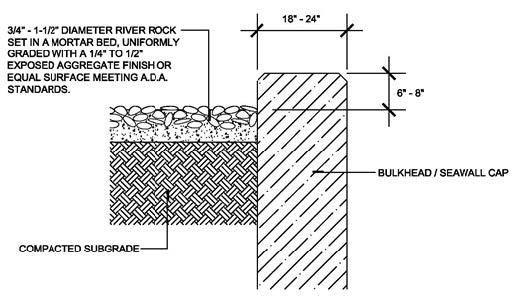
1: Seawall cap and safety buffer zone with hardscape installation, (planting is also permitted).
3.3 Safety Buffer Zone - Area adjacent to the seawall.
- The Safety Buffer Zone shall be designed in accordance with the selected typology.
- The surface of the Safety Buffer Zone shall be 6” minimum below the top of bulkhead / seawall.
- Paving within the Safety Buffer Zone shall be river rock, approximately 0.75 to 1.5 inches in diameter, set in concrete leaving a relief of 0.25 to 0.5 inches or similar aggregate pavers with ADA domes.
- Planting beds shall be a minimum five (5) feet wide with trees or palms planted at grade and low-level plantings provided at the base of the trees or palms.
- Planting beds may be narrower (minimum three (3) feet wide) if permeable pavers provide air and water to soil.
- In areas between the planting beds, a minimum of three (3) feet wide uniform exposed aggregate of river rock textured surface shall be provided.
- Landscape lighting shall be provided to accentuate trees or palms in this area.
- Low-level lighting (i.e. bollard, wall, or furnishing mounted) within the area adjacent to the Circulation Zone shall be installed to provide pedestrian / pathway lighting.
3.4 Circulation Zone – Unobstructed linear pedestrian walkways.
- The circulation zone shall be designed in accordance with typologies shown in Appendix B, Section 4.
- The circulation zone shall be constructed of non-slip paving materials with high aesthetic appearance and structural qualities pursuant to Appendix B, Section 6.3.
- The walkway surface shall be accessible to disabled persons throughout the entire length of the waterfront and comply with ADA standards.
- The walkway may meander along the shoreline; however, all offsets in the alignment of the walkway shall not exceed ten (10) feet and be spaced not less than fifty (50) feet apart pursuant to Appendix B, Section 5.
- Obstructions to movement (trees, bollards, lighting, etc.) within the circulation zone shall not reduce the clear width of the walkway to less than fifteen (15) feet at any point except in Typology 5 and Typology 6, where each walkway may be reduced to no less than eight (8) feet.
3.5 Transition/Passive Zone – Area interspersed with shade trees, low level plantings, seating, lighting, and other furnishings.
- The transition/passive zone shall be designed in accordance with the selected typology.
- Accessories such as benches, trash receptacles, bicycle racks, drinking fountains, pedestrian scale light poles and landscape lighting, drinking fountains, etc. shall be confined to the passive zone.
- Accessories shall be located so that no elements shall impede the circulation zone when in use i.e. benches shall be set back to accommodate users’ limbs and bike racks located that attached bicycles do not obstruct circulation.
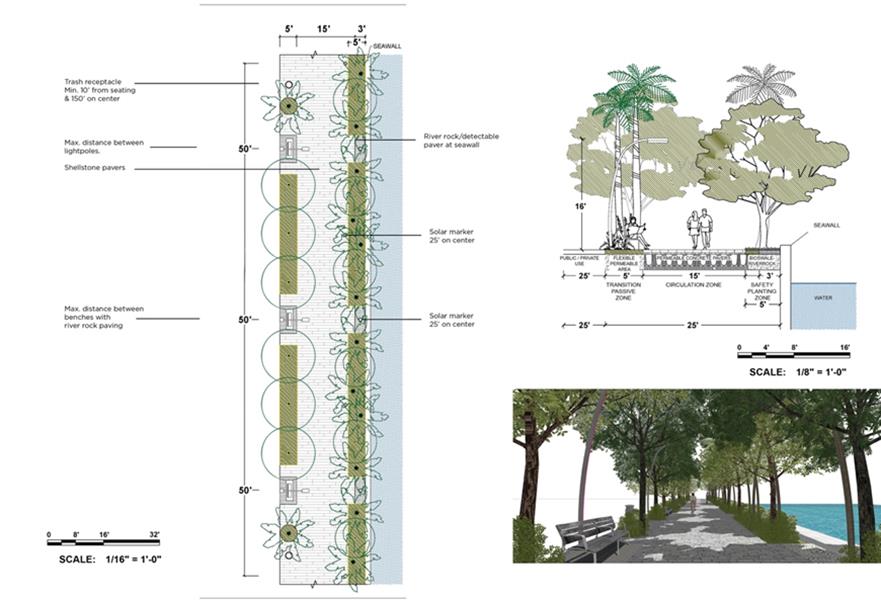
4.1. Typology 1: Central Walk
Where the walk is framed by landscape elements.
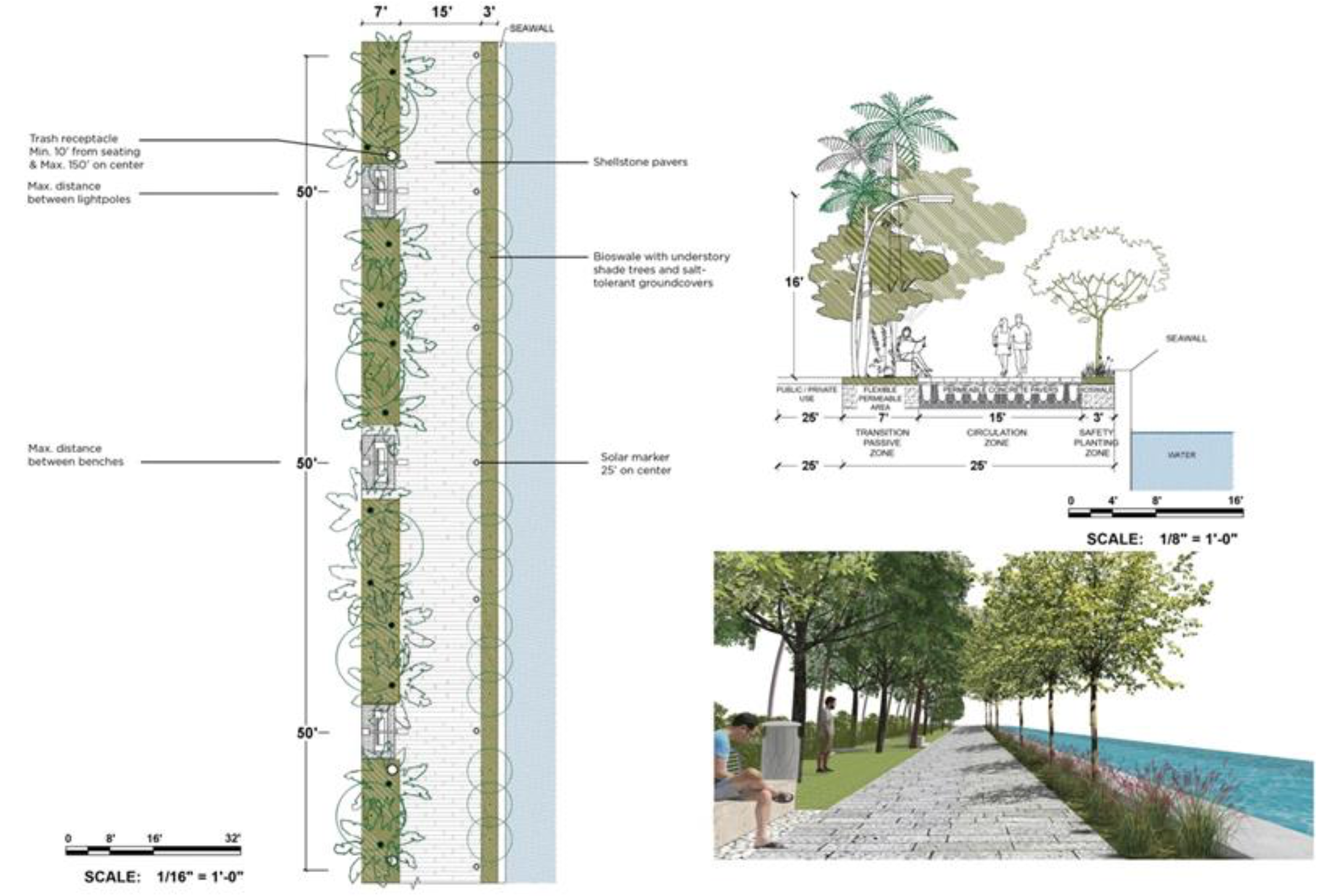
4.2. Typology 2: Outside Walk with Bioswale
Same as Typology 1 with bioswale in place of detectable river rock.
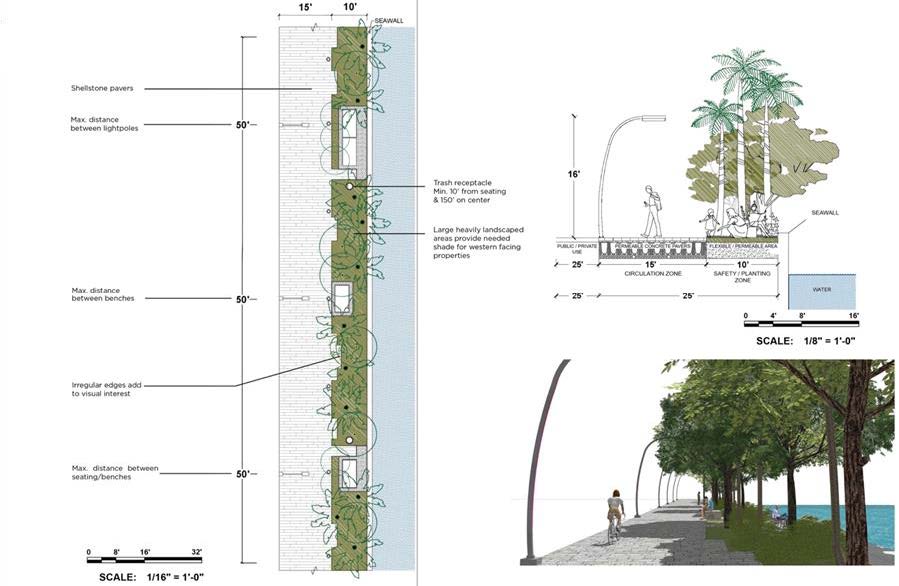
4.3. Typology 3: Inside Walk
Where the open or green space is adjacent to the water and the walk is on the opposite side.
4.4. Typology 4: Meandering Walk
A combination of the typologies where the main pedestrian path meanders away from the water and back towards it repetitively. (Overall walkway dimensions remain twenty-five feet (25’).
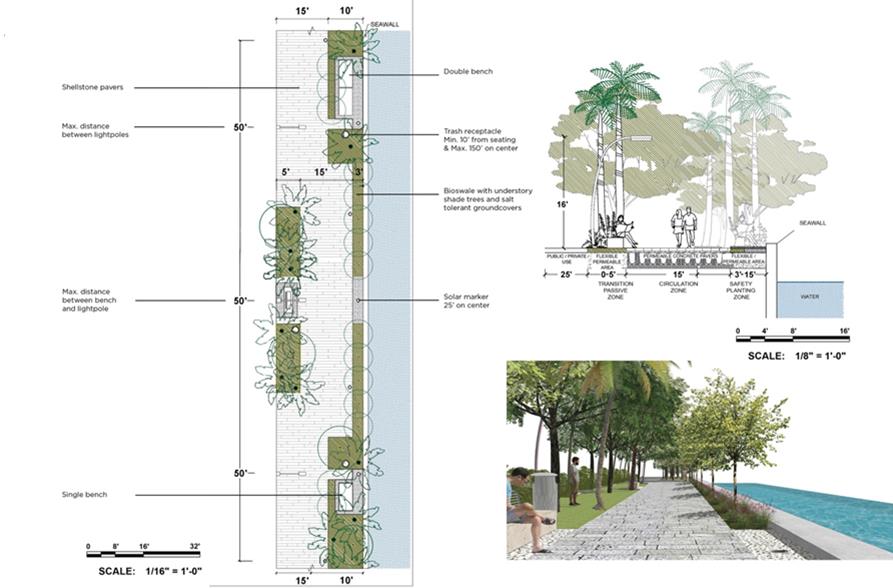
4.5. Typology 5: Split Walk
The walk is split into two and green space is in the center to allow for bikers and pedestrians to be separate or to create two different experiences: one facing the water and one facing the City.
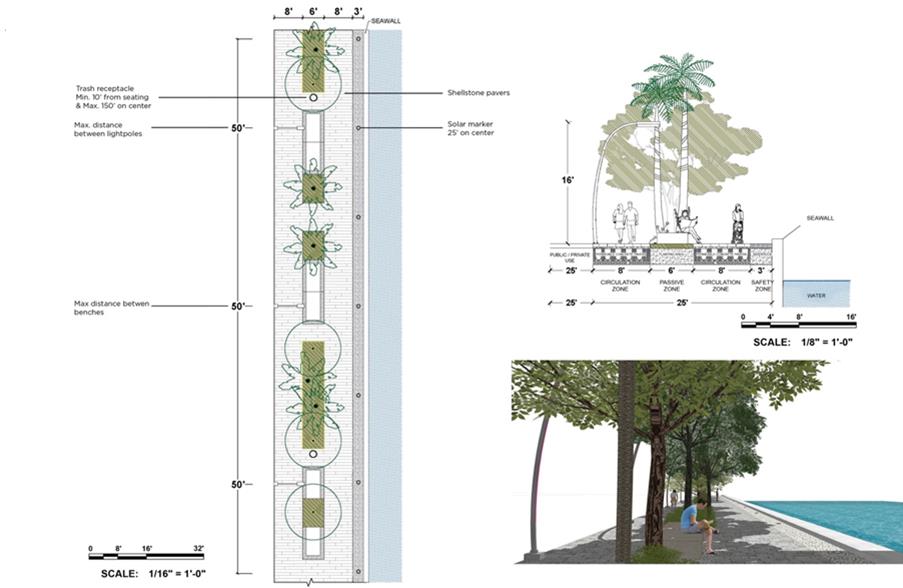
4.6. Typology 6: Split Walk with Bioswale
Same as Typology 5 with a bioswale in place of detectable river rock.
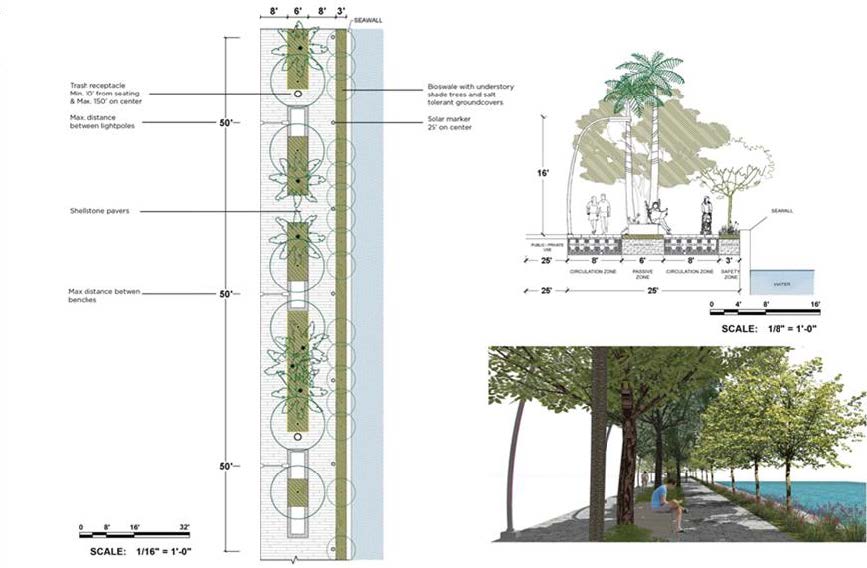
4.7. Typology 7: Amenity Walk
Similar to the Central Walk where the detectable river rock has been removed and the seawall has been raised to create a seating bench. Additional seating shall be provided in the form of half donut stone benches wrapping palm trees every fifty feet (50’).
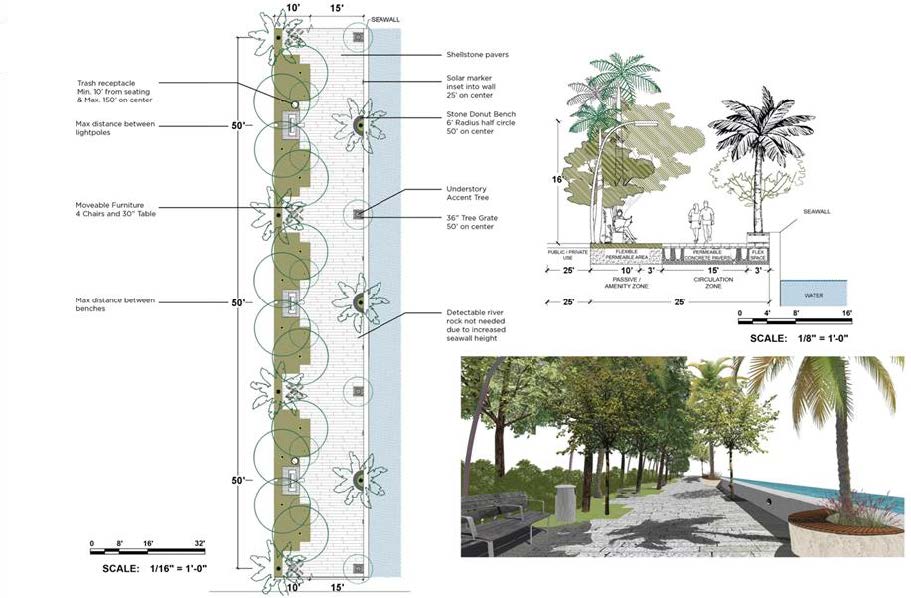
4.8 Typology 8: On-Street Greenway layout
On-Street Greenway layout shall create enhanced paths between waterfront segments.
- Sidewalks on the waterside shall be a minimum of eight feet (8’) clear and shall be broom-finished with integral colored concrete LM Scofield C-12 (Mesa Beige) or approved equivalent.
- Sidewalks on the waterside should meet minimum standards to qualify as an FDOT standard shared-use path whenever space permits.
- Street furnishings
- Lighting: FPL decorative package
- Benches: Landscape Forms Plainwell bench or approved equivalent with Greenway custom medallion with a minimum of one (1) bench per block on both sides of the street.
- Trash receptacles: Landscape Forms Plainwell receptacle or approved equivalent with a minimum of two (2) per intersection.
- Bicycle rack: Landscape Forms Pi rack or approved equivalent at a five hundred feet (500’) minimum spacing.
- Signage per the Design Standards.
- Landscape
- Shall be a continuous verge with continuous shade trees except at intersections where palms are permitted.
- Landscape verge shall be seven feet (7’) wide except when interrupted to allow for street furnishings or pedestrian access to crosswalks.
- Crosswalks on watersides connecting to Greenway shall incorporate colored concrete crosswalks, accent planting at corners, and wayfinding markers on the greenway side.
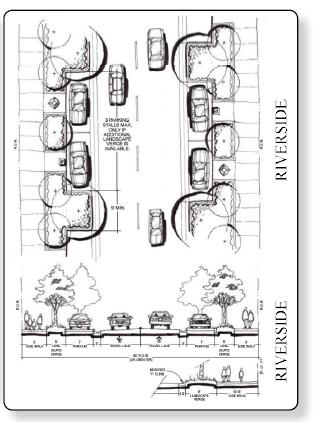
1: Typical cross section for sixty feet (60') wide right of way.
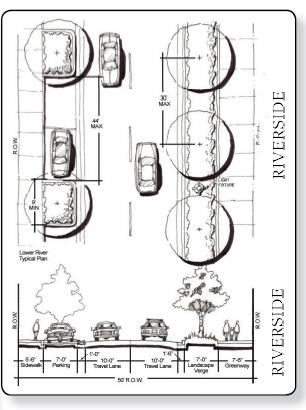
2: Typical cross section for fifty feet (50') wide right of way.
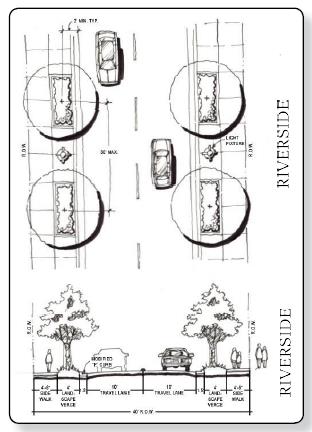
3: Typical cross section for forty foot (40') wide rights of way.
Section 5.1 Horizontal Transitions between Typologies
Transition areas will be eight (8) to fifteen (15) feet wide where the width of the transition area (A) is equal to the width of the connecting path (B). See graphic below for transition types between the promenade typologies.
New sections of the path shall transition seamlessly with existing sections, this may be achieved through a variety of design configurations, maintaining a continuous circulation path.
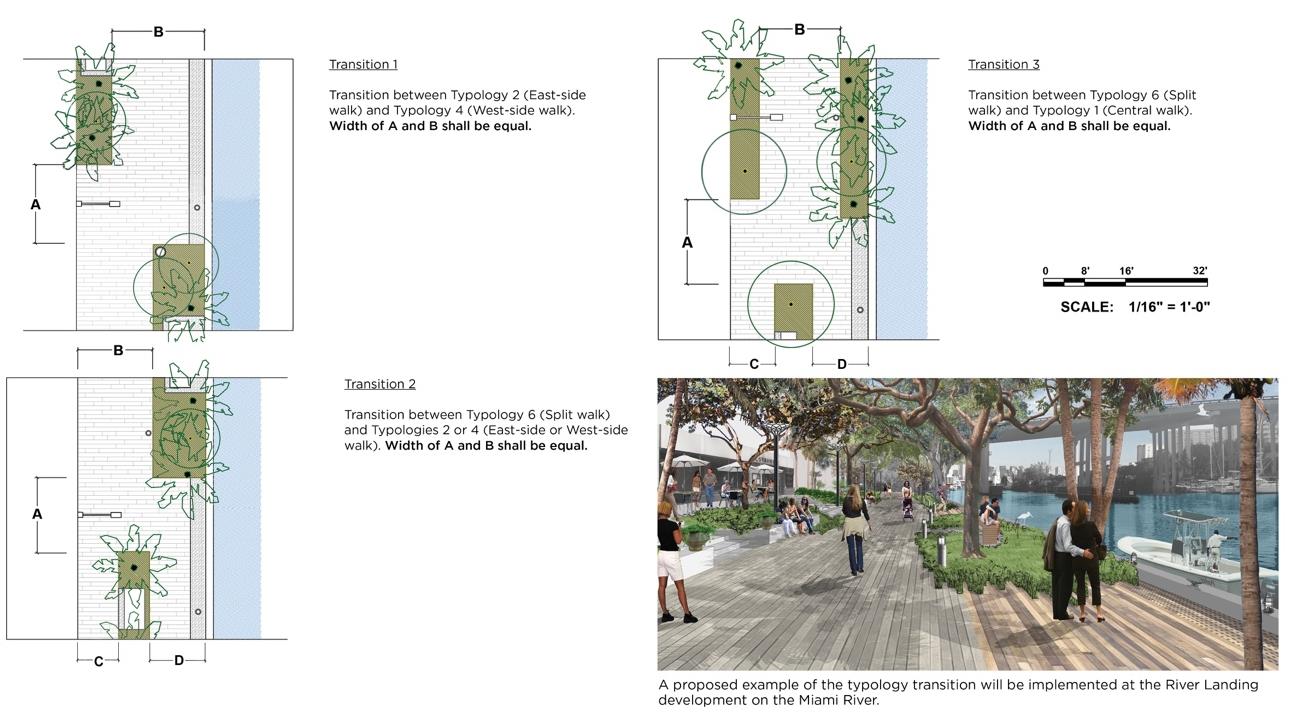
1: Examples of horizontal transitions between Typologies.
Section 5.2 Vertical Transitions
- Upland vertical transitions are permitted to aid circulation and visual connection between properties with high finished floor levels due to flood conditions and the public waterfront walkway.
- Generally, vertical transitions may take place by having different zones at differing elevations and may have gradual grade changes along the path of travel to ease transitions from properties to the waterfront.
- The Safety Buffer Zone must be lower than seawall to function as a curb.
- The Circulation Zones or Zone edges may be higher or lower than adjacent zones.
- The Circulation Zone Path may slope in direction of travel but may not be so steep as to qualify as a ramp pursuant to ADA guidelines
- The Passive Zone may be higher than the Circulation Zone.
- Seating walls and retaining walls are permitted though the Passive Zone must screen vertical portions of the private property.
- The Passive Zone may slope but may not drain onto circulation zones.
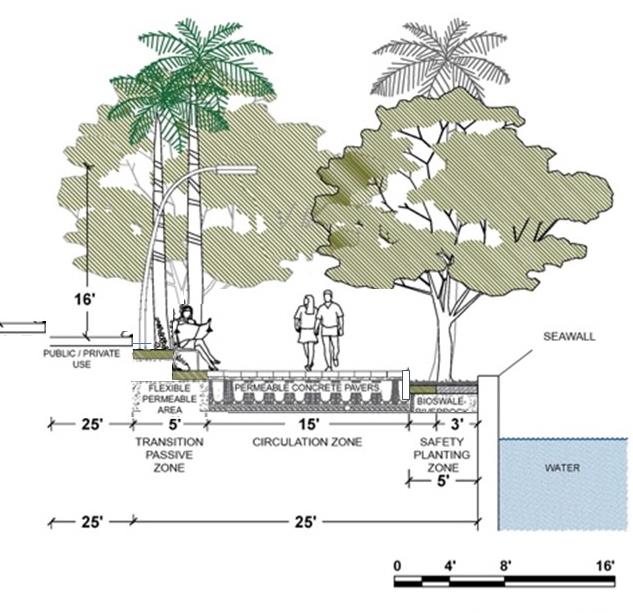
2: Example of vertical transitions between and within zones which may be applied to all Typologies. - Waterside vertical transitions are appropriate to improve access to the water.
- Penetrations through a seawall to accommodate boat access may occur if they are protected by deployable flood barriers and a barrier operations and storage plan are provided.
- Public vessel access or launch points may be provided with multiple typologies. All materials at lower portions shall be anchored and flood resistant.
- When Typologies 6 and 7 are used, a portion of the Circulation Zone may be lower to improve water access.
- Circulation zones shall be maintained with clear width and Public access.
- ADA compliant access shall be maintained including multiple ramps when appropriate.
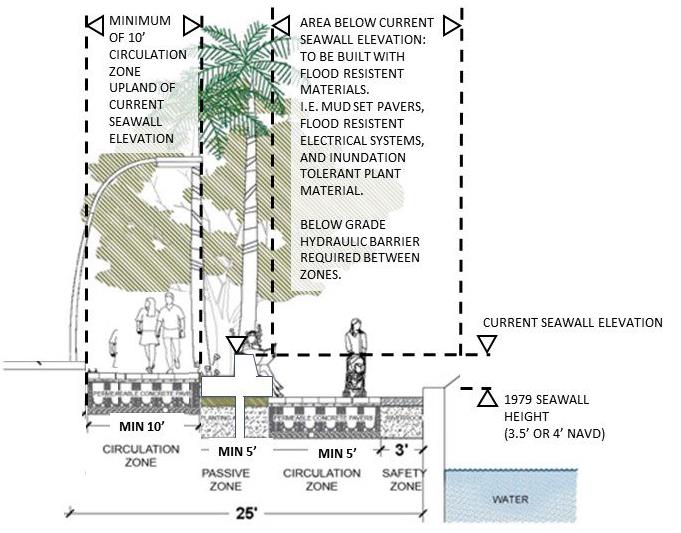
3:Example of Type 6 or 7 pathways with split elevations.
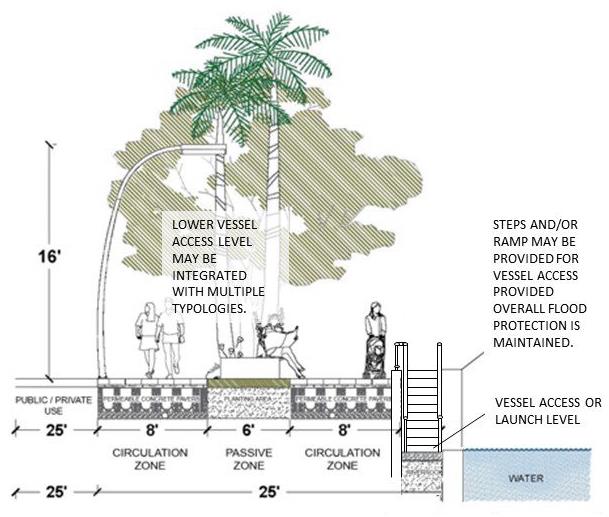
4: Example of vessel access level.
6.1 General Requirements
- Landscaped areas should be landscaped with plant materials listed in the Waterfront Materials Index. Shade trees are required within the Passive Zone and may also be planted along the Safety Buffer Zone in lieu of palms to create an allée of trees. Shrubs, low shrubs, and groundcovers (low level plantings) should be planted at the base of trees and palms to enhance waterfront walkway aesthetics and to help buffer the walkway perimeters.
- Landscape elements shall not obstruct pedestrian circulation paths.
- Landscape design shall provide a consistent selection of landscape elements to unify the visual experience and contribute to the waterfront’s ecological character
- No planting material shall be used that is classified as prohibited, controlled, or invasive by either State, County, or Local agencies.
- All planting areas shall have low-water use/high efficiency irrigation systems, such as drip irrigation, low-trajectory irrigation nozzles, automatic shut-offs, and equipped with soil moisture and/or rain sensors to regulate water use pursuant to the requirements set forth in Section 22.5-75 of the City Code, Miami-Dade County regulations, or South Florida Water Management District regulations, whichever is most restrictive.
- Raised planters, if used, and all planter walls may double as seating walls when greater than fifteen (15) and less than thirty (30) inches in height above adjacent surface and greater than fifteen (15) inches in depth.
6.2 Tree and Palm Requirements
- Trees and palms shall be installed within the Passive and Safety Zones pursuant to the selected typology.
- Trees and Palms shall provide a minimum of fifty percent (50%) immediate shade coverage with one hundred (100%) shade coverage within five (5) years.
- Trees and palms shall be planted to establish a unified canopy for visual unity and pedestrian comfort.
- Trees and palms shall be a minimum of fourteen feet (14’) in height and have a minimum of nine feet (9’) clear trunk at installation.
- Tree and palm selection shall be confined to the list in the Waterfront Materials Index and ninety percent (90%) of total quantity of trees and palms used shall be native or fifty percent (50%) of total trees and palms used shall be native if using Coconut Palms.
- If one hundred (100%) shade coverage is demonstrated via diagrams, flexibility regarding tree and palms spacing is permitted.
- Trees and palms shall be selected for their proven resiliency, particularly for high wind and salt tolerance.
- Large canopy shade trees and palm trees shall take priority over waterfront views between ten (10) and forty (40) feet above the seawall elevation.
- Avoid trees and palms with known pests and diseases that increase pesticide requirements.
- At grade planters for medium to large trees shall be a minimum of sixty (60) square feet with a minimum width dimension of five (5) feet.
- At grade planters for palms and small trees shall be a minimum of thirty (30) square feet with a minimum width dimension of four (4) feet.
- Provide adequate root zone space for trees.
- Root zones must have uncompacted soil with access to air and water.
- Either planting beds or porous pavements allow access to air and water.
- Provide uncompacted soil volume in the following volumes:
Mature Tree Size Soil Volume (max. depth of 3.5') SMALL - Height: <30' 300 ft3 MEDIUM - Height or Spread: >30' and <50' 1,200 ft3 LARGE - Height or Spread: >50' 1,800 ft3 When soil is shared between trees 25% reduction allowed - When root zones are under paving, paving must be supported to allow for uncompacted soil.
- Custom support systems, structural soils, or suspended systems may support paving.
- Support system components do not apply to soil volume calculation (i.e., structural portion of structural soil or suspension system components).
- Structural Cells shall be provided under paving when large trees are specified in planters less than 100 square feet and further than twelve (12) feet from adjacent, continuous green space areas.
- Root barriers shall be installed at pavement edges where large trees and palms are specified.
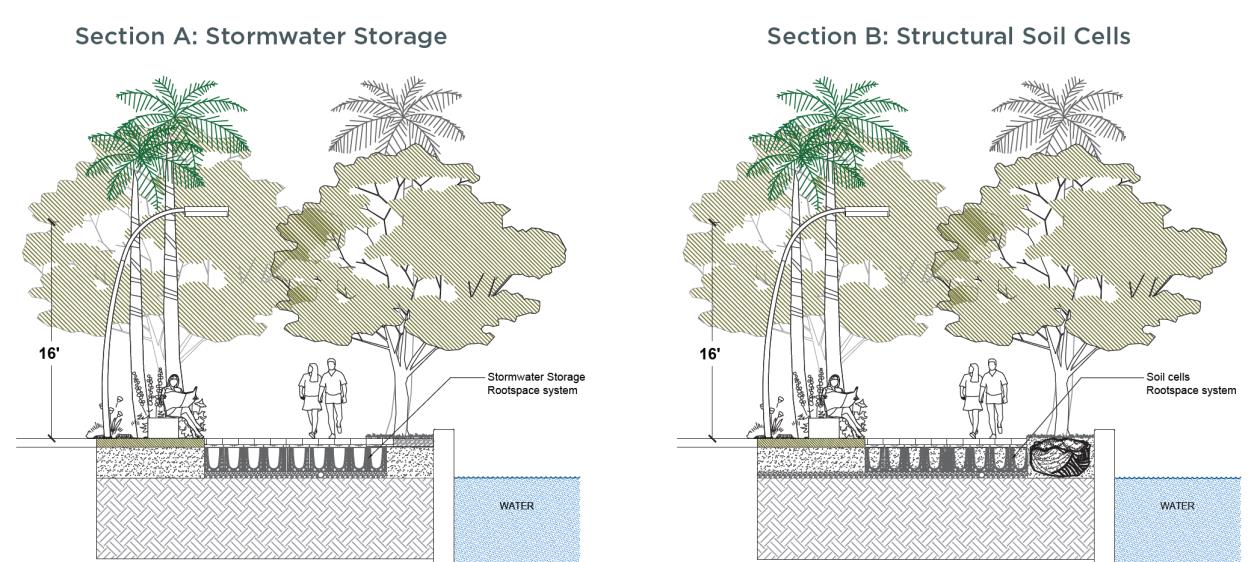
6.3 Shrubs, Ground Cover, Mulch, and Soil Requirements
- Shrubs and groundcover selection shall be planted to establish visual unit and accentuate water views.
- Landscape elements shall be installed within the Passive and Safety Zones pursuant to the selected typology.
- Shrubs and groundcover selection shall consist of a minimum of eighty percent (80%) native species and be salt and drought-tolerant pursuant to the list in the Waterfront Materials Index.
- Salt-tolerant turf shall be provided in areas intended for recreation or gathering.
- All planting beds shall be covered with a minimum of three inches (3”) of shredded Melaleuca, Grade B, or eucalyptus mulch. Cypress mulch shall not be permitted.
- Planting soil shall be pursuant to the Waterfront Materials Index.
- Minimum Vegetated Area
- Typology 1: 24%
- Typology 2: 30%
- Typology 3: 38%
- Typology 4: 35%
- Typology 5: 20%
- Typology 6: 30%
- Typology 7: 30%
7.1 Hardscape
- Hardscape shall create a unified visual and tactile feel throughout the walkway with seamless transitions between properties.
- Hardscape materials shall primarily include materials commonly used in marine environments such as concrete pavers, stone pavers, and river rock consistent with the Waterfront Materials Index.
- Hardscape materials should utilize neutral colors, primarily gray and sand with natural aggregates, such as marble chips and seashells.
- Permeable Hardscape materials shall be used to reduce stormwater utility infrastructure and promote the filtration and collection of stormwater consistent with the Waterfront Materials Index.
- Hardscape should have a low reflectance albedo (minimum 0.3 factor) to reduce glare and heat absorption to decrease the heat-island effect.
- Concrete with salt finish or shell aggregate should be used in steps adjacent to the water.
- Hardscape shall be laid in a running bond pattern for pedestrian areas and herringbone in areas where vehicular use is required for emergency access.
- River rock, mortared, shall be used as a detectable paver for the waterfront edge and around benches for protection against skateboards, consistent with the selected typology.
- In proposed playground areas, poured-in-place rubberized play surface and artificial turf may be utilized.
8.1 Lighting
- Lighting shall be provided in accordance with the selected typology and shall attain safe and appropriate foot-candle necessary for pedestrian mobility, consistent with the Waterfront Materials Index.
- All proposed lighting elements shall be consistent with the fixture design specifications in the Waterfront Materials Index.
- Overhead lighting shall be confined to the zone identified by the proposed typology.
- Landscape up-lighting shall be provided to accentuate trees, palms, and other landscape elements.
8.2 Seating
- Seating shall be confined to the Passive and Safety Zones pursuant to the selected typology.
- Seating materials shall be consistent with the Waterfront Materials Index fixture design specifications and may be provided through a variety of movable, fixed, seat/retaining walls or terraced steps.
- Seating shall be provided at a minimum of one (1) linear foot of seating for every twenty (20) feet of Frontage along the water.
- Distance between seating shall be no greater than fifty (50) feet or as identified pursuant to the typology.
- All seating areas shall emphasize direct water views.
8.3 Amenities
- Bicycle parking shall be provided at a minimum of one (1) space per every one hundred (100) feet of frontage and shall be consistent with the Appendix in the Waterfront Materials Index and may be waived if similar facilities are already provided within the vicinity.
- Water fountains may be provided and shall be consistent with the fixture design standards in the Waterfront Materials Index and may be waived if similar facilities are already provided within the vicinity.
- Waste receptacles shall be provided at a minimum of one (1) per every one hundred fifty (150) feet of frontage and shall be consistent with the fixture design standards in the Waterfront Materials Index and may be waived if similar facilities are already provided within the vicinity. Waste receptacles are selected with rain covers and removable liners to conceal waste and allow for easy maintenance. Provide separate, labeled waste receptacles for garbage and recycling. Receptacles are to be emptied and maintained by the property owner.
8.4 Signage
- All public access points, including park walkways, roadways, dedicated midblock walks, and public plazas shall be marked with a District Flag Directional Sign consistent with the signage standards of the Waterfront Materials Index.
- District Identity Sign shall be placed at property midpoint consistent with the signage standards of the Waterfront Materials Index.
- Adjacent accessible publicly oriented private developments such as cafes or shops shall identify the use with signage oriented towards the waterfront walkway.
- Uniformly designed historic or environmental markers and descriptive plaques shall be placed in the Passive Zone.
- Signage shall identify access points and adjacent activities (cafes, shops, etc.) for boaters.
- Signage shall not be placed within the Circulation Zone.
- Refer to Waterfront Materials Index signage standards for full logo usage guidelines.

