Miami City Zoning Code
Appendix D
Miami Worldcenter
MIAMI WORLDCENTER
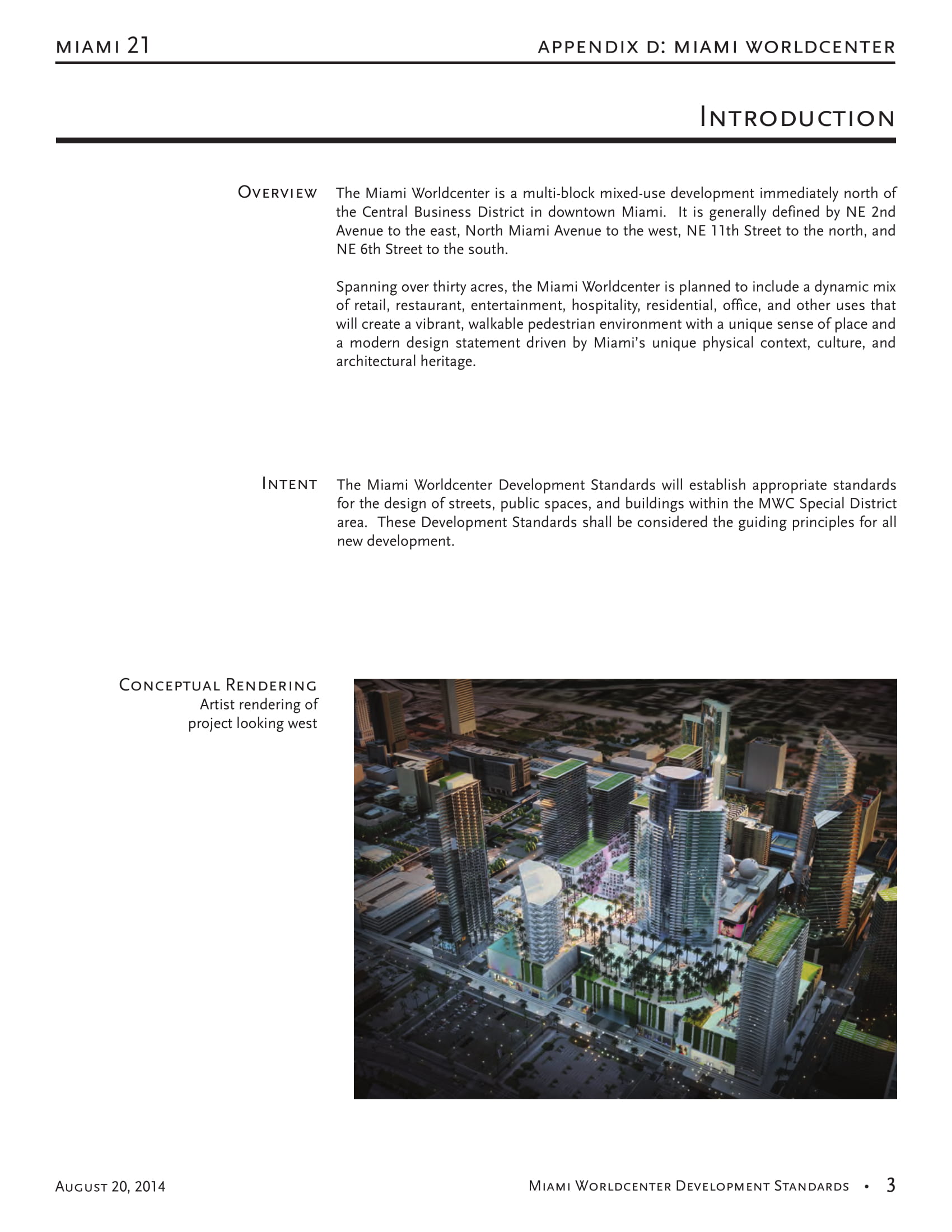
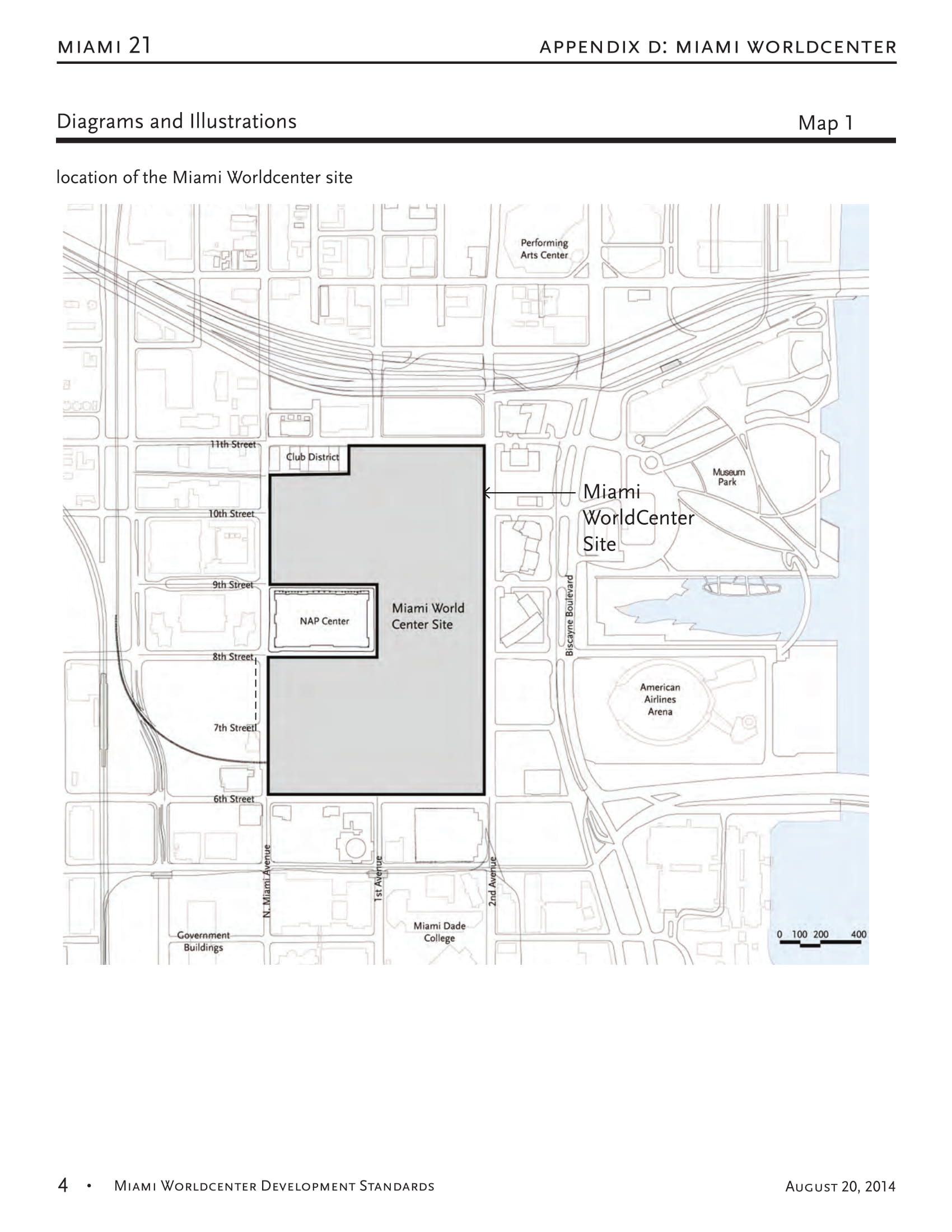
The Miami Worldcenter (hereinafter also referred to as the “Miami Worldcenter area”) is generally bounded by NE 2nd Avenue on the east, North Miami Avenue on the west, NE 11th Street on the north, and NE 6th Street on the south, excluding the areas generally described as “The Club District” and the “Network Access Point of the Americas (NAP Center)”. The boundaries are more specifically identified in Map 1, as included in the Development Standards.
Section 1. MIAMI WORLDCENTER GOALS
The conservation goals include conserving energy and reducing carbon dioxide emissions through improving pedestrian connectivity and encouraging walkability, multi-modal mass transit use, increased tree canopy, new public spaces, and green buildings.
Section 1(a) The development goals include:
- Establishing specific areas that are pedestrian-oriented and mixed-use. Increased density and intensity of use is encouraged due to the proximity of current and proposed transit service and appropriate building densities and land uses should occur within walking distance of transit stops.
- Mantaining the future growth of dowtown infill redevelopment ensuring Miami's focus for the region's economic, civic, and cultural activities.
- Creating a diversity of uses distributed throughout the selected specific area that enables a variety of economic activity, workplace, residential, and civic space. Civic and commercial activity should be embedded in the mixed-use District as identified in the Intent for the Park West Commercial-Residential Districts.
- Reinforcing community identity through thoughtful placement of Civic and public gathering spaces.
- Constructing buildings and landscaping that contribute to the physical definition of Thoroughfares as civic places.
- Establishing a framework of transit and pedestrian systems that accomodates automobiles while respecting the pedestrian and the special form of public spaces.
- Ensuring that private development contributes to infraestructure and promotes a pedestrian and transit friendly public and private realm of quality.
Section 1(b) The Miami Worldcenter Development Standards (“Design Standards”) and the Miami Worldcenter Regu- lating Plan (“Regulating Plan”) provide more detailed clarification to the SD 16.3 Worldcenter area and are incorporated herein by reference.
Section 2. EFFECT OF MIAMI WORLDCENTER AREA DESIGNATION.
The Miami Worldcenter Development and the regulations herein shall supplant those otherwise in conflict with the Miami 21 code. Unless stated otherwise herein, these regulations supersede any provisions of the Miami 21 code.
Section 3. WARRANT
Section 3 (a)
A warrant shall be required prior to the issuance of a building permit for: (1) any development which seeks a deviation from the standards in this Appendix D: (2) a development which substantially affects the height, mass, location or exterior configuration of any existing building; (3) or the construction of a new building; or (4) the implementation of signage, awnings, fences or any other improvement visible from a public right-of-way.
Section 3(b)
The purpose of the Warrant shall be to ensure conformity of future development applications with Appendix D, as amended, keeping in mind the expressed intent of the Southeast West Commercial-Residential Districts, with the general considerations listed in Article 4, Table 12 and with the special considerations contained in the Miami Worldcenter Development Standards incorporated herein by reference. A Traffic Study shall only be required in connection with: ( 1) an original Warrant application for a new Building: or (2) modifications to approved Buildings where the proposed use(s} is substantially different from that originally approved.
Section 3(c) Special District Permit Minor Modifications & Modifications to Approvals
(1) Unless otherwise required by these Development Standards. as amended, the Zoning Code of the City of Miami, as amended, or the Florida Building Code, as amended, these Development Standards may be modified by the Planning Director, or his or her designee, pursuant to a Special District Permit ("Special District Permit"). The Zoning Administrator, or his or her designee, may waive or modify any provision of these Development Standards, up to ten percent {10%}, by Special District Permit, except Density, Intensity or Height, on a case by case basis. when doing so will promote the intent of the Miami Worldcenter or these Development Standards. All applications for a Special District Permit shall be submitted in writing to the Zoning Administrator. detailing the need for the modification or correction. as the case may be. together with a fee detailed in the City's adopted fee schedule. Special District Permit applications shall be reviewed by the Zoning Administrator within fifteen (15) days of submission. and shall be referred to the Planning Director, or his or her designee. within five {5) days after the expiration of the initial fifteen (15} day review period. If the requested relief or modification to these Development Standards is determined to be in compliance with the intent of these Development Standards, the Planning Director shall approve the Special District Permit. Special District Permit applications may be filed in connection with a new building or fn connection with the modification of a previously issued approval, including, but not limited to a Warrant.
(2) The Planning Director. or his or her designee. may authorize variations or modifications to this Ordinance. including these Development Standards, up to a maximum of twenty percent (20%) by Warrant, on a case by case basis, when such variation would promote the intent of these Development Standards. or is otherwise found by the Planning Director to be appropriate given the particular facts and circumstances of the Warrant application.
(3) An applicant may modify a Warrant or Special District Permit approved under this Appendix. as a minor modification through the Special District Permit process. Minor Modifications include:
- Those changes that meet these Appendix D regulations: or
- Changes in the project phasing: or
- An increase in height not exceeding five percent (5%) of the approved height: in no instance can such increase exceed the twenty percent (20%) cumulative increase available by Warrant in Appendix D, as amended: or
- Projects with and FLR up to 20,000 square feet may receive adjustments in glazing up to 80% to meet net-zero building standards. Proposed net-zero Building performance shall be a minimum LEED Gold certification and comply with applicable sections of the Florida Building Code including but not limited to natural light requirements.
In the event that the modification is determined to be "not minor," a new Warrant shall be required. Modification available under this Section 3(c) shall not be applicable to the Building Configuration contained in Section 9(a).
Section 4 FLEXIBLE ALLOCATION OF DEVELOPMENT CAPACITY
Property within the Miami Worldcenter area may be subject to a Covenant(s) in Lieu of Unity of Title in a form approved by the City and the City Attorney ("Covenant in Lieu"), which permits flexible allocation of Density and Intensity for sites within the Miami Worldcenter area so long as the overall height and mass distribution does not result in development out of scale or character within the permitted Building envelope(s). The Covenant in Lieu shall be consistent with the land development regulations for the Miami Worldcenter area, or the adjacent areas, and the Miami Comprehensive Neighborhood Plan. Sufficient FLR must be allocated to build structures a minimum of two (2) stories on all parcels except Open Space and Civic Space sites,
Section 5. DEFINITIONS
For the purpose of theMiami Worldcenter area, the following definitions shall apply: Terms not defined herein shall have the meaning provided in Miami 21 Article 1 (“Zoning Ordinance”).
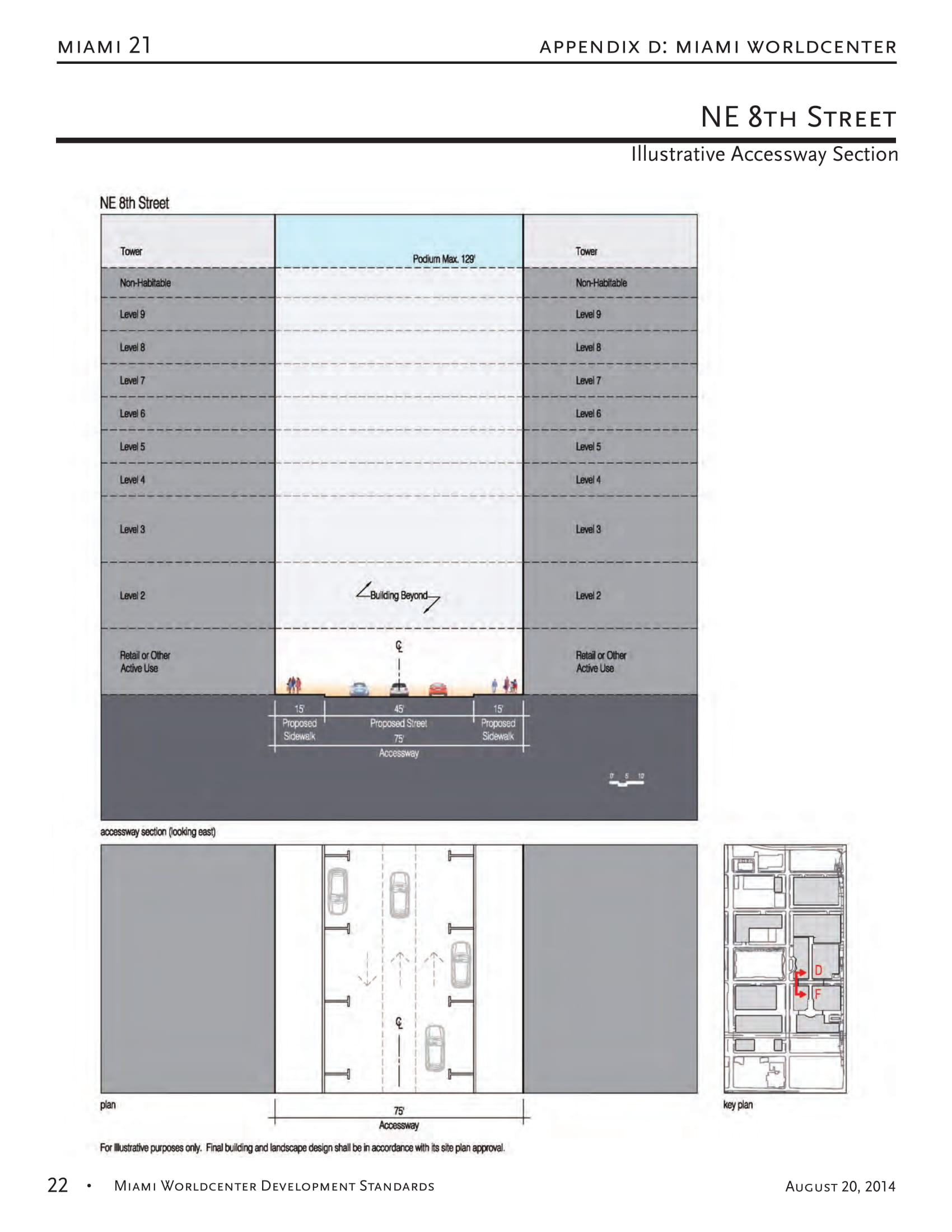
Accessway:An ingress/egress easement for pedestrian and vehicular access as designated by a recorded plat deed, or other legal instrument.
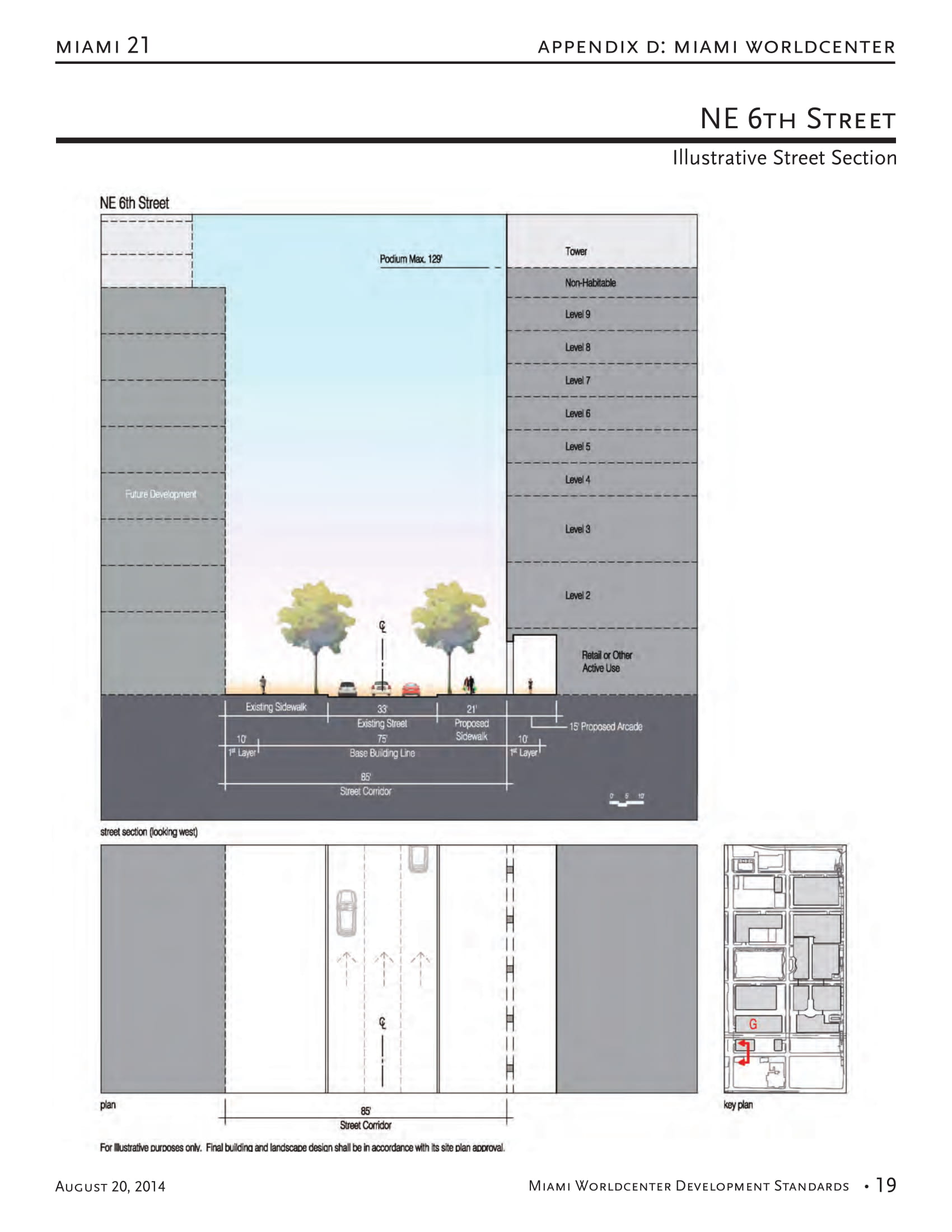
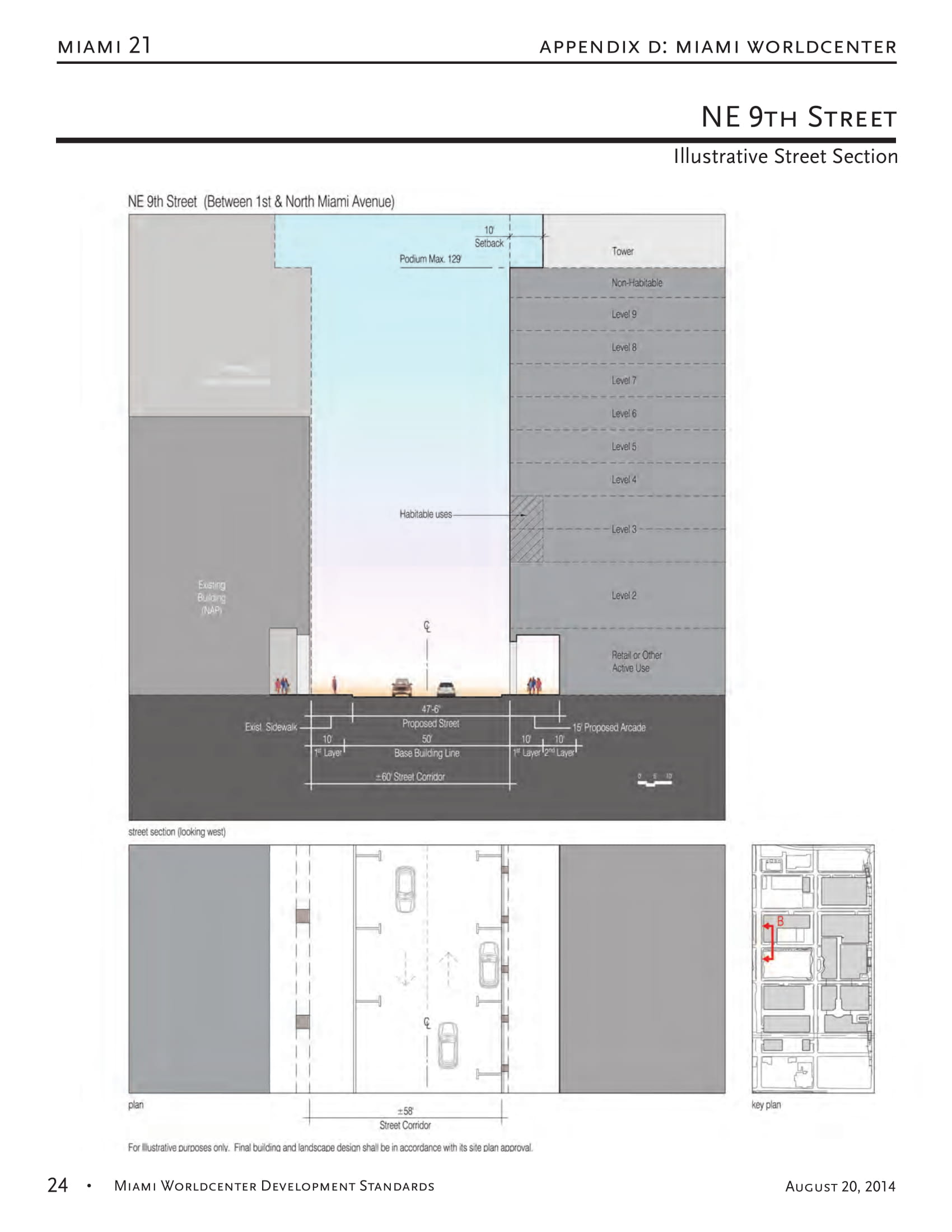
Arcade: A covered pedestrian outdoor space along any side of a Building at the ground level that is open on three sides and has a minimum width of fifteen (15) feet, which may provide access to shops along one (1) or more sides, per the Development Standards.
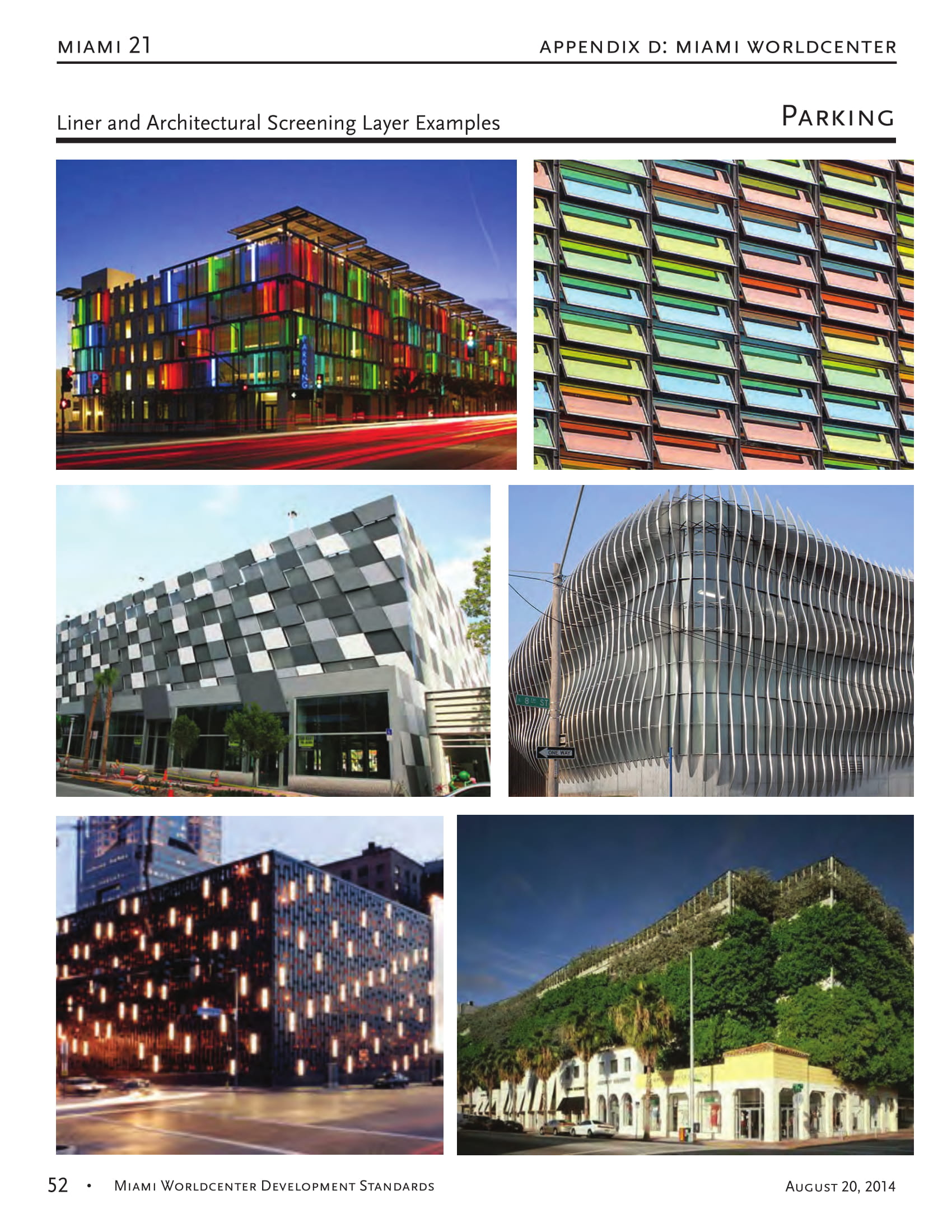
Architectural Screening Layer:An architectural treatment along the face of a buildingfacadeintended to conceal all internal building elements such as ramping, plumbing pipes, fans,ducts, ceilings, slab edges, and lighting. An Architectural Screening Layer is required forany parking garage or portion thereof that is not concealed by a Liner.
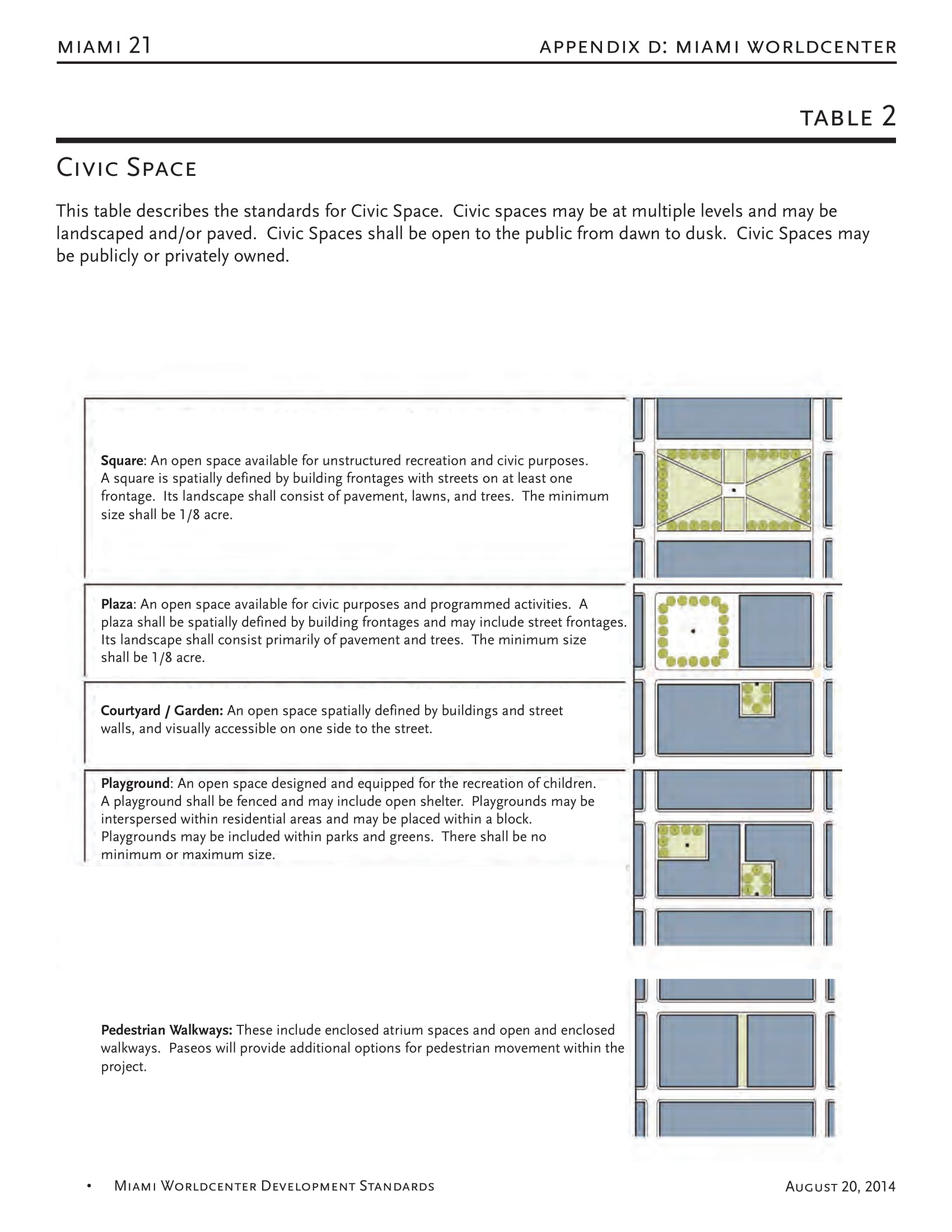
CivicSpace:An outdoor area provided or dedicatedfor public use in perpetuity by fee title or easement. Civic Space types are defined by the combination of certain physical constants including the relationship between their intended use, their size, their landscaping and their enfronting buildings. See Table 2 of the Development Standards.
Courtyard:Open space, partially defined by walls or buildings as regulated by the SD 16.3 Miami Worldcenter area. See Design Standards.
Facade: The exterior wall of a building that is set along a Frontage
Floorplate: The total indoor and outdoor Floor Area of any given Story of a Building, measured to the exterior of the wall, excluding balconies.
Frontage: Lot face abutting a public space, such as a Thoroughfare, whether at the front, rear, or side of a lot.
Gallery: A covered pedestrian area abutting any side of a building on the ground floor which may provide access along one or more sides of a building,
Green Space: An outdoor Open Space, at grade, unroofed, landscaped and free of impervious surfaces.
InfrastructureandUtilities:A facility related to the provision of roads, water and sewer lines, electrical, telephone and cable transmission, and all other utilities and communication systems necessary to the functioning of a community.
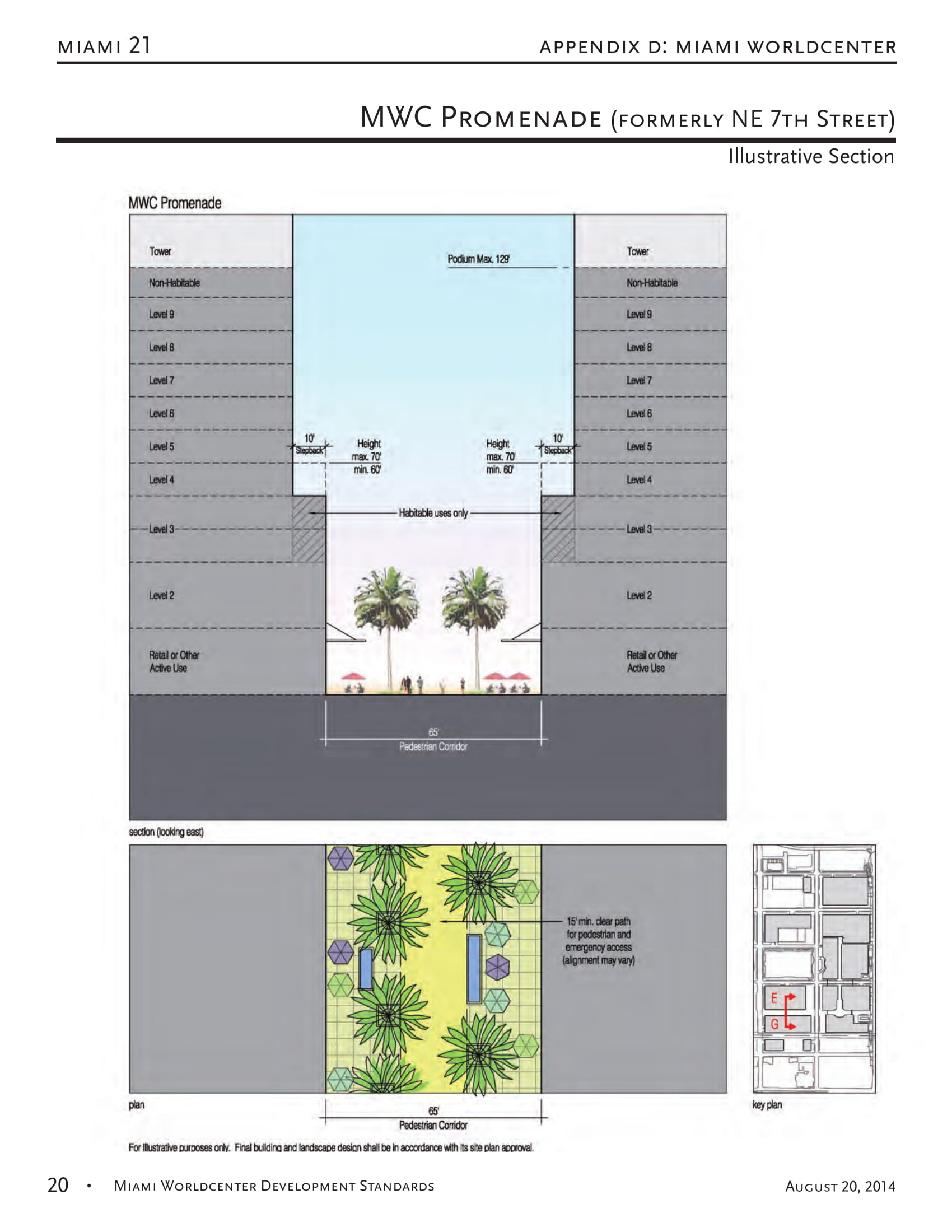
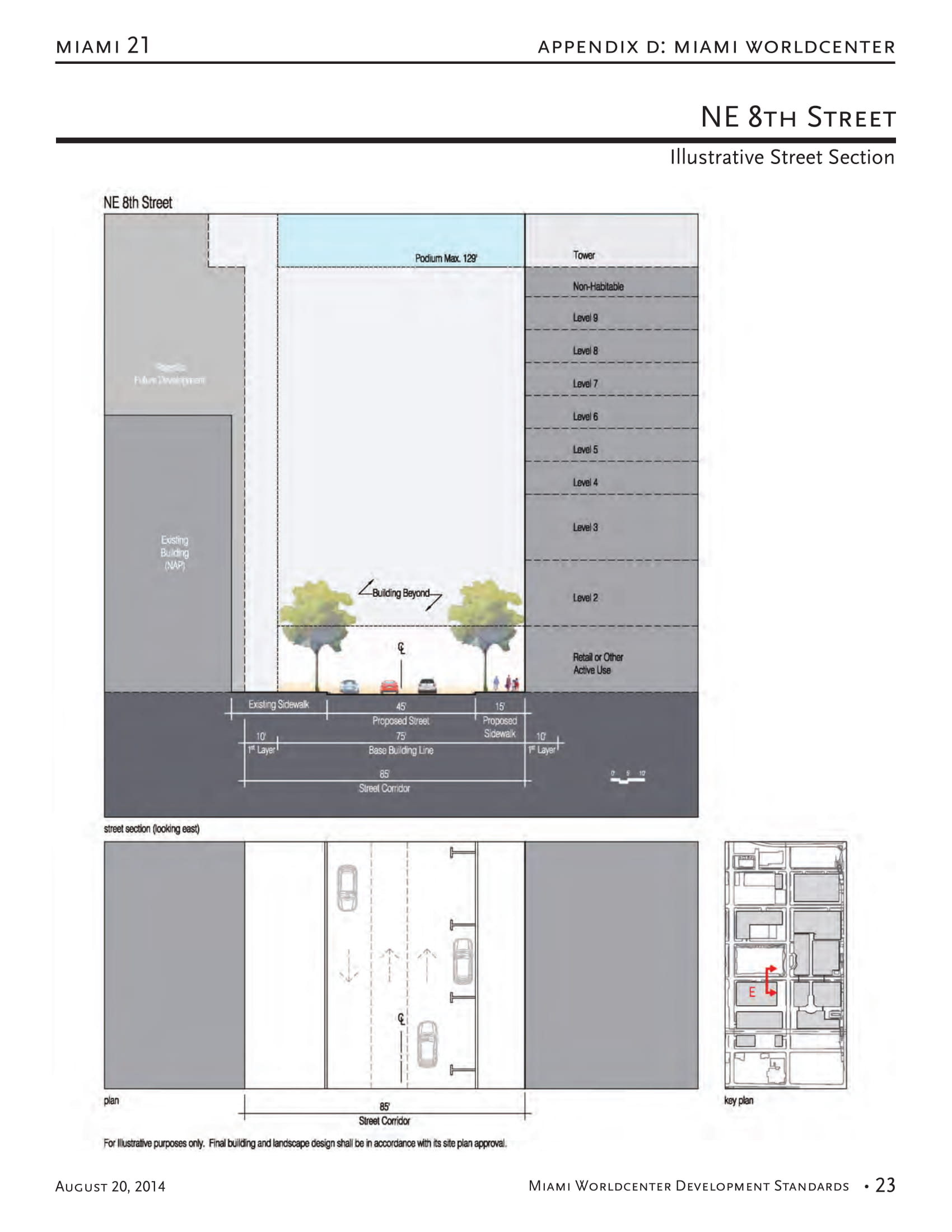
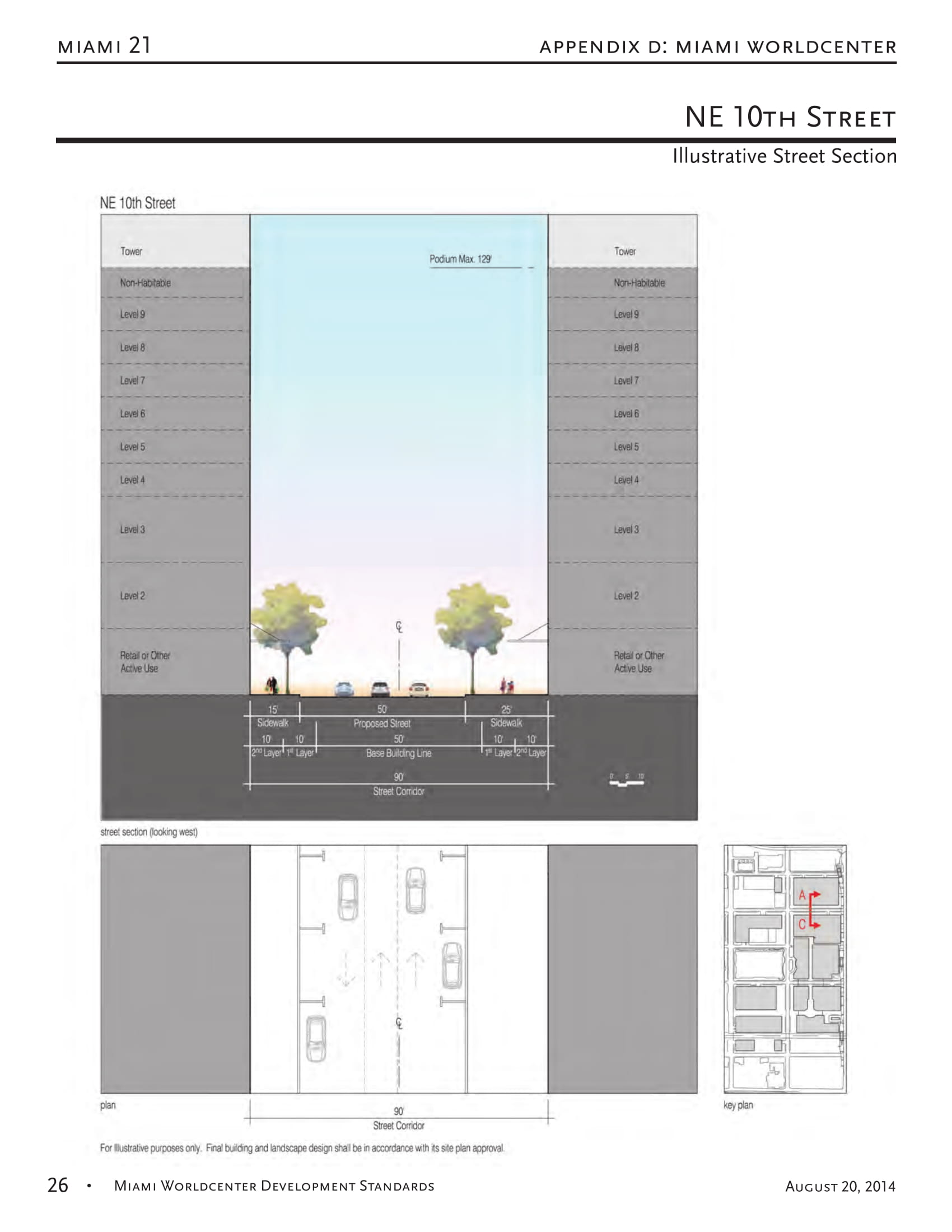
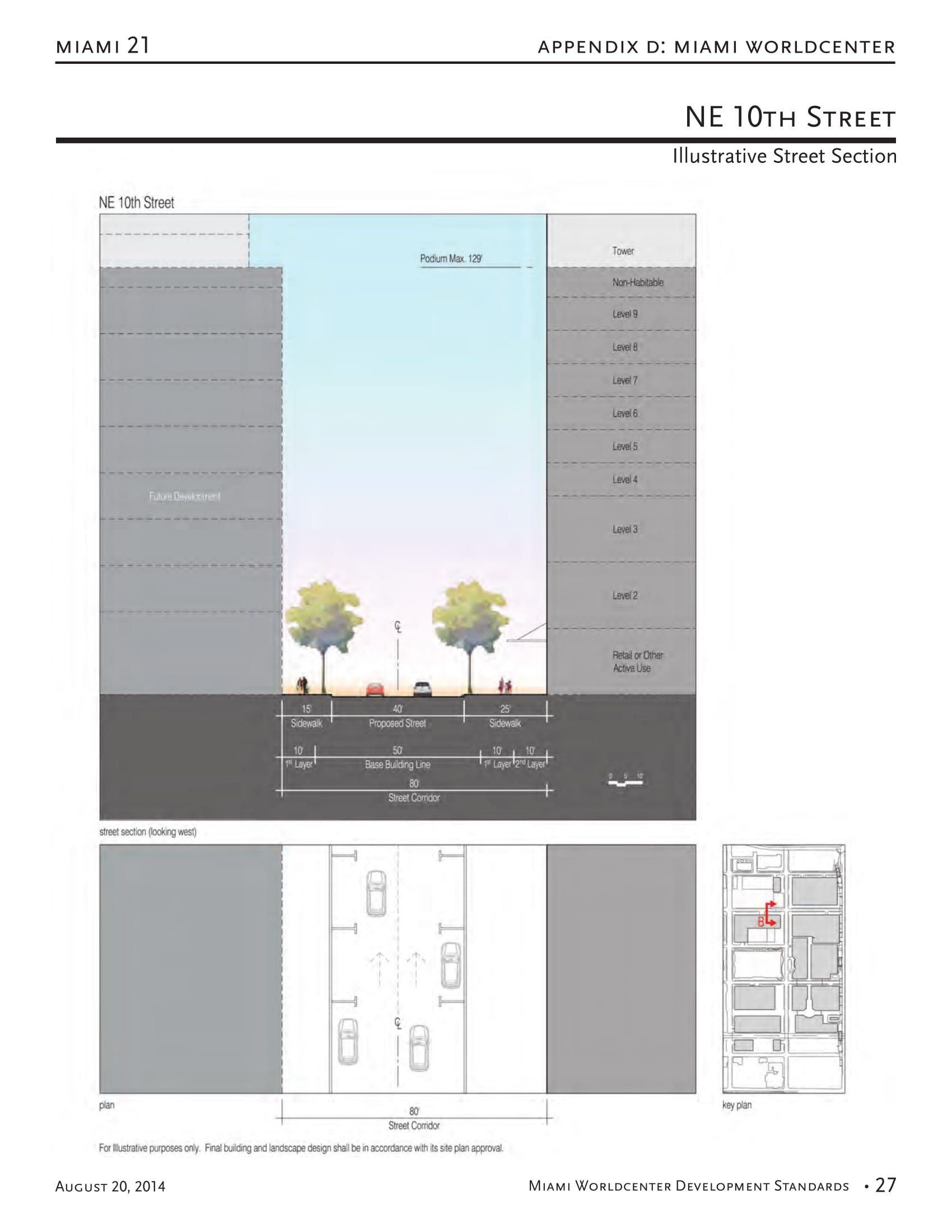
Layer,First:The area between Base Building Line and the required setbackas shown in the Development Standards.
Layer:A range of depth of a lot within which certain elements are permitted as regulated in the Miami Worldcenter area, as provided in the Development Standards.
Liner: A building or part of a building with Habitable Space specifically designed to enfront a public space, masking a use that has no capacity to monitor public space, such as a parking lot, parking garage or storage facility.
Master Sign Package:The Master Sign Package shall allow buildings exceeding 200,000 squarefeet of Building Floor Area, mixed use developments over four (4) stories, entertainmentestablishments, and Civil Support Uses exceeding 200,000 square feet of Buil.ding Floor Area greater flexibility in Sign regulations to result in a higher or specialized quality ofdesign. A Master Sign Package shall include a plan view of each block indicating locationof each sign type on each level and specifications for each sign type.
Open Space: Any parcel or area of land or water, located at the ground level floor, essentially unimproved by permanent buildings, and any ground floor level area of Galleries, Arcades, and Paseos, as depicted in the Development Standards, which is set aside, dedicated, or otherwise designated or reserved for public use or enjoyment, or private use or enjoyment by the owners and occupants of land adjoining or neighboring such open spaces.
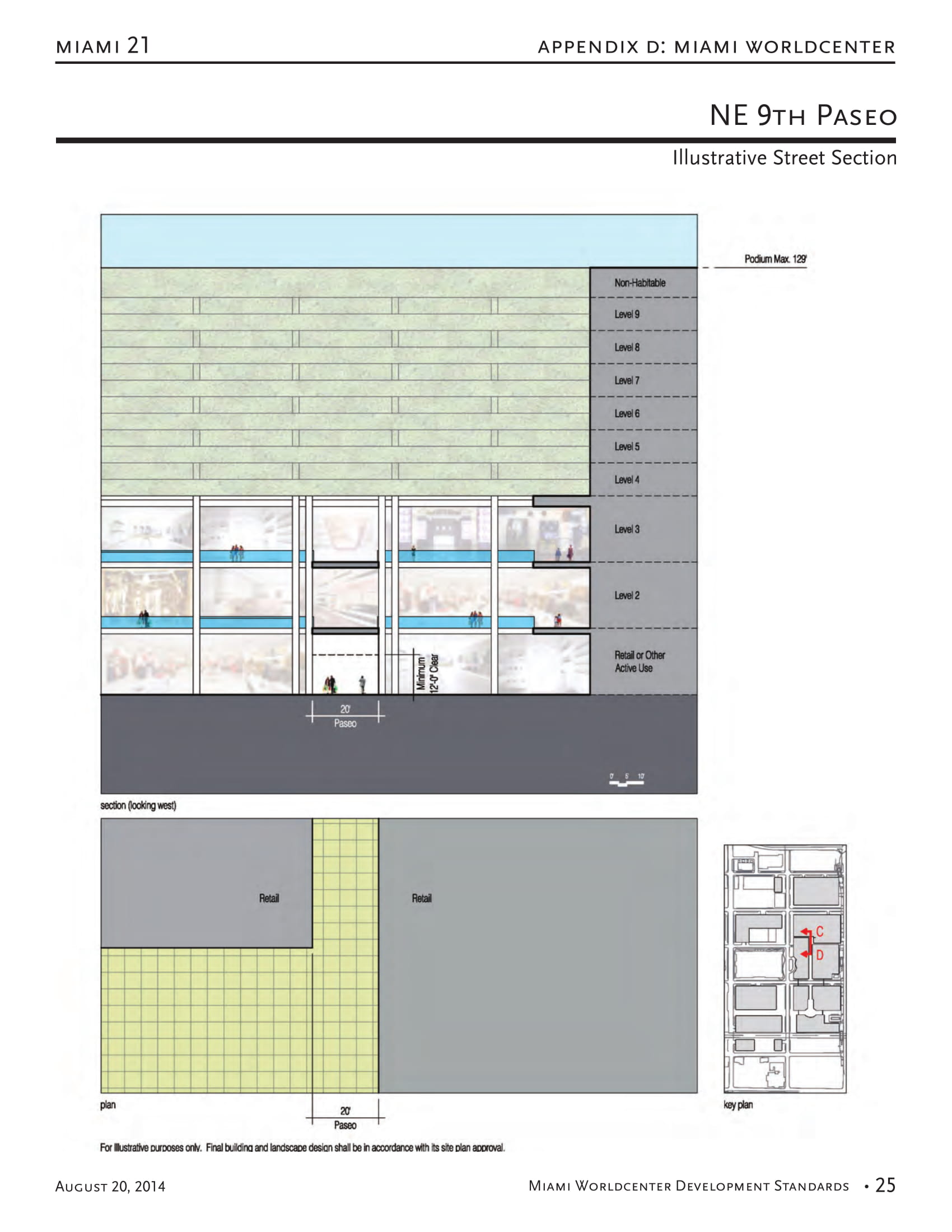
Paseo: An access way limited to pedestrian and controlled vehicular access connecting streets, plazas, alleys, garages and other public use spaces. Paseos must have a minimum width of 20 feet and may be enclosed or otherwise secured. Paseos will remain open to the public during regular business hours but may besecured during non-business hours.
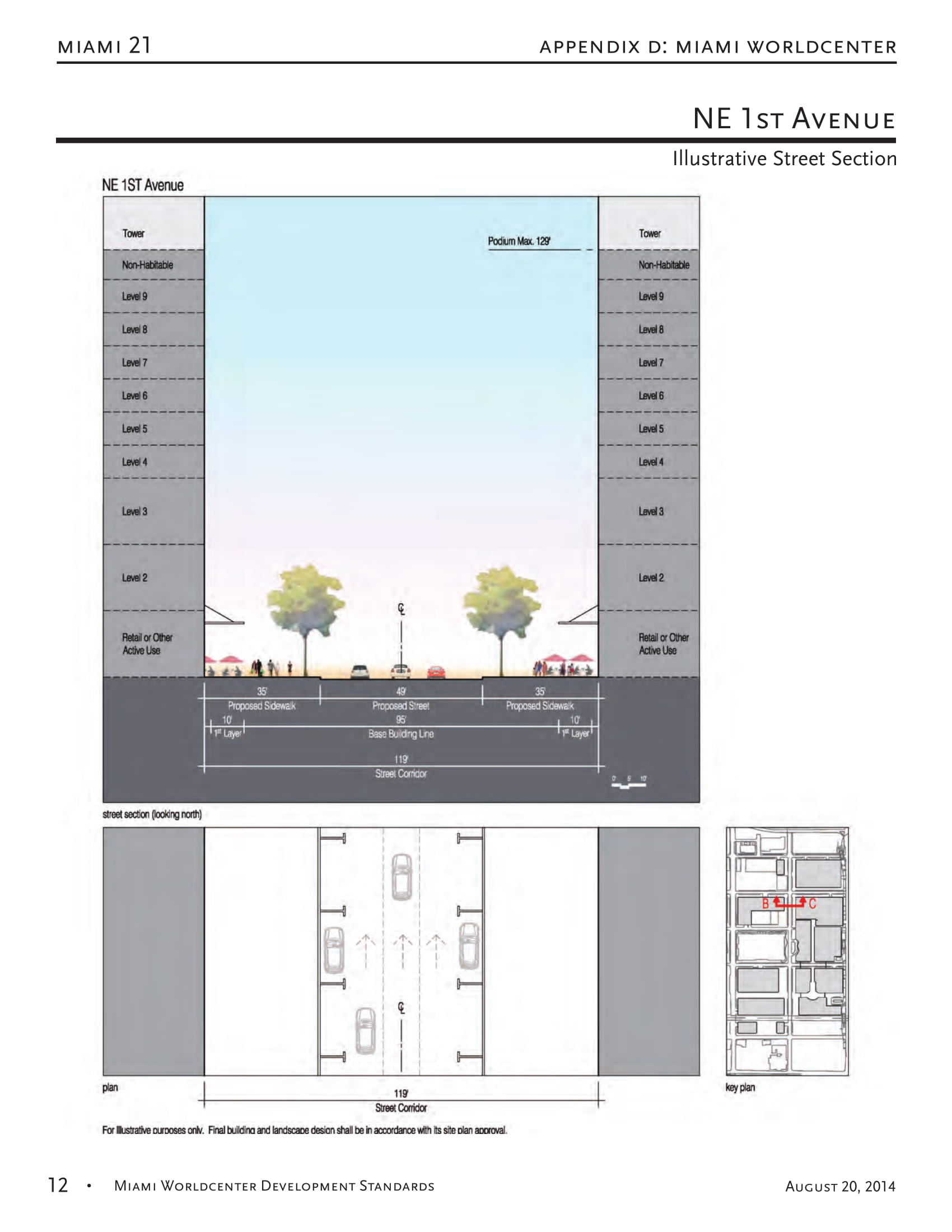
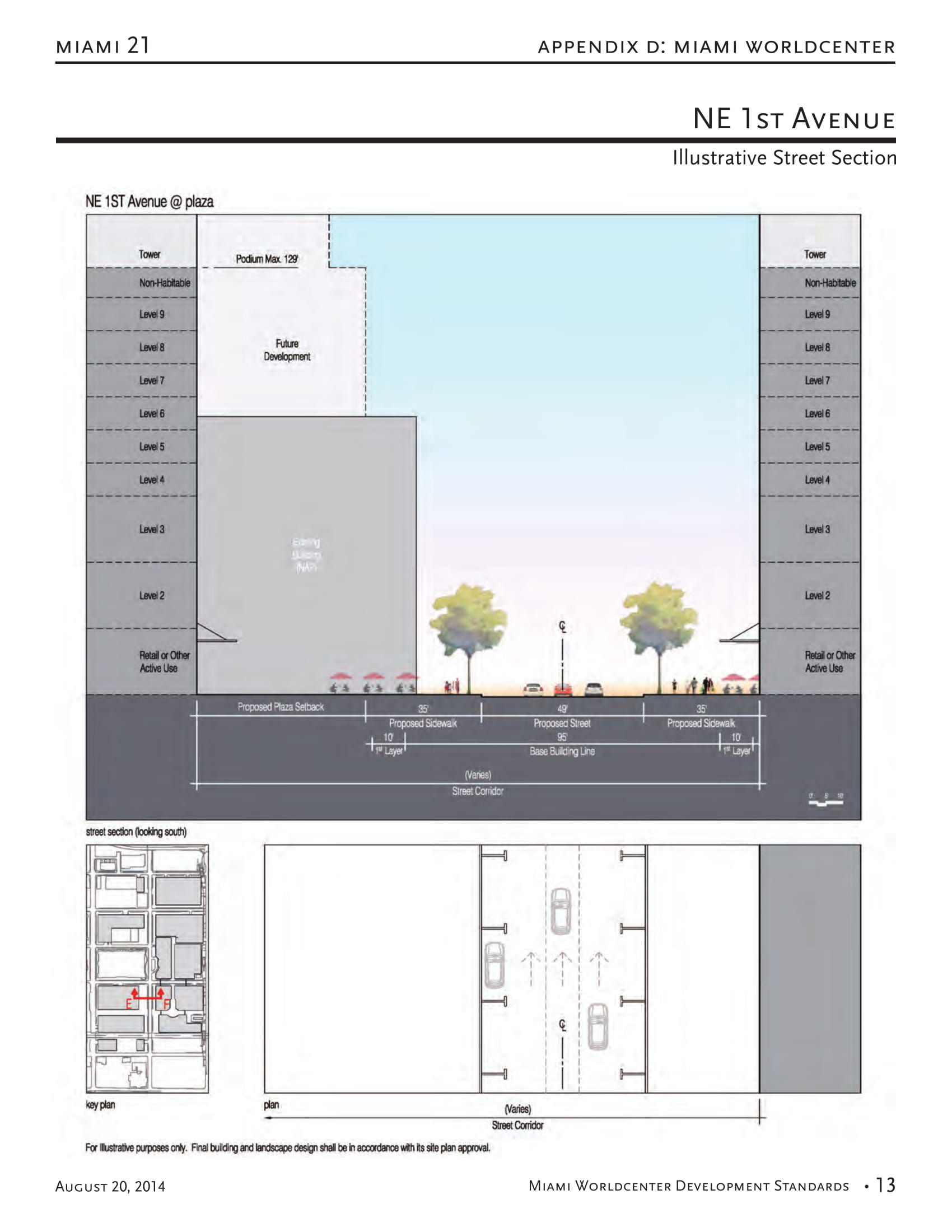
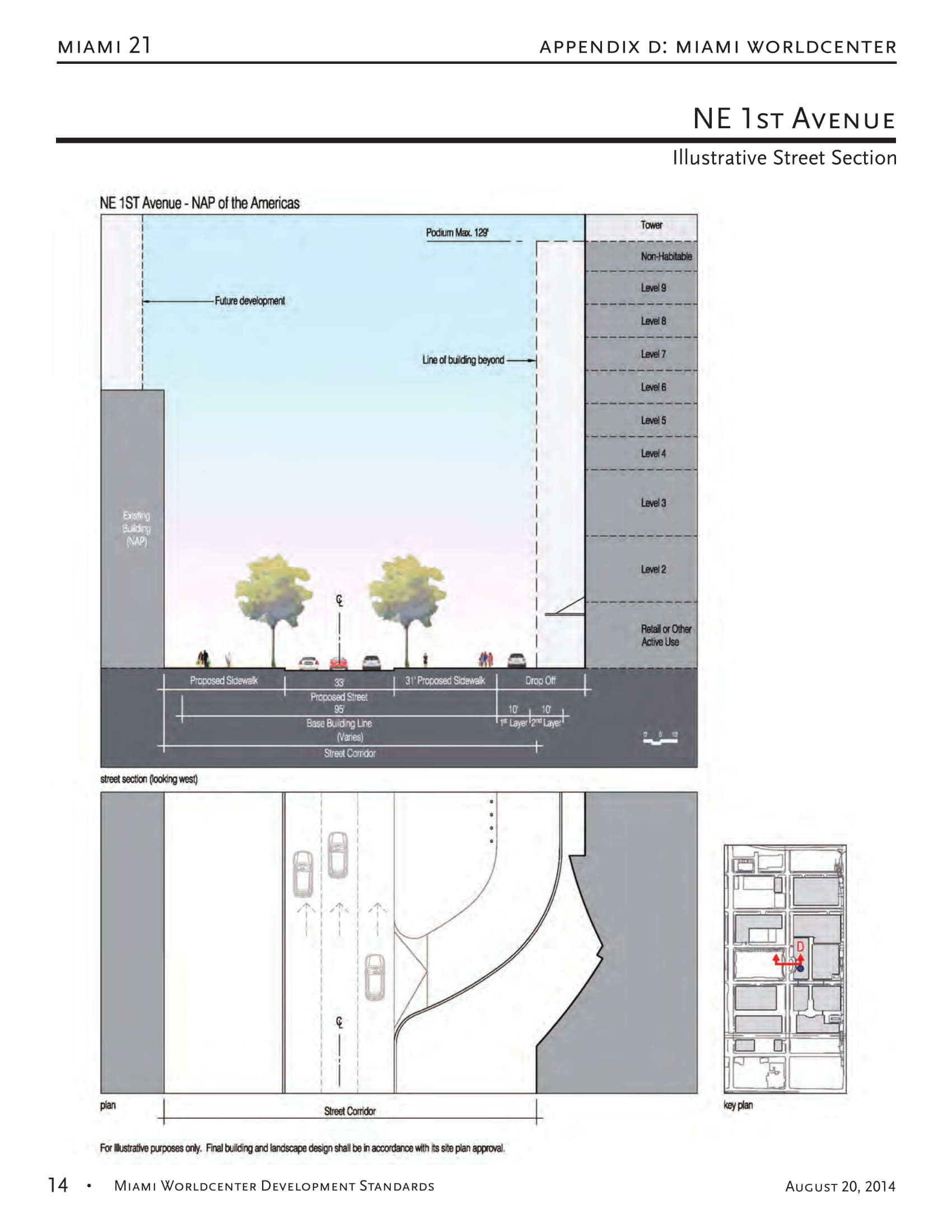
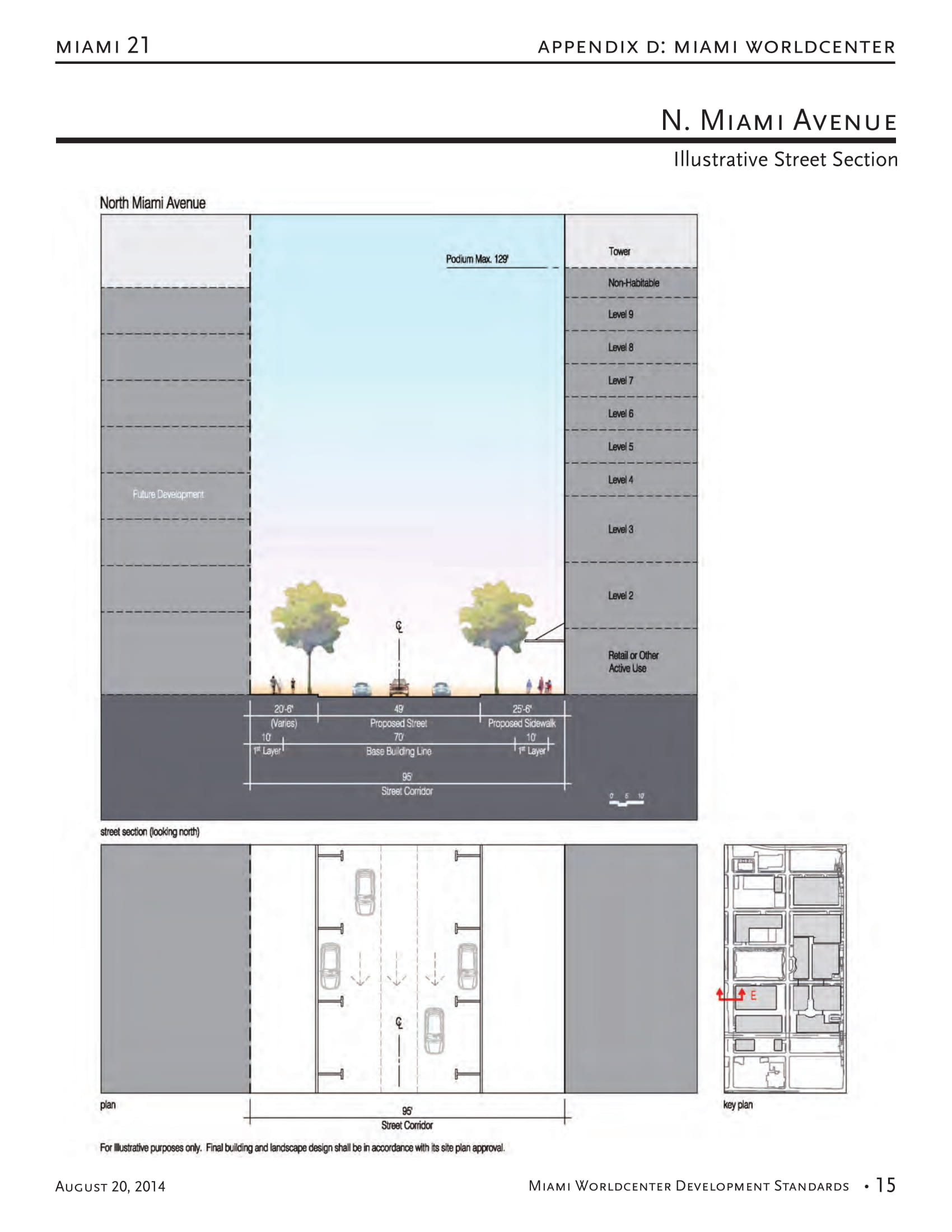
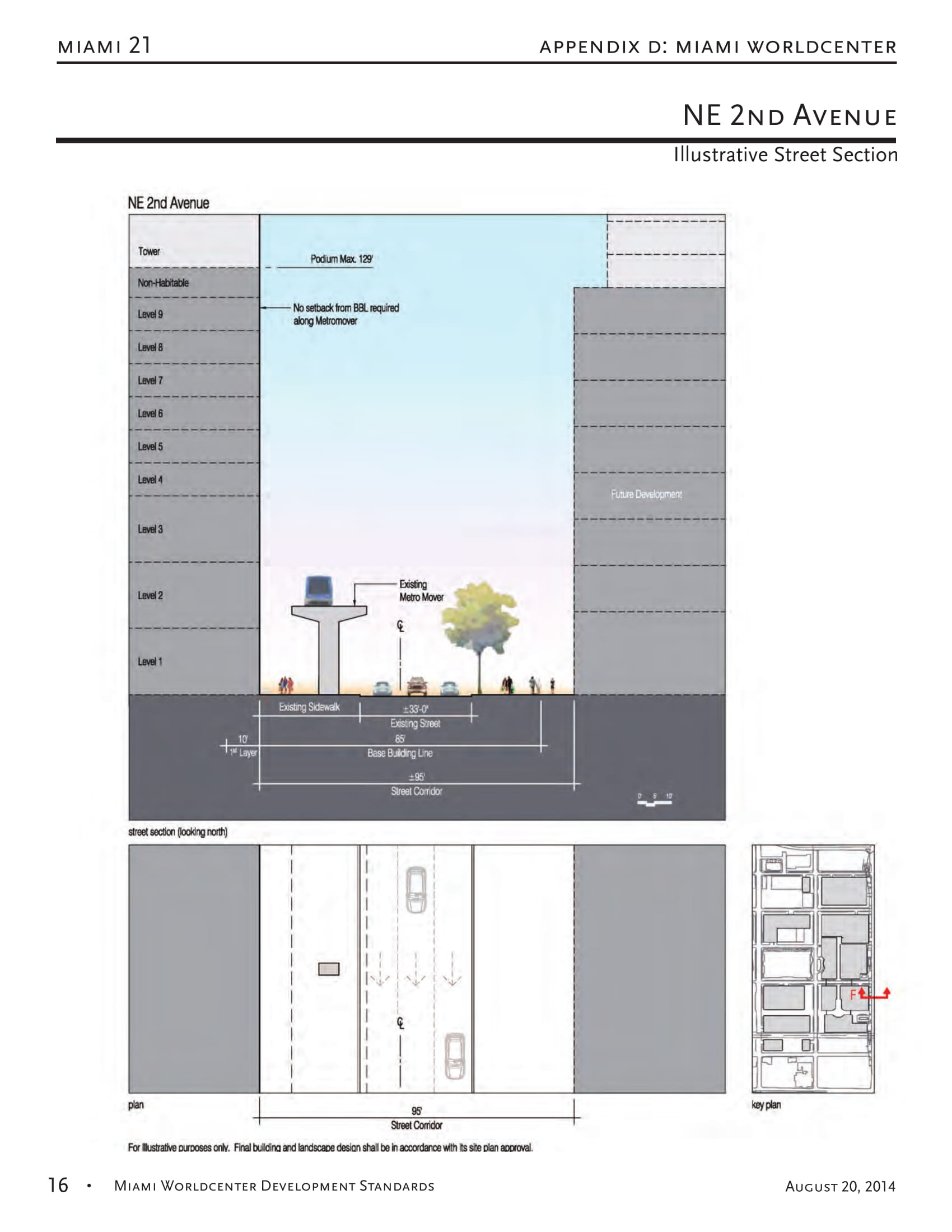
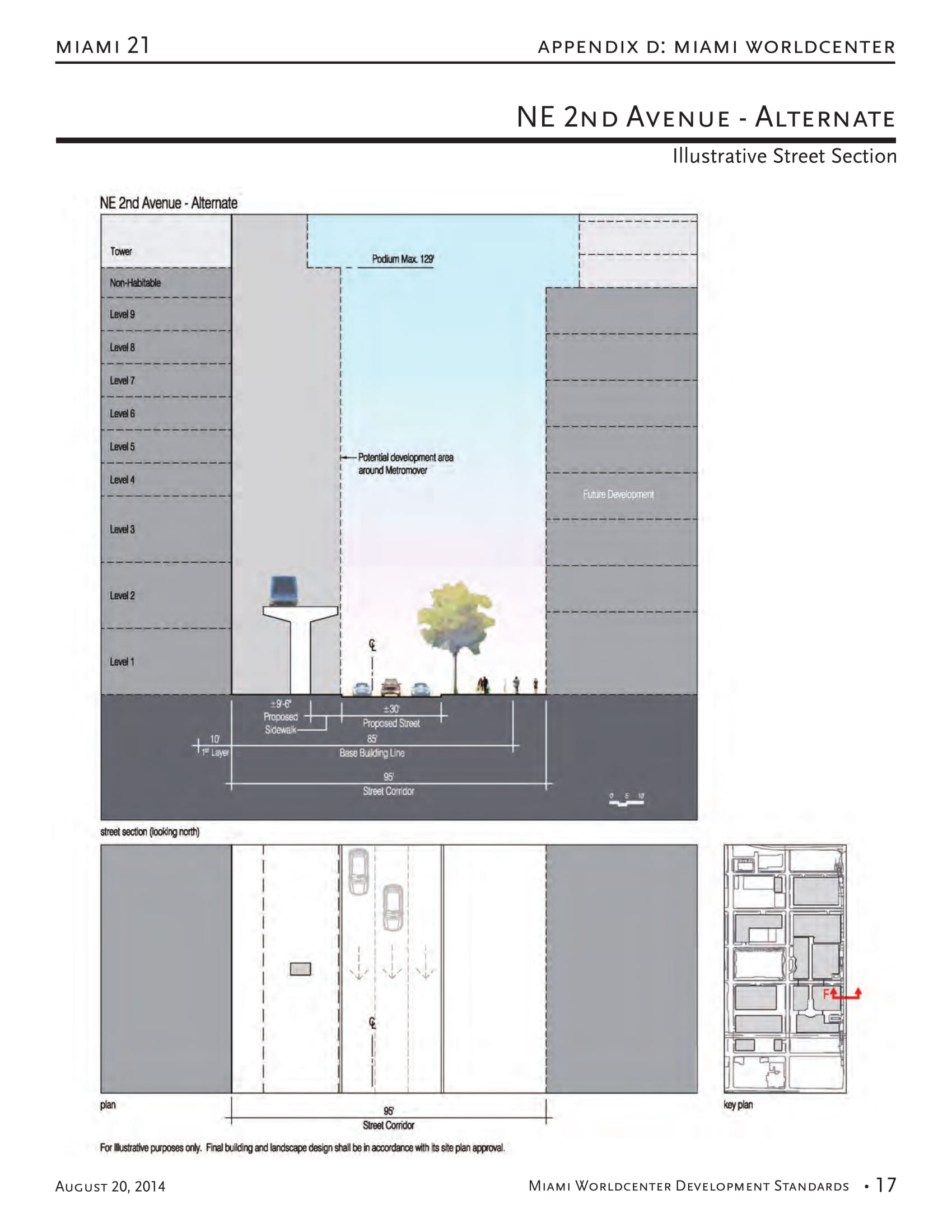
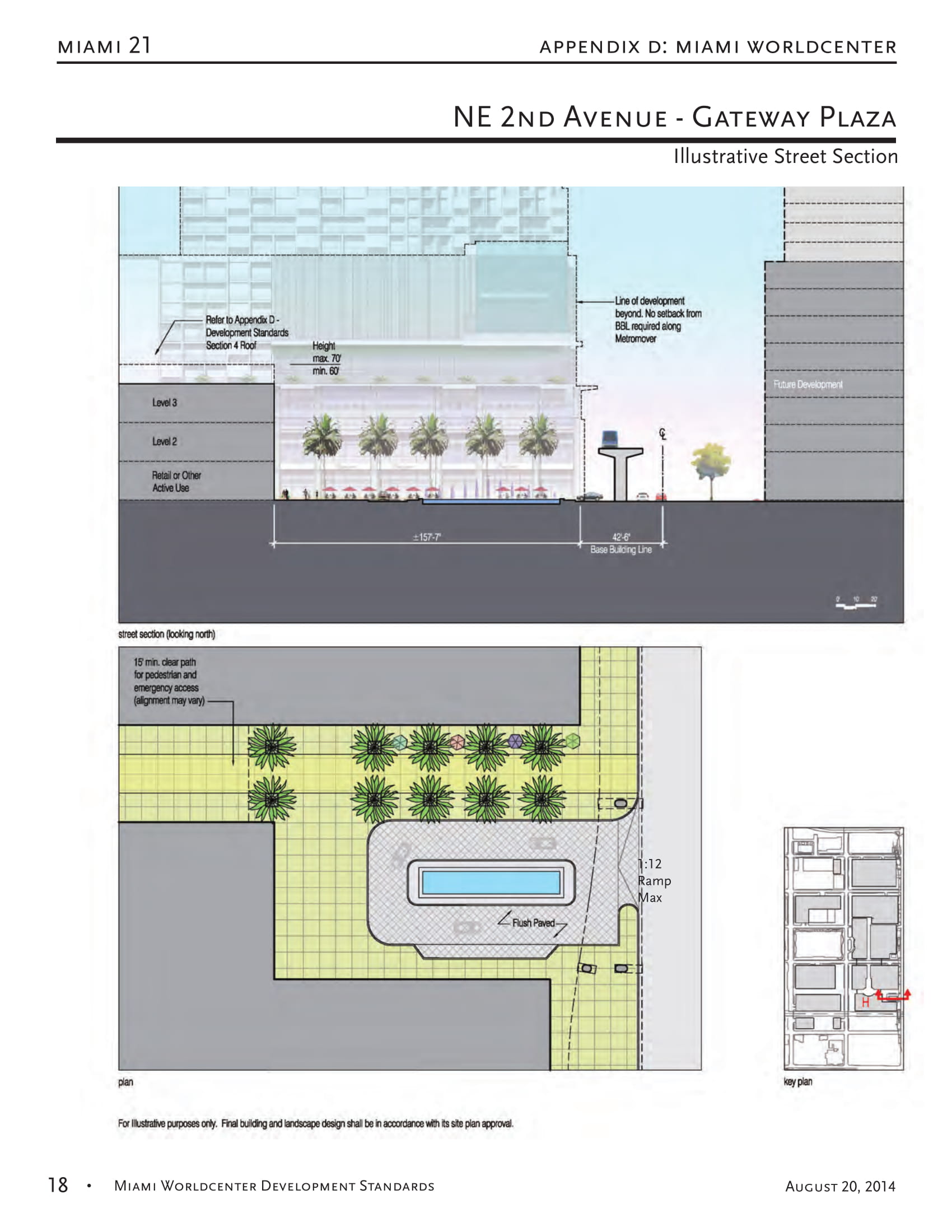
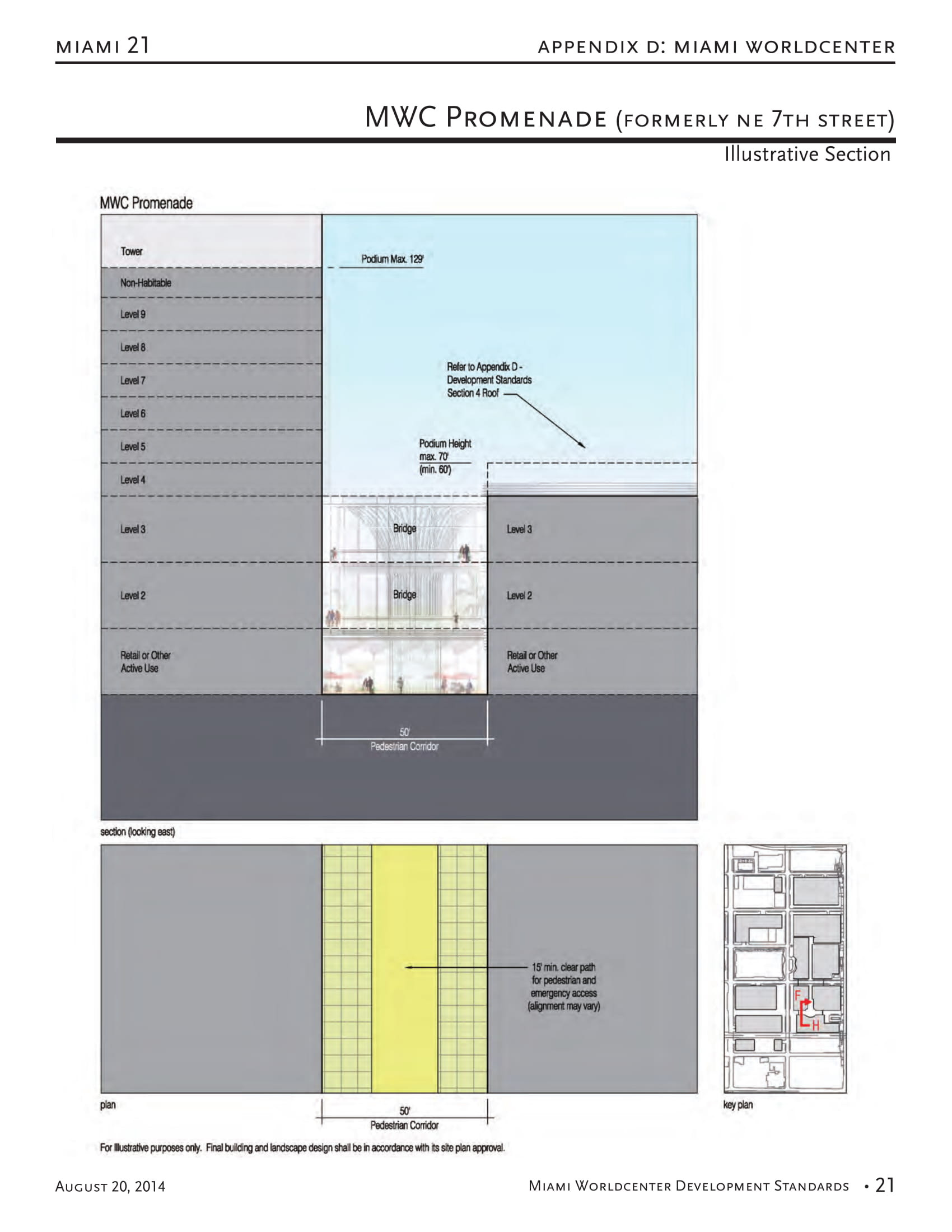
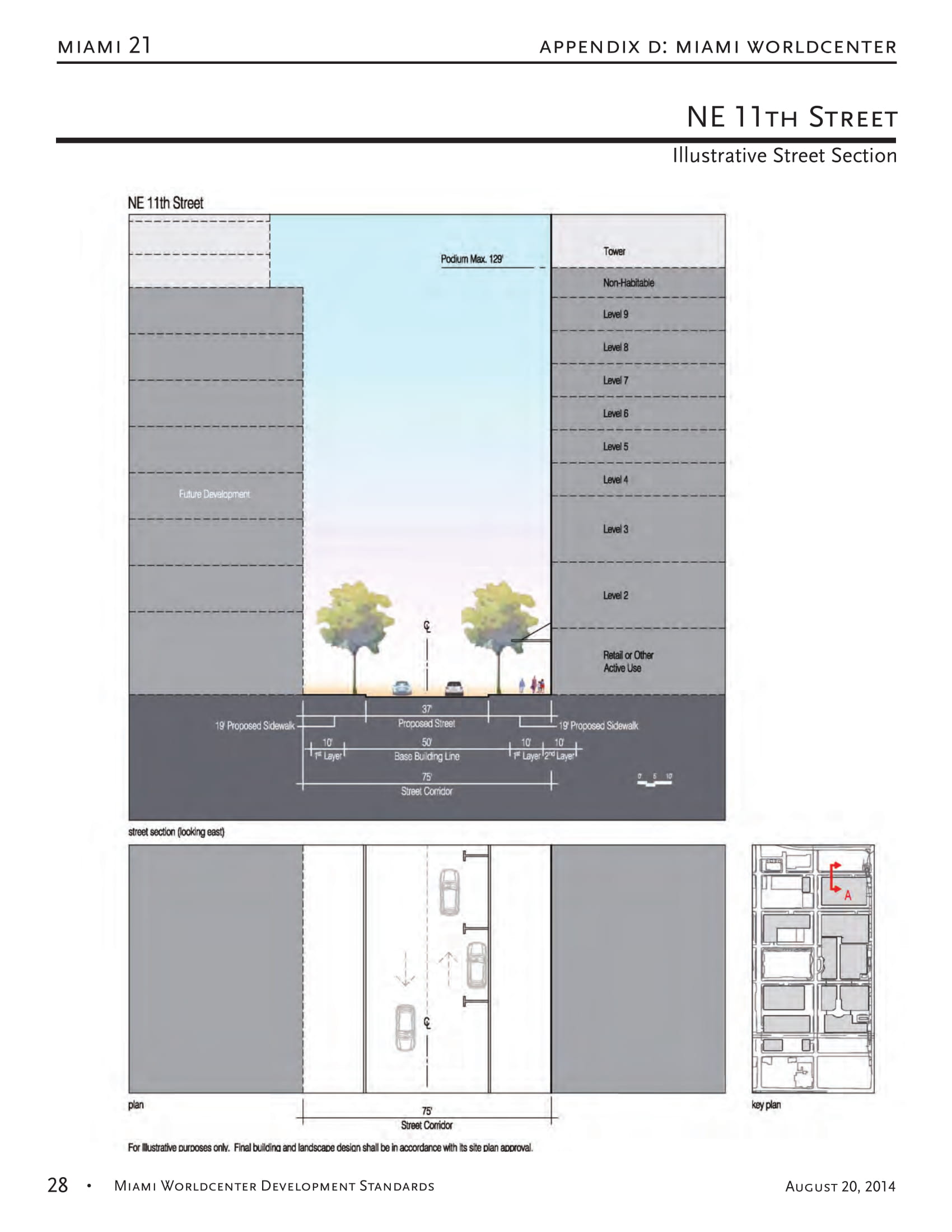
Podium: That portion of a building up to the 129 feet, as measured from the averageelevation of the crown of the adjacent right-of-way.
PorteCochere:A vehicular entrance/drop-off area that includes a canopy element and a driveway that extends into the First Layer.
Public Benefits Bonus: An advantage that allows a developer to increase FLR by an additional 50% of FLRcapacity within the Miami Worldcenter are in exchange for the developer’s contribution to specified programs that provide benefit, advantages, and increased use and enjoyment of the district to the public.
Public Parking: A structured parking facility or portion thereof or garage available to the general public for parking motor vehicles and bicycles.
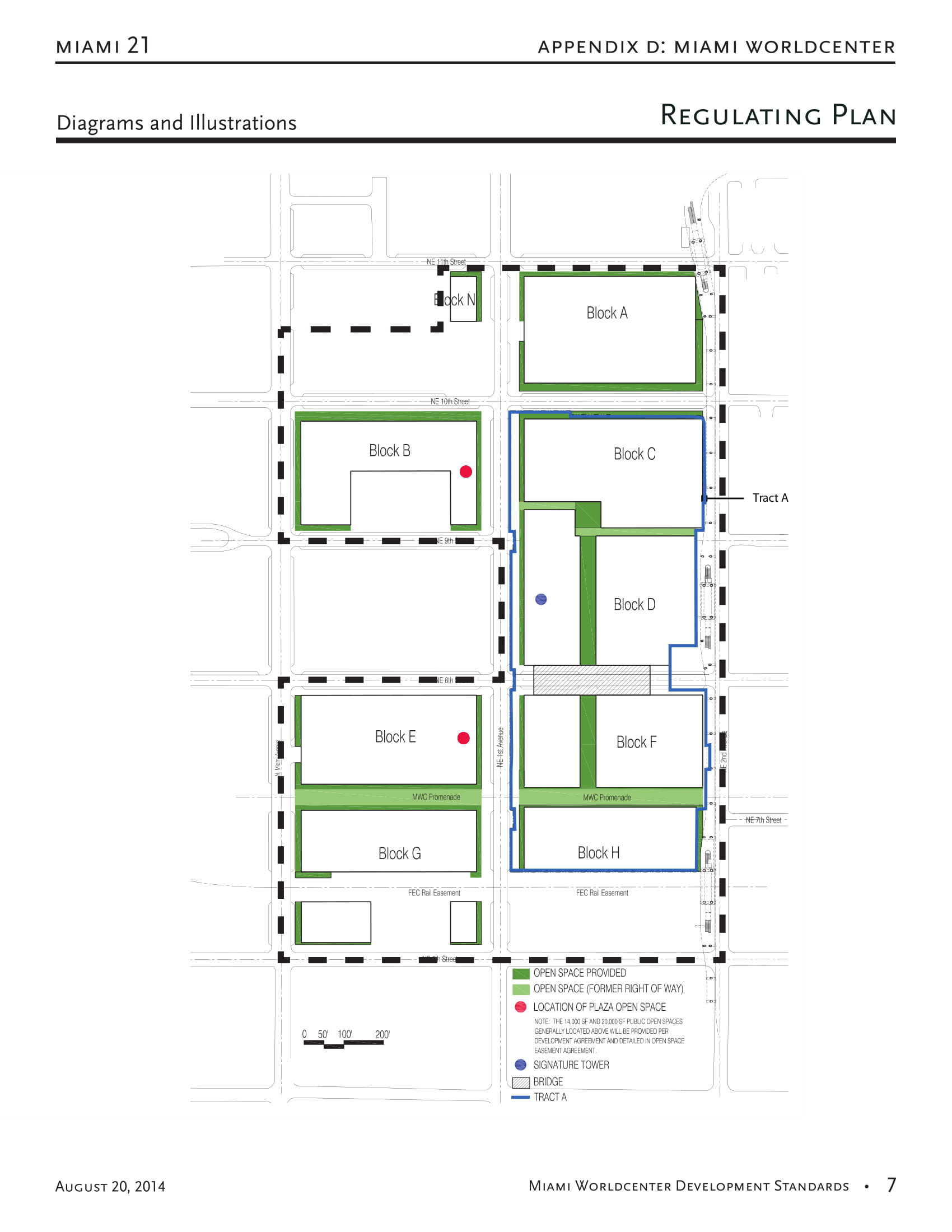
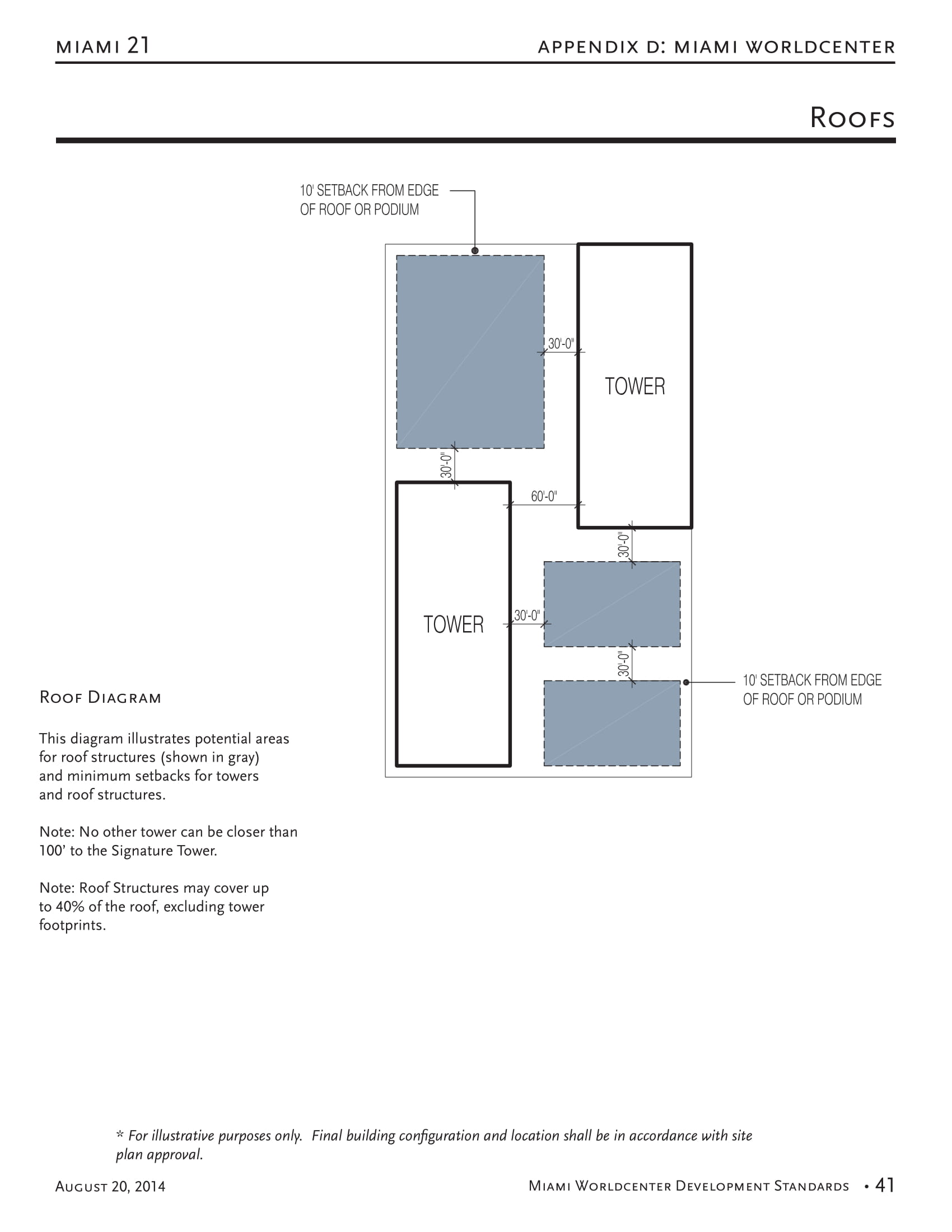
Signature Tower:The Miami Worldcenter Signature Tower shall be a distinct and unique Tower to belocated on Tract A of the Miami Worldcenter Plat which shall front on NE 1st Avenue andmaintain a minimum distance of 100 feet from any other Tower located on Tract A as shownon the Regulating Plan within the Development Standards.
Special District Permit: The Special District Permit shall be an administrative permit as described inSection 3(c) of this Article.
Stepback: Offset in the facade of the Podium as depicted in the Development Standards.
Street Corridor: The space defined by the Streetwall (building facades) and the ground plane in between the Streetwalls.
Streetscape: The urban element that establishes the major part of the public realm. The streetscape is composed of Thoroughfares (travel lanes for vehicles, parking lanes for cars, and sidewalks or paths for pedestrians) as well as the amenities of the Frontages (street trees and plantings, benches, street- lights, paving, street furniture, Building Facades and elevations, yards, fences, etc.).
Streetscreen: A freestanding wall no greater than eight feet high built along the Frontage Build-to line, or co- planar with the Facade, often for the purpose of masking a parking lot from the Thoroughfare.
Streetwall:Refers to the facades of buildingsthat face a Thoroughfare, as provided in the Development Standards. Streetwalls shape the level of visual interest on each block and create a sense of enclosure for pedestrians. A streetwall height is measured from the average grade of the sidewalk level to the first building Setback from the Base Building Line, as shown in the Development Standards.
Tract A:The area encompassed and depicted in the Miami Worldcenter Plat and generally boundedby NE 10th Street on the north, NE 7th Street on the south, NE 2nd Avenue on the east, and NE 1st Avenue on the west and as shown on the Regulating Plan in the DevelopmentStandards.
Thoroughfare: A vehicular way incorporating travel lanes for vehicles, parking lanes for cars, and sidewalks or paths for pedestrians as part of an interconnected network for vehicular and pedestrian mobility.
Tower: That portion of a building that extends above the Podium, excluding Roof Structures as described in the Development Standards.
Section 6. LOTS AND FRONTAGES
Section 6 (a) Buildable sites shall Enfront a vehicular Thoroughfare, or Civic Space with at least one Frontage, as depicted in the Development Standards.
Section 6 (b) For the purposes of the Miami Worldcenter area, lots are divided into Layers which control development on the lot.
Section 7. MEASUREMENT OF HEIGHT
Section 7 (a) Unless otherwise specified herein, the Height of Buildings shall be measured in Stories. The Height of fences, walls and hedges shall be measured in feet. The Height of Building facades facing the street, fences, walls, and hedges shall be measured from the Average Sidewalk Elevation or Base Flood Elevation as established by FEMA.
Section 7 (b) Story is a habitable level within a Building. Except as otherwise provided in this Ordinance, the maximum Height of a Story from finished floor to finished floor is 14 feet. Basements that are fully below-grade are not considered Stories for the purposes of determining Building Height.
Section 7 (b)(1) A ground level retail Story may exceed the 14 foot limit up to 25 feet. Where the first two (2) Stories contain retail uses, the maximum combined Height shall be limited to 40 feet and the first floor shall be a minimum of 14 feet. Where the first three stories are retail, their total maximum combined Height shall be 60 feet and the ground floor and second floor shall be a maximum of 40 feet in combined floor to floor Height. The three retail floors shall be counted as 3 Stories, and the total finished floor to finished floor Height of the Podium shall not exceed 129 feet.
Section 7 (b)(2) Single floors within a Podium above ground level used for public functions, such as ballrooms, meeting rooms, convention halls, classrooms, lecture rooms, theaters, and sports facilities may have a single Story floor to floor Height up to a maximum of 60 feet. The total finished floor to finished floor Height of the Podium shall not exceed 129 feet.
Section 7 (b)(3) Mezzanines are permitted. Mezzanines larger than thirty-three percent (33%) of the Floor Area of the Floorplate below shall be counted as an additional floor.
Section 7 (b)(4) A Parking Structure or a portion of a structure containing parking, concealed by a Liner or Architectural Screening Layer may be equal to the Height of the Podium, without regard for the number of Stories in the Parking Structure as further defined in the Development Standards.
Section 7 (c) Building Heights shall be measured in Stories and shall conform to Table 3 and to the Development Standards. First-floor elevation shall be at average Sidewalk grade. A first level Residential use or Lodging use shall be raised a minimum of two (2) feet and a maximum of three and a half (3.5) feet above average street grade, except that entrance lobbies and public spaces may be at sidewalk level.
Section 7 (c)(1) Except as specifically provided herein, the Height limitations of the Miami Worldcenter area shall not apply to (1) any Structures for housing elevators, stairways, tanks, ventilating fans or similar equipment required to operate and maintain the Building (provided that such Structures shall not cover more than twenty-five percent (25%) of roof area; (2) water towers, flagpoles, vents, or similar Structures, which may be allowed to exceed the maximum Height by Warrant; or (3) fire or parapet walls. Trellises may extend above the maximum Height up to fourteen (14) feet.
Section 7 (c)(2) Except as provided in Subsection (d), there shall be no Height or coverage limits for (1) non- functional decorative architectural elements, and (2) solar or wind energy collectors.
Section 7 (d) No Building or other Structure shall be located in a manner or built to a Height which constitutes a hazard to aviation or creates hazards to persons or property by reason of unusual exposure to aviation hazards. In addition to any Height limitations established by the Miami Worldcenter area, limitations established by the Miami-Dade County Height Zoning Ordinance as stated in Article 37 of the Code of Miami-Dade County (Miami International Airport), as may be amended from time to time, shall apply to Heights of Buildings and Structures.
A letter authorizing clearance from the Miami-Dade Aviation Department and the Federal Aviation Administration (FAA) shall be required by the Zoning Administrator prior to the issuance of any Building permit.
Section 8. BUILDING DISPOSITION
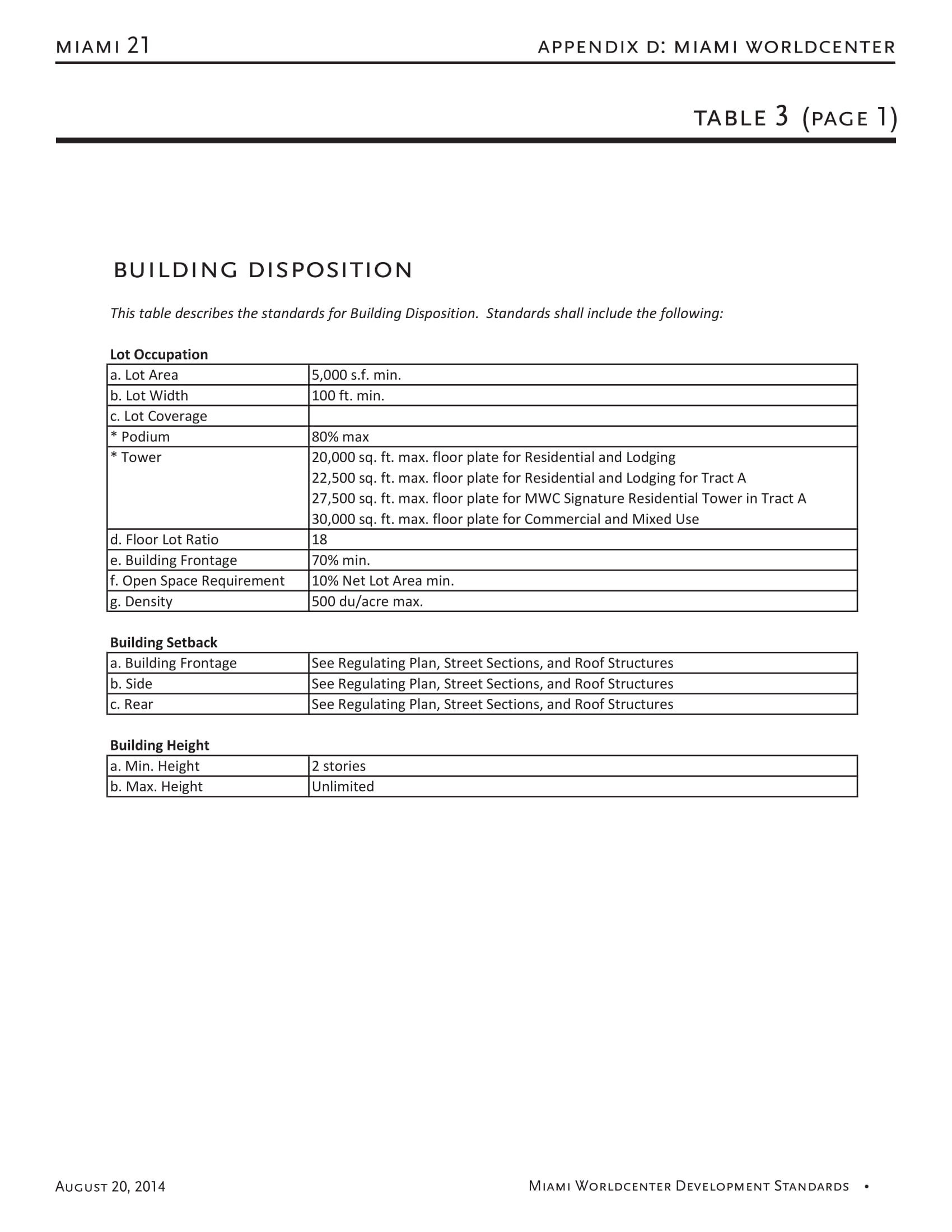
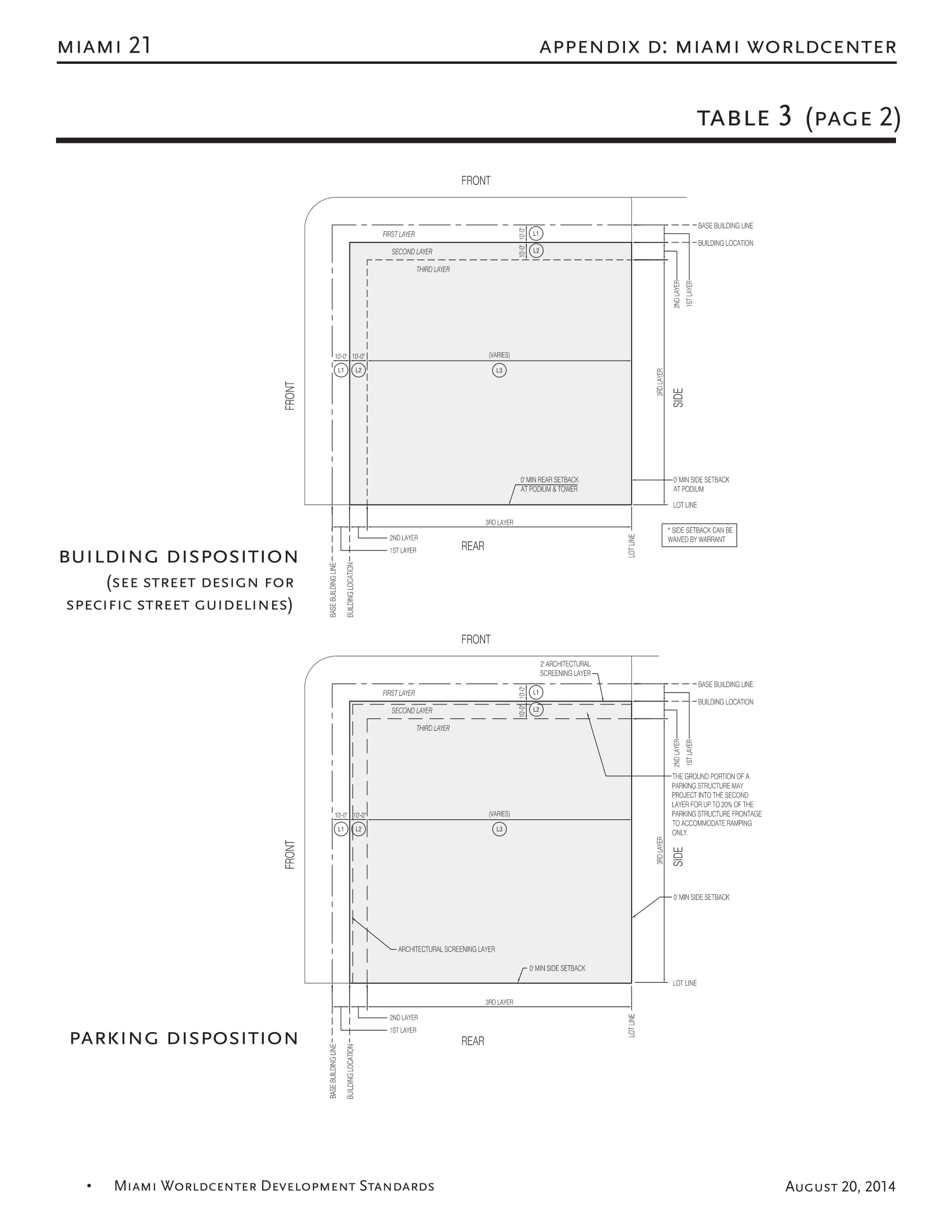
Section 8 (a) Improvements on newly platted lots shall be dimensioned according to Table 3 of the Development Standards
Section 8 (b) Lot coverage by any Building shall not exceed that shown in Table 3 of the Development Standards.
Section 8 (c) Buildings shall be disposed in relation to the boundaries of their lots according to Table 3 of the Development Standards.
Section 8 (d) Buildings shall have their principal pedestrian entrances on a Frontage or from a Courtyard at the Second Layer as depicted in the Development Standards.
Section 8 (e) For the first two (2) Stories, Facades shall be along the Frontage a minimum of seventy percent (70%) of its length on the addressing the Setback Line as shown in Table 3 and in the Development Standards.
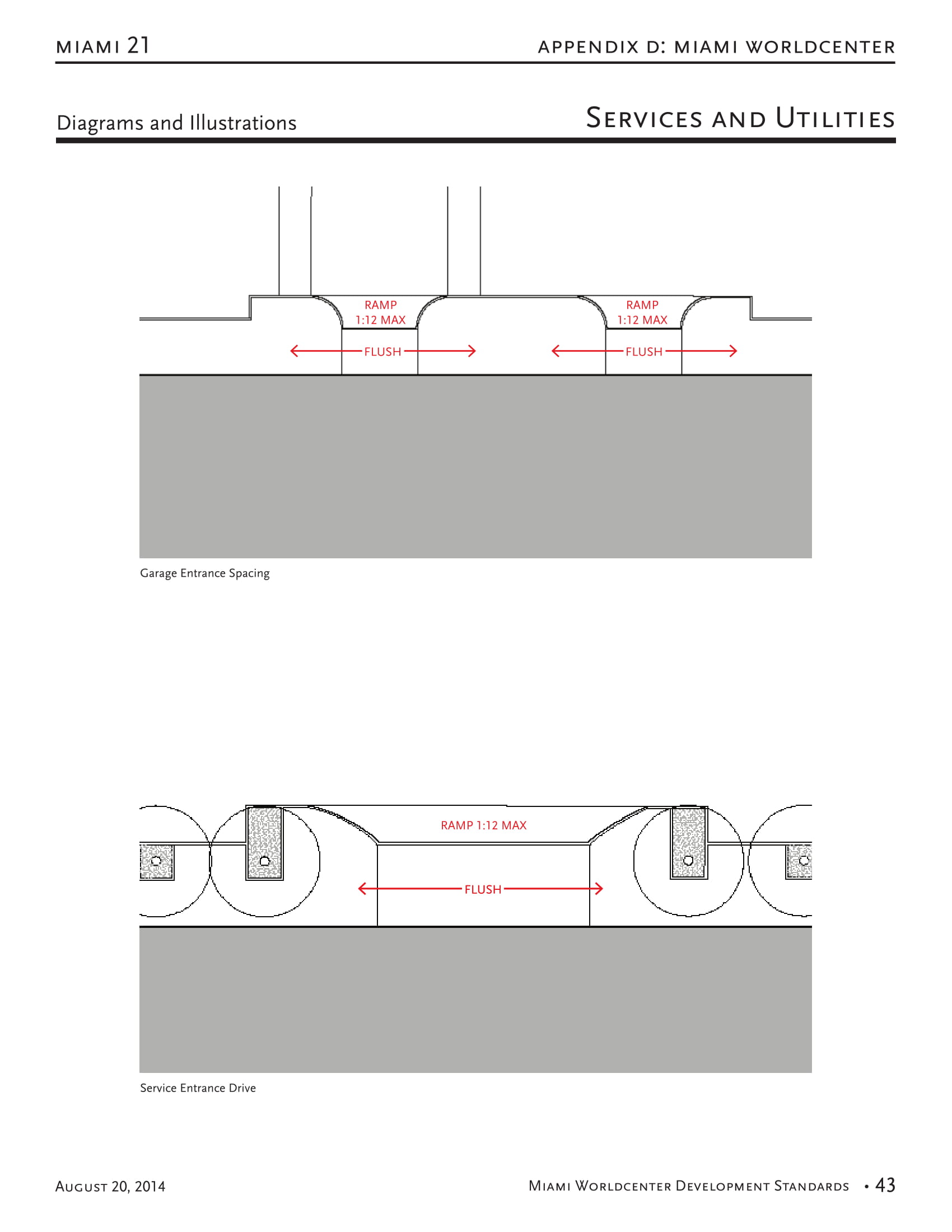
Section 8 (f) At the first Story, Facades along a Frontage shall have frequent doors and windows as provided in the Development Standards. Vehicular entries should be minimized to the maximum extent possible consistent with the level of use and shall occur at a minimum spacing of sixty (60) feet unless a shorter distance is approved by warrant.
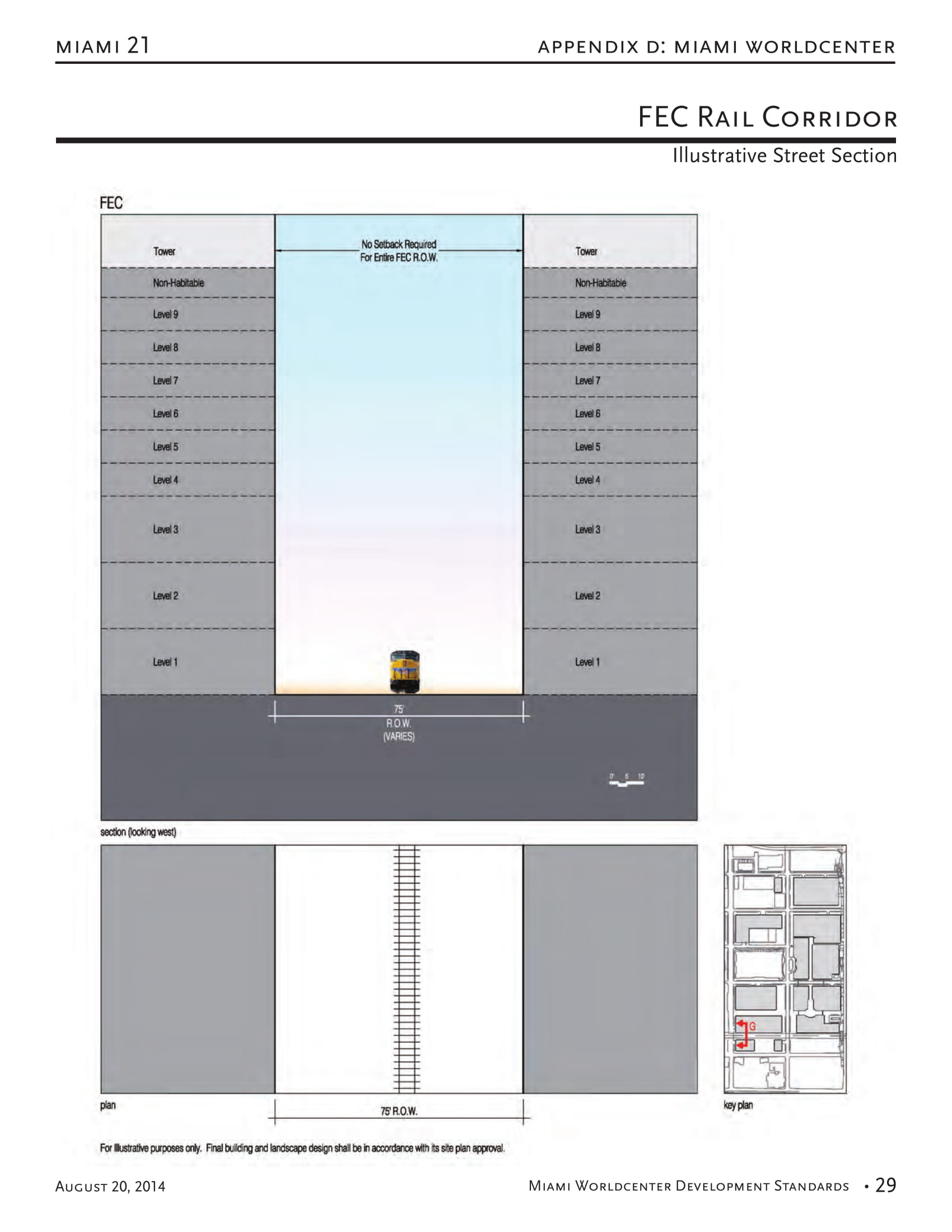
Section 8 (g) Setbacks from the Base Building Line for Buildings shall be as shown in Table 3 of the Development Standards. Setbacks from the Base Building Line may be adjusted to conform to an existing adjacent building location by Warrant. Frontage Setbacks from the Base Building Line above the eighth floor for lots having one dimension measuring one hundred (100) feet or less may be a minimum of zero (0) feet by Warrant. Lots abutting the FEC Railway and the Metromover rail may have a zero (0) foot Setback for the Podium and Tower. The Frontage Setback from the Base Building Line shall not be required for a Frontage facing a Pedestrian Promenade, Plaza, Civic Space or a Street Corridor 90 feet or greater in width, as provided in the Regulating Plan and Development Standards. A heavily landscaped and Streetscreened outdoor vehicle storage area may be located on NE 10th Street between North Miami Avenue and NE 1st Avenue, by Warrant, having a reduced parking placement Setback of only ten (10) feet on all frontages.
Section 8 (h) Above the podium, minimum Tower spacing is sixty (60) feet, except the Signature Tower which shall be spaced a minimum of one hundred feet (100), Tower to Tower. For lots having one dimension of one hundred (100) feet or less along a street Frontage or its longest depth, side and rear Setbacks from non-Frontage lot lines above the Podium may be reduced to a zero (0) feet by Warrant.
Section 9. BUILDING CONFIGURATION
Section 9 (a) Above the Podium, the maximum Tower Floorplate dimensions shall be limited as detailed below. Length of Building shall be measured parallel to the Frontage Line.
20,000 square feet for residential uses
30,000 square feet for Commercial Uses and forparking.
Verticalmixed-usebuildingswithatleast ten percent (10%) oftheTowerfloorshavingCommercialUsesmayuse the 30,000 square foot Floorplate average for the entireTower.
200 linear feet maximum Tower length of a side for Commercial uses or Residential uses
22,500 square feet for Residential Uses and 225 linear feet maximum Tower Floorplate length of a side for Residential Uses on Tract A.
The Signature Tower may contain a Floorplate of up to 27,500 square feet and may have a maximum tower length of 275 linear feet.
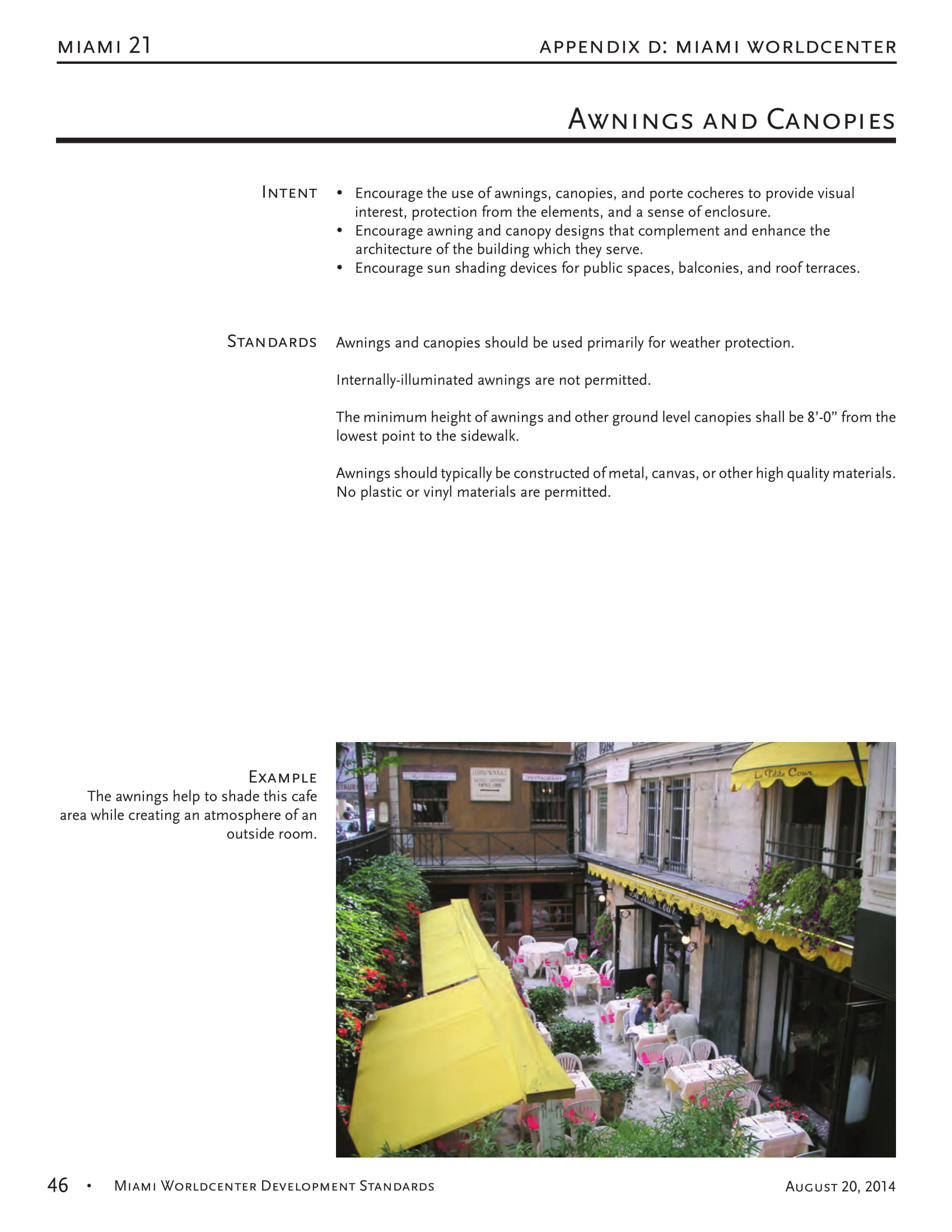
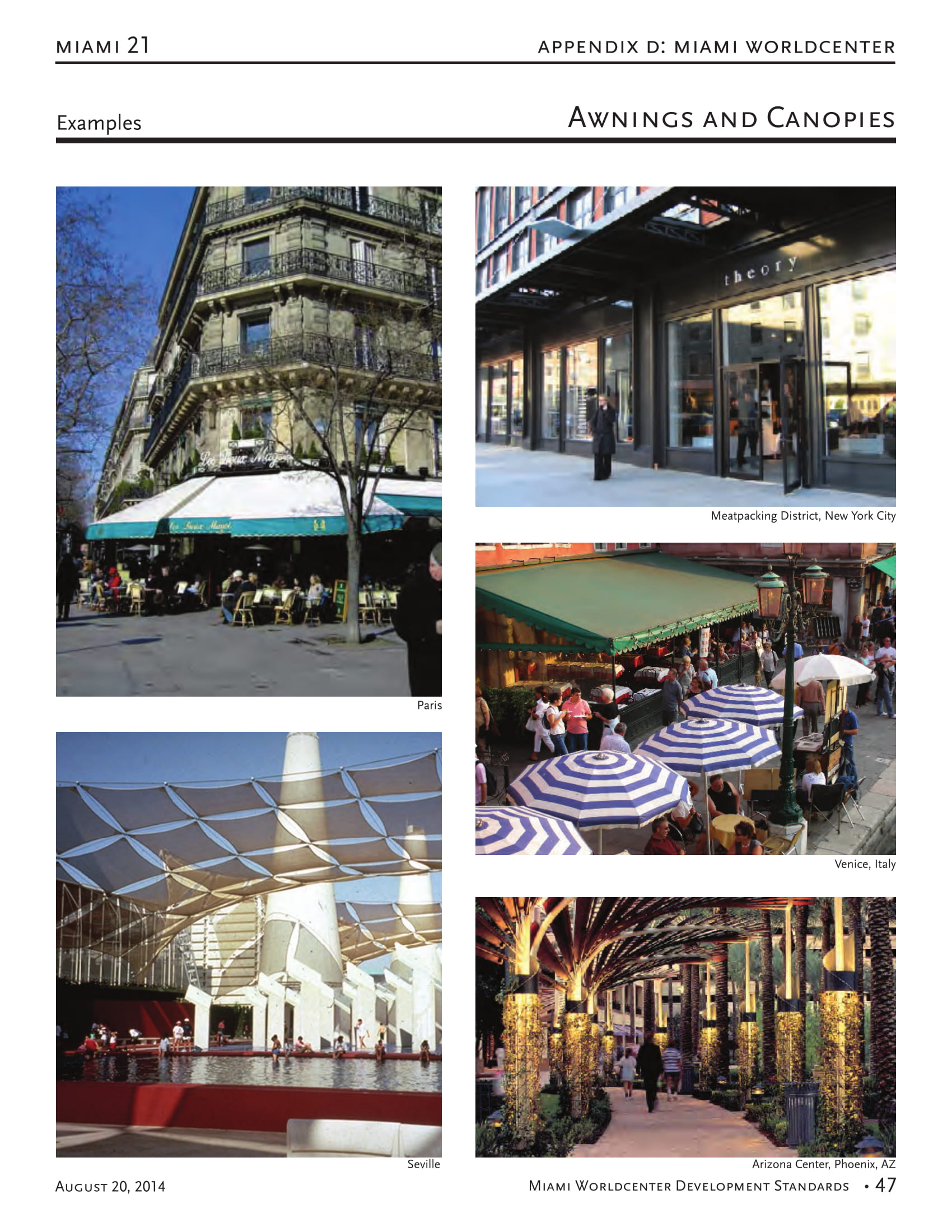
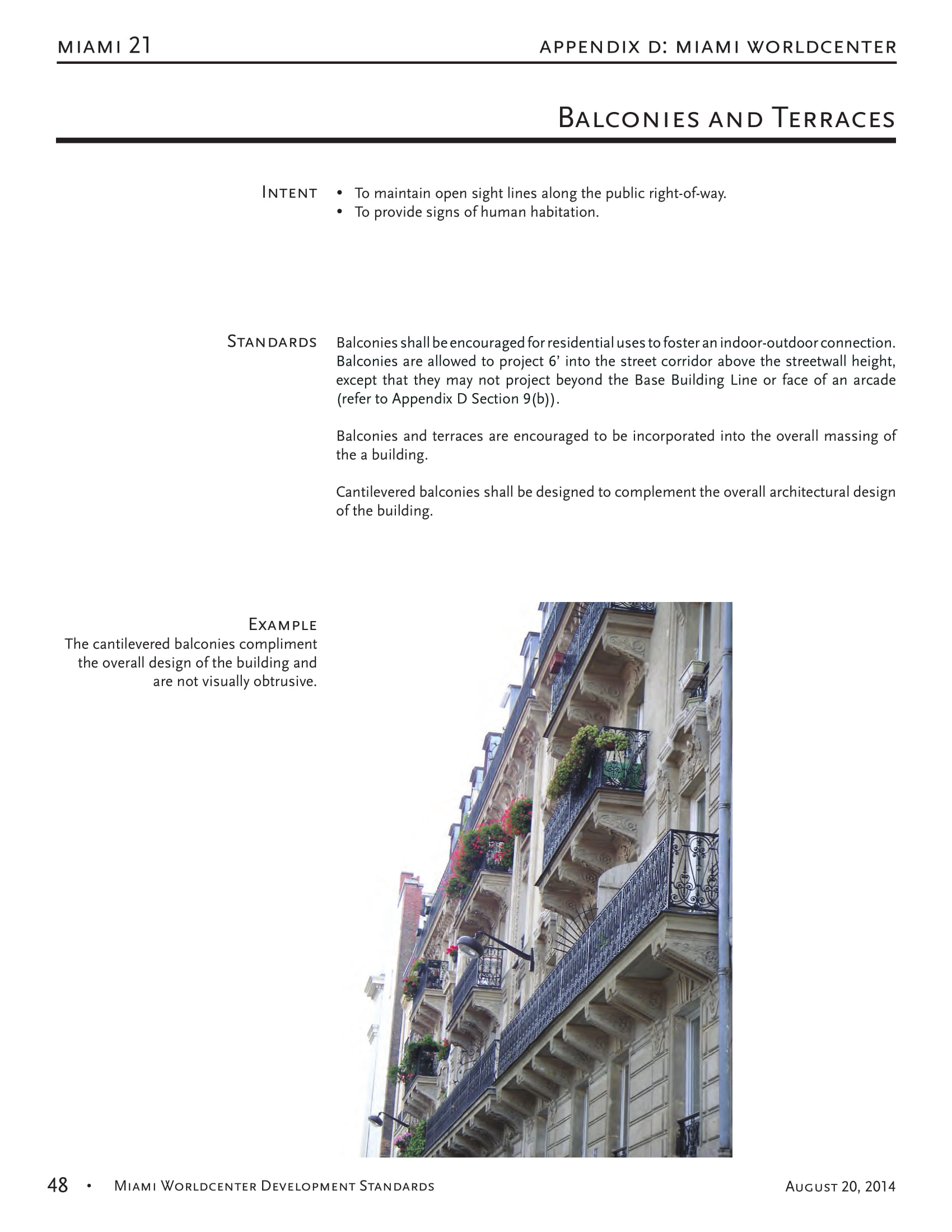
Section 9 (b) Projections into the First Layer shall be as follows: Above the first story, up to ½ of the Streetwall Façade may project up to 6 feet into the First layer; Entry canopies may project up to one hundred percent (100%) of the depth of the First Layer, except as may be further allowed by Chapter 54 of the City Code; Canopies and cantilevered awnings may project into the First Layer; Above the first Story, cantilevered balconies and bay windows may project a maximum 6 feet into the First Layer; Above the Streetwall, balconies and bay windows may project up to 6 feet into the setbackfromtheStreetwall;Roofcantilevers,trellisesandcrownsmayprojectupto15feetintothe First Layer and be elevated one story above the roof terrace; and, Facade components promoting energy efficiency such as shading and Screening devices that are non-accessible may project a maximum of 4 feet into the FirstLayer.
Section 9 (c) Galleries and Arcades shall be a minimum of 15 feet wide, except where the Gallery or Arcade is located uner the Miami-Dade County Transit System then the Gallery or Arcade may be reduced in conformance with that permitted by the Miami-Dade County Transit Authority. The height of an arcade, measured to its lowest point, shall be no less than itswidth.
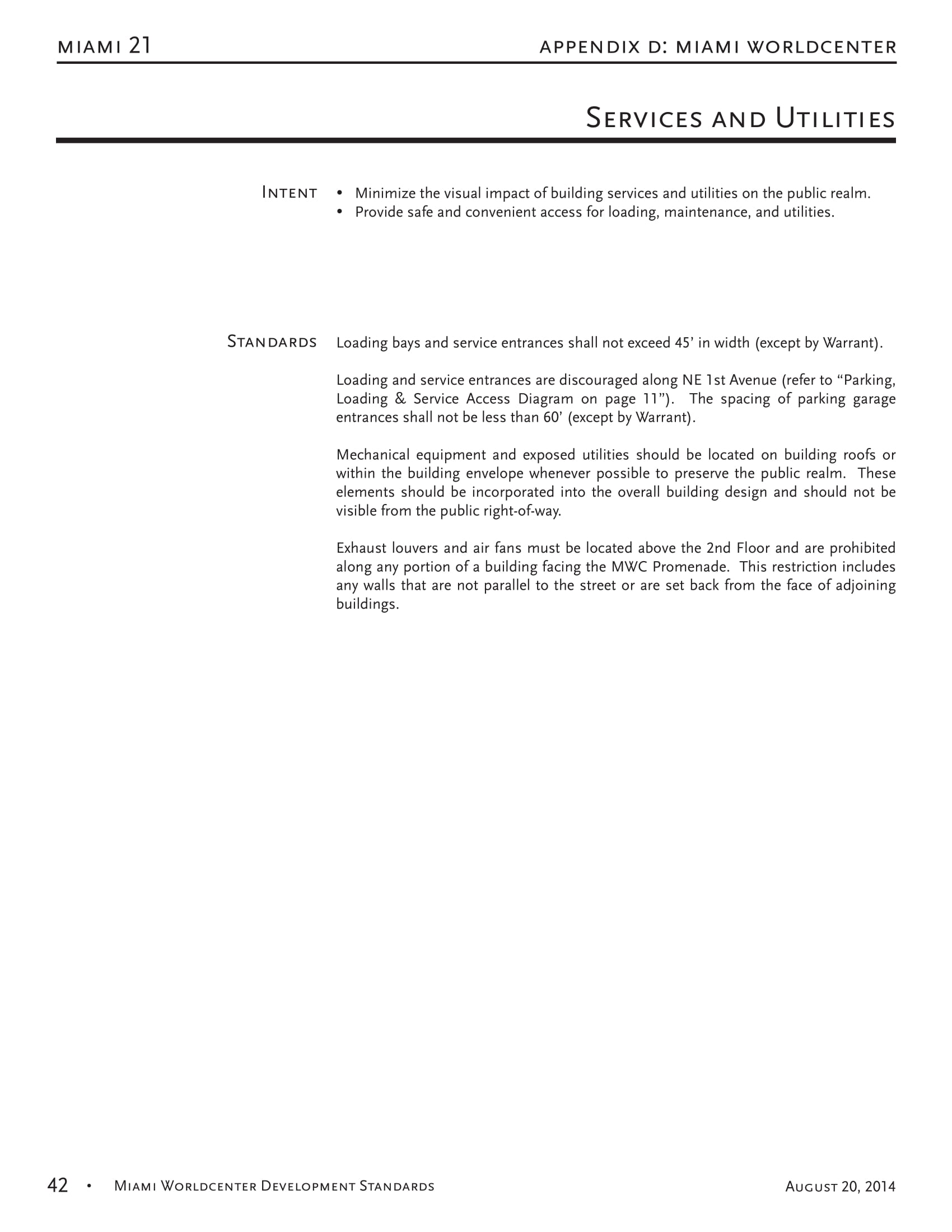
Section 9 (d) All outdoor storage, electrical, plumbing, mechanical, and communications equipment and appurtenant enclosures shall be located within the Second orThird Layer and concealed from view from any Frontage or Sidewalk by Liner Buildings, walls, Streetscreens, or opaquegates.
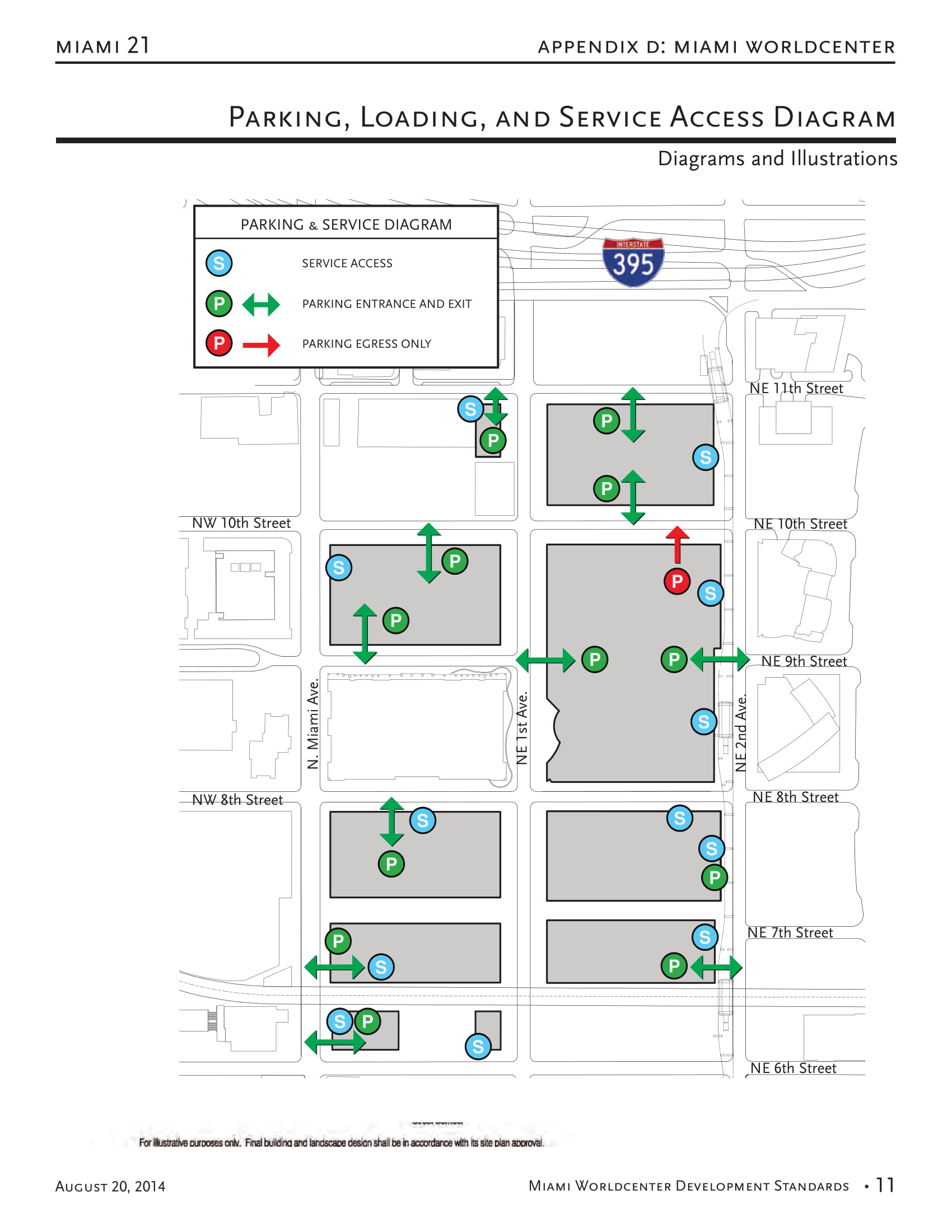
Section 9 (e) LoadingDocksandserviceareasshallbeinternaltothebuildingserved.Required loading Spaces may be reduced by process of Warrant upon submittal of a shared service management plan. Vehicularentriestoloading docks and service areas shall be as provided in the DevelopmentStandards, Parking, Loading, and Service Access Diagram.
Section 9 (f) Allgroundfloorutilityinfrastructureandmechanicalequipmentshallbeconcealedfrompublicview. AtthebuildingFrontage,allequipmentsuchasbackflowpreventers,Siameseconnections,andthe like shall be placed within the line of the Facade or behind the Streetscreen. Exhaust air fans and louversmaybeallowedontheFacadeonlyabovethe secondflooras describedinthe DevelopmentStandards, Service and Utilities. Rooftop equipment, except antennas, shall be screened from lateralview.
Section 9 (g) WithintheSecondandThirdLayers,fences,wallsandhedgesshallnotexceedaheightofeight(8) feet; this limitation shall not apply on top of the Podium.
Section 10. BUILDING USE & DENSITY
Section 10 (a) Principal and accessory uses of Buildings shall conform to Article 4, Table 3, Building Function: Uses for T6-O, Urban Core. All uses permitted by Right (R), shall continue to be permitted by Right. Open Air Retail (excluding Flea Markets), Large Scale Retail Establishment, College/University, and Community Facilites shall also be permitted by Right. Alcohol Beverage Establishments shall be permitted pursuant to Chapter 4 of the City Code. All other uses shall conform to the necessary approval as described in Article 4, Table 3.
Section 10 (b) Densities are permitted in accordance with Article 4, Diagram 9, Residential Density Increase Areas within the Park West District, as amended. Lot area, inclusive of dedications, is used for purposes of calculating Density and Intensity. Intensities shall be equivalent to the following:
Floor Lot Ratio (FLR) 18/50% Additional Public Benefit
Section 11. PARKING STANDARDS
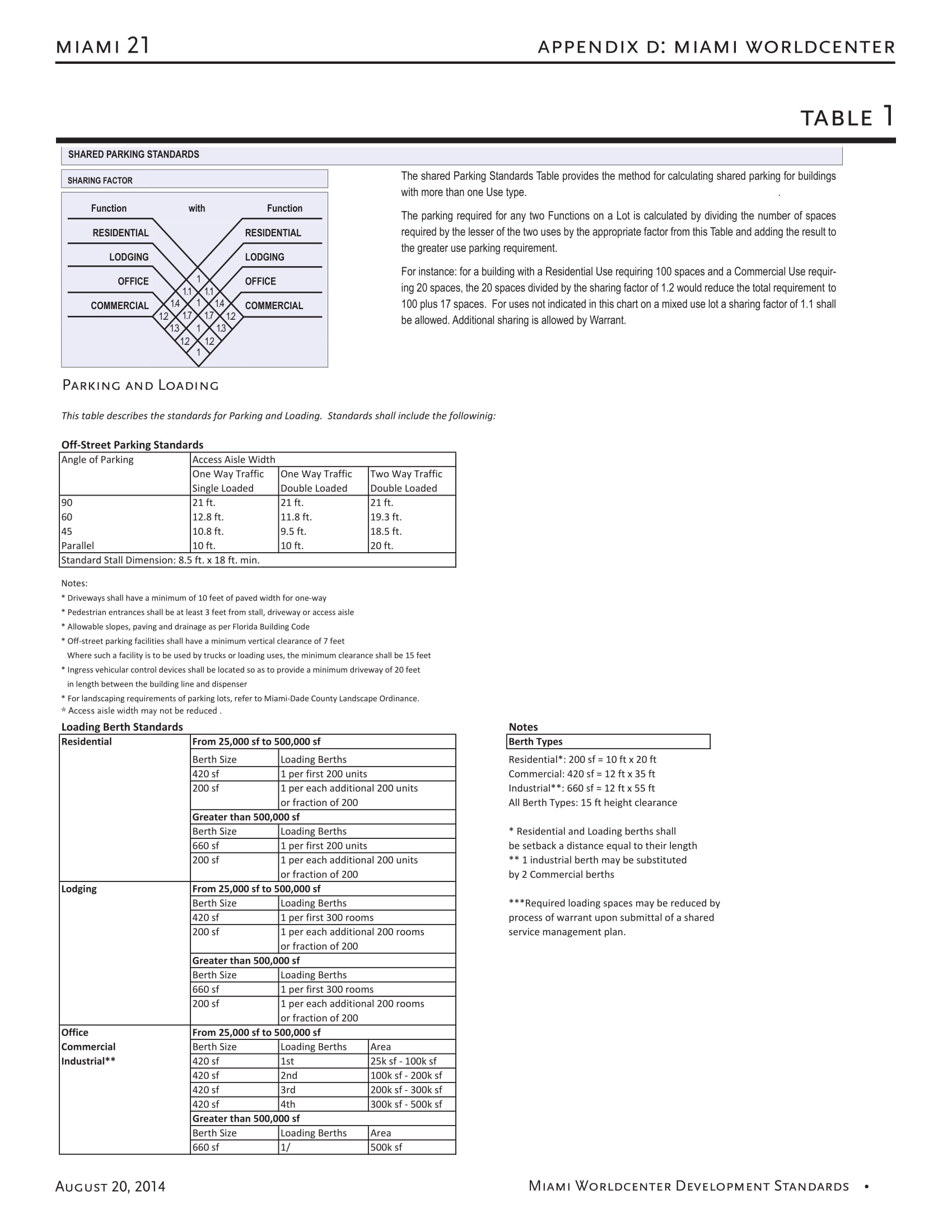
Section 11 (a) The required parking shall be calculated based on the Habitable Rooms of Each Use as follows:
Retail and Commercial 1 space / 1000 sf 1 space / 300 sf
Office 1 space / 1000 sf 1 space / 600 sf
Residential 1 space / dwelling unit 2 spaces / dwelling unit Hotel 1 space / 4 guest rooms 1.5 spaces / guest room
Other 1 space / 1000 sf 1 space / 600 sf
Theater 1 space / 7 seats 1 space / 3 seats
Section 11 (b) On-street parking in the Miami Worldcenter area shall count toward the minimum parking requirements.
Section 11 (c) For residential uses located within 1,000 feet of an existing Metromover stop, no off-street parking is required. Parking may be reduced as described in Article 4, Table 4 of Miami 21, as may be amended.
Section 11 (d) Vehicular parking and loading shall be required as shown in Table1 of the Development Standards.
Section 11 (e) Required Parking and loading shall be accessed as detailed on the Parking, Loading, and Service Access Diagram of the Development Standards unless approved by Warrant.
Section 11 (f) All parking, including open parking areas, covered parking, garages, Loading Docks and service areas shall either be located within the Third Layer or shall be masked from the Frontage by (1) an architectural screening layer per Sec. 12 (d) below, (2) a Liner Building or (3) Streetscreen, as illustrated in the Development Standards and in design to be approved by the Planning Director. Underground parking may extend into the Second and First Layers only if it is fully underground and does not require raising the first-floor elevation of the First and Second Layers above that of the sidewalk. Ramps to underground parking shall be within the Second or Third Layers.
Section 11 (g) The vehicular entrance of a parking lot or garage on a Frontage shall be no wider than 45 feet and the minimum distance between vehicular entrances shall be sixty (60) feet.
Section 12. ARCHITECTURAL STANDARDS
Section 12 (a) Only permanent structures shall be allowed. Temporary structures such as mobile homes, construction trailers, travel trailers, recreational vehicles and other temporary structures shall not be allowed except as otherwise provided by Chapter 62 if the City Code.
Section 12 (b) The Facades on Retail Frontage lines shall be detailed as storefronts and glazed with clear glass begin- ning no more than 30 “ above the sidewalk and extending no less than seventy percent (70%) of the length of the sidewalk-level Story and any second floor facade containing pedestrian active use as provided in the Development Standards, except retail establishments with a ground floor area of 35,000 square feet, or more shall be detailed as storefronts and glazed with clear glass beginning no more than 30" above the sidewalk and extending no less than fifty percent (50%) of the length of the unencumbered Facade. Display Windows on Retail Frontage Lines must be a minimum of three (3) feet in depth, must include three-dimensional displays, should include visibility into the retail space and must be accessible from the insides stated herein. Security screens shall be seventy percent (70%) open.
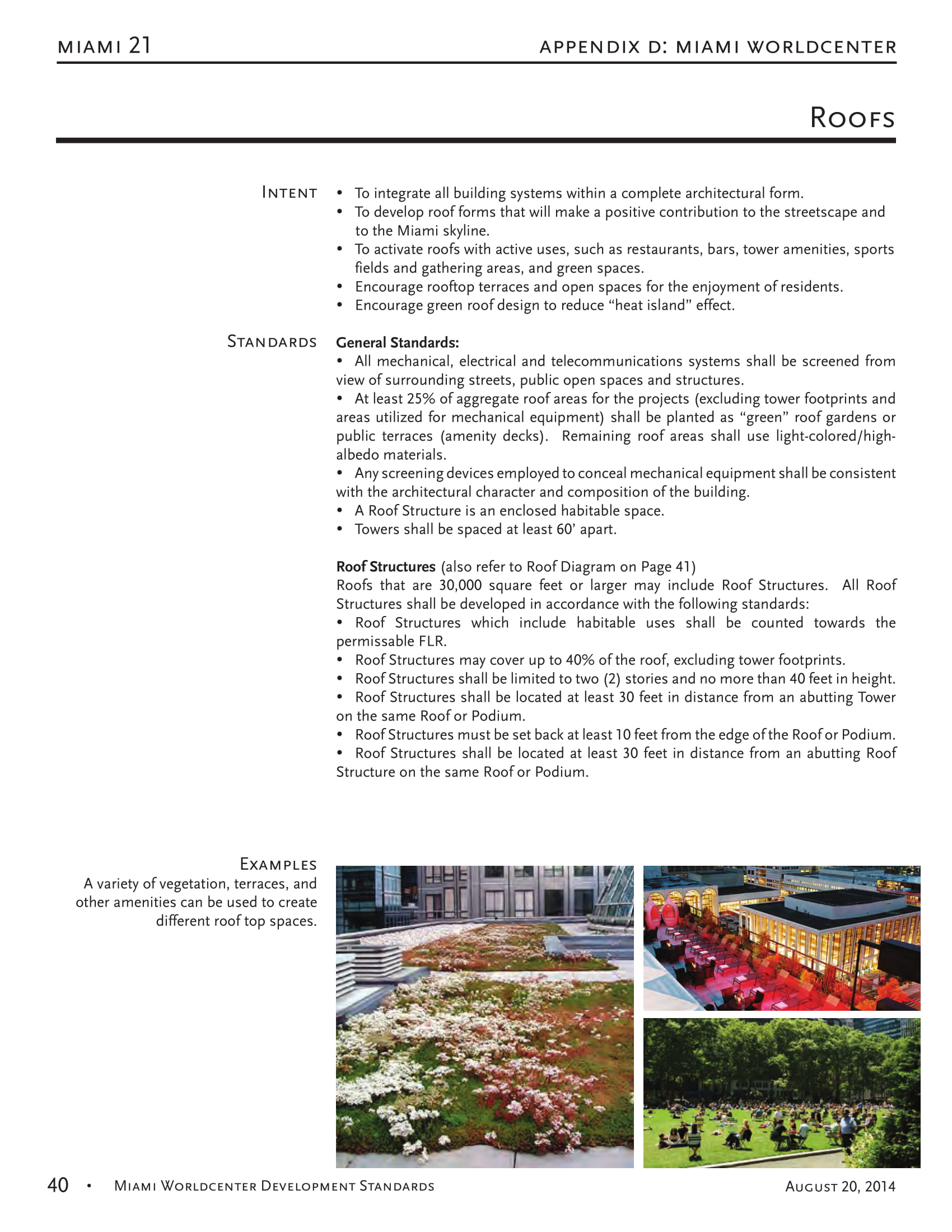
Section 12 (c) Roof materials should be light-colored, high albedo or planted surface and shall be designed in accordance with the regulations in Section 3.13.2 of Miami 21.
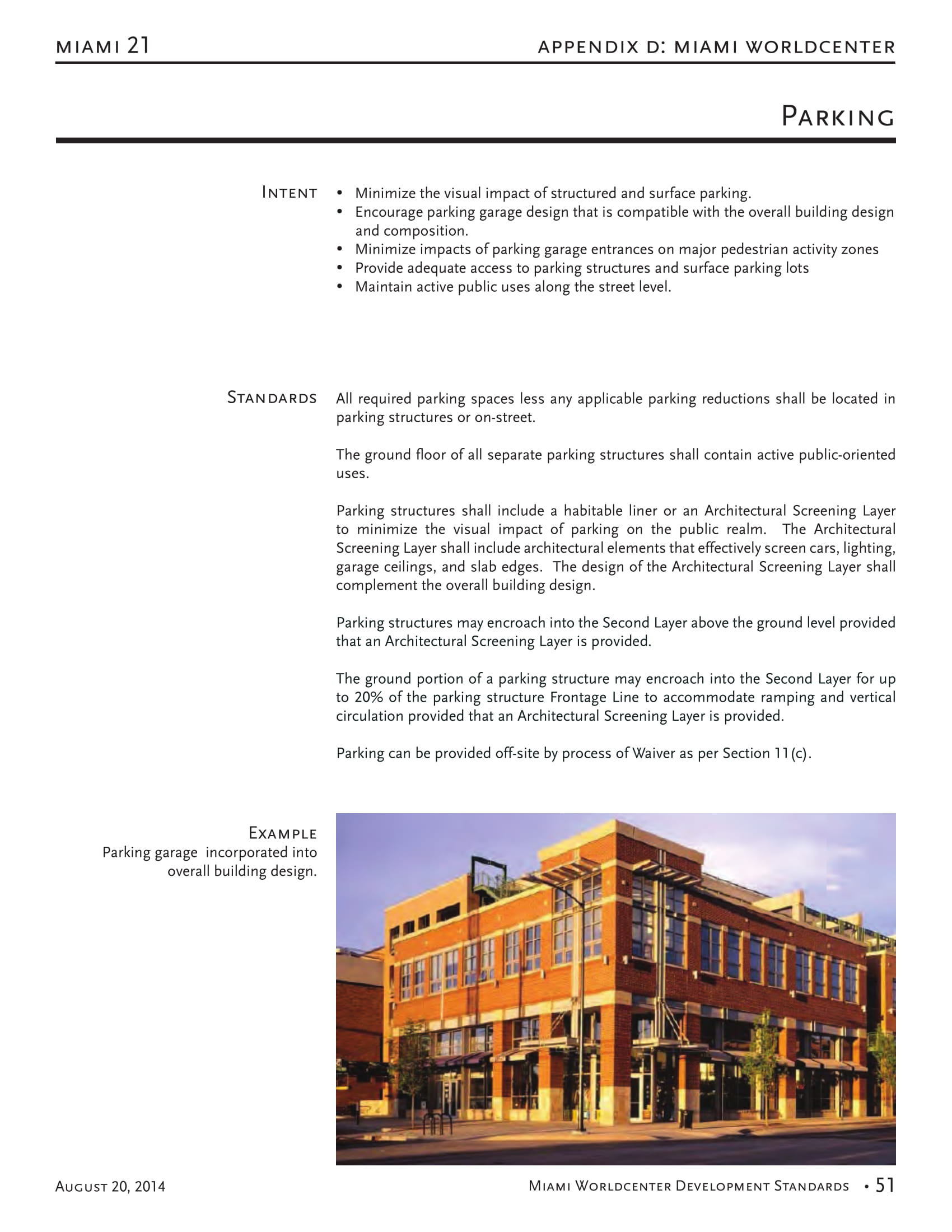
Section 12 (d) The Façade of a parking garage that is not concealed behind a Liner shall be screened behind an Architectural Screening Layer along the Façade to conceal all internal elements such as plumbing pipes, fans, ducts, ceilings, slab edges and lighting, as illustrated in the Development Standards. The architectural expression shall complement and enhance the building. Ramping shall be internalized. Exposed spandrels shall be prohibited. Spandrels that are integrated into the wall system shall be permitted. Spandrels are considered to be integrated when there is no open space adjacent to the spandrel(s); the intent is to intregrate the spandrel into the wall system, and to screen interior elements form view. As depicted in the Development Standards, parking may extend into the Second Layer above the second Story if an Architectural Screening Layer is provided for one hundred (100%) percent of that portion of the Podium Facade.
Section 13. LANDSCAPE STANDARDS
Section 13 (a) The First Layer shall be surfaced and landscaped as shown in the DevelopmentStandards.
Section 13 (b) Open Space shall be a minimum ten percent (10%) of the total gross net lot area. A minimum of ten percent (10%) of the publicopenspaceshallbelandscaped,asprovidedinthe DevelopmentStandards.
Section 14. SIGN STANDARDS
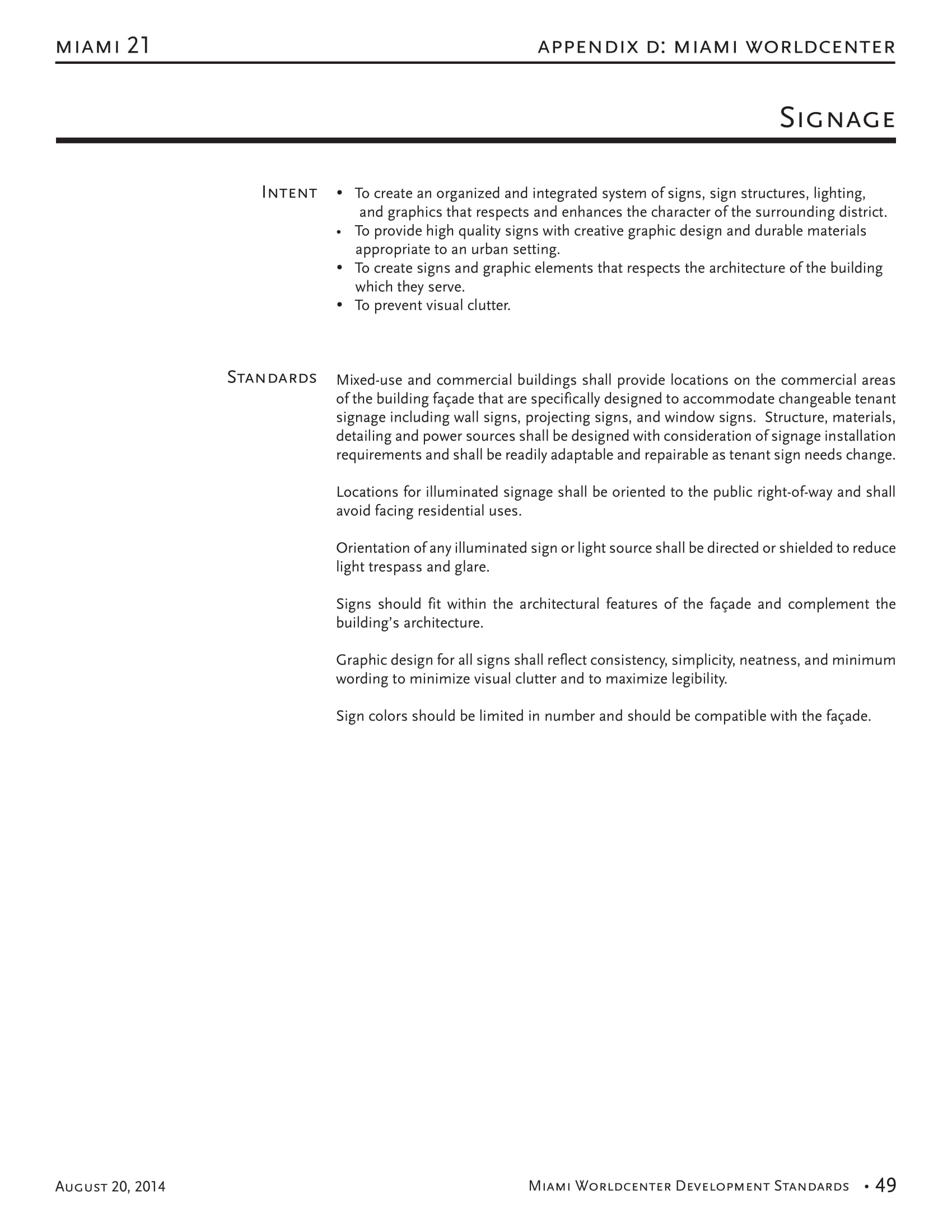
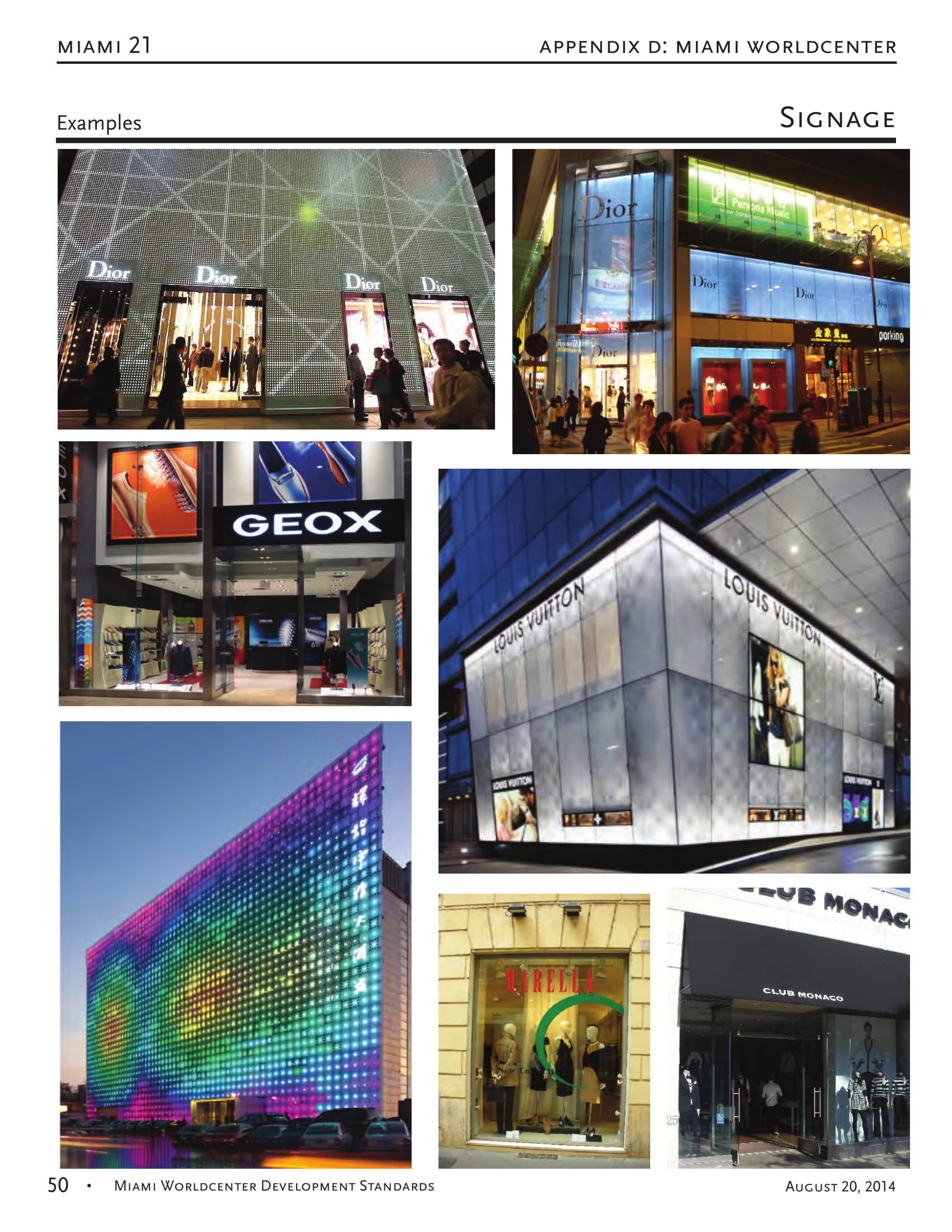
Notwithstanding any other provision of the City code and Zoning Ordinance, signs shall be permitted in the Miami Worldcenter area in accordance with the Development Standards, and consistent with the intent of Article 10, Table 15 of Miami 21, as applicable to T6-O.
Section 15. AMBIENT LIGHTING STANDARDS
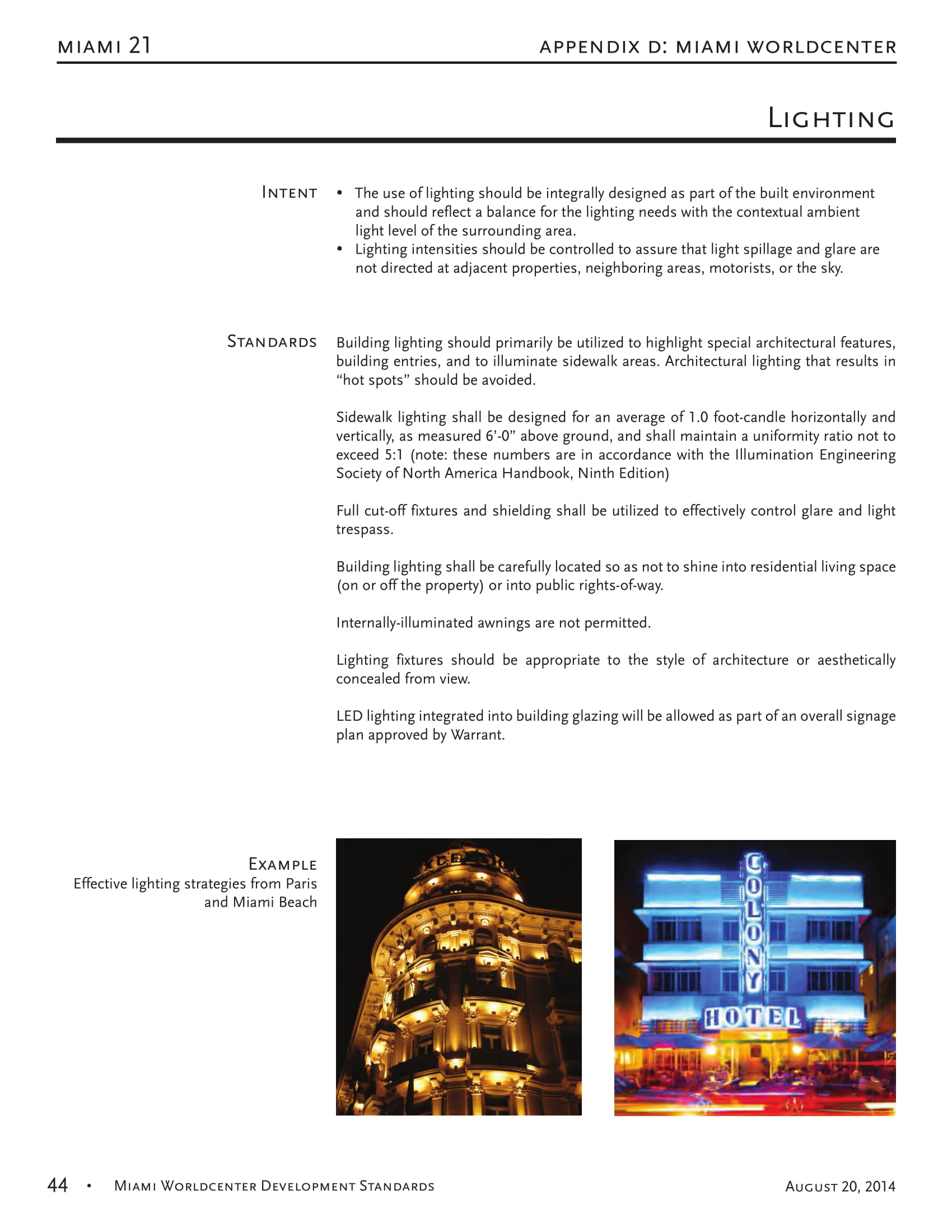
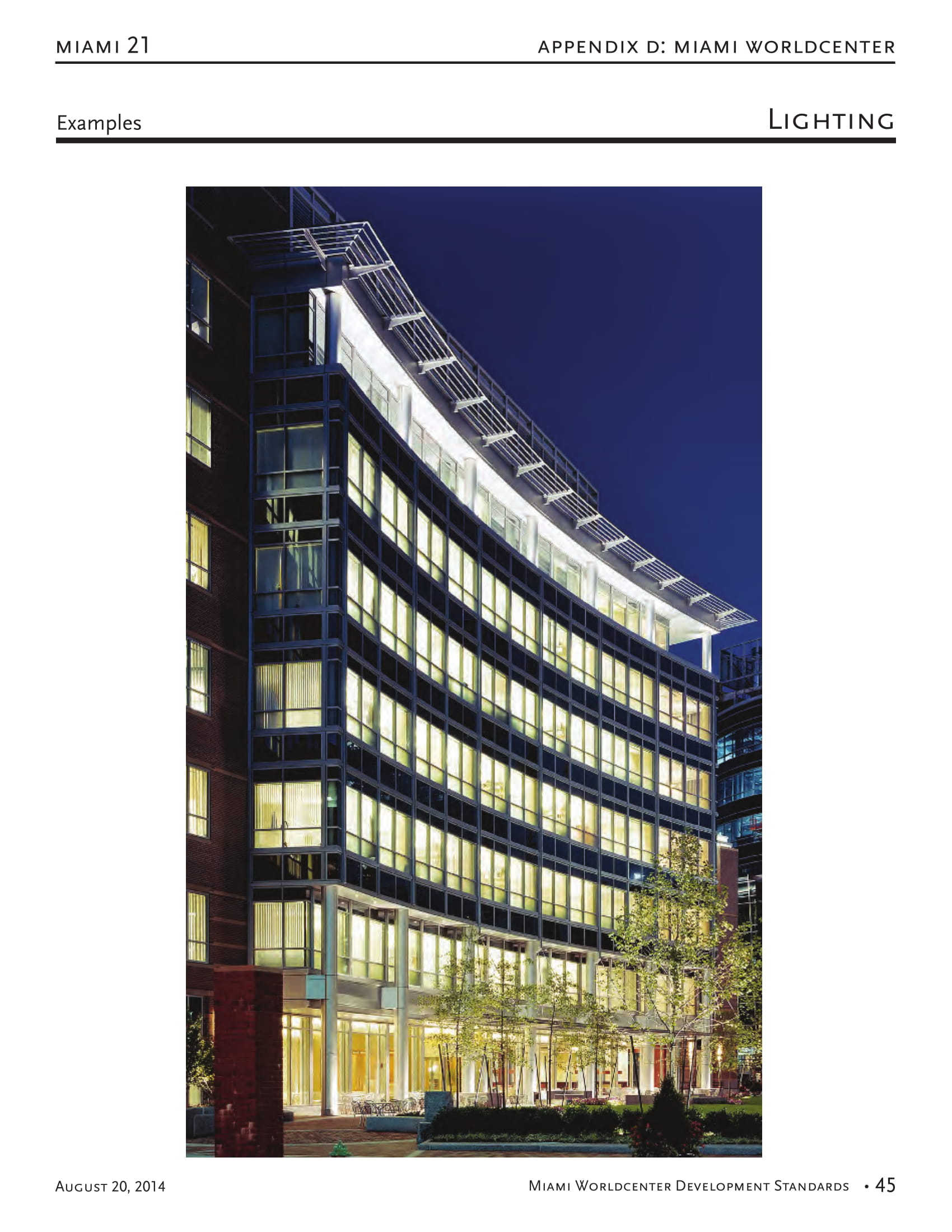
Section 15 (a) Average lighting levels measured at the Building Frontage shall not exceed two (2) foot-candles except where a greater level is approved by a Warrant.
Section 15 (b) Streetlights shall be of a type illustrated in The Development Standards. Interior garage lighting fixtures shall not be visible fromstreets.
Section 16. CIVIC SPACE
At least twenty percent (20%) of the required open space in the Miami Worldcenter area shall be assigned to Civic Space, as described in Table 2 Development Standards.
Section 17. ALLOWABLE INCREASES IN FLR FOR PROVIDING PUBLIC BENEFITS
Section 17 (a) The intent of this section is to provide bonus building capacity in the Miami Worldcenter area in exchange for the developer’s contribution to specified programs that provide benefit and enjoyment to the public. A bonus of an additional fifty percent (50%) of FLR capacity shall be permitted if the proposed development contributes to the specified programs below in the amount and manner set forth in Section 3.14 of the Zoning Ordinance.
Section 17 (b) Sustainability
All buildings in the Miami Worldcenter area shall be certified by the United States Green Building Council (USGBC), at a minimum, as LEED silver, or by an equivelant certification agency approved by the City, within a year after obtaining a certificate of occupancy or its equivelent.
Section 18.
In the event of a conflict between the text of Appendix D and the visual charts, graphics, and maps comprising the Development Standards, the text shall cont