
Summit City Zoning Code
CHAPTER 11
PARKING
11-11-1: Purpose
The regulations of this chapter are intended to help promote economically viable and beneficial use of land and avoid the negative impacts that can result from establishing excessive minimum motor vehicle parking requirements. Such adverse impacts include increased costs for and barriers to development, leaving valuable land unproductive, increasing stormwater runoff, degrading water quality and negatively affecting community appearance. The regulations are also intended to accommodate nonmotorized transportation alternatives.
11-11-2: Motor Vehicle Parking
Off-street motor vehicle parking spaces must be provided in accordance with the minimum ratios established in this section. See 11-11-3 for additional information about bicycle parking requirements.
- Residential: Off-street motor vehicle parking for residential uses must be provided in accordance with Table 11-1, or if special use approval is required, in accordance with minimum requirements established as a condition of special use approval.
Table 11-1: Residential Off-Street RequirementsUse Minimum Off-Street Parking Requirements Household Living 1 to 4 households on single lot 1 per dwelling unit 5 or more households on single lot 1 per dwelling unit, plus 0.5 per each dwelling unit with more than one bedroom Group Living All 1 per 2 sleeping rooms or beds - Nonresidential:
- Schools and assembly uses must provide off street parking space equal to at least one space per 10 persons for whom seating is provided and not less than one parking space for every classroom.
- There is no minimum off-street motor vehicle parking requirement for other nonresidential uses, provided that uses requiring special use approval may be subject to minimum parking requirements established at the time of special use approval.
11-11-3: Bicycle Parking
- Purposes: This section establishes requirements for the provision of short-term bicycle parking. Short-term bicycle parking is generally intended to serve the needs of cyclists who park their bicycles for short time periods, including customers, clients, students and other short-term visitors.
- Spaces Required: Short-term bicycle parking spaces must be provided in accordance with the minimum ratios established in Table 11-2.
Table 11-2: Minimum Required Bicycle Parking RatiosUSE CATEGORY Minimum Required Bicycle Parking Spaces Subcategory Specific use RESIDENTIAL Household Living 5 or more households on single lot 5% of motor vehicle parking spaces provided or 2 spaces, whichever is greater PUBLIC, CIVIC AND INSTITUTIONAL Library or Cultural Exhibit 10% of motor vehicle parking spaces provided or 2 spaces, whichever is greater Parks and Recreation 10% of motor vehicle parking spaces provided or 2 spaces, whichever is greater School Elementary or Middle School 10% of motor vehicle parking spaces provided or 2 spaces, whichever is greater Senior High 5% of motor vehicle parking spaces provided or 2 spaces, whichever is greater COMMERCIAL Assembly and Entertainment 5% of motor vehicle parking spaces provided or 2 spaces, whichever is greater Commercial Service Personal improvement service 5% of motor vehicle parking spaces provided or 2 spaces, whichever is greater Financial Services 5% of motor vehicle parking spaces provided or 2 spaces, whichever is greater Restaurant Restaurant 5% of motor vehicle parking spaces provided or 2 spaces, whichever is greater Retail Sales Consumer shopping goods 5% of motor vehicle parking spaces provided or 2 spaces, whichever is greater Convenience goods 5% of motor vehicle parking spaces provided or 2 spaces, whichever is greater Studio, Artist or Instructional Service 5% of motor vehicle parking spaces provided or 2 spaces, whichever is greater - Location and Design:
- Location: Short-term bicycle parking spaces must be located in highly visible areas that do not interfere with pedestrian movements. At least 50% of required short-term bicycle parking spaces must be located within 100 feet of a customer entrance, with the remainder located no more than 300 feet from any entrance. Short-term bicycle parking must be located on the subject lot, unless a license has been approved by the village to allow private bicycle parking facilities to be located in the right-of-way.
- Design: Required short-term bicycle parking spaces must:
- Consist of bike racks or lockers that are anchored so that they cannot be easily removed;
- Be of solid construction, resistant to rust, corrosion, hammers, and saws;
- Allow both the bicycle frame and the wheels to be locked with the bicycle in an upright position using a standard U-lock;
- Be designed so as not to cause damage to the bicycle;
- Facilitate easy locking without interference from or to adjacent bicycles; and
- Have minimum dimensions of 2 feet in width by 6 feet in length, with a minimum overhead vertical clearance of 7 feet.
Figure 11-1: Bicycle Parking Space Dimensions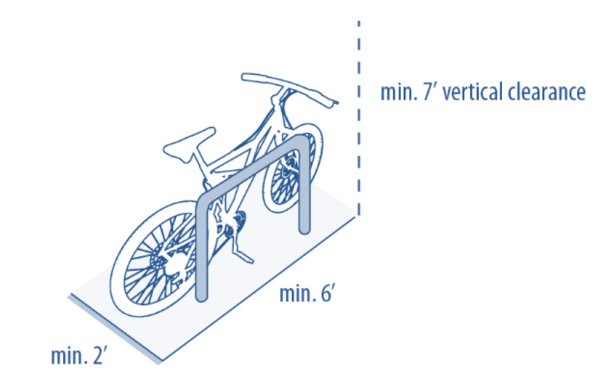
- Special uses:
- Reductions of short-term bicycle parking requirements may be approved in accordance with the special use procedures of 11-15-5.
- Modifications of bicycle parking design and location requirements may be approved in accordance with the special use procedures of 11-15-5.
11-11-4: Use Of Off-Street Parking Areas
- Off-street parking spaces are intended to serve residents, tenants, patrons, employees, or guests of the principal use. Off-street parking areas may only be used for the temporary parking of licensed motor vehicles in operating condition.
- Off-street parking spaces may not be used for the storage, display or sale of goods equipment or materials. No motor vehicle repair work of any kind is permitted in an off-street parking space.
- Parking spaces may be used for electric vehicle charging.
11-11-5: Parking Location
Off-street parking is prohibited in front and street side setback areas in R zoning districts. This provision is not intended to prohibit parking on an approved driveway on a lot occupied by a detached house, attached house or two-unit house.
11-11-6: Parking Area Design
- Applicability: The parking area design regulations of this section apply to all off-street parking lots for motor vehicles, whether containing required parking spaces or non-required parking spaces.
- Ingress and Egress: All parking areas must be designed to allow vehicles to enter and exit a street and cross public sidewalks in a forward motion, except that this requirement does not apply to lots with access on a minor street.
- Stall Size: Parking spaces must be at least 8.5 feet in width and 18 feet in length, exclusive of access drives and aisles. In parking areas where permanent wheel stops have been installed, 2.5 feet of the parking space length (depth) beyond the wheel stop may be counted as part of the required stall length if that area is unobstructed and not part of another parking stall, drive aisle or sidewalk.
- Markings: Parking spaces in lots with more than 2 spaces must be marked on the surface of the parking area with paint or permanent marking materials and maintained in clearly visible condition.
- Parking Area Layout (Geometrics): Parking areas must be designed and marked in accordance with the dimensional standards of Table 11-3, which shows minimum dimensions for various parking layouts (angles). Requirements for layouts or angles not shown in Table 11-3 may be interpolated from the layouts shown, as approved by the building official.1
Table 11-3: Parking Area GeometricsA = Stall Angle, B = Stall Width, C = Stall Length, D = Aisle Width (1-way/2-way)A B C D 0º 8.5 22.0 12.0/20.0 9.0 22.0 12.0/20.0 45º 8.5 18.0 12.0/20.0 9.0 18.0 11.0/19.0 60º 8.5 18.0 16.0/21.0 9.0 18.0 15.0/20.0 75º 8.5 18.0 21.0/22.0 9.0 18.0 20.0/21.0 90º 8.5 18.0 –/24.0 9.0 18.0 –/22.0 10.0 18.0 –/20.0
Figure 11-2: Parking Area Geometrics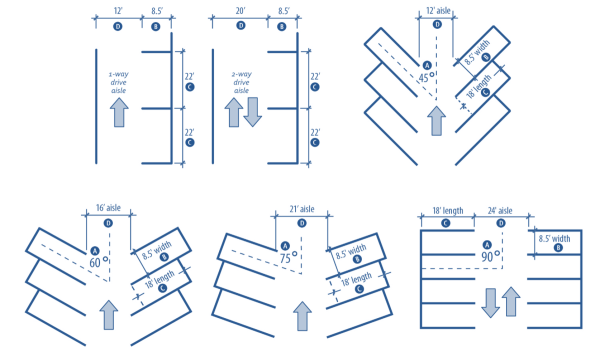
- Tandem Parking: Tandem parking spaces may be used to satisfy minimum parking requirements for household living uses when the spaces are assigned to the same dwelling unit. In all other cases, required parking spaces must be designed to allow each parking space to be accessed without passing through another parking space. Tandem parking arrangements must have a minimum stall of 8.5 feet and a minimum length of 36 feet.
Figure 11-3: Tandem Parking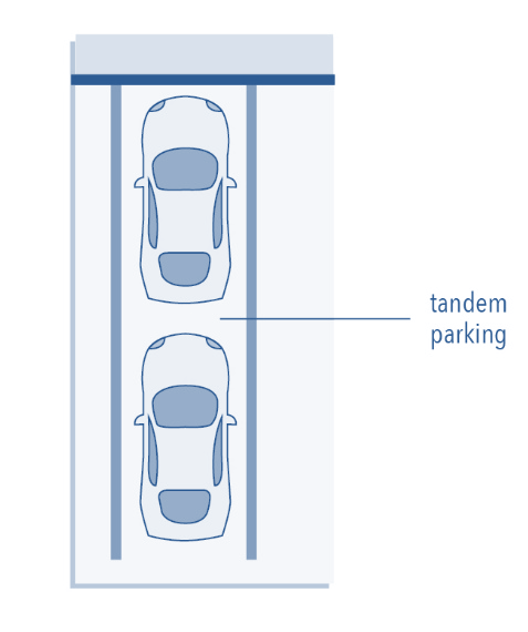
- Surfacing:
- All off-street parking areas must be graded and paved or otherwise improved with bituminous concrete, portland cement concrete or other dustless, all-weather surface (including pervious pavement) approved by the building official.
- Parking area surfacing must be completed prior to initiation of the use to be served by the parking.
- Vertical Clearance: All parking spaces must have overhead vertical clearance of at least 7 feet.
- Driveways:
- Required off-street parking spaces must open directly upon an aisle or driveway (for which a driveway permit has been obtained) of such width and design as specified in this chapter or as otherwise approved by the building official as a safe and efficient means of vehicular access.
- Driveways onto major streets must comply with the standards set forth in the Illinois Department of Transportation's "Policy on Permits for Access Driveways to State Highways."
- Landscaping and Screening: See Chapter 12.
Notes:
1 Current ordinance requires minimum stall dimensions of 9’ by 19’.
11-11-7: Stacking Spaces For Drive-Through Facilities
- Spaces Required: Establishments with drive-through facilities must provide stacking spaces for each drive-through station as indicated in Table 11-4:
Table 11-4: Drive-through Stacking Space RequirementsUse Minimum Spaces (per lane) Automated teller machine 2 (measured from ATM) Bank 3 (measured from teller or service area) Car wash, automated or customer-operated 2 (measured from vehicle entrance) Car wash, attendant hand wash 3 (measured from vehicle entrance) Drug store 2 (measured from pick-up window) Restaurant drive-through 3 (measured from order board) Kiosks 2 (measured from service window) Other As determined by the building official - Dimensions: Each lane of stacking spaces must be at least 8.5 feet in width and at least 18 feet in length. Stacking lanes must be delineated with pavement markings.
- Location and Design:
- Stacking lanes must be located on the subject property. They may not be located within required driveways or drive aisles and may not interfere with access to parking and ingress and egress from the street.
- All areas associated with drive-through facilities, including drive-through signs, stacking lanes, trash receptacles, loudspeakers and service windows must be located to the rear or on the non-street-facing side of the property. Drive-through lanes must be set back at least 10 feet from abutting R-zoned lots, and a screening wall or fence must be provided along the common lot line in accordance with the F1 screening regulations of 11-12-5(C)(2).
- Pedestrian Access: The principal pedestrian access to the entrance of the use from a public sidewalk may not cross the drive-through facility stacking lane.
11-11-8: Accessible Parking For People With Disabilities
- The number, location and design of accessible parking spaces for people with disabilities must be provided in accordance with this section and the Illinois Accessibility Code.
- Accessible spaces must be provided in accordance with Table 11-5.
Table 11-5: Minimum Accessible Parking Space RatiosTotal Off-Street Parking Spaces Provided Accessible Parking Spaces Required 1 to 25 1 26 to 50 2 51 to 75 3 76 to 100 4 101 to 150 5 151 to 200 6 201 to 300 7 301 to 400 8 401 to 500 9 501 to 1,000 2% of total over 1,000 20 plus 1 for each 100 over 1,000 Medical facilities specializing in treatment of persons with mobility impairments 20% of total Outpatient medical facilities 10% of total - Accessible parking spaces count towards the total number of parking spaces required.
- Each accessible parking space, except on-street spaces, must be at least 16 feet in width, with either an 8-foot or 5-foot wide diagonally striped access aisle. The access aisle may be located on either side of the vehicle portion of the accessible space. Abutting accessible parking spaces may not share a common access aisle. See Figure 11-4.
Figure 11-4: Accessible Parking Spaces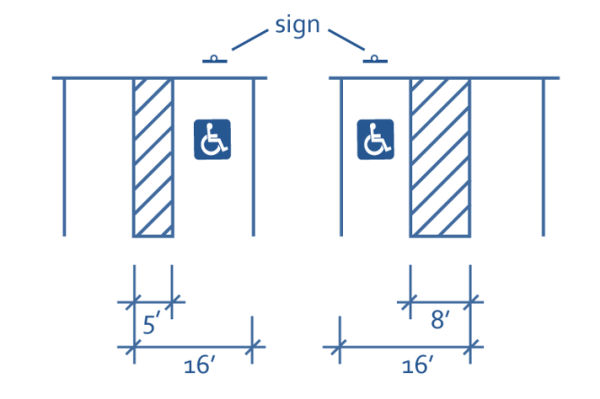
- Accessible parking spaces must be signed in compliance with applicable state law and must identify the current fine amount for violations. The sign must be fabricated to be 2 separate panels; one for the disability symbol and one for the current fine amount as established by village council.
- Accessible parking spaces and accessible passenger loading zones that serve a particular building must be the spaces or zones located closest to the nearest accessible entrance on an accessible route. In separate parking structures or lots that do not serve a particular building, parking spaces for disabled persons must be located on the shortest possible circulation route to an accessible pedestrian entrance of the parking facility.
- The regulations of this section apply to required spaces and to spaces that are voluntarily designated for accessible parking.
11-11-9: Loading
Off-street loading areas must be designed so that all vehicle maneuvering and loading/unloading operations will occur on private property. Unenclosed off street loading areas may not be located within 50 feet of any abutting R-zoned properties unless the loading areas is screened on all sides abutting the R-zoned property in accordance with the F1 screening regulations of 11-12-5(C)(2). Off street loading areas may not be located in any street yard.
All loading spaces must be surfaced in the same manner as required for parking areas.
11-11-10: Pedestrian Circulation
- Applicability: An on-site circulation system for pedestrian and non-motorized travel must be provided in accordance with the requirements of this section for all lots occupied by buildings, except for:
- Residential buildings containing 4 or fewer dwelling units;
- Agricultural uses;
- Industrial or other uses without a resident- or customer-entrance; and
- Uses, other than parking lots, that do not include a principal building intended for regular human occupancy.
- Required Connections: The pedestrian circulation system must provide safe, direct and convenient pedestrian access connecting main entrances of buildings and uses with all other such entrances and with available access points including parking, streets, sidewalks and transit stops. In the case of building or site additions, these requirements apply only to the new or expanded areas.
- Design: Required on-site pedestrian circulation facilities must be designed and constructed in accordance with the following requirements:
- Pedestrian access must consist of an accessible, easily-discernible walkway or multi-use path with a minimum width of 5 feet.
- The pedestrian access surface located on private property must be constructed of concrete, asphalt or other fixed, firm and nonslip material, approved by the building official.
- Pedestrian access routes that cross parking lots, drive aisles or other parking lots must be clearly differentiated from the vehicle surface through the use of physical separation or by durable, low-maintenance materials such as pavers, bricks, scored concrete, pavement textures or painted surfaces to define places of pedestrian movement.

