
Summit City Zoning Code
CHAPTER 19
MEASUREMENTS AND EXCEPTIONS
11-19-1: Fractions And Rounding
When calculations required under this zoning ordinance result in fractions, the results must be rounded as follows:
- Minimum Requirements: When a regulation is expressed in terms of a minimum requirement, any fractional result must be rounded up to the next consecutive whole number. For example, if a minimum requirement of one tree for every 30 feet is applied to a 50-foot strip, the resulting fraction of 1.67 is rounded up to 2 required trees.
- Maximum Limits: When a regulation is expressed in terms of maximum limits, any fractional result must be rounded down to the preceding whole number. For example, if a maximum limit of one dwelling unit for every 3,750 square feet of lot area is applied to an 8,000 square foot lot, the resulting fraction of 2.13 is rounded down to 2 allowed dwelling units.
11-19-2: Lot Area
Lot area is measured as the total ground-level surface area contained within the property lines of a lot.
11-19-3: Lot Area Per Dwelling Unit
Lot area per dwelling unit is a measure of residential density. It governs the amount of lot area required for each dwelling unit on a lot. To determine the number of dwelling units allowed on a lot, divide the lot area by the minimum lot-area-per-unit requirement, and round any fractional result down to a whole number. If, for example, a minimum lot-area-per-unit requirement of 1,750 feet is applied to a 10,000 square foot lot, a maximum of 5 units would be allowed on that lot (5.71 rounded down to 5).
11-19-4: Floor Area
The floor area of a building is measured as the sum of the gross horizontal areas of all floors of the subject building, measured from the interior faces of the exterior walls or from interior faces of walls between separate buildings. “Floor area” includes basement and cellar floor areas; elevator shafts and stairwells at each floor; floor space used for mechanical equipment, open or enclosed, located on the roof; penthouse; attic space having headroom of 7 feet 10 inches or more; interior balconies and mezzanines; enclosed porches; and floor area devoted to accessory uses. Space devoted to off-street parking or loading is not included in floor area calculations.
11-19-5: Floor Area Ratio
The floor area ratio (FAR) of a building is the floor area of the building divided by the area of the lot upon which the building is located.
11-19-6: Frontage Or Street Frontage
Street frontage is measured between side property lines of a lot along the property line that abuts the street.
11-19-7: Lot Width
Lot width is measured as the average (mean) horizontal distance between the side property lines of a lot.
Figure 19-1: Lot Width Measurement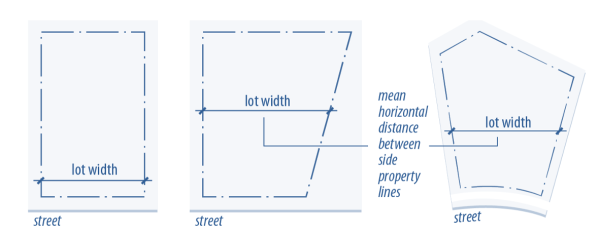
11-19-8: Setbacks
- Measurement: Required setbacks are measured from the applicable lot line or right-of-way line. Building setbacks are measured to the nearest exterior building wall. Minimum setbacks that apply to other features (parking areas, fences, storage areas) are measured from the nearest point of the area or feature for which a setback is required. Unless otherwise expressly stated, no part of any structure may be located within the street right-of-way.
- Street setbacks are measured from the actual right-of-way line of the street (other than an alley).
- Interior side setbacks are measured from a side lot line that does not abut a street.
Figure 19-2: Side (Interior) Setback Measurement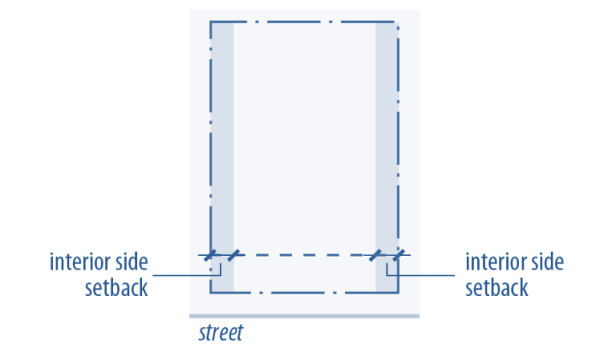
- Rear setbacks are measured from the rear lot line, except on double-frontage lots. On double-frontage lots, street setbacks apply from all property lines that abut streets.
Figure 19-3: Rear Setback Measurement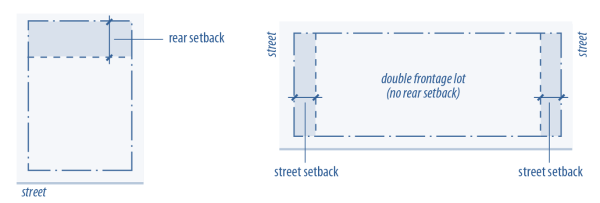
- Setbacks on Irregular Lots: Setbacks are measured from lot lines towards the center of the lot, as follows:
- Generally, setbacks are measured as set out in 11-19-8(A).
- When lot lines are curvilinear, setbacks must be measured parallel to the curvilinear lot line.
Figure 19-4: Setbacks from Curvilinear Lot Lines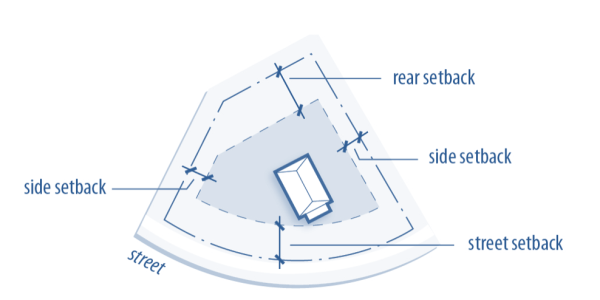
- When there are multiple rear lot lines, the rear setback must be measured from each of rear lot lines.
Figure 19-5: Setbacks from Multiple Rear Lot Lines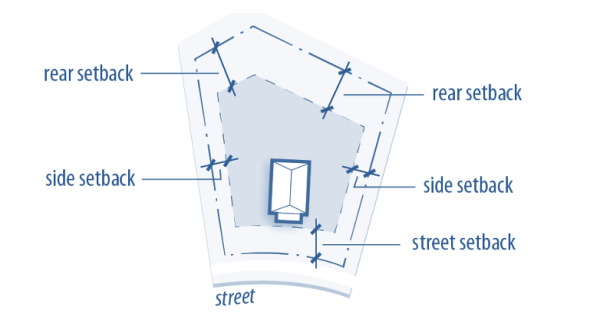
- When there is no rear lot line, the rear setback must be measured as a radial distance from the intersection of side lot lines at the rear of the lot.
Figure 19-6: Rear Setback Measurement When There is No Rear Lot Line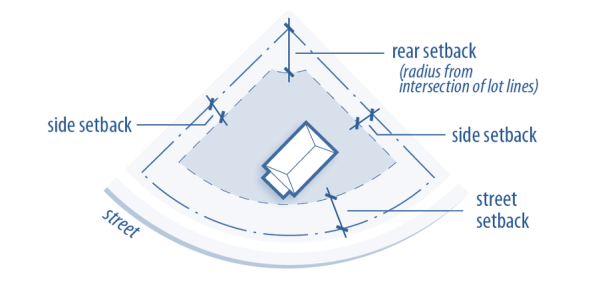
- Permitted Setback Obstructions in R Zoning Districts: Setbacks in R zoning districts must be unobstructed and unoccupied from the ground to the sky except as indicated in Table 19-1:
Table 19-1: Permitted Setback Obstructions in R Zoning DistrictsAllowed Within Setback? Obstruction Street Side Rear Accessory buildings (see also Chapter 9) No No Yes Air conditioning units (Window units only) Yes Yes Yes A/C condensers, generators, compressors, transformers, pool, rainwater collection and geothermal equipment (ground-mounted) No No Yes Arbors, pergolas and trellises Yes Yes Yes Awnings, canopies, light shelves and solar shading devices projecting no more than 2 feet into the setback Yes Yes Yes Barbeque pits and outdoor fireplaces No No Yes Bay windows projecting no more than 2 feet into the setback Yes Yes Yes Carports Yes Yes Yes Chimneys and flues projecting no more than 2 feet into the setback Yes Yes Yes Clotheslines No Yes Yes Decks, patios, and other features and structures less than 30 inches in height above grade Yes Yes Yes Eaves and gutters projecting no more than 2 feet into the setback Yes Yes Yes Fences and walls Yes Yes Yes Fire escapes projecting no more than 4.5 feet into the setback Yes Yes Yes Flagpoles and similar features Yes Yes Yes Geothermal heat pumps and geothermal heat exchange equipment up to 4 feet in height above grade No No Yes Green houses and hoop houses No No Yes Insulation added to the outside of the exterior wall of an existing building Yes Yes Yes Plants and cold frames Yes Yes Yes Porches Yes No Yes Rainwater harvesting equipment projecting no more than 4. 5 feet into the setback Yes Yes Yes Recreational equipment (e.g., swing sets, playground equipment, tree houses, etc.) No No Yes Satellite dish antennas See 11-9-6 Signs (see also Chapter 13) Yes Yes Yes Sills, belt courses, cornices and similar architectural features projecting no more than 2 feet Yes Yes Yes Solar energy systems, building-mounted No Yes Yes Solar energy systems, ground-mounted No No Yes Swimming pools and tennis courts No No Yes Vehicle parking/storage, inoperable No No Yes Wheelchair lifts and ramps that meet federal, state and local accessibility standards Yes Yes Yes - Front Porches: Front porches that are open on at least three sides may encroach a maximum of 5 feet into a required street setback, subject to the following restrictions:
- The total amount of porch encroachment into any required street setback may not exceed 250 square feet.
- On lots with multiple frontages, porches may encroach into only one street setback.
- Occupiable floor area and porch/deck space is prohibited above a porch that encroaches into a required street setback.
- Contextual Setbacks: When existing buildings on one or more abutting lots are closer to the street (front or street side) property line than the otherwise required setback, additions to existing buildings or construction of new buildings on the subject lot may comply with the average street yard depth that exists on the nearest 2 lots on either side of the subject lot instead of complying with the zoning district’s minimum street setback requirement. Existing yard depths must be based on the front corners of the buildings on the lots used in the contextual setback determination that are nearest to the subject lot.
Figure 19-7: Contextual Setbacks (1)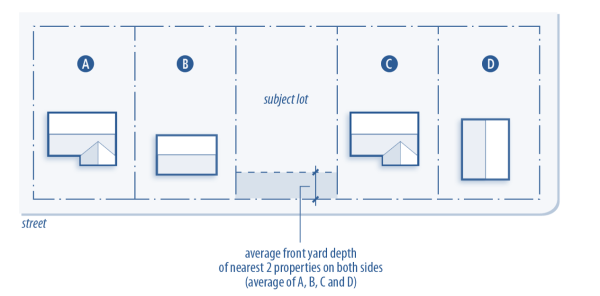
- If one or more of the lots required to be included in the averaging calculation is vacant, that vacant lot will be deemed to have a street yard depth equal to the minimum street setback requirement of the subject zoning district.
Figure 19-8: Contextual Setbacks (2)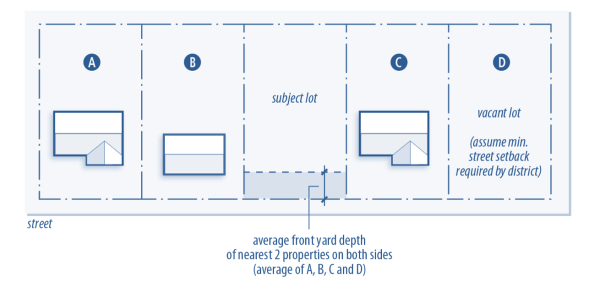
- Lots with frontage on a different street than the subject lot or that are separated from the subject lot by a street or alley may not be used in computing the average.
Figure 19-9: Contextual Setbacks (3)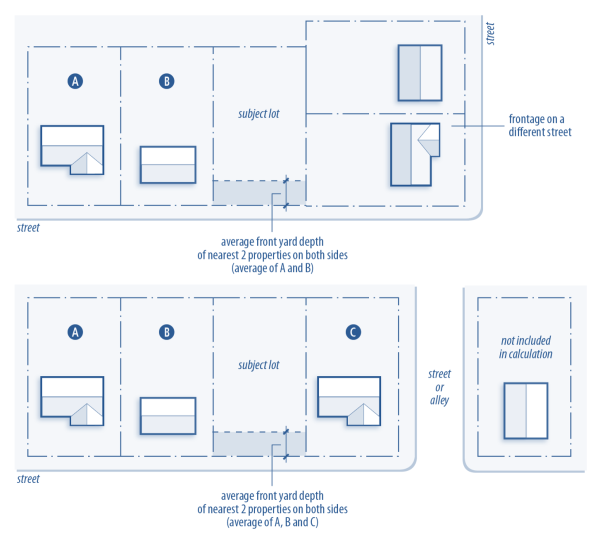
- When the subject lot is a corner lot, the average street yard depth will be computed on the basis of the nearest 2 lots with frontage on the same street as the subject lot.
Figure 19-10: Contextual Setbacks (4)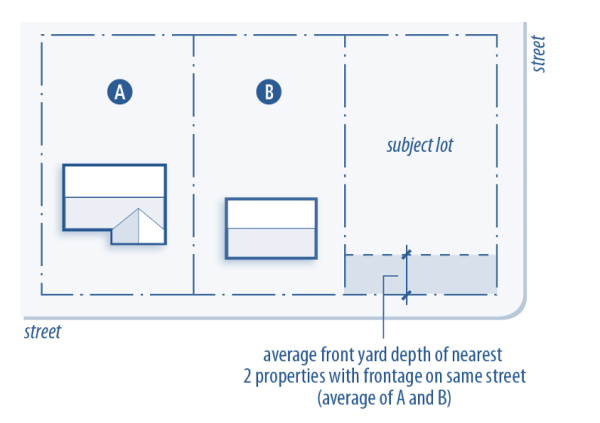
- When the subject lot abuts a corner lot with frontage on the same street, the average street yard depth will be computed on the basis of the abutting corner lot and the nearest 2 lots with frontage on the same street as the subject lot.
Figure 19-11: Contextual Setbacks (5)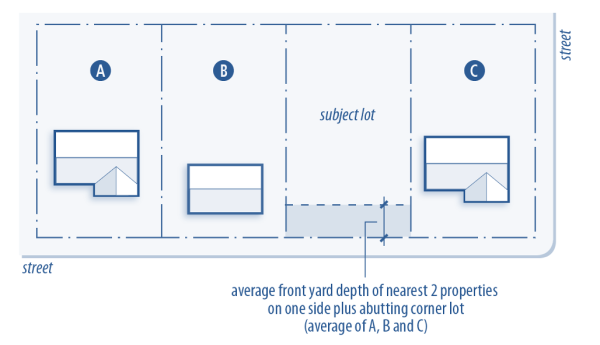
- These contextual setback provisions may not be used to reduce the setback of a street-facing garage door to less than 20 feet.
- If one or more of the lots required to be included in the averaging calculation is vacant, that vacant lot will be deemed to have a street yard depth equal to the minimum street setback requirement of the subject zoning district.
11-19-9: Parking Setbacks
- All off-street parking spaces must be located behind any applicable parking setback line. This requirement applies whether such spaces are located in a surface (open-air) parking lot or in a parking structure. Parking setbacks do not apply to on-street parking spaces, parking spaces located in an underground structure or parking spaces located above the ground floor of a building.
- Parking setbacks are measured in accordance with 11-19-8(A).
11-19-10: Build-To-Zone
- The build-to zone is the area on the lot where all or a portion of the street-facing building façade must be located, established as a minimum and maximum setback range, measured in accordance with the setback measurement provisions of 11-19-8(A).
- The street-facing building façade must be located in and extend along the length of the build-to-zone for a minimum distance equal to a percentage of the width of the lot, as required by specific provisions of this zoning ordinance. The required minimum percentage is calculated by dividing the width of the building façade located within the build-to-zone by the width of the lot. For purposes of this calculation, the width of the lot is the narrowest width of the lot within the build-to-zone.
Figure 19-12: Build-to-Zone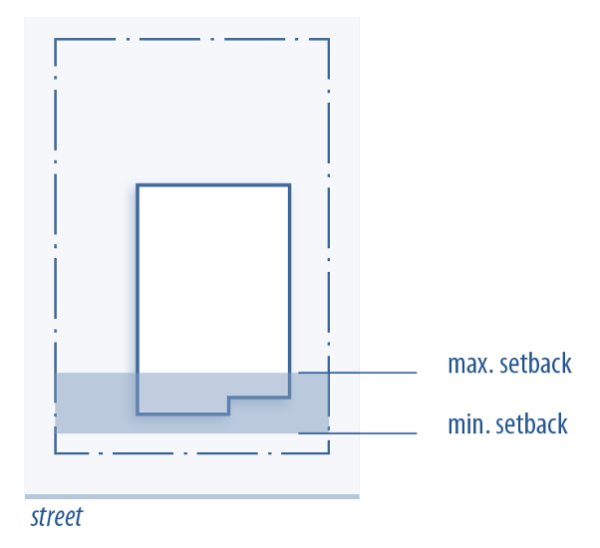
- On corner lots, the building official is authorized to designate which street is the front street and which street is the secondary or side street. The primary street designation must be based on consideration of the following criteria:
- The street with the highest functional street classification;
- The street that the lot takes its address from; and
- The street parallel to an alley within the block.
- On corner lots, the building must be within the required build-to-zone for the first 25 feet extending from the intersection of the 2 street rights-of-way.
11-19-11: Building Coverage
Building coverage is the total area of a lot covered by principal and accessory buildings. Only building areas beneath a roof are counted for purposes of measuring building coverage. A porch with a roof, for example, is counted, but an uncovered deck structure is not considered building coverage.
11-19-12: Transparency
- Transparency regulations govern the percentage of a street-facing building façade that must be covered by glazed elements (e.g., transparent windows and doors)
- Unless otherwise expressly stated, the transparency of a ground floor facade is measured between 2 and 8 feet above the adjacent sidewalk.
Figure 19-13: Ground Floor Transparency Measurement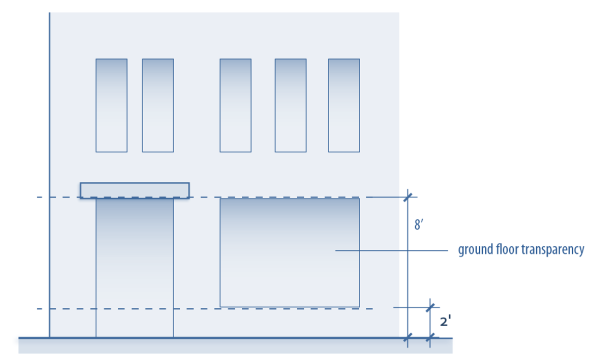
- The transparency of an upper-story facade is measured from top of the finished floor to the top of the finished floor above. When there is no floor above, upper-story transparency is measured from the top of the finished floor to the top of the wall plate.
Figure 19-14: Upper-Floor Transparency Measurement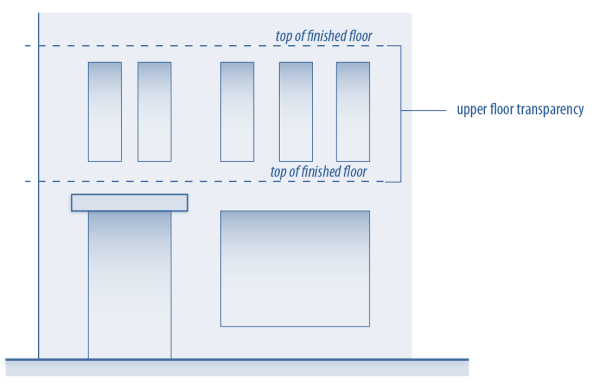
- Glazed elements used to satisfy minimum transparency requirements must be clear and non-reflective and not be painted or tinted (transparent, low-emissivity glass is permitted).
11-19-13: Street-Facing Building Entrances
- Required street-facing building entrances must provide ingress and egress for residents and customers. Additional entrances off another street, pedestrian area or internal parking area are also permitted.
- An angled entrance may be provided at any corner of a building along the street to meet street-facing entrance requirements.
11-19-14: Building Height
- Measurement:
- Building height is measured as the vertical distance from established grade at to the highest point of the roof surface of a flat roof, to the deck line for a mansard roof, to the mean height level between the eaves and ridge of principal roof structure for hip, gabled, and gambrel roofs.
- For buildings having walls adjoining one street only, established grade is the elevation of the sidewalk at the center of the wall adjoining the street. For buildings having walls adjoining more than one street, grade is the average of the elevation of the sidewalk at the centers of all walls adjoining the streets.
- For buildings having no wall adjoining the street, grade is the average level of the finished surface of the ground adjacent to the exterior walls of the building. Any wall approximately parallel to and not more than 5 feet from a street right-of-way line is to be considered as adjoining the street. Where no sidewalk exists, the village engineer is authorized to establish existing grade.
Figure 19-15: Building Height Measurement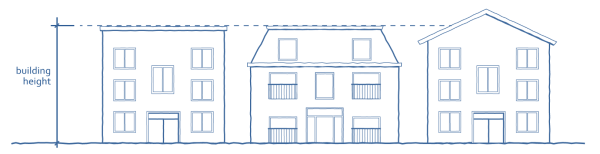
- Whenever building height limits are expressed in stories, a “story” is measured between the surface of any floor and the surface of the floor immediately above it or, if there is no floor above it, then the space between the floor and the ceiling immediately above it. A “half-story” includes space under a sloping roof that has the line of intersection of roof decking and wall face not more than 3 feet above the top floor level, and in which space no more than 60% of the floor area is finished for use.
- Building height is measured as the vertical distance from established grade at to the highest point of the roof surface of a flat roof, to the deck line for a mansard roof, to the mean height level between the eaves and ridge of principal roof structure for hip, gabled, and gambrel roofs.
- Exceptions:
- Chimneys, elevators, equipment penthouses, monitors, cooling towers and ventilators may exceed maximum building height limits, provided they are not intended for human occupancy and they do not extend more than 20 feet above the top of the principal structure to which they are attached. This 20-foot limit may be increased through the special use procedures of 11-15-5.
- Belfries, clock towers, cupolas, domes, flag poles and spires may exceed maximum building height limits, provided they are not intended for human occupancy and they are not more than 150% taller than the applicable height limit. This 150% limit may be increased through the special use procedures of 11-15-5.
11-19-15: Other Height Measurements
- Fences and Walls: The height of fences and walls is measured as vertical distance from the average finished grade on the inside of the fence to the top of the fence or wall. Fences atop walls or landscape features (e.g., raised beds) are measured to average finished grade at the base of the wall or landscape feature. Fence posts may exceed the height of the highest connected portion of the fence by up to 12 inches.
- Other Structures: The height of structures other than buildings, fences or walls is measured as vertical distance from the average finished grade at the base of the structure to the highest point of the structure. Unless otherwise expressly stated, the height of a structure may not exceed the maximum building height allowed in the subject zoning district.
11-19-16: Occupancy
For the purpose of determining compliance with standards or requirements based on building occupancy or capacity, calculations must be based on the building code.

