
Summit City Zoning Code
CHAPTER 9
ACCESSORY USES AND STRUCTURES
11-9-1: Generally Applicable Regulations
- Accessory Uses Allowed: Accessory uses and structures are allowed only in connection with lawfully established principal uses.
- Allowed Uses and Structures: Allowed accessory uses and structures are limited to those expressly regulated in this chapter as well as those that, in the determination of the building official, satisfy all the following criteria:
- They are customarily found in conjunction with the subject principal use or principal structure;
- They are subordinate and clearly incidental to the principal use of the property; and
- They serve a necessary function for or contribute to the comfort, safety or convenience of occupants of the principal use.
- Time of Construction and Establishment:
- Accessory uses may be established only after the principal use of the property is in place.
- Accessory buildings may be established in conjunction with or after the principal building or use. They may not be established before the principal building or use is in place.
- Location: Accessory uses and structures must be located on the same lot as the principal use to which they are accessory, unless otherwise expressly stated.
- Compliance with Lot and Building Regulations: Unless otherwise expressly stated, accessory uses and structures are subject to the same lot and building regulations as apply to principal uses and buildings. See also the provisions governing allowed yard obstructions (11-19-8(C)) and exceptions to height limits (11-19-14(B)).
11-9-2: Apiaries
- Applicability: Bees may be kept in accessory use apiaries in accordance with the regulations of this section.
- Permits: Before erecting or placing an accessory use apiary, an applicant must provide written notice to all abutting prop¬erty owners and obtain a permit from the building official. Apiary permits must be renewed annually.
- Registration: Apiaries must be registered with the Illinois Department of Agriculture. Proof of registration must be submitted to the building official.
- Siting: Apiaries are allowed only in the rear yard.
- Setbacks: Apiaries must be set back at least 10 feet from all lot lines and at least of 10 feet from the principal structure on the lot.
- Number: A maximum of 2 hives are allowed per lot in R districts. A maximum of 6 hives are allowed per lot in all other zoning districts.
- Safety: Beekeepers must requeen colonies that exhibit unusually aggressive behavior, such as stinging or swarming, and ensure that an on-site water source is available within 25 feet of the apiary during the months of March through November.
- Maintenance: Apiaries must be maintained so that they do not become a nuisance. Colonies must be maintained in movable-frame hives with adequate spacing and management techniques to avoid overcrowding and swarming.
- Screening: Apiaries must be screened to provide a flyway barrier. Such screening shall be at least 6 feet in height and consist of a solid fence, vegetative barrier, or combination of such materials. The entrance to the apiary must include a latched gate that must remain closed at all times that a beekeeper is not present.
- Sales: On-site retail sales activities are prohibited unless retail sales is permitted in the subject zoning district.
11-9-3: Electric Vehicle Charging Stations
- General:
- Private (restricted-access) electric-vehicle (EV) charging stations are permitted as accessory uses to lawfully established principal uses in all zoning districts.
- Public EV charging stations are permitted as accessory uses to lawfully established principal nonresidential uses in all zoning districts.
- Parking:
- Electric vehicle charging stations may be counted toward satisfying minimum off-street parking space requirements.
- Public electric vehicle charging stations must be reserved for parking and charging electric vehicles.
- Equipment: Vehicle charging equipment must be designed and located so as to not impede pedestrian, bicycle or wheelchair movement or create safety hazards on sidewalks.
- Signage: Public electric vehicle charging stations must be posted with signage indicating that the space is reserved for electric vehicle charging purposes only. For purposes of this provision, “charging” means that an electric vehicle is parked at an electric vehicle charging station and is connected to the battery charging station equipment.
Figure 9-1: Electric Vehicle Parking Signs (typical)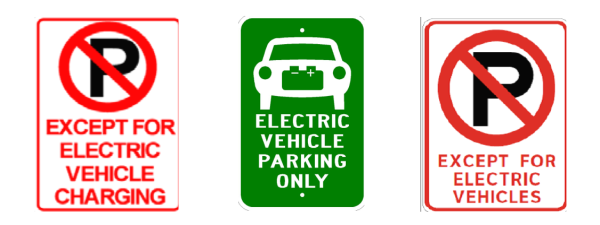
11-9-4: Geothermal Heat Exchange Systems
- General: Geothermal heat exchange systems are permitted as an accessory use in all zoning districts.
- Location:
- Above-ground equipment is subject to compliance with the minimum building setback regulations of the subject zoning district, including the setback obstruction provisions of 11-19-8(C).
- Underground equipment, piping and devices may not be located in any public easement or right-of-way.
11-9-5: Home Occupations
- Home occupations are those in which household residents use their home as a place of work, with no employees, customers or clients coming to the site. Typical examples include telecommuting office workers, writers, consultants, artists and crafts people.
- Purpose: The home occupation regulations of this section are intended to allow Summit residents to engage in customary home-based work activities, while also helping to ensure that neighbors are not subjected to adverse operational and land use impacts (e.g., excessive noise or traffic or public safety hazards) that are not typical of residential neighborhoods.
- Exemptions: Nonresidential uses that are expressly allowed in conjunction with residential uses (e.g., bed and breakfast uses and day care homes) are not subject to home occupation regulations.
- Allowed Uses: The home occupation regulations of this section establish performance standards for all home occupations rather than listing specific home occupation uses that are allowed. Uses that comply with the standards of this section are allowed as of right unless otherwise expressly stated.
- Prohibited Uses: The following uses are expressly prohibited as home occupations:
- Any type of assembly, cleaning, maintenance, painting or repair of vehicles or equipment with internal combustion engines or of large appliances (such as washing machines, clothes dryers or refrigerators);
- Dispatch centers or other businesses where employees come to the site and are dispatched to other locations;
- Equipment or supply rental businesses;
- Taxi, limo, van or bus services;
- Tow truck services;
- Taxidermists;
- Restaurants;
- Funeral or interment services;
- Animal care, grooming or boarding businesses; and
- Any use involving the use or storage of vehicles, products, parts, machinery or similar materials or equipment outside of a completely enclosed building; and
- Any use that does not comply with regulations of this section.
- Where Allowed: Home occupations are permitted as of right as an accessory use to a principal use in the household living use category. Home occupations are subject to the general regulations of 11-9-5(H).
- General Regulations: All home occupations are subject to the following regulations.
- Home occupations must be accessory and subordinate to the principal residential use of the property.
- Home occupations that change the character of the residential building they occupy or that adversely affect the character of the surrounding neighborhood are prohibited. Home occupations may not, for example, produce light, noise, vibration, odor, parking demand, or traffic impacts that are not typical of a residential neighborhood in Summit. Home occupations must be operated so as not to create or cause a nuisance.
- Any tools or equipment used as part of a home occupation must be operated in a manner or sound-proofed so as not to be audible beyond the lot lines of the subject property.
- External structural alterations or site improvements that change the residential character of the lot upon which a home occupation is located are prohibited. Examples of such prohibited alterations include construction of parking lots, the addition of commercial-like exterior lighting, the addition of a separate building entrance that is visible from abutting streets or the exterior display of an illuminated nameplate sign (See 60.030-C Nameplates).
- No display of any material or merchandise is allowed.
- The use or storage of hazardous substances is prohibited, except at the “consumer commodity” level, as that term is defined in 49 C.F.R. Sec. 171.8
- Only residents of the dwelling unit in which the home occupation is located may be engaged in a type 1 home occupation. No nonresident owners, employees or contractors may be present on the subject property.
- No clients, customers, patients, or students are allowed in conjunction with a type 1 home occupation.
- Home occupations and all related activities, including storage (other than the lawful parking of passenger vehicles), must be conducted entirely within the principal residential building or an allowed accessory building.
- More than one Type 1 home occupation is allowed as an accessory use, but the general regulations of 11-9-5(H) and the supplemental regulations of 11-9-5(I) apply to the combined home occupation uses.
11-9-6: Satellite Dish Antennas
- Where Allowed:
- Satellite dish antennas up to 40 inches in diameter are permitted as of right as an accessory use to all lawfully established principal uses in all zoning districts. They are subject to all applicable accessory structure setback regulations.
- Satellite dish antennas over 40 inches in diameter, up to 120 inches in diameter, are permitted as of right as an accessory use to all lawfully established principal uses in nonresidential zoning districts. They are subject to all applicable accessory structure setback regulations.
- Location:
- In R districts, satellite antennas may be located only to the rear of any principal structure. If usable communication signals cannot be obtained from a rear location, the satellite antenna may be located in the side yard. If usable satellite communication signals cannot be received by locating the antenna in the rear or to the side of the principal structure, the antenna may be placed in the street yard outside of the required building setback or on the roof in a location that is visible from the street, provided that the diameter of the satellite dish antenna does not exceed 18 inches.
- In districts other than R districts, satellite dish antennas may be located anywhere in the buildable area of the lot (outside of required building setbacks) or on an allowed principal or accessory building on the lot.
- Ground-mounted satellite dish antennae must be placed or visually screened to reduce visual impact from surrounding properties at street level and from public streets.
11-9-7: Solar Energy Systems
- General:
- Solar energy systems are permitted as of right as an accessory use to all lawfully established principal uses in all zoning districts.
- Accessory solar energy systems must comply with all applicable building and electrical code requirements.
- Building-Mounted Solar Energy Systems:
- Building-mounted solar energy systems may be mounted on principal and accessory structures.
- Building-mounted solar energy systems may not encroach into required street setbacks. Systems mounted on principal structures may encroach into interior side and rear building setbacks in accordance with 11-19-8(C).
- Only building-integrated or flush-mounted solar energy systems may be installed on street-facing building elevations.
- Solar energy systems may not extend more than 3 feet above the applicable maximum building height limit for the subject building type or more than 5 feet above the highest point of the roof line, whichever is less.
Figure 9-2: Roof-Mounted Solar Energy Systems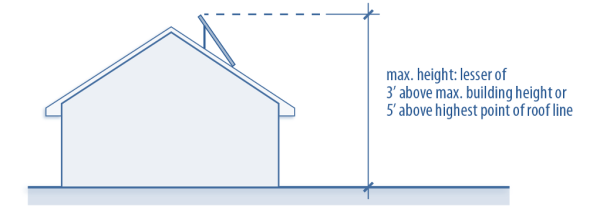
- Ground-Mounted Solar Energy Systems:
- In residential zoning districts, ground-mounted solar energy systems may not be located in a required street setback or street yard area.
- Ground-mounted solar energy systems may be located within required interior side and rear setbacks.
- Ground-mounted solar energy systems are subject to applicable accessory structure height and lot coverage regulations.
11-9-8: Small Wind Energy Conversion Systems
- General:
- The regulations of this section apply to all small wind energy conversion systems.
- Small wind energy conversion systems are also subject to building code requirements.
- Where Allowed:
- One small wind energy conversion system is permitted per lot as an accessory use to a lawfully established principal use in all zoning districts, provided that such systems comply with all applicable requirements of this section.
- Up to 3 small wind energy conversion systems may be allowed on a single lot if the lot is at least one acre in area and the systems are approved in accordance with the special use procedures of 11-15-5.
- Height:
- The maximum allowed height of a small wind energy conversion system, measured as the distance from ground level at the base of the structure to the highest point of the structure, varies based on the size of the lot on which it is located, as indicated in Table 9-1.
Table 9-1: Maximum Height of Small Wind Energy Conversion SystemLot Area (acres) Maximum Height (feet) 0–0.99 30 1–1.99 65 2–4.99 85 5 or more 100 - The lowest point of any moving elements, such as blades or vanes, must be at least 25 feet above grade immediately beneath the moving element.
- The maximum allowed height of a small wind energy conversion system, measured as the distance from ground level at the base of the structure to the highest point of the structure, varies based on the size of the lot on which it is located, as indicated in Table 9-1.
- Siting: Small wind energy conversion systems may not be located in required building setbacks or within easements. In addition, systems must be set back from all property lines by a distance at least equal to 110% of the overall height of the system, measured from grade at the base of the structure to the highest point of the system structure, which includes the tip of the top blade when the blade is in its highest position.
- Design and Operation:
- All small wind energy conversion systems must be equipped with manual and automatic over-speed controls to limit the blade rotation speed to within the design limits of the system.
- The rotating turbine may not produce vibrations that are perceptible to humans standing at ground level outside the property lines of the subject lot.
- Operational noise of a small wind energy system may not exceed 60 db(A) at the nearest property line except during short-term high wind speed events such as storms.
- Lattice-type towers and towers using guy wires are prohibited.
- All power transmission and telemetry lines from a ground-mounted small wind energy conversion system to any building or other structure must be placed underground.
- Towers, rotors and turbines may not be illuminated unless required by a state or federal agency, such as the FAA.
- All structures and equipment must maintain factory colors or be finished in a non-reflective, matte finished, neutral color.
- No commercial messages may be placed or painted on the tower, rotor, turbine, generator or tail vane that is legible from off-site. This provision is not intended to prohibit warning signs or manufacturer’s logos.
- All climbing pegs, ladders and similar apparatus on ground-mounted small wind energy conversion systems must be located at least 12 feet above the ground at the base of the structure.
- Permits: The following information must be submitted with a permit application for a small wind energy conversion system:
- A description of the system, including its maximum power-rated output capacity.
- The make, model, an illustrative photograph or brochure, manufacturer’s specifications including noise data (decibels) for the proposed wind energy conversion system, the support structure, and method of attachment to the ground and/or structure.
- Elevation drawing of the wind energy conversion system showing total height, turbine dimensions, tower and turbine colors, distance between ground and lowest point of any blade, and if proposed, the location of climbing apparatus.
- If the wind energy conversion system is not certified as meeting the IEEE 1547 standards (Institute of Electrical and Electronic Engineers), then an assessment must be provided from an electrical engineer indicating that protection equivalent to the IEEE standard will be provided.
- Abandonment: Any small wind energy conversion system that is not operated for a continuous period of 12 months or more or that is in an obvious state of disrepair or a threat to public safety will be considered abandoned and must be dismantled and removed from the property at the expense of the property owner.

