
Summit City Zoning Code
CHAPTER 13
SIGNS
11-13-1: General
- Purpose: The sign regulations of this section are intended to balance the following differing, and at times, competing goals:
- To support the desired character of the village, as expressed in adopted plans, policies and regulations;
- To promote an attractive visual environment;
- To encourage the effective use of signs as a means of communication for businesses, organizations and individuals;
- To provide a means of way-finding for visitors and residents;
- To provide for reasonable business identification, advertising and communication;
- To prohibit signs of such excessive size and number that they obscure one another to the detriment of the economic and social well-being of the village and its residents, property owners and visitors;
- To protect the safety and welfare of the public by minimizing hazards for motorized and nonmotorized traffic;
- To minimize the possible adverse effects of signs on nearby public and private property; and
- To provide broadly for the expression of individual opinions through the use of signs on private property.
- Scope and Applicability: All signs within the village are subject to the regulations of this chapter and all other applicable provisions of this zoning ordinance.
- Content Neutrality; Substitution of Noncommercial Messages: Any sign allowed under this chapter may contain, in lieu of any other sign message or copy, any lawful noncommercial message if the sign complies with all size, height, location and other applicable requirements of this chapter. Such a substitution of message does not require issuance of a sign permit. The purpose of this “substitution” provision is to prevent any inadvertent favoring of commercial speech over noncommercial speech, or the favoring of any one noncommercial message over any other noncommercial message.
- Off-premise Outdoor Advertising Signs: Off-premise outdoor advertising sign are allowed only in those zoning districts and locations expressly identified in this zoning ordinance and only when such signs comply with all applicable off-premise outdoor advertising sign regulations. Provisions of this zoning ordinance that refer to “signs” being allowed or certain types of signs being allowed (e.g., freestanding, wall, projecting) are not to be construed as references to off-premise outdoor advertising signs being allowed, unless the subject provision expressly refers to “off-premise outdoor advertising signs.” See Table 7-1 to determine which zoning districts allow off-premise outdoor advertising signs.
Notes:
Title 7, Chapter 5 of the village code also includes sign-related regulations, some of which are inconsistent with existing and proposed zoning regulations.
11-13-2: Prohibited Signs And Sign Characteristics
The following signs and sign characteristics are prohibited except as otherwise expressly stated:
- Signs for which no required permit has been issued;
- Signs located in such a manner as to constitute a nuisance;
- Search lights, strobe lights, rotating beacon lights, flashing lights that are visible from public right-of-way, except as otherwise expressly allowed by this chapter or required by law;
- Signs located in or obstructing a required parking or loading space, or that otherwise obstruct vehicular or pedestrian access or circulation, or that pose any other hazard to motorized or nonmotorized travel;
- Signs that obstruct any fire escape, required exit, window or door opening used as a means of egress;
- Signs that interfere with an opening required for ventilation, except that signs may cover transom windows when not in violation of building and fire prevention codes;
- Signs affixed directly to a tree, utility pole or traffic control device;
- Signs that obstruct, impair, obscure, interfere with the view of, or that may be confused with, any authorized traffic control sign, signal, or device;
- Sign displays with a brightness of such intensity or brilliance that they impair the vision or endanger the safety and welfare of any pedestrian, cyclist, or person operating a motor vehicle;
- Roof signs;
- Signs attached to or painted on an inoperable or unlicensed vehicle (motorized or non-motorized) located in view of the right-of-way; and
- Signs attached to or painted on a licensed motor vehicle if the sign: (1) directs attention to a business, service, commodity, or activity offered or sold on the premises and (2) if the vehicle is parked closer to the street than the nearest building wall (does not apply to vehicles parked for the purpose of immediate loading and unloading).
11-13-3: Sign Exceptions
The following signs are not counted as signs for purposes of determining the number of signs or amount of signage on a lot.
- Signs Adjacent to Driveways and Drive Aisles:
- One sign may be installed at each vehicle entrance and exit driveway to any lot occupied by an allowed nonresidential use or multiple-family residential building containing more than 4 dwelling units. Such signs must be located within 10 feet of the intersection of the driveway and the street right-of-way. Driveway signs may be illuminated but may not exceed 4 square feet in area or 5 feet in height.
- Off-street parking areas with a capacity of more than 4 vehicles may display a sign on the interior of the parking area Such signs must be located within 20 feet of an internal site driveway or drive aisle and may not exceed 12 square feet in area or 10 feet in height. Such signs must be located to be visible from internal site drive aisles (rather than from off-site). In areas used primarily by passenger vehicles.
- Signs Adjacent to Drive-Throughs: Signs are permitted in conjunction with drive-through windows, in accordance with the following regulations.
- Location: Drive-through signs must be located within 4 feet of the curb bordering a drive-through lane.
- Number and Dimensions: One primary drive-through sign not to exceed 36 square feet in area or 8 feet in height is allowed per order station up to a maximum of 2 primary drive-through signs per lot. One secondary drive-through sign not to exceed 15 square feet in area or 6 feet in height is allowed per lot.
- Residential Separation: Drive-through signs must be set back at least 50 feet from R zoning districts.
- Visibility: Drive-through signs must be oriented to be visible only by motorists in allowed drive-through lanes. They may not be located or oriented to be visible from off-site.
Figure 13-1: Drive-through Signs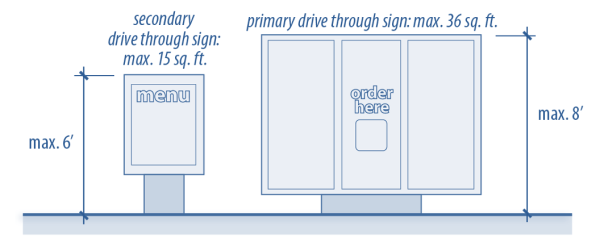
- Small, Flush-Mounted Signs: Small, flush-mounted, non-illuminated wall signs are allowed in all zoning districts. No more than one such sign is permitted per principal building and such signs may not exceed 2 square feet in area.
- Window Signs: Window signs are allowed as sign exceptions for allowed nonresidential uses, provided they do not cover more than 20% of the area of the window to which they are affixed.
- Temporary Signs:
- Temporary Signs on Lots Marketed for Sale, Rental or Lease: One temporary sign is allowed per public street frontage on a lot or portion of a lot that is actively being marketed for sale, rental or lease, subject to the regulations in in Table 13-1:
Table 13-1: Real Estate SignsRegulation R Districts All Other Districts Maximum Sign Area (sq. ft.) 12 32 Maximum Sign Height (feet) 8 12 - Temporary Signs on Active Construction Sites: One temporary sign is allowed per public street frontage on a lot upon which building or construction is actively occurring, pursuant to a valid, unexpired building permit:
- Temporary construction signs may not exceed 32 square feet in area or 0.50 square feet of sign area per linear foot of street frontage, whichever is greater, but in no case may the sign exceed 400 square feet in area. The maximum sign area calculation must be based on the street frontage to which the sign is oriented.
- Temporary construction signs may not exceed 15 feet in height.
- Temporary construction signs must be removed within 2 weeks of completion of the construction or development or upon revocation or expiration of the building permit.
- Banners:
- One banner attached to the wall of a building is allowed as a sign exception for allowed nonresidential uses, provided that such banner does not exceed 32 square feet in area.
- Banners must be removed no later than 90 days after installation or at such time that permanent signs are installed, whichever occurs first.
- Temporary Signs and Banners on Lots Occupied by Residential and Nonresidential Uses:
- Lots Occupied by Residential Uses:
- One temporary freestanding or wall sign is allowed on a lot occupied by an allowed residential use, provided that such sign does not exceed 16 square feet in area.
- Allowed temporary signs on lots occupied by an allowed residential use may be used no more than 2 times per year and must be removed no later than 45 days after their installation.
- Lots Occupied by Nonresidential Uses:
- One temporary sign attached to the wall of a building is allowed on a building occupied by a permitted nonresidential use, provided that such sign does not exceed 32 square feet in area.
- Allowed temporary sign on buildings occupied by an allowed nonresidential use may be used no more than 2 times per year and must be removed no later than 45 days after their installation.
- Lots Occupied by Residential Uses:
- Promotional Signs: Promotional signs are permitted as sign exceptions on lots occupied by allowed nonresidential uses. Such signs are subject to the following standards:
- No more than 4 promotional sign permits are allowed per business per year.
- A promotional sign permit may be issued for a maximum 14-day period. Any or all the 4 allowed promotional sign time periods may run consecutively.
- The height of a promotional sign may not exceed the maximum allowed height of any freestanding sign allowed in the subject zoning district. In addition, any inflatable promotional signs must be set back from all property lines by a minimum distance of one foot for every one foot of sign height, as measured from ground level at the base of the sign.
- Promotional signs may not be mounted on the roof, except for inflatable or other non-rigid sign/displays, which may be roof-mounted.
- Campaign Signs: Campaign signs must be removed no later than 7 days after the voting event. Campaign signs are prohibited on public property and are allowed on private property only with the consent of the owner of the subject property. In R zoning districts campaign signs may not exceed 16 square feet in area.
- Special Event Signs: Special event signs are subject to village board approval. Village board-approved special event signs are not subject to the sign regulations of this chapter unless otherwise expressly stated at the time of approval.
- Temporary Signs on Lots Marketed for Sale, Rental or Lease: One temporary sign is allowed per public street frontage on a lot or portion of a lot that is actively being marketed for sale, rental or lease, subject to the regulations in in Table 13-1:
- Other Sign Exceptions: The following additional signs are also allowed as sign exceptions:
- Signs erected and maintained pursuant to the discharge of governmental functions, or that are required by law, ordinance, or government regulation, or that are required to be posted in order to effectuate a legal right.
- Flags that do not contain a commercial message.
- Wall plaques and wall signs that are not illuminated and that do not exceed 4 square feet in area;
- Signs that are not legible from any public right-of-way or from beyond the boundaries of the lot or parcel;
- Signs within completely enclosed buildings, provided that such signs are oriented to be primarily visible from inside the subject building; and
- Labels and notices on equipment or structures, provided the label or notice does not exceed 15 square inches in area.
11-13-4: Sign Regulations Of General Applicability
- Applicability: The regulations of this section apply to on-premise wall, projecting and freestanding signs and all off-premise outdoor advertising signs, except as otherwise expressly stated. These regulations are in addition to any other applicable regulations established in this chapter.
- Required Setbacks, Spacing and Separations:
- Signs may not project more than 8 feet into the public right-of-way and in all cases must be set back at least 18 inches from the curbline of any street.
- Signs that are visible from an R district must be separated from the R district by a minimum distance of 25 feet.
- Signs with an area of more than 300 square feet that are visible from an R district must be separated from the R district by a minimum distance of 100 feet.
- Additional spacing requirements apply between off-premise outdoor advertising signs (See 11-13-6(H)(4)).
- Mounting Height of Wall Signs and Projecting Signs: Wall signs and projecting signs must be mounted so that no portion of the sign extends above the top of the parapet or building wall to which they are attached, except in those cases where the height of the parapet or building wall or the presence of architectural features will not accommodate a wall or projecting sign that is at least 3 feet in height. In such cases, the sign may extend above the parapet or building wall for a distance that will permit a sign with a height of up to 3 feet.
- Dynamic Displays: Unless otherwise expressly stated, all signs that include a dynamic display are subject to the supplemental regulations of 11-13-8.
- Illumination: Except for authorized dynamic displays, the illumination on the face of any sign where illumination is permitted must be by constant light and may not exceed 70 foot candles measured at a distance of 2 feet from the face of the sign.
- Vertical Clearance: Signs that overhang a sidewalk or other public right of way must have a minimum vertical clearance of 9 feet above such sidewalk or other public right.
11-13-5: Signs In R And P Zoning Districts
- Applicability: The regulations of this section apply to signs in all R and P districts. See also the general regulations of 11-13-4.
- Signs Allowed: The following signs are allowed in R and P districts in addition to any signs allowed pursuant to 11-13-3. On-premise projecting signs and off-premise outdoor advertising signs are prohibited in R and P districts.
- Residential Buildings: With 5 or More Dwelling Units and Neighborhood and Subdivision Identification Signs
- Lots occupied by one or more residential buildings occupied by 4 or more dwelling units are allowed a maximum of one freestanding sign per street frontage and a maximum of one wall sign per building wall. Wall signs may not exceed 16 square feet in area.
- The freestanding signs allowed by this section may not exceed 32 square feet in area or 0.20 square feet of sign area per linear foot of street frontage, whichever is greater, but in no case may the sign exceed 48 square feet in area. The maximum sign area calculation must be based on the street frontage to which the sign is oriented. Maximum height may not exceed 20 feet.
- Nonresidential Uses: The following regulations apply to all principal nonresidential uses in R and P districts.
- Wall Signs: Nonresidential uses in R and P districts are allowed a maximum of one wall sign per public building entrance. No individual wall sign may exceed 32 square feet in area. In buildings with multiple public building entrances, the sign area of all wall signs may not exceed 32 square feet in the aggregate.
- Freestanding Signs: Nonresidential uses in R and P districts are allowed a maximum of one freestanding sign per street frontage. Allowed freestanding signs are subject to a maximum height limit of 20 feet and may not exceed 32 square feet in area or 0.20 square feet of sign area per linear foot of street frontage, whichever is greater, but in no case may the sign exceed 48 square feet in area. The maximum sign area calculation must be based on the street frontage to which the sign is oriented.
- Dynamic Displays: Dynamic displays are prohibited in R and P districts except that on a lot occupied by an allowed public, civic or institutional use, the zoning board of appeals is authorized to approve a special use for the allowed wall sign or the allowed freestanding sign to include a dynamic display.
- The allowed dynamic display component may not exceed 32 square feet in area, and no more than one (wall or freestanding) dynamic display is allowed per street frontage.
- The sign area allowed for a dynamic display is not in addition to the maximum sign area allowed for a wall or freestanding sign, but rather is counted as part of the maximum area of a wall or freestanding sign.
- Dynamic displays in R districts and P may operate only between the hours of 7:00 a.m. and 9:00 p.m. unless otherwise expressly approved through the special use process.
- Dynamic displays are subject to the dynamic display regulations of 11-13-8.
- Off-Premise Outdoor Advertising Signs: Off-premise outdoor advertising signs are prohibited in R and P districts.
- Residential Buildings: With 5 or More Dwelling Units and Neighborhood and Subdivision Identification Signs
11-13-6: Signs In Mixed-Use, Commercial And Industrial Zoning Districts
- Applicability: The regulations of this section apply to signs in all mixed-use, commercial and industrial zoning districts. See also the general regulations of 11-13-4.
- Signs Allowed:
- In addition to any sign exceptions allowed pursuant to 11-13-3, the following signs are allowed in all mixed-use, commercial and industrial zoning districts:
- Wall signs;
- Projecting signs; and
- Freestanding signs.
- Off-premise outdoor advertising signs are allowed only if approved in accordance with the special use procedures of 11-15-5.
- In addition to any sign exceptions allowed pursuant to 11-13-3, the following signs are allowed in all mixed-use, commercial and industrial zoning districts:
- Maximum Number of Signs Allowed:
- A maximum of one wall sign or one projecting sign is allowed per 100 linear feet of building frontage.
- A maximum of one freestanding sign is allowed per public street frontage.
- Maximum Sign Area: The maximum combined area of all wall, projecting, and freestanding signs allowed on a lot in a mixed-use, commercial and industrial zoning district may not exceed 21 square feet per linear foot of street frontage or 50 square feet, whichever is greater. In addition to the maximum aggregate sign area limits, individual wall, projecting and freestanding signs may not exceed 120 square feet in area.
- Maximum Sign Height:
- Freestanding Signs: Freestanding signs may not exceed 122 feet in height.
- All Other Signs: Wall signs and projecting signs may not be mounted in a manner that results in the highest point of the sign exceeding the height of the building wall or parapet to which it is attached.
- Design:
- Poles or pylons used to support freestanding signs must be constructed of a material or concealed by a decorative cover that is architecturally compatible with the overall design of the sign and the character of buildings on the site, in terms of style, colors, and materials.
- The ground area surrounding the base of all freestanding signs must be landscaped. The landscape area must include at least one square foot of landscape treatment for each 2 square feet of sign area. The sign base landscape area must include shrubs, perennial and/or annual flowers, ornamental grasses, and/or vegetative ground cover. Landscaping plans for sign bases, indicating plant materials and location, must be submitted with the sign permit application.
- Dynamic Displays on Wall, Projecting and Freestanding Signs:
- A maximum of one of the wall signs, projecting signs or freestanding signs allowed on a lot in a B-1 or B-3 zoning district may include a dynamic display.
- The sign area allowed for a dynamic display is not in addition to the maximum sign area allowed for a wall, projecting or freestanding sign, but rather is counted as part of the maximum area of the wall, projecting or freestanding sign.
- The dynamic display may not exceed the maximum sign area allowed for the respective sign type or 48 square feet, whichever is less.
- Only one, contiguous dynamic display is allowed on a wall, projecting or freestanding sign face.
- Off-premise Outdoor Advertising Signs: Off-premise outdoor advertising signs are allowed only if approved in accordance with the special use procedures of 11-15-5. Approved off-premise outdoor advertising signs must comply with the regulations of this subsection (11-13-6(B)).
- Maximum Number: No more than one off-premise outdoor advertising sign is allowed on a single lot.
- Maximum Height: Off-premise outdoor advertising signs may not exceed 30 feet in height.
- Orientation: All off-premise outdoor advertising signs must be oriented to be primarily visible from the adjacent roadway.
- Required Setbacks, Spacing and Separations:
- Off-premise outdoor advertising signs must be separated by a minimum distance of 150 feet from any public park.
- Off-premise outdoor advertising signs that are visible from an R district must be separated from the R district by a minimum distance of 150.
- See 11-13-4(B) for setback, spacing and separation regulations generally applicable to all signs.
- Number of Sign Faces: Off-premise outdoor advertising signs may not have more than 2 sign faces. See also 11-13-11(A)(3).
- Posts and Columns: Off-premise outdoor advertising signs that are freestanding may not be supported by more than one post or column unless required by site engineering considerations, as certified by a registered professional engineer and approved as part of the special use approval.
- Illumination:
- Illumination on the face of any off-premise outdoor advertising sign may not exceed 70 foot-candles.
- Any illumination must be by constant light unless otherwise expressly stated.
- No off-premise outdoor advertising sign may contain flashing, blinking or traveling lights or reflective glitter.
- Conversion: A sign permitted as an off-premise outdoor advertising sign may not be converted to any other type of sign without first obtaining a permit. The reverse is also true.
- Dynamic Displays:
- Off-premise outdoor advertising signs that incorporate a dynamic display are subject to the dynamic display regulations of 11-13-8.
- No off-premise outdoor advertising sign with a dynamic display may be modified, extended, or enlarged until a permit has been issued for its installation and use as a dynamic display sign.
- The conversion of an off-premise outdoor advertising sign into an off-premise outdoor advertising sign with a dynamic display requires a permit as if it were an entirely new sign.
- A nonconforming off-premise outdoor advertising sign may not be modified, changed or converted into a dynamic display off-premise outdoor advertising sign unless it complies with all requirements of this zoning ordinance, and all setback, spacing and separation requirements have been verified.
Notes:
1 Current maximum area is 3x frontage.
2 Current maximum height is 25 feet.
11-13-7: Signs In PD Districts
Signs in PD districts are subject to the regulations established in the approved development plan.
11-13-8: Dynamic Displays
The supplemental regulations of this section apply to all signs with dynamic displays. Except as otherwise expressly stated, these regulations apply whether incorporated into off-premise outdoor advertising signs or on-premise signs that are allowed to include a dynamic display.
- The images and messages displayed on a dynamic display must have a minimum dwell time of at least 8 seconds and may not contain any movement, animation, audio, video, pyrotechnics or other special effects.
- The transition or change from one message to another must occur in one second or less and involve no animation or special effects.
- The images and messages displayed must be complete in and of themselves within the required dwell time.
- Dynamic displays may not be located within 50 feet of the driving surface of a signalized intersection, measured horizontally in a straight line from the nearest point of the sign structure to the nearest point of the intersection.
- Dynamic displays may not be located within or within 20 feet of the driving surface of a street, measured horizontally in a straight line from the nearest point of the sign structure to the nearest point of the street curb or edge of the traveled roadway marked or understood as such.
- Dynamic displays may not be located within 200 feet of any R district. This separation distance does not apply if the dynamic display is not visible from the referenced district, area or lot, and the requirements may be modified in R districts if approved through the special use process. Required separation distances must be measured horizontally in a straight line from the nearest point on a sign structure to the nearest point of an R district.
- Dynamic displays must be equipped with a default mechanism that freezes the display in one position or presents a static or blank display if a malfunction occurs.
- Dynamic displays must be equipped with a light detector/photocell that automatically adjusts the display's brightness according to natural ambient light conditions.
- The maximum brightness level of a dynamic display may not exceed 6,500 nits (candelas per square meter) during daylight hours or 500 nits between 30 minutes after sunset and 30 minutes before sunrise, as those times are determined by the National Weather Service (Actual Time). Brightness must be measured from the brightest element of the sign’s face.
11-13-9: Administration
- Any person proposing to erect any sign requiring a sign permit must submit a sign permit application to the building official. Applications for such permit must be accompanied by detailed plans, including scaled drawings of the proposed sign, a detailed site plan and other information deemed necessary by the building official to determine compliance with applicable regulations.
- Sign permit fees must be paid prior to the issuance of a sign permit.
- If the work associated with a sign permit has not been completed within 180 days of the date of the issuance of the permit, such permit will lapse and become null and void.
11-13-10: Nonconforming Signs
- Description: A nonconforming sign is a sign that was lawfully established but that no longer complies with applicable zoning ordinance regulations because of the adoption or amendment of regulations after the sign was established.
- On-premise Signs: Nonconforming on-premise signs may continue subject to the following provisions:
- Nonconforming on-premise signs must be maintained in good repair and safe condition. No permits may be issued for upgrades or modifications of nonconforming signs.
- If an on-premise sign is nonconforming by reason of restrictions on its brightness or illumination or its use of strobe or beacon lights, the sign must be immediately removed or made to conform.
- A window sign that is nonconforming by reason of restrictions on its sign area must be immediately removed or made to conform.
- If a nonconforming on-premise sign is damaged or partially destroyed to the extent of more than 50% of its replacement cost at the time of damage, the sign must be removed or made to conform to all applicable regulations within 90 days of the date of the date of damage or destruction.
- If the on-premise sign is not used for advertising purposes for a period of 180 consecutive days, the sign is deemed abandoned and must be removed.
- Strobe Lights and Beacons: Search lights, strobe lights and rotating beacon lights that are visible from public right-of- way are prohibited and must be removed immediately, except as otherwise required by law.
- Off-Premise Outdoor Advertising Signs: Nonconforming off-premise outdoor advertising signs may continue subject to the following provisions:
- Nonconforming off-premise outdoor advertising signs must be maintained in good repair and safe condition. No permits may be issued for upgrades or modifications of nonconforming off-premise outdoor advertising signs.
- If an off-premise outdoor advertising sign is nonconforming by reason of restrictions on its brightness or illumination or its use of strobe or beacon lights, the sign must be immediately removed or made to conform.
- If a nonconforming off-premise outdoor advertising sign is damaged or partially destroyed to the extent of more than 50% of its replacement cost at the time of damage, the sign must be removed or made to conform to all applicable regulations within 90 days of the date of the date of damage or destruction.
- If a nonconforming off-premise outdoor advertising sign is not used for advertising purposes for a period of 180 consecutive days, the nonconforming off-premise outdoor advertising sign is deemed to have been abandoned and must be removed. A sign that directs attention to the sign owner's outdoor advertising business, commodity, or service is not considered “outdoor advertising” for purposes administering and enforcing the provisions of this paragraph.
11-13-11: Rules Of Measurement
- Sign Area:
- Signs Enclosed in Frames or Cabinets: The area of a sign enclosed in a frame or cabinet is determined based on the outer dimensions of the frame or cabinet surrounding the sign face (see Figure 13-2).
Figure 13-2: Sign Area Measurement (Signs in Cabinets or Frames)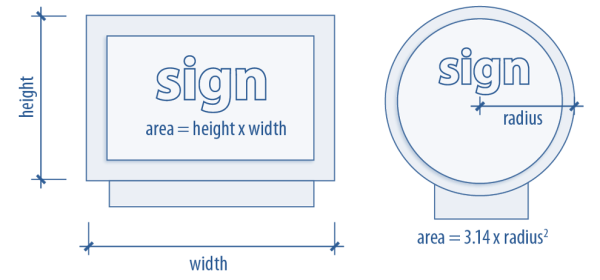
- Channel (individual) Letter Signs:
- The area of a sign comprised of individual letters or elements attached to a building wall is determined by calculating the area of the smallest geometric figure (e.g. square, rectangle, circle, polygon, etc.) that can be drawn around the letters and/or elements (see Figure 13-3).
- Signs consisting of individual letters and/or elements will be measured as one sign when the distance between the letters and/or elements is less than the largest dimension of the largest sign letter (see Figure 13-4).
Figure 13-3: Sign Area Measurement (Individual Letter Signs)
Figure 13-4: Sign Area Measurement (Single vs. Multiple Signs)
- Multi-Sided Signs: Unless otherwise expressly stated, when the sign faces of a multi-sided sign are parallel or within 30 degrees of parallel, only one side is counted for the purpose of determining the area and number of signs. If the sign faces are not parallel or within 30 degrees of parallel, all sign faces are counted (see Figure 13-5).
Figure 13-5: Multi-Sided Signs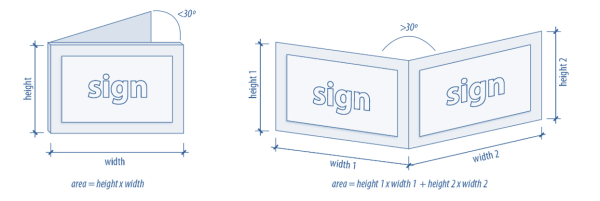
- Non-planar Signs: Spherical, free-form, sculptural or other non-planar sign area is measured as 50% of the sum of the areas using only the 4 vertical sides of the smallest 4-sided polyhedron that will encompass the sign structure. Signs with greater than 4 polyhedron faces are prohibited.
Figure 13-6: Non-Planar Sign Measurement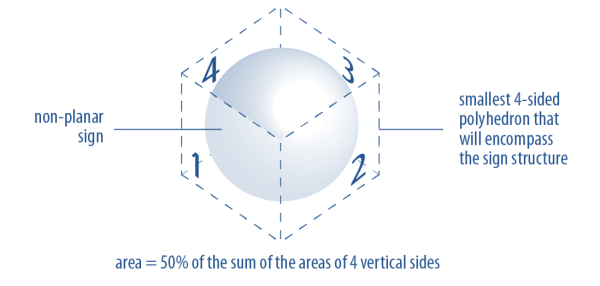
- Signs Enclosed in Frames or Cabinets: The area of a sign enclosed in a frame or cabinet is determined based on the outer dimensions of the frame or cabinet surrounding the sign face (see Figure 13-2).
- Sign Height: The height of a sign is measured as the vertical distance from curb level to the highest point of the sign.
Figure 13-7: Sign Height Measurement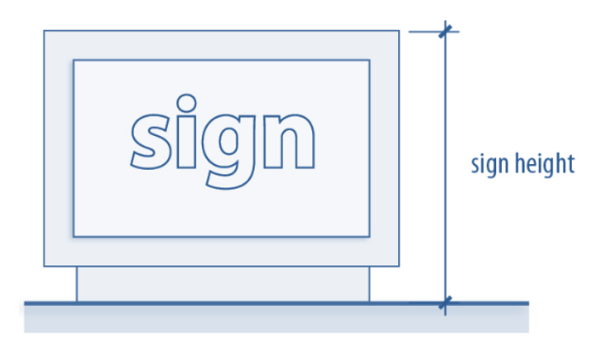
- Setback, Spacing and Separation Distances:
- Required setback, spacing and separation distances between signs must be measured in a straight line from the nearest points on the respective sign structures. Required separation distances between signs and zoning districts, area or lots must be measured in a straight line from the nearest point on the sign structure to the nearest point of the subject district, area or lot.
- The required separation distance between off-premise outdoor advertising signs must be measured in a straight line from the center of the respective off-premise outdoor advertising sign structures, as located on the ground.
- Illumination and Luminance:
- Foot-Candles: Sign illumination in foot-candles is measured 2 feet from the sign face.
- Nits: For the purpose of verifying compliance with maximum brightness level limits expressed in “nits,” brightness levels must be measured with the dynamic display set to run full white copy with a luminance meter positioned at a location perpendicular to the sign face center. When taking the luminance reading, the sign face must be the only subject visible in the viewfinder.
- Window Area: The area of a window includes the continuous surface of the glass or glazed elements of the window until divided by an architectural or structural element. Mullions are not considered an architectural or structural element that divides a window.
Figure 13-8: Measurement of Window Area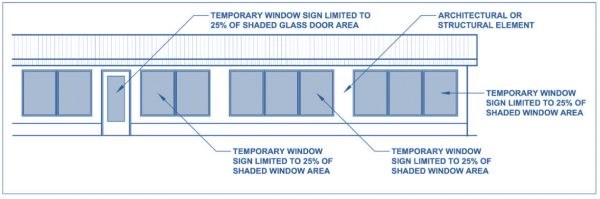
11-13-12: Murals
11-13-12 Murals (A) Applicability: Murals (as defined herein) shall be included within the categories of permitted signs in accordance with the regulations of this Section. Murals are intended to provide for artistic expression to enhance community life in the Village of Summit, to beautify the Village, and to provide for and protect the use and enjoyment of property in the Village of Summit.
(B) Definitions: Whenever the following words or phrases are used, they shall, for the purposes of this chapter, have the meaning ascribed to them in this Section, except when the context otherwise indicates: Mural. An inscription, word, drawing, figure, painting, writing, mark, or design that is written, etched, painted, sprayed, or drawn directly upon the exterior of any building or other structure that has been made with the permission of the owner. As such, a “mural” shall be otherwise included within the class of “wall signs” in Section 11-13-6(B): Signs Allowed of this Zoning Ordinance. Any such inscription, word, drawing, figure, painting, writing, mark, or design that is written, etched, painted, sprayed, or drawn directly upon the exterior of any building or other structure or object that is made without the permission of the owner shall not be a “mural” but shall instead be a defacement of property prohibited by Section 6-14-2(A) of the Village Code, and/or posting of bills prohibited by Section 6-1-57 of the Village Code.
(C) Limit to the Number of Murals Permitted on a Building or Structure: No person shall locate a mural on more than two (2) walls of a building or structure, subject to the provisions of this Zoning Ordinance pertaining to variances for one (1) additional mural on one (1) additional wall.
(D) Buildings and Structures: Murals on Buildings and Structures shall comply with all provisions of Chapter 13 of the Zoning Ordinance, except any provision in this Subsection 12 shall control over any conflicting provision in Chapter 13 of the Zoning Ordinance:
(1) Location Restrictions. Murals on Buildings and Structures shall be permitted uses in any MX, C-1, C-2, I-1, I-2, and I-3 Zoning Districts.
(2) Requirements. Murals may cover any one wall of a Building or Structure completely, except as noted below, but shall not cover more than 50 percent of any other wall of the same building or structure. However, no mural shall be placed on the front facia of any building, and no mural may cover completely any windows, doors, or openings on any wall.
(E) Maintenance of Murals: All murals permitted under this Zoning Ordinance shall be kept clean, sanitary and free from waste and defacement, and shall be otherwise maintained in good condition. The owner(s)/applicant(s) shall be responsible for maintaining the condition of the mural. If a mural is not properly maintained, in the determination of the Village and its officials, the owner(s)/applicant(s) shall have 30 days to take whatever steps are necessary to correct the defects. In the event that no steps are taken to correct the defects, the owner(s)/applicant(s) shall be subject to a daily fine of no less than $50.00, and shall be subject to a code hearing complaint pursuant to Chapter 15, Title 7 of the Village Code.(F) Miscellaneous
(F) Regulations of Murals:
(1) Murals that are predominantly commercial in nature are permitted but not favored. Murals in the Village of Summit are intended to provide an outlet for artistic expression and freedom of expression to beautify the overall community in the Village of Summit. (2) Murals shall not contain gang symbols, or depict unreasonable or offensive acts, utterances, gestures, or displays that create a clear and present danger of a breach of the peace or imminent threat of violence. Murals shall not contain obscene or defamatory depictions or words, or otherwise incite violence or criminal activity. By way of examples and not a limitation, the following subjects shall be prohibited from being displayed on any mural: drugs, alcohol, and sexual acts, and negative depictions of race. (3) Murals may not depict material (whether illustrations, depictions, or words) harmful to minors.
(G) Permit.
(1) Requirements. No person shall allow a mural on their property without a sign permit issued by the Village:
(a) Process. An applicant for a permit for a mural shall be in conformity with the application processes set forth in Section 11-13-9 of the Zoning Ordinance and Section 7-5-1 of the Village Code, including the payment of applicable permit fee(s). In addition to and consistent with the provisions of Section 11-13-9 of the Zoning Ordinance and Section 7-5-1 of the Village Code, such permit application shall be submitted to the Clerk of the Village and the Building Department, shall be referred to the proper Village committee for its review and recommendation, and then shall be forwarded to the Village Board for its approval consistent with Section 7-5-1B of the Village Code. Once granted, a permit for a mural must be renewed annually, and shall also be subject to an annual inspection. The annual renewal fee shall be $100, or the amount of the original permit, whichever is less.
(b) Insurance. A certificate of insurance in the amounts specified in Section 7-5-1(C)(1) of the Village Code shall be provided for murals, which, in addition to covering accidents and incidents associated with the creation of the mural, shall also protect and hold harmless the Village for any injuries relating thereto.
(c) Performance Bond. In addition to the certificate of insurance specified in Section 11-13-12(g)(1)(b) of this Subsection, a performance bond in the amount of one hundred thousand dollars ($100,000.00) shall be provided for the maintenance of the mural as required by Section 11-13-12(e) of this Subsection. Such performance bond shall be renewed periodically if the amount of the performance bond has been depleted because of its use to maintain the mural.
(d) Permits for Certain Applicants. Permit applications for murals made by not-for-profit companies or entities, charities, schools, churches, and public bodies may be exempt from the permit and renewal fees in subsection (a), the insurance requirements in subsection (b), and the Performance Bond requirements in subsection (c) with the approval of the Village Board.
(h) Other Restrictions. Nothing in this section shall be construed as a restriction other than a reasonable time, place, and manner restriction as permitted by law.

