
Summit City Zoning Code
CHAPTER 10
TEMPORARY USES
11-10-1: Description And Purpose
- A temporary use is the use of private property that does not require a building permit and that may or may not comply with the use and lot and building regulations of the zoning district in which the temporary use is located.
- The temporary use regulations of this chapter are intended to permit such occasional, temporary uses and activities when consistent with the purposes and regulations of this zoning ordinance.
11-10-2: Authority To Approve
- Except as expressly stated in 11-10-5, all temporary uses require village approval.
- The building official is authorized to establish administrative procedures governing the processing, review and approval of temporary uses.
- The building official is authorized to approve temporary uses that comply with the provisions of this chapter and to impose conditions on the operation of temporary uses to help ensure that they do not create significant adverse impacts on surrounding uses and that they operate safely and without causing nuisances, consistent with the general purposes of this zoning ordinance.
- Temporary uses that do not comply with all applicable regulations and all conditions of approval may be approved as special uses in accordance with 11-15-5. The building official is authorized to refer any temporary use to the zoning board of appeals for consideration in accordance with special use procedures of 11-15-5.
- Special events require village board review and approval.
11-10-3: Authorized Uses
The building official is authorized to approve temporary uses upon determining that the proposed use is a customary temporary use in the subject location and will generally be compatible with surrounding uses and not be a detriment to public safety. The following is a non-exhaustive list of the types of temporary uses and activities that may be approved by the building official:
- Christmas tree and similar holiday sales lots for a maximum of 90 days per lot per year;
- Parking lot sales for a maximum of 30 days per lot per year;
- Tents accessory to an allowed principal or temporary use;
- Outdoor carnivals, concerts, festivals, revivals and public gatherings for a maximum of 30 days per lot per year and no more than 10 consecutive days per occurrence;
- Construction staging areas, construction offices and storage of materials related to ongoing construction for the period in which construction is ongoing and all required permits remain valid;
- Temporary residential sales and leasing offices and model homes, when located on the same lot or in the same subdivision as the residential units actively being offered for lease or sales; and
- Temporary mobile storage units, subject to the following supplemental regulations:
- Temporary mobile storage units are allowed in R zoning districts, subject to compliance with all the following regulations:
- Temporary mobile storage units are permitted for a period not to exceed a total of 90 days within any calendar year unless a valid building or construction permit is in place for the subject property, in which case the temporary mobile storage unit may remain in place for a maximum of 115 days or until the permit expires, whichever occurs first. If a dwelling unit on the subject lot has been damaged by natural disaster act of God, the building official is authorized to grant time extensions of otherwise applicable temporary mobile storage unit time limits.
- No more than one temporary mobile storage unit may be located on any lot.
- Temporary mobile storage units may not exceed 16 feet in length, 8 feet in width, and 8.5 feet in height. Figure 10-1.
Figure 10-1: Maximum Mobile Storage Unit Size in Residential Districts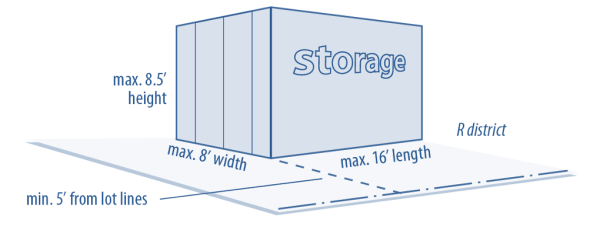
- Temporary mobile storage units must be set back at least 5 feet from all property lines.
- Temporary mobile storage units must be placed on an improved all-weather surface, generally asphalt, brick pavers, or concrete. Units are prohibited within landscape areas, open spaces, stormwater basins, or any other location that may cause hazardous conditions, constitute a threat to public safety, or create a condition detrimental to surrounding land uses and development.
- No materials may be stacked or stored on the exterior of the mobile storage unit and no running gear or transport trailer may be stored on site outside of a completely enclosed building.
- Temporary mobile storage units are allowed in nonresidential zoning districts, subject to compliance with all the following regulations:
- Temporary mobile storage units are permitted for a period not to exceed a total of 90 days within any calendar year unless a valid building or construction permit is in place for the subject property, in which case the temporary mobile storage unit may remain in place for a maximum of 180 days or until the permit expires, whichever occurs first. If the principal building on the subject lot has been damaged by natural disaster act of God, the building official is authorized to grant time extensions of otherwise applicable temporary mobile storage unit time limits.
- No more than 3 temporary mobile storage units may be located on any lot.
- Temporary mobile storage units may not exceed 20 feet in length, 8 feet in width, and 8.5 feet in height. See Figure 10-2.
Figure 10-2: Maximum Mobile Storage Unit Size in Nonresidential Districts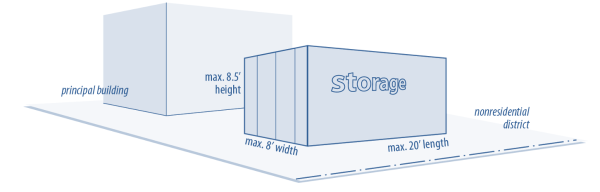
- Temporary mobile storage units must comply with all building setback requirements of the subject zoning district.
- Temporary mobile storage units may not be placed or located on a required parking space, circulation aisle/lane, or fire access lane.
- Vertical stacking of storage units and stacking of any other materials or merchandise on top of any mobile storage unit is prohibited. No running gear or transport trailer may be left underneath any mobile storage unit.
- Temporary mobile storage units are prohibited within landscape areas, required open spaces, stormwater basins, or any other location that may cause hazardous conditions, constitute a threat to public safety, or create a condition detrimental to surrounding land uses and development.
- Temporary mobile storage units are allowed in R zoning districts, subject to compliance with all the following regulations:
11-10-4: General Procedure
Upon receipt of a complete application for a temporary use permit, the building official must review the proposed use for its likely effects and surrounding properties and its compliance with the general provisions of this chapter. The building official may impose such conditions of approval as the building official determines necessary to mitigate potential adverse impacts. Such conditions may include the following:
- Requirements for vehicle access and parking;
- Restrictions on hours of operation;
- Limitations on signs and outdoor lighting;
- Requirements for financial guarantees covering the costs of cleanup and/or removal of structures or equipment; and
- Other conditions necessary to carry out the stated purposes of this zoning ordinance and this chapter.
11-10-5: Exemptions
The following temporary uses are permitted as of right, without obtaining approval from the building official:
- Garage sales conducted in R districts or on lots occupied by residential dwelling units no more than 2 times in any calendar year and for no more than 4 consecutive days per occurrence. These limits apply on a per-lot basis, regardless of the person conducting the garage sale. No person conducting a garage sale may sell merchandise at the garage sale acquired solely for resale purposes. Garage sales are sometimes referred to as “yard sales,” “estate sale,” “moving sales,” “occasional sales” and other similar names. All such sales, by whatever name, are classified and regulated as “garage sales.” Authorization to conduct more than 2 garage sales in any calendar year requires review and approval in accordance with the special use procedures of 11-15-5.
- Temporary dumpsters are allowed on lots with ongoing construction, subject to compliance with all the following regulations:
- Temporary dumpsters related to ongoing construction are permitted for a period in which construction is ongoing and all required permits remain valid.
- Temporary dumpsters may not exceed 22 feet in length, 8 feet in width, and 8.5 feet in height.
- Temporary dumpsters must comply with all structure setback requirements of the subject zoning district.
- Temporary dumpsters may not be located in storm water basins, or any other location that may cause hazardous conditions, constitute a threat to public safety, or create a condition detrimental to surrounding land uses and development.
- In single-family residential zoning districts and development areas, no more than 1 temporary dumpster may be located on any lot.
- Temporary dumpsters are allowed on lots for a period of 60 days following a natural disaster (act of God) occurring in the immediate area of the lot, to be used for the disposal of debris resulting from the natural disaster (act of God). The building official is authorized to grant extensions of the 60-day time limit.

