
Summit City Zoning Code
CHAPTER 12
LANDSCAPING AND SCREENING
11-12-1: Purposes
The regulations of this chapter establish minimum requirements for landscaping and screening. The regulations are intended to advance the general purposes of this zoning ordinance and to help:
- Maintain and enhance the village’s appearance;
- Mitigate possible adverse impacts of higher intensity land uses abutting lower intensity land uses;
- Reduce the impacts of noise and glare.
- Maintain and improve air quality;
- Protect surface water quality and reduce the negative impacts of stormwater runoff by reducing impervious surface area and providing vegetated areas that filter and retain greater amounts of stormwater on site;
- Moderate heat by providing shade;
- Encourage preservation and replacement of existing trees and landscaping; and
- Encourage use of low-impact development practices.
11-12-2: Applicability
The landscaping and screening regulations apply as set forth in the individual sections of this chapter. The following are expressly exempt from all landscaping and screening regulations of this chapter:
- Agricultural uses;
- Public parks and open spaces; and
- Reconstruction of any building that is damaged or destroyed by tornadoes, straight-line winds, ice storms, accidental fire, floods, hail, lightning, or other forces beyond the reasonable control of the property owner.
11-12-3: Street Trees
- Purpose: Street trees help maintain and enhance the appearance of the village, contribute to pedestrian safety and comfort and offer environmental benefits by allowing the infiltration of stormwater, reducing urban heating and improving air quality.
- Applicability: The street tree planting requirements of this section apply to all the following, except as otherwise expressly stated:
- Construction of any principal building or non-accessory parking;
- Any addition to or enlargement of an existing principal building when the addition or enlargement exceeds 20% of the building’s existing floor area; and
- Any increase in impervious coverage on the subject lot that exceeds 20% of the lot’s existing impervious coverage.
- Requirements:
- Number: At least one large tree is required per lot or per 30 feet of street frontage, whichever results in more trees. If large trees are not appropriate due to the presence of overhead lines or other obstructions, small trees may be substituted
- Location:
- Required street trees must be installed in front of the subject property between the curb or outer edge of street where there is no curb and the sidewalk. When no sidewalk exists, required trees must be installed on the subject property within 20 feet of the street right-of-way.
- The building official is expressly authorized to approve the installation of street trees in alternative locations when circumstances prevent tree planting within the areas described in 11-12-3(C)(2)(a) or when compliance with 11-12-3(C)(2)(a) would result in a poor growing environment for the tree or damage to public or private improvements.
- Required street trees must be located within pervious landscape areas or within tree wells.
- Spacing: Street trees are not required to be evenly spaced, but the distance between street trees may not exceed 75 feet.
- Materials, Installation and Maintenance: See 11-12-6 and 11-12-7.
11-12-4: Parking Lot Buffers
- Purpose: The parking lot buffer regulations of this section are intended to help mitigate the visual and operational impacts of parking lots that are adjacent to streets or residential zoning districts.
- Applicability: Unless otherwise expressly stated, the parking lot buffer regulations of this section apply to all the following:
- The construction or installation of any new parking lot containing 10 or more parking spaces; and
- The expansion of any existing parking lot results in the provision of 10 or more parking spaces or more than 3,500 square feet of paved area.
- Exceptions:
- Parking areas used solely for the display of motor vehicles for sale, lease or rental are exempt from the street frontage buffer and R district buffer requirements of this section.
- Household living uses consisting of a single household on one lot or 2 households on one lot (existing or proposed) are exempt from the street frontage buffer and R district buffer requirements of this section.
- Parking areas in industrial zoning districts are exempt from the street frontage buffer requirements of this section.
- Requirements:
- Street Frontage Buffers:
- When a parking lot is located adjacent to a street right-of-way, street frontage (parking lot) buffers must be provided in accordance with the regulations of this subsection to physically and visually buffer the parking lot from the right-of-way.
- Street frontage buffers are required only when the parking lot is located within 100 feet of the right-of-way and there are no intervening buildings between the parking lot and the right-of-way.
- Street frontage buffers must be at least 7 feet in width and be planted with at least one large or medium tree per 30 linear feet street-frontage buffer. An S1 low-profile screen must also be provided within the street frontage buffer, in accordance 11-12-5(C)(1).
- Trees planted to satisfy the street tree planting requirements of 11-12-3 may be counted toward satisfying street frontage buffer tree planting requirements.
- Shrubs and groundcover plants must be provided in all street frontage buffer areas that are not covered by fences or walls.
- A portion of a motor vehicle parking space may be landscaped instead of paved to meet street frontage landscape buffer requirements. The landscaped area may be up to 2.5 feet of the front of the space, as measured from a line parallel to the direction of the bumper of the vehicle using the space.
Figure 12-1: Parking lot Street Frontage Buffer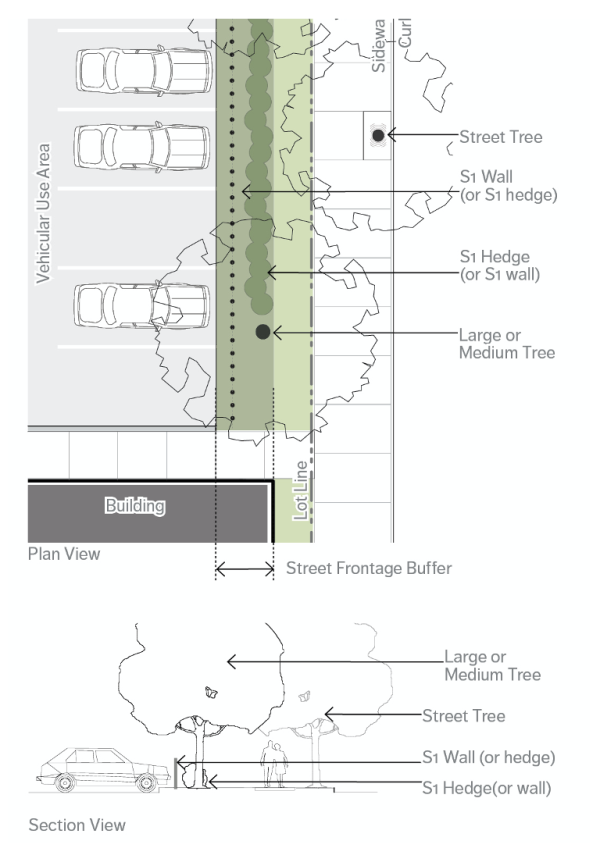
- R District Parking Lot Buffers:
- When a parking lot is located adjacent to an abutting R-zoned lot, an R district buffer must be provided in the form of an F1 screen, in accordance with 11-12-5(C)(2).
- R district buffers are required only when the parking lot is located within 100 feet of an abutting R-zoned lot and there are no intervening buildings between the vehicular use area and the abutting R-zoned lot.
- Shrubs and groundcover plants must be provided in all R district buffer areas that are not covered by fences or walls.
- A portion of a motor vehicle parking space may be landscaped instead of paved to meet R district landscape buffer requirements. The landscaped area may be up to 2.5 feet of the front of the space, as measured from a line parallel to the direction of the bumper of the vehicle using the space.
Figure 12-2: R District Parking Lot Buffer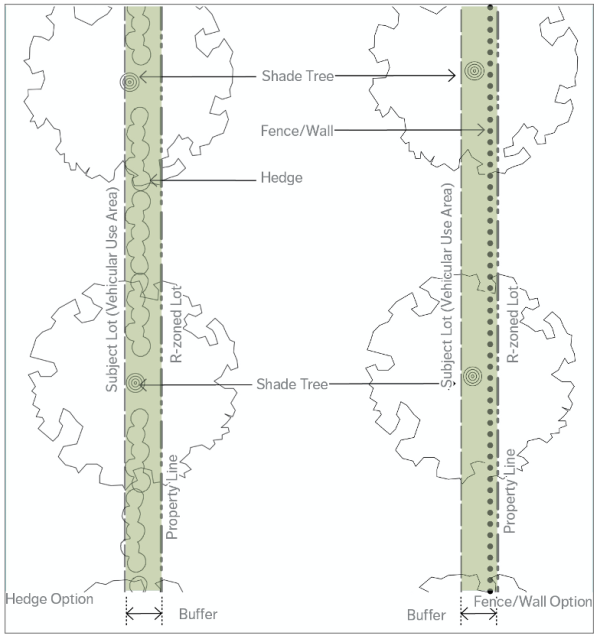
- Materials, Installation and Maintenance: See 11-12-6 and 11-12-7.
- Street Frontage Buffers:
11-12-5: Screening
- Purpose: Screening requirements are intended to partially or completely shield expressly identified uses and site features from view of abutting streets or other abutting lots.
- Features Required to be Screened:
- General: This subsection establishes screening requirements for several common site features that require visual separation from streets and abutting lots. Other uses, districts, structures and activity areas may also require screening in accordance with other provisions of this zoning ordinance.
- Dumpsters and Recyclable Material Bins: All dumpsters and recyclable material bins must be screened from view of the street and all abutting rights-of-ways (other than alleys) and from R-zoned properties. Required screening must consist of an opaque fence or wall with a minimum height of 6 feet. One side of the storage area must be furnished with an opaque, lockable gate.
Figure 12-3: Dumpster and Recycling Bin Screening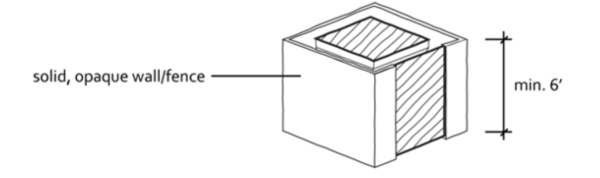
- Type of Screens:
- S1, Low-profile Screen:
- Purpose: The S1, low-profile screen is intended to help soften visual impacts of parking and other and provide an “urban edge” along the street, while maintaining some visibility of the areas required to be screened.
- Design: An S1 screen requires shrubs planted to form a continuous visual barrier (hedge) at least 3 feet in height. A 3-foot tall brick, stone, cast stone, or formed concrete wall may be substituted for the shrubs.
- F1, Screening Fence or Wall:
- Purpose: An F1 screening fence or wall is required in those instances where a complete visual barrier is needed.
- Options: F1 screening requirements may be met by either of the following options.
- The installation of an opaque fence at least 6 feet in height and at least one tree per 30 linear feet of fence; or
- The installation of a masonry wall with a minimum height of 6 feet.
- Street Setback: When located in a required street setback, required F1 screening fences and walls may not exceed 4 feet in height.
- Materials, Installation and Maintenance: See 11-12-6 and 11-12-7.
- Modification of Requirements:
- Applicable screening requirements may be waived or modified through the alternative compliance approval process (see 11-12-8(D)) or through the special use approval process when:
- Existing features provide a visual screen equivalent to the screening requirements of this section;
- The screening requirements cannot be achieved; or
- The screening is prohibited by other ordinances or regulations or by plat restrictions.
- An extension of time to install required screening may be approved through the alternative compliance approval proves or special use approval process when the properties benefited by the screening are undeveloped.
- Applicable screening requirements may be waived or modified through the alternative compliance approval process (see 11-12-8(D)) or through the special use approval process when:
- S1, Low-profile Screen:
11-12-6: Landscape And Screening Material
- General:
- Applicability: The regulations of this section apply to all trees, plant materials, and other features used to satisfy the landscaping and screening requirements of this zoning ordinance.
- Plant List: The building official is authorized to prepare a specific list of recommended and prohibited plant species for use in administering and enforcing the regulations of this chapter.
- Selection: Trees and plants used to satisfy the requirements of this zoning ordinance must:
- Meet or exceed the plant quality standards established in the latest edition of the American Standard for Nursery Stock (ANSI Z60.1); and
- Not be artificial plants or listed as a prohibited species on the recommended and prohibited species.
- Planting Areas:
- All planting areas must have amended soil to help ensure the health of newly installed plant material.
- All planting areas must be contained by edging material other than vegetation.
- Trees:
- Types: Unless otherwise expressly specified, required trees may be deciduous (broadleaf) or evergreen (conifers).
- Size:
- New Trees: New or transplanted trees provided to satisfy the requirements of this zoning ordinance must comply with the following minimum size requirements:
- Large trees must have a minimum caliper size of 2.0 inches at the time of installation;
- Small trees must have a minimum caliper size of 1.5 inches at the time of installation; and
- Evergreen trees must have a minimum height of 6 feet at the time of installation.
- Overhead Lines: Trees to be installed below overhead lines must be selected from the list of small trees specified on the recommended and prohibited species list or be otherwise expressly approved by the building official.
- Existing (Preserved) Trees:
- Preserved trees will be credited toward satisfying the tree planting requirements of this zoning ordinance in accordance with the regulations of this subsection (11-12-6(B)(2)(c)).
- Credit will be given on the following basis:
- Preserved trees up to 6 inches in diameter at breast height (DBH) will be credited as 3 trees.
- Preserved trees larger than 6 inches DBH, up to 12 inches DBH will be credited as 4 trees;
- Preserved trees that are more than 12 inches DBH up to 24 inches DBH will be credited as 5 trees; and
- Preserved trees that are more than 24 inches DBH will be credited at a ratio of 10 trees.
- The tree preservation incentive credits provided in this subsection (11-12-6(B)(2)(c)) may not be used to reduce the number of trees required by this chapter by more than 50%.
- To receive tree preservation credit, the following additional conditions must be met:
- Preserved trees for which credit is given must be in good health and condition and may not be prohibited species;
- The original grade of the dripline area of a preserved tree may not be changed;
- Tree protection fencing must be installed around the outer limits of the dripline area and remain in place from commencement of construction activity until all exterior work is complete.
- Tree protection fencing must consist of orange vinyl construction fencing, chain link fencing, snow fencing or other similar fencing at least 42 inches in height and supported at maximum of 10-foot intervals by posts or stakes sufficient to keep the fence upright and in place. A visible warning/no-disturb sign must be affixed to fence at 100-foot intervals.
- The building official is expressly authorized to reduce off-street parking requirements to allow for the preservation of existing trees.
- If healthy, preserved trees are removed, they must be replaced by the number trees for which credit was given.
- If preserved trees die or are lost to storms or natural causes within one year of the date of approval of the landscape plan, they must be replaced by the number trees for which credit was given. If preserved trees dies or are lost to storms or natural causes beyond one year of the date of approval of the landscape plan, they must be replaced by an equal number of trees (1:1 basis).
- New Trees: New or transplanted trees provided to satisfy the requirements of this zoning ordinance must comply with the following minimum size requirements:
- Species: If more than 10 trees are required, no more than 40% may be of a single species. If more than 25 trees are required, no more than 25% may be of a single species. This requirement applies to trees being planted, not to existing trees.
- Shrubs:
- New Shrubs:
- Deciduous shrubs must have a minimum container size of 3 gallons.
- Evergreen shrubs must have a minimum container size of 5 gallons.
- Shrubs may also be balled and burlapped.
- If more than 75 shrubs are required, no more than 40% may be of a single species.
- Existing (Preserved) Shrubs: Existing shrubs may be used to satisfy the landscaping and screening requirements of this zoning ordinance if protected and maintained during site development and construction phases of work and if such plants are not otherwise prohibited.
- New Shrubs:
- Ground Cover:
- All required landscape areas that are not planted with trees or shrubs must be covered with ground cover plants, which may include turf. Mulch must be confined to areas underneath trees and shrubs and is not an allowed substitute for ground cover.
- Ground cover plants other than turf must be minimum 4-inch pot or plug size. Areas planted in ground cover other than turf must be planted at distances appropriate for the species and at a density that will achieve complete coverage after the second full growing season.
- Mulch: All required trees and shrubs must be located within a mulched area and be separated from turf by a minimum distance of 2 feet (4-foot diameter mulched area). Mulch within such areas must comply with the following requirements:
- Mulch must be applied to provide a 2-inch (minimum) to 4-inch (maximum) soil cover, with no weed barrier material visible.
- At least 50% of the total mulch area must be comprised of organic mulch, such as bark, shredded wood, wood chips, or other organic matter. Mineral mulch such as decorative stone, river stone or tumbled glass may be used in up to 50% of the mulch area.
- Organic mulch must be fully chipped or shredded, un-splintered wood product or bark chips free of soil, rocks, weeds, metals, toxins, and foreign objects.
- Fences and Walls: Unless otherwise expressly stated, fences and walls provided to meet the regulations of this chapter are subject to the regulations of this subsection.
- Fences must durable and constructed with materials that are customarily used for fences, including wood, decorative rigid vinyl (polyvinyl chloride), metal or wrought iron. Fence posts must be structurally stable.
- The finished side of all fences other than tree protection fences must face the adjacent property or street. Chain-link fencing may not be used to satisfy the regulations of this chapter.
- Walls, raised planting beds and planters must be constructed of brick, stone or other durable masonry material approved by the building official.
11-12-7: Landscape Installation, Irrigation And Maintenance
- Installation:
- Required landscaping must be installed in accordance with an approved landscape plan.
- All trees and plant material must be installed in accordance with sound nursery practices, in a manner designed to encourage vigorous growth.
- All newly installed trees must be staked.
- Trees and plant material suitable for planting must be balled and burlapped or container grown. Planting areas should be at least twice the diameter of the root system or the container.
- All landscaped areas that are adjacent to pavement must be protected with curbs or equivalent barriers. Flush curbs, curb cuts, or other methods must be used to direct stormwater to landscape areas that abut paved areas.
- Landscaping may not obstruct traffic visibility at street intersections or.
- The village is not liable for any damage to above-ground or below-ground improvements or landscaping within the public right of way, even when such damage or destruction is the direct result of government action. When landscaping is placed or installed within the public right-of-way, the village has no obligation to replace or repair such landscaping if removed or damaged by village field operations or other governmental functions. The village also has no obligation to maintain above ground or below ground improvements or landscaping within the public right-of-way.
- Protection: All landscape areas provided to meet the requirements of this zoning ordinance must be protected from potential damage by adjacent uses and development, including parking and storage areas.
- Irrigation:
- All required landscaped areas must be provided with irrigation in accordance with one of the following 2 options:
- A permanent irrigation system with a controller to tailor watering schedules to weather and site conditions; or
- A temporary irrigation system that provides sufficient water to ensure that all trees and plants will become established.
- Irrigation systems must comply with all applicable building and plumbing codes.
- All required landscaped areas must be provided with irrigation in accordance with one of the following 2 options:
- Timing of Installation:
- All required landscaping and appurtenances, except trees, must be installed prior to the issuance of a certificate of occupancy.
- All required trees must be installed within 120 days after issuance of a certificate of occupancy or temporary certificate of occupancy.
- Maintenance:
- Required landscaping and screening must be continuously maintained, including necessary watering; weeding; pruning; pest control; litter and debris clean-up; and replacement of dead, diseased or damaged plant material.
- Failure to comply with an approved landscaping plan, including failure to maintain required landscaping and screening and failure to replace dead, diseased or damaged landscaping, constitutes a violation of this zoning ordinance and is subject to penalties and enforcement under Chapter 18.
- The property owner is responsible for maintenance of trees and landscaping in accordance with the approved landscape plan and the regulations of this zoning ordinance. Any dead, diseased or damaged trees, landscaping or screening materials must be removed and replaced by the property owner within 90 days of date that written notice of the obligation to remove and replace required landscaping is issued by the village. Property owners have no obligation to replace or restore required landscaping that is damaged or destroyed as a direct result of government action or lawful action of a franchise utility provider.
11-12-8: Landscape Plans
- Required Information: All building permit applications for sites requiring landscaping must include a landscape plan that includes at least the following information:
- General: The date, scale, north arrow, and name of the property owner;
- Site Features:
- The location of property lines and dimensions of the site;
- The approximate center line of existing water courses;
- The approximate location of significant drainage features;
- The location and size of existing and proposed streets and alleys, drive aisles, parking areas and sidewalks on or adjacent to the lot;
- The location of all existing and proposed buildings and structures on the lot;
- Existing topography and proposed grading;
- Area in which grading and vegetation removal will occur; and
- The location of existing and proposed utility easements and overhead utility lines on or adjacent to the lot.
- Proposed Landscaping:
- The location, size and type of proposed landscaping (trees, shrubs, groundcover) and the location and size of the proposed landscape areas;
- Planting details and specifications, including type of mulch and edging to be used in landscape areas;
- The method of protecting any existing trees and vegetation proposed to be preserved, including the identification of existing and finished contours illustrating the limits of grading near the drip line of any trees;
- The proposed irrigation plan for each required landscape area, including a list of abbreviations and symbols, water main size, water meter size and location, point of connection, backflow prevention assembly size, make and model;
- The schedule of installation of required trees, landscaping and appurtenances;
- The location of all existing and proposed structures on the site;
- The existing topography and proposed grading; and
- The area and dimensions of each landscape area and the total landscape area provided on the site.
- Preparation of Landscape Plan: Required landscape plans must be accompanied by written certification from an architect, landscape architect or engineer licensed to practice in the State of Illinois, that the landscape plan is in conformance with the minimum requirements of this chapter.
- Administrative Review: After receipt of a complete landscape plan, the building official must:
- Approve the landscape plan as complying with the requirements of this chapter;
- Approve the landscape plan with conditions of approval that will bring it into compliance with the requirements of this chapter; or
- Reject the landscape plan as failing to comply with the requirements of this chapter.
- Alternative Compliance Landscape and Screening Plans:
- To accommodate creativity in landscape and screening design and to allow for flexibility in addressing atypical, site-specific development/redevelopment challenges, the building official is authorized to approve alternative compliance landscape plans prepared by a landscape architect licensed to practice in the State of Illinois. In order to approve such alternative compliance landscape plans, the building official must determine that one or more of the following conditions or opportunities are present:
- The site has space limitations or an unusual shape that makes strict compliance impossible or impractical;
- Physical conditions on or adjacent to the site such as topography, soils, vegetation or existing structures or utilities are such that strict compliance is impossible, impractical or of no value in terms of advancing the general purposes of this chapter;
- Safety considerations such as intersection visibility, utility locations, etc., make alternative compliance necessary; or
- Creative, alternative landscape plans will provide an equal or better means of meeting the intent of the landscaping and screening regulations of this chapter.
- To accommodate creativity in landscape and screening design and to allow for flexibility in addressing atypical, site-specific development/redevelopment challenges, the building official is authorized to approve alternative compliance landscape plans prepared by a landscape architect licensed to practice in the State of Illinois. In order to approve such alternative compliance landscape plans, the building official must determine that one or more of the following conditions or opportunities are present:

