
Summit City Zoning Code
CHAPTER 8
SUPPLEMENTAL USE REGULATIONS
11-8-1: General
This chapter includes supplemental regulations that apply to some uses. These regulations supplement the applicable zoning district regulations. The applicability of these supplemental use regulations is indicated in the individual sections of this chapter and in the use regulations of the respective zoning district.
11-8-2: Adult Entertainment Establishments
- Separation from Protected Uses: Adult entertainment establishments are prohibited on lots located within 500 feet of any of the following:
- R-zoned property;
- Lot occupied by a residential use;
- Lot occupied by a non-secular assembly and entertainment use;
- Lot occupied by a school; or
- Lot occupied by another adult entertainment establishment.
- Special Use Approval: In order to grant approval to an adult entertainment establishment, the board of trustees must make all the following findings:
- The design and operation of the facility will not adversely affect the public health and safety;
- The adult entertainment establishment will not cause substantial injury to the value of other property in the neighborhood in which it is located;
- The adult entertainment establishment will not unduly increase traffic congestion in the public streets and highways in the area in which it is located;
- The adult entertainment establishment will not cause additional public expense for fire or police protection; and
- The adult entertainment establishment will not substantially increase the possibility of criminal acts against persons and properties within 500 feet of such proposed special use or against persons who regularly use such properties.
- Registration: The owner of a building or a premises, the owner’s agent for the purposes of managing, controlling or collecting rents, or any other person managing or controlling a building or premises any part of which contains an adult entertainment establishment, must register the following information with the village clerk:
- The address of the premises;
- The name of the owner of the premises and names of the beneficial owners if title to the property is held in a land trust;
- The address of the owner and the beneficial owners;
- The name of the business or establishment;
- The names and addresses of the owner, beneficial owner or the major stockholders and officers of the business or establishment;
- The date of initiation of the adult entertainment establishment;
- The nature of the adult entertainment establishment; and
- If the premises or building is leased, a copy of the lease must be attached.
- Exterior Display: No adult entertainment establishment may be conducted in any manner that permits the observation of any material depicting, describing or relating to specified sexual activities or specified anatomical areas from any public way or from any property not registered as an adult entertainment establishment. This section applies to any display, decoration, sign, show window or other opening.
- Existing Adult Entertainment Establishments: Any adult entertainment establishment that was lawfully established, but that become nonconforming, may be continued as follows:
- Upon written notice from the village to the owners or interests therein that any building, structure, lot or regulated use is nonconforming under the provisions of this title, as amended, the owners of interest therein must, within 2 months from the date of such notice, apply to the village clerk for a certificate of nonconformance.
- Failure to apply for a certificate of nonconformance within 2 months of the notice provided in this section will require the discontinuance of the nonconformity within 6 months of the notice provided.
- Nonconforming adult entertainment establishments for which there has been an application for a certificate of nonconformance from the village clerk must be discontinued within one year of the notice provided in this section.
11-8-3: Attached Houses
- Applicability: Attached houses are subject to all applicable regulations of this zoning ordinance and other village codes and ordinances except as modified or supplemented by the attached house development and building regulations of this section.
- Side Setbacks: No side building setback is required for common or abutting walls. Otherwise, the minimum side setback requirements of the subject zoning district apply.
- Design: Attached houses must be affixed to a permanent foundation.
- Ownership: A twinhouse dwelling lot may be paired with only one other lot, and both lots must be held under the same ownership at the time of construction of both twinhouses. Both attached twinhouse dwelling units must be constructed as a single unit and project during the same construction time period.
- Covenants and Restrictions: A declaration of covenants, conditions and restrictions or a similar enforceable agreement must be submitted with the plat if new lots are being created or with the building permit application if no new lots are being created. The declaration must specify respective owner obligations and rights with regard to any common structures, such as shared walls, roof, and other inseparable improvements.
11-8-4: Cannabis Business Establishments
- General
- All cannabis business establishments within the Village shall require a special use permit and shall be processed in accordance with the provisions of section 11-15-5 of this Title.
- The Village may require the applicant to install building enhancements such as security cameras, lighting, additional parking, or other improvements as a condition of issuing the special use permit to ensure the safety of employees and customers of the cannabis business establishments. Said improvements shall be determined based on the specific characteristics of the floor plan for a cannabis business establishment and the site on which it is located
- The Village may approve the co-location of an adult-use cannabis craft grower with processing organizations and/or dispensaries or co-location of infusers with craft growers and/or dispensaries, subject to the provisions of State law and the special use criteria within the Village
- No cannabis business establishment shall be opened or operated unless specifically authorized under and pursuant to State law and this Title.
- All cannabis business establishments within the Village shall require a special use permit and shall be processed in accordance with the provisions of section 11-15-5 of this Title.
- Special Use Components: In addition to the factors contained in Section 11-15-5 of this Title, the following components of the facility must be evaluated based on the entirety of the circumstances affecting the particular property in the context of the existing and intended future use of other properties in the vicinity:
- Impact of the proposed facility on existing or planned uses located within the vicinity of the subject property;
- Proposed structure in which the facility will be located, including co-tenancy (if in a multi-use building), total square footage, security installations/security plan, and building code compliance;
- Hours of operation and anticipated number of customers/employees.
- Anticipated parking demand and available private parking supply, including any unique demand for handicapped parking;
- Anticipated traffic generation and adjacent roadway capacity;
- Site design, including access points, internal site circulation and commercial vehicle loading, unloading and parking;
- Proposed signage plan;
- Compliance with all applicable regulations including Sections 11-8-4(c) through 11-8-4(h) of this Chapter, as applicable, and
- Other criteria determined to be necessary to assess compliance with this zoning ordinance.
- Cannabis Cultivation Centers: Cannabis cultivation centers are special uses in all industrial districts. The proposed facility must comply with the following:
- A medical cannabis cultivation center may not be located within 2,500 feet of property line of a lit occupied by a preexisting day care or school use or within 2,500 feet of any R zoning district boundary.
- An adult-use cannabis cultivation center may not be located within two hundred and fifty (250) feet of the property line of a lot occupied by a preexisting public or private nursery school, preschool, primary or secondary school, daycare center, daycare home.
- The facility may contain no more than 210,000 square feet of canopy space for plants in the flowering stage.
- The facility may not conduct any retail sales.
- Parking regulations are the same as those in I-1 Light Industrial District.
- A medical cannabis cultivation center may not be located within 2,500 feet of property line of a lit occupied by a preexisting day care or school use or within 2,500 feet of any R zoning district boundary.
- Cannabis Dispensing Organizations:
- The facility may not be located within two hundred and fifty (250) feet of the property line of a lot occupied by a preexisting public or private nursery school, preschool, primary or secondary school, daycare center, daycare home, or residential care home.
- The facility may not be located within in a dwelling unit or any R-zoned area.
- The facility may not have drive-through service.
- The facility may not be located within fifteen hundred (1500) feet of another existing dispensary.
- Retail sales of non-cannabis products occurring within the facility must be accessory to the facility's intended use as a cannabis dispensing organization and may not occupy more than 80% of the total floor area of the facility. For purposes of calculating the total floor area dedicated to retail sales, that portion of the floor area dedicated to the distribution of cannabis or cannabis infused products is excluded from this calculation; all floor area dedicated to the sale of other cannabis products and/or paraphernalia is included.
- Parking regulations are the same as those in the B-2 General Business District. Parking plan shall provide sufficient general and handicapped parking spaces to accommodate peak hours of use.
- Cannabis Infuser Organizations: Cannabis infuser organizations are special uses in all business and industrial districts. The purposed facility must comply with the following:
- The facility may not be located within two hundred and fifty (250) feet of the property line of a preexisting public or private nursery school, preschool, primary or secondary school, daycare center, daycare home, or residential care home.
- The facility may not be located in a house, apartment, condominium, or any area zoned for residential use.
- Parking regulations are the same as those in the I-1 Light Industrial District
- Cannabis Craft Grow Organizations: Cannabis craft grow organizations are special uses in all industrial districts. The proposed facility must comply with the following:
- The facility may not be located within two hundred and fifty (250) feet of the property line of a preexisting public or private nursery school, preschool, primary or secondary school, daycare center, daycare home, or residential care home
- The facility may not be located in a house, apartment, condominium, or any area zoned for residential use.
- The facility may contain no more than 5,000 square feet of canopy space for plants in the flowering stage.
- The facility may not be located within 1500 feet of another craft grower for cultivation center.
- Parking regulations are the same as those in the I-1 Light Industrial District.
- The facility may not be located within two hundred and fifty (250) feet of the property line of a preexisting public or private nursery school, preschool, primary or secondary school, daycare center, daycare home, or residential care home
- Cannabis Processing Organizations: Cannabis processing organizations are special uses in all industrial districts. The proposed facility must comply with the following:
- The facility may not be located within two hundred and fifty (250)j feet of the property line of a preexisting public or private nursery school, preschool, primary or secondary school, daycare center, daycare home, or residential care home.
- The facility may not be located in a house, apartment, condominium, or an area zoned for residential use.
- Parking regulations are the same as those in the I-1 Light Industrial District.
- The facility may not be located within two hundred and fifty (250)j feet of the property line of a preexisting public or private nursery school, preschool, primary or secondary school, daycare center, daycare home, or residential care home.
- Cannabis Transporting Organizations: Cannabis transporting organizations are special uses in all industrial districts. Transporting organizations may be allowed in business districts if any are co-located with a dispensary. The proposed facility must comply with the following:
- The facility may not be located within two hundred and fifty (250) feet of the property line of a preexisting public or private nursery school, preschool, primary or secondary school, daycare center, daycare home, or residential care home.
- Parking are the same as those in the I-1 Light Industrial District. Facilities shall provide parking for all commercial vehicles regularly stored at the facility.
- The facility may not be located within two hundred and fifty (250) feet of the property line of a preexisting public or private nursery school, preschool, primary or secondary school, daycare center, daycare home, or residential care home.
11-8-5: Community Garden
The supplemental use regulations of this section apply to all community garden uses.
- Unless permitted by the underlying zoning district or approved as a special use, on-site sale of community garden products is prohibited.
- Lawn and garden equipment of the type customarily used by consumers for household lawn and garden care is the only type of motorized equipment allowed. The use of motorized equipment is restricted to hours beginning at 8:00 a.m. and ending at 8:00 p.m.
- The site must be designed and maintained to prevent any chemical pesticide, fertilizer or other garden waste from draining on to adjacent properties.
- An on-site trash storage container must be provided and located as close as practicable to the rear lot line. Compost bins or piles must also be located as close as practicable to the rear lot line. Trash must be removed from the site at least once a week.
- Only individuals and organizations authorized by the property owner may participate in the community garden.
- A sign must be posted on the property identifying the name and phone number of the property owner or the owner's agent name. The sign must be at least 4 and no more than 8 square feet in area and be posted so that it is legible from the public right-of-way.
- The owner of any lot used for a community garden must give each abutting property owner and occupant written notice of the intent to establish a community garden and the applicable use regulations of this zoning ordinance at least 30 days before the start of the community garden.
- Measures must be taken to prevent cultivated areas from encroaching onto adjacent properties.
- The property must be maintained free of tall weeds and debris. Dead garden plants must be regularly removed and, in any instance, no later than October 31 of each year.
- Within a residential zoning district, operating hours for community garden activities are restricted to between 5:00 a.m. and 11:00 p.m. daily.
- Any community garden use regulation of this section may be modified by special use approval.
11-8-6: Self-Service Storage Facilities
- When a drive-up or exterior access-style self-service storage facility is located on a lot abutting an R-zoned lot, a screening wall or fence must be provided along the common lot line in accordance with the F1 screening fence or wall standards of 11-12-5.
Figure 8-1: Screening of Drive-up Style Self-Storage Facilities from Abutting R Districts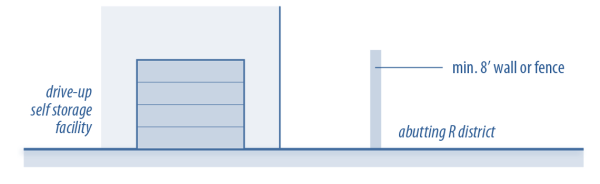
- No activities other than storage and pick-up and deposit of stored materials are allowed within the storage units.
- In the B districts, no outdoor (open-air) storage of any kind is allowed that is visible at ground level from abutting R districts or from any street rights-of-way.
11-8-7: Vehicle Sales And Rental
In acting on special use applications for personal vehicle sales and rental uses, review and decision-making bodies must consider the following criteria:
- Size of proposed use;
- Location of proposed use;
- Proximity to other vehicle sales and rental uses;
- Proximity to residences;
- Effect on traffic and surrounding uses.
11-8-8: Wireless Telecommunication Facilities
- Purpose: The wireless communication facility regulations of this section establish supplemental regulations governing wireless communications towers and antennas. These regulations are established to promote the following goals:
- Protecting residential areas and land uses from potentially adverse impacts of towers and antennas;
- Encouraging the location of towers in nonresidential areas;
- Minimizing the total number of towers;
- Promoting joint use of new and existing telecommunications tower sites as a primary option rather than construction of additional single-use telecommunications towers;
- Encouraging users of towers and antennas to locate them, to the extent possible, in areas where the adverse impact on the community is minimal;
- Encouraging users of towers and antennas to configure them in a way that minimizes the adverse visual impact of telecommunications towers; and
- Helping to ensure the ability of telecommunications services providers to offer such services to the community quickly, effectively and efficiently.
- Applicability: The regulations of this section apply to all new telecommunications towers, except for amateur radio facilities, receive-only antennas that do not exceed 70 feet in height, and small wireless facilities as defined in 50 ILCS 835.
- Federal Law: The wireless communication facility regulations of this section must be applied within the constraints of the Telecommunications Act of 1996, the Middle-Class Tax Relief and Job Creation Act of 2012 and other applicable federal laws and rules.
- Permit Required:
- A permit is required for the construction or installation of a telecommunications tower. Telecommunication service providers are encouraged to submit a single application for approval of multiple telecommunications tower sites.
- Permit applications must be filed with, and in a form as prescribed by, the building official, and will be considered complete only upon the building official’s determination that all required fees, information and documents have been submitted.
- The permit application must include such submittals, material and information as may be required by the building official to establish that the request meets the standards and requirements of this section. Any information of an engineering nature that the applicant submits, whether civil, mechanical, or electrical, must be certified by a licensed professional engineer. Information required to be submitted may include any or all the following:
- An inventory of the applicant’s existing telecommunications towers, antennas, or sites approved for telecommunications towers or antennas, that are either within the corporate limits of the village or within 1.5 miles of the village’s corporate limits. This inventory must include such information as the building official may direct, including specific information about the location, telecommunications tower height, and design of each telecommunications tower. The building official may share such information with other persons seeking to locate a telecommunications tower or antenna within the jurisdiction of the village.
- A scaled site plan clearly indicating the location, type and telecommunications tower height of the proposed telecommunications tower and/or antenna, on-site land uses and zoning, adjacent land uses and zoning (including when adjacent to other municipalities), zoning classification of the site and all properties within the applicable separation distances set forth in this section, adjacent roadways, proposed means of access, setbacks from property lines, elevation drawings of the proposed telecommunications tower and any other structures, topography, parking, and other information deemed by the building official to be necessary to assess compliance with this section.
- Legal description of the parent tract and leased parcel (if applicable).
- The setback distance between the proposed telecommunications tower and the nearest R-zoned properties.
- The separation distance from other telecommunications towers described in the inventory of existing sites submitted pursuant to this section must be shown on an updated site plan or map. The applicant must also identify the type of construction of the existing telecommunications tower and the owner/operator of the existing telecommunications tower, if known.
- A landscape plan showing specific landscape materials.
- Method of fencing, and finished color and, if applicable, the method of camouflage and illumination, if any.
- A statement indicating compliance with the regulations of this section and all applicable federal, state or local laws.
- A notarized statement by the applicant indicating whether construction of the telecommunications tower will accommodate co-location of additional antennas for future users.
- Identification of the entities providing the backhaul network for the telecommunications tower described in the application and other cellular sites owned or operated by the applicant in the village.
- A description of the availability and suitability of the use of existing telecommunications towers, other structures, or alternative technology, not requiring the construction or use of a new telecommunications tower.
- A description of the feasible locations of future telecommunications towers or antennas within the village based upon existing physical, engineering, technological or geographical limitations in the event the proposed telecommunications tower is erected.
- Telecommunications Tower Requirements:
- Lot Size: For purposes of determining whether the installation of a telecommunications tower complies with the lot and building regulations of the subject zoning district, the dimensions of the entire lot must be used, even though the telecommunications tower may be located on leased parcels within such lot.
- Appearance: Telecommunications towers must be maintained in a clean condition, free from corrosion or rust, and subject to any applicable standards of the FAA, be painted a neutral color so as to reduce visual obtrusiveness. At a telecommunications tower site, the design of the buildings and related structures must, to the extent possible, use materials, colors, textures, screening, and landscaping that will blend them into the natural setting and surrounding buildings.
- Lighting and Illumination: Telecommunications towers may not be illuminated, unless required by the FAA or other applicable authority. If lighting is required, the lighting design must cause the least disturbance to surrounding views.
- State or Federal Requirements: All telecommunications towers must meet or exceed current standards and regulations of the FAA, the FCC, and any other agency of the state or federal government with the authority to regulate telecommunications towers. If such standards and regulations are changed, then the owners of the telecommunications towers governed by this section must bring the telecommunications tower into compliance with the revised standards and regulations within 6 months of the effective date of the standards and regulations, unless a different compliance schedule is mandated by the controlling state or federal agency. Failure to bring telecommunications towers into compliance with such revised standards and regulations constitutes grounds for the removal of the telecommunications tower or antenna at the owner's expense.
- Building Codes; Safety Standards: To ensure the structural integrity of telecommunications towers, the owner of a telecommunications tower must ensure that it is maintained in compliance with standards contained in applicable state or local building codes and the applicable standards for telecommunications towers that are published by the American National Standards Institute. If, upon inspection, the village concludes that a telecommunications tower fails to comply with applicable codes and standards and constitutes a danger to persons or property, then upon notice being provided to the owner of the telecommunications tower, the owner will have 30 days to bring such telecommunications tower into compliance with such standards. Failure to bring the telecommunications tower into compliance within the 30-day period constitute grounds for the removal of the telecommunications tower or antenna at the owner’s expense.
- Signs: Advertising signs are prohibited on an antenna or telecommunications tower.
- Buildings and Support Equipment: Buildings and support equipment associated with antennas or telecommunications towers must comply with all applicable regulations.
- Setbacks and Separations: The following setback and separation requirements apply to telecommunications towers:
- For purposes of measurement, telecommunications tower setbacks and separation distances must be calculated and applied to facilities located in the village irrespective of other municipal jurisdictional boundaries.
- Guy wires and accessory buildings must comply with minimum zoning district setback requirements.
- Telecommunications towers in nonresidential zoning districts must be separated from R districts by a distance of 200 feet or 3 times the height of telecommunications tower, whichever is greater. See Figure 8-2.
Figure 8-2: Tower Separation from R Districts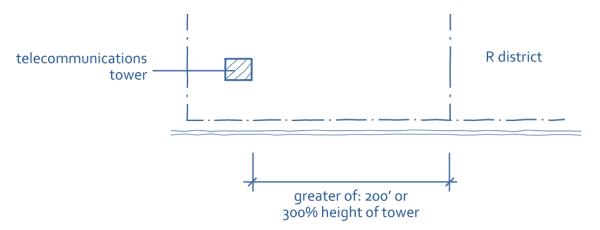
- Telecommunications towers in R zoning districts must be separated from all other telecommunications towers as provided in this paragraph. The minimum required separation distances between the proposed telecommunications tower on R-zoned property and any other preexisting telecommunications towers must be measured by drawing or following a straight line between the base of the existing telecommunications tower and the base of the proposed telecommunications tower. Minimum required separation distances (listed in linear feet) are be based on the height and type of telecommunications tower, as follows:
- Guyed or lattice telecommunications towers must be separated by at least 3,000 feet from any pre-existing lattice or guyed telecommunications towers; by at least 1,500 feet from any monopole 75 feet in height or greater; and by at least 750 feet from any monopole less than 75 feet in height. See Figure 8-3.
Figure 8-3: Required Separations for Guyed and Lattice Towers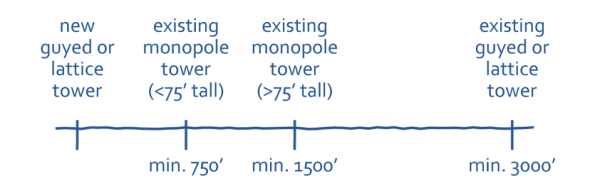
- Monopole telecommunications towers 75 feet in height or greater must be separated by a distance of at least 1,500 feet from any pre-existing lattice or guyed telecommunications towers; by at least 1,500 feet from any monopole 75 feet in height or greater; and by at least 750 feet from any monopole less than 75 feet in height. See Figure 8-4.
Figure 8-4: Required Separations for Monopole Towers with a Height of 75’ or More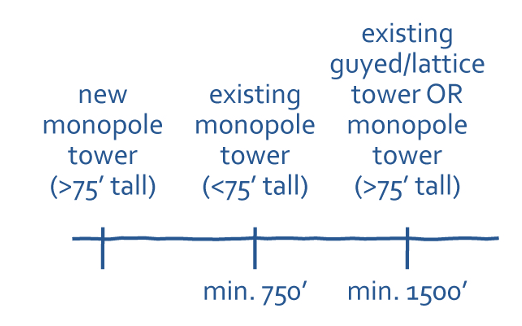
- Monopole telecommunications towers less than 75 feet in height must be separated by a minimum distance of 750 feet from any pre-existing lattice or guyed telecommunications towers; by at least 750 feet from any monopole 75 feet in height or greater; and by at least 750 feet from any monopole less than 75 feet in height. See Figure 8-5.
Figure 8-5: Required Separations for Monopole Towers with a Height less than 75’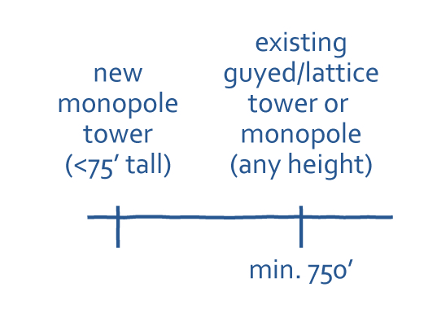
- Guyed or lattice telecommunications towers must be separated by at least 3,000 feet from any pre-existing lattice or guyed telecommunications towers; by at least 1,500 feet from any monopole 75 feet in height or greater; and by at least 750 feet from any monopole less than 75 feet in height. See Figure 8-3.
- AM Array: For purposes of implementing this section, an AM array, consisting of one or more telecommunications tower units and supporting ground system that functions as one AM broadcasting antenna, is considered one telecommunications tower. Measurements of setbacks and separation distances must be measured from the outer perimeter of the telecommunications towers included in the AM array. Additional telecommunications tower units may be added within the perimeter of the AM array as of right.
- Security Fencing: Unless waived by the building official as provided in this section, a security fence is required to enclose a telecommunications tower to protect the telecommunications tower and the public. This fencing requirement may be waived or modified for locations where the security and protection of the public and telecommunications tower is otherwise provided.
- Landscaping: The following requirements govern the landscaping surrounding telecommunications towers.
- Telecommunications tower facilities must be landscaped with a visual buffer of plant materials that effectively screens the view of the telecommunications tower compound from property used for residential purposes. The standard buffer must consist of a landscaped strip at least 4 feet in width outside the perimeter of the compound.
- Existing mature tree growth and natural land forms on the site must be preserved to the maximum extent possible. In some cases, such as telecommunications towers sited on large, wooded lots, natural growth around the property perimeter may be a sufficient buffer.
- The landscaping requirements of this subsection may be waived or modified by the building official for locations where the visual impact of the telecommunications tower would be minimal, or where an alternative telecommunications tower structure is used.
- Height: Telecommunications towers are subject to the following height requirements:
- Residential and Public Districts: The maximum height of telecommunications towers in R zoning districts may not exceed 90 feet for a single user; 110 feet for 2 users; or 130 feet for 3 or more users.
- Mixed-Use and Commercial Districts: The maximum height of telecommunications towers in MX or C zoning districts may not exceed 100 feet for a single user; 120 feet for 2 users; or 140 feet for 3 or more users.
- Industrial Districts: The maximum height of telecommunications towers in I zoning districts may not exceed 125 feet for a single user; 150 feet for 2 users; or 175 feet for 3 or more users.
- Availability of Suitable Existing Telecommunications Towers, Other Structures, or Alternative Technology: No new telecommunications tower may be approved unless the applicant demonstrates that no existing telecommunications tower, structure or alternative technology that does not require the use of a new telecommunications tower or structures can accommodate the applicant's proposed antenna. Such demonstration may consist of evidence or information that establishes any of the following:
- No existing telecommunications towers or structures are located within the geographic area that meet applicant's engineering or coverage requirements.
- Existing telecommunications towers or structures are not of sufficient height to meet applicant's engineering or coverage requirements.
- Existing telecommunications towers or structures do not have sufficient structural strength to support applicant's proposed antenna and related equipment.
- The applicant's proposed antenna would cause electromagnetic interference with the antenna on the existing telecommunications towers or structures, or the antenna on the existing telecommunications towers or structures would cause interference with the applicant's proposed antenna.
- The fees, costs, or contractual provisions required by the owner in order to share an existing telecommunications tower or structure or to adapt an existing telecommunications tower or structure for sharing are unreasonable. Costs exceeding those of installing a new telecommunications tower are presumed to be unreasonable.
- The applicant demonstrates that there are other limiting factors that render existing telecommunications towers and structures unsuitable.
- The applicant demonstrates that an alternative technology that does not require the use of telecommunications towers or structures is unsuitable. Costs of alternative technology that exceed new telecommunications tower or antenna development will not be presumed to render the technology unsuitable.
- Interference with Governmental Radio Signals Prohibited: Signal transmission may not interfere with any village or other governmental radio signals, including village police, fire, emergency dispatch and public works signals.
- Location in Residential Districts Restricted: Location of telecommunications towers in R zoning districts is discouraged. To that end, and in addition to other provisions of this section, no telecommunications tower may be approved in an R district unless one of the following is established:
- There are no sites within nonresidential zoning districts that will accomplish substantially the same coverage and that the proposed R-zoned site is necessary, from a technical perspective.
- Because of unique circumstances, such as the location of the property and proximity of residential structures, the proposed telecommunications tower will not have a significant adverse impact on existing or reasonably anticipated residential uses or property values in the area of the proposed tower.
- Building official Approval:
- Except in those districts where telecommunications towers are classified as a special use, the building official must review the application for a permit under this section and determine if the application and the proposed telecommunications tower complies with the provisions of this section. Within 60 days following receipt of a complete application, the building official must do one of the following:
- Approve the application as submitted and issue a permit;
- Approve the application and issue a permit, subject to such conditions and restrictions as the building official may direct to ensure compliance with this section; or
- Deny the application.
- A telecommunications tower that is modified or reconstructed to accommodate the co-location of an additional antenna must be of the same telecommunications tower type as the existing telecommunications tower, unless the building official allows reconstruction as a monopole.
- To accommodate joint use by additional users, the building official may approve modifications or rebuilding of an existing telecommunications tower to a taller telecommunications tower height, not to exceed the maximum height limits of this section. The telecommunications tower’s pre-modification height will be used to calculate separation distance requirements; no additional separation distance will be required for the additional allowed co-location height.
- To accommodate joint use by additional antenna, the building official may authorize a telecommunications tower that is being rebuilt to be moved up to 50 feet from its existing location. After the telecommunications tower is rebuilt to accommodate joint use, only one telecommunications tower may remain on the site and the relocated telecommunications tower will continue to be measured from the original telecommunications tower location for purposes of calculating separation distances; no additional separation distance will be required for the authorized movement.
- To encourage joint use, the building official may authorize locating additional antennas on existing telecommunications towers.
- Except in those districts where telecommunications towers are classified as a special use, the building official must review the application for a permit under this section and determine if the application and the proposed telecommunications tower complies with the provisions of this section. Within 60 days following receipt of a complete application, the building official must do one of the following:
- Removal of Abandoned Antennas and Telecommunications Towers: Any telecommunications tower or antenna located on a tower that is not operated for a continuous period of 12 months will be considered abandoned. If there are 2 or more users of a single telecommunications tower, then the telecommunications tower will not be deemed abandoned until all users cease using the telecommunications tower for a continuous period of 12 months or more. The owner of any abandoned antenna or telecommunications tower must remove the antenna and tower within 90 days of receipt of notice from the village notifying the owner of abandonment. If the abandoned antenna or telecommunications tower is not removed within the required 90-day period, the village has the right, but not the obligation, to enter the property and remove the facility. All costs incurred by the village in causing removal must be promptly paid by the owner. In addition, the village has the right to place liens on the property to recover the costs of removal.
- Preexisting Telecommunications Towers: Preexisting telecommunications towers are allowed to continue their usage as they presently exist without meeting the requirements of this section, other than compliance with the federal and state requirements and applicable building and safety codes. Routine maintenance of such preexisting towers is permitted. In addition, telecommunications towers that are installed in accordance with the provisions of this section will not be deemed to constitute the expansion of a lawful nonconforming use or structure. New construction other than routine maintenance on a preexisting telecommunications tower must comply with the requirements of this section.

