
Summit City Zoning Code
CHAPTER 14
ADDITIONAL REGULATIONS OF GENERAL APPLICABILITY
11-14-1: Outdoor Lighting
- Purposes: The outdoor lighting regulations of this section are intended to help ensure adequate lighting for motorized and nonmotorized travelers; provide for the efficient use of energy; and reduce the impacts of nuisance lighting and glare on nearby areas.
- Applicability and Exemptions: The outdoor lighting regulations of this section apply to all outdoor lighting installed after the effective date specified in 11-1-3, except that they do not apply to any of the following:
- Outdoor lighting on lots occupied by residential buildings containing fewer than 4 dwelling units;
- Public street lights;
- Spotlighting of official government flags if the spotlighting is contained within the area of the flag;
- Outdoor lighting used exclusively for and during public recreational activities, sporting events at stadiums and ball fields or other outdoor public spaces or venues;
- Outdoor lighting used for emergency equipment and work conducted in the interest of law enforcement or for public health, safety or welfare;
- Outdoor lighting in association with special events approved by the village board;
- Outdoor lighting used for a temporary use lasting no more than 10 days;
- Lighting fixtures with a light output of no more than 1,000 lumens; and
- Temporary holiday light displays.
- General Standards: All outdoor lighting must comply with the following general standards:
- Canopy-Mounted Lights: Recessed fixtures must be used in all under-canopy lighting. No lamps, reflectors, refractors or focusing or diffusing may extend below the underside of the canopy surface.
- Arrangement and Shielding:
- Lighting must be installed to shield and direct light away from abutting lots that are not under common ownership or control with the lot on which the lights are located. Shielding must be designed and installed to ensure that the light-producing element of the fixture is not visible from on the abutting property, as measured 5 feet above grade.
- Light-producing elements must be concealed or shielded with cutoffs so that no more than 2.5% of the light emitted directly from the lamp or indirectly from the fixture is projected at an angle of more than 90 degrees above nadir and no more than 10% of the light emitted directly from the lamp or indirectly from the fixture is projected at an angle of more than 80 degrees above nadir.
Figure 14-1: Required Shielding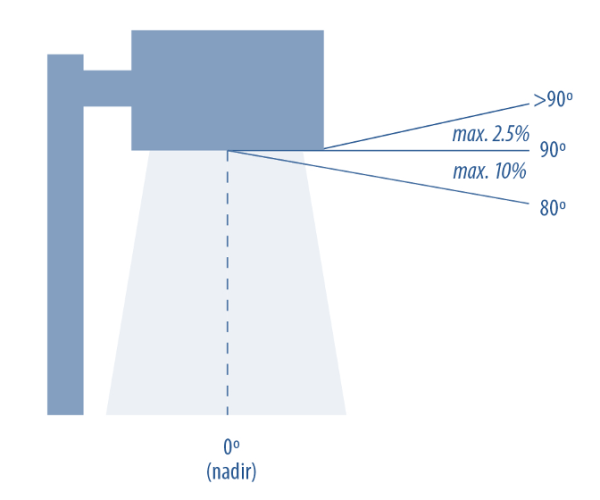
- Spillover Light: Light trespass along the lot line of the subject property may not exceed 0.5 foot-candles when abutting an R district and may not exceed 3.0 foot-candles when abutting any other zoning district or public right-of-way. Maximum illumination levels are measured 3 feet above grade or from the top of any opaque screening fence or wall along the property line.
- Measurement of Illumination: Light levels must be measured with a direct-reading, portable light meter, calibrated annually by an independent laboratory regularly engaged in the calibration of such instruments. The meter's sensor must be located at the top of the visual screening fence or wall along on the property line (or at a height of 3 feet above finished grade at the property line if there is no fence or wall), aimed towards the subject property in horizontal position. Readings must be recorded after the value has stabilized. Measurements are made after establishment of darkness with the light sources to be measured illuminated, and then with those light sources extinguished. The difference between these 2 readings must then be compared to the maximum allowed illumination at the property line. In this way, contributions to light levels by the moon and other ambient light sources are eliminated and the light intensity from the subject light sources can be accurately determined.
11-14-2: Outdoor Storage Of Combustible Material
Outdoor storage of uncontained bulk combustible or explosive materials is prohibited throughout the village. For purposes of this provision, "combustible materials" include paper, lumber, boxes, trash, refuse, auto fluff, auto shredder residue, timber, coal, and similar materials that are burnable at ordinary incinerator temperatures. This provision is not intended to prohibit the outdoor storage of lumber, firewood or other materials for consumption on the premises where stored, provided that the amount of such materials does not exceed 10 cubic yards and 8 feet in height.
11-14-3: Overlay Districts Generally
11-14-3 Overlay districts generally. 11-14-3-A Described. Overlay districts deal with special situations or accomplish specific Village goals that cannot be easily or efficiently addressed solely through the use of base districts. As the name implies, overlay districts “overlay” applicable base district classifications to alter some or all of the zoning regulations that apply to particular sites. Overlay districts are shown on the maps in the Official Zoning Map. 11-14-3-B Effect. Overlay district regulations supplement the zoning regulations of the applicable base district. When overlay district standards conflict with applicable base district standards or other regulations of this Zoning Ordinance, the regulations of the overlay district always govern. When no special overlay district standards are specified, the base district standards and all other applicable regulations of this Zoning Ordinance will govern.
11-14-4: Archer Avenue/Road Corridor Overlay District
11-14-4 Archer Avenue/Road Corridor Overlay District.
11-14-4-A Purpose.
11-14-4-A-1 The Archer Avenue/Road Corridor Overlay district (AARCO) regulations supplement the zoning regulations that apply under a property's base zoning district. The general purpose and intent of the AARCO is to help:
a. foster commercial development in the future by allowing only commercial retail stores, commercial establishments, service establishments, and professional offices that generate sales tax revenues, maintain the Village’s property tax base, and allow for convenient locations for the members of the public in surrounding and nearby neighborhoods to shop, dine, obtain services, and conduct business; and
b. allow only such uses in the future that generate sales tax revenues and that are not exempt from real property or sales taxes except for certain existing public and institutional zoned properties.
11-14-4-A-2 When these overlay district regulations conflict with applicable base district or other regulations of this Zoning Ordinance, the regulations of the overlay district shall govern. When no overlay district regulations are specified, the base district regulations and all other applicable regulations of this Zoning Ordinance govern, unless otherwise more specifically regulated, including, without limitation, by a planned development.
11-14-4-B Boundaries. The overlay district regulations of this Section 11-14-4 apply to all property within an area generally parallel and adjacent to Archer Avenue/Road on both sides from Harlem Avenue (the east Village boundary) moving east to west, and then moving northeast to southwest to the spur of the Baltimore and Ohio Railway (the southwest Village boundary). The boundaries of the AARCO shall include the territory on both sides of Archer Avenue/Road within the Village as follows: for the east-west portion of Archer Avenue/Road, the property on the north and south sides of Archer Avenue/Road up to and including the existing alley(s) parallel to Archer Avenue/Road and the line(s) of the alley(s) extended; for the northeast-southwest portion of Archer Avenue/Road, the property on the northwest and southeast sides of Archer Avenue/Road up to and including the existing alley(s) parallel to Archer Avenue/Road and the line(s) of the alley(s) extended.
11-14-4-C Uses. Existing properties within the AARCO are subject to the use regulations of the base zoning district. However, uses on property in the AARCO established after the effective date of this ordinance may be only those uses permitted in the C-1 (Corridor Commercial), C-2 (Commercial Service), or MX (Mixed-Use) district classifications, except as otherwise allowed by the Village Board.
11-14-4-D Rezoning. Property in the AARCO may not be rezoned to any zoning district classification other than C-1 (Corridor Commercial), C-2 (Commercial Service), or MX (Mixed-Use), provided that this provision is not intended to prohibit approval of planned development (PD) zoning for projects that meet the mandatory or elective PD requirements of Section 11-5-4.
11-14-5: Harlem Avenue Corridor Overlay District
11-14-5 Harlem Avenue Corridor Overlay District.
11-14-5-A Purpose.
11-14-5-A-1 The Harlem Avenue Corridor Overlay district (HACO) regulations supplement the zoning regulations that apply under a property's base zoning district. The general purpose and intent of the HACO is to help:
a. foster commercial development in the future by allowing only commercial retail stores, commercial establishments, service establishments, and professional offices that generate sales tax revenues, maintain the Village’s property tax base, and allow for convenient locations for the members of the public in surrounding and nearby neighborhoods to shop, dine, obtain services, and conduct business; and
b. allow only such uses in the future that generate sales tax revenues and that are not exempt from real property or sales taxes except for certain existing public and institutional zoned properties.
11-14-5-A-2 When these overlay district regulations conflict with applicable base district or other regulations of this Zoning Ordinance, the regulations of the overlay district shall govern. When no overlay district regulations are specified, the base district regulations and all other applicable regulations of this Zoning Ordinance govern, unless otherwise more specifically regulated, including, without limitation, by a planned development.
11-14-5-B Boundaries. The overlay district regulations of this Section 11-14-5 apply to all property within an area generally parallel and adjacent to Harlem Avenue on its west side from its northern terminus in the Village at Interstate 55 (at the northeast Village boundary) to its southern terminus in the Village at Argo High School (at the southeast Village boundary). The boundaries of the HACO shall include the territory on the west side of Harlem Avenue within the Village up to and including the existing alley(s) parallel to Harlem Avenue and the line(s) of the alley(s) extended.
11-14-5-C Uses. Existing properties within the HACO are subject to the use regulations of the base zoning district. However, uses on property in the HACO established after the effective date of this ordinance may be only those uses permitted in the C-1 (Corridor Commercial), C-2 (Commercial Service), or MX (Mixed-Use) district classifications, except as otherwise allowed by the Village Board.
11-14-5-D Rezonings. Property in the HACO may not be rezoned to any zoning district classification other than C-1 (Corridor Commercial), C-2 (Commercial Service), or MX (Mixed-Use), provided that this provision is not intended to prohibit approval of planned development (PD) zoning for projects that meet the mandatory or elective PD requirements of Section 11-5-4.
11-14-6: 63rd Street Corridor Overly District
11-14-6 63rd Street Corridor Overlay District.
11-14-6-A Purpose.
11-14-6-A-1 The 63rd Street Corridor Overlay District (63SCO) regulations supplement the zoning regulations that apply under a property's base zoning district. The general purpose and intent of the 63SCO is to help: a. foster commercial development in the future by allowing only commercial retail stores, commercial establishments, service establishments, and professional offices that generate sales tax revenues, maintain the Village’s property tax base, and allow for convenient locations for the members of the public in surrounding and nearby neighborhoods to shop, dine, obtain services, and conduct business; and b. allow only such uses in the future that generate sales tax revenues and that are not exempt from real property or sales taxes except for certain existing public and institutional zoned properties
11-14-6-A-2 When these overlay district regulations conflict with applicable base district or other regulations of this Zoning Ordinance, the regulations of the overlay district shall govern. When no overlay district regulations are specified, the base district regulations and all other applicable regulations of this Zoning Ordinance govern, unless otherwise more specifically regulated, including, without limitation, by a planned development.
11-14-6-B Boundaries. The overlay district regulations of this Section 11-14-6 apply to all property within an area generally parallel and adjacent to 63rd Street on both sides from Harlem Avenue (the east Village boundary) moving east to west to the east side of the Indiana Harbor Belt Railway right-of-way immediately west of Archer Avenue/Road (near the west/southwest Village boundary). The boundaries of the 63SCO shall include the territory on both sides of 63rd Street within the Village as follows: the property on the north and south sides of 63rd Street up to and including the existing alley(s) parallel to 63rd Street and the line(s) of the alley(s) extended.
11-14-6-C Uses. Existing properties within the 63SCO are subject to the use regulations of the base zoning district. However, uses on property in the 63SCO established after the effective date of this ordinance may be only those uses permitted in the C-1 (Corridor Commercial), C-2 (Commercial Service), or MX (Mixed-Use) district classifications, except as otherwise allowed by the Village Board.
11-14-6-D Rezonings. Property in the 63SCO may not be rezoned to any zoning district classification other than C-1 (Corridor Commercial), C-2 (Commercial Service), or MX (Mixed-Use), provided that this provision is not intended to prohibit approval of planned development (PD) zoning for projects that meet the mandatory or elective PD requirements of Section 11-15-4 and other applicable provisions.

