
Summit City Zoning Code
CHAPTER 3
MIXED-USE AND COMMERCIAL DISTRICTS
11-3-1: The Districts
The village’s mixed-use and commercial zoning districts are listed in Table 3-1. When this zoning ordinance refers to “mixed-use” or “commercial” zoning districts or to “MX” or “C” or districts, respectively, it is referring to these districts.
Table 3-1: Mixed-Use and Commercial Zoning Districts
| Map Symbol | District Name |
| MX | Mixed-Use |
| C-1 | Corridor Commercial |
| C-2 | Commercial Service |
11-3-2: Purposes
- MX District: The MX district is primarily intended to accommodate a mix of uses in pedestrian-oriented, vertical mixed-use storefront buildings.
- C-1 District: The C-1 district is primarily intended to accommodate community-serving business uses along high-volume, high-visibility road corridors.
- C-2 District: The C-2 district is primarily intended to accommodate business and commercial service uses.
11-3-3: Uses
Uses are allowed in MX and C districts in accordance with the use regulations of 11-7-1.
11-3-4: Lot And Building Regulations
- Table of Regulations: The lot and building regulations of Table 3-2 apply to all principal uses and structures in MX districts, except as otherwise expressly stated in this zoning ordinance. General exceptions to lot and building regulations and rules for measuring compliance can be found in Chapter 19. Additional regulations governing accessory uses and structures can be found in Chapter 9.
Table 3-2: MX and C District Lot and Building RegulationsRegulations MX C-1 C-2 Building Location q Front/street side build-to zone (min-max setback, ft.) 0-15 [1] 0-25 10-25 w Interior side, min. setback (ft.) 0 0 0 e Rear, min. setback (ft.) 0 0 0 r Max. building height (feet/stories) 45/3 45/3 60/5 Parking and Loading Location t Surface or Accessory Parking Side or rear yard Side or rear yard Side or rear yard y Structured Parking Entrance Side or rear facade Side or rear Side or rear u Loading Area Entrance Rear facade Side or rear Side or rear i Parking within Building If above-grade, parking must be set back at least 20 feet from front facade; no setback required if below grade Windows and Doors o Min. Ground-Story Façade Transparency (%) 65 40 No minimum 1) Min. Upper-Story Façade Transparency (%) 15 15 15 1! Min. No. Front Entrances 1 per 60 ft. of facade 1 per building None - Table Notes: The following notes refer to the bracketed numbers (e.g.,” [1]”) in Table 3-2:
[1] Measured from the front or street side property line into the lot. If less than 15 feet exists between the back of curb and the property line, the build-to zone must be measured beginning at 15 feet from the back of curb into the lot.
Figure 3-1: MX and C District Lot and Building Regulations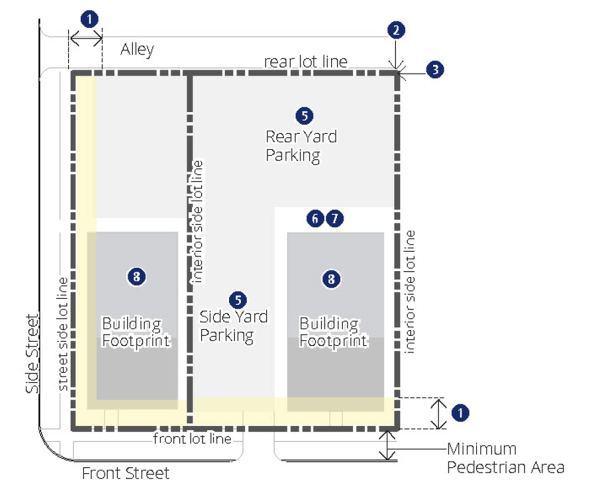
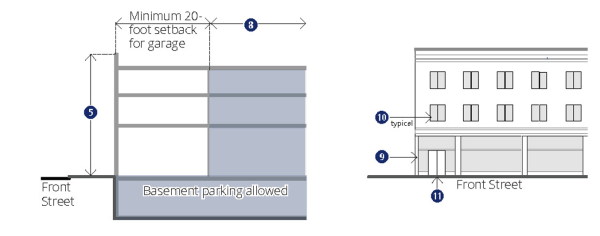
- Exceptions and Exemptions:
- Outdoor Recreation Uses: Outdoor parks and recreation and outdoor participant sports and recreation uses in MX or C districts are not required to comply with lot and building regulations, except that:
- If a building is incorporated, the building must comply with the regulations.
- Side and rear setback requirements must be met.
- Public and Institutional Uses: Public and institutional uses are subject to P district lot and building regulations.
- Outdoor Recreation Uses: Outdoor parks and recreation and outdoor participant sports and recreation uses in MX or C districts are not required to comply with lot and building regulations, except that:
- Front Entrances: Front building entrances must be emphasized through one or more of the following design features:
- A roof or canopy differentiating the building entrance area from the overall building roof type;
- A porch leading to the building entrance;
- Sidelights or transom windows abutting the entrance door;
- Locating the entrance in a separate bay of the building that is either recessed or projected from the front façade; or
- Other designs adding emphasis and drawing attention to the entrance on the facade.
- Front and Side Streets:
- Some lot and building regulations distinguish between front and side streets. For purposes of these provisions, the following are designated as front streets: Archer Avenue, South Archer Road, 63rd Street, or Harlem Avenue.
- All parcels must have a front lot line established.
- For lots with only one lot line abutting a street, that lot line is the front lot line.
- When a lot extends between 2 front streets essentially parallel to each other, both frontages are designated as front lot lines.
- See also 11-19-10.
- Building Materials and Colors:
- Primary Facade Materials: At least 80% of each street-facing building facade must be constructed of primary materials. Permitted primary building materials include high-quality, durable, natural materials, such as stone, brick; wood lap siding; fiber cement board lapped, shingled, or panel siding; or glass. Other high-quality synthetic materials may be approved by the village with an approved sample and examples of successful, high-quality local installations.
- Secondary Facade Materials:
- Secondary materials are limited to details and accents and include gypsum reinforced fiber concrete for trim and cornice elements; metal for beams, lintels, trim, and ornamentation, and exterior architectural metal panels and cladding.
- Exterior Insulation and Finishing Systems (EIFS) is permitted for trim and on upper floor facades.
- Color: Building colors on street-facing facades are limited to colors included in historic color palettes from any major paint manufacturer. Other colors may be utilized for details and accents, not to exceed a total area larger than 10% of the street-facing facade surface area.
- Indoor/Outdoor Operations:
- MX and C-1 Districts: All allowed business, service and commercial activities in MX and C-1 districts must be conducted within completely enclosed buildings unless otherwise expressly stated. This requirement does not apply to allowed off-street parking or loading areas, automated teller machines, outdoor seating areas or drive-through facilities, mobile food vehicles operating on private property, or to incidental display of goods not exceeding 10% of the subject use’s indoor floor area.
- C-2 District: All repair, production and work activities must be conducted within completely enclosed buildings in C-2 districts. Outdoor display and storage is permitted in C-2 districts, subject to the following screening requirements:
- Outdoor storage or display areas that abut R districts along a side property line or rear property line or are separated from an R district by only an alley along a side property line or rear property line must be effectively screened from view of the R district by a solid wall, solid fence, or dense vegetative screen not less than 6 feet in height. Chain-link fencing does satisfy this screening requirement.
- The view of outdoor areas used to store goods and materials that are not available for retail sale to the general public must be visually screened from all contiguous streets other than alleys either by permitted structures or by a vegetative buffer that is at least 6 feet in height or by a combination of such features. Required screening must be located between the perimeter of the outdoor storage area and any property line abutting a public street, other than an alley. This screening requirement is not intended to prohibit openings reasonably necessary for access drives and walkways.
Figure 3-2: Screening of Outdoor Storage/Display Areas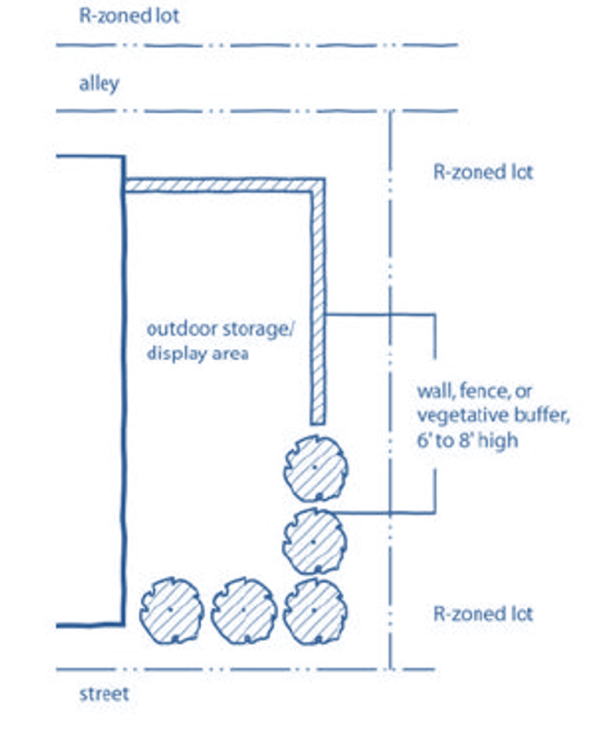
- Yard Treatments: Parking areas are limited to those locations identified in the lot and building regulations of Table 3-2. This subsection establishes additional regulations governing the permitted treatment of yard areas around buildings.
- Landscape, Patio, Sidewalk: All yards must consist of landscape areas, patio space, or sidewalk space, unless otherwise expressly stated.
- Driveways: Driveways may cross through yards as follows:
- Driveways may cross perpendicularly through the front or street side yards.
- Driveways may cross perpendicularly through interior side and rear yards to connect to parking on abutting lots.
- Trash, Recycling, Refuse Locations: All trash, recycling, and other refuse areas must be located and treated as follows:
- Trash, recycling, and other refuse areas must be in a building, rear yard or alley.
- When no rear yard exists or when the rear yard is less than 10 feet in depth, trash, recycling, and other refuse areas may be located in the rear portion of an interior side yard.
- Trash, recycling, and other refuse areas may be located inside the building with access doors off the rear or interior side facade. Access doors must be opaque, screening a minimum of 80% of the opening.
- See 11-12-5 for additional regulations governing screening of trash, recycling, and other refuse areas.
11-3-5: Other Relevant Regulations
Uses and development in MX and C zoning districts may be subject to other regulations and standards, including the following.
- Nonconformities: See Chapter 17.
- Accessory Uses and Structures: See Chapter 9.
- Temporary Uses: See Chapter 10.
- Parking: See Chapter 11.
- Landscaping and Screening: See Chapter 12.
- Signs: See Chapter 13.

