
Grandview City Zoning Code
31-25
LANDSCAPING AND SCREENING STANDARDS
(A)
Intent.
The landscaping and screening requirements are intended to preserve and enhance property values by ensuring that yards, open spaces, parking lots and areas next to public rights-of-way are constructed and maintained with plants and landscape materials. This Section further intends that property development should respect land capability and constraints, minimize erosion and destruction of natural amenities and reduce conflicts between land uses.
(B)
Application and Scope.
No new structure, building, building addition, parking lot or parking lot expansion shall be constructed unless in compliance with the landscaping and screening standards of this Section.
(C)
Definitions.
For the interpretation of this Section, the following definitions shall be used:
(1)
Landscaped: An area devoted to or developed predominately with plant material or natural landscape features, including lawn, ground cover, gardens, trees, shrubs, and other plant materials;
(2)
Screened: Shielded, concealed, and effectively hidden from view by a person standing at ground level on an abutting site, or outside the area or feature so screened, by a fence, wall, hedge, berm, or similar architectural or landscaped feature.
(D)
Landscaping Requirements.
All uses shall provide and maintain a landscaped area as provided herein:
Plant Quality: All plants shall meet the plant quality standards set forth in the most recent addition of the American Standard for Nursery Stock, published by the American Association of Nurserymen. Plants shall be nursery-grown and be species that thrive in hardiness zones 5b and 6a as outlined by the State of Missouri United States Department of Agriculture.
Single-Family and Two-Family Dwellings: shall maintain a minimum of twenty-five percent (25%) of lot area as a permeable and uncovered surface that contains living materials. Prior to issuance of a Certificate of Occupancy, sod shall be installed over the entire lot.
(1)
Trees: A minimum of two (2) trees shall be installed, one (1) located between the front building and property line and the other elsewhere on the lot. Lots with two (2) street frontages shall have a minimum of three (3) trees, one (1) on each frontage and the other elsewhere on the lot. Trees shall have a minimum two inch (2") caliper measured at one foot (1') above ground level.
(2)
Foundation Landscaping: Foundation plantings of assorted shrubs across the front of the dwelling shall be required. Homes on corner lots shall have generous foundation planting of shrubs on both frontages. In either case, the shrubs shall be planted three foot (3') on center. Foundation landscaping is not required at entrances or driveways.
All other uses shall provide and maintain a landscaped area that equals or exceeds ten percent (10%) of the total lot area, except that the C-3 district, because of its district and unique character, shall be exempted from this provision.
(1)
The following areas are listed by priority for the placement of this required landscaped area and may be utilized in conjunction with the Screening Requirements as set forth in this Section:
(a)
A minimum landscaped area often feet (10') in width along all street frontages;
(b)
A minimum landscaped area of ten feet (10') in width along all perimeter property lines.
Additionally, of the required landscaped area, no more than twenty percent (20%) may consist of porous non-living materials.
(2)
All off-street parking areas (except for single and two-family uses) shall provide site trees on the basis of one (1) tree for every ten (10) off-street parking spaces provided or fraction thereof. This requirement is independent of required parking lot trees.
(3)
When more than ten (10) trees are required on a site, no more than fifty percent (50%) may be of the same species to protect against the spread of disease.
Parking Lot Trees and Landscaping
(1)
All off-street parking areas (except for single and two-family uses) that consists of more than 10 spaces shall provide landscape islands with one (1) shade tree and three (3) shrubs. Landscape islands, required landscape areas, and other landscaping in the parking lot shall exceed five percent (5%) of the parking lot area. Parking lot lighting may be an exception to a landscape island's shade tree requirement.
(2)
Off-street parking fronting public right-of-way shall be lined with shade trees. See the Table of Screening Requirements in section (E) for parking lot screening when adjoining right-of-way. If an easement exists in a required landscape area, alternatives to trees may be submitted for review.
(3)
Site trees shall be of a minimum two inch (2") caliper as measured one (1) foot above ground level at the time of planting. Further, required site trees may be utilized in conjunction with screening requirements as set forth in this Section.
(E)
Screening Requirements.
Where permitted uses are at a lower elevation than abutting frontage or use and screening is required by this Section, screening types that utilize plantings and berms are encouraged. It is recognized that in these instances an effective screen is difficult to achieve and, in such cases, seeks to provide the best screen possible.
(1)
Types of Required Screenings.
(a)
Types of Screens. The following three basic types of screens are hereby established and are to be used as the basis for screening requirements as established in the Table of Screening Requirements as provided herein. Variations of these screening types may be permitted at time of site-plan review with approval from the Director of Community Development.
(i)
Opaque Screen, Type A. A screen that is opaque from the ground to a height of at least six feet (6') with intermittent visual obstructions from the opaque portion to a height of at least twelve feet (12'). The opaque screen is intended to exclude all visual contact between uses and to create a strong impression of special separation. The opaque screen may be composed of a wall, fence or landscaped earth berm. Planted or natural vegetation screens will be judged on the basis of the average mature height and density of foliage of the subject species, or field observation of existing vegetation.
The opaque portion of the screen must be opaque in all seasons of the year. At maturity, the portion of intermittent visual obstructions should not contain any completely unobstructed openings more than ten feet (10') wide. The portion of intermittent visual obstructions may contain deciduous plants. Suggested planting patterns that will achieve this standard are included in the following diagrams. Planting areas for the placement of these screens shall be a minimum of five feet (5') in width.
(ii)
Semi-Opaque Screen, Type B. A screen that is opaque from the ground to a height of three feet (3'), with intermittent visual obstruction from above the opaque portion to a height of at least twelve feet (12'). The semi-opaque screen may be composed of a wall, fence, landscaped earth berm, planted vegetation, or existing vegetation. Compliance of planted vegetative screens or natural vegetation will be judged on the basis of the average mature height and density of foliage of the subject species, or field observation of existing vegetation. At maturity, the portion of intermittent visual obstructions should not contain any completely unobstructed openings more than ten feet (10') wide. The zone of intermittent visual obstruction may contain deciduous plants. Planting areas for the placement of these screens shall be a minimum of five feet (5') in width.
(iii)
Broken Screen, Type C. A screen composed of intermittent visual obstruction from the ground to a height of at least twelve feet (12'). The broken screen is intended to create the impression of a separation of spaces without necessarily eliminating visual contact between the spaces. It may be composed of a wall, fence, landscaped earth berm, planted vegetation, or existing vegetation. Compliance of planted vegetative screens or natural vegetation will be judged on the basis of the average mature height and density of foliage of the subject species, or field observation of existing vegetation. The screen may contain deciduous plants. Suggested planting patterns that will achieve this standard are included in the following diagrams. Planting areas for the placement of these screens shall be a minimum of five feet (5') in width.
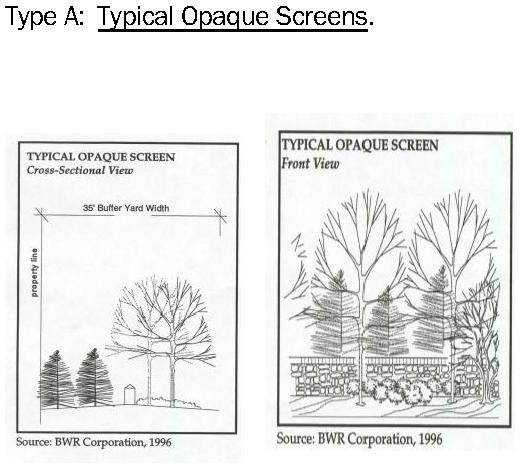
Available Options:
1.
Small trees planted 30' on center with 6' high evergreen shrubbery planted 4' on center. (See recommended planting list e.)
2.
Large trees planted 40' on center (See recommended planting list c.) with a 6' high redwood fence.
3.
Tall evergreen trees, staggered planted, with branches touching the ground. (See recommended planting list b.)
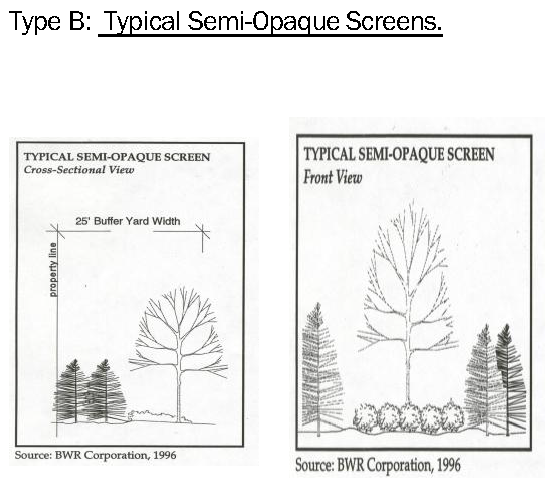
Available Options:
1.
Small trees planted 30' on center with a 3' high stone wall or with 3' high evergreen or deciduous hedge shrubbery planted 3' on center.
2.
Small trees planted 20' — 30' on center on top of 3' high seeded earth berm. (See recommended planting list a.) with a 3' high seeded earth berm.
3.
Large trees planted 40' on center. (See recommended planting list c.) with 3' high evergreen or deciduous hedge shrubbery planted 3' on center.
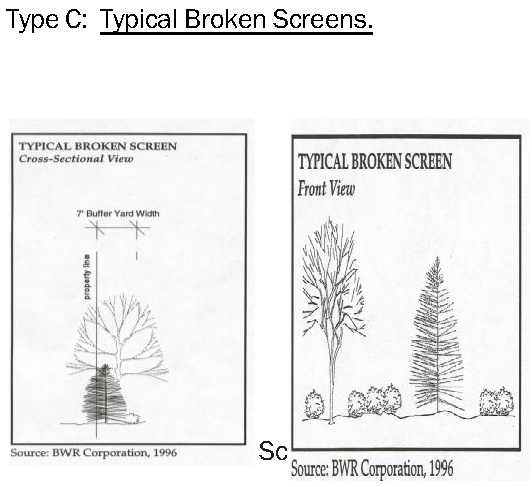
Available Options:
1.
Small trees planted 30' on center. (See recommended planting list a.)
2.
Small trees planted 40' on center. (See recommended planting list a.) with a split-rail fence.
3.
Large trees planted 40' on center (See recommended planting list c.) with assorted shrubbery. (See recommended planting list f.)
(b)
Screening, as required in the Table of Screening Requirements, shall be required along the common lot line(s) of adjacent uses. Where uses are separated by an intervening right-of-way, the burdened use need only screen from the adjoining right-of-way as required in the table. Screening required by a burdened use for a benefited use shall apply only to those uses that are determined to be permitted within the particular zoning district. A burdened use is not required to provide screening to benefit a use within a zoning district that is determined to be a non-conforming use.
(2)
Recommended Plant Material List.
(a)
All plant materials used to satisfy the requirements of this Ordinance shall meet or exceed the plant quality standards of the American Standard for Nursery Stock.
(b)
Plant materials that deviate from the recommended plant material list may be considered for approval, but documentation for the specific plant material type from the Missouri Department of Conservation or a certified horticulturalist shall accompany the submitted landscape plan.
Small Trees for Partial Screening
(1)
Aristocrat Pear
(2)
American Hornbeam
(3)
Eastern Redbud
(4)
Flowering Dogwood
(5)
Washington Hawthorn
(6)
Russian Olive
(7)
Sargent Flowering Cherry
(8)
Eastern Red Cedar
(9)
Sunburst Locust
(10)
Bradford Pear
(11)
Serviceberry
(12)
Purple-leaf Plum
(13)
American Holly
(14)
Golden Rain Tree
(15)
Quaking Aspen
(16)
Carolina Silverbell
(17)
Magnolia, Nigre, Saucer
(18)
Sweet Bay
Large Trees for Evergreen Screening
(1)
Douglas Fir
(2)
Shortleaf Pine
(3)
Norway Spruce
(4)
Blue Spruce
(5)
White Spruce
(6)
Eastern White Pine
(7)
Austrian Pine
(8)
White Fir
(9)
Red Pine
(10)
White Pine
(11)
Bald Cypress
Large Trees for Shading
(1)
Green Ash (Marshal's Seedless)
(2)
Linden, Littleleaf, and Silver
(3)
Cucumbertree
(4)
Shademaster Locust
(5)
Norway Maple
(6)
Red Maple
(7)
Ginkgo (male only)
(8)
Honeylocust, Thornless
(9)
Redmond Linden (basswood)
(10)
London Plane-Tree
(11)
Shademaster Locust
(12)
American Sycamore
(13)
Northern Red Oak
(14)
Bur Oak
(15)
Hackberry
(16)
English Oak
(17)
Shingle Oak
(18)
Black Locust
(19)
Pecan
(20)
Black Walnut
(21)
Red Oak
(22)
Buisman's Elm
(23)
Golden Larch
(24)
Sugar Maple
(25)
Tulip Tree
Small Shrubs for Evergreen Screening
(1)
Brown's Globe Yew
(2)
Convexa Japanese Holly
(3)
Azaleas and Rhododendrons
(4)
Littleleaf Japanese Holly
(5)
Wintergreen Barberry
(6)
Dwarf Horned Holly
(7)
Dwarf Burning Bush
(8)
Ward's Dwarf Yew
(9)
Andorra Compact Juniper
(10)
Anthony Waterer Spirea
(11)
Warty Barberry
(12)
India Hawthorn
(13)
Japanese Yews
(14)
Dwarf Pfitzer
(15)
Euonymous
(16)
Dwarf Forsythia
(17)
Glossy Abelia
(18)
Mugho Pine
(19)
Inkberry
Large Shrubs for Evergreen Screening
(1)
Hedge Bamboo
(2)
Thorny Elaengus
(3)
Laurel or Sweet Bay
(4)
Fortune Tea Olive
(5)
Lauretinus Viburnum
(6)
Japanese Privet
(7)
Yaupon Holly
(8)
Red Photinia
(9)
Burford Holly
Assorted Shrubs for Broken Screening
(1)
Japanese Barberry
(2)
Cropping Leucothoe
(3)
Winter Honeysuckle
(4)
Vernal Witch Hazel
(5)
Common Witch Hazel
(6)
Northern Bayberry
(7)
Fringetree
(8)
Pfitzer Juniper
(9)
Border Forsythia
(10)
Star Magnolia
(11)
Judd Viburnum
(12)
Dblefile Viburnum
NOTE: Where two requirements may overlap, the most restrictive shall apply.
*
For industrial districts, see additional special provisions that are required I-1 and I-2 Sections.
+
Ten foot (10') minimum landscaped area as required in this section.
**
Single and two-family residential are not required to screen between uses but all other uses in R-1A, R-1, R-1, R-2, R-3, and R-4 are required to provide screening between uses as shown above.
(1)
Burdened Zone: The use that must provide the required screening.
(2)
Benefited Zone: The use from which the burdened use is screened.
(F)
Special Screening Requirements.
(1)
Definitions. The following five basic types are hereby established and are to be used as the basis for screening requirements as established for the uses herein described.
(a)
Berms. A berm screen constructed of earthen materials not to exceed a slope steeper than 2:1. A berm shall be so designed that drainage from said slope shall be directed away from paved areas and sidewalks and shall be sodded and landscaped as necessary to provide soil stabilization. Additional plantings shall be added to provide an effective screen at least six feet (6') in height within three (3) growing seasons after installation.
(b)
Fence, open. An open weave or mesh type fence, constructed of wood or other approved material, shall be combined with plant materials to form an effective opaque screen not less than six feet (6') in height within three (3) growing seasons after initial installation.
(c)
Fence, solid. A solid fence screen shall be not less than six feet (6') in height and shall be constructed of wood or other approved materials and shall form an effective opaque screen.
(d)
Planting screen. A planting screen shall consist of compact evergreen plants or other suitable plants. They shall be of a kind, or used in such a manner, so as to provide an effective screen at least six feet (6') in height within three (3) growing seasons after initial installation. A planting screen intended for parking lot screenings shall have a minimum height of three (3') feet within three (3) growing seasons.
(e)
Walls. A wall screen shall consist of concrete, stone, brick, title, or similar type of approved masonry material and shall form an effective opaque screen not less than six feet (6') in height. The wall of a building is encouraged to be used and may count toward the barrier required for screening.
(2)
Special Screening Applications. Screening in accordance with the above defined types of screens shall be provided to a height of six feet (6') and a minimum fifty percent (50%) opacity for the following uses except under Section 31-25(F)(2)(d) which requires one hundred percent (100%) opacity screening:
(a)
Off-Street Parking Areas: Off-street parking areas and lots shall be screened with any type detailed in Section 31-25(F).
(b)
Off-Street Loading Areas: All off-street loading areas that abut or front on an R-3 or R-4 residential zoning district shall be permanently screened from view along the abutting property line(s). Loading areas for any use may not abut or front on an R-1A, R-1, R-1M, or R-2 District.
(c)
Rubbish and Garbage Area: All rubbish and garbage areas for an industrial, commercial, office, and multi-family use shall conform with Section 23-32 of the Code of Laws.
(d)
Outside Storage Area Visible from Major Streets or Lesser Zoning District: All outside storage areas permitted under the Performance Standards in any commercial or industrial district or permitted as a principal permitted use in any commercial or industrial district shall be permanently screened to a height of six feet (6') and one hundred percent (100%) opacity with a masonry, wood, vinyl, or similar material fence as follows:
(i)
Along any side from which any angle of view from:
71 Highway or its frontage roads.
Blue Ridge Boulevard Extension.
Main Street-Highgrove Road corridor.
M-150 Highway or its frontage roads.
(ii)
Along any side that abuts a lesser zoning district (i.e. industrial to commercial to office and residential districts).
(iii)
Retail sales lots, such as auto sales, farm equipment sales, and other retail sales where the product being stored is for sale to the general public are exempted from the screening requirements as stated herein.
(iv)
Automobile repair shop outdoor storage areas shall conform to the screening and storage requirements as contained in Section 3-24(I).
(e)
Screening Requirements for Tow Lots and Salvage/Junk Yards: All tow lots and salvage/junk yards where allowed as a permitted or conditional use in the I-1 and I-2 Districts shall be permanently screened from view on all sides by a solid fence of 100 percent (100%) opacity to a height not less than eight feet (8'). Said screening must not interfere with the required sight triangle.
(G)
Installation and Maintenance of Landscape and Screen Materials.
(1)
Installation. All landscaping shall be installed in a sound other City Codes and according to accepted good planting procedures. If after three (3) growing seasons following installation, plant materials have not formed an effective screen, or if an effective screen is not maintained, the Director of Community Development may require that another type of screen be added or additional plantings be installed. Landscaped areas shall require protection from vehicular encroachment. The Building Inspector and/or the Planner shall inspect all landscaping and no certificate of occupancy or similar authorization will be issued unless the landscaping meets the requirements herein provided.
(2)
Maintenance. The owner, tenant and their agent, if any, shall be jointly and severally responsible for the maintenance of all landscaping which shall be maintained in good condition so as to present a healthy, neat and orderly appearance and shall be kept free from refuse and debris. If replacement is necessary, all plants and other non-living landscape materials shall be equal in size, density and appearance as originally required at the time of site plan approval.
(3)
Plant Material.
(a)
Trees. Trees shall be a minimum of two inch (2") caliper (as measured one foot (1') above ground level) at the time of planting.
(b)
Shrubs and hedges. Shrubs shall be a minimum of two feet (2') in height when measured at ground level immediately after planting. Hedges, where required, shall be planted and maintained so as to form a continuous, unbroken, solid visual screen within a maximum of one (1) year after time of planting.
(c)
Vines. Vines shall be a minimum of thirty inches (30") in height immediately after planting and may be used in conjunction with fences, screens, or walls to meet physical barrier requirements as specified.
(d)
Ground covers. Ground covers used in lieu of grass, in whole or in part, shall be planted in such a manner as to present a finished appearance and reasonably complete coverage within three months after planting.

