
Grandview City Zoning Code
31-26
SIGN REGULATIONS
(A)
Intent.
The intent of this Section is to create the framework to regulate, administer, and enforce outdoor sign advertising and display within the City of Grandview. This Ordinance has a number of specific purposes:
(1)
To preserve the residential character of residential neighborhoods; and
(2)
To preserve adequate business identification, advertising, and communication; and
(3)
To preserve order and cleanliness; and
(4)
To avoid the appearance of clutter; and
(5)
To protect property values; and
(6)
To avoid litter and the growth of weeds around signs; and
(7)
To reduce traffic hazards caused by distractions to motorists and impairment of sight lines; and
(8)
To ensure that the City remains an attractive place to live and work; and
(9)
To reduce administrative burdens; and
(10)
To protect the health, safety, welfare, convenience and comfort of the public.
(B)
Definitions.
(1)
Abandoned Sign: Any sign that is located on property that becomes vacant and unoccupied for a period of more than three (3) months, or for which no legal owner can be found; any sign that pertains to a time, event or purpose that no longer applies; or any sign that is not maintained in accordance with the requirements of Section 31-26(G) shall be deemed to be abandoned.
(2)
Animated Sign: Any sign that uses movement or change of lighting to depict action or to create a special effect or scene.
(3)
Area: See Section 3-26(K) of this Ordinance.
(4)
Awning Sign: A wall-mounted sign attached to or constructed on the face of a temporary shelter composed of non-rigid materials but supported by a rigid framework attached to a building wall.
(5)
Banner Sign: A sign made of fabric or any non-rigid material with no enclosing framework and securely attached on all sides.
(6)
Billboard: (See "Off-Premises Sign").
(7)
Building Sign: A sign affixed to and wholly supported by an exterior wall of a building or structure.
(8)
Canopy or Arcade Sign: A wall-mounted sign attached to or constructed on the face of a permanent roofed structure covering an area customarily used for pedestrian circulation.
(9)
Changeable Copy Sign: A pole-mounted sign or a wall-mounted sign attached to or constructed on the face of a permanent roofed structure (not including an animated sign.) A permitted pole-mounted sign may also contain an accessory sign not exceeding thirty-two (32) square feet of area for changeable copy in addition to the permitted pole sign, provided the changeable copy sign is attached to the pole and the pole and the copy is changed a minimum of every 90 days.
(10)
Commemorative Sign: A permanent sign or architectural feature, cast or engraved in stone or metal, and fixed to or made an integral part of the structure, indicating the name of the structure, its address, date of construction, or other information of commemorative or historical significance.
(11)
Construction Sign: A temporary sign identifying an architect, contractor, subcontractor, material supplier or others participating in the construction on the property on which the sign is located.
(12)
Direct Lighting: Illumination by means of an external source.
(13)
Directional/Information Sign: An on-premises sign identifying a premises, or an activity conducted upon such premises, and providing direction for the safe and efficient flow of vehicular or pedestrian traffic to such activity or premises. Directional signs shall include signs marking entrances, exits, parking areas, loading areas, or other operational features of the premise. Directional signs may not include any advertising whatsoever whether by words or language.
(14)
Directory Sign: An accessory sign to, and attached to, a pole or a separate monument base sign(s) in addition to the primary sign(s) identifying the shopping center. A directory sign shall be limited to identifying businesses in the center and shall use individual movable panels not exceeding six (6) square feet in area per panel.
(15)
Double-Faced Sign: A sign with two faces or panels, neither of which is visible at the same time and is directly back to back as opposed to a V-shaped sign.
(16)
Electronic Message Center: A sign on which the copy changes automatically on a lampbank or through mechanical means — e.g., electrical or electronic time and temperature units and signs commonly known as "Digital Signs."
(17)
Externally Illuminated Sign: A sign whose illumination is derived entirely from an external artificial source.
(18)
Façade: The entire building front, including the parapet.
(19)
Flashing Sign: A sign that contains an intermittent or sequential flashing light source used primarily to attract attention. This does not include changeable copy signs, animated signs, or signs which, through reflection or other means create an illusion of flashing of intermittent light (compare "Animated Sign"). Signs that conform to 31-26(L)(2) are considered an Electronic Message Center.
(20)
Freestanding Sign: Pole Base. A sign supported upon the ground by a pole base and not attached to any building.
(21)
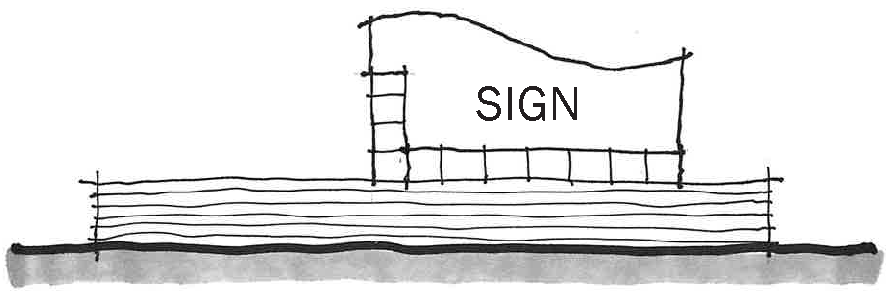
Freestanding Sign, Monument Base: A sign supported upon the ground by a mounted base, permanently anchored in a concrete pedestal and not to any building. Such monument base freestanding sign shall not exceed an average of five feet (5') in height as measured from the ground to the top of the sign to include the base. (See Below)
(22)
Frontage: The length of the property line of any one premise along a public right-of-way on which it borders.
(23)
Government Sign: Signs erected pursuant to the authority of a governmental entity.
(24)
Grand Opening Sign Package: Banner signs utilized for the specific purposes outlined in 31-26(F)(2)(c) of this Ordinance.
(25)
Height (of a sign): The vertical distance measured from the highest point of the sign, including embellishments, to the average grade beneath the sign.
(26)
Identification Sign: A sign for which text is limited to the name and address of the building, institution, or person and/or to the activity or occupation being identified.
(27)
Illegal Sign: A sign that does not meet the requirements of this Ordinance and has not received legal nonconforming status.
(28)
Indirect Lighting: Illumination by means of a concealed light source, whereby all incandescent or fluorescent devices are shielded from view by opaque or translucent materials, and including reflected lighting.
(29)
Inflatable Sign: Any sign designated or constructed with the ability to be mechanically filled with air or gas.
(30)
Internally Illuminated Sign: Illumination by means of a light source completely enclosed by the sign panel(s).
(31)
Intermittent Lighting: (See Flashing Sign)
(32)
Maintenance: The cleaning, painting, repair, or replacement of defective parts of a sign in a manner that does not alter the basic copy, design, or structure of the sign.
(33)
Name Plate: A non-electric or premise identification sign giving only the name, address, and/or occupation of an occupant or group of occupants.
(34)
Nonconforming Sign: A sign that was erected legally, but does not comply with subsequently enacted sign restrictions and regulations.
(35)
Off-Premises Sign: A sign structure advertising an establishment, merchandise, service, or entertainment that is not sold, produced, manufactured, or furnished at the property on which said sign is located— e.g., "Billboards," "Outdoor Advertising," or "Off-Site Sign."
(36)
On-Premises Sign: A sign that pertains to the use of the premises on which it is located and maintained.
(37)
Painted Wall Sign: A sign that is applied with paint or similar substances on the face of an exterior wall and is considered to be a wall-mounted sign for calculation purposes.
(38)
Parapet Wall: That part of the wall entirely above the roof line.
(39)
Political Sign: A temporary sign used in connection with a local, state, or national election or referendum.
(40)
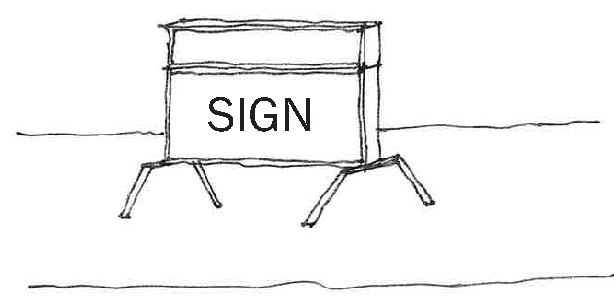
Portable Sign: Any sign designed to be moved easily and not permanently affixed to the ground or to a structure or building (See Below).
(41)
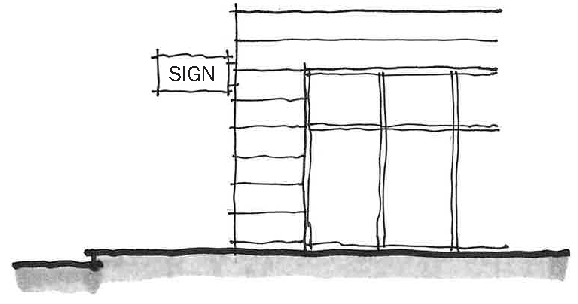
Projecting Sign: A sign other than a flat wall sign, that is attached to and projects from a building wall or other structure not specifically designed to support the sign and is not parallel to the structure to which it is attached. (See Below)
(42)
Public Service Information Sign: Any sign intended exclusively to promote items of general interest to the community, such as time, temperature, date, atmospheric conditions, news or travel control.
(43)
Real Estate Sign: A temporary sign advertising real estate upon which the sign is located as being for rent, lease, or sale.
(44)
Roof Line: The top edge of the roof or building parapet, whichever is higher, excluding any cupolas, pylons, chimneys, or minor projections.
(45)
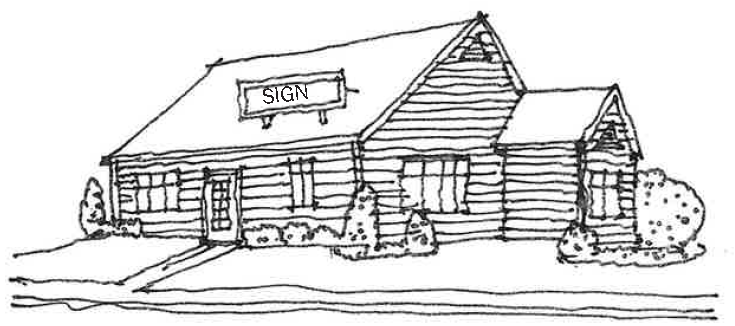
Roof Sign: Any sign erected upon a roof of a building where the roof is greater than fifteen (15) degrees from the horizontal plane. (See Projecting Sign). A roof sign shall not extend above the peak of the roof (See Below).
(46)
Rotating Sign: Any sign or device that has any visible revolving part, or visible mechanical movement. Such motion does not refer to methods of changing copy.
(47)
Shopping Center: Five (5) or more separate and contiguous business establishments.
(48)
Sidewalk Sign: A sign that business owners may place on a sidewalk to direct attention to the business and its commodities or services. No permit is required for such a sign.
(49)
Sign: Any device, structure, fixture, or placard using graphics, symbols, and/or written copy that is visible from a public place designed to advertise, identify or convey information. In cases where more than one display surface, panel, face or device is attached to one structural support, the entire structure shall be considered as one sign.
(50)
Sign Area: The smallest rectangle enclosing the extreme limits of the sign panel(s) attached to the sign structure, and which are integral parts of the display. If a sign consists of more than one sign panel, the area of each sign panel shall be calculated separately and then the areas of each panel shall be added together to yield the total sign area. See Section 31-26(K)
(51)
Sign Structure: Any connections or supports upon which a sign is attached. (See Roof Sign).
(52)
Special Event Sign: A temporary sign advertising or pertaining to any civic, patriotic or special event of general public interest taking place within the city.
(53)
Street Banner Sign: Any banner sign that is stretched across and hung over a public right-of-way.
(54)
Subdivision Identification Sign: A free-standing or wall sign identifying a recognized subdivision, condominium complex, or residential development.
(55)
Temporary Sign: A sign not constructed or intended to remain for longer than thirty (30) calendar days as regulated by Section 31-26(F) of this Ordinance.
(56)
Three Dimensional Sign: A sign with three or more sign faces, the area of which is the largest plane of view.
(57)
Under-Canopy Sign: A sign suspended beneath a canopy, ceiling, roof, or marquee, used for directional or identification purposes and considered as a nameplate wall sign.
(58)
V-Shaped Sign: A sign with two (2) faces or panels not supported by one common structural member and which faces are not back to back such as a double-faced sign.
(59)
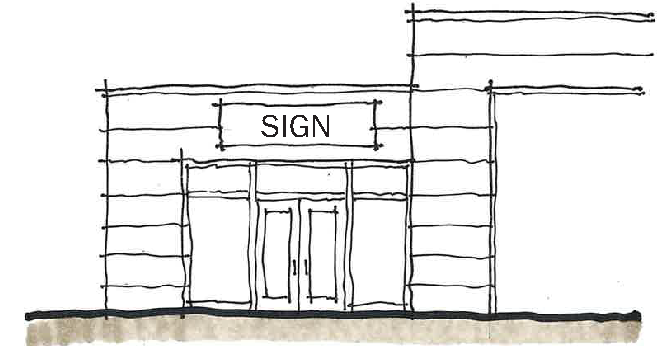
Wall Sign: A sign erected on the surface of the building that does not extend above the roof line of the parapet of the wall upon which it is located. This definition includes painted, individually lettered, and cabinet signs, signs on mansard, and signs on a fence (See Below).
(60)
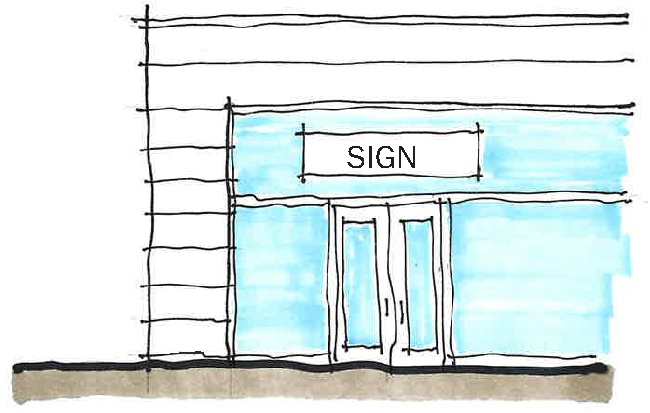
Window Sign: A sign installed inside a window and intended to be viewed from the outside, and/or signs painted on the inside or outside of windows or glass portions of doors or buildings (See Below).
(C)
Signs Prohibited.
The following signs shall be expressly prohibited in all zoning districts, any contrary provisions or implications of this Ordinance notwithstanding:
(1)
Signs in, upon, or over any public property or public right-of-way, except for the following:
(a)
Governmental signs;
(b)
Signs as may be authorized by the Board of Alderman in accordance with such conditions and standards as may be established by the Board of Aldermen.
(2)
Flashing, rotating, and moving signs including portable signs, beacons, searchlights, animated signs, and signs with moving lights or creating the illusion of movement. Exemption: Permitted signs that conform to Section 31-26(L)(2) or a sign displaying only the current time or temperature by intermittent lighting.
(3)
Signs that may be confused with or construed as a traffic control device.
(4)
Any embellishments to signs including sign extensions beyond the outer perimeter of the primary sign face or extending outward from the sign face and parallel to the ground.
(5)
Signs with related audio or noise generating devices.
(6)
Any abandoned sign. See Section 31-26(G)
(7)
Signs attached to trees, utility poles, or drawn upon rocks or other natural features whether on public or private property, except warning and/or identification signs placed by public utility companies.
(8)
Signs located within the Sight Triangle on any corner lot. See Section 31-5(P)
(9)
Signs that are directly illuminated, except monument signs, when placed within one hundred fifty feet (150') of a residential district.
(10)
Permanent inflatable signs. See Section 31-26(F)(2)(b)(v)
(11)
Any sign not expressly permitted by this Section.
(12)
Portable signs or trailer-mounted signs, to exclude sidewalk signs.
(13)
Signs that bear or contain statements, words or pictures of an obscene, pornographic, profane, or defamatory nature.
(14)
Signs without valid permit(s).
(D)
Permits Required.
(1)
Permits Required. No sign may be created, constructed, erected, remodeled, relocated, or expanded until a sign permit is obtained in accordance with this Section, except that temporary signs as provided for in Section 31-26(F) shall be exempt from the requirement of a permit fee. No sign permit shall be issued unless the sign is permitted by and complies with all regulations of this Ordinance.
(2)
Permit Fees. See Section 31-31 of this Ordinance.
(3)
Permit Expiration. If the work authorized under the permit has not been completed within one hundred eighty (180) days after the date of issuance, the permit shall become null and void.
(4)
Investigation Fees. Whenever any sign is created, constructed, erected, remodeled, relocated, or expanded without first obtaining the required sign permit, a special investigation shall be made. After said investigation is made, the required sign permit shall be obtained and a fee shall be charged for the investigation that is equal to the amount of the sign permit fee that is required.
(5)
Special Criteria for Certain Districts. (Additional sign permit application process for all signs located in the Downtown-Main Street Conservation District and the Grandview Road-Highgrove Road Residential Historic District.)
(a)
Any sign being altered, constructed or removed within the Downtown-Main Street Conservation District or the Grandview Road-Highgrove Road Residential Historic District must submit a Certificate of Appropriateness application to be reviewed and approved by the Historic Preservation Commission subject to provisions listed in Section 31-28.
(E)
Exemptions from Permits.
(1)
Exempted Circumstances. No permits shall be required in the following circumstances:
(a)
The changing or replacing of the content, advertising, or material on a sign face, without in any way altering the sign structure or the size of the sign face, provided said sign is for the same occupant, otherwise a new permit is required;
(b)
Repairing, cleaning, or maintaining a sign if no structural change is made;
(c)
Regarding any sign within a building unless otherwise restricted by this Section.
(2)
Exempted Signs. The following signs shall be exempted from the permit requirements of this Ordinance.
(a)
Flags and Decorations. Flags, emblems, or insignia of any governmental body, church, school, or service organization that do not contain advertising. Decorative displays for holidays containing no commercial advertising shall be allowed on private property during the customary periods for such holiday.
(b)
Government Signs. Government signs as defined herein, are exempt from obtaining a permit; however, they are required to submit construction documents for review and approval by the Director of Community Development or their designee prior to the construction of the sign(s). All contractors shall obtain an Occupational License as outlined in Chapter 13 of the Grandview Code of Laws.
(c)
Memorial Signs. Memorial signs and tablets displayed on private property.
(d)
Incidental Signs. Small signs not containing any advertising and, not exceeding six (6) square feet in area per face, with a maximum area of twelve (12) square feet, displayed on private property for the convenience of the public, such as signs to identify restrooms, signs to identify freight entrances, directional signs, warning signs, and nameplate signs indicating name and address only.
(e)
Garage Sale Signs. Garage sale signs located on private property and not exceeding six (6) square feet in area per face, with a maximum area of twelve (12) square feet. These signs shall be removed within two (2) calendar days following the completion of the sale.
(f)
Merchandise Displays and Pennants. Merchandise displays and pennants that contain no advertising and are kept in good repair.
(g)
Political Signs. Political signs not exceeding nine (9) square feet in area per face with a maximum area of eighteen (18) square feet shall be permitted in residential zoning districts, and thirty-two (32) square feet per face, with a maximum area of sixty-four (64) square feet in commercial, office, industrial and special purpose zoning districts. Such signs shall not be placed upon the public right-of-way, and may be displayed thirty (30) days prior to and seven (7) days after an election. After a primary election, those candidates who won in such primary election may continue to display their signs during the interim period and up to seven (7) days after the following general election.
(h)
Real Estate Signs. One non-illuminated real estate sign per street frontage may be displayed on any parcel, but such sign must serve the street frontage upon which it sets. The sign shall be located entirely on the property to which it applies, be maintained in good repair, and be removed within 14 days after the sale, rental, or lease of the property. Real estate signs displayed on commercial, office, or industrial property shall not exceed one hundred (100) square feet in area per face with a maximum area of two hundred (200) square feet. Real estate signs displayed on single residential parcels shall not exceed eight (8) square feet per face, with a maximum area of sixteen (16) square feet. Real estate signs displayed on residential projects of twelve (12) or more units shall not exceed thirty-two (32) square feet per face with a maximum area of sixty-four (64) square feet. Real estate signs exceeding these size limitations shall be reviewed and approved by the Director of Community Development on a case-by-case basis.
(i)
Construction Signs. Non-illuminated signs indicating the names of architects, engineers, contractors and similar persons or firms involved in any construction or development. No such sign shall exceed one hundred (100) square feet in area per face with a maximum area of two hundred (200) square feet. No more than one sign shall be allowed for each street frontage on any one construction project and such sign must serve the street frontage upon which it sits. Such signs shall be removed within fourteen (14) days after the issuance of the Certificate of Occupancy by the Building Official, or the completion of the project. Construction signs exceeding these size limitations shall be reviewed and approved by the Director of Community Development on a case-by-case basis.
(j)
Window Signs. Window signs as defined herein.
(k)
Inflatable Signs. Inflatable signs when used by civic organizations only and after approval is granted from the Director of Community Development.
(l)
Noncommercial Opinion Signs. One (1) noncommercial opinion sign per lot not exceeding nine (9) square feet in area per face with a maximum area of eighteen (18) square feet shall be permitted in residential zoning districts, and thirty-two (32) square feet per face, with a maximum area of sixty-four (64) square feet in commercial, office, industrial, and special purpose zoning districts. Such signs shall not be placed upon public right-of-way. Such signs shall not be directly or indirectly illuminated. Contain reflective paint, or possess any moving devices.
(m)
Sidewalk Signs. Allowed only in non-residential districts.
(i)
Location. Where a business's main entrance is immediately adjacent to a sidewalk to which the sign is placed. The sign shall be portable and must leave an unobstructed area of forty-eight inches (48") in width on the sidewalk to allow for adequate pedestrian circulation. The sign shall not obstruct ingress or egress to a building.
(ii)
Timing. The signs shall only be on sidewalks during business hours.
(iii)
Size. The sign shall be no shorter than two and one half feet (2.5') in height, with a maximum of four feet (4') in height. No sidewalk sign shall be greater than ten square feet (10 sq. ft.) in area.
(iv)
Quantity. Businesses that have their own entrance directly to a sidewalk may possess one (1) sidewalk sign. Buildings with multiple tenants with a shared entrance from a sidewalk may only possess one (1) sidewalk sign. Multiple users may use the sidewalk sign.
(v)
Design. Signs shall not be animated or illuminated.
(F)
Temporary Signs.
Temporary signs may be erected and maintained in accordance with the following provisions:
(1)
General Conditions:
(a)
Permit Required. No persons shall erect, alter or relocate any temporary sign without first making application as specified in this Ordinance, and obtaining a sign permit from the Building Official.
(b)
Material and Methods. The Building Official shall impose as a condition of the issuance of the permit such requirements as are necessary to assure the safety and convenience of the public.
(2)
Permitted Temporary Signs:
(a)
Temporary quasi-public signs, giving notice of events and activities sponsored by recognized civic, patriotic, religious, or charitable organizations for non-commercial purposes, subject to the following:
(i)
Location. Quasi-public signs may be located on or off of the premises where the event is taking place provided permission is given by the owner of the property. Such signs shall not project beyond any lot line;
(ii)
Timing. Quasi-public signs shall not be erected or maintained more than fourteen (14) days prior to the date on which the event advertised is to occur and shall be removed within three (3) days after the termination of the event;
(iii)
Size. Quasi-public signs shall be safely anchored and shall be allowed a sign area not to exceed thirty-two (32) square feet of sign area per face, sixty-four (64) square feet total.
(b)
Temporary business banner signs calling attention to a special sale, unique or limited activity (i.e.: Grand Opening, Quitting Business), or special sale price of a service or product of limited duration. Such signs shall be limited to banner signs only as regulated herein but in no case shall each retail or service business display more than one such sign.
(i)
Location. Temporary business banner signs shall be located only on the lot upon which the special activity is to occur. Such signs shall not project over the lot line.
(ii)
Quantity. A single business on a lot may obtain one (1) temporary banner sign per 500' of street frontage. Businesses located in commercial strip centers may obtain one (1) temporary banner sign.
(iii)
Size. Banner signs and inflatable signs must be securely attached at the four corners and are allowed a sign area not to exceed ten percent (10%) of the façade upon which it is placed or sixty (60) square feet, whichever is less, or thirty (30) square feet if not erected upon a façade.
(iv)
Height. A freestanding inflatable sign shall not exceed the height limits designated for permanent freestanding signs in the zoning district in which the sign is to be placed.
(v)
Balloon-type attention devices. Large freestanding inflatable devices may be placed on roofs or approved temporary or permanent structures provided they comply with all provisions of this section, excepting that there is no limit on the vertical cross-sectional area of the balloon.
(vi)
Timing. Temporary business signs shall be permitted for not more than six (6) periods per calendar year, each period not to exceed thirty (30) calendar days each. A separate permit is required for each of the six periods allowed. At the expiration of each period, the permit holder shall immediately remove such temporary sign.
(vii)
Fee. See Section 31-31 of this Ordinance.
(c)
Grand Opening Banner Sign Package
(i)
Intent. This section is intended to provide new businesses the opportunity to obtain additional temporary banners for the purposes of promoting their grand opening events.
(ii)
Timing. Businesses may apply for a Grand Opening Banner Sign Package up to thirty (30) days before the opening date. The sign package permit is good for a total of sixty (60) days from the date of approval. The Grand Opening Banner Sign Package is allowed one (1) time per business.
(iii)
Quantity. Up to four (4) temporary banner signs are allowed. Blank flag signs or "feather flags," may accompany the temporary banner signs, but shall contain no language, graphics, or signage.
(iv)
Fee. See Section 31-31 of this Ordinance.
(G)
Maintenance or Abandonment of Signs.
(1)
All signs shall be of sound structural quality, be maintained in good repair, have a clean and neat appearance, remain free from fading, tears, cracks, or missing sign panels, and the land adjacent shall be kept free from debris, weeds, and trash. Signs that are not properly maintained as determined by the Building Official, or that are abandoned, shall be removed by the property owner within thirty (30) days after abandonment of the principal use or may thereafter be removed or repaired by the Building Official after proper notification as set forth in this Ordinance. Removal expense of such shall be charged to the property owner as outlined and authorized by Chapter 16 of the Grandview City Code.
(2)
Owners of signs that do not conform with the maintenance requirements of this ordinance at the time of its adoption shall have six months from the date of adoption to bring the non-conforming sign into compliance with the ordinance. Signs that do not comply with the maintenance requirements of this ordinance after said six months have elapsed shall be subject to removal as authorized by Chapter 16 of the Grandview City Code.
(3)
Notwithstanding any other provision of this Section 31-26 to the contrary, signs that would otherwise be deemed abandoned and subject to removal may remain on property that becomes vacant or unoccupied if said sign conforms to the maintenance requirements of this ordinance and if obsolete sign faces are replaced with blank sign faces.
(H)
Sign Contractor's License.
No applicant, person, firm or corporation shall hereinafter install, erect or maintain any sign (except that banner signs shall be exempted from this provision) that is electric, that extends more than fifteen feet (15') above the ground level or that is greater than thirty-two (32) square feet in area, until such person, applicant firm, or corporation has been licensed by the City of Grandview as a sign contractor. Further, no license will be approved until such contractor has filed with the City of Grandview a certificate of an insurance company duly authorized to do business in Missouri, stating that there is, in effect, a liability insurance policy of $50,000 and $100,000 bodily injury limits of liability and $50,000 property damage limits of liability insuring the applicant. The certificate of insurance shall also state that the policy shall not be canceled, amended, changed or altered without giving the City ten (10) days written notice.
(I)
Off-Premises Signs.
An off-premises sign is any permanent, freestanding sign that advertises, promotes, or gives information about products, businesses, or services not connected with the premises upon which the sign is located. An off-premises sign shall be subject to the following provisions:
(1)
The maximum area of the sign, shall be six hundred seventy two (672) square feet per face. No embellishments are permitted;
(2)
Off-premises signs shall be spaced a minimum of one-thousand feet (1,000') apart as measured along the centerline of I-49 or Missouri Highway 150;
(3)
Off-premises signs shall be restricted to property abutting I-49 or Missouri Highway 150;
(4)
Off-premises signs shall be located a minimum of five hundred feet (500') from any residential zone, residential use, or any planned residential use as shown in the adopted Comprehensive Plan;
(5)
Placement of said sign shall comply with the building setbacks of the zoning district;
(6)
Off-premises signs may be located on the property line, but shall not extend over or into the right-of-way. No off-premises signs shall be located within a sight triangle;
(7)
Off-premises signs shall be a maximum of thirty five feet (35') in overall height, measured from the centerline of the roadway, including the sign and support structure, and thirty feet (30') in length;
(8)
Off-premises signs shall be permitted only on lots with a minimum frontage of seventy feet (70');
(9)
Off-premises signs shall not be allowed on the same lot with more than one (1) freestanding sign;
(10)
Off-premises signs shall only be permitted in the C-2, General Commercial Districts or in PD, Planned Districts that specifically permit such signs.
(J)
Non-Conforming Signs.
Any sign that becomes a non-conforming sign on the effective date of this Ordinance or that becomes a nonconforming sign at any future date shall be regulated according to the rules set forth in Section 31-27(A) of this Ordinance. In the event that the structural framework or supporting members, or one or more parts thereof of such non-conforming sign require modification or replacement, then such non-conforming sign shall be made to conform to the maximum area, number, allowable structure type, protection, height, lighting, and motion requirements for signs otherwise permitted in the zoning district or be removed. The changing of the copy or advertising material on the face of the structure shall not be deemed modification or replacement.
(K)
Sign Area.
(1)
On-Premises Sign Area:
(a)
Single Panel: The area of a single panel sign shall be measured by calculating the area of the extreme limits of the sign panel(s). If a single-faced sign contains more than one sign panel, the area of each sign panel shall be calculated separately and then the area of each sign panel shall be added together to yield the total sign area of a single faced sign. In no case shall the area between any sign panels or the supporting sign structure be calculated as part of the sign area.
(b)
Double-Faced (or Panel): Same as single panel sign except that a double-faced sign shall only count both faces for sign area determination.
(2)
Off-Premises Sign Area: The area of off-premises signs shall be measured in the same manner as on-premises signs, except for off-premises signs that have "add-ons" or embellishments to the principal sign panel, then each additional "add-on" shall be calculated separately for its area and added to the principal sign panel. However, in no case shall the total area of the principal sign panel, when added to the "add-ons," exceed the maximum sign area provided within the district in which it is located.
(L)
Sign Construction Standards.
(1)
Design
(a)
General. Signs and sign structures shall be designed and constructed to resist wind and seismic forces as specified in this Section. Bracing systems shall be designed and constructed to transfer lateral forces to the foundations. For signs supported on buildings, the dead and lateral loads shall be transmitted to the ground in a manner so as to avoid overstressing the elements of the structural frame. The overturning moment produced by lateral forces shall not exceed two-thirds of the dead-load resisting moment. Uplift due to overturning shall be resisted by proper anchorage to the ground or to the structural frame of the building. The weight of earth superimposed over footings may be used in determining the dead load resisting moment. Such earth shall be carefully placed and thoroughly compacted.
(b)
Wind Loads. Signs and sign structures shall be designed and constructed to resist wind forces as specified in the Grandview Building Code.
(c)
Seismic Loads. Signs and sign structures shall be designed and constructed to resist seismic forces as specified in the Grandview Building Code.
(d)
Combined Loads. Wind and seismic loads need not be combined in the design of signs or sign structures; only the loading producing the larger stress need be used. Vertical design loads, except roof live loads, shall be assumed to be acting simultaneously with wind or seismic loads.
(e)
Allowable Stresses. The design of wood, concrete, steel or aluminum members shall conform to the Grandview Building Code. Loads, both vertical and horizontal, exerted on the soil shall not produce stresses exceeding those specified in the Grandview Building Code. The working stresses of wire rope and its fastenings shall not exceed 25 percent of the ultimate strength of the rope or fasteners. Working stresses for wind or seismic loads combined with dead loads may be increased as specified in the Grandview Building Code.
(f)
If required by the Building Official, an engineer's seal may be required to certify the design of the sign.
(2)
Special Design for Electronic Message Center Signs. Electronic message center signs are permitted subject to review by special use permit.
(a)
Electronic message center signs are not allowed as part of a temporary sign.
(b)
Any portion of the message or image must have a minimum duration on the screen of eight (8) seconds. An exception to this requirement is made for a sign that displays time and temperature.
(c)
The change from one message to the next shall not take more than one (1) second and shall not involve flashing or movement of text or images.
(d)
In case of malfunction, the sign display shall be defaulted to a blank screen.
(e)
Prior to the issuance of a sign permit, the applicant shall provide written certification from the sign manufacturer that the light intensity has been factory pre-set not to exceed 7,000 NITS during daylight hours and 2,500 NITS between dusk and dawn and that the intensity level is protected from end-user manipulation.
(f)
The sign shall not display light of such intensity or brilliance to cause glare or otherwise impair the vision of the driver, or result in a nuisance to the driver.
(3)
Listing Required. Every electric sign of any type shall be listed and installed in conformance with that listing in the National Electrical Code, unless otherwise permitted by special permission.
(M)
Relationship to Overlay Districts.
While section 31-26 of the Zoning Ordinance regulates signage citywide, exceptions shall be made for properties within overlay districts, regulated in this Ordinance or outside of, to achieve the specific intent listed in the overlay.
(1)
Main Street Conservation District Overlay - Signage for properties within this district shall be regulated by the Main Street Conservation District Design Guidelines. For specifications not listed in the Design Guidelines, applicants shall utilize the following table for further information. The Historic Preservation Commission shall approve a Certificate of Appropriateness in accordance with section 31-28 of this Ordinance, prior to applying and the issuance of a sign permit.
(N)
Sign Specification Chart.
*
Changeable Copy sign may be used in addition to the allowed free-standing sign
**
For wall-mounted signs on a canopy, 10% of all façades is permitted
***
35' pole base above elevation of I-49 centerline measured from the nearest point of the sign
+
Min. 8' clearance from bottom of sign to ground if within 10' of R-O-W.
++
If a stand-alone building with its own parking and access, then shall apply for its own free-standing sign
+++
Director may approve 2 additional signs if lane length, configuration, and queuing design justify more
*
Changeable Copy sign may be used in addition to the allowed free-standing sign
**
For wall-mounted signs on a canopy, 10% of all façades is permitted
***
35' pole base above elevation of I-49 centerline measured from the nearest point of the sign
+
Min. 8' clearance from bottom of sign to ground if within 10' of R-O-W.
++
If a stand-alone building with its own parking and access, then shall apply for its own free-standing sign
+++
Director may approve 2 additional signs if lane length, configuration, and queuing design justify more
*
Changeable Copy sign may be used in addition to the allowed free-standing sign
**
For wall-mounted signs on a canopy, 10% of all façades is permitted
***
35' pole base above elevation of I-49 centerline measured from the nearest point of the sign
+
Min. 8' clearance from bottom of sign to ground if within 10' of R-O-W.
++
If a stand-alone building with its own parking and access, then shall apply for its own free-standing sign
+++
Director may approve 2 additional signs if lane length, configuration, and queuing design justify more
*
Changeable Copy sign may be used in addition to the allowed free-standing sign
**
For wall-mounted signs on a canopy, 10% of all façades is permitted
***
35' pole base above elevation of I-49 centerline measured from the nearest point of the sign
+
Min. 8' clearance from bottom of sign to ground if within 10' of R-O-W.
++
If a stand-alone building with its own parking and access, then shall apply for its own free-standing sign
+++
Director may approve 2 additional signs if lane length, configuration, and queuing design justify more
*
Changeable Copy sign may be used in addition to the allowed free-standing sign
**
For wall-mounted signs on a canopy, 10% of all façades is permitted
***
35' pole base above elevation of I-49 centerline measured from the nearest point of the sign
+
Min. 8' clearance from bottom of sign to ground if within 10' of R-O-W.
++
If a stand-alone building with its own parking and access, then shall apply for its own free-standing sign
+++
Director may approve 2 additional signs if lane length, configuration, and queuing design justify more
*
Changeable Copy sign may be used in addition to the allowed free-standing sign
**
For wall-mounted signs on a canopy, 10% of all façades is permitted
***
35' pole base above elevation of I-49 centerline measured from the nearest point of the sign
+
Min. 8' clearance from bottom of sign to ground if within 10' of R-O-W.
++
If a stand-alone building with its own parking and access, then shall apply for its own free-standing sign
+++
Director may approve 2 additional signs if lane length, configuration, and queuing design justify more
(Ord. No. 7419, exh. A, 2-28-2023; Ord. No. 7578, § 1, 5-13-2025)

