Grandview City Zoning Code
31-5
APPLICATION OF DISTRICT REGULATIONS
Regulations within each district shall be applied uniformly to each class of structure or land.
(A)
Conformance with Standards.
(1)
Use Regulations.
No building, structure, or land shall hereafter be used or occupied, and no building, structure or part thereof, shall hereafter be erected, constructed, reconstructed, moved, or structurally altered except in conformity with all of the regulations herein specified for the district in which it is located unless the building, structure, or land is within an overlay district listed in section 31-4 of this Ordinance. In the case of overlay districts, additional regulations may apply to buildings, structures, or land on top of the base zoning district regulations.
(2)
Classification of Uses Not Listed Within the District Regulations.
In the case where a use is not specifically listed under any of the permitted, conditional, temporary, or accessory uses under the district regulations of the individual districts, the Director of Community Development shall determine the appropriate district or districts where such use shall be allowed based on a comparison of other uses that most closely resemble the unlisted use. In the event the person or firm disagrees with the determination of the Director of Community Development, such determination may be appealed to the Zoning Board of Adjustment.
(3)
Conformance with Bulk and Yard Regulations.
No building or other structure shall hereinafter be erected or altered to: (a) exceed the height or bulk; (b) accommodate or house a greater number of facilities; (c) have narrower, smaller, wider or larger yards or other open spaces than herein permitted; or in any other manner contrary to the provisions of this Ordinance.
(4)
Yards, Open Space, and Off-Street Parking.
No part of a yard, open space, off-street parking, or loading space required in connection with any building for the purpose of complying with this Ordinance shall be included as part of a yard, open space, off-street parking, or loading space for any other building.
(a)
The only exception to this requirement is in the case of an accessory dwelling unit or in commercially zoned districts where the Director of Community Development feels that parking and loading is of abundance and additional parking or loading space would be unnecessary. Adjacent property owners will provide a written and signed agreement stating that they are willing to share off-street parking and or loading space.
(5)
Reduction of Required Lots and Yards Prohibited.
No yard lot existing on the effective date of this Ordinance shall be reduced in dimension or area below the minimum requirements set forth herein.
(6)
Approval of Lot Sizes and Future Usage.
All lots created after the effective date of this Ordinance shall meet at least the minimum or not exceed the maximum requirements, except for Parent Lots, established by this Ordinance and shall be approved in conformance with the City's Subdivision Ordinance except as may be otherwise specifically provided in this Ordinance:
(a)
No building, structure, or part therefore, shall hereafter be built, moved or remodeled, and no building, structure or land shall hereafter be used, occupied, arranged, or designed for use of occupancy of a zoning lot that is smaller or larger than the minimum or maximum lot area or minimum or maximum lot width required in the zoning district in which the building, structure or land is located; and
(b)
No existing building or structure shall hereafter be remodeled so as to conflict, or further conflict, with the lot area per dwelling unit requirements for the zoning district in which the building or structure is located.
(B)
Modification of Required Front Yards.
Whenever forty percent (40%) or more on a front-foot basis of all property on one side of a street between two intersecting streets has been built up with buildings having front yards of more or less depth than required by this Ordinance, and provided the majority of such front yards do not vary more than six feet (6') in depth, then the average depth of front yards of such majority of buildings shall establish the required front-yard depth for all such blocks, provided that this provision shall in no case reduce the required front yard to less than ten feet (10').
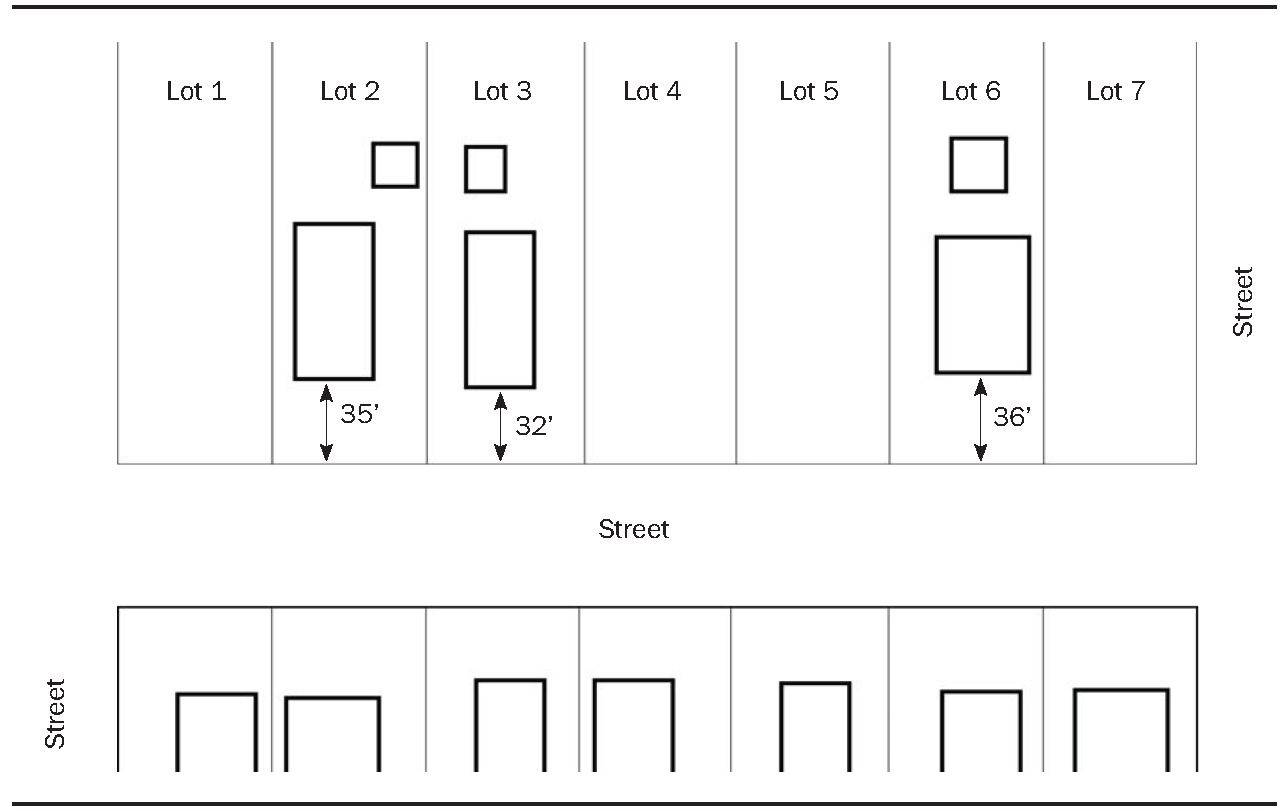
In the example above, lots 2, 3, and 6 are already developed with buildings. These three (3) lots make up more than 40% of the total amount of lots on this block between intersecting streets. The setbacks of these buildings vary, but are within the six foot (6") depth range. In order to determine the building line for lots 1, 4, 5, and 7, the average setback of lots 2, 3, and 6 will be used. The building line for the remaining lots is thirty-four (34') feet.
If, however, after site plan review, the Director of Community Development determines that this section does not appropriately establish the front-yard setback so that visual continuity and harmony are created within the block face in question, then the Director may establish the appropriate front-yard setback.
(C)
Principle Permitted Uses.
No building, structure, or part therefore, shall hereafter be built, moved or remodeled, and no building, structure or land shall hereafter be used, occupied, operated or designed for use or occupancy except for a use that is listed as a Principal Permitted Use or Accessory Use under the District Regulations for the Zoning District in which the building, structure or land is located. No Principal Permitted Use already established on the effective date of this Ordinance shall be altered, modified or enlarged so as to conflict with, or further conflict with, the regulations for the zoning district in which such use is located.
(D)
Conditional Uses.
No use of building, structure or land that is designated as a Conditional Use in any zoning district shall hereafter be established, and no existing conditional use, or part therefore, shall hereafter be changed to another Conditional Use in such district, unless a Conditional Use Permit has been secured in accordance with the provisions of Section 31-29(F) of the Ordinance. Any established use on the effective date of this Ordinance that would be classified as a Conditional Use in the district in which it is located, has all the rights of an approved Conditional Use and does not require any additional approval or review. No Conditional Use already established on the effective date of this Ordinance shall be altered, modified or enlarged so as to conflict with, or further conflict with, the regulations applicable to the zoning district in which such use is located.
(E)
Temporary Uses.
Within any district established by this Ordinance, temporary uses shall be permitted as listed within the zoning district in which the proposed temporary use is located, but only provided that:
(1)
A site plan, indicating the proposed use, length of stay, off-street parking, and traffic circulation be submitted with the appropriate filing fee as established in Section 31-31 and approved by signature of the Director of Community Development except otherwise provided for in the District Regulations;
(2)
The use is of a limited and temporary duration, not to exceed six (6) months unless the applicant requests and receives approval for a temporary use exceeding six (6) months. In the event a temporary use permit is approved for more than six (6) months, the Director of Community Development may establish a periodic review schedule to ensure compliance with conditions made a part of the temporary use permit.
(3)
The use will serve a public need or contribute to the public convenience and welfare;
(4)
The use bears some functional or other beneficial relationship to a permitted use within the district and has the written approval of the property owner; and
(5)
The use will not be likely to interfere with the appropriate use and enjoyment of nearby properties that may be affected by its operation.
The following temporary uses shall be exempted from the requirements of this section, provided the use is permitted in the zoning district in which the temporary use is requested, and the use shall occur for no longer than 45 days:
(1)
Activities associated with community events operated by the owner/occupant and/or non-profit organizations;
(2)
Businesses having a permanent location with a current occupational license to prepare and sell food; and
(3)
Sale of Christmas trees; and
(4)
Any of the above uses for which attendance of more than 100 persons in any one day shall comply with all provisions of this section.
(F)
Accessory Buildings, Structures, and Uses.
No accessory building, structure or use, or temporary building, structure or use, shall hereafter be built, moved or remodeled, established, altered or enlarged unless such accessory building, structure or use is permitted by and in conformance with the provisions of Section 31-22 of this Ordinance, and all other regulations or requirements pertaining to the district in which such building, structure or use is located.
(G)
Exemptions from Regulations.
The following structures or uses are exempt from the regulations of this Ordinance and shall be permitted in any district:
(1)
Poles, wires, cables, conduits, vaults, laterals, pipes, mains, valves, or any other similar equipment for transmission or distribution to customers of telephone or other communication services, electricity, gas, steam or water, or the collection of sewage or surface water, operated or maintained by a public utility, but not including substations located on or above the surface of the ground;
(2)
Railroad tracks, signals, bridges and similar facilities and equipment located on a railroad right-of-way;
(3)
Permanent or Portable Basketball goals or similar structures, provided they are set back a minimum of 15 feet from the back edge of the curb (or edge of the street where no curbing exists); and
(4)
Building or trailer for storage of materials and/or equipment necessary for construction authorized by a valid building permit, provided the location of the building or trailer has been approved by the Building Official, and provided it is removed within 30 days of issuance of the temporary or permanent certificate of occupancy for the construction project.
(H)
Exempted Buildings, Structures, and Uses of the City.
All buildings, structures, or uses owned or operated by the City of Grandview shall also be exempted from the use regulations of this Ordinance and shall be permitted in any district provided that:
(1)
A site plan is submitted and approved in accordance with the provisions of Section 31-23 of the Ordinance; and
(2)
The building or structure conforms to all other provisions of this Ordinance, the building code, and all other local, state and federal building and accessibility requirements.
(I)
Structures Permitted Above The Height Limits.
The following may exceed the prescribed height limit provided they are required for a use permitted in the district in which they are erected or constructed: chimneys, cooling towers, condensers, elevator bulkheads, belfries, stacks, ornamental towers, monuments, cupolas, domes, spires, and other necessary mechanical appurtenances and their protective housing, and provided that a parapet wall is used to screen such appurtenances from view. Parapet walls shall not be calculated in the overall height of the structure they serve.
Ground-based transmission towers may be erected to a height not to exceed 60' unless the building height for the particular district exceeds 60'. A minimum setback of one-third the height of the tower shall be maintained from all property lines. Towers shall meet Federal Communications Commission and Federal Aviation Administration requirements.
Churches, however, may be erected to a height not exceeding seventy-five feet (75').
(J)
Obstructions Permitted in Required Yards.
All minimum yards required by this Ordinance shall be open, unobstructed space except as permitted as follows:
(1)
All Required Yards.
Awnings, shutters, canopies, arbors, and trellises; chimneys projecting not more than twenty-four inches (24") into the required yard; flag poles; steps necessary for access to a building or lot; approved fences and walls; and hedges and other vegetation.
(2)
Required Front Yards.
Bay windows, oriels, or balconies projecting not more than ten feet (10') into the required front yard; or unenclosed, unroofed or roofed porches extending no more than one-third the setback distance from the property line into the required front yard; overhanging eaves and gutters projecting into the required front yard not more than one-third the distance to the front property line from an exterior wall; off-street parking, except that ten (10') feet of clear visibility shall be maintained on corner lots in accordance with Section 31-5(P) entitled "Sight Triangle."
(3)
Required Rear Yards.
Accessory uses, buildings or structures as permitted by this Ordinance; off-street parking spaces, balconies, breezeways, unenclosed roofed or unroofed porches, terraces and decks, and bay windows projecting not more than five feet (5') into the required rear yard; overhanging eaves and gutters projecting into the required rear yard not more than one-third the distance to the rear property line from an exterior wall.
(4)
Required Side Yards.
Accessory uses, buildings or structures as permitted by this Ordinance; overhanging eaves and gutters projecting into the required side yard not more than one-third the distance to the side property line from an exterior wall; open off-street parking, except as provided for in Section 31-24(F) of this Ordinance.
(K)
Number of Buildings, Structures and Uses Permitted Per Lot.
(1)
R-1 and R-2 Residential Districts.
Within R-1 and R-2 residential districts, only one principal permitted use or building shall be located on a single zoning lot. In addition, no residential building shall be located on the same zoning lot with any other use except permitted accessory uses. Exemptions apply to the Town of Grandview Overlay District 31-4(F).
(2)
Other Districts.
In other districts, any number of buildings, structures or uses permitted by this Ordinance may be established, provided that the individual district regulations can be met.
(L)
Continuing Maintenance Required for Off-Street Parking, Yards, and Open Space.
The maintenance of any off-street parking space required by this Ordinance shall be a continuing obligation of the owner of the property to which such requirements apply. No yard, open space, lot area, or off-street parking area required by this Ordinance for any building, structure, or use shall, by virtue of change of ownership or any other reason be used to satisfy any yard, open space, lot area, or off-street parking area required for any other building structure, or use, except as may be otherwise specifically provided for herein. In addition, no yard or lot existing on the effective date of this Ordinance shall be reduced in dimension or area below the minimum or beyond the maximum requirements set forth herein for the district in which such yard or lot is located.
(M)
Fences.
(1)
Residential Districts.
Fences may be erected to a height of six feet (6') in all yards, except for in Primary Front Yards. Primary Front Yards may have up to four foot (4') fences.
(a)
Corner Lots.
Given the unique nature of a corner lot, largely due to their site design and having at least two street frontages, a fence location and size varies from a mid-block lot. Example A illustrates how six foot (6') fences may be erected on a corner lot. While not every property in Grandview is exactly the same, some interpretation by the Director of Community Development will be necessary from time to time.
Example A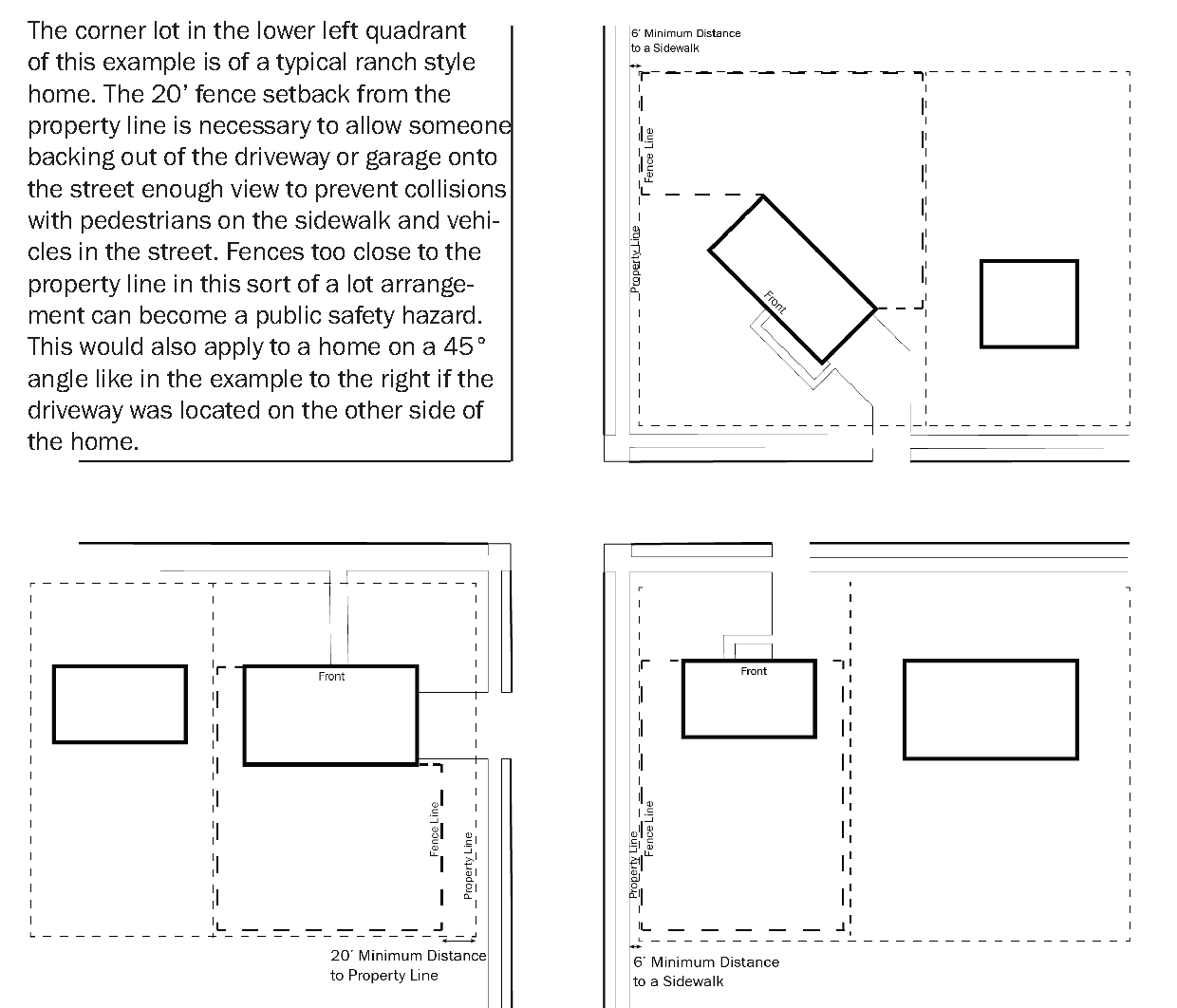
However, all fences, regardless of height, shall not be placed within any Sight Triangle as defined in Section 31-5(P) of this Ordinance.
(2)
Other Districts.
Fences surrounding school yards or located in other zoning districts shall not be subject to a height limitation, except for fences in districts with residential as the primary use. If a residential property and use exists, in a non-residentially zoned district, it shall comply with subsection one (1) of this section. However, all fences, regardless of height, shall not be placed within any Sight Triangle as defined in Section 31-5(P) of this Ordinance.
(a)
Electric Fences and Barbed Wire.
Electric fences or barbed wire shall be permitted atop a fence, no closer than six feet (6') from the ground, except on AG, Agricultural zoned properties for purposes of containing livestock.
(N)
Lots and Buildings to Front on Public or Approved Private Street.
All lots created after the effective date of this Ordinance shall front upon a public street or an approved private street, and no building shall be hereafter erected or constructed except upon such a lot. Private streets must be established through the PD, Planned District process.
(O)
Satellite Receiving Dish Antenna-All Districts.
(1)
No satellite receiving dish antenna shall be utilized as a sign and all antenna greater than one meter (39") in diameter shall be screened from view from surrounding public streets to the greatest extent possible while still permitting reception of an acceptable quality signal.
(2)
Satellite receiving dish antenna in multiple family, office, commercial or industrial districts greater than one meter (39") in diameter may be either ground-mounted or building-mounted. Ground-mounted antenna in these districts shall not exceed thirty feet (30') in overall height and shall be located behind the required minimum building setbacks applicable to the principle structures in that district. Building mounted satellite receiving dish antenna in these districts shall not exceed more than thirteen feet (13') above the roof surface and shall be screened from view from surrounding public streets to the greatest extent possible while still permitting the reception of an acceptable quality signal. Any mast exceeding twelve feet (12') in height used to support a ground or building mounted antenna needs to meet the building code standards required to adequately support such antenna.
(3)
Satellite receiving dish antenna placed in the AG, R1-A, R-1, R-2, R-3, and R-4 districts shall adhere to the requirements contained in those sections of this Ordinance.
(P)
Sight Triangles.
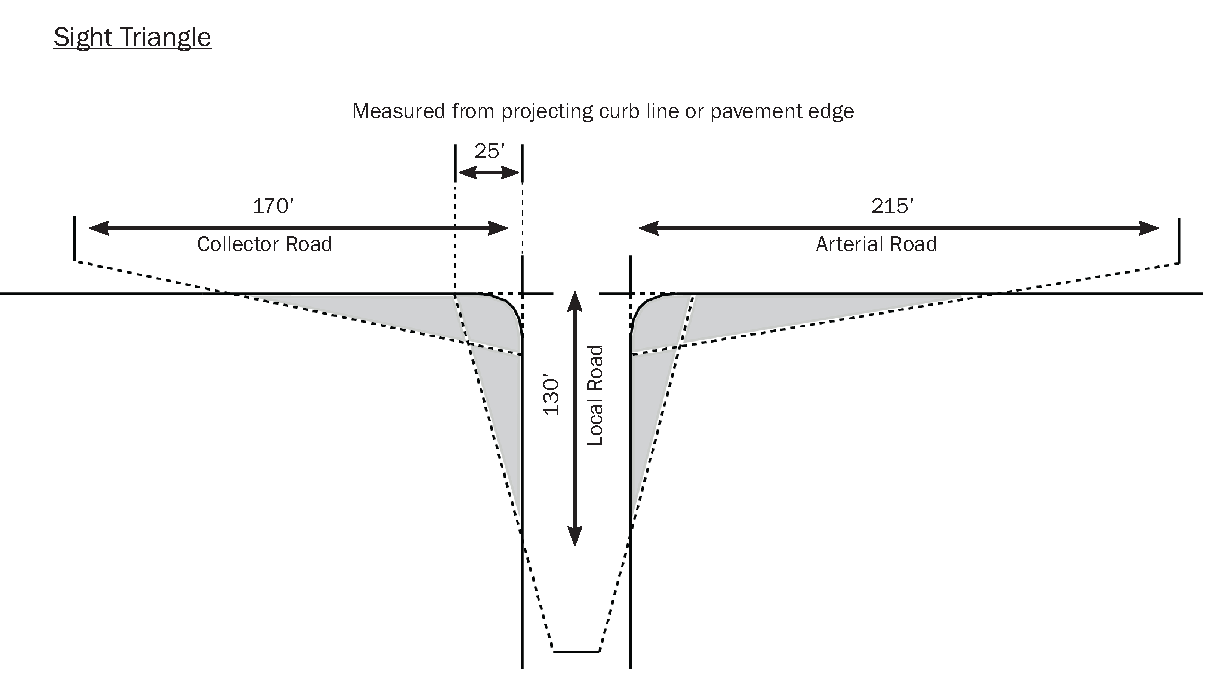
As defined is section 31-3, sight triangles are a triangular-shaped area at a street intersection in which nothing shall be erected, placed, planted, or allowed to grow in such a manner as to materially impede vision above a height of three feet (3') from the grades at the back of the curb of the intersecting streets. The triangle will vary in dimensions based on the classification of the adjacent roadways. This is done to appropriately size the sight triangle for the context of the built environment.
The sight triangle may not apply in certain contexts such as the City's C-3, Downtown Commercial Zoning District where buildings are built to a zero foot (0') setback.