
Hapeville City Zoning Code
ARTICLE 11
2.- U-V ZONE URBAN VILLAGE
Sec. 93-11.2-1.- Intent.
The U-V district is established in order to:
(1)
Accommodate a mixed-use, urban fabric that preserves neighborhood scale;
(2)
Accommodate residents in the district with pedestrian access to services and employment typical of a live/work community;
(3)
Promote neighborhoods established near shopping and employment centers;
(4)
Encourage pedestrian and neighborhood uses in the commercial area;
(5)
Discourage land uses that are automobile or transportation related;
(6)
Exclude industrial uses such as manufacturing, processing and warehousing;
(7)
Promote retail and related commercial uses such as business offices, florists, card shops, antique shops, new apparel shops and banks; and
(8)
Encourage intensified mixed-use with commercial uses on the ground floor and dwellings above.
(Ord. No. 2005-11, § 3(8-5-120H), 11-15-2005)
Sec. 93-11.2-2. - Definitions.
As used in this article, unless specifically stated otherwise, the following terms shall be defined as indicated, and where any definition herein conflicts with another definition in the zoning ordinance, the definition contained herein shall prevail:
Build-to line. The line generally parallel to the front lot line to which buildings shall enfront to the extent identified in this article. It is a requirement, not a permissive minimum, as is a setback, however, where a minimum and maximum build-to line exists, the building may enfront anywhere between the two lines. The line shall be measured from the back of the sidewalk clear zone along all street frontages and not from the front lot line. For the purposes of this article, the build-to line shall exist even when not enfronted by a building.
Dwelling, live-work. A one-family attached dwelling unit of at least two stories that contains a commercial component of not more than the lesser of 600 square feet in floor area or 40 percent of the dwelling's total floor area. Said commercial component shall be limited to the ground floor of the dwelling unit; shall be covered by separate lease; shall be adjacent to the supplemental area; shall be limited to the permitted business and professional offices/agencies, retail and restaurant uses contained in section 93-11.2-3; and shall be the place of employment for no more than two persons, one of whom shall be a resident thereof. For the purposes of this article, a live-work dwelling shall not be a single structure containing a multifamily dwelling unit and a commercial use arranged vertically unless both dwelling and commercial use share a common kitchen, utilities, and common deed or lease.
Enfront. To place an element such as a building along a build-to line.
Occupiable space. Covered floor area utilized for any principal permitted use except parking, storage, digital industry switchboards, power generators, and other relay equipment.
Master planned development. Any alteration of the natural environment which requires approval of a site plan, construction drawings, or issuance of a development permit in accordance with section 93-2-16.
Regionally significant development. A master plan development that:
(1)
Exceeds 60 acres in size within the city,
(2)
Lies partially within at least two other jurisdictions,
(3)
Abuts an interstate highway within or outside of the jurisdictional limits of the city,
(4)
Consists of contiguous parcels, which may be separated from each other by up to 200 feet of public streets or rail corridors, but not other parcels, and
(5)
Includes a development buildout that exceeds the minimum thresholds established by the Georgia Department of Community Affairs for developments of regional impacts in metropolitan areas.
Supplemental area. The privately held area between the back of the required sidewalk clear zone and the build-to line.
(Ord. No. 2005-11, § 3(8-5-120I), 11-15-2005; Ord. No. 2009-08, § 1, 6-16-2009)
Sec. 93-11.2-3. - Permitted uses.
The following are permitted within the U-V zone:
(1)
Business and professional offices/agencies, including:
a.
Architectural.
b.
Dental.
c.
Engineering.
d.
Graphic arts.
e.
Insurance.
f.
Legal.
g.
Manufacturers' representatives.
h.
Medical clinic, medical or dental laboratory, medical or dental office, surgical center.
i.
Real estate.
j.
Banks and other financial institutions (not including pawnshops and check cashing businesses).
(2)
Institutional uses, including:
a.
Art studios.
b.
Business schools.
c.
Colleges and universities.
d.
Dance studios.
e.
Libraries and other public buildings.
f.
Professional schools (including music/dance studios).
g.
Technical schools.
h.
Playgrounds, parks, and buildings open on a noncommercial basis for recreation only. Uses of this nature are exempt from being within a completely enclosed building.
(3)
Retail; sales, with a maximum floor area of 6,000 square feet, including:
a.
Antique shops.
b.
Apparel shops (offering new merchandise).
c.
Appliance, radio and television sales outlets and services, including incidental repairing where all repair is conducted out of customers' view and is limited to 25 percent of the business's floor area (offering new merchandise).
d.
Baking shops.
e.
Book, card and stationary stores.
f.
Computer sales and repairs (offering new or refurbished merchandise). These uses are subject to a finding by the city planning commission that the proposed method of establishment and operation would not adversely impact the use and enjoyment of surrounding properties nor negatively affect the character of the zone. For purposes of this subsection, refurbished shall mean merchandise intended for retail that has been tested and certified by an authorized service center of the manufacturer or otherwise restored to like-new working condition and appearance and then re-packaged and labeled as a refurbished product. Such merchandise shall appear new and be free from all defects such as major scratches, dents or other forms of cosmetic damage.
g.
Florist shops.
h.
Furniture stores (offering new merchandise).
i.
Hobby shops (offering new merchandise).
j.
Jewelry stores (offering new or used merchandise)
k.
Opticians and optical stores.
l.
Photography stores.
m.
Printing shops.
(4)
Retail; drugstores, pharmacies and soda shops with a maximum floor area of 15,000 square feet.
(5)
Retail; sales, with a maximum floor area of 20,000 square feet, including:
a.
Department stores (offering new merchandise).
b.
General merchandise stores (selling new merchandise).
c.
Hardware stores.
d.
Office supply stores.
(6)
Retail; grocery stores with a minimum floor area of 30,000 square feet.
(7)
Personal services, with a maximum floor area of 6,000 square feet, including:
a.
Barbershops and beauty shops.
b.
Data processing facilities.
c.
Laundry and dry cleaning shops.
d.
Tailor shops.
e.
Travel agencies.
(8)
Bed and breakfast inns without kitchens or cooking facilities in rooms used for guest occupancy.
(9)
Restaurants or carry-out restaurants but not including drive-through/drive-in restaurants with a maximum size of 6,000 square feet. Such restaurants shall be allowed to operate no more than six billiard tables upon the premises. Drive-through or drive-in restaurants may be allowed through special permit. The desired configuration for a drive-through or drive-in restaurant in this district is not a stand-alone building but rather part of a larger development and the site plan specifically addresses pedestrian orientation and safety.
(10)
Theaters (with a maximum size of 8,000 square feet) which do not provide entertainment as defined in section 11-2-1 of this Code, including adult films, adult stage productions, adult videos or other adult entertainment performances.
(11)
Customary accessory buildings and uses.
(12)
Public, private and parochial schools operated for the purpose of instructing in elementary and high school general education subjects. In addition, other schools are allowed subject to a finding by the city planning commission that the proposed method of establishment and operation would not adversely impact the use and enjoyment of surrounding properties.
(13)
Churches and other places of worship.
(14)
Single-family detached dwellings, subject to the density restrictions in subsection (19) of this section.
(15)
Single-family attached dwellings with at least two units attached, but no more than 12 and subject to the density restrictions in subsection (23) of this section.
(16)
Group homes, subject to the restrictions in section 93-2-19.
(17)
Adult daycare facilities.
(18)
Combination of residential and business applications within a single structure, provided that each use must have a separate entrance directly accessible from the required sidewalk or within a jointly used lobby.
(19)
Bail bond offices, subject to section 93-2-23.
(20)
Check cashing businesses, subject to section 93-2-23.
(21)
Pawnshops, subject to section 93-2-23.
(22)
Private probation offices, subject to section 93-2-23.
(23)
Residential density limitations shall be as follows:
a.
The maximum permitted residential density of a master planned development shall be 40 units per acre as calculated based on the sum of all residential uses and the total acreage of the project, including multiple parcels or city blocks, but not rail lines, public streets, or other areas not owned by the applicant;
b.
The built residential density of individual parcels or blocks within a master planned development may be greater or less than 40 units per acre, provided the project's combined average maximum permitted residential density is not exceeded; and
c.
Any changes to an approved site plan shall require approval of the city planning commission and shall be reviewed based on the geographic extent of the original approved site plan, shall not exceed maximum density requirements of the original application, and shall indicate all built or planned improvements.
(24)
Veterinarians and animal hospitals.
(Ord. No. 2005-11, § 3(8-5-120J), 11-15-2005; Ord. No. 2007-11, § 1, 7-3-2007; Ord. No. 2011-10, § 1, 9-20-2011; Ord. No. 2015-15, § 14, 8-4-2015; Ord. No. 2016-03, § 5, 3-1-2016; Ord. No. 2018-15, § 2, 11-6-2018; Ord. No. 2016-28, § 6, 12-6-2016; Ord. No. 2019-15, § 2, 7-2-2019; Ord. No. 2020-21, § 1, 9-1-2020; Ord. No. 2021-06, § 3, 3-2-2021)
Sec. 93-11.2-4. - Nonpermitted uses.
The following uses, while permitted in other areas within the city, are not permitted in the U-V zone.
(1)
Reserved;
(2)
Adult entertainment establishments, as defined by section 11-2-1 of this Code, including, but not limited to, adult bookstores, video or DVD adult rental or purchase, adult movie or adult live theaters, adult gifts and novelties, and other venues for viewing other adult entertainment through any other electronic or other technological medium;
(3)
Automotive repair shops, dealerships and service stations, boat sales, auto parts stores;
(4)
Tattoo parlors;
(5)
Palm reading and fortunetelling, including psychic and crystal ball readings;
(6)
Reserved;
(7)
Carnivals;
(8)
Stables;
(9)
Shooting galleries, firearm, and archery ranges;
(10)
Firearms dealers;
(11)
Modeling agencies;
(12)
Massage parlors;
(13)
Bathhouses;
(14)
Hypnotists;
(15)
Handwriting analysis;
(16)
Escort services;
(17)
Bazaars;
(18)
Specialty shops;
(19)
Flea markets;
(20)
Junk stores;
(21)
Variety shops;
(22)
Labor pools;
(23)
Addiction services clinic, mental health clinic, hospital, rehabilitation or treatment facility.
(24)
Extended stay motels/hotels;
(25)
Nursing homes;
(26)
Personal care homes; and
(27)
Kennels.
(Ord. No. 2005-11, § 3(8-5-120K), 11-15-2005; Ord. No. 2015-15, § 14, 8-4-2015; Ord. No. 2016-03, § 6, 3-1-2016; Ord. No. 2016-28, § 7, 12-6-2016; Ord. No. 2019-15, § 3, 7-2-2019; Ord. No. 2021-06, § 10, 3-2-21)
Sec. 93-11.2-5. - Conditional uses.
Specific uses may be permitted as conditional uses, provided conformance to the purpose and intent of the applicable code. Such uses are:
(1)
SIC Code 5261, lawn and garden supplies with a maximum floor area of 20,000 square feet, provided:
a.
No outdoor storage of merchandise in the supplemental area.
b.
Outdoor storage in the rear yard, only, is permitted, provided storage areas are completely screened.
(2)
SIC Code 5411, grocery stores and food stores with a floor area less than 30,000 square feet;
(3)
SIC Code 7011, hotels and motels;
(4)
SIC Code 7641, reupholstery and furniture repair with a maximum floor area of 6,000 square feet;
(5)
Laundry and dry cleaning shops with a maximum floor area of 6,000 square feet;
(6)
Parking lots (except for municipal parking lots benefiting the U-V zone); and
(7)
Kindergarten schools as defined under section 93-1-2, and the following facilities as defined herein:
a.
"Day care center" or "center" means any place operated by a person, society, agency, corporation, institution or group wherein are received for pay for a group care, for fewer than 24 hours per day without transfer of legal custody, 19 or more children under 18 years of age.
b.
"Group day care home" means any place operated by any person, partnership, association or corporation wherein are received for pay for group care not less than seven or more than 18 children under 18 years of age for less than 24 hours without transfer of legal custody.
c.
"School-age group day care home" means a group daycare home, or part thereof with separate facilities and a separate license, which provides daytime care exclusively to school-age children before and/or after the normal school day. Such programs may operate a full-day program solely during the regular school year during those periods when school is not in session.
(8)
Spas. For the purpose of this section, a spa shall be defined as a business location where massages by certified masseurs, makeovers, body wrapping, hair removal, saunas, manicures, pedicures and non-surgical cosmetic procedures are performed. Any combination of at least three or more of the above listed uses shall occur in the location.
(9)
All multifamily uses shall be conditional uses in U-V zone. In addition to meeting the conditional use provisions, all multifamily uses in U-V shall comply with [subsection] 93-11.2-3(19).
(10)
Research and development facilities that meet the following criteria:
a.
Facility does not emit or produce designated hazardous waste or hazardous waste as defined in O.C.G.A. § 12-8-62.
b.
Facility cannot conduct outside research or development activities or storage units.
c.
The conditional use permit will be issued for the specific business and specific parcel that has applied; all new or subsequent business will have to reapply.
(Ord. No. 2005-11, § 3(8-5-120L), 11-15-2005; Ord. No. 2007-11, § 2, 7-3-2007; Ord. No. 2019-24, § 1, 8-6-2019)
Sec. 93-11.2-6. - Special uses.
The following uses require a special use permit, in accordance with section 93-3.2-5 and 93-3.2-6, in any U-V zone:
(1)
Reserved.
(Ord. No. 2015-15, § 14, 8-4-2015)
Sec. 93-11.2-7. - Area, placement, and buffering requirements.
All buildings or structures erected, converted or structurally altered shall hereafter comply with the following lot area, yard, and building coverage requirements:
(1)
Lot area and width. The minimum area shall be established by the restriction governing lot coverage, setbacks, height, and parking requirement as found in article 22.1. Generally, no lot shall have a minimum frontage of less than 20 feet; however, single-family residential lots shall have a minimum frontage of 30 feet.
(2)
Front yard. See subsection (3) below.
(3)
Build-to line. The minimum build-to line shall be zero feet and the maximum shall be 15 feet, provided that the maximum build-to line may be increased as determined to be necessary and advisable by the city planning commission in the course of its site plan review process. In determining such increase, the city planning commission shall consider the size and configuration of the proposed buildings, their relationship to the existing and proposed thoroughfares, the relationship to existing and proposed parks and plazas, the location of existing mature trees, and supplemental area of adjacent structures. Where the built-to line is modified to provide parks and plazas, said facilities shall be directly accessible to the public during normal city park hours.
(4)
Side yards. There shall be no minimum side yard requirement except as required by subsection (8) of this section for residential zone buffers.
(5)
Rear yards. There shall be no minimum rear yard requirements except as required by subsection (8) of this section for residential zone buffers.
(6)
Distance between buildings.Section 93-2-6 notwithstanding, the minimum distance between two buildings on a single lot or on contiguous property under the same ownership shall be ten feet, plus four additional feet for every story or fraction thereof that the building exceeds three stories, or such distance determined necessary by the city planning commission to enhance the aesthetics of development. All exterior walls shall be designed per the International Residential Building Code 2003, as amended, or the International Building Code 2003, as amended. Adjoining buildings, whether commercial, residential, or mixed-use, shall have sprinkler systems and there shall be a fire resistance rating of one hour between buildings and occupancies that are side-by-side and top and bottom. However, if a building is a single-family dwelling and the adjacent building is closer than 15 feet there can be no vertical openings (windows) between the two structures of buildings that exist within 15 feet of the horizontal fire separation.
(7)
Height regulations. No building or structure shall be less than 24 feet in height or exceed four stories or a 64 feet in height, provided the city planning commission may allow a development with greater height via site plan approval, if it finds that:
a.
The proposed height will not adversely impact adjacent properties or nearby residential neighborhoods.
b.
The added height is necessary to support redevelopment of an area, which currently contains uses that have an adverse impact upon adjacent neighborhoods.
c.
The proposed development is designed to facilitate the objectives and strategies of an officially adopted master plan, an LCI Study or the current comprehensive plan.
d.
The proposed development meets approval from the fire department and FAA.
e.
The proposed development meets the sprinkling standards set forth by the fire department. It shall meet the requirements as set forth in NFPA (13)(D), standard for the installation of sprinkler systems in one-family or two-family dwellings and NFPA (13)(R) for residential occupancies up to and including four stories in height. All others shall be required to meet NFPA (13) standard for the installation of sprinklers.
(8)
Residential buffer. Where any use other than a single-family detached use in this district adjoins a residential zone, all applicable new developments must provide an attractive physical barrier between different zones as necessary to minimize disruptive light, noise, odor, dust, unsightly appearances and intrusive activity relative to the residential zone. A smooth transition to adjacent residential zones shall be ensured by the provision of:
a.
A minimum 15-foot landscaped buffer located within the U-V zone along the district line. Said buffer shall comply with the buffer requirements of chapter 93, article 29. Shrubs, flowers or grasses shall also be provided and maintained to visually screen non-residential areas and provide an attractive boundary that encourages continued investment in the adjacent residential zones.
b.
A permanent opaque wall between six and eight feet in height and faced in wood, stacked stone, brick or hard-coat true stucco. Said wall may be located anywhere within the required landscaped buffer.
c.
Where an alley separates this zone from a residential zone, the required landscape buffer and permanent opaque wall shall be provided on the portion of the U-V-zoned property adjacent to the alley.
(Ord. No. 2005-11, § 3(8-5-120M), 11-15-2005; Ord. No. 2015-15, § 14, 8-4-2015; Ord. No. 2019-04, § 1, 2-19-2019; Ord. No. 2020-4, § 5, 1-7-2020)
Editor's note— Ord. No. 2015-15, § 14, adopted August 4, 2015, renumbered the former sections 93-11.2-6—93-11.2-13 as sections 93-11.2-7—93-11.2-14. The historical notation has been preserved for reference purposes.
Sec. 93-11.2-8. - Supplemental area requirements.
Supplemental areas shall meet the following requirements:
(1)
The following may not be located in the supplemental area:
a.
Recreational areas and facilities such as swimming pools, tennis courts;
b.
Fences and walls;
c.
Service elements such as dumpsters, loading docks and similar elements;
d.
Mechanical features; and
e.
Parking.
(2)
Adjacent to ground floor retail or restaurant uses the supplemental area:
a.
Shall be at the same grade, slope, and cross slope as the adjacent required sidewalk;
b.
Shall be hardscaped for a minimum of 80 percent of its horizontal area with decorative pavers, bricks, slate, or stamped or colored concrete, but not asphalt;
c.
Shall be accessible to the general public and may be used for pedestrian amenity elements such as benches, trees, outdoor dining, merchandise display and potted plants.
(3)
Adjacent to ground floor dwelling units, excluding live-work dwellings, the supplemental area:
a.
Shall be landscaped, except for area uses for stoops, porches, wheelchair ramps, or walkways;
b.
Shall be planted with one canopy tree, as established in section 93-2-14(k)(11), an average of 40 feet on-center as measured parallel to the front lot line.
c.
Shall be differentiated from the adjacent sidewalk by a continuous wall, fence, hedge, or retaining wall between six and 30 inches in height.
(4)
Adjacent to ground floor live-work dwellings, all other uses, or when not adjacent to a building the supplemental area shall be treated as identified in subsections (2) or (3) of this section.
(Ord. No. 2005-11, § 3(8-5-120N), 11-15-2005; Ord. No. 2015-15, § 14, 8-4-2015)
Note— See editor's note at section 93-11.2-7.
_____
Sec. 93-11.2-9. - Sidewalk requirements.
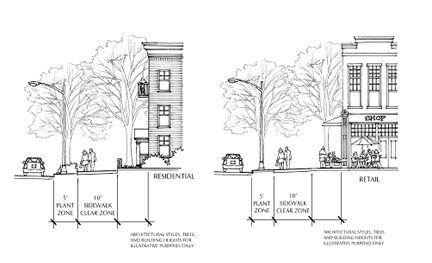
Public sidewalks shall be located along all public and private streets. Sidewalks shall be of the widths indicated below and shall consist of two areas: a landscape area and a clear area. The following regulations shall apply to all required sidewalks:
(1)
Sidewalk landscape area requirements.
a.
The landscape area shall have a minimum width of five feet and shall be located adjacent to the curb.
b.
The landscape area may be primarily paved adjacent to on-street parking and shall be landscaped in all other areas.
_____
c.
Street trees shall be planted on average 30 feet on center, spaced equal distance between streetlights, and in line with stripes of parallel parking spaces. All newly planted trees shall comply with the requirements of chapter 93, article 29, shall be limbed up to a minimum height of seven feet and shall be of an appropriate street tree species found in appendix A, attached to the ordinance from which chapter 93, article 29 was derived. The city planning commission may approve an alternate for street tree requirement subject to constraints such as overhead or underground utilities or underground utility easements.
d.
The landscape area is also intended for the placement of street furniture, including utility poles, waste receptacles, fire hydrants, traffic signs, newspaper vending boxes, bus shelters, bicycle racks, public kiosks and similar elements in a manner that does not obstruct pedestrian access or motorist visibility as approved by the city.
e.
The landscape area shall be maintained by the adjacent property owner.
(2)
Sidewalk clear area requirements.
a.
The clear area shall be the portion of the sidewalk reserved for pedestrian passage and unobstructed by permanent objects to a height of eight feet, including but not limited to steps and stoops, traffic control boxes, and utility structures. The sidewalk clear area shall have a consistent cross slope not exceeding two percent.
b.
No awning or canopy shall extend more than five feet over the clear area.
c.
Along the following streets, if zoned U-V: South Central Avenue, North Central Avenue, Perry Hudson Boulevard, Dogwood Drive, Sylvan Road, Virginia Avenue, International Boulevard, and Atlanta Avenue, the sidewalk clear area shall have a minimum width of ten feet.
d.
Along all other streets zoned U-V, the sidewalk clear zone shall have a minimum width of six feet.
e.
Where property within the district abuts a residential zone without an intervening street, the sidewalk area within 20 feet of such district shall taper when necessary to provide a smooth transition to the existing residential zone sidewalk. In the event that the abutting residential zone has no existing sidewalk, the sidewalk shall taper to a width of six feet, measured from the street curb, or as approved by the city planning commission.
(3)
Paving materials to remain continuous. Any paving materials, including concrete, special pavers, or decorative paving within the landscape area or clear area shall continue across any intervening driveway.
(Ord. No. 2005-11, § 3(8-5-120O), 11-15-2005; Ord. No. 2015-15, § 14, 8-4-2015; Ord. No. 2020-4, § 6, 1-7-2020)
Note— See editor's note at section 93-11.2-7.
Sec. 93-11.2-10. - Parking and curb cut requirements.
In addition to the requirements of article 23, off-street parking and loading, the following requirements shall apply within the U-V district:
(1)
See article 22.1 of this chapter for minimum parking space requirements.
(2)
See section 93-23-7 for mixed-use developments, which may be reduced as authorized by the board of appeals subject to a shared parking arrangement under the following criteria:
a.
The minimum number of parking spaces for a project where shared parking is proposed shall be determined by a study prepared by the applicant following the procedures of the Urban Land Institute (ULI) Shared Parking Report or Institute of Transportation Engineers (ITE) Shared Parking Guidelines. The actual number of parking spaces required shall be based on well-recognized sources of parking data such as the ULI or ITE reports. If standard rates are not available or limited, the applicant may collect data at similar sites to establish local parking demand rates. If the shared parking plan assumes use of an existing parking facility, then field surveys shall be conducted to determine actual parking accumulation.
b.
An applicant shall submit the following information as part of an application to reduce parking requirements and avoid conflicting parking demands:
1.
A to-scale map indicating location of proposed parking spaces;
2.
Hours of business operation of nonresidential parking users;
3.
Copies of the legal instrument that authorizes the use of shared parking facilities;
4.
Copies of the relevant legal instrument authorizing the shared use, shall be filed with the department of economic development.
5.
Where authorized shared parking exists and a change affecting the shared use occurs, the applicant shall have up to 30 calendar days to provide the city director of economic development with a valid legal instrument reflecting the modified parking arrangements.
c.
Change to any of the conditions identified in this subsection, except as identified in subsection (2)b.5 above, shall terminate authorization for shared parking. A shared parking arrangement shall be deemed a condition of the zoning and any modification will require a new site plan, parking plan, and zoning approval.
(3)
Developments are permitted a maximum of two driveway curb cuts per block face or one. For the purposes of this section, two curb cuts serving two one-way driveways shall only be counted as one curb cut.
(4)
No curb cuts, driveways or circular drives shall be permitted on South Central Avenue, Virginia Avenue or Atlanta Avenue when access can be provided from a side or rear street. Circular drives are prohibited, with the exception of hotel and hospital uses.
(5)
Rear alleys or rear drives shall be provided to access attached single-family garages, detached single-family dwelling garages, and commercial loading and service areas.
(6)
Carports shall be prohibited.
(7)
Garages shall not face adjacent streets except where alley or rear drive access is not feasible, in which case such garages shall be set back a minimum of 25 feet from the build-to line. All garage materials shall match those of the principal structure.
(8)
Parking structures shall conceal automobiles from view, shall have the appearance of a horizontal storied building on all levels, shall be faced in brick, stacked stone, cast stone, poured-in-place rubbed concrete, or pre-cast concrete faced in or having the appearance of brick or stacked stone. Parking structures adjacent to the supplemental area shall also meet the requirements of section 93-11.2-10(1).
(9)
Bicycle or moped parking spaces are required as follows: All non-residential uses shall provide one such space for every 20 automobile spaces and condominium and apartment uses shall provide one such space for every five units provided that no such uses shall have fewer than two such spaces or be required to exceed 30 spaces. Such spaces shall be located within the sidewalk landscape a maximum distance of 100 feet from the primary pedestrian entrance, or within the supplemental area, or at least as close as the closest automobile space, except for handicapped parking spaces. Bicycle parking spaces shall include a bike rack with a metal anchor sufficient to secure the bicycle frame when used in conjunction with a user-supplied lock.
(10)
Dumpsters shall be entirely screened from view of any street with vertically enclosed opaque walls matching the materials of the principal structure.
(Ord. No. 2005-11, § 3(8-5-120P), 11-15-2005; Ord. No. 2015-15, § 14, 8-4-2015)
Note— See editor's note at section 93-11.2-7.
Sec. 93-11.2-11. - Reserved.
Editor's note— Ord. No. 2009-02, § 1, adopted Feb. 17, 2009, deleted § 93-11.2-10, which pertained to general facade requirements and derived from Ord. No. 2005-11, § 3(8-5-120Q), adopted Nov. 15, 2005.
Note— See editor's note at section 93-11.2-7.
Sec. 93-11.2-12. - Commercial design ground floor requirements.
In addition to the requirements of section 93-11.2-10, the following shall apply to buildings with enfronting ground floor commercial uses; and all enfronting buildings along South Central Avenue, North Central Avenue, Virginia Avenue, International Boulevard, or Atlanta Avenue:
(1)
Enfronting ground floor facades shall provide a display window area consisting of:
a.
A non-glass base or knee wall beginning at grade and extending not more than 24 inches above the required sidewalk.
b.
A glass display window beginning at the top of the bulkhead or knee wall, to a height not less than ten feet and not more than 12 feet above the adjacent required sidewalk. Such glass shall provide views into display windows that have a minimum depth of 2½ feet into and are accessible from the building interior.
c.
Primary pedestrian entrances to all commercial uses adjacent to the front yard shall be recessed a maximum of five feet from the exterior facade, remain unlocked during normal business hours, and have a surface area that is a minimum of 70 percent glass.
d.
A glass transom located above the glass display window and entry door shall have a minimum height of 24 inches and a maximum height of 36 inches.
e.
A minimum of 75 percent of the length of the enfronted portion of the build-to line shall be provided in glass, including glass doors and display windows.
f.
No linear distance of more than ten feet without intervening glass display windows or glass doors.
g.
A non-glass sign band located above the glass transom having a minimum height of 36 inches.
(2)
Ground floor drop ceilings shall be recessed a minimum of 18 inches from the display window opening.
(3)
The ground floor finished floor to ceiling slab shall be a minimum of 18 feet. Finished ceiling height shall be a minimum of 14 feet.
(Ord. No. 2005-11, § 3(8-5-120R), 11-15-2005; Ord. No. 2015-15, § 14, 8-4-2015)
Note— See editor's note at section 93-11.2-7.
Sec. 93-11.2-14. - Regionally significant developments.
The following additional requirements shall apply to regionally significant developments:
(1)
The regulations set forth herein shall only apply to portions of regionally significant developments located greater than 30) feet from any parcel zoned R-1, R-2, R-3, R-4, R-5, R-O, R-SF, or V.
(2)
In addition to those uses set forth in section 93-11.2-3, the following shall also be permitted uses within regionally significant developments:
a.
Conference/convention centers;
b.
Hotels and motels having at least 200 guest rooms and at least one on-premises restaurant defined as a retail establishment that serves prepared food to customers, generally for eating on premises;
c.
Telecommunications and/or data centers;
d.
Subsection 93-11.2-5(6) notwithstanding, commercial parking lots and decks shall be a permitted use when located in an area with a day-night sound level (DNL) in excess of 75 decibels at the time of the adoption of this section, as shown in exhibit 1 of the FAA's Hartsfield-Jackson Atlanta International Airport FAR 150 Study, dated January 2006. For all other areas, commercial parking lots and decks shall be permitted uses when serving retail, restaurant, conference/convention centers, hotels, or office uses within an adjoining jurisdiction, and as set forth in subsection (3) below.
e.
Warehouse and Distribution facilities, subject to the following:
1.
Such facilities shall be located inside the 70+ DNL area identified in the Hartsfield-Jackson Atlanta International Airport FAR 150 Study, dated January 2006, and shall have their primary points of ingress/egress on North Airport Loop Road.
2.
Manufacturing and assembly line operations shall not be permitted.
3.
Truck loading and unloading areas shall be shielded from the main road(s) serving the facility.
4.
All equipment, electrical substations and mechanical devices shall be shielded from view from the main road(s) servicing the facility.
5.
The storage of goods or materials in an open area is not allowed.
6.
Accessory buildings, when such are required for the function of the principal building/use(s), are permitted provided that all such accessory building comply with all setback and yard area requirements, screening/landscaping and any other provisions of this zoning district as are required of principal buildings.
7.
The grade level of all proposed structured shall be oriented for safe pedestrian access.
8.
All electric, telephone, telecommunications, and other service lines shall be installed subsurface.
9.
A greenbelt planting screen is required between the main service road and the facility.
10.
Landscaped islands are required in parking lots.
11.
No land or structure in this district shall be used or occupied in any manner which creates dangerous, injurious, noxious or otherwise objectionable conditions which may affect any other property.
(3)
Parking for a retail, restaurant, office, conference/convention centers, or hotel uses within an adjoining jurisdiction shall only be permitted in Hapeville when:
a.
Such use occupies a building that is located in multiple jurisdictions, and
b.
Such use meets or exceeds the minimum parking requirements of the city, including for the portion within the adjoining jurisdiction; and
c.
At least 75 percent of the required parking for the proportion of the use within another jurisdiction is located within the adjoining jurisdiction.
(4)
The minimum parking space requirements for uses not specified in Section 93-22.1-1 shall be:
a.
Conference/conventions centers. One space per 1,500 square feet of floor area.
b.
Hotels and motels. One space per lodging unit.
c.
Telecommunications and/or data centers. One space per employee.
(5)
In no case shall the number of parking spaces within a commercial parking lot(s) exceed more than 30 percent of the minimum number of parking spaces required for the regionally significant development at build-out in accordance with article 22.1 and section 3 [section 93-22.1-3] herein, which shall be calculated by applying such minimum requirements to all portions of the regionally significant development, including those portions within other jurisdictions
(6)
Sections 93.11.2-3 and 93.11.2-5 notwithstanding, there shall be no maximum floor area limits for any use.
(7)
Subsections 93-11.2-7(1), (2), and (3) and section 93-22.1-1 notwithstanding, there shall be no minimum lot frontage, lot area, lot coverage, setbacks, or width requirements for nonresidential uses within regionally significant developments. Furthermore, the minimum build-to line along a public street within a regionally significant development shall be zero feet and the maximum build-to-line shall be 15 feet.
(8)
Subsection 93-11.2-7(6) notwithstanding, the minimum distance between two buildings on a single lot or on contiguous property shall only be limited by applicable public safety and fire codes.
(9)
Subsection 93-11.2-7(7) notwithstanding, no building or structure height shall exceed the applicable flight-safety restrictions for Hartsfield-Jackson Atlanta International Airport established by the FAA, not to exceed 1,176 feet above mean sea level, except where the applicable property has been encumbered, prior to adoption of this section, by a pre-existing aviation easement, the terms of which shall control over the above FAA standards.
(10)
The prohibition against them in subsection 93-11.2-8(1) notwithstanding, fences and walls not exceeding four feet in height shall be permitted in the supplemental area when used to surround outdoor dining.
(Ord. No. 2009-08, § 2, 6-16-2009; Ord. No. 2015-15, § 14, 8-4-2015)
Note— See editor's note at section 93-11.2-7.

