
Hapeville City Zoning Code
ARTICLE 2
- GENERAL PROVISIONS
Sec. 93-2-1.- One principal building per lot.
Within single-family residential zones, no more than one principal building with its customary accessory buildings may occupy, or be constructed upon, any lot of record.
(Code 1981, § 8-5-11)
Sec. 93-2-2. - Reduction in lot area.
No lot may be reduced in area below the minimum lot areas as specified herein for the zone within which that lot is located.
(Code 1981, § 8-5-12)
Sec. 93-2-3. - Street access.
No building shall hereafter be constructed on a lot which does not have frontage on a publicly dedicated and maintained street.
(Code 1981, § 8-5-13)
Sec. 93-2-4. - Major street plan.
(a)
For the purposes of this chapter, all streets in the city are hereby divided into four classes:
(1)
Major streets, 50 to 90 feet of right-of-way minimum.
(2)
Arterial streets, 40 to 70 feet of right-of-way minimum.
(3)
Minor and collector streets, 40 to 50 feet of right-of-way minimum.
(4)
Alleys, ten to 20 feet of right-of-way minimum.
(b)
The classification of each street in the city is as shown on a map entitled "Official Major Street Plan of Hapeville, Georgia," adopted by the planning commission and the mayor and council and certified by the city clerk. This map is hereby made a part of this chapter and shall be retained in the office of the city clerk.
(Code 1981, § 8-5-14; Ord. No. 2005-10, § 1(8-5-14), 10-4-2005)
Sec. 93-2-5. - Accessory uses, accessory structures, yard requirements of accessory structures, outbuildings and fences.
1)
Accessory uses.
a)
Where allowed by Code, accessory structures may be used for storage.
b)
The presence of such facilities or equipment as utility services, utility meters, mailboxes, bathroom, or kitchen equipment in an accessory building or a portion of a principal dwelling shall be considered prima facie evidence that such accessory building or such portion of a principal dwelling is a separate and distinct dwelling unit and is subject to the regulations of the zoning district in which it is located. See section 93-2-26, accessory dwelling units (ADU).
c)
Temporary structures may only be used in conjunction with permitted construction work in any zoning district and shall be removed immediately upon the completion of construction.
Additional regulations regarding temporary structures are found in this chapter.
2)
Permanent accessory structures.
a)
An accessory building or structure is a structure detached from the principal structure on a lot of 19 record, the use of which is incidental and subordinate to the primary use of the property. Accessory buildings shall comply with the following standards and all other applicable regulations of this zoning ordinance and the architectural design standards. Where a conflict exists, the standards of this section shall control.
b)
Accessory uses and structures in lots developed for commercial, industrial or mixed-uses shall comply with the following standards and all other applicable regulations of this zoning ordinance:
i)
Accessory buildings in commercial, industrial or mixed-use lots shall be permitted in C-1, C-2, V, U-V, RMU, I-1, and I-2 zoning districts.
ii)
The accessory use or structure shall contribute to the comfort, convenience or necessity of the occupants of the principal use or structure served.
iii)
The accessory use or structure shall be subordinate in area, extent and purpose to the primary use or structure served.
iv)
The accessory use or structure shall not be injurious to the use and enjoyment of surrounding properties.
v)
Restrictions on the number, size and height.
(1)
There may not be more than two accessory structures on a commercial lot.
(2)
Accessory structures may not exceed ten percent of the primary structure floor area. The floor area or square footage of an accessory structure shall include all square footage (heated or otherwise) When more than one accessory building is erected, the "maximum accessory building size" controls the sum of the floor areas of those buildings.
(3)
Unless otherwise specified, accessory structures used solely for storage may not exceed 100 square feet.
(4)
Gazebos, arbors, fireplaces, and waste receptacle enclosures shall be exempt in calculating the maximum number of accessory structures on a lot. However, such structures shall be subject to the accessory structure setback standards.
(5)
No accessory structure shall exceed the height of the principal structure.
vi)
Permitting.
(1)
No accessory building shall be erected or placed on a lot that does not contain a principal structure. Building permits may be issued for the principal structure and an accessory structure; however, a certificate of occupancy must be issued for the principal structure prior to issuance of a certificate of occupancy for an accessory structure.
(2)
All accessory structures in excess of 100 square feet or any accessory structures including mechanical, electrical or plumbing with construction require a building permit and certificate of occupancy.
(3)
All accessory structures must meet all applicable fire, building, and safety codes.
vii)
Construction and design requirements.
(1)
All accessory structures must be placed on a permanent foundation. Structures not placed on a permanent foundation are considered temporary structures and are subject to regulations found in this chapter.
(2)
The accessory structure must complement the principal structure in terms of architectural design, materials, roof pitches, and other details. All accessory structures are required for review by the design review committee.
(3)
Where applicable, access to the second story of an accessory building must be located within the interior of the ground floor space.
(4)
Commercial outdoor cooking facilities are considered an accessory structure to the principal commercial structure. Commercial outdoor cooking facilities must be:
(a)
Associated with a permitted, permanent food establishment;
(b)
Be located within a permanent structure or surrounded by opaque stained or painted fencing or walls with overhead protection;
(c)
Have floor surfaces that are smooth, easily cleanable and of durable construction; and
(d)
Meet all fire, building, and health codes. Commercial outdoor cooking facilities may not exceed 20 percent of the square footage of the permanent food establishment.
(5)
Placement.
(a)
All accessory buildings and structures shall be located on the same lot as the principal structure to which they are accessory.
(b)
Accessory buildings shall be allowed in rear yards only. An accessory building located within 20 feet of the principal structure shall comply with the setback requirements of the principal structure to which it is accessory. Accessory buildings located more than 20 feet from the principal structure may be placed five feet from a side or rear lot line unless otherwise directed by the fire marshal. In addition to these yard requirements, the horizontal separation of accessory buildings from the structure on the same lot and the horizontal separation from all structures on adjacent lots shall be at least ten feet.
(c)
Accessory buildings on a corner lot shall comply with the setback for the principal structure. No accessory building on a corner lot that adjoins a residentially used or zoned lot to the rear shall be located within 25 feet of the rear property line. This 25-foot setback will not be required when the adjoining yard is a rear yard.
(d)
Accessory structures may not adversely affect nor reduce the number of parking spaces for the principal structure that are required by city ordinance or exceed impervious surface limits.
(e)
Notwithstanding standards of this chapter to the contrary, nothing shall prohibit the re-construction of accessory buildings that are legal, nonconforming structures that have been in existence for a minimum of 20 years along the existing and established building line. All other standards of the chapter shall remain in effect.
c)
Accessory uses and structures on a residential lot shall comply with the following standards and all other applicable regulations of this zoning ordinance:
i)
Accessory buildings in lots developed for residential use shall be permitted in R-0, R-AD, R-1, R-2, R-3, R-4, R-5, R-1, R-SF, V, U-V, RMU or C-R zoning districts.
ii)
The accessory use or structure shall contribute to the comfort, convenience or necessity of the occupants of the principal use or structure served.
iii)
The accessory use or structure shall be subordinate in area, extent and purpose to the primary use or structure served.
iv)
The accessory use or structure shall not be injurious to the use and enjoyment of surrounding properties.
v)
General restrictions; restrictions on number, size and height.
(a)
No accessory structure shall have a ground floor area greater than that of the principal residential structure. Square footage of the accessory building is limited to the schedule presented in Table A—Accessory Building Allowance Based on Dwelling Unit Size, or Table B—Accessory Building Allowance Based on Lot Size (owner's option). The floor area of an accessory structure shall be calculated to include all conditioned floor area. If allowed, when more than one accessory building is erected, the "maximum accessory building size" controls the sum of the floor areas of those buildings.
Table A—Accessory Building Allowance Based on Dwelling Unit Size
Table B—Accessory Building Allowance Based on Lot Size
(b)
Outdoor residential cooking facilities, gazebos, arbors, pool equipment shelters, arbors, fireplaces, residential greenhouses and waste receptacle enclosures shall be exempt in calculating the maximum number of accessory structures on a lot.
(c)
The number of accessory buildings may vary depending on the size of the lot. Table C—Maximum Number of Accessory Buildings establishes the schedule for number of accessory buildings allowed on a building lot.
Table C—Maximum Number of Accessory
Buildings
(d)
The height of an accessory building shall not exceed 25 feet or the height of the principal residential structure measured from the average adjacent grade to the peak or ridgeline of the roof, whichever is less.
vi)
Permitting.
(a)
No accessory building shall be erected or placed on a lot that does not contain a principal dwelling. Building permits may be issued for the principal dwelling and an accessory structure; however, a certificate of occupancy must be issued for the principal dwelling prior to issuance of a certificate of occupancy for an accessory structure.
(b)
A building permit shall be required for the construct ion, erection or set-up of any accessory building in excess of 100 square feet or any accessory structures which include mechanical, electrical, or plumbing.
(c)
A separate certificate of occupancy shall be required for the construction, erection or set up of any accessory building intended for human occupancy such as an accessory dwelling unit, home office or any accessory building in excess of 144 square feet.
(d)
All accessory structures must meet all applicable fire, building, and safety codes.
vii)
Construction and design requirements.
(a)
Accessory buildings shall be architecturally compatible with the principal dwelling on the lot and meet architectural design standards.
(b)
All accessory structures in excess of 80 square feet must be placed on a slab or permanent foundation.
(c)
All accessory structures must meet all applicable building, fire, and safety codes.
(d)
Second story access. Where applicable, access to the second story of an accessory building must be located within the interior of the ground floor space.
(e)
When an accessory building is attached to the principal dwelling by a breezeway, passageway, deck, or similar means, the accessory building shall comply with the setback requirements of the principal dwelling to which it is accessory. In order to qualify as an attached garage or accessory building, therefore eliminating the need for compliance with these accessory building standards, the attached accessory building must share a common wall with the principal dwelling that is a minimum of 80 percent of the wall length of the accessory building or 20 feet, whichever is greater. Such common wall must be an integral part of the principal dwelling. An attached garage or accessory building shall comply in all respects with the standards applicable to the principal dwelling.
(f)
Additional construction and design requirements for accessory dwelling units requirements are found in section 93-2-26, accessory dwelling units (ADUs).
viii)
Placement.
(a)
Accessory buildings shall be located on the same lot as the principal dwelling to which they are accessory.
(b)
Accessory buildings shall be allowed in rear yards only. An accessory building located within 20 feet of the principal dwelling shall comply with the setback requirements of the principal dwelling to which it is accessory. Accessory buildings located more than 20 feet from the principal dwelling may be placed five feet from a side or rear lot line.
(c)
Accessory buildings on a corner lot shall comply with the setback for the principal dwelling. No accessory building on a corner lot that adjoins a residentially used or zoned lot to the rear shall be located within 25 feet of the rear property line. This 25-foot setback will not be required when the adjoining yard is a rear yard.
(d)
All accessory buildings must be located a minimum of ten feet from the principal dwelling and all other accessory buildings on the lot or on neighboring lots. This distance shall be measured from outside wall to outside wall.
(e)
Except as herein provided, the minimum yard requirements of section 93-22.1-1 of this chapter also apply to accessory buildings. In addition to these yard requirements, the horizontal separation of accessory buildings from the dwelling on the same lot and the horizontal separation of accessory buildings from dwelling on adjacent lots shall comply with standards in Table D—Distance from Dwelling for Very Large Accessory Buildings. All distances shall be measured from outside wall to outside wall.
Table D—Distance from Dwelling for Very Large Accessory Buildings
(f)
Notwithstanding standards of this chapter to the contrary, nothing shall prohibit the re-construction of accessory buildings that are legal, nonconforming structures that have been in existence for a minimum of 20 years along that established building line. That building line shall be the minimum setback for re-building of the accessory building on the lot. All other standards of the chapter shall remain in effect.
3)
Temporary accessory structures.
a)
Factory-fabricated, transportable buildings that are designed to arrive at the site ready for occupancy, except for minor unpacking and connection to utilities, and designed for removal to 195 and installation at other sites, may be placed on a property to serve as the following:
i)
Temporary offices used for on-site apartment leasing, real estate sales office, and model sales home;
ii)
Temporary offices used during the expansion or rehabilitation of an existing non-residential use;
iii)
Temporary offices for construction and security personnel during the construction of a development for which the city has issued a grading permit or building permit;
iv)
Construction storage during active construction phase. See temporary storage structures and uses below for additional requirements.
b)
Temporary structures allowed under section 93-2-5(5) may be located anywhere on site, except within the following areas:
i)
Existing vegetated buffers or within the buffer setbacks.
ii)
Areas designated for future vegetated buffers whether or not vegetation currently exists.
iii)
Other areas designated on the site and/or subdivision plan for open space, vehicular use, or ingress/egress.
iv)
Required parking areas.
c)
Other requirements.
i)
The temporary structure shall be factory-fabricated and transportable.
ii)
Underskirting shall be installed around all temporary structures requiring site plan approval.
iii)
In addition to any other off-street parking required on the site, off-street parking shall be provided in accordance with the requirements set forth in article 22.1.
d)
All permits required by applicable building, electrical, plumbing, and mechanical codes shall be obtained from the community services department prior to installation of the temporary structure.
e)
Foundation plantings installed in accordance with section 93-23-18 shall be required for temporary structures intended for use as temporary offices, except when located on a paved surface or parking lot.
f)
A sketch plan containing sufficient information to show compliance with the above standards shall be submitted to and approved by the community services department prior to installation of the temporary structure.
g)
Temporary structures are not to include retail sales of new or used merchandise, or other uses not permitted within the zoning district where the structure is located.
h)
Temporary offices used for on-site apartment leasing, real estate sales office, and model sales home are permitted until construction allows for a model/sales office to be opened onsite as determined by the community services director, at which time the temporary office shall be removed.
i)
Temporary structures used during renovation of legally conforming or nonconforming structure shall be permitted so long as there is an active construction permit on file with the department of community services, not to exceed time limits established in the applicable code sections below. All other temporary structures under this section may remain on the site for no more than 12 months. This period may be renewed for up to two 12-month periods, for good cause shown, upon approval of a written request submitted to the community services director 30 days prior to the expiration of the permit. In no event, however, shall such extensions allow the temporary structure to remain on the site for more than three years.
j)
All temporary and portable storage units and structures, construction trailers and the like, shall be constructed, altered, repaired, enlarged, placed, moved or demolished in accordance with applicable city building codes. The issuance of building permits, where required, verifying such compliance shall be administered by the community services director.
k)
Temporary storage structures and uses.
i)
With the exception of temporary storage structures for construction materials, enclosed portable storage units and structures intended only for temporary storage may be used following the receipt of a building permit, payment of the required fee, where applicable, and subject to the following provisions:
(1)
The building permit submittal package must contain a site plan designating the proposed location of the temporary storage structure on the lot.
(2)
Temporary storage structures and portable storage units shall not be placed on any street or alley right-of-way or public property. These structures must be placed on the lot in which the use is intended.
(3)
Within all zoning districts, enclosed portable storage units and structures intended only for storage may be used for temporary storage of items related to the primary use located on the property for a period not to exceed 30 days. This period of time may be extended to 45 days upon request to and written approval of the community services director. This does not apply to storage for construction related activities. Registration shall be required for each such use of any temporary storage structures.
(4)
Where practical, such structures shall not be located within front yard areas.
(5)
No portable storage units shall be used to store any chemical, hazardous, flammable or combustible materials.
l)
Prohibited accessory and temporary structures.
i)
Manufactured homes, mobile homes, shipping containers, freight trailers, box cars, trailers or any other structure or vehicle that was not originally fabricated for use as an accessory building shall be prohibited.
4)
Fences and freestanding walls.
a)
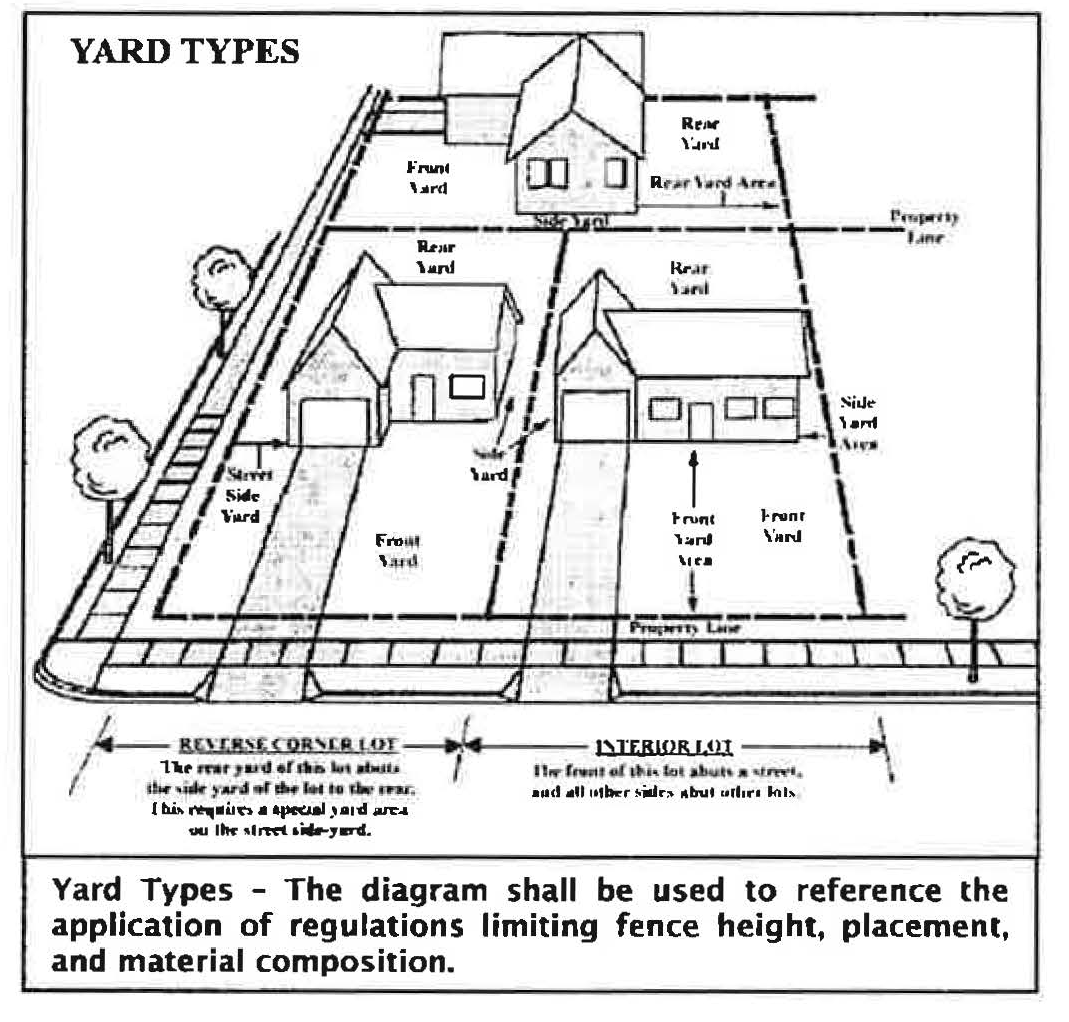
Height limitations. Fences and freestanding walls (other than retaining walls) cannot be located within any public right-of-way, and must comply with the following height restrictions:
i)
In the R-SF, R-1, R-2, R-3, R-4, R-5, and R-0 zoning districts, the following shall apply:
(1)
A fence in any front yard area shall not exceed four feet in height.
(2)
A fence in any side or rear yard area shall not exceed six feet in height, or eight feet in height on the property line that abuts an I-1, I-2, C-1, C-2 or C-T zoning district.
ii)
In the C-R, V, and UV zoning districts, the following shall apply:
(1)
A fence in any front yard area shall not exceed four feet in height.
(2)
A fence in any side or rear yard area shall not exceed six feet in height, or eight feet in height on the property line that abuts a residential or C-T zoning district.
iii)
In the C-1 and C-2, zoning districts, a fence in any yard area shall not exceed six feet in height, or eight feet in height on the property line that abuts a residential or C-T zoning district.
iv)
In the I-1 and I-2 zoning districts, a fence in any yard area shall not exceed eight feet in height.
v)
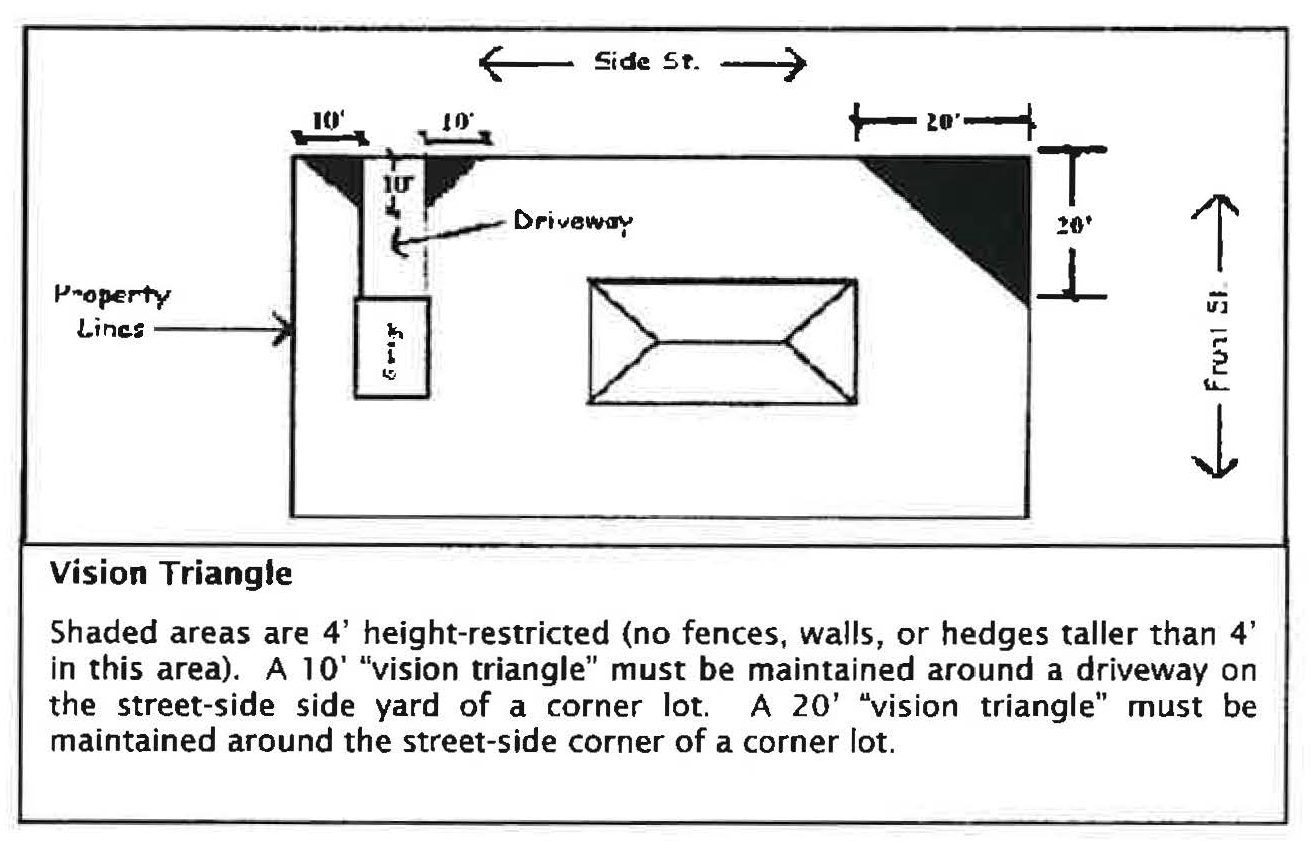
In all zoning districts, fences or freestanding walls shall not obstruct visibility at street intersections (see section 93-2-7 and vision triangle diagram).
b)
Materials and landscaping.
i)
Fences in the front yards of R-SF, R-1, R-2, R-3, R-4, R-5, and R-0 zoning districts must be constructed of ornamental metal, masonry, wood, vinyl, or other ornamental material specifically made for fence construction.
ii)
Fences in the C-R, V, and UV zoning districts must be constructed of ornamental metal, masonry, wood, or other ornamental material specifically made for fence construction.
iii)
Fences in the C-1 and C-2 zoning districts must be constructed of ornamental metal, masonry, wood, or other ornamental material specifically made for fence construction. The erection of any fence over four feet in height in these districts shall include a landscaped strip between the fence and the street right-of-way. The landscaped strip shall be a minimum of three feet wide and comply with the buffer requirements of chapter 93, article 29. Such landscaping shall be approved by the department of community services prior to the issuance of a building permit.
iv)
Fences in the I-1 and I-2 zoning districts must be constructed of ornamental metal, masonry, wood, or other ornamental material specifically made for fence construction. The erection of any fence over four feet in height in these districts shall include a landscaped strip between the fence and the street right-of-way. The landscaped strip shall be a minimum of three feet wide and comply with the buffer requirements of chapter 93, article 29. Such landscaping shall be approved by the department of community services prior to the issuance of a building permit.
c)
General fence regulations.
i)
Reserved.
ii)
The use of chain-link material is permitted only in rear yard areas on interior lots not adjacent to public rights-of-way. Fences along public rights-of-way must be constructed from ornamental metal, ornamental masonry, wood, or other ornamental material specially made for fence construction.
iii)
On corner lots, chain-link fences are not permitted along the property line where it abuts a neighbor's front property line or along the frontage adjacent to the public right-of-way.
iv)
It shall be unlawful to erect a fence of materials not specifically designed for fence construction. Materials prohibited for fence construction include, but are not limited to, tin roofing material, plastic roofing material, doors, or automobile parts.
v)
All fences shall be lawfully constructed, kept in good repair, and maintained in sound condition.
vi)
Fences required for swimming pools shall comply with Georgia State Minimum Standards Swimming Pool Code, 1994 Edition, Georgia Swimming Code Amendments, 2000.
vii)
Portions of fences with separations between slats of less than 50 percent, shall be constructed with the framing supports fronting the interior of the lot along those sections.
(Code 1981, § 8-5-15; Ord. No. 2001-02, § 1, 2-6-2001; Ord. No. 2005-01, § 1(8-5-15), 12-7-2004; Ord. No. 2008-03, § 1, 6-3-2008; Ord. No. 2008-08, § 1, 6-3-2008; Ord. No. 2008-09, § 1, 7-1-2008; Ord. No. 2014-10, § 2, 9-16-2014; Ord. No. 2015-05, § 1, 5-19-2015; Ord. No. 2019-17, § 1, 7-16-2019; Ord. No. 2020-4, § 1, 1-7-2020; Ord. No. 2024-03, 1-9-2024)
Sec. 93-2-6. - Distance between buildings.
All accessory buildings shall be at least ten feet from principal buildings. All multifamily buildings shall be at least 20 feet apart unless otherwise required by the fire marshal. All single-family attached buildings shall be at least 20 feet from any other principal building.
(Code 1981, § 8-5-16; Ord. No. 2024-03, 1-9-2024)
Sec. 93-2-7. - Vision clearance at corners.
Within the city, no fence, building, sign, planting or other obstruction above a height of four feet shall be maintained within 20 feet of the intersection of the right-of-way of two streets or railroads, or of a street intersection with a railroad right-of-way, or of a private driveway intersection with the right-of-way of a street.
(Code 1981, § 8-5-17; Ord. No. 75-3, 4-1-1975; Ord. No. 86-1, 1-7-1986)
Sec. 93-2-8. - Frontage on corner lots and double frontage lots.
On lots having frontage on more than one street, the minimum front yard shall be provided for each street in accordance with the provisions of this chapter; except, however, on residentially zoned corner lots, the height limitation shall apply to the yard area of such lot which is defined as "rear yard" in section 93-1-2.
(Code 1981, § 8-5-18; Ord. No. 91-7, 4-2-1991)
Sec. 93-2-9. - Utilities location.
Electrical transformer stations, telephone exchanges, gas regulator stations, sewage and water treatment plants and pumping stations, and standpipes for public water supply may be located in any zone subject to the approval of the board of appeals as a special exception. In such cases, the following requirements shall be complied with:
(1)
Those facilities shall be essential for the immediate area or for the proper functioning of the total utility system of which the same is a part.
(2)
Any building or structure, except an enclosing fence, shall be set back at least 30 feet from any property line.
(3)
Those facilities shall be enclosed by a permanent solid wall or by a woven wire fence of the type commonly known as a cyclone fence.
(4)
Open spaces on the premises shall be suitably landscaped and maintained.
(5)
When those facilities are located within any residential zone, the storage of vehicles and equipment on the premises shall be prohibited.
(6)
The surrounding area shall not be adversely affected by, and shall be protected from noise, odor, glare, dust, fumes, gas, smoke and vibration by suitable means and conditions.
(Code 1981, § 8-5-19)
Sec. 93-2-10. - Single-family attached developments (SFA), special provisions.
(a)
No building permit or certificate of occupancy shall be issued for single-family attached units unless:
(1)
The regulations and procedures of the city's subdivision regulations have been met including final approval of the subdivision plat.
(2)
The book and page in which any covenants and restrictions are recorded shall be shown on the final plat of the subdivision.
(Code 1981, § 8-5-21; Ord. No. 2020-15, § 1, 7-21-2020)
Sec. 93-2-11. - Condominium developments; special provisions.
(a)
No building permit or certificate of occupancy shall be issued for condominiums unless proof of adoption of the provisions of the Georgia Condominium Act has been presented to and approved in writing by the city attorney.
(b)
Covenants for SFA condominiums and multifamily condominiums.
(1)
The developer of a condominium, or a homeowners association created by the developer, by record covenants and restrictions, shall preserve and maintain for the owners and occupants of the development the lands set aside for open spaces, parks or recreation use, the common off-street parking spaces established for the development, and garbage and trash disposal. The book and page in which such covenants and restrictions are recorded shall be shown on a final plat of the development and on each deed transferring property within the development. The developer shall show proof of adoption and registration of articles and bylaws under the Georgia Condominium Act (GCA), with mandatory membership in the association before any individual properties are sold.
(2)
In the event that the homeowners association fails to maintain the common property in a reasonable condition, the mayor and council shall serve written notice upon the association and upon the individual property owner setting forth the manner in which the organization has failed to maintain the common open space in reasonable condition. This notice shall include a demand that the deficiencies of maintenance be corrected within 30 days thereof. If the deficiencies are not corrected within the 30 days, the city, in order to preserve the taxable values of the properties within the development and to prevent the common open space from becoming a public nuisance, may enter upon the common open space and maintain the same until the association is prepared to provide maintenance. The cost of the maintenance by the city shall be assessed against the property within the development that has a right of enjoyment of the common open space, and shall become a lien upon the property.
(c)
No building permit or certificate of occupancy shall be issued for a condominium project unless:
(1)
An enclosure wall six feet in height of suitable materials for visual and acoustical privacy shall enclose all side and rear yards of the SFA unit, or shall enclose a patio of 150 square feet minimum for each condominium unit (not including buildings in excess of two stories).
(2)
A masonry firewall (as described in the city building code, section 602-607) with a minimum of a four-hour fire rating shall be constructed between each individual unit. No opening shall be permitted in firewalls. These walls shall be self-supporting and continuous extending through all floors, and three feet above roof if roof covering is of combustible material. If roof covering is noncombustible, the wall may be carried up to and tightly against the undersides of the noncombustible roof deck or sheathing. Combustible framing members shall not extend through these walls.
(d)
Prior to the issuance of a certificate of occupancy for a condominium development, the developer of such project shall file with the building inspector a statement of his plan, with supporting documentation, for the sale, operations and management of the development. Based upon the information and documentation submitted, the building inspector shall cause to be prepared a written review of the plan for the benefit and guidance of prospective purchasers of units within the development. The review comments shall become a part of the sales agreement between the purchaser and the developer.
(Code 1981, § 8-5-22)
Editor's note— Condominiums can no longer be established under the Apartment Ownership Act.
State Law reference— Ownership Act, Ga. Code Ann., Ch. 85-16B; Condominium Act, Ga. Code Ann., Ch. 85-16E.
Sec. 93-2-12. - Multifamily units; special provisions.
All multifamily housing developments, which are not SFA and/or condominium projects and do not include units for individual sale, all units in which are or will remain in one ownership by an individual, partnership or corporation, shall have a masonry or concrete firewall and/or floors (as described in the city building code, sections 602—607) with a four-hour fire rating. These walls shall be constructed between every ten units. Combustible members shall not extend through these walls and/or floors.
(Code 1981, § 8-5-23)
Sec. 93-2-13. - Drainage improvements; special provisions.
In all zoning districts, a grading and drainage plan shall be submitted along with an application for a building permit for the proposed construction of a structure and the pavement of driveways and parking which will cover an excess of 35 percent of the lot area with impervious materials. The plans shall include an analysis of stormwater runoff under existing site conditions and under proposed developed site conditions. If the city engineer determines an increase in the stormwater runoff would create flooding of public and/or private property during a ten-year frequency storm, those plans shall include the details of providing and maintaining a flow and storage capacity sufficient to avoid potential flooding identified. The issuance of an occupancy permit shall not be granted until required drainage improvements are completed and approved by the city engineer.
(Code 1981, § 8-5-25)
Sec. 93-2-14. - Reserved.
Editor's note— Ord. No. 2020-3, § 1, adopted January 7, 2020, repealed § 93-2-14 which pertained to tree conservation and derived from Ord. No. 2010-08, adopted July 20, 2010. Similar provisions can now be found at chapter 93, article 29.
Sec. 93-2-15. - Nursery schools and kindergartens.
(a)
Nursery schools and kindergartens are permitted in any district when operated in conjunction with an existing church, provided all other applicable city, state and county regulations have been complied with, and provided further that at least 100 square feet of outdoor play area is provided for each child and that the play area is enclosed by a permanent solid wall or by a woven fence of the type commonly known as a "cyclone fence" having a height of at least four feet.
(b)
Nursery schools and kindergartens not operated in conjunction with an existing church are permitted only in C-R and C-2 districts, subject to the further stipulations that all other applicable city, state and county regulations have been complied with, and provided further that at least 100 square feet of outdoor play area is provided for each child and that the play area is enclosed by a permanent solid wall or by a woven wire fence of the type commonly known as a "cyclone fence" having a height of at least four feet.
(Code 1981, § 8-5-28; Ord. No. 79-11, 11-6-1979)
Sec. 93-2-16. - Site plan review.
(a)
Intent and purpose. The site plan review procedures are intended to ensure adequate review and consideration of potential impacts of proposed development upon surrounding uses and activities, and to encourage a high standard of side planning and design resulting in quality development in the city.
(b)
Application. An application for site plan review may be filed by the owner, or agent for the owner, of any property to be developed according to the plan. All applications for site plan review shall be filed with the building official for transmission to the planning commission. Site plan review requirements are applicable for all proposed development in all zones within the city and all property submitted for annexation.
(c)
Submission requirements. Applications for site plan review shall contain the following information and any additional information the planning commission may prescribe by officially adopted administrative regulations; ten copies of the application shall be submitted:
(1)
Site and landscape plan. Maps and site plans shall be submitted (minimum scale of 1" = 50' or larger, e.g. 1" = 40', 1" = 30', etc.) indicating project name, applicant's name, adjoining streets, scale, north arrow and date drawn, showing:
a.
The locations, size and height of all existing and proposed structures on the site.
b.
The location and general design cross section characteristics of all driveways, curb cuts and sidewalks including connections to building entrances.
c.
The locations, area and number of proposed parking spaces.
d.
Existing and proposed grades at an interval of five feet or less.
e.
The location and approximate size of all proposed plant material to be used in landscaping, by type such as hardwood deciduous trees, evergreen trees, flowering trees and shrub masses, and types of ground cover (grass, ivies, etc.). Planting in parking areas should be included, as required in section 93-23-18.
f.
The proposed general use and development of the site, including all recreational and open space areas, plazas and major landscape areas by function, and the general location and description of all proposed outdoor furniture (seating, lighting, telephones, etc.).
g.
The location of all retaining walls, fences (including privacy fences around patios, etc.) and earth berms.
h.
The identification and location of all refuse collection facilities, including screening to be provided.
i.
Provisions for both on-site and off-site stormwater drainage and detention related to the proposed development.
j.
Location and size of all signs.
(2)
Tree conservation and/or replacement plan. A plan describing all trees over three-inch caliper on the site to be retained as well as those to be planted, as required by chapter 93, article 29. When feasible, this plan may be incorporated into the site and landscape plans so long as all required information is present.
(3)
Site and building sections. Schematic or illustrative sections shall be drawn to scale of 1" = 8' or larger, necessary to understand the relationship of internal building elevations to adjacent site elevations.
(4)
Typical elevations. Typical elevations of proposed building shall be provided at a reasonable scale (1/8" = 1'0") and shall include the identification of proposed exterior building materials.
(5)
Project data.
a.
Site area (square feet and acres).
b.
Allocation of site area by building coverage, parking, loading and driveways, and open space areas, including total open space, recreation areas, landscaped areas and others.
c.
Total dwelling units and floor area distributed generally by dwelling unit type (one-bedroom, two-bedroom, etc.) where applicable.
d.
Floor area in nonresidential use by category.
e.
Total floor area ratio and/or residential density distribution.
f.
Number of parking spaces and area of paved surface for parking and circulation.
(6)
Project report. A brief project report shall be provided to include an explanation of the character of the proposed development, verification of the applicant's ownership and/or contractual interest in the subject site, and the anticipated development schedule. At the discretion of the planning commission, analyses by qualified technical personnel or consultants may be required as to the market and financial feasibility, traffic impact, environmental impact, stormwater and erosion control, etc. of the proposed development.
(d)
Review procedure.
(1)
All applications for site plan review shall be submitted at least ten working days in advance of the planning commission meeting at which it is considered.
(2)
Upon receipt, the building official shall place the application on the appropriate planning commission agenda. The planning commission shall consider the merits of the application at one or more public meetings.
(3)
The building official and/or city planner may submit written reports to the planning commission containing recommendations regarding the application.
(4)
The planning commission shall have 60 days after its initial consideration of the site plan to make a decision regarding the application, unless the matter is continued with the consent of the applicant. All conditions of approval or denial shall be clearly defined in the motion of approval or denial, and duly and precisely recorded in the minutes of the meeting. A failure to act on an application within the period specified above shall constitute approval of the application.
(5)
The planning commission shall evaluate the site plan application, and approve the application provided the commission determines that the proposed development will be of high quality and of such design that the development will not adversely impact the city or the immediately surrounding area. In the absence of such determination, the planning commission shall conditionally approve or disapprove the application.
(6)
The application shall revise any conditionally approved site plan as necessary to address any and all conditions placed on it by the planning commission to the satisfaction of the chairman of the planning commission and the building official. Upon approval and verification by the dated signatures of the chairman of the planning commission and the building official, a site plan shall be accepted and filed by the building official.
(7)
A building permit will be issued, subject to development being carried out in full accord with the approved site plan. In the event that any of the features, terms or conditions of the approved site plan are not complied with, the building official shall suspend or revoke any permits which have been issued pursuant to said site plan or take such other action as necessary to insure compliance.
(e)
Period of validity for site plan. No site plan shall be valid for a period longer than 12 months from the date it is approved by the fixing of the signature of the chairman of the planning commission and the building official, unless within such period a building permit is obtained and construction commenced. The planning commission may grant extensions not exceeding 12 months each upon written request of the original applicant and resubmission of the application, if the application as submitted is substantially the same as the initially approved application. However, the planning commission has the power in such cases to attach new conditions to its reapproval, or to disapprove the request for an extension. Where an application for extension contains changes which the planning commission concludes materially alter the initial application, it shall refer the application to the building official, who shall initiate a new site plan review procedure.
(Code 1981, § 8-5-29; Ord. No. 87-14, 5-5-1987; Ord. No. 99-09, § 1, 8-3-1999; Ord. No. 2020-4, § 2, 1-7-2020)
Sec. 93-2-17. - Churches; special provisions.
Notwithstanding any other provision of this chapter, all churches and other places of worship shall comply with the following restrictions and limitations:
(1)
Churches and places of worship shall be permitted only in zones where public assemblies are allowed as a permitted use.
(2)
One parking space shall be provided for the larger of:
a.
Every three fixed seats, with every 18 inches of bench length to count as one seat; or
b.
Each 35 square feet of enclosed floor area of the largest assembly room accommodating moveable seats.
(3)
No permanent parking for churches or other places of worship shall be permitted within 20 feet of the property boundary of any adjoining residential use.
(4)
Development standards shall be as follows:
(5)
Each lot shall have frontage on a major, arterial or collector street.
(Code 1981, § 8-5-31; Ord. No. 98-05, § 1, 3-3-1998)
Sec. 93-2-18. - Laundromats; special provisions.
Notwithstanding any other provision of this chapter, all laundromats shall comply with the following restrictions and limitations:
(1)
All laundromats shall be conditional uses.
(2)
One parking space shall be provided for the larger of:
a.
Every three washing machines located within the facility; or
b.
Per 180 square feet of enclosed floor area.
(3)
No laundromat may occupy more than 3,000 square feet of floor area.
(4)
No parking for laundromats shall be permitted within 20 feet of the property boundary of any adjoining residential use.
(5)
No laundromat shall be established maintained or operated that does not comply with the following standards:
a.
The premises shall be kept rodent-proof and free of vermin;
b.
The premises shall be sanitary;
c.
Trash receptacles shall be located on the premises and shall be emptied at the least daily. The premises shall be free of any accumulation of loose or unstored refuse, waste, dirt, trash, or garbage;
d.
Every window and door shall be kept in good repair;
e.
All floors shall be impervious to water;
f.
Ventilation shall be maintained at the following minimum level for each room four air changes per hour during business hours of which 25 percent of each air change of the fresh air;
g.
The back of each coin-operated laundry machine shall not be accessible to public;
h.
Each washing machine should be equipped with a door opening which will not open while machine is in operation; water and heating equipment shall not be accessible to the public;
i.
Dryers shall be equipped so that the door can be opened from the inside. Dryers shall also be equipped with automatic switch off devices that automatically switch off when the door opens;
j.
Artificial lighting at least of 30 foot candles intense illumination shall be maintained during business hours in the room in which coin-operated machines are located;
k.
In the event there is no full-time attendant on the premises a telephone shall be maintained for public use on inside the premises with the following telephone numbers from the prominently posted nearby: those of the fire department, police department and those of persons connected with the coin- operated laundry to be notify the event of service failure or emergency;
l.
The permittee shall have the premises coin-operated laundry machines and equipment inspected and cleaned at least once each business day;
m.
Lint shall be cleaned at least once each business day;
n.
Washers and dryers having capacity of 20 pounds or more shall be anchored to the floor;
o.
Where the water pressure on the premises exceeds 80 psi an approved pressure reducing value shall be required;
p.
Each coin-operated laundry shall have at least one floor drain in the area of washing machines which drain shall be at least three inches in width providing that a coin-operated laundry in existence on the effective date of this chapter do not to comply with this subsection; if alternative drainage arrangements satisfactory to the community services director are provided;
q.
Each coin-operated laundry that is connected to a sewer must be designed to discharge sanitary sewer comply with all local and state laws regulations relating to acceptance of waste at the sewage treatment plant;
r.
Wastewater shall not be discharged into storm sewers or open streams when discharged wastewater cannot be made to a sewer designed to discharge sanitary sewage, waste discharge tanks of sufficient size to be installed from which waste accumulation shall be transported to improve disposal area or wastewater treatment plant are required;
s.
Each coin-operated laundry shall comply with all other applicable provisions of the City Code.
(5)
Development standards shall be as follows: minimum lot size 20,000 square feet; minimum lot with 100 feet; minimum front yard/major streets 75 feet or to a street 60 feet; collector 50 feet; minimum side yard 15 feet abutting residential use 30 feet; minimum rear yard 20 feet abutting residential use 40 feet;
(6)
Each lot shall have frontage on a major arterial or collecting street; and
(7)
Compliance with subsections (2) through (6) and whether or not the conditional use is in the best interest of the health, safety, welfare, and aesthetics of the city shall be the standards used by mayor and council to issue the conditional use permit.
(Ord. No. 2007-03, § 1, 2-20-2007)
Sec. 93-2-19. - Vehicle sales accessory to lending institutions; special provisions.
Notwithstanding any other provision contained within this chapter, vehicle sales may be conducted by the owner of property on which the principal use is established and shall comply with the following restrictions and limitations:
(1)
All vehicle sales accessory to lending institutions shall be deemed customary accessory uses in any commercial zone. For purposes of this section, the term lending institution shall be defined as an entity that conforms to one of the following classifications found in the North American Industrial Classification System manual published in 2002 by the U.S. Office of Management and Budget:
(a)
522110 Commercial banking. This industry comprises establishments primarily engaged in accepting demand and other deposits and making commercial, industrial and consumer loans. Commercial banks and branches of foreign banks are included in this industry.
(b)
522120 Savings institutions. This U.S. industry comprises establishments primarily engaged in accepting time deposits, making mortgage and real estate loans and investing in high grade securities. Savings and loan associations and savings banks are included in this industry.
(c)
522130 Credit unions. This industry comprises establishments primarily engaged in accepting members' share deposits in cooperatives that are organized to offer consumer loans to their members.
(2)
Such sales shall not be conducted more often than two times per calendar year and shall be limited to four days per sale.
(3)
All vehicles displayed shall be operable and free of major body damage.
(4)
Vehicles shall be stored in lawful parking spaces and not in any driveways or aisles.
(5)
The number of vehicles displayed shall not exceed fifty percent of the available parking spaces on the premises.
(6)
Signs associated with such sales shall be limited to one banner sign having a maximum area of 32 square feet which shall be unaffected by other provisions of the sign ordinance as to sign area. Such advertising shall be limited to the period of the actual sale and one week prior to the sale.
(Ord. No. 2014-09, § 1, 10-7-2014)
Sec. 93-2-20. - Use regulations regarding group homes.
In addition to the other requirements set forth in this section, group homes may be permitted in the following zones: R-O, R-AD, R-1, R-2, R-3, R-4, R-I, R-SF, R-5, V, U-V, RMU, N-C and C-R, subject to the following conditions:
(1)
No additional parking beyond the existing driveway and garage areas is allowed on the property where the group home is located, and vehicles may only be parked on such areas. In the event that additional parking is required, the operator of the group home may apply for a variance from the board of appeals to increase the existing parking area, such increase to be confined to the rear of the lot;
(2)
The group home provides a current list of residents living in the facility who have disabilities, and information concerning special needs to the Hapeville fire and police departments to ensure resident safety and evacuation from the premises in the event of a fire or other emergency within the home;
(3)
The governing body for the facility provides the city with the names and telephone numbers of two persons who can be contacted in the event of an emergency;
(4)
As used herein "governing body for the facility" shall mean the board of trustees, the partnership, the corporation, the association, or the person or group of persons who maintain and control the facility and which is legally responsible for operation of the facility;
(5)
The existing dwelling is upgraded and inspected by the city with respect to the accommodation and accessibility of the dwelling by disabled persons;
(6)
No controlled substances are stored, served, sold, consumed, or in the possession of any person on the premises;
(7)
An operable telephone is maintained and readily available in the facility; provided further that the city shall be contacted immediately in the event that a physical altercation or any violation of state or federal law or local ordinances occurs on the premises;
(8)
The facility at all times of operation adheres to the guidelines and procedures as provided by the state department of human resources, office of regulatory services;
(9)
Unless more stringent restrictions apply, every room in all group homes and similar facilities, occupied for sleeping purposes by one person shall contain at least 80 square feet of floor space and every room occupied for sleeping purposes by more than one person shall contain at least 80 square feet of floor space for each occupant thereof;
(10)
The facility is rendered compliance with all applicable life safety codes including but not limited to federal, state and local fire and building codes;
(11)
Any exterior modifications to the existing structure will be consistent with the residential character of the surrounding neighborhood;
(12)
The group home has obtained all federal and/or state permits or licenses required for its operation;
(13)
The group home must register with the city community services department and provide a copy of all State licenses and documentation to the city's building official and code enforcement officer;
(14)
The group home shall meet all parking regulations as identified in this Code;
(15)
The group shall apply for and receive a city business license prior to operation; and
(16)
The group home is not located within one thousand five hundred (1,500) feet of an existing group home.
(Ord. No. 2015-15, § 2, 8-4-2015)
Editor's note— Ord. No. 2015-15, §§ 2, 3, adopted August 4, 2015, enacted provisions intended for use as sections 93-2-19 and 93-2-20. Inasmuch as there are already provisions designated as section 93-2-19, and at the discretion of the editor, said provisions have been redesignated as sections 93-2-20 and 93-2-21.
Sec. 93-2-21. - Use regulations regarding personal care homes.
(a)
Personal care homes, as defined herein, may be permitted in any RMU, V, U-V, C-R, N-C, C-1 and C-R zone, subject to special use permit and the following conditions:
(1)
Any exterior modifications to an existing structure or construction of a new structure shall be consistent with the character of the surrounding area;
(2)
The personal care home provides on-site parking and/or drop-off space adequate to meet the needs of the proposed facility;
(3)
The personal care home provides to the Hapeville fire and police departments a current list of residents living in the facility who have disabilities, and information concerning special needs, so as to ensure each resident's safety and evacuation from the premises in the event of a fire or other emergency within the home; and
(4)
The personal care home has obtained all federal and/or state permits or licenses required for its operation.
Table 1. Community Residences by Zone
(Ord. No. 2015-15, § 3, 8-4-2015)
Note— See editor's note at section 93-2-20.
Sec. 93-2-22. - Billiard rooms and billiard tables.
(a)
Billiard rooms, as defined in this chapter, are prohibited in every zoning district of the city.
(b)
No facility shall offer to the public more than one freestanding billiard table, unless such billiard tables are operated as permitted within this chapter.
(Ord. No. 2016-03, § 3, 3-1-2016)
Editor's note— Ord. No. 2016-03, § 3, adopted March 1, 2016, enacted provisions intended for use as section 93-2-21. Inasmuch as there are already provisions so designated, and at the discretion of the editor, said provisions have been redesignated as section 93-2-22.
Sec. 93-2-23. - Extended-stay hotels.
No extended-stay hotel shall be initially constructed or thereafter operated, and no hotel may be converted to be, and operated as an extended-stay hotel unless in full compliance with each of the following provisions:
(a)
Extended stay hotel standards.
(1)
The minimum number of guest rooms shall be 100.
(2)
Public access to the interior of the premises shall be by means of a single, main entrance within view of a registration desk that is staffed by at least one person at all times.
(3)
A manager and a minimum of one additional employee shall be on duty on the premises at all times.
(4)
The minimum number of floors shall be four.
(5)
A minimum lighting intensity of two and one-half foot-candles shall be maintained in all motor vehicle drives and parking areas and all pedestrian areas.
(6)
A minimum lighting intensity of five foot-candles shall be maintained at each public entrance and exit.
(7)
A flat roof is allowed; sloped roofs shall have a minimum roof pitch of a six-to-twelve ratio (6:12).
(8)
All construction shall comply with the architectural design standards that allow brick, concrete stucco, stone and wood. In addition, glass in combination with metal and approved synthetic finishes complying with the "Dryvit" standards acceptable to the city shall be allowed.
(9)
Management must provide without additional charge guest room cleaning on a minimum schedule of once weekly.
(10)
Outside storage, long term parking of heavy equipment, and parking of construction or related equipment shall be prohibited.
(11)
Any pay phone on the premises shall only be located in the lobby of the building.
(12)
A minimum of two of the following amenities shall be offered for the use of all guests:
a.
Fitness room.
i.
The fitness room of an extended-stay hotel with between 100 and 200 guest rooms shall be no less than 275 square feet. Further, the fitness room must contain a minimum of four pieces of exercise equipment. Four required pieces must include the following: One treadmill, one upright or recumbent cycle, one elliptical cross trainer or stair climber and a two strength station gym or two independent strength pieces.
ii.
The fitness room of an extended-stay hotel with over 200 guest rooms shall be no less than 350 square feet. Further, the fitness room must contain a minimum of six pieces of exercise equipment. Six required pieces must include the following: Two treadmills, two upright or recumbent cycles, one elliptical cross trainer or stair climber and a two-station gym or two independent strength pieces.
b.
Swimming pool, with dimensions of no less than 30 square feet by 60 square feet.
c.
A minimum of two meeting rooms, each having, dimensions of no less than 1,200 square feet.
(13)
A daily hot breakfast shall be made available on the premises, by the hotel, for consumption by guests.
(14)
Affiliation of the hotel with a national chain shall be required.
(15)
A minimum of a three-star rating from the Smith Travel Accommodations Report, or its successor(s)-in-interest, shall be required.
(b)
Hotel guest room standards.
(1)
Access to guest rooms shall be via an interior corridor, only, with guest room doors opening only onto such corridors.
(2)
No guest room shall be directly accessible from the exterior of the building.
(3)
Access to individual guest rooms shall be by magnetic card access or as otherwise required by fire or life safety regulations.
(4)
Room furnishings shall be subject to inspection by the city police chief who shall evaluate the furnishings for "wear and tear" on a seven-year cycle and shall be authorized to require replacement of any furnishings deemed to be in disrepair or otherwise in need of replacement.
(5)
All guest rooms shall be protected with a smoke detector and sprinkler system approved by the city fire department.
(6)
All guest rooms shall provide an automatic power shut off timer for each stove top unit or other type burner.
(7)
No guest room permitted under this section shall be converted to or used as an apartment or condominium.
(8)
Guest room amenities shall be consistent with or exceeding an upscale market class as defined by the Smith Travel Accommodations Report or its successor(s)-in-interest.
(c)
Maximum number of certificates of occupancy available. The number of certificates of occupancy allowed, at one time, for the operation of an extended-stay hotel within the city shall not exceed four. The lots of the holders of certificates of occupancy, existing on the date of adoption of the ordinance from which this section derives, for extended-stay hotels in the city bear the Fulton County Parcel Identification numbers of 14 0127 LL0356, 14 0127 LL1107, 14 0098 00090476, and 14 0127 LL1263.
(d)
Zoning districts. Extended-stay hotels shall be located only within the areas designated as "high intensity mixed use" or "commercial", on the "City of Hapeville Future Development Map", dated October 21, 2014, and as may be amended from time to time. The city future development map is available for inspection during normal business hours in the office of the city clerk. Further, no extended-stay hotel shall be developed on a lot abutting any area occupied, planned (as so designated on the city future development map) or zoned for residential use, only.
(e)
Penalties for noncompliance. An extended-stay hotel that fails to meet the requirements of the above subsections (a) through (d) is prohibited from offering cooking facilities in more than 20 percent of its total units. Further, any extended-stay hotel that fails to meet the requirements of this section shall be subject to citation imposing the maximum penalty allowed under the charter and ordinances of the city for each day of noncompliance. Each day of noncompliance shall constitute a separate offense punishable by a separate citation.
(Ord. No. 2016-18, § 4, 8-16-2016; Ord. No. 2021-03, § 1, 1-19-2021)
Editor's note— Ord. No. 2016-18, § 4, adopted August 16, 2016, enacted provisions intended for use as sections 93-2-22 and 93-2-23. Inasmuch as there are already provisions so designated as section 93-2-22, and at the discretion of the editor, said provisions have been redesignated as sections 93-2-23 and 93-2-24.
Sec. 93-2-23.5. - Provisions concerning bail bond offices, check cashing businesses, pawnshops and private probation offices.
(a)
Permitted locations. Bail bond offices, check cashing businesses, pawnshops and private probation offices shall be allowed only in those areas designated as "permitted locations for private probation offices, bail bond offices, check cashing businesses, and pawnshops" as indicated on those certain maps prepared by the Ecological Planning Group, which maps are kept on file with the city clerk. Any person, entity, or individual may review said map upon request to the city clerk.
(b)
Limitation on certificates of occupancy. The number of certificates of occupancy allowed, at one time, each for the operation of a bail bond office, check cashing business, pawnshop and private probation office within the city shall not exceed one per each 10,000 persons living in the city according to the most recent decennial census of the United States as published by the United States Bureau of the Census.
(Ord. No. 2016-28, § 9, 12-6-2016)
Editor's note— Ord. No. 2016-28, § 9, adopted December 6, 2016, set out provisions intended for use as § 9-2-23. As there were already provisions so designated, and at the editor's discretion, these provisions have been included as § 9-2-23.5.
Sec. 93-2-24. - Hotels or motels with cooking facilities.
Any hotel guest room that includes cooking facilities shall have a total floor area of not less than 400 square feet for an efficiency or one bedroom unit, a total floor area of not less than 600 square feet for a two bedroom unit, and not less than an additional 150 square feet of floor area for each additional bedroom; and provided further that all proposed hotel and motel developments shall be subject to the site plan review requirements of section 93-2-16.
(Ord. No. 2016-18, § 5, 8-16-2016)
Note— See editor's note at section 93-2-23.
Sec. 93-2-25. - Home occupations; special provisions.
Notwithstanding any other provision of this chapter, all home occupations shall comply with the following restrictions and limitations:
(1)
No home occupation shall be established, maintained or operated that provides or offers any group instruction, any group assembly or any group activity. The offering of individual lessons (including, but limited to, art, music, dance, language or cultural lessons) is permitted where each session is limited to no more than two pupils.
(2)
No home occupation shall be established, maintained or operated which has a separate source of, or separate account for, electrical power other than that provided to the dwelling in which the home occupation is conducted.
(3)
Except as may be allowed by section 93-3.3-13 or section 93-3.3-17, there shall be no evidence of a home occupation on the exterior of the dwelling in which the home occupation is conducted.
(4)
No merchandise or equipment used in the operation of a home occupation may be stored on the exterior of the dwelling in which the home occupation is conducted or stored in an accessory building located on the same lot as the dwelling in which the home occupation is conducted.
(5)
No merchandise or goods sold in the operation of a home occupation may be displayed or offered for sale in a manner that is visible from the exterior of the dwelling in which the home occupation is conducted.
(6)
No home occupation shall employ any person other than an immediate or extended family member of a resident of the dwelling in which the home occupation is conducted.
(7)
The operation of a home occupation shall not use more than 25 percent of the ground floor area of the dwelling in which the home occupation is conducted.
(8)
The operation of a home occupation shall not involve the use of chemicals, machinery or electrical power that creates noise, noxious odors or hazards that endanger the health, safety or welfare of residents of the city or that are otherwise disruptive to the residents of the city.
(9)
Only motor vehicles used primarily as passenger vehicles may be used in connection with the operation of a home occupation. On-street parking of such motor vehicles is permitted. The use of other types of motor vehicles (included, but not limited to, trucks) in connection with the operation of a home occupation and on-street parking of such motor vehicles is prohibited.
(Ord. No. 2018-01, § 2, 1-9-2018)
Sec. 93-2-26. - Accessory dwelling units (ADU).
An accessory dwelling unit is an accessory building occupied as a residence. Accessory buildings may be occupied as an ADU by another party so long as one of the dwelling units on the property is owner-occupied. The ADU may be occupied by the property owner or rented. The unit must be aesthetically similar to the primary structure. The primary use of the lot must remain single-family, and the lot may not be subdivided nor may the accessory unit be sold separately. In addition to all requirements for accessory structures, the following criteria apply to ADUs:
(1)
All ADUs require a building permit and certificate of occupancy. The application for this permit must be made to the planning and zoning department and must include a sworn, notarized statement from the property owner stating that the owner will occupy one of the dwelling units on the premises as their primary residence. Any transfer of ownership of the property will require a new sworn, notarized statement to be submitted by the new owners.
(2)
ADUs are allowed in districts R-0, R-1, R-2, R-3, R-4, R-5, R-AD, and R-SF. Additionally, they are allowed in districts U-V, V, and RMU granted the primary use of the lot is residential.
(3)
Plumbing including running water and sanitary sewer is required in an ADU.
(4)
A full kitchen is permitted. However, an ADU is only allowed to have one kitchen.
(5)
The lot must be a minimum of 4,000 square feet.
(6)
The structure must be at least 240 square feet.
(7)
The property must have an additional parking space beyond the given minimum parking requirements.
(8)
Only one accessory dwelling unit may be created per lot.
(Ord. No. 2019-17, § 2, 7-16-2019)
Sec. 93-2-27. - Food truck courts and food trucks; special provisions.
The following standards shall control the development and manner of operation of the following uses within the city.
(1)
Food truck court as a primary use located on private property.
a.
Food truck courts may be established as a primary use in undeveloped lots or free-standing commercial parking lots provided the property is not zoned or used as residential, the lot is paved where food trucks and parked vehicles are located, and that there are no unoccupied buildings present on the parcel.
b.
Food truck courts operating as a primary use shall require a special use permit. The special use permit application must include a site plan designating food truck locations, parking, amenities, and is subject to approval by city staff.
c.
Food truck court operators must obtain an occupational tax permit.
d.
Food truck court operators must provide the city with emergency contact information.
e.
Operators of food truck courts shall enter into rental agreements with any food truck vendor, which shall include the specific space being leased. Copies of said contracts shall be furnished upon request to the code enforcement officer.
f.
No vehicles or food trucks shall be permitted to park overnight in the food truck court. The operators will be responsible for the removal of any unauthorized vehicles.
g.
There shall be no more than six food trucks per acre.
h.
Food truck courts operating as a primary use must provide a minimum of four parking spaces for customer use per food truck in addition to any parking necessary for the use of the food trucks themselves. All spaces must be paved and striped.
i.
Food truck courts shall have dedicated on-site amenities for the patrons, including but not limited to on-site customer restrooms, customer seating, adequate lighting, trash receptacles, and clear pathways for patrons separate from parking and circulation. Food truck court operators shall be responsible for all maintenance of on-site amenities and property.
j.
Any accessory structures, such as pavilions, wooden gazebos, or pergolas may be provided by the food truck court operator subject to design review committee approval. Other than dining umbrellas, which must be removed at the end of the business day, temporary canopies are not permitted.
k.
Food truck courts must adhere to all requirements of the sign ordinance. No LED strip lighting shall be used in conjunction with any food truck court.
l.
No food truck shall be left unattended or unsecured at any time.
m.
All food trucks shall have valid mobile food vendor permits from the city per the requirements of section 11-11-3. Operators of food truck courts shall retain a copy of each food truck's mobile food vendor permit, to be furnished upon request to the code enforcement officer.
n.
No wastes of any kind shall be discharged from a food truck. Trash receptacles shall be provided by the food truck court operator for customers to dispose of food wrappers, food utensils, paper products, cans, bottles, food and other such waste. The food truck court operator shall be responsible for removing all trash, litter and refuse from the site at the end of each business day.
o.
No loudspeakers shall be used for announcements or hawking of products in conjunction with any food truck court.
p.
Food trucks must be located a minimum of 100 feet from any operating restaurant entrance. Food trucks may be located within 100 feet of a restaurant entrance if the restaurant is closed based on the posted operating hours.
q.
No food truck in a food truck court shall be located within any required setback, any sight distance triangle or required buffer. Access aisles sufficient to provide emergency access to any food truck shall be provided.
r.
Sales of articles other than food and non-alcoholic beverages shall be prohibited.
s.
Food truck courts may operate between 7:00 a.m. and 10:00 p.m., seven days per week.
(2)
Food truck courts as an accessory use located on private property.
a.
Food truck courts are allowed as an accessory use when there is an excess of parking in addition to the minimum site parking requirements.
b.
Food truck courts operating as an accessory use shall require a special use permit. The special use permit application must include a site plan designating food truck locations, parking, amenities, and is subject to approval by city staff.
c.
The accessory food truck court may not block access to the existing uses on the site.
d.
Food truck court operators must obtain an occupational tax permit.
e.
Food truck court operators must provide the city with emergency contact information.
f.
Operators of food truck courts shall enter into rental agreements with any food truck vendor, which shall include the specific space being leased. Copies of said contracts shall be furnished upon request to the code enforcement officer.
g.
No vehicles or food trucks shall be permitted to park overnight in the food truck court. The operators will be responsible for the removal of any unauthorized vehicles.
h.
No food truck shall be left unattended or unsecured at any time.
i.
All food trucks shall have valid mobile food vendor permits from the city per the requirements of section 11-11-3. Operators of food truck courts shall retain a copy of each food truck's mobile food vendor permit, to be furnished upon request to the code enforcement officer.
j.
There shall be no more than three food trucks per acre.
k.
Food truck courts operating as an accessory use must provide a minimum of four parking spaces for customer use per food truck in addition to any parking necessary for the use of the food trucks themselves. All spaces must be paved and striped.
l.
Food trucks located in an accessory food truck court must be located a minimum of 100 feet from any operating restaurant entrance. Food trucks may be located within 100 feet of a restaurant entrance if the restaurant is closed based on the posted operating hours.
m.
Food truck courts shall have dedicated on-site amenities for the patrons, including but not limited to on-site customer restrooms available to the public during operating hours, customer seating, adequate lighting, trash receptacles, and clear pathways for patrons separate from parking and circulation. Food truck court operators shall be responsible for all maintenance of on-site amenities and property.
n.
Any accessory structures, such as pavilions, wooden gazebos, or pergolas may be provided by the food truck court operator subject to design review committee approval. Other than dining umbrellas, which must be removed at the end of the business day, temporary canopies are not permitted.
o.
No wastes of any kind shall be discharged from a food truck. Trash receptacles shall be provided by the food truck court operator for customers to dispose of food wrappers, food utensils, paper products, cans, bottles, food and other such waste. The food truck court operator shall be responsible for removing all trash, litter and refuse from the site at the end of each business day.
p.
Food truck courts must adhere to all requirements of the sign ordinance. No LED strip lighting shall be used in conjunction with any food truck court.
q.
No loudspeakers shall be used for announcements or hawking of products in conjunction with any food truck court.
r.
No food truck in a food truck court shall be located within any required setback, any sight distance triangle or required buffer. Access aisles sufficient to provide emergency access to any food truck shall be provided.
s.
Sales of articles other than food & non-alcoholic beverages shall be prohibited.
t.
Food truck courts may operate between 7:00 a.m. and 10:00 p.m., seven days per week.
(3)
Food truck court or food trucks located on public property.
a.
Food trucks may be allowed to operate on a city-sponsored food truck court, city property, or in the public right-of way subject to the following conditions:
1.
The city may establish a food truck court on public property. Any food truck vendor desirous to operate in a city food truck court must operate under an agreement for the space with the city.
2.
All food trucks shall have valid mobile food vendor permits from the city per the requirements of section 11-11-3. Operators of food trucks shall retain a copy of its mobile food vendor permit, to be furnished upon request to the code enforcement officer.
3.
Food trucks may locate on city property or public right-of-way provided the food trucks operators provide locations, dates, and times for their proposed operations. The city manager must approve all locations, dates, and times for food truck operations.
4.
Food trucks are not permitted to operate in the right-of-way in residential districts unless approved by special permission by the city manager. Food trucks operating under special permission in the right-of-way in residential areas are restricted to four hours, one day per month.
5.
No vehicles or food trucks shall be permitted to park overnight on city property or in the public right-of-way. Unauthorized vehicles may be ticketed or impounded at the owner's expense.
6.
No food truck shall be left unattended or unsecured at any time. Unauthorized or unattended food trucks may be ticketed or impounded at the owner's expense.
7.
Food trucks located in city-sponsored food truck courts may operate between 7:00 a.m. and 10:00 p.m., seven days per week.
8.
Food trucks located in the public right-of-way may operate up to six hours per day, and up to three days per week and between the hours of 7:00 a.m. and 10:00 p.m. Food trucks may not violate any parking ordinances or rules, unless specifically approved by the city manager.
9.
Food trucks located in the public right-of-way may not reduce shared parking requirements for surrounding properties or impede traffic.
10.
Food trucks located in the public right-of-way must be located a minimum of 100 feet from any operating restaurant entrance. Food trucks may be located within 100 feet of a restaurant entrance if the restaurant is closed based on the posted operating hours.
11.
Access to food trucks may not hinder or impede pedestrian traffic.
12.
No food truck in a city sponsored food truck court or public right-of-way shall be located within any required setback, any sight distance triangle or required buffer. Access aisles sufficient to provide emergency access to any food truck shall be provided.
13.
Sales of articles other than food and non-alcoholic beverages shall be prohibited.
(4)
Food trucks as an ancillary use.
a.
Food trucks operating as an ancillary use may locate on a site for limited periods or special events.
b.
A host business or property owner may allow for a food truck to operate ancillary to an existing business for limited periods or special events.
c.
If the food truck shares a parking lot with other tenants or property owners, and the minimum parking requirements for all users are greater than the number of spaces provided in the lot, the hosting entity shall obtain written consent from each tenant or property owner prior to operating a food truck court. This consent will be made available to the city upon request. Lack of written consent will constitute of violation of this Code and the food trucks will be required to leave the premises immediately.
d.
All food trucks shall have valid mobile food vendor permits from the city per the requirements of section 11-11-3. Operators of food truck courts shall retain a copy of each food truck's mobile food vendor permit, to be furnished upon request to the code enforcement officer.
e.
Ancillary food truck may operate up to six hours per day, and up to three days per week.
f.
Up to two food trucks are allowed as an ancillary use per acre.
g.
No vehicles or food trucks shall be permitted to park overnight in the food truck court. The operators will be responsible for the removal of any unauthorized vehicles.
h.
No food truck shall be left unattended or unsecured at any time.
i.
Food trucks must be located a minimum of 100 feet from any operating restaurant entrance. Food trucks may be located within 100 feet of a restaurant entrance if the restaurant is closed based on the posted operating hours.
j.
No food truck in a food truck court shall be located within any required setback, any sight distance triangle or required buffer. Access aisles sufficient to provide emergency access to any food truck shall be provided.
k.
Sales of articles other than food and non-alcoholic beverages shall be prohibited.
l.
No wastes of any kind shall be discharged from a food truck. Trash receptacles shall be provided by the host of the food truck vendor for customers to dispose of food wrappers, food utensils, paper products, cans, bottles, food and other such waste. The host of the food truck vendor shall be responsible for removing all trash, litter and refuse from the site at the end of each business day.
m.
Food truck must adhere to all requirements of the sign ordinance. No LED strip lighting shall be used in conjunction with any food truck.
n.
No loudspeakers shall be used for announcements or hawking of products in conjunction with any food truck.
o.
The host or food truck vendor may provide limited seating to customers of the food truck vendor(s). Canopies for the protection of customers from the elements may also be provided by the property owner. Such canopies shall be temporary, shall not exceed an area of 144 square feet, and shall be removed at the conclusion of business each day.
(Ord. No. 2021-14, § 4, 8-3-2021)

