
Hapeville City Zoning Code
ARTICLE 3
3.- SIGNS AND MURALS2
Editor's note— Ord. No. 2016-08, § 1(Exh. A), adopted April 5, 2016, repealed and reenacted article 3.3 in its entirety to read as herein set out. Formerly, article 3.3, divisions 1 and 2, pertained to similar subject matter, and derived from Ord. No. 2014-07, §§ 1—3, adopted August 19, 2004, and Ord. No. 2014-12, § 1, adopted October 21, 2014.
DIVISION 1. - SIGNS[3]
Editor's note—
Sec. 93-3.3-1. - Statement of purpose and intent.
(a)
This division seeks to create the legal framework necessary to ensure a comprehensive and balanced system of signs within the city. A comprehensive regulation is necessary to ensure that signs installed in the city are compatible with the unique nature and character of the community. The purpose of this division is to preserve the right of free speech and expression, facilitate appropriate communication between people and their environment, promote the public health, safety and welfare, and avoid the visual clutter that is potentially harmful to traffic and pedestrian safety, property values, business opportunities, and community appearance. With these concepts in mind, the provisions in this division, which regulate signs by such factors as design, size, height, spacing and location, but not on the basis of any message conveyed by such signs, and also regulate the maintenance of signs, are hereby established to achieve the following purposes:
(1)
To protect the health, safety, general welfare and property values of residents and property owners of the city.
(2)
To promote and implement the goals, objectives and policies adopted in the comprehensive plan.
(3)
To effectively balance public and private objectives by allowing adequate signs for the needs of business and developers.
(4)
To regulate the installation and placement of signs in order to provide safe operating conditions for pedestrians and motorists by eliminating unsafe, cluttered, distracting, or illegal signs.
(5)
To promote the use of signs that are aesthetically pleasing, of appropriate scale, integrated with surrounding buildings and landscape, and compatible with the character of the surrounding area.
(6)
To ensure the protection of free speech rights provided by the United States Constitution and the Georgia Constitution.
(b)
It is the intent of this division to:
(1)
Provide functional flexibility, encourage variety and relate signage to basic principles of good design.
(2)
Balance the rights of individuals to convey messages through signs and the right of the public to be protected against the unrestricted proliferation of signs by regulating signs on the basis of such factors as design, height, spacing, and location, but not on the basis of the content of any message conveyed thereby.
(3)
Provide an enhanced visual environment for residents and visitors and protect existing view sheds in the community.
(4)
Promote economic development.
(5)
Ensure the fair and consistent enforcement of sign regulations.
(Ord. No. 2020-18, § 1, 8-4-2020)
Sec. 93-3.3-2. - Definitions.
For the purposes of this article, the following definitions shall have the meanings ascribed to them in this section, unless specifically stated otherwise:
Abandoned sign. A sign which is left in a state of neglect for a period of 180 days.
Aerial view sign. This includes, but is not limited to, any sign horizontally affixed to a roof or attached to a roof such that the sign is not readily viewable from the surrounding ground.
Aggregate sign area. The total area of all signs on a lot. Exempt signs shall not be considered in the calculation of aggregate sign area.
Animated sign. A sign that features movement or a change of lighting to depict action or to create a special effect or scene. Animated signs exclude changeable copy signs meeting the standards of this article.
Awning sign. Any sign applied directly to or attached directly to an awning.
Balloon sign. A lighter-than-air, gas-filled balloon, tethered in a fixed location, which contains a message on its surface or attached to the balloon in any manner.
Banner. Any cloth, bunting, plastic, paper, or similar non-rigid material attached to any structure, staff, pole, rope, wire, or framing which is anchored on two or more edges or at all four corners. Banners are temporary in nature and do not include flags.
Billboard sign. Any pole sign having an area of 300 square feet or greater. Billboard signs may display a traditional static image, a "multiple message sign" accomplished by a mechanical transition to a second or third image or a "large screen video display" utilizing full motion video technology and commonly referred to as digital or LED billboards. See section 93-3.3-22 for specific requirements.
Building frontage. The maximum linear width of a building measured in a single straight line parallel, or essentially parallel, with the abutting public street or parking lot.
Canopy. A structure other than an awning made of fabric, metal, or other material that is supported by columns or posts affixed to the ground and may also be connected to a building.
Canopy sign. Any sign that is part of, or attached to, a canopy.
Changeable copy sign. Any sign with an area under 300 square feet that incorporates changing lettering, images, or displays to form a message or messages, whether such changes are accomplished electronically, digitally or manually.
Clearance. The distance above the walkway, or other surface if specified, to the bottom edge of a sign. This term can also refer to a horizontal distance between two objects.
Decision date. The date upon which the city planner makes a final decision on the approval or denial of a complete sign permit application.
Erect. To build, paint, construct, attach, hang, place, suspend, or affix.
Externally illuminated signs. Any sign illuminated by an external light source directed primarily toward such sign.
Feather flag sign. Any cloth, fabric, plastic or similar lightweight, nonrigid material, designed for advertisement, display, identification, description, illustration, or conveying a message or information, visible from any public place or exposed to the general public, and attached to a vertical or near-vertical pole mounted into the ground or on a portable structure such that the material is not free to furl and unfurl as a flag would do. The term "feather flag" shall also include similar devices or terms, such as blade, teardrop or shark fin signs or flags, and sign flags. A feather flag may or may not exhibit a text message or symbol of any kind and may be a single color or multiple colors. This includes sign flags.
Festoon. A decorative chain, strip or ornamentation hanging between two points.
Flashing sign. Any sign the illumination of which changes in intensity, scrolls, flashes or changes message or appearance more often than once every ten seconds. This definition does not include changeable copy signs or digital displays that meet the requirements set forth herein.
Incidental sign. A permanent sign erected at the entrance or exit from private property onto a public street that provides traffic direction to entering or exiting traffic.
Incidental window sign. A small sign erected to be seen through a window of a non-residential establishment not exceeding one square foot.
Inflatable sign. A sign that is an air-inflated object, which may be of various shapes, made of flexible fabric, resting on the ground or structure and equipped with a portable blower motor that provides a constant flow of air into the device.
Interactive sign. An electronic or animated sign that reacts to the behavior or electronic signals of motor vehicle drivers.
Internally illuminated signs. Any sign which has characters, letters, figures, designs or outlines illuminated by electric lights, LEDs or luminous tubes located within the interior of the sign.
Lawn sign. A stake sign located in the supplemental area of a single-family or two-family dwelling for a temporary period.
Light trespass. Light emitted by a lighting installation, which extends beyond the boundaries of the property on which the installation is sited.
Marquee. A roof-like structure, often bearing a signboard, projecting over an entrance, as to a theater or hotel.
Median. A paved or planted strip dividing any public or private right-of-way, road or highway into lanes parallel to the direction of travel.
Message sequencing. The spreading of one message across more than one sign structure.
Monument sign. A sign permanently affixed to the ground and independent of any building for its support. The base of a monument sign is mounted flush with the ground.
Multi-Tenant sign. A freestanding sign used by multiple tenants that that occupy a building or set of buildings.
Mural. A large picture or image which is painted, constructed, or affixed directly onto a vertical building wall, which may or may not contain text, logos, and/or symbols.
Noncombustible material. Any material that will not ignite at or below a temperature of 1,200 degrees Fahrenheit and will not continue to burn or glow at that temperature.
Nonconforming sign. A sign that was legally erected and maintained at the effective date of this Ordinance, or amendment thereto, that does not currently comply with sign regulations of the district in which it is located.
Official sign. A sign erected or required by government agencies or utilities, on property controlled by such entities. Official sign includes, but is not limited to, those permanent and temporary signs identified in the Manual of Uniform Traffic Control Devices for the purpose of controlling vehicular and pedestrian traffic on public roadways.
Pennant. A triangular or irregular piece of fabric or other material, commonly attached in strings or strands, or supported on small poles intended to flap in the wind.
Pole sign. A freestanding sign that is permanently supported in a fixed location by a structure of one or more poles, posts, uprights, or braces from the ground and not supported by a building or a base structure.
Person. Any individual, entity, firm, partnership, association, corporation, company or organization of any kind.
Primary facade. The exterior wall of the building most nearly parallel to widest street on which the building fronts.
Projecting sign. A building-mounted, double-sided sign with the two faces generally perpendicular to the building wall or, on corner lots, projecting away from a building corner towards an adjacent street intersection. Such signs do not to include signs located on a canopy, awning, or marquee (also known as blade sign).
Reflective sign. A sign containing any material or device which has the effect of intensifying reflected light.
Roofline. The highest continuous horizontal line of a roof. On a sloping roof, the roofline is the principal ridgeline, or the highest line common to one or more principal slopes of roof. On a flat roof, the roofline is the highest continuous line of the roof or parapet, whichever is the higher.
Roof sign. Any sign attached to a building or structure and displayed above the lowest horizontal line of the building roof.
Sandwich board sign. A type of freestanding, portable, temporary sign consisting of two faces connected and hinged at the top and whose message is oriented to pedestrians (also known as A-frame sign).
Secondary facade. Any exterior wall of a building that is most nearly parallel to an adjoining street that is not the primary facade. A secondary facade may also be to the rear of the primary facade and may adjoin a parking lot rather than a street. The end elevation of a building shall also be considered a secondary facade.
Sign. Any device, structure, fixture, painting, emblem, or visual that uses words, graphics, colors, illumination, symbols, numbers, or letters for the purpose of communicating a message. Sign includes the sign faces as well as any sign supporting structure.
Sign area. The total area of a sign face used to display information, messages, advertising, logos, or symbols. For double-faced signs, the side with the largest sign area shall be used in computing sign area. The sign area of a double-faced sign having unequal faces shall be the area of the larger face. The sign area of wall signs shall be the net geometric area measured by the smallest possible rectangle or combination of rectangles enclosing the display surface of the sign, including the outer extremities of all letters, characters and delineations. Double-faced signs having an interior angle formed by the faces greater than 45 degrees shall be considered individual sign faces and the area of each face shall be used in computing sign area. Window sign area shall be measured in the same manner as wall signs. Decorative architectural or design elements on a building surface or window shall not count toward the sign area (e.g. borders).
Sign face. The part or parts of a sign that is/are used or can be used to convey information visually.
Sign structure height. The vertical dimension of a sign as measured as the distance from the highest portion of the sign to the mean finished grade of the street closest to the sign. In the case of a sign located greater than 100 feet from a public street, height shall be measured to the mean grade at the base of the sign. Clearance for freestanding and projecting signs shall be measured as the smallest vertical distance between finished grade and the lowest point of the sign, including any framework or other structural elements. The permitted maximum height for all signs is determined by the sign type and the zoning district in which the sign is located using the sign measuring standards.
Sign district. A portion of the city believed to share a common character and identified on the city "Sign District Map," Figure 1.1. Sign districts or character areas establish sign standards for properties located in these districts. See section 93-3.3-2-1.
Sign supporting structure. Poles, posts, walls, frames, brackets, or other supports holding a sign in place.
Snipe sign. A sign tacked, nailed, posted, pasted, glued, or otherwise attached to trees, poles, stakes, fences, public benches, streetlights, or other objects, or placed on any public property or in the public right-of-way or on any private property without the permission of the property owner (also known as bandit sign).
Stake sign. Any sign supported by uprights placed in the ground and not supported by or suspended from any building with a maximum sign area of five square feet. Unless otherwise specified, such signs are intended to be temporary.
Storefront. The primary facade of a commercial building or a single, undivided tenant space that may be located in a multi-tenant commercial building.
Streamers. A display made of lightweight, flexible materials, consisting of long, narrow, wavy strips hung individually or in a series, with or without a logo or advertising message printed or painted on them and typically designed to move in the wind.
Street frontage. The side or sides of a lot abutting on a public street or right-of-way.
Street pole banner. A banner suspended above a public sidewalk and attached to a single street pole.
Structural change or repair. Any reinforcement, replacement, bolstering, augmenting or substitution of a support element of a sign structure, including but not limited to alteration or replacement of the foundation, support structures, columns or beams, sign frame or sign head for any purpose other than to render the sign structure safe.
Structural trim. The molding, battens, cappings, nailing strips, latticing, and platforms which are attached to a sign structure, but which do not contribute to the conveying of a message.
Submission date. The date stamped on a sign application indicating the date the application was received in the community services department.
Temporary sign. A sign erected on a non-permanent basis, or a sign originally designed to be transportable and moved from one location to another, or a sign composed of materials not designed to withstand the elements for extended periods of time.
Temporary window sign. Any window sign consisting of a temporary sign that that is not permanently or semi-permanently affixed to or integrated with the window surface.
Vehicular sign. A sign affixed to a vehicle in such a manner that the sign is used primarily as a stationary message for the property on which the vehicle sits or is otherwise not incidental to the vehicle's primary purpose.
Wall sign. Any sign which is attached parallel to or painted on an exterior building wall.
Vending machine sign. A sign fabricated into the cabinet of a vending machine by the manufacturer of that machine.
Wall sign. A building-mounted sign which is either attached to, displayed on, or painted on an exterior wall in a manner parallel with the wall surface. A sign installed on a false or mansard roof is also considered a wall sign (also known as: fascia sign, parallel wall sign, or band sign).
Window sign. Any sign that is applied, painted, or affixed to a window, or placed inside a window, within three feet of the glass, facing the outside of the building, and easily seen from the outside. Customary displays of merchandise or objects and material behind a store window are not considered signs.
Zoning district. The classification of parcels of land as defined under the city zoning chapter.
(Ord. No. 2020-18, § 1, 8-4-2020)
Sec. 93-3.3-2-1. - Sign district map.
Figure 1.1 Sign District Map
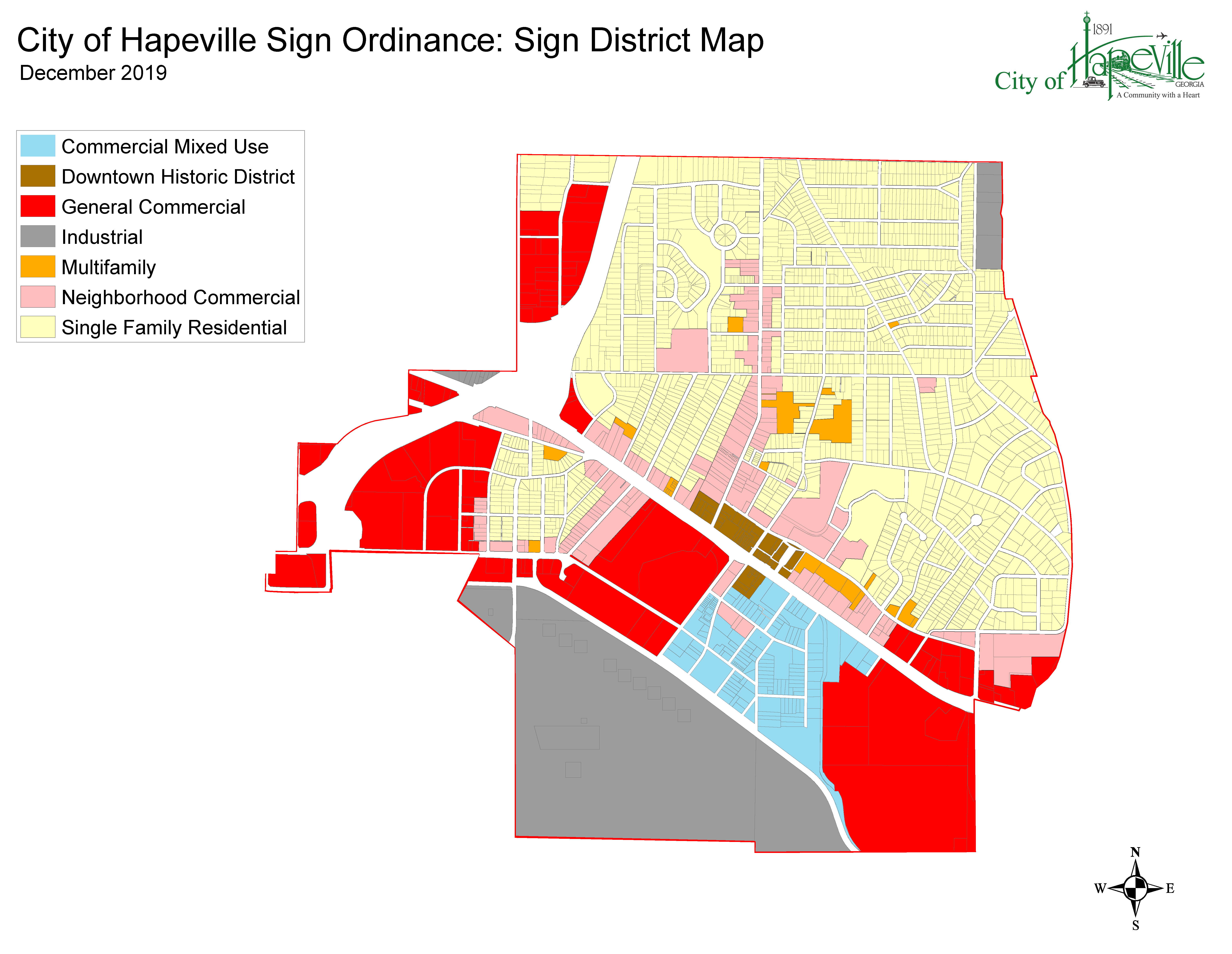
(Ord. No. 2020-18, § 1, 8-4-2020)
Sec. 93-3.3-3. - Permit required.
Except where specifically excluded from permit requirements by a provision in this division, it shall be unlawful for any person to place, erect, repair, alter, relocate, change, modify or maintain any sign structure without first obtaining a permit from the community services department in the manner set forth in this chapter and otherwise complying with the terms herein. Changes to sign faces made without any other changes to the size, shape, or type of sign do not require a new permit.
(Ord. No. 2020-18, § 1, 8-4-2020)
Sec. 93-3.3-4. - Permit application submission, requirements, decision, and appeal.
(a)
Submission of sign permit applications. Sign permit applications must be delivered to the department of community services. All permit applications must be stamped department of community services personnel indicating the submission date.
(b)
An application for a permit to erect a sign shall be made on a form or forms provided by the community services department and shall contain the following information:
(1)
Name of applicant and property address for sign.
(2)
Name, address, and telephone number of the property owner, and the signature of the property owner or duly authorized agent for the owner.
(3)
Contact person and contact information.
(4)
Description of the activities occurring on the site where the sign will be installed.
(5)
Description, including dimensions, of any existing signage that will remain on the site. Current photographs showing existing signs on the premises and certifying the date on which photographs were taken.
(6)
Identification of the type of sign(s) to be erected by the applicant.
(7)
Site plan depicting the locations of proposed signage and existing remaining signage.
(8)
Two copies of a plan drawn to scale depicting:
a.
Lot dimensions, building frontage, and existing rights-of-way and driveways.
b.
The design of each sign face and sign structure, including dimensions, total sign area, sign height, depth, color scheme, structural details, materials, lighting scheme and proposed location.
c.
Building elevations, existing and proposed facades, parapet walls, eave line and the location and size of all proposed and existing permanent signage.
(c)
Decision of the city planner.
(1)
Provided that the application is complete, all permit fees have been paid, the city planner shall render a determination for compliance with the code requirements and shall inform the community services department of his or her decision within 30 calendar days of the application submission date. The community services department shall give notice to the applicant of the planner's decision on or before the 30th day.
(2)
The city planner shall reject any application that includes violations of the terms of this article, is incomplete, or contains false material information or omissions within 30 calendar days of the application submission date. Applications subsequently submitted in conformity with this section shall be deemed to have been submitted on the date of resubmission rather than the original submission date.
(3)
If the city determines that a previously issued sign permit was issued pursuant to an application that contained violations of the terms of this article, false material information or omissions, he or she shall promptly revoke such permit and the sign shall be immediately removed.
(d)
Appeal. An applicant who is dissatisfied by a decision of the city planner on the application for a sign permit has the right to appeal that decision. Any such appeal shall occur under the following procedures:
(1)
The applicant shall deliver a written notice of appeal to the city planner within 14 calendar days of his or her receipt of the notice of the decision. In the event that that no appeal is made within the 14-day period, the decision of the city planner shall become final. In the event that an appeal is filed, the city planner shall promptly transmit to the board of appeals all documents constituting the record upon which the decision appealed from was made.
(2)
The board of appeals shall:
a.
Hold a hearing on any timely filed appeal no more than 30 days after the notice of appeal was received; and
b.
Make its final determination of the appeal not more than 30 days after the date of such hearing.
The review by the board of appeals shall be limited to a determination of whether or not the decision of the city planner was clearly erroneous.
(3)
Any appeal of the decision of the board of appeals shall be taken to the county superior court by a petition for a writ of certiorari.
(Ord. No. 2020-18, § 1, 8-4-2020)
Sec. 93-3.3-5. - Variances for signs in this division.
(a)
Variance. The board of appeals shall judge a request for a variance from the terms of this division based on the following criteria:
(1)
All existing permitted signs and structures on the subject property are in conformance with this division; and
(2)
The topography adjacent to the roadway is such that a sign conforming to the physical standards of this ordinance will not be visible to passing traffic in the same manner as signs of other similar establishments.
(b)
Financial loss to the appellant is not sufficient grounds by itself to justify a variance.
(c)
Peculiar conditions or circumstances that are the result of actions of the current or former owner of the property covered by the application cannot be considered as grounds to justify a variance.
(d)
The authority to erect and maintain additional signs as may be permitted under any such variance shall terminate upon the subdivision of the lot for which such variance was granted. Any appeal of the decision of the board of appeals shall be taken to the county superior court by a petition for a writ of certiorari.
(Ord. No. 2020-18, § 1, 8-4-2020)
Sec. 93-3.3-6. - Permit expiration date.
If work authorized under a permit has not been completed within six months after the date of issuance, the permit shall become null and void.
(Ord. No. 2020-18, § 1, 8-4-2020)
Sec. 93-3.3-7. - Permit fees.
Each application for a sign permit must be accompanied by a payment for the permit fee. The fee for a sign permit shall be as established by mayor and council from time to time. A copy of the fee schedule shall be available electronically on the city website or as hard copy in the community services department.
(Ord. No. 2020-18, § 1, 8-4-2020)
Sec. 93-3.3-8. - General sign regulations.
In addition to the limitations set forth in the other sections of this division, the following limitations shall apply to these specific types of signs:
(1)
No sign shall be placed in such a position as to endanger pedestrians, bicyclists, or traffic on a street by obscuring the view or by interfering with official street signs or signals by virtue of position or color.
(2)
No sign may interfere with vision clearance at corners (see section 93-2-7).
(3)
Signs and their supporting structures shall maintain clearance and noninterference with all surface and underground utility and communications lines or equipment.
(4)
Signs may be double-sided.
(5)
Wall signs:
a.
No wall sign shall cover wholly or partially any wall opening, nor project beyond the ends or top of the wall to which it is attached.
(6)
Projecting signs:
a.
No projecting sign may be placed over any street, any alley, or any other public right-of-way available for vehicular traffic.
b.
Any projecting sign located at a commercial business that is illuminated, either internally or externally, shall be illuminated between sunset and the close of business, on each side thereof, by lighting of at least five watts per square foot of sign surface, but in no case lighting that is more than 60 watts for each sign surface.
c.
All projecting signs must be installed at a 90-degree angle to the building facade, unless installed on a building corner facing a street intersection, in which case a projecting sign may be installed at a 135-degree angle to the building, towards the intersection
d.
Projecting signs shall not project above the roofline.
(7)
Awning and canopy signs:
a.
An awning sign must be painted or installed directly on the awning or canopy.
b.
The sign area of any awning sign shall not exceed 50 percent of the linear front of the awning.
(8)
Incidental signs:
a.
All incidental signs shall be placed on private property and set back from the right-of-way by no less than ten feet. Only one incidental sign per driveway entrance shall be permitted.
b.
The sign area of any incidental sign shall not exceed two square feet.
(9)
Window signs:
a.
Window signs may be arranged as a single sign or as multiple signs. Window signs shall be limited to ground floor windows.
b.
Temporary window signs that do not exceed three square feet in sign area per tenant or building facade and are subject to the following requirements:
1.
There is a limit of two temporary window signs not exceeding three square feet in sign area posted at any one time. This does not include interior neon or LED signs as described in subsection 2. below.
2.
One temporary interior neon or LED sign not to exceed a maximum of two square feet is permitted per building or tenant facade, except in the downtown historic sign district, in which such signs shall not exceed a maximum of one square foot.
3.
The aggregate window area of both permanent and temporary window signs per building or tenant façade shall not exceed the area allowed for window signs by sign district per section 93-3.3-21.
4.
Temporary window signs meeting the above requirements shall not require a permit.
c.
Temporary window signs that exceed three square feet in sign area per tenant or building façade are subject to the following requirements:
1.
The aggregate window area of both permanent and temporary window signs per building or tenant façade shall not exceed the area allowed for window signs by sign district per section 93-3.3-21.
2.
Temporary window signs exceeding three square feet but not more than the aggregate window area as allowed above shall be limited to installations of 60 days once per year.
3.
Temporary window signs exceeding three square feet require a permit.
d.
Changeable copy signs are not permitted as window signs.
(10)
Sandwich board signs:
a.
The owner of a building or occupant of a tenant space in a building in the downtown district, neighborhood commercial district or commercial mixed-use district may display one sandwich board sign for each business having a storefront. Such signs must be constructed of wood, metal or durable plastic. The surface of any sandwich board sign may be chalkboard, whiteboard or other durable material.
b.
No sandwich board sign may be placed as to restrict the flow of pedestrians. A minimum sidewalk clear zone of five feet shall be maintained. Sandwich board signs shall be removed at the end of each business day.
c.
The maximum sign area of a sandwich board sign shall be six square feet.
(11)
Changeable copy signs, excluding billboards:
a.
An owner or a permittee may incorporate up to 40 percent of the allowable sign area of a sign as a changeable copy sign, which shall be physically part of that sign. The changeable copy portion of the sign may not be installed absent the remaining 60 percent of the sign that shall be non-changeable copy or static in nature, excluding framing and other structural elements.
b.
No changeable copy sign may change more often than six times per minute and no message shall change more often than once every ten seconds. Signs shall accomplish message transitions as a hard cut, with no animation or delay between images. The brightness of such signs shall not have an illumination level of more than three-tenths of a foot-candle above the average ambient light level measured 100 feet from the face of the sign.
c.
Changeable copy signs with digital or electronic displays shall be subject to the following additional requirements:
1.
Digital changeable copy signs shall only be located in the general commercial sign district.
2.
The area of each display panel shall not exceed ten percent of the total sign face.
3.
Digital changeable copy signs shall be equipped with an automatic dimming device that shall lower the intensity of the sign illumination to ensure that a hazardous condition for motorists or pedestrians is not created.
4.
Digital changeable copy signs shall remain, and appear to be, fixed and static. In no instance shall the displayed content move, change, flash, or be animated or appear to move, change, flash, or be animated in any way.
5.
The color of any characters, symbols, text, mark or the like must contrast with the field of the sign to provide for maximum visibility and legibility, and each character, symbol, text, mark or the like on the display panel must be the same color. The background or field of the sign shall be a solid color.
6.
Individual display panels erected at fuel stations shall not exceed a size of two feet and no panel shall be larger than 30 square feet or face any property zoned for single-family residential use.
7.
No digital changeable copy sign shall be located within 150 feet of any single-family residence, or any property zoned for single-family residential use.
(Ord. No. 2020-18, § 1, 8-4-2020)
Sec. 93-3.3-9. - Nonconforming signs.
(a)
The city finds that nonconforming signs may adversely affect the public health, safety and welfare. Such signs may adversely affect the aesthetic character of the city and may adversely affect public safety due to the visual impact and structural characteristics of such signs on motorists.
(b)
Signs which on the effective date of this division were approved and legally erected under previous sign regulations and which became nonconforming with respect to the requirements of this division may continue in existence subject to the following restrictions:
(1)
No change shall be made in the size of any nonconforming sign, nor shall any structural change be made to any such sign, unless the sign is brought into compliance with the provisions of this division.
(2)
Any nonconforming sign declared to be unsafe by the city shall be removed or rendered safe and brought into compliance with the provisions of this division.
(3)
No nonconforming sign damaged by fire or other causes to the extent of more than 50 percent of its assessed value shall be repaired or rebuilt except in compliance with this division. Repair work must take place within six months of the incident that caused the damage.
(4)
Any sign erected on public property or in a public right-of-way in violation of this division may be removed by duly authorized employees of the city and the responsible party may be cited for such violation.
(5)
A nonconforming sign shall not be replaced by another nonconforming sign, except the substitution or interchange of sign face on nonconforming signs shall be permitted, provided such materials do not constitute structural elements.
(6)
Minor repairs and maintenance of nonconforming signs shall be permitted. However, no structural repair or change in the size, shape or height of a nonconforming sign shall be permitted except to bring the sign into compliance with the requirements of this division.
(7)
A nonconforming sign which meets all requirements of this Code when erected may remain in place until one of the following conditions occurs:
a.
The deterioration of the sign or damage to the sign renders the sign a hazard; or
b.
The sign has been damaged to such extent that structural repairs are required to restore the sign. Structural repairs are any repairs necessary to maintain the stability and structural integrity of the sign and are not merely aesthetic in nature.
(8)
No structural repair, change in shape, size, height or design of a nonconforming sign shall be permitted except to render such sign in compliance with all requirements of this division.
(9)
The above notwithstanding, any nonconforming sign damaged or destroyed by an Act of God may be restored to its extent immediately prior to said damage or destruction.
(Ord. No. 2020-18, § 1, 8-4-2020)
Sec. 93-3.3-10. - Applicability.
The provisions of this division shall apply to all signs erected within the corporate limits of the city.
(Ord. No. 2020-18, § 1, 8-4-2020)
Sec. 93-3.3-11. - Prohibited signs.
The following signs are prohibited:
(1)
Abandoned signs.
(2)
Aerial signs.
(3)
Animated signs involving motion or sound unless approved by special use permit.
(4)
Any sign in a public right-of-way or on city property.
(5)
Signs that exhibit statements, words, or pictures of obscene or pornographic subjects as determined by the city.
(6)
Any sign that due to its color, shape, size, height, lighting, location, position and/or design appears to be in imitation of, or may be confused by motorists and pedestrians with, an official traffic control sign or signal.
(7)
Any sign that impedes the view of an official traffic control sign or signal.
(8)
Any sign that is erected or maintained in such a manner so as to interfere with safe and free ingress and egress of any door, any window, any emergency exit or any fire escape. In addition, no sign shall be attached or otherwise affixed to any standpipe, any emergency exit, or any fire escape.
(9)
Any sign that obstructs the sight of motorists or pedestrians so as to create a traffic safety hazard.
(10)
Any sign that promotes illegal activity.
(11)
Balloon signs.
(12)
Building, window and door lighting having an intensity greater than 0.2 foot-candles measured at the boundary of any abutting property.
(13)
Feather flag signs.
(14)
Flashing, blinking, or varying light intensity signs, with the exception of changeable copy signs that meet the requirements of section 93-3.3-8.
(15)
Interactive signs.
(16)
Inflatable devices, signs, balloons, or festoons.
(17)
Mechanical movement signs.
(18)
Pennants, streamers or searchlights.
(19)
Reflective signs or signs containing mirrors.
(20)
Roof signs.
(21)
Sandwich board signs located in any residential zoning district.
(22)
Signs which emit smoke, visible vapors, particulate matters, sound, odor or contain open flames.
(23)
Snipe signs.
(24)
Street pole banner signs attached to telephone, electrical power or light poles.
(25)
Vehicle signs with a total sign area in excess of six square feet, where the vehicle upon which the sign is painted, drawn or otherwise affixed meets any of the following:
a.
If parked on a non-residential lot, the vehicle is not being used for the purpose of providing transportation for the owners, employees, inventory, merchandise, supplies or materials concerning a business operating on the lot; and
b.
Any part of the vehicle is parked for more than three consecutive hours within 100 feet of any public right-of-way;
c.
The vehicle is not being actively loaded or unloaded;
d.
The vehicle is visible from any public right-of-way;
e.
There are other available and accessible locations on or about the lot where the vehicle can be parked, which are not within 100 feet of any public right-of-way and visible from such.
(Ord. No. 2020-18, § 1, 8-4-2020)
Sec. 93-3.3-15. - Signs requiring a special use permit.
The following signs require a special use permit, pursuant to section 93-3.2-5. These signs must be historic in nature and must not include sound, flashing or blinking lights or lights of varying intensity.
(1)
An animated sign that rotates.
(Ord. No. 2020-18, § 1, 8-4-2020)
Sec. 93-3.3-16. - Signs exempt from permit.
(a)
The following signs are allowed and exempt from the permit regulations contained in this division but, notwithstanding, must comply with all other applicable requirements in this division and this Code:
(1)
Address numerals not exceeding four inches in height in the single-family residential district and ten inches in height in all other districts.
(2)
Any sign not visible from a public right-of-way.
(3)
One temporary sign per street frontage erected in conjunction with any subdivision, development, improvement, or other construction project. Such sign shall be limited to an area of 60 square feet.
(4)
Incidental window signs. Such signs shall have a maximum combined area of one square foot.
(5)
Incidental signs (see subsection 93-3.3-8(8)).
(6)
Temporary window signs. Such signs are not exempt from maximum area calculations for window signs (see subsection 93-3.3-8(9)c.).
(7)
Official signs.
(8)
One temporary stake sign per each lot that is less than three square feet in sign area. For corner lots, one temporary stake sign shall be exempt per street frontage.
(9)
One wall sign that does not exceed one square foot in sign area.
(10)
Lawn signs in residential areas that meet requirements found in section 93-3.3-21.
(11)
Any signs erected in relation to a federal, state, county, or city election or referendum. Such signs shall be regulated pursuant to state law.
(b)
Unless otherwise stated, any sign erected under this section shall not be calculated as part of the overall sign area allowed per lot by another section in this division. No sign erected under this section shall be internally or externally illuminated.
(Ord. No. 2020-18, § 1, 8-4-2020)
Sec. 93-3.3-17. - Temporary signs.
(a)
Unless otherwise allowed by this division, temporary signs are limited to additional restrictions listed in section 93-3.3-21 for the sign district in which they are located.
(b)
Temporary signs shall be limited to a maximum of two signs allowed twice per year for a period not to exceed 30 consecutive days. This restriction shall not apply to temporary window signs or temporary signs located in the single-family residential sign district. Temporary signs shall not be placed in any public right-of-way.
(c)
All temporary signs shall be securely installed and shall meet all applicable safety standards as prescribed by the building code, electrical code and life safety code.
(d)
The City may give a written notice of violation to the owner of any temporary sign erected or maintained in violation of this division or any other city ordinances or laws and to the owner of the property or premises on which the sign is located. Such notice would contain a request for a written plan of action within five days from receipt of notice. The notice shall be sent via certified mail. Within this plan of action, the permittee or owner shall outline a remedy to address the violation. If the permittee or owner wishes to appeal the violation, they may request a variance through the board of appeals or opt for a citation and address it with the city municipal court. Should the court confirm the violation, the sign must be removed by the owner or by city at the owner's expense.
(e)
No fee shall be required for issuance of a permit for temporary signs.
(Ord. No. 2020-18, § 1, 8-4-2020)
Sec. 93-3.3-19. - Maintenance.
(a)
All signs regulated by this division shall be kept clean, neatly painted, and free from all electrical and mechanical hazards, including, but not limited to, faulty wiring and loose connections. The premises surrounding all signs shall be maintained by the owner in a sanitary and inoffensive condition, free of weeds, rubbish, and debris. The city may cause any sign which shows gross neglect, becomes dilapidated, or the ground area around such a sign is not well maintained to be removed after due notice.
(b)
The city shall give the permittee or owner of any sign which shows gross neglect or has become dilapidated or which the ground area around the sign is not well maintained a written notice of violation with a request for a written plan of action within five days. The five day period shall commence on the day the letter is received by the permitee or owner. The notice shall be mailed via certified mail. Within this plan of action, the permittee or owner shall outline a remedy to address the violation. If the permittee or owner wishes to appeal the violation, they may request a variance through the board of appeals or opt for a citation and address it with the city municipal court. Should the court confirm the violation, the sign must be removed by the owner or by city at the owner's expense.
(Ord. No. 2020-18, § 1, 8-4-2020)
Sec. 93-3.3-20. - Illumination.
(a)
Internal illumination. The illumination of internally lit signs shall not exceed 0.2 foot-candles of incandescent light measured at the boundary of any abutting property.
(b)
External illumination. Indirectly lit signs shall be lighted so that no light source is positioned in such a manner that creates a hazardous condition for motorists or pedestrians.
(c)
Illuminated signs shall be installed in a manner that prevents light trespass on adjacent properties or public rights-of-way. No illuminated sign shall be installed within the single-family residential sign district.
(Ord. No. 2020-18, § 1, 8-4-2020)
Sec. 93-3.3-21. - Sign standards by sign district.
Any sign not specifically allowed in a sign district under this section shall be prohibited in that district, except as otherwise provided for under this division. Size, height, setback, quantity, and type of sign shall be regulated under sections 93-3.3-21 and 93-3.3-8 of this division. Unless otherwise stated, listed restrictions in the following subsections are per parcel or lot.
(1)
Single-family residential.
a.
Permitted sign types and regulations for signs in the single-family residential sign district in the city.
1.
Monument signs at the entrance of a subdivision. Monument signs may only be illuminated externally and may only be illuminated from dusk to dawn.
2.
Lawn signs, not to exceed a combined 12 square feet of sign area Such signs shall be exempt from permitting requirements.
3.
Temporary signs not to exceed ten square feet each. For regulations regarding temporary signs, see section 93-3.3-17.
b.
All signs shall be set back a minimum of ten feet from the back of curb.
(2)
Commercial mixed use.
a.
Permitted sign types and regulations for signs in the commercial mixed-use sign district include:
1.
Awning signs.
2.
Billboards, subject to section 93-3.3-22.
3.
Flags.
4.
Pole signs/monument signs, which must be setback a minimum often feet from back of curb.
(i)
Where a sign contains information for more than one commercial entity, an additional five square feet per tenant is permitted, up to a maximum sign area of 50 square feet. Such signs may be increased in height by two feet per tenant, up to a maximum of 20 feet tall.
5.
Projecting signs, not to exceed a projection of four feet from the face of the building. Signs must provide for eight feet of minimum clear space between the bottom of any sign and the sidewalk or ground.
6.
Sandwich board signs, which must be removed at the end of each business day and must allow at least five feet of unobstructed passageway. No sandwich board sign shall exceed six square feet in sign area.
7.
Temporary signs.
8.
Wall signs.
9.
Window signs.
b.
The aggregate square footage of all wall signs, awning signs, and projecting signs shall not exceed the linear width of the building or tenant façade.
c.
All signs shall be set back a minimum of 25 feet from the I-85 and I-75 rights-of-way.
d.
All exterior lighting shall comply with FAA requirements related to aircraft safety, and all exterior lighting shall be maintained in accordance with plans and specifications submitted to and approved by the building official.
(3)
Downtown district.
a.
Permitted sign types and regulations for signs in the downtown sign district include:
1.
Awning signs.
2.
Flags.
3.
Pole signs, which must be setback a minimum of six feet from back of curb.
(i)
Where a sign contains information for more than one commercial entity, an additional four square feet per tenant is permitted, up to a maximum sign area of 40 square feet. Such signs may be increased in height by two feet per tenant, up to a maximum of 20 feet tall.
4.
Marquees.
5.
Projecting signs, which shall not exceed a projection of either four feet from any building or one-third of the width of any sidewalk, whichever is less. Projecting signs must provide for a minimum of eight feet of space between the bottom of the sign and the sidewalk or ground.
6.
Sandwich board signs that must be removed at the end of each business day and must accommodate a minimum of five feet of unobstructed walkway. No sandwich board sign shall exceed six square feet in sign area.
7.
Wall signs.
8.
Window signs shall not exceed 30 percent of the window area. A second window sign of the same dimension shall be allowed on buildings with multiple frontages fronting on a public street. Incidental window signs do not count toward the aggregate sign area.
9.
Temporary signs.
b.
Other than window signs, the total number of signs in this district shall not exceed one sign of any allowed type for the primary building or tenant facade and one sign of any allowed type for each secondary building or tenant facade.
c.
The aggregate square footage of all wall signs, awning signs, and projecting signs shall not exceed the linear width of the building or tenant façade.
(4)
General commercial.
a.
Permitted sign types and regulations for signs in the general commercial sign district include:
1.
Awning signs.
2.
Billboards, subject to the requirements and limitations in section 93-3.3-22.
3.
Flags.
4.
Pole signs/Monument signs, which must be setback a minimum often feet from back of curb.
(i)
Where a sign contains information for more than one commercial entity, an additional ten square feet per tenant is permitted, up to a maximum sign area of 100 square feet. Such signs may be increased in height by three feet per tenant, up to maximum height of 30 feet tall.
5.
Projecting signs, which shall not exceed a projection of six feet from the face of any building.
6.
Wall signs.
7.
Window signs.
8.
Temporary signs.
b.
The aggregate square footage of all wall signs, awning signs, and projecting signs shall not exceed the linear width of the building or tenant façade.
c.
Except as provided in subsection 93-3.3-23(f), no wall sign or window sign shall be permitted above the ground floor of any building.
(6)
Industrial.
a.
Permitted sign types and regulations for signs in the industrial sign district in the city:
1.
Awning signs.
2.
Billboards, subject to the requirements and limitations in section 93-3.3-22.
3.
Flags.
4.
Pole signs/monument signs. The maximum number of pole signs and monument signs shall be one for every 500 linear feet of frontage or fraction thereof on a single frontage. Frontage on one street shall not be allocated to sign area on another street. Pole signs and monument signs must be set back a minimum of ten feet from back of curb.
(i)
Where a sign contains information for more than one commercial entity, an additional ten square feet per tenant is permitted, up to a maximum sign area of 100 square feet. Such signs may be increased in height by three feet per tenant, up to a maximum of 30 feet tall.
5.
Projecting signs, which shall not exceed a projection of six feet from the face of any building. Any projecting sign must provide a minimum of eight feet of space between the bottom of such sign and the sidewalk or ground.
6.
Temporary signs.
7.
Wall signs.
8.
Window signs.
b.
The aggregate square footage of all wall signs, awning signs, and projecting signs shall not exceed the linear width of the building or tenant façade.
c.
All signs shall be setback a minimum of 25 feet from the I-85 and I-75 rights-of-way.
(7)
Neighborhood commercial.
a.
Permitted sign types and regulations for signs in the neighborhood commercial sign district include:
1.
Awning signs.
2.
Flags.
3.
Pole signs/Monument signs, which must be set back at least six feet from back of curb.
(i)
Where a sign contains information for more than one commercial entity, an additional five square feet per tenant is permitted, up to a maximum sign area of 50 square feet. Such signs may be increased in height by two feet and width by six inches per tenant, up to a maximum of 12 feet tall and six feet wide.
4.
Projecting signs, which shall not exceed a projection of either four feet from any building or one-third of the width of the sidewalk, whichever is less. Any projecting sign must provide for a minimum of eight feet of minimum space between the bottom of such sign and the sidewalk or ground.
5.
Sandwich board signs, which must be removed at the end of each business day and must allow at least five feet of unobstructed passageway. A sandwich board sign shall not exceed six square feet in sign area.
6.
Wall signs.
7.
Window signs.
8.
Temporary signs
b.
Other than window signs, the total number of signs in this district shall not exceed two signs of any allowed type for the primary facade and one sign of any allowed type for each secondary facade.
c.
The aggregate square footage of all wall signs, awning signs, and projecting signs shall not exceed the linear width of the building or tenant façade.
(8)
Multi-family residential.
a.
Permitted sign types and regulations for signs in the multi-family residential sign district include:
1.
Monument sign.
2.
Projecting sign.
3.
Wall sign.
4.
Temporary signs.
b.
The sign area for any lot in this district shall not exceed one square foot for every linear foot of lot frontage, regardless of the construction, placement or type of sign or signs.
(9)
Public institutional. The standards for signs to be erected on those lots or upon buildings in the public institutional sign district shall be subject to the standards of the neighborhood commercial sign district.
(Ord. No. 2020-18, § 1, 8-4-2020)
Sec. 93-3.3-22. - Billboard signs.
(a)
The regulation and design of all billboard signs shall be governed by this section, subject to the following standards:
(1)
Billboard signs are permitted on any property having frontage on an interstate and located in any of the following sign districts: the commercial mixed-use sign district; the general commercial sign district; and the industrial sign district.
(2)
A billboard sign shall not be located more than 100 feet from an interstate right-of-way.
(3)
In addition to the other information required in section 93-3.3-4, a permit issued by the state department of transportation authorizing the installation of the proposed billboard sign shall be submitted to the city planner simultaneously with the application for a permit to erect said sign.
(4)
No billboard sign shall be located within 300 feet of a residentially zoned property as measured from the outermost edge of the sign to the closest point of the residential property.
(5)
A billboard sign shall meet the setback standards of the zoning district, provided the structure setback from any interstate right-of-way shall be a minimum of 25 feet.
(6)
No billboard sign shall exceed a height of 65 feet as measured from the ground to the top of the sign.
(7)
A billboard sign shall have a maximum width of 48 feet and a maximum sign face area of 672 square feet.
(8)
No billboard sign shall be located within 500 linear feet of any other billboard sign on the same side of the street, road or highway, including any such sign located outside of the city limits, as measured along the right-of-way.
(9)
The sign area of a billboard sign located adjacent to an interstate right-of-way shall not be used in calculating "aggregate sign area" For other signage on the same parcel.
(b)
Multiple message billboard signs shall be subject to the following standards:
(1)
Multiple message billboard signs shall not be located within 500 feet of the nearest residentially zoned property, park, playground, recreation area, scenic area or cemetery, as measured from the outermost edge of such sign to the closest point of the above-referenced property line.
(2)
When a message is changed mechanically, the transition shall be accomplished in three seconds or less.
(3)
No multiple message billboard sign shall be placed within 5,000 feet of another multiple message billboard sign on the same side of the street, road, or highway.
(c)
Digital billboards present a different set of circumstances regarding their impact on the community, such signs shall be governed by the following additional standards:
(1)
Digital billboards shall be limited to parcels fronting on interstate highways only, and shall be positioned for viewing from such interstate highways.
(2)
No digital billboard shall be located within 500 feet of another billboard on the same side of the interstate highway. Billboard signs located outside the city limits shall be included in determining this distance.
(3)
No digital billboard shall be located within 5,000 feet of another multiple message billboard, including any other digital billboard, on the same side of the highway. Billboard signs located outside the city limits shall be included in determining this distance.
(4)
Digital billboards shall not be located within 500 feet of the nearest residentially zoned property, park, playground, recreation area, scenic area or cemetery, as measured from the outermost edge of the sign to the closest point of the above-referenced property line.
(5)
All digital billboard images must remain stationary and not contain any visible moving parts, alternating, "crawling" or other moving messages or have the appearance of having moving parts or messages.
(6)
The display, background or other message medium on a digital billboard shall not change more often than once every ten seconds, with a transition period of one second or less.
(7)
A digital billboard shall contain a default design that will freeze the sign in one position should a malfunction occurs.
(8)
Any maximum size limitations shall apply to the side of the multiple message sign with the greater area.
(9)
The owner of a digital billboard shall arrange for an annual certification of the foot-candle intensity measured in foot-candles by an independent contractor showing compliance and provide such certification to the code enforcement officer.
(10)
All digital billboards shall have installed an ambient light monitor that will continuously monitor and automatically adjust the brightness of the display based on ambient light conditions. Maximum brightness levels for digital billboards shall not exceed three-tenths foot-candles over ambient light levels measured as prescribed in a "Recommended Night-time Brightness Levels for On-Premise Electronic Message Centers (EMC's)" published by the International Sign Association, April 2011. Certification that the sign has been preset to automatically adjust the brightness to this level or lower must be provided to the code enforcement officer.
(11)
Digital billboards shall meet the same installation and permitting requirements and inspections as adopted for electrified signs and all other signs.
(12)
The owner or permittee of a digital billboard shall coordinate with the city in displaying, when appropriate, emergency information important to the travelling public including, but not limited to, Amber Alerts or alerts concerning terrorist attacks or natural disasters. Emergency information messages shall remain in the advertising rotation according to the protocols of the agency that issues such information.
(13)
The owner of a digital billboard shall provide contact information to the community services department for an individual who is available at any time and who is capable of turning off said sign promptly following a malfunction.
(14)
At any time more than five percent of the LED display lights on a digital billboard malfunction or are no longer working, the owner or billboard permittee shall repair said sign within 30 calendar days or the sign will be subject to removal.
(15)
In the event the city finds that a digital billboard causes glare, impairs the vision of a motorist, or otherwise poses a traffic safety hazard to motorists or pedestrians, the owner of said sign shall reduce the intensity of lighting on such sign to a level sufficient to eliminate the hazard within 24 hours of receipt of written notice by the code enforcement officer.
(16)
Each digital billboard must comply with all state department of transportation rules and regulations applicable to electronic changeable message signs where not in conflict with this section.
(Ord. No. 2020-18, § 1, 8-4-2020)
Sec. 93-3.3-23. - Special requirements for all signs.
(a)
Applicability. All lots, buildings, structures or property shall be regulated under the requirements of this division.
(b)
Placement. All signs must be placed on a lot as defined in other sections of the zoning ordinance and the subdivision regulations. No sign may be placed on any lot where such lot does not meet the minimum requirements of the zoning ordinance and subdivision regulations. With the exception of billboards, no sign may be placed on any lot that has road frontage only on an interstate or intrastate highway.
(c)
Covering architectural elements. No placement of any sign shall cover or conceal architectural fenestrations, adornments, details, doors or windows unless the design review committee determines that the placement of such sign cannot be more appropriately located and that the placement of such sign will not adversely affect access to the building, cause unnecessary glare into the building or adversely impact the historic character or architectural theme of the building.
(d)
Posting on trees, poles, etc. No sign shall be allowed to be tacked, painted, posted, marked, or otherwise affixed on trees, utility poles, or other similar structures, or on rocks, the ground itself, or other natural features.
(e)
No posting on supports. No message may be displayed on any portion of the structural supports of any sign.
(f)
Special situations; buildings of three stories or more. Those developments having buildings of three or more stories may be permitted one wall sign on the primary and secondary building or tenant facade not to exceed 50 percent of the width of the building or tenant facade and not exceeding an area of one square foot for each horizontal linear foot of building or tenant facade. Such wall signs shall be limited to the ground floor wall, only. A single wall sign may be installed on each facade of the highest floor, subject to a maximum width of 20 percent of the building façade length and a maximum area often percent of the exterior wall area of that floor; the sign area and width allowance for such wall signs apply to each individual building facade and are not cumulative.
(Ord. No. 2020-18, § 1, 8-4-2020)
Sec. 93-3.3-24. - Construction standards for all signs.
(a)
Building code compliance. All signs shall be constructed and maintained in accordance with the provisions of the building code and, to the extent a sign contains electrical components, electrical code as adopted and from time to time amended (hereinafter referred to as the "city building code") except that no building permit shall be required unless the building official determines that a structure must be built to support the sign.
(b)
Materials required. All signs for which a permit is required by this division (excluding temporary signs) shall be designed and fabricated to conform to industry performance standards as concerns UV/sunlight exposure, abrasion, extreme temperatures, weather, chemicals and solvents, cleaning processes and graffiti. All signs for which a permit is required by this division (excluding temporary signs) shall be constructed of durable, noncombustible material with the exception of chemically treated plywood, also known as medium density overlay (MDO) plywood, redwood, sand blasted or carved wood having a minimum thickness of four inches and may also consist of aluminum, anodized aluminum, stainless steel, brass, polycarbonate, acrylic, and vinyl.
(c)
Reflectors. Gooseneck reflectors and lights shall be permitted on pole signs, monument signs, projecting signs, and wall signs; provided, however, the reflectors shall be provided with proper glass lenses so that no light creates a hazardous or dangerous condition.
(d)
Other code compliance. All building, zoning, or other relevant codes excluding building permitting (other than that permitting required elsewhere herein) shall be applicable to the location, construction and siting of signs and shall be read in harmony with this division.
(Ord. No. 2020-18, § 1, 8-4-2020)
Sec. 93-3.3-25. - Unsafe or unlawful signs.
Any sign determined by the city to be unsafe or unstable, a menace to the public health or safety, abandoned, dilapidated, or erected or maintained in violation of this division shall cause the city to notify the permittee, owner, or occupant of the property on which the sign is located of such violation with a request for a written plan of action within five days. The five-day period shall commence on the day the letter is received by the permitee or owner. The notice shall be mailed via certified mail. Should the permittee, owner, or occupant of the property on which the sign is located cannot be contacted, the city having affixed the notice to the sign or to the building on which the sign is erected for a period often days shall be deemed to have effected notice.
Within this plan of action, the permittee or owner shall outline a remedy to address the violation. If the permittee or owner wishes to appeal the violation, they may request a variance through the board of appeals or opt for a citation and address it with the city municipal court. Should the court confirm the violation, the sign must be removed by the owner or by city at the owner's expense.
The city may cause any unsafe or unlawful sign that constitutes an immediate threat to the physical safety of persons or adjoining property to be removed summarily and without notice and cause the cost of removal to be placed as a lien on the property on which the sign is located.
(Ord. No. 2020-18, § 1, 8-4-2020)
Sec. 93-3.3-26. - Penalties.
Any person found in violation of any provision of this division shall be subject to a fine not to exceed $1,000.00 per day. A separate offense shall be deemed committed each day during or on which a violation occurs or is permitted to continue. Any sign erected or maintained in violation of this division shall be subject to removal by the city upon an order of the municipal court and all costs related to such removal shall be charged against the property and may be collected by lien or otherwise.
(Ord. No. 2020-18, § 1, 8-4-2020)
Sec. 93-3.3-27. - Statement of purpose and intent.
A mural is a work of art painted otherwise directly applied on a building or wall. The presence of works of art, including murals, can be a key element to creating a visually satisfying environment for a community. The city is likely to attract commercial enterprises, permanent residents, and visitors if it improves and maintains its overall appearance. The residents ultimately will benefit from enhanced retail and commercial environments and improvements in the quality of life if an attractive environment exists. The existence of works of art, such as murals, is an invaluable element to creating and maintain a visually appealing setting, which will promote economic development, advance the general prosperity of the community, and serve the general welfare. This is particularly true for the city, which has concentrated residential and commercial areas where murals are more readily noticed and appreciated than such works of art would be in municipalities with geographically large areas.
The purpose of this division is to recognize the following mural types: (1) historic murals; (2) original art murals; and (3) limited message murals. All other similar forms of outdoor visual art that do not meet the definitions of these three forms of murals set forth herein shall be regulated as wall signs under division 1 of this article pertaining to signs.
(Ord. No. 2016-08, § 1(Exh. A), 4-5-2016)
Sec. 93-3.3-28. - Historic murals.
Historic murals are original works of visual art or signs produced by hand that were tiled, painted directly on or affixed directly to a wall or building prior to the date of adoption of this division. Murals that re-create a historic image bearing a relationship to a historic Hapeville theme established after the date of adoption of this division also constitute historic murals. Original historic murals and re-creations of historic images are deemed to comply with this Code.
(Ord. No. 2016-08, § 1(Exh. A), 4-5-2016)
Sec. 93-3.3-29. - Original art murals.
Original art murals are original works of visual art produced by hand that are tiled, painted directly on, or affixed directly to a wall or building. This section is intended to allow and encourage content neutral original art murals. Original art murals may be mechanically produced or computer generated prints or images, but shall not include the use of digitally printed vinyl. Such murals shall not contain electrical or mechanical components or feature a changing image. original art murals cannot contain text, graphics, or symbols.
(a)
Standards for original art murals. Original art murals shall comply with the following standards:
(1)
The mural shall remain in place, without alteration, a minimum of five years. The applicant shall attest to this standard on the permit application.
(2)
No part of any mural shall extend beyond the building wall or freestanding wall on which it is tiled, painted, or affixed.
(3)
No part of the mural shall extend more than six inches from the plane of the wall upon which it is tiled, painted, or affixed.
(4)
Only oil based alkyd enamel or polyurethane enamel, or newer 100 percent acrylic exterior paints shall be used to create murals.
(5)
Murals executed using spray paint shall be limited to air brushing to ensure that high quality paint is used.
(6)
An appropriate clear sealer or a suitable varnish or topcoat shall be applied to the finished mural. Graffiti resistant sealers should be chosen.
(b)
Prohibited original art murals. The following forms of original art murals shall be prohibited:
(1)
Any mural that contains an element that moves, rotates, or otherwise creates a changing image or message.
(2)
Any mural that uses flashing or scrolling lights, an internal light source, or other light feature.
(3)
Any mural containing electrical or mechanical components.
(4)
Any mural that is applied to a surface as a vinyl or other non-permanent material.
(Ord. No. 2016-08, § 1(Exh. A), 4-5-2016)
Sec. 93-3.3-30. - Limited message murals.
Limited message murals are murals that are painted on or applied to and made integral with a building wall or free-standing wall that contain a graphic or written message.
(a)
Standards for limited message murals. Limited message murals shall comply with the following standards:
(1)
Limited message murals may contain a graphic or written message not exceeding 50 percent of the width of the building or tenant facade, provided that no such graphic or written message shall have an area exceeding ten percent of the building or tenant facade area as measured at the exterior dimension of the graphic or written message and framing.
(2)
The mural shall remain in place, without alteration, a minimum of five years. The applicant shall attest to this standard on the permit application.
(3)
No part of any mural shall extend beyond the building wall or freestanding wall on which it is tiled, painted, or affixed.
(4)
No part of the mural shall extend more than six inches from the plane of the wall upon which it is tiled, painted, or affixed.
(5)
Only oil based alkyd enamel or polyurethane enamel, or newer 100 percent acrylic exterior paints shall be used to create murals.
(6)
Murals executed using spray paint shall be limited to air brushing to ensure that high quality paint is used.
(7)
An appropriate clear sealer or a suitable varnish or topcoat shall be applied to the finished mural. Graffiti resistant sealers should be chosen.
(b)
Prohibited limited message murals. The following forms of limited message murals shall be prohibited:
(1)
Any mural that contains an element that moves, rotates, or otherwise creates a changing image or message.
(2)
Any mural that uses flashing or scrolling lights, an internal light source, or other light feature.
(3)
Any mural containing electrical or mechanical components.
(4)
Any mural that is applied to a surface as a vinyl or other non-permanent material.
(Ord. No. 2016-08, § 1(Exh. A), 4-5-2016)
Sec. 93-3.3-31. - Mural permitting process.
This section establishes administrative permitting procedures to allow re-creation, preservation, and maintenance of historic murals, and creation of original art murals and limited message murals. The procedures set forth herein establish standards for review and approval of applications for new murals or those proposed for repainting or other maintenance to ensure the appropriateness of the mural with the context and compliance with this division. Administrative permits for such applications shall encompass review and approval by the design review committee relative to the following standards; compliance with all other aspects of this Code shall be subject to application of the Code by the city planner.
Standards to be used to process mural applications.
(1)
The design review committee shall consider the size, scale, and relationship of a mural to the historic context in the case of historic murals. Original art murals and limited message murals may or may not bear any relationship to the Hapeville context. The content of a mural shall not be the focus of review.
(2)
Repainting of historic advertising shall be guided by exacting documentation concerning the mural.
(3)
A permanent plan for maintenance and exact repainting according to the plan of the original artist shall be submitted with the application. The exact matching of color and application technique shall be specified in the plan.
(4)
Any mural proposed must be on a wall surface that will not mar a key historic feature and will be compatible with the streetscape. The image of any faded advertising murals shall be stabilized using appropriate preservation techniques and shall remain otherwise unchanged.
(5)
The standards of this division applicable to each mural type shall be considered.
(Ord. No. 2016-08, § 1(Exh. A), 4-5-2016)
Sec. 93-3.3-32. - Substitution.
The owner or the permittee of any mural which is otherwise allowed by this article may substitute non-commercial speech in lieu of any other commercial or non-commercial speech. This substitution of copy may be made without any additional approval or permitting. The purpose of this provision is to prevent any inadvertent favoring of commercial speech over non-commercial speech, or favoring of any particular non-commercial speech over any other non-commercial speech. This provision prevails over any more specific provision in this article to the contrary.
(Ord. No. 2016-08, § 1(Exh. A), 4-5-2016)

