
Powell City Zoning Code
CHAPTER 17
84.- SIGNS
Sec. 17.84.010.- General.
Signs shall be permitted in the various zone districts as accessory uses in accordance with the regulations contained in this chapter.
(Code 1992, § 17.48.010; Ord. No. 10-1999, § 1(part), 1999)
Sec. 17.84.020. - Intent and purpose.
A.
The city council recognizes that signs are a necessary means of visual communication for the public's convenience and that businesses, services and other activities have the right to identify themselves by using signs that are accessory and incidental to the use on the premises where the signs are located. The city intends to provide a reasonable balance between the right of an individual to identify his business and the right of the public to be protected from the visual discord that results from the unrestricted proliferation of signs. The city also intends, by this chapter, to ensure that signs are compatible with adjacent land uses and with the total visual environment of the community.
B.
It is the intent and purpose of this chapter to promote the health, safety and welfare of the residents and visitors of the city, by regulating and controlling the size, location, type, quality of materials, height, maintenance and construction of all sign structures not located with a building for the following reasons:
1.
To preserve the area's natural scenic beauty;
2.
To contribute to inviting entrances into the city by eliminating clutter associated, in part, with the unrestricted proliferation of signs, lights, flags and similar devices;
3.
To encourage area beautification through creative, interrelated design of signage, landscaping, buildings, access and parking that enhances the community's manmade and natural environment;
4.
To give all businesses an equal opportunity to have a sign that will help people find the services they need;
5.
To ensure that pedestrians and motorists are protected from damage or injury caused by, or partly attributable to, the distractions and obstructions of improperly situated signs.
(Code 1992, § 17.48.002; Ord. No. 10-1999, § 1(part), 1999)
Sec. 17.84.030. - Administration.
A.
The erection, remodeling or removal of any sign (except as noted herein) shall require a permit from the building official prior to the construction, placement or erection of a sign in accordance with the requirements of this section.
B.
The construction of all signs shall be in full compliance with these regulations and with the master signage plan or common signage plan in effect for the property.
(Code 1992, § 17.48.003; Ord. No. 10-1999, § 1(part), 1999)
Sec. 17.84.040. - Definitions.
The following words, terms and phrases, when used in this chapter, shall have the meanings ascribed to them in this section, except where the context clearly indicates a different meaning:
Billboard means a board or panel used for the display of posters, printed or painted advertising matter, either illuminated or non-illuminated, which directs attention to goods, merchandise, entertainment or services offered elsewhere than the premises where the sign is located.
Bulletin means a structure for the posting of notices, messages and announcements typically erected by churches and other public institutions and not advertising commercial products, goods or services.
Canopy means a permanent, roof-like shelter extending from part or all of the building face.
Free air space means any open area between the top of the sign and the ground, vertically, and between the extreme horizontal limits of the sign extended perpendicular to the ground.
Grade means the elevation of the centerline of the street at the center of the property for the purpose of measuring signs.
Sign means any device or display of letters, words, models, banners, flags, pennants, symbols or other representations which are an announcement or advertisement or which call attention to a product, service, organization, person or event. The term "sign" does not include the flag, pennant or insignia of any nation, state city or political unit.
A.
The term "sign" shall not include the following:
1.
Window displays incorporating placards, pennants, merchandise, pictures or models of products or services; and/or signs in or on windows provided that any such window sign is flush with the glass and does not otherwise protrude from the window;
2.
Works of fine art which in no way identify a product or business and which are not displayed in conjunction with a commercial enterprise that may benefit or realize direct or commercial gain from such a display;
3.
One nameplate per public entrance per business of not more than two square feet per face which is suspended under a canopy;
4.
Temporary decorations or displays clearly incidental and customary and commonly associated with national, local or religious holiday celebrations;
5.
Signs not visible beyond the boundaries of the lot or parcel upon which they are located, or from any public thoroughfare or right-of-way;
6.
Traffic and other official signs of any public or governmental agency;
7.
On-site traffic directional signs which do not exceed four square feet per face or ten feet in height and which do not carry a commercial message other than identification. The minimum horizontal distance between such signs shall be 15 feet, except for signs designating the purpose for which parking stalls may be used, such as for handicapped parking, compact cars, etc.;
8.
Temporary interior paper window signs;
9.
Signs over gas pumps which indicate gas prices only, provided that such signs shall be limited to one per pump island and shall be no larger than four square feet per face;
10.
One flush-wall nameplate per business, not to exceed two square feet in area, to be located at, or near, the rear entrance of such business; bus or other benches displaying advertisements pursuant to an agreement with the city and the owner, provided that such agreement regulates the size, content, placement, design and materials used for construction of the benches.
B.
The term "sign" shall include the following:
1.
"Awning sign" means a sign which is mounted on a temporary shelter supported entirely from the exterior wall of the building.
2.
"Building sign" means a sign which directs attention to the building to which it is attached, including but not limited to, canopy signs, projecting signs, reef signs, under-canopy signs, wall signs and window signs.
3.
"Canopy sign" means any sign attached to or constructed on the face of a canopy.
4.
"Changeable copy sign" means a sign on which copy is changed manually in the field, such as a reader board with changeable letters.
5.
"Election sign" means a sign relating to a candidate, issue, preposition, ordinance or other matter to be voted upon by the electors.
6.
"Flashing sign" means any illuminated sign on which the artificial light is not constant in intensity and color at all times.
7.
"For sale/For rent sign" means a sign advertising real estate for lease, rental or sale.
8.
"Ground sign" means a type of freestanding sign which is erected on the ground and which contains nor more than 20 percent total free air space.
9.
"Ideological sign" means a sign conveying a philosophical, religious, charitable or other similar noncommercial message.
10.
"Illuminated sign" means a sign designated to give forth artificial light or designed to reflect light derived from any source.
11.
"Individual letter sign" means a type of flush wall sign consisting of individual letters, incised letters, script or symbols with no background material other than the wall of the building to which the letters or symbols are attached. If the individual sections of an individual letter sign are connected by a common structure, commonly known as a "raceway," which provides for the electrical and/or mechanical operation of the sign, the "raceway" must be painted to match the color of the building, or other structure, to which the sign is mounted and must be limited to a height of no more than one-half of the height of the tallest letter.
12.
"Joint identification sign" means a sign identifying a commercial, industrial or professional center or complex having at least three separate businesses, such as a mall or shopping center. Only a center's management company or owner shall apply for a center sign.
13.
"Off-premises sign" means a sign or billboard which is used or intended for use to advertise, identify, direct or attract the attention of the public to a business, institution, product, organization, event or location offered or existing other than upon the same lot, tract or parcel of land where the sign or billboard is displayed.
14.
"On-premises sign" means a sign identifying or advertising a business, person, activity, goods, products or services which are located or sold on the premises where the sign is located.
15.
"Pole sign" means a sign supported by one or more uplifting poles or braces in or upon the ground, not attached to any building or having its bottom edge above ground.
16.
"Portable sign" means any sign not permanently attached to the ground or other permanent structure and designed to be transported, including, but not limited to, signs designed to be transported by means of wheels; sign converted to A or T frames and balloons used as signs.
17.
"Projecting sign" means a sign attached to or erected on a wall of a building with the face of the sign perpendicular to the building wall.
18.
"Reader board sign" means a programmable electronic sign which conveys words or scrolled messages vis-à-vis the programming of the illumination of lights located within or on such sign.
19.
"Residential development sign" means a sign identifying a subdivision, planned mobile home development or residential, building complex, displaying no more than the name and location of the development.
20.
"Roof sign" means any sign erected upon, against or directly above a roof or on top of the parapet of a building.
21.
"Sign face" means the surface of the sign upon, against or through which the message is displayed or illustrated.
22.
"Sign without backing" means any word, letter, emblem, insignia, figure or similar character or group thereof that is neither backed by, incorporated in or otherwise made a part of any larger display area.
23.
"Temporary business sign" means a sign which is portable and does not have a permanent location, which is used to advertise special purpose business activities for a limited amount of time.
24.
"Temporary commercial banner" means any sign made from plastic, canvas or any other pliable material and designed to be simply and quickly displayed for the primary purpose of advertising a temporary commercial promotion or commercial special event.
25.
"Temporary construction sign" means a sign, not a for sale sign, identifying new development or construction and including such information as the name of the project, the owner, the leasing agent, the contractor, the architect and brief descriptive material on the project or other pertinent data.
26.
"Under-canopy sign" means any sign attached to or constructed under a canopy.
27.
"Vehicle mounted sign" means any sign which is affixed to or otherwise mounted on any vehicle or on any object which is placed on, in or attached to a vehicle. For the purpose of this definition, the term "vehicle" means and includes trucks, buses, vans, railroad cars, automobiles, tractors, trailers, motor homes, semi-tractors or any other motorized or non-motorized transportation device, whether or not such vehicle is in operating condition.
28.
"Wall sign" means a sign attached to, erected against or painted upon the wall of a building with the face of the sign horizontally parallel to the building wall.
29.
"Wind driven sign" means any sign consisting of banners, flags, pennants, ribbons, spinners, streamers, captive balloons or other objects or material fastened in such a manner as to move by the wind.
30.
"Window sign" means a sign installed or painted on a window for purposes of viewing from outside the premises.
(Code 1992, § 17.48.010; Ord. No. 10-1999, § 1(part), 1999)
Sec. 17.84.050. - Exemptions.
The following signs are exempt from all of the provisions of this chapter except section 17.84.240:
A.
Signs required by law or authorized by law for a public purpose;
B.
One sign for each residential unit showing only the name and/or address of the occupant, not exceeding two square feet in area and mounted flat against the building wall;
C.
Cornerstones and historical markers;
D.
Decorations of a temporary nature;
E.
Interior window displays of merchandise;
F.
Real estate for sale, rental or lease signs not exceeding six square feet in area;
G.
Noncommercial signs whose function is to be informational or directional, provided that their location is approved by the building official;
H.
Danger or warning signs of a cautionary nature;
I.
Traffic signs;
J.
Identifying signs and lettering on business doors, exterior or interior, and home occupation signs not exceeding six square feet in area;
K.
Interior window signs in commercial district;
L.
For sale and temporary construction signs without electric service are exempted from permit requirements only;
M.
All signs existing as of the date of passage of the ordinance from which this chapter is derived, provided that such signs are in conformance with previous Code requirements.
(Code 1992, § 17.48.020; Ord. No. 10-1999, § 1(part), 1999)
Sec. 17.84.060. - Reconstruction or repair of nonconforming signs.
A.
To be classified as a nonconforming sign, such sign must have been in lawful existence as of the effective date of the previous Code requirements pursuant to section 17.84.050(M). To be allowed to continue as nonconforming, a sign must remain substantially unchanged from its condition as of the effective date of the previous Code requirements. As used herein, the replacement, extension or repair of the sign and/or the change of location or height of any such sign shall be considered to be a substantial change in its existing use. A change of the message content is not a substantial change in existing use.
B.
Rebuilding or re-erecting the sign or structure is a substantial change in existing use if such use or re-erection expenses exceed 50 percent of the current replacement cost of the entire sign or structure. If it can be demonstrated to the satisfaction of the building official that a nonconforming sign or structure has been vandalized or subject to other criminal or tortuous act or damage resulting from a motor vehicle accident, then the replacement, building or re-erecting of said sign or structure will not be considered a substantial change in existing use irrespective of the cost of replacement. If damage to a nonconforming sign or structures is caused by natural disasters, including but not limited to high winds, hail, or the like, and such damages exceeds 50 percent of the current replacement cost of the entire sign or structure, then replacement or repair will be considered a substantial change in existing use.
C.
Normal upkeep and repair of a nonconforming sign or structure on a frequent basis to the extent that the total cost of such repairs in any 12-month period does not exceed 50 percent of the current replacement cost of the entire sign or structure is not a substantial change in existing use. In the event any sign or sign structure has been blank for a period of 12 consecutive months, the owner of said sign will be given written notice to either display a message on said sign or structure or remove such sign structure within 120 days following the giving of such written notice.
D.
In reaching a determination as to the costs incurred in subsections B and C of this section, the following will apply:
1.
The sign owner shall furnish the building official cost data supporting any contention that any such sign or structure is not damaged more than 50 percent of the current replacement cost.
2.
The building official may also utilize any other fair market costs or other data available.
E.
No off-premises sign (except ideological or election signs) shall be constructed within the city limits after the effective date of the ordinance from which this chapter is derived, subject to the special exceptions for off-premises signs allowed pursuant to section 17.84.110(A)2. No illumination shall be added to any off-premises sign already in existence.
(Code 1992, § 17.48.030; Ord. No. 10-1999, § 1(part), 1999; Ord. No. 23-2015, 2015)
Sec. 17.84.070. - Prohibited signs.
The following signs are prohibited:
A.
Overhanging, projecting and freestanding signs along streets may not be closer than 18 inches to the curbline extended. No sign may project into an alley;
B.
No person shall permanently park any vehicle or trailer on a public right-of-way or on public property or on private property so as to be visible on the public right-of-way which has attached thereto or located thereon any sign or advertising device for the basic purpose of providing advertisement of products or directing people to a business or activity located on the same property or any other premises;
C.
Illuminated signs shall not be constructed in such a manner that direct or reflecting rays of light will be directed into or upon any residential district, residential building or public right-of-way;
D.
Rooftop signs and all other signs that project above the peak of a roof except in the case of a flat roof, in which case the sign shall not project more than ten feet above the parapet of the roof;
E.
Portable signs, excepting A-frame or sandwich style signs, which A-frame or sandwich style signs require and are subject to a revocable permit prior to their use or display;
F.
Revolving and rotating signs;
G.
Strings of light bulbs not permanently mounted on a rigid background used in connection with commercial purposes other than traditional holiday decorations;
H.
Wind driven signs;
I.
No sign, including portable signs, A-frame or sandwich style signs, off-premises signs and/or freestanding and ground signs shall be placed in or upon any street, dedicated right-of-way, sidewalk, median or other property owned by the city excepting as follows:
1.
Any sign allowed pursuant to this section shall be in compliance with section 8.12.090.
2.
Any sign allowed pursuant to this section shall be subject to a revocable permit to be issued by the building official prior to their use or display.
3.
This section shall apply only to free standing, portable A-frame/sandwich style signs which signs shall not be attached to any post, pole, tree or any other city structure.
4.
Any sign permitted pursuant to this section shall be limited in size to no greater than 24 inches in width and no greater than 48 inches in height. Signs permitted pursuant to this section shall be limited to one sign per business and shall be located directly in front of the applicant's business or building, and shall be allowed to be displayed only during the applicant business' normal business hours, otherwise said sign is to be removed from the city property on which it is placed. Additionally, only one sign shall be permitted to be displayed at any one time within 25 feet from any street corner. The sign applicant, as a condition precedent to the city's issuance of any permit pursuant to this section, must provide to the city proof of his having liability insurance covering damages and injuries to individuals or property in an amount of not less than $500,000.00. The sign applicant must also agree as part of his application and permit to indemnify and hold harmless city from any and all damages to property and injury to individuals that occur as a result of the placement of applicant's sign on city property pursuant to this section.
5.
Any sign permit approved by the city pursuant to this section may be revoked by the city, for good cause, including, but not limited to, any of the following reasons: the failure by the applicant to obtain a sidewalk sign permit pursuant to this section; the failure of the applicant to obtain and/or to maintain the requisite liability insurance pursuant to this section; the failure by the applicant to locate and/or maintain any sign pursuant to and in compliance with any and all ordinances of the city currently adopted or which may be adopted in the future.
(Code 1992, § 17.48.040; Ord. No. 10-1999, § 1(part), 1999; Ord. No. 20-2010, 2010)
Sec. 17.84.080. - Permitted signs.
Signs may be constructed within the corporate limits of the city, provided that they are in compliance with all applicable laws and regulations, and further provided that a sign permit has been issued by the building official.
(Code 1992, § 17.48.050; Ord. No. 10-1999, § 1(part), 1999)
Sec. 17.84.090. - Design, construction and maintenance.
A.
All signs shall be designed, constructed and maintained in accordance with the following standards:
1.
All signs shall comply with applicable provisions of the International Building Code and the electrical code of the city at all times.
2.
Except for banners, flags, temporary signs and window signs conforming with the requirements of this chapter, all signs shall be constructed of permanent materials and shall be permanently attached to the ground, a building or another structure by direct attachment to a rigid wall, frame or structure.
B.
All signs shall be maintained in good structural condition, in compliance with all building and electrical codes, and in conformance with this chapter.
(Code 1992, § 17.48.052; Ord. No. 10-1999, § 1(part), 1999)
Sec. 17.84.100. - Standards and limitations in residential zones.
The following standards and limitations shall apply to all signs in residential zones:
A.
Off-premises signs. No off-premises sign (except election signs) shall be constructed in any residential zone;
B.
Election signs. Not to exceed eight square feet per face, unlighted, no limit for number of signs;
C.
Child care center. One sign per center, not to exceed ten square feet per face, unlighted;
D.
Ideological signs. No limit on number of signs, not to exceed 16 square feet per face and a total of 32 square feet per lot. Lighting limited to face of sign only;
E.
Licensed home occupations. One per occupation, not to exceed four square feet per face;
F.
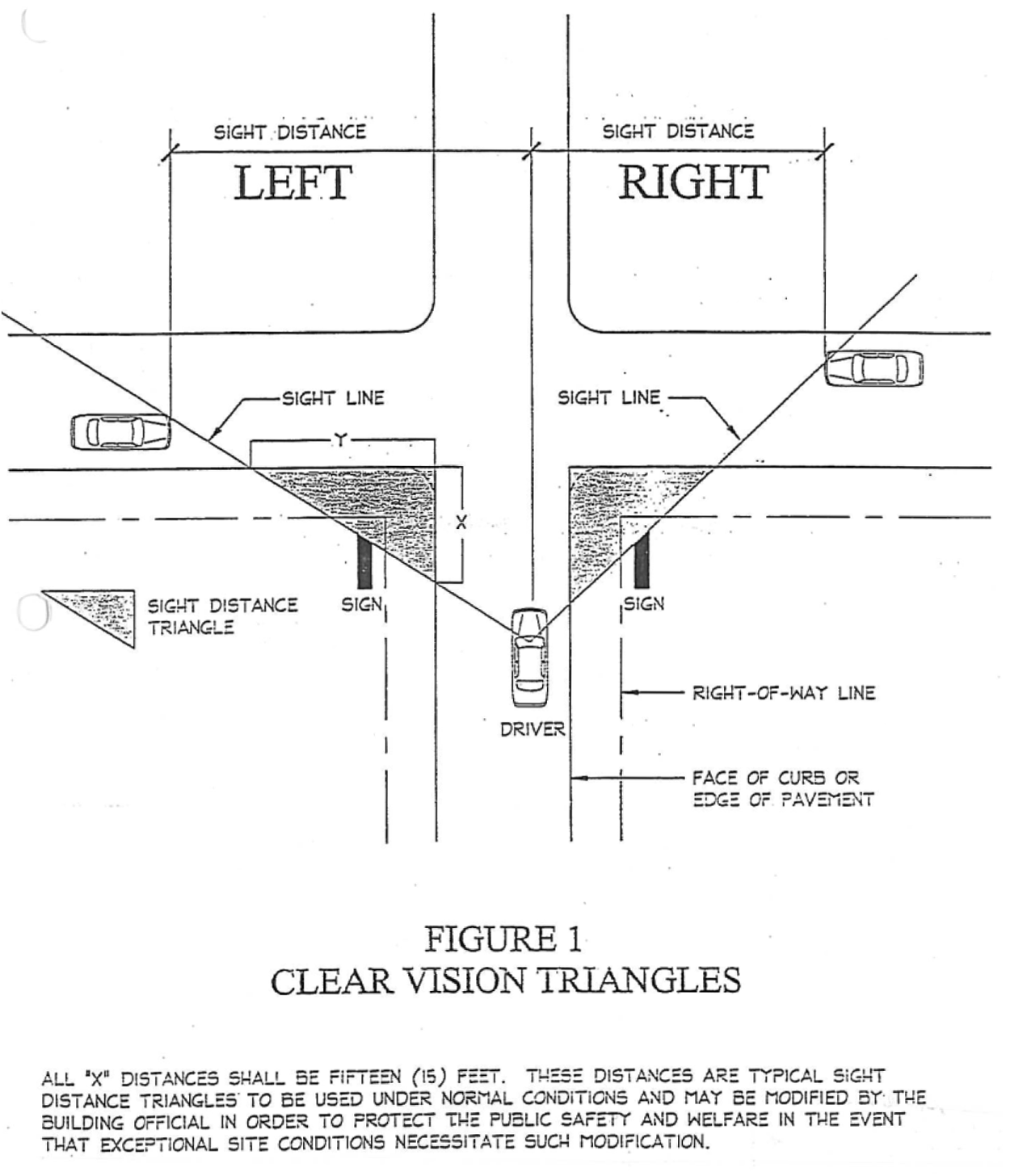
Clear vision triangle. No sign shall be placed within any clear vision triangle as illustrated in Figure 1 below.
(Code 1992, § 17.48.054; Ord. No. 10-1999, § 1(part), 1999)
Sec. 17.84.110. - Standards and limitations in nonresidential zones.
A.
The following standards and limitations shall apply to all signs in nonresidential zones:
1.
Off-premises signs. No off-premises sign (except ideological or election signs) shall be constructed in any nonresidential zone. No illumination shall be added to any off-premises sign already in existence.
2.
Special exceptions for off-premises signs. Off-premises signs may be permitted to compensate for certain problems pertaining to sign visibility and sign location within a business park or business complex. No permit for an off-premises sign may be issued unless a special exception for off-premises signage is given by the zoning board of adjustment. The zoning board of adjustment may grant a special exception if the location of a business within a business park, industrial park, business complex or group of businesses precludes the placement of a sign which is visible from a public street. If this condition exists, the following stipulations shall apply:
a.
Off-premises signs shall not be permitted within a residential zoning district.
b.
If a business which qualifies for a special exception under this section elects to erect an off-premises sign, it shall comply with the strictest freestanding sign regulations of the district in which it is located. The maximum size and height shall be as described in Table 17.84.140(B).
c.
Businesses within a business park or complex that elect to erect off premises signs shall combine all individual signs into a single directory sign. A directory sign may exceed the size requirements stated in Table 17.84.140(B) by a maximum of 25 percent. All height requirements stated in Table 17.84.140(B) shall be required.
3.
Election signs. Not to exceed 32 square feet per face, unlighted, no limit for number of signs.
4.
Ideological signs. No limit on number of signs, not to exceed 32 square feet per face.
5.
Flush wall signs, projecting wall signs, window signs, freestanding signs, and ground signs.
a.
For the first 200 feet in building frontage building length, the maximum sign area permitted shall be equal to two square feet of sign area for each linear foot of building frontage length.
b.
For that portion of a building frontage which exceeds 200 feet in length, the maximum sign area permitted shall be equal to one square feet of sign area for each linear feet of building frontage length over 200 feet. The sign area permitted hereunder shall be in addition to the sign area permitted in subsection A.5.a of this section.
c.
In no event shall the total sign allowance for any property be less than one square foot of sign allowance for each linear feet of lot frontage.
d.
The total sign allowance shall be calculated independently for each side of the building as permitted in subsections A.5.a and A.5.c of this section.
6.
Clear vision triangle. No sign shall be placed within any clear vision triangle as illustrated in Figure 1 which is set out in section 17.84.100.
(Code 1992, § 17.48.056; Ord. No. 10-1999, § 1(part), 1999)
Sec. 17.84.120. - Billboards.
Billboards are allowed within the corporate limits of the city subject to the following conditions and requirements being met:
A.
The maximum height of any billboard shall not exceed 16 feet and the bottom of any billboard shall not be less than ten feet from the ground.
B.
Billboards shall not have a face size in excess of 72 square feet per face side.
C.
All billboards shall be located and space at least 750 feet apart from any other billboard.
D.
Billboards shall be allowed only in B-G, I-G and I-L zoning districts as defined in this Code.
E.
Billboards shall not be allowed within 1,000 feet from the intersection of Bent Street and Coulter Avenue, excepting therefrom any billboard erected by the city for the purpose of directing the public to and/or identifying the downtown business area.
(Code 1992, § 17.48.060; Ord. No. 10-1999, § 1(part), 1999)
Sec. 17.84.130. - Building signs.
A.
For one- and two-story buildings, no building sign or combination of building signs and projecting signs shall exceed 250 square feet in area, except when used as a joint identification sign. For buildings not exceeding two stories in height, the gross surface area of signage shall not exceed three times the lineal feet of the wall on which it is to be attached, and shall not, in any event, exceed 250 square feet; for buildings over two stories in height up to ten percent of the wall area, not to exceed 1,000 square feet, may be used for signage.
B.
Flush or painted wall signs shall not project more than four inches from the wall to which attached when located more than eight feet above any pedestrian way, measured from the sign's bottom edge, if pedestrian or vehicle traffic is next to the wall. No flush wall or individual letter sign element attached to a building shall exceed seven feet in height. Flush wall and individual letter signs may not project more than 12 inches horizontally from the face of the building, mansard or similar architectural feature from which they are erected.
C.
Roof signs. Signs mounted on the roof of a building or structure or signs projecting above the peak of a roof are not allowed in any zone.
D.
Canopy signs. Any sign located on the face of a canopy shall comply with all requirements for a flush wall sign. No canopy sign shall project above the top of the canopy upon which it is mounted or project from the face of the canopy.
E.
No under-canopy sign shall exceed the width of the canopy upon which it is built in the case of a sign which is erected perpendicular to the building wall; in the case of a sign which parallels the building wall, the requirements of a flush wall sign shall apply; the bottom edge of the sign shall be at least eight feet above any pedestrian way.
F.
Projecting signs. A maximum of one projecting sign may project from the wall to which it is attached a maximum of six feet provided that such sign shall not, in any event, be located closer than 18 inches to the curbline. The sign shall be located at least ten feet above any pedestrian way, as measured from the lower point on the sign; the surface area shall not exceed 50 square feet.
1.
Projecting signs shall not exceed 15 square feet per face.
2.
No sign may project over a public right-of-way in any zone district, except that signs eight feet or more above grade may project up to 48 inches from the face of the building if the total area for such signs is the lesser of one square foot of sign for each linear foot of building.
G.
Not more than 50 percent of the total area of a building sign may be of manual changeable copy.
H.
Awning signs.
1.
No awning sign shall project above the top of the awning on which it is mounted. No awning sign shall project from the face of the awning. Awnings on which awning signs are mounted may extend over a public right-of-way no more than seven feet from the face of a supporting building. Awnings on which awning signs are mounted shall be at least eight feet above any public right-of-way, except that any valance attached to an awning may be no less than seven feet above a public right-of-way.
2.
Awning signs shall not be backlit, except for individual letters and business logos. The amount of signage on an awning shall be limited to the lesser of 35 square feet per individual tenant space or 25 percent of the total area of the awning.
(Code 1992, § 17.48.070; Ord. No. 10-1999, § 1(part), 1999)
Sec. 17.84.140. - Freestanding and ground signs.
A.
Ground signs, which exceed 42 inches in height, and freestanding signs, which do not maintain free-air space between a height of 42 inches and 72 inches above the adjacent street elevation, shall be set back from the right-of-way line a maximum distance as established in the sight distance triangle table. A freestanding sign is not considered to have free air space if the sign base width exceeds 50 percent of the width of the face or three feet, whichever is smaller. Freestanding and ground signs shall not be located closer to the right-of-way line than allowed in Tables 17.84.140B and C.
B.
The maximum size for ground or freestanding signs shall be 90 square feet per side. The maximum height for freestanding signs shall be 25 feet above grade. Bottom of sign face shall be a minimum of eight feet above grade. The maximum height for ground signs shall be 12 feet above grade. No freestanding or ground sign shall be built within 15 feet of any interior side lot line. The minimum horizontal distance between freestanding or ground signs located on the same lot shall be 75 feet. Refer to Table 17.84.140B, Requirements for Freestanding Signs.
C.
The maximum combined sign area of all faces of a freestanding or ground sign shall be two times the maximum sign area allowed per side, based on setback. Any limitation imposed under this section on the size of the face of a sign also shall apply to the entire side of the sign.
D.
The required setback of any freestanding or ground sign shall be measured from the street right-of-way line of the street frontage, which is the basis for the allotment of such sign. Any such setback shall be measured perpendicularly from the street right-of-way line to the nearest portion of the sign face or structure.
E.
When a freestanding or ground sign is placed on a lot with two or more street frontages, the sign shall be said to be adjacent to a particular street frontage when it is located closer to that street frontage than any other street frontage.
F.
No more than one freestanding or ground sign per street frontage shall be permitted for any property, except allowed election signs and allowed for sale or for rent signs.
G.
If a lot has more than one street frontage, the freestanding or ground sign permitted for each frontage must be located adjacent to the street frontage which is the basis for the allotment of the sign.
H.
The sign face of a single face sign must be more nearly parallel to the street frontage to which it is adjacent. The sign faces of a multi-face sign must be most nearly perpendicular to the street frontage to which they are adjacent.
I.
A drive-in restaurant, when located on a lot with frontage on only one street, shall be permitted one additional freestanding or ground sign for the sole purpose of a menu board for the drive-thru customers. Such sign shall not exceed five feet in height, 35 square feet in area, and shall be limited to one face. Fifty percent of the square footage of such a sign shall be excepted from the total allowed for the property.
J.
All supporting structures of ground signs shall be of the same or similar materials or colors of the allocated building which house the business or activities advertised on the sign.
K.
When electrical service is provided to freestanding or ground signs, it shall be underground.
Table 17.84.140(A). Sight Distance Triangle Setbacks
Note: for explanation of distances, see Figure 1, which is set out in section 17.84.100.
Table 17.84.140(B). Requirements for Freestanding Signs
Table 17.84.140(C). Requirements for Ground Signs
(Code 1992, § 17.48.080; Ord. No. 10-1999, § 1(part), 1999)
Sec. 17.84.150. - Joint identification signs.
A.
Two signs, only one of which may be freestanding, may be used to identify a commercial, industrial or professional center or complex. In the case of a multi-story building, an additional directory, not to exceed nine square feet, may be erected near the entrance identifying the businesses or professions located therein.
B.
In the case of a freestanding sign, the sign shall not exceed 350 square feet in area; the sign may display a directory of the businesses and/or professions located within the center or complex, along with the name and address of the center or complex, provided the information displayed is an integral part of the sign, the letters identifying the businesses or professions are uniform in height, and that such a sign will not be erected within 50 feet of a residential district.
C.
In the case of wall signs, the gross surface area of the sign shall not exceed 25 percent of the wall to which it is attached or 300 square feet, whichever is greater. The sign may display a directory of the businesses and/or professions located within the center or complex, provided the information displayed is an integral part of the sign and that the letters identifying the businesses or professions located within the center are uniform in height.
D.
All applications for sign permits required pursuant to this chapter shall include the location and dimensions for any sign or signs to be located on the property for which the application is being sought.
(Code 1992, § 17.48.090; Ord. No. 10-1999, § 1(part), 1999)
Sec. 17.84.160. - Residential development signs.
A.
In a subdivision, planned mobile home development or residential building complex, one identification sign per entrance may be erected to identify the development. The signs may be freestanding or attached to the building wall or fence. The signs shall display no more than the name and location of the building complex. The sign shall not exceed 35 square feet in total area and be no more than six feet in height.
B.
Identification signs during the construction of a development shall be subject to the following limitations:
1.
The maximum size for identification signs shall be 64 square feet in area per face.
2.
All such signs shall be located within the development and shall be subject to the following limitations:
a.
No more than one such sign shall be permitted on any single road bounding the development.
b.
Such signs must be at least 1,000 feet apart.
3.
Identification signs must be removed when the development is substantially complete.
(Code 1992, § 17.48.100; Ord. No. 10-1999, § 1(part), 1999)
Sec. 17.84.170. - Bulletin signs.
Bulletin signs may be erected for schools, churches and other similar public or private institutions subject to the following limitations:
A.
One sign shall be permitted on each street frontage if located on the same site as the principal building.
B.
No bulletin sign shall exceed 24 square feet in area.
C.
No bulletin sign shall be located closer than eight feet to any property line.
D.
Ground signs shall be permanently anchored to the ground and shall not exceed the height of six feet above the ground, measured from ground level to the top of the sign.
E.
Buildings constructed on the property line prior to the adoption of the ordinance from which this chapter is derived shall be allowed one bulletin sign, provided that such sign is a flat wall sign and attached to the building.
(Code 1992, § 17.48.110; Ord. No. 10-1999, § 1(part), 1999)
Sec. 17.84.180. - For sale signs.
For sale or for rent signs not exempted from the provisions of these regulations shall be subject to the following conditions:
A.
Only one such sign shall be permitted for each front lot line.
B.
No sign shall exceed 16 square feet in area, except in commercial and industrial districts, in which no sign shall exceed 64 square feet in area.
(Code 1992, § 17.48.120; Ord. No. 10-1999, § 1(part), 1999)
Sec. 17.84.190. - Temporary business signs.
A.
Each business is limited to one temporary business sign.
B.
The location of the sign must be approved by the building official.
C.
Temporary business signs may be displayed for a maximum of 60 days.
D.
Temporary signs may be illuminated but shall not flash.
E.
No temporary business sign shall exceed 32 square feet in area.
(Code 1992, § 17.48.130; Ord. No. 10-1999, § 1(part), 1999)
Sec. 17.84.200. - Temporary construction signs.
A.
No more than two such signs shall be allowed on any lot where construction or development is taking place.
B.
No sign shall exceed ten feet in height.
C.
The total area for any sign shall not exceed 64 square feet.
(Code 1992, § 17.48.140; Ord. No. 10-1999, § 1(part), 1999)
Sec. 17.84.210. - Off-premises signs.
Any building or freestanding sign allowed under this chapter may be used to advertise off-premises business or products as a substitute for a permitted sign on the same site where the building or freestanding sign is located. An application for a permit for an off-premises sign shall be accompanied by proof of consent to such use by the property owner. Off-premises signs must conform to the regulations that apply to that location.
(Code 1992, § 17.48.150; Ord. No. 10-1999, § 1(part), 1999)
Sec. 17.84.220. - Other types of signs.
Proposed signs not specifically permitted by this section may be constructed upon approval by the building official, provided that the proposed sign is compatible with all other applicable laws.
A.
Election signs. No election sign shall be allowed on a lot prior to 60 days before an election day; provided, however, that any person desiring an election sign to remain on a lot in any zone for a longer period may apply to the planning and zoning commission for a variance to extend the time period. All election signs shall be removed within five days after the election day.
B.
Electrical signs.
1.
Flashing, blinking or chasing effects shall be prohibited on all signs except time and temperature and reader board signs.
2.
Illuminated signs shall avoid the excessive concentration of illumination.
3.
Every electric sign shall have affixed thereon an approved Underwriter's Laboratories label, and all wiring connected to such sign shall comply with all provisions of the National Electrical Code, as adopted by the city.
C.
Commercial banners and pennants, standards and limitations.
1.
Temporary commercial and noncommercial banners and portable A-frame or sandwich style signs may be displayed up to 30 days per calendar year without a permit.
2.
Businesses that display temporary commercial banners or portable A-frame or sandwich style signs more than 30 days per year are required to obtain a two-year revocable permit from the city.
3.
All temporary commercial and noncommercial banners shall be flush and securely fastened to the building on which it is affixed and no such banner or pennant shall be draped or otherwise loosely hung. Temporary banners and pennants shall not be attached to fences or building canopies.
4.
The banner must be unlighted.
5.
The area of the display shall be deducted from the allowable sign area for the building or sign on which it is displayed.
6.
The area of the temporary commercial banner may not exceed 50 percent of the permitted sign area for the building or freestanding sign, depending upon how much sign is displayed.
7.
Only one temporary commercial banner or portable A-frame or sandwich style sign per property will be permitted.
8.
There is no limit to the number of days banners permitted by a two-year revocable permit can be displayed.
9.
This section shall not apply to banners permitted and/or otherwise regulated pursuant to chapter 5.52.
D.
Vehicle-mounted signs.
1.
The primary purpose of any vehicle upon which a vehicle-mounted sign is affixed must be to serve in the transportation or conveyance of persons or commodities.
2.
No sign shall be placed or erected in the bed of a truck or on the deck of a trailer truck.
3.
No vehicle upon which a vehicle-mounted sign is affixed may be parked on any lot for the primary purpose of directing or attracting the attention of the public to a building, institution, product, organization, event or located offered or existing other than the same lot where such vehicle is parked.
4.
Vehicle-mounted signs used in connection with a special event are exempted from the requirements of this section.
E.
Removal of sign. Whenever a business, industry, service or other use is discontinued, the sign pertaining to the use shall be removed by the property owner within 90 days.
(Code 1992, § 17.48.160; Ord. No. 10-1999, § 1(part), 1999)
Sec. 17.84.230. - Sign area measurement.
A.
The structure or bracing of any sign shall be omitted from measurement, unless such structure or bracing has been made an integral part of the message.
B.
Where a sign has two or more display faces, the area of all faces shall be measured, unless such faces join back to back, are parallel to each other and are no more than 24 inches apart.
C.
The area of any backing or background material that is a part of the sign display shall be included in the sign area to be measured.
D.
The area of any sign shall be measured by determining the sum of the area of each square, rectangle, triangle, circle or portion or combination of rectangles as are necessary to encompass letters or irregular dimensions.
E.
Individual letters and symbols with no background other than a building wall shall be measured by the minimum rectangular area necessary to encompass such letters or by a combination of rectangles as are necessary to encompass levers or irregular dimensions.
(Code 1992, § 17.48.170; Ord. No. 10-1999, § 1(part), 1999)
Sec. 17.84.240. - Maintenance.
All signs, including but not limited to the signs for which no permits or fees are required, shall be maintained in good structural condition at all times. All part thereof, except those of galvanized or rust-resistant construction shall be kept nearly painted at all times. Any sign which is in a dilapidated condition, not painted, not in a good state of repair, or which otherwise constitutes a threat to the health, safety or welfare of the public or of neighboring property owners, or has been abandoned, or constitutes a hazard for any other reason is declared a nuisance and subject to abatement as provided under title 8. The building official shall inspect and have the authority to order the painting, repair, or removal of any sign found to constitute a nuisance as provided herein.
(Code 1992, § 17.48.180; Ord. No. 10-1999, § 1(part), 1999)

