
San Clemente City Zoning Code
CHAPTER 17
40 - MIXED-USE ZONES AND STANDARDS4
Editor's note— Ord. No. 1609/1610, § 5(Exh. c, 1), adopted November 17, 2015, amended Ch. 17.40, in its entirety, to read as herein set out. Prior to inclusion of said ordinance, Ch. 17.40 pertained to similar subject matter. See also the Code Comparative Table and Disposition List for historical derivations.
17.40.010 - Purpose and Intent.
The General Plan details the goals, objectives, and policies for the City's mixed-use zones, including the establishment of active, pedestrian-oriented districts which enhance the quality of life and vitality of the City. It is the purpose of this chapter to implement the General Plan's vision for distinct mixed-use zones through development regulations that allow for the mixture of retail, office and residential uses within the same zone, while achieving a high level of architectural quality.
A combination of mixed-use zones and overlays are established to bring particular development standards for designated parcels within the downtown core, in the transitional areas near the core, in frontage areas on El Camino Real, within the North Beach, in the Pier Bowl and along the southern portion of El Camino Real east of Interstate 5, described in the following paragraphs.
A.
North Beach Mixed-Use (MU 1) Zone. A vertical or horizontal mix of Neighborhood Serving Commercial (NC) and Community Serving Commercial (CC), and multifamily housing on the second floor or higher. The North Beach area includes this zone to provide for a mix of uses and development standards similar to those within the Downtown transition area, while excluding stand-alone residential development.
B.
North El Camino Real Mixed-Use (MU 2) Zone. A vertical or horizontal mix of Neighborhood Serving Commercial (NC), Community Serving Commercial (CC), and multifamily housing. The North El Camino Real is a unique community and visitor serving hub for entertainment and coastal recreation. This zone is intended to support the fulfillment of this character and potential through adopted development standards. In large measure, the zone replicates the use provisions of the former C2 zone, which had allowed for a mix of uses.
C.
Downtown Mixed-Use (MU 3.0) Zone. The downtown area (MU 3.0) is defined in the San Clemente General Plan as the symbolic "core" of the City, maintaining its pedestrian-oriented village character. The MU 3.0 zone allows a vertical or horizontal mix of Neighborhood Serving Commercial (NC) and Community Serving Commercial (CC) — Attached and multifamily housing is permitted on the second floor or higher. Commercial development—(nonresidential uses) are allowed in this zone such as community and tourist-serving retail commercial, entertainment, restaurants, offices, institutional and public uses. Residential uses accompanying commercial development are accommodated within this zone. Along with enhancing the pedestrian nature of downtown, the inclusion of residential uses into commercial development will provide housing opportunities for employees and owners of commercial establishments, as well as others interested in living in the downtown area.
Many of the sites in the downtown area also have an Architectural (-A) Overlay District designation and/or a Central Business (-CB) District overlay designation. The requirements of these overlay districts affect the use, style and physical layout of projects. The overlay districts are described in Chapter 17.56, Overlay Districts and Standards, of this title. (Please refer to the City's Zoning Maps for the location of these overlay districts.)
The location of uses and parking within projects is particularly important to the pedestrian ambiance of this zone. In the CB Overlay District, pedestrian-oriented uses are to be located along the street and less pedestrian-oriented uses to the rear or above street facing spaces.
Throughout the MU 3.0 zone, residential units are encouraged above the street level of projects to provide housing opportunities for employees, owners of commercial establishments and others interested in living in the downtown area, as well as to make room for more pedestrian-oriented uses on the street level. The City may allow nonresidential uses included in Table 17.40.030, Permitted and Conditionally Permitted Uses within the Mixed-use Zone, on the same floor as residential uses (above street level) through the appropriate discretionary review process. Buildings are to be located along the street and parking is to be located behind buildings (or to the side of buildings when parking behind buildings is impossible) to maintain and promote an interesting sidewalk scene for the pedestrian, in accordance with the City's General Plan and Urban Design Guidelines. For specific requirements regarding the location of uses, please refer to Section 17.04.030.2, Special Use Regulations for the Downtown Mixed-Use (MU 3.0) Zone, and Section 17.56.030, Central Business (-CB) Overlay District, of this title, along with the City's General Plan and Urban Design Guidelines. The use of nonresidential space in this zone is vital to the pedestrian nature of the area. Nonresidential spaces must contain uses that serve clients and patrons that will visit the site. These spaces may not be merely used for storage for other businesses or for adjacent residential uses or be used as spaces that function in the same manner as home occupancy uses.
The scale, architectural style and physical layout of projects in the MU 3.0 zone are important to its pedestrian-oriented village character. In accordance with the General Plan, future development in this area is to be consistent in scale and character with the prevailing Spanish Colonial Revival buildings. For specific details, please refer to Section 17.56.020, Architectural (-A) Overlay District, of this title, along with the City's General Plan and the Urban Design Guidelines.
D.
Downtown Transition Mixed-Use (MU 3.1) Zone. A vertical or horizontal mix of Neighborhood Serving Commercial (NC), Community Serving Commercial (CC), and multifamily housing. Also, standalone residential uses are allowed. This zoning category provides providing for a transitional level of development surrounding the Downtown Core. Important distinctions regarding height and design form, plus an allowance for stand-alone residential development, distinguish this zone from the MU 3.0 zone.
E.
El Camino Real South, West of Interstate 5 Mixed-Use (MU 3.2) Zone. A vertical or horizontal mix of Neighborhood Serving Commercial (NC), Community Serving Commercial (CC), and multifamily housing. This zone is particularly applied to parcels fronting the west side of El Camino Real and backing onto the parallel alley west of El Camino Real, southward of Downtown and northward of the Interstate 5 overcrossing. These particular parcels average approximately 100 feet in depth and slope downward from El Camino Real. The alley at the rear of these parcels abuts the single family residential (RL) zone. The intent of the MU 3.2 zone is to provide for commercial development fronting El Camino Real and mixed use development opportunity while respecting the scale of development on the neighboring residential areas.
F.
Downtown/Residential Allowance Area Mixed-Use (MU 3.3) Zone. A vertical or horizontal mix of Neighborhood Serving Commercial (NC) and multifamily housing. A series of parcels on Avenida Del Mar, Calle Seville, and Avenida Granada, southwest of South Ola Vista, which have been developed as residences can contribute to the scale and design of the downtown area while allowing for residential uses into the future.
G.
El Camino Real South, East of Interstate 5 Mixed-Use (MU 5) Zone. Neighborhood Serving Commercial (NC) commercial uses or multifamily housing. The MU 5 land-use designation accommodates commercial and residential development within the same zone, but limits development such that commercial and residential uses cannot exist on the same lot. The standards for this zone include a requirement that the type of use allowed, residential or commercial, depends upon whether large contiguous areas of that use exist.
(Ord. No. 1609/1610, § 5(Exh. C, 1), 11-17-2015; Ord. No. 1638, § 3(Exh. A, § 3), 1-17-2017; Ord. No. 1652, § 4, 5-15-2018)
17.40.020 - Residential Densities in Mixed-Use Zones.
This title limits the maximum and minimum residential density for each mixed-use zone; however, the density allowed for any residential project within the City may be limited further through the appropriate discretionary review process, when discretionary review is provided for in this title. The City Planner, Zoning Administrator, Planning Commission and/or City Council shall have the authority to reasonably condition any residential development subject to discretionary review to ensure proper transition to and compatibility with adjacent developments, existing or proposed.
(Ord. No. 1609/1610, § 5(Exh. C, 1), 11-17-2015; Ord. No. 1803, § 4(Exh. A), 4-21-2026)
17.40.030 - Mixed-Use Regulations.
A.
Permitted and Conditionally Permitted Uses.
1.
General Requirements. The uses identified in Table 17.40.030, Mixed-Use Zone Uses, shall be the primary uses allowed to occur on a property. All uses except for those provided for in Sections 17.28.210, Outdoor Display Areas and 17.28.300, Temporary Uses and Structures, of this title shall be conducted within enclosed structures. The primary uses identified in Table 17.40.030 shall be permitted or conditionally permitted, as indicated.
2.
Special Use Regulations.
a.
Residential and Nonresidential Uses on the Same Building Floor. In vertical mixed-use projects, nonresidential uses may be permitted on the same building floor as a residential use with the approval of a Conditional Use Permit, in accordance with Section 17.16.060, Conditional Use Permits, of this title.
b.
Review of the Location of Pedestrian and Non-pedestrian Uses in the Central Business Overlay (-CB). Non-pedestrian uses, as defined in Section 17.56.030, Central Business District Overlay, are discouraged in pedestrian-oriented spaces, also defined in Section 17.56.030, Central Business District Overlay, and shall be allowed in such spaces through the discretionary review processes indicated in Table 17.40.030, Permitted and Conditionally Permitted Uses within Mixed-Use Zones. For specific criteria for the location of pedestrian and non-pedestrian uses in pedestrian spaces, please refer to Section 17.56.030, Central Business District Overlay, for provisions for the Central Business District Overlay.
c.
Location of Residential Uses.
i.
MU 1, MU 2, MU 3.0, and MU 3.2 zones. Residential uses shall be limited to floors above street level in MU 1, MU 2, and MU 3.0 zones. In the MU 3.2 zone, residential uses shall be limited to floors above street level where floor area is located within 25 feet of South El Camino Real. Lobbies, entryways, and other non-habitable space for residential uses shall be allowed on the street level.
ii.
MU 3.1 and MU 3.3 zones. Residential uses may be on the ground level in MU 3.1 and MU 3.3 zones.
iii.
MU 5 zone. For residential uses in the MU 5 zone, please refer to Section 17.40.050(A), Residential Use Restrictions for MU 5.
d.
The Use of Non-residential Space. Non-residential spaces shall contain uses that serve clients and patrons that will visit the site. These spaces may not be merely used for storage for other businesses or for adjacent residential uses or be used in the same manner as home occupancy businesses.
e.
Location of Parking. Parking shall be located behind buildings or to the side of buildings when parking behind buildings is impossible.
B.
Prohibited Uses. .....The following uses are prohibited:
1.
Uses that are listed in Table 17.40,030 but that are not identified as either permitted — "P" — or conditionally-permitted — "MC," "C," or "O"; and
2.
Uses that are excluded from Table 17.40.030, unless they are found by the City to be similar to permitted or conditionally-permitted uses.
3.
Uses where a blank cell appears in Table 17.40.030.
4.
As indicated in Table 17.40.030, the following uses are not permitted in any mixed-use zone:
a.
Marijuana Manufacturing.
b.
Marijuana Testing Laboratory.
c.
Marijuana Delivery.
d.
Marijuana Dispensary.
5.
The cultivation of Industrial hemp, as defined in Section 11018.5 of the California Health and Safety Code, is not permitted in any mixed-use zone to the fullest extent allowed by state law.
Table 17.40.030
Mixed-Use Zone Uses
1. Refer to Section 17.28.120, Convenience Stores/Retail Establishments Selling Convenience Items, of this title.
2. Refer to Section 17.28.090, Bed and Breakfast.
3. Refer to Section 17.56.030 Central Business (-CB) Overlay District. This use is potentially subject to locational criteria within a structure based on its compatibility with the objectives of creating or maintaining pedestrian-oriented space in the Central Business Overlay District. A Minor Conditional Use Permit is required to allow non-pedestrian uses in pedestrian-oriented space, as defined in Section 17.56.030.
4. Refer to Section 17.28.110, Congregate Care Facilities.
5. Refer to Section 17.28.100, Child Day Care Facilities.
6. Small-family and large-family day care homes are permitted in a detached single-family dwelling, a townhouse, a dwelling unit within a dwelling, or a dwelling unit within a covered multi-family dwelling in which the underlying zoning allows for residential uses, or a legal non-conforming single-family dwelling unit in a nonresidential zone. Small-family and large-family day care homes only shall operate in buildings that were lawfully constructed.
7. Refer to Section 17.28.220, Parking Lots.
8. Refer to Section 17.28.230, Public Park Facilities.
9. Refer to Section 17.28.240, Public Utilities.
10. Qualified Affordable Housing Developments and Senior Housing Projects are permitted uses in the subject zoning district only if the properties are located in the Housing Overlay, pursuant to Section 17.56.090. Qualified Affordable Housing Development Projects may provide residential units on the ground floor if necessary to meet density allowances as set forth in Objective Design Standards Section 17.56.090.
11. Refer to Section 17.28.190, Mobile Homes.
12. Refer to Section 17.36.040, Planned Residential District Overlay.
13. Refer to Section 17.40.020.A.2 for special use requirements that apply to residential uses.
14. Residential uses may be located on the ground level in the MU 3.1, MU 3.3, and MU 5 zones. For residential uses in the MU 5 zone, please refer to Section 17.40.050(A), Residential Use Restrictions for MU 5.
15. Refer to Section 17.28.280, Senior Housing Projects.
16. Refer to Section 17.28.260, Drive-Throughs.
17. Refer to Section 17.24.040, Accessory Buildings.
18. Refer to Section 17.28.040, Alcoholic beverages and motor vehicle fuel, concurrent sale of, of this title, for special provisions for concurrent sales of motor fuel and alcoholic beverages.
19. Refer to Section 17.28.050, Amusement Centers.
20. Refer to Section 17.28.130, Grading.
21. Massage is subject to Section 5.28 of the City of San Clemente Municipal Code. Refer to Section 17.28.185, Massage Establishments, of this title, for special provisions for massage establishments. To the extent otherwise allowed, Accessory Massage is permitted only in the commercial portion of a mixed-use building.
22. The provisions for amusement centers shall apply to poolhalls. Refer to Section 17.28.050, Amusement Centers.
23. Refer to Section 17.28.250, Recycling Facilities.
24. Refer to Section 17.28.305, Urban Private Storage.
25. Refer to Section 17.28.320, Vehicle Service and Repair-Related Facilities.
26. A boarding house may not be located within 300 feet of any other boarding house measured by following a straight line without regard to intervening buildings from the nearest point of the parcel on which the proposed boarding house is to be located to the nearest point of the parcel that contains the existing boarding house. No more than one boarding house is allowed on a legal parcel.
27. Refer to Section 17.28.292, Short-Term Lodging Units, of this title for special provisions for STLUs and STARs.
28. Refer to Section 17.28.320, Vehicle Service and Repair-Related Facilities.
29. A boardinghouse may not be located within 300 feet of any other boardinghouse measured by following a straight line without regard to intervening buildings from the nearest point of the parcel on which the proposed boardinghouse is to be located to the nearest point of the parcel that contains the existing boardinghouse. No more than one boardinghouse is allowed on a legal parcel.
30. Refer to Section 17.28.292, Short-Term Lodging Units, of this title for special provisions for STLUs and STARs.
31. But if the boardinghouse is a Residential Care Facility (as defined by Section 17.88.030), allowed administratively under Chapter 5.38 (Residential Care Facility Boardinghouse—Streamlined Administrative Approval).
32. Market Rate Residential or Mixed Use projects proposing four or fewer units that meet the applicable objective design standards contained in Chapter 17.26 shall be permitted ministerially. Market Rate Residential or Mixed Use projects proposing five or more units and those that do not meet the objective design standards shall be considered as part of a discretionary review process.
33. Qualified Affordable Housing Developments, Senior Housing, and Market Rate Residential projects shall not be allowed to convert existing hotel/motel uses which have provided lower cost visitor serving accommodation in the last five years, unless the project provides equivalent new lower cost visitor serving accommodation or unless required to be approved pursuant to State law.
(Ord. No. 1609/1610, § 5(Exh. C, 1), 11-17-2015; Ord. No. 1613, § 5(Exh. A, 6, 7), 1-19-2016; Ord. No. 1616, § 9, 2-2-2016; Ord. No. 1622, § 10, 5-17-2016; Ord. No. 1632, § 3(Exh. A, §§ 7, 8), 11-15-2016; Ord. No. 1638, § 3(Exh. A, § 4), 1-17-2017; Ord. No. 1652, § 4, 5-15-2018; Ord. No. 1681, § 6, 10-15-2019; Ord. No. 1707, § 3, 2-2-2021; Ord. No. 1745, §§ 8, 9, 12-20-2022; Ord. No. 1759, § 3(Exh. A), 10-3-2023; Ord. No. 1784, § 4(Exh. A), 12-10-2024)
17.40.040 - Mixed-Use Zone General Development Standards.
The following property development standards shall apply to all land and permitted or conditionally permitted buildings located within their respective mixed-use zones.
A.
The Creation of New Lots. The creation of new lots within mixed-use zones following the date of adoption of this title shall conform to the minimum dimensions for lots established within this zone, except in the case of condominium lots or individual lots within a shopping center, in which case minimum dimensions shall be applied to the boundaries around the entire center. Parcels created within shopping centers are exempt from the site development standards Stated herein, as they relate to minimum site areas, and minimum lot width and depth, as long as the following conditions are met:
1.
A conceptual development plan for the entire center has been developed and approved pursuant to the provisions of this title;
2.
Easements for reciprocal access, parking and maintenance are recorded in a form approved by the City Attorney, and maintained; and
3.
All applicable setbacks adjacent to the exterior boundaries of the shopping center or mixed-use development are met.
B.
General Development Standards. Table 17.40.040A, Mixed-Use Zone Development Standards, lists the site development standards required for mixed-use development projects.
Table 17.40.040A
Development Standards All Mixed-Use Zones
Table 17.40.040B
MU 1 Development Standards
Table 17.40.040C
MU 2 Development Standards
Table 17.40.040D
MU 3.0 Development Standards
Table 17.40.040E
MU 3.1 Development Standards
Notes to MU 3.1, Development Standards, "Parking":
1 This exception is made for the Downtown Parking Study Area because of the results of Downtown, North Beach, and Pier Bowl Parking Needs Assessment completed in 1995. The study found that there was an excess supply of parking space within the Study Area for the uses existing at the time of the study, even considering that a number of lots within the Study Area are nonconforming as to parking. When requests for alterations of use and additional square footage are considered by the City, only the net increase in parking requirements will be assessed, as opposed to requiring that projects make up for existing parking deficiencies within a site.
2 Example: If an existing retail establishment currently requiring four parking spaces wishes to convert to a restaurant requiring seven parking spaces, the net increase in parking requirements is three spaces. To be permitted by the City, the restaurant in this example would have to be able to cover the net increase of three parking spaces. The following table illustrates the additional parking spaces that the restaurant would need to provide to be approved:
Table 17.40.040F
MU 3.2 Development Standards
Table 17.40.040G
MU 3.3 Development Standards
Notes to MU 3.3, Development Standards, "Parking":
1 This exception is made for the Downtown Parking Study Area because of the results of Downtown, North Beach, and Pier Bowl Parking Needs Assessment completed in 1995. The study found that there was an excess supply of parking space within the Study Area for the uses existing at the time of the study, even considering that a number of lots within the Study Area are nonconforming as to parking. When requests for alterations of use and additional square footage are considered by the City, only the net increase in parking requirements will be assessed, as opposed to requiring that projects make up for existing parking deficiencies within a site.
2 Example: If an existing retail establishment currently requiring four parking spaces wishes to convert to a restaurant requiring seven parking spaces, the net increase in parking requirements is three spaces. To be permitted by the City, the restaurant in this example would have to be able to cover the net increase of three parking spaces. The following table illustrates the additional parking spaces that the restaurant would need to provide to be approved:
Table 17.40.040H
MU 5 Development Standards
(Ord. No. 1609/1610, § 5(Exh. C, 1), 11-17-2015; Ord. No. 1652, § 4, 5-15-2018)
17.40.050 - Mixed-Use Zone Special Development Standards.
This section and Chapter 17.24, General Development Standards, of this title, includes a number of special provisions affecting mixed-use properties. Unless otherwise indicated in the referenced sections, or in other City documents regulating mixed-use development, the development standards listed in Chapter 17.24, General Development Standards, of this title shall apply to all zones described in this chapter.
Table 17.40.050
Special Development Standards for All Mixed-Use Zones
A.
Restrictions for MU 5 (Minimum Contiguous Use). In order to maintain and enhance the compatibility of existing land uses in the MU 5 zone, the development of a vacant site or demolition of an existing primary structure and construction of new primary structure on a site in this zone shall comply with the following standards:
1.
Nonresidential development is required on a site when the development would result in a minimum of 20,000 square feet of contiguous lot area devoted to nonresidential development within a block;
Figure 17.40.050A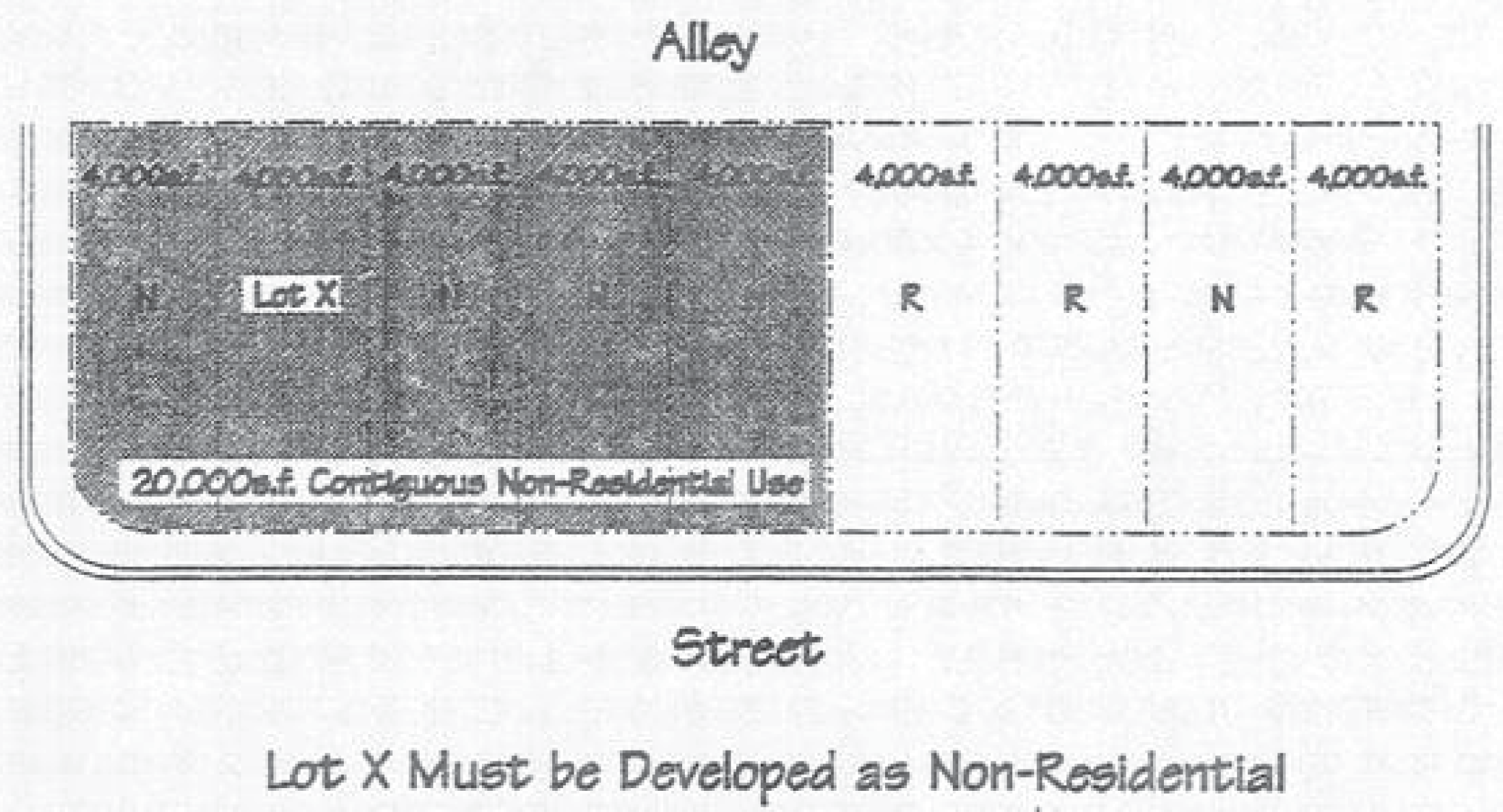
2.
Residential development is required on a site when the development would result in a minimum of 20,000 square feet of contiguous lot area devoted to residential development within a block;
3.
A choice of nonresidential or residential development is allowed on a site when the following conditions exist:
a.
The development of the property would result in a minimum of 20,000 square feet of contiguous lot area devoted to both nonresidential and residential development within a block; or
b.
The subject site is a corner lot; or
c.
Any other circumstances not addressed by the restrictions described in this section.
Figure 17.40.050B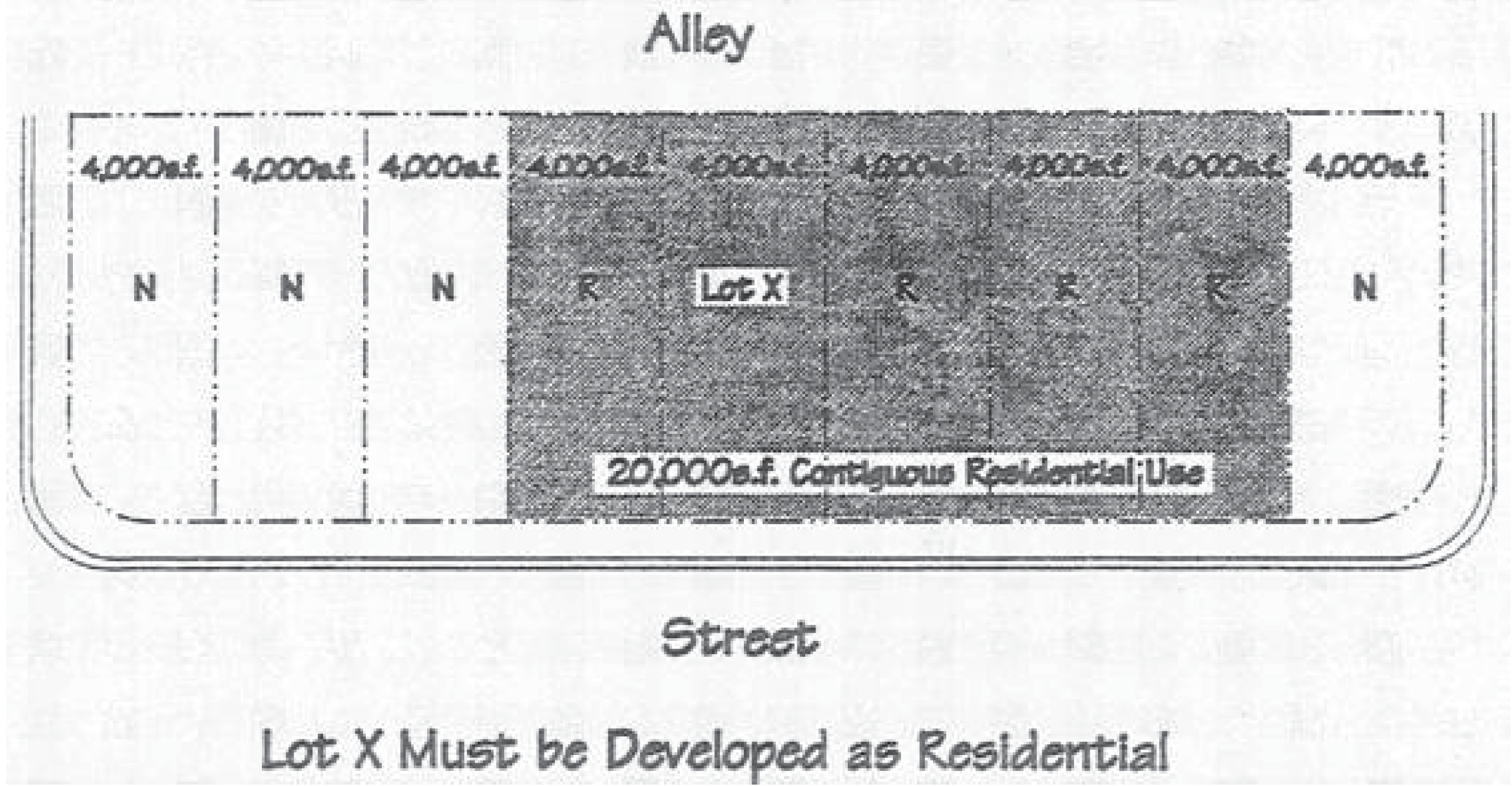
Contiguous lot area, for the purpose of this standard, includes the lot area of contiguous adjacent parcels which are currently developed with the use in question (residential or nonresidential). Contiguous lot area is calculated within blocks. Parcels located on adjacent blocks are not counted in contiguous lot area calculations.
Figure 17.40.050C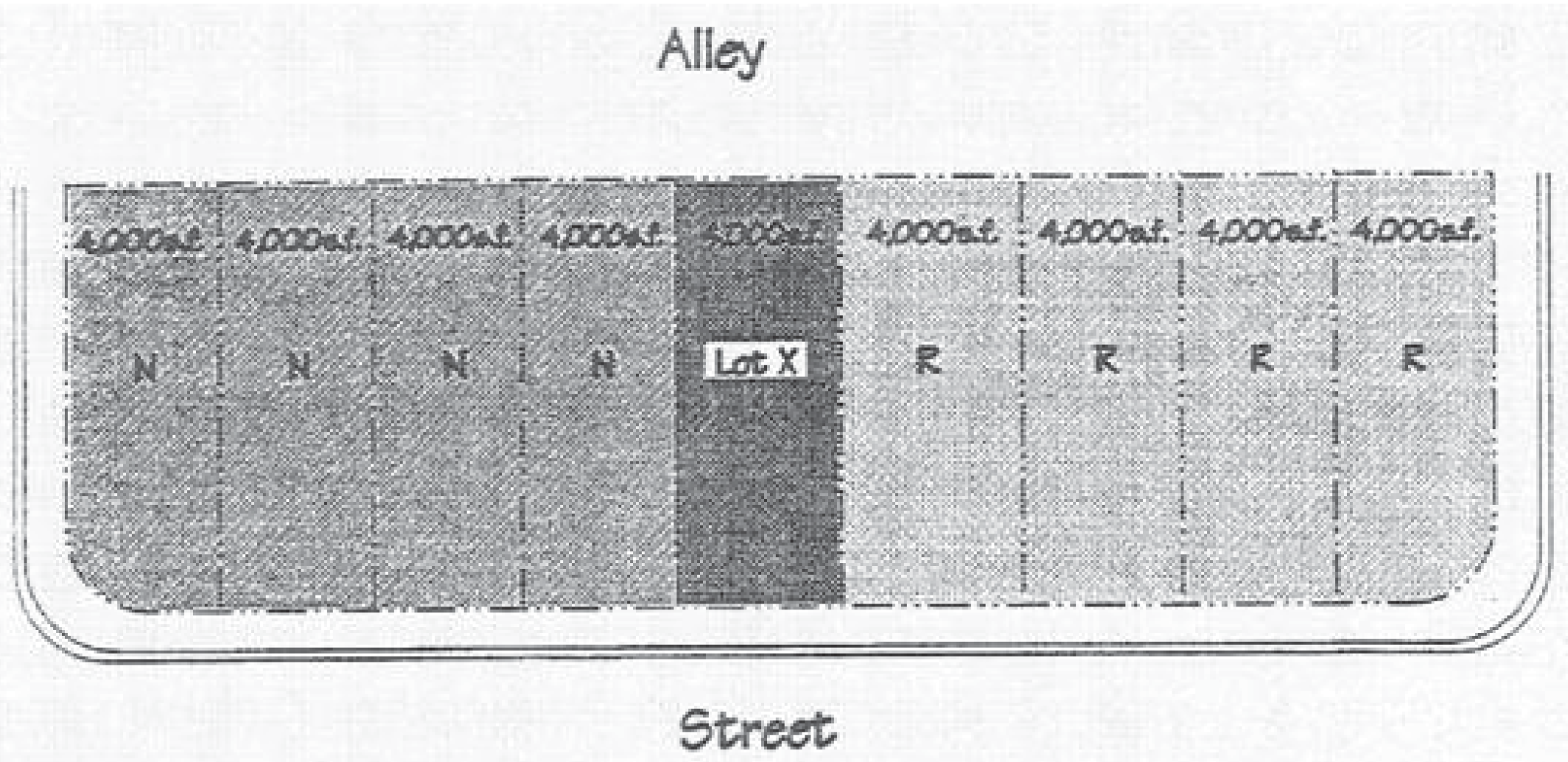
B.
Minimum Dwelling Unit Size for Mixed-Use Projects. For mixed use projects, the minimum unit size for dwelling units shall be 600 square feet of habitable floor area. Exceptions to this standard may be granted by the City for affordable or senior housing, through the discretionary review process required for the project.
C.
Exceptions to the Development Standards for Lots of 12,000 Square Feet or Smaller.
1.
Exceptions. Development of commercial and mixed-use projects on lots of 12,000 square feet or smaller shall comply with the standards of Mixed Use zones, except for the following:
a.
Minimum Commercial Floor Area for Mixed-Use Projects. With approval of a Conditional Use Permit, the minimum commercial floor area requirement for mixed-use projects may be reduced from .35 to .15 when the following criteria apply:
i.
The project site is 12,000 square feet or smaller in size.
ii.
The maximum floor area of the mixed-use project has been limited to 1.2 or smaller.
b.
Maximum Height Limit for Mixed-Use Projects. With approval of a Conditional Use Permit, three stories, with 45 feet to top-of-roof and 37 feet to plate, may be allowed for mixed-use projects on lots 12,000 square feet or smaller, if the following finding can be made in addition to the other findings required for exceptions for mixed-use projects on small lots and the general findings for Conditional Use Permits:
The Planning Commission has reviewed and considered the project in light of the design guidelines of the City and all appropriate appendices, and finds the project to be acceptable in terms of height, massing, scale and compatibility with and/or sensitivity to neighboring projects.
c.
Total Parking Space Requirement for Mixed-Use Projects on Lots of 6,000 Square Feet or Smaller. When the calculation of the total number of parking spaces required for a mixed-use project is a number less than five (e.g. 4.9), then the number may be rounded down, with approval of a Conditional Use Permit, if all of the following conditions apply:
d.
Landscaping for Commercial and Mixed-Use Projects. The following reductions in the landscaping required in Section 17.68.050(C)(b), Urban Open Area Requirement, of this title, may be granted with approval of a Minor Exception Permit:
e.
Miscellaneous Parking Requirements for Existing Development Being Converted to a Mixed-Use Project on Lots 6,000 Square Feet or Smaller. When a commercial or residential project legally existing prior to May 16, 2001, is being converted to a mixed-use project, then the requirements for covered parking, parking location, parking space size and parking-related landscaping found in this chapter may be reduced with approval of a Conditional Use Permit, and if all of the following findings can be made in addition to the other findings required for exceptions for mixed-use projects on small lots and the general findings for Conditional Use Permits.
i.
No square footage is being added to the project;
ii.
There is not net increase in the number of parking spaces required for the project, as defined in Table 17.40.040, Mixed-use Zone Development Standards, footnote 9. The requirement for covered parking spaces is waived for no more than two parking spaces;
iii.
The conversion improves the quality of the project and the neighborhood;
iv.
The conversion contributes to the goals established for the land use designation, as defined in the City's General Plan, the purpose and intent established for the zone, as defined in the Zoning Ordinance, and compliance with the guidelines, as defined in the Design Guidelines of the City; and
v.
Except for the parking requirements being waived, the project meets the intent of the Design Guidelines of the City and all appropriate appendices, as they relate to parking.
2.
Required Findings for Exceptions. Prior to approving a Minor Exception Permit or Conditional Use Permit, whichever is required, for exceptions allowed in this section, all of the following findings must be made along with the general findings required for the approval of a Minor Exception Permit or Conditional Use Permit, whichever is required:
a.
Because of the limited size of the lot, the exception(s) is (are) reasonably necessary to accommodate development that fulfills the purpose and intent of the zone and relevant overlay zones;
b.
The project meets the intent of the Design Guidelines of the City and all appropriate addendums as it relates to projects in this zone.
D.
Exceptions to the Minimum Floor Area Requirements for the Commercial Portion of Mixed-Use Projects for Buildings on the City's Designated Historic Structure List in Mixed-Use Zones.
1.
Exceptions. Structures on the City's Designated Historic Structures List and located in mixed-use Zones may be excepted from the minimum floor area requirements for the commercial portion of mixed-use projects through a Conditional Use Permit, in accordance with Section 17.16.060, Conditional Use Permits.
2.
Required Findings for Exceptions. Prior to approving a Conditional Use Permit for an exception to the minimum commercial floor area for mixed-use projects allowed in this section, all of the following findings must be made along the general findings required for the approval of a Conditional Use Permit:
a.
The project contains commercial floor area that meets the intent of the zone;
b.
The exception is necessary to maintain the historical integrity of the structure;
c.
The project meets the intent of the City's Urban Design Guidelines, as it relates to projects in this zone.
E.
Exceptions to the Development Standards for Mixed-Use 3.2 Zone on Lots of 8,000 Square feet or Smaller.
1.
Exceptions. Development of mixed-use projects on lots of 8,000 square feet or smaller shall comply with the standards of mixed-use zones, with the following exceptions that may be granted through a Conditional Use Permit, in accordance with Section 17.16.060, of this title.
a.
Minimum Commercial Floor Area for Mixed-Use Projects. The minimum commercial floor area requirement for mixed-use projects may be reduced from .35 to .15 when the following criteria apply:
i.
The project site is 8,000 square feet or smaller in size.
ii.
The maximum floor area of the mixed-use project has been limited to 1.2 or smaller.
2.
Required Findings for Exceptions. Prior to approving a Conditional Use Permit for exceptions allowed in this section, all of the following findings must be made along with the general findings required for the approval of a Conditional Use Permit:
a.
Because of the limited size of the lot, the exception(s) is (are) reasonably necessary to accommodate development that fulfills the purpose and intent of the zone and relevant overlay zones;
b.
The project meets the intent of the Design Guidelines of the City and all appropriate addendums as it relates to projects in this zone.
F.
Building Height and Stories in the Downtown Core. In the Downtown Core, building height shall not exceed 33 feet or two stories. On sloping sites, the City Council may grant an exception to allow three-story buildings up to 35 feet in height. To grant an exception, the City Council must make each of these findings:
1.
The proposed building façade, as viewed from the public sidewalk located immediately adjacent to the site, would not exceed 35 feet or two stories.
2.
The site's topography allows a "stepped" building design to reduce apparent height, especially when viewed from Avenida Del Mar or El Camino Real.
3.
The proposed building's design is consistent with Design Guidelines and the General Plan Urban Design Element's requirements.
4.
The development project is consistent with the Zoning Ordinance.
(Ord. No. 1609/1610, § 5(Exh. C, 1), 11-17-2015; Ord. No. 1652, § 4, 5-15-2018; Ord. No. 1759, § 3(Exh. A), 10-3-2023; Ord. No. 1803, § 4(Exh. A), 4-21-2026)

