
San Clemente City Zoning Code
CHAPTER 17
88 - DEFINITIONS
17.88.010 - Purpose and Intent.
The purpose of this chapter is to ensure precision in interpretation of this title. The meaning and construction of words and phrases defined in this chapter apply throughout this title, except where the context of such words or phrases clearly indicates a different meaning or construction.
(Ord. 1172 § 3 (part), 1996)
17.88.020 - General Interpretation.
A.
.....The word "shall" is mandatory and not discretionary. The word "may" is permissive and discretionary.
B.
.....The word "should" indicates a guideline that must be followed in the absence of compelling considerations to the contrary.
C.
.....In the case of any difference of meaning or implication between the text of any provision and any caption or illustration, the text shall control.
D.
.....References in the masculine and feminine genders are interchangeable.
E.
.....Unless the context clearly indicates to the contrary, words in the present and the future tense are interchangeable, and words in the singular and plural are interchangeable.
F.
.....Unless the context clearly indicates to the contrary, the following conjunctions shall be interpreted as follows:
1.
"And" indicates that all connected items or provisions shall apply;
2.
"Or" indicates the connected items or provisions apply singly; and
3.
"And/or" indicates the connected items or provisions may apply singly or in any combination; and
4.
"Either...or" indicates that the connected items or provisions shall apply singly but not in combination.
G.
.....The word "used" shall include arranged, designed, constructed, altered, converted, rented, leased, occupied, or intended to be utilized.
H.
.....The words "City Planner" shall mean the City Planner of the City or designee.
I.
.....The words "City Engineer" shall mean the City Engineer of the City or designee.
J.
.....The words "Building Official" shall mean the Building Official of the City or designee.
K.
.....The words "Community Development Director" shall mean the Community Development Director of the City or designee.
L.
.....The words "Public Works Director" shall mean the Public Works Director of the City or designee.
M.
.....The words "City Manager" shall mean the City Manager of the City or designee.
N.
.....The words "Zoning Administrator" shall mean the Zoning Administrator of the City or designee.
O.
.....The words "Planning Commission" shall mean the City Planning Commission.
P.
.....The words "Design Review Subcommittee" shall mean the San Clemente Design Review/Cultural Heritage Subcommittee of the Planning Commission.
Q.
.....The word "Council" shall mean the City Council, the governing body of the City.
R.
.....The words "Coastal Commission" shall mean the California Coastal Commission established pursuant to the California Coastal Act (Division 20 of the Public Resources Code).
S.
.....The word "City" shall mean the City of San Clemente.
T.
.....The word "County" shall mean the County of Orange.
U.
.....The word "State" shall mean the State of California.
V.
.....The words "Zoning Ordinance" or "this title" shall mean Title 17 of the municipal code of the City.
W.
.....The words "General Plan" shall mean the General Plan of the City.
X.
.....The word "code" shall mean the municipal code of the City.
(Ord. 1172 § 3 (part), 1996)
17.88.030 - Definitions.
In cases where a term is not defined below, the City Planner has authority to use Merriam-Webster Dictionary or other similar reference to define the meaning of terms, and to interpret terms that may influence decisions.
A
"Abutting" means having a common border with, or being separated from such a common border by a right-of-way, alley or easement. Properties separated by a street, alley, intersection, or other public right-of-way (other than an elevated interstate freeway), shall be considered abutting when their property lines would touch in any way if drawn to the center line of such street, alleyway, intersection, or other public right-of-way.
Figure 17.88.030A
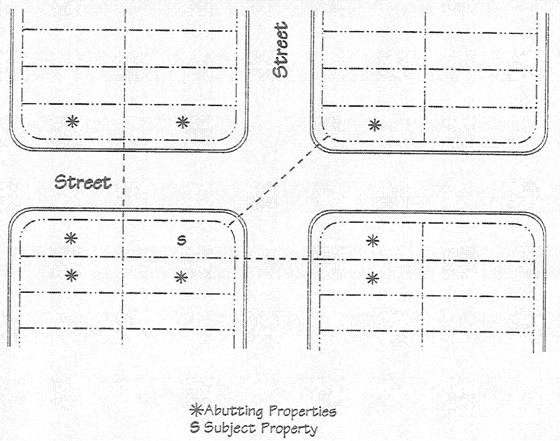
Figure 17.88.030B
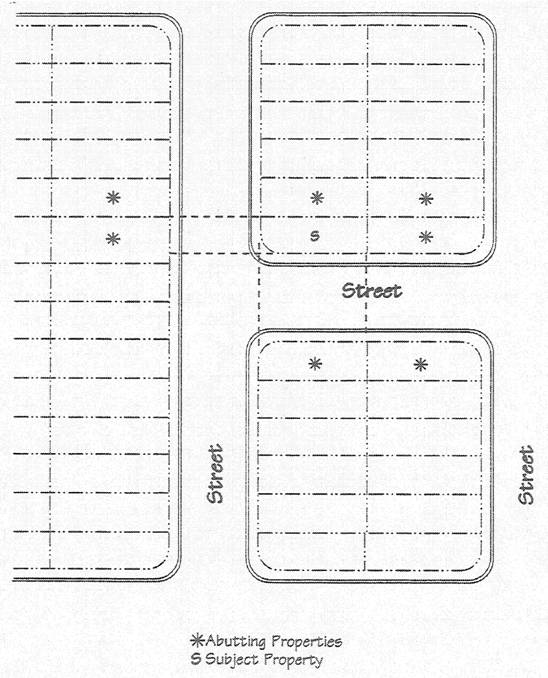
Figure 17.88.030C
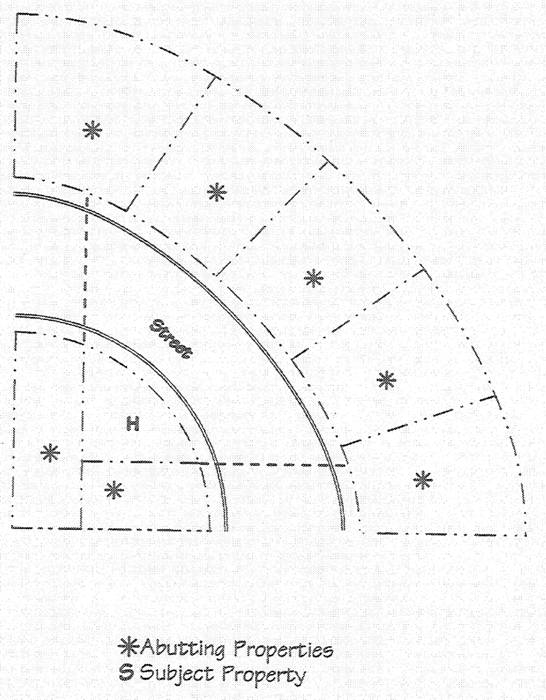
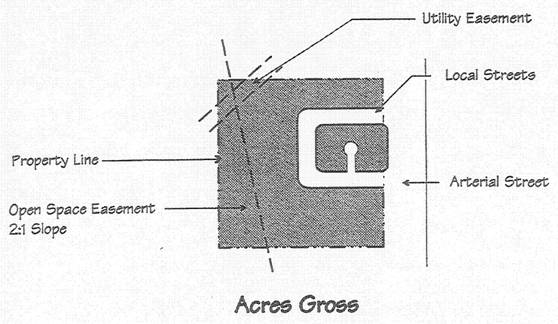
Figure 17.88.030D
Accessory Building. See "building, accessory."
"Accessory Dwelling Unit" ("ADU") means a residential dwelling unit that is detached from, attached to, or located within the living area of an existing primary dwelling unit, and that provides complete independent living facilities with permanent provisions for sleeping, eating, cooking, and sanitation facilities for one (1) or more persons. An accessory dwelling unit also includes an efficiency unit, as defined in California Health and Safety Code Section 17958.1, and a manufactured home, as defined in Section 18007.
"Accessory Use" means a use incidental or subordinate to, and devoted exclusively to the main use of a lot or a building located on the same lot or building site. Such uses include, but are not limited to, outdoor dining, nursery school play yards, automobile dealership display lots, and plant nurseries. No such use shall intrude upon the public right-of-way without an encroachment permit issued pursuant to the Municipal Code. See "use, accessory."
Accessory Structure. See "structure, accessory."
"Accessory tobacco sale use" means an accessory use at a grocery store, supermarket, convenience store, retail kiosk, or similar primary use, where no more than two percent (2%) of a business' gross floor area is used for the display or retail sales of conventional cigars, cigarettes, e-cigarettes or tobacco.
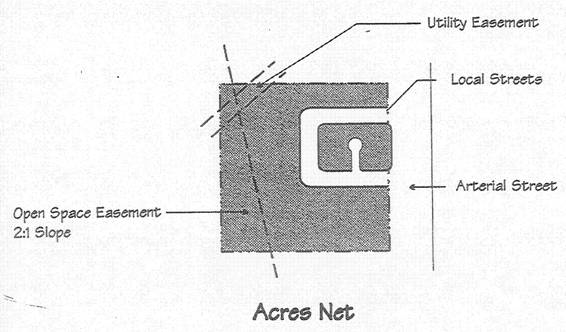
Acres, Gross. "Gross acres" means the total number of acres within the subject area, including local street rights-of-way (either existing or to be dedicated), but excluding arterial street rights-of-way (either existing or to be dedicated).
Acres, Net. "Net acres" means the total number of acres created within the subject area once local street rights-of-way (either existing or to be dedicated) have been subtracted from the gross acres.
"Adult" means a person over the age of twenty-one (21).
"Adult bookstore" means any establishment, which as a regular and substantial course of conduct, displays and/or distributes adult merchandise, books, periodicals, magazines, photographs, drawings, sculptures, motion pictures, videos, slides, films, or other written, oral or visual representations which are distinguished or characterized by an emphasis on a matter depicting, describing or relating to specified sexual activities or specified anatomical parts. (See "Adult-Oriented Business" for definition of regular and substantial portion of its business.)
"Adult cabaret" means a nightclub, bar, lounge, restaurant or similar establishment or concern which features as a regular and substantial course of conduct, any type of live entertainment, films, motion pictures, videos, slides, other photographic reproductions, or other oral, written, or visual representations which are characterized by an emphasis on matter depicting, describing or relating to specified sexual activities or specified anatomical parts.
"Adult hotel/motel" means a hotel or motel, which as a regular and substantial course of conduct provides to its patrons, through the provision of rooms equipped with closed-circuit television or other medium, material which is distinguished or characterized by the emphasis on matter depicting, describing or relating to specified sexual activities or specified anatomical parts and/or which rents, leases, or lets any room for less than a twelve (12) hour period and/or rents, leases or lets any room more than once in a twenty-four (24) hour period and/or which advertises the availability of any of the above.
"Adult model studio" means any premises where there is furnished, provided or procured a figure model or models who pose in any manner which is characterized by its emphasis on matter depicting, describing, or relating to specified sexual activities or specified anatomical parts for the purpose of being observed or viewed by any person or being sketched, painted, drawn, sculptured, photographed, filmed, or videotaped before any person who pay a fee, or any other thing of value, as a consideration, compensation, or gratuity for the right of opportunity to so observe the model or remain on the premises. Adult model studio shall not include any live art class or any studio or classroom which is operated by any public agency, or any private educational institution authorized to issue and confer a diploma or degree under Section 94300 et seq. of the Education Code.
"Adult motion picture arcade" means any business establishment or concern containing coin- or slug-operated or manually or electronically controlled still, motion picture or video machines, projectors, or other image-producing devices that are maintained to display images to an individual in individual viewing areas when those images are distinguished or characterized by any emphasis on matter depicting, describing or relating to specified sexual activities or specified anatomical parts.
"Adult-oriented business" means any business establishment or concern which as a regular and substantial course of conduct performs as an adult bookstore, adult theater, adult motion picture arcade, adult cabaret, stripper, adult model studio, adult motel/hotel; any business establishment or concern which as a regular and substantial course of conduct sells or distributes sexually oriented merchandise or sexually oriented material; or any other business establishment or concern which as a regular and substantial course of conduct offers to its patrons products, merchandise, services or entertainment characterized by an emphasis on matters depicting, describing or relating to specified sexual activities or specified anatomical parts. "Adult-oriented business" does not include those uses or activities, the regulation of which is preempted by state law. "Adult-oriented business" shall also include any business establishment or concern which, as a regular and substantial course of conduct provides or allows performers, models, actors, actresses, or employees to appear in any place in lingerie or similar attire which does not opaquely cover specified anatomical parts. For the purposes of this section, a business establishment or concern has established the provision of products, merchandise, services or entertainment characterized by an emphasis on matters depicting, describing or relating to specified sexual activities or specified anatomical parts as a regular and substantial course of conduct when one (1) or more of the following conditions exist:
a.
The area devoted to adult merchandise and/or sexually oriented material exceeds more than fifteen percent (15%) of the total display or floor space area open to the public;
b.
The business establishment or concern presents any type of live entertainment which is characterized by an emphasis on specified sexual activity or specified anatomical parts at least four (4) times in any month in any given year.
c.
The regular and substantial course of conduct, of the business consists of or involves the sale, trade, display or presentation of services, products, or entertainment which are characterized by an emphasis on matter depicting, describing, or relating to specified sexual activities or specified anatomical parts.
"Adult theater" means a business establishment or concern which, as a regular and substantial course of conduct, presents live entertainment, motion pictures, videos, slide photographs, or other pictures or visual reproductions which are distinguished or characterized by their emphasis on matter depicting, describing, or relating to specified sexual activities or specified anatomical parts.
"Affordable housing" means housing that is rented or sold for an amount that is limited by a set percentage of the County median income, adjusted for family size, as reported and updated annually by the Department of Housing and Community Development (HCD).
"Amusement centers" means an establishment where the primary intent is to provide amusement, sport and/or recreation within an enclosed building, structure, or portion thereof. Uses shall include, but not be limited to, video-game devices, pinball machines, billiards, or other uses which the decision-making body determines are of a similar nature.
Animal Hospital. See "veterinary office."
"Antenna" means any externally located object used for the transmission or reception of electromagnetic waves. Antenna shall also include any antenna systems, rods, poles, wires, microwave equipment and other miscellaneous systems, equipment or similar devices used for the transmission or reception of electromagnetic waves. Any question regarding the definition of the term antenna will be determined by the City Manager or designee. For other types of antennas, please see "satellite antenna."
"Application" means the form, information, plans, required documentation and fees submitted by an applicant to the appropriate public agency for the purpose of determining whether to approve or deny permits, licenses, certificates or other entitlements from a public agency.
Arcades. See definition of "amusement centers."
Area, Lot. See "lot area."
"Arterial streets" means arterial, primary and secondary streets as shown in the "Roadway System Map" of the City's General Plan Mobility and Complete Streets Element.
"Average Building Height" means the methodology used to calculate maximum height limit based on averaging the height of each corner of the roof element compared to finished grade. Please refer to Section 17.24.110 for the method of determining average building height.
B
"Back lighting" is a type of lighting that creates a silhouette of letters or graphics on a structure. A source of light is mounted behind opaque letters or graphics that are offset from a surface (e.g. Light Emitting Diodes behind pin-mounted letters mounted to a building's facade). The light is projected onto the surface behind the letters and graphics so a silhouette of them is created.
"Bar" means an establishment that serves beer, wine, and/or alcohol; may provide seating; and may provide food service.
1.
"Cocktail Lounge" means an establishment that serves beer, wine, and/or alcohol; may provide seating; and may provide food service.
2.
"Taproom" means an establishment, which may also be known as a standalone beer tasting room, for the sale or offering of beer for sampling on the premises of establishments in which beer and beer-related products are available for off-site sale, distribution, and consumption.
"Base Station" has the same meaning as set forth in 47 C.F.R. Section 1.6100(b)(1), or any successor provision.
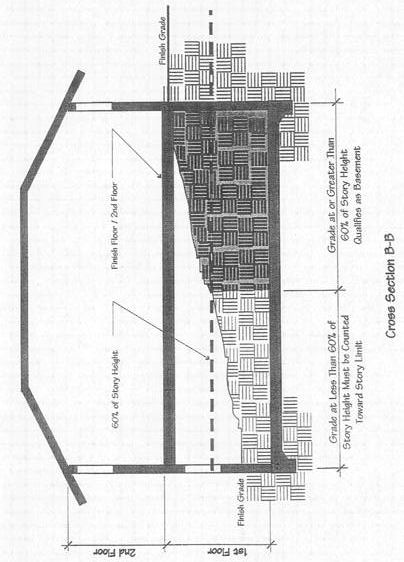
"Basement" means any portion of a building which has at least sixty percent (60%) or more of the story height below finished grade.
Figure 17.88.030E
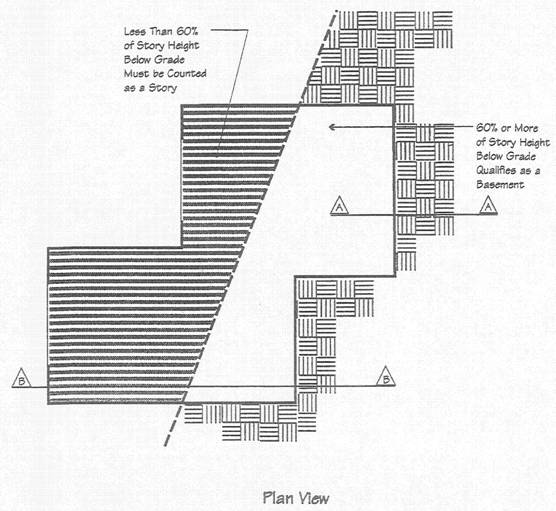
Figure 17.88.030F
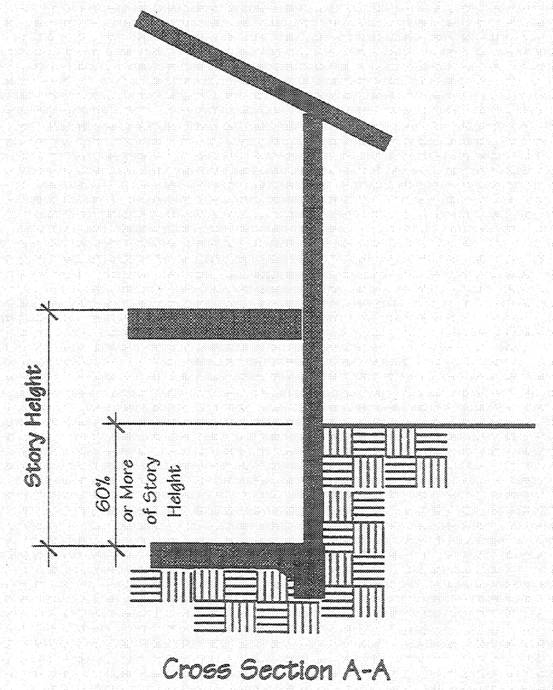
Figure 17.88.030G
"Bed-and-breakfast inn" means a structure wherein the owner of the property lives and at least two (2) lodging units without individual kitchens are rented on a short-term basis under separate oral or written contracts and where at least one (1) meal is provided daily in a common dining area.
"Bedroom" means any room which meets the minimum requirements of both the Zoning Ordinance and the Uniform Building Code for a Habitable Room, which is constructed in such a manner that less than fifty percent (50%) of one (1) wall is open to an adjacent room or hallway and which can be readily used for private sleeping purposes shall be counted as a bedroom in order to determine parking or other requirements. For the purpose of calculating parking requirements, the following rooms which regularly make up a standard dwelling unit shall not be considered a "bedroom": one (1) kitchen, one (1) living room; one (1) family or recreation room; one (1) dining room; and the customary sanitary facilities. The City Planner shall determine whether or not a room qualifies as one (1) of the above exceptions, in accordance with the appeal provisions of Section 17.12.140, Appeals of an Action, of this title.
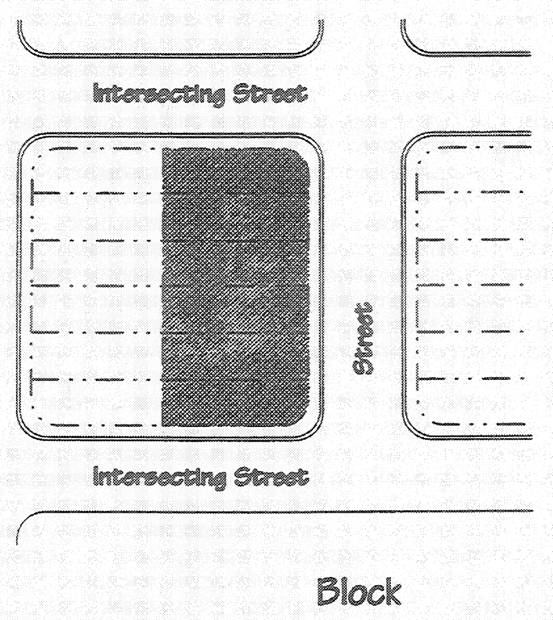
"Block" means all property fronting upon one (1) side of a street, between intersecting and intercepting streets, or between a street and a railroad right-of-way, waterway, dead-end street, or City boundary. An intercepting street shall determine only the boundary of the block on the side of the street, or a street which it intercepts.
Figure 17.88.030H
"Boardinghouse" means either of the following:
1.
A dwelling unit or any portion thereof used to provide long-term lodging under four (4) or more individual contracts or rental agreements.
2.
Any short-term lodging use that it is not a hotel, motel, bed-and-breakfast inn, or STLU (including STAR). Because a STLU is inherently limited to a single rental contract under Subsection 17.28.292C.2, a boardinghouse under this second definition covers all multiple-rental, short-term lodging uses that are not a hotel, motel, or bed-and-breakfast inn.
"Body Art Establishments" means any structure or venue, whether permanent or temporary, where body art is performed.
Building, Accessory. "Accessory building" means an enclosed structure used or intended for supporting or sheltering any use or occupancy, which may either be attached to or detached from a primary building on the same lot, but which is incidental in scale to the primary building and/or within which a use is being conducted and is accessory to the primary use being conducted on the site.
Building, Accessory, Attached. "Attached accessory building" means an accessory building that is structurally part of the primary building, has a common wall, and adjoining floor area.
Building, Primary. "Primary building" means a building within which the principal use or principal occupancy of a lot is conducted.
C
"Carport" means an accessible structure used for automobile shelter which is permanently roofed.
Carport, Street-Facing. "Street-facing carport" means a carport which is oriented toward the street from which primary access to the carport is taken.
"Change of Copy" means the change of any words, letters, numbers, figures, designs or other symbolic representations incorporated into a sign.
"Church or Religious Institution" means a building which is used as an established place of worship, has a regular congregation and regularly offers religious services, represents a recognized creed and form of workshop and is affiliated with an organization of ordained clergy. Legal, conforming churches and religious institutions may operate an emergency shelter as an accessory use, pursuant to San Clemente Municipal Code Chapter 17.56.
"Clinical Service Uses" shall mean establishments which provide physical and mental health services on an out-patient basis. The services may be of preventative, diagnostic, treatment, therapeutic, rehabilitative or counseling nature, but do not include group counseling uses. Typical uses would include, but not be limited to, medical and health clinics, chiropractic/physical therapy clinics, individual counselling services and emergency care centers.
"Coastal sage scrub" means a natural occurring plant community consisting mostly of perennial shrubs and groundcovers adapted to winter rains and summer drought that occurs mostly on coastal hills and canyons within Central and Southern California. Typical Coastal sage scrub plants include: Rhus integrifolia (Lemonadeberry), Heteromeles arbutifolia (Toyon or California Holly), Artemisia californica (Coastal Sagebrush), Eriogonum fasciculatum (California Buckwheat), Quercus agrifolia (Coast Live Oak), and Salivia spp. (various species of Sage).
Coastal Zone Definitions. For the purposes of the Coastal Zone Overlay, the following definitions shall apply:
1.
"Adjacent structure" means a structure located on a lot contiguous (sharing a property line) to the proposed structure or development.
2.
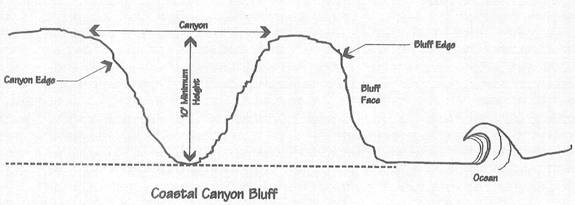
"Bluff" means any high landform which abuts or is adjacent to the coast and has a vertical relief of ten (10) feet or more. See also definition of "edge" and "face."
Figure 17.88.030.I
3.
"Canyon" means any valley, or similar landform, which has a vertical relief of ten (10) feet or more. See also definition of "edge" and "face."
4.
"Cliff" means a steep, vertical landform which has a vertical relief of ten (10) feet or more. See also definition of "edge" and "face."
5.
"Coastal" means that area within the City's Coastal Zone as depicted on the "Environmentally Sensitive Habitat Areas" map of the Land Use Plan in the City's Coastal Program.
6.
"Coastal sage scrub" means vegetation which include, but are not limited to, the following: many species of Dudleya, Calandrinia maritima, Cleomeisomeris, Coreopsisgigantea, Eriogomunigiganteum, Eriogomungrande, Eriophyllumnevinii, Galvesia speciosa, Haplopappus venetus, Hemizonia clementina, Lavatera assurgentiflora, Malacothrix saxatilis, Phacelia lyonii, and Rhus integrifolia, plus two (2) species of Polypodium, Artemisia californica, Crossosoma californicum, Diplacus species, Encelia californica, Eriogonum fasciculatum, Galium, Haplopappus, Helianthemum, Lotus, Lupinus, Malacothamnus, and Opuntia species, Malosma laurina, Rhus integrifolia, Salvia, Senecio, and Solanum species, and Toxicodendron radicans diversilobum, the sprawling Marah macrocarpus and Calystegia macrostegia, and many other showy herbs like species of Castilleja, Haplopappus, Lotus, Lupinus, and Zauschneria, and Eriophyllum confertiflorum.
7.
"Development" means the placement or erection of any solid material or structure, on land or in the water; the discharge or disposal of any dredged material or of any gaseous, liquid, solid, or thermal waste; grading, removing, dredging, mining, or extraction of any materials; change in the density or intensity of use of land, including, but not limited to, subdivision pursuant to the Subdivision Map Act (commencing with Section 66410 of the Government Code), and any other division of land, including lot splits, except where the land division is brought about in connection with the purchase of such land by a public agency for public recreational use; change in the intensity of use of water, or of access thereto; construction, reconstruction, demolition or alteration of the size of any structure, including any facility of any private, public or municipal utility; and the removal or harvesting of major vegetation other than for agricultural purposes, kelp harvesting, and timber operations which are in accordance with a timber harvesting, and timber operations which are in accordance with a timber harvesting plan submitted pursuant to the provisions of the Z'BergNejedly Forest Practice Act of 1973 (commencing with Section 4511).
Only like development shall be utilized when determining a stringline setback for proposed development.
8.
"Edge" means the upper termination of a bluff, canyon or cliff. When the top edge is rounded away from the face as a result of erosional processes related to the presence of the steep bluff face, canyon, or cliff face, the edge shall be defined as that point nearest the face beyond which the downward gradient of the land surfaces increases more or less continuously until it reaches the general gradient of the bluff, canyon, or cliff. In a case where there is a steplike feature at the top of the bluff face, canyon, or cliff face, the landward edge of the topmost riser shall be taken as bluff edge, canyon edge, or cliff edge.
9.
"Environmentally sensitive area" means any area in which plant or animal life or their habitats are either rare or especially valuable because of their special nature or role in an ecosystem and which could be easily disturbed or degraded by human activities and developments.
Environmentally sensitive habitat areas in San Clemente's Coastal Zone include wetlands, riparian areas, habitats of rare or endangered species and several coastal canyons which still contain native plant communities. The environmentally sensitive habitat areas are depicted on the Environmentally Sensitive Habitat Areas Map of the City's Coastal Element. The canyons contain important natural habitat areas. Development of land in and adjacent to the canyons is subject to the canyon-preservation policies noted in the City of San Clemente Coastal Element. The canyons are as follows: Marblehead Coastal Canyons*, Palizada Canyon, Trafalgar Canyon, Toledo Canyon, Lobos Marinos Canyon, Riviera Canyon, Montalvo Canyon, and Calafia Canyon.
* The Marblehead Coastal Specific Plan site is an area of "deferred certification"
and at this time is not a part of the City's adopted Local Coastal Plan. Therefore,
these coastal canyon/coastal bluff development standards shall not apply to the Marblehead
site or canyons. At the time a Land Use Plan and Coastal Zoning Ordinance are adopted
and certified by the California Coastal Commission for the Marblehead Coastal Property,
the provisions of this section will be incorporated as an addendum to the City of
San Clemente Local Coastal Plan.
10.
"Face" means a sharp or steep face of rock, decomposed rock, sediment, or soil resulting from erosion, faulting, folding, or excavation of the land mass of a bluff, canyon or cliff. The face may be a simple planar or curved surface or it may be steplike in section.
11.
"Native vegetation" means vegetation composed of plants which originated, developed, or were produced naturally in the Southern Orange County coastal region and were not introduced directly or indirectly by humans. Native vegetation includes, but is not limited to, marsh vegetation, native grasslands, coastal/inland sage scrub, and woodlands.
12.
"Primary vegetation line" means one (1) development setback standard that may be utilized for Coastal Canyons; characteristics to be established based on an on-site visit, and inventory of existing vegetation and topography.
13.
"Riparian vegetation" means an environment associated with plant communities which require high soil moisture conditions maintained by transported freshwater in excess of that otherwise available through local precipitation.
14.
"Seacliff" means a cliff whose toe is or may be subject to marine erosion.
15.
"Structure" means any physical construction, including but not limited to, any building, road, pipe, flume, conduit, siphon, aqueduct, telephone line, and electrical power transmission and distribution line.
Only like structures shall be utilized when determining a stringline setback for proposed development.
16.
"Toe" means the lowest part of an embankment.
"Condominium" means an undivided interest in common in a portion of real property coupled with a separate interest in space called a unit, the boundaries of which are described on a recorded final map, parcel map, or condominium plan, in sufficient detail to locate all boundaries thereof. An individual interest within a condominium may include, in addition, a separate interest in other portions of real property.
"Congregate care facility" means a facility for senior citizens, that is arranged in a group setting and includes independent living and sleeping accommodations in conjunction with shared dining and recreational facilities. No congregate care units shall contain kitchens.
"Convalescent home" means a facility licensed by the State Department of Public Health, the State Department of Social Welfare, or the County, which provides bed and ambulatory care for patients with post-operative convalescent, chronically ill, or dietary problems, and persons aged or infirm unable to care for themselves; but not including treatment for alcoholism, drug addiction, or mental or contagious diseases or afflictions.
"Convenience store" means any retail establishment between one hundred (100) and two thousand five hundred (2,500) gross square feet in building area and/or land use area where the primary activity is the display, storage, and/or sale of convenience items, including, but not limited to, prepackaged food products, beverages, household goods, automotive-related items, or other items which the decision-making body determines are similar in nature.
"Cottage Food Home Occupation" means an occupation or business enterprise which produces approved cottage food products (as defined by the California Department of Public Health per AB 1616) produced entirely within the kitchen of a residential dwelling unit by the resident(s) thereof, which is clearly incidental and secondary to the residential use of the dwelling unit. Cottage food home occupations are operated by a cottage food operator, who is a resident of the home.
"Covered parking" means a parking stall(s) within a garage, carport, or completely under the overhanging portion of a building.
"Cultural facilities" means public or private institutions displaying or preserving objects of community or cultural interest in one (1) or more of the arts or sciences, including libraries, museums, and theaters.
"Custom home" means a residential home built within a custom lot subdivision to satisfy the unique design specification of the owner of the lot on which the home is to be built. No property owner or designee shall be entitled to receive more than three (3) permits for such homes within the same custom lot subdivision in any three hundred sixty-five (365) day period. Any property owner or designee who receives more than one (1) permit for a custom home in the same custom lot subdivision shall design each home to have a unique exterior appearance and individualized floor plan.
"Custom lot subdivision" means a tract of land solely developed with custom homes. A subdivision shall be considered custom only when it is designated as such through the discretionary review process and the City Council adopts an authorizing ordinance pursuant to Government Code Sections 66434F and 66434.2; the tract's designation as a custom lot subdivision shall be noted on any additional map sheet to be recorded with the final map.
D
Day Care Facility, Child. "Child Day Care Facility" means a State-licensed facility which provides nonmedical care to children under eighteen (18) years of age in need of personal services, supervision or assistance essential for sustaining the activities of daily living or for the protection of the individual on less than a twenty-four (24) hour basis. Day care facilities include Day Care Centers, Large-family Day Care Homes, and Small-family Day Care Homes, as follows:
1.
Day Care Center, Child. "Child day care center" means a Day Care Facility other than a Large-family Day Care Home and Small-family Day Care Home, including infant centers, preschools, extended day care facilities, and school-age child care centers.
2.
Day Care Home, Large-Family. "Large-Family Day Care Home" means a home that provides care, protection, and supervision of fourteen (14) or fewer children at any one (1) time, as defined and regulated in Health and Safety Code Section 1597.465 et seq. Large-Family Day Care Homes can care for up to three (3) infants when a facility cares for more than twelve (12) children.
3.
Day Care Home, Small-Family. "Small-Family Day Care Home" means a home that provides care, protection, and supervision of eight (8) or fewer children, as defined and regulated in Health and Safety Code Section 1597.44 et seq. Small-Family Day Care Homes can care for up to two (2) infants when a facility cares for more than six (6) children.
"Days" shall always be consecutive calendar days unless otherwise stated.
Dedication, Offered. "Offered dedication" means that portion of land that is irrevocably offered to the City for future public rights-of-way or other public use.
"Density" means the number of dwelling units per net or gross acres. Density may also be Stated in the square footage of lot area required per unit. See also "acres, gross," and "acres, net."
Development, New. "New development" means construction, improvement or placement of structure(s) on a parcel(s) of land.
District. See "zone."
"Domicile" means a person's fixed, permanent, and principal home for legal purposes.
"Drive-Through" means relating to or conducting exchanges with clients who drive up to a window and remain in their automobiles.
"Duplex" means a multifamily dwelling containing two (2) dwelling units.
Dwelling, Multiple-Family. "Multiple-family dwelling" means a building or buildings designed with two (2) or more dwelling units, excluding hotels, motels and timeshares.
Dwelling, Single-Family. "Single-family dwelling" means a detached building designed primarily for use as a single dwelling unit, no portion of which is rented or leased as a separate dwelling unit, except as permitted by this code.
"Dwelling unit" means a habitable room or group of habitable rooms (e.g. living room, bedroom, den, library, recreation, studio, etc.) with no more than one (1) kitchen designed for occupancy by one (1) or more persons living as a single housekeeping unit (as defined in this chapter) and with common interior access to all living, kitchen, and bathroom areas.
E
"E-cigarette" means any electronically actuated device or inhaler meant to simulate cigarette smoking that uses a heating element to vaporize a liquid solution, popularly referred to as "juice," and that causes the user to exhale any smoke, vapor, or substance other than that produced by unenhanced human exhalation. The juice used in e-cigarettes typically contains nicotine, and for this reason e-cigarettes and their juice can be classified as both tobacco products and tobacco paraphernalia.
"Elevation" means:
1.
A scale drawing of the front, rear or side of a building or structure; or
2.
A vertical distance above or below a fixed reference level.
"Eligible Facilities Request" has the same meaning as set forth in 47 C.F.R. Section 1.6100(b)(3), or any successor provision.
"Employee housing" has the same meaning as it does in the California Employee Housing Act (Cal. Health & Saf. Code, Div. 13, Pt. 1.)
F
"Final authority" means the final decision-making authority absent on appeal.
"Floor area ratio" means the total gross floor area, excluding parking structures, interior stairways, and nonhabitable subterranean floors, of all buildings on a lot divided by the lot area.
Figure 17.88.030J
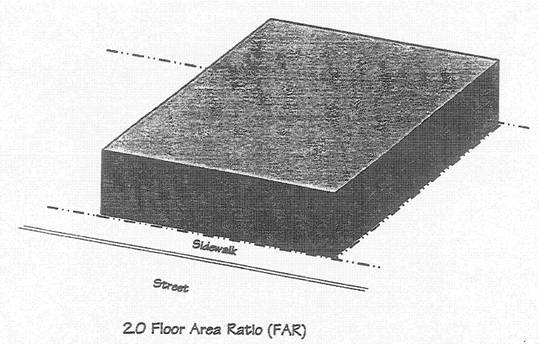
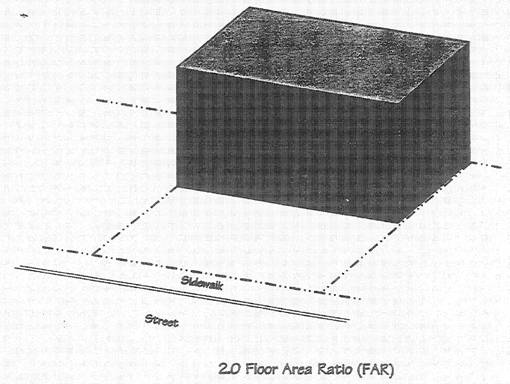
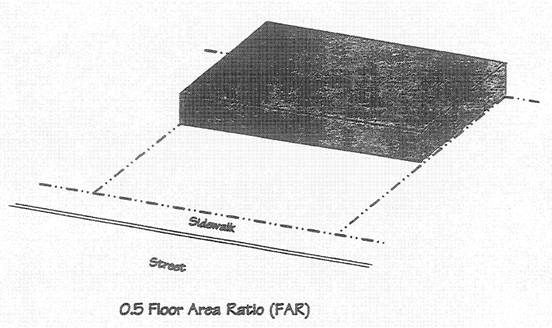
Figure 17.88.030J (Continued)
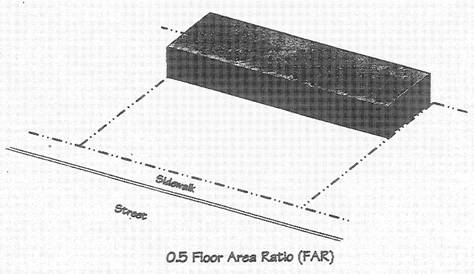
Floor Area, Gross. "Gross floor area" means the total enclosed area of all floors of a building measured to the outside face of the structural members of exterior walls, and including halls, stairways, elevator shafts at each floor level, service and mechanical equipment rooms, and habitable basement or attic areas, but excluding outdoor courtyards and stairways and other exterior space.
Floor Area, Dwelling Unit, Net. "Net floor area of a dwelling unit" shall be the total horizontal floor area of all interior space of a dwelling unit, including the exterior walls, measured in square feet. Private parking areas, outdoor patios, and balconies, and areas used in common such as, but not limited to, covered walkways, roofed patio areas, covered entries, covered parking, covered driveways, and loading areas shall not be included as the net floor area of a dwelling unit.
Floor Area, Residential. "Residential floor area" means the total horizontal floor area of all interior space of the dwelling units of a project measured to the outside face of the structural members of exterior walls. Private parking areas, outdoor patios and balconies, and areas used in common such as, but not limited to, covered walkways, roofed patio areas, covered entries, covered parking, and covered driveway and loading areas shall not be included in the residential floor area.
Fueling station (see "Service station".)
G
"Garage" means an accessible structure primarily used for automobile shelter which is permanently roofed, and has three (3) enclosed sides and a garage door.
Garage, Street-Facing. "Street-facing garage" means a garage which is oriented, by virtue of the location of the garage door, toward the street from which primary access to the garage is taken.
Grade, Finished. "Finished grade" means the final elevation of the ground surface after development, as shown on a precise Grading Plan.
"Granny flat". See "Accessory Dwelling Unit."
"Group counseling" means counseling or therapy services that are provided to groups of five (5) or more persons at a time. Examples of group-counseling uses include, but are not limited to, nutritional and diet centers; medical, clinical, and other health-related counseling; and career, professional, and life coaching.
"Group instruction" means non-counseling, non-therapy instructional services that are provided to groups of five (5) or more persons at a time. Examples of group-instruction uses include, but are not limited to, classes in photography, fine arts, crafts, or dance or music; driving schools; and yoga or martial-arts studios.
"Guest" when used in reference to an STLU (including a STAR), means any person (including an invitee) visiting a renter of a lodging unit but not authorized by the lease to sleep or stay overnight in the unit.
"Guest house" means living quarters, having no kitchen/kitchenette, located on the same premises with a primary building and occupied for the sole use of occupants of the primary building, temporary guests, or persons permanently employed on the premises. No compensation for use of the guest house, in any form, shall be received or paid.
H
"Habitable room" means a space in a structure for living, sleeping, eating or cooking. Bathrooms, toilet compartments, closets, halls, storage or utility space, and similar areas are not considered habitable space. For the purpose of calculating residential parking requirements, any closets, storage or utility spaces greater than seventy (70) square feet in size shall be considered a habitable room.
"Hand held sign" means any sign which is held by or mounted to human beings or animals.
"Hedge" means, for purposes of Section 17.24.090, dense vegetation, which starts at grade or up to 48 inches above grade, so aligned as to form a physical barrier similar in shape and proportion to a wall or fence.
Height, Building. Please refer to Section 17.24.110 for the method of determining building height.
"Height, Chimney." Chimney height is measured from grade to top of the chimney, including any spark arrestor or other appurtenance.
"Helipad" means an area of land designed, constructed, properly equipped, and authorized by the Federal Aviation Administration to function as a private landing and takeoff facility for helicopters.
"Heliport" means an area of land designed, constructed, properly equipped, and authorized by the Federal Aviation Administration to function as a public landing and takeoff facility for helicopters.
"Historical Resources" means all properties (historic, archaeological, landscapes, traditional, etc.) eligible or potentially eligible for the National Register of Historic Places, as well as those that may be significant pursuant to state and local laws and registration programs such as the California Register of Historical Resources or the City of San Clemente Historic Resources Inventory. For the purpose of this title, the following definitions shall apply:
1.
"Adjacent property" means any property that is located within one hundred (100) yards of property which has been designated as historically significant, and which is determined by the Planning Commission to have an actual or potential visual impact on the historically significant property.
2.
"Historical district" means an area or distinct section containing structures which have a special character, historical interest or aesthetic value or which represents the Spanish Heritage architectural style typical to the history of the City.
3.
"Historically significant property" means any site, building or structure of particular historic, architectural or cultural significance to the City as determined by the Planning Commission. Such site may be identified with historic personages or with important events in the main currents of national, State or local history, or may embody the distinguishing characteristics of an architectural specimen, inherently valuable for a study of a period, style, method of construction, or may be a notable work of a master builder, designer or architect whose individual genius influenced his age.
4.
"Landmark" means a building, site, structure, object, or improvement, manmade or natural, with special character or special historical, cultural, architectural, archeological, social, or aesthetic value inherent to the heritage of the City of San Clemente, the State of California, and/or the United States.
5.
"Demolition of Historic Structures" means an act that destroys in whole or in part a designated historic resource.
"Home occupation" means a business conducted in compliance with Section 17.28.160, Home Occupations, carried out by an occupant conducted as an accessory use within the primary dwelling unit.
"Hospital" means either a general acute care hospital, as defined by Health and Safety Code section 1250(a), that provides a wide range of emergency, clinical, and temporary medical services to the general public, or, to the extent permitted by law, a "standalone emergency department" as defined in Chapter 17.88, Definitions, of this title. It does not include any other "health facility" identified in Health and Safety Code section 1250; nor does it include any other type of specialty hospital.
Household, Eligible. "Eligible household" means a household earning 80 percent or less of the County median income, as defined in the City of San Clemente Housing Element.
"Hotel" means a building or group of buildings on the same parcel, containing six (6) or more short-term lodging units, whether under single or separate ownership that has the following characteristics: Access is provided through a common entrance lobby to lodging units, the lodging units have no cooking facilities, they are accompanied by commercial or recreational facilities that are incidental and accessory to the principal hotel use, and that are a minimum of one thousand (1,000) square feet. Such accessory uses include, but are not limited to, gift shops, clothing stores, and other similar retail uses; beauty parlor, barber shop, and other similar personal services; ticket, travel, stock brokers, and other similar agencies; restaurants, coffee shops, cocktail lounges, and other similar food and beverage services; meeting rooms, convention centers, and other similar places for public assembly; athletic clubs, health spas, exercise rooms, and other similar recreational facilities; and any other accessory uses which the decision-making authority deems appropriate in conjunction with the principal hotel use. For the purposes of this title, "hotel" does not include those terms defined in this chapter that describe other specific types of lodging uses or arrangements with six (6) or more lodging units.
I
Inland Canyon Definitions. For the purposes of this title and Section 17.24.060 - Canyon Setbacks, Inland, the following definitions shall apply:
"Canyon Edge" means the upper termination of a canyon. In cases where the top edge is rounded away from the face of the canyon as a result of erosional processes related to the presence of the canyon face, the canyon edge shall be defined as that point nearest the canyon beyond which the downward gradient of the land surface increases more or less continuously until it reaches the general gradient of the canyon. In a case where there is a steplike feature at the top of the canyon face, the landward edge of the topmost riser shall be taken to be the canyon edge.
"Inland Canyon" means, in noncoastal areas of San Clemente, any valley, or similar landform, which has a vertical relief of ten (10) feet or more. See Section 17.24.060 for Inland Canyon setbacks.
"Noncoastal Canyon" has the same meaning as Inland Canyon.
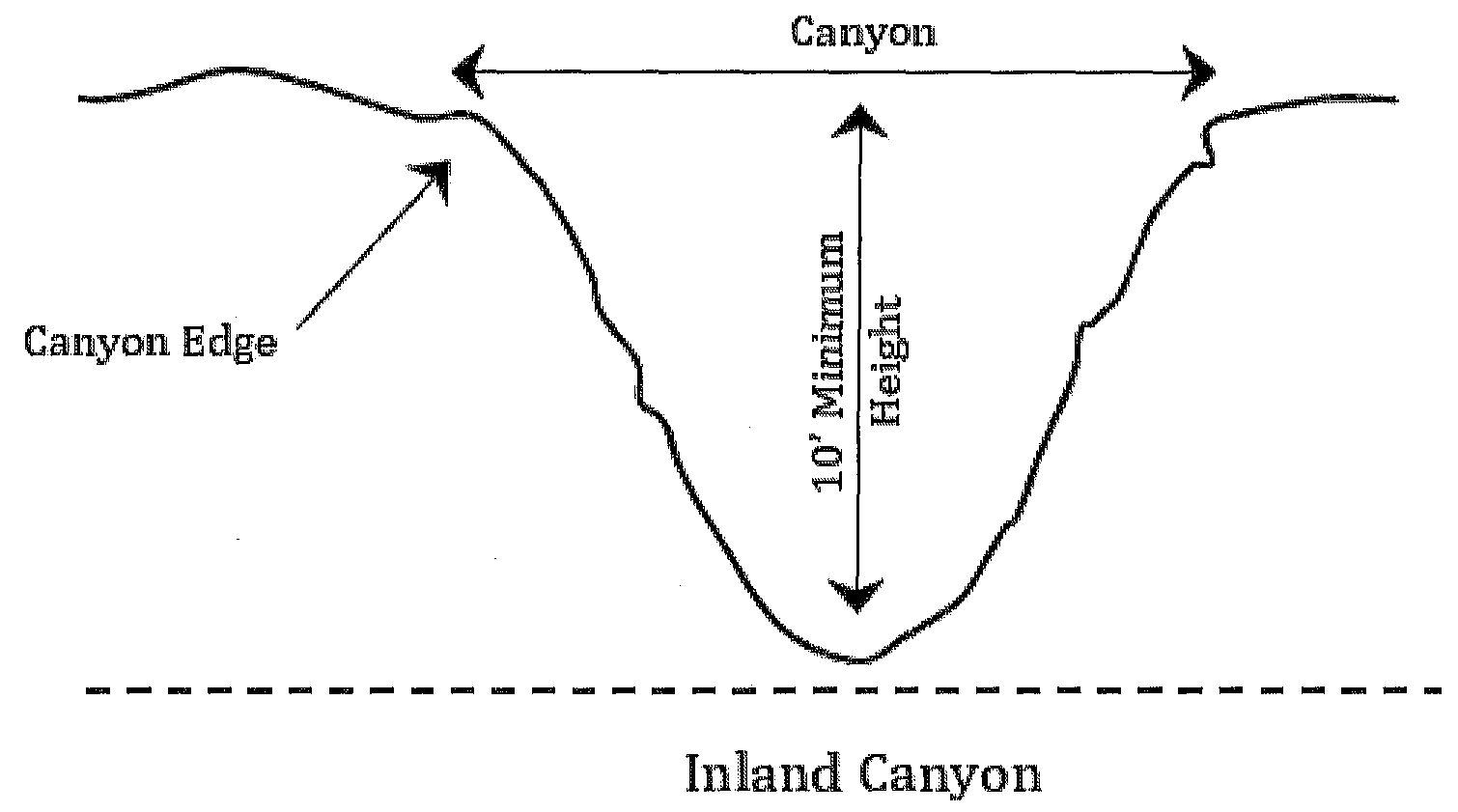
Inland Canyon
"Internet access studio" or "internet café" means any place including but not limited to: computer arcades, computer lounges, cyber arcades, internet cafés, internet arcades, internet workstation stores, on-site computer rentals, PC arcades, and other similar businesses where the primary purpose of the business is devoted to making available the use of computers, or a port connection for a portable computer, to gain access to the internet system. Any internet access studio or internet café consisting of five (5) or more computer terminals made accessible to the public (excluding school, library or similar public use) shall be considered through a Conditional Use Permit.
K
Kennel, Commercial. "Commercial kennel" means a lot or premises upon which five (5) or more dogs or cats over the age of four (4) months are kept for the purpose of boarding, breeding, raising or training for a fee or for sale.
"Kitchen" means any room or part of a room which is designed, built, used and/or intended to be used for food preparation and/or cooking which contains facilities that include a sink; a stove, oven, range or other similar non-portable cooking device; and a refrigerator.
L
"Landscaping" means an area devoted to, or developed and maintained predominately with, plant materials, including lawn, ground cover, trees, shrubs, and other plant materials. Landscaping may also include accessory decorative outdoor landscape elements, such as pools, fountains, paved or decorated surfaces (excluding driveways, parking, loading, or storage areas), and sculptural elements.
"Landscaping, Vertical" means plants growing upward on a vertical surface, such as a wall, structure, or building façade. Examples of vertical landscaping include, living walls, tower gardens, trellised vining plants, pallet gardens, and hanging gardens.
"Live art class" means any premises on which all of the following occur: there is conducted a program of instruction involving the drawing, photographing, or sculpting of live models exposing specified anatomical parts; instruction is offered in a series of at least two (2) classes; the instruction is offered indoors; an instructor is present in the classroom while any participants are present; and pre-registration is required at least twenty-four (24) hours in advance of participation in the class.
"Living area" means the interior habitable area of a dwelling unit, including basements and attics, but not including a garage or any uninhabitable structure.
"Lodging unit" means a structure or any portion of a structure that is occupied, designed, or permitted for paid occupancy for lodging or temporary sleeping purposes excluding a single housekeeping unit.
"Long term" means a period of thirty (30) or more consecutive calendar days. When applied to lodging, "long-term" refers to the duration of occupancy.
"Lot" means site or parcel of land under one (1) ownership that has been legally subdivided, resubdivided, or combined, and having frontage upon a street, other than an alley, or a private easement determined by the City Engineer to be adequate for purposes of access.
1.
"Corner lot" means a lot abutting upon two (2) or more streets at their intersections, or upon two (2) parts of the same street, forming an interior angle of less than one hundred thirty-five (135) degrees.
2.
"Flag lot" means a lot having access or an easement to a public or private street by a narrow, private right-of-way.
3.
"Interior lot" means a lot other than a corner lot.
4.
"Key lot" means a lot with a side line that abuts the rear line of any one (1) or more adjoining lots.
5.
"Reverse corner lot" means a corner lot, the rear of which abuts the side of another lot.
6.
"Through lot" means a lot having frontage on two (2) generally parallel streets, with only one (1) primary access.
Figure 17.88.030K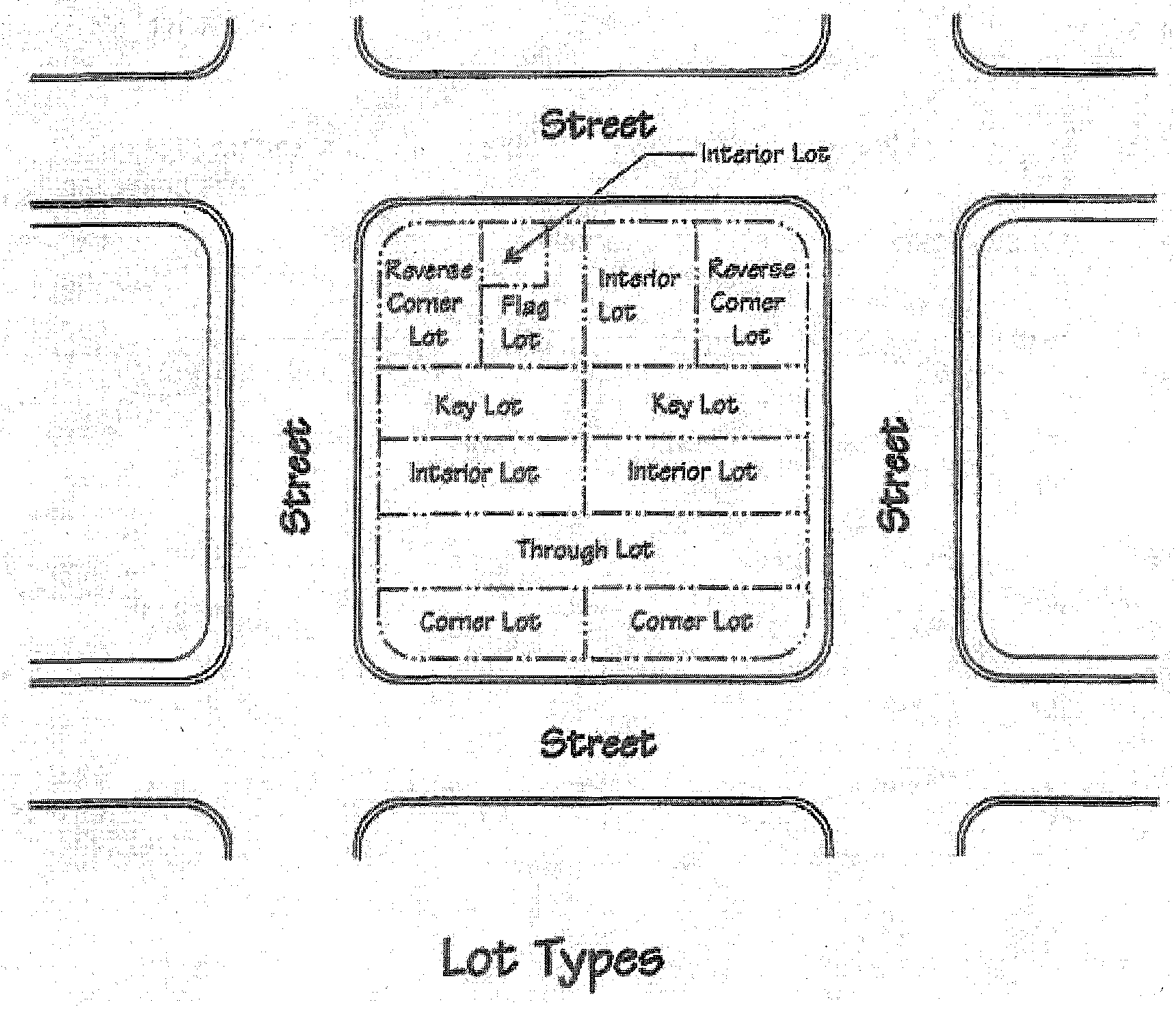
Lot coverage means the percent of the lot area that may be covered by all buildings or roofed structures. This includes garages, accessory buildings, balconies, covered patios, decks, covered entryways, and any similar structures that reduce the amount of lot area open to the sky.
For the purpose of this definition, lot coverage shall be measured:
1.
To the foundation line, for buildings, patio covers, and similar structures; and
2.
To the edge of the structure, balconies, and similar structures.
Lot Lines.
1.
"Front lot line" means the narrowest dimension of a lot fronting on a street. In the case of a lot having a curved front lot line, the front lot line, for the purposes of calculating the rear lot line or lot depth of an irregularly shaped lot, shall be a line which is:
a.
Tangent to the curve of the front lot line; and
b.
Parallel to a straight line that connects the points where the side lot lines intersect the front lot line.
In the case of a curved corner, the midpoint of the corner's radius shall demarcate the front lot line from the street side lot line. In the case of multiple curves and/or irregular street frontages, the Planning Division shall determine that an appropriately situated point along that curve shall demarcate the front lot line from the exterior side lot line(s). The determination shall consider in the following order of importance: (a) the general depth-to-width orientation of the lot and the establishment of a practical and reasonable building envelope, (b) the orientation of the lot and orientation of the determined building envelope as it would most harmoniously concur with development and/or building envelopes on the adjacent lots, (c) the existing development on the subject lot and the degree to which it may conform to more than one (1) possible determination, and (d) other factors specific to the lot that would affect the practicality and reasonableness of a determined building envelope
2.
"Rear lot line" means a lot line, not intersecting a front lot line, which is most distant from and most closely parallel to the front lot line. For the purpose of calculating lot depth, the rear lot line of an irregularly shaped lot shall be calculated as follows:
a.
For a trapezoidal lot, the rear line of which is not parallel to the front lot line, the rear lot line shall be deemed to be a line parallel to the front line and drawn through a point bisecting the recorded rear lot line; or
b.
For all other irregularly shaped lots, a line ten (10) feet in length within the lot and farthest removed from the front lot line and parallel to the front lot line shall be used as the rear lot line.
In no case shall the application of the definition of rear lot line be interpreted as permitting a primary residential building to be located closer than five (5) feet to any property line.
3.
"Side lot line" means any lot line which is not a front or rear lot line.
Lot Measurements.
1.
"Lot area" means the horizontal area within the boundary or lot lines of a lot after dedication. Easements whose primary purpose is to provide vehicular or pedestrian access to other property shall not be calculated in the area of a lot.
2.
Lot Depth.
a.
For Rectangular Lots. The horizontal length of a straight line drawn from the midpoint of the front lot line to the midpoint of the rear lot line;
b.
For Other Lots. The horizontal length of a straight line drawn from the midpoint of the front lot line to a line which intersects the midpoint of the rear lot line. See also "Rear lot line".
3.
"Lot frontage" means the horizontal length of the front property line.
4.
"Lot width" means the horizontal distance between the side lot lines, measured at right angles to the lot depth, at a midway point between the front and rear lot lines.
"Low barrier navigation center" has the same meaning as in California Government Code section 65660(a), as that section is amended from time to time.
M
"Manufactured home" means a structure, transportable in one (1) or more sections, which is built on a permanent chassis and is depicted for use with or without a permanent foundation when connected to the required utilities. For floodplain management purposes, the term "manufactured home" also includes park trailers, travel trailers, and other similar vehicles placed on a site for greater than one hundred eighty (180) consecutive days.
"Marijuana Use":
1.
"Cannabis" means all parts of the plant Cannabis sativa Linnaeus, Cannabis indica, or Cannabis ruderalis, whether growing or not; the seeds thereof; the resin, whether crude or purified, extracted from any part of the plant; and every compound, manufacture, salt, derivative, mixture, or preparation of the plant, its seeds, or resin. "Cannabis" also means the separated resin, whether crude or purified, obtained from marijuana "Cannabis" also means marijuana as defined by Section 11018 of the Health and Safety Code as enacted by Chapter 1407 of the Statutes of 1972.
2.
"Commercial marijuana activity" includes the cultivation, possession, manufacture, distribution, processing, storing, laboratory testing, labeling, transportation, distribution, delivery, or sale of marijuana and marijuana products.
3.
"Cultivation" means any activity involving the planting, growing, harvesting, drying, curing, grading, or trimming of marijuana.
4.
"Delivery" means the commercial transfer of marijuana or marijuana products to a customer. "Delivery" also includes the use by a retailer of any technology platform owned and controlled by the retailer, or independently licensed under California law, that enables customers to arrange for or facilitate the commercial transfer by a licensed retailer of marijuana or marijuana products.
5.
"Dispensary" means a facility where cannabis, cannabis products, or devices for the use of cannabis or cannabis products are offered, either individually or in any combination, for retail sale, including an establishment that delivers cannabis and cannabis products as part of a retail sale.
6.
"Distribution" means the procurement, sale, and transport of marijuana and marijuana products between entities for commercial use purposes.
7.
"Licensee" means the holder of any state issued license related to marijuana activities, including but not limited to licenses issued under Division 10 of the Business and Professions Code.
8.
"Manufacture" means to compound, blend, extract, infuse, or otherwise make or prepare a marijuana product.
9.
"Marijuana" means all parts of the plant Cannabis sativa L, whether growing or not; the seeds thereof; the resin extracted from any part of the plant; and every compound, manufacture, salt, derivative, mixture, or preparation of the plant, its seeds or resin. It does not include:
a.
Industrial hemp, as defined in Section 11018.5 of the California Health and Safety Code; or
b.
The weight of any other ingredient combined with marijuana to prepare topical or oral administrations, food, drink, or other product,
10.
"Marijuana accessories" means any equipment, products or materials of any kind which are used, intended for use, or designed for use in planting, propagating, cultivating, growing, harvesting, manufacturing, compounding, converting, producing, processing, preparing, testing, analyzing, packaging, repackaging, storing, smoking, vaporizing, or containing marijuana, or for ingesting, inhaling, or otherwise introducing marijuana or marijuana products into the human body.
11.
"Marijuana products" means marijuana that has undergone a process whereby the plant material has been transformed into a concentrate, including, but not limited to, concentrated cannabis, or an edible or topical product containing marijuana or concentrated cannabis and other ingredients.
12.
"Marijuana Testing Laboratory" means a facility, entity, or site that offers or performs tests of marijuana or marijuana products.
13.
"Person" includes any individual, firm, co-partnership, joint venture, association, corporation, limited liability company, estate, trust, business trust, receiver, syndicate, or any other group or combination acting as a unit, and the plural as well as the singular.
14.
"Private residence" means a house, an apartment unit, a mobile home, or other similar dwelling.
15.
"Sale" includes any transaction whereby, for any consideration, title to marijuana is transferred from one (1) person to another, and includes the delivery of marijuana or marijuana products pursuant to an order placed for the purchase of the same and soliciting or receiving an order for the same, but does not include the return of marijuana or marijuana products by a licensee to the licensee from whom such marijuana or marijuana product was purchased.
"Massage" shall mean the scientific manipulation of the soft tissues, including but not limited to any method of treating any of the external parts of the body for remedial, health or hygienic purposes by means, including but not limited to, rubbing, stroking, pressuring, acupressuring, kneading, tapping, pounding, vibrating or stimulating with the hands, feet, elbows or any other part of the body, with or without the aid of any instrument or device and with or without such supplementary aids as rubbing alcohol, liniment, antiseptic, oil, powder, cream, lotion, ointment, or other similar preparations commonly used in this practice, under such circumstances that it is reasonably expected that the person to whom the treatment is provided or some third person on his or her behalf will pay money or give any other consideration or any gratuity therefor.
"Massage establishment" shall mean a fixed location where massage is performed for compensation.
"Massage establishment, accessory" shall mean an establishment that provides massage which is incidental to the primary business, where the owner of the primary business is responsible for the massage services and conduct of the massage technician(s) employed at the location.
"Microbrewery" means a small scale brewery operation that typically is dedicated solely to the prosecution of specialty beers; may have restaurant or pub on the same property; has limited production (up to fifteen thousand (15,000) barrels a year); with bottling devices only to transfer beer into individual kegs; and may have a tasting room.
"Minor Exterior Alteration" means an alteration to the exterior finish, architectural details, and building materials of a structure. Examples include, but are not limited to: changing building materials, colors and finishes; replacing wood or metal windows with vinyl windows (for non- historic structures only), installing doors and windows in new openings (for non-historic structures only); and modifying the color and type of railings.
"Mixed-use," unless indicated otherwise within specific chapters or sections of this title, mixed-use shall mean a mix of both nonresidential and residential uses, either within the same zone or project.
"Mobile home" means a structure which is transportable in one (1) or more sections, designed and equipped to contain not more than two (2) dwelling units, to be used with or without a foundation system. Mobile home does not include a recreational vehicle, commercial coach, or factory-built housing.
"Mobile home park" means any area or tract of land where one or more mobile home spaces are rented or leased out for rent or lease to accommodate mobile homes, manufactured homes, or travel trailers used for human habitation for thirty (30) days or longer.
"Motel" means a building or group of buildings on the same parcel containing six (6) or more short-term lodging units having no cooking facilities, a majority of which have individual entrances from the outside. It is a hotel for purposes of Chapter 3.24.
N
"Neon Lighting" utilizes neon or other gases within translucent tubing in or on any part of a sign structure.
"Nonconforming" means a structure or use that does not comply with requirements in this Title. Refer to Chapter 17.72 for definitions related to Nonconforming Structures and Uses.
O
Office, Medical. "Medical office" means a facility where medical services, and managerial, administrative, and clerical functions relating to medicine, are conducted. Medical office include: chiropodists, chiropractors, dentists, clinical service uses (defined in this section), optometrists, osteopaths, physicians, psychologists, surgeons, and other uses which the decision-making body determines are of a medical nature and similar. Medical office does not include group-counseling uses (defined in this section).
Office, Professional. "Professional office" means a location where the managerial, administrative, professional and clerical functions of a business or industry are conducted. Professional offices include: accountants, architects, attorneys, designers, drafting services, engineers, financial planners, insurance agents, real estate brokers, stockbrokers, and other uses which the decision-making body determines are similar and of a professional nature.
Office, Veterinary. "Veterinary office" means a place where animals are given medical or surgical treatment by a duly licensed veterinarian and are cared for during the time of such treatment. Use as a kennel shall be limited to short-time boarding and shall be only incidental to such hospital use.
Oil Facility, On-Shore. "On-shore oil facility" means any structure or development created for the purpose of storing, transporting or processing liquid petroleum products, excluding the transportation, storage or retail sale of gasoline or motor oil.
Open Area, Usable Residential. "Usable residential open area" means outdoor or unenclosed area on the ground or on a balcony, deck, porch, terrace or similar structure designed and accessible for outdoor living, recreation, pedestrian access or landscaping. Usable open area does not include parking facilities, driveways, utility or service areas, any required front or street side yard slopes greater than ten (10) percent, any space with a dimension of less than six (6) feet in any direction or an area of less than sixty (60) square feet.
"Open space" means land that will remain essentially undeveloped (with the exception of permitted and conditionally permitted uses associated with individual zones) and provide for the preservation of environmental and aesthetic resources including topographical features, the protection of life and property from environmental hazards, and passive and active recreational opportunities for both the residents of and visitors to San Clemente. Passive recreational activities, which can include hiking, swimming and surfing, require little permanent alteration of open-space areas. Active recreational activities, which can include basketball, tennis and golf, require more extensive permanent alteration of open-space areas and can include both indoor and outdoor recreational facilities, such as a recreation center, public pier, basketball courts and golf courses.
"Original grade" means the grade of a property that existed before the ground was disturbed or development occurred.
"Outdoor Dining Area" means for the purpose of standards within this title, an area for dining which is not located within an enclosed structure and where patrons may consume food and/or beverages provided by an abutting restaurant. Such restaurants may either provide table service in the outdoor dining area or sell take-out items to be consumed in the outdoor dining area. "Enclosed: may be defined differently by building and fire codes. Please refer to the Building Division and the Orange County Fire Authority for building permit and safety requirements.
Outdoor Dining Facilities, Permanent. "Permanent outdoor dining facilities" means outdoor dining facilities which cannot comply with the temporary use provisions in Section 17.28.300, Temporary Uses and Structures, of Title 17 of this code or have not received approval of a Special Events Permit.
"Outdoor Display Area" means any permanently maintained outdoor area used for the display of merchandise intended for on-premises sale.
Outdoor Display, Permanent. "Permanent outdoor display" means outdoor display which cannot comply with the temporary use provisions in Section 17.28.300, Temporary Uses and Structures, of Title 17 of this code or have not received approval of a Special Events Permit.
"Overlay district" means any district in which the general zone is combined with those districts defined in Chapter 17.56, Overlay Districts and Standards, for the purpose of adding special regulations.
P
"Pedestrian-oriented space" means commercial floor area in a building at street level of a site in the Central Business District Overlay that meets either of the following criteria:
1.
The commercial space has a wall that is contiguous with the front property line.
2.
The entrance to commercial space is located within fifteen (15) feet of the front property line.
"Personal Wireless Services" has the same meaning as set forth in 47 U.S.C. Section 332(c)(7)(C)(i).
"Principal Use" means the primary use on a property based on gross floor area occupied by the use.
"Private Storage, Urban." "Urban private storage" means a controlled-access commercial storage facility located at the basement level of a commercial or mixed-use building and providing rental space to tenants who secure their individual storage areas with their own lock and key. Such facilities are restricted by the standards outlined in Section 17.28, Special Uses, of this Title.
"Public benefit" means project elements that exceed standards mandated by the Zoning Ordinance and other City documents and provide a physical or aesthetic benefit to the public. Additional public benefit might include: public parking spaces exceeding the number required for the project, public art and other types of public amenities or exemplary design features. Public benefit shall be evaluated through the discretionary review process.
"Public Right-of-Way, or ROW" means the improved or unimproved surface or subsurface of any public street, or similar public way of any nature, dedicated or improved for vehicular, bicycle, and/or pedestrian related use. The ROW includes public streets, roads, lanes, alleys, sidewalks, medians, parkways, public utility easements, and landscaped lots.
R
"Recreational uses" means activities, including golf, tennis, swimming, trails, or other outdoor sports or recreation, operated predominantly in the open, including incidental enclosed services or facilities.
Recycling Facilities. For purposes of Section 17.28.250, Recycling Facilities, of this title, the following definitions shall apply:
1.
"Collection facility" means a center for the acceptance by donation, redemption or purchase of recyclable materials from the public. Such a facility does not use power-driven processing equipment except as indicated in Subdivision 4 of Subsection (E), Criteria and Standards. Collection facilities may include reverse vending machines, small collection facilities and large collection facilities.
2.
Collection Facility, Large. "Large collection facility" means a collection facility which may occupy an area of more than five hundred (500) square feet and may include permanent structures.
3.
Collection Facility, Small. "Small collection facility" means a collection facility which occupies an area of not more than five hundred (500) square feet, and may include:
a.
A mobile unit;
b.
Bulk reverse vending machines or a grouping of reverse vending machines occupying more than fifty (50) square feet;
c.
Kiosk-type units which may include permanent structures;
d.
Unattended containers placed for the donation of recyclable materials.
4.
"Processing facility" means a building or enclosed space used for the collection and processing of recyclable materials. Processing means the preparation of material for efficient shipment, or to an end-user's specifications, by such means as baling, briquetting, compacting, flattening, grinding, crushing, mechanical sorting, shredding, cleaning, and remanufacturing. Processing facilities include light processing facilities and heavy processing facilities.
5.
Processing Facility, Certified. "Certified processing facility" means a processing facility certified by the California Department of Conservation as meeting the requirements of the California Beverage Container Recycling and Litter Reduction Act of 1986.
6.
Processing Facility, Heavy. "Heavy processing facility" means any processing facility other than a light processing facility.
7.
Processing Facility, Light. "Light processing facility" means a processing facility which occupies an area of under forty-five thousand (45,000) square feet of gross collection, processing and storage area and has up to an average of two (2) outbound truck shipments per weekday. Light processing facilities are limited to baling, briquetting, crushing, compacting, grinding, shredding and sorting of source-separated recyclable materials and repairing of reusable materials sufficient to qualify as a certified processing facility. A light processing facility shall not shred, compact, or bale ferrous metals other than food and beverage containers.
8.
"Recyclable material" means reusable material including but not limited to metals, glass, plastic and paper, which are intended for reuse, remanufacture or reconstitution for the purpose of using the altered form. Recyclable material may include used motor oil collected and transported in accordance with Sections 25250.11 and 25143.2(b) (4) of the California Health and Safety Code. Recyclable material does not include refuse or hazardous materials.
9.
"Recycling facility" means a center for collection and/or processing of recyclable materials. Recycling facilities include "collection facilities" and "processing facilities." A recycling facility does not include storage containers or processing activities located on the premises of a residential, commercial or manufacturing use and used solely for the recycling of material generated by that residential property, business or manufacturer.
10.
Recycling Facility, Certified. "Certified recycling facility" means a recycling facility certified by the California Department of Conservation as meeting the requirements of the California Beverage Container Recycling and Litter Reduction Act of 1986.
11.
Recycling Unit, Mobile. "Mobile recycling unit" means an automobile, truck, trailer or van, licensed by the Department of Motor Vehicles, which is used for the collection of recyclable materials. A mobile recycling unit also means the bins, boxes or containers transported by trucks, vans or trailers, and used for the collection of recyclable materials.
12.
"Reverse vending machine" means an automated mechanical device which accepts at least one (1) or more types of empty beverage containers including, but not limited to, aluminum cans, glass and plastic bottles, and issues a cash refund or a redeemable credit slip with a value not less than the container's redemption value as determined by the State. A reverse vending machine may sort and process containers mechanically, provided that the entire process is enclosed within the machine. In order to accept and temporarily store all three (3) container types in a proportion commensurate with their relative redemption rates, and to meet the requirements of certification as a recycling facility, multiple grouping of reverse vending machines may be necessary.
A "bulk reverse vending machine" is a reverse vending machine that is larger than fifty (50) square feet; is designed to accept more than one (1) container at a time; and will pay by weight instead of by container.
"Residential care facility" means an intermediate care facility/developmentally disabled-habilitative or an intermediate care facility/developmentally disabled nursing, as defined by California Health and Safety Code section 1250; a community care facility, as defined by California Health and Safety Code section 1502; a residential care facility for the elderly, as defined by California Health and Safety Code section 1569.2; a residential care facility for persons with chronic life-threatening illness, as defined by California Health and Safety Code section 1568.01; an alcoholism or drug abuse recovery or treatment facility, as defined by California Health and Safety Code section 11834.02; a pediatric day health and respite care facility, as defined by California Health and Safety Code section 1760.2; a congregate living health facility, as defined by California Health and Safety Code section 1250; or a family care home, foster home, or group home serving persons with mental health disorders or other disabilities or dependent and neglected children under California Welfare and Institutions Code section 5116.
"Restaurants" means an establishment which prepares and sells foods and/or beverages for immediate consumption, including, but not limited to, dining rooms, cafés, cafeterias, coffee shops, and pizza parlors.
1.
"Drive-in" means an establishment that delivers prepared food and/or beverages to customers in motor vehicles, regardless of whether or not it also serves prepared food and/or beverages to customers who are not in motor vehicles, for consumption either on or off the premises.
2.
"Drive-thru" means a restaurant which includes one (1) or more drive-through lanes for the ordering and receipt of foods and/or beverages by patrons remaining in their vehicles.
3.
"Fast-food" means an establishment that offers quick food service, which is accomplished through a limited menu of items already prepared and held for service, or prepared, fried or grilled quickly, or heated in a device such as a microwave oven. Orders are generally not taken at the customer's table, and food is generally served in disposable wrapping or containers for consumption either on or off the premises.
"Renter", when used in reference to an STLU (including a STAR) or boardinghouse, means a person that rents or occupies a lodging unit and who is authorized to sleep and stay there overnight.
Retaining Walls. For purposes of Section 17.24.180, Retaining Walls, the following definitions shall apply:
1.
"Finished grade" means the level of the ground surface adjacent to a retaining wall above the footing. For purposes of measuring the height of a retaining wall, finished grade shall include concrete flatwork, earth berming, dirt, sod, or similar ground cover.
2.
"Footing" means that portion of a foundation of a structure which transmits loads directly to the soil.
3.
"Guardrail" means the structural materials required on or adjacent to a retaining wall which exceeds thirty (30) inches in height for the purposes of minimizing the possibility of an accidental fall from the higher level to the lower level. Structural materials, for the purpose of this definition, shall include, but not be limited to, glass panel, open wood picket, and open wrought iron.
4.
Guardrail, Open means a guardrail constructed from open materials, such as glass panel, open wood picket and open wrought iron.
5.
"Pilaster" means a column which provides lateral support for walls, fences, and guardrails.
6.
"Retaining wall" means any structural device constructed from metal, brick, block, concrete, or similar material which forms a physical barrier that is designed to resist the lateral displacement of soil or similar material. Retaining walls higher than thirty (30) inches in height require a Building Permit.
S
Satellite Antennas. For purposes of Section 17.28.080, Antennas, Satellites, of this title, the following definitions shall apply:
1.
"Flat pad area" means that portion of any property which is less than a five (5) percent grade and abuts the foundation of the main structure on the property.
2.
"Grade level" means the level of the grade existing on the date the application for the satellite antenna is submitted.
3.
"Satellite antenna" means any antenna dishes, electronic devices or other equipment used to receive and/or transmit signals from orbiting communication satellites. For other types of antennas, please see "antenna."
4.
"Screening" means the placement of walls, fences, landscaping and any other approved material in such a manner so as to obscure the satellite antenna from public view to the greatest extent feasible providing, however, screening shall not significantly interfere with the reception of unencoded satellite signals or impose costs which are excessive in light of the purchase and installation cost of the satellite antenna. Satellite antennas which appear as patio umbrellas need not be screened.
5.
"Supporting structures" means poles, masts, bases, guy wires, eyelets, and any and all other appurtenances to satellite antennas whether used to anchor the antenna, enhance reception or any other use whatsoever.
"School" means an institution of learning for minors, whether public or private, which offers instruction in those courses of study required by the California Education Code or which is maintained pursuant to standards set by the State Board of Education. This definition includes a nursery school, kindergarten, elementary school, junior high school, senior high school or any special institution of education, but it does not include a vocational or professional institution of higher education, including a community or junior college, college or university.
"Second residential unit". See "Accessory Dwelling Unit."
"Senior housing project" means housing for senior citizens that are qualified residents per criteria defined in State of California Civil Code and the Federal Housing Act, as may be amended from time to time. People qualified to reside in senior housing projects, per State and Federal statutes, include:
A.
Persons sixty-two (62) years of age or older;
B.
Persons fifty-five (55) years of age or older in a senior citizen housing development as defined by California Civil Code;
C.
Qualified Permanent Residents as defined by California Civil Code; and
D.
Permitted Health Care Residents as defined by California Civil Code.
"Service Station" means any premises where vehicle-related gasoline and other fuel products are sold and/or light maintenance activities such as engine tune-ups, lubrication, minor repairs, and carburetor cleaning are conducted. This definition shall not include premises where heavy automobile maintenance activities such as engine overhauls, automobile painting, and body fender work are conducted.
"Setback" means the required distance that a building, structure, parking, or other designated item must be located from a lot line. See also "yard."
"Sexually oriented material" means any element of sexually oriented merchandise, or any book, periodical, magazine, photograph, drawing, sculpture, motion picture film, or other written, oral, or visual representation characterized by an emphasis on matter depicting, describing, or relating to specific sexual activities or specified anatomical parts. This definition also includes, but it not limited to sexual novelties depicting, designed or shaped as specified anatomical parts or which depict specific sexual activities.
"Sexually oriented merchandise" means sexually oriented implements and paraphernalia, such as, but not limited to: dildos, auto sucks, sexually oriented vibrators, edible underwear, benwa balls, inflatable orifices, anatomical balloons with orifices, simulated and battery-operated vaginas, and similar sexually oriented devices which are designed or marketed primarily for the stimulation of human genital organs or sado-masochistic activity.
"Short term" means for a period of twenty-nine (29) or fewer consecutive calendar days When applied to lodging, "short-term" refers to the duration of occupancy
"Short-term apartment rental or STAR" means a type of STLU that is a multi-family-dwelling structure on a single parcel, under single ownership, where some or all individual units are rented as STLUs and where the STAR owner being a person that holds legal or equitable title to the property lives on-site in one (1) of the other units not being rented short term. STAR does not include an STLU in a multi-family-dwelling structure where the units are under multiple separate ownerships, such as a condominium development, unless the STAR owner owns all the units in the structure and on the parcel and resides in one (1) of the other units not being rented short term. Multi-family-dwelling structures containing six (6) or more STARs or STLUs, whether under individual or separate ownership for the purposes of this title, are considered hotels' or "motels."
"Short-term lodging unit" or "STLU" means any lodging unit that is occupied or intended or designed to be occupied on a short-term basis other than a hotel, motel, or bed-and-breakfast inn and in accordance with Subsection 17.28.292C.2, is limited to a single rental contract. Among other things, "STLU" includes (1) a STAR, which is subject to special regulations specified in Section 17.28.292 of this title, and (2) home-exchanges where homeowners temporarily occupy one (1) another's property simultaneously during the same short-term period without rent or other exchange of money more than once in any twelve (12) month period.
Signs. For purposes of Chapter 17.84, Sign Regulations, of this title, the following definitions shall apply:
1.
"A-frame sign" means a freestanding portable sign usually hinged at the top, or attached in a similar manner, and widening at the bottom to form the shape similar to the letter "A."
2.
"Abandoned sign" means a sign which no longer directs, advertises or identifies a legal business establishment, product or activity on or off the site where such sign is displayed.
3.
"Address sign" means a sign intended to display the address of a residence, business and/or site and containing no advertising.
4.
"Ancillary services sign" means a sign displaying ancillary services such as smog services, lotto, or that represent trade affiliations, such as credit card services, or other similar services and not for the purpose of displaying products being sold.
5.
"Animated sign" means any sign that uses movement or change of lighting, including reflective lighting to depict action or create a special effect or scene. Also see "beacon."
6.
"Arcade sign" means a pedestrian-oriented sign attached to the underside of an awning or arcade. Also see "awning" and "shingle sign."
7.
Area of Sign. See "Sign area."
8.
"ATM sign" means a sign identifying a "drive-up" or "walk-up" automatic teller machine.
9.
"Attached sign" means any sign or advertising device which is permanently affixed to a structure or building.
10.
"Audible sign" means a sign that utilizes sound. Also see "menu board."
11.
"Awning sign" means any sign or graphic attached to, painted on or applied to an awning or canopy.
12.
"Backlit channel letter sign" means a type of sign utilizing opaque channel letters with an open back. Backlit channel letters contain the only source of light that projects such light onto the background against which the channel letters are silhouetted. Also known as a halo sign.
13.
"Balloon" means any mobile device that is inflated with gaseous materials and is used for the purpose of attracting attention whether or not it contains a written or graphic message.
14.
"Banner sign" means any cloth bunting, plastic, paper, fabric or similar material attached to or pinned on or from any structure, used for the purposes of advertising a business, organization, service, product or event. Flags and flag signs shall not be considered banners.
15.
"Beacon" means any light with one (1) or more beams that rotate or move. Also, see "animated sign."
16.
"Bed and breakfast sign" means a sign advertising a bed and breakfast use.
17.
"Bench sign" means a sign usually located upon or adjacent to the public right-of-way on a structure or seat that is intended for persons to sit, rest or wait.
18.
"Billboard" means a free-standing off-site sign which advertises a name, place, product, service or any other subject not related to the property or use of the property on which it is located. Also see "off-site sign."
19.
"Blade Sign" means any sign, other than a wall or projecting sign, which hangs from a building and extends perpendicular from the face of a building
20.
Bulletin Board. See "marquee sign."
21.
"Business directory" means a sign identifying location of occupants of a building or a group of buildings which are divided into rooms or suites used as separate offices, studios or shops.
22.
"Business frontage" means that portion of a business façade which encloses an individual tenant and/or business fronting on either a public street, common use parking area, pedestrian area or driveway, excluding alleys.
23.
"Can sign" means a type of wall sign that utilizes a cabinet or similar enclosure affixed to a wall, and typically has a replaceable lens or sign face. Also known as a lens sign.
24.
Reserved.
25.
Canopy. See "awning."
25.1.
"Change of Use" means any use that differs from the previous use of a building or land.
26.
Changeable Copy Sign. See "marquee sign."
27.
"Channel letter sign" means a sign utilizing individual letters and/or numbers, that protrude away from the wall or structure on which the letters and/or numbers are individually mounted.
28.
Civic Event Sign. See "Banner sign."
28.1.
"Commercial Mascot Sign" means a human or animal, live or simulated, dressed as decorated as, functioning as, or holding a commercial message or advertising device that attracts the attention of motorists or pedestrians traveling in the public right-of-way. This definition includes "sign twirlers," "sign clowns," "human signs," and similar devices.
29.
"Common use parking area" means an on-site parking lot that a business has access to for providing parking for its tenants and customers.
30.
Comprehensive Sign Program. See "Master Sign Program."
31.
"Construction sign" means a temporary sign containing information pertaining to the future development on the site where the sign is located, may include the name of the project, the developer, contractor, architect, financing source, future occupants or other information directly related to the development.
32.
"Copy" means any words, letters, numbers, figures, designs or other symbolic representations incorporated into a sign.
33.
"Customary maintenance" means the replacing or repairing of a part or portion of a sign necessitated by ordinary wear and tear, or the reprinting of existing copy without changing the wording, composition or color of said copy.
34.
Detached Sign. See "free-standing sign."
35.
"Directional sign" means any on-site sign which is designed, erected and maintained to serve as public convenience in directing pedestrian and vehicular traffic, but not used for the purpose of advertising uses or activities on the site.
36.
Display Surface. See "sign area."
37.
"Double-faced sign" means a single structure designed with the intent of providing copy on two (2) sides.
38.
"Drive-up menu board" means a sign identifying the food items sold on the site and may include means to order the food from a vehicle to be picked up at a drive-up window.
39.
"Eaveline" means that portion of the roof that projects over or meets an outside wall. See illustration.
40.
Exception. See "sign exception."
41.
"Exempt sign" means a sign which is not subject to certain regulations in this title.
42.
"Exposed raceway" means an enclosure or conduit that is used to conceal wiring for a lighted sign and is visible from any elevation, typically located between the sign and the building to which the sign is attached. See illustration.
43.
"Externally lighted sign" means a sign whose illumination is arranged so that the light is reflected from the sign to the eyes of the viewer. External illumination is typically located away from the sign.
44.
"Fascia sign" means a vertical sign attached to a building, commencing below the edge of the roof and extending no more than eighteen (18) inches above the lower edge of the roof. See illustration.
45.
"Finished grade" means for the purpose of calculating sign height, finished grade shall mean the newly established finished grade after construction, exclusive of any filling, berming, mounding or excavating solely for the purpose of locating the sign.
46.
"Flag" means a visual device with no commercial copy, usually rectangular in shape and made of a cloth material suspended by, or attached to, a pole or post and may be raised or lowered.
47.
"Flag sign" means a visual display device with commercial copy, usually rectangular in shape and made of a cloth material suspended by, or attached to, a post or pole and may be raised and lowered.
48.
"Flashing sign" means any electric sign which intermittently flashes on and off, changes in intensity or creates the illusion of flashing in any manner.
49.
"Free-standing sign" means a sign which is supported by one (1) or more braces, poles, posts or other similar structural components that are placed on or anchored in the ground and are not attached to a building or buildings. Free-standing signs include monument and pole signs.
50.
"Freeway-oriented sign" means any sign whose primary purpose is to identify the business to motorists on the freeway.
51.
"Freeway visible sign" means any sign that may be visible from the freeway, but whose primary purpose is not freeway-oriented. See "freeway-oriented sign."
52.
Frontage. See "business" or "street frontage."
53.
"Garage sale sign" means a temporary sign for the purpose of advertising a garage sale.
54.
Grade. See "finished grade, height of sign."
55.
"Grand opening sign" means a temporary promotional sign allowed for a period not exceeding thirty (30) days, used by newly established businesses to inform the public of their new location and service. "Grand opening" does not mean an annual or occasional promotion of retail sales by a business.
56.
Halo Sign. See "backlit channel letter sign."
57.
"Height of sign" means the distance measured from the base of the sign at finished grade to the top of the highest attached component of the sign. See "finished grade."
58.
"Illegal sign" means any sign not authorized or permitted by this chapter or a sign (other than exempt signs) erected without first obtaining the required approval or which the permit has expired or been revoked.
59.
"Internally lighted sign" means a sign whose illumination is entirely within the sign, making the contents of the sign visible at night by means of a light being transmitted through translucent material, but with the source of the illumination itself not being visible.
60.
"Kiosk" means a free-standing, round or multiple-sided structure whose main purpose is to display signs or information.
61.
"Legal sign" means any sign authorized or permitted by this chapter.
62.
"Logo" means a trademark or symbol of an organization which is registered with the federal or State government and consistently used in conducting the business activities of said organization.
63.
"Marquee" means a permanent structure that is typically attached to and supported by a building and that projects beyond the building wall and usually uses changeable copy.
64.
"Master Sign Program" means a specific set of design standards established for the purpose of unifying a variety of signs associated with a multitenant or multiuse project, building or complex of buildings.
65.
"Model home sign" means signs advertising or related to a model home complex.
66.
"Monument sign" means a free-standing cabinet or panel sign mounted on, or within a base, above grade, which is detached from any building and the sign structure is not narrower than the display surface of the sign.
67.
"Mural" or "mural sign" means any non-commercial display or illustration applied directly on a wall, ceiling or other permanent surface. The media used may be, but is not limited to, paint, dye, or ink. It may be applied using different medium, including but not limited to tile, stone, ceramic, porcelain, glass and/or metal tiles.
68.
Reserved.
69.
"Neon Lighting" utilizes neon or other gases within translucent tubing in or on any part of a sign structure.
70.
"Nonconforming sign" means a sign which complied with the City of San Clemente Sign Ordinance at the time it was approved and installed, but which is now in conflict with the regulations of this chapter.
71.
"Nonpermanent vehicle mounted sign" means any sign or advertising device attached to any vehicle including semi-trailers, for purposes of advertisement, excluding magnetic signs and those signs permanently painted directly on the vehicle. Also see "vehicle-mounted sign."
72.
"Off-site sign" means a sign which advertises or directs attention to a person, establishment, merchandise, business, service, event or entertainment which is not located, sold, produced, manufactured, provided or furnished on the site, parcel and/or lot where the sign is located. Also see "billboard."
73.
"On-site sign" means a sign which advertises or directs attention to a person, establishment, merchandise, business, service, event or entertainment which is located, sold, produced, manufactured, provided or furnished on the site, parcel and/or lot where the sign is located.
74.
"Open house sign" means a temporary sign which identifies and directs the public to a building that is for sale or lease and will be open and available for inspection for limited periods of time.
75.
"Parapet" means that portion of the building exterior wall projecting above the plate line of the building.
76.
Pennant. See "banner."
77.
"Pole sign" means a free-standing sign directly supported by a sign structure consisting of poles, posts or braces or other similar components that is narrower than the display surface of the sign. Also see "freestanding sign."
78.
Reserved.
79.
"Portable sign" means a sign that is easily transported and not permanently fixed to a building, permanent structure, fixture or the ground and usually displayed in front of the business. Portable signs do not include banner signs, grand opening signs or real estate signs.
80.
"Prohibited sign" means any sign prohibited by this chapter.
81.
"Projecting sign" means a sign, other than a wall sign, that projects more than twelve (12) inches from, and is supported by, the wall to which it is affixed, and does not project above the wall to which it is attached. The copy is typically at a right-angle to the wall. Also see "marquee sign."
82.
Promotional Signs. See "banner."
83.
"Public right-of-way" means any street, highway, walk, alley, channel, public easement, bicycle trail or other ways in which the public has a proprietary right.
84.
Raceway. See "exposed raceway."
85.
"Real estate sign" means a sign indicating that the site or building is for sale, lease or rent. Also see "open house signs."
86.
Revolving Sign. See "animated sign."
87.
"Roof sign" means any sign which is erected, constructed or maintained on or above a roof system, plate-line, roof-line or parapet of any building.
88.
"Security sign" means a sign indicating that the property is monitored by a security company.
89.
"Service station sign" means signage that is utilized to identify or advertise the servicing of motoring vehicles, including the sale of gas.
90.
"Shingle sign" means a sign suspended from a roof overhang or a covered awning, porch, walkway, arcade or canopy which identifies the tenant of the adjoining space. Also see "arcade" and "awning sign."
91.
"Sign" means any card, cloth, paper, metal, painted, wooden or other medium affixed or applied on or to the ground, tree, wall, fence, building, structure, figure, person, animal, or similar object which is used or intended to be used to attract attention to the subject matter for advertising, directional or informational purposes.
92.
"Sign area" shall generally mean the entire area of the sign face, including the nonstructural perimeter trim, but excluding structures or uprights on which the sign is supported. The area of a sign shall include the entire area within a type of perimeter or border which may enclose the outer limits of any writing, representation, emblem, figure or character. The supports or uprights on which any sign is supported should not be included in determining the sign area unless such supports or uprights are designed in a manner as to form an integral background of the sign.
93.
"Sign exception" means a procedure by which deviations to certain provisions contained within this chapter are considered.
94.
Sign Face. See "sign area."
95.
"Sign Permit" means entitlement from the City to place or erect a sign, and may include an Administrative Sign Permit, Discretionary Sign Permit or Sign Exception Permit.
96.
Sign Size. See "sign area."
97.
"Sign structure" means any structure which supports a sign.
98.
"Site frontage" means area of site that fronts on either a public street or common use parking area.
99.
"Snipe sign" means temporary signs that are fastened to fences, trees, utility poles, or other structures or fixtures and also includes signs on posts, sticks, or otherwise stuck in the ground. Also see "real estate signs."
99.1.
"Spanner Sign" means a sign utilized for advertising that spans or is attached to multiple structures.
100.
"Street frontage" means that portion of a business, building or site fronting on a public street.
101.
"Subdivision sign" means signs advertising or identifying a subdivision.
102.
"Temporary sign" means any sign that is used only temporarily and is not permanently mounted and not intended for permanent display.
103.
Trademark. See "Logo."
104.
Umbrella, Signs on. "Signs on umbrellas" are signs identifying a product or business, attached to the fabric of an umbrella that is located and intended to protect an outdoor seating area; however not including awning signs or canopy signs.
105.
"Unmaintained sign" means a sign which is damaged, in disrepair or vandalized and has not been repaired within thirty (30) days of the date of the damaging event or within thirty (30) days of receiving notice to do so from the City.
105.1.
"Use" means the purpose for which land or a structure is permitted.
106.
"Vehicle-mounted sign" means any sign or advertising device painted on an operable and licensed vehicle for the purpose of advertisement. Also see "nonpermanent vehicle-mounted sign.
107.
"Wall sign" means any sign which is attached to, painted on or erected upon the exterior wall of a building or structure including the parapet, with the display surface of the sign parallel to the building wall, and which does not project more than eighteen (18) inches from the building and/or project above the height of the wall or parapet.
108.
"Window sign" means any sign painted, attached, glued or otherwise affixed to the interior or exterior surfaces of a window or located within five (5) feet of the window for the primary purpose of being visible from the exterior of the building.
109.
"Wind-driven sign" means a single or series of pennants or other similar objects which are fastened together at intervals by wire, rope, cord, string or by any other means and which are designed to move and attract attention upon being subjected to pressure by wind or breeze. For example, feather banners, streamers, and inflatable components. Flags and flag signs are not considered a wind-driven sign.
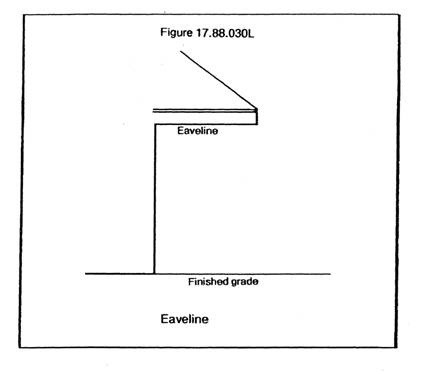
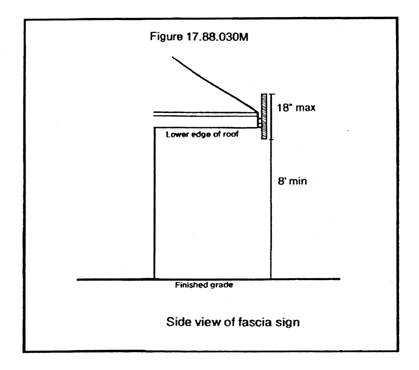
"Single housekeeping unit" means that the residents of a dwelling unit satisfy the following criteria:
1.
They have established ties and familiarity and interact with each other.
2.
Membership in the single housekeeping unit is fairly stable as opposed to transient or temporary.
3.
They share meals, household activities, expenses, and responsibilities.
4.
All adult residents have chosen to jointly occupy the entire premises of the dwelling unit, and they each have access to all common areas.
5.
If the dwelling unit is rented, all adult residents are named on and party to a single written lease that gives them each joint use and responsibility for the premises.
6.
Membership of the household is determined by the residents not by a landlord, property manager, or other third party.
7.
The residential activities of the household are conducted on a nonprofit basis.
8.
They do not have separate entrances nor do they have separate food-storage facilities, such as separate refrigerators or food-prep areas.
"Skateboard ramp" means any outdoor ramp or similar device covering an area greater than four hundred fifty (450) square feet and designed to create a slope, slant, or curve transitioning from a horizontal plane to a vertical section for the purposes of skating, skateboarding, dirt/freestyle/trick/racing bikes, or similar activities.
"Skirt Wall" is material used to enclose or partially enclose the area under a building or structure crawlspace or raised floor which serves as a protective or decorative feature.
"Small Cell Facility" has the same meaning as "small wireless facility" in 47 C.F.R. 1.6002(l), or any successor provision (which is a personal wireless services facility that meets the following conditions that, solely for convenience, have been set forth below):
1.
The facility—
a.
Is mounted on a structure fifty (50) feet or less in height, including antennas, as defined in 47 C.F.R. Section 1.1320(d), or
b.
Is mounted on a structure no more than ten percent (10%) taller than other adjacent structures, or
c.
Does not extend an existing structure on which it is located to a height of more than fifty (50) feet or by more than ten percent (10%), whichever is greater;
2.
Each antenna associated with the deployment, excluding associated antenna equipment (as defined in the definition of antenna in 47 C.F.R. Section 1.1320(d)), is no more than three (3) cubic feet in volume;
3.
All other wireless equipment associated with the structure, including the wireless equipment associated with the antenna and any pre-existing associated equipment on the structure, is no more than twenty-eight (28) cubic feet in volume;
4.
The facility does not require antenna structure registration under 47 C.F.R. Part 17;
5.
The facility is not located on Tribal lands, as defined under 36 C.F.R. Section 800.16(x); and
6.
The facility does not result in human exposure to radiofrequency radiation in excess of the applicable safety standards specified in 47 C.F.R. Section 1.1307(b).
"Smoke or tobacco shop" means any premises dedicated to the display, sale, distribution, delivery, or offering of tobacco, tobacco products, or tobacco paraphernalia, except grocery stores, supermarkets, convenience stores, retail kiosks, or similar uses that only sell conventional cigars, cigarettes, e-cigarettes or tobacco as an accessory tobacco sale use, as defined in this section.
"Specified anatomical parts" means:
a.
Less than completely and opaquely covered human genitals; pubic region; buttocks; or female breast below a point immediately above the top of the areola; or
b.
Human male genitals in a discernibly turgid state, even if completely and opaquely covered.
"Specialty Hospital" means any facility place, or building that is maintained and operated exclusively to provide twenty-four (24) hour paid in-patient services for the specialized treatment and recovery of chronic health or mental health conditions or elective procedures or treatments. Services provided may include, but are not limited to, food service nutrition counseling acupressure, massage fitness and physical therapy, and pharmaceutical and medical attention. This type of facility is distinct from an acute care general hospital and from a residential use where these services are occasional or otherwise incidental to a primarily residential occupancy.
"Specified sexual activities" means:
a.
Actual or simulated sexual intercourse, oral copulation, anal intercourse, oral-anal copulation, bestiality, direct physical stimulation of unclothed genitals, flagellation or torture in the context of a sexual relationship, or the use of excretory function in the context of a sexual relationship, any of the following depicted sexually oriented acts or conduct: anilingus, buggery, coprophagy, coprophilia, cunnilingus, fellatio, necrophilia, pederasty, pedophilia, piquerism, sapphism, zooerastia; or
b.
Clearly depicted human genitals in a state of sexual stimulation, arousal or tumescence; or
c.
Use of human or animal ejaculation, sodomy, oral copulation, coitus, or masturbation; or
d.
Fondling or touching of nude human genitals, pubic region, buttocks or female breast; or
e.
Masochism, erotic or sexually oriented torture, beating or the infliction of pain; or
f.
Erotic or lewd touching, fondling or other sexually oriented contact with an animal by a human being; or
g.
Human excretion, urination, menstruation, vaginal or anal irrigation.
h.
Striptease or the removal of clothing to the point where specified anatomical parts are not opaquely covered.
"Specific plan" means a detailed plan for the development of a specific area. Specific plans are a significant tool to implement the General Plan. A specific plan documents the proposed distribution, location, extent and intensity of major components of public and private transportation, sewage, water, drainage, solid waste disposal, energy, parks and other essential facilities proposed to be located within or needed to support the land uses described in the plan, as well as implementation and financing methods and added benefits to the City as a whole.
"Standalone emergency department" means a medical facility that satisfies each of the following criteria:
(1)
The emergency department shall operate under the consolidated license of a general acute care hospital and meet all of the requirements imposed under that license, including being within fifteen (15) miles of its parent hospital.
(2)
The emergency department shall be a conversion from a previously existing acute care campus and may not be a newly developed freestanding emergency department.
(3)
The emergency department shall be open twenty-four (24) hours a day, three hundred sixty-five (365) days a year.
(4)
The emergency department shall be staffed by at least one (1) board-certified emergency physician at all times.
(5)
The emergency department shall be staffed with properly trained emergency room nurses and meet the minimum staffing requirements for emergency departments in this state.
(6)
The emergency department shall have a complete range of laboratory and diagnostic radiology services, including a complete array of laboratory test, basic X-ray, computerized tomography (CT) scan, and ultrasound capabilities.
(7)
The emergency department shall meet the specialty call requirements, as defined by the Orange County Emergency Medical Services Agency, under its consolidated license.
(8)
The emergency department shall have transfer agreements with specialty centers, such as trauma, burn, and pediatric centers, to meet the needs of the injury or patient population served in the community.
(9)
The emergency department shall have the capabilities to stabilize patients with emergency medical conditions and to transport them to its parent hospital or other higher level of care facilities in a safe and timely manner, consistent with the standards of care in the local communities.
(10)
The emergency department shall have a fully functioning transport program with a proven track record of safely transporting patients who require admission to its parent hospital or other higher level of care and specialty services facilities, such as trauma, burn, and pediatric facilities.
(11)
All applicable federal and state regulatory requirements shall be met under the consolidated license of a general acute care hospital, including all applicable regulations of the Centers for Medicare and Medicaid Services and Title 22 of the California Code of Regulations.
"Stand Alone Residential" means the use of a lot or joined lots exclusively for residential and residential ancillary purposes.
"Stem Wall" is a supporting structure that joins the foundation of a building with the vertical walls constructed on the foundation.
"Stepback" means a vertical offset on a building wall, usually from one (1) story to another.
"Story" means that portion of a building included between the surface of any floor and the surface of the floor above it. If there is no floor above the surface floor, then a story shall be the space between the surface of a floor and the ceiling above it.
"Structure" means anything constructed or erected which requires location on ground or attached to something having location on the ground.
Structure, Accessory. An "accessory structure" means a structure that is incidental to the primary building on a site. The classification includes fences, walls, decks, landings, swimming pools, outdoor fire places, patios, platforms, porches and terraces and similar minor structures other than buildings (see "Building, Accessory" and "Building, Accessory, Attached").
Structure, Accessory, Attached. An "accessory structure" shall be considered "attached" when it is structurally a part of a building or structure or similar development, either accessory or primary, that requires foundation, footing, or comparable construction below grade ensuring the structure's stability.
"Structure, Primary." See definition of "Building, Primary."
"Support Structure" means any structure capable of supporting a base station.
"Supportive housing" has the same meaning as in California Government Code Section 65650(a), as that section is amended from time to time.
T
"Tobacco paraphernalia" means any paraphernalia, equipment, device, or instrument that is primarily designed or manufactured for the smoking, chewing, absorbing, dissolving, inhaling, snorting, sniffing, or ingesting by any other means into the body of tobacco, tobacco products, or other controlled substances as defined in California Health and Safety Code Section 11054 et seq. Items or devices classified as tobacco paraphernalia include, but are not limited to, the following: pipes, punctured metal bowls, bongs, water bongs, electric pipes, e-cigarettes, e-cigarette juice, buzz bombs, vaporizers, hookahs, and devices for holding burning material. Lighters and matches are excluded from the definition of tobacco paraphernalia.
"Tobacco product" means any product in leaf, flake, plug, liquid, or any other form, containing nicotine derived from the tobacco plant, or otherwise derived, which is intended to enable human consumption of the tobacco or nicotine in the product, whether smoked, chewed, absorbed, dissolved, inhaled, snorted, sniffed, or ingested by any other means. The term "tobacco product" excludes any product that has been specifically approved by the United States Food and Drug Administration (FDA) for sale as a tobacco/smoking cessation product or for other medical purposes, where such product is marketed and sold solely for such an approved purpose.
"Tobacco shop." See "smoke or tobacco shop."
"Tobacco" means any preparation of the nicotine-rich leaves of the tobacco plant, which are cured by a process of drying and fermentation for use in smoking, chewing, absorbing, dissolving, inhaling, snorting, sniffing, or ingesting by any other means into the body.
"Tower" means any structure built for the sole or primary purpose of supporting any FCC-licensed or authorized antennas and their associated facilities, including structures that are constructed for personal wireless services including, but not limited to, private, broadcast, and public safety services, as well as unlicensed wireless services and fixed wireless services such as microwave backhaul, and the associated site. This definition does not include utility poles.
"Transitional Housing" has the same meaning as in California Government Code Sections 65582(j).
"Triplex" means a multifamily dwelling containing three (3) dwelling units.
U
Use, Abandoned. "Abandoned use" means use wholly discontinued for any reason, except pursuant to a valid order of a court of law, for a period of one (1) year.
"Use, Accessory" means a use incidental or subordinate to, and devoted exclusively to the main use of a lot or a building located on the same lot or building site. Such uses include, but are not limited to, outdoor dining, nursery school play yards, automobile dealership display lots, and plant nurseries. No such use shall intrude upon the public right-of-way without an encroachment permit issued pursuant to the Municipal Code. See "accessory use."
Use, Alterations of. For the purpose of Section 17.64.125, Waivers of Parking Requirements, an "alteration of use" means any change of use, intensification of use, or any other situation where there is an increase in the required parking caused by reasons other than the creation or addition of square feet of development.
V
"Vehicle dealership" means a place of business primarily engaged in the sales or leasing of new and/or used vehicles and may include ancillary rental, parts sales, and vehicle repair.
Vehicle, Oversized. "Oversized vehicle" means a vehicle which exceeds any of the following dimensions: twenty (20) feet in length, nine (9) feet in height, or seven (7) feet in width.
"Vehicle Rental" means a place of business limited to an office use and engaged in renting vehicles.
"Vehicle Parts Stores" retail sales of vehicle-related parts with no on site installation of parts or other vehicle services.
Vehicle Repair, Major. "Major vehicle repair" means establishments which provide major repair and maintenance related to motor vehicles. Typical uses would include, but not be limited to, auto-body repair shops auto glass shops, automotive painting shops, customizing shops, engine rebuilding, transmission shops, and upholstery shops.
Vehicle Repair, Minor. "Minor vehicle repair" means establishments which provide routine care and maintenance related to motor vehicles. Typical uses would include, but not be limited to, brake shops, tire stores, muffler shops, alignment shops, detail shops, radiator shops, stereo installation shops, and tune-up services and oil and lubrication services.
"Vehicle Sales" means a business, other than a vehicle dealership, engaged solely in buying and selling used vehicles.
"Vehicle service and repair-related facilities" means uses which service or repair vehicles, including car washes, minor and major vehicle repair facilities, and other similar uses. Vehicle dealerships (with strictly sales and no service and repair facilities), service stations, and vehicle parts/accessories retailers are not, for the purposes of this title, considered vehicle service and repair-related facilities.
W
"Wine Tasting" means the sale or offering of wine for sampling on the premises of establishments in which wine and wine-related products are primarily available for off-site sale, distribution, and consumption.
"Wireless Permit" means a permit issued pursuant to Section 17.16.075 authorizing the placement or modification of a small cell facility of a design specified in the permit at a particular location within the City.
"Wireless Telecommunications Facility" means the transmitters, antenna structures and other types of installations used for the provision of wireless services at a fixed location, including, without limitation, any associated tower(s), support structure(s), and base station(s).
"Without Prejudice" means an applicant can resubmit an application and fee for the same project. Applicants must wait one (1) year from a project's denial date before resubmitting.
Y
Yard.
1.
"Front yard" means an area extending across the full width of the lot between the front lot line and a structural setback line parallel to the front lot line.
2.
"Interior side yard" means an area extending from the required front yard to the required rear yard and from the interior side lot line to a structural setback line parallel to the side lot line. Where there is no required front and/or rear yard, the interior side yard shall be measured from the required front lot line and/or rear lot line, respectively.
3.
"Rear yard" means an area extending across the full width of the lot between the rear lot line and a setback line parallel to the rear lot line.
4.
"Street side yard" means an area extending from the required front yard to the rear lot line and from the street-side lot line to a structural setback line parallel to the street-side lot line. Where there is no required front and/or rear yard, the street side yard shall be measured from the front lot line and/or rear lot line, respectively.
Figure 17.88.030N
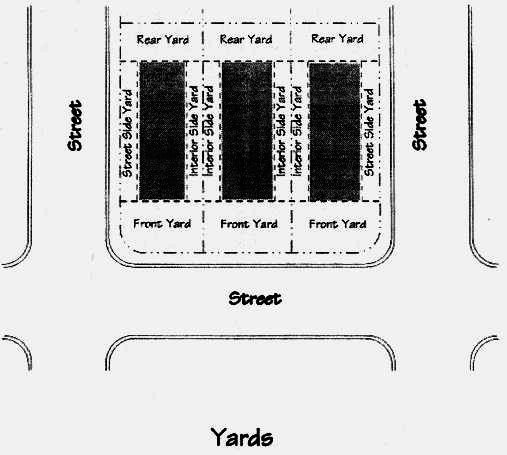
Z
"Zone" means a portion of the City within which certain uses of land and buildings are permitted or prohibited and within which certain development standards are established as set forth and specified in this title.
(Ord. 1448 §§ 2, 4, 2007; Ord. 1445 §§ 16—18, 2007; Ord. 1442 § 7, 2007; Ord. 1314 §§ 69—73, 2006; Ord. 1308 §§ 20—26, 2006; Ord. 1304 § 35, 2005; Ord. 1257 § 3, 2002; Ord. 1239 §§ 18 and 19, 1999; Ord. 1235 § 4, 1999; Ord. 1190 § 20, 1997; Ord. 1182 § 17, 1997; Ord. 1173 § 3, 1996; Ord. 1172 § 3 (part), 1996; Ord. No. 1524, §§ 3, 4, 12-7-2010; Ord. No. 1548, § 3(Exh. B, §§ 1—6), 3-6-2012; Ord. No. 1561, § 3(Exh. A, §§ 33—36, 38—49), 11-27-2012; Ord. No. 1575, § 3(Exh. A, §§ 14—21, 12-3-2013; Ord. No. 1585, § 2(Exh. A), 9-2-2014; Ord. No. 1594, § 3(Exh. A, § 44), 5-5-2015; Ord. No. 1608, §§ 3—5, 10-20-2015; Ord. No. 1599, §§ 4(Exh. A, 2, 3), 7-7-2015; Ord. No. 1609/1610, § 6(Exh. D, 1), 11-17-2015; Ord. No. 1613, § 5(Exh. A, 11), 1-19-2016; Ord. No. 1616, § 10, 2-2-2016; Ord. No. 1619, § 4, 4-5-2016; Ord. No. 1622, § 4, 5-17-2016; Ord. No. 1632, § 3(Exh. A, § 12), 11-15-2016; Ord. No. 1652, § 4, 5-15-2018; Ord. No. 1660, § 3, 9-4-2018; Ord. No. 1668, § 2, 3-5-2019; Ord. No. 1681, § 7, 10-15-2019; Ord. No. 1690, § 2, 2-18-2020; Ord. No. 1707, § 3, 2-2-2021; Ord. No. 1743, § 4, 12-20-2022; Ord. No. 1744, §§ 4, 5, 12-20-2022; Ord. No. 1745, §§ 4, 5, 12-20-2022; Ord. No. 1808, § 4(Exh. A), 5-19-2026)
17.88.040 - Severability.
Should any section, subsection, clause, or provision of Ordinance 1239, codified in Section 17.88.030, for any reason be held to be invalid or unconstitutional, such invalidity or unconstitutionality shall not affect the validity or constitutionality of the remaining portions of Ordinance 1239, codified in Section 17.88.030; it being hereby expressly declared that Ordinance 1239, and each section, subsection, sentence, clause and phrase thereof would have been prepared, proposed, approved, adopted and/or ratified irrespective of the fact that any one or more sections, subsections, sentences, clauses or phrases be declared invalid or unconstitutional including, but not limited to, the locational and operational requirements contained in Section 5.12.050. In the event a court of competent jurisdiction renders a decision invalidating the permit issuance process contained in this chapter, any adult-oriented business which operates in the City shall be deemed to be operating under a de facto permit subject to requirements contained in Section 5.12.050. The de facto permit shall remain subject to the remaining provisions of this chapter which have not been invalidated including but not limited to Section 5.12.080 (Permits nontransferable—Use specific); and Section 5.12.090 (Enforcement and revocation).
(Ord. 1239 § 19, 1999; Ord. No. 1664, § 47, 9-18-2018)

