
San Clemente City Zoning Code
CHAPTER 17
12 - DEVELOPMENT REVIEW PROCESS
Sections:
17.12.010 - Purpose and Intent.
This chapter is intended to describe the general procedures for filing applications when required or permitted by this title. Information related to specific applications can be found in Chapter 17.16, Applications, of this title. Tables 17.12.020, Review Authority for Permits and Entitlements, and 17.12.100, Public Hearing Requirements, contained in this chapter, list the various applications that are explained in detail in Chapter 17.16, Applications, as well as a summary of the review process for each application.
(Ord. 1172 § 3 (part), 1996)
17.12.020 - Review Authorities.
This section identifies the review authorities responsible for making decisions on applications required by the Zoning Ordinance.
A.
City Council. Refer to Chapter 2.04 for a description of the City Council's function, duties, and powers.
B.
Planning Commission. Refer to Chapter 2.32 for a description of the Planning Commission's function, duties, and powers.
C.
Zoning Administrator. The Community Development Director, or designee, acts as the Zoning Administrator. Refer to Chapter 2.34 for a description of the Zoning Administrator's function, duties, and powers.
D.
The Planning Division. The Planning Division is responsible for the administration of the Zoning Ordinance, including the following functions:
a.
Application Process. The Planning Division shall process applications consistent with goals and policies in the General Plan and the Zoning Ordinance. If a project is located in a Specific Plan area, then applications shall also be processed consistent with the Specific Plan.
b.
Public Information. The Planning Division shall have the responsibility to provide information to the public on provisions and requirements of the Zoning Ordinance.
c.
Coordination. The Planning Division shall be responsible for coordinating matters related to the administration of this title with other agencies, City departments and divisions, and City boards and commissions. The Planning Division participates in the Development Management Team (DMT), which is a group of City staff from various departments and staff from other agencies (e.g., the Orange County Fire Authority) that meets regularly to coordinate on the review of applications for completeness, consistency with requirements, guidelines, and policies. The DMT also makes non-binding recommendations to the applicable review authority. Unless required by this Title, the City Planner has discretion on whether to bring an application to the DMT for review and a recommendation.
d.
Application Status Updates. The Planning Division shall provide information to applicants and interested parties on the status of applications.
E.
Designated Review Authority for Required Approvals. Refer to Table 17.12.020, Review Authority for Permits or Entitlements, for the review authority designated to act upon applications required by this Title, according to procedures described in Section 17.12.060.
Table 17.12.020
Review Authority for Permits and Entitlements
1 Refer to Section 17.12.090, Consideration of Concurrent Applications, regarding review of concurrent applications.
(Ord. 1172 § 3 (part), 1996; Ord. 1308 § 6, 2006; Ord. No. 1594, § 3(Exh. A, § 1), 5-5-2015; Ord. No. 1609/1610, § 6(Exh. D, 7), 11-17-2015; Ord. No. 1690, § 5(Exh. C), 2-18-2020; Ord. No. 1759, § 3(Exh. A), 10-3-2023; Ord. No. 1803, § 4(Exh. A), 4-21-2026)
17.12.025 - Design Review Subcommittee.
This section describes the Design Review Subcommittee's function, duties, and applications that may require design review.
A.
Function and Duties. The Design Review Subcommittee is an advisory body, not an approval body. The Subcommittee advises applicants on how projects can best comply with policies and design guidelines that relate to various visual impact issues, such as site planning, architecture, landscaping, and the preservation of cultural and aesthetic resources. The policies and guidelines are contained in various planning documents, such as the General Plan, Design Guidelines, Specific Plans (when projects are located in a Specific Plan area), Zoning Ordinance, and Coastal Land Use Plan.
The Design Review Subcommittee does not focus on land use issues, which are the purview of the review authority. The Design Review Subcommittee forwards a recommendation to the review authority that acts upon a project. For sites on the City's designated historic structures and landmarks list, the Design Review Subcommittee (DRSC) functions as the Cultural Heritage Subcommittee (CHSC). The CHSC has similar duties as the DRSC but with added emphasis on historic resource preservation.
B.
Referrals to the Design Review Subcommittee. The review authority may refer applications to the Design Review Subcommittee if not required otherwise by Chapter 17.16 for specific applications.
C.
Applications that May Require Design Review Subcommittee Review. Table 17.12.025 identifies applications that may require projects to be reviewed by the Design Review Subcommittee. For each application shown below, the table provides examples of common design issues reviewed by the Design Review Subcommittee.
Table 17.12.025 - Applications and Design Review Process
(Ord. No. 1594, § 3(Exh. A, § 2), 5-5-2015; Ord. No. 1759, § 3(Exh. A), 10-3-2023)
17.12.030 - Preapplication Review.
The following are primary among the purposes of preapplication review of a development project:
A.
To familiarize the applicant with the application requirements and the review process for a project;
B.
To familiarize the applicant with City documents affecting a project, including, but not limited to, the General Plan, Hillside Development Ordinance, Design Guidelines and Zoning Ordinance;
C.
To ensure early consideration of General Plan goals and policies;
D.
To identify for the applicant some of the significant issues and community concerns that may arise as the project moves through the review process;
E.
To provide Planning Division staff with the opportunity, when appropriate, to bring in staff from other divisions and departments for early consultation on a project;
F.
To determine the appropriate reports and studies that will be necessary for the review of the project, including, but not limited to, traffic reports, biological studies and fiscal impact analyses.
It is not the intent of this title that preapplication review be extensive enough to identify all issues, concerns, or problems related to a project. It is the intent that the process allow for the applicant to become more familiar with the City's review process and staff to identify obvious and significant issues relative to the project. Preapplication review is encouraged; unless otherwise indicated in this title, preapplication review shall be voluntary.
Where requested by the applicant, or required by this title, a preapplication consultation may be held with the Planning Division staff and/or other department or division staff to obtain comments regarding a development project. Information regarding preapplication review is available from the Planning Division. With the preapplication request, the applicant should submit as much detailed information about the project as available.
(Ord. 1172 § 3 (part), 1996)
17.12.040 - Filing an Application.
A.
Persons Who May File an Application (or Preapplication). .....Unless otherwise specified, an application required or permitted by this title will only be accepted if signed by the owner of the subject property or by the property owner's authorized agent. When the property owner's authorized agent submits an application, the application must be accompanied by written authorization from the property owner. If the property for which an application is submitted is in more than one ownership, all the owners or their authorized agents must either sign the application or submit a written, signed document indicating their consent to the application.
B.
Application Forms. .....Unless indicated otherwise by Chapter 17.16, Applications, of this title, applications required or authorized by this title shall be submitted to the Planning Division and shall include forms and any other materials, reports, dimensioned plans or other information required by the application checklist available from the Planning Division. If a public hearing is required prior to issuance or approval of the application, all public notification materials required by Table 17.12.100, Public Hearing Requirements, must be included with the application. It is the responsibility of the applicant to ensure that all required information is provided.
C.
Fees. .....The City Council shall, by resolution, establish and amend from time to time a schedule of fees for applications required or authorized by Chapter 17.16, Applications, of this title. Applicants shall pay the fees and costs for processing applications when the application is filed with the Planning Division. The purpose of the application fees is to reimburse the City for all costs incurred as the result of its administration of the provisions of this title.
D.
Waiver of Fees. .....For special circumstances, the City Council may waive or reduce the application fees established by resolution of the City Council, based on the merit of the request. Waiver of fees shall be approved prior to application submittal. The applicant must file a request for waiver of fees with the City's Planning Division. The letter shall explain the reasons for the request for a waiver. The Planning Division shall forward the letter requesting a waiver of fees to the City Council for their review at the next regularly scheduled City Council meeting at which time the request can be agendized under New Business.
E.
Supplemental Information. .....The City Planner, or review authority, may request the applicant submit information to clarify, correct, or otherwise supplement submitted information beyond that originally submitted in the course of processing the application should he or she find that additional information is necessary to adequately review a request. Such a request shall not invalidate the original determination that the application was complete at the time the determination was originally made. Supplemental information may include, but is not limited to, visual analysis tools such as story pole staking, photo simulations, and models. Projects with added concern for visual impacts are more likely to require story poles that include construction or expansion of three-story structures in the Architectural Overlay district and structures with the potential to affect public view corridors from public places in the Coastal Overlay zone.
1.
Certification of Visual Analysis Tools. When visual analysis tools are required, the accuracy of the materials shall be certified by a licensed architect or engineer prior to scheduling the first public hearing for a project.
2.
Story Pole Installation Requirements. When story poles are required, they shall be erected at least 14 calendar days prior to the first public hearing or meeting on the Project, as determined by the City Planner, except that the approval authority shall have discretion to require that they be erected earlier, but not to exceed 28 calendar days prior to the hearing. The following must be completed for a site to be deemed to have been properly staked with story poles:
a.
Story poles and connecting thick colored lines or pennants, which accurately represent the limits of the proposed structure's envelope. This includes the outermost corners of the building's roof area and along the tallest roof ridgelines or peaks, or other areas necessary to evaluate visual impacts at the discretion of the City Planner or Review Authority. The City Planner shall have final approval authority over the location of the story poles to ensure that they do not detrimentally impact the public or the then current use of the property; and
b.
A staking plan with the location and height of the story poles must be certified as accurate by a registered land surveyor or registered civil engineer. If a complete and certified staking of story poles for a project is not in place in the time required, the project shall be continued to a later date. Neither the applicant, a relative of the applicant, nor any other person possessing a financial interest in the property or the project may certify the location and height accuracy of the staking poles.
3.
Story Pole Re-certification. Re-certification is required at least 14 calendar days prior to the first public hearing as described above in 2. Requirements, in the following instances:
a.
If the project is modified during the design review process requiring the project to be re-staked; and/or
b.
If the initial installation of story poles was completed one year prior to the final hearing date.
4.
Story Pole Removal. A deposit in the amount the City Planner determines to be reasonably necessary to remove the story poles shall be made prior to the time the project is scheduled for public hearing. Story poles shall be removed by the applicant within 20 calendar days after the appeal period for the project has expired. Upon timely removal of the story poles, the deposit shall be returned to the applicant. The applicant's failure to remove the story poles within the prescribed time period shall result in the automatic forfeiture of the deposit, and the City shall have the ability to access the site to remove the poles. Story poles must be removed if a project has been inactive for a period longer than six months. Story pole placement shall be photo-documented from viewpoints determined by the City Planner to document size, mass, height, and scale, and shall be submitted to [be] retained by the City with the project file. Prior to the first public hearing on the project, the applicant shall grant to the City a written right of entry for purposes of pole removal.
(Ord. 1172 § 3 (part), 1996)
(Ord. No. 1759, § 3(Exh. A), 10-3-2023)
17.12.050 - Application Completeness.
A.
Review for Completeness. .....The Planning Division shall determine the completeness of an application within the time period specified by State law (Government Code Section 65943), after receiving a submitted application and associated information. No application shall be processed pursuant to this title until the Planning Division determines the application is complete. If the Planning Division fails to make a determination as to completeness of an application or resubmitted application within the time period specified by State law (Government Code Section 65943), the application shall be automatically deemed complete and processed pursuant to the provisions of this title.
B.
Applicant Notification. .....If an application is deemed complete, the Planning Division shall notify the applicant in writing. The application shall then be processed pursuant to the provisions of this title. If an application is deemed incomplete, the Planning Division shall notify the applicant in writing, outlining the reason(s) for the determination and the information necessary to complete the application.
(Ord. 1172 § 3 (part), 1996)
(Ord. No. 1759, § 3(Exh. A), 10-3-2023)
17.12.055 - Environmental Review.
All applications will be reviewed by the Planning Division for compliance with the California Environmental Quality Act (CEQA). No application shall be approved pursuant to this title prior to the completion and/or certification of applicable environmental documentation required by CEQA. Applications shall be processed within the time limits prescribed in CEQA (Government Code Section 65920 et seq.).
(Ord. 1172 § 3 (part), 1996)
(Ord. No. 1759, § 3(Exh. A), 10-3-2023)
17.12.060 - Decision Process.
Application for permits or other matters shall be acted upon in accordance with one of the five decision processes established shown on Figure 17.12.060.A, except for capital improvement program projects. The subject matter of the development application determines the process that shall be followed for each application. The provisions of Chapter 17.16 that pertain to each permit, map, or other matter describe the decision process in more detail. Depending on the proposal, the review process may also require review by an advisory body such as the Design Review Subcommittee or Cultural Heritage Subcommittee. Figure 17.12.060.A is provided for convenience of reference only and does not define, describe, or limit the scope, meaning, or intent of any provision of this Title. This diagram describes the City of San Clemente's processes only, not decision processes that may be required by other agencies such as the California Coastal Commission.
Figure 17.12.060.A, Decision Processes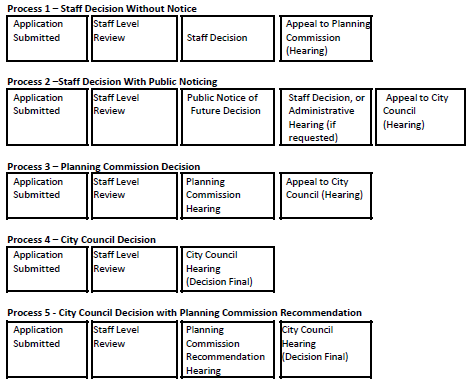
* Depending on the proposal, the review process may also require review by an advisory body such as the Design Review Subcommittee or Cultural Heritage Subcommittee.
A.
Process One—Staff Decision Without Public Hearing. A Process One decision on an application may be approved or denied by a City staff person specified in Table 17.12.020 or their designee. A public hearing will not be held. A decision may be appealed to the Planning Commission according to Section 17.12.140.
B.
Process Two—Zoning Administrator Decision. A Process Two decision on an application shall be made as follows:
1.
Decision Process. The City Planner may approve, conditionally approve, or deny the application administratively. If an administrative hearing is requested by the public, pursuant to Subsection B.2, the Zoning Administrator, or their designee, is the review authority and may approve, conditionally approve or deny the application at an administrative hearing, pursuant to 17.12.100.C.
2.
Public Notification. Notice of a decision shall be provided to the public according to Section 17.12.100.C. with necessary materials provided by an applicant.
3.
Appeals. The decision may be appealed to the City Council according to Section 17.12.140.
C.
Process Three—Planning Commission Decision. A Process Three decision on application shall be made as follows:
1.
Decision Process. The Planning Commission may approve, conditionally approve, or deny the application at a public hearing.
2.
Public Notification. Notice of a public hearing shall be provided according to Section 17.12.100 with necessary materials provided by an applicant.
3.
Appeals. The Planning Commission's decision may be appealed to the City Council according to Section 17.12.140.
D.
Process Four—City Council Decision.
1.
A Process Four decision on an application may be approved, conditionally approved, or denied by the City Council at a public hearing.
2.
Public Notification. Notice of a public hearing shall be provided according to Section 17.12.100 with necessary materials provided by an applicant.
3.
Ability to Act as Review Authority for a Lower-Level Process. The City Council by majority vote may decide to serve as the Review Authority for any applications that require a lower-level Process according to Table 17.12.020.
E.
Process Five—City Council Decision with Planning Commission Recommendation. A Process Five decision on an application shall be made by the City Council as follows:
1.
Planning Commission Recommendation. Before the City Council decision, the Planning Commission shall hold a public hearing to consider the application. The hearing shall be noticed in accordance with Section 17.12.100. The hearing may be continued if desired by the Commission to solicit and obtain information needed to make a recommendation. However, the hearing shall be concluded no later than 60 calendar days after the initial hearing date. At the conclusion of the public hearing, the Planning Commission shall make a written recommendation to the City Council to approve, conditionally approve, or deny the application. If the Planning Commission fails to act within this 60-day period the matter shall proceed to City Council without a recommendation.
2.
Decision Process. After receiving the Planning Commission's recommendation or expiration of the 60-day time period with no recommendation, the City Council shall hold a public hearing to consider the application. The hearing shall be noticed in accordance with Section 17.12.100. The City Council may approve, conditionally approve, or deny the application at the conclusion of the hearing.
F.
Referrals to Higher Review Level. A Review Authority has the discretion to refer applications to a higher review level, as follows:
1.
The City Planner or Zoning Administrator may refer Process 1 or Process 2 decisions to the Planning Commission, depending on level of public concern anticipated for a matter. If decisions are referred to the Planning Commission, a public hearing and notification shall be required according to Section 17.12.100.
(Ord. 1172 § 3 (part), 1996; Ord. 1472 § 2, 2008; Ord. No. 1594, § 3(Exh. A, § 3), 5-5-2015; Ord. No. 1759, § 3(Exh. A), 10-3-2023; Ord. No. 1803, § 4(Exh. A), 4-21-2026)
17.12.065 - Inactive Applications.
The City may close inactive applications according this Section.
A.
Incomplete Letters. The City determines the completeness of an application within the time period specified by State law as described in Section 17.12.050. If the application is incomplete, the City notifies the applicant in writing to describe what is needed to process the application, such as studies, development plans, forms, and fees. The letter specifies a timeframe for submitting the requested items.
B.
Resubmittal Timeframe. Applications shall be deemed inactive and be closed at the discretion of the City Planner if the applicant does not submit requested items for six consecutive months following the date of the incomplete letter, unless the incomplete letter specifies an alternate timeframe or an extension is granted according to Subsection C.
C.
Request for Time Extension. The applicant may request an extension of time to resubmit the application. The time extension request shall be made in writing and received within the resubmittal timeline described in Subsection B. The written request shall provide a detailed explanation of the reason(s) for the request and the additional time needed to provide the requested information and/or application fees. Such reasons may include by way of example and not by limitation, additional time needed to conduct a required seasonal biological survey or to secure a professional consultant to carry out a required analysis.
The City Planner shall review the written request and provide the applicant a written determination, approving or denying the request, based on finding whether there are unusual circumstances preventing the applicant from resubmitting the application within the given timeframe. If the City Planner grants the applicant's request, the written determination shall specify the additional time granted to resubmit the application. Then, the applicant shall submit requested items within extended resubmittal timeframe or the City shall have discretion to close the application.
D.
Return of Unused Deposit Account Funds. If an application is withdrawn by the City or the applicant, the City shall contact the applicant to refund any unused deposit account fees. If an applicant is unresponsive, the City will refund fees when an opportunity arises to communicate with the applicant. Fixed fee applications are not refundable.
(Ord. No. 1575, § 3(Exh. A, § 2), 12-3-2013; Ord. No. 1759, § 3(Exh. A), 10-3-2023)
17.12.070 - Time Limits for Processing Applications.
Applications shall be processed within the time limits prescribed in State law, Government Code Section 65920, et seq. The time limits for processing appeals shall be in addition to the time limits specified for the original processing of the request. Please refer to Section 17.12.140, Appeals of an Action, of this chapter for the time limits for processing appeals.
(Ord. 1172 § 3 (part), 1996)
17.12.080 - Reserved.
Editor's note— Ord. No. 1759, § 3(Exh. A), adopted Oct. 3, 2023, renumbered the former § 17.12.080 as § 17.12.055. The former § 17.12.080 pertained to environmental review.
17.12.090 - Consideration of Concurrent Applications.
Applications for a number of requests for one project may be combined and processed concurrently, as long as all applicable processing requirements are satisfied. The purpose of allowing concurrent review is to consolidate final action on the project with the highest review authority responsible for making a decision on the applications for a project. The following shall apply to concurrently processed applications:
A.
Public Hearing and Non-Public Hearing Applications. When an application requiring a public hearing is combined with an application that does not require a public hearing, the combined applications shall require a public hearing.
B.
City Council and/or Planning Commission as Highest Review Authority. When City Council and/or Planning Commission review is required for at least one of the applications for a project, the final decision on all applications shall be made by the highest review authority.
When the City Council is the highest review authority for a project, all review by other bodies with approval authority over the applications shall be in the form of a recommendation to the City Council.
When the Planning Commission is the highest review authority for a project, all review by other bodies with approval authority over the applications shall be in the form of a recommendation to the Planning Commission.
C.
Omitting City Planner and Zoning Administrator Review. In order to eliminate redundant review and an unnecessary lengthening of the discretionary review process, it is appropriate to eliminate City Planner or Zoning Administrator review of some applications. When combined applications are being processed for a project, and both Planning Commission and City Planner or Zoning Administrator review are required, City Planner or Zoning Administrator review shall be omitted and Planning Commission review substituted.
(Ord. 1172 § 3 (part), 1996; Ord. No. 1803, § 4(Exh. A), 4-21-2026)
17.12.100 - Public Hearing and Notification.
A.
Purpose. .....This section defines procedures for public notification when required by this title. The purpose of this section is to ensure public awareness and full and open public discussion and debate regarding proposed actions being taken pursuant to this title.
B.
Notice of Public Hearings. .....A notice of public hearing is required for processes 3 to 5 in Section 17.12.060 that involve a public hearing action by the Planning Commission, or City Council. The City Planner is authorized to advertise and notice Planning Commission public hearings. The City Clerk is authorized to advertise and notice City Council public hearings. Table 17.12.020, Review Authority for Permits and Entitlements, identifies the applications that require a public hearing, as well as the review authorities for applications.
Notice of public hearings shall be given pursuant to applicable provisions of State law, Government Code Sections 65090 and 65091, and this title, including all of the following requirements which must be complied with at least 10 days prior to the public hearing:
1.
Publication. Publication in a newspaper of general circulation in the City of San Clemente; and
2.
Mailing Recipients. A notice of public hearing shall be mailed to the following:
a.
Owners of property within 300 feet of a site that is the subject of the public hearing. If the number of owners to whom notice would be mailed or delivered pursuant to this subsection is greater than 1,000, the City, may provide notice by placing a display advertisement of at least one-eighth page in at least one newspaper of general circulation within the City at least 10 days prior to the hearing in lieu of a mailed or delivered notice;
b.
Local agencies expected to provide water, sewage, streets, roads, schools, or other essential facilities or services to the project, where ability to provide these facilities and services may be significantly affected;
c.
Persons requesting notice of such hearing;
d.
The City of San Clemente as owning property within a specified distance from the exterior boundaries of the subject property (radius of notice), unless the City is the sole applicant for the hearing that is the subject of the notice; and
3.
Notice Content. At a minimum, the notice of public hearing shall include all of the following:
a.
General subject of the public hearing;
b.
The location of the property that is the subject of the application;
c.
The date, time, and place of the public hearing;
d.
The Review Authority holding the public hearing; and
e.
The name, telephone number, and address of the City staff person to contact for additional information.
4.
Posting. Posting three notices adjacent to the subject property in conspicuous places facing the public street. Posting of public hearing notices may be delegated by the City Planner to the project applicant. If posting is delegated to the project applicant, notices must be provided to the applicant by the Planning Division.
5.
Affidavit of Mailing, Publication and/or Posting. Once a notice of public hearing has been given, in accordance with this Section, an affidavit shall be filed in the permanent records of the subject project, according to the following requirements:
a.
Mailing and Publication. The City Planner shall be responsible for the affidavit of mailing and publication, if the hearing is held by the Zoning Administrator or Planning Commission. The City Clerk shall be responsible for the affidavit of mailing and publication, if the hearing is held by the City Council.
b.
Posting. The City Planner, if the hearing is held by the Zoning Administrator or Planning Commission, or the City Clerk, if the hearing is held by the City Council, shall be responsible for the affidavit of posting. If posting is delegated to the project applicant, an affidavit of posting must be provided by the City and signed by the applicant or the applicant's representative.
C.
Notice of a Future Decision for Administrative Permit Decisions. .....A notice of a future decision is required for administrative projects subject to Process 2 outlined in Section 17.12.060.B. The City Planner is authorized to notice future decisions on administrative projects requiring such notification. Notice of future decisions shall be given at least 10 days prior to the administrative decision as follows:
1.
Notice by Mail. Mailed or delivered to:
a.
Owners of property within 300 feet of a site that is the subject of the administrative project. If the number of owners to whom notice would be mailed or delivered pursuant to this subsection is greater than 1,000, the City may provide, at the subject applicant's expense, notice by placing a display advertisement of at least one-eighth page in at least one newspaper of general circulation within the City at least 10 days prior to the hearing in lieu of mailed or delivered notice;
b.
Persons requesting notice of action on a specified project application;
2.
Once notice has been given in accordance with Section 17.12.100.C.1, any person may file written comments or a written request to be heard within ten calendar days of the date of the notice. If a written request to be heard is filed, the City Planner shall:
a.
Schedule an administrative hearing; and
b.
Provide written notice at least five calendar days prior to the date of the administrative hearing to the owner of the subject real property or the owner's duly authorized agent, the project applicant and/or applicant's representative, and any person who filed written comments or a written request to be heard.
3.
The noticing requirements specified in Section 17.12.100.B shall apply if an administrative permit is processed concurrently with a permit, entitlement, or action that requires a public hearing.
D.
Failure of Any Person to Receive a Mailed Notice. .....Failure of any person to receive notice according to this Section shall not invalidate any proceedings.
E.
Materials for Notice Mailings. .....Applicants shall provide all necessary materials for each public notice required by this Title, including: one set of stamped, labeled envelopes; a mailing list in label format; a radius map (for mailings); and a signed form certifying all materials are accurate within six months of notice distribution.
(Ord. 1172 § 3 (part), 1996; Ord. No. 1575, § 3(Exh. A, § 22), 12-3-2013; Ord. No. 1759, § 3(Exh. A), 10-3-2023; Ord. No. 1803, § 4(Exh. A), 4-21-2026)
17.12.110 - Failure to Provide Information.
A.
.....Failure to provide any of the following information in the time period required for processing applications shall constitute a reason for denial of an application:
1.
Information that is to be supplied by the applicant and is necessary to prepare a legally adequate environmental document (Section 15109 of the State CEQA Guidelines);
2.
Information necessary to clarify, amplify, correct, or otherwise supplement the information required for the application; or
3.
Information without which the City's decision to approve a project would not be supported by substantial evidence.
B.
.....Denial for the above reasons may be deemed by the City to be a denial without prejudice to the applicant's right to reapply for the same permit. Please refer to Section 17.12.170, New Application Following Denial, of this chapter for limitations on the resubmittal of projects.
(Ord. 1172 § 3 (part), 1996)
17.12.120 - Reconsideration of an Action on an Application.
A.
Decision to Reconsider. .....Any application or conditions of approval that are acted upon by the City Planner under Process 2, Zoning Administrator, Planning Commission, or City Council may be reconsidered by the decision-making body if all of the following occur:
1.
Reconsideration is requested by a member who voted for the prevailing action upon the application;
2.
Reconsideration is agreed to by a simple majority of the members voting on this motion to reconsider;
3.
The motion to reconsider comes before the adjournment of the meeting at which the original vote was taken, or before the minutes of that meeting are approved by the City Council.
B.
Reconsideration. .....Reconsideration of a previous action by a decision-making body shall be processed in the following manner:
1.
The matter shall be publicly noticed in the same manner in which the original notice was given.
2.
Reconsideration should take place at the next regularly scheduled meeting of the decision-making body, following the decision to reconsider.
When reconsidering an action, the decision-making authority may review the action anew and is not limited to the original reason Stated for reconsideration.
(Ord. 1172 § 3 (part), 1996; Ord. No. 1803, § 4(Exh. A), 4-21-2026)
17.12.130 - Effective Date of Decision on an Action.
A decision that is subject to appeal shall not become effective until the time established for appeals, as defined in Section 17.12.140, Appeals of an Action, of this title, has expired, or in the case of an appeal being filed, after the final determination of the City Council upon the appeal.
(Ord. 1172 § 3 (part), 1996)
17.12.140 - Appeals of an Action.
A.
Appeals by the Public.
1.
Right to Appeal.
a.
Decisions of the Community Development Director or City Planner. Any person may appeal a decision of the Community Development Director and/or City Planner to the Planning Commission, except for a decision on a Wireless Permit. The Planning Commission's decision may be appealed to the City Council, whose decision shall be final. Appeals of decisions of the City Planner on Wireless Permits are governed by Section 17.16.075(b)(2).
b.
Decisions of the City Manager on City Antenna Permits. Any person may appeal a decision of the City Manager on City Antenna Permits to the Planning Commission. The Planning Commission's decision may by appealed to the City Council, whose decision shall be final.
c.
Decisions of the Zoning Administrator. Any person may appeal a decision of the Zoning Administrator to the City Council. The City Council's decision on the appeal shall be final.
d.
Decisions of the Planning Commission. Any person may appeal a decision of the Planning Commission to the City Council. The City Council's decision on the appeal shall be final.
2.
Time Limits for Filing an Appeal.
a.
Decisions of the Community Development Director or City Planner. Except for appeals on Wireless Permit decisions, an appeal of a decision made by the Community Development Director or City Planner shall be filed with the Planning Division within ten consecutive calendar days following the decision sought to be appealed. Appeals of decisions of the City Planner on Wireless Permits are governed by Section 17.16.075(b)(2).
b.
Decisions of the City Manager on City Antenna Permits. An appeal of a decision made by the City Manager on a City Antenna Permit shall be filed with the Planning Division within ten consecutive calendar days following the decision sought to be appealed.
c.
Decisions of the Zoning Administrator or Planning Commission. An appeal of the decision of the Zoning Administrator, or Planning Commission shall be filed in the office of the City Clerk or with the City Planner within ten consecutive calendar days following the decision sought to be appealed.
d.
Calculation of the Appeal Period. For the purpose of calculating the appeal period, the first day of the appeal period shall be the day immediately following the day on which the decision occurred. Other than appeals on Wireless Permits, the final day of the appeal period shall be the tenth calendar day following the first day of the appeal period, at 5:00 p.m. If the last day to appeal falls on a holiday or on a Saturday or Sunday, the following business day shall be deemed the last day to appeal.
3.
Application for Appeal. Appeals shall be in writing on a form obtained from the Planning Division or City Clerk. The appellant shall state the specific reasons for the appeal on such form, submit funds to pay the required appeal fee, and submit public notification materials. The appeal form and fee shall be submitted within the timeframe required by Section 17.12.140(A)(2)(d). Unless otherwise provided for in Table 17.12.100, Public Hearing Requirements, of this chapter public notification materials shall consist of postage pre-paid envelopes addressed to each person owning property within 300 feet of the property which is the subject of the appeal, as such names appear on the latest County equalized tax assessment role.
B.
Appeals by the City Council and Planning Commission.
1.
City Council Right to Appeal. The City Council may appeal any decision of the Zoning Administrator or Planning Commission by calling up the decision for consideration by the City Council, in accordance with Subsection (B)(3) and (B)(4) of this section.
2.
Planning Commission Right to Appeal. The Planning Commission may appeal any decision of the Zoning Administrator by calling up the decision for consideration by the Planning Commission, in accordance with Subsection (B)(4) of this section.
3.
Time Limits for Appealing a Decision. An appeal by the City Council or Planning Commission shall be made by the time the official transmittal of the decision on an application is received and filed, through minutes, action memorandum or otherwise. A transmittal of a decision shall be provided to the appeal body at the next available regular or adjourned regular public meeting following the decision. In the instance of Zoning Administrator decisions, transmittal of the decision is provided to the City Council and Planning Commission concurrently.
4.
Appeal by Majority Vote. Appeals shall be initiated by a majority vote of the City Council or Planning Commission at a regular or adjourned regular public meeting. The City Council may elect to hear an appeal of a Zoning Administrator decision or send the appeal to the Planning Commission. The appeal will be heard as a public hearing at a future meeting of the appealing body as indicated in Subsection (D).
C.
Public Notice of the Appeal. .....Notice of the public hearing on the appeal shall be provided as required in Section 17.12.100, Public Hearing and Notification, of this title. As indicated in Subsection (D) of this section, Time Limit for Hearing an Appeal, stamped envelopes for mailing the public hearing notices shall be provided by the appellant.
D.
Time Limit for Hearing an Appeal. .....Public hearings on appeals shall be held within 60 days of the date in which an appeal is initiated by application submittal (Subsection A.3), or a majority vote by a City appeal body (Subsection B.4). The City Clerk shall notify the applicant, in writing, of the date established for the public hearing within 10 days of receipt of a completed appeal application. The appellant must provide stamped envelopes for public notification, by 20 days prior to the scheduled hearing on the appeal, or the appeal shall be taken off the appeal body's calendar and the appellant shall have waived any and all rights to such appeal.
E.
Scope of Review. .....The body hearing the appeal shall not be limited to the issues raised on the appeal, but rather shall be entitled to review new evidence and to consider all elements of the appealed action. At the close of the public hearing on the appeal, the appellate body may reverse, affirm, revise or modify original action on the application being appealed.
F.
Effective Date of Appealed Actions. .....Please refer to Section 17.12.130, Effective Date of Decision on an Action, of this chapter, Effective Date of Decision.
(Ord. 1172 § 3 (part), 1996; Ord. No. 1690, § 5(Exh. C), 2-18-2020; Ord. No. 1759, § 3(Exh. A), 10-3-2023; Ord. No. 1803, § 4(Exh. A), 4-21-2026)
17.12.150 - Expiration of Approvals.
A.
Expiration of an Approved Application. .....An application approved in accordance with this title shall be deemed to have expired, when either of the following occur:
1.
When the activity permitted by the approved application is not commenced, as defined in Subsection (B) of this section, Commencement of a Permitted Activity, within the time period specified in the approval, or within three years if no time is specified. The time period during which a project must be commenced starts on the effective date of a decision approving a project, as defined in Section 17.12.130, Effective Date of Decision of an Action, of this Chapter.
2.
When the activity permitted by the approved application has lapsed, as defined in Subsection (C) of this section, Lapse of a Permitted Activity.
B.
Commencement of a Permitted Activity. .....An activity permitted by an approved application shall be deemed to have commenced on the following dates:
1.
For an activity requiring the issuance of a building permit, on the date that the building permit is issued for that development;
2.
For an activity not requiring the issuance of a building permit, on the date the use becomes operational and/or opens for business at such location.
C.
Lapse of a Permitted Activity. .....An activity permitted by an approved application shall be deemed to have lapsed at the following times:
1.
For an activity for which a building permit has been issued, but construction has not been completed, at such time that the building permit expires in accordance with the applicable sections of the Uniform Building Code as amended and adopted by the City;
2.
For an activity that has become operational or opened for business, one year after the date the activity ceases operation and/or the business closes at such location;
3.
For an activity engaged in the sale of alcohol for on- or off-site consumption and conforming to the use requirements of this title (including but not limited to the requirements to obtain such discretionary approvals as indicated in Section 17.28.040, or per the use tables in Chapters 17.32 through 17.48 of this title) at such time as conforming use has been discontinued for more than 90 consecutive calendar days, and thus is rebuttably presumed to have been abandoned.
a.
Where the discontinuance is for the purpose of repair, maintenance and aesthetic improvement, being conducted pursuant to building permits, the use shall not be considered lapsed until such discontinuance is for a period in excess of 180 days.
D.
Renewal of an Expired Application. .....Any approved application which has been allowed to expire shall be subject to the filing of a new application pursuant to Chapter 17.16, Applications, of this title.
(Ord. 1314 § 4, 2006; Ord. 1304 § 10, 2005; Ord. 1172 § 3 (part), 1996)
(Ord. No. 1546, § 3, 1-3-12)
17.12.160 - Extension of Time.
A.
Authority. .....An extension of time may be issued for approved applications described in Chapter 17.16, Applications, of this title.
B.
Submittal of Extension Requests.
1.
Time Limits on Submitting Extension Requests. Unless otherwise provided by State law, extension requests for approved applications described in Chapter 17.16, Applications, of this title shall only be considered if the written request for the extension is filed with the City Planner prior to the approved application's expiration date.
2.
Method of Request. Requests for extensions shall be made in writing and shall state the reasons why an extension is needed.
C.
Review Authority.
1.
The Community Development Director shall be the final decision authority for time extensions, if both of the following criteria applies to a request:
a.
The Community Development Director determines there have been no code or policy changes that would substantially affect the application.
b.
The Community Development Director determines the original conditions of approval will apply to the proposed time extension or the Community Development Director determines amended conditions of approval, that differ from the original approval, are required, but the proposed time extension meets all of the follow criteria:
i.
The proposed changes are not expected to be of significant concern to the decision making authority that took action on the original application and to the general public.
ii.
The proposed project and conditions of approval do not have an adverse impact on surrounding properties or the environment that were not previously considered and addressed by the original decision making authority.
iii.
The proposed project continues to meet the required findings for approval.
iv.
The proposed project continues to comply with development standards.
v.
The proposed project continues to be consistent with applicable design guidelines and policies of the General Plan and Specific Plan, if applicable.
2.
If the Community Development Director determines a time extension request does not meet the criteria of Subsection 1., then the Community Development Director shall forward the time extension request to the decision making authority that approved the original application.
D.
Circumstances Under Which Extensions May Be Granted. .....An extension of the approval of a project may be granted if the current findings for the specific type of permit can be made.
E.
Time Duration of Extension. .....Time extensions shall be valid for two years unless stipulated otherwise.
(Ord. 1172 § 3 (part), 1996)
(Ord. No. 1546, § 4, 1-3-12)
17.12.170 - New application Following Denial.
The City shall not accept an application which is substantially similar to an application previously denied by the City within one year of the denial, unless the denial was made without prejudice. The determination of whether the application is substantially similar to a previously denied application shall be made by the City Planner, subject to the appeal provisions in Section 17.12.140, Appeals of an Action, of this chapter.
(Ord. 1172 § 3 (part), 1996)
17.12.175 - City Initiated Changes or Revocation of Approved Applications.
This section provides a process for the City to change or revoke approved applications when conditions of approval are violated, it is necessary to resolve a nuisance, and/or when applications contain incorrect, false, or misleading information.
A.
Review authority.
1.
Applications Approved at a Public Hearing. The City Council shall modify or revoke applications that were approved at a public hearing.
2.
Applications Approved Without a Public Hearing. The City Council or City Manager may modify or revoke an application that did not require a public hearing and was approved by the City Manager, Director of Community Development, City Planner, or other member of City staff. City Manager decisions may be appealed per Section 17.12.140.
B.
When a public hearing is required. A public hearing is required to modify or revoke application, if the Zoning Ordinance required a public hearing for the original approval of the application.
C.
Required findings. The review authority shall meet one or more of the following findings to modify or revoke an approved application:
1.
Conditions of approval of the approved application(s) are being violated or are not being satisfied.
2.
The site or land use is being operated in a manner that constitutes a nuisance.
3.
The application contained incorrect, false, or misleading information.
(Ord. No. 1594, § 3(Exh. A, § 4), 5-5-2015; Ord. No. 1609/1610, § 6(Exh. D, 5), 11-17-2015)
17.12.180 - Applicant Requests to Change Approved Applications.
Projects shall be developed in conformity with project approvals. If the applicant wishes to modify the project, as approved, the applicant shall submit revised plans and any other applicable information to the City for review by the City Planner. The City Planner shall make one of the following determinations regarding the request:
A.
Insignificant Modifications. If the City Planner determines that the modifications are minor, the modifications may be approved administratively.
B.
Significant Modifications Without Public Impact or Concern. If the City Planner determines that the modifications are significant enough to warrant discretionary review but will not have public impacts or cause public concern, then the modifications shall be reviewed under Process 2, pursuant to 17.12.060.B. If the original application for a project required a public hearing, then the review of modifications shall require a public hearing, in accordance with Section 17.12.100, Public Hearing and Notification, of this chapter.
C.
Significant Modifications with Public Impact or Concern. If the City Planner determines that the modifications are significant enough to warrant discretionary review and have the potential for public impact or concern, then the modifications shall be referred to the final decision-making authority for the original project. If the original application for a project required a public hearing, then the final decision-making authority's review of modifications shall require a public hearing, in accordance with Section 17.12.100, Public Hearing and Notification, of this chapter.
(Ord. 1172 § 3 (part), 1996; Ord. No. 1594, § 3(Exh. A, § 5), 5-5-2015; Ord. No. 1803, § 4(Exh. A), 4-21-2026)
17.12.190 - One Time Extension.
All unexpired approved applications for which the activity permitted by the approved application has not commenced, as defined in Subsection (B) of Section 17.12.150, which were approved by the City prior to January 1, 2012, are hereby extended for one calendar year from the date they would have otherwise expired under this title.
(Ord. No. 1546, § 5, 1-3-12)

