
San Clemente City Zoning Code
CHAPTER 17
26 - OBJECTIVE DESIGN STANDARDS FOR MULTI-FAMILY RESIDENTIAL AND RESIDENTIAL MIXED-USE DEVELOPMENT
Sections:
17.26.010 - Purpose and Intent.
The State of California continues to enact new laws that accelerate housing production by streamlining the approval of housing development at the local level. The Objective Design Standards supplement the development standards of the City of San Clemente Zoning Code and further the goals, policies, and implementation of the General Plan, which encourages an elevated design and fosters an enhanced quality of life through the built environment. The Objective Design Standards provide architectural and site design requirements for new multifamily residential and residential mixed-use development.
(Ord. No. 1784, § 4(Exh. A), 12-10-2024)
17.26.020 - Applicability.
A.
.....The design standards of this chapter apply to any project that is reviewed under the procedures set forth in the zoning code. The following multi-family residential projects qualify for ministerial review under the Objective Design Standards only, without the requirement for discretionary review or consideration of other design standards:
1.
Affordable Housing and Senior Housing Projects, consisting of efficiency, studio, one-, two-, three-, and/or four-bedroom units, which meet the requirements of a "Qualified Affordable Housing Development Project" pursuant to Zoning Code Section 17.56.090 (Housing Overlay) and accompanying map.
2.
Other multi-family residential development projects, where such use is permitted in the applicable zoning district and subject to ministerial processing pursuant to California Government Code Section 65913.4.
3.
Any other housing-related project that qualifies for objective, ministerial, or administrative review pursuant to State law.
(Ord. No. 1784, § 4(Exh. A), 12-10-2024)
17.26.030 - Development Project Review.
Multi-family residential development projects shall be reviewed consistent with the procedural and development requirements of Zoning Code Section 17.56.090 (Housing Overlay) or relevant State law, subject to the Objective Design Standards of this section. Projects meeting the applicability provisions are eligible for ministerial review and are statutorily exempt from environmental review pursuant to CEQA Section 16268. A Coastal Development Permit shall be required for projects within the Coastal Zone.
(Ord. No. 1784, § 4(Exh. A), 12-10-2024)
17.26.040 - Development Allowances to Meet Housing Element Density Goals.
In order to ensure that there is potential for multi-family residential development projects within the Housing Overlay and for other projects subject to ministerial review to obtain the maximum density allowed pursuant to the Zoning Code, certain development allowances shall apply, in addition to any allowances or exceptions authorized by State law. These allowances shall apply to multi-family residential development projects on sites with identifiable constraints, which based on a strict application of the Zoning Code could not be feasibly developed with 100 percent of the number of units allowed.
A.
The minimum unit size within the Housing Overlay shall be 190 square feet, consistent with the "efficiency unit" category of accessory dwelling unit referenced in Zoning Code Section 17.88.030. No maximum unit size shall apply but the economic incentive to provide large units shall not be accepted as justification that it would be infeasible to provide the maximum number of units on a site.
B.
Multi-family residential development projects shall conform to the development standards that apply to the underlying residential zoning district, mixed-use zoning district, or commercial zoning district in which the project is located, with the following exceptions:
1.
The number of required vehicle parking spaces may be reduced to a minimum of one space per residential unit, or fewer spaces if the residential development is within ⅛ mile of public transit as defined by California Government Code Section 65863.2, in order to maximize housing density.
2.
The required landscaping area may be provided at grade, in planter boxes, or as vertical planting on walls such as vines on a trellis, planting in gabions, or mounted plant boxes. Vertical planting area is calculated as wall surface area covered with plant material based on expected plant size at maturity, with vine specimens being expected to cover ten square feet even if smaller at the time of planting.
(Ord. No. 1784, § 4(Exh. A), 12-10-2024)
17.26.050 - Objective Design Standards.
A.
Site Design Standards.
1.
Open Areas. New development shall provide usable residential open areas (as defined by Title 17, Section 17.88 (Definitions), subject to the following standards.
a.
The greater of 60 square feet per residential unit or 20 percent of the total lot area shall be used for open areas; setback areas may be used to meet the open area requirement.
2.
Parking Location, Access, and Design.
a.
Parking Location. Locate parking areas to the rear or internal locations of the property, using alley access where an alley exists. Where site conditions of severe topography or biological resources prevent parking areas from being located to the rear of the property, the following standards apply:
i.
Locate parking areas to the interior side with a maximum horizontal dimension measured parallel to the sidewalk of 65 feet and setback ten feet from property lines and five feet from the face of buildings.
ii.
Street frontage of a single parking area shall be limited to one double row with circulation aisle (65 feet maximum length still applies). A building shall be sited beyond the street fronting parking area before additional parking row(s) are added.
iii.
The setback area shall be fully landscaped in accordance with Section 17.26.050(A)(4), unless used as a pedestrian walkway. If a pedestrian walkway is proposed, the walkway shall be a minimum width of five-feet along the entire length of the setback area and be constructed of firm, stable, and slip-resistant materials (e.g., poured-in concrete), permeable paving, or concrete pavers.
b.
Parking Access and Driveways. The number of driveway openings to public streets shall be limited to one driveway opening per 150 linear feet of lot area abutting a public street (street frontage). This limit does not apply to access from alleys. Private street or alley access shall serve as the primary vehicular access to parking areas, if available. If not available, then public streets may provide access. When access is possible to access a site from more than one public street, use the street with the least traffic volume.
c.
Internal Circulation (Larger Development). Larger development, defined as multifamily developments (30+ units) and mixed-use developments (10,000 square feet and larger), that proposes internal circulation (i.e., sidewalks, streets, and drives) internal to the site shall be subject to the following circulation standards.
i.
Align new streets and sidewalks with existing streets and sidewalks. Connected sidewalk(s), shared driveways, shared access drives, or shared parking count toward this requirement.
ii.
Provide a sidewalk on at least one side of a private drive. The sidewalk shall be a minimum width of five-feet along the entire length of the drive, compliant with Americans with Disabilities Act standards, and shall be constructed of firm, stable, and slip-resistant materials (e.g., poured-in concrete), permeable paving, or concrete pavers.
iii.
Create landscaped buffer of minimum five-feet between the buildings and the private drive(s) that include groundcover and shrubs a maximum of 30-inches in height after two years of growth and one tree per 25 linear feet of adjacent building elevation.
d.
Parking Design.
i.
Parking Structures. Structured parking provides parking within a structure below, at, or above grade. If a parking structure is proposed, the following standards shall be required.
1.
Locate parking structures to the rear or interior portions of the property. Where site conditions related to severe topography, or biological resources prevent a parking structure from being located to the rear or interior portions of the property:
a.
Place the short dimensions of the parking structure at the street edge, measured horizontally from the street fronting width of the garage and vertically from the ground to the top of the structure.
b.
Utilize vertical planting on the portions of the parking structure along street frontage. If vertical planting including vines and trees planted within five feet of the building façade or along the building façade does not restrict at least 50 percent of the total view of the parking structure as observed from any street frontage, then architectural features, false façades, and/or screening devices shall be provided.
c.
When the structure will serve a mixed-use development, locate storefronts, offices, or other commercial space along the ground level of street frontage. When this is not possible, provide one of the following:
i.
Parking structure with an integrated ground floor shop.
ii.
Parking structure with a planted visitor serving patio space that covers at least 50 percent of the horizontal street frontage(s).
d.
Garage entries, loading and service entries, utility rooms, stairs, elevators, and other similar elements shall occupy no more than 20 percent of the width of a building façade that fronts a public street.
ii.
Parking Courts. A parking court is a type of parking area where parking is provided between the street and the building. Where 50 or more parking total parking stalls are proposed, then portions of those stalls shall be broken up within smaller parking courts in accordance with the following standards:
1.
Parking courts shall consist of 25 or fewer spaces.
2.
Parking courts shall be physically separated from each other using building structures, landscaped areas including parking diamonds, or pedestrian walkways.
iii.
Parking Drives. A parking drive is a paved way located outside the public right-of-way that provides vehicular access between the street and parking area, that also incorporates open parking spaces, carports, or garage doors along the length. If parking drives are proposed, the following standards shall be required.
1.
Arrange parking in bays. Separate each eight spaces of continuous perpendicular or angled parking from others by planting areas not less than one parking space wide.
2.
In Multi-family projects over 30 dwelling units, the location of Parking Drives shall be internal to the site and not located around the periphery or edge of the site adjacent to public street(s) where visible from public view.
iv.
Covered Parking. When covered parking is required pursuant to Section 17.64.050 (Off-Street Parking Requirements by Land Use), then covered parking shall be provided by means of garages, carports, and trellised canopies.
1.
Carports and garage door openings shall not be located adjacent to the primary street unless there is no other driveway access available onsite for parking.
2.
When visible from the public street frontage, covered parking entrances shall be recessed by a minimum of 18 inches from the street-facing elevation and be accompanied by projecting elements such as porches, windows, trellises, architectural ornament, or landscaping. An extended or projected feature shall project a minimum of two feet and run horizontally for a minimum depth of four feet.
3.
Garage entries, loading and service entries, utility rooms, stairs, elevators, and other similar elements shall occupy no more than 20 percent of the width of a public street facing building façade.
3.
Streetscape Design.
a.
Sidewalk Design. New development shall provide a sidewalk, measured from the front property line to the planned curb, in the entire area within the public right of way that is not dedicated to vehicle and bicycle circulation or other planned improvements, which may include street furniture and trees. Sidewalk materials and construction shall be provided as per City standard in consultation with Public Works staff. The walking surface shall be concrete finish in accord with the City Standard, with the exceptions for use of Historic Tile Sidewalk Materials specified in Zoning Code 12.08.030.
b.
Development proposed in a Pedestrian District shall provide widened sidewalk spaces for pedestrian seating and planting at select mid-block and corner locations. These improvements may be implemented by a future City streetscape program, or individually with new developments. Developers shall incorporate the required sidewalk space into the project plans and work with the City to determine if the project location is suitable for this type of improvement as part of the project or as part of a future City streetscape program.
c.
Street Lighting. Street lighting shall be provided as per City Standard in consultation with Public Works staff. The single lamp fixture shall be used on all streets in the Pedestrian District except for El Camino Real. A double lamp fixture shall be used on El Camino Real.
d.
Street Furniture. Street furniture means the functional elements, objects, and pieces of equipment installed and mounted along streets including public art, seating benches, fountains, planters and planting pots, bicycle parking, and bins and trash containers. If proposed, street furniture shall only be located in widened sidewalk spaces that are more than 12 feet in width.
4.
Landscaping. In addition to landscape standards contained in Chapter 17.68 (Landscape Standards) of the Zoning Code, projects shall conform to the following standards.
a.
Site Interior/Yard Planting. Landscaping shall be utilized for all required front, side, and rear yard areas that are not specifically used for parking, driveways, walkways, or open space (private, common, and pedestrian space) in accordance with the following standards.
i.
Landscaping shall include groundcover and shrubs a maximum of 30-inches in height, after two years of growth, and one tree (minimum 24-inch box size) provided for each 300 square feet of yard area. Trees shall be spaced at a minimum of 25 feet on center.
ii.
Projects shall utilize plant materials that are drought tolerant and primarily native to Coastal California, such as those identified in in Appendix A - Plant Selection Guide.
b.
Parking Area Landscaping. In addition to standards contained in Section 17.64.060 (Design Standards for Off-Street Parking Facilities) of the Zoning Code, projects shall conform to the following standards, in addition to site line standards imposed by the Engineering Department required for vehicle safety.
i.
Perimeter Landscaping. Perimeter landscaping shall be provided to visually screen off-street surface parking areas from the public street view, adjacent properties, and open space (private, common, and pedestrian space). Screening shall be in accordance with the following standards.
1.
Screening shall be provided by planting or a combination of planting and low solid walls or earth berms up to 42 inches high.
a.
Screened perimeter areas shall be ten feet deep along public streets and five feet deep along interior property lines.
b.
Solid walls used for screening shall be accompanied by a minimum five-foot-wide landscaped edge between the property line and the wall, facing the street.
c.
Landscaping shall include groundcover and shrubs a maximum of 30-inches in height after two years of growth and one tree (minimum 24-inch box size) provided for each 300 square feet of perimeter area between the property line and the parking area. Trees shall be spaced at a minimum of 25 feet on center.
ii.
Interior Landscaping. For surface parking lots greater than 5,000 square feet, an internal area of at least ten percent of the total parking area shall be planted with a combination of trees and shrubs in accordance with the following standards.
1.
Tree spacing shall be such that every designated parking space is within 30 feet of the trunk of a tree (minimum 24-inch box size). Landscaped fingers or "planted breaks" may be used.
2.
If palm trees are used for interior landscaping, then other tree species with large canopies shall also be used.
3.
Projects shall utilize plant materials that are drought tolerant and primarily native to Coastal California, such as those identified in Appendix A - Plant Selection Guide.
iii.
Street Trees. Street trees along public streets shall be provided in consultation with Public Works staff and shall consist primarily of drought tolerant species native to Coastal California, such as those included in Appendix A - Plant Selection Guide.
1.
Street trees shall be provided at an interval of 25 feet along the entire length of the property line adjacent to a public street, except where driveway or utility locations prohibit placement.
2.
Street trees shall be planted with enough distance from the curb so a parked car door can open without hitting the tree.
3.
Provide a four-foot by four-foot planting space or well under each tree.
4.
The ground surface of the planting space or well shall be level with the sidewalk.
5.
Use stone blocks or steel grates as approved by the City.
6.
Low precipitation and drip-type systems shall be installed.
5.
Building Equipment and Service Areas.
a.
Ground-Mounted Equipment on Private Property. Ground-mounted equipment, such as air conditioning units, landscape irrigation's controls, transformers, fuse boxes, telephone equipment, gas meters, water meters, stand pipes, and fire sprinkler connectors, shall be located underground if within the front yard setback, or screened from public view if outside the front yard setback. When no front yard setback is required, ground mounted equipment should not be located in the area between the street and the building closest to the street.
b.
Where ground-mounted equipment cannot be located outside the front yard due to topographical, biological, or minimum building density constraints, ground-mounted equipment located in the front yard shall be located where not visible from public view or shall be screened from public view. Screening of ground-mounted equipment must be designed and constructed similar to adjacent landscaping, architecture and/or materials.
c.
Roof-Mounted Equipment. All roof-mounted appurtenances including, but not limited to air conditioning units, and mechanical equipment shall be shielded and architecturally screened from view from on-site parking areas, adjacent public streets, and adjacent residentially zoned property. It shall be located in an equipment well which is screened by a screening wall, parapet wall or equipment well. The height of such equipment, mounted in the well, shall not exceed the height of the architectural element used to screen the well. To the extent that topographical, biological, or minimum building density constraints make the placement of equipment and screening as required above infeasible, visibility of equipment and screening shall be minimized to the greatest extent feasible. Roof screens shall be sheathed in a matching or complementary material to the exterior building and may include metal panels, parapet walls or screens constructed of exterior grade plywood or other durable materials.
6.
Outdoor Lighting. All outdoor lighting shall comply with the following standards. For specific lighting requirements related to architectural styles, see Section 17.26.050(C).
a.
Step Lighting.
i.
All step lighting within the residential development must incorporate a grate cover or directional light shield cover to direct and focus the emitted light towards the ground surface.
ii.
The grate cover or directional cover must be constructed of durable and weather-resistant materials, meeting ASTM standards for outdoor use, to ensure longevity and performance in various environmental conditions.
iii.
The design of the grate cover or directional cover shall align with the overall architectural aesthetics of the development while prioritizing functionality and safety.
b.
Exterior Light Fixtures.
i.
Street facing Exterior light fixture illumination must be downward directed, limited to spillover within the property boundary, and employ light diffusion techniques, such as specialized glass treatments or diffusers, to evenly distribute and soften the emitted light.
ii.
The glass treatments applied to exterior light fixtures shall adhere to industry-standard light transmission and diffusion properties, ensuring optimal illumination without causing glare or light pollution.
iii.
Light diffusion materials must be resistant to discoloration or degradation caused by environmental factors, guaranteeing consistent performance over time.
iv.
Exterior light fixtures shall be selected based on the principles of sustainable lighting design, incorporating energy-efficient technologies and compliant with ENERGY STAR requirements.
v.
The color temperature of exterior light fixtures shall align with recommended guidelines to create a visually comfortable and harmonious outdoor environment for residents and passersby.
vi.
Lighting that is directed at neighboring properties is not permitted.
7.
Signage. Sign design shall be consistent with the following standards:
a.
Construction.
i.
Signs shall be constructed as to not obstruct line of sight for pedestrians, bicyclists or vehicular drivers.
ii.
All permanent sign faces shall be constructed of permanent materials including, but not limited to, painted and/or sandblasted wood, ceramic tile, applied letters, carved wood, metal, plastic or other compatible, durable and waterproof material. No material more combustible than treated wood shall be used in the construction of any permanent sign.
iii.
All signs shall be constructed in accordance with all applicable Uniform Building Code and National Electrical Code provisions.
iv.
Sign support hardware shall be of a compatible material with the sign it supports and shall complement the architecture and design of building to which it is affixed.
v.
Signs shall be designed and oriented to minimize light or glare upon adjacent residential properties and public rights-of-way.
b.
Lighting of Signs.
i.
Electrical lines from buildings to signs shall be concealed from public view. Exposed raceways are prohibited.
ii.
Light fixtures in planted areas or within support structures shall be screened so that light spillover is restricted to the sign area.
iii.
All external lighting shall be directed away from any adjacent residential uses and public rights-of-way.
iv.
Internally lighted signs shall be a maximum of 200,000 lumens.
v.
Front lit channel letters shall be employed rather than halo lighted signs.
c.
Landscaping.
i.
Landscaped planters shall be required to be installed at the base of all permanent freestanding signs.
ii.
The area of the landscaped planter shall be at least equal in size to the area of two sign faces for pole signs and one sign face for monument signs.
iii.
All landscaped planters shall be irrigated and landscaped with living plant material. Drought tolerant, low maintenance plants shall be utilized wherever possible.
d.
Signage size and location shall comply with the objective requirements of Section 17.84 (Sign Regulations).
B.
Building Design Standards.
1.
Building Form and Massing.
a.
Scale down the street-facing façades of buildings more than two stories high in order to reduce apparent height. Achieve this by stepping back the third story and any additional stories at least ten feet from the street-facing property line, or five feet beyond the lower street-facing portion of the building face, whichever setback is greater. The third story stepback is not required to be uniform. A variety of methods to achieve the stepback may be used.
b.
Buildings over two stories in height that have frontages on a common open space or courtyard shall have their top story set back at least five feet from the building face at the courtyard.
c.
For buildings with two or more stories, the first floor shall have the tallest plate height by a minimum of ten percent higher than any other plates.
d.
Buildings on sloping lots shall step down with the topography of the slope, where visible from public view, unless such design would make it infeasible to achieve the maximum density given the size of the lot.
e.
Building frontages on public streets shall include defined projecting or recessed architectural elements such as building or unit entrances, bays, bay windows, stair towers, balconies, verandas, porches, trellises, overhangs, and loggias count toward this requirement. Such elements shall occur at a minimum of every 30 feet and each story shall have at least two of the following features:
i.
A recessed feature that has a minimum depth of six feet used to define courtyards, entries, balconies, porches, loggias, or other outdoor spaces along the perimeter of the building.
ii.
An extended or projected feature that projects a minimum of two feet and runs horizontally for a minimum depth of four feet used to emphasize architectural elements such as entrances, bays, stair towers, balconies, and verandas.
iii.
Offsets of façade or roof line of two feet or greater in height.
f.
Roof lines shall not extend horizontally by more than 20 feet in length without at least one prominent change as described below.
i.
Provide variation in roof height of at least 24 inches measured from the highest point of each roof line. Variation in roof height shall be accompanied by plan offsets.
ii.
Provide variation in roof form such as gable, hipped, shed, or parapet, pitch (i.e., low to medium), or orientation. Variation in roof orientation shall be accompanied by plan offsets.
iii.
Provide variation in architectural elements such molding, cornices, eaves, overhangs, corbels, and brackets.
2.
Building Entrances. Entrances shall be oriented in accordance with the following standards.
a.
Mixed-Use Buildings.
i.
Buildings located adjacent to public streets shall have primary (main) pedestrian entrances for commercial uses oriented to face adjoining street(s).
ii.
Buildings not located adjacent to public streets shall have primary (main) pedestrian entrances for commercial uses oriented to face parking areas, walkways, or open space such as courtyards or plazas.
iii.
Buildings with more than 100 linear feet of public street frontage shall provide at least one building entrance for each 100 linear feet.
iv.
Entrances shall be recessed a minimum of two feet from the sidewalk right-of-way.
v.
Entrances shall be clearly recognizable from the street using one or more of the following methods:
1.
Awnings or canopies above an entry with an eight-foot minimum height above the finished grade.
2.
Architectural elements such as columns, porticos, overhanging roofs, or ornamental light fixtures.
vi.
When non-residential and residential uses are in a vertical mixed-use structure, separate pedestrian entrances shall be provided for each use.
vii.
The entrance to residential portions of the building or additional commercial suites (upper floors) shall be accessed through a street level lobby, architecturally integrated entry corridor, from an adjacent alley, or from an internal parking area.
b.
Multi-Family Residential Development.
i.
Each unit entrance shall have a non-obstructed, direct sightline either toward the street or to an interior or exterior open space on the site such as verandas, open passages, outdoor courtyards, gardens, or parking areas.
ii.
When an outdoor courtyard or garden is used as an entrance to dwellings, the courtyard or courtyard entry shall open directly to the public street and sidewalk adjacent to the site.
3.
Building-Street Edge. The building-street edge is defined as the configuration of buildings and open spaces along the street frontage of the site. Where a multi-story development is proposed, one of the following building-street edge configurations at the ground level shall be used.
a.
Continuous uninterrupted building edge at the sidewalk for the length of the street frontage.
b.
Continuous uninterrupted building edge with recessed or projected covered walkway, pedestrian plaza, courtyard, or a combined building and pedestrian open space (e.g., patio or veranda), built to the sidewalk for the length of the street frontage. Any proposed recessed or projected features shall conform to Section 17.26.050(B)(1)(d)(i—ii).
c.
A combination of building, pedestrian open space, and parking frontage, parallel to the sidewalk for the length of the street frontage. The street frontage of a single parking area shall be limited to one double row with circulation aisle (65 feet). A building or building element shall occur before an additional parking row is added. All parking areas shall be setback at least ten feet from front and side street property lines, with the setback area fully landscaped.
4.
Additional Building Design Standards Applicable to Mixed-Use Buildings.
a.
Storefront Transparency. All glass in windows and doorways shall be 90 percent clear for maximizing visibility into stores. A minimal amount (two to three percent) of neutral tinting of glass to achieve sun control is acceptable if the glass appears essentially transparent when viewed from the outside. Opaque, reflective, or dark tinted glass that obstructs interior views at the street level is prohibited.
b.
Public Realm. At least 50 percent of the building frontage facing a public street, primary pedestrian way, or parking lot shall be devoted to pedestrian-oriented features (e.g., storefronts, pedestrian entrances to nonresidential uses; transparent display windows; landscaping).
C.
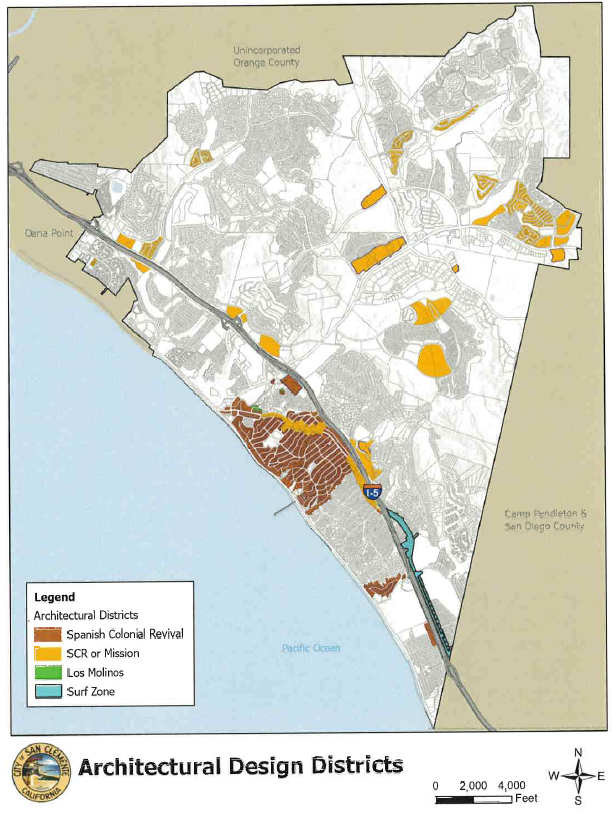
Architectural Design Districts. .....There are distinct architectural styles and patterns of design that comprise San Clemente's character. These are represented in four Architectural Design Districts: Spanish Colonial Revival, Mission, Los Molinos, and Surf Zone. All new development proposed within an Architectural Design District identified in Figure 17.26.050(C) shall comply with the standards for the applicable Architectural Design District.
1.
Spanish Colonial Revival.
a.
Background. The original architecture of San Clemente is expressive of the founder's vision of a "Spanish Village by the Sea" The historic image and identity of the community is reinforced through the design of buildings and gardens that reflect the traditions of California's Spanish Colonial Revival.
b.
Applicability. Properties designated as Spanish Colonial Revival on Figure 1 shall comply with the architectural design standards contained in this section, which are excerpted from the Henry Lenny Guidelines and interpreted in the context of the Henry Lenny Design Guidelines if a standard in this section is unclear. Properties designated as SCR or Mission on Figure 1 have the option to comply with either of the architectural design district standards. Development identified as Spanish Colonial Revival shall comply with these standards.
c.
Form and Massing.
i.
Building façades shall be asymmetrical by incorporating:
1.
A minimum of two or more roof planes; and
2.
A minimum of one vertically oriented element (e.g., elements that are built upwards) and one horizontally oriented element (e.g., elements that are longer than they are tall).
ii.
For buildings with two or more stories, the first floor shall have the tallest plate height, by a minimum of ten percent higher than any other plates.
d.
Roof Design.
i.
Roof Configuration. The following configurations are permitted.
1.
The structure's primary roof element shall be gabled, hipped, and shed roofs.
2.
Flat roofs as accents on elements of the main building, such as roof decks, porches, and colonnades. Where visible from public view, flat roofs shall have a color and material that matches the tile used on pitched roofs on the same structure. This requirement does not apply to parapet walls which may be a different material.
3.
Roof pitch shall be 3:12 or greater.
ii.
Roof Materials. The following materials are permitted.
1.
Terra cotta flat or barrel tiles.
iii.
Roof Elements. Roofs shall incorporate ridges, hips, valleys, rakes, and eaves subject to the following standards.
1.
Ridges. A horizontal line of intersection at the top between sloping planes of a roof.
a.
Ridge tiles shall cap all adjacent roof sections and be packed with mortar.
b.
Three to four booster tiles shall be used at the ends.
c.
All flashing and waterproofing membrane materials shall be hidden from public view.
2.
Valleys. A valley is an intersection of two inclined roof surfaces, toward which rainwater flows. Valleys shall be of either type:
a.
A standard/cut valley treatment where tiles are cut and secured to the roof leaving a straight path for water to shed.
b.
A woven valley treatment where tiles are weaved back and forth across the midpoint from both sides of the valley.
3.
Rakes. A rake is the inclined, occasionally projecting, edge of a sloping roof. On a tile roof, tiles shall be rolled over rakes in at least one of the following ways:
a.
Plain rake-to-wall transition.
b.
Slaked stucco to encapsulate the tile.
c.
Rake terminated with rafter tail or cornice.
4.
Eaves. An eave is the overhanging lower edge of the roof.
a.
Eaves shall have exposed rafter tails with spacing of no more than three times the width of the rafter.
b.
Construct corbels/brackets of stone, wood, or stucco. Carvings shall be a classical profile such as an ogee, cyma recta, or cyma reversa.
c.
Bird stops shall be of mortar with weep or drain holes.
iv.
Roof drainage systems shall blend into the building through utilization of at least one of these systems:
1.
Rain gutters shall either be cornice gutters (as referenced in the Henry Lenny Design Guidelines) or copper round gutters.
2.
Downspouts shall be copper and vertical from the roof or gutter to the ground. When a downspout engages the wall, a copper leader box shall be used.
3.
Scuppers shall use clay tiles, spouts, sculpted faces or gargoyles, or tapered canales.
e.
Exterior Walls, Ceilings, and Flooring.
i.
Exterior walls.
1.
Walls shall be constructed to provide the appearance of a 12—24 inch thick wall at articulation points and door/window openings.
2.
The total area of solid building façade (plain wall) shall be greater than the total area of door and window openings in the wall, except at storefront locations.
3.
At least 80 percent of rectangular wall openings shall be vertically oriented. If horizontal openings are proposed, they shall be broken up vertically by using a loggia, arcade, or mullion placement.
4.
Wall Finishes. The following finishes are permitted.
a.
Smooth finish stucco with or without scoring. Sprayed on, mixed or textured stucco finish is not permitted.
b.
Whitewashed brick.
c.
Cantera stone in warm tones.
5.
Wall Colors. The following colors are permitted.
a.
Primary wall colors shall be white or off-white.
b.
Secondary wall colors shall be white, off-white, or earth tone.
c.
Accents, trim, and highlighting features shall contrast with the white, off-white, or earth tone colors (e.g., dark blue, green, and brown).
ii.
Exterior Ceilings.
1.
Exterior ceilings shall have a minimum clearance of nine feet.
2.
Exterior Ceilings shall be vaulted, beamed, or covered.
3.
If beamed ceilings are proposed, stained wood is required.
4.
Coves, beams, and vaults shall correspond with the spacing of arcades or columns.
iii.
Exterior Flooring and Hardscape Surfaces. The following flooring and hardscape surfaces are permitted.
1.
Brick punctuated with glazed tiles.
2.
Brick in herring bone, basket weave, or soldier course pattern.
3.
Terra cotta or Lincoln tile (Mexican Clay).
4.
Flag stone, stand stone, or limestone.
5.
Plain concrete with scoring patterns or colored concrete in sand type, non-red colors.
6.
Pebble mosaic ties in black, gray, or sand type, non-red colors.
7.
French style cement or ceramic tiles.
f.
Windows and Doors.
i.
Window Types, Materials, and Components.
1.
Permitted window types include:
a.
Casement with a single pane of glass or divided.
b.
Double hung.
c.
Decorative (e.g., vent, round, oval, quatrefoil).
2.
Glass areas shall be broken up by mullions and transoms.
3.
When proposed, focal windows shall be triple-arched or windows with parabolic shaped grills of wood, iron, or other elaborations.
4.
Frames and mullions shall be metal, wood, or fiberglass; painted, or stained; stucco framing is acceptable.
5.
Decorative metalwork shall be traditional Spanish Colonial Revival style steel.
6.
Windows shall be set toward the interior to allow the wall thickness to be revealed on the exterior of the building. Insets shall be a minimum of four inches.
ii.
Door Types and Components.
1.
Permitted door types include:
a.
Wood panel with or without glass.
b.
Wood and glass.
c.
Fiberglass
d.
Antique or found doors.
e.
Plank doors.
2.
Frames and mullions shall be wood, painted, or stained; stucco or tile framing is acceptable.
3.
Doors shall be set back in deeply recessed and arched openings. Insets shall be a minimum of six inches.
g.
Exterior Lighting.
i.
Lanterns, pendants, sconces, gas lamps, and other decorative fixtures of Spanish Style (i.e., geometric and angular with points and spikes) shall be used on building exteriors.
ii.
Placement of fixtures shall be restricted to entrances, passageways, pedestrian spaces, and arcades.
iii.
Architectural Elements. If included, where visible from public view, these architectural elements shall be designed as follows.
iv.
Balconies and Porches.
1.
Balconies and porches shall be constructed of iron or wood coated with stucco, painted, or stained.
2.
Design shall be one of the following:
a.
Balcony or porch with supporting posts from ground to floor.
b.
Cantilevered or projecting balcony or porch with posts supporting the roof.
c.
Cantilevered or projecting balcony or porch and cantilevered or projecting roof with no supporting posts.
d.
Recessed balconies or porches.
e.
Open balconies over porches or loggias.
v.
Colonnades and Arcades.
1.
Columns and Colonnades.
a.
Columns shall be round or square in shape with no capital or base.
b.
Column heights shall be between seven and ten times its width.
c.
Column spacing shall be no more than six times its width from center to center, and no less than four times its width from face to face.
2.
Arcades and Arches.
a.
Arcades shall be located against plain surfaces.
b.
Arches shall be round or semi-circular; no flat arches.
c.
Arches and support column shall be a minimum of 18 inches deep, with an articulated column base.
vi.
Awnings.
1.
Awning fabric shall be canvas in natural colors, earth tones, deep jewel tones, or black.
2.
Awnings shall be designed in a triangular shape in a catenary curve, open on the sides with either a pane or decorative valance.
3.
Supports shall be wrought iron or wood.
vii.
Exterior Staircase.
1.
The tread shall be a decorative tile, stone, paver, or finished concrete.
2.
The riser at the face of each stair shall be enhanced with a decorative tile.
3.
The railing can be a stepped or rounded-stucco wall, wrought iron, wood, or tile cap that is a continuation of building form. No glass or chain link is permitted.
viii.
Towers/Chimneys/Cupolas.
1.
Projections shall be used to emphasize important architectural elements such as entrances, bays, stair towers, balconies, and verandas. Elements higher up on a building, such as a tower, shall be scaled up.
2.
Decorative towers, chimneys, and cupolas shall incorporate stucco, brick, terra-cotta pipe, barrel tiles, or ironwork.
i.
Character Defining Features. Projects with ten or more units shall include a minimum of one of the features listed below.
i.
Courtyard.
ii.
Patio or Plaza.
iii.
Colonnades and Arcades.
2.
Mission.
a.
Background. The Mission architectural design district is derived from the Mediterranean region and was often used in the design of the California Missions.
Common features of Mission architecture include stucco and plaster walls, low to medium pitched roofs, columns and archways, and exposed wood features.
b.
Applicability. Properties designated as Spanish Colonial Revival or Mission on Figure 1 have the option to comply with either of the architectural design district standards. Development identified as Mission shall comply with these standards.
c.
Form and Massing of building façades shall be asymmetrical by incorporating:
i.
A minimum of two or more roof planes; and
ii.
A minimum of one vertically oriented element (e.g., elements that are built upwards) and one horizontally oriented element (e.g., elements that are longer than they are tall).
iii.
For buildings with two or more stories, the first floor shall have the tallest plate height by a minimum of ten percent higher than any other plates.
d.
Roof Design.
i.
Roof Configuration. The following configurations are permitted.
1.
The structure's primary roof element shall be gabled and shed roofs with raised parapets.
2.
Hipped roofs with straight or flared eaves for towers, turrets, and belvederes.
3.
Flattened or semi-circular domes on towers.
4.
Pointed caps on circular towers.
5.
Flat roofs as accents on elements of the main building, such as roof decks, porches, and colonnades. Where visible from public view, flat roofs shall have a color and material that matches the tile used on pitched roofs.
6.
Pent eave roofs with brackets.
7.
Roof dormers with gable or hipped roofs, raised parapets.
8.
Roof pitch shall be 3:12 or greater.
ii.
Roof Materials. The following materials are permitted.
1.
Terra cotta flat or barrel tiles.
2.
Standing seam metal, painted plaster, or decorative tile may be used for dome roofs.
iii.
Roof Elements. Elements shall be provided as follows.
1.
Roof Elements. Roofs shall incorporate ridges, hips, valleys, rakes, and eaves subject to the following standards.
a.
Ridges. A ridge is a horizontal line of intersection at the top between two sloping planes of a roof.
i.
Ridge tiles shall cap all gables and be packed with mortar.
ii.
Three to four booster tiles shall be used at the ends.
iii.
All flashing and waterproofing membrane materials shall be hidden from public view.
b.
Hips. A hip is the inclined projecting angle that is formed by the junction of two adjacent sloping sides of a roof.
i.
Hip tiles shall be capped and packed with mortar.
ii.
Three to four booster tiles shall be used at the ends.
iii.
If no hip cap is used, ridge tiles shall lap over hip tiles.
c.
Valleys. A valley is an intersection of two inclined roof surfaces, toward which rainwater flows. Valleys shall be of either type:
i.
A standard/cut valley treatment where tiles are cut and secured to the roof leaving a straight path for water to shed.
ii.
A woven valley treatment where tiles are weaved back and forth across the midpoint from both sides of the valley.
d.
Rakes. A rake is the inclined, occasionally projecting, edge of a sloping roof. On a tile roof, tiles shall be rolled over rakes in at least one of the following ways:
i.
Plain rake-to-wall transition.
ii.
Slaked stucco to encapsulate the tile.
iii.
Rake terminated with rafter tail or cornice.
e.
Eaves. An eave is the overhanging lower edge of the roof.
i.
Eaves shall have exposed rafter tails with spacing of no more than three times the width of the rafter.
ii.
Construct corbels/brackets of stone, wood, or stucco. Carvings shall be a classical profile such as an ogee, cyma recta, or cyma reversa.
iii.
Bird stops shall be of mortar with weep or drain holes.
2.
Roof drainage systems shall blend into the building through utilization of at least one of these systems:
3.
Rain gutters shall either be cornice gutters (as referenced on page 71 of the Henry Lenny Design Guidelines) or copper round gutters.
a.
Downspouts shall be copper and vertical from the roof or gutter to the ground. When a downspout engages the wall, a copper leader box shall be used.
b.
Scuppers shall use clay tiles, spouts, sculpted faces or gargoyles, or tapered canales.
e.
Exterior Walls, Ceilings, and Flooring.
i.
Exterior walls.
1.
Wall Thickness. Walls are subject to the following standards.
a.
Walls shall be constructed to provide the appearance of a 12—24 inch thick wall at articulation points and door/window openings.
b.
The total area of solid building façade (plain wall) shall be greater than the total area of door and window openings in the wall, except at storefront locations.
c.
At least 80 percent of rectangular wall openings shall be vertically oriented. If horizontal openings are proposed, they shall be broken up vertically by using a loggia, arcade, or mullion placement.
2.
Wall Finishes. The following finishes are permitted.
a.
Adobe.
b.
Smooth or pool trowel finish stucco with or without scoring; or painted or built-up brown coat finish stucco. Sprayed on, mixed or textured stucco finish is not permitted.
c.
Stone masonry such as river rock veneer on cut stone, cast stone, or foundation walls, chimneys, and front porch balustrades.
d.
Clay tile.
e.
Wrought iron in Mission Revival, Arts and Crafts, or traditional design.
f.
Cement plaster with spatter dash finish or sand finish.
g.
Wood paneling (when used for accent trim, framing, and decorative elements). Oak paneling with dropped panels on walls and soffits of a recessed main entrance.
3.
Wall Colors. The following colors are permitted.
a.
Light earth tone, white, or off-white.
b.
Accents, trim, and highlighting features shall contrast with the light earth tone, white, or off-white colors (e.g., dark blue, green, and brown).
ii.
Exterior Ceilings.
1.
Exterior ceilings shall have a minimum clearance of nine feet.
2.
Exterior Ceilings shall be vaulted, beamed, or covered.
3.
If beamed ceilings are proposed, stained wood is required.
4.
Coves, beams, and vaults shall correspond with the spacing of arcades or columns.
iii.
Exterior Flooring and Hardscape Surfaces. The following flooring and hardscape surfaces are permitted.
1.
Brick punctuated with glazed tiles.
2.
Brick in herring bone, basket weave, or soldier course pattern.
3.
Terra cotta or Lincoln tile (Mexican Clay).
4.
Flag stone, stand stone, or limestone.
5.
Plain concrete with scoring patterns or colored concrete in sand type, non-red colors.
f.
Windows and Doors.
i.
Window Types and Components.
1.
Permitted window types include:
a.
Casement with a single pane of glass or divided.
b.
Double hung.
c.
Decorative (e.g., vent, round, oval, quatrefoil).
2.
Glass areas shall be broken up by mullions and transoms.
3.
When proposed, focal windows shall be triple-arched or windows with parabolic shaped grills of wood, iron, or other elaborations.
4.
Frames and mullions shall be metal, wood, or fiberglass; painted, or stained; stucco framing is acceptable.
5.
Decorative metalwork shall be traditional Mission style steel.
6.
Windows shall be set toward the interior to allow the wall thickness to be revealed on the exterior of the building. Insets shall be a minimum of four inches.
ii.
Door Types and Components.
1.
Permitted door types include:
a.
Wood panel with or without glass.
b.
Wood and glass.
c.
Fiberglass
d.
Antique or found doors.
e.
Plank doors.
2.
Frames and mullions shall be wood, painted, or stained; stucco or tile framing is acceptable.
3.
Doors shall be set back in deeply recessed and arched openings. Insets shall be a minimum of six inches.
g.
Exterior Lighting.
i.
Lanterns, pendants, sconces, gas lamps, and other decorative fixtures of Spanish Style (i.e., geometric and angular with points and spikes) or Arts and Crafts style shall be used on building exteriors.
ii.
Recessed lighting is permitted if the cans are treated with wrought iron or a painted shroud (wrapping around and extending vertically beyond the light bulb).
iii.
Placement of fixtures shall be restricted to entrances, passageways, pedestrian spaces, and arcades.
h.
Architectural Elements. See Spanish Colonial Revival.
i.
Character Defining Features. Projects with 10 or more units shall include a minimum of one of the features listed below.
i.
"Companario." A scalloped wall pierced for the hanging of bells.
ii.
Ornamented Openings. Lavish embellishments at entrances.
iii.
"Corredor." Outdoor arcade for shaded protection, gathering, and walking.
iv.
Bell Tower. Tiered vertical element.
v.
Quadrangle - Courtyard or Patio with water element (e.g., fountain, pool).
vi.
Colonnades and Arcades.
3.
Surf Zone Design District.
a.
Background. The Surf Zone Design District is located along South El Camino Real (East of 1-5). The design standards for this area feature an eclectic mix of architectural styles, which together can be described as "Surf Zone" architecture. This is a mixture of Contemporary, Polynesian, Australian, and Seaside/Fishing.
b.
Applicability. Properties designated as Surf Zone in Figure 1 shall comply with the architectural design standards contained in this section.
c.
Roof Design.
i.
Roofs shall be a combination of at least two pitch types (e.g., steep gable roofs of 10:12 or greater and low hipped roofs of 3:12 or greater with long overhangs).
ii.
Isosceles (sharp) triangular forms and shapes shall be used for the composition of gabled or hipped roofs.
iii.
Wood beams shall be used to highlight roof lines and angular details including roof lines and entryways.
d.
Materials and Colors.
i.
Materials and Textures. A minimum of two different materials shall be used for building exteriors:
1.
Wood: unfinished lumber, finished and coated lumber, and laminated wood.
2.
Steel: stainless, corten, galvanized.
3.
Masonry: brick, stone.
4.
Stucco.
5.
Concrete.
6.
Bamboo, pill grass, sugar cane
7.
Tiki style fiberglass.
ii.
Base Colors.
1.
The base tone of the building shall be associated with earth tones, or colors found on the beach (e.g., sandy beige and hues of soft blues, grays, and greens).
2.
No two buildings shall share the same color scheme if they are next to or adjacent to each other. Adjacency does not include buildings behind primary structures or buildings across the street.
3.
On walls visible from public rights-of-way with no windows or architectural features, a mural or vertical planting is permitted.
iii.
Accent Colors. Accent colors that contrast with the base color shall be used for front doors, window/door frames, railings, mailboxes, lettering and numbering, and other framing details. These details shall not be the same color as the building.
e.
Decorative Accents and Details.
i.
Awnings.
1.
Fabric or cloth in an accent color that contrasts with that of the building. Awnings shall not be the same color as the building.
2.
Metal or wood awnings.
4.
Los Molinos Design District.
a.
Background. The Los Molinos Design District is an eclectic industrial district center for the local surfing industry, manufacturing, arts and crafts, and business incubation. Most buildings with this style will be one—two stories in height with vaulted roofs, allowing for ample light to flood the interior of the building.
b.
Applicability. Los Molinos is generally defined as properties within Los Molinos Industrial Park, Bonita Canyon Park (west of Calle Bonito), and residential parcels on Avenida De La Estrella and Calle Bonita. Properties designated in Figure 1 as Los Molinos shall comply with architectural design standards contained in this section and detailed in the West Pico Corridor Specific Plan.
c.
Roof Design. Roofs shall be designed subject to the following standards.
i.
Varied roof-pitch is acceptable.
ii.
Built-up roofs shall be accompanied by parapets.
iii.
Roof aggregate shall be earth tone colors (warm and muted shades of brown, gray, beige, red) and applied to cover the entire roof.
iv.
Metal roofing systems are acceptable with earth colors (warm and muted shades or brown, gray, beige red), or finished black, or clear coasted patina.
v.
Roof equipment shall be screened from public view through enclosures that match the architectural style of the primary structure and are painted to match the roof color. Equipment that contributes to the architectural character of the site and district (e.g., windmills, water towers, cisterns) are exempt from this requirement.
d.
Exterior Walls, Flooring, and Signage.
i.
Exterior walls.
1.
Wall Finishes. Exterior walls shall have the look of raw exposed materials and textures as described below.
a.
Pre cast concrete.
b.
Brick.
c.
Split-faced block and ribbed finished corrugated metal (e.g., acid washed or painted).
d.
Stone.
e.
Steel Beams.
2.
Wall Colors.
a.
Earth tone (warm and muted shades of brown, gray, beige, red, blue), white, or off-white.
b.
Accents, trim, and highlighting features shall contrast with the light earth tone, white, or off-white colors (e.g., dark blue, green, and brown).
c.
On walls visible from public rights-of-way with no windows or architectural features, a mural or vertical planting is permitted.
ii.
Flooring and Hardscape Surfaces. Project entries and interior pedestrian areas shall utilize decorative paving consisting of any of the following:
1.
Brick.
2.
Tile.
3.
Pavers.
4.
Stamped concrete.
iii.
Building Signage.
1.
Building signage shall appear handcrafted (i.e., not manufactured) in the style of one or more of the following sign types:
a.
Projecting signs on decorative metal brackets.
b.
Pinned-off metal or wooden letters applied to a wall.
c.
Signs painted directly on a wall, awning, or window.
d.
Wood sandblasted signs.
e.
Handcrafted or carved signs.
2.
Lighting of signs shall be shielded and indirect (versus face-lit internal letters). If external lighting is used, fixtures shall be non- obtrusive and match the architectural style of the building.
(Ord. No. 1784, § 4(Exh. A), 12-10-2024)

